Celebrating over 1 Million Downloads and 50,000 Free CEUs on the Sound Bites® Podcast | NEW: Get 1 years’ worth of CEUs with the new 15-CEU Podcast Course
Confident Parenting from a Science and Social Justice Lens
Parents are bombarded with and overwhelmed by complex cultural, environmental, economic and political issues that impact their parenting skills, choices and confidence. By approaching various parenting challenges and questions from a science and social justice lens and parenting based on values, we can be more aware of the systemic forces that harm kids, differentiate what we can and cannot control, and build more fulfilling relationships with our children.
It’s important to be aware of the systemic forces that harm kids and the outsized onus for individual parents to take control of their kids’ health and wellbeing. My book helps parents differentiate what they can and can’t control, and whether something’s worth controlling and if so, how to actually control it versus how we’re told we’re supposed to control it.” – Kavin Senapath
Tune into this episode to learn about:
the connection between science and justice
science curiosity vs. science literacy
values-based parenting
food-related topics including:
infant formula
clean eating
MSG
PFAS/forever chemicals
Fat phobia
Hazard vs risk
The origins of and history behind BMI
Resources and related episodes
Kavin Senapathy
Kavin Senapathy is an award-winning science journalist and author of The Progressive Parent: Harnessing the Power of Science and Social Justice to Raise Awesome Kids (HarperCollins/Hanover Square). Senapathy’s writing appears in outlets like SciShow, Slate, Scientific American, SELF, The Daily Beast, Salon, and Forbes. A member of the National Association of Science Writers and the American Society of Journalists and Authors, her work delves into a slew of seemingly disparate but connected beats, from gender, sex, and race, to diseases and their treatment, to the researchers, doctors, and activists fighting for truth and justice.
Instead of spending time, money and energy on doing something that seems healthy for kids, like avoiding ingredients on a no-no list, that time, money and energy may be better spent doing something that actually protects your kids like making sure they’re eating enough fruits and veggies or doing something that brings them joy or helping kids in your community by advocating for free lunches or donating to a worthy local cause or volunteering if that’s your thing.” – Kavin Senapathy
Resources
Some links may be affiliate links. As an Amazon Associate, I earn from qualifying purchases.
Welcome to Sound Bites, hosted by registered dietitian nutritionist, Melissa Joy Dobbins. Let’s delve into the science, the psychology, and the strategies behind good food and nutrition.
Melissa Joy (00:20):
Hello and thanks for tuning into the podcast. As you may know, my audience is a mix of healthcare professionals and the general public, and while I delve into the science quite a bit on the show, I do try to make it digestible and meaningful for all listeners regardless of their background.
But if you’re a dietitian or a diet technician, I want to make sure that you know about all of the continuing education opportunities through my podcast. I have about three years’ worth of free CEU activities that you can access through my website.
And I also recently created a 15 CEU package for one whole year’s worth of credits, including the required ethics credit that you can purchase. There’s only one quiz to take, and you get one certificate for the 15 credits. I’ve provided over 30,000 free CEUs through my podcast, and I’m getting great reviews about the new 15 CEU course as well.
So, head on over to soundbites rd.com/freeCEUs to learn more. And if you’re not a dietitian, now you know more about the continuing education requirements that dietitians have.
Hello and welcome to the Sound Bites Podcast. Today’s episode is about parenthood and how to think about various parenting challenges and questions from a justice and science centered lens with, of course, a focus on food.
My guest today is Kavin Senapathy. Kavin is a science and health writer, parent of two middle schoolers and author ofThe Progressive Parent: Harnessing the Power of Science and Social Justice to Raise Awesome Kids. She is a member of the American Society of Journalists and Authors, and the National Association of Science Writers. Welcome to the show, Kavin.
Kavin Senapathy (02:13):
Thanks so much for having me again, Melissa.
Melissa Joy (02:16):
Yeah, yeah. So, you were on the show quite a while back, back in 2019. Talking about food pseudoscience and science moms. So, I’m excited to have you back. We’ve kept in touch over the years and want everybody listening to know that this episode is not sponsored. But I did receive a copy of your book, so thank you so much for that.
Kavin Senapathy (02:39):
Yes.
Melissa Joy (02:40):
For those of my listeners who haven’t heard that previous episode or are not familiar with you, I would just love for you to share some information about your background and the work you do.
Kavin Senapathy (02:50):
Yeah, I’ve been told that I can ramble a little bit on this answer. Yeah, so I’m a parent and science and health writer and journalist based in Madison, Wisconsin. And of course, since I’m a health writer, health and food go hand in hand. So, very interested in it. And that’s what led me to the world of registered dietitians and getting to know people like Melissa.
I am fortunate to work as a science writer for nearly a decade. Science and health writing was pretty much my dream job for years before I even knew it could be a profession, which it’s interesting, I encounter many science writers who didn’t realize that you could be a science writer.
So, to give you an idea of myself, when I was in high school, I won the Wisconsin statewide medical spelling bee, and then I was also in my school’s poetry and prose writing club. I’m a proud member of the high school graduating class of 2000, which makes me an elder millennial.
And I don’t know if you’ve noticed, but elder millennials are known for proudly telling you how old we are.
Melissa Joy (04:09):
That’s great.
Kavin Senapathy (04:11):
I’ve always loved reading and writing, which is a big reason I majored in English at the University of Wisconsin. But I didn’t start writing about science and health until many years later in my 30s when I was a parent of a toddler and an infant at the time.
I’d gone through some particularly tough mental health struggles in pregnancy and postpartum and specifically anxiety and postpartum OCD, and we’ve talked about that.
But after a year or two of starting meds and therapy, I was working part-time and had the opportunity to start contributing to a new parenting blog, which was called Grounded Parents. And delving into all of the context and science around any parenting question and writing about it became almost a coping mechanism for my anxiety in some ways.
So, long story short, it turned out that science writing is a good fit for me. So, I started doing it for several outlets professionally. So, it’s funny, now I get to pay to indulge in this particular coping mechanism, not only with parenting, but with everything to do with life that an anxious nerd would wonder about.
So, over the years, I’ve done quite a bit of on and off the job learning and training on everything from editorial fact checking to delving into various realms of health and life science related research, genomics and human health diseases, and so much more.
So, I’ve spoken with a slew of experts and regular people in my reporting and just learned so much from them. And food often has so much to do with it. I enjoy writing for and write for a slew of clients and outlets.
People can find some of my work in outlets like Slate, Undark Magazine, Scientific American, and one of my most favorite clients is SciShow, which is an awesome YouTube show, educational show by Complexly, which is an educational production company founded by brothers Hank and John Green, who are these prolific YouTubers. And I’m a freelancer.
So, listeners, please do hit me up if you have a need for a science or health writer. And then yeah, of course, definitely, my biggest project to date is my book, The Progressive Parent: Harnessing the Power of Science and Social Justice to Raise Awesome Kids. So, yes, that’s what brings me back to the Sound Bites Podcast for a second time.
Melissa Joy (07:01):
Yeah. Well, I was so excited that you reached out to me about this, and I had seen some posts about the new book on social media, but yeah, I’d love to have you back on the show. And at first, I thought, okay, got to crack this book open and see what’s in here. And we have way more that we could talk about.
But between you and I, we’ve kind of agreed on maybe the most important aspects that we want to touch on. And interestingly, I have several podcast episodes related to some of the things that we’re going to talk about, so I found that, I guess a bit surprising, but I guess I shouldn’t be surprised. I just didn’t know what to expect from the book. So, that was really cool. And this is your first book, right?
Kavin Senapathy (07:44):
Yeah, it’s my — I’ve contributed book chapters and co-written a book or two, but this is my first solo book, yes.
Melissa Joy (07:52):
Wow. Okay, great. What inspired you to write this?
Kavin Senapathy (07:56):
Yeah, for sure. It’s a kind of slow growing inspiration that has come to fruition over time, I guess you could say. There’s just so much unsolicited advice in the world of parenthood. So, the last thing I wanted to do is give a whole bunch of prescriptive parenting advice.
So, I’d say what initially inspired me is being, again, really so familiar with the fear that comes with loving children so fiercely. And I’ve learned both as a parent and a writer that scrutinizing the parenting wisdom and guidance is really so much more challenging than it looks.
So, the concept for the book was about 80% this big picture take on the connections between the issues I’ve covered in my years of work as a science writer and journalist, and my experience as a parent and 20% assignment from my publisher to cover certain questions.
But I would say really on top of all of that, my biggest inspiration has been the people, whether it be activists, community organizers, researchers, doctors who are all out there doing the work to bring together science-based, justice-based ways to make the world better for young people.
Melissa Joy (09:25):
Excellent. So, let’s start with an overview of the book. What can people find in it?
Kavin Senapathy (09:30):
Yeah. I’ve heard from some parenting writers who read many parenting books that it’s not like any parenting book they’ve read. So, I would say again, there is some prescriptive advice in the book, which only takes up a fraction of the pages.
And the rest is more about how we can position ourselves as parents and other adults in any given situation based on our varying sets of values, many of which we share and with the resources and information and bandwidth that we have available to us. And given all of the information, facts and science where it’s applicable.
So, looking at the table of contents, it might look like the chapters are about a wide range of unrelated issues. So, everything from bodily autonomy and ableism and fatphobia to clean eating and living to greenwashing, to vaccines, to beginning to navigate race, ethnicity, and ancestry.
So, again, what really ties all of these together are those threads of science and social justice. So, for Sound Bites listeners specifically, I would say a good chunk of the book, maybe even half, is either directly about food or related to food and children’s wellbeing. All those things are so related.
Melissa Joy (11:04):
Yes. And obviously we’re going to focus on at least some of the food related content. It is interesting how much of it does relate back to food. One of the questions I had though before we do that, is what is the connection between justice and science? Can you talk to us about that?
Kavin Senapathy (11:21):
Yeah. So, I would say as someone who loves science myself, who reads scientific research for fun and nerding out purposes, I’ve learned that when people think about science, they think about this conceptual science that lives in a vacuum and resembles what we call the scientific method, which is often presented as a flow chart that features a few steps that include hypothesis, experimentation, observation, analysis, and repeat.
For instance, if you’ve taken a physics class or even a science class, you may have been taught to think of when you’re thinking about a surface, you think of a frictionless surface to consider things that are happening on that surface.
But when science plays out in the real world, it’s messier, including all of the stuff published in peer reviewed journals. Hypotheses can be misguided, and experiments and observations can be biased.
So, the major connection between science and justice is that because injustice and inequity are woven into all systems and institutions and policies, that injustice directly affects science itself. And it definitely affects the scientific messaging that parents receive.
Melissa Joy (12:54):
Okay. You have this really compelling analogy in the book about science being more like lanterns than being the sun. So, I’d love for you to share that.
Kavin Senapathy (13:05):
Right. So, the sun is something that we don’t have control over the sun. The sun simply is there, and it sheds light evenly on everything if you’re outdoors, for instance and there’s no cloud cover. But a lantern or a flashlight is something that somebody holds, they have control of, they own, and they choose what to illuminate from what angle and to whose benefit.
And so, that analogy in the book essentially points to people’s idea of science being something that sort of indiscriminately sheds light on everything evenly, with no agenda or motivation versus the way that science really happens is that it’s wielded by individuals and those power dynamics affect everything.
Melissa Joy (14:00):
And being aware of, I guess this shift in perspective or just the realities of that is a good place to start because it impacts how you see research. And we’re not here to say like, just all research is bogus and just throw it maybe out with the bath water or whatever.
It’s like when we talk about different types of biases, cognitive biases, confirmation biases, things that we want to be aware of so that we can appreciate the nuances in the bigger picture.
Kavin Senapathy (14:27):
Right. In a way that affects us and affects children. So, yeah, for sure.
Melissa Joy (14:33):
You also brought up this idea of science curiosity instead of science literacy. So, I’d also like for you to explain that.
Kavin Senapathy (14:40):
This is really neat and so I get excited when this resonates with people who read the book. So, as I argue in the book, science is another layer to scrutinize when facing any big question to which there are empirical answers.
And again, there’s probably nothing more fraught with big questions than parenthood and kids’ wellbeing. So, in doing so, I talk about in the book something closer to science curiosity than science literacy alone may be more valuable for parents.
So, science curiosity is a term introduced by a team of researchers headed by Dan Kahan, and he’s a professor of psychology and law at Yale Law School. And his team sheds light on the distinction between science curiosity and science literacy, which I go into in chapter one of the book.
But one interesting finding is that in his team’s 27 team paper on science curiosity and political information processing, he and his co-authors look at why some people are more likely to engage in what’s called politically motivated reasoning. That’s this tendency to latch onto information that fits one worldview and discard evidence that contradicts it.
So, that’s an important question to researchers because ostensibly we want to be able to grasp the body of evidence about any science related question to inform worldviews and decisions. So, scholars are interested in who is more or less prone to this tendency to sort of cherry pick information to suit their views.
So, until recently, this idea of scientific literacy or the ability to grasp a news story, for instance, about a scientific matter and make out what it means was thought to make people less prone to this type of fallacious reasoning and thinking.
But this research actually suggests that the opposite is true. So, science literacy on its own can contribute to polarization. So, roughly, in other words, those with a basic understanding and knowledge of science can use it and are likely to use it to bolster their existing agendas and discard what doesn’t suit their narrative, even if their narrative is inaccurate.
And science curiosity is not the same thing. It’s this ingrained desire to seek out scientific information, to satisfy curiosity. And this type of curiosity may prevent or protect against the type of fallacious cherry picking I mentioned.
So, the question of how to instill this science curiosity in individuals is up in the air. There’s no evidence-based bootcamp to train people to be curious. Even though that sounds great to me. I would take that. But it may be a somewhat innate quality. But as I go into in the book, curiosity is always something to strive for as parents and really, I’m sure, as dietitians as well.
Melissa Joy (18:13):
Yeah, I like that. So, a lot of what you’re saying, it sounds like a version of confirmation bias. And again, just being aware of that and having that curiosity kind of sounds like you’re just being more open to whatever you find versus seeking those things that reinforce what you already thought.
Kavin Senapathy (18:30):
Right, of course. Yeah.
Melissa Joy (18:30):
Yeah. Sounds healthy. Alright, so let’s delve into some of these more food related aspects in your book. I’d like to start off with breastfeeding, infant formulas. You talk about some misconceptions about infant feeding.
And I just have to say whether we get into these stories or not. Because a lot of the book is about your personal experience. You mentioned earlier your mental health struggles and postpartum depression and different things that really have led you on certain paths to seek out more information and solutions and connect with other people on those topics.
So, again, whether we get into these stories or not, my breastfeeding story was very similar to yours and even our birthing stories were eerily similar. So, let’s talk about the breastfeeding and infant formula.
Kavin Senapathy (19:19):
Yeah. So, I was certainly among the millions of parents who were led to believe that exclusive breastfeeding that is only human milk for the first six months of an infant’s life, is the best way to feed your baby and is superior to formula. And that all kinds of better outcomes in the short and long-term when it comes to not only health but achievement sort of.
And I was convinced that I needed to breastfeed. You’re kind of scared to ever use formula to feed your baby because then you’re told that your milk supply will dry up and your breastfeeding relationship will be ruined.
I can paraphrase a pediatrician I spoke with who is one of the more fed is best friendly type of pediatricians as opposed to the breast is best school of thought. He says, “People are led to believe that all of these outcomes are dependent on exclusive breastfeeding, but the pressure to do so really just doesn’t line up with the facts and the science.”
And so, really breastfeeding or not breastfeeding is not going to make the difference between your kid pole vaulting for Yale and struggling to make ends meet.
The reason that we’re told that breastfeeding is so much better, and this ideology has been around since the 90s, along with the admins of a global organization known as the Baby-Friendly Hospital Initiative, which is part of the World Health Organization and UNICEF.
So, the thing is, worldwide data for decades has shown that breastfed infants do fair better when it comes to certain outcomes. Short-term it’s like respiratory infections and a few other outcomes, long-term it could be anything from certain types of cancers, a lower risk or heart disease or obesity, which is a whole other.
And that is because of the issue with all of this data about breastfeeding versus a formula feeding and outcomes. And that is that when it comes to like drugs, you do a randomized control trial to see, see what the outcomes are.
But with infant feeding the data are almost all observational. That means researchers look at groups of people and they look at infants that are formula fed versus infants who are breastfed. And then look at the outcomes.
And in the developed world, for instance, in the United States, people who exclusively breastfeed their infants or who breastfeed for longer periods of time tend to be of higher socioeconomic status being stable, co-parenting relationships, and all these other factors that go along with that ability to exclusively breastfeed.
So, those are just some of these confounding factors. And confounders, of course, is another concept that the book goes into. But overall, if you really look at all of the data about infant feeding and human milk, there isn’t any reason to believe that human milk causes superior outcomes or that safely manufactured, safely prepared infant formula is a bad choice. It’s a fine choice for the vast majority of people with access to it.
And the book also goes into how none of this is to let the formula industry off the hook because it certainly has behaved in predatory and unethical ways. And there are still, of course, problems with the industry and there are people putting pressure on the industry and the regulators for good reason.
But the formula industry being problematic is not justification to pressure everybody in a universal way to exclusively breastfeed their baby or else.
Melissa Joy (23:50):
Yeah. The book does get into some of the information you’re talking about with regard to this predatory behavior, as you say, without getting into the long story. But it has to do with developing countries and access to safe water and having moms use this formula and then not being able to have access to it.
I mean, that’s very much in a nutshell, but just wanted to kind of explain that a little bit. Even as a registered dietitian, knowing that formula was totally fine, definitely got the message that breastfeeding was best.
And it wasn’t until my baby, my son, I had him in 2008, he weighed less at six months than he did at four months. Yeah. And I was exclusively breastfeeding and that’s when I started to supplement.
But there was probably like a 24-hour period where I was kind of freaking out with not that formula was bad, but my biggest fear was that, like you said, if you’re not nursing, I mean, my milk supply was never great.
But then if you’re nursing less or you’re not nursing, then the milk supply goes down even more. And then when you try to nurse, then the baby … I just thought, “This is going to be a horrible — my baby’s going to be so upset that there’s no milk.”
And then, of course we had bottle fed him when I had pumped, but what if he doesn’t like the formula or whatever. And then 24 hours went by and I had a sense of relief that I didn’t have to be the sole provider and just stress about every single ounce that I pumped and count up, it’s in the freezer or is that enough for the amount of time that I’m gone? I mean, it’s just like crazy.
Kavin Senapathy (25:32):
And then the power might go. If the power ever went out, the first thing I worried was the-
Melissa Joy (25:37):
That liquid gold.
Kavin Senapathy (25:38):
Yeah. I should mention an organization known as the Fed Is Best Foundation. I would say they are among the real experts on how to safely feed infants by, if you want to exclusively breastfeed, how to avoid that risk of not only weight loss, but other related complications that can be pretty bad and how to use formula.
Because usually for the most part, you’re not taught how to use formula. So, if you have to use it, if it becomes necessary, many people don’t know how. And so, the book talks about this organization as well, and they also have a book out called the Fed Is Best book. And it’s excellent. I think it’s like really creating change.
Melissa Joy (26:27):
Well, yeah, and to your point with these confounders or these confounding factors, I talk about randomized control trials versus epidemiology all the time on the podcast. And it’s like these confounding factors are enough there to make us stop and think, okay, this fed is best mantra versus the breast is best because the positive outcomes come from a fed baby versus underfed children, babies.
Kavin Senapathy (26:55):
And then the positive outcomes come from privilege, really. And it’s easier to prescribe people to exclusively breastfeed than to increase access to everything that actually creates better outcomes.
Melissa Joy (27:09):
Yes. And I’ve talked about this on the show before too, my best friend was a dietitian and lactation consultant, so she was giving me all the best tips and overall, I had a really good experience, but here was the plain fact that it wasn’t enough to feed my baby on its own.
So, also, I have a related episode on the shame of infant formula that I think ties into this and, and can supplement this conversation as well if people are interested. I’ll have the link in my show notes at soundbitesrd.com.
So, let’s move on to clean eating and the idea of these “no-no lists.” This, I feel like it’s been around for a while. I’m kind of hoping it’s going away. But I’m curious where you see this popping up or persisting and how you suggest people navigate this.
Kavin Senapathy (27:58):
Sure. So, these no-no lists of ingredients or additives to avoid in food are often promoted by certain chains and grocery brands. And the idea is that these lists of additives, if you avoid them, then you can avoid exposing your children to these toxic chemicals that will harm them in a slew of different ways.
And avoiding those chemicals kind of gives parents the sense of control about what we’re exposing our children to. So, there are all kinds of ingredients on those lists. And listen, if lists of ingredients from MSG to food colorings and others would really help keep kids safe and healthy, then I would be totally behind them.
But the book goes into examples of items on these no-no lists, and whether avoiding them really helps and whether it really helps your child on an individual level. Does avoiding something help on a systemic level or a community level. But yeah, essentially these lists, they provide more of an illusion of control than real control.
Melissa Joy (29:26):
Yes. There’s certain restaurants or foods that come to mind with this topic, and I won’t name names. But there’s one in particular, and I have to check and see if they’re still doing this, but I’ve talked about this on the show before, there was a particular frozen food company that due to pressure from their customers for a clean label, fewer ingredients on the label, they were not fortifying their pasta that was in these frozen dinners.
Kavin Senapathy (29:58):
Ooh.
Melissa Joy (29:59):
Yeah. And so, normal dry pasta is fortified with B vitamins. It’s just, maybe people don’t know that we think pasta’s pasta. So, when I was touring this plant, this topic came up and it was just one of those times where I just thought, this is crazy because you’re literally taking vitamins out of a food or not putting them in, I guess when you were talking about enrichment and fortification.
Sometimes you are replacing something that was lost during processing, or you’re adding something like vitamin D to milk that’s fortifying, you’re putting something in that wasn’t there before. But I digress.
My point being, it’s not like you’re removing some random additive, which actually may have a purpose to prolong shelf life or to … even sodium in products a lot of times is there to make the food safer, but a vitamin something that was there for all of those things are probably there for reasons.
But my point being it’s like, that was just really surprising to me is like, wow, this is maybe an unintended consequence of people wanting these clean labels. So, a lot of that obviously is public perception versus the science and what’s really going on.
But that makes me think of that. Do you have any other thoughts on this? Other than us just trying to reassure people that our food is safe, and that there’s a reason for these different ingredients, getting more food scientists to communicate about some of this would be great. How do you approach this?
Kavin Senapathy (31:32):
Yeah. So, when we look at these no-no lists again, for instance, or the idea of clean eating, let’s think of an ingredient that’s on most of these lists. High fructose corn syrup, for instance.
When I, as a parent or someone who cares about what kids eat, think about high fructose corn syrup, say giving my kids a snack with that ingredient on the ingredients list and their friends are over or whatever. Am I worried about feeding them this ingredient, high fructose corn syrup?
If I think about it, if I look at, I don’t know, I’m assuming graham crackers or some of them have high fructose corn syrup, I’m not worried about them eating it. Am I worried about high fructose corn syrup and the sheer amounts of it that people consume and the sheer amounts of corn that are grown for various reasons that are arguably not very healthy for children and communities? Maybe.
And so, I would say that for people who are communicating about answering questions about clean eating, again, the question is just if a child has access to and consumes plenty of fruits and vegetables and nutritious foods, then the corn syrup or the MSG, for instance, is barely a blip on my radar anymore as someone who is genuinely a concerned parent who cares.
Melissa Joy (33:12):
Yeah. You brought up MSG and I was going to bring that up because that’s one of the examples in your book. And as you know, I did a three-part podcast series on MSG, it was when I had gone to a conference and learned about some of the xenophobic roots of MSG.
And I actually had met you there in person we met on Twitter definitely back in the day, I will say. And then we got to meet each other in person there. I’ll never forget that. That is something that you talk a lot about as well.
And I think that would be a great example to just share briefly with our listeners about something that might seem like a scary ingredient and the very sciency explanation and how it really originated from a racism perspective.
Kavin Senapathy (34:00):
Right. And this is one of those examples where you really do have to scrutinize the process of science itself that led to this widespread notion that MSG, which stands for monosodium glutamate, is harmful when consumed.
So many people, even despite lots of messaging now to correct these misconceptions, MSG is often viewed as this artificial lab made sort of ingredient that makes the flavor so irresistible that it, it addicts us to unhealthy food like potato chips and Cheetos and fast food.
And I too, I remember years of my life when I would ask for no MSG restaurants because as you mentioned, the xenophobic history, which the book goes into. And, and again there’s a whole episode on this because it’s so really interesting and it’s almost like a xenophobic saga.
So, I was surprised to learn that glutamate is a naturally occurring amino acid and that it occurs naturally in all kinds of food and is actually MSG is responsible for the flavor that we call umami. And that it is in certain foods that we would consider unhealthy, but it’s also, it’s a seasoning.
It’s naturally in tomatoes and cheese, but the science itself is interesting. For instance, you’ll hear that the science shows that the MSG is responsible for all kinds of health problems or symptoms.
And then it turns out that the science itself was kind of poorly done rat studies exposed to MSG in a way that would not at all resemble how say I might use MSG, or actually I should say my husband because I got to be honest, he cooks more. But he would put it in a pan of vegetables or stir fry or soup or anything like that.
Melissa Joy (36:22):
Yeah. And I’ll just say one more thing and we’ll move on to the next topic, but the xenophobic aspect of it being they thought MSG caused Chinese restaurant syndrome and caused all these problems. And the irony is it’s a Japanese ingredient, but there’s a lot of ironies here.
But there was a letter to the editor in the New England Journal of Medicine that really sparked a lot of this fear and racism, which just kind of part of our history, I guess. But anyway, I did a three-part series on this that I spoke to an author, I spoke to a chef, a dietitian, actually two dietitians, one’s a dietitian, one’s a PhD in food nutrition.
And the same week I released that NPRs This American Life released an episode talking about MSG and that letter to the editor. I’ll have links to all of that in my show notes at soundbitesrd.com. And I really encourage people to take a listen to that.
I did want to also just touch on at least briefly hazard and risk. And you have something that you can explain to us about risk jars. It’s the way of explaining hazard versus risk because I think that’s something that when we talk about science and understanding, whether it’s the research study itself or what we see the headlines or an article, a lot of times hazard and risk get completely mixed up and conflated sometimes.
Kavin Senapathy (37:45):
Right. So, the book goes into the difference between hazard and risk. So, a hazard is anything that could cause harm. It’s a really type of particular distinction. So, for instance, a grape is a choking hazard, and the risk of choking is the likelihood that someone will choke on the grape.
So, certain factors influence the risk of choking, including age, toddlers have a higher risk of choking on a grape. Which is why the good advice to cut grapes into quarters for toddlers is good advice that I practiced myself and the book goes into this.
But a big way that hazard versus risk is confused in the media is when the International Agency for Research on Cancer or IARC, which is a specialized agency of the WHO categorizes substances as cancer causing. And so, IARC slots, various agents including lifestyle, occupational, environmental exposures into categories based on their ability to cause cancer.
So, group one is for what they call established carcinogens. That includes smoking, for instance, asbestos, alcohol and processed meat. And then the next two tiers, probably carcinogenic and possibly carcinogenic, are for substances with a less certain causal relationship with cancer. And group three is for substances that can’t be classified due to lack of data.
And so, when people think of a hazard, they often think of it as this sort of binary, either the hazard is the person gets exposed to it and then a bad thing happens or not. But as I touch on in the book, there’s a specific paper about the risk of a specific disease and that paper introduces the concept of a risk jar.
So, let’s take whether it be a specific cancer or Alzheimer’s disease, which is what this paper refers to, everybody is born with certain genetic risk factors for any given outcome or disease. So, again, let’s take Alzheimer’s. Some people have more of these genetic risk, in the paper this risk jar is described as being filled with beads. And when these risk beads hit a certain threshold, that’s when the disease develops.
Again, yes, so going back, people are born with a certain number of beads in each risk jar. And then environmental exposures stress, all can contribute leads to this risk jar until a person does or doesn’t develop that outcome.
So, for instance, not everybody who is exposed to the sun — everyone’s exposed to the sun because we need the sun, but not everyone who goes out in the sun gets skin cancer. But some people will. And so, what happens is IARC has famously categorized certain herbicides in group two as carcinogenic.
And so, then the notion or what people are led to believe is that food that comes from crops grown with that chemical must therefore be cancer causing. So, in the book I talk again about hazard versus risks with an example that I kind of came up with, we’ll call it the International Agency for Research on Cuts.
So, let’s say this agency similarly categorized agents that can cause cuts. So, razor blades, scissors, printer, paper, knives, glassware, chainsaws, guillotines would all be in a group one for items that are known to be cut causing to humans.
But the risk of cuts from exposure to any of these hazards varies widely even though we know all of them could cause cuts in various situations. So, yeah. So, we keep knives and glassware in our kitchen even though they could potentially kill a person. But we probably don’t keep katanas.
Melissa Joy (42:32):
Right. We could do an entire episode on PFAS or Forever Chemicals. So, I would love for you to just very briefly touch on that topic if it’s possible.
Kavin Senapathy (42:44):
Yeah. We hear a lot about these Forever Chemicals, which are chemicals that have been used in manufacturing of various goods over the decades. And the problem is they persist in the environment.
So, it’s like a huge daunting, much bigger than we could totally delve into in this episode. But this is one of those chemicals that does really concern me. But the question is how to avoid them and how much control we have when it comes to avoiding them.
One researcher I spoke with for the book was essentially saying that we hear that we should avoid X, Y, Z to avoid PFAS, but really it’s everywhere. She would actually be shocked if something did not have a measurable level of PFAS in it.
So, in terms of just touching on it, I would say it’s super daunting if we think of it in terms of avoiding exposure to what’s dangerous in this case, PFAS.
The book also talks about combating some of those exposures that we have less control over with what is called helpful or health-promoting exposures.
When we look at anything that’s sort of bad for our health, we can look at chemicals that we’re exposed to in the environment and we can look at, for instance, stress and the chemicals that our own body releases in response to stress and the harm that that can cause in our body. And it’s always this exercise of weighing those two.
So, sometimes instead of stressing over the fact that there is PFAS everywhere and we really need the government and industries to fix this, which again is a huge hard problem that the book goes into.
If we can focus on positive exposures, which are again, fruits and vegetables and good healthcare and green spaces and clean air and good times with loved ones. Those can all protect against some of those exposures that we have less control over, whether it be, again, high fructose corn syrup or the very scary forever chemicals.
And again, the book also talks about privilege and how something like PFAS and avoiding it often comes down to how many resources we have.
Melissa Joy (45:33):
Right. Yeah. It’s just trying to connect some of those social justice dots. And it makes me think of when you said like, how much control do we have?
Let’s touch briefly on that whole concept of recycling was a big example of this, where the onus is put on the customer to you should do this and you should do that, when really corporations have a lot of power and a lot of opportunity to move the needle.
And I know there’s challenges. I actually have a related episode on recycling, but the more you learn about it, the more it’s like, “Oh my gosh, there’s no easy solution here. It’s kind of a mess.” But I know that that’s part of the social justice aspect of your book is let’s not just put everything on the individual.
Now, there are things, and actually that’s a question I have for you when it comes to food, where does individual responsibility matter? But if you can talk about that a little bit.
Kavin Senapathy (46:24):
Yeah. It’s really surprising to me and it’s hard for people to let go of it, but the book talks about a concept called wish cycling, which is this phenomenon of individuals putting items in their recycling bins and the city collecting and recycling and just imagining that it goes off to a better life where it’s remade into something useful.
But the book and your episode probably touch on how a lot of this is actually industry propaganda, including the triangle symbols that we see on our plastic products. I was just with a family member this weekend who was putting something in the recycling bin, and I said, “Oh, you can’t recycle that.” And she says, “It has the triangle on it.”
And as I learned in speaking with experts and researching the book, only those with the one and two on the triangle can be recycled and have any real chance of being turned into something else useful. And there are all these other details about the industry.
So, again, it comes down to this question of whether doing something that is putting something in the recycling bin, whether it’s recyclable or not, that might make us feel better about our consumption, but is it really for the better? And is it really worth the effort?
And then the book also, of course, the whole book tries to be as non-judgmental as possible. So, when it comes to single use plastics, for instance, you see … when I go to the grocery store, I see the plastic containers of cut fruit.
And I used to even have this idea, which I later realized was problematic, that people who buy this cut fruit might be lazy because they’re not cutting their own fruit. And now they’re using this single use plastic, and they should feel bad about themselves.
So, then the question becomes, is it really the person who’s buying some cut fruit in plastic who’s ruining the earth?
Melissa Joy (48:51):
There are bigger fish to fry. There are bigger sources of, yeah.
Kavin Senapathy (48:55):
Yeah.
Melissa Joy (48:56):
Right. Along those lines of judgment or making assumptions about people, let’s talk about fatphobia. You have a section in the book on fatphobia and some really enlightening information about BMI that I’d love for you to share.
Kavin Senapathy (49:15):
Sure. So, fatphobia is basically the notion that body fat and/or the concept of body mass index can tell us not only about someone’s health, but ultimately their character. And this type of judgment is woven into everything including education and medicine. We’re raised with fatphobia and have it reinforced all around us.
And so, it blew my mind to learn that trying to hold people to a normal BMI is just not helpful. It’s actually hateful, and it’s also just not accurate to assume that a fat person is unhealthy and that any of their health problems are attributable to their weight.
So, underlying the science of all of this is the belief that there is such a thing as a normal healthy weight. And we hear that all the time. And body mass index itself was first coined in the early 70s, but the concept behind it has been around for a couple hundred years.
And I talk about this Belgian mathematician named Adolphe Quetelet, who devised the index in the mid-1800s as part of his study of what he called the average man, which looked at a slew of human traits.
And together this model average man with all of these traits that fall into the norm represented the ideal. So, called Quetelet’s index, this concept, which eventually morphed into BMI was based on the measurements of small groups of people that he looked at, namely Western Europeans.
And so, by the turn of the next century, these studied traits ended up being used as scientific justification for all kinds of horrific events, including sterilization of disabled people, autistic people, people experiencing poverty. But it wasn’t until the insurance industry came along that the concept of BMI started to be applied to individuals as an indicator of health.
So, life insurance companies created tables of height and weight to calculate what to charge policy holders in the early 20th century. And then without really scientific backup to justify it, physicians also began to adopt these measures.
And by the mid-80s, the National Institutes of Health had revised its definition of obesity to be tied to individual patients BMI, but it’s just not true. And the media consistently reinforces again, that it’s a matter of personal responsibility.
And certainly, children are not aware of this history, and it’s generally not taught in history class, history largely shows that when people aren’t subjected to famine, humans have naturally come in a spectrum of all shapes and sizes. And there have always been fat people who we would consider healthy by most typical measures and thin folks with health problems.
And then there’s the whole issue of consideration of the conditions that influence body fat, like discrimination and stress and lack of sleep, green spaces, and how all of this has made, again, mothers and parents a main target of this sort of misguided war against obesity and how that war against obesity has really affected children for the worst.
Melissa Joy (53:17):
Yeah, absolutely. As we’re wrapping up, we’ve talked about some examples and the doom and gloom, but you mentioned briefly that you aren’t scolding people in this book. I don’t remember exactly how you said it, but I did want to reiterate, it is very detailed in some of these different examples, but you have an encouraging tone, and you have a kindness that is definitely worth noting and spreading that message.
So, I would love for you in wrapping up, perhaps to kind of share your vision of how this book can help parents be less stressed, less anxious, maybe get some perspective on some of these issues, but also how to have more of a positive outlook through this science and justice lens. To care about all children, not just their own.
Kavin Senapathy (54:11):
Right. I would say that overall, summing up what the book wants people to do is to stay aware of the systemic forces that harm kids. And again, this outsized onus for individual parents to take control of their kids’ health and wellbeing. You hear that all the time, do X, Y, Z and take control of your kids’ health, take control of their future.
But sometimes, spending the energy and time and money on doing something that seems healthy for kids, like say, avoiding ingredients on a no-no list, that time and energy and bandwidth may be better spent doing something that actually protects your kids.
Like again, making sure they’re eating enough fruits and veggies or doing something that brings them joy or to actually help kids in your community or anywhere like pushing for free lunches or donating to a worthy local cause or volunteering if that’s your thing.
So, I think what the most hopeful thing about this book is that it helps people know how to look at parenting and differentiate what they can and can’t control, and whether something’s worth controlling and if so, how to actually control it versus how we’re told we’re supposed to control it.
Melissa Joy (55:36):
Excellent. Thank you. I know people can find more about the book and follow you. You have a website, you’re on Instagram, Facebook, so if you want to share some of that as we’re wrapping up.
Kavin Senapathy (55:49):
Yeah. My website is kavinsenapathy.com. My Instagram is Kavin Senapathy, and I recently just joined Bluesky, so I haven’t posted on Bluesky yet, but it sounds really promising.
Melissa Joy (56:04):
I’ve been hearing about this. The great migration. Yeah. So, I will have the links to your website and your social media and your book in my show notes at soundbitesrd.com. And I do want to add, you have more than 35 pages of references in your book.
So, people there are citations, and she shows you where she’s getting all this information, and you just put it together so well. So, thank you.
And then, like I said, I’ve got some related episodes. I’ve got a really interesting one with Dr. Kari Nixon, who I learned about through your Sci moms. She wrote a food shaming blog a while ago. And this episode’s on food shaming and the medical humanities, which I didn’t know what that was until I interviewed her. That’s fascinating.
And I have one on scientific justice. I have one on infant formula that I mentioned before. I have one on weight bias in healthcare with Dr. Fatima Cody Stanford, who’s amazing. And then one of my favorite episodes of all time is about embracing cultural foods and flavors with dietitian, Maya feller. So, and of course the MSG series.
So, is there anything else that you’re working on? I mean, I hate to even say that because you just have spent how many years of blood, sweat and tears on this book. But yeah. Anything else you want to share with us?
Kavin Senapathy (57:29):
I’m always working, I’m always reading research. I have a few stories relevant to the book that I am pursuing, including following kind of some of what’s going on with this pushback against pressure to exclusively breastfeed. I’m always nerding. I found something, I guess you could say.
So, keeping up with me on, I wish there was like one place we could all keep up with each other just centrally, it’s not the case anymore, but you can find me.
Melissa Joy (58:00):
Yes, yes. We will stay connected. And I encourage everybody to follow you on social and yeah, I mean, keep fighting the good fight and putting the word out about evidence-based information, and looks like we might be doing a little bit more of that in the near future, so-
Kavin Senapathy (58:20):
As we navigate.
Melissa Joy (58:22):
Navigate this.
Kavin Senapathy (58:23):
Yes.
Melissa Joy (58:24):
Absolutely. Kavin, thank you so much for coming on the show and sharing everything about your new book. Congratulations on the book and it’s just been really great reconnecting with you.
Kavin Senapathy (58:33):
Yes, you as well. Thank you.
Melissa Joy (58:35):
For everybody listening as always, enjoy your food with health in mind. Until next time.
[Music Playing]
Voiceover (58:42):
For more information, visit soundbitesrd.com. This podcast does not provide medical advice. It is for informational purposes only. Please see a registered dietitian for individualized advice. Music by Dave Birk, produced by JAG in Detroit podcasts, copyright Sound Bites, Inc. All rights reserved.
LISTEN, LEARN AND EARN
Listen to select Sound Bites Podcasts and earn free CEU credits approved by the Commission on Dietetic Registration (CDR) for registered dietitian nutritionists and dietetic technicians, registered. Get started!
Get Melissa’s Sound Science Toolkit here!
Partnerships:
Sound Bites is partnering with the Association of Diabetes Care and Education Specialists (formerly the American Association of Diabetes Educators)! Stay tuned for updates on the podcast, blog and newsletter!
Sound Bites is partnering with the International Food Information Council! Stay tuned for updates on the podcast, blog and newsletter!
Sign up for my monthly newsletter and episode eblasts so you never miss an update!
Listen on Stitcher (Android)
Install the Stitcher App
1. Search for “sound bites with melissa joy dobbins” 2. Choose Play Current Episode or Add to Playlist
Choose “Play Episode”
Subscribe & Review on iPhone
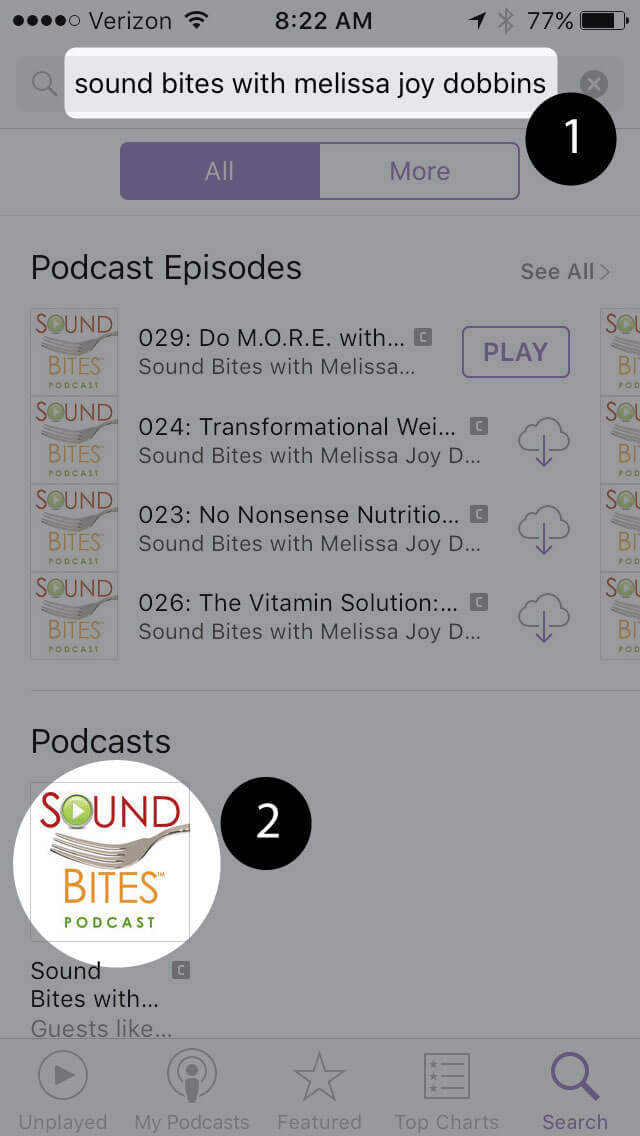
Open the “Podcast” app on your iPhone
Search for “Sound bites with melissa joy dobbins”
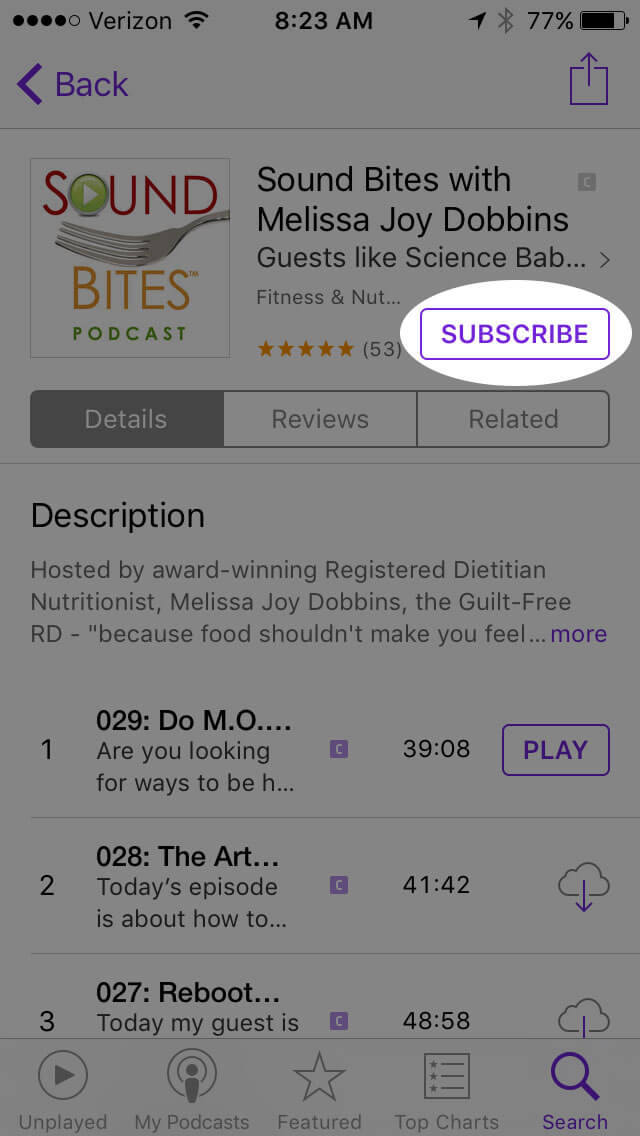
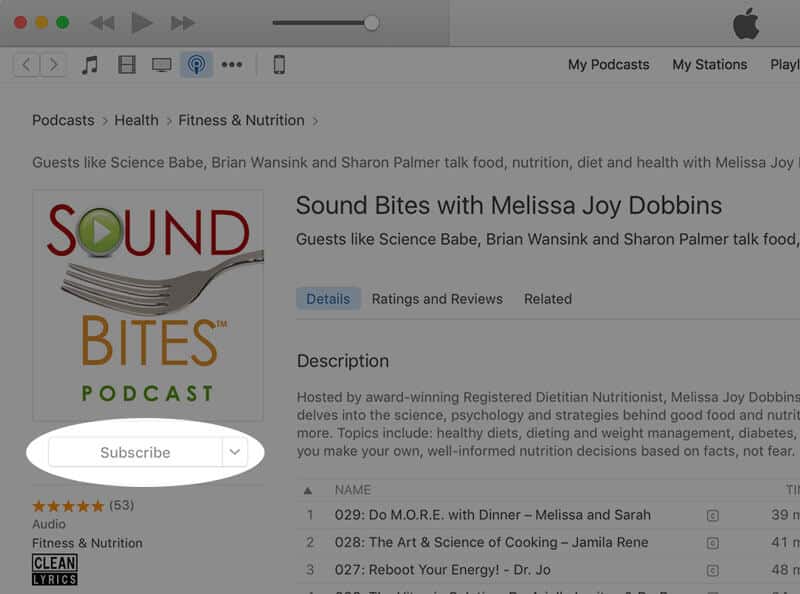
Open the podcast and click “Subscribe” and your done!
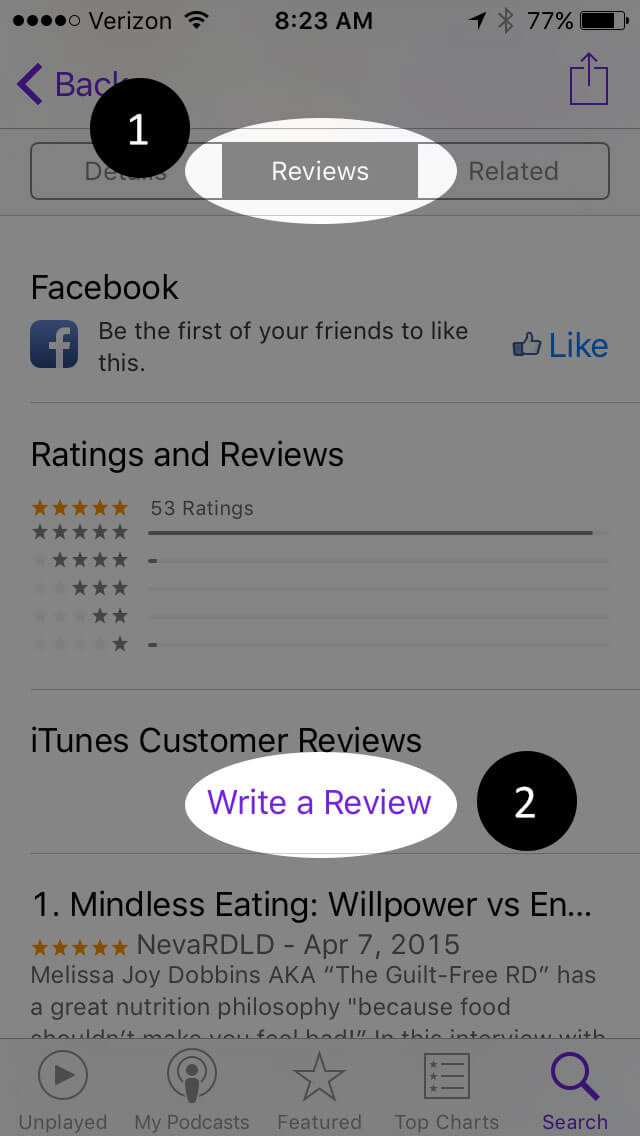
Write a Review
Click “Reviews”, then “Write a Review”.
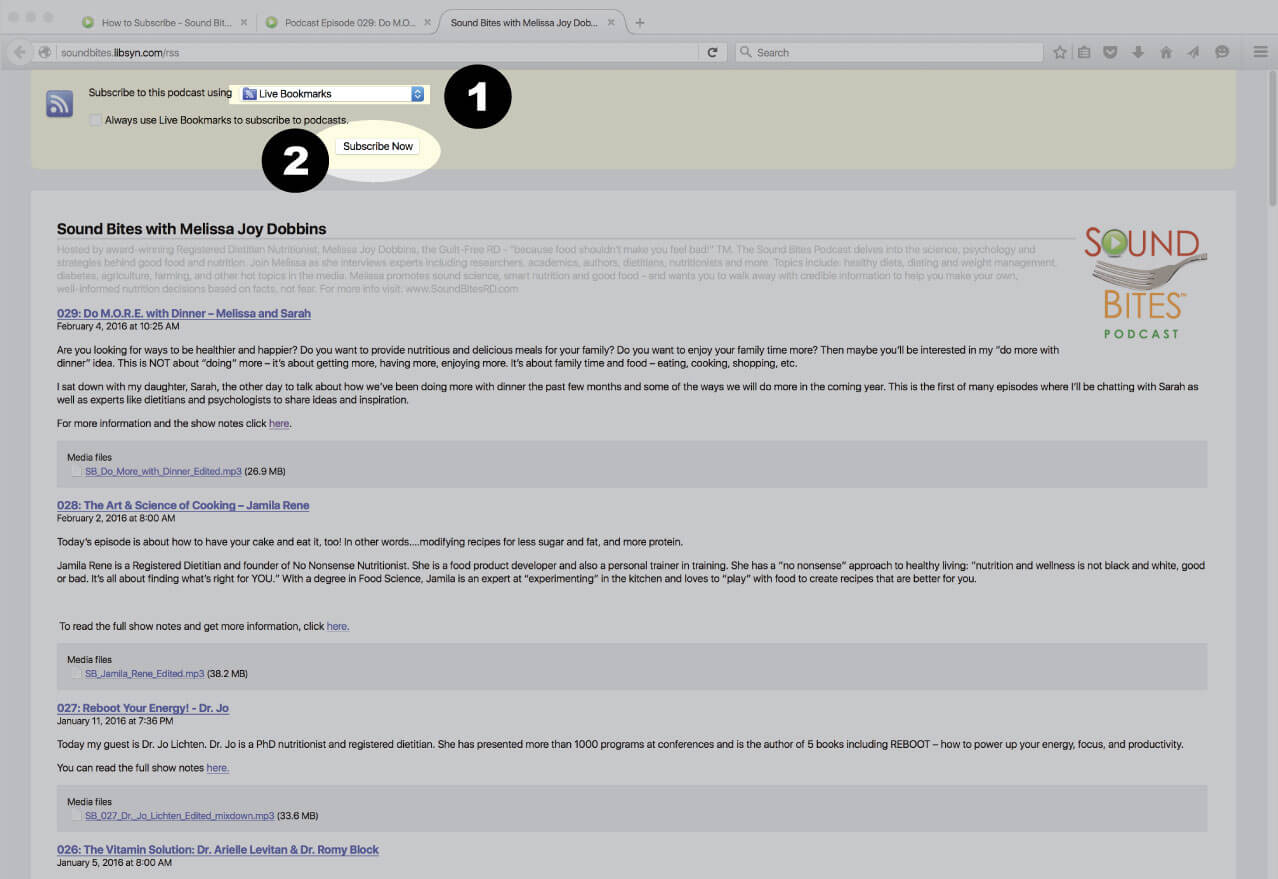
Subscribe via RSS Feed
Navigate to any podcast player . Click on the RSS feed icon.
Click on the RSS feed icon.
Click on RSS Feed
Choose which application you would like to use to receive the RSS feed
Click “Subscribe Now”
Confirm settings and subscribe.
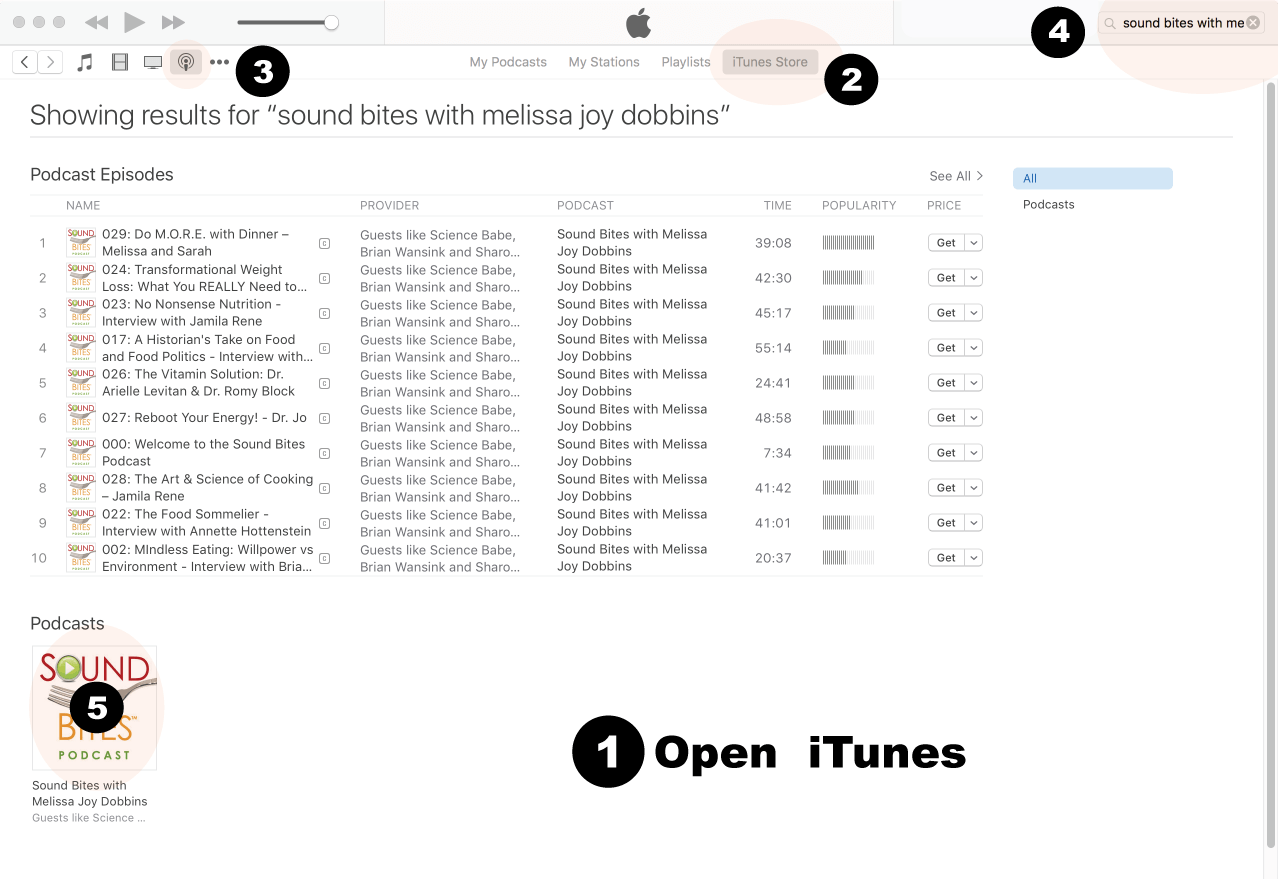
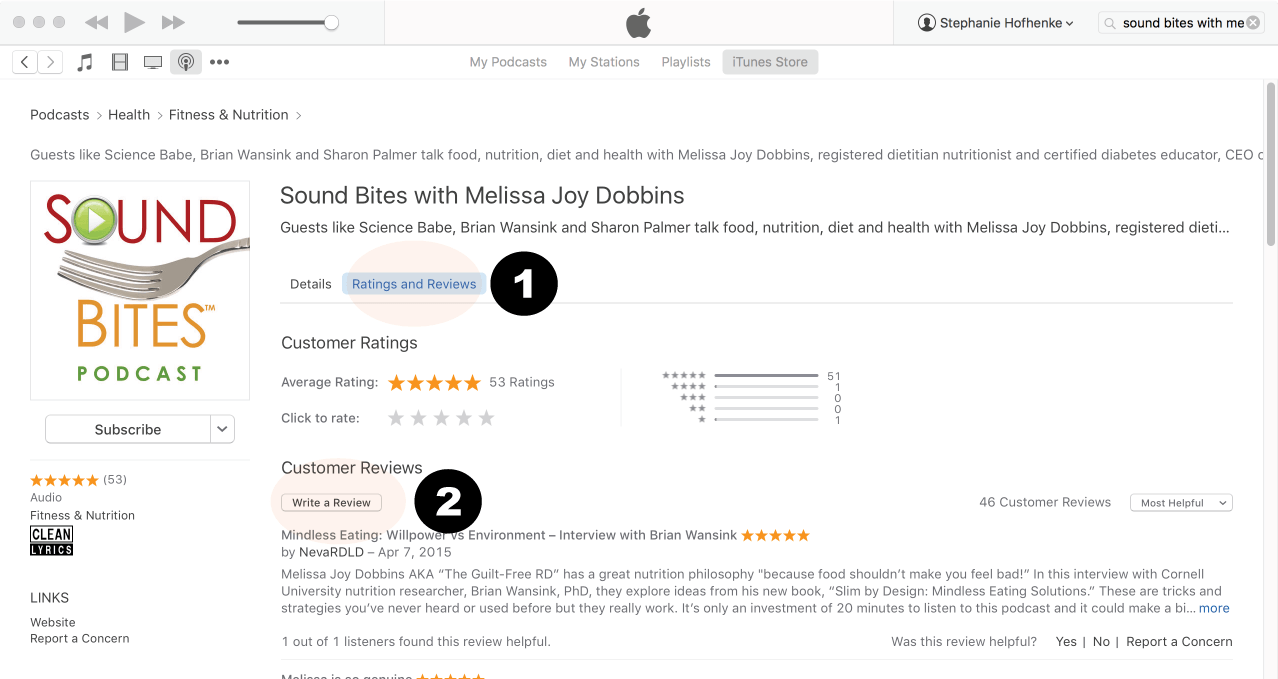
How to Review in iTunes
Open iTunes desktop application
Click iTunes Store
Click on Podcasts
Search for “Sound bites with Melissa Joy Dobbins”
Click on podcast image
Search for Sound Bites podcast in iTunes
Click Ratings & Reivews
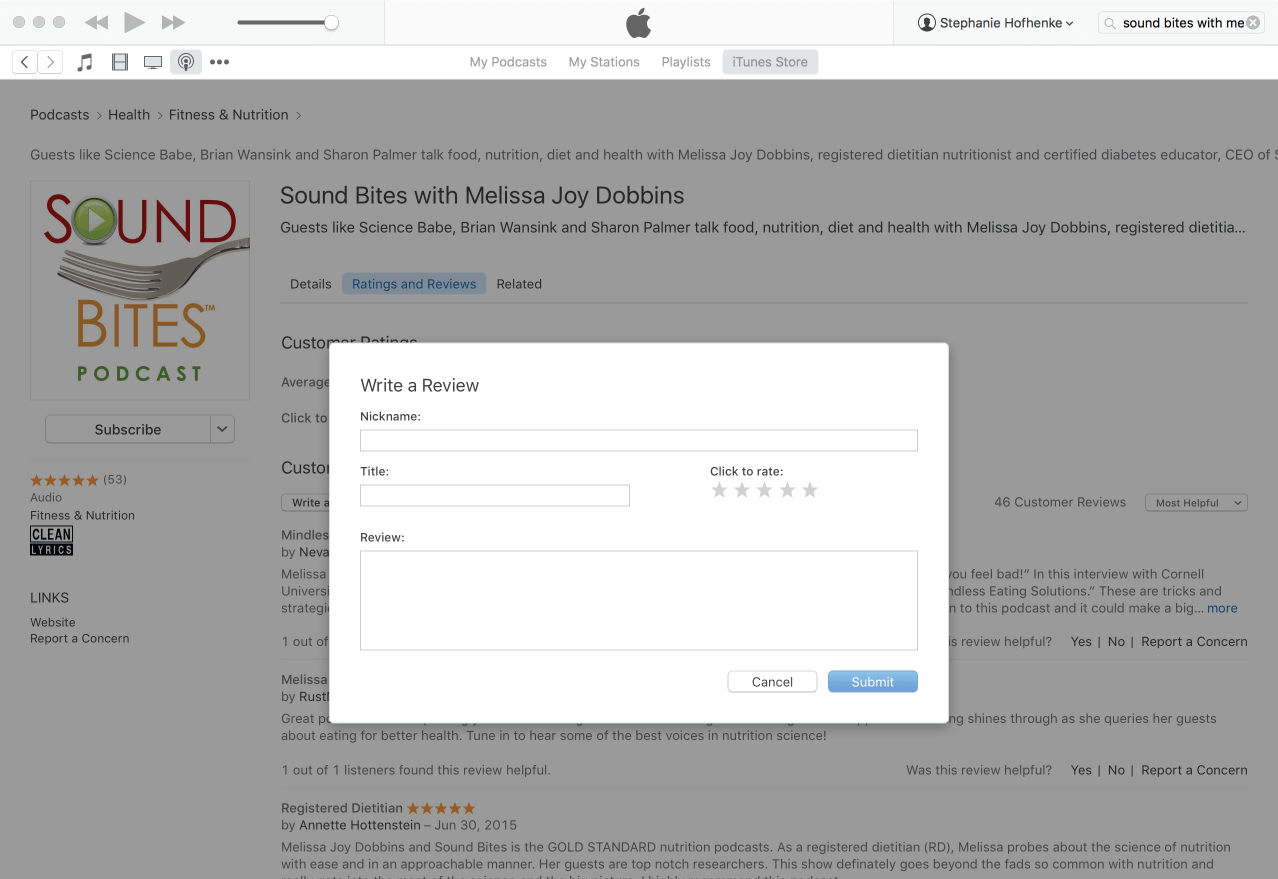
Click Write a Review
View reviews and write your own review.
Write your review…. Thank you!
Write your review!
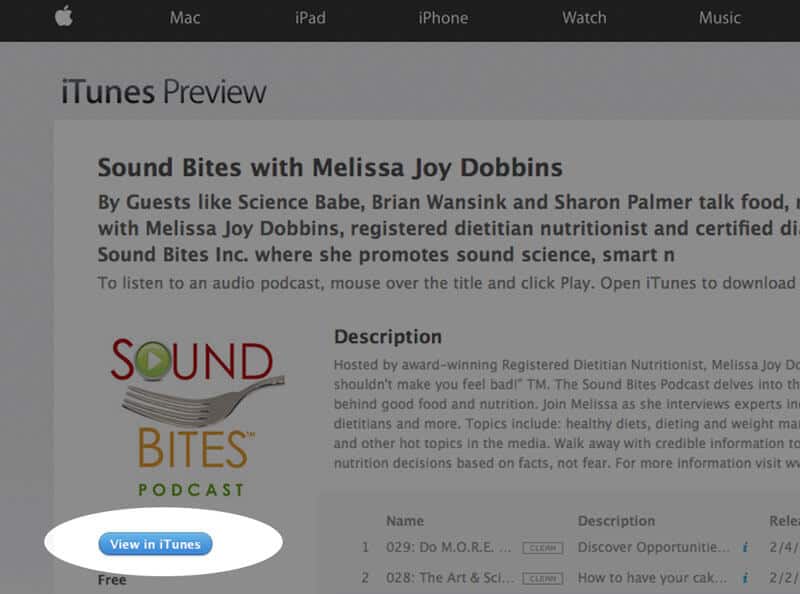
How to subscribe via iTunes
Click here to view the Sound Bites Podcastin iTunes, then click the blue “View in iTunes” button. This will open your iTunes application directly to Sound Bites Podcast. Click the “Subscribe” button, and your done!




 Kavin Senapathy is an award-winning science journalist and author of The Progressive Parent: Harnessing the Power of Science and Social Justice to Raise Awesome Kids (HarperCollins/Hanover Square). Senapathy’s writing appears in outlets like SciShow, Slate, Scientific American, SELF, The Daily Beast, Salon, and Forbes. A member of the National Association of Science Writers and the American Society of Journalists and Authors, her work delves into a slew of seemingly disparate but connected beats, from gender, sex, and race, to diseases and their treatment, to the researchers, doctors, and activists fighting for truth and justice.