Celebrating over 1 Million Downloads and 50,000 Free CEUs on the Sound Bites® Podcast | NEW: Get 1 years’ worth of CEUs with the new 15-CEU Podcast Course
Disclosure: This episode is not sponsored. However, I attended a sponsored conference (virtually) where I saw Dr. McMurry-Heath present.
Equality needs science. I call it Just Science, where the science being developed, the benefits it will bring, the opportunities it creates, reach deep into communities in ways that are just, impactful, and inclusive.” -Dr. Michelle McMurry-Heath
Changing the Dialogue Around Science
From research related to COVID-19 to more sustainable foods, scientists are developing amazing new ways to build and support a healthier planet. But if the vast majority of the world’s population cannot access and benefit from these incredible innovations, their value is limited. Dr. Michelle McMurry-Heath, the head of the Biotechnology Innovation Organization, tells us that the distribution of scientific progress is the social justice issue of our age. She discusses how biotechnology can help solve food safety, sustainability and food access issues – and the importance of delivering these advancements into people’s lives no matter where or how they live.
Tune in to this episode to learn about:
The intersection of science and social justice
The important role that science, biotechnology and innovation play in human health, environmental stewardship and sustainable agriculture
Broadening access to scientific progress so more people from diverse backgrounds can benefit from cutting-edge innovation
Social justice advocacy
Dr. McMurry-Heath’s new book Just Science: How Biotechnology Can Heal Our Society – Coming later this year!
Helpful resources and takeaways for the general public and healthcare professionals to learn more and get involved
Access to scientific breakthroughs will be one of the most important, and consequential, issues of our lifetimes. This is about what kind of society we want to be. One with opportunity for all, or one where regular access to nutritious food remains the providence of the few?” -Dr. Michelle McMurry-Heath
Michelle McMurry-Heath, M.D., Ph.D.
Dr. Michelle McMurry-Heath is the President and CEO of the Biotechnology Innovation Organization (BIO). A medical doctor and molecular immunologist by training, Dr. McMurry-Heath becomes just the third chief executive to steward the world’s largest biotechnology advocacy group since BIO’s founding in 1993.
BIO represents 1,000 life sciences companies and organizations from 30 countries. The organization’s mission is to support companies that discover and deploy scientific breakthroughs that improve human health, environmental stewardship, and sustainable agriculture.
The common thread in McMurry-Heath’s work across academia, government and industry has been her focus on broadening access to scientific progress so more patients from diverse backgrounds can benefit from cutting-edge innovation. Driven by her own past family experiences navigating clinical trials and funding uncertainties within the rare disease community, McMurry-Heath calls “the distribution of scientific progress the social justice issue of our age.”
Before coming to BIO, Dr. McMurry-Heath worked at Johnson & Johnson, where she served as Global Head of Evidence Generation for Medical Device Companies and then Vice President of Global External Innovation and Global Leader for Regulatory Sciences.
Prior to her time at J&J, Dr. McMurry-Heath was a key science policy leader in government, including serving as the associate science director of the FDA’s Center for Devices and Radiological Health.
McMurry-Heath was also the founding director of the Aspen Institute’s Health, Biomedical Science, and Society Policy Program. McMurry-Heath received her MD/PhD from Duke’s Medical Scientist Training Program, becoming the first African American to graduate from the prestigious program.
[00:00:00] Melissa: Hello, and welcome to the sound bites podcast. Today’s episode is about scientific justice and the distribution of scientific progress. My guest today says that this is the social justice issue of our age. This is about changing the dialogue around science and how Biotechnology can help solve food, safety, sustainability, and food access issues.
My guest today is Dr. Michelle McMurry-Heath. She’s the president and CEO of the Biotechnology Innovation Organization or BIO for short, Dr. McMurry Heath is a medical doctor and molecular immunologist by training. In fact, she has an MD PhD from Duke’s prestigious medical scientist training program. And coincidentally was the first African-American to graduate from this program.
And she assumed leadership of BIO, the world’s largest Biotechnology advocacy group in June of 2020. BIO’s mission is to support companies that discover and deploy scientific breakthroughs that improve human health, environmental stewardship, and sustainable agriculture. Welcome to the show Dr. McMurry Heath.
[00:01:14] Michelle: Oh, thank you for having me.
[00:01:15] Melissa: I’m really excited to talk with you. I had the pleasure of seeing you speak virtually at a conference recently and I found your presentation very compelling. The perspective you shared is really at the core of what I try to convey to my audience on my sound bites podcast.
So ever since I did my master’s research on Biotechnology and risk communication, I have seen how this gap between the science and public perceptions really needs to be bridged. And I am really looking forward to hearing more about the work you do at BIO. But first I’d really like to hear more about your background and your personal story.
What inspired you to become a doctor and what led you to the work you’re doing today? You have quite an impressive work history. And we don’t have three days to, to go in-depth into everything, but I would love to hear some of that. And probably will ask you some more questions about some of your history as we go through the conversation
[00:02:18] Michelle: Of course, of course.
Well, thank you for having me once again. It’s been an interesting journey. I was raised by two public health leaders in the bay area of California, born and raised in Oakland, California. And it was so interesting. Both of my parents were committed both to civil rights and social justice.
Although my mother liked to joke that she only made it to one NAACP meeting in the sixties and she went to meet a man and she met my dad and she didn’t go back.
[00:02:48] Melissa: Well, love that.
[00:02:51] Michelle: But she stayed committed to public health and working in the community and going door to door. Really providing care, particularly to mothers and infants in poor neighborhoods in Oakland and Alameda and Berkeley for the next 40 years of her life.
So she definitely made up for her commitment there. And my father was designing psychological programs for communities that couldn’t afford that type of care privately. So I grew up with that orientation and I really struggled to find, okay, what is my place in this continued evolution? Because I really see the impact of what both of my parents are focusing on, but I also had some broader interests.
And so when I got to college and got the opportunity to work in a lab and really discovered the charm and the enchantment of working at the bench to solve a problem that didn’t have an answer. It’s so different from what you do in the rest of school, where you’re trying to learn answers that have already been fully mapped out when you’re at the lab bench and you’re really doing novel research, you get to work to find an answer that nobody has anywhere in the world. And that was just incredibly compelling to me. And I also saw the power in it. I saw that this is how we make those cures. This is how we make that scientific progress that leads a disease from being a terminal that sentence to one that’s manageable or cured.
And that’s an incredible, powerful journey. So I got interested in this fusion between biomedical research or biotech research and medicine. And that led me down this path, but along the way, I got glimpses that science was not just critical to improving healthcare and the delivery of medicine, but also in preventive care and raising healthy communities and delivering healthy infrastructure so that the next generation could have less illnesses to fight in the first place. And so often when we talk about prevention or we talk about the social determinants of health, we focus only on the policy interventions without realizing that they’re also scientific interventions that are sometimes well within our reach.
If we just have the focus and the dedication to achieving them.
[00:05:18] Melissa: Wow. Okay. Yes. Quite an interesting journey for you to become interested in science policy. I’m curious where Biotechnology came in for you, and we’ll get to that. I read that the common thread in your work across academia, government and industry has been your focus on broadening access to scientific progress so that more patients from diverse backgrounds can benefit from cutting edge innovation. And I’d love to hear more about that.
[00:05:50] Michelle: Yeah. It’s so interesting to me because I always felt like I was straddling two worlds. I go back and forth between these really amazing conversations about what was scientifically possible if you follow the trail that DNA lays out for us, which is basically what Biotechnology is and communities that could not see that that had absolutely any relevance to their day-to-day lives. The communities that I grew up when the church community that helped raise me they really saw the social justice fight and the fight for access to health insurance, but they didn’t see that science could be a key component to everything that they were hoping to achieve for themselves and for their children.
And so I wanted to bridge that gap because I think it’s a huge untapped resource. And if we look at just the power and the impact of the COVID vaccine, for example, you can see how powerful it is to train the lens of science on a problem that society faces and throw everything we have at it. And I think if we were to train the lens of science on poverty and injustice and inequity, we would see the same sorts of very fast and very high in magnitude change as we’ve seen in that regard. So that’s the concept I call just science the just development of, pursuit of and distribution of scientific research. And I think it’s critically important as we try to build a more equitable world for tomorrow.
[00:07:28] Melissa: Absolutely. You mentioned COVID – and your background, you’re probably only the second guest on my podcast who actually has a background in Pandemic diseases and prior to the outbreak of COVID, I’d love to hear a little bit about the work that you did. You were promoting personalized medicine and bolstering international preparation for pandemic disease threats. And again, this was prior to COVID, right?
[00:07:56] Michelle: Yeah. So I landed on Capitol hill for what was supposed to be a one year internship and turned into five years of work in the wake of both 9/11 and the anthrax attacks. And so this was early in the 2000s, but Congress was very much trained, particularly my office because Senator Lieberman’s office was one floor removed from Senator Daschle who’d received one of the anthrax letters. They were really trained on, okay, this is just a glimpse of what’s coming and how can we help prepare the country for pandemic illnesses?
And so we started working on bioterrorism preparedness legislation there. I got to work in the department of health and human services as they were starting to build up their pandemic preparedness programs. And then I carried that topic matter through my work in nonprofits at the Aspen Institute where I really got to ask some of those questions a bit more broadly.
So I’ve gotten to see over the course of 20 years, how we start to think about these issues and where we’ve fallen short and where we’ve taken our eyes off the prize, because there’s so many other pressing social priorities. But it was amazing to see all of those lessons brought to bear on the COVID pandemic and actually some of those early investments and approaches being seminal to the progress that we did make against COVID.
[00:09:21] Melissa: Right and it’s not lost on me that. This is a situation where the science and the social science are completely intertwined. And I feel like that’s the first time in a long time that we’ve had to look through those lenses and these kind of two worlds that you were straddling kind of came together.
[00:09:41] Michelle: It’s absolutely true. And it’s so interesting. There’s been a recent report by the Commonwealth foundation that has looked at the impact of COVID-19 vaccines. And we’d like to think of biomedical research has a nice to have, or a luxury item that perhaps helps the most advantaged, but doesn’t really change our economy or change the trajectory of our nation.
But that’s far from the case. COVID vaccines alone are estimated to have saved the U S economy $900 billion just in health expenditures, not even talking about the impact on the economy and getting people back to work. And in addition, it’s saved just in the U S alone 2.2 million lives. And 17 million hospitalizations just by March of this year.
So it tells you that if we can really train ourselves to harness science, we can achieve so many of the aims that we were looking forward to, and this doesn’t even touch upon our aims of stopping climate change and getting nutritious food to every table and raising healthier children.
[00:10:53] Melissa: Which I know are very paramount to the work that you do at BIO. I’m interested, and obviously your mother’s work working with mothers and children – almost sounds like in a WIC women, infants and children’s sort of capacity, how you became interested in nutrition and the work that you like to focus on with health and social determinants of health. I mean, I think we really need to put a finer point on that as, as we talk about the work that’s going on at BIO that you’re doing.
But was there anything in particular that brought you to the nutrition table?
[00:11:29] Michelle: So my mother was a good old fashioned public health nurse. Even alongside the WIC programs, the public health department was tasked with going into communities, making sure that people were armed with education about nutrition and the need to fight obesity, but at the same time, infant immunizations and preventing infant mortality.
And all of these threads of course are intertwined and no one understands that better than the public health community. They see each and every day how tightly linked each of these areas are. So it was very, very clear to me early on that you couldn’t separate nutrition out from the aims you had to improve economic status, health status, or educational achievement.
It was very, very critical to all. Then you layer on top of that, that through the seventies, eighties, nineties, you saw such a huge increase in obesity and obesity related diseases. I think my mother’s catchment area, as she moved up in leadership, she kind of had a broader lens, changed from one where you never saw children with type two diabetes to one in which you commonly saw children with type two diabetes all within her professional lifetime.
So it’s just become a starker and starker reality for us. And as I went to medical school I was in North Carolina and in Durham, it was a very, very similar dynamic to what you saw in Oakland. And of course we saw those kids coming into the hospital with those sorts of impacts on their lives.
So it’s always been clear that nutrition is important part of that and I did pediatrics, anyone who studies pediatrics knows that nutrition is key.
[00:13:20] Melissa: Absolutely. Let’s talk more about the work that BIO is doing. I mentioned their mission, but if you wanted to share more about their vision or their purpose and the types of companies that you support and work with, and also would like to get into kind of the three focus areas and talk a little bit more about Biotechnology and the environment and agriculture. Of course.
[00:13:44] Michelle: So BIO is a membership organization of about a thousand biotechnology companies, and we range from the very smallest biotech companies that you might have less than 10 employees to the very largest and about 90% of our companies are in the biopharma space, but we also cover the agriculture space and the environment space. And basically what ties our member companies together is that they use science of DNA to try to find solutions to whatever they’re working on. And we really try to be a voice for the work that they’re doing. We have so much that we want to accomplish, but we’re really trying to drive a biorevolution through education, collaboration, and advocacy.
So that’s really how we go about it. And we want to make sure that as we’re helping the ecosystem conduct rapid biotech research, that we are equitably harnessing that research for health, sustainability, and justice. So that’s what BIO is set up to do. And we have many different ways we go about that.
One is raising awareness of the issues and the barriers that our science faces to people on Capitol hill. But it’s also and having a broader conversation with the public about the role of science and the role of the entire ecosystem of science in getting to the end goals that we all share. I think sometimes there’s a thought that academic science alone gets you where you need to go.
And for those of us who’ve either partnered with or worked with or been a part of Biotechnology companies, you see that it is so critical to have that last mile of research and development actually have a solution that helps the patient. It does no good to discover a gene is critical to a disease, or even that a protein might stop a disease if you don’t have that very important testing and clinical trials that show that your hypothesis works in the human body and is safe for patients to use and can actually improve outcomes. That’s the work that a lot of our companies do and they do it not just in the biopharma space, but also when it comes to agriculture solutions as well.
I think of, for example, AquaBounty, who takes what we know about manipulating the genetic background to make sure that we have aquaculture that is more abundant and cheaper and more accessible to more tables.
[00:16:22] Melissa: I’m wondering with the communications aspect and the community aspect, are you tasked with trying to help the public understand these benefits because in my background I’ve seen that that’s where some things break down. I mentioned earlier, I did my master’s research on biotechnology and it was actually bovine growth hormone in cows milk. And this is in the early nineties and it was what do healthcare professionals and dieticians know about this?
What are they telling their patients about? And then you fast forward several decades later and that technology just really isn’t even being used for the most part, because primarily consumers didn’t trust it. And then we’re getting back to the agriculture aspect where the farmers don’t really have that as one of their tools.
So that’s kind of the lens that I started seeing the world through as early as graduate school. And I’m curious if those types of challenges are what you’re seeing as well. Yeah.
[00:17:25] Michelle: It’s so interesting that you say that because sometimes we think of science as nice to have, but I actually think science skepticism is a nice to have luxury. If you’re driving to your whole foods and you want to insist that your very expensive produce has no genetically modified pieces to it.
That might be your option, your privilege. But if you’re in a small, poor community where you’re lucky to get a fresh piece of fruit in a local store, you want anything that’s going to make those nutritious options, more accessible and affordable for your family. So we have to think about this from a broader point of view.
I think too often, we’re well-intentioned about thinking we’re standing up for the broader public without actually paying attention to the obstacles that particularly disadvantaged communities are facing each and every day. We have a company Benson Hill that uses CRISPR technology, which is recently won the Nobel prize to target very specific genes in produce crops to make fruit and vegetables 1) more visually appealing, accentuate the taste profile, add protein to their composition. And make them more amenable to things like hydroponic gardening. So you can imagine a strip mall in an inner city turned into a hydroponic farm so you can now deliver those amazing new fruits and vegetables to that local bodega without the transportation costs and the impact on the environment of that transportation. Not to mention the very expensive farming costs of traditional farming sometimes to the local community. And we have to ask ourselves, are we letting the perfect be the enemy of the good? Are we standing in the way of making sure that we have children and each and every neighborhood who have fruits and vegetables on their plate every single day, so that we can have the luxury of pointing disparaging fingers at a technology that we may not even intimately understand.
[00:19:34] Melissa: Absolutely. Drop the mic. Yes. So I think because of my master’s research and being published with that topic, it was very eye opening for me to realize going into my career, then I started off in a clinical setting and then outpatient and education, but it was very clear to me then like, okay, science is one thing, but the social science or the behaviors or the thoughts and the perceptions and the communication aspect is another thing. So it’s really exciting for me to learn about what BIO is doing. Because it just seems like to me, it’s just pulling everything all together. Absolutely.
[00:20:13] Michelle: And science skepticism is more contagious than any virus. I mean, we saw this with the COVID vaccines. You can start in a very privileged spot where you actually don’t have to worry because you’re working from home all day and you can cast scientific dispersions, but it spreads like wildfire. And so if you’re interested in the health of the public from a public health point of view, from a systemic society-wide point of view, then we really need to make sure we are much more careful in the questions we ask. And that’s not to say we shouldn’t ask probing questions and we should not be demanding and we should not make sure that the science that is changing our lives is safe and effective. I’m a former food and drug administration official so I believe in safe and effective beyond all else. But once that hurdle has been met, that threshold has been achieved, then we need to make sure that we are getting those solutions out the door.
[00:21:09] Melissa: Right. And just to add one more thing to that, biotechnology science in so many ways has all of these benefits that to your point about access – if we can’t get it to the public, then what good is it? And I think I’m hoping that you will agree that it’s improving. I mean, I think we’ve come a long way from the rbST labels on milk and vaccines and autism, certainly the pandemic and COVID and mask mandates and vaccines and all of those things – it’s made us talk about it for one thing. So I think that’s helpful, but yeah, so looking at how biotechnology and how science can improve the environment, improve sustainability, improve nutrition through access to food and affordable food, even food waste – I think that that’s something that BIO is looking at, and I’d love to hear about that as well.
Anything health, food, and ag related that you want to share? Any examples or stories? It’s so exciting that there’s these possibilities, but then there’s the realities. And to me it sounds like that’s where BIO comes in and tries to connect those dots.
[00:22:22] Michelle: Yeah. And it’s so broad the possibilities. We have several members in this space, but I’m thinking about the CEO of Lanza Tech in particular. We have companies that are trained on using biofuels to fuel airlines in a way that’s more sustainable and more affordable. And the CEO of Lanza Tech is from south America. And she said to me, Jet travel is the great equalizer, because if you’re growing up in poor country around the globe, you can get to great education.
You can get to job opportunities, you can have access and exposure to other societies and cultures. And the higher the prices of that form of transportation go, and the more we limit those opportunities, the less people in those impoverished countries have to look forward to and to hope for. So it’s very interesting.
If you really take up the aperture and widen your lens, how important some of these technological advances are, and not just to ourselves, but to communities around the globe.
[00:23:28] Melissa: Right. That equity or the equality. You’re a social justice advocate so I’d love to hear more about this intersection of science and biotechnology and social justice and what that means for you in the work you do.
I mean, we’ve talked a little bit about access and social determinants of health, but I would love to have you take a deeper dive on that.
[00:23:49] Michelle: Most definitely. So let’s start with maybe the elephant in the room, which is scientific advances have to be affordable and accessible for all. It does no good to have amazing science that’s understood by all if it cannot be obtained by. And so that’s a very important part of what we stand for at BIO, not just in the agriculture space, but also in the biopharma space, but we have to do that without sacrificing the speed and the breadth of our research and development. We have to do that in a way that keeps the innovation engine humming because the future is so much more important than today. And if I think about, for example, the diseases that really cripple minority communities, diabetes, heart disease, stroke, you can even think of maternal mortality and lupus. None of these areas have a solution we clearly know today that we can pull off the shelf and cure and or stop the spread of these illnesses.
I mean, just think about that. No matter how much health insurance, or accessibility we provide, and we should have universal access and availability, having access to an empty medicine cabinet does not solve your solution at the end of the day. So we have to do both. It’s not either or it’s and both because we need to have those new solutions and we need to make sure that the research is targeted and aimed at the equitable generation of those breakthroughs so that we get those solutions for those diseases, that disproportionately impact poor minority communities. So there’s a lot more work to do. But one of the things that’s so interesting to me about that COVID vaccine set of statistics is one of the most impactful things about it was that there were absolutely no impediments to people receiving the vaccine.
There was no cost, there was no insurance requirement. There were no copays. There were no waiting periods. It was accessible to all. And when you do that, you see the full breadth of the impact of the site. And that really should be our gold standard, not just in the biopharma space, but also in getting out those nutritious agriculture products and the sustainability solutions that you know, that our members are also generating.
[00:26:13] Melissa: Yeah. I have two follow-ups to that. And I don’t want to forget my second one. The one that I thought of just now is I read something I don’t know, it was probably six months or so ago about the population or the demographic, if you will, of people who were more likely to not be vaccinated. And it basically said people who didn’t have health insurance. And I pretty much think that the way it was worded was basically people who didn’t have a relationship with healthcare. Healthcare had not been a part of their lives. And I found that really compelling and made so much sense because talk about barriers and challenges – yes, the vaccine was free and distribution, and we had some issues with that or whatever, but it’s just that social science aspect of it. That is like, if something’s unfamiliar to me, then I have to get past that in order to get the vaccine. I don’t know if you read anything like that or if you have any thoughts on that?
[00:27:21] Michelle: Well, it was so interesting because I do think the thread you’re pulling out there was a very important part, particularly in the early days of our campaign to get everyone access to the vaccines. But we really saw a shift in the demographics over time. As the science became very clear in terms of the vaccine, allowing us to return to a bit more of normalcy. It also at the same time became a lot more politicized. And so now what tracks with it is not race or demographics so much as it is political affiliation.
And that is a real shame. We see – it’s so heartbreaking. To see how easily science can become political. So frustrating. We have amazing innovators of every political persuasion within BIO, and they have a wrath of point of view. They have very varied points of view, and yet they all see that science can be so powerful for whatever future you are aiming towards.
And that’s what we have to realize. Science is non-partisan. Science is really about whatever future we’re going towards, it’s a necessary ingredient.
[00:28:35] Melissa: Absolutely. The other thing that I think is a bit of good news is in my nutrition world, it seemed that once the pandemic hit, there was less chatter about some of what I would refer to as the elitist conversation with regard to food.
You kind of mentioned it earlier. If you’re going to whole foods for your Organic produce or whatever, that, those things that were trending or top of mind, or really seem to be important quote, unquote to certain people, really fell down on the list way farther down on the list.
And we were having conversations about things that I think are more meaningful, like food safety and access to food and simple cooking and well, what do you do stock up your pantry? How do you rely on your pantry and frozen foods and things that, from my perspective, and from a public health perspective, just seem to be like more meaningful conversations.
So have you seen that in your world? Not just about nutrition, but in the BIO space?
[00:29:35] Michelle: Most definitely. I mean, I think for so many of us the last two years have been about getting back to basics. Right. Determining what really drives your life and what’s most important for you and your family. And I hope that we keep that pragmatic view as we go forward, because it’s been a real reality check and it’s so critical that we don’t lose or leave behind the lessons that we’ve learned in this very difficult period.
[00:30:06] Melissa: I agree. Absolutely. Well, I understand you’re working on a book and it’s called Just Science. And maybe I should say it JUST Science and I’d love to hear about it.
[00:30:20] Michelle: It’s really a tour of all of the ways in which science can right the inequality equation. So if you look at how we conduct clinical trials, if you look at access to nutritious food, If you look at how we make sure that every community has access to clean air and clean water and how actually exposure to pollution also tracks with a lot of other measures of inequality in our society, because those that are most vulnerable among us are also exposed to the most threats. We need to make sure that as we generate new science and find solutions to those threats, that we use them to uplift those communities. And if you care about health disparities, if you care about making sure that childhood obesity is not disproportionately impacting poor community, if you care about raising healthy children, no matter what zip code they come from, then you have to make sure that you are paying attention to scientific innovation and getting that innovation to every corner of the globe.
[00:31:32] Melissa: Wow. And when is it due out? I can’t wait to read it.
[00:31:35] Michelle: It’ll be out in the next couple of months and it we’re really excited about it.
And what’s been so amazing about it is going around the country, talking to innovators, but also community leaders who have been struggling with a lot of these issues for years. Everything from lead in the water to access to medicine, to access to nutritious foods. It’s been really, really interesting to hear their firsthand accounts and record them in the book.
[00:32:05] Melissa: Oh, that’s wonderful. I cannot wait to read it. I would love for you to share anything else that you want to share with our listeners today. I know that I’m signed up for the good day BIO newsletter and I’ll put a link to that in my shownotes, and people can find out more information at BIO.org. Right?
[00:32:25] Michelle: Right. Exactly. We’re so balkanized and polarized these days. We’ve actually grown our good day BIO newsletter and you can sign up for it on BIO.org into a website as well called BIO.news which is really just trying to get out more unbiased information about what our scientific innovators are doing each and every day, because it’s important for folks to have all sides of stories so they can make up their own minds.
So that’s really critically important. But the one thing I want to make sure I don’t leave without saying is I want to make a plea to the amazing burgeoning upcoming generation of activists that I think this last two years has really fostered. The next generation has such a commitment to making this world a better place.
And I hope that as you’re thinking about how do I apply my talents to that effort that you consider how important science is going to be in the next 25 years of social justice and how it can really enable all of the work that you so passionately want to do. We are here to help support you in that work.
We want to draw everyone who has an interest in science and technology into the field, because we need more understanding. We need more bridge builders. We need more communicators. We need more passionate advocates to really make sure that everyone can benefit from the amazing progress that we’re seeing in science and technology.
[00:34:02] Melissa: Wonderful. It gives me hope. It really does, that science can and should be such a big part of the social justice equation. I think there’s a lot of good opportunities there and very hopeful. So people can learn more and get involved. And my audience is a mixture of the general public and health professionals, but definitely encourage people to go to BIO.org.
You have a podcast as well. Just lots of great information. You’re on social media. You can follow Dr. Michelle on Twitter at Dr. Michelle BIO and connect with her on LinkedIn. And I’ll have all of these links and more resources from BIO in my show notes at soundbitesrd.com.
[00:34:44] Michelle: Thank you so much for having me today and what a great conversation.
And I look forward to hearing your future episodes as well.
[00:34:51] Melissa: Thank you so much, Dr. Michelle, I have enjoyed talking with you so much and I’m just really in awe and I’m inspired by the work that you’re doing. And I can’t wait to see what comes next and I can’t wait to read your book. Thank you. Thank you so much.
And for everybody listening as always enjoy your food with health in mind. And social justice. Til next time.
LISTEN, LEARN AND EARN
Listen to select Sound Bites Podcasts and earn free CEU credits approved by the Commission on Dietetic Registration (CDR) for registered dietitian nutritionists and dietetic technicians, registered. Get started!
Get Melissa’s Sound Science Toolkit here!
Partnerships:
Sound Bites is partnering with the Association of Diabetes Care and Education Specialists (formerly the American Association of Diabetes Educators)! Stay tuned for updates on the podcast, blog and newsletter!
Sound Bites is partnering with the International Food Information Council! Stay tuned for updates on the podcast, blog and newsletter!
Sign up for my monthly newsletter and episode eblasts so you never miss an update!
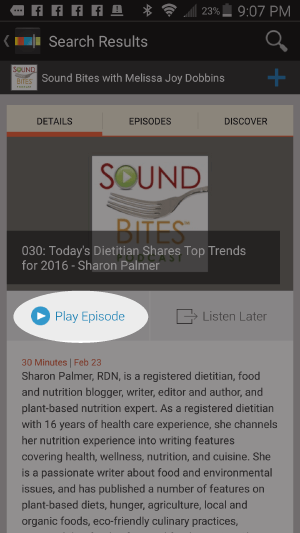
Listen on Stitcher (Android)
Install the Stitcher App
1. Search for “sound bites with melissa joy dobbins” 2. Choose Play Current Episode or Add to Playlist
Choose “Play Episode”
Subscribe & Review on iPhone
Open the “Podcast” app on your iPhone
Search for “Sound bites with melissa joy dobbins”
Open the podcast and click “Subscribe” and your done!
Write a Review
Click “Reviews”, then “Write a Review”.
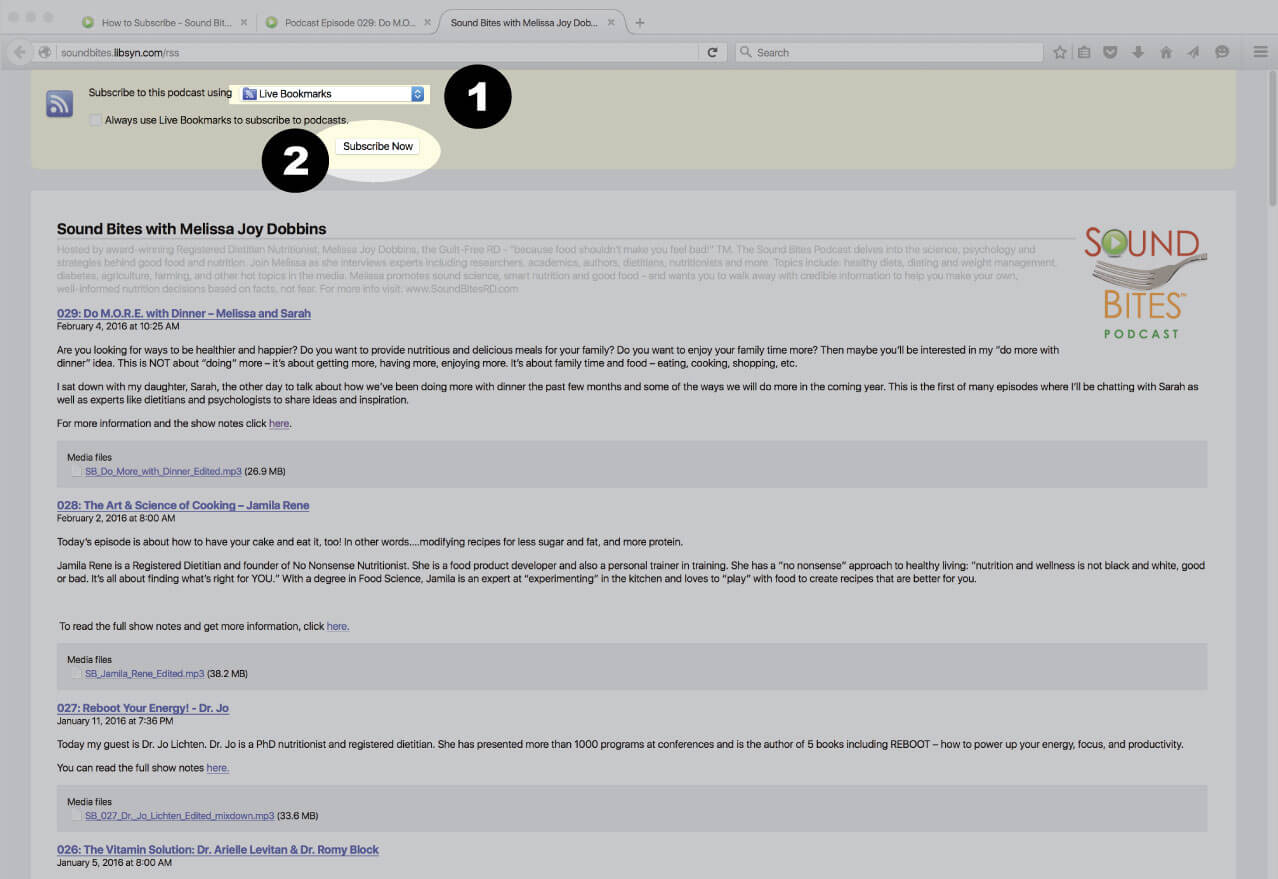
Subscribe via RSS Feed
Navigate to any podcast player . Click on the RSS feed icon.
Click on the RSS feed icon.
Click on RSS Feed
Choose which application you would like to use to receive the RSS feed
Click “Subscribe Now”
Confirm settings and subscribe.
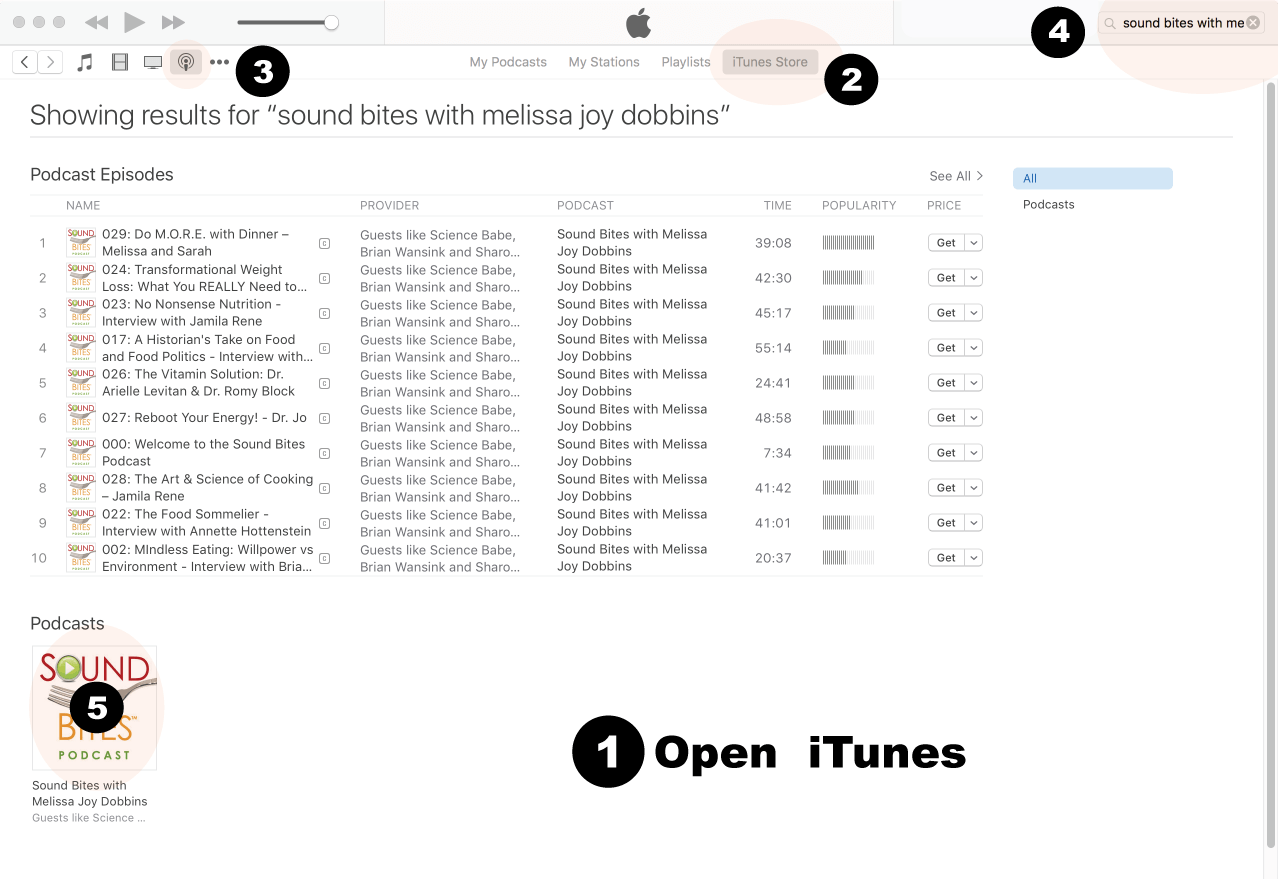
How to Review in iTunes
Open iTunes desktop application
Click iTunes Store
Click on Podcasts
Search for “Sound bites with Melissa Joy Dobbins”
Click on podcast image
Search for Sound Bites podcast in iTunes
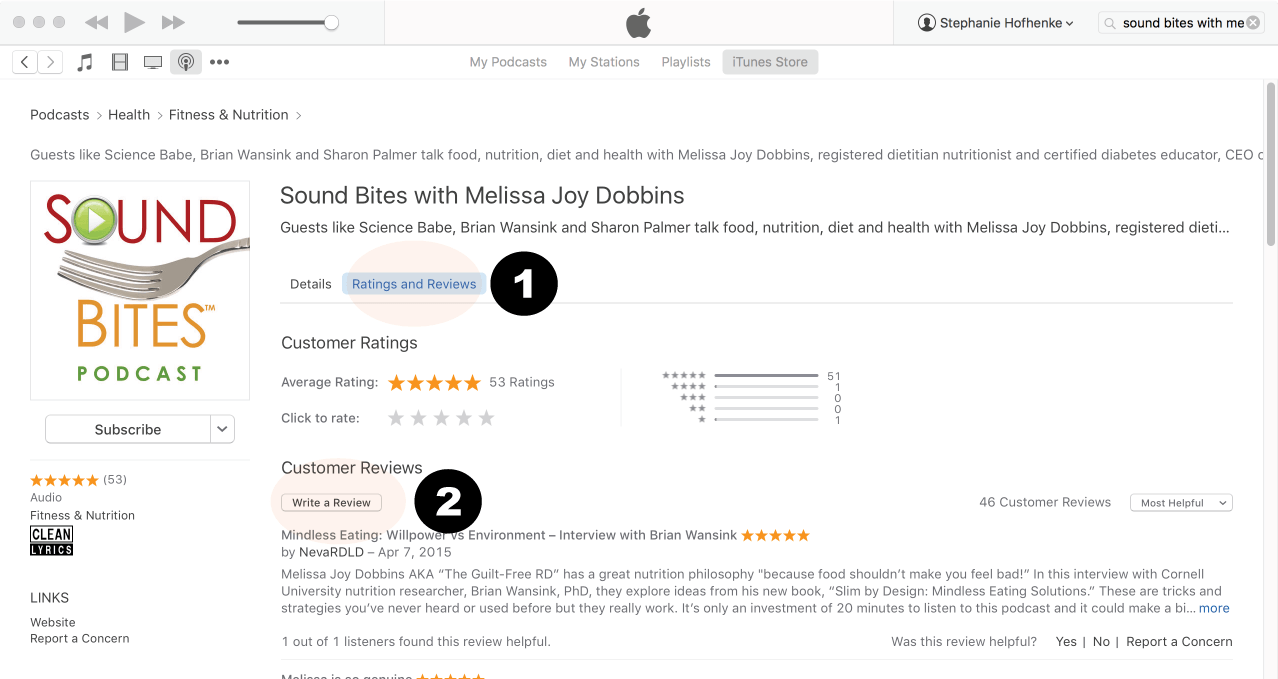
Click Ratings & Reivews
Click Write a Review
View reviews and write your own review.
Write your review…. Thank you!
Write your review!
How to subscribe via iTunes
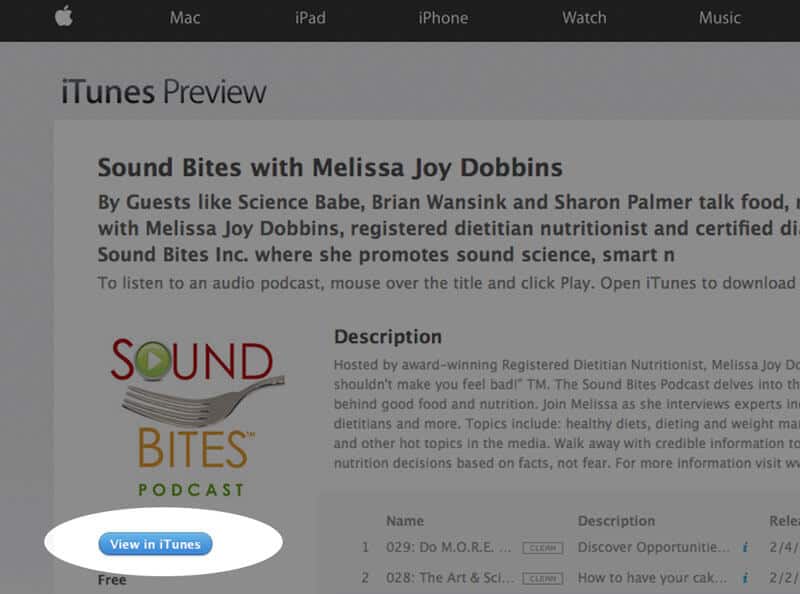
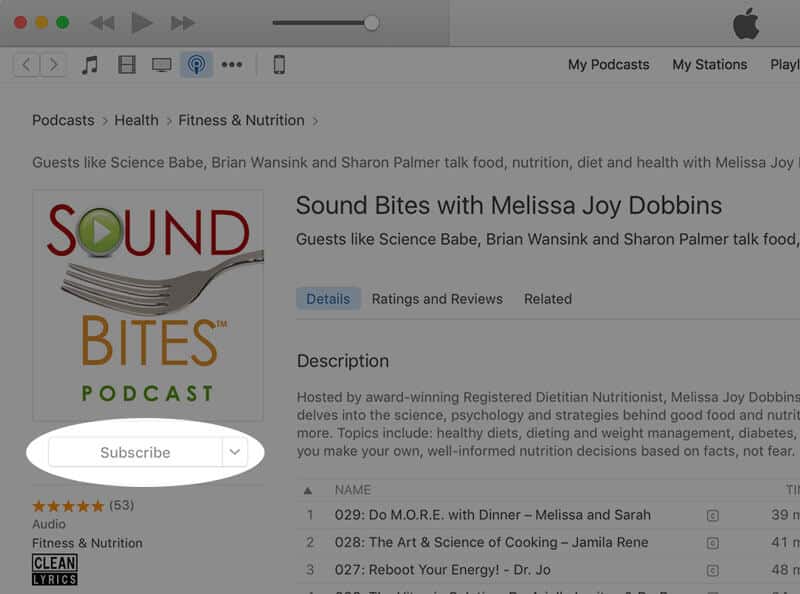
Click here to view the Sound Bites Podcastin iTunes, then click the blue “View in iTunes” button. This will open your iTunes application directly to Sound Bites Podcast. Click the “Subscribe” button, and your done!