Celebrating over 1 Million Downloads and 50,000 Free CEUs on the Sound Bites® Podcast | NEW: Get 1 years’ worth of CEUs with the new 15-CEU Podcast Course
This episode is available for 1.0 Free CEU through the Beef Nutrition Education Hub. Get started here.
Disclosure: This podcast episode is sponsored by The National Cattlemen’s Beef Association (NCBA), a contractor to the Beef Checkoff.
Adolescent Health at a Crossroads: Looking Ahead at Nutrition Research & Dietary Guidelines
It’s well-established that nutrient adequacy in adolescence affects physical development and academic performance, as well as long-term health – yet research is woefully lacking for this life stage and dietary guidance lacks specificity for these unique needs. In fact, the 2020 Dietary Guidelines for Americans noted that the nutrient gaps among adolescents are so significant, that this “constellation of potential nutritional risk factors” is a public health challenge. To help address this gap, the National Cattlemen’s Beef Association, on behalf of the Beef Checkoff, partnered with Dr. Mario Ferruzzi and his team at the Arkansas Children’s Nutrition Center (ACNC), one of 6 USDA national nutrition centers, to convene 50 leading nutrition scientists, physicians, registered dietitians, and public health experts. This podcast episode is a result of conversations with many of the esteemed experts who spoke/presented there.
Featured experts
Dr. Mario Ferruzzi, PhD
Mario Ferruzzi, PhD is a Professor and Arkansas Children’s Endowed Chair in Digestive Disease and Nutrition Research. He serves as Chief for the Section of Developmental Nutrition in the Department of Pediatrics at the University of Arkansas for Medical Sciences and Director of the Arkansas Children’s Nutrition Center, a partnership between Arkansas Children’s Research Institute and USDA-ARS. He received his B.S. in Chemistry from Duke University and Ph.D. in Food Science and Nutrition from The Ohio State University. Dr. Ferruzzi previously served as a David H. Murdock Distinguished Professor at North Carolina State University’s Plants for Human Health Institute and as a Professor of Food Science and Nutrition Science at Purdue University. Dr. Ferruzzi’s research interests are at the interface of agriculture, food, and nutrition sciences, particularly on factors affecting micronutrient and phytochemical bioavailability, metabolism, and impact to human health with a particular interest in improving the nutritional and functional quality of food products for at risk populations.
Leslie Kaplan, MD, CEDS
Dr. Leslie Kaplan is a pediatrician specializing in adolescent and young adult medicine. She has practiced in various health care settings over the last 25 years, including primary care adolescent medicine, college health, and eating disorder treatment. A Certified Eating Disorder Specialist (CERDS), she now has a unique private practice treating the medical needs of those with eating disorders. She also has the invaluable experience of being a mother to 3 young adult daughters.
Jill Castle, MS, RDN
Jill Castle, founder, and CEO of The Nourished Child® is a speaker, advisor, media contributor and author of numerous books, including the forthcoming book, Kids Thrive at Every Size. Jill is one of the nation’s premier childhood nutrition experts. Known for her ability to blend current research, practical application, and common sense, Jill believes that children can thrive at every size. With her paradigm-shifting, whole-child approach, she inspires parents, healthcare professionals, and organizations that serve children and families to think differently about young people’s health and wellbeing.
Heather Leidy, PhD
Dr. Heather Leidy is currently an Associate Professor at the University of Texas at Austin with a joint appointment in the Department of Nutritional Sciences and the Department of Pediatrics through the Dell Medical School. She also serves as the Director of the Research Interest Groups through the American Society of Nutrition and as a member of the 2020 Dietary Guidelines Advisory Committee.
As a nutritional physiologist, Dr. Leidy examines the effects of dietary protein quantity, quality, and timing of consumption on the metabolic, hormonal, and neural signals that promote satiety, healthy eating behavior, and weight management across the lifespan.
Regan Bailey, PhD, RDN Dr. Regan Bailey is an Associate Director for the Institute for Advancing Health Through Agriculture and Professor of Nutrition at Texas A&M University. Dr. Bailey is also a registered dietitian, and her research focuses on opportunities to improve the methods of measuring nutritional status to optimize health. She utilizes nationally representative survey data to characterize the American dietary landscape, to identify the optimal methods for assessment of biomarkers of nutritional status, and importantly, to understand how dietary intakes relate to health outcomes. Dr. Bailey served on the 2020 Dietary Guidelines for American Advisory Committee, as chair of the Data Analysis and Food Pattern Modeling Subcommittee.
Resources
Some links may be affiliate links. As an Amazon Associate, I earn from qualifying purchases.
Speakers: Melissa Joy Dobbins, Dr. Mario Ferruzzi, Dr. Leslie Kaplan, Jill Castle, Dr. Heather Leidy, & Dr. Regan Bailey
[Music Playing]
Voiceover (00:01):
Welcome to Sound Bites, hosted by registered dietician nutritionist, Melissa Joy Dobbins. Let’s delve into the science, the psychology, and the strategies behind good food and nutrition.
Interviewer (00:27):
What is one adjective that describes what it’s like to be a young adult today?
Teen 1 (00:31):
Probably exhausting.
Teen 2 (00:32):
It’s terrifying.
Teen 3 (00:34):
Stressful.
Teen 4 (00:35):
I would say connectivity.
Teen 5 (00:36):
Very tiring. You’re at a stage where you’re in between child and adult. People are treating you one way and you feel a different way. There’s a lot going on.
Teen 6 (00:45):
Exciting because as you get older and as you become a teen, you’re given more independence and you gain these opportunities and experiences that come with this independence.
Interviewer (00:54):
What are the three things you’re most concerned about?
Teen 2 (00:56):
Really, it’s my math test that I have next week for school.
Teen 1 (01:01):
College, moving out, being independent.
Teen 7 (01:04):
Probably social media because I feel like sometimes it makes me feel bad about myself.
Teen 6 (01:09):
The future. I don’t know what college I’m going to go to or what job I’m going to have after that. I’d say I’m concerned about health. I’d say I’m concerned about the relationships that I have.
Interviewer (01:18):
What are the three things you’re most hopeful or optimistic about?
Teen 8 (01:22):
Like self-growth, my 20s, and school, and my future career.
Teen 9 (01:26):
Wanting to be a great teacher and a mother, being the first person in my family to get a college degree.
Teen 6 (01:33):
The technology we have now, the direction of optimism in the world, like the way people think now.
Teen 10 (01:38):
Getting started with my career, and I’m very excited to drive.
Teen 11 (01:42):
Summer and the start of my sports seasons like soccer, football, and baseball.
Teen 12 (01:48):
Getting out of high school. I want to see a better future.
[Music Playing]
Melissa Joy (01:51):
Hello, and welcome to the Sound Bites Podcast. Today’s episode is about adolescent health and the nutrition related health challenges impacting adolescents, the many factors affecting their dietary intake, the increased nutritional needs during this stage of development, and the need for more research to inform dietary guidance for this age group.
The format of this episode is a little different than my typical shows. I have interviewed several different experts and compiled these into one episode in an effort to provide an in-depth look into this topic and provide food for thought for future research, recommendations, and communications.
We are submitting this episode to CDR for one free continuing education unit for dieticians and diet technicians. Commercial support has been provided by the National Cattlemen’s Beef Association, a contractor to the Beef Checkoff. Let’s jump right in.
It’s well established that nutrient adequacy in adolescence affects physical development and academic performance, as well as long-term health.
Yet research is woefully lacking for this life stage, and dietary guidance lacks specificity for these unique needs. In fact, the 2020 Dietary Guidelines for Americans noted that the nutrient gaps among adolescents are so significant that this quote, “constellation of potential nutritional risk factors” unquote, is a public health challenge.
To help address this gap, the National Cattlemen’s Beef Association on behalf of the Beef Checkoff partnered with Dr. Mario Ferruzzi and his team at the Arkansas Children’s Nutrition Center, which is one of six USDA National Nutrition Centers, to convene 50 leading nutrition scientists, physicians, registered dieticians, and public health experts earlier this year.
I attended this forum entitled, Nourish Now, a science dialogue on improving adolescent health through nutrition. And this podcast episode is a result of my conversations with many of the esteemed experts who presented there.
The objectives of the Nourish Now Forum were as follows. One, illuminate the nutrition related health challenges affecting adolescents as well as the potential public health impact of their nutrient deficiencies.
Two, address societal and behavioral factors affecting adolescent’s dietary choices and preferences.
Three, demonstrate the need for balanced dietary patterns to address the unique nutritional needs and nutrient gaps of adolescents.
Four, identify research needs and opportunities to better support evidence-based dietary guidance to effectively improve the health and wellbeing of adolescents.
[Music Playing]
The forum kicked off with welcome comments by Dr. Mario Ferruzzi. Dr. Ferruzzi is a professor and Arkansas Children’s Endowed Chair in Digestive Disease & Nutrition Research. He serves as chief for the Section of Developmental Nutrition in the Department of Pediatrics at the University of Arkansas for Medical Sciences. He also, serves as the director of the Arkansas Children’s Nutrition Center.
Dr. Mario Ferruzzi, tell us why we’re here today. We’re convening, we’re collaborating. This is a very important topic. Tell us about this.
Dr. Mario Ferruzzi (05:16):
We’re very interested here at the Arkansas Children’s Nutrition Center in developing research that supports dietary guidance for all Americans, and that includes understanding the diverse needs that exist for different groups, different ages, different populations of individuals, et cetera.
One of the groups that was brought up as a individual portion of the population that perhaps is understudied and, in many cases, underappreciated in the context of nutrition, are the adolescents in our lives.
Many of us have teenagers, have had teenagers, are going to have teenagers. How they eat, how they interact with food, and what we can do to guide them to better health through nutrition and through food, is a critical, critical point to address.
And we think that this is one of those opportunities for us to convene with experts from around the country in partnership with the National Cattlemen’s Beef Association, the Arkansas Children’s Nutrition Center, which one of the USDA Human Nutrition Centers, to begin that conversation in earnest and figure out how we’re going to set a research strategy moving forward that can be impactful.
[Music Playing]
Melissa Joy (06:24):
The first session was an engaging and enlightening presentation by educator and author Michelle Icard about appreciating the adolescent life stage and looking at the uniqueness of this life stage and how adolescent’s perspectives and influences affect their choices.
I can tell you as a parent of teens and a former adolescent myself, Michelle shared some insights that really helped connect the dots and make sense out of this interesting life stage.
One of the biggest takeaways for me was that as adults, we can avoid many things during our day that make us uncomfortable, but teenagers do uncomfortable things all day every day.
Michelle said that their number one fear is, I’m not normal. They face this fear all day every day, and it’s exhausting.
Despite some of these truth bombs, this was a very fun and inspiring session about understanding the teenage brain.
The next section was on adolescent growth and development and nutritional landscape to discuss and understand adolescent’s developmental phases, nutritional needs, and physiological milestones that influence adolescent’s immediate and future health.
This session featured speakers Dr. Leslie Kaplan, Dr. Victor Fulgoni, and Jill Castle.
Dr. Leslie Kaplan is a pediatrician and certified eating disorder specialist who specializes in adolescent health and young adult medicine. She has practiced in various healthcare settings over the last 25 years, including primary care adolescent medicine, college health, and eating disorder treatment.
Dr. Leslie Kaplan, you shared some interesting information this morning about how adolescents’ brains work and you mentioned some impediments to healthy nutrition during adolescence, and I would love for you to share those with us.
Dr. Leslie Kaplan (08:24):
Right, right. A few things come to mind. There are definitely some sort of inherent impediments to healthy nutrition in this age group, just by virtue of them being adolescents.
One is an impulsivity and inability to lay gratification or to plan. Of course, that’s going to affect food choices. And a young adolescent who has soccer practice is not going to be thinking, “Oh, what’s the best snack that I should choose to fuel my body for this practice?” He’s going to go for the chips. They’re quick and easy, they’re tasty. So, that’s one way.
Another way, of course, is the very increased influence of peers and the echo chamber. It’s echo chamber social media. So, during adolescence, sometimes teenagers will just to strive to fit in, will kind of get down this rabbit hole of how do I lose weight? And they may do some fad diets. Or how do I build muscle? They may overexercise or overtrain.
Also, substance abuse can start during this time, so that influences nutrition all sorts of ways. But a common one that I deal with nowadays is nicotine use. That was for many years on the decrease. Now, it’s way up there again. And nicotine is an appetite suppressant.
Also, during this time, there’s a whole shift in circadian rhythm. It’s called a sleep phase delay. So, teenagers naturally want to go to bed later and wake up later. Meanwhile, school still starts at 8:00 AM. If teenagers have to wake up two minutes before going to school, they’re probably not going to be eating breakfast.
Also, a lot of teenagers are really busy, so they have after school activities, robotics, sports, debate team that can go well into the evening and they may not be getting healthy snacks or even a healthy dinner.
Melissa Joy (10:29):
One of your areas of specialty is eating disorders. I’d love for you to touch on what you shared about the medical consequences of eating disorders, but also, just of dieting.
Dr. Leslie Kaplan (10:39):
Yeah. Eating disorders can be very devastating to our health. The medical consequences are vast and wide and can be quite severe. They affect just about every organ system.
Some of those in particular I worry about because when an eating disorder strikes in adolescents, it can affect linear growth and bone density, even cause cerebral atrophy. And those things in particular, while most of the other consequences resolve with nutritional rehabilitation, those that I mentioned may not. So, it’s a unfortunate time to get an eating disorder adolescences.
But meanwhile, dieting has medical consequences too. So, things like constipation, bloating, fatigue, menstrual irregularities, osteopenia or osteoporosis, and mental sluggishness in general, all can be happening at a time when we really expect a lot out of our teenagers, both physically and cognitively.
[Music Playing]
Melissa Joy (11:51):
Jill Castle, a registered dietician and author, is one of the nation’s premier childhood nutrition experts. She is founder of The Nourished Child, a website and podcast for parents. And her newest book is Kids Thrive at Every Size.
So, Jill, we’ve been talking about adolescent nutrition, and one of the things that I always learn from you is that adolescents have increased nutrition needs, but yet they’re oftentimes not meeting those needs because they’re either cutting back, or dieting, or restricting in some way, or maybe they just don’t know what they’re doing. They’re just not fueling properly.
So, talk to me a little bit more specifically about these increased needs, certain nutrients, and then also, the decreased intake aspect.
Jill Castle (12:38):
Right. That’s a great question, Melissa. I think the biggest increase is for calories because there’s this growth spurt happening and puberty is happening, and those are energy hungry processes.
Protein needs go up as well. We’ve got adolescents who are laying down muscle tissue and all those developing organs are growing.
And then on a micronutrient level, teens have increased needs for iron. The blood is expanding. So, as that body is getting bigger, blood is expanding, that increases iron requirements. Muscle tissue increases iron requirements.
And then for adolescent females who are menstruating, they have an ongoing monthly blood loss. And so, that’s really the heart of why there’s such an increased need for iron.
Adolescents also, have increased needs for calcium and while they don’t have increased needs for vitamin D, vitamin D is super important because pretty much globally, teens aren’t getting enough vitamin D from their diets.
But there’s a lot going on with adolescents and we’re really thinking about what is the organ growth doing? What are the bones doing? What is the blood doing? And all of these things that are expanding and growing just very naturally increase the overall nutrient requirements for teens.
So, when we think about teens and how they eat, we know that the healthy eating index tells us that they have the poorest compliance with the dietary guidelines on record of all age groups.
And so, while we’re talking about these higher nutrient requirements, we’re really talking about foods like meat, particularly beef as an excellent source of iron and zinc.
When we are talking about vegetarian teens, for example, they might be looking towards more beans in their diet. We know that animal sources of protein are going to have highly bioavailable iron, and zinc, and vitamin B12 for these adolescents.
So, those beef, dark meat, poultry, and other animal foods for iron, and zinc, and B12 are going to be important inclusions in the diet. And then when we get into calcium and vitamin D, those dairy products are going to be very useful, highly bioavailable sources of calcium and vitamin D for teenagers.
Melissa Joy (15:07):
Thank you for explaining that. That’s very helpful.
In your presentation, you mentioned the ideal diet. So, what is the ideal eating pattern for teens? I believe you talked about something called a growing plate that was very interesting.
Jill Castle (15:21):
I sort of took the MyPlate icon and modified it a little bit for my population and my own practice so that teens and parents could really look at a picture and see what they’re supposed to be eating on a day-to-day basis.
So, obviously when I mapped this out, half of the plate is fruits and vegetables. A quarter of the plate is whole grains, and the other quarter of the plate is protein foods. And then we have dairy on the side as milk or another dairy food.
When we look at the overall balance of the diet for teenagers, we know that they’re not getting that balance based on that healthy eating index that we talked about before. But when I talk with teens about a healthy growing plate, I’m really trying to look at foods with a nutrient lens.
And by getting a quarter of what’s on their plate from protein, I know we’re going to nail down protein, iron, zinc, B12, and some of those other nutrients that are going to come from protein foods, particularly those animal-based protein foods.
I know with the fruits and vegetables they’re going to get the other nutrients that are important for them. Fiber, vitamin A, vitamin C. When we look at dairy, I spoke about that, they’re going to get the calcium and the vitamin D. And when we look at whole grains, we’re going to get B vitamins plus fiber.
All of these different food groups on this growing plate proportionally can meet the calorie and nutrient needs that are escalated or accelerated during the teenage years.
Because the calories are so much higher, we know that the number of servings of those food groups, those different food groups need to increase during the adolescent years.
But the essential nut for parents and professionals to understand is that there’s a wide variety of nutrients that these teenagers need. They can get it from a balanced growing plate that includes all the different food groups, and they may need more of those food groups just to match their energy needs.
But overall, it can be done with this balanced growing plate that showcases high quality food sources that are going to provide these essential nutrients that they need.
There’s also, some really interesting research. We know that teens are at high risk for key nutrient deficiencies, but there’s research out there that shows that when adolescents add low-fat animal foods to their diet, so this would be a high-quality protein source like beef, eggs, or dairy, that it improves the overall nutrient intake that they receive and they get closer to nutrient adequacy.
So, it’s really how do we make this information accessible and practical? It’s really thinking about these low-fat animal foods like beef, and dairy, and eggs. How can you work those into breakfast, for example, or dinner, or even at snack time.
Teenagers may not be sitting at the table every night for dinner with you, but there are ways to have these foods on hand that make it easy to grab and go, add on top of a salad.
A lot of kids like beef jerky these days. It’s an awesome low-fat animal food that’s going to provide that iron, that zinc, that B12, and that high quality protein that teens need at this stage of development.
Melissa Joy (19:02):
Yeah. Those are all really great points, and that is very interesting research. I feel like adolescents are already kind of high risk, but you mentioned some specific high-risk teens during your presentation, the subset group of adolescents. So, I’d love for you to just briefly touch on that.
Jill Castle (19:21):
Yeah. Teens are on a whole at high risk for nutrient inadequacy, but there are certain groups of teenagers that are even at a higher risk, and those I would categorize as pregnant teens, teens with larger bodies, teens with an eating disorder or dysfunctional eating, athletes, and teenagers who are food insecure.
So, let’s circle back. Teens who get pregnant, we don’t have a lot of evidence about them, but what we do know is that when a teenage female is pregnant, she has higher nutrient needs still for her own growth and development, but then she has this baby, this fetus that is growing inside of her, and that baby has high nutrient needs also.
So, there’s a little competition going on for the nutrients and somebody’s going to probably lose out. And oftentimes it will be the teenager because the baby will be prioritized in that situation.
Another high-risk group, as I mentioned, is teens in larger bodies. We have evidence of nutrient deficiencies, things like vitamin D. Vitamin D loves to hang out in the fat stores. It gets sequestered there and it becomes unavailable to the bones.
We also, know that teens with larger bodies are showing signs of iron deficiency and a whole host of other nutrient deficiencies like Omega-3 fatty acids, which some people may think, wow, they have larger bodies, they must be adequately nourished. But that’s not the case. Excess body fat does not mean that you’re getting the nutrients that you need during this stage of life.
And another group, as Dr. Kaplan mentioned in our presentation, teens with eating disorders. In particular teens with restrictive eating tendencies or purging oriented tendencies, can suffer significant nutrient deficiencies.
Athletes, which I had four athletes that I raised, they also have higher nutrient requirements because they are accumulating muscle, they’re burning more calories, they may be short on time so they’re not necessarily eating well-rounded meals and snacks.
And then lastly, the last group I would say at high risk for nutrient deficiencies in the adolescent sector is teens who are food insecure. They may not have access to nutrient-dense foods, particularly protein sources.
They might be able to access a lot of carbohydrate-based foods, but may not be able to get that good quality protein source in their diets on a regular basis. So, they are at high risk, I believe, as well.
Melissa Joy (22:05):
Very good points. You mentioned your kids, you’re the mom of four kids. Is there anything that you wanted to share with us from like a personal perspective? Any takeaways of raising four very different children, I’m assuming?
Jill Castle (22:19):
So, I think that my biggest observations about mothering teens is that it’s not a time to sort of let the reins go and say, “Oh, they’re teenagers. I don’t have to do anything. They can fix their own food. They can get their …”
Actually, for whatever reason, teens tend to be a little bit unmotivated around cooking for themselves. But when there is food available, when snack is out on the counter or dinner is ready and they don’t have to do anything, they seem to eat a lot better.
So, my encouragement for parents is your job’s not over. Teenagers still respond very well to having food readily available. They like quick grab and go.
So, if you want to make it healthy, chop up those fruits and vegetables and make those sandwiches and have salads ready and easy to assemble, if not already ready for your kids. And take some time maybe to grill some beef or some chicken and just have it in the refrigerator.
Teens will eat well, but they might not execute on doing it for themselves. But if it’s there and easy to access, most teens that I know myself, my own included, will eat very well and enjoy it as well.
Melissa Joy (23:39):
That’s very interesting. That makes so much sense. I can see that in my own house as well.
Earlier you also, mentioned kids in larger bodies, which brings me to your new book. I would love for you to share a little bit about your new book.
Jill Castle (23:54):
So, my new book is called Kids Thrive at Every Size: How to Nourish Your Big, Small, or In-Between Child for a Lifetime of Health and Happiness. It’s first and foremost a habit book for children between the ages of 3 and 13.
So, all the essential lifestyle habits that parents should be cultivating from an early age, including things like screen time, sleep, daily movement, food choices, eating behaviors, those types of things.
Secondarily, it’s really my guide for parents who are raising children in larger and or smaller bodies so that they can not only lay down these healthy habits, these lifestyle habits that should continue on for decades, but to help them navigate our current social construct around size.
There are different concerns and different pressures for parents who are raising children in larger and smaller bodies. And I wanted to help them have a blueprint for raising their kids so that they are healthy, but also, wanted to help them raise children who felt good about the skin that they’re in and that were emotionally in a good place.
Particularly as these children have to navigate a lot of bias and discrimination and stigma and shame even from our own healthcare providers. So, I’m helping families hopefully navigate all of that in this book.
Melissa Joy (25:23):
Well, thank you. Yes, I have a copy and it is an incredibly wonderful book. Thank you for writing it. It addresses these complex issues in a very practical way. It doesn’t just scratch the surface on screen time, sleep habits, blah, blah, blah.
No, this is really a wonderful resource and it’s a really excellent dive into some difficult conversations that we need to talk about more. So, thank you.
Jill Castle (25:50):
You are welcome. Thanks for asking me about it.
[Music Playing]
Melissa Joy (25:53):
After that session, was a sharing out of sorts on research and experiences from the field where we heard about insights, findings, and implications from a variety of experts who are working with adolescents to understand the current state of adolescent focused science and address potential gaps, barriers, and opportunities.
There were so many great experiences shared during the session, but in particular, I’d like to share these with you. One was the discussion about a protein rich breakfast may improve sleep quality via circadian rhythms.
Also, how do we define adolescents? What’s the age range? Adolescents are not small adults, nor are they big children. A lot of food for thought here.
Following that, another group of experts shared a variety of insights on psychosocial behavior, an impact on dietary intake and quality in an effort to explore current and emerging research to better understand how adolescent’s environments, behaviors, and influences affect their food choices and overall diet quality to help inform future nutrition research needs.
Again, so many interesting experiences shared here. One speaker talked about the social facilitation of eating or eating more when you are with others than when you’re alone. And social modeling of eating or eating like others to belong. And the effect of social media on food choice and intake, such as celebrities promoting certain foods.
Another speaker focused on adolescent sleep research, circadian misalignment, and nutrition. Fascinating stuff.
And another speaker talked about field research on teen food insecurity, and I found this so profound. They looked at training teens living with food insecurity as paid mentors to younger kids in a summer food service program, and how that was key in overcoming barriers to participating in this program. A lot of those barriers had to do with shame and image of participating in that program.
The final session of the day was entitled, Looking Ahead: Implications for Adolescent Dietary Guidance. This session featured three former dietary guidelines advisory committee members, Dr. Regan Bailey, Dr. Teresa Davis, and Dr. Heather Leidy.
Dr. Heather Leidy is an associate professor at the University of Texas at Austin with a joint appointment with the Department of Nutritional Sciences and the Department of Pediatrics through the Dell Medical School.
She also, serves as the Director of Research Interest Groups through the American Society of Nutrition and was a member of the 2020 Dietary Guidelines Advisory Committee.
What is the state of the research now, that’s looked at health outcomes or nutrient adequacy of adolescents in America? Where are we with this?
Dr. Heather Leidy (28:59):
You would think at this point in time, in 2024, that we would have a plethora of research now, across the life stages. But we’re just not there yet with the adolescent population.
When you look at these life stages, a lot of the research lumps children and adolescents together, but when you look at some of even the numbers, about 1.5% of all the research is in children adolescents. And that’s together.
So, when you start to tease out the adolescent population, there’s just not that many studies out there. And so, I think that’s the trouble when we think about current and future dietary guidance or guidelines and recommendations with health. We’re really pulling from either adult research or children and adolescents. And so, it’s sparse.
And along those lines, when you look at the health outcomes, as most of you know, a lot of it is just BMI, which we know is really not a great marker of looking at overall health.
And so, it’s BMIs then we start looking at nutrient adequacy, and I think that’s where a lot of the research is. But most of it’s with observational studies, so it’s very rare to find intervention-based studies that are targeting micronutrient deficiencies or preventing that through intervention.
So, I think when you look at the gap of the evidence and you’re looking at life stages, adolescents is really the one where I think we need to highlight it and bring more information in saying it’s just not there. So, where do we go next?
Melissa Joy (30:14):
Yeah. So, where do we go from here? So, given the risk of nutrient inadequacies in adolescence and this need for a food-focused approach when we’re developing successful dietary strategies to promote health, what are your recommendations for healthy dietary patterns?
Dr. Heather Leidy (30:35):
So, when you go back and look at the body of evidence that we do have in adolescents, there’s some meta-analysis that have come out now, that really highlight three key strategies that have been successful in these studies. And that’s family-based interventions technology, and then using specific foods or eating patterns.
And so, thinking about that in terms of that next step, it seems like looking at a dietary pattern and developing studies or even recommendations on that is not really going to be successful with teens. It sounds like what we know with the evidence that they need something more tangible.
So, increasing dairy or even going further than that, milk consumption or certain foods, even if it’s snacking occasions, targeting very specific eating occasions. A lot of my research is looking at breakfast. So, for us we’ve had quite a bit of success doing breakfast interventions.
It’s one strategy that teens can relate to just getting up and having something or if you’re then talking about certain foods, you could identify that in this population. And it seems to work better than more of a holistic approach, which I think is what we really want. We want them to have a healthier dietary pattern, but what does that look like?
And it’s probably the same thing for adults too, but I think for adolescents, they want something that’s just quick and easy and something that they can understand. And so, focusing on that I think is key.
And then also, tying in that family-based strategy, whether adolescents want to do it or not. If their parents or siblings are following something, they will gravitate to it, maybe reluctantly at first. But I think that’s the other piece.
And then as I mentioned, the technology piece. Making it fun and interacting and engaging. Even social media that I think concept can be really helpful pushing or promoting certain foods that can improve health and wellbeing in this population.
Melissa Joy (32:15):
Right. Thank you. So, I know that plant-based healthy dietary patterns are a big topic of conversation these days. Do you have any insights that you’d like to share regarding that?
Dr. Heather Leidy (32:26):
Yeah. So, being on the 2020 Dietary Guidelines and even moving forward, there is an emphasis on plant-based dietary patterns. So, it’s defining what that is.
And I think the consensus is for everybody that yes, we do need to eat more plant-based foods. That’s all the ones that meet our food group recommendations.
And even in adolescents, I think it’s more critical given that a lot of those food groups have those micronutrients that teens are deficient in.
The challenge occurs, though, (which is what’s happening) is when they hear a plant-based dietary pattern, they instantly think, well, then we need to remove or restrict animal-based foods.
The challenge is, is as many of us know, when you look at the composition of animal-based foods, particularly those that are lean, like low-fat dairy, lean meats, those types of foods provide a significant amount of calcium, vitamin D, zinc, protein, and iron.
Those are the things that when you look at deficiencies in teens, one, they’re not eating enough of those types of foods. We see that with the inadequacy.
And so, I think it’s a concern when teens are hearing that, most will gravitate to whatever is cool or novel, and so they think, “Well, I’ll just become vegan and follow a hundred percent plant-based diet.”
And they’re missing the point that yes, we do need to follow a fundamentally plant-based diet, but there is high value in having animal-based foods in the diet to help with a lot of those nutrient and adequacies.
And so, I think, again, it’s about education and promotion of those foods and being mindful of, yeah, to be blunt, like probably not a hot dog is a best strategy, but having lean meat, or eggs, or a glass of milk could be really helpful when you’re trying to improve your overall dietary pattern.
Melissa Joy (34:00):
Right. Some of those very nutrient rich choices, for sure. Thank you.
It’s estimated that adolescents consume about 35 to 40% of their daily energy in schools. So, how can we leverage like school breakfast and school lunch programs to help better nourish students and adolescents?
Dr. Heather Leidy (34:20):
So, in terms of school-based engagement or school engagement with eating patterns, I think it depends on the specific individual life stage within adolescents.
And I’ve talked about this before in terms of young adolescents respond very differently to school eating behaviors than older adolescents. And so, I think we need to take a step back and understand middle school kids versus high school kids. I think that’s very different.
I’d say collectively, nobody wants to eat in school, but they are in school. And so, how do you make that more socially acceptable? How do you make it, not necessarily fun, but more cool or easily accessible?
And so, we’ve done some breakfast in the classroom studies in middle schools. And other folks have done that as well, how you have these breakfast kiosks and the snack stations where they can come by and grab foods. And so, it kind of takes away from the stigma of cafeteria.
There’s nothing wrong with the cafeteria. I think another component is making the cafeteria and the lunch eating occasion maybe similar to what you see in college settings. A lot of times they have like the grab and go.
And that’s happening more now. There’s more food stations in schools. I think the timeframe is also, another big concern in the sense that when you look at how much time kids have to eat in schools, it’s 15 to 20 minutes. Sometimes it’s chunked between two different classes.
And so, making that a priority for kids to actually be able to have the time to eat in school can be, I think, really important.
And one of the things that we’ve been talking about as well is just this idea of nutrition education, having kids, teens understand the value of healthier eating, what those foods would look like I think is really important.
And so, that’s not going to happen with just a couple recommendations in terms of, yes, schools need to do a better job. I think it has to come at a higher level.
But I think if the research can come alongside showing how school-based interventions can promote health and wellbeing through healthier eating behaviors, if that can get established, maybe we can push the needle forward in terms of future policies and government engagement to make that happen.
Because I know the finances that would be a part of making school meals healthier, I think is a burden. And then the timeframe, because there’s so much time in a given day.
And so, it really comes down to this reprioritization, if you will, of making nutrition and eating behaviors kind of a main priority across the day in a school. I think those are the things that I think could really drive some changes in school-based settings.
Melissa Joy (36:37):
Excellent. And as we are gathering more data, doing more research, compiling a lot of the exciting experience examples that were shared at this conference, what are some other things that we can do right now, to inform better dietary guidance and to support healthcare practitioners and just help adolescents improve their nutritional intake?
Dr. Heather Leidy (37:02):
So, first and foremost, at least from my perspective, is identifying that we have a gap in our research or in recommendations that are specifically tailored to adolescents across these different, many life stages.
And what I mean by that is the young adolescents, middle and emerging adults, if you will. It’s identifying that we do have a need for future research, in essence, future guidance based on evidence and there’s a lack there.
So, I think first and foremost, just highlighting the fact that this is a gap that we need to target and focus on. And then thinking about that transition from childhood to adolescents. We know that adolescents have the poorest diet quality.
And so, focusing on the eating patterns that they are experiencing and then developing recommendations and strategies on how to make that more effective.
I mean, I think the biggest concern that I have as a researcher for us is, as I said, we do breakfast and snack interventions and it’s easier to give kids recommendations to eat foods. It’s much harder to say don’t eat these foods. And it’s not about restricting foods, but it’s about having them make healthier food choices.
And so, I think it’s starting there that it’s really not about a mission as it is of just if you’re adding healthier foods into a dietary pattern, some research does suggest that they will then make better food choices if they’re eating healthier food choices earlier on. And so, I think that has to happen.
Next is first identifying that we do have this big gap in the lack of evidence. But then as we start progressing with more evidence, whether it’s observational or intervention-based studies, we need to make sure that they’re tailored, that are individualized for this population.
And again, going back to that family technology and specific foods I think can be really helpful.
[Music Playing]
Melissa Joy (38:37):
Dr. Regan Bailey is an associate director for the Institute for Advancing Health Through Agriculture and professor of Nutrition at Texas A&M University.
Dr. Bailey is also, a registered dietician and her research focuses on opportunities to improve the methods of measuring nutritional status to optimize health.
Dr. Bailey also, served on the 2020 Dietary Guidelines for Americans Advisory Committee as chair of the Data Analysis and Food Pattern Modeling Subcommittee.
Dr. Bailey, we’ve talked a lot about adolescent nutrition and this forum covered a lot of information, but I would just like to kind of take a step back and review why nutrition is important at this stage, especially as it relates to long-term health or chronic disease development.
Dr. Regan Bailey (39:25):
As we talked about at the meeting, diet quality in adolescents and emergent adults is among the lowest across the life course. And so, of course, diet is related to diet related chronic disease.
And it’s particularly important in this age group because we are talking about body composition, which influences onset of puberty. We are in this life stage accruing peak bone mass, there’s musculoskeletal growth going on, neurodevelopment, immune function.
Nutrition is directly related to all of these things. And this is a really high-risk group in terms of diet quality when you look at the healthy eating index. And we have very few policies and programs that are targeted towards adolescents and emerging adults as opposed to younger children or older adults.
Melissa Joy (40:18):
Absolutely. Can you speak to the common nutrient inadequacies and what foods or food groups help fill those gaps?
Dr. Regan Bailey (40:26):
Sure. So, work with several of the people at the conference on the dietary guidelines. We identified several nutrients for all Americans; calcium, vitamin D, fiber, potassium. But especially in adolescents and particularly girls. Girls are at risk of low intakes of protein, folate, B6, B12, whereas both boys and girls have low intakes also in this age group of phosphorus, magnesium, and folate.
And so, there are very few foods that provide great sources of all of these nutrients. And so, we really need to focus on dietary patterns and increasing dietary diversity to get a wide range of foods to provide all these nutrient gaps that we’re seeing.
This is also, the least likely age group to use dietary supplements, so those nutrients without adding extra calories. And so, the people who are at most risk are least likely to use these products. And I’m not encouraging or discouraging use of supplements, but just making that connection as well.
Melissa Joy (41:33):
Right, yes. And that dietary diversity is so important to your point, to provide a variety of nutrients because as you said, there’s very few like magical foods that would help fill all these nutrient gaps. So, I’m glad that you addressed that.
How can we demonstrate the need for balanced dietary patterns to help address these unique nutritional needs of adolescents?
Dr. Regan Bailey (42:01):
So, one of the things we talked about is that in this life stage, mealtime and eating occasions tend to be very different than other times in the life course. And so, oftentimes breakfast is skipped, there’s disordered eating, there’s not the traditional breakfast, lunch, dinner, snack profile in this age group that we see in other life stages.
And so, without having the frequency of eating occasions, it’s hard to get different nutritional benefits if you’re having very limited.
And so, what we see in this age group is they tend to eat very late at night, and it tends to be oftentimes consumption of foods that are high in added sugars, saturated fats and sodium.
So, more snacking late at night rather than a traditional breakfast, lunch, dinner profile. Most calories are consumed later in the evening just given busy schedules of adolescents, early school times, all of those things.
Melissa Joy (43:01):
Yes, very unique group for sure. Very unique time in life.
So, looking ahead, how can we best address the adolescent population with future dietary guidance?
Dr. Regan Bailey (43:14):
Well, something we talked about and I just want to reiterate the importance of the structure of how adolescents interact with the food environment. So, optimizing things like school lunch and school breakfasts will help because that’s where a consistent and nutrient dense source of calories can be included.
But also, having time built in because we eat for many different reasons. We don’t just eat to have nutrients. So, modeling that eating occasions should be a time to enjoy and be with your friends and the enjoyment of eating.
And that’s also, a time where modeling of behaviors, like consumption of nutrient dense foods can occur peer to peer, which tends to be more meaningful than kind of a top down, eat this, don’t eat that kind of strategy.
In addressing a problem of this magnitude, we need to understand that these kids are facing not just nutrition problems. There’s stress, there’s sleep, there’s food insecurity. There are a lot of issues that they are facing. And so, nutrition is not front of their mind.
They’re more worried about the number of likes they have on TikTok or something like that, rather than nutrition. So, how do we bring nutrition to be a priority or even a thought, honestly, in this age group. And how we as a community from all sectors can help support other nutrition, I think is something we really need to focus on.
Melissa Joy (44:42):
All great points. Thank you so much.
[Music Playing]
In wrapping up, I wanted to talk with Dr. Mario Ferruzzi again to hear his impressions of the forum and recommendations moving forward.
Dr. Zi, based on the evidence presented at the forum, what are some key nutrient gaps and dietary recommendations that you think should be addressed in future research and in current recommendations for adolescents?
Dr. Mario Ferruzzi (45:07):
Well, first I have to start off by saying, wow, I think what we’ve heard has been incredible in terms of an awareness piece for even me, someone who’s into the nutrition research space. My big take home here has been the complexity of these questions.
How we begin to address what are individual adolescent nutrition needs when we still struggle to define what are we really talking about in this transition through adolescents, this path that our kids are taking as they start and grow up in the full-grown adults. And the unique needs across that life stage is just tremendous.
And the fact that food choices, while they may be framed at home or be modified, the social aspects of this, the emotional aspects of this, the psychological aspects of this are incredible.
So, where are we getting at in terms of unique needs? I mean, what was very apparent to me is that many of the shortfall nutrients that come to mind are even more critical in the period of adolescence.
So, whether that’s calcium and vitamin D, whether that’s protein, protein quality and quantity, or whether that’s iron, and zinc, and vitamin A.
Things that we think about societally, but even more critical for this adolescent population as they set the strong foundation moving into adulthood, and the gaps that have to be addressed there in their diet.
For example, the complex questions of what your protein choices might be, are we looking at an ascent of plant-based proteins? And what is happening from the standpoint of the nature of the protein that kids might be consuming?
The importance of protein sources from animal sources, whether that be dairy, whether that be red meat or other meats, is going to increasingly need to be studied as it addresses shortfalls in things like quality protein. Animal proteins are certainly key for that, and we know them quite well. Same with dairy.
But some of those sources like red meat are going to be able to give us — beef is going to be able to give us not just a quality protein, but another key shortfall, micronutrient fruit segments of the population, including adolescent females, iron, which is critical.
The calcium and vitamin D part to build the strong bones in adolescents that are going to help protect them and develop better bones for strong bones for the rest of their life.
So, I’m just learning that these gaps that we already know in other parts of the population have so many nuances in adolescence, and it’s complicated by the fact that we’re still trying to map out accurately what adolescents are actually eating.
So, not only do we have the challenge of being able to define what they need, but then the challenge of being able to accurately assess what they’re eating and be able to create the right food environments for them to do that.
And I think we’re talking about beginning to develop the insight into how we even get to guidance for this specific group. It is about mapping not just what they need, but mapping what they’re eating.
And what those gaps are can become guidance. But then to translate that, you need all those other disciplines we talked about upfront.
You need to understand the psychology, the unique place that adolescents are in their life, what they’re getting at school, what they’re getting at home, what they’re getting with their friends, and what their lifestyle and lifestyle demands are that are very different from when we were adolescents.
So, it’s easy enough for us to fall into the trap that we remember what it’s like to be 15. I’m pretty sure that it’s a very different 15 now, than it was when we were.
Melissa Joy (48:46):
Different world for sure.
Why does the Arkansas Children’s Nutrition Center convene summits like this in partnership with other groups and stakeholders?
Dr. Mario Ferruzzi (48:56):
Yeah, that’s a very good question. I mean, this is the first time we’ve really convened something with stakeholder groups, but it’s not the first time we’ve participated as individual scientists in groups like these.
And I think it’s important to point out, at the Arkansas Children’s Nutrition Center, we are one of six human nutrition research centers that are funded by USDA Agricultural Research Services.
The goal for us is not just to advance science and support of dietary guidance, but it’s also, to advance the fundamental science of nutrition in alignment with the needs of our agricultural systems and stakeholders.
Listening to these types of needs is going to be critical to us being able to establish our research program directions, but also, understand where our programs align for translational impact. Our research has to have outcomes and translational potential to help our key stakeholders and partners across the agricultural system.
So, convening those is key. We actually like it for lots of reasons. One is it shows that people understand that we are a site for top research. It also, means that we can bring and convene experts from all over the world if needed to address specific questions that our stakeholders need.
And our participation in meetings and congresses such as this around the country is another way for us to do that.
But it’s really special when we can do it at home and we can do it at Arkansas Children’s, and we can really showcase not just the research question that we might be debating and at point. In other words, we may not be trying to find a solution at the moment.
What we’re trying to find is a path to that solution, a research roadmap that we can then begin to develop over the next 1 year, 5 years, 10 years. And we can look and make sure that resources are placed to address critical questions that are going to impact the US population.
And we’re able to do that in a really unique and special way when we can do it at home. And it involves all of our scientists that can participate and see the importance of that.
That’s not always the case. Sometimes we have people that want to stay in their own silos at different places in different parts of the country. But when you can convene, we see it as an inspirational moment to actually talk high level science, but also, to frame the translational potential and significance of what we do as a national human nutrition-based research center.
Melissa Joy (51:27):
And I understand that you are also, a father, so I would love if you could share any personal insights into raising teenagers from a nutrition standpoint.
Dr. Mario Ferruzzi (51:37):
Yeah, that’s always a complicated question. I can take the scientist hat off at any given moment and put the dad hat on, and it gets harder as you would expect. Science is based on data, being a dad and trying to tell your kids what they need to eat versus what they eat is filled with lots of emotion and can be very complicated.
I’m blessed by the fact that, first of all, I have two wonderful children. I have a 20-year-old daughter who is majoring in animal science at LSU and is very much well versed on the food and the food systems and the animal food systems.
And I have a son who’s going to be a senior in high school. So, they’re a little bit older and very much more self-sufficient. But getting them there was a really strong challenge as is for any parent who has teenagers.
We are a food family. My wife and I are both food scientists by training, so we probably talk more food than the average family does. And it’s not always about passion. Some of it may be chemistry and some of it may be food safety, and some of it may be how did they even make that? And we’re trying to figure it out.
So, I think the one thing I would tell you, or my personal experiences in this, my kids aren’t really afraid of any food because I think we talk about it often. Being Italian myself means I’m very emotional, have my preferences, and are very strong preferences on food. I’m not always right as I’m told by my teenagers.
But I think it’s important that the one thing I tell other parents is just talk about it. You may have an opinion about food, but if your opinion is so strong, teenagers may go the other way, as I’ve experienced by own self.
So, my own kids will tell me, “Yeah, we know you study nutrition, but what do you really know about what I need?” And I think that’s what I mean about separating me, the scientists from me, the parent. And I’m blessed that my kids have really just been great.
But the other thing is, my son has suffered from food allergies, so peanut and tree nut. And that immediately takes a tool away from you as a parent to say, I can give you a high-quality protein snack. I can give you something with lots of nutrients and bioactive phytochemicals. Well, that takes it immediately out for the entire house.
And so, now, you’re looking at what does this do to the diet, not just of the individual, but the diet of the entire household when you start taking away out healthy foods because you can’t have them in the house.
Well, as he’s gone through desensitization and things have we’ve reintroduced these, where would you see a change? But these are research questions that ironically don’t have answers. And we at Arkansas Children’s happen to be investigating some of these things now.
So, my own personal experiences kind of have a past to maybe getting an answer in the next five years, which is what’s happening to diet quality when you have food elimination diets, not just to the individual, but to the family unit.
And these are important questions because guidance has to be built in that context. It can’t just be take away, what do we add back? And I think even those of us that study this sometimes get trapped.
So, we all have unique challenges in our household, and boy, adolescents are fun and mine are getting ready to step out of that phase, but I wouldn’t trade it for the world. That was just a great time for us.
Melissa Joy (54:48):
Yeah. And the food elimination could be because of a food allergy, or it could be maybe because a parent thinks that a certain food isn’t healthy or something.
So, yeah, it gets tricky when the adolescents have these increased nutrient needs and yet maybe a decrease in that nutrient intake as we’ve been talking throughout the summit. So, a lot of challenges thrown in there.
Dr. Mario Ferruzzi (55:10):
Yeah. It’s tough to navigate right now.
Melissa Joy (55:13):
Yeah. Just being a parent is hard. I know.
Dr. Mario Ferruzzi (55:16):
That’s right.
[Music Playing]
Melissa Joy (55:18):
Thank you for tuning into this episode. I hope you enjoyed learning more about this topic. If you’re interested in learning even more, you can watch the entire video of the forum by going to the Beef Nutrition Education Hub.
You’ll also, find the research paper by Dr. Victor Fulgoni on how beef intake is associated with higher nutrient intake and nutrient adequacy in US adolescents. Health professionals can obtain 4.5 continuing education credits by taking this course.
I will have links to more information and resources, including the Beef Nutrition Education Hub in my show notes at soundbitesrd.com.
If you enjoyed this episode, please tell others about the podcast. Word of mouth is the best way to help support my podcast. And as always, enjoy your food with health in mind. Till next time.
Voiceover (56:08):
For more information, visit soundbitesrd.com. This podcast does not provide medical advice. It is for informational purposes only. Please see a registered dietician for individualized advice.
Music by Dave Burke, produced by JAG in Detroit Podcasts. Copyright, Sound Bites Inc. All rights reserved.
LISTEN, LEARN AND EARN
Listen to select Sound Bites Podcasts and earn free CEU credits approved by the Commission on Dietetic Registration (CDR) for registered dietitian nutritionists and dietetic technicians, registered. Get started!
Get Melissa’s Sound Science Toolkit here!
Partnerships:
Sound Bites is partnering with the Association of Diabetes Care and Education Specialists (formerly the American Association of Diabetes Educators)! Stay tuned for updates on the podcast, blog and newsletter!
Sound Bites is partnering with the International Food Information Council! Stay tuned for updates on the podcast, blog and newsletter!
Sign up for my monthly newsletter and episode eblasts so you never miss an update!
Listen on Stitcher (Android)
Install the Stitcher App
1. Search for “sound bites with melissa joy dobbins” 2. Choose Play Current Episode or Add to Playlist
Choose “Play Episode”
Subscribe & Review on iPhone
Open the “Podcast” app on your iPhone
Search for “Sound bites with melissa joy dobbins”
Open the podcast and click “Subscribe” and your done!
Write a Review
Click “Reviews”, then “Write a Review”.
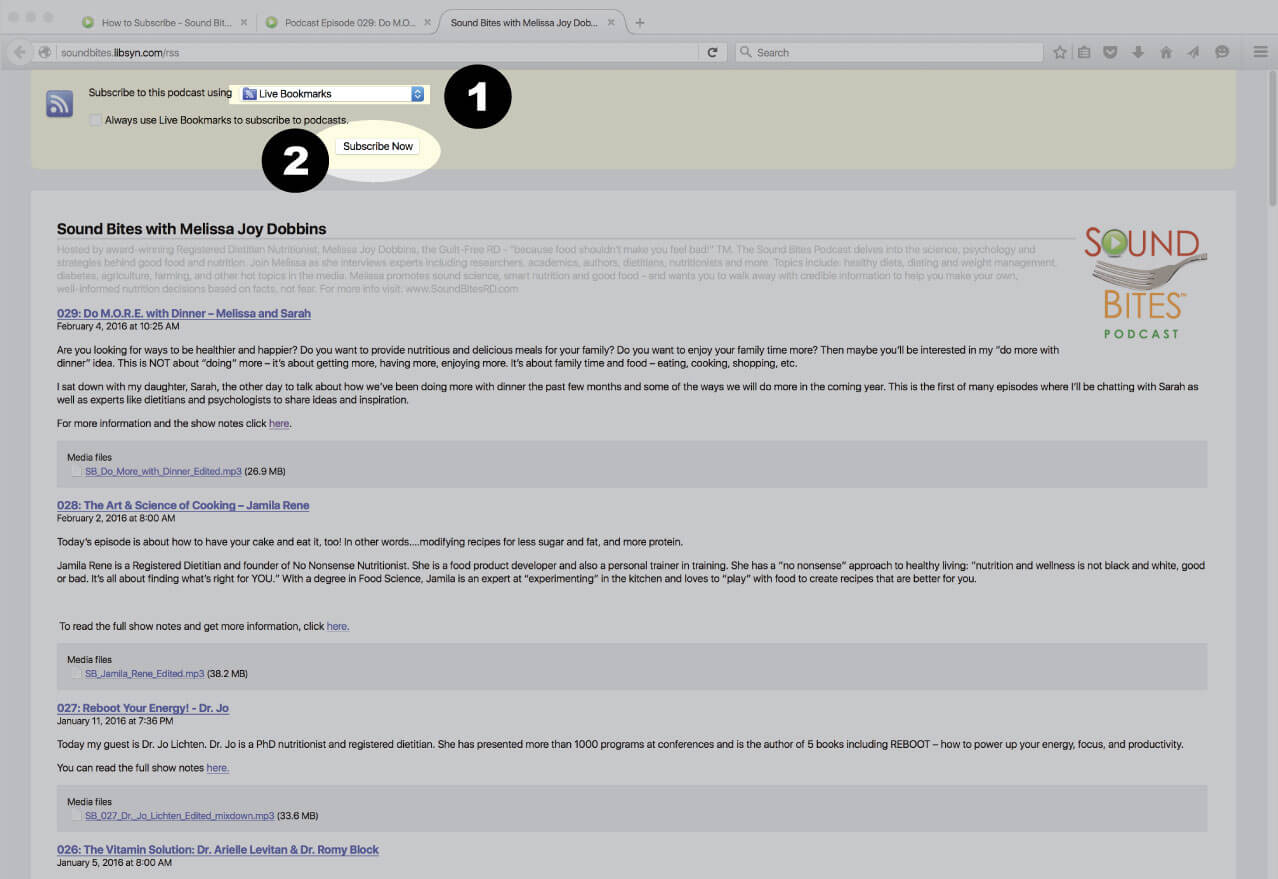
Subscribe via RSS Feed
Navigate to any podcast player . Click on the RSS feed icon.
Click on the RSS feed icon.
Click on RSS Feed
Choose which application you would like to use to receive the RSS feed
Click “Subscribe Now”
Confirm settings and subscribe.
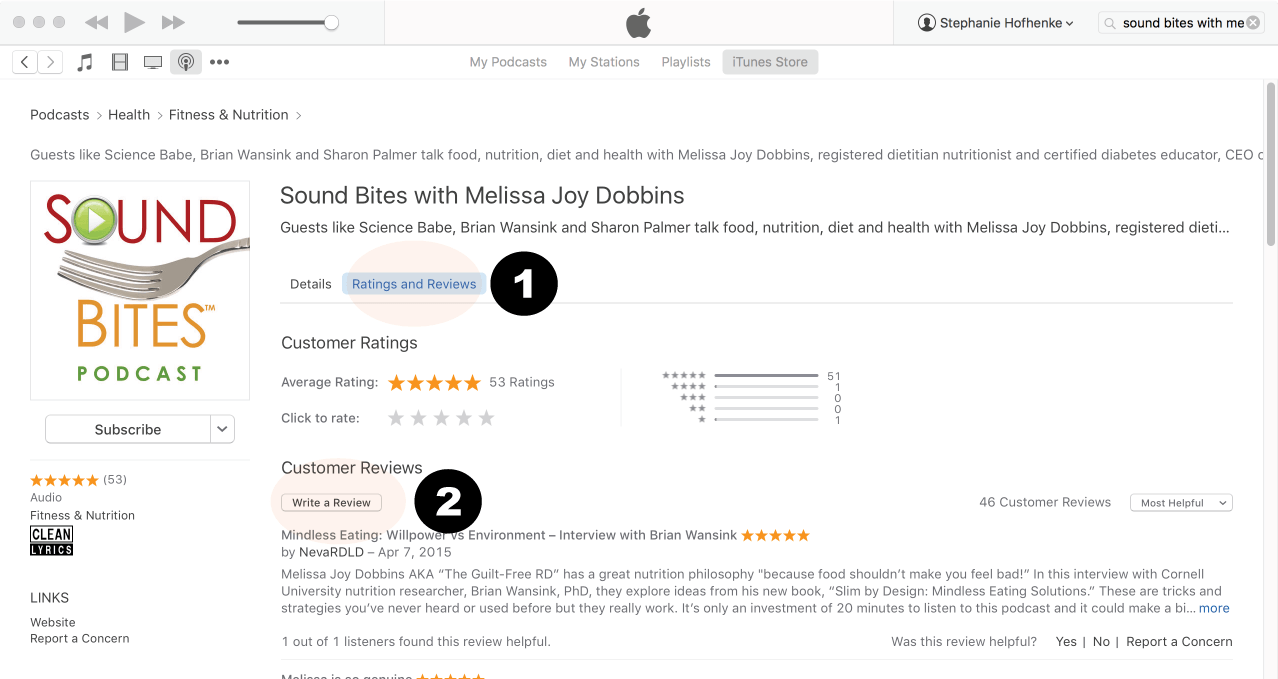
How to Review in iTunes
Open iTunes desktop application
Click iTunes Store
Click on Podcasts
Search for “Sound bites with Melissa Joy Dobbins”
Click on podcast image
Search for Sound Bites podcast in iTunes
Click Ratings & Reivews
Click Write a Review
View reviews and write your own review.
Write your review…. Thank you!
Write your review!
How to subscribe via iTunes
Click here to view the Sound Bites Podcastin iTunes, then click the blue “View in iTunes” button. This will open your iTunes application directly to Sound Bites Podcast. Click the “Subscribe” button, and your done!





 Dr. Mario Ferruzzi, PhD
 Leslie Kaplan, MD, CEDS
 Jill Castle, MS, RDN
 Heather Leidy, PhD
 Regan Bailey, PhD, RDN




















Great info
Thank you! Glad you enjoyed it!