Celebrating over 1 Million Downloads and 50,000 Free CEUs on the Sound Bites® Podcast | NEW: Get 1 years’ worth of CEUs with the new 15-CEU Podcast Course
Disclosure: This episode is NOT sponsored. Maya Feller is a paid consultant to Amy’s Kitchen.
Convenience without Compromise: What Really Matters When Choosing Frozen & Processed Foods?
Are convenience foods a problem, or could they actually be part of the solution? When it comes to frozen meals and processed foods… are we asking the wrong questions? Let’s take a look at how frozen and convenience foods can fit into a balanced, plant-forward way of eating – without compromising on nutrition. Because healthy eating doesn’t happen in a perfect world – it happens on busy weeknights, with tight schedules, and in real-life routines.
Tune in to this episode to learn about:
Common perceptions and misperceptions about frozen foods
The moral hierarchy around food
What to consider when choosing frozen and convenience foods
What to look for in meals compared to other types of products
How frozen foods can help people get more plants in their diet
How to limit fat, saturated fat, sodium and sugar content in your frozen food choices
How to increase fiber, protein and other nutrients in your frozen food choices
Resources for health professionals and the public
We all need access to safe, affordable, nourishing, culturally relevant food options. Because if food does not taste good, people won’t eat it.” – Maya Feller
Maya Feller MS, RD, CDN
Maya is the founder and lead dietitian at Maya Feller Nutrition. In her practice, her team provides medical nutrition therapy and nutrition coaching for hormone and metabolic health, cardiovascular disease, diabetes, mood disorders, developmental disabilities, disordered eating, and more. Maya believes in providing inclusive nutrition education from an anti-bias patient-centered, culturally humble approach to help people make informed food choices. Maya shares her approachable, food-based solutions with millions of people through her new YouTube Channel, and host of YouTube “Where Wellbeing Meets Flavor” where she hosts cooking demos, exclusive interviews and Q&As, her on-demand masterclasses and courses, regular speaking engagements, writing, her social platforms, and as a national nutrition expert on Good Morning America. Maya is also an Everyday Health Medical Review Expert, on the advisory board for SHAPE and Parents, as well as appearing on TODAY Show, Tamron Hall, and in The New York Times, mindbodygreen, Well+Good, Food Network, Martha Stewart, Real Simple, Good Housekeeping, Cooking Light, Eating Well, Prevention, Glamour, SELF, and more. She is the author of Eating from Our Roots: 80+ Healthy Home-Cooked Favorites from Cultures Around the World (goop Press, January 24, 2023).
Get curious about your food. Look beyond labels and focus on what’s actually in it, how it’s made, and whether it provides nutrients like fiber, protein, and plants; choose options that fit your real day-to-day life, and use tools like frozen or prepared meals to save time, reduce food waste, and stay nourished. Because a balanced, convenient meal is often a better choice than skipping meals or defaulting to less satisfying options.” – Maya Feller
Resources
Some links may be affiliate links. As an Amazon Associate, I earn from qualifying purchases.
Get all the latest information on the processed foods reports, convening outputs, upcoming expert webinars and consumer research by checking out IFIC.org or following @IFIC_Insights (on Facebook, Instagram, X, LinkedIn)
I love to see vegetables in the first five ingredients. And the reason that I’m pointing that out is because if that’s in the first five ingredients, that means that the added sugars are not in the first five ingredients. It also means that added salt is not in the first five ingredients, and it also means that the saturated and synthetic fats are not in the first five ingredients.
So, it’s a little bit of a reverse engineering where I’m encouraging folks to actually look at the ingredient list as the driving factor.
Voiceover (00:35):
Welcome to Sound Bites, hosted by registered dietitian nutritionist, Melissa Joy Dobbins. Let’s delve into the science, the psychology, and the strategies behind good food and nutrition.
Melissa Joy (00:54):
Hello, and welcome to the Sound Bites Podcast. Today’s episode is about convenience without compromise: how to navigate processed foods with some care and some nuance, and how to look beyond labels in a sense, and focus on what’s in the food, how it’s made. And like I always say, what nutrients is the food providing?
At the end of the day, how do we choose options that fit into our real day-to-day lives without compromising on nutrition?
This episode is not sponsored.
Do me a favor and click the follow button wherever you’re listening to this podcast. That’s a really great way to support the show and get notified about new episodes.
My guest today is Maya Feller. Maya is the founder of Brooklyn-based Maya Feller Nutrition, a virtual nutrition clinic, and the author of Eating From Our Roots, 80+ Healthy Homecooked Favorites From Cultures Around the World.
And we actually did an interview with Maya. I’ve got my signed copy of this beautiful, beautiful book here. Thank you, Maya.
We did an interview on this book and this topic about embracing cultural foods and flavors back in July of 2023. That’s episode 241 if anybody wants to scroll back and listen to – one of my absolute favorite episodes. So, welcome to the show, Maya.
Maya Feller (02:20):
Melissa, thank you so much for the warm welcome and for having me back. I always love speaking with you. Thank you for sharing me with your audience. It is such a pleasure to be here.
Melissa Joy (02:30):
I’m so excited to have you back. We had so much fun talking last time, and I am really interested in digging into today’s topic. I actually did a frozen foods episode recently, so that’s related to this topic and we’re kind of building on that conversation.
But I do want our listeners to know that that is episode 305. It’s called What’s In Your Freezer. And if you’re a dietitian and you’re interested in getting a continuing education credit, you can get one for that episode too.
But before we jump into our conversation today, Maya, I would love for you to share more with our listeners about your background and the work you do, and any disclosures to note.
Maya Feller (03:09):
Yeah, absolutely. So, I have a virtual practice that’s based in Brooklyn. We’re a small team of dietitians, and our main focus is the non-communicable conditions. So, diabetes, hypertension, cardiovascular disease, autoimmune conditions.
We also work with and we welcome people who identify as neurodivergent or folks that have mental health conditions or are working with mood disorders. And I find it to be very, very fulfilling. When I’m not seeing patients, another part of the work that I do is in the media. And I do appear regularly on Good Morning America as a registered dietitian talking to the nation, which is a huge pleasure and incredible honor.
And then I also do consult with food companies. So, currently, I have to disclose that I’m working with Amy’s Kitchen. So, I may infuse some of the things that I’ve learned throughout that partnership into this conversation, but of course, everything that I say here is my own thoughts and opinions.
Melissa Joy (04:13):
Yeah, absolutely. And I’m just starstruck that you’re on GMA all the time, Good Morning America. You just do such a fabulous job and I’m so glad that they keep having you back. But I think that kind of ties into a story about how you started working with Amy’s. So, I would love for you to share that.
Maya Feller (04:29):
It’s funny, people will say to me, “Oh, I want you to come on TV and talk about my brand.” And I say, “Well, number one, if you ever see me on TV talking about a brand and it does not say sponsored, then that’s something that’s actually in my kitchen.” So, it’s either in my pantry or in my refrigerator or in my freezer.
And I have been a longtime consumer of Amy’s foods. When my son was younger, I would say the bean and cheese burritos were like a staple in our freezer. He absolutely loved those. The pizza bites are still a staple. The mac and cheese bites are also a staple in our freezer. My daughter loves those as well.
But I was doing a segment and just talking about some better for you frozen options, and frozen options that are intentionally made and sourced in ways where there’s a lot of plant forward ingredients. And I talked about Amy’s, and then they reached out to me after. It was not my intention, actually.
You wouldn’t believe it, Melissa, but this had to be for sure maybe two years ago. And they did reach out and we talked about it. And I only really work with brands, like I said, that I believe have a lot of integrity, put people and planet at the forefront, and are delicious and respectful. And so, yeah, so that’s how I came to work-
Melissa Joy(05:58):
All the things.
Maya Feller(5:59):
Exactly all the things, how I came to work with Amy’s. And it’s actually a real pleasure.
Melissa Joy (06:02):
Thank you for sharing that because I think it’s important for our listeners, whether they’re dietitians or the general public, to have a little bit of a peek behind the scenes a little bit like how does that work? And I think as you’re saying, you work with brands that align with your values, basically I’m paraphrasing what you’re saying, but as do I. And I just think it’s important to talk about that.
So, like I said, this episode’s not sponsored, but you do work with Amy’s and we’re talking about frozen foods and convenience foods and processed foods. At the end of the day, we’re all using convenience, processed foods, frozen foods.
And I think it’s important to take a step back and say, okay, should we feel bad about that? Are we making the most of these opportunities? How can we feel better and get more out of our choices? So, that’s what we’re going to talk about today.
I guess I would start by asking you, what are the most common perceptions or misperceptions that you’re seeing and hearing from your clients and from your audiences with media and social media?
Maya Feller (07:03):
Yeah. One of the biggest misconceptions that I hear across the board is frozen is a step down from fresh. And there’s a few things that play into that. There’s the hierarchy around what is “good clean food.” And then I always have to ask people like, well, number one, once you start having that conversation about “good clean food,” does that mean other food is bad and dirty? Absolutely not.
But there’s this moral hierarchy around food. I think there is a wellness halo in general that people have when they think about fresh produce. And fresh produce is absolutely fine. As a dietitian, I recommend it all the time, but it doesn’t actually mean that you are a better person because you eat fresh produce. It just means that you are a person who eats fresh produce. So, I think that those are two things that come into play.
I also think that people don’t understand that for a lot of fresh produce, when you freeze it, you’re actually harvesting it at the peak of growing season, which means you’re actually locking in the nutrients at that moment. And it’s a fantastic way for every single one of us, because as we know in this country, in the US, people are not eating the recommended amount for fruits and vegetables. I know, we all know this.
Melissa Joy (08:30):
Not by a long shot.
Maya Feller (08:31):
Not by a long shot. It’s a fantastic way to actually have access to those delicious fruits and vegetables that you want year-round. And if you live in an area where there’s not a farmer’s market, there’s not an affordable grocery store, then you absolutely want to include frozen items in your weekly rotation because that just helps you up those ingredients that are so good for your body.
Melissa Joy (08:56):
Absolutely. And as you’re saying, just because you eat fresh foods doesn’t make you a better person. I’m also thinking if you’re not eating as many fresh foods, doesn’t make you a bad person. Or you shouldn’t feel bad about that. And so, we’re giving people some permission today to realize the benefits of, especially the produce, again, being harvested and frozen at the peak nutrition, because I think a lot of people don’t think about the transportation that produce goes through.
I mean, I live in the Midwest, most of the produce is not grown and raised in the Midwest (mostly California). So, there’s the transportation and our storage, how many times they’re like, oh, those berries have been in the fridge for a little while and they do lose some nutrition.
But again, we don’t want to get into like, “Oh, if it’s been in your fridge for a week, it’s devoid of nutrition or whatever.” Mostly just make sure it doesn’t go bad, eat it before it goes bad. Food waste is not good for your nutrition status.
So, Maya, there’s a lot of chatter today about processed foods and ultra processed foods, but as you and I both know, there is not an agreed upon scientific definition for ultra processed foods. And now, we’re hearing terms like highly processed foods, but especially in the research literature, which I’ve talked about on the podcast before.
But if we don’t have a uniform definition, and one research study is using this as a definition and the other one’s using a different one, then we can’t compare and it’s all over the map as far as what that word means. It means different things to different people, I’m sure.
But let’s talk about processed and reference to frozen foods, like how processed are frozen foods? Can they still be nutritious? And we talked a little bit about produce, but we’re going to be talking about other types of frozen foods too. But what might surprise people about frozen foods?
Maya Feller (10:48):
So, I think one of the biggest, surprising factors about frozen foods is that you think about a frozen meal, they’re not all made the same. Of course, you’re going to have some packages that will have an abundance of added sugars, added salts, and added fats, and that’s when we start to get into that language around being heavily processed.
And I think that’s what is surprising to the general public, is that they don’t understand the nuance between something that is close to being whole and minimally processed, because once you take an apple, for example, off the tree, that’s step one in processing. You chop it, it’s another step in processing, you puree it, it’s another step in processing.
You add sugar and a little bit of salt and maybe some fat to it, and that’s another step in processing – still an apple, but very different than the apple that you picked from the tree. Frozen foods run that same gamut.
And so, what I usually say to people is you want to become an informed consumer. And I’m sure that your listeners have heard this time and time again from the guests. You want to make sure that you actually understand whatever the packaged frozen good is that you’re picking up, whether or not the front of the package and the claims on the front actually match the nutrition facts panel and the ingredient list.
So, if something says a good source of whole grains, you definitely want to see whole grains in the first five ingredients on the back of that package. If it says no added sugars on the front of the package, you want to flip it over and the nutrition facts panel under added sugars should have a zero there in terms of the grammes.
So, for people to become informed consumers, understand that not all packaged and frozen goods are made the same. And to really understand, Melissa, what you and I both really deeply know from research, but we also understand and believe, is that frozen foods when made intentionally and that they have an abundance of plant-based products actually can be wonderful for you to consume. And they can fit into your pattern of eating without shame, without guilt, and they’re an option for you, especially if you’re busy or you have limited access. There’s nothing wrong with them. They’re truly great.
I use them regularly. I mean, I had frozen berries this morning in my smoothie. I’m not going to tell people to not do it. Pomegranate’s not in season right now, and I had pomegranate, I had cherry (also not in season), strawberries, blueberries, and blackberries. So, the frozen option for me was a great option because it gave me access to something that I wanted and nutrients that my body needs.
Melissa Joy (13:41):
Yeah, absolutely. And it’s more cost-effective to use frozen berries in a smoothie for sure. And I always say, then you also don’t need to use the ice. And it’s just a perfect ingredient for that. So, yes, the front of the label has those marketing terms and those label claims, and some have more meaning than others.
Like a qualified health claim has a specific criteria that it has to meet, and it means what it says. And then there’s terms like natural or … I don’t know, I haven’t gotten up to speed on the healthy claim, but maybe I have to do a separate episode on that.
But my point being, I just have always encouraged people to look at the back of the label where the facts are more than the marketing terms, just because it’s just less confusing, I guess. And you can say, “Okay, well, this serving of this product has this much fat, saturated fat, protein, fiber, calcium, whatever.” And then you can always compare two products as well.
But when we’re looking at, you mentioned clean eating before, and I know there was this trend for a clean label is something like five ingredients or less, and ingredients have gotten a lot of negative attention in the news lately. So, how do we talk to people about specific ingredients, fearing certain foods or ingredients or labels? How do we help people make those informed choices in a more specific way?
Maya Feller (15:13):
So, I think that as we’re talking about nutrients and ingredients, we want people to understand their own baseline. There’s a lot of bio-individuality, and I know that when people hear something like that, that sounds buzzy or trendy. I want to be crystal clear that there’s a lot of clinical language that we have used for decades that’s now getting a different spin.
So, when I say bio-individuality, I mean that there are agreed upon cut points for blood sugars, cholesterol, and blood pressure, and also of course, all of your labs, but they’re agreed upon these are the normal limits, and each of us individually, fits somewhere different within what the expectation is.
Once you know your baseline health, it is really important that you make choices that actually support your body. So, for example, if you hear, I mean, which is, remember when no fruit was trending and there was this whole thing going around the internet like fruit is bad for you, don’t have fruit, it’s got too much sugar, which is absolutely not true or clear.
Fruit has naturally occurring sugar. It also comes with polyphenols, vitamins, minerals, and you know what I mean? So, we have to put it into that context. If you’re somebody who has high blood pressure, having fruit can be wonderful because it has potassium. If you’re someone who has diabetes, then you need to think about the quantity of fruit that you have in one particular sitting and what you pair it with.
Same thing for someone who’s got high cholesterol, if you’re working with an autoimmune condition, or if you have a histamine intolerance. That’s the bio-individuality. But when it gets buzzy, then we run away with the “fruit is no good.”
And so, what I want your listeners and consumers in general to understand is that nutrients or ingredients on their own have a very different impact on each person. And if you’re going to pay attention to anything, then really, I would say be mindful and intentional about your intake of added sugar, be mindful and intentional about your intake of added salts, be mindful and intentional about your intake of saturated and synthetic fats.
Now, people might say, “Yeah, but frozen foods have those things.” But here’s the thing, when you choose an option that is better for you and where the manufacturer has really thought about those ingredients, many times that meal is actually a standalone meal, and it’s just that we’re not accustomed to having it as a meal. We think of it as a component, but it’s actually a meal. And if you have it as a meal, then it’s not going to have a significant negative impact on those additives.
So, it’s also kind of reframing our plate and thinking about, okay, well, I’ve got this thing and it’s how many servings? It’s two servings. If I have two, then I’m having two servings, or if I have one, I’m having one serving, and it goes the same thing for those individual nutrients.
Melissa Joy (18:33):
Yes, thank you. I do think that it’s important that we evaluate foods based on, yeah, is this one item? Is it a snack? Is it a meal? Because the targets are different. If it’s a meal, the amount of calories and the fat and the protein that you’re looking for and everything, those numbers are going to be larger. Well, you’re going to have a bigger allowance for calories and fat, and hopefully, be able to get more protein in a meal than you would in a snack.
So, definitely there’s pros and cons that we need to consider when choosing frozen foods and as we’re saying, different considerations for whole meals versus snacks. Can you talk to me a little bit more about what people should look for, maybe what you look for on a label, and how do we navigate all of that information without being overwhelmed and confused?
Maya Feller (19:20):
Yeah, I love that question, Melissa. So, it’s funny because I usually don’t share what I do just because I focus on food so much that I say, “Do not use me as your benchmark.”
But what I do say when people are navigating through the realities of the day-to-day is actually rather than saying, “Okay, I’m going to look at a standalone meal, I want you to actually step back and do the macro picture.” What does my overall day look like and where am I getting my fruits, my vegetables, my whole grains, my beans, my nuts, and my seeds over the course of the day?
And this is where things get really shaken up, is I encourage people to think about flipping breakfast on its head. Breakfast can absolutely be pancakes, it can be cereal, but breakfast could also be a leftover of lunch or dinner. And especially, if you’re thinking in those food groups, you could decide to wake up and have a veggie pad Thai for breakfast and be just fine. There’s nothing wrong with that. So, take that macro lens and look at the food groups and what you’re having.
When you are working with a label or a frozen or packaged good, I think it’s also important to understand the serving size. So, on that label, if it says five or six servings and you eat the entire container, then you’ve had six servings. And so, once you say, “Okay, I’ve had six servings,” and if that’s the choice that you make, then what does the rest of your day look like with regard to fitting in those other food groups?
I tend to take an additive perspective like, what can I add to my plate that’s going to provide me with nutrients, especially because I am so aware that so many people are thinking about how to stretch their food dollars and thinking about what’s the best way to get a filling nutritious meal on the table that tastes good.
And so, I’m here to say, alright, let’s reduce the pressure, let’s take off some of that stress, and how do we think about building out your pantry in a way where you’ve got stapled canned goods. So, you’ve got your canned beans, you’ve got your whole grains, you’ve got your pastas, you even have a combination of jarred sauces that you can take your frozen vegetables from the freezer and put in, or you can start with a base of a meal.
You could do, for example, like Amy’s mac and cheese bowl, which my son loves, and it has broccoli in it, and he replicated it himself because they don’t have Amy’s where he lives. He lives overseas. But you could start with something like that and then say, well, what goes really well with it? Maybe you want to round it out with some more sauteed veggies, or you want to do it with a little bit of salsa on top, salsa verde.
So, it’s like I want people to create meals that are satisfying and create a pantry and a kitchen that actually allows them to do that without getting stuck in the minutia of calorie counting and macros counting.
Melissa Joy (23:27):
Yeah, so two things come to mind when you’re talking, and one is the number of servings that we’ve been talking about. So, when I was a supermarket dietitian and did a bunch of store tours – I mean, I’ve always done store tours, but especially as a supermarket dietitian, I did that a lot, especially diabetes tours. And that was always the most important thing.
And I’m like, look, this is the serving size. That doesn’t mean that’s your portion. Maybe your portion is two servings, that’s okay. Servings portions, different things, we just need to do the math and kind of take the guilt away from that. So, that’s like the main thing. These numbers on the package refer to this serving size.
And again, it could be something, well, you’re having a smaller meal or a bigger meal, or I don’t need as many calories as my son (and calories, whatever, all the other stuff) my growing teenager. So, we’re going to be looking at different things on those packages, but then also you mentioned something that I think a lot of people don’t think about is adding stuff to a frozen meal or a frozen pizza.
I saw one of our colleagues had posted about adding some more veggies or something to a frozen pizza and like rounding out that meal. I had a mac and cheese and broccoli. I think it was like a fettuccine broccoli, like the chicken fettuccine broccoli frozen thing for lunch not too long ago. And it had a decent amount of broccoli, but I had some leftover broccoli. So, I just added that, I’m like why not, add some more.
So, there’s just a lot of different ways that we can round out those meals. And as far as whatever numbers people are looking for, it is going to depend on what their health goals are. Like you said, if you have diabetes, maybe you’re going to be looking more for the total carbohydrate.
And yes, we all want to limit our sugar intake, but you can have a reasonable amount. And I’m constantly checking the fiber content and the protein content and the calcium content. So, you can always check those things.
Are there other things that you recommend along those lines across the board, what would be helpful for people when they’re choosing these foods, whether it’s rounding it out or what to look for on labels?
Maya Feller (25:35):
I am a big ingredients person, I really always recommend more plants, the better. Melissa, you called out fiber. I think in the US, people are getting about 10 grams of fiber per day, which is a far cry from 25 or even 30.
Melissa Joy (25:53):
Yes.
Maya Feller (25:54):
So, I love to see on that ingredient list, whole grains, I love to see beans, I love to see vegetables in the first five ingredients. And the reason that I’m pointing that out is because if that’s in the first five ingredients, that means that the added sugars are not in the first five ingredients. It also means that added salt is not in the first five ingredients, and it also means that the saturated and synthetic fats are not in the first five ingredients.
So, it’s a little bit of a reverse engineering where I’m encouraging folks to actually look at the ingredient list as the driving factor. I think that is one of the reasons, honestly, why I do like the Amy’s meals so much, is because you’ll see a lot of plant-based ingredients. And when I’m working with folks, I can almost guarantee, maybe except for some of the people that have IBS or IBD, we modify the types of vegetables that they consume.
But for most people, I’m always saying, where can you add a bean? Where can you add a veggie? Where can you add a whole grain? And to be clear, I have no issue with white rice whatsoever. It’s a fantastic vehicle for adding other veggies and proteins to it.
But that is definitely something that I encourage people to get comfortable with, is that ingredient list and understanding that it is in order of abundance. So, whatever the first ingredient is, is the majority of what is in the food. And that’s something that I really like.
And then of course, I will always look at the overall fiber content because I feel like goodness gracious, now, what we know about the health of the gut microbiome and how it interacts with the rest of the body, I feel like for sure, we can all stand to have significantly more fiber and fiber coming from diverse plant sources.
So, I would definitely look at the fiber. And I would say depending on where you are in the life cycle and also where you are with regard to your physical activity and strength-based work, for sure, I want to look at the protein.
And so, those would be two things. I’ve already mentioned the added sugars, the fat and the added salt, but I would do the ingredients first. That’s just my big flip it on its head. And then I’m definitely looking at fiber and I’m looking at protein.
Melissa Joy (28:24):
I want to talk a little bit more about how frozen foods can help with plant forward diets and filling those fiber and protein gaps. Are there some specific tips or general ideas that you have for people to … how frozen foods help them get more plants.
I think it’s probably going to surprise people like, “Gee, if I’m trying to get more plants, that might be an easy way to do it.” So, more plants, more fiber, more protein, talk to us how frozen foods can help with that.
Maya Feller (28:52):
So, I’ve said this before and I feel like I even said it on the news. I’m like you don’t have to become a vegan or a vegetarian, but from time to time, I want you to think like a vegetarian and have a meal that is just an abundance of plants. And frozen foods really can help you do that, where you can choose a vegetarian option, and that will really be a wonderful fiber boost.
I actually did a little carousel on Instagram about Amy’s food specifically, but this applies to all frozen foods, like how to bridge that fiber gap. And there’s so many options. Let’s say you have a bean chili, that can be way above five grams of fiber.
I mean, so it’s pretty awesome if you think about it and who doesn’t love a three-bean chili with a stone ground corn tortilla chip, a little bit of Pico de Gallo, some jalapenos, some sour cream and some cilantro on top with a squeeze of lime. I mean …
Melissa Joy (29:57):
Yeah, okay.
Maya Feller (29:58):
(Laughs) Right?
Melissa Joy (29:59):
You’re making me hungry.
Maya Feller (30:01):
I know, I know.
Melissa Joy (30:02):
Can I have that for breakfast?
Maya Feller (30:03):
Absolutely. So, that’s a way that I think that frozen foods can help folks. And the way that we both started to salivate and say, “That sounds delicious,” it doesn’t have to be a sad desk lunch. There’s a lot of wonderfully flavored options that actually span the globe with regard to cuisine.
So, you can have a little bit of Thai inspired food. You might even be able to get some Tex-Mex inspired food. There’s for sure comfort American inspired foods. There’s so much happening in the frozen food section that can be a way to take you around the globe without getting on a plane, and also help you increase your veggies. So, I would say be adventurous and just try different flavors and see what you like.
Melissa Joy (31:00):
Yeah, I think it’s a really safe way to be adventurous. You’re not investing in a jar of spices, different spices, which I encourage people to do. But if you don’t even know if you like that yet, you can get one frozen meal that has that Indian influence or like you said, Thai. There’s a lot of different options in there that you can see what flavors and spices you like, and then that might inspire you to cook that way or something. So, I think it’s a really great way to do that.
I know this is something we talked about in my frozen foods episode earlier about frozen foods helping with food waste. Is there anything you wanted to say about that? Because I think that food waste is still a really important topic that we need to keep front of mind, especially as grocery prices increase, that food waste helps you reduce your money that you’re wasting because you’re not throwing food away.
Maya Feller (31:51):
It extends your shopping dollars. And I say this to people a lot. So, if you have the emotional bandwidth, the financial flexibility and the time to purchase a bundle of fresh foods, process them, cook them, and eat them, then by all means do so. But just know that it takes quite a bit of activity to do that. I’m not discouraging anyone from doing it.
However, if you have a frozen meal in your refrigerator, the shelf life is significantly longer than a bundle of fresh produce, and you will eat it when you’re ready to eat it, as opposed to being on a time crunch.
The other thing is that portioned meals also tend to be eaten in their entirety. So, if you buy something that’s a single serve, most of us tend to eat that single serving and we’re not dealing with Tupperware and reheating something within 72 hours or having to toss it. So, that’s a nice way to, as you said, stretch those shopping dollars because you’re eating what you prepare.
And what I found with a lot of my patients, Melissa, is that they have the best of intentions because like I said at the beginning, we have this whole moral hierarchy around how we eat. So, they go and they buy an abundance of things that they intend to cook, and either they cook it and they don’t eat it, or they don’t ever cook it, and it becomes compost.
So, I really do think, like I said, building that pantry and that freezer and your refrigerator in a way that allows you to have what you need, not overspend and not waste can be super helpful.
The other thing too that sometimes I recommend for folks is when you’re making that list of what you want for the week, think about how you can balance those shelf stable items with the fresh as a way to, A, cut your cooking time and your prep time, but also keep you within a real budget because like you said, food is really expensive right now.
Melissa Joy (33:57):
Yeah. And the other thing that I always think about too is the built-in portion control as well. So that’s also nice. So, I would really like to hear what are some of your favorite frozen foods.
Maya Feller (34:12):
So, I have to do my favorite frozen foods, and then I also have to do what’s in my freezer because it’s not just me, but it’s also my kids, which is a huge deal.
So, me personally, some of my favorite frozen foods are frozen berries, frozen veggies. I also like frozen meals that are pre-portioned. I love a Mexican casserole (laughs), and then I love to add flavors to it. So, those tend to be among my favorites.
And then for the kids, my daughter is a lover of plant-based chicken nuggets. That’s like a staple in our house, both of my kids – don’t ask. They are not there for a real chicken nugget or like a chicken-chicken nugget, but they are there for a plant-based chicken nugget. And altogether, we love a frozen pizza big time. And then I actually put a whole salad on top of my frozen pizza.
[Laughter]
Melissa Joy (35:17):
I’m thinking like Arugula type.
Maya Feller (35:20):
Or even like a Caesar salad, like a margarita, and then you just put an entire Caesar salad right on top of it. So delicious.
[Laughter]
Melissa Joy (35:28):
You mean a margarita pizza?
Maya Feller (35:30):
Yeah, yeah, exactly. Yes. A margarita pizza.
Melissa Joy (35:32):
Was just like I’m drinking a margarita, that salad’s just going right on top of the pizza.
[Laughter]
Maya Feller (35:36):
Yeah, yeah, yeah. A margarita pizza topped with a Caesar salad. That’s a huge one in our house. It’s funny, everybody knows me, I tend to cook the majority of my food, and I am a big chef’s helper person.
So, I have frozen pureed, garlic, and ginger. So, I do a real combination … it’s already made, Melissa, it’s life-changing. I’m a big, how do I make my fridge, my pantry, and my freezer work for me? And if I know that I’m going to be in a really busy moment, then I’m getting a couple of extra frozen momos or dumplings, or things like that, because then I want to make sure that I have them at the ready. But yeah, those are among my favorites.
Melissa Joy (36:27):
Well, that’s interesting, the garlic and the ginger you said, in the previous frozen foods episode with the guest Jennie Norka, she mentioned frozen chopped onions. And I was like, “What?” Now, I’ll admit, I haven’t been able to find them yet, but I’m looking for them because I know they exist and I need these. I need these.
Maya Feller (36:48):
I was working on a project with some recipes from my cookbook and we had to use some frozen avocados, which was totally new to me. And I was like, “Of course.” So, it’s perfectly ripe, and then flash frozen. Yeah, I know.
Melissa Joy (37:02):
I’ll look for that too. Very cool. Some of my favorites, which I shared in the other episode is the frozen fish cod that you can cook from frozen. I’m like that’s got me written all over it. I forgot to thaw it.
Maya Feller (37:15):
Oh, I totally forgot about the frozen seafood. Bring it, the whole shrimp, all of it.
Melissa Joy (37:21):
Yeah, same here. The cooked frozen shrimp. You do have to thaw that, but then I just sauté it up or whatever. And yeah, so those are two of my favorites. What else are my favorites?
I always have little frozen dinners, the kind for me, the kind for my son, because he needs more calories and everything. The other frozen pizzas for sure and the frozen dumplings, things like that.
Maya Feller (37:43):
Yeah, yeah.
Melissa Joy (37:44):
Yeah.
Maya Feller (37:45):
I think that’s the thing, there’s a variety. And the truth is that it’s like if you go (I always say this, even about my milk) into my fridge, you’re going to see three different types of milk. And that’s what keeps it for me interesting and also tasty.
So, if you go into my freezer, you’re going to see everything from a frozen meal to single ingredients frozen.
Melissa Joy (38:06):
For sure. Yeah, and I just think, especially you’re so culinary, I’m still working on that myself. But for people who just don’t feel like they’re Maya Feller chef status, then they can get some really nice frozen meals that, like we said, have all those flavors. And you mentioned variety. Variety is important for us to get a variety of nutrients in our diet. So, that’s always important as well.
As we’re wrapping up, we’ve got some resources to share with our listeners, but is there any more specific tips or examples that you want to encourage people to try with frozen foods to save time, boost nutrition, or just how convenience foods can help prevent skipped meals or less-balanced meals?
Maya Feller (38:50):
It’s like you were reading my mind. I was actually going to say exactly that, Melissa. So, one of the things that we know over the course of a day is that people tend to not have breakfast for lack of time.
There’s so many amazing frozen breakfasts like tofu scrambles. I mean, I love a tofu scramble, or even a breakfast enchilada or a breakfast burrito that really does give you protein, fats, and carbohydrates in a really nice balanced package that’s very nutrient-dense.
And so, think about the times in the day that are the hardest for you to actually prepare a meal and consider inserting a frozen meal there, specifically one that is thoughtfully crafted, has a lot of vegetables and plants, Amy’s or whatever you have access to.
But I do say that’s a great way to make sure that you’re getting all the nutrients that your body needs and that you’re having meals on a regular and consistent basis.
Melissa Joy (39:56):
Okay, great. Thank you. Before we wrap up, you’re going to be launching a new membership of some sort. Do you want to share that with our listeners?
Maya Feller (40:05):
Oh yeah, I’m so excited about this. So, this is in response to the need for credible evidence-based nutrition. So, we’re launching a membership in May, which is very exciting, and it’s going to be called The Dish. So, it is a virtual space for people to come together and be in community, but also get either group nutrition education or content only.
And the thing that’s super exciting about this, Melissa, is that folks can use their HSA or FSA dollars for the group nutrition education portion because there’s MNT there. And the content only portion of the membership is not going to be more than $12 a month for the subscription. I’m aiming for much, much lower.
In fact, yeah, I have a lot of desires, but I’m very excited because we’re going to keep it very, very affordable. But we are launching in May and we’re going to have these two components where folks can drop in and come to the table, and have these weekly sessions with dietitians about diabetes, hypertension, autoimmune, kind of current nutrition trends navigating the landscape. And it’s going to be really affordable. And yeah, I’m so excited.
Melissa Joy (41:23):
Okay, wonderful. And people can just go to mayafellernutrition.com to stay abreast of any updates regarding this.
Maya Feller (41:32):
Yeah, absolutely. So, you can head to my website, mayafellernutrition.com. We’ll also have it up on my Instagram in highlights and in our link where you can … that’s Maya Feller RD, sign up. I’m actually really excited about this because it is needed. And gosh, folks are so confused right now with all the conflicting information.
Melissa Joy (41:55):
Yeah, there’s a lot out there, and I’m so excited to hear about this new initiative that you’re working on. And I will put links to all of the stuff that we talked about, your website, your Instagram. You have a couple of other links to share with people, your cookbook.
And then we also have some Amy’s links following them on their website and social media as well. Maya, thank you so much for coming on the podcast again and talking about real food, real lives, and how these frozen foods can really help us boost nutrition. And we don’t need to feel guilty about that.
Maya Feller (42:32):
That’s right. No shame, no guilt. Thank you so much for having me, Melissa. It’s always a pleasure to see you.
Melissa Joy (42:38):
Oh, I hope I get to see you in person sometime soon. And for everybody listening, if you liked this episode, share it with a friend. Tell someone about the podcast and click that follow button and support my show. And as always, enjoy your food with health in mind and a few frozen foods. Till next time.
[Music Playing]
Voiceover (42:58):
For more information, visit soundbitesrd.com. This podcast does not provide medical advice. It is for informational purposes only. Please see a registered dietitian for individualized advice.
Music by Dave Birk, produced by JAG In Detroit Podcasts. Copyright, Soundbites, Inc., All rights reserved.
LISTEN, LEARN AND EARN
Listen to select Sound Bites Podcasts and earn free CEU credits approved by the Commission on Dietetic Registration (CDR) for registered dietitian nutritionists and dietetic technicians, registered. Get started!
Get Melissa’s Sound Science Toolkit here!
Partnerships:
Sound Bites is partnering with the Association of Diabetes Care and Education Specialists (formerly the American Association of Diabetes Educators)! Stay tuned for updates on the podcast, blog and newsletter!
Sound Bites is partnering with the International Food Information Council! Stay tuned for updates on the podcast, blog and newsletter!
Sign up for my monthly newsletter and episode eblasts so you never miss an update!
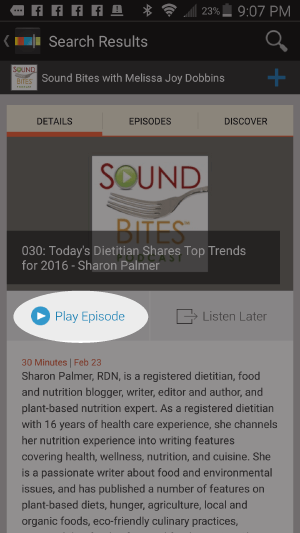
Listen on Stitcher (Android)
Install the Stitcher App
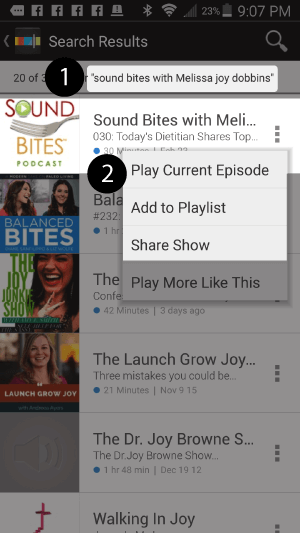
1. Search for “sound bites with melissa joy dobbins” 2. Choose Play Current Episode or Add to Playlist
Choose “Play Episode”
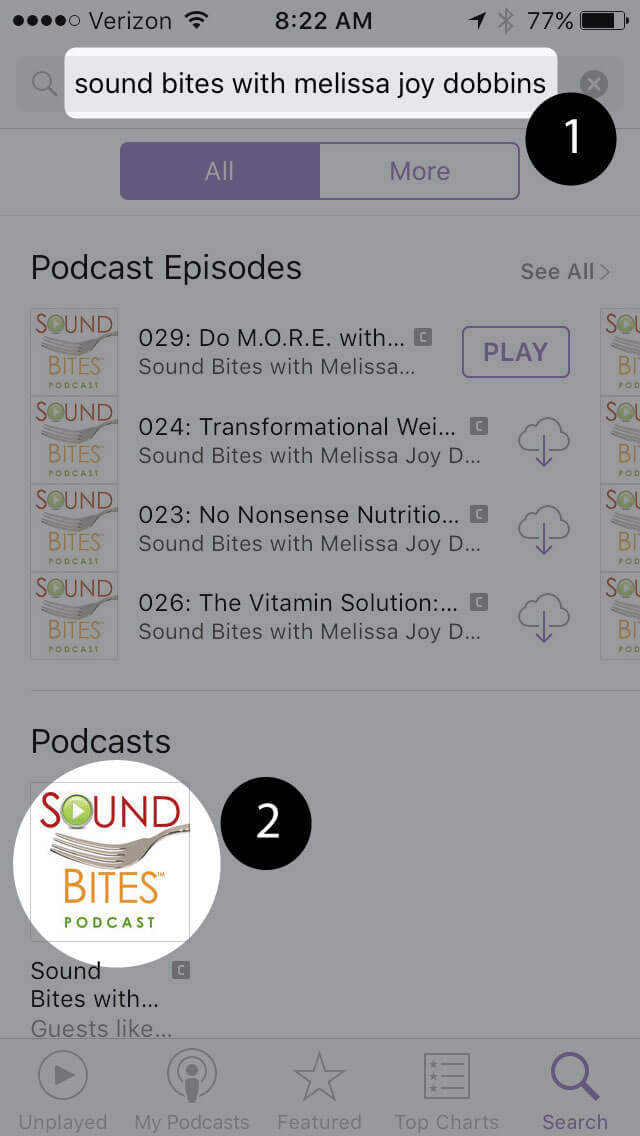
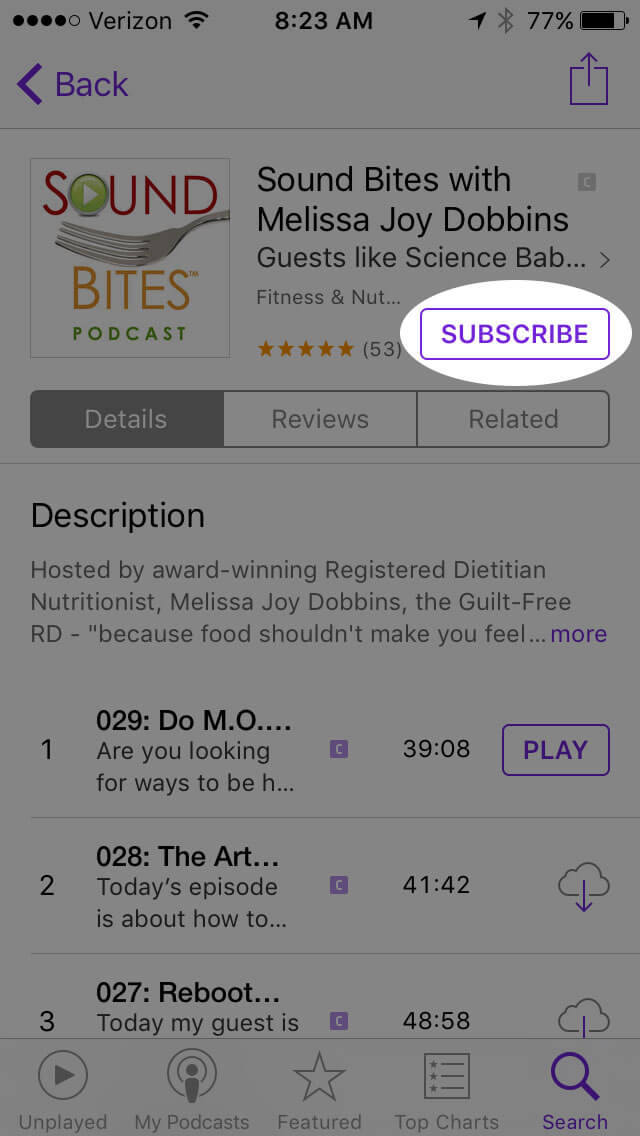
Subscribe & Review on iPhone
Open the “Podcast” app on your iPhone
Search for “Sound bites with melissa joy dobbins”
Open the podcast and click “Subscribe” and your done!
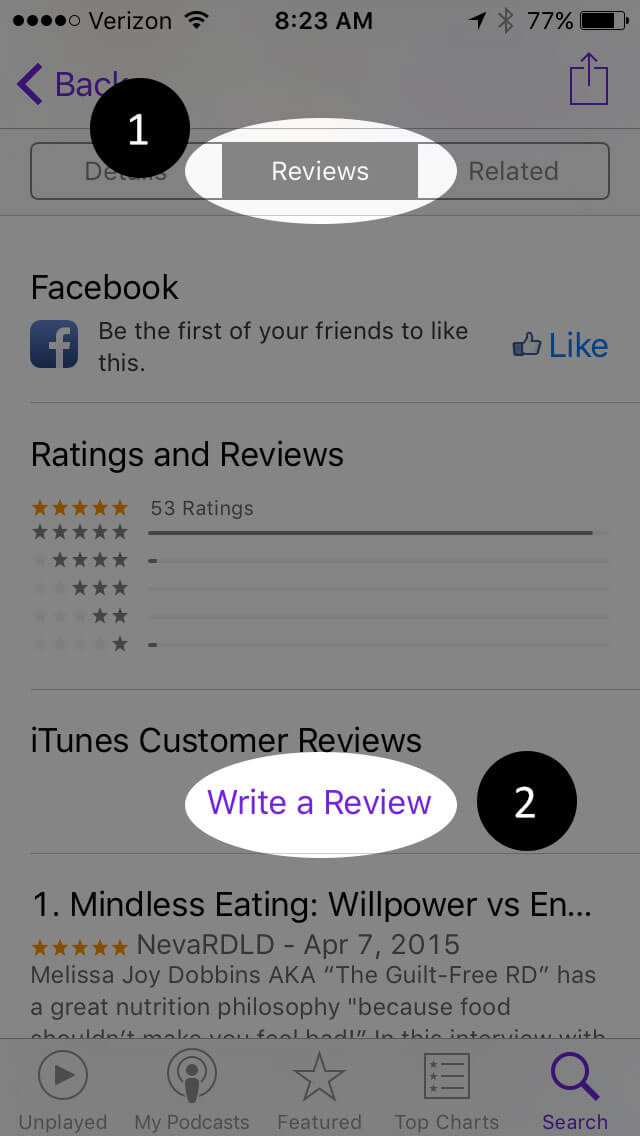
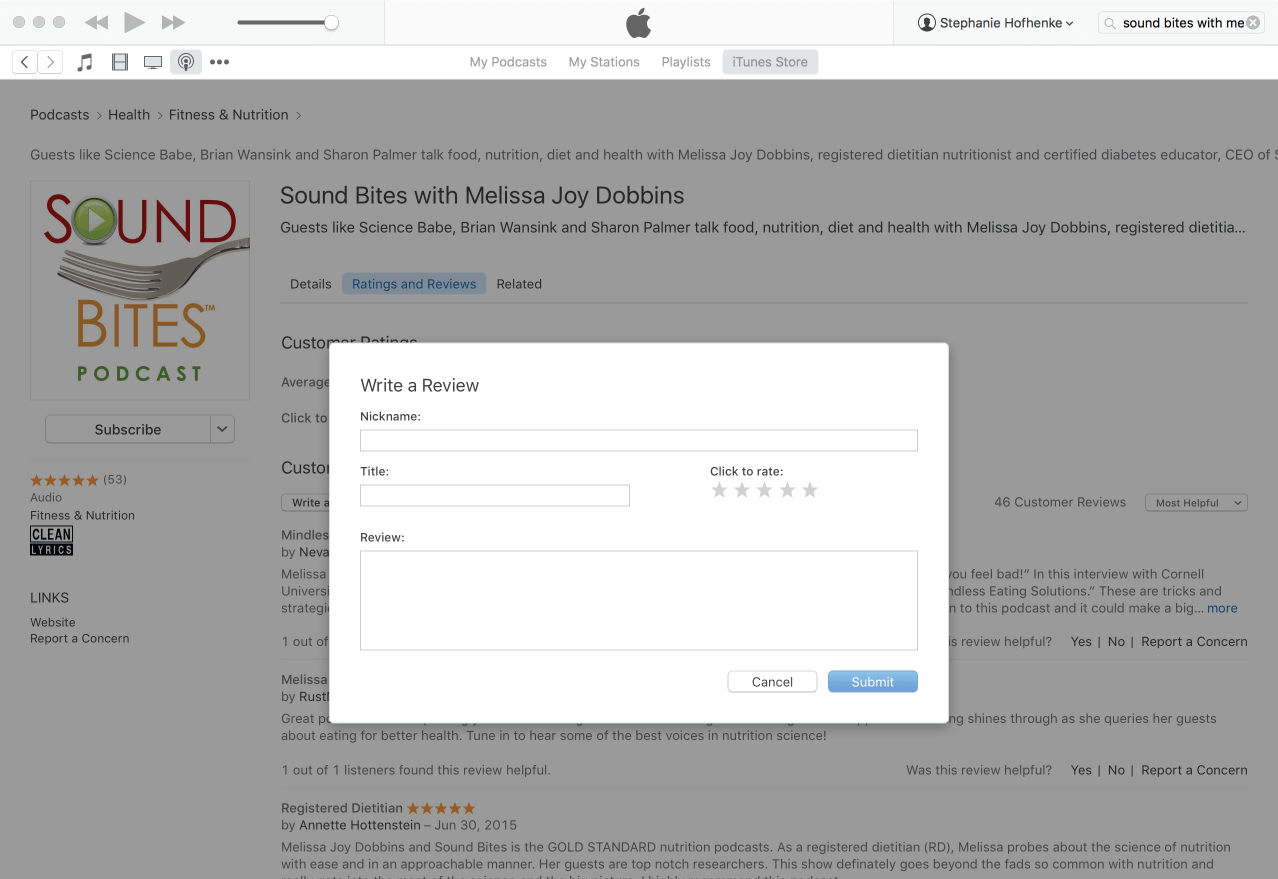
Write a Review
Click “Reviews”, then “Write a Review”.
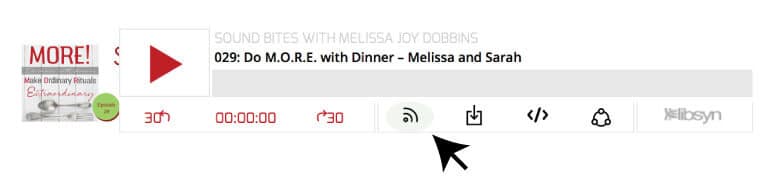
Subscribe via RSS Feed
Navigate to any podcast player . Click on the RSS feed icon.
Click on the RSS feed icon.
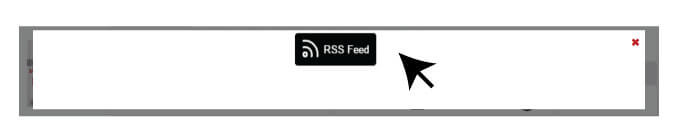
Click on RSS Feed
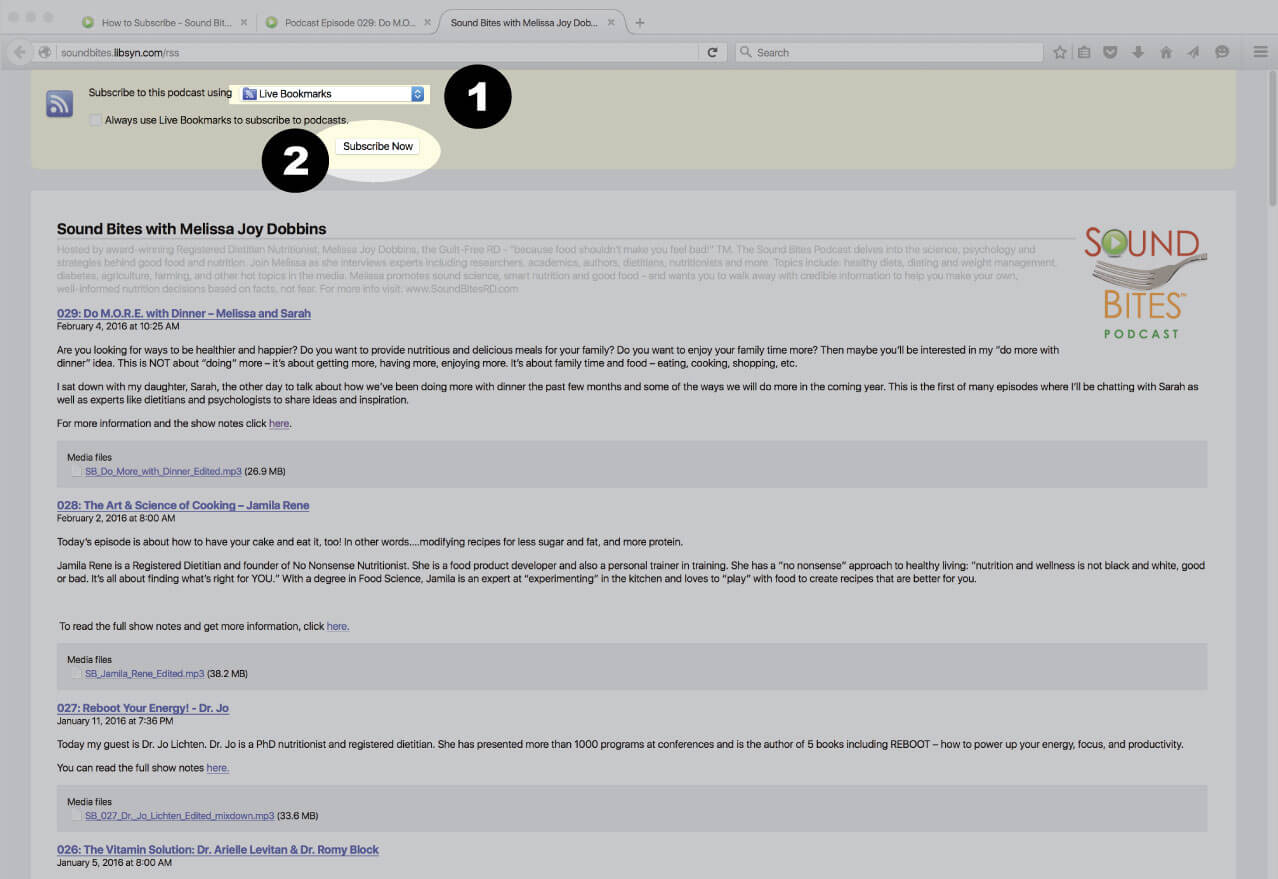
Choose which application you would like to use to receive the RSS feed
Click “Subscribe Now”
Confirm settings and subscribe.
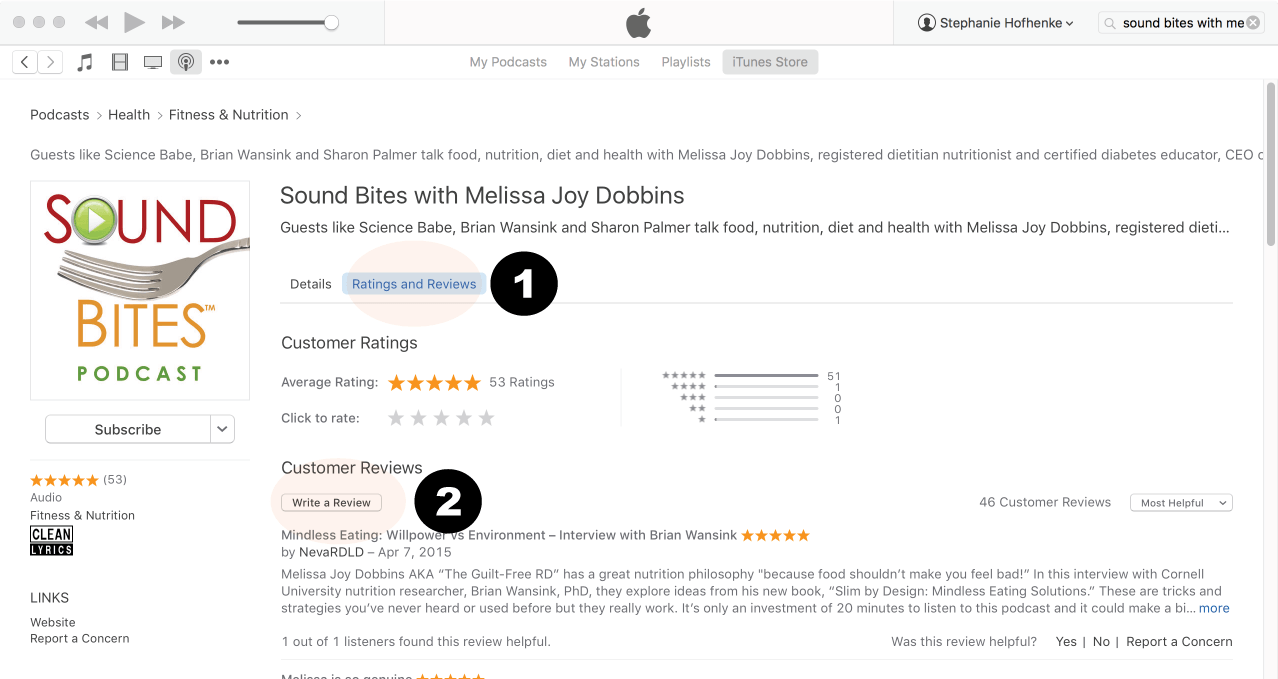
How to Review in iTunes
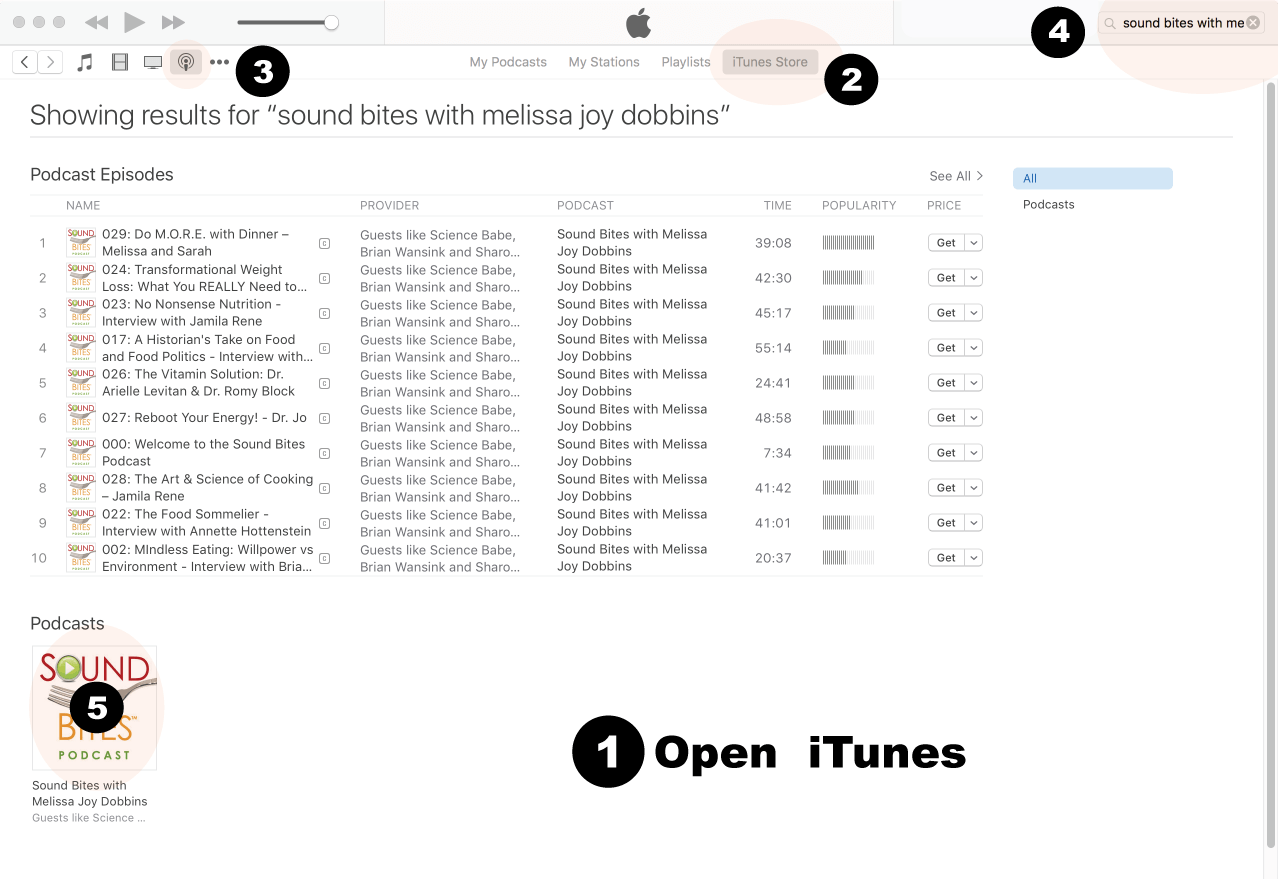
Open iTunes desktop application
Click iTunes Store
Click on Podcasts
Search for “Sound bites with Melissa Joy Dobbins”
Click on podcast image
Search for Sound Bites podcast in iTunes
Click Ratings & Reivews
Click Write a Review
View reviews and write your own review.
Write your review…. Thank you!
Write your review!
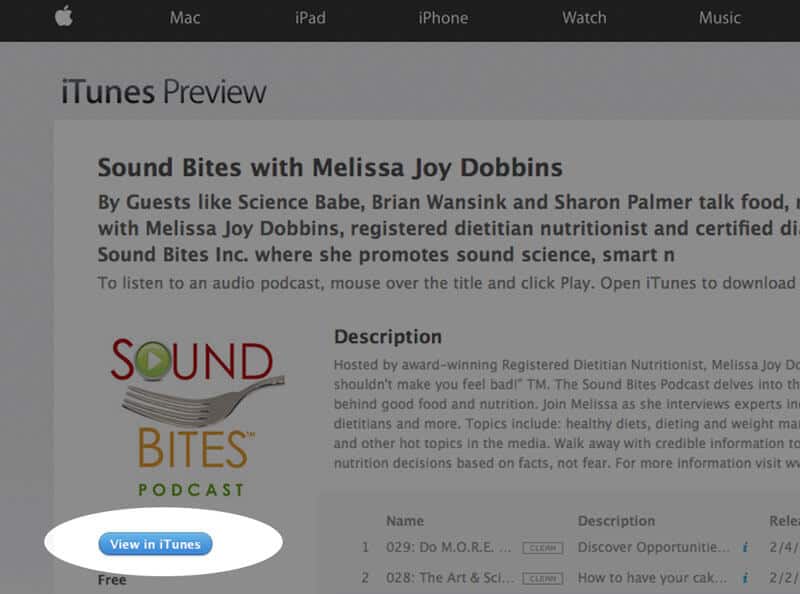
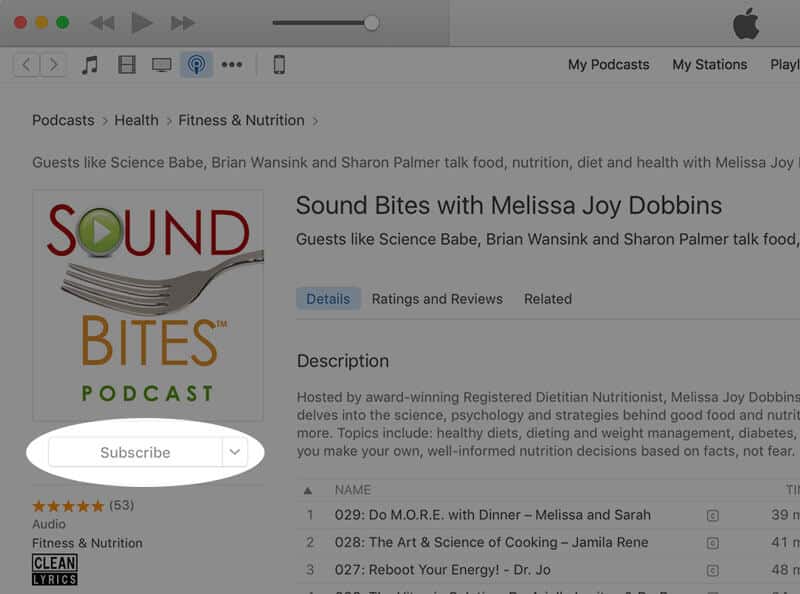
How to subscribe via iTunes
Click here to view the Sound Bites Podcastin iTunes, then click the blue “View in iTunes” button. This will open your iTunes application directly to Sound Bites Podcast. Click the “Subscribe” button, and your done!