Celebrating over 1 Million Downloads and 50,000 Free CEUs on the Sound Bites® Podcast | NEW: Get 1 years’ worth of CEUs with the new 15-CEU Podcast Course
Food Science on Social Media: Fear, Facts, and the Fight Against Misinformation
From viral reels warning about ‘chemicals in your food’ to influencers claiming the food industry is hiding the truth, social media is full of strong opinions about what we eat. But how much of this messaging is grounded in real science, and how much is driven by fear, confusion, or misinformation? In this episode, we’re diving into how food, food science, and the food industry are portrayed online and hearing from an expert who’s working to bring clarity, context, and credibility back to the conversation.
Tune in to this episode to learn about:
the raw milk recall from Ballerina Farm
the David Bar controversy
how some companies are profiting off your fears of the food industry
how and why misinformation spreads on social media
how credible experts can address misinformation online
how to approach mythbusting without amplifying myths
promoting evidence-based, accurate info in a clear and relatable manner
handling haters effectively on social media
short form vs. long form online content
what changes in the food industry may improve food science communications
resources for health professionals and the public
Hydroxide
Hydroxide is a food scientist with a B.S. in Food Science and Technology and over 7+ years of experience in the food industry. She has worked in all kinds of environments: meat processing plants, chocolate factories, fermentation rooms, tech startups, and so much more. She has gained over 400k+ social media followers across platforms in less than a year, and is on a mission to prove that the words “food” and “science” when together, are not to be feared.
Resources
Some links may be affiliate links. As an Amazon Associate, I earn from qualifying purchases.
I’ve worked in meat processing plants where I would have eaten off the floor there. It was wonderfully clean, well-run. We are so separated from the making of our food still, and that’s a big thing. And like I said, like a white space for these “natural” food companies which by the way, still use food processing.
Their marketing is just so much more effective because people who feel like they’ve been hurt by very real things that happen in the food industry, it’s like you’ve been damaged by these products being sold, and the solution is to buy my products that are being sold.
The power of the purse is very real, but we also need to understand that Nestle and I don’t know, a small organic food company, they have the same KPIs at the end of each quarter, which is to make money.
[Music Playing]
Voiceover (00:58):
Welcome to Sound Bites, hosted by registered dietitian nutritionist, Melissa Joy Dobbins. Let’s delve into the science, the psychology, and the strategies behind good food and nutrition.
Melissa (01:23):
Hello, and welcome to the Sound Bites Podcast. Today’s episode is about food science and the food industry.
From viral reels warning about chemicals in your food to influencers claiming the food industry is hiding the truth, social media is full of strong opinions about what we eat, but how much of this messaging is grounded in real science, and how much is driven by fear, confusion, or misinformation?
In this episode, we’re diving into how food, food science, and the food industry are portrayed online. And we’re going to hear from an expert who’s working to bring clarity, context, and credibility back into the conversation.
And this episode is not sponsored, but this should be a video episode if the tech gods work with us today.
So, if you want to watch the video episode, you can hop over to YouTube. And the easiest way to do that is to go to my website at soundbitesrd.com/podcast, click on the podcast show notes, and you’ll see a way to listen on Spotify, Apple, and there’s a YouTube button there as well. So, check that out.
And also, do me a favor and click follow or subscribe wherever you are watching or listening. That’s the best way to get updates on new episodes and to support the show.
My guest today is Hydroxide. Hydroxide is a food scientist with a BS in food science and technology and over seven years of experience in the food industry. She has worked in all kinds of environments, meat processing plants, chocolate factories, fermentation rooms, tech startups, and more.
She has gained over 400,000 social media followers across the platforms in less than a year. And she’s on a mission to prove that the words food and science when together are not to be feared.
Welcome to the show, Hydroxide.
Hydroxide (03:21):
Happy to be here. Yay, I’m so excited.
Melissa (03:24):
So, we met at the IFT FIRST, Institute of Food Technologists FIRST conference last summer. And you were on a panel speaking and you’ve been on my list ever since. So, I’m just really excited to have you on the show.
Of course, I always want my listeners to learn more about my guests. So, if you could share a little bit more about your background, maybe like what got you interested in food science, that would be great.
Hydroxide (03:50):
Yeah, of course. So, I think a lot of people don’t know that food science even exists. The joke in our industry is that everyone thinks we’re either chefs or dietitians, and we’re kind of neither but we can also be kind of both, so it’s a little bit confusing.
But for me, I remember nutrition was something I was really interested in in high school. I think I really loved the application of science with food, and I think nutrition was sort of my gateway drug, I guess, into that, so to speak.
So, as I was learning more and more about nutrition and sort of diving deep, I remember I was reading this book. It’s like the early 2000s book Eat This, Not That, and it was this book where you would basically see different fast foods and what the best choice was. And I remember seeing (I think it’s for McDonald’s or something) like a quarter pounder was a better choice than one of their salads.
And in my head, I was like, “How is that possible?” Like salad versus burger. I feel like salad is always better. So, I started learning a little bit more about food chemistry and the reasons why these building blocks sort of create what we see and eat on a daily basis.
And when I was touring a lot of universities, I was at a land-grant university, typically their ag program had a dietetics program, as well as a food science program. And I think when I saw food science, I was like, “Yeah, this is a little bit more of what I’m aiming to do. It’s a little bit more of the application of food rather than the application of clinical practice.”
Melissa (05:23):
Nutrition, right. And just to clarify, the salad versus the burger issue, it’s not the lettuce and the veggies, it’s the stuff you put on it, like the salad dressing and everything.
I love that because I remember that was one of my big aha’s too. And I’m like this is very counterintuitive sometimes, and we’re supposed to be using common sense with food. But also, you have your stage name, if you will, maybe alias, moniker or whatever — why Hydroxide?
Hydroxide (05:51):
A lot of reasons. It’s kind of an anagram of my real name, and I also just — can you cuss on the show?
[Laughter]
Melissa (06:02):
I have to mark it explicit.
Hydroxide (06:04):
Okay, yeah, yeah, yeah. Because for me, I thought it was kind of funny. It could be like a basic [**guest cussing**] basically because hydroxide is a basic molecule on the pH scale. I always like to be a slightly, I don’t know, what’s the word? Not effervescent, but yeah, just try to add a little humor to what I do.
Melissa (06:25):
I like effervescent, very much so. Total side, like comment, we both have a background in dance. And I love the pirouette you did in your protein PDCAAS video by the way (laughs).
Hydroxide (06:40):
Thank you. It was very bad, but it was good enough.
Melissa (06:42):
It was good. It was good. So, I’m on the board of a dance company and effervescent is one of our new pieces that we’re working on, so isn’t that interesting. We have so much in common.
Okay, so thank you for the background, and that’s why I said stage name too because with your background in arts, I thought that might be more apropos than a moniker or whatever.
But like I said, we met at the IFT FIRST meeting and I saw you on a panel. You have been very successful at communicating about food, food science, the food industry, and I’ve especially enjoyed your Instagram reels and your YouTube videos.
So, just excited to have you on to talk today about all things like food, science, nutrition, social media, to share some insights with my listeners today, which as you know, my audience is a mix of health professionals, dietitians, but also the general public.
And I think you might have a mix of audiences as well, so we can talk about that, like speaking to both audiences in that sense, sometimes is a little challenging. So, you clarify that you’re a food scientist and a food industry professional, not a healthcare practitioner. Is there anything you want to say about that before we go any further?
Hydroxide (07:54):
Yeah, I think anytime I reference health and science, it’s from my experience as a scientist, not necessarily my experience as someone applying health sciences to real people. Because I work with the food itself — nothing I say is necessarily medical advice. But I try to keep it diligent in terms of researching health information, because, as you know, it’s hard to separate food and nutrition, they don’t exist in a vacuum.
And I would say as a food scientist, if anyone listening is also a food scientist, unfortunately, we do have to know a lot of nutrition information, because a lot of people will ask us about that stuff, so it’s best to just be equipped with the best science possible, and listen to our wonderful dietitian friends.
Melissa (08:43):
Thank you. Well, likewise, a lot of people don’t realize how much chemistry dietitians have to take and I wore my chemistry t-shirt for you today for people who are seeing the video, this is theobromine. Theobromine, it’s a bitter compound that is in tea and chocolate. So, yeah, there’s a lot of chemistry in nutrition, and there’s a lot of food and nutrition in science.
So, we do go hand in hand, and as you said, a lot of people don’t even know that food science is a career, and we need more food scientists communicating. That’s one of the things that we hear at IFT FIRST every summer.
What prompted you to get into social media?
Hydroxide (09:26):
For me, I think it was a mixture of I had this really tough year in terms of the job market. And anyone who has applied for a job in the past three years knows how difficult it is. So, I thought it would be kind of fun as sort of a side project, I guess, that could not just add to my resume, but also help me network and that sort of thing.
I also have just a passion for science communication already. I was already dabbling in it a little bit in college. And I think what was fun is that I have just a lot of friends who asked these questions and I thought, “Well, if they’re asking, they can’t be the only ones. So, I might as well make this public information.”
So, that’s originally why I started posting. And I just enjoy making little videos and educating and kind of getting a little creative muscle to work. And it has grown in a way that I could have never possibly anticipated.
Melissa (10:18):
Yes. What do you attribute that growth to? Do you think you just kind of like struck while the iron was hot, you filled a need?
Hydroxide (10:28):
It’s funny because people who work in social media try to apply a lot of data to understand why, but to me, the algorithm is sort of an esoteric being sometimes. I think my series that really blew up is my every single conversation I’ve ever had as a food scientist series.
I think one of the reasons why this series blew up is because I talk in this super droll tone. But I think with science, a lot of people talk quickly, and it’s hard for people to understand. So, when it’s in this kind of humorous, slow, kind of hideously filmed thing, you’re kind of interested in terms of how dumb the video actually is, but the information itself is very valuable.
And it’s been disseminated in a way that’s not super quick. And it’s supposed to be like a skit, so it’s like a little bit more entertaining. I always say entertainment is the backbone of what I do. So, I think that’s an aspect. And like you said, I just don’t think there’s a lot of food science information out there that’s easily accessible to a lot of people.
Melissa (11:30):
Absolutely. Well, you definitely bring the humor and just the creativity, and you’re just so natural. I can’t wait for my listeners who haven’t discovered you yet to just go check out your videos and stuff because you’re just so natural and relatable. I mean, like your kitchen, it’s like a normal kitchen. It’s not like a Hollywood kitchen, I love it (laughs).
Sometimes you’re sitting, like you’re in your room, your bedroom, it looks like now, and sometimes you’re sitting on a beanbag on the floor, and you’re just like natural, you’re real, you’re real. That’s weird.
So, you and I, we have similar philosophies when it comes to no fear with the food, and we’ve covered similar topics on our platforms, such as food dyes, seed oils, ultra processed foods. Some of the recent topics that you’ve covered, I mentioned this protein PDCAAS. It was a video or reel, I don’t know.
It was super fascinating. Like as a dietitian, I was like, “Oh, wow, I didn’t know some of this. This is super cool.” And you’ve talked about some of the common myths about well, these foods are banned in other countries or like the EU versus the U.S. And then there’s this new controversy with the David Bar, PFAs, all kinds of things like that.
And we could touch on some of that, but if not, I’ll link to those videos in my show notes at soundbitesrd.com. And we’ll have all the links to how people can follow you and check those videos out.
Well, one topic I haven’t covered yet that has been on my list for a while is raw milk. And I think you might know this. A lot of my regular listeners know I worked for the Dairy Council for eight years, and I did my master’s research on hormones in milk. So, I have a pretty strong opinion on raw milk.
You recently did a reel about ballerina farms and raw milk. And I had never heard of ballerina farms before, I will admit, not going to lie. Ballerina caught my eye because I’m a dancer. And I was like, “What is this all about?” So, I’m going to play the reel and then we’re going to break it down.
[Reel Playing]
“So, ballerina farm has recalled all of their raw milk because surprise, surprise, it failed two food safety counts for being high in coliforms. Yes, the poopy particles. Now, coliforms don’t necessarily mean that there’s poop, but it’s a 100% sign that contamination is occurring at ballerina farm.
Not only does raw milk carry excess things like coliforms, E. coli (which can cause kidney disease, salmonella tuberculosis), but today in the news, the same day that this ballerina farm news broke out, an infant in New Mexico died because a mother drank raw milk during pregnancy.
Raw milk is extremely high in probability for listeria, and listeria can pass through the blood brain barrier, which can cause listeriosis, miscarriage, and infant fatalities. Which the sad part of all of this is that so much of what ballerina farm does and a lot of raw milk sellers is that they sell this item to moms, moms to be, and children, the exact people who should not be taking in this product.
The literal owner came out and said this quote, “Producing raw milk takes careful planning from a facility and infrastructure standpoint. Unfortunately, we learned this after the fact.”
I cannot stress this enough to you guys that just because someone is not big food means that they care about anything about you other than your dollar. And in some ways, they make things way less safe than a giant corporation that has money to invest in their food safety. It’s kind of this weird, catch-22.
These people aren’t even trying to set you up for health success at all, they’re trying to set their bank accounts up so that they can continue to sell off of your fears of the food industry.
They’re also advertising raw milk as a beauty solution for young mothers, as if we have other things to worry about right now. The tech company philosophy of move fast and break things should absolutely not apply to the food industry.
And make no mistake, these natural food companies see your distrust in the food system and see white space. They see a place to make a dollar off of your fear.”
[End of Reel]
Of course, the raw milk topic caught my attention after the ballerina did. But the way you presented this information in a way that I’ve never heard it put this way about the food industry just really resonated with me. Lots to unpack, but I think you explained everything very well in the video.
But let’s talk about maybe some of the things that you weren’t able to address in this 90-second or whatever minute video.
Raw milk, just the science alone, we know that pasteurization is important. It kills things that could be harmful for us, it doesn’t kill the things that are good for us. Why do you think it’s so prevalent and what do you say when people say, “Well, I grew up drinking raw milk, and I never got sick, or I do it all the time and I’m fine?”
Hydroxide (16:32):
So, I think one of the reasons why it’s so popular is, again, kind of similar to a lot of what I talk about in my videos where people, they feel fed up by their current food system and “big food,” and it’s all for very understandable reasons.
So, the way that they navigate that is by “like going all natural.” So, I would say raw milk is rarely the first step in people’s “natural” journey. It usually starts with buying organic or learning about GMOs, that kind of thing. And then I think because raw milk is not legal for interstate sale, you can only purchase in your state if it is legalized, which some states, it’s still not legal for sale.
And the selling point of raw milk is very strong. It’s a get to know your farmer kind of thing. It’s like, “Oh, I know a guy that he would never do this to me kind of thing.”
I think with so much of food, I rarely have hard lines in the sand, especially because I know that there’s so much cultural significance to the food we eat, there’s so much history behind the food we eat, but I would say like raw milk is my hard line in the sand specifically, because of not just the hazards and risks associated with it, but because Louis Pasteur famously invented pasteurization.
And now, we only have to heat up milk to a certain temperature for like 10 seconds or a few seconds for it to really be fine. And if there was a way for us to do that to remain lettuce and have it still be fine, why wouldn’t we? It just makes no sense to me in that sense.
And I will say (and maybe this is where a touch of the nuance comes in), there have been a few studies that I’ve read and noodled over that say that people who have grown up on farms do have adjusted immune systems that make it so that raw milk consumption is less hazardous or less risky.
Not that it means it’s free of risk at all, but a lot of these health people these days, they’re not rural people. I grew up in an interesting area on the east coast where I knew people who had dairy farms, I knew people who had like horse farms or they did a lot of other rural activities.
The people who are proponing raw milk, they go to Erewhon and buy their raw milk, they’re going to Pilates and they’re going to their spin class, and they have never planted a seed a day in their life.
So, I think that’s kind of what I was getting at in that video too, which is like it’s being sold as this strange dichotomy of something that’s hippy dippy, but also a magic potion. You know what I mean? And honestly, listening to that video made me upset again, honestly, and recently, it gets worse (chuckles).
There’s a raw farm called Raw Farms, LLC that sells raw milk that is currently under investigation by the FDA for having E. coli in their samples. And they’re refusing to recall their product and I’ve never seen that in the history of my career.
Melissa (19:47):
Wow, wow.
Hydroxide (19:49):
Yeah. So, they’re basically using their anti-recall status as a marketing thing. And the median age of affected patients is three-years-old. So, this is … sorry. Got to let that out there.
Melissa (20:02):
So, I used to work in a maternal fetal medicine clinic, and even if I didn’t, I know these things: pregnant women, infants, young children, they are high risk for foodborne illness. And the thing about raw milk is it’s not just that you’re going to be sick for a few days, it could be serious enough to kill you.
So, like the risk is just like why even take that risk? And like you said, it’s being kind of marketed specifically to these vulnerable populations, and that’s what’s so frustrating and upsetting.
Hydroxide (20:39):
Yeah. It feels incredibly manipulative in my opinion. And I feel as if like it’s fun to poke fun at the gym bros for drinking raw eggs, you know what I mean? Like drinking egg whites or something, but egg whites are pasteurized (laughs).
But it really hurts to see, especially because I know new and young moms already go through enough messaging and get so much thrown at them. And there’s so many difficulties involved with that, that I think sort of being manipulative and talking about beauty and like it’s another way to work off of someone’s shame when they’re just trying to raise a family. It’s awful.
Melissa (21:18):
And that’s one of the reasons I came up with my moniker, the guilt-free RD. It has so many different aspects to it. It could be just the fear of food from a weight standpoint, from a diabetes standpoint, “Oh, I can’t have this, it’s going to raise my blood sugars, or what the packaging says.”
And really at the core of all of that is when I was a teenager and I would see infomercials and books and pills and powders, just taking advantage of people. And especially more vulnerable people, like we see some people who are struggling with a chronic health condition who maybe they’re not getting where they want to get with traditional mainstream medicine and science, and they are so vulnerable to the marketing tactics for non-traditional.
And I’m not saying there are some that are harmless, but some can be very harmful. And so, it really taps into a lot of that. And I know we share that (laughs). But beyond the science there and the marketing and the raw milk aspect, let’s talk about this big food versus the fears of the food industry.
Because again, I’ve never heard anyone quite put it this way. And I really think you are really capturing the essence of what I feel when I’m trying to help people not be afraid of food in the food industry. They’re evil and they’re in a lab and they’re making everything addictive. It’s like, “Oh my gosh, can we just level set the playing field here?”
But let’s talk more about targeting that vulnerability, the fear of the food industry.
Hydroxide (23:22):
Yeah. And I think it all comes from a very real place. And I think I empathize with that, which is that there is something wrong with our food industry. I’m not afraid to say that. I think people think this is where the shill accusations come in, where people think I’m just shilling, but in reality, I’m the boots on the ground. I’m telling you what actually happens behind the scenes.
And in kind of the intro you gave me, I’ve worked in meat processing plants where I would have eaten off the floor there. It was wonderfully clean, well-run, all that kind of stuff. And I think it’s also just a sign that we are so separated from the making of our food still, and that’s a big thing.
And that is it’s kind of exactly like I said, like a white space for these natural “food companies” which, by the way, still use food processing. Their marketing is just so much more effective because people who feel like they’ve been hurt by very real things that happen in the food industry. It’s like the … how do I how do I explain it?
There’s this thing where I say where it’s like you’ve been damaged by these products being sold, and the solution is to buy my products that are being sold. And it’s like, “Hey, okay wait, slow down here.” It’s like the power of the purse is very real, but we also need to understand that like Nestle and I don’t know, a small organic food company, they have the same KPIs at the end of each quarter, which is to make money.
Melissa (24:59):
So, you hear a lot a lot of people wanting to go for those small independent brands, and from a food industry perspective, those small independent brands and products, there’s a lot of innovation going on there, and that’s very valuable. And they can move faster and do things that the bigger companies can’t have. So, there’s just pros and cons to both.
Hydroxide (25:22):
Absolutely.
Melissa (25:23):
But then some of these smaller brands get purchased by a bigger company. And it’s like well, does that change the brand because it went from the small independent thing to part of a bigger company?
Do some people even know that this brand that they loved that’s this (name names) like the small, tiny independent brand that they … do you even know that a big corporation bought it? It’s like I get it on the surface, but part of it is also like you said, it’s like this weird catch-22 or it’s just like there’s no substance to the difference there.
And you alluded to like (because I know this from an agriculture standpoint) bigger corporations like the factory farms, they can be more sustainable in a lot of ways, because they can be more efficient.
And the safety levels there are much greater than a smaller independent company because they have the resources to make sure that those things happen. And they’re kind of held to higher standards in a lot of ways. But a lot of people don’t hear that side of the story.
Hydroxide (26:26):
It’s funny, you’re saying this, because last week, I had a really cool conversation with someone who runs a regenerative agricultural farm. And he’s like more like a medium sized farm. So, I wouldn’t say he’s like big ag, but he’s also not like a tiny family farm by any means.
And something he really addressed with me is that conservation is a big key and a pillar in what he does. And that conservation is only able to happen because his farm is much bigger. And I think that is kind of like the weird thing is, any big, big, big food company, their food safety, it depends.
The answer is that always it depends. But for the most part, because they have so much to lose, they are not willing to take those risks, which is also why they don’t innovate very interesting products sometimes. So, it’s kind of this interesting thing where they’re so risk avoidant that the food is safe, but they’re not necessarily trying.
And then for some of these smaller food brands, which I love seeing like new products getting made and things that are really challenging the status quo and just making our food system more interesting, they don’t necessarily have the manpower, or sometimes, they don’t even care about being risk averse, because they are trying to take as many risks as possible to get the business to succeed.
So, I think that’s one of the answers that I wish I had for people, but I just can never ever people, is they’re like, “Okay, well, which food companies are the best?” And it really depends on who’s working there, what their systems are like, like everyone is different. It’s a big web.
Melissa (28:02):
Yeah, absolutely. And as you’re talking, it’s reminding me of walking through the expo hall at IFT FIRST and seeing it’s not necessarily a dietitian’s dream, because it’s a lot of ingredients. It’s a lot of fiber, protein, whatever, and after a while, and kind of glaze over, like where’s the food?
[Laughter]
But I mean, and I’m all for ingredients but as we’re talking, it makes me think, I’d like to ask you, there’s so much fear out there of different ingredients and these clean labels, which I’m hoping is eventually the tides going to turn on that because as you know, manufacturers are taking ingredients out to make their labels shorter.
But in some cases, it could be they’re not fortifying or enriching the grains or the ingredients in the food, which could actually make the food less healthy, less nutrient dense, and so on. So, do you get many questions about scary ingredients?
I know you’ve done ultra processed food topics, but can you talk to me a little bit about just the whole food ingredient landscape, and what you’re seeing there and how you address concerns there?
Hydroxide (29:12):
Yes. Well, I would say that’s the entirety of a lot of what people ask me about because there’s this really amazing newsletter called the Grow to Market. They’re like a food CPG/small food incubator newsletter.
And what I really love is that the person, Kat who interviews people, she interviews like the small food startups and really gets down to their business, the brass tacks of their business, which is really helpful for someone like me who needs to learn more about the scope of business.
And there was someone making an alcohol cocktail brand. And they’re basically talking about how once they switched to … like ingredients will always be more important than nutritional facts. And I think that is so evident on something that is a cocktail.
Alcohol is a known carcinogen. You can’t escape it. I don’t care if you have a little glass of wine here and there, but it is a carcinogen and no matter how many clean label ingredients you get on there, it’s still alcohol.
Melissa (30:12):
And I’m not looking for vitamin D or fiber there (laughs).
Hydroxide (30:15):
Exactly. The ingredients are a much bigger cell than macros ever will be, which is interesting because I would say the macros and the micronutrients too are the more important part of what we eat.
And obviously, again, none of these things exist in a vacuum, but there’s more than one way to skin a cat and having the ingredients list be a certain way or replacing sodium nitrite with celery root powder, even though celery root powder contains nitrides just because it’s more consumer friendly, it just all feels like this wild goose chase cycle of trying to keep up with what the consumer wants, but then not actually making any real hard change in the health of our food system.
Melissa (31:02):
And I don’t want to digress too much on this, but that’s what frustrates me sometimes, is like what the consumer wants. Why does the consumer want that? Who’s telling them they want that? I think that’s a chicken or the egg sort of a thing (laughs).
Hydroxide (31:18):
Yes, it absolutely is. And that’s why I do what I do, is just hopefully to add a few more drops into the big bucket of information out there.
Melissa (31:28):
Absolutely. So, when you see misinformation or disinformation online and it’s gaining traction, how do you decide when and how, or if you respond or you address it?
Hydroxide (31:41):
I think one thing I always try to look at is whether or not it fits what I already know. Because if it’s a situation that I don’t understand and have no background in, I probably won’t comment on it just because I don’t want to create more misinformation.
I try to not base my content around being reactionary, because even though I do have a lot of that, I try to make more original content if I can, because even though reactionary content makes more views, I don’t necessarily think it addresses the problem. Because anytime that something is just simply reacted to, it draws more attention.
And this is such an interesting episode, because I feel like I’m supposed to be talking about food science, but I’m really talking about the content development process. But it is, to me, very interesting.
Melissa (32:29):
No, there’s definitely a huge part of this interview (laughs).
Hydroxide (32:32):
Yeah. I think sometimes if something’s really hot, like this David Bar thing that just happened with their third-party lab report. And also, if it seems really obvious, I will probably make a video about it because a lot of fear can get spread very quickly when the solution is something … well, quite obvious to me that I have to translate into something that feels obvious.
So, yeah, I try to be timely with what I do and what I say, but I also try not to react to absolutely everything because I don’t want to create content based on chasing other things. I want to be an original creator.
Melissa (33:09):
I love that. Yeah, that makes a lot of sense. Along those lines, and we can get more into the science too, but I think there’s a lot of science in what you’re doing in the communication. And again, with my audience being a mix, I think we’re all consumers.
So, we’re all dealing with being bombarded with information overload and misinformation. And I talk a lot about critical thinking skills and building trust and how do you separate fact from fiction and all of that, whether you’re a consumer or a health professional and you’re helping your audiences be better critical thinkers as well.
So, what are your thoughts on how misinformation spreads on social media? I have a little bit of information that I’ve used in a presentation that I can share, but this is the world you live in, so I’d love to hear what you think about this.
Hydroxide (34:02):
Well, you probably have better numbers than I do, because mine’s majority anecdotal. But I mean, our host as social media landscape is constructed for misinformation to spread. These platforms are built for misinformation to spread.
So, I acknowledge that I will never pace the AI misinformation slop videos, I will never outpace the health influencers where it’s their full-time job to stand in the grocery store aisle and point out the issues in all our food. I’ll never be able to outpace that.
It all comes back to just kind of that basic marketing/TV. You’ve worked in television, you know soundbites work, reactionary imagery works, extreme messages work; logical, empathetic thinking is not sexy, and nor will you sit down to watch it, nor will I sit down to watch it.
I will publicly acknowledge that I am also, like you said, a consumer not just of food, but of media as well. And everyone is getting their information about the world while they’re sitting on the toilet scrolling nowadays.
Melissa (35:07):
Not me, I don’t do that. Just for the record (laughs).
Hydroxide (35:12):
Good for you, good for you. But the majority of people do. So, I think misinformation spreads in such an easy way.
And the other thing too, is these platforms are built so that the comment in the comment section that has the most likes is not the first comment. The comment that has the most reactionary things to it.
So, fighting, all that stuff, will get boosted way more than something that everyone agrees upon. So, these just have seeds planted in them for that kind of thing to spread, you know rage bait as they call it, or goon bait, so yeah.
Melissa (35:49):
I learned rage bait from my teenage son. I was like, oh … I think he said it was the word of the year last year or something.
[Laughter]
Hydroxide (35:56):
I’m not surprised.
Melissa (35:57):
In my media trainings and my communications trainings, almost one of the first things I say is, as dietitians, incredible health professionals and food science folks as well, we have our work cut out for us because when you don’t have to be evidence based, you can say whatever you want, so you can be as compelling as you want. But we have to be compelling and evidence-based. So, it’s a challenge.
Because you say like you’re not necessarily teaching food science, you’re teaching media literacy, there’s a lot that goes into that. So, there’s some research published in Nature, 2021, I think — oh, that might be a different article. Anyway, around that time somewhere.
There’s three drivers of misinformation online according to this research. The first and most common is inattention to accuracy. A little bit more than 51% of the people in this research study said that that was one of the three reasons, and the most common reason people fail to consider whether a story is true or false because the social media environment distracts them or encourages rapid habitual sharing.
The second most common is confusion based. 33% people mistakenly believe that it’s accurate. And as you know, repeated exposure makes the claims seem more credible. So, there’s a lot of that.
And then the third reason is preference based. So, people are knowingly sharing false information, because of factors such as partisanship or desire to signal a social identity. And that’s more important to them than whether it’s actually true.
So, I think the more we understand the realities of the online space — I know you and I talked about short form content versus long form content. I’ve talked about this on the podcast before, but there was a study done by MyFitnessPal in Dublin City University, it was actually a TikTok study. This was in 2023.
And basically, they looked at videos not by dietitians, but health and wellness influencers. They excluded dietitians, and they looked at over 67,000 videos specifically about food. And they analyzed them with some techniques, including AI to see if the information aligned with public health and nutrition guidelines in terms of accuracy.
Only 2.1% of these videos were classified as accurate (no big shock). It’s there, right? Like okay, obviously. But we’ve got the data to prove it. One of the big takeaways, and actually, I did an interview with one of the authors on this study, Dr. Theo Lynn, and that is episode 271. I’ll link to that in my show notes if anybody is interested in taking a deep dive on that.
But one of the biggest takeaways (well, two things): dietitians (and this works for food science professionals too), is like right at the beginning of your video, your reel, or your content is stating your credibility as a registered dietitian nutritionist, as a food scientist, blah, blah, blah. That really the people who are seeking accurate info, that does matter to them.
But the other big thing was that really short form content like these little videos and reels and the short form content is really not an ideal space for science. And so, I’m excited that you’re doing your YouTube channel and that’s why I do the podcast.
Although, I mean, I’ve been doing it for 11 years, but it’s just good validation that a longer form content platform has the time and the space to get into these nuances, and then I use social media to try to leverage this. So, I didn’t know if you had any thoughts about any of that.
Hydroxide (39:38):
Yeah, I mean, that 2% is pretty staggering when you hear it out loud. I shouldn’t be surprised by that. But I think, wow, two out of every hundred videos you see has accurate information, that is astounding.
Melissa (39:56):
I will say the caveat there is like part of the information could have been accurate. But if it wasn’t all accurate, then it didn’t get counted. So, that makes it a little bit more understandable.
Hydroxide (41:11):
Yeah, for sure. I guess maybe two out of every hundred facts you hear is accurate, but that’s also not so reassuring, is it? Kind of as a counterpoint to that, I do think that is why we need to be on short form.
I always try to have like Uncle Sam, like I want you to be posting science content on short form. Because what I find very interesting and is also kind of a bind for food companies to sort of make this information and what makes the David protein bar situation so interesting, which we can go into, is when misinformation is spread about specific food brands, it’s really difficult for brands to come out and address it because you have not just legality issues involving with it, but food companies are commonly very slow moving.
And I think it also seems untrustworthy if it’s from the brand itself. So, I think that’s why we don’t see a lot of transparency from these sorts of misinformation directly from food brands, is because of that.
Melissa (41:13):
I’m so glad you brought that up because I know in our previous conversation, you were saying navigating being a food company in the social media landscape is very difficult. And I’d love to talk about this a little bit more because I interviewed somebody not too long ago, and I said, you know, if I could wave a magic wand, I would want there to be more information and less marketing. That’s never going to happen.
But I said what is the responsibility of the food company to clear up some, let’s say people are wanting — like I did my master’s research on hormones and cow’s milk. And I remember meeting with Starbucks back in 2005, 2006 era and that’s when they were going to all go to only rBGH free milk.
And I brought in my research and like this is the research shows that it’s safe. They’re like, “Oh, we know the research shows it’s safe, but our customers want hormone free milk.” I’m like, well, it’s not exactly hormone free because there’s already hormones in it. But anyway, which is not a problem.
And I remembered learning then like, okay, I mean, I get the whole thing, like companies are going to deliver what customers want, but again, why do the customers want that? Chicken in the egg, where’s this going?
But I remember just learning that to swallow that bitter pill, like okay, but wanting the company to say, “We’re going to make this change for you, but we want you to know that there is nothing wrong with that product.”
And finally, fast forward 20 years later (laughs), I get an answer from a guest of mine who like, duh, people don’t trust — the food company can’t be the only person, the only people educating and setting the record straight on that because consumers aren’t going to trust.
It has to be a collaborative effort between food companies and healthcare communities and policymakers, and everything altogether. So, I didn’t mean to go on a long tangent there, but I would love to hear more about this because I think that’s where the crux of some of these issues are.
Hydroxide (43:26):
Absolutely. And I think your kind of big aha moment when it comes to the rBGH milk, I think something that is a bit sad about being a food scientist is I feel like we receive the blame for the bad things food companies do, but in reality, when we are advocating for ourselves in these food companies, it’s like we’re sort of pushed to the side and told like, “You just need to reformulate this and make this cheaper” and that sort of thing.
But in reality, I think if food companies were to lean on their food scientists as true experts and not just people to, I don’t know, maximize their supply chain, I think there would be a huge change in terms of how we feel about the food industry, is that food scientists are equipped with the skills and the knowledge to talk about this kind of stuff, because a lot of us scientists are very shy, write statements behind the scenes for someone else to talk about that are accurate.
So, I think that is the issue, is working in food science is very strange because just because something is correct scientifically doesn’t mean the company wants to sell that as an aspect. And so, you’re kind of in this bind where … and I think for young food scientists, at least for me, this was a very big piece of navigation I had working, going from academia to the food industry, is just seeing this weird switch flip of, I’m a scientist, I’m accurate, da-da-da-da, but then it makes you realize I have to learn how this business works.
And how this business works is not through the lens of a scientist, it’s through the lens of a business person. And I think unfortunately, that means that a lot of, I don’t know, business type decisions are the reason why people don’t trust this when it could be a lot more cohesive.
Melissa (45:16):
Thank you. There’s so much there. I really appreciate you weighing in on that because I can tell it’s something that you struggle with as well. Yeah, we definitely need more food scientists communicating, and that’s the wave of the future. I really believe that.
Hydroxide (45:32):
Let’s hope so.
Melissa (45:33):
It’s got to be, it’s got to be, it’s got to be. What kind of reactions or responses does your content get? Is it a mix? I’m sure you’ve got some super fans, you’ve probably got some haters. Across the board, what kind of reactions are you getting, and are there certain topics that tend to be more polarizing or do politics come into play ever?
Hydroxide (45:55):
Politics and food? They never mix, right?
[Laughter]
Melissa (46:00):
Food isn’t political. Oh, yes, it is.
Hydroxide (46:02):
Yes, it is. Yeah, yeah, yeah. I feel very lucky that I have an amazing audience. And I will say that from the top of the mountain, is I think I feel very lucky to be online, and one of the reasons why I’ve been able to post so much is because my audience is absolutely incredible.
I think my audience is a mix of general public people just concerned about food and want to learn more, as well as like food industry professionals, a lot of dietitians, a lot of culinary folks who work in that field. And I think what’s really great about my audience is they’re all very smart and they’re all very funny.
I recently made a TikTok video about Temu steak, you can buy from Temu — Temu, I don’t know how to pronounce it.
Melissa (46:44):
I think it’s Temu.
Hydroxide (46:44):
And the comments had me rolling on the floor. People are so funny and clever and amazing. And for the most part, I would say on most videos, I don’t really get that much hate or if I do, maybe I’m just really good at ignoring it.
But the videos that are obviously more politically charged in our current landscape are of course, the ones that received the rage bait, is seed oils, talking about seed oils. Yeah, I would say the most common hate comment I get is about my septum nose piercing because I guess that’s like a big reaction item for people.
And I think I like having it just because I like seeing people, they get so upset over just a piece of jewelry. It’s very strange. And I’m not very alternative, like I don’t have any tattoos or anything else. I like to think this is like my little tiny rage against the machine sort of fashion statement.
And it just makes you realize like you could come out and show up perfect on social media as something truly accepted by everyone and people will still find something to not like about you. So, I think those comments just kind of remind me like I’m expressing myself the way I want to be, and someone’s always going to have to say something.
But yeah, for the most part, I’d say my comment section is pretty great, and I feel grateful for that.
Melissa (48:00):
That’s wonderful. I was wondering do you think when you do get negative comments that it’s just your nature not to take it that personally and just kind of have a distance from that, or that maybe that the good comments are outweighing those, and you’re just like you have it in perspective?
Hydroxide (48:18):
Yeah, I think what’s really humbling and very meaningful to me is I will receive a lot of messages that are like, really, really like they bring a tear to my eye very often. Recently, I just received a message that was like, “You broke me out of my seed oil psychosis. Thank you.” Or “You make you make grocery shopping easier for me and my children.”
And these are real people. These aren’t just like fans or chatbots or whatever, these are real people whose lives feel more reassured by what I post online. And that is that’s worth its weight in gold, honestly. And so, I think knowing that really, really helps.
And then the other thing about hate comments, too, is I have this little evil devil on my shoulder that’s like, yes, more engagement. So, it’s kind of like our algorithmic conversation/rage bait. It works.
Melissa (49:13):
Yeah, I wish I knew that. I’ve talked about this a little bit on the podcast before, but I got my black belt in karate, and I posted a reel a couple years ago. And it went viral. Like I have maybe 4000 followers, and it was viewed over three hundred and sixty thousand times.
Hydroxide (49:28):
Holy moly.
Melissa (49:29):
It had more than 5000 likes and more than 5000 shares. And I was like, “What is happening?” And then all the MMA bros were like saying, “You’re not even trying.” My face was red, I almost puked twice. And I took it really personally.
If it had been about nutrition (I have a crisis communications background) or seed oils, I would have been like ready. But because it was like personal, I’m like, “I’m a mid-50s-year-old woman being active. What is wrong with you people?” It really got in my head, and it really bothered me for a long time.
And then just recently, a dietitian colleague who has quite a lot of big social media following, she said, “Oh, you should have just interacted with those comments, and it would have grown your following.” And I was like, “Oh, I wish I knew that instead of just curling up in a ball and being like, what is happening?” I know.
Hydroxide (50:23):
That’s hard. Yeah, getting something blowing up like that, that is your just your personal hobby.
Melissa (50:27):
I’ve been on TV in Chicago hundreds of times, I’ve been on national TV segments, but this was weird. This was kind of creepy. This was like, I’ve got to really put myself out there. And my teenage son was like, “Well, just delete the video.” And I’m like, “I don’t want to,” like I’m proud to.
So, I think we should talk about the David Bar because we’ve teased it a little bit and we do want to give people some science too. Actually, my daughter gave me some and my son’s been eating them. I don’t think I’ve tried them yet, but I hear they’re delicious. And they’re like a high protein bar. Tell us what’s the controversy and what’s the science?
Hydroxide (51:07):
I feel like they run into like a PR thing in every three months, it feels like. But this time, someone took the David Bar, which is a protein bar that utilizes a new fat replacement ingredient called Epogee.
And they sent this bar to a third-party lab to get it tested because the big selling point on this bar is the macros are nuts. Like the bar tastes very good, the calories are pretty low. I think like 150, 170 grams-
Melissa (51:37):
Calories.
Hydroxide (51:38):
Calories, sorry. So, pretty low in calories. I think it has about 28 to 30 grams of protein in it. Very high amount. Most protein bars max out at like 20, 21. So, this is a big deal for anyone who’s looking to get something high protein, low calorie. It’s the high protein, low calorie bar you can get.
Some consumers sent it off to a third-party lab and they came back saying they’re actually lying about their calories. Their calories are way higher. Their fat is way higher. They claim that this ingredient has no fat in it, but it actually does. So, this was a huge controversy, and everyone called it like a Mean Girls situation.
If you’ve ever seen the movie Mean Girls, where Regina George gets fed the Kalteen bars as a prank to basically make her gain weight.
Melissa (52:26):
It reminded me of the Seinfeld frozen yogurt too, the fat free frozen yogurt. It’s not fat free. I don’t know if you ever saw that.
Hydroxide (52:33):
I have not seen that, but my mom is an avid Seinfeld fan. So, I need to catch up to that one. But yeah, so people were going crazy over this basically being like, how could they lie to us? We’ve actually been gaining weight this whole time, I can’t believe it.
But the issue is it all comes back to testing methodology because Epogee is this fat replacement ingredient that’s zero calories. Epogee is not absorbed by our bodies, but that doesn’t mean we have proper test methodology for it.
So, if you’re selecting a testing methodology to look out for, I don’t know, a certain type of compound, a certain triglyceride or these sorts of backbones associated with fats, then you’re going to find it. But that’s not a sign that it’s absorbed in our body.
And one of the reasons why I know that this third-party lab report is not founded in the nutritional reality is because David came out very quickly and said, “Guys, this is not true.” And when a food company says that, it’s a big deal and says it quickly, I rarely see that. Because they are basically standing on business saying we know this is true because if someone tried to sue us, we’d win. That’s what they’re saying.
Because a food company would never come out and say something that could potentially get them into legal trouble. But if they are so sure about it that they make a statement that quickly, and also just because, again, the science behind it of the testing methodology is not accurate to detecting Epogee — that level of standing on business, it’s a clear cut sign that they are not tricking us at all.
And I made a video about it, and they actually ended up reposting it, which was interesting because that was the first time a food company ever reposted one of my videos. So, they mean it. So, Epogee, it’s not the same thing as fat (it’s similar). And this was similar to what happened in the arsenic and candy report that came out of Florida.
So, they used a soil sampling test to test for arsenic in these gummies. But you can’t test gummies the way you test soil. They’re not the same thing. So, all of those nitty gritty science tests really matter, and the methodology really matters in terms of this information.
Melissa (54:56):
Very interesting. And I think this is something I don’t know. But when a trusted person, a trusted science professional says this, “Like, oh, that makes sense.” I don’t understand the science, but that makes sense.
How do you build trust with your followers? I mean, like I said, you know, you’re very natural, you’re very relatable, but are there any other things that you employ to build trust with your audience?
Hydroxide (55:28):
That’s a really good question. It’s hard to define trust. I think something for me is that I try not to be inflammatory with what I put out there. Occasionally, I do because it’s just the rage baiting thumbnail making landscape we live in.
But I think for me, generosity is a core pillar of the stuff that I put out. And I always say that content creation is kind of like dating, only you can’t see the other person on the other side.
So, I do my best to treat the person watching my videos like I’m there with them and I’m trying to be generous with my information. I’m not trying to be withholding or have an attitude about it kind of thing.
Melissa (56:07):
Yeah, you’re not judgy.
Hydroxide (56:08):
Yeah, I think I try not to be judgmental because I kind of compare what I do with my job to like cars. I don’t care about cars, I really don’t care about cars. I just want a car that drives, I want a car that works, and I think that’s how a lot of people feel about food. They just want food that works, they just want to move on with their day. And I get that.
Melissa (56:29):
Absolutely.
Hydroxide (56:29):
Food is not everyone’s life, and it shouldn’t be. So, I think that’s where I try to harvest my inspiration from.
Melissa (56:38):
I love that. And one of the other things that I learned from that MyFitnessPal survey study was that we have benevolence. So, like we are truly helping people. Yeah, we might be benefiting financially from our content in some way, shape, or form, but at the core of our profession, we have benevolence, and I think that we have to leverage that, and that makes a big difference.
I was going to ask you to share an example of a time when you helped shift the narrative. You already shared a couple of examples or the comments that you get from people saying you made my life easier in the grocery store.
But if you had any other thoughts on how do you know when your message is resonating, when it’s making a difference or an example of when you change someone’s perspective about food science or the food industry?
Hydroxide (57:33):
I think messages are really a key sign of this. Because messages are not public. So, a lot of times people feel ashamed to talk about if they’ve changed their opinion or not in a comment section on a social media post.
And I receive quite a few messages about, I’m a mom or I’m a teacher, or I’m just someone trying to be interested in that. So, I think for me, that’s been … I see a lot of comments about it, too. But some of the messages I get are long and very kind. And yeah, it just it means the world to me. It’s incredible.
Melissa (58:10):
It fuels you to continue. So, I mentioned earlier, if I could wave a magic wand, this is what I would change. If you could wave a magic wand and change anything about food science and communications, what would it be?
Hydroxide (58:22):
Oh, that’s a good one. It’s hard to summarize that in one quick thing.
Melissa (58:28):
You could say a few things if you want.
Hydroxide (58:30):
That’s true. I would say that-
Melissa (58:32):
You can have three wishes.
Hydroxide (58:34):
Okay, okay, that’s cool. I’m waving my magic wand for three wishes.
I would say I wish everyone was able to understand the purpose of chemicals and that a chemical is not a bad thing.
Everything is chemicals. Sugar is a chemical, water is a chemical. So, I kind of wish that that anti-chemistry opinion was gone because I think it would make us have a lot more trust in what we do, and I also think it would make things more fun.
Like cooking with chemistry just makes things cooler and more interesting, and it would make food products more innovative and cool. So, I would say that’s one of them.
The other one I would say is dietary needs are different for everyone. And you don’t have to abide by a certain diet brand or something like that just to feel good about the food you eat. You can be flexible in what you do.
And then my third wish would probably be I wish food companies would care more about their food scientists and the talent and the breadth that they provide to their companies.
Melissa (59:49):
Absolutely. Three great wishes. I’ll be your fairy godmother and I’ll grant those for you (laughs).
Hydroxide (59:55):
Yay!
Melissa (59:56):
Yay! All is well that ends well. I want you to share where people can connect with you online, and then I have some information that I want to share with our listeners as well. But any parting thoughts about our conversation today or anything that we didn’t talk about that you think is really important that you want people to know?
Hydroxide (01:00:15):
Yeah, I would say cooking at home is a good place to start if you’re trying to be more interested in food, that is a great place to start. I’m not very good at cooking myself actually funnily enough, but I try to make most of my food at home, not just to save money and use my kitchen, but I think it provides you with some level of like everyone’s kind of a food scientist in their own kitchen.
So, I think just having that level of like tangibility and application of food in your daily life can really make a difference. So, that’s something I would really encourage.
Melissa (01:00:50):
I love that. I’m not a great cook either, by the way. I learned a lot in the process (laughs) from my colleagues who have written cookbooks and so on. And actually, I’m working on this Do More With Dinner resource kit that will hopefully be out soon.
And that’s going to be a free downloadable for all of my listeners. It’s got some of my favorite recipes and just kitchen hacks, that sort of thing that I’ve collected along the way, nothing that I’ve created on my own.
So, where can people connect with you online?
Hydroxide (01:01:17):
Get your pens and notepads out because it’s kind of long. You can find me on TikTok at Hydroxide. You can find me on Instagram @hydroxide.foodscience. You can find me on YouTube at HydroxideFoodscience. I just opened a Substack, you can find me there at HydroxideFoodscience. I have a Twitch, again, HydroxideFoodscience. And my website is coming out soon, hopefully, hydroxidefoodscience.com.
Melissa (01:01:43):
Awesome. I don’t know what Twitch is, sorry, what is that?
Hydroxide (01:01:46):
It’s a streaming platform.
Melissa (01:01:48):
Oh, okay. Very cool. I’ve been toying with the Substack, but I don’t know, you just can’t be everywhere.
Hydroxide (01:01:54):
I know. Yeah. I mostly keep my Substack as like a … I have only one article on there and it’s about like design principles in food. It’s more of my fun place.
Melissa (01:02:03):
You love to be creative, I love that. And all the links that you mentioned and all the resources that we talked about, the related episodes that I mentioned, I’ll have all of those links in my show notes at soundbitesrd.com.
And yeah, I just have a little call to action for the listeners. As you scroll through social media this week, I encourage you to pause before reacting to scary or sensational food messages. Ask yourself, what’s the source? What’s the science, and what’s the context?
And if this episode helped you feel more confident about navigating food information online, share it with a friend, a colleague, a family member, somebody who could benefit from a little more clarity and a little less fear. And if you’re a health professional, communicator, or educator, consider how you can be a trusted source and a trusted voice in your own online success.
That’s another thing that you and I share in common, Hydroxide, is we are encouraging our peers to get their voices out there and share credible information. We need more voices out there. That’s why I do my communications trainings, and even in small ways you can make a meaningful difference in how people understand food and nutrition and science. So, also feel free to share this episode as a resource with your networks.
So, thank you again for coming on the podcast. It has been so much fun talking with you and I look forward to staying connected with you.
Hydroxide (01:03:25):
Ditto, back to you, and I’ve really enjoyed this time. I appreciate all the questions. They’re really great.
Melissa (01:03:30):
My pleasure. I mean, we need to do a follow-up episode and get into more of the science now that we’ve kind of just scratched the surface. And for everybody listening, as always, enjoy your food with health in mind. Until next time.
[Music Playing]
Voiceover (01:03:45):
For more information, visit soundbitesrd.com. This podcast does not provide medical advice, it is for informational purposes only. Please see a registered dietitian for individualized advice.
Music by Dave Birk, produced by JAG in Detroit Podcasts. Copyright, Sound Bites, Inc. All rights reserved.
LISTEN, LEARN AND EARN
Listen to select Sound Bites Podcasts and earn free CEU credits approved by the Commission on Dietetic Registration (CDR) for registered dietitian nutritionists and dietetic technicians, registered. Get started!
Get Melissa’s Sound Science Toolkit here!
Partnerships:
Sound Bites is partnering with the Association of Diabetes Care and Education Specialists (formerly the American Association of Diabetes Educators)! Stay tuned for updates on the podcast, blog and newsletter!
Sound Bites is partnering with the International Food Information Council! Stay tuned for updates on the podcast, blog and newsletter!
Sign up for my monthly newsletter and episode eblasts so you never miss an update!
Listen on Stitcher (Android)
Install the Stitcher App
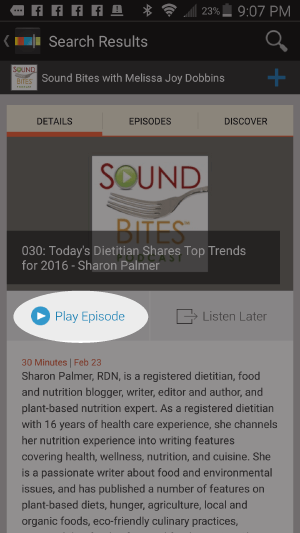
1. Search for “sound bites with melissa joy dobbins” 2. Choose Play Current Episode or Add to Playlist
Choose “Play Episode”
Subscribe & Review on iPhone
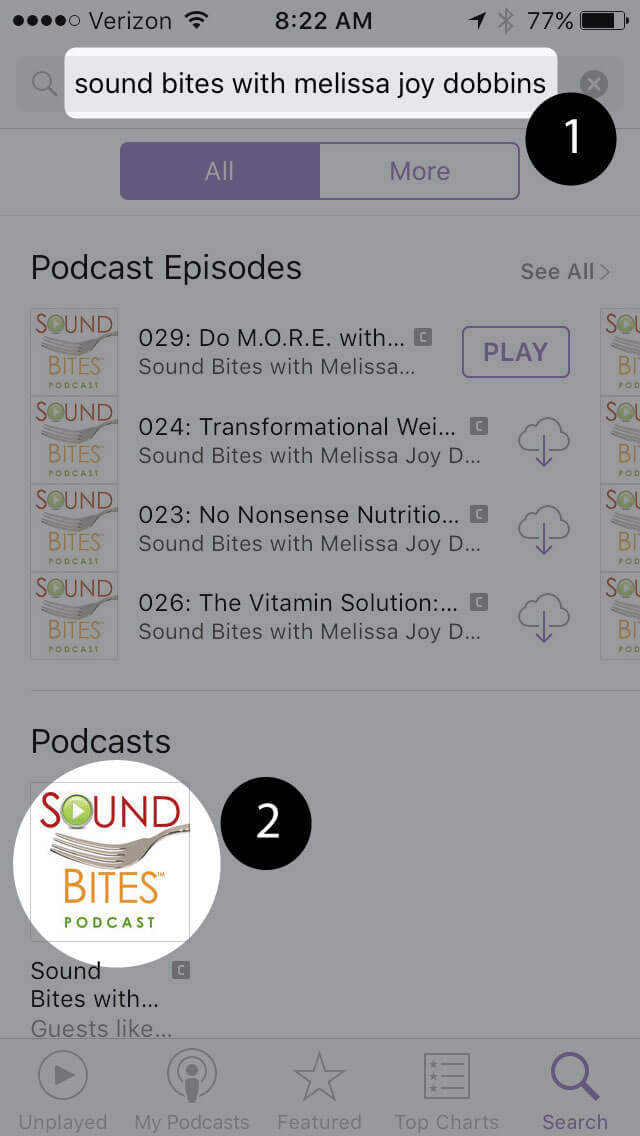
Open the “Podcast” app on your iPhone
Search for “Sound bites with melissa joy dobbins”
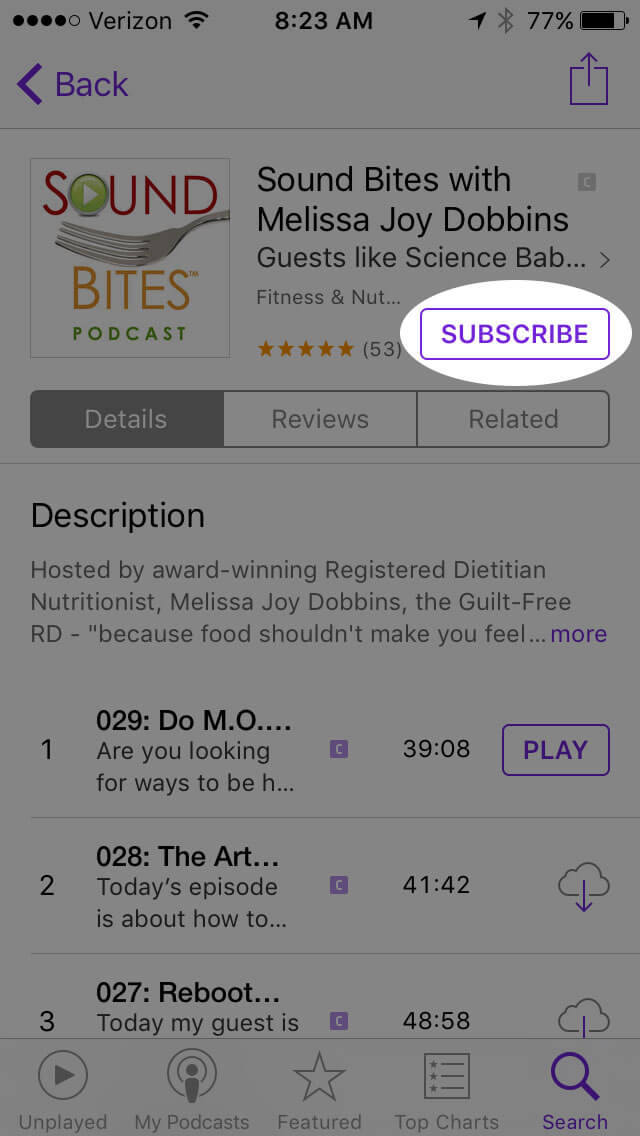
Open the podcast and click “Subscribe” and your done!
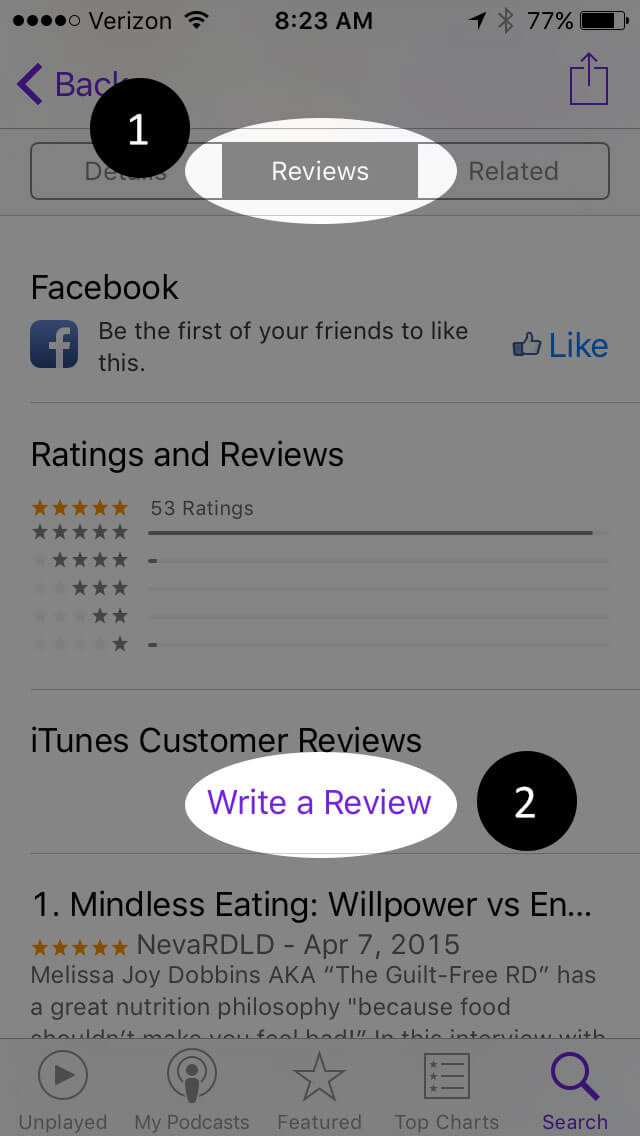
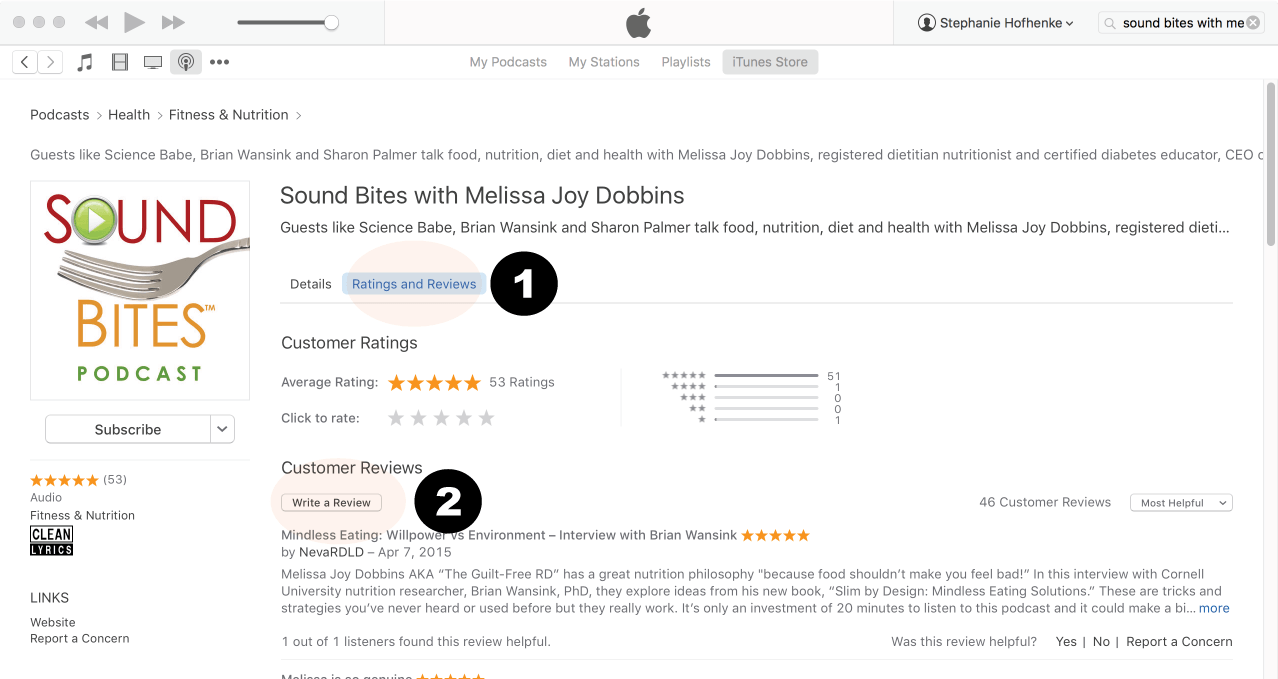
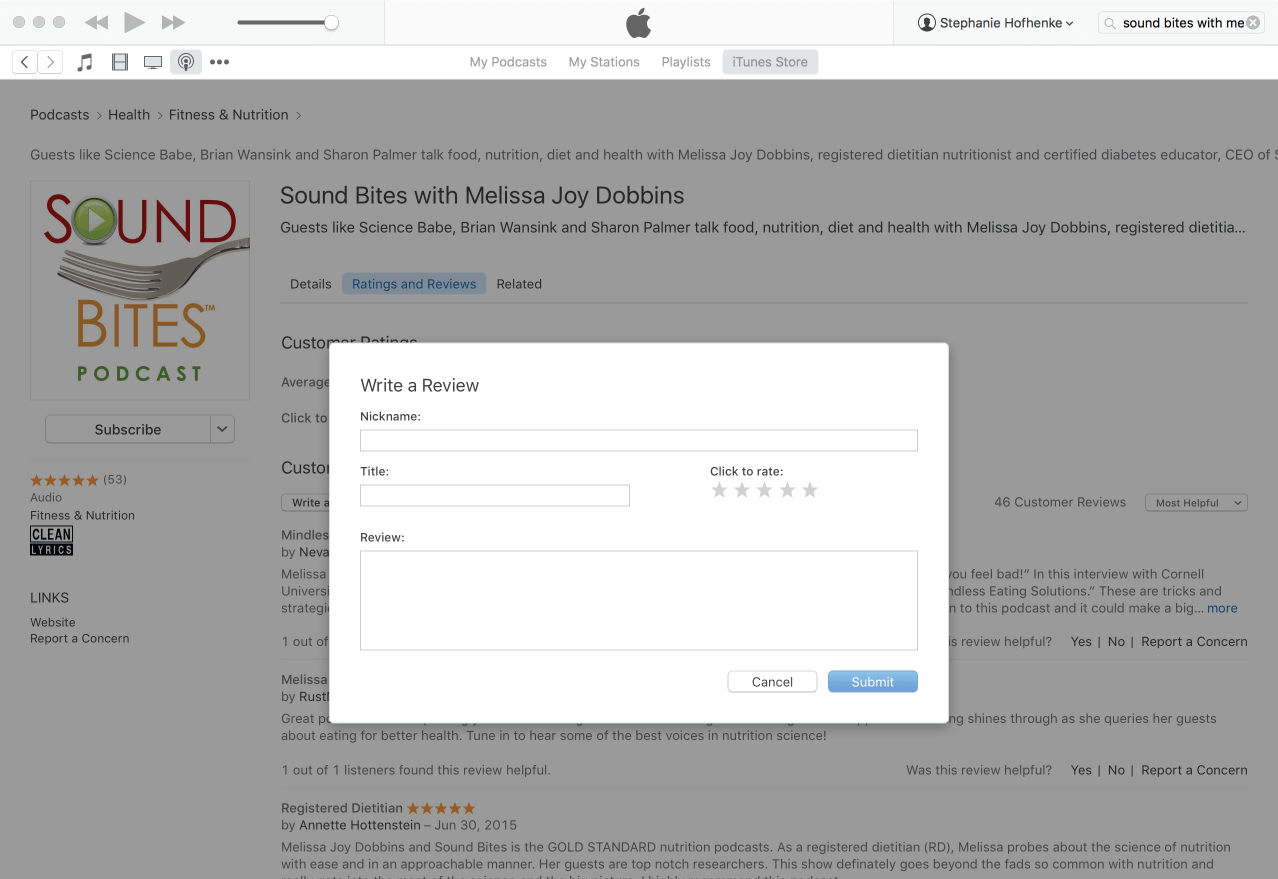
Write a Review
Click “Reviews”, then “Write a Review”.
Subscribe via RSS Feed
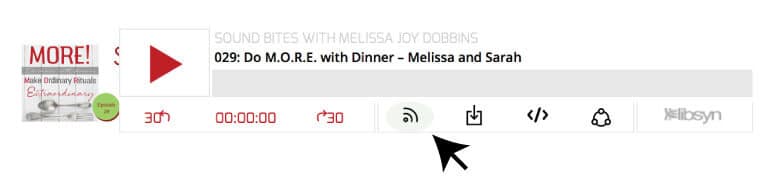
Navigate to any podcast player . Click on the RSS feed icon.
Click on the RSS feed icon.
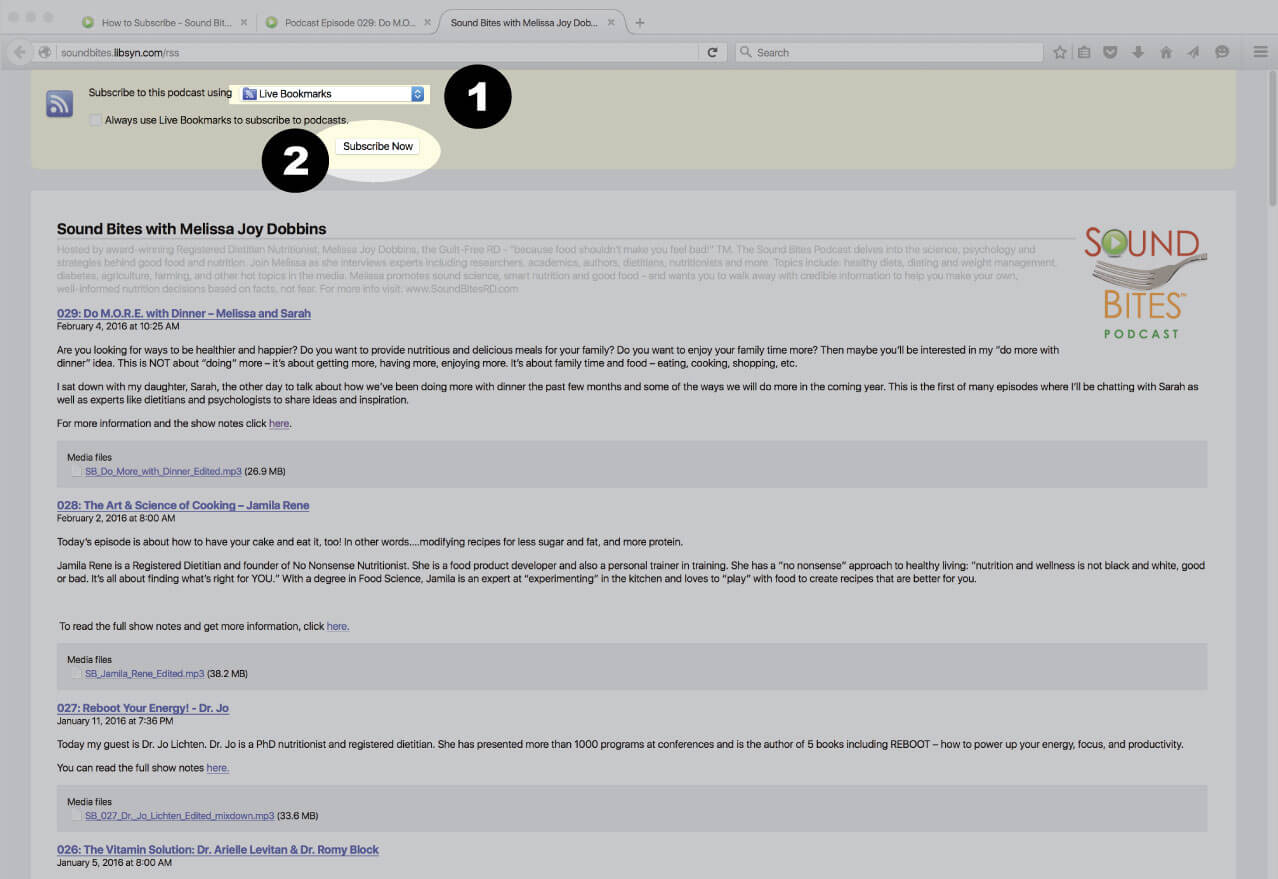
Click on RSS Feed
Choose which application you would like to use to receive the RSS feed
Click “Subscribe Now”
Confirm settings and subscribe.
How to Review in iTunes
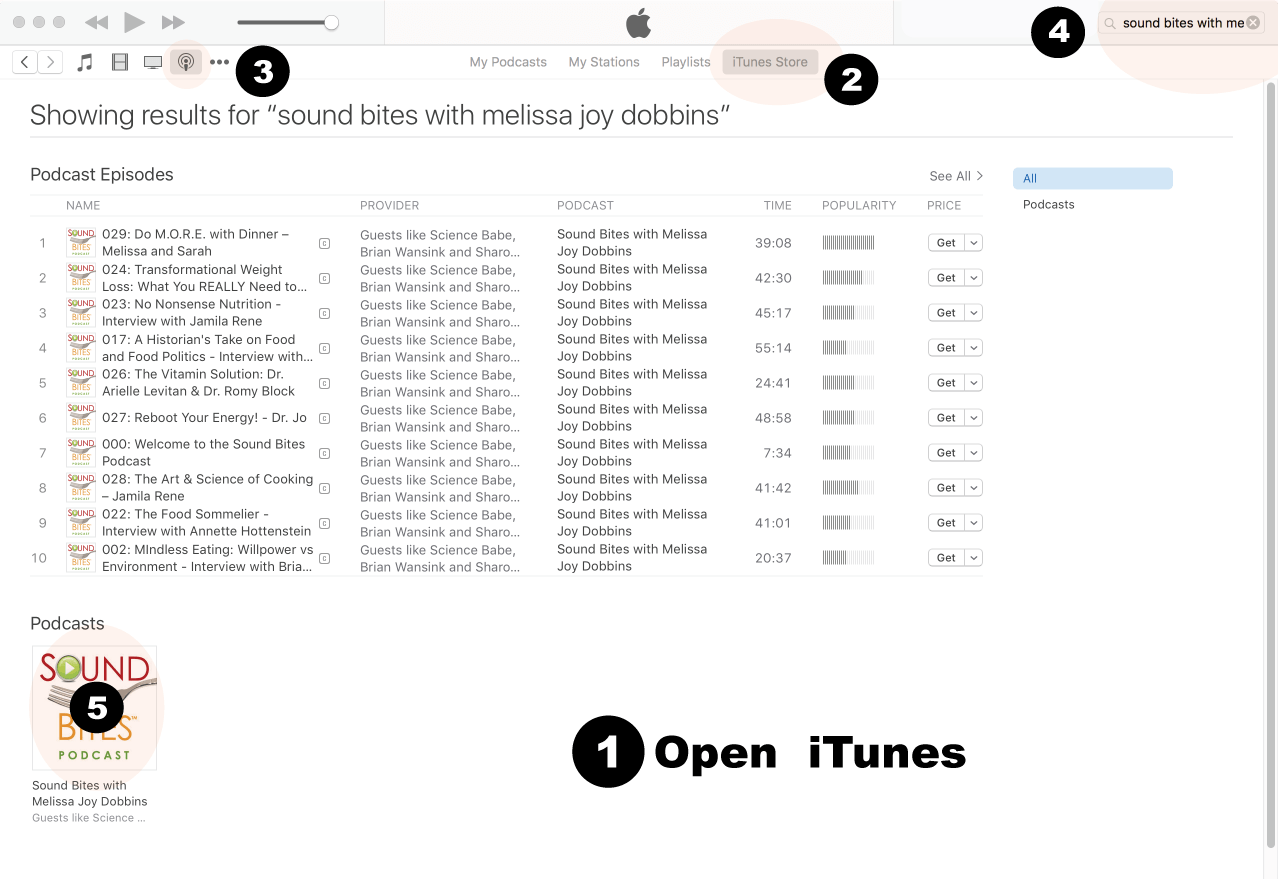
Open iTunes desktop application
Click iTunes Store
Click on Podcasts
Search for “Sound bites with Melissa Joy Dobbins”
Click on podcast image
Search for Sound Bites podcast in iTunes
Click Ratings & Reivews
Click Write a Review
View reviews and write your own review.
Write your review…. Thank you!
Write your review!
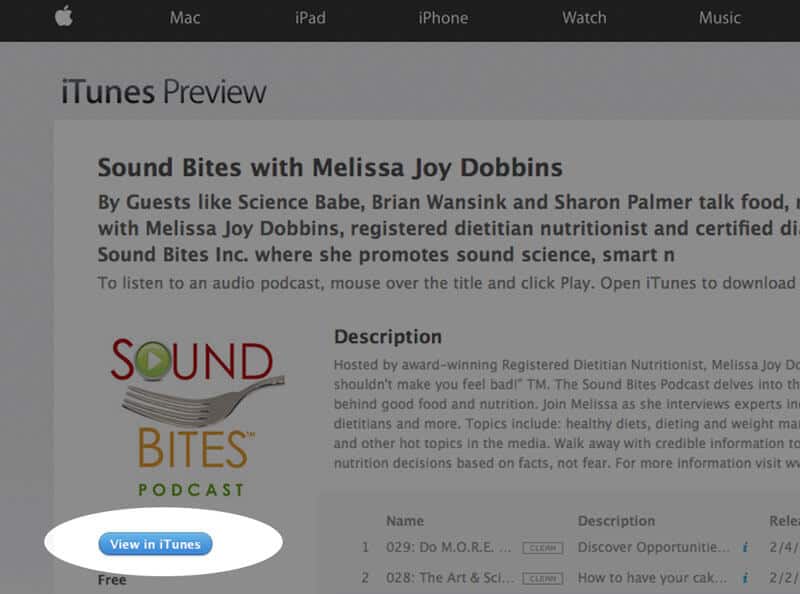
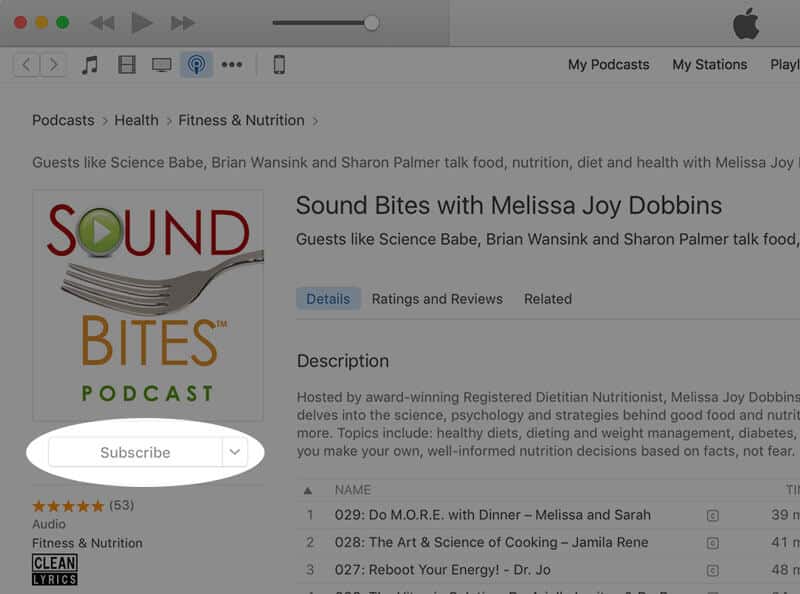
How to subscribe via iTunes
Click here to view the Sound Bites Podcastin iTunes, then click the blue “View in iTunes” button. This will open your iTunes application directly to Sound Bites Podcast. Click the “Subscribe” button, and your done!




 Hydroxide is a food scientist with a B.S. in Food Science and Technology and over 7+ years of experience in the food industry. She has worked in all kinds of environments: meat processing plants, chocolate factories, fermentation rooms, tech startups, and so much more. She has gained over 400k+ social media followers across platforms in less than a year, and is on a mission to prove that the words “food” and “science” when together, are not to be feared.