Celebrating over 1 Million Downloads and 50,000 Free CEUs on the Sound Bites® Podcast | NEW: Get 1 years’ worth of CEUs with the new 15-CEU Podcast Course
New Research Uncovers Inaccuracies on Social Media and Insights for Credentialed Health Professionals
New health, nutrition and weight loss trends are popping up daily on social media. Many of these fly-by-night trends are simply that, but a new study focusing on the platform TikTok found that these trends may have more of a hold on people than once thought.
To expose the inaccurate information being extracted from TikTok, MyFitnessPal, the #1 nutrition and food tracking app, partnered with Dublin City University on a two-part research project called “Health and Nutrition Inaccuracies on TikTok”. Part 1 looked at social media influencers and Part 2 looked at Gen Z TikTok users. Study findings ranged from determining that only about 2% of content being classified as accurate to Gen Z users trusting influencers more if they claim to be qualified dietitians.
I think people need to make themselves aware of the source and the message of the content they’re consuming. If it’s about your health or your wealth, you deserve to make sure that you make the best decision you can with the information that you can acquire. And people should always remember, ultimately time is money. You’ll probably save yourself just as much time going to a dietitian and getting some advice than spending a whole lot of time buying supplements or services or whatever, and then ultimately not achieving what you want.” – Dr. Theo Lynn
Tune into this episode to learn about:
how and where Americans are getting their health information has changed
improving our digital literacy is necessary to make better choices
MyFitnessPal’s ‘Nutrition IQ’ surveys’ key themes and concerning statistics
the Dublin City University 2-part research study
why the study focused on TikTok vs other platforms
preliminary findings from the 2-part study
what the “2% accuracy” finding really means
the positive finding about Gen Z’s trust in registered dietitians over unqualified influencers
the importance of licensed professionals helping to champion scientific truth across social media
the mere exposure effect, parasocial effect, and rules of persuasion
how to identify warning signs when scrolling on social media
how RDNs can stay on top of trends and leverage them to create compelling content that is evidence-based
a helpful infographic on ‘How to Spot Questionable Nutrition Tips on Social Media’
if it’s ‘safe’ to be on TikTok
resources for the public and health professionals
Theo Lynn, PhD
Professor Theo Lynn, Full Professor of Digital Business and Associate Dean for Research at DCU Business School, specializes in the transformative role of digital technologies in business and society, with a focus on strategy, digital communications, and data analytics. He’s been published widely across prestigious journals and serves as Series Editor for Palgrave Studies in Digital Business & Enabling Technologies.
Additionally, he co-directs the Irish Institute of Digital Business and has held various leadership roles at DCU Business School. With over 250 grants totaling €20m, he has led significant projects including Horizon 2020 initiatives like CloudLightning and RECAP, and currently leads the RINNO and ERASMUS+ MENA-Preneurs projects.
Professor Lynn holds degrees from University College Dublin and has served as a Visiting Professor at institutions worldwide. He’s also an Expert Evaluator for the European Commission and Qatar National Research Fund. Professor Lynn has also founded several companies, including Enki Information Systems and Atomic Assets, advising numerous domestic and international firms.
Resources
Some links may be affiliate links. As an Amazon Associate, I earn from qualifying purchases.
Welcome to Sound Bites, hosted by registered dietitian nutritionist Melissa Joy Dobbins. Let’s delve into the science, the psychology, and the strategies behind good food and nutrition.
Melissa Joy (00:23):
Hello and welcome to the Sound Bites Podcast. Today’s episode is about digital health literacy. We will discuss how and where Americans are getting their health information. Hint, hint, we’re talking social media here. And we’ll also talk about some insights from some recent surveys and research studies.
But ultimately, we’re going to focus on how we can all improve our own digital health literacy, and how dietitians and other healthcare professionals can better leverage social media to communicate evidence-based information and combat inaccurate information.
My guest today is Dr. Theo Lynn, Professor of Digital Business and Associate Dean for research at Dublin City University Business School. He specializes in the transformative role of digital technologies in business and society, with a focus on strategy, digital communications, and data analytics.
He’s been published widely across prestigious journals and has led significant projects with over 250 grants. Welcome to the show, Dr. Lynn.
Theo Lynn (01:36):
Hi. Thanks, Melissa. Delighted to be here.
Melissa Joy (01:38):
Excited to talk with you. I want all of our listeners to know that this episode is not sponsored. Now, Dr. Lynn, we’ve had some conversations before. I’ve seen you present, and we have discussed before that I should just call you, Theo. Is that okay?
Theo Lynn (01:53):
Yeah, absolutely.
Melissa Joy (01:54):
Thank you so much. I would love for you to share with our listeners more about your background and the work that you do. I said that you’re at Dublin City University, so you are in Ireland, in case that wasn’t implied or obvious to anybody listening.
But yeah, I’d love to hear more about how you came into this line of work. Certainly, you’re not in the nutrition field, but you have this ability to take your digital world and see our nutrition world through that lens. So, I’d love to hear more about you.
Theo Lynn (02:28):
Well, first of all, I was an entrepreneur, and like many of your listeners, I’m sure, ran my own business for over 15 years. And I was lucky to sell some of those successfully.
And I had the opportunity of relatively varied education in business and law and IT. So, for a long time around the National Center for Cloud Computing in Ireland. And my interest is reading in that intersection between business, society and digital technologies.
And by 10, 15 years ago, really, I started doing a lot of work around social media, particularly big data analytics and social media that develop. And in particular, I was interested in online harms, data breaches, data protection, data privacy, misinformation, disinformation.
And through that misinformation work, I ended up doing work with Safefood, which is the UK Irish or Ireland Food Safety Agency. So, we worked with them a lot on understanding healthy diet discourses on Twitter at the time, and then ultimately on to Facebook, Instagram, et cetera.
And so, that’s the kind of more professional interest in this area. So, even today, we do a lot of work on, for instance, hate speech in Formula One and in the World Cup and soccer stuff. And we do a lot of work on trust, and we do a lot of work on health informatics.
So, there’s a natural space there. This particular topic, I suppose, when MyFitnessPal approached us about doing work on it, was of interest. Because I have three teenagers. I have an 18-year-old, a 16-year-old boy, and a 14-year-old girl.
And they spend a lot of time on TikTok and the amount of time they spend on TikTok and the amount of information they’re consuming, and I suppose the weight that they give, what they hear on TikTok in their decision making and what they share was starting to become somewhat of a concern to me.
So, this type of research, I think if you’re a parent, a grandparent or a godparent or any other way you interact with adolescents or young adults, I think it’s a very important topic.
And so, that’s my motivation. Quite a lot of what we do is related to communications and electronic word of mouth. And we have a relatively successful master’s in research program here around digital marketing. And obviously Ireland is often the international headquarters for most of the U.S. native internet companies.
And so, Twitter will be nearby, Facebook nearby, TikTok are nearby, so a lot of our graduates are working there. So, this is a professional interest and a personal interest to me. And so, it’s exciting times, lots of opportunities, but I think maybe this research highlights some of the challenges, and I think that’s what we’re here to talk about today.
Melissa Joy (05:20):
Excellent. Thank you. And I would love for you to just also share with us your degrees, because you hinted a little bit at some of your education, but I would love for you to share that.
Theo Lynn (05:32):
Oh, deary me. Okay. So, Ireland is a very different education system than the U.S. So, we specialize very early. So, my primary degree is what you guys would call a double major in business and law.
And then I have a master’s in management information systems, and then I have a doctorate in law. And obviously I’m a full professor in digital business, so I have a couple of different things going on there.
Melissa Joy (05:59):
Yeah, I did not want to gloss over that because that’s very impressive.
Theo Lynn (06:04):
Yes. The law thing that kills you every time, Melissa. People love lawyers.
Melissa Joy (06:11):
Well, you have combined these different areas of expertise in a really interesting way. And you mentioned misinformation and disinformation, and I recently did an episode on that specifically related to a paper that was published in the Journal of Nutrition about misinformation and disinformation and how healthcare professionals can better navigate those waters. So, if anybody’s interested, I’ll put the link to that in my show notes.
You also mentioned trust. We’re going to talk about trust and communications. This is all wrapped up in this topic today, and I appreciate also you being a parent. I’m a parent. I have a 24-year-old and a 16-year-old.
So, yeah, we might be chatting about some of those personal sides of this conversation as we talk today. But we know that health, nutrition and weight loss trends, they’re popping up daily on social media.
And you mentioned MyFitnessPal, the folks at MyFitnessPal had approached you about this research study, but prior to the two-part research study that you collaborated with them on, that we’re going to talk about in a little bit, the folks at MyFitnessPal, which by the way, is the number one nutrition and food tracking app. I am sure everybody listening has heard of them, but if not now you know.
They conducted a nutrition IQ survey, and they actually do this every couple of years just to get a baseline understanding of the general population’s knowledge on nutrition. And they also did a recent survey focused on millennials and Gen Z instead of the general population.
And they were looking at the United States, Canada, the UK, and Australia. And they uncovered some key themes as well as some concerning statistics about these two generations turning to TikTok in particular for health and wellness information and some of these viral trends that came out.
So, I just wanted to speak real quickly to some of that, because this is a big part of what led to this research that you did with them. So, some of the sort of key themes that were uncovered during one of their surveys is that people are struggling to identify the nutritional value of their food.
88% report that they have no idea how much protein, fiber, carbs, et cetera, that they consume daily, which is not surprising. And 62% of people, however, think that they know everything they need to know about nutrition, which is a little interesting, I’ll just say that.
But in general, a lot of people are overestimating the good nutrients that they’re getting, and they’re underestimating the bad ones. And essentially kind of my takeaway in a nonjudgmental way is that people kind of have a low nutrition IQ.
But that transitions into this more recent survey focused on the millennials and Gen Z with this sort of alarming statistics. And I’d love for you to speak to some of that because it’s a good segue into the research that you did.
Theo Lynn (09:20):
Yeah, I suppose probably like you, Melissa, when I saw the results, the guides were sharing from MyFitnessPal, I think, first of all, I suppose for people, our generation we’re kind of looking at this going, “Well, it’s TikTok, how many people are using TikTok?”
And then when you see how many people aged 13 to say 30, use TikTok, it’s a phenomenal amount of people. We’re talking about a significant portion of society. That’s the first thing.
And then when we thought about it more, I suppose, and I can say this to your listeners, I’m not a … and so I guess I’m not entirely surprised that it reflects low health literacy. And I think that the other aspect of this is probably it reflects a low digital health literacy.
So, sometimes you laugh that people can’t identify what protein is or what a carbohydrate is, or they can’t conceptualize portion sizes, I suppose, to nutritionists and dietitians and people who are very knowledgeable in these areas. There’s probably a big surprise.
But I suppose as a parent, I’m not that surprised and as just a human, I’m not that surprised. Certainly, my wife is not that surprised. And I think that the issue that we have there is, the biggest concern to me was the very, very high rates of people surveyed by MyFitnessPal who not only consume a vast amount of nutrition and diet information from TikTok.
I mean, it’s a primary source of news for them now. And so, they’re consuming this news and consuming this information, and a lot of them said that they adopt that nutrition, the health-related information, not just once a week, a few times a week.
And some of the health trends or the food trends that are there, these kind of, whether they’re fad diets or the kind of novel exotic types of things, whether it’s eating dog food for protein, and I have a son who’s a sports person, and he wants that protein and he wants to bulk up and all this kind of stuff.
But this thing where people are eating dog food or baby food and frankly, there’s one that’s come up in our own data at a later point, is drinking urine. And they think that that’s a good idea. I think that that’s incredibly challenging for me. I think, I just go, “How did you think that that was a good idea?”
And it’s not one person or 10 people, or 20 people. It’s lots of people. I don’t have the exact figure, but I want to say the eating dog food for protein TikTok was like over 2 million views. So, even if a very small proportion of the people watching that try it, that’s a shocker.
So, for me, that’s quite interesting. I don’t want to defend TikTok, but TikTok do have a health and nutrition guidelines. But I think it’s incredibly hard to monitor those things. And it’s incredibly hard to moderate that type of content as well, which highlights the importance of qualified dietitians and nutritionists participating in TikTok.
And I think that just this lack of health literacy, lack of digital health literacy, and you combine those things together, I think it’s a worrying trend.
Melissa Joy (12:48):
Absolutely. Thank you. Yes. So, the research that you did was specifically TikTok and for some of the reasons that you just mentioned, but also, I believe TikTok is the number one search engine over Google for many of the Gen Z population.
I personally feel like the information that we’re discussing today can be generalized across social media, but the research was specifically on TikTok. And this is why.
And back to what you were saying, I mean, I’m not surprised that people struggle to identify not just how much protein they’re getting, but sometimes what a protein food is. As a certified diabetes educator, one of the first things I do with people is help them understand what is a carbohydrate and what is not.
So, that is not surprising at all that people agree and state that logging their food helps them learn some of that and keep an eye on their intake.
And to your point too, not only are people getting health and nutrition information from TikTok, but like recipes, people have transitioned away from Pinterest. I mean, I’m sure people still use Pinterest or whatever, or just going online and allrecipes.com or whatever, and not sponsored by them either. I’m just like, that’s one of my favorite ones that I go to.
But the younger people are going to TikTok for recipes too. So, yes, it’s definitely a big source of information for them. And you mentioned some of these trends and yeah, if you haven’t heard about the dog food to increase protein, you heard it here, but as you said, it’s 2 million viewers.
But things like NyQuil chicken, which do not do that, it’s not safe. Girl dinner, the girl dinner which could be a whole entire episode. But chia seed water, just different things like that.
So, the trends might be goofy or sensational, but they could also be dangerous and harmful. So, because of all this, this is again what prompted your research. And so, MyFitnessPal partnered with you at Dublin City University on a two-part research project called Health and Nutrition Inaccuracies on TikTok.
Let’s talk about the purpose. I mean, we understand the background and what prompted this, but let’s talk about the purpose of the research study and the methods. And again, it’s two parts. So, maybe we should start with study one first.
Theo Lynn (15:14):
Yeah. First thing that’s coming out is understanding the sheer volume of influencers out there, sharing diet nutrition information. So, there’s like tens and tens and tens of thousands.
Melissa Joy (15:24):
Of influencers?
Theo Lynn (15:25):
Yeah. And I think it’s important we think about influencers about being these nearly mega celebrities, but we’re all influencers within our social network. And then we go to the next level. And there are some very huge influencers with millions of followers. And then there are other ones with hundreds of thousands of followers all the way down.
But it’s the aggregate effect of these that’s also very important. And so, in the first study we were interested in understanding is how accurate is the diet and nutrition information shared by non-qualified or non-credentialed social media influencers on TikTok?
So, really, we’re looking at influencers who are not dietitians and not nutritionists. And we looked at just over 450 influencers from the U.S., Australia, and the UK who are focused on kind of an interlocking area around health, wellness, food, diet, nutrition.
Average these would be about a million followers each, probably somewhere at the over 20 million likes on their posts. These are very popular, significant reach. And in fairness, we got permission from TikTok to access their APIs.
So, we’re not scraping the data off the internet, we’re getting the data directly from TikTok. And they were very supportive in that context. And then we ended up with about 67,000 videos.
Melissa Joy (16:48):
Were dietitians part of this or are these influencers or not?
Theo Lynn (16:52):
There was no dietitians or nutritionists in this influencer set. So, we’re looking at non-credentialed influencers.
Melissa Joy (16:58):
Got you.
Theo Lynn (16:58):
So, first of all, we had a lot of video-
Melissa Joy (17:00):
67,000 videos.
Theo Lynn (17:02):
Yeah. Now, just to put it into context, when you are thinking about these videos in each event we’re taking a sample, those have transcripts of the voiceover. So, what we’re really analyzing is the voiceover. What did these people say?
And we’re using relatively cutting-edge technology. So, we’re using what’s called deep learning. And lots of people are a bit more familiar with deep learning because they might be exposed to a form of deep learning through ChatGPT.
So, that’s where deep learning and other for want of better word, “AI” is being used to generate content or generate answers. We’re using these technologies to classify content. And so, we’re trying to classify it as accurate or partially inaccurate. Or inaccurate or uncertain.
And I suppose the preliminary analysis is saying that only 2%, 2.1% of all the transcripts we analyzed were classified as accurate. We compared to public health guidelines, public health and nutrition guidelines.
Now, just to counter that maybe 70 to 77% is uncertain. And actually, the uncertain thing, it sounds like, well, is that a finding or not? That’s quite an interesting finding because even when we train these models and we look manually and we get nutritionists to look at these posts, we can see straight away what the problem is.
Because unlike Instagram or Twitter, or even Facebook, TikTok videos can be quite a lot. So, you have quite a lot of content in a TikTok post. And what actually happens is there’s a whole variety of posts.
For instance, they might say, “We’re going to talk about food, we’re going to talk about calorie counts.” But then they don’t give any kind of information about the ingredient amount. So, the recipe or portion sizes or anything.
Or they mightn’t have any information that you could make any kind of judgment on nutritional guidelines. Or they might have something that sounds like it’s consistent with health guidelines. And then ramble off into a personal anecdote which in some instances is contrary to a guideline.
You have lots of situations where people specify the guidelines, but then they’re not necessarily talking about something of nutritional value, or they’re talking about a cooking technique, and they don’t make any nutritional references.
In those particular cases, it’s not surprising that the AI finds it uncertain because you know what? A human would find that uncertain too, say, “Well, I can see this, but I actually don’t have the information to make a judgment.”
So, one of the problems is these partially inaccurate posts is that it’s confusing to the general public. And as we saw earlier on, well, nutrition IQ survey is kind of suggesting, well, yeah, we identify that maybe there is a low health or low digital health literacy.
And what this finding is doing is kind of reinforcing that. It’s kind of saying, “Well, that’s not entirely surprising because the influencers that are sharing content, that these adolescents and young adults are consuming, well, they’re not incredibly clear. And alignment with nutritional guidelines is not a priority.”
And we suggest that maybe showed me a priority if you have to share, to be honest with you, if you’re going to share anything that affects people’s money or entire life, I think, it’s important that you have the expertise and experience.
Melissa, you said you do a lot of work with people with diabetes, and so we have lots of examples where people, may be an influencer’s focusing on people with diabetes, but it’s not clear in their posts that a particular diet is only for diabetics or not. Do you know what I mean?
Melissa Joy (21:03):
Mm-hmm (affirmative).
Theo Lynn (21:03):
So, that’s what really the first one’s getting at is, well, okay, we have a lot of content here and this content, we can understand why this would lead to less than positive outcomes.
Melissa Joy (21:17):
Certainly confusion.
Theo Lynn (21:19):
Yeah. So, I want to say, just to clarify, I’m not suggesting that it’s disinformation. So, I don’t think by any means that these people are being intentionally misleading. Although I would say in some instances there’s clearly sponsorship or something going on.
But what it is, is there is inaccurate health information. And it’s that inaccuracy, which is very specific. I think what we have to talk about is, well, why should I trust this influencer and why should I trust the content that they’re sharing, the advice that they’re giving? And I think that’s really what led to study two.
Melissa Joy (21:58):
Yeah. Just to respond quickly to that, and again, people can find out more about misinformation and disinformation in this previous interview that I did. Because they are two different things. And I remember you saying this when I saw you present that you really didn’t find a lot of what you felt was disinformation, which is encouraging, but still more the misinformation being shared.
And not surprising if they are non-credentialed that you have, like you said, the sort of this mix of information partially inaccurate. Which again, I think, clearly leads to confusion. It’s not helpful at the end of the day.
Good. So, let’s transition to study two, which builds off of study one. What did you look at there?
Theo Lynn (22:39):
So, actually study two, I understand for most people, the study one quite … because it’s AI and TikTok. Study two, I think is actually on one side’s more insightful. So, in study two, what we did is we set up a series of experiments and we had just over a thousand TikTok users across the U.S., Canada, Australia, and the UK.
And we hired an actor to play the role of a nutrition influencer giving nutrition advice. And basically, there’s a couple of different conditions. So, some people will be exposed to the influencer who is presenting their credentials upfront and accurate information.
And others would have no credentials and accurate information, and others would have credentials and inaccurate information, et cetera.
And what we find is, first of all, if an influencer presents their credentials upfront, people are more likely to trust that influencer than if there are no credentials. That’s kind of obvious.
Interestingly enough, they will trust that influencer even if the content is inaccurate. So, they’re going to trust that more. And then secondly, if the influencer presents their credentials and presents consensus based scientific evidence to support their claim or the information they’re given, the trust goes up again.
So, the big takeaway there for dietitians and nutritionists is that, well, if you’ve got the credentials, present the credentials, then present evidence to support your claim in your posts. And that helps raise trust in you as an influencer. And in the message that you’re giving.
I think it’s very important for your listeners to understand trust. Trust is a very nuanced psychological construct, there’s a couple of main elements there, like benevolence, that someone’s acting in your best interest, that there is integrity, that these are people who are honest and that there is competence. These people have the ability.
And then there’s a subtle part on the other side of this, which is consistency. That these people are consistently saying similar messages. And if you think about that and compare the non-credentialed influencer and a registered dietitian, it’s a massive difference.
The registered dietitian is signing up to a code of ethics to behave in a certain type of way, give a certain type of advice. They’re acting in the best interest of, it could be their clients or patients, but it could be the general public as well, that they’re confident because they have credentials, they have qualifications related to specific area.
And that they’re going to act with integrity. And so, they should be relatively consistent in their messaging. And so, the power of — and what we’re seeing from the nuances in this particular research, and I’m not going to bore everyone with the academic analysis.
But the nuances are that by presenting your credentials and consensus-based scientific evidence for a particular nutrition claim, you’re actually engaging in a type of social nudge, which is countering other messages, but also building trust, dietitians and you as a dietitian and nutrition advisor, and that message.
The second social nudge is when influencers are presenting inaccurate or partially accurate information, and maybe people will be misled or maybe misunderstand what’s being presented to them. The dietitian and nutritionist can play an important role in countering potential inaccuracies by again, responding but also, and this is the critical part, presenting their credentials and presenting evidence to support what they’re saying.
So, from a content design and engagement perspective, the second study creates very actionable recommendations for dietitians and nutritionists. But the key thing, Melissa, is if you’re not in, you can’t win.
So, I think our generation, we were Instagram, Pinterest, Facebook, that was our generation of social media. And so, the challenge is trying to engage on this new platform is a significant challenge for many people over 30. It’s perceived as a platform for 13 to 30-year-olds.
So, trying to engage with that sometimes can be a challenge, but I think it’s critically important that we engage the audience where they are. And that’s an important output of this.
Melissa Joy (27:33):
Yes. Thank you. Several things that you mentioned I wanted to touch on. When you talked about trust and benevolence, when I saw you speak, that resonated so strongly with me. So, I want to reiterate that. You said that trust is competence and integrity, consistency and benevolence.
And that’s what sets us apart as dietitians and healthcare professionals from the non-credentialed influencer is that benevolence.
And ask any dietitian why they went into this field, they will say to make a lot of money, no. They went into this field to help people. And so, it was really encouraging to hear that that core value that we have and the reason we are in this profession, we can actually not only use to our advantage, but inherently it provides us that advantage.
And we need to leverage that. And that simple practical takeaway that you’re sharing, like mention your credentials right off the bat in the first 5, 10, 15 seconds if you can. That’s something simple that we can all do.
And then of course, supporting what you’re saying with evidence, which poses its challenges. But I talk about that a lot on the podcast. And I have a recent interview with Karen Collins really detailing how do we actually get into the weeds and do that. So, I’ll link to that in my show notes as well.
But these social nudges that you’re talking about, again, that’s very helpful. I have a background in crisis communications, and I’ve learned that the nutrition and health communication community, if you will, learned kind of the hard way that one of the best ways to combat inaccurate information out there is to consistently put out accurate information.
And I share this a lot with my dietitian colleagues when I do media trainings and so on, is sometimes we feel like, what’s the point of like repeating the importance of fruits and vegetables and that it doesn’t matter if it’s organic or conventional, but you need to wash it, which really means you need to rinse it underwater.
And all of like, don’t people know this? Why is it important for me to keep saying it? Well, that’s because when people get fear mongering advice about pesticides and produce, then they go online searching for information and they will find plenty of consistent evidence-based information from credentialed people.
So, I just wanted to really emphasize that and highlight that. Was there anything else that you wanted to share about trust?
Theo Lynn (30:19):
Yeah, I would say, this may be taking it as a positive thing for Canadians. It would seem that Canadians are different. I think that’s an important finding as well in that for whatever reason, Canadians were more skeptical of the influencers. Both in terms of the influencer and the message.
I think that that could be related to they have a slightly different cultural context in Canada. And when we look at other studies, while they don’t seem to be different in terms of health literacy and digital literacy, they do seem to be slightly different in terms of their trust in the health system and government institutions and authority figures.
And so, there’s an interesting thing there, which is I should tell your listeners, when I was a kid, we moved to America and I grew up in Ohio, and then as a business person, I came back and had a business in Boston.
And so, I have a lot of love for the U.S but in the last couple of years, maybe our trust in authority for either side of the political spectrum or things has changed a lot. And then that will be the same in the UK and it’ll be same in Australia. And you only have to look at different places, or only yesterday, lots of governments seem to particularly fall in Asia.
And so, certainly people are less trusting in authority than they were before. And I think influencers then play a different role because they’ve so much reach. And if you imagine that you are spending so much time looking at something like TikTok, and you’re young and you’re impressionable, and we have this concept called parasocial where people become fans of these influencers and over time, they might feel a sense of connection or some kind of bond or alignment with that person.
And so, just humans there’s a thing called default truth theory that we like to think people are telling the truth. Do you know what I mean?
And so, when you combine these things together, and these people are incredibly capable, incredibly good content producers. I mean, they are phenomenal content producers, that is their business.
So, when they’re out there presenting a message, that’s their main job. Their main job is not being a dietitian and a nutritionist. Their main job is being a social media communicator.
And so, it’s not totally unsurprising that their content is very attractive, and their content is emotionally strong and you know, it has a lot of sizzle. And what I’m saying is, well, dietitians and nutritionists, they have a lot of steak which means there’s a lot of substance in the message, but for adolescents and young adults, that might be a bit boring.
Whereas the influencers have all sizzle and sometimes they’re just presenting messages that just reaffirm what the person wants to hear. And if you want to lose weight or you want to look a particular way that’s a very strong psychological and emotional driver.
And so, when someone says, I can make you look like this, “I can help you lose weight, and this is what you need to do.” And they look very attractive, and they present it in a way that’s just phenomenally well produced, and there’s millions of people looking at this and there’s hundreds of thousands of likes, it’s not entirely surprising that people consume this and believe it.
And so, I suppose one thing that we need to do is make sure that we’re tailoring different messaging for different audiences. Most nutritious dietitians will be dealing with one country. But someone like MyFitnessPal obviously has a global reach.
But the second thing is that maybe dietitians and nutritionists need some sizzle. So, I think it’s really important that when they’re thinking about how they communicate increasingly, if they’re going to look at young adults and adolescents, they need a bit of sizzle and still maintain the steak. And the steak is their credentials. It’s the evidence and all the knowledge and experience that they have.
And so, that’s the challenge. We need to bring the next generation of dietitians and nutritionists up to a level where they’re also exceptional communicators. Because the dietitian and nutritionist is typically working with one person, and it’s a health intervention, a social media influencer, it’s a light communication to hundreds of thousands of people.
So, it’s a very, very different thing, but we’re competing for peace of mind with the consumer. And I think that’s a massive challenge that comes out of it.
I should mention one thing that’s happening in Europe, which I think is particularly positive. We’ve just introduced a thing called the Digital Services Act, which puts an onus on social media platforms, particularly very large online platforms, to take measures to curb misinformation, including health misinformation.
And there’s this concept of a trusted flagger. And a trusted flagger is an individual and organization that flags misinformation on social media. And so, shortcuts in one sense moderation by the social media companies. So, the social media companies can look at those people and if they say this content is misinformation, they will accelerate mitigation or a response.
And one of the things that we’re recommending out of the research is, hey, I think whether it’s dietitian associations or nutrition associations or individual nutritionists, dietitians, there’s a role, particularly in this particular context in Europe where the dietitian and nutritionist were qualified can play a role as that trusted flagger with the social media company.
I think that’s quite an interesting concept. It’d be interesting to see how that plays out now over the coming years.
I should add that the penalties for very large online companies, not adhering to that act can be up to 4 to 6% of their revenue. So, there’s a very significant penalty if you don’t comply or be seen to comply with that regulation.
So, I think in other parts of the world, people are looking at how misinformation, hate speech, a whole variety of different political misinformation and disinformation, and they’re thinking about who are the people that we should listen to for identifying misinformation and disinformation, and then what should the platforms be mandated to do in the instance where an expert has identify those things.
And I think that the experts in diet and nutrition are qualified dietitians, nutritionists, I think that we have to listen to their voices more in the context of content moderation.
Melissa Joy (37:19):
Well, I love the analogy of sizzle versus steak or having your steak with some sizzle. And I love hearing this is very encouraging, what you’re saying about these trusted flaggers and that penalty or incentive for companies to monitor this.
Yes. When dietitians work with patients or clients one-on-one, it’s very different than communicating to the masses. And that’s a big challenge inherent in the work that we do and being compelling while still being evidence-based.
But yeah, those non-credentialed folks can say whatever they want and be very sensational and compelling. So, it is a challenge that we have. And I talk about all the time on the podcast. You mentioned the parasocial effect. How is the mere-exposure effect similar or different to that?
Theo Lynn (38:08):
That’s a slightly different psychological phenomenon. So, if you think about it in a kind of a very simplistic way, people develop a preference for things because they’re familiar with them. So, in the context of social media, and if you take say something like TikTok or Twitter, what you’re getting is a repeated exposure through the stream of the same brands or influencers or types of content.
And so, you’ll hear lots of terms, terms like echo chamber or bubble filter, where basically even if you didn’t have a strong opinion about a brand or an influencer or you haven’t interacted with those accounts, by seeing them more repeatedly, even when you don’t interact them.
So, you’re just scrolling through your feed and you’re seeing these things, that can actually make you more favorable to those brands or influencers over time, even though you don’t consume their content.
So, eventually when you see a post from those influencers, you might actually start to feel more possibly towards them, even if you don’t actively engage with their content on a regular basis. And so, it’s not necessarily liking, but it’s psychologically and subconsciously probably comforting, say, “There’s something familiar about this user.”
And so, content, algorithms as well as advertising obviously are designed to increase user engagement by showing you lots and lots of content that you’re likely to interact with or, and I think this is important and a theory called the influence of presumed influence that you see other people interacting with stuff and that acts as a reinforcing mechanism or some kind of, I suppose, a trust anchor of sorts so that the algorithm is showing you this content and it’s showing what other people in your network use or maybe other influential people are sharing.
So, you’re seeing this all the time, you’re seeing what’s trending, even if you don’t interact with it, it’s actually reinforcing this subconsciously in your head. And then ultimately you click on something and subconsciously you feel familiar with that particular influencer or a brand, and consume their content, et cetera. At least that’s the theory.
Melissa Joy (40:19):
Interesting. And maybe this is related to what we were talking about a little bit earlier, but the rules of persuasion and talk to me about I think it’s authority versus social proof.
Theo Lynn (40:31):
That’s an oldie, but a goodie. So, I mean, that goes back some time with a professor called Robert Cialdini. And actually, you could use some of that to explain some of what we’re talking about.
So, Cialdini did a study where he looked at lots of different cultures and he effectively came up with these rules of persuasion, and some of them are kind of interesting ones. So, like a big one would be reciprocity. People feel obligated to return a favor of kindness.
So, if you give someone a gift or you give something of value, and in this case it might be information or advice, they’re more likely to respond positively. So, what you actually see is for instance, in the early days of Twitter a few following of people, 20, 30% used to follow you back because they saw following of being of value or liking being of value. So, you like the person back.
I don’t know about you, but if someone comes around to my house with a bottle of wine, if you be guaranteed the next time I go to their house, I’ll bring a bottle of wine. So, reciprocity is both a very natural thing in all cultures, but it’s also can be an escalating thing sometimes too.
I think the second thing is consistency. So, once people start doing something or commit to something, they’re more likely to follow and consistently do those things because they don’t want to be seen as contradicting the previous decisions.
So, consistency is really important. And equally you’ll be more persuasive if you’re saying the same consistent message over and over and over.
And then you mentioned an important point, which is social proof. And I think the social proof and authority, which there’s a different rule, people tend to follow the actions of others, especially when they’re uncertain.
To a large degree what we find is people tend towards convenience, ease, the task of verifying information is cumbersome. And particularly whether they’re uncertain or they’re getting mixed conflicts, they’re going to look at social signals. And those social signals are often followers, likes, comments, references, et cetera.
So, when you see these influencers, they’re constantly focusing on their social signals. But a key thing is people are more likely to be persuaded by someone who’s seen as an authority or an expert. I know this can go different ways because I remember particularly in studies in the early days of Twitter, because someone put MD in their biography, they would get this bit of a bump.
And it didn’t matter whether it was managing director or medical doctor, they got this bump. But if you take those two things like authority and social proof, this again is where the credentialed dietitian and registered nutritionist kind of has a bit of a superpower, that they can go in, they say, well, look, I actually have qualifications in this. I have experience in this, and here is scientific evidence that supports this. I think that’s very, very important.
And the other ones are liking and scarcity. So, this is where the influencer probably wins out a bit more, is that people are more easily persuaded by individuals that they have a positive impression of or they’re attracted to or they’re similar to.
So, liking can be people are charismatic or they’re very attractive. And you find that, social media influencers are physically attractive. They sell to their audience. They’re constantly saying like, they reinforce this, and they have this very high likability factor.
They use very approachable language. One of the problems we have with the uncertainty with the AI cation is they share a lot of personal stories and anecdotes. And what they’re trying to do is reinforce these kind of common values and interests with their community.
And then scarcity. So, this is what I call the Groupon effect, is that, you know what? People want something when it’s scarce or limited supply or it’s hard to get. So, this kind of fear of missing out or being left behind is really important.
In fact, there was a study, and I was just reading about over the weekend, and which is being talked about a lot in the media at the moment about this thing about when you’re trying to get kids to put down the smartphone a bit more. The key is getting the collective group of friends to all agree not to use their smartphone for a period.
Because no one likes to be left out of the group. And so, again, people are on TikTok and they’re listening to influencer X and someone says, this is the way to do it. And I think women and young men are slightly different. I look at my son and he’s into all this kind of what kind of food do I need to be stronger or faster, et cetera.
And it goes about how do I look a particular way, or how do I lose weight or maintain weight, or whatever. And so, people want to be part of their tribe or like everyone else.
So, those different types of rules of persuasion come together in different types of way. And social media is particularly designed to leverage those. If you think about the functionality and features of social media, it’s all about literally we like people, we have social proofs that built into the system.
You like me, I follow you back. There’s a whole variety of just social nudges built into social media to reinforce that. And here’s the thing is dietitians and nutritionists need to leverage those in the same way that influencers do.
And I think that that requires a determined and designed approach to how you share content and interact with people online.
Melissa Joy (46:12):
Wow. Those are some really great insights and points. Thank you. I guess I’m wondering, based on all of the challenges, I mean, I know social media is here to stay, but should we view it as a place to get information? Or should we view it more like entertainment?
Theo Lynn (46:29):
Well, if I could answer that, Melissa, now, that’s a million-dollar question, maybe a billion-dollar question.
Talk radio, it was like the original social media could ring up and talk to the DJ and you could have these conversations. And it’s a different type of medium. We’re all looking at TikTok now because it’s very different than the other platforms.
And certainly, Meta and Twitter and Instagram and whatever they’re all trying to repeat what Tiktok liaise to do. I have no doubt, Melissa, in three or four years’ time, we’d be talking about some other platform.
Melissa Joy (47:09):
Of course.
Theo Lynn (47:09):
I don’t know, you’re film fan, but there was a U.S. film called Idiocracy. And I often think, well, my challenge is, are we headlong heading towards this kind of dumbing down of society where nearly all educational content or knowledge has to be entertaining to consume.
Certainly, as a professor, you feel like you have to entertain more and engage more and be on different platforms and try different things. I don’t think they’re mutually exclusive things. I mean, we’re trying to make … well, it can be quite stayed information, more consumable for people in the same way that we do that for broccoli. I think we just, we need to improve it a bit.
But I think that, you have to look at societal trends and the pressures and impact that are on kids today. And the sharing images about yourself.
I just recently came back from China with my older teenagers and their friends, and it was great because they weren’t really able to use their phone. So, they’re forced into taking pictures of other people and them in different contexts.
And I said, “Wouldn’t it be sad if in 10 years’ time, you look back at your teenage years and all you have is selfies, like just pictures of yourself in a room or pictures.” And that’s the danger, the phone. I think maybe the selfie camera function is probably the worst thing that ever happened to smartphones and social media because it focuses on you as opposed to focuses on the experience you’re having or other people.
So, I don’t think you can divorce social media from all these. I don’t think social media is the number one problem in society. I think incivility is the number one problem we have in society. And misinformation is a form of incivility because ultimately, you’re not acting in the best interests of your audience. You have a personal agenda.
And so, I feel relatively strongly that dietitians and nutritionists and in different countries that are protected terms, they play an important role because their experience and their expertise sets them aside.
But they also are in a ethical and regulated context. And so, what we need to do is lift those people up and value what they’re communicating to the public. And that means that, to be honest with you, some nutritionists and dietitians have to hold themselves to a higher standard when they’re promoting different food stuff, et cetera.
So, I think that social media isn’t innocent, you know what I mean? But I’m low to think that they’re the bug bear for everything. I think that it’s the people who are on social media and who capitalize on that cause no problems.
I do have significant concerns about the algorithmic nature of the content delivery systems. And they have responsibilities to make them ethical. But ultimately humans exploit those loopholes.
And so, it’s very hard to hold a social media platform accountable for something that a third-party did in a legal way. And so, I think that what we have to do is educate young adults and the general population on digital literacy and in the context of this particular topic, digital health literacy.
And I don’t think that’s easy. I’m not so sure some of our more older, whether it’s the food pyramid or the food plate or what’s there useful anymore. So, there’s such a much more complex mediatized environment.
And Melissa, when you were talking, I was thinking about this. I remember going to Washington just before the pandemic, and I saw this great presentation where this guy, and his daughters were like four or five or something like that. And he got into looking at product placement of fruits and food on children’s TV.
And he said what became very bizarre was you would have TV programs where the characters were, whether strawberry shortcake or something like that. And what would they have if they had a successful outcome. They would have fairy cakes or brownies or something.
And then there was one promoting vegetables. And after finishing the adventure of what was the prize, let’s eat cake, or let’s eat fairy cakes.
So, we’re not very good at healthy food communication. We’re not, we’re good at appealing to what people want to hear. And so, the people who are good at healthy food advice, our dietitians and nutritionists, and what we need to do is amplify their voice and make sure that their share of voice, which is the high-quality part of the market, is getting to the appropriate audiences.
Melissa Joy (52:08):
And turn up that sizzle. Yeah.
Theo Lynn (52:10):
Yeah. Absolutely.
Melissa Joy (52:12):
Theo, do you think there will be a TikTok ban someday? And do you think it’s safe to be on TikTok?
Theo Lynn (52:18):
Do I think it’s safe to be on TikTok? I don’t see any issue being TikTok. I mean, we also do dark web research. So, after you find your credit card details on the dark web, you just realize it’s a matter of time before someone’s going to hack your credit card.
I think we’re all responsible for ourselves, and if a bad actor wants to target you, Melissa, a bad actor will target you. And I think the issue here is, are you any safer on TikTok than Twitter? You know what I mean? Or X?
Melissa Joy (52:55):
I love that you’ve been calling it Twitter.
Theo Lynn (52:57):
Yeah. I say that because I was a massive Twitter fan.
Melissa Joy (53:01):
I was too.
Theo Lynn (53:02):
I am not a massive X fan. You know what I mean?
Melissa Joy (53:04):
You and I share that passion and that disappointment.
Theo Lynn (53:07):
Yeah. And I used to be a massive Elon Musk fan, and so I kind of look at this environment and while I go on X, I’m never quite sure what’s going to come up next. Do you know what I mean?
And what I can say about the stuff that we do on hate speech and sports, while I can understand Elon Musk’s personal attitudes towards civil liberties and freedom of speech, Meta and TikTok are engaging with people about trying to curb hate speech on their platforms.
And I can’t say that about X. So, I think I would distinguish between the political concerns about Chinese ownership of TikTok from the algorithmic concerns are TikTok. Because to be honest with you, all the guys on Twitter are super intelligent people. And all the guys in Google are super intelligent people. All the guys at Meta are super intelligent people.
They’re all doing really complex, advanced stuff with algorithms. You know what I mean? So, if the U.S. want to ban TikTok for political reasons or protections reasons, that’s one issue. But banning it for its algorithms, I think, will be somewhat impartial in the context that all these platforms are incredibly sophisticated.
I can tell you, as someone who’s researching relatively advanced systems and recommendations and deep learning and machine learning, that space is moving so fast, Melissa. It’s just unbelievably fast.
So, even by the time we’d finished doing the preliminary study with MyFitnessPal, the technology had moved on so much that we have to really start doing the project again. So, a lot of the work we’re doing is based on we started with technology version one.
I think we’re on technology version three or four now. So, it’s moving so fast, and I think it’s very hard for people to keep up with that speed of change and this accelerated lifestyle. So, I don’t think it should be banned.
I think they should be contributing. They should be committed to moderation; they should be committed to education. And I think that the underlying ethos should be to put the public first. And I think that that’s difficult when you’ve got shareholders, and you need to put shareholders first.
And that means advertising and eyeballs on content, et cetera. So, I think that’s a different type of challenge.
Melissa Joy (55:49):
Okay. Do you envision a social media platform that would be better or ideal for credentialed nutrition communicators? Or does one already exist that you would say, “Hey, this is really the place where you should go.”
Theo Lynn (56:07):
I think that it depends on what your diet nutrition goal is. So, clearly social media can play an important role in private groups, for instance for helping people move along as a group in terms of nutrition.
And we see it weight loss, people kind of poo poo apps like WeightWatchers and MyFitnessPal, they provide a scaffold and structure for people to achieve goals, gather information, and make decisions. I wouldn’t call them social media platforms in the same kind of way.
Melissa Joy (56:47):
Like a community.
Theo Lynn (56:49):
Yeah. I’m of the view that it’s important for dietitians and nutritionists to go to the community as opposed to expecting the community to go to them. That’s a massive challenge. So, there’s people like yourself and you’re out there all the time trying to do your podcast and learning how to do audio broadcasting, and I mean, that’s a big challenge.
And it’s very hard to build a podcasting community. That’s a big challenge. And if you take your own context, even since you’ve started Spotify, Spotify has transformed all that. Do you know what I mean?
So, how we interact with podcasts and audio has changed, so it’s always going to change. You know what I mean? We used to watch TV. Now our TV watches us.
So, all these things change, and so there is no point in one sense taking for instance, specialist tools like MyFitnessPal saying, well, it’s going to be a social media platform. It’s a totally different skillset set. They may, I don’t know, I’m not that close to the guys from MyFitnessPal.
But what I know is the technology and the social engineering around social media and social network sites, it’s nearly a misnomer to call them social media platforms, Melissa. I mean, they’re search engines, they’re advertising platforms, they’re content sharing platforms.
You can watch your TV programming or video programming on these platforms. And in China, for instance, something like WeChat, when I was there, I used that to pay for — I can use it as a bank, I can use it to pay into tourist attractions.
So, everything is designed. So, I think that there’ll be new platforms or new versions or new iterations of existing platforms we use in the coming years. And I think the key thing is that I’m not saying that dietitians, nutritionists need to become communication experts or social media experts.
But I think that they need to spend 10 or 15% of their time engaging with the audience where the audience is. And some of that is going to be sharing advice, and some of it is going to be countering bad advice.
And one thing that I think is a potentially strong strategy for credentialed dietitians and nutritionists is to identify social media influencers who have this reach an audience and who have like-minded ideas and thoughts on diet and nutrition, and then lend their credentials and qualifications to those influencers and in return, you are getting an audience. And I think that that is a very good twin track.
Melissa Joy (59:46):
Thank you for sharing all of that, Theo. So, just to clarify, you’re talking about dietitians and other credentialed healthcare people, like partnering and collaborating with other non-credentialed influencers. Is that what you’re suggesting?
Theo Lynn (01:00:04):
Yeah. I think that’s the way to go forward. I mean, no one’s an expert in everything. And trust me, I try. But I think that the ultimate formula for success in influencing good dietary and nutrition habits is a combination of reach and expertise, experience.
And these influencers have that reach. They are phenomenal content generators, content producers, and they know their audience, and they benefit from your credentials and your scientific knowledge and your dietary nutrition information.
And so, there’s a whole variety of different types of formats that you can participate as a dietitian and nutritionist with these influencers with where you are the trusted expert and you’re building trust in the influencer and you’re building trust in you, and you’re building your brand and you’re building trust in the message.
And it’s a win-win for everyone. But the critical thing is ensuring that you verify that the person that you’re going to collaborate with is the appropriate person for you to collaborate with. And so, it’s first we test and we trust to some extent. So, I think that that’s the critical thing, Melissa.
Melissa Joy (01:01:24):
Yes. And I have seen some dietitians do that successfully. So, that is a very interesting point. And I guess that that’s what I also encourage dietitians who are maybe thinking about starting a podcast. I say, “Hey, go for it.”
However, you don’t have to have your own podcast to have a strong voice in the podcast space. So, we could have credentialed dietitians being on other podcasts with hosts that are not credentialed and maybe prone to sharing misinformation because they don’t know any better.
So, I really always encourage dietitians. That’s a great way to get your voice out in that to that space as well.
Theo Lynn (01:02:01):
Yeah, absolutely.
Melissa Joy (01:02:02):
So, as we’re wrapping up, we’ve got some information including an infographic that MyFitnessPal created. It’s actually a blog and an infographic that I will link to in my show notes at soundbitesrd.com.
We also have a PDF of the preliminary TikTok study results and some links where people can connect with you. But I would love to hear what might be some bottom-line takeaways for our listeners. My audience is a mix of dietitians and healthcare professionals and the general public.
So, if you could share your sort of top line or bottom-line takeaways for each of those sort of categories.
Theo Lynn (01:02:43):
Well, there’s a couple of things. So, for dietitians and nutritionists who want to engage on TikTok, so first of all, I encourage you to engage on TikTok.
The second thing is, if you’re going to engage on TikTok from a content engineering perspective, it’s incredibly important that you establish your credentials early in the post. And that you make sure that you reference (and I want to emphasize this), widely accepted scientific evidence to support your claim or your message. So, I think there, very important.
The other thing is you can play an incredibly important role in countering misinformation. And the same rules apply if you’re going to counter, establish your credentials and provide supporting evidence. And the only thing I would say is yes, there is a risk that some influencer decides that he doesn’t like you or she doesn’t like you. But you know what, that’s the role of being a grownup.
And so, first of all, do not deny your voice and do not deny your power as a qualified expert in something.
I think the second thing is, and this is for everybody, we have this in the infographic, but you know what? Verify the credentials. If you’re going to stick something in your body, you’re going to consume something and you’re going to adhere to some kind of regime, verify the credentials and what you’re hearing.
So, if someone is saying, “Look, I have lots of experience. I do this.” I have a lot of time for fitness coaches and this, but they’re not dietitians and nutritionists. But I would say there’s a big difference between having an undergraduate degree in food science and being a qualified dietitian.
So, I think that you have to understand what different qualifications mean, what different credentials mean, and is the advice that you’re getting appropriate to the qualifications that the person presents. I think that’s very, very important.
Check the content. Yeah. It’s painful to have to go and check different sources, and it’s a lot of confusion out there, and you’re going to get a lot of messages, but check the science, and if you are confused or you’re uncertain, that’s when you should be talking to an expert.
I think that the general thing is particularly for consumers and if I take your audience whether they’re looking for information themselves or that they’re a parent or a grandparent or a godparent or whatever, the relationship with your people is, if someone’s making extreme dietary and nutritional claims or outlandish claims that it’s going to cure cancer, you’re going to lose all this weight really quickly, et cetera. And the science is too simplistic, it’s probably not true.
If there was a one size fits all approach to losing weight or any kind of diet, nutrition outcome, we’d all be doing it. And so, the reality of these things is, these are not simple things. And so, if someone’s giving you a simple solution, it’s probably not true.
And so, there’s all kinds of shortcuts. It’s funny one of the people I work with in MyFitnessPal, and we were designing the info graphic, we were talking about different phrases that pop up in … the amount of people who have secret solutions or ancient secrets. It’s phenomenal, Melissa.
I mean, literally there’s so many ancient secrets and secret sauces and secret solutions and hidden recipes to success. It’s not something that exists. So, there is no silver bullet in these things.
Melissa Joy (01:06:31):
They all sound like the Da Vinci code. Yeah.
Theo Lynn (01:06:34):
Yeah. That’s a good point. There is no cheat code. And so, I think that if it’s about your health or your wealth, you deserve to make sure that you take the best decision you can with the information that you can acquire.
But just that it takes too much time is not a good answer. And people should always remember, ultimately time is money. You’ll probably save yourself just as much time going to a dietitian and nutritionist, getting some advice than spending a whole lot of time buying supplements or services or whatever, and then ultimately not achieving what you want to do.
So, I mean, I just think people need to make themselves aware of the source and the message of the content they’re consuming.
Melissa Joy (01:07:25):
Thank you so much. Yes. And love your suggestion that try to see a registered dietitian if you can. We are more and more available with telehealth and insurance coverage, so we really do have that benevolence. And follow us on social media as well.
Theo Lynn (01:07:43):
Yeah. I mean, isn’t that the amazing thing though, since COVID, so many people are available online via Zoom? On phone. So, access is no longer the big barrier.
Melissa Joy (01:07:55):
That’s right. Yes. Access to mental health care, nutrition, medical care is improving a lot with this digital aspect for sure.
Well, thank you so much Theo, for coming on the show and talking with me and sharing your expertise and insights on all of this. It’s been really fun talking with you.
Theo Lynn (01:08:18):
Thank you, Melissa.
Melissa Joy (01:08:18):
And for everybody listening, if you like this episode, share it with a friend, tell a friend or coworker about the podcast, tune into other episodes, and for everybody listening, as always, enjoy your food with health in mind. Until next time.
[Music Playing]
Voiceover (01:08:36):
For more information, visit soundbitesrd.com. This podcast does not provide medical advice. It is for informational purposes only. Please see a registered dietitian for individualized advice.
Music by Dave Birk, produced by JAG in Detroit Podcasts, copyright Sound Bites, Inc. All rights reserved.
LISTEN, LEARN AND EARN
Listen to select Sound Bites Podcasts and earn free CEU credits approved by the Commission on Dietetic Registration (CDR) for registered dietitian nutritionists and dietetic technicians, registered. Get started!
Get Melissa’s Sound Science Toolkit here!
Partnerships:
Sound Bites is partnering with the Association of Diabetes Care and Education Specialists (formerly the American Association of Diabetes Educators)! Stay tuned for updates on the podcast, blog and newsletter!
Sound Bites is partnering with the International Food Information Council! Stay tuned for updates on the podcast, blog and newsletter!
Hi Melissa,
I thoroughly enjoyed your interview with Dr. Theo Lynn. What an interesting study looking at thousands of Tik Tok videos and analyzing them for accuracy. My takeaway: this is a wake up call for RDS everywhere to get on social media and promote themselves — include credentials and references as Dr. Lynn emphasized several times. Thanks for the work you do!
Anastasia Schepers, MS, RD, CLC
Sign up for my monthly newsletter and episode eblasts so you never miss an update!
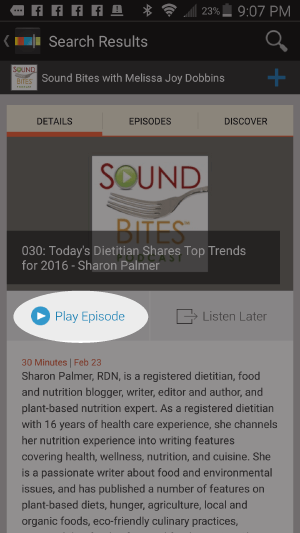
Listen on Stitcher (Android)
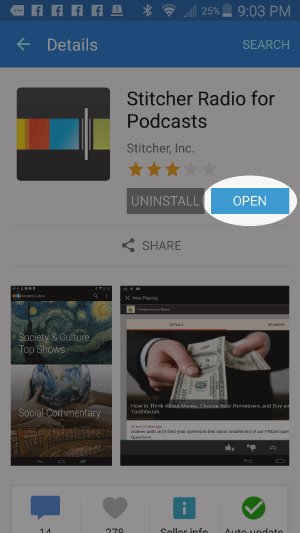
Install the Stitcher App
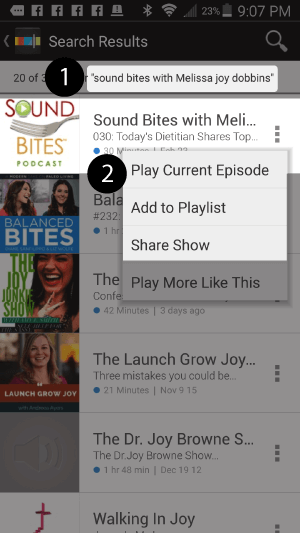
1. Search for “sound bites with melissa joy dobbins” 2. Choose Play Current Episode or Add to Playlist
Choose “Play Episode”
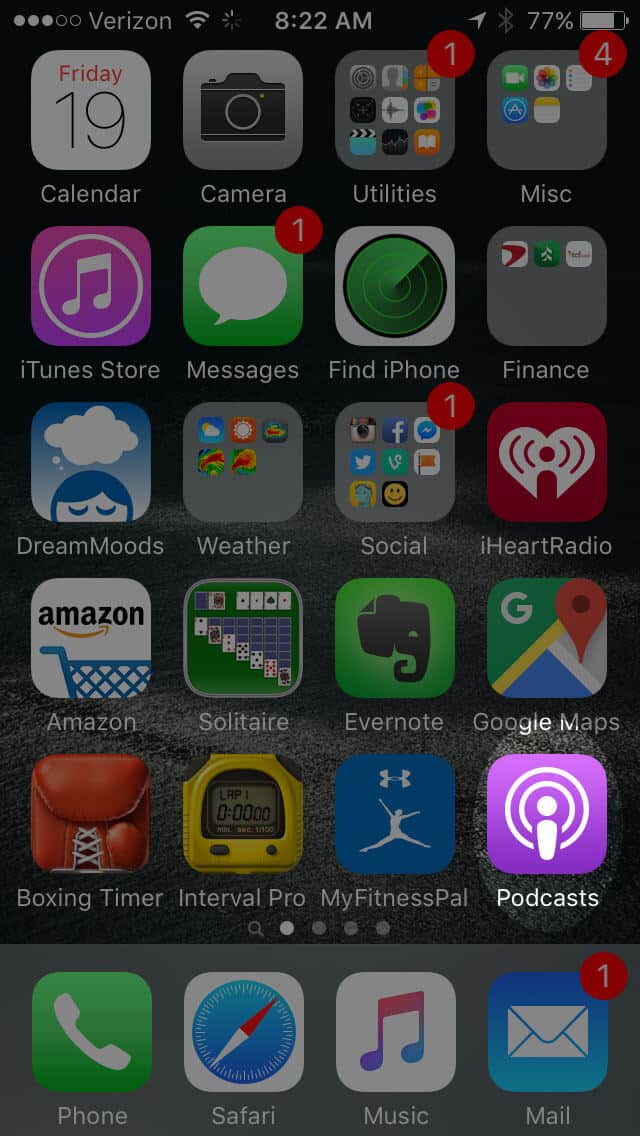
Subscribe & Review on iPhone
Open the “Podcast” app on your iPhone
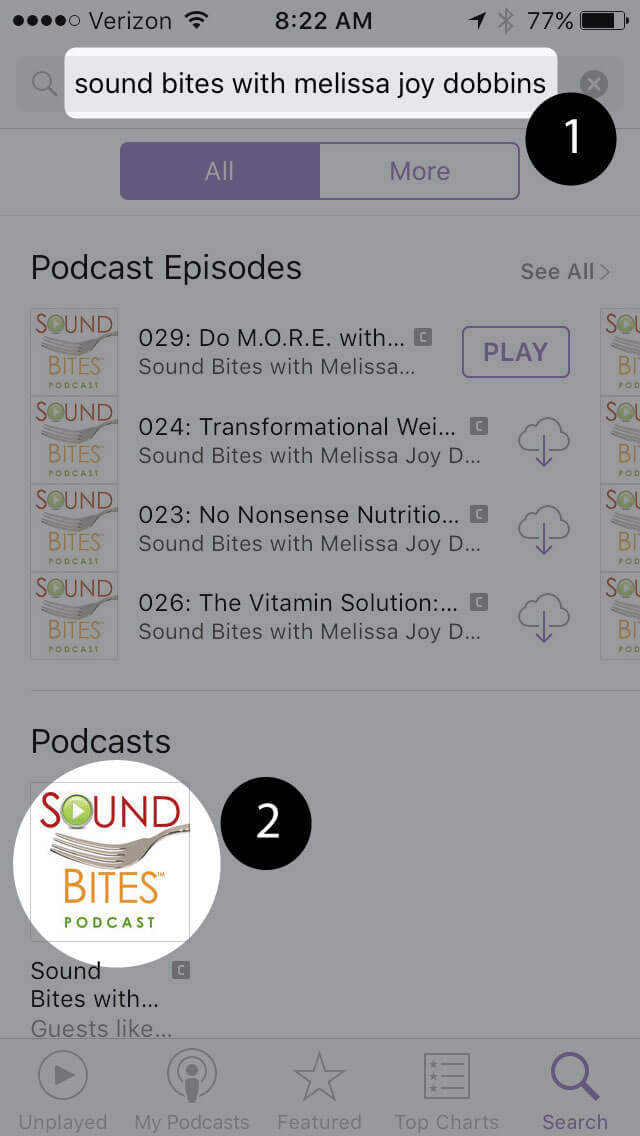
Search for “Sound bites with melissa joy dobbins”
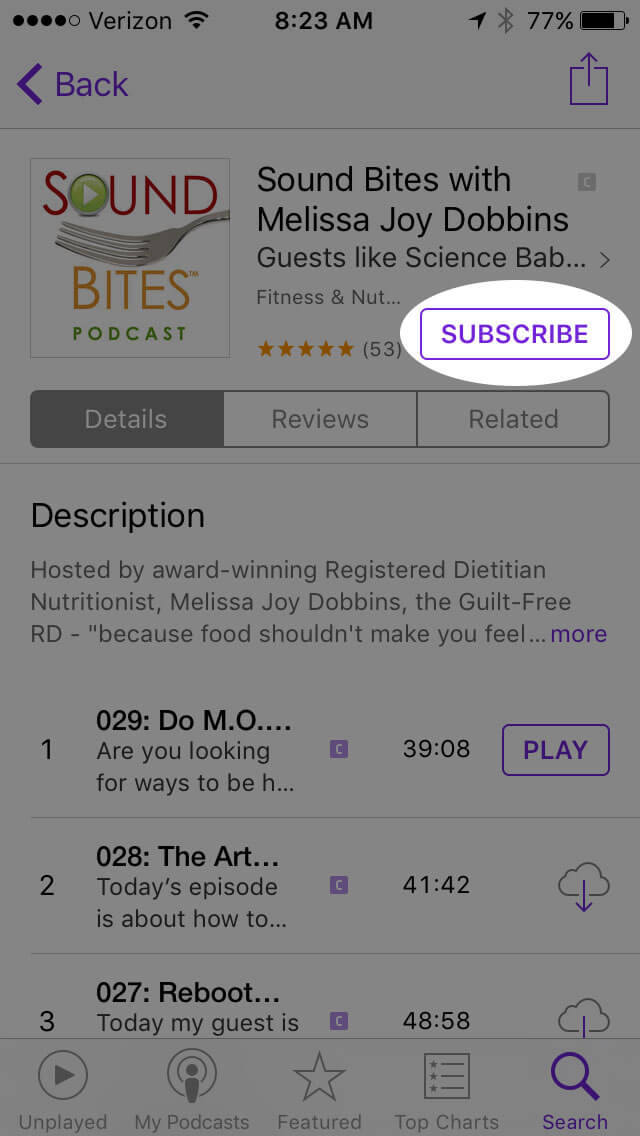
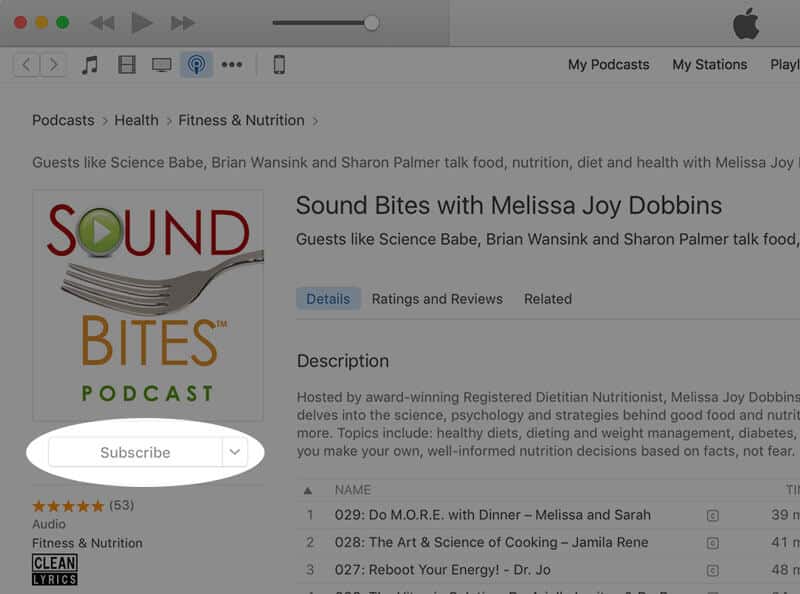
Open the podcast and click “Subscribe” and your done!
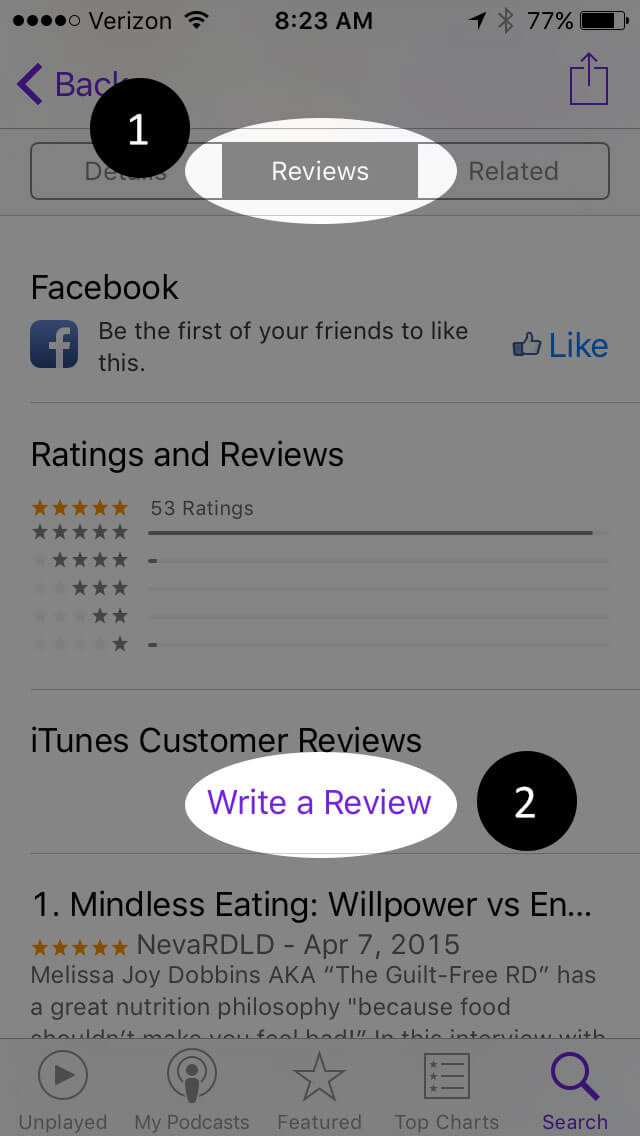
Write a Review
Click “Reviews”, then “Write a Review”.
Subscribe via RSS Feed
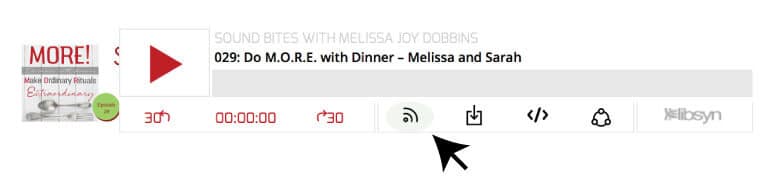
Navigate to any podcast player . Click on the RSS feed icon.
Click on the RSS feed icon.
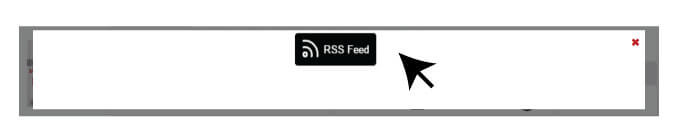
Click on RSS Feed
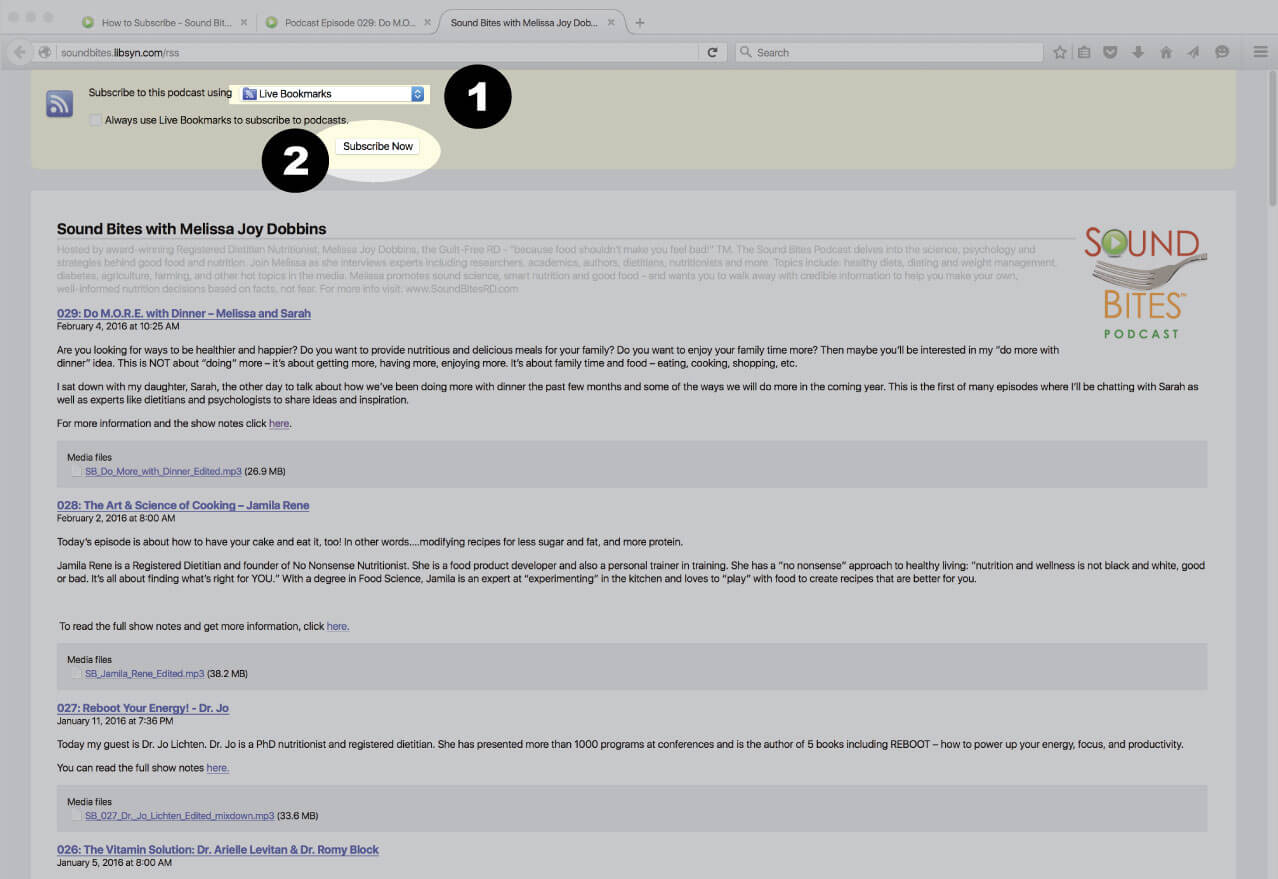
Choose which application you would like to use to receive the RSS feed
Click “Subscribe Now”
Confirm settings and subscribe.
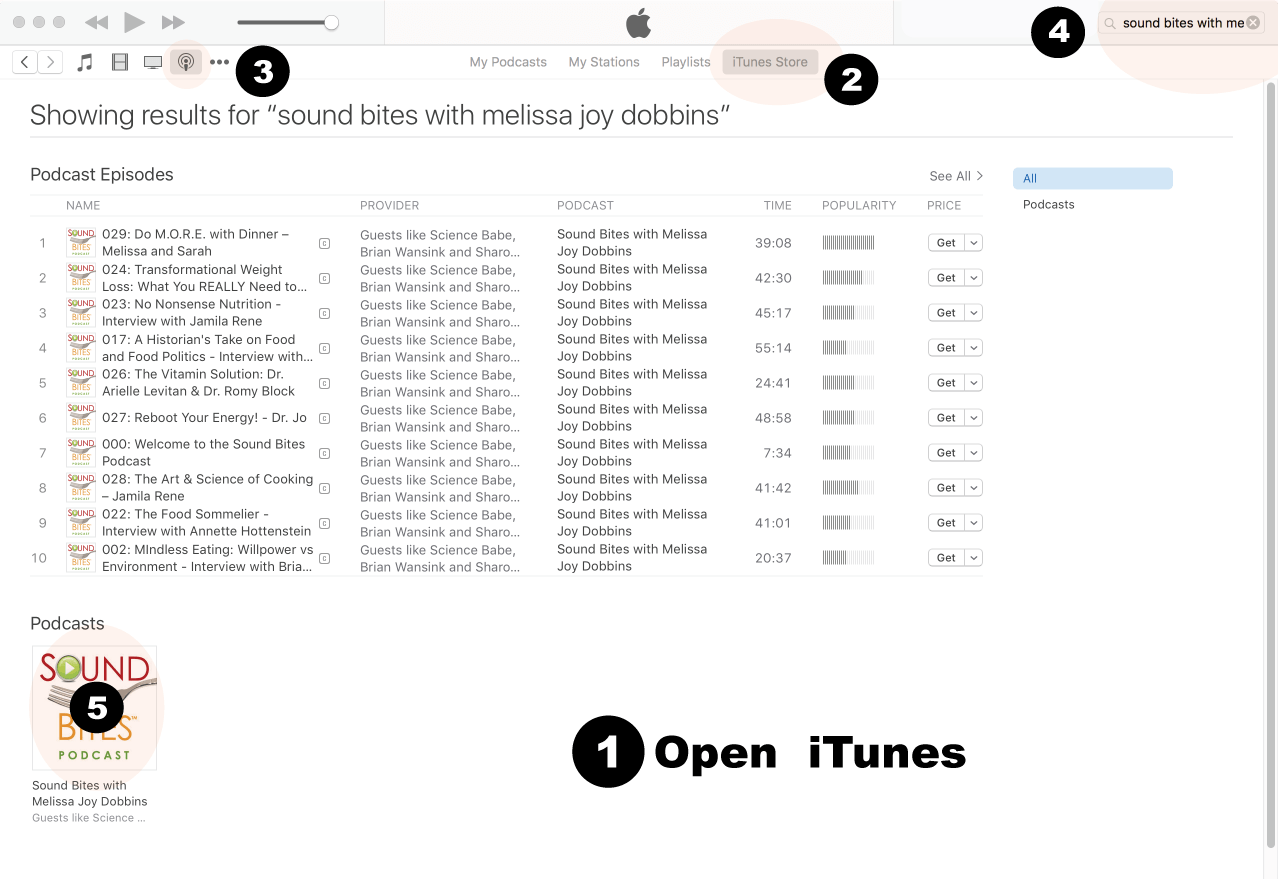
How to Review in iTunes
Open iTunes desktop application
Click iTunes Store
Click on Podcasts
Search for “Sound bites with Melissa Joy Dobbins”
Click on podcast image
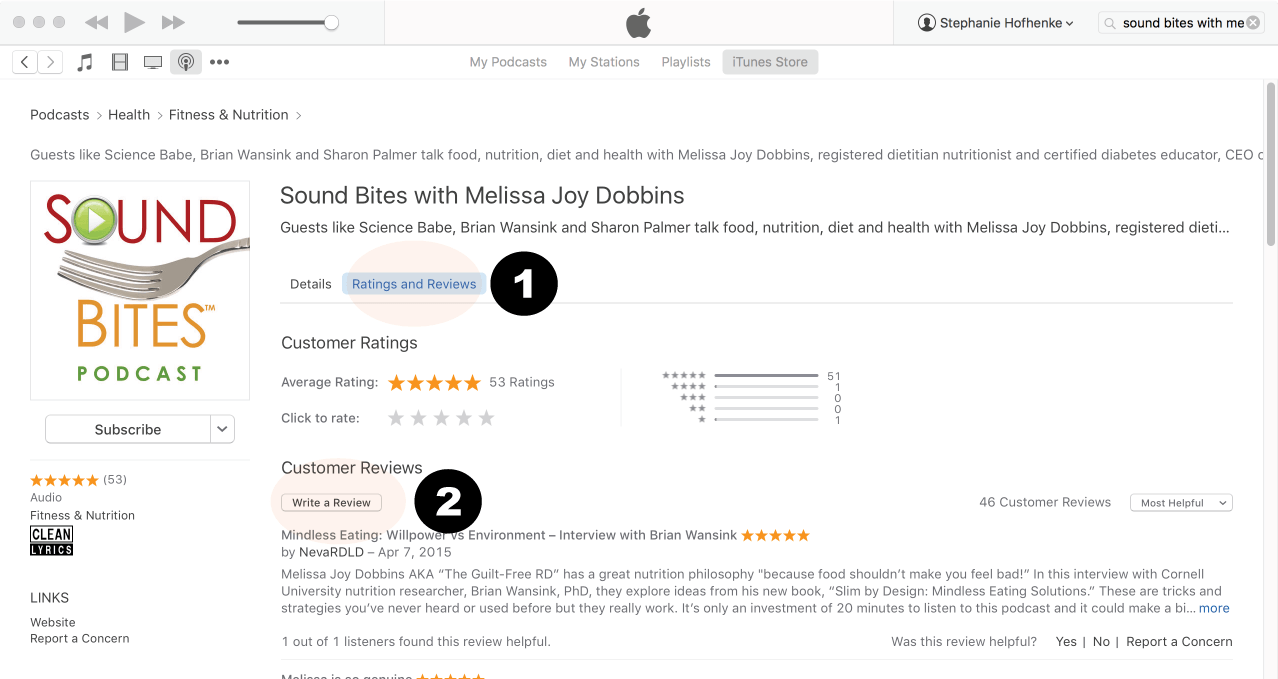
Search for Sound Bites podcast in iTunes
Click Ratings & Reivews
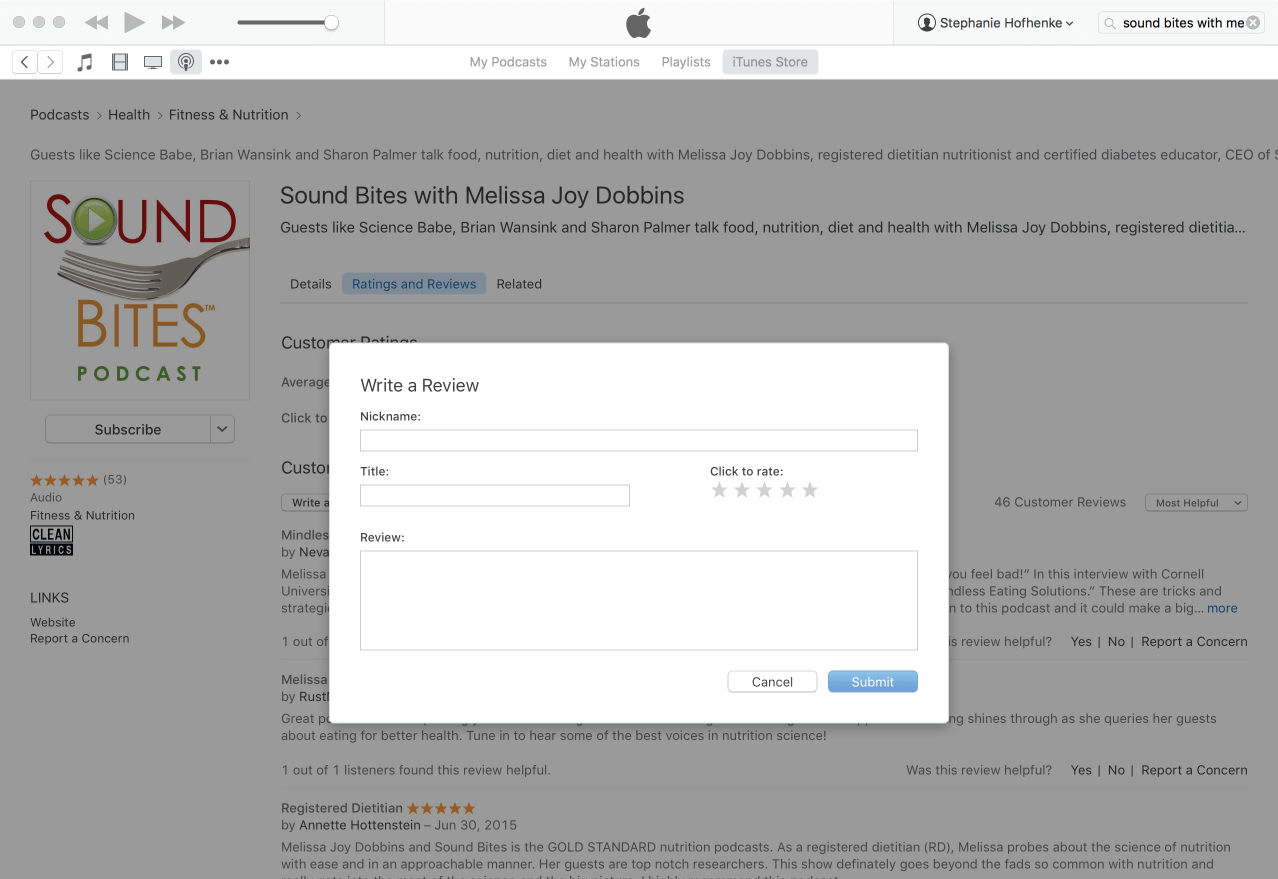
Click Write a Review
View reviews and write your own review.
Write your review…. Thank you!
Write your review!
How to subscribe via iTunes
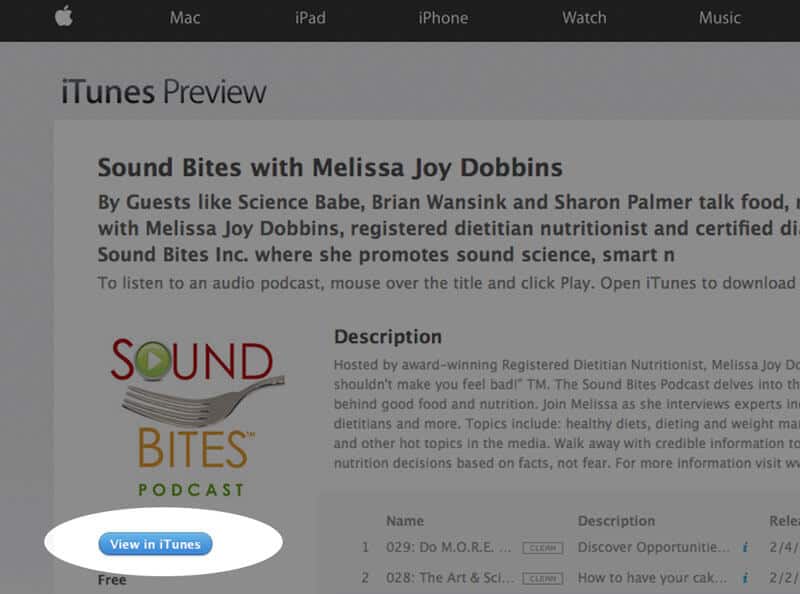
Click here to view the Sound Bites Podcastin iTunes, then click the blue “View in iTunes” button. This will open your iTunes application directly to Sound Bites Podcast. Click the “Subscribe” button, and your done!




 Professor Theo Lynn, Full Professor of Digital Business and Associate Dean for Research at DCU Business School, specializes in the transformative role of digital technologies in business and society, with a focus on strategy, digital communications, and data analytics. He’s been published widely across prestigious journals and serves as Series Editor for Palgrave Studies in Digital Business & Enabling Technologies.

Hi Melissa,
I thoroughly enjoyed your interview with Dr. Theo Lynn. What an interesting study looking at thousands of Tik Tok videos and analyzing them for accuracy. My takeaway: this is a wake up call for RDS everywhere to get on social media and promote themselves — include credentials and references as Dr. Lynn emphasized several times. Thanks for the work you do!
Anastasia Schepers, MS, RD, CLC
Thank you, Anastasia! I’m so glad you enjoyed the episode. Yes – we need more credible RD voices out in the media and social media!
Melissa