Celebrating over 1 Million Downloads and 50,000 Free CEUs on the Sound Bites® Podcast | NEW: Get 1 years’ worth of CEUs with the new 15-CEU Podcast Course
UPFs: Myths, Realities and Risks to the Global Food Supply
Are processed foods truly undermining our health, or are they an essential part of a safe, nutritious, and affordable food supply? Should the way we classify foods based on processing outweigh decades of national dietary guidelines—or are these systems flawed from the start? And what happens to public health policy when decisions hinge on classifications that may not be scientifically sound?
Tune into this episode to learn about:
how UPFs are defined
the NOVA classification system
how much of our diet is UPF
benefits of UPFs in the diet
how and why the current public discourse on UPFs is “superficial”
growing global distrust of science
how the food industry is responding to criticisms around UPFs
actions the food industry has taken to improve products
how the food industry gains insights into consumer preferences
the roles and responsibilities of food companies to educate and inform consumers
collaboration between the food industry and policymakers
what the future of UPFs might look like
resources for more information
The concept of so-called ultra-processed foods is highly problematic, and I don’t think it is, as it stands, a useful underpinning of policymaking. Its application risks having more negative unintended consequences than positive consequences.” – Rocco Renaldi
Rocco Renaldi
Rocco Renaldi is the Secretary-General of the International Food and Beverage Alliance (IFBA), where he leads efforts to promote healthier lifestyles and responsible business practices in the global food and beverage industry. He works with leading companies to reformulate products, enhance transparency, and support public health initiatives. Renaldi plays a key role in fostering collaboration between industry and policymakers to address global health challenges such as obesity and non-communicable diseases.
In the debate about processed foods, separating fact from fear is critical. Public health recommendations should be rooted in science, not oversimplifications.” – Rocco Renaldi
Resources
Some links may be affiliate links. As an Amazon Associate, I earn from qualifying purchases.
The concept of so-called ultra-processed foods is highly problematic, and I don’t think it is, as it stands, a useful underpinning of policymaking. Its application risks having more negative unintended consequences than positive consequences.
[Music Playing]
Voiceover (00:18):
Welcome to Sound Bites, hosted by registered dietitian nutritionist, Melissa Joy Dobbins. Let’s delve into the science, the psychology, and the strategies behind good food and nutrition.
Melissa Joy (00:40):
I’ve been getting a lot of questions from listeners about the continuing education credits that dietitians can get for some of my podcast episodes. So, I wanted to clarify that I do offer free CEUs for some episodes, but not all the episodes.
I have about three years’ worth of free continuing education credits, as well as some very low cost CEUs and a package on sale for one full year’s worth of CEUs if you want the convenience of taking just one quiz and getting one certificate for all 15 credits.
This is a fun and easy way to get your credits, so be sure to check it out. And you can get all the details on my website at soundbitesrd.com/freeceus.
Hello, and welcome to the Sound Bites Podcast. Today’s episode is about ultra-processed foods with a particular focus on the food industry, their roles and responsibilities, and how they are responding to the ultra-processed food conversation and criticisms. This episode is not sponsored.
My guest today is Rocco Renaldi. Rocco is the Secretary General of the International Food & Beverage Alliance, where he leads efforts to promote healthier lifestyles and responsible business practices in the global food and beverage industry.
He works with leading companies to reformulate products, enhance transparency, and support public health initiatives. He plays a key role in fostering collaboration between industry and policy makers to address global health challenges such as obesity and non-communicable diseases.
Welcome to the show, Rocco.
Rocco Renaldi (02:23):
Thank you for having me, Melissa.
Melissa Joy (02:24):
Very interested in your background. So, if you could explain and discuss a little bit more about the work you do so that our listeners get a better feel for your perspective on our conversation today.
Rocco Renaldi (02:37):
Sure. Look, I’ve been working for the past 25 years or so with the food industry in different forms, a lot in a consultancy capacity, but in particular since 2013, I have been leading the work of the International Food & Beverage Alliance, which is a group of some of the biggest global companies in this space, food and non-alcoholic beverages.
And really, my mission has been, first of all to bring them around the table to work out common approaches to what is undeniably a big global challenge, which is a health challenge that is in part related to diets.
And a lot of the work that I’ve been doing over the last 12 years or so with these companies is to fashion some common approaches, which are concrete things like for instance, we have a global program to phase out industry produced trans fats, which we have now accomplished, we have a set of global salt reduction targets with some category-specific targets 2025 and now to 2030.
And we also have a common global policy on responsible marketing, particularly as it concerns children and the global standard on the provision nutrition information to consumers as well, including on label. So, these are some of the flagship initiatives that we’ve been leading. I have also led over this time — I’ve been the interface, if you like, between this industry at global level and the global policy makers.
So, that includes the World Health Organization, the Food and Agriculture Organization, and to a degree, some of the key national governments that are part of that, and the various stakeholders that participate in this international debate.
Melissa Joy (04:22):
Excellent, thank you.
Rocco Renaldi (04:24):
And all of that in the spirit of the industry being a part of the solution.
Melissa Joy (04:28):
Yes, yes, thank you so much. Before we jump into everything, ultra-processed foods in the food industry, if you could just maybe articulate it a little bit for us why it is so important to have this global perspective on this issue.
Rocco Renaldi (04:42):
I think first of all, the issues at stake are global. We start from a problem which is obesity, non-communicable diseases, some of which are intertwined with dietary patterns. These issues emerged in industrialized countries first, but they are now pretty much global in nature.
Secondly, I mean, we’ve had economic globalization over the last 30 years or so, even though it is now somewhat challenged. We’ve had a clear growth in international commerce, and with that also comes international dietary patterns that emerge.
Second reason why a global dimension is important is learning because while these are global issues, they have not developed at the same speed or they have not started at the same time in different parts of the globe.
And also, they play out somewhat differently in different parts of the world. There’s a lot that we can learn if we look at the world as a whole, and bringing those perspective together is, I think, important to find effective solutions.
Melissa Joy (05:51):
Thank you. So, I’ve talked about ultra-processed foods on the podcast many times. Some episodes are devoted solely to the topic, otherwise, it weaves itself into many of the conversations on other episodes. But let’s start with, is there a definition of ultra-processed foods? And if so, what is it?
Rocco Renaldi (06:10):
So, there are several definitions around, but I think by far the most prominent one is a so-called the NOVA definition that was developed by Professor Monteiro and the group of other academics most associated, I think with the University of Sao Paulo in Brazil in 2009. And that is, as I said, I think by far, the most well-known definition.
Now, that definition is I think, in flux in the sense that now there are other organizations, including governments, most notably the Food and Drug Administration in the United States is consulting now in its own definition. The World Health Organization is also working on a potential definition of the next couple of years, and there are other academic groups that are not necessarily associated with governments that are also, I know looking into this.
Melissa Joy (06:59):
Yes. You mentioned the NOVA system, which is a classification system, and again, I’ve addressed this on the podcast before, but just a simple overview. They categorize foods into four groups depending on their degree of processing. Category one is unprocessed or minimally processed, two is processed culinary ingredients, three is processed foods, and four is ultra-processed foods. So, that’s very top line.
But as you said, the NOVA system is the most commonly used to date in research, and in the overall conversation. Is the food industry aligned with this definition or how are they thinking and feeling about this classification system?
Rocco Renaldi (07:37):
So, the short answer is no, the slightly longer answer is that in our view, the NOVA approach is very problematic from several points of view. The most obvious of these is that it is not a scientific definition.
Category four in NOVA are ultra-processed foods. There isn’t a clear distinction of what this ultra is meant to be, but it does include criteria such as, for instance, is the food packaged, is the food made by a company that’s making profit from it? Is it heavily marketed?
I mean, those are not criteria that allow you to make a meaningful distinction in terms of what kind of food product this is. But beyond these elements, which are, I would say eminently ideological as opposed to scientific, there is also a very important flaw, which is the complete absence of any nutritional dimension in this definition.
So, for instance, you can be a loaf of bread with exactly the same nutrient profile, in fact, the same ingredients, one is fresh and the other is packaged, and one will be ultra-processed and the other won’t according to that definition. That raises obvious eyebrows in any conversation with people in the food industry whose first angle is nutrition, which is I think also inescapable if we are looking at improving diets or dietary habits.
Melissa Joy (09:16):
Absolutely. I think that was one of the first things that caught my attention was kind of seeing a laundry list of food items that were considered ultra-processed that in my opinion as a dietitian, and not just my opinion, but they’re nutrient rich foods; things like soy milk and plant-based burgers and certain peanut butters and so on, yogurts can be considered ultra-processed.
Thank you for speaking to that. Kind of, maybe you just put the cart before the horse there, we’ve already implied that not all foods that are categorized as ultra-processed would be considered unhealthy from nutrient standards, nutrition standards. I believe you have some data on how much ultra-processed foods people are actually eating.
Rocco Renaldi (09:59):
It’s not our data, but there are studies around which show percentages like 60% of people’s diets or something like that are made of so-called UPFs. I think the UPF acronym here is used as a proxy basically for convenience food.
And therein lies the problem in the sense that you’re basically saying, yes, people eat a lot of packaged food products. There’s a so what in that, which is, okay, what are those products and what is this shopping basket versus that shopping basket look like? Even if both contain maybe 60% of the items that are packaged foods, they can be nutritionally very different baskets.
Melissa Joy (10:42):
Yeah, absolutely. So, as I’m asking this question and listening to your answer, I’m like, well, how can we determine how much ultra-processed foods is in the diet if we don’t have an agreed upon definition. But packaged foods, we can certainly distinguish between whole foods or fresh foods.
And I’m sure you’re familiar with the Julie Hess paper, but I want our listeners to be familiar with this (and I’ve mentioned this on the podcast before) — but there was a study published in the Journal of Nutrition in 2023 titled Dietary Guidelines Meet Nova: Developing a Menu for A Healthy Dietary Pattern Using Ultra-Processed Foods.
And the short story there, Julie Hess was the primary author on this paper, a couple things to share. She’s quoted as saying, “According to current dietary recommendations, the nutrient content of a food and its place in a food group are more important than the extent to which a food was processed.”
This study was a proof-of-concept study showing that it is possible to build a healthy diet with 91% of the calories coming from “ultra-processed foods” as classified using the NOVA scale. And they put together a menu that scored 86 out of a hundred points on the healthy eating index 2015. And all we need to know about that is that the average healthy eating index score for Americans is about 58.
So, I will also note that the menu that they put together was below the recommendations on whole grains and exceeded the sodium content, but otherwise, it met all of the other criteria regarding vegetables, fruits, lower in saturated fat, lower in added sugars, adequate protein, meaning the dairy foods, meaning seafood and plant proteins and so on.
I wanted to just call that out for our listeners because I think it’s important again, to illustrate just because something’s called ultra-processed A, what is it? B, is it healthy or not? You and I had talked before and you had said that the current public discourse on ultra-processed foods is superficial. Explain to me what you mean by that and how we can have maybe a more meaningful conversation on this topic.
Rocco Renaldi (12:49):
First of all, the health study that you refer to, to a degree, it’s maybe a provocation. It’s designed to stimulate debate, but it is useful because it challenges what has almost become sort of received wisdom, which is UPFs are bad. Well, from a nutritional point of view, it shows the importance of that nutritional dimension, of that nutritional lens at which to look at the issue.
And I think that starts telling you why that debate is somewhat superficial because unless you go and study the academic paper that underpins the NOVA classification, which is now some 15 years old, and not everybody is inclined to go through academic papers — well, you won’t know that part of the definition are these eminently unscientific aspects.
And instinctively, people might say, yeah, of course, if something is ultra-processed, it must be value … the word ultra, it’s use is, I would say, deliberately. It’s almost facetious. It signals that this is excessively processed, it’s-
Melissa Joy (13:52):
It’s inflammatory.
Rocco Renaldi (13:52):
It’s inflammatory, yeah, you use whatever terms you want, but it sets the tone for a conversation that can only be negative. So, that’s one reason why I’d use the term superficial because you have to go and dig deeper to understand the issue much better.
Secondly, I would say that this discussion as it has been framed, makes you want to look back nostalgically at a golden era where we are all running through the fields and happily chomping on the produce that we grew in that bucolic idyll that is sort of a superficial juxtaposition of modern or current equals bad and past equals beautiful golden age. That is a major fallacy.
And the reality is that the evolution of humanity as it has happened over the past half century or more, almost a century now, would not have been possible without the evolution of the food system that includes a major growth in processed foods that went alongside, let’s say the agricultural revolution, urbanization, the economic transition, industrialization, urbanization, and all of that.
And so, I think looking at the problems we have in the world in terms of public health and nutrition, well, you have to look at public health nutrition within the wider context, the wider socioeconomic and also, historical and cultural context in which these phenomena have arisen instead of pointing the finger at a culprit that has a facetiously sort of devised acronym, like this is simplistic and therefore, superficial.
Melissa Joy (15:49):
Simplistic. As you’re talking a little bit about the history, one of my very first podcast interviews 10 years ago was with food historian, Rachel Laudan, and she really does a nice deep dive into the industrial revolution. So, I will link to that in my show notes if anybody wants to take a listen to that.
But yes, as a dietitian and someone interested in public health, when I see things like the ultra-processed food sort of fearmongering, as well as other things that we’re seeing in the nutrition conversation today is I feel like it’s a distraction and a tangent from really getting to the source of the real problems, and therefore, interferes with us developing real solutions.
How is the food industry responding to criticism of ultra-processed foods? You mentioned some of the things that they’ve done, the trans fats out of the food system. I mean, that was at least 10 years ago, I believe. They’ve been doing a lot for many decades, but talk to me a little bit about how they’re responding and what else they’re thinking about doing moving forward.
Rocco Renaldi (16:56):
The first thing that we are doing is engaging in discussion just like we are now in terms of putting across a perspective that comes from organizations, companies, industries that have a lot of experience in making food and that bring a multifaceted perspective to it.
And I think that’s a really important piece because the conversation is not necessarily very balanced at the moment, and it’s very easy to generate headlines with bad news or with scary concepts. So, bringing perspective to that debate, I think is the first important thing that we are doing.
Beyond that, the problem with this so-called UPF concept is that it doesn’t leave any room for meaningful change in the sense that if you are a manufacturer of some packaged food products, let’s say, using that definition, you have nowhere to go, you are bad, you’re damned no matter what you do.
And so, we cannot have a direct sort of response in terms of action as a result of this UPF discussion because there’s something that can respond directly to that. What we are doing is continuing what we have been doing for some time, and that means innovating, it means renovating, it means reformulating, it means increasing choice, and it means also communicating those innovations and new choices that we bring to market.
And it means engaging with consumers to understand what it is that drives their choices, how their preferences are evolving, and also working with government and other stakeholders to in part, also steer those choices in a way that is compatible with health and balanced diets. So, it’s not like we are passive in the system in that sense that things just happen, it is possible to a degree to have a meaningful influence.
And we have seen that health and nutrition, they have risen on the agenda steadily, and they are important considerations down consumer choices. The trick now is to also make those choices not only appealing, but affordable.
And there is a lot of work that companies are doing on that, and there’s many ways in which you can do that, you can improve on that front. I think that’s a really important focus of what companies are currently doing.
But I think it’s also sort of a reality check around all of this because what we talk about within the industry is affordable nutrition. It’s a concept of food security that is also endorsed by the FAO and the UN. It’s sufficient, good quality food, nutrition, safe, affordable nutrition for all.
Melissa Joy (19:57):
Yes, absolutely. Yeah, we hear all the time that the food industry is giving consumers what they want in the way of indulgent foods. And we also hear other things that I’m not even going to repeat because they’re so inflammatory, about maybe the food industry driving what consumers want.
But I think it’s really important to talk about the other piece that you mentioned working like you said, I think with government to help improve the quality of the food and the choices and the health and nutrition. Some consumers are demanding more nutritious products, they’re not all just demanding more indulgent foods.
So, if you could speak a little bit more to that, how the food industry is working with consumers. Is it consumer insights? Is it surveys, and also with other entities to give consumers what they want and also, what they need?
Rocco Renaldi (20:47):
Yeah. And the consumer is ultimately at the very center of all of this. So, our member companies have a load of experience by now in terms of evolving recipes and food products including and especially from a nutritional perspective. And they do that in a way that is very, very much based on consumer understanding and consumer acceptance.
For every innovation you see in the marketplace, there are 10 innovations that failed that didn’t make it, or that made it briefly and then faded away, we’ve got tons of examples of that. And reformulation that has those pitfalls all the time. You cut sugar because you want to reduce population level sugar intake.
Well, often, the consumer will then reject that product or you reduce the salt, and the consumer’s like, “Ah, this doesn’t taste like it used to,” and they’ll put the salt back in at the table, for instance, and then you’re back to square one. So, the trick is to be finely in tune with consumer expectations and respecting consumer acceptance.
And when we talk about the reformulation journey, that’s the only way to do it, is to do it gradually in a way that takes the consumer with you. And often also by stealth, we call it reformulation by stealth. Companies have learned a lot from this. At some point, there were many companies who are putting on the label with one third less salt or whatever.
Melissa Joy (22:19):
Consumers like that (chuckles).
Rocco Renaldi (22:21):
Exactly. So, you’re better off often not saying anything. But then you don’t want a consumer to notice it because otherwise, they’ll switch to the other brand that hasn’t changed.
Melissa Joy (22:29):
And then you’re doing something to improve it, and the consumer doesn’t know, so they don’t know that you’re doing something to improve it (laughs).
Rocco Renaldi (22:35):
Exactly, exactly. But then there are other cases. So, for example, if there is awareness, for instance, amongst consumers that’s something … or if there’s a demand for healthier products, for instance, chips not fried, but oven baked for example.
This has become a significant segment of that market in that category, and it’s something that is working well, and we’ve managed to reduce the fat content of many products that way. So, it depends, there is not one way. But studying the consumer reaction is at the core of this all the time.
Melissa Joy (23:08):
Maybe a few months ago I did an episode on food dyes with the food technologist from the Institute of Food Technology (Renee Leber is her name) and I learned so much from that conversation. And obviously that’s a big topic in the media today in the health and nutrition conversation, and I’ve said this on other episodes, but I feel like the red dye number three is a red herring.
Of course, if they’re safe, whatever, why do we need them in the food supply? People don’t understand the nuances when you take a synthetic dye out and then you’re using a natural one. It’s just not a simple replacement. The colors aren’t as vibrant, they don’t function the same way, the product doesn’t look the same, there might be some food sensitivity issues with them.
There’s a lot of things going on in the food innovation and reformulation space, but the biggest issue for me as a dietitian and a public health advocate is why are we spending so much time and energy focusing on that when that time and energy could be spent on something I think really meaningful?
So, I am glad that you’re highlighting some of the things that the food industry has done, and I would love to hear what you kind of see like the future of ultra-processed foods is? Maybe it’s beyond ultra-processed foods, just the future of packaged foods.
Like what do you see the food industry doing continuing to work with the government and other entities to make healthier choices, easier choices and more affordable? I would love to hear sort of your crystal ball on that.
Rocco Renaldi (24:36):
Yeah, it’s a big question, but I also think that there could be a nuance in my answer in the sense that the answer doesn’t necessarily look the same across the globe because at the end of the day, food culture is very much part of culture, and that is still very different, and that’s a good thing.
But I think there’s some principles that we should draw out, and the most top line for me is a modern food system, a system that is able to provide affordable, positive nutrition and a wide range of choices to the population.
It is also a food system that successfully combines the traditional and the modern, if you like, or the convenience and the artisanal or the natural or whatever we care to describe it as, but that is multifaceted in that way. So, it’s not, to me sort of an either or question.
It’s not like we should not be — just like I take issue with evangelism about a supposed bygone golden era, we should also not be evangelists for a diet that is entirely composed across the food, that is obviously not right. So, it’s almost like a back-to-basics plea, which is a balanced diet is only possible with balance.
And balance means variety, and variety means you need to include many things, some of which will be packaged, some of which will not be; some of which will be indulgent, and some of which will be particularly healthy, some of which will be calorific and some not. And on some days, in some weeks, be it Christmas, yes, do indulge traditional. Dietary patterns also means you might actually put on some weight in winter and you lose it in summer.
I mean, all these things are parts of a sophisticated, I think, complex vision of food systems that get lost in a simplistic, polarized debate such as the one we’ve just been going through. So, I think the answer isn’t simple, isn’t straightforward, it’s quite diverse. But diversity is exactly one of the key principles, choice is the other.
And I think one element that we should not forget, and that is underlined in every UN global strategy that I know, which is a whole of society approach, meaning in order to fix or mitigate the problems that we’ve got, including in the food system, you can’t expect one player to do it, you can’t regulate the problems away, which doesn’t mean there isn’t a place for regulation too, but there’s no silver bullet.
And if there is no silver bullet, then the only solution is to get together as stakeholders in society and find ways to build a compact that is a sustained effort to move the system towards that sort of vision that I articulated.
Melissa Joy (27:54):
Excellent.
Rocco Renaldi (27:55):
And I think there’s appetite in the food industry for that engagement and for those conversations, but the polarization of this debate doesn’t make it easy to operate on that level.
Melissa Joy (28:06):
To come to that table that you said, yes. So, I often think, wouldn’t it be nice when we hear about all these ingredients that people want food manufacturers to take out of the food and okay, well, we’re going to take them out even though they’re safe and we are just going to give the consumers what they want.
And I’m like, well, what responsibility, if any, does the food industry have to explain to consumers, “We’re going to take that out because you don’t want it, but just so you know it was safe, you don’t need to be afraid of it.” What do you say to that?
Rocco Renaldi (28:37):
So, I think one of the difficulties of a polarized environment is the undermining of trust. The food industry itself suffers from a lack of trust when it comes to communication on the safety of ingredients.
And that is almost inevitable if there is this perception of conflict of interest or this perception that these companies don’t care, the reality is that the first thing that they care about is the safety of consumers because their business depends on it. And that’s true for any company, any respectable company, of which I think the vast majority that I know are.
So, there is that trust deficit or gap that makes communication by industry tricky, which doesn’t mean industry shouldn’t communicate in particularly when it comes to consumers, because you know marketing is communication and there’s nobody that knows consumers better than companies that do marketing, that understand the consumers.
There is a big responsibility on government, and something that is happening today is the undermining of trust in government institutions, and that is, I think, very much a negative because we’ve entrusted government agencies to regulate ingredients, et cetera, and if we undermine public trust in those institutions, we undermine public trust in food safety and the food system, and that’s a vicious circle.
I think there is an urgent need for a new approach that you can direct through policy, but you should not substitute science-based decision-making with approaches that are, let’s say, whimsical.
Melissa Joy (30:22):
Yes, that makes a lot of sense. If the food companies aren’t trusted, they’re not going to be believed when they try to explain that this ingredient is safe and so on, and could be better done in a collaborative effort.
Speaking from a global perspective, how do you view movements such as MAHA in shaping international perspectives?
Rocco Renaldi (30:45):
Look, we don’t engage directly with domestic policymaking because our remit is international. I will say or repeat that in our view, science-based decision-making is and should always remain the key underpinning of food policy.
And when we observe that is not the case, we observe a fall in trust and that engenders a negative vicious circle. To me, the productive approach is one that is measured, that is consistent, that doesn’t scare consumers, and that remains firmly based in the best scientific evidence that we have.
Now, science is not always unanimous, and you have also somewhat different approaches in different parts of the world. For instance, I live in Europe and Europe has always been more precautionary in its approach which results today in some ingredients being authorized, for instance, in the United States and not in Europe, which I know is part of the debate in the US, but that is because there were different starting points.
The European Union had more of, and even now has an even stronger hazard-based sort of approach than the risk-based approach which has been predominant in the international regulatory approach. And so, if you shift from one to the other, it’s clear that you come to a different conclusion.
We as food companies are always proponents of a firm risk-based approach because obviously, exposure matters. In simple terms, how much of this product are you likely to eat? In large quantities, water kills too. So, if you have a purely hazard based approach, sometimes you will reach absurd conclusions.
Melissa Joy (32:44):
Yeah, no, thank you for mentioning that. I have touched on that on the podcast a couple times as well, and I’ll link to some episodes that address this hazard versus risk. It’s a little complex, but it’s an important distinction and it does speak to how we do come to different conclusions in the U.S. versus the EU.
As we’re wrapping up, what would you say your bottom-line takeaway for our listeners is on the whole topic of ultra-processed foods and the food industry?
Rocco Renaldi (33:11):
So, I think first of all, the concept of so-called ultra-processed foods is highly problematic, and I don’t think it is as it stands, a useful underpinning of policymaking, its application risks having more negative unintended consequences than positive consequences.
Secondly, I think consumers are intelligent, consumers have legitimate aspirations, they love brands that they know, that they know are safe, but thirdly, we need to help consumers, we need to make sure that they have access to sufficient choices, that they are empowered to make the right choices, and that they’re also a little bit encouraged to make the right choices.
None of this is possible with Dictacs bands, et cetera. Much of this may be possible with a sophisticated vision, a whole of society approach, and I’m afraid, a timeline that goes beyond the electoral frame.
Melissa Joy (34:15):
Very good, very good. Where can people find out more information and connect with you?
Rocco Renaldi (34:21):
I’d love to hear from anyone who’s interested to engage. You can find my contact details on the IFBA website, that’s ifballiance.org. You also find a lot of materials and links to other resources on there, and you can also find me on LinkedIn, just send me a message.
Melissa Joy (34:38):
Excellent. I will have both of those links in my show notes at soundbitesrd.com. Rocco, thank you so much for coming on the show and having this conversation with me, I really appreciate it.
Rocco Renaldi (34:48):
Thank you, Melissa. Thank you for having me.
Melissa Joy (34:50):
And as always, enjoy your food with health in mind, until next time.
[Music Playing]
Voiceover (34:56):
For more information, visit soundbitesrd.com. This podcast does not provide medical advice, it is for informational purposes only. Please see a registered dietitian for individualized advice.
Music by Dave Birk, produced by JAG in Detroit Podcasts. Copyright sound bites, Inc, all rights reserved.
LISTEN, LEARN AND EARN
Listen to select Sound Bites Podcasts and earn free CEU credits approved by the Commission on Dietetic Registration (CDR) for registered dietitian nutritionists and dietetic technicians, registered. Get started!
Get Melissa’s Sound Science Toolkit here!
Partnerships:
Sound Bites is partnering with the Association of Diabetes Care and Education Specialists (formerly the American Association of Diabetes Educators)! Stay tuned for updates on the podcast, blog and newsletter!
Sound Bites is partnering with the International Food Information Council! Stay tuned for updates on the podcast, blog and newsletter!
Sign up for my monthly newsletter and episode eblasts so you never miss an update!
Listen on Stitcher (Android)
Install the Stitcher App
1. Search for “sound bites with melissa joy dobbins” 2. Choose Play Current Episode or Add to Playlist
Choose “Play Episode”
Subscribe & Review on iPhone
Open the “Podcast” app on your iPhone
Search for “Sound bites with melissa joy dobbins”
Open the podcast and click “Subscribe” and your done!
Write a Review
Click “Reviews”, then “Write a Review”.
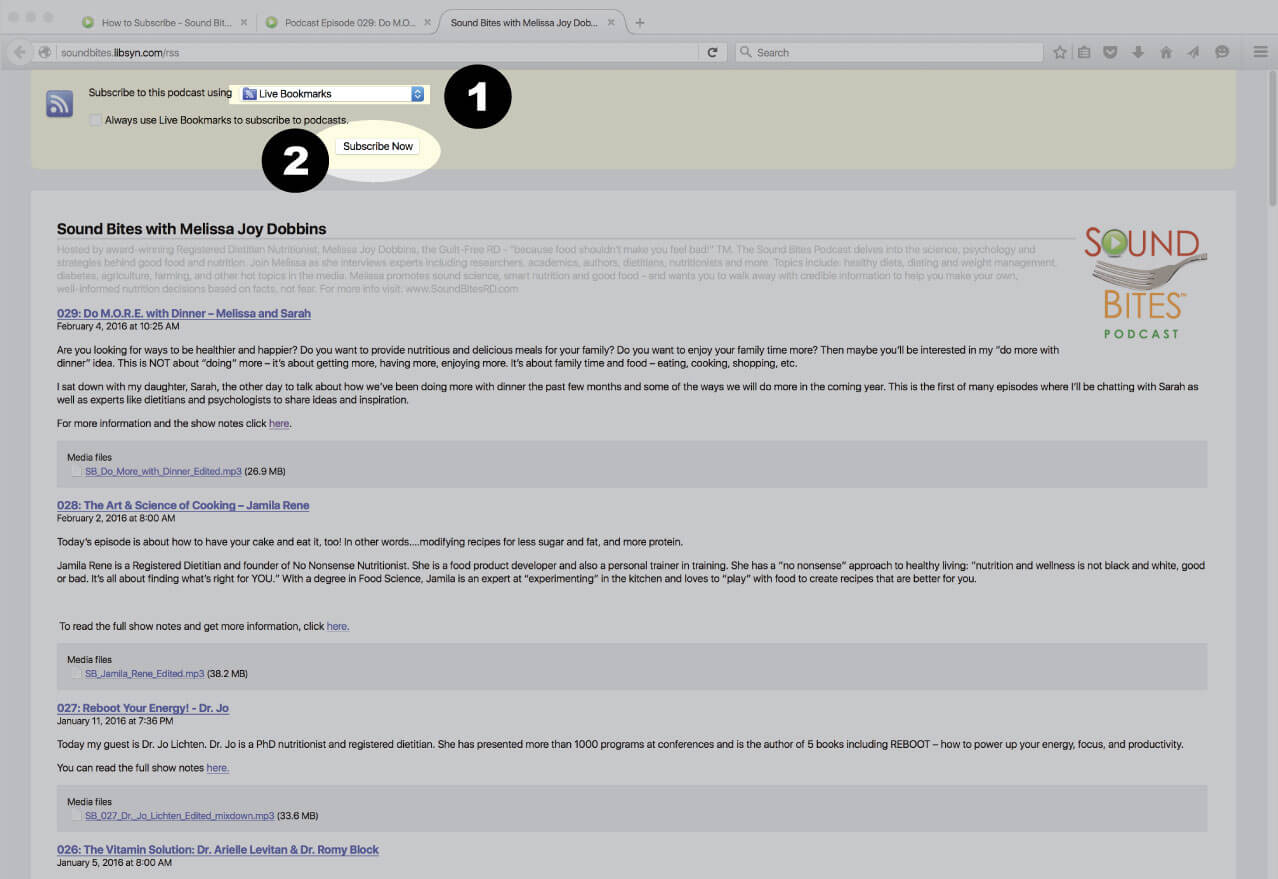
Subscribe via RSS Feed
Navigate to any podcast player . Click on the RSS feed icon.
Click on the RSS feed icon.
Click on RSS Feed
Choose which application you would like to use to receive the RSS feed
Click “Subscribe Now”
Confirm settings and subscribe.
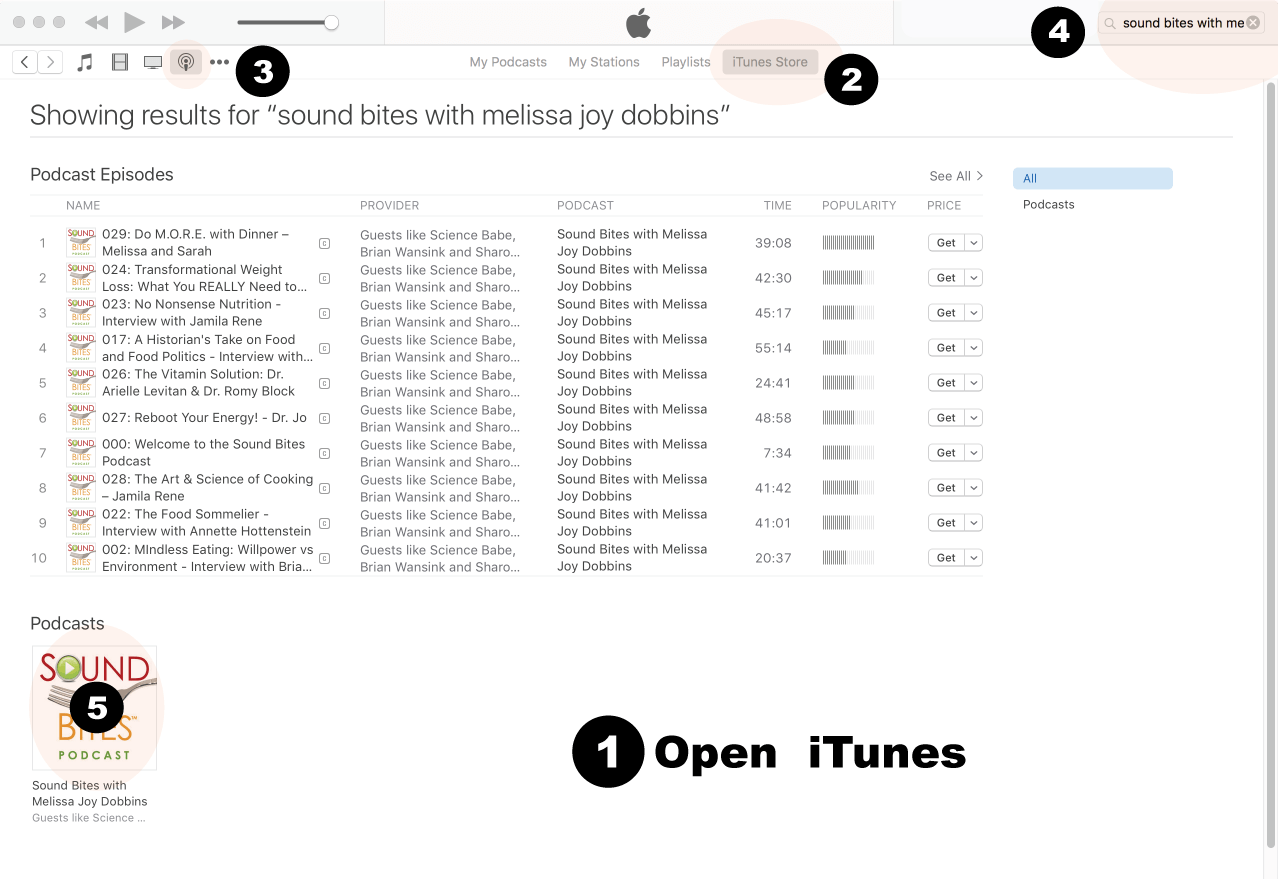
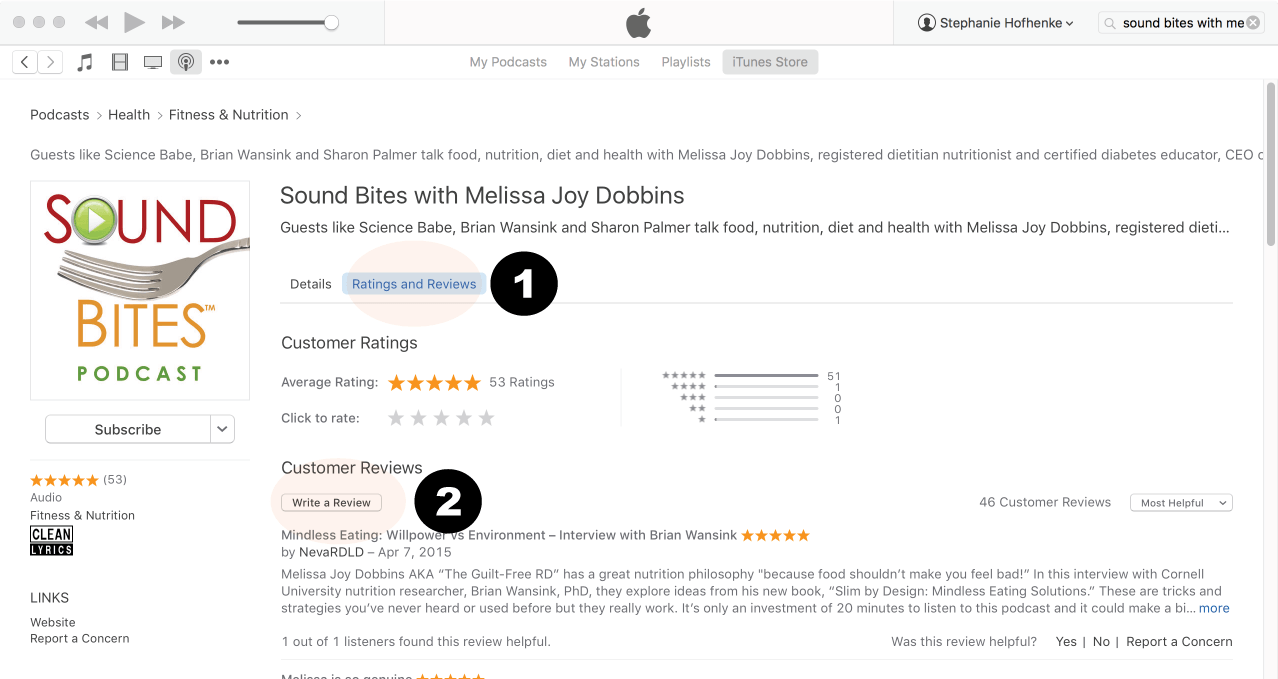
How to Review in iTunes
Open iTunes desktop application
Click iTunes Store
Click on Podcasts
Search for “Sound bites with Melissa Joy Dobbins”
Click on podcast image
Search for Sound Bites podcast in iTunes
Click Ratings & Reivews
Click Write a Review
View reviews and write your own review.
Write your review…. Thank you!
Write your review!
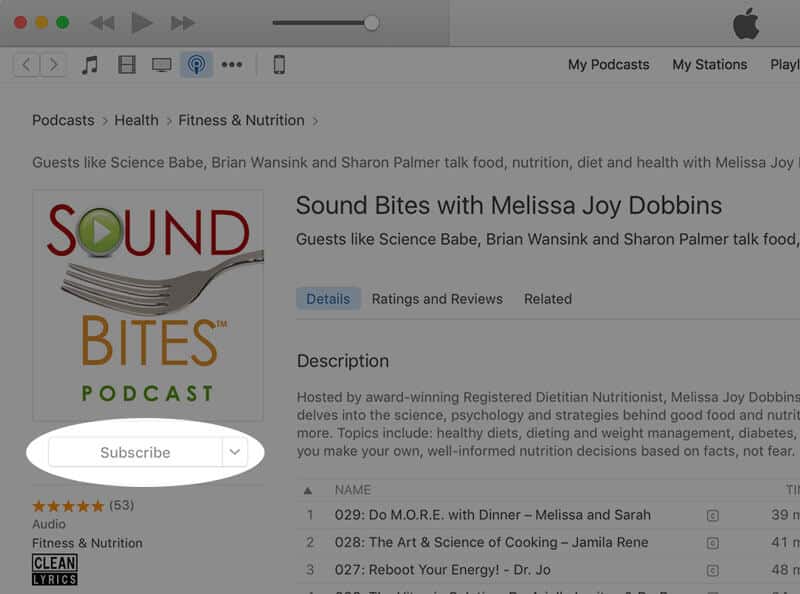
How to subscribe via iTunes
Click here to view the Sound Bites Podcastin iTunes, then click the blue “View in iTunes” button. This will open your iTunes application directly to Sound Bites Podcast. Click the “Subscribe” button, and your done!




 Rocco Renaldi is the Secretary-General of the International Food and Beverage Alliance (IFBA), where he leads efforts to promote healthier lifestyles and responsible business practices in the global food and beverage industry. He works with leading companies to reformulate products, enhance transparency, and support public health initiatives. Renaldi plays a key role in fostering collaboration between industry and policymakers to address global health challenges such as obesity and non-communicable diseases.