Celebrating over 1 Million Downloads and 50,000 Free CEUs on the Sound Bites® Podcast | NEW: Get 1 years’ worth of CEUs with the new 15-CEU Podcast Course
How Safe Are Food Dyes? An Expert Weighs in on the Research & Regulations
How safe are the food dyes found in many of the products we consume daily? Are concerns about their effects based on scientific evidence or misinformation? With government agencies and researchers continuously evaluating these additives, what changes might we see if more regulations and bans are put in place? As food products evolve in response to shifting policies, how can consumers stay informed and make the best choices for themselves?
With proposed legislative bans on the rise and the spread of misinformation online, it’s only natural to feel nervous or have concerns about artificial food dyes. However, it’s important for consumers and the health and wellness community to understand the scientific context behind artificial food dyes so they can feel confident in their food choices.” – Renee Leber
Tune into this episode to learn about:
What types of foods/beverages contain food colors and why
Artificial vs. natural food dyes
What the research shows about the safety of food dyes
Common myths and misconceptions about food dyes
Challenges in making food color changes or product reformulations
The California food dye acts
Red dye number 3
The differences and similarities between the US and EU approach to risk management
The truth about the differences between what the EU has banned compared to the US
The difference between hazard and risk and why it is important
A new food additives toolkit from IFT
Takeaways and resources for the public and health professionals
Renee Leber, BS
Renee Leber has over ten years of product development experience. She has worked with food companies producing a variety of product categories before accepting the role of Manager, Food Science & Technical Services at IFT. Renee leads the IFT Concierge Service, helping teams across the globe find solutions for everyday challenges to long term initiatives. Renee meets R & D teams in their time of need and provides ready to access research and resources allowing them to overcome hurdles in topics like shelf life, reformulation, food quality and safety, and regulatory compliance.
Resources
Some links may be affiliate links. As an Amazon Associate, I earn from qualifying purchases.
Welcome to Sound Bites, hosted by registered dietitian nutritionist, Melissa Joy Dobbins. Let’s delve into the science, the psychology, and the strategies behind good food and nutrition.
Melissa Joy (00:23):
Hey there, if you’re a dietitian and you’re trying to fulfill your continuing education requirements, be sure to check out my free CEU activities. I have nearly three years’ worth of free CEUs you can receive by listening to my podcast.
I also have a CEU package on sale for one year’s worth of continuing education credits, which offers the convenience of taking only one quiz and receiving one certificate for all 15 credits. Simply go to my website at soundbitesrd.com/freeceus for all the details.
Hello, and welcome to the Sound Bites Podcast. Today’s episode is about food additives, in particular food dyes or food colors. Are they safe? What does the science say, and what do we need to know about food dye bands? This episode is not sponsored.
My guest today is Renee Leber. Renee has over 10 years of product development experience. At the Institute of Food Technologists, she leads the IFT Concierge Service, helping teams across the globe find solutions for everyday challenges to long-term initiatives.
Welcome to the show, Renee.
Renee Leber (01:41):
Hi, thanks for having me.
Melissa Joy (01:43):
Excited to talk with you. I would love for you to share more about your background and the work you do with our listeners. You and I have had the opportunity to chat and get our ducks in a row as far as what we want to cover today, but you have a really interesting background, and I’d love for you to share that.
Renee Leber (01:59):
Thank you. So, I actually started my career out on the culinary side of the world. Like many in the U.S., I wasn’t very familiar with food science when I was growing up and before I entered the industry. So, started off on the culinary side of the world, fell in love with food science.
I went to the Culinary Institute of America, joined every research project I could with them, and eventually, it was actually one of my chefs at the culinary that said, “You need to look at food science and see if this is a direction you’d want to grow your career in.”
And sure enough, fell in love with it. I went to the Ohio State University for Food Science and Technology. While I was there, I joined a at the time, very small company called Jeni’s Splendid Ice Creams (so, I’m going to date myself). This is when they were still an Ohio-based company. It’s when they still had seven, eight scoop shops in Columbus.
And I was with that company when they crossed state lines for the first time and when they jumped to retail for the first time. So, it was an interesting growth, where all of a sudden, you went from knowing the cow’s names to being on a Target shelf.
And so, fascinating time, fascinating way to start my career. I moved into fresh produce with Freshway Foods after that, which is just north of Dayton, Ohio. I worked with them for a few years before US Foods came in and purchased Freshway as their fresh fruit and vegetable processing arm.
Then I got to look at how mergers work, especially when it is more of a buy-up type of a merger, and making systems talk to each other, looking at the traceability aspects of how to merge different programs and companies do things slightly differently. So, making sure that all of our systems fit within their systems.
So, that was an interesting time period. Got through that and US Foods said, “Would you have any interest in joining our corporate team in Chicago?” And I thought that sounded extremely exciting.
Joined US Foods, it was a massive/it is a massive company, but the product development team is a fairly small team. At any given time, there are 8 to 12 people who are wearing a lot of different hats. So, I worked across many different desks, got to see all sides of the industry.
And then about three years ago, I heard from IFT and they asked if I would’ve any interest in talking about a program they were starting called the Concierge Services Program. And IFT has just always been in the background of my career, it’s always been an organization I’ve loved.
So, I jumped at the opportunity to talk with them and I’ve been so thankful to work with them for the last three years. We have this program in place that’s all about connecting companies to the research and resources they need and the time they need it.
We’re seeing more and more now that companies have a lot of fires and not as many hands as maybe they used to, to really deal with those fires. And they need a little bit of help sometimes to pull the resources in place to make sure that their teams are successful. So, that’s where we come in.
Melissa Joy (04:58):
Wonderful. Yeah, I was going to ask you to explain a little bit more. It kind of sounds like an extension service sort of service.
Renee Leber (05:06):
A little bit. So, what we really focus on is putting the right resources in their hands. So, we’re not in the business of making the decisions, but we want to make sure that from everything, from EPR laws all the way to strange, bitter off flavors that we have the answers as to what is the science saying behind this and what do you need to know to make the decision that you’re then not going to have to remake three months later.
Melissa Joy (05:31):
Very cool. Well, my regular listeners know I love IFT, and I’ve gone to the IFT first meeting two years in a row on a press pass, which is just amazing and hoping to go again this summer. And one of the most striking things that I saw in the exhibit hall last year was this booth with all these different food colors and the natural food color options that they’re innovating right now and everything.
So, when I heard about some of the things going on with red dye no. 3, I’m really excited to talk with you about that and bring all my listeners up to date.
So, let’s start in general with just food colors or food dyes, what types of foods and beverages contain these types of colors? And I mean, obviously, they’re there for the aesthetic and the visual, but are there other reasons that they’re in there? Are they really necessary too?
Renee Leber (06:28):
Yep. So, everyone thinks of cookies, cupcakes, candies when they think of synthetic food colorings as well as natural food colorings. And the answer is yes, they’re absolutely in those categories. We see them throughout baked goods, we see them throughout our beverages, but they’re in so much more. And so, a lot of people jump to those bright colored cookies, the candies, but they’re a background color in a lot of products, and they can be there for a variety of reasons.
So, an interesting one might be something like honey mustard dressing. People are expecting that to be a certain yellow type color. And so, some honey mustard dressings contain a yellow color to make sure it’s meeting those consumer expectations, but some of our products that have longer shelf life and might outlive their color vibrancy – colors are added in order to make sure that when they’re halfway through shelf life, they don’t look unappealing.
Consumers eat with their eyes first, and so if they can start to tell that the color is waning, they might not buy it, they might not eat it, they might assume it’s bad. And so, sometimes those colors are added to make sure it looks like what it needs to look like longer. So, in that sense, it’s aesthetic, but it’s more than just aesthetics, because otherwise, you’d start to get into failing products earlier in shelf life, which can lead to additional food waste.
The other thing we’ve seen is sometimes processing can diminish colors, sometimes oxygen can diminish colors. And so, if the concern is that the product might go through processing and end up looking a little bit more muted or a little bit more brown, sometimes those colors are added back to give the appearance that consumers are looking for and expecting.
Melissa Joy (08:10):
Right, yeah. I have this sort of example that I’m probably going to wait, I’m just going to tease it now and talk about it a little bit later. But I know Trix cereal changed from some of the synthetic colors to the natural colors and got a mixed response from consumers.
Renee Leber (08:27):
Yes.
Melissa Joy (08:28):
Well, let’s just talk about it now. So, when I saw that change, I have to admit I’m a little old school, I was a little disappointed. I was like, “Well, I trusted that the synthetic colors were safe,” and we’re going to talk all about that aspect. And I don’t eat Trix a lot, but I was like, “Oh, I had the nostalgia when I wanted.” It just doesn’t look the same and kind of to me, didn’t taste the same. Like you said, we eat with our eyes.
And I ended up talking with the dietitian from General Mills and learning that when they made that switch, trying to do the right thing, trying to … well, I shouldn’t say doing the right thing, doing what they thought consumers wanted, and they made that switch, then they heard from a lot of consumers that didn’t want that switch.
And they realized they had two different types of consumers, some that wanted the vibrant colors, the nostalgia, others who wanted the natural colors. So, I just found that really interesting from a consumer perception, consumer preference standpoint.
So, you probably have other similar examples that you can bring up as we go along, but let’s talk about the safety. What does the science say? I mean, we’re talking about all food colors and food dyes right now, and I’m sure it’s a case-by-case basis, but what would you like us to know about the safety aspect? What does the research say or how is this regulated?
Renee Leber (09:54):
Alright, so let’s start with food colors in general. There are two types of food colors that the FDA recognizes, and most people, when they say artificial food colors, what they mean is are synthetics. So, the FD&C colors. And it’s important to note that in the eyes of the FDA, anything that is colored for the sake of coloring is artificially colored.
So, it doesn’t necessarily matter if you put an anthocyanin that came from a berry into a product to make it redder, it’s still artificially colored because that color wouldn’t naturally be present within the product without a colorant. So, that’s off the top. It’s a common misconception in the public right now, and so I think it’s worthwhile to bring that up.
Then we have our synthetic colors, our FD&Cs, and those are extremely heavily regulated. So, if you go back 60, 70 years, we used to have more synthetic colors than we do now. At this point, we are down to our six as of late, but recently seven, and those have gone through extensive testing processes, and it’s down to their testing them by the batch.
So, any synthetic color that gets made, the FDA will go in and test the batch production to make sure that it’s meeting the standard of identity that it needs to, and that they are comfortable with the safety.
When it comes to our exempt colors, those are the ones that people think of when they think of natural colorants; what’s coming from berries, the reds from beets, greens from plants, things of that nature, those are our exempt colors.
The FDA doesn’t feel the need to look at those by the batch, but before they’ll approve any of the exempt colors, they want to know where is this going to be used, how is it going to be used, what is the quantity that it will be used in? What environmental factors will it be used in? Will it be exposed to pH, will it be exposed to oxygen, whatever the case might be.
And so, they’re looking at mountains of data on these colors to get them approved, and then periodically, will reevaluate them if they have safety concerns.
Melissa Joy (12:01):
Okay, great. Yeah, I pulled some information, we can kind of go through maybe some of the myths about food colors. And I mentioned additives, that’s kind of beyond the scope of our conversation today, but it kind of dovetails. There’s other additives besides colors that are kind of in the spotlight right now.
Renee Leber (12:20):
Absolutely.
Melissa Joy (12:21):
But when we’re looking at some myths and misconceptions, just specifically maybe about food dyes, one thing that I hear a lot is that the European Union has banned certain additives and/or colors that we have not in the U.S., and that’s just a really common statement that I hear. So, I’d love for you to address that. Is that true?
Renee Leber (12:46):
So, it’s interesting – the FDA, USDA evaluate all the scientific data as it comes out. The European Union is doing the same with FSA. We see this across the board, we know that Australia and New Zealand also evaluate all of these studies as they come out. And to your point, the interesting thing is sometimes the same agreement isn’t always reached, and that’s looking at the data and assessing whether or not there’s going to be risk there.
So, in Europe, they work off of the precautionary principle which basically says, “If I’ve evaluated the data and I’ve approved a substance for use, if there becomes any concern that the substance is having any kind of risk, might pose any kind of harm to the general public, then I have to take action on that concern.”
In the United States, we do generally regard it as safe. Basically, what this means is we evaluate all of the data that we have on a substance in order to get to a point where we consider it grass. And so, once we consider it grass, again, generally, I got to just say, then the substance can go into the food industry. And when that happens, it’s going in for specific uses that are pre-approved.
As additional data comes out, the FDA will evaluate the additional data, and when they start to see concerns, that’s when they’ll look at pulling or banning items or additives or colors that are currently in the food system.
So, it’s not as different as a lot of people say it is, but it’s a different way of looking at it. The FDA is very much focused on we have to evaluate the data and follow the science. The EU talks about it in a significantly more cautionary way, but the results are not as different as many people say.
So, we have seven food additives as of last year, we had seven food colorants that are synthetic in the U.S. There’s one that was banned in Europe of those seven. Now, we have banned red 3, which is still allowed in Europe in certain applications.
So, the data that the countries are looking at is the same data, this is data that’s open-source data. There’s always going to be a difference in interpretation, but it’s not just this wide chasm of difference that I’ve also heard people talk about.
Melissa Joy (15:08):
I found it very interesting to learn that there are certain things that the EU has banned or not allowed to use that we use, but vice versa. So, yeah, I think that that is really important to emphasize.
So, let’s talk about, I mean, and one of the myths is, well, we can just take that color out and put another color in, and I know there’s a lot more science to that.
Renee Leber (15:30):
There is.
Melissa Joy (15:32):
So, let’s talk about some maybe examples or specifically regarding the challenges in making the color changes or substitutions or reformulations.
Renee Leber (15:43):
Absolutely. So, you’re right, I’ve heard that too. Why can’t industry just pull red 40 out and put in beet juice or whatever the case might be? And the answer is complicated. One of the biggest things that can be said are synthetic colors are easy to use, they are less expensive, and those costs are something that can consumers benefit from. They have longer shelf life and they’re easy to blend. And so, if you’re thinking about something like (I’m going to go back to the Trix cereal) – it’s much easier to blend those colors to get the exact colors you want.
When it comes to our exempt colors, our colors from natural sources, they don’t always act as you think they might. And so, there are times when a pH will fluctuate and a red will get darker through shelf life. There are times when we would add a red and a yellow to something and you’re not necessarily going to get the orange you expect. So, it’s a lot more trial and error.
A lot of these are very environment dependent. So, beet juice is one of the ones that we see more regularly now come out as a red colorant, but it’s not as stable as a color like red 40. It’s not going to be a one-to-one and it can’t be used in all applications, because in some applications, it will degrade fairly quickly.
And so, companies have to be very aware of what is my shelf life? How long do I need these colors to last? And then what is consumer expectation? If I have a two-year shelf life on a product, which is a longer shelf life, but it can absolutely happen. So, if I have a two-year shelf life on a product and my product is orange, are people going to be upset if by the end of my shelf life it’s not vibrant orange, it’s closer to beige, or it’s more of a light brown?
And a lot of consumers don’t want to see that, especially if they’re paying more to see it, a more beige color at the end of shelf life. And so, it’s significantly more complicated than most people give it credit for, because the easy button that most people think of are the synthetic colors.
Melissa Joy (17:51):
So, let’s talk specifically about red dye no. 3. We’ve got some California food dye acts to talk about, but also, I learned through IFT that the FDA announced a ban going into effect in 2027, so maybe you can straighten that out for me, the FDA focus versus what’s going on in California.
Renee Leber (18:15):
Absolutely. California passed the California Food Safety Act, and that was passed in 2023. And what that said was there were four additives that California was going to remove from the state of California for intents and purposes.
And so, they said, these are not going to be in manufacturing, these are not going to be for sale, these are not going to be in distribution, and one of those was red 3. That goes into effect at the end of 2027. The FDA recently also announced a ban on red 3 that will also go into effect in 2027 and the reason for this was the Delaney Clause.
And so, just to level set this, when the FDA announced the ban (and I’m going to quote them directly here), part of the announcement said, “Claims that the use of FD&C red no. 3 in food and ingested drugs puts people at risk are not supported by the available scientific information.”
So, as part of the ban on red 3, they came out and said, “This is not a supported risk based on all the scientific information we have.” So, the next question is: so why did it get banned? Which is because of the Delaney Clause.
So, if we go back 60 years now, there was a period of time where we had a colorant called the orange 1. It was an FD&C color, it is no longer available. That went into Halloween candy in a very high dosage and got into the general public, and there were some kids that unfortunately had an adverse effect.
And so, again, this was 65 years ago, and at the time, we didn’t have the testing capacity or abilities that we do now, but what happened was we passed a clause called the Delaney Clause. And what the Delaney Clause said is if we see any kind of mutagenic or carcinogenic properties in an additive or colorant, we have to take that seriously and we have to pull that colorant or additive regardless of whether it’s in humans or in animal studies.
And so, because we know that red 3 and in high dosages can cause tumors in male rats – and specifically male rats, it doesn’t cause tumors in female rats, doesn’t cause tumors in any other species, but we know it’s causing tumors in male rats, it’s causing thyroid tumors. And it’s doing it through a hormonal mechanism that isn’t relative to humans, but we know it’s there.
And the Delaney Clause, which was passed in 1958, says, “If we can see an additive causing cancer within animals or humans, it needs to be banned.” And so, we had some groups that approached the FDA with this in hand and basically said, “This is causing cancer in animals. We know this is causing cancer in animals, this has been reviewed time and time again. The Delaney Clause says you have to ban it, and the Delaney Clause is still on the books.”
So, that led to the ban of FD&C red 3 and the simultaneous release from the FDA about how they do not believe that it poses any risk to human health.
Melissa Joy (21:21):
Okay, wow. No wonder consumers are confused.
Renee Leber (21:25):
Yep. Unless you’re really up on your food safety history.
Melissa Joy (21:29):
Right? Any chance that Delaney Clause will get revoked or what would the word be? Retired?
Renee Leber (21:39):
So, this is not the first time we’ve seen additives get pulled because of the Delaney Clause. Some years back, we saw this happen with flavors. Every time it happens, it bubbles up and people talk about it.
The simple fact of the matter is we’re no longer struggling to get into parts per million when it comes to our testing, we’re in parts per trillion easily for most of these substances. We’re no longer struggling to figure out the mechanisms, why some of this is happening.
So, every time it bubbles up recently, that question has come to the surface. I think it’s going to be an uphill battle with public perceptions. So, we’ll see is as time goes on.
Melissa Joy (22:18):
Yeah. It’s a little outdated.
Renee Leber (22:20):
The question of whether or not it’s still following the science gets thrown around whenever it gets enacted if it’s not in agreement with what current scientific studies are showing.
Melissa Joy (22:32):
Maybe we can talk a little bit more about the animal studies and the findings observed in the rats not being relevant to humans. And it’s obvious that the perception would be, “Oh, that sounds really scary, and if it happens in animals, it can happen in humans.” What do you say to those people to further reassure that it’s safe?
Renee Leber (22:54):
So, we would look at two things. One of the things the FDA always looks at is dosage. When it comes to the tumors that can be caused in male rats, this is an extremely high dosage of red 3. So, it’s significantly higher than what our population is exposed to. That’s something that we look at for all of our additives.
It should be a form of comfort to most people to know that the threshold for impact is substantially higher than anything we would expect in the population. That said, the other thing is, unfortunately, when it comes to hormonal pathways, it’s again, a complicated topic.
Most people don’t have a working knowledge of the hormonal pathways of male rats. I have looked at this in and out, and I will tell you, I do not have a full working knowledge of the hormonal pathways of male rats. I understand some of the mechanisms at play here, but it gets very complicated.
And so, for the average consumer to come out and say, “Well, if you look at this, this is why it’s happening, here are the hormones involved, here are the pathways involved,” it gets very difficult very quickly because the average consumer doesn’t live in this world.
And so, I think part of the challenge here is figuring out how to simplify it in a way that’s significantly more than, “Just trust me, it doesn’t apply to humans” but let’s get into six little words so that I can tell you the multiple hormones in male rats this is affecting.
There has to be a middle ground so that we can take the consumers along with us and what’s happening. And it’s just such a dense and complicated topic that that’s a massive challenge within itself that I’m not sure that we’ve figured out how to do yet.
Melissa Joy (24:42):
Wow. Very, very, very interesting. I noticed that the International Food Information Council did a spotlight survey recently, I think it was October and it was about Americans trust in food and nutrition science.
And they found that less than 4 in 10 Americans say they strongly trust science about food, nutrition and/or diet. Are you having similar conversations at IFT about this? I’m constantly saying, “We need more scientists to be communicators.” What do you think about that?
Renee Leber (25:12):
So, we’re absolutely seeing the same thing. One of the things that we try so hard to do with IFT first is really put a spotlight on our scientists and to get the word out on what is the latest and greatest to food science.
And then we publish communications coming out of IFT first to do our best to say how do we both take this to nutritionists and food scientists, but then also to the general public. And I feel like we almost have two separate streams of messaging, and it’s how do we make sure that we’re providing the general public with what it is that’s really beneficial for them to know without them feeling like we’re having an entirely separate conversation behind the scenes.
And so, it’s trying to walk that line and I think that we’re getting better at it as an industry. It’s something that is a big initiative for us and something that we have been actively addressing at IFT first between our business first sessions and our educational program.
But I think it’s also something that podcasts like this are helping to address because you’ll see people who are interested in additives who are not part of the industry but listen to podcasts and then feel like they have the information that they can now make the decisions that they want to make.
And one of the things we’ve seen at IFT significantly more is that idea that nutrition is personalized to me and my choices are personalized to me, and what is nutrition for the general public might not be nutrition to me.
And so, we have people who are very additive conscious, but then we have people who say, “I want to bring my sodium down, I want to bring my added sugar down. This is what I’m concerned about today. I want more protein and that’s what I’m focusing on.”
And so, it gives them the ability to hear a little bit about the other side. So, if you are a, “I’m going to get more protein person,” maybe you do need to know about additives and you’ll find it interesting. If you’re an additive person, it gives you a place to go where now you feel like you can hear both sides of the discussion.
Melissa Joy (27:14):
Oh, very interesting. And that reminds me, I recently discovered IFT’s podcast called Omnivore. So, for my listeners, you might want to check that out. I’ll put a link in the show notes so you can just find it on whatever podcast app you use. It’s called Omnivore, and Renee has been on there recently a couple times.
And yeah, I think it’s great to get the word out. And almost every session I attend at IFT first this topic comes up about science communication, and having the scientists communicate more, so it’s really exciting.
One other thing that I think is hard for the public to understand is how this dose makes the poison. So, how any ingredient, any substance can be harmful in excessive amounts. So, could you speak to that just a little bit because I think that that kind of helps provide perspective.
Renee Leber (28:08):
Absolutely. So, this gets into hazard versus risk. You’ll have things that can be hazards, which are anything that has the potential to cause harm. That can be chemical, it can be microbiological, it can be a variety of different things. But if it has the ability to cause harm, it is technically a hazard.
Risk comes into play when you look at how it impacts your general population. And so, if we say something like salmonella is a hazard, it’s a biological hazard, it can cause harm to the population. Now, if we look at how much of the population gets exposed to salmonella, how much of our population do we expect to be eating – going to just give an example here and say undercooked eggs, undercooked chicken, that’s falls into the risk.
So, we’re looking at what are the potential harm this can do, what is the population exposure level and it’s balancing that equation. And we typically do this most visibly in microbiology. And I feel like we’ve all seen the recalls, which is why I’m leaning into this, but we do a similar thing when it comes to additives. So, one of the things that typically gets done with additives is we’re looking for at what level can this cause harm when additives get tested, when it comes to things like the studies on rats.
And so, what they’re looking at is per the body weight, what is the amount of ingested additive it takes before there’s any kind of symptomatic harm that can be monitored? And then what they’ll look at is for the population, is this a likely amount that somebody who consumes a lot of this substance might have? And then it’s a balancing act.
So, if there are a lot of things in society that we know have the potential to cause harm, micros are a prime example. But there are also some additives where we’re looking at them and saying, “If you consume enough, there is harm there.” And that’s then looking at the population to figure out what that harm level is.
Melissa Joy (30:09):
Would it be appropriate to say things like even too much water or too much sodium?
Renee Leber (30:13):
Too much sugar? Absolutely. The list goes on. Yep.
Melissa Joy (30:17):
Getting back to California, just real quick, you wrote an article that I read where you say California has a history of progressive food legislation, and we talked about the California Food Safety Act, but there’s also the School Food Safety Act. Do you want to comment on that? Because that’s kind of a whole other can of worms.
Renee Leber (30:38):
That’s a whole other can of worms, yes. So, California passed in 2024, the end of 2024, a second bill that basically said, “We are not going to put synthetic food colors into public schools, we’re not going to put them in the meals, we’re not going to put them in the snacks, California no longer supports synthetic colors in public schools.”
And this came out of a 2021 review from the California Office of Environmental Health Hazard Assessment, and what’s interesting about that is it was reviewing previous studies done. And so, the last of those was in 2008 with the Southampton study.
This information has all been widely available and it’s been available to the FDA, it was available to FSA, it was available to Australia and New Zealand and all three of those after the Southampton study wrote about how they didn’t find the data conclusive to warrant any further action, and that’s on behavioral.
So, everything that California was looking at when it comes to the school act is looking at do synthetic colors have an impact on behavioral studies? And what they found was that some of the studies, they felt like had significant results that they wanted to act off of.
Now, in some of those studies, there were questions as to the scope, there were questions as to the design of the study, the FDA, FSA, they get very specific about how they want to see scientific integrity in their studies and they want to be able to understand the conclusions, what the conclusions are.
So, what is your sample size? If your sample size is two people, there’s so much natural variation that you’re not going to see a lot of data that you can actually use. And so, a lot of these studies got looked at and said, “This isn’t something that we can find an actionable result from.” California decided to say there is enough risk there that we are deciding to act when it comes to kids in public schools.
And so, it’s a bit of a departure from what we’re seeing out of our safety organizations but that was also something that was heavily pushed along by public perception. And there is a public perception about these colors and the effects that they can have on kids. And so, they were looking for where this data is supporting that conclusion, and if it was, and they found enough to believe that it was good for California to enact this legislation.
So, it’s going to have some implications to the state of California. One of the interesting things is it does not impact anything you would buy at the grocery store. This is specifically just in public schools. They’ve pushed a few different legislative pieces. Recently, they pushed a legislative piece shortly before this one actually on having more plant-based proteins in school lunches.
So, this is something that they’ve been working on for a while. They’ll probably see some things come off the menu. They’ll probably see some things get less vibrant. They’ll probably see some things get more expensive as companies are trying to navigate how to do this with them.
Hopefully, shelf life will be less of a concern given the environment in which this would be served. But that’s again, another consideration companies are going to have to take into account when they start down this road with California school systems.
Melissa Joy (34:12):
Wow, interesting. So, it just speaks to, like you said, the public perception driving a lot of this and also going back to what we talked about earlier, it’s not just as simple as swapping something out or taking something out.
There’s costs involved, there’s a lot of layers to that, and that brings me to my next question is we’re talking about California, will other states follow suit? I mean obviously, manufacturers, California is a big state.
Renee Leber (34:41):
They are.
Melissa Joy (34:43):
Do they just say, “Well, this product will be in California and then the product we had before will be the rest of the state, and if there’s more states kind of follow suit?” Just wrap my brain around that please.
Renee Leber (34:54):
So, patchwork legislation is a headache for the industry to follow. It’s not something that many companies want to see. California banned red 3, the FDA has now banned red 3, those timelines are going to run pretty concurrently, companies will shift red 3 out of their portfolios.
When it comes to these school colorants though, if you are a company that supplies California schools and you have colorant in there, you might end up with a second skew just for California. You might end up with a more expensive skew just for California.
There are scenarios where we might see companies that just say, “We can’t do this. It’s too expensive. We’re not seeing the return on investment.” At the end of the day, very few industries are going to go into debt to figure out a problem in this way. So, it’s possible we’ll see some things come off the shelf.
It’s possible we’ll see sometimes where companies say, “Okay, there’s going to be an impact to shelf life, so now you’re going to have less time to use this.” Which could mean more waste for the California school system. It’s also possible companies will say, “It’s just not going to be the same color you’re expecting.”
So, perhaps, if they have something like a strawberry ice cream (I don’t know if they serve that in schools) – but if they do, but perhaps it’s not going to be a vibrant pink color or perhaps mac and cheese is going to be less yellow now.
Whatever the case might be, it might just be something that schools are willing to accept, especially because there might not be a lot of other options. To your point with Trix, if that’s something that a school would be looking at, perhaps it’s okay that the colors are more muted now.
Melissa Joy (36:38):
Do you have any other examples you can share? I’m thinking there has to have been things where we were used to it a certain way and I’m thinking visually because of course there’s always the sodium example with the companies reducing sodium and the historic, like they told us they were going to and we’re like, “That tastes like garbage, no, thank you.”
Versus the stealth way, where e like we’ve adjusted our flavors, but something visually where we were used to it being a certain way, and now, we’ve adjusted. Is there something you can think of an example?
Renee Leber (37:07):
So, we see this a lot in the dairy side of things. We’ll see it with things like yogurts, they’re going to get a lot more bland in color potentially. When it comes to things that I think of with school kids, things like strawberry, applesauce, believe it or not, can be colored to get that pinkish color. So, if that becomes closer to a beige brown, is that okay or are kids going to look at it and think differently about it than when it’s pink? Maybe.
Especially at first, it might take a moment to get used to, but with that kind of product, with the pH and with the moisture, it might be more complicated to get it back to a pink. So, there might be a learning curve for both companies and schools.
It’s a unique relationship because while you have a customer who almost so to speak, has their own little customer, there are not a ton of options. This isn’t like a restaurant where you can go and pick out a different thing.
So, realistically, you might just see it be a learning curve where schools purchase this, and then should they hear enough feedback, they’ll go back to the company and work through a different solution.
Melissa Joy (38:19):
Interesting. Well, I understand that IFT recently created a food additives toolkit. What can you tell us about this?
Renee Leber (38:26):
We did. So, we have a toolkit and we also have a food additives overview. And I would strongly recommend both. If you go to the IFT page and then under topics, click food ingredients and additives, our toolkit goes through additives, why are they in food? What type of additives are most common, preservative effects, colored effects, kind of the logic behind all of it. And then our overview will go into each of these additives in question.
And we basically have a series of one-pagers. And so, what that’s going to do is give you the regulations on each of the additives as well as the FD&C colors, some tips and tricks for substituting it. These won’t oftentimes be a one size fits all, but some things to think about, and then historical perspective and additional studies to read.
So, we’re very excited to have those out. We know this is something that people are concerned about, we know this is something that’s impacting the industry greatly, and so trying to give them the tools that they need in order to make sure that they’re making the right decisions for their customers and their products.
Everyone who’s been in product development has been in a situation where you acted quickly to address a need, and to your point with Trix, all of a sudden, it’s on the shelf and it’s a mountain of feedback that you knew was a possibility, but you didn’t know it was going to be in the force that it’s in. So, we’re trying to give people the tools that they need, that way, it’s not multiple reformulations as they go.
Melissa Joy (40:00):
Oh my gosh, yeah. And all those resources you mentioned are free and accessible to anybody, whether they’re members or not.
Renee Leber (40:05):
Our toolkit is our one-pagers are a member perk.
Melissa Joy (40:10):
And I will of course have all of those links in my show notes at soundbitesrd.com. We’ve got the Omnivore Podcast that I mentioned, we’ve got all the IFT social handles, I believe we have yeah, your LinkedIn page and just some articles related to this. And I probably have some related podcast episodes, not specifically about food dyes but just about IFT definitely that I’ll put in my show notes as well.
As we’re wrapping up, what would you say would be the bottom line if you’re talking to kind of two different types of listeners that I have, the general public and health professionals or dietitians.
Renee Leber (40:48):
So, my first takeaway from this is when it comes to these regulations, there are a number of reasons why they’re being passed and it’s not all science related reasons. And so, knowing why things are happening and reading more than one website and finding scientists and science communicators to get a backstory.
The day after the FDA banned red 3, in an article I found by a news site that specifically gave the same quote, it came out all over the place. They said, “FDA bans carcinogenic food colorant” and that was the tagline.
And so, I feel like a lot of times what we’re seeing is whatever is the flashiest headline gets it, and then in some footnote at the bottom, and the FDA says red 3 doesn’t have a carcinogenic effect in humans. But by that point, 98% of the readers have moved on.
And so, one of the things that I can’t stress enough is find the scientists, find the science voices, find podcasts, read articles, but find them from sources that are in the scientific community and are communicating the science as well as finding public perception, which I think sometimes can take center stage.
Melissa Joy (42:06):
Yeah, get beyond those headlines.
Renee Leber (42:08):
Yes, absolutely, absolutely. The other thing I will stress is that FDA, FSA, our scientific regulatory bodies are continuously monitoring studies. They understand that there are risks, they understand what a lot of the hazards are, and they’re balancing that out with the general population.
And so, not every regulatory body is going to come to the same conclusion, there are some things where it’s what is the risk you’re willing to take? If I anticipate my population might have five grams of something per pound of body weight, and the anticipated risk level is 30 grams per pound of body weight, am I willing to take that risk?
Am I willing to say there might be somebody out there who will get this level and there might be a problem, and different regulatory bodies look at that differently. Some of them have tenfold what the level is in order to have action, some have more than that.
A lot of times it’s a case-by-case basis, but they’re evaluating this information. And a lot of times you’ll see them publish on this. And it’s never going to be the glitz and glam that can be in the CBS article or the Newsweek article, it’s going to be Deep Science. It’s not going to be the same level of enjoyment reading all the time.
But it’s something that I think is worthwhile that once you read the news headline, if you’re interested in it, find out what the FDA is saying. And sometimes, it’s going to sound very similar to these news articles, and sometimes there’s a lot of detail and a lot of kind of little things that get lost in that translation.
Melissa Joy (43:52):
Absolutely. Well, this has been excellent. Thank you so much, Renee. I’ve learned a lot, and we have just got some great resources through IFT that I appreciate you sharing with us, and I’d love to have you back on the show again to talk about another sciencey topic sometime.
Renee Leber (44:07):
That would be great. This has been a pleasure. Thank you so much for having me.
Melissa Joy (44:10):
Thank you. And for everybody listening, as always, enjoy your food with health in mind. Until next time.
[Music Playing]
Voiceover (44:19):
For more information, visit soundbitesrd.com. This podcast does not provide medical advice, it is for informational purposes only. Please see a registered dietitian for individualized advice. Music by Dave Birk, produced by JAG in Detroit Podcasts. Copyright Sound Bites, Inc, all rights reserved.
LISTEN, LEARN AND EARN
Listen to select Sound Bites Podcasts and earn free CEU credits approved by the Commission on Dietetic Registration (CDR) for registered dietitian nutritionists and dietetic technicians, registered. Get started!
Get Melissa’s Sound Science Toolkit here!
Partnerships:
Sound Bites is partnering with the Association of Diabetes Care and Education Specialists (formerly the American Association of Diabetes Educators)! Stay tuned for updates on the podcast, blog and newsletter!
Sound Bites is partnering with the International Food Information Council! Stay tuned for updates on the podcast, blog and newsletter!
Sign up for my monthly newsletter and episode eblasts so you never miss an update!
Listen on Stitcher (Android)
Install the Stitcher App
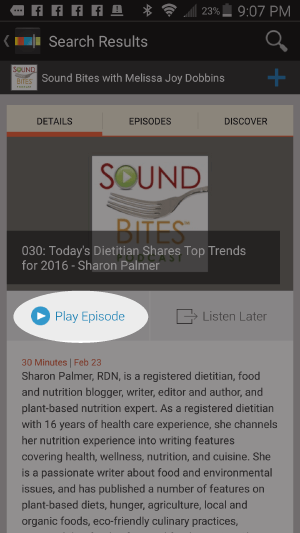
1. Search for “sound bites with melissa joy dobbins” 2. Choose Play Current Episode or Add to Playlist
Choose “Play Episode”
Subscribe & Review on iPhone
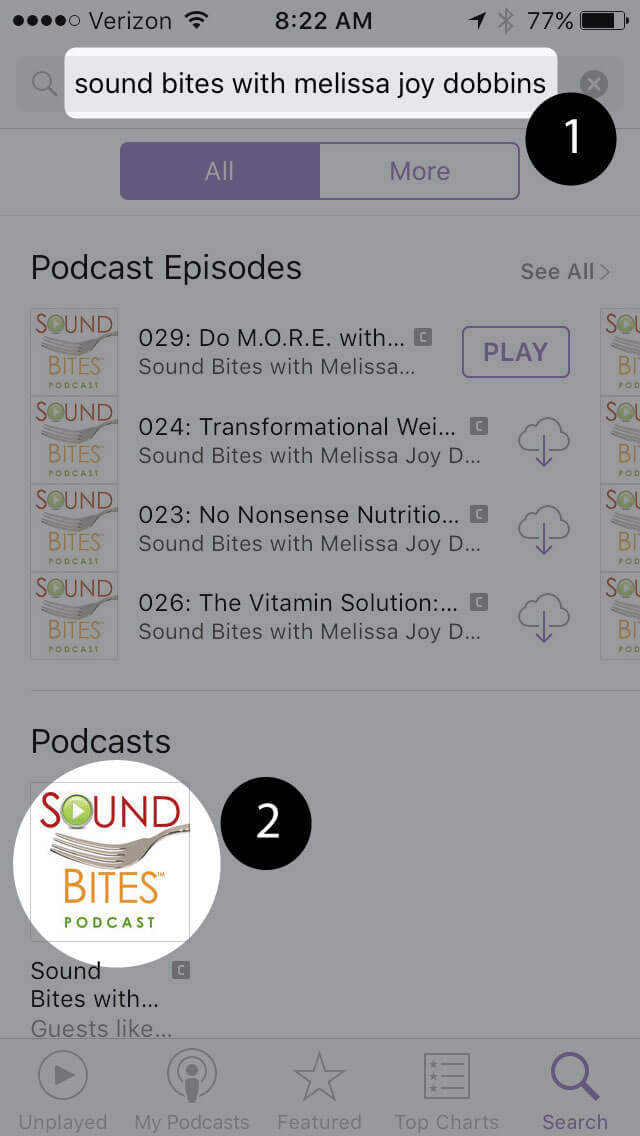
Open the “Podcast” app on your iPhone
Search for “Sound bites with melissa joy dobbins”
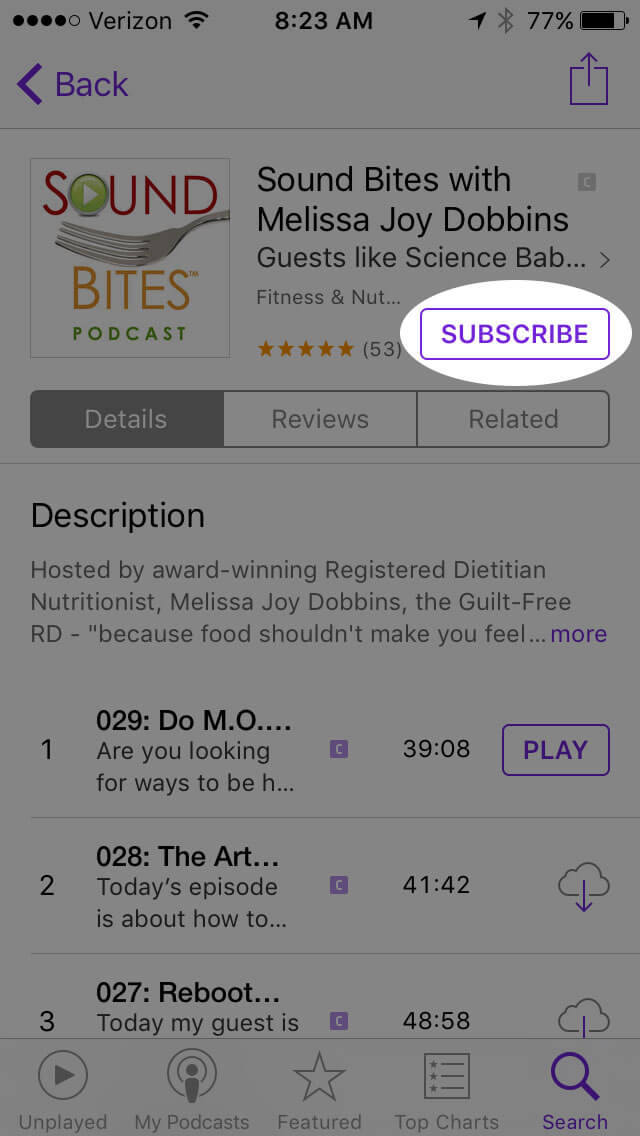
Open the podcast and click “Subscribe” and your done!
Write a Review
Click “Reviews”, then “Write a Review”.
Subscribe via RSS Feed
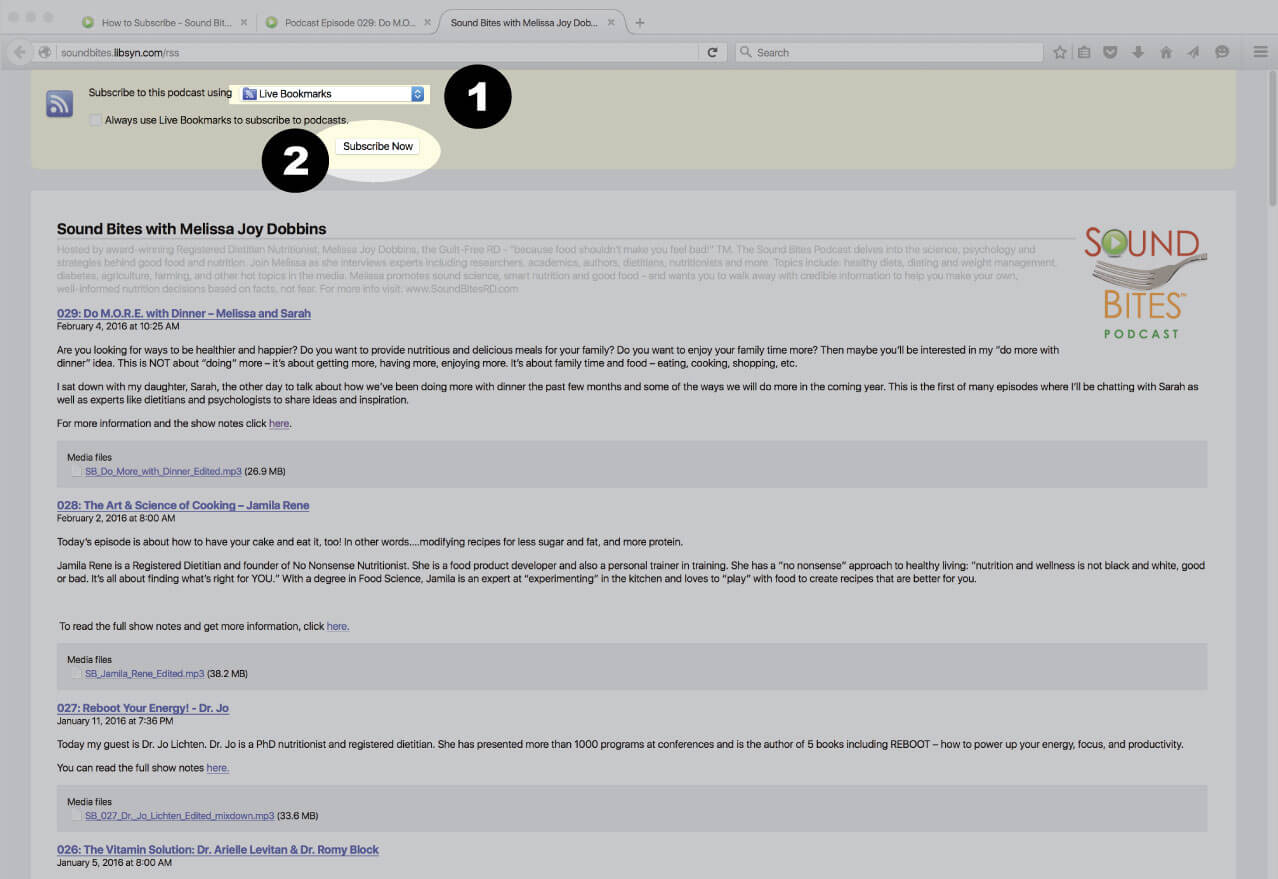
Navigate to any podcast player . Click on the RSS feed icon.
Click on the RSS feed icon.
Click on RSS Feed
Choose which application you would like to use to receive the RSS feed
Click “Subscribe Now”
Confirm settings and subscribe.
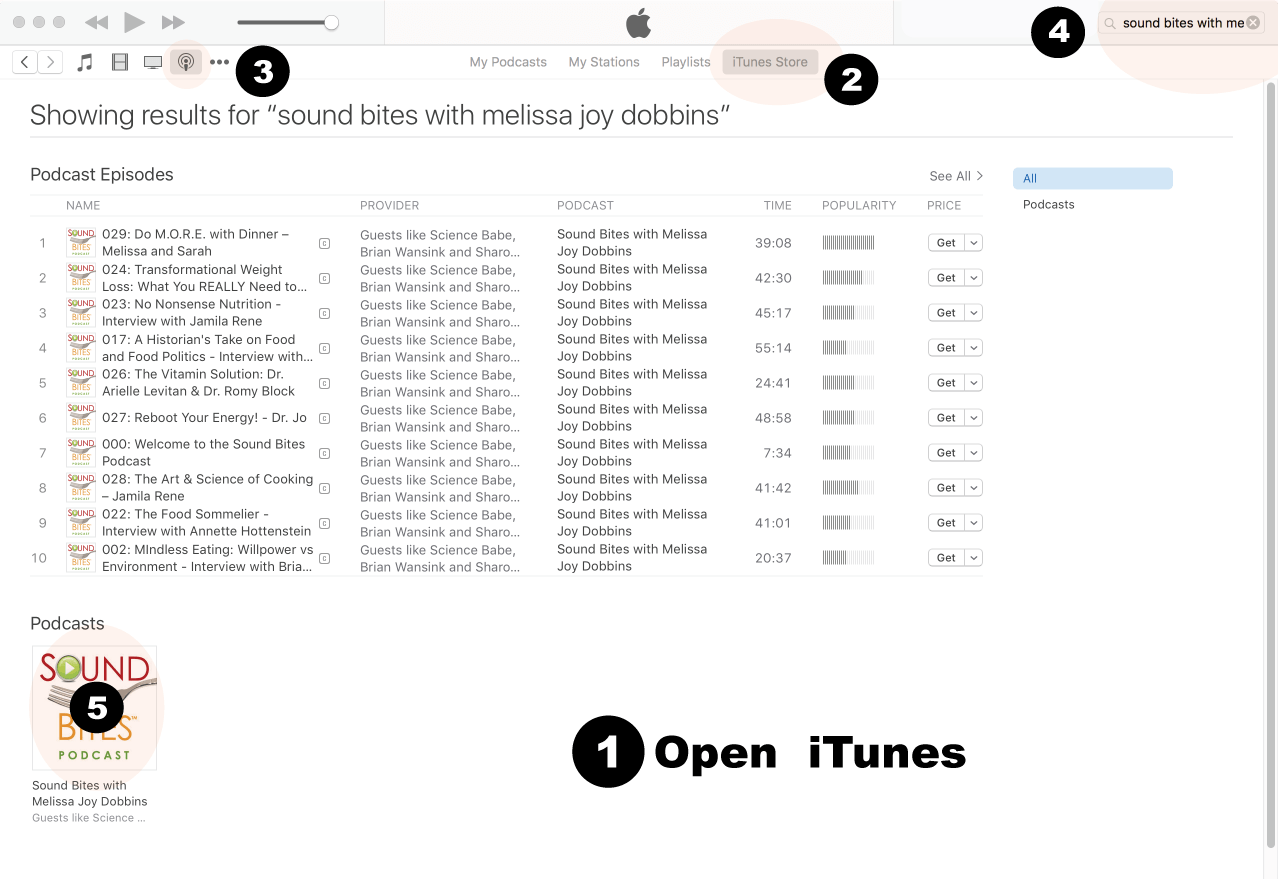
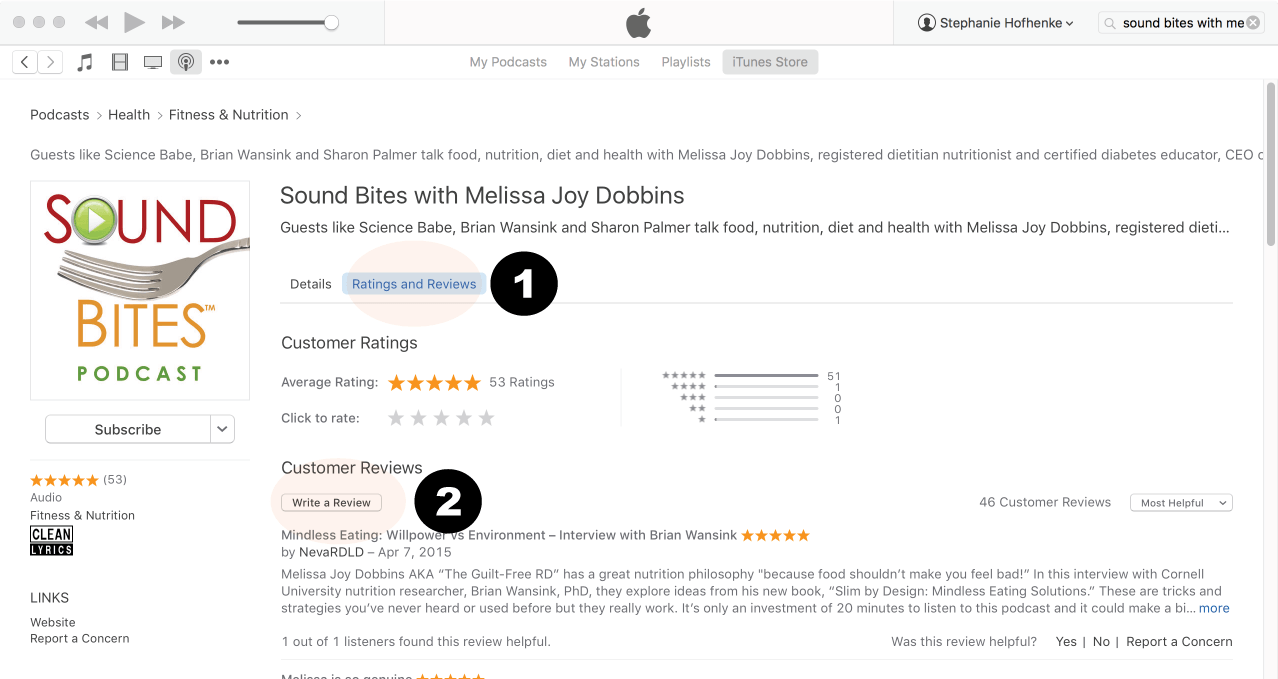
How to Review in iTunes
Open iTunes desktop application
Click iTunes Store
Click on Podcasts
Search for “Sound bites with Melissa Joy Dobbins”
Click on podcast image
Search for Sound Bites podcast in iTunes
Click Ratings & Reivews
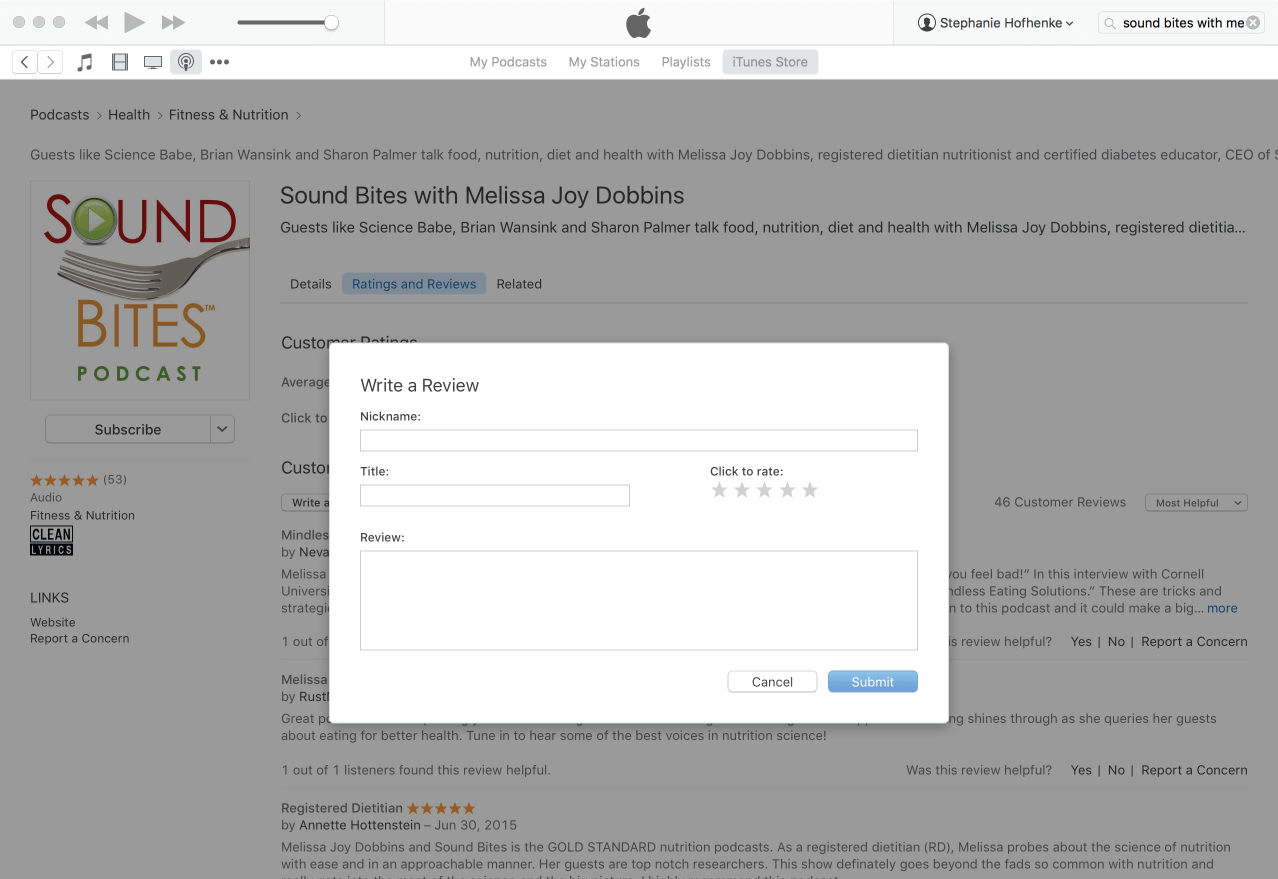
Click Write a Review
View reviews and write your own review.
Write your review…. Thank you!
Write your review!
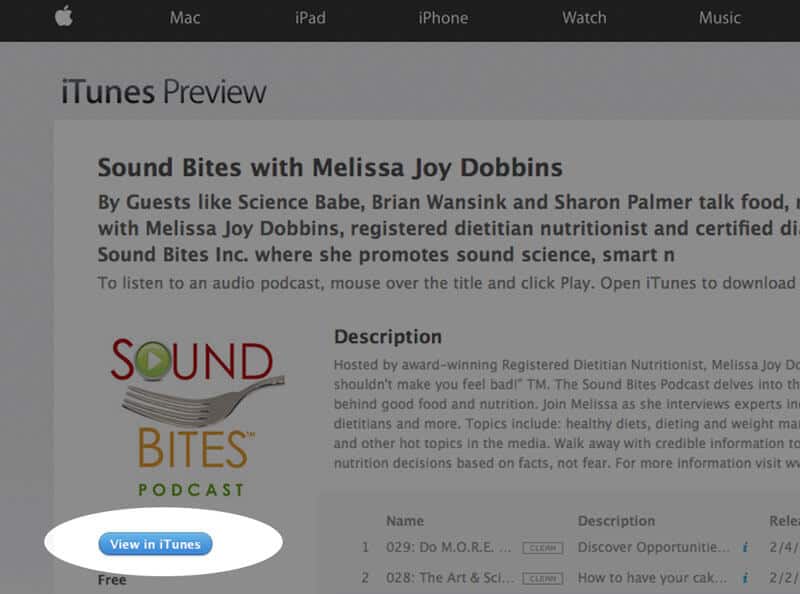
How to subscribe via iTunes
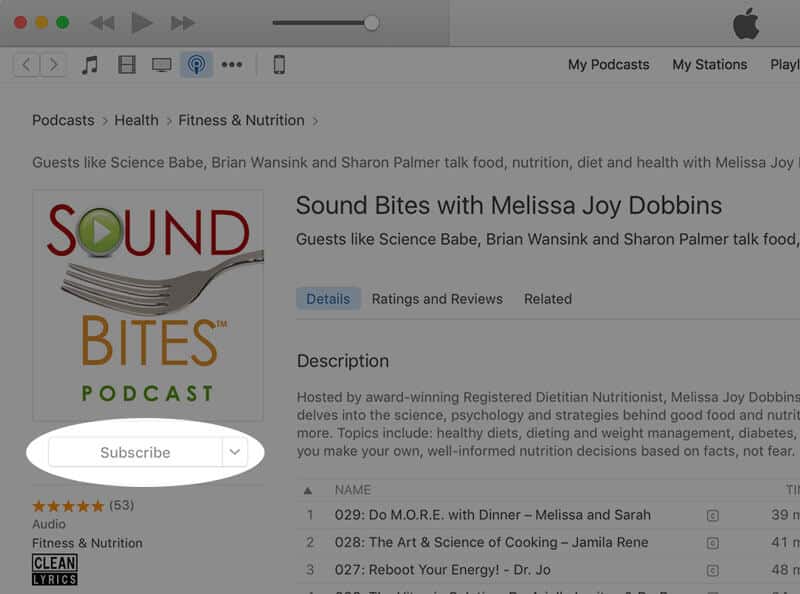
Click here to view the Sound Bites Podcastin iTunes, then click the blue “View in iTunes” button. This will open your iTunes application directly to Sound Bites Podcast. Click the “Subscribe” button, and your done!