Celebrating over 1 Million Downloads and 50,000 Free CEUs on the Sound Bites® Podcast | NEW: Get 1 years’ worth of CEUs with the new 15-CEU Podcast Course
Click here to earn 1.0 FREE CEU for listening to this podcast episode! Hidden Hunger: Closing the Gap for Healthy Growth in Children – Dr. Caree Cotwright awards 1.0 CPEUs in accordance with the Commission on Dietetic Registration’s CPEU Prior Approval Program.
Disclosure: This episode is sponsored. Commercial support has been provided by Danone North America & Danimals. Dr. Caree Cotwright is a paid consultant to Danone North America. No brands are discussed or promoted.
Many kids don’t consume the proper amount of nutrients that are vital for healthy growth, chronic disease prevention, and overall health. This episode examines hidden hunger – when children consume enough calories but not enough essential nutrients for growth and development. Listeners will explore the nutrient gaps most common in U.S. children, the role of picky eating and access in shaping dietary patterns and practical ways to help families close nutrient gaps with affordable, nutrient-dense foods.
Picky eating is really a broad description for having strong food preferences, and maybe a hesitancy to try new foods. So, even when healthy options are available, picky eating might make it harder for kids to get enough variety. A child that avoids vegetables or dairy, for example, may be missing out on calcium, vitamin D, fiber.” – Dr. Caree Cotwright
Tune in to this episode to learn about:
the prevalence and drivers of hidden hunger
myths about hidden hunger and who is at risk
common nutrient gaps in children’s diets
why nutrient quality matters as much as calories
how “picky eating” and food preferences impact nutrient intake
strategies to increase food acceptance and variety
simple, delicious, affordable ways to boost nutrition
easy swaps to make healthier choices more accessible
practical meal and snack ideas families can use
how equity and nutrition security influence children’s nutrition
real-world examples of how hidden hunger shows up in schools and communities
barriers parents and families face and how health professionals can support them
practical strategies families can use even when resources are tight
the importance of building “nutrition resilience”
the power of collaboration among health professionals, teachers and families
addressing the belief that “eating healthy is too expensive”
resources for health professionals and the public
Families don’t have to do it alone. We are a team. It’s a family affair; it’s a community affair. That means that dietitians, schools, doctors, communities, can all be a part of the solution, and our children as well.” – Dr. Caree Cotwright
Caree Jackson Cotwright, PhD
Dr. Caree Jackson Cotwright is the former Director of Nutrition Security and Health Equity at the USDA Food and Nutrition Service where she led national efforts to strengthen equitable access to nutritious foods. She is a leading expert in childhood nutrition, equity, and community-based health promotion. Her work helps families, educators, and communities close nutrient gaps and support children’s lifelong health.
I think there’s a myth that if a child appears to be overweight, that they are getting too much food, they’re getting all the nutrients that they need. And that simply is not true. And so I really reframe the conversation by focusing not just on how much kids are eating, but the quality of the foods they are eating.” – Dr. Caree Cotwright
Resources
Some links may be affiliate links. As an Amazon Associate, I earn from qualifying purchases.
Nutrition resilience is about giving kids and parents the skills, ability and habits to enjoy nourishing foods now, and the confidence to carry those choices into adolescence and adulthood for the kids.” – Dr. Caree Cotwright
Chao, H.-C. (2018). Association of picky eating with growth, nutritional status, development, physical activity, and health in preschool children. Frontiers in Pediatrics, 6, 22. https://doi.org/10.3389/fped.2018.00022
Mascola A.J., Bryson S.W., Agras W.S. (2010). Picky eating during childhood: a longitudinal study to age 11 years. Eat Behav. 11(4):253-7. doi: 10.1016/j.eatbeh.2010.05.006. Epub 2010 May 27. PMID: 20850060; PMCID: PMC2943861.
Hamner HC, Dooyema CA, Blanck HM, et al. (2023) Fruit, Vegetable, and Sugar-Sweetened Beverage Intake Among Young Children, by State — United States, 2021. MMWR Morb Mortal Wkly Rep 72:165–170. DOI: http://dx.doi.org/10.15585/mmwr.mm7207a1
U.S. Department of Agriculture and U.S. Department of Health and Human Services. Dietary Guidelines for Americans, 2020-2025. 9th Edition. December 2020. Available at DietaryGuidelines.gov.
Quann, E.E., Fulgoni, V.L. & Auestad, N. Consuming the daily recommended amounts of dairy products would reduce the prevalence of inadequate micronutrient intakes in the United States: diet modeling study based on NHANES 2007–2010. Nutr J 14, 90 (2015). https://doi.org/10.1186/s12937-015-0057-5
Lasekan J, Yao Q, Choe Y, Niemiro GM, Hicks P. Key Nutrient Intakes at Risk Among US Children in the National Health and Nutrition Examination Survey (NHANES) 2015-2016 Stratified by Age and Gender. Children (Basel). 2025 Feb 17;12(2):238. doi: 10.3390/children12020238. PMID: 40003340; PMCID: PMC11854443.
Yu, Z., Li, Y., Ba, D. M., Veldheer, S. J., Sun, L., Geng, T., & Gao, X. (2024). Trends in Calcium Intake among the US Population: Results from the NHANES (1999–2018). Nutrients, 16(5), 726. https://doi.org/10.3390/nu16050726
Fulgoni, V. L., 3rd, Keast, D. R., Bailey, R. L., & Dwyer, J. (2011). Foods, fortificants, and supplements: Where do Americans get their nutrients?. The Journal of nutrition, 141(10), 1847–1854. https://doi.org/10.3945/jn.111.142257
Alves, J. G. B., & Alves, L. V. (2024). Early-life nutrition and adult-life outcomes. Jornal de Pediatria, 100(Suppl 1), S4–S9. https://doi.org/10.1016/j.jped.2023.08.007
Omand, J. A., Janus, M., Maguire, J. L., Parkin, P. C., Aglipay, M., Simpson, J. R., Keown-Stoneman, C. D. G., Duku, E., Reid-Westoby, C., & Birken, C. S. (2021). Nutritional risk in early childhood and school readiness. The Journal of Nutrition, 151(12), 3811–3819. https://doi.org/10.1093/jn/nxab307
Taylor C.M., Emmett P.M. (2019). Picky eating in children: causes and consequences. Proceedings of the Nutrition Society. 78(2):161-169. doi:10.1017/S0029665118002586
Jones, B. L., Orton, A. L., Tindall, S. W., Christensen, J. T., Enosakhare, O., Russell, K. A., Robins, A.-M., Larriviere-McCarl, A., Sandres, J., Cox, B., & others. (2023). Barriers to healthy family dinners and preventing child obesity: Focus group discussions with parents of 5-to-8-year-old children. Children, 10(6), 952. https://doi.org/10.3390/children10060952
Remington, A., Anez, E., Croker, H., Wardle, J., & Cooke, L. (2012). Increasing food acceptance in the home setting: A randomized controlled trial of parent-administered taste exposure with incentives. The American Journal of Clinical Nutrition, 95(1), 72–77. https://doi.org/10.3945/ajcn.111.024596
Sara N. Bleich and Stacy Dean, “The USDA’s Actions to Promote and Elevate Nutrition Security During the First 1000 Days”, American Journal of Public Health. 112, no. S8 (October 1, 2022): pp. S773-S775.
Vilsack, T. J. (2023). Healthy school meals for all: the role of food law and policy. J. Food L. & Pol’y, 19, 8.
Cotwright, C. J., Alvis, C., de Jesus Jimenez, F., Farmer, P., Okoli, C., Delane, J., & Cox, G. O. (2020). Improving willingness to try fruits and vegetables among low-income children through use of characters. Health Equity, 4(1), 84-90.
Cotwright CJ, Bales DW, Lee JS, Parrott K, Celestin N, Olubajo B. Like Peas and Carrots: Combining Wellness Policy Implementation With Classroom Education for Obesity Prevention in the Childcare Setting. Public Health Reports®. 2017;132(2_suppl):74S-80S. doi:10.1177/0033354917719706.
Speakers: Melissa Joy Dobbins & Dr. Caree Jackson Cotwright
[Music playing]
Voiceover (00:01):
Welcome to Sound Bites, hosted by registered dietitian nutritionist, Melissa Joy Dobbins. Let’s delve into the science, the psychology, and the strategies behind good food and nutrition.
Melissa Joy (00:21):
Hello, and welcome to the Sound Bites Podcast. I’m your host, Melissa Joy Dobbins, a registered dietitian nutritionist and a certified diabetes care and education specialist.
Today, we are coming to you live from the expo hall floor at the 2025 Food & Nutrition Conference & Expo, the annual meeting of the Academy of Nutrition and Dietetics, and the world’s largest gathering of food and nutrition professionals.
This episode is part of a special four-part series from Danone North America. Today’s episode is brought to you by Danimals. Throughout the series, I’ll be sitting down with experts to explore the latest science and practical strategies that help people of all ages eat well and feel well.
And because we’re recording live here at FNCE, we’ll also be taking questions from the audience. So, be sure to stick around until the end of each episode to hear these questions answered by our guests.
And I want to be sure to mention that this episode has been approved by the Commission on Dietetic Registration for one CPEU. For more information about this continuing education activity, go to my website at soundbitesrd.com/freeceus. That’s where you’ll get all the details about how to listen, learn, and earn one free continuing education credit.
Today’s episode focuses on child nutrition, specifically a public health issue known as “hidden hunger,” when children get enough to eat, but their diets don’t deliver the vitamins and minerals needed for healthy growth and development.
Joining me is Dr. Caree Jackson Cotwright, former Director of Nutrition Security and Health Equity at the USDA Food and Nutrition Service. She’s a national leader in childhood nutrition, equity, and community-based health promotion.
Dr. Cotwright and I are both paid consultants to Danone North America to share the science and support for yogurt’s role in a healthy eating pattern. Commercial support for this series has been provided by Danone North America.
Caree, welcome to the podcast. I’m so glad you’re here with us in Nashville today.
Dr. Caree Cotwright (02:24):
Thanks so much, Melissa, for having me, this is so exciting.
Melissa Joy (02:27):
Yeah, this’ll be fun. Being here live, it’s very exciting.
Let’s start with the big picture and what kids are missing when it comes to nutrition. When a child gets enough to eat, that doesn’t always mean that they’re well-nourished. What are some of the most common nutrient gaps we’re seeing in children today?
Dr. Caree Cotwright (02:46):
Yes, I’ll start by highlighting that even though most US kids are getting enough calories, they may fall short on key nutrients. For example, more than 90% of kids don’t eat enough vegetables, 80% don’t eat enough fruit, and about 70 to 90% are falling short on dairy.
So, that means that there are shortfalls in nutrients like calcium, fiber, potassium, vitamin C. And when you consider how these key nutrients are a part of development, that’s a huge gap, Melissa.
Melissa Joy (03:16):
Yes, absolutely. Those are some shocking statistics.
Let’s define the term “hidden hunger” before we move forward into this topic. As I mentioned, hidden hunger occurs when kids get enough calories (you just said the same thing), but their diets are falling short on these essential nutrients.
How does the concept of “hidden hunger” show up in your work, and why is it such an important issue for us to address like early in life?
Dr. Caree Cotwright (03:41):
Well, we know that children can be even overweight, but malnourished. And so, if our work is looking at preventing childhood obesity and hidden hunger can be tricky, because when you think about how kids may appear healthy on the outside, but on the inside, their bodies might be missing key nutrients for things like bone development, brain development, immune function, those things are so important.
So, this is where things like picky eating can mask hidden hunger, and it’s really common for kids to go through those phases of rejecting certain foods. Melissa, you know, you might have to introduce a food 10 to 15 times before a kid likes it.
And so, we have to continue to do that because we have to address the gaps early. And in my work, we introduce food concepts to children between the ages of zero to five.
And so, we’re working with teachers, we’re working with parents, and we’re working with young kids. And we promote fueling up on foods with fun methods like characters, videos, songs, books, and we have to do that.
And I’ll just go back, thinking about early child development, we’re missing out on key nutrients like calcium and vitamin D and iron. There are so many things that we have to really work to promote. And so, as we are doing that, I dare say that we have fun doing it.
And then I do want to mention as well, we also have a need to promote healthy beverages.
Melissa Joy (05:09):
So, some of these foods might fill the belly, but they’re not filling those nutrient gaps, right?
Dr. Caree Cotwright (05:15):
Yes.
Melissa Joy (05:16):
For some families, hidden hunger isn’t just about access to foods, it’s also about preferences. You mentioned picky eating, that can be a very common part of childhood as their eating patterns develop, becoming familiar with different foods, but it’s still obviously something parents struggle with.
How does this really play into the nutrient gaps that we’re talking about?
Dr. Caree Cotwright (05:40):
As we talk about picky eating, or what we call picky eating, it’s really a broad description for having strong food preferences, and maybe hesitancy to try new foods, which we term as neophobia. And so, as we’re thinking about that, it really is a natural part of developing a healthy eating pattern.
So, while it’s not a medical diagnosis, it’s a common phase for children as they’re growing up. So, even when healthy options are available, picky eating might make it harder for kids to get enough variety. So, a child that avoids vegetables or dairy, for example, may be missing out on calcium, vitamin D, fiber, those things that we talked about earlier.
And so, a good friend of mine, lovingly known as Dr. Young, she tells kids that they don’t like something yet. So, they say, “I don’t like that.” She says, “Say, I don’t like it yet,” because that offers an opportunity to taste again.
And I love that framing because they are still developing their taste and the flavors that they like and the textures that they like. So, again, remembering to offer over and over and over is so important.
Melissa Joy (06:39):
And you mentioned the variety. I mean, a kid might like broccoli and bananas, but no other fruits and vegetables, and those are excellent choices, but the variety is still important. And yes, that familiarity, I love that too.
It’s not like, “Oh, I don’t like this, and this will always be this way.” Very good.
How widespread is hidden hunger in the US? You gave me some statistics earlier, but also are there certain communities or age groups where we see it more often?
Dr. Caree Cotwright (07:08):
Yes. So, we know that hunger is such a problem in the US, and even during my time at USDA, one of the things that we promoted is that one in four Americans were on the food and nutrition assistance programs that we have.
So, we want to make sure that people are able to thrive, and we don’t want hunger to be an issue, and it’s something that we have to continue to work on.
But particularly, children in underserved communities are especially at risk, partly because of limited access to affordable foods that are nutrient-dense, fruits, vegetables, whole grains, dairy. And then children and teenagers are particular.
I have an adolescent myself, she’s in the 6th grade, and they’re starting to make their own food choices. They’re having more independence. So, we want to make sure that school-age kids are having the opportunity where they’re spending time making healthier choices, and we want to make that easy and appealing.
One thing that I do, Melissa, sometimes is when my kids come home, before they even get in the door, I’ll make a tray, and I might put carrots with some dip, turkey pepperoni, I may put sliced apples, peanut butter.
So, I’ll have some type of protein source, some type of dairy source, I put out yogurt to give them the little yogurt packs when they come in, and it makes them feel so great because they don’t have to think about it, it’s right there. It’s easy, and it’s accessible.
Melissa Joy (08:23):
Yeah, that’s awesome. I’m glad you mentioned the adolescents as well, because that age group has some increasing nutrient needs and oftentimes, some decreased intake for a variety of reasons. I, myself, was on food assistance programs when I was small, and they made all the difference in our family, and I often think about that.
Dr. Caree Cotwright (08:55):
The programs are there to help meet those gaps. Again, providing those healthy foods for parents.
And you mentioned, Melissa, that that helped your family make ends meet. And that’s what we are here for. And again, one in four Americans are enrolled in the programs like SNAP, like WIC. We know that 30 million children participate in the National School Lunch Program.
We want to make sure that everyone that is eligible is enrolled. And one of the things that we promote is healthy school meals for all. And when you think about that, think about how much of a difference that can make for our children when we know that many of our children are not receiving food from other places.
So, to any of our listeners who need to be a part of those programs, you can definitely visit your local offices. And definitely make sure that as dietitians, we spread the word about the impact and effectiveness of the programs without stigma, without shame, because the programs are there to assist Americans.
Melissa Joy (10:30):
Excellent, thank you. Hidden hunger isn’t always obvious, it isn’t always easy to spot. There’s a lot of misunderstandings about what it really means. What are some of the biggest myths or misconceptions that you’ve seen about hidden hunger, and how do you help people better understand this issue?
Dr. Caree Cotwright (10:48):
I think there’s a myth that if a child appears to be overweight, that they are getting too much food, they’re getting all the nutrients that they need. And that simply just is not true. And so, as we address this, I really reframe the conversation by focusing not just on how much kids are eating, but the quality of the foods that they are eating.
And so, making sure their plates are filled with those nutrient-dense foods that we talked about. Even thinking about simple things like in terms of my plate, making half your plate fruits and vegetables. I shared those statistics earlier. We are not getting enough fruits and vegetables as a nation; not just the kids, but the adults.
And so, making sure those fruits and vegetables are present, that they’re available. And as we talk about picky eaters, that it’s not always realistic to do a massive overhaul at once. Introducing small changes, introducing things one at a time, again, veggies with dip, using different spices, allowing the kids to be a part of the choices that they make is really wonderful.
I never met a parent that wouldn’t buy an apple over a bag of chips for their daughter and their son.
Melissa Joy (11:48):
When I think about that aspect, the weight issue, we want to focus more on quality versus quantity, and the nutrient-rich choices. And also, the access and the variety, to your point as well. So, let’s dig a little deeper beyond the numbers.
Why does this issue matter so much? Like how does hidden hunger relate to issues of equity and nutrition security in the US? I know this is really a passion area for you.
Dr. Caree Cotwright (12:17):
Yes, and I want to pause for a moment, Melissa, and make sure our listeners know what nutrition security is. So, nutrition security is defined as everyone in our country having consistent and equitable access to healthy, safe, and affordable food that is optimal for their health and well-being.
And that’s a long definition, but it’s so rich and it’s so wonderful, because if we can achieve nutrition security, think about how much greater we would fly as a nation. And so, as I think about that, I want to address the terms that hidden hunger matters, because it can affect kids’ ability to succeed.
And so, when we think about children going to the classroom, not being ready to learn because they haven’t eaten the food that they need, that’s a major focus. They can become tired, sick more often, are struggling to focus in class, then that may translate into behavior issues, but it’s simply the hunger issue.
And so, sometimes, that’s not easily recognizable. So, we have to really find ways within communities to acknowledge this and make sure that our children are well fed and prepared to learn.
Melissa Joy (13:24):
I couldn’t agree more. You’ve worked extensively with schools and communities. What are some of the real-world ways that hidden hunger shows up in those settings?
Dr. Caree Cotwright (13:35):
Yes, and in schools and communities, I will say, we know that for our national programs like the School Breakfast Program and our National School Lunch Program, oftentimes, that’s the only meal that some of our children receive. And that’s sad news, but it’s the reality – the whole day.
And so, we just have to address that and again, work and partner with our teachers. I have been so blessed to be in the community to do our work. And I’ll give you a wonderful example. I was working with the Food Bank of Northeast Georgia, and they had a mobile food pantry for schools.
And so, they would work with us in my laboratory to make sure they had recipes available for the parents because they would get in all types of produce. So, one day, Melissa, they got kohlrabi.
[Laughter]
Melissa Joy (14:16):
What do I do with this?
[Laughter]
Dr. Caree Cotwright (14:18):
They were saying, “The parents aren’t going to want to take this, what should we do?” And my students got together, and we took a lo mein recipe, and we taught the parents how to shred the kohlrabi into that kind of a cabbage-like vegetable, for the listeners that may have not experienced kohlrabi.
We threw out that seasoning pack for ramen noodles and put our own flavors. And the parents and the kids, they loved it. So, sometimes, it’s just making those simple changes, doing things, meeting people where they are, and making budget-friendly recipes.
But what I love more than anything is we allow them an opportunity to taste and see how it was prepared before their eyes.
Melissa Joy (14:56):
Oh, I love that so much. I’m involved in my community’s food pantry, and we get quite a bit of fresh produce donated, and let’s say it’s rhubarb, people think rhubarb pie. There’s a lot of other things you can do with rhubarb. You can make a pie, but there are other things you can do that are a little more nutritious.
And giving people those tips and recipes … I haven’t gone so far to do like a food demo like you do. But yeah, it’s really important to connect the dots. You can’t just give them something that they’re not familiar with and expect them to know how to prepare it, how to utilize it. Parents are often doing the best they can with what they have.
What challenges do families face in trying to make sure that kids get the nutrients they need? And how can health professionals, and especially dietitians, support them in that effort?
We have so many dietitians here at FNCE, so I’m looking at asking you, curious, what role dietitians can play in recognizing and addressing hidden hunger in different settings?
Dr. Caree Cotwright (16:01):
Yes, Melissa, parents have so many things they’re juggling. So many pressures where you think about time and preparation of food, cost, access, the picky eating that we talked about. And even with the best of intentions, it can be hard to consistently provide nutrient-rich meals.
We are registered dietitians, Melissa, and it can get to be very busy, and so that preparation can be so important. So, in terms of supporting parents with practical and realistic strategies, it’s so critical. One of the times or one of the things that we do, is working with parents within Head Start settings.
We’ve done virtual cooking classes. So, if a mom can’t turn on her camera or if she can’t cook right there, we record the session so she can go back and use those recipes and use that food. And we’ve heard Head Start moms and parents say, “Oh my gosh, my child ate whole grain pasta. Who are you?”
[Laughter]
Just making sure that we are meeting people exactly where they are, and that’s so important. And dietitians can really make a huge difference because we can help families identify nutrient gaps, and then we can suggest small, meaningful ways to do food swaps.
Things that they will still enjoy, they will still like, but they’re still getting those nutrient-dense replacements that we really want them to incorporate. And so, ultimately, addressing hidden hunger requires all of us, parents, dietitians, schools, communities, pediatricians, policymakers. I really think that’s important as well.
So, we can get the work done if we are helping with parents and again, providing them with ways to build their confidence. Because sometimes, I think it’s so overwhelming. It’s fun for us, we love to get in the kitchen, but everybody doesn’t like to. So, we can make those practical suggestions. I think it makes a world of difference for parents.
Melissa Joy (17:46):
Yes, and those realistic tips, absolutely. So, we’ve talked about why hidden hunger matters. Let’s talk a little bit about why it happens. What are some of the main drivers of hidden hunger in the US?
Dr. Caree Cotwright (18:00):
Many of the drivers for hidden hunger are thinking about … you want to think about knowledge, access, and choices. And so, when we think about that, it’s not just the individuals. Our food
environment has a lot of foods that are not nutrient-dense. They may be cheaper than our healthier options.
And so, we have to really consider that and teach our parents, our communities how to make those healthy choices within their budget. And that’s something that we just talked about. What can registered dietitians do?
I love that you have this podcast. I love that you are spreading the word. We have to do that. Using social media, there is power in that and allowing parents to tune into that. So, as we do that, parents can sometimes think these things are out of reach, and their kids are seeing advertising and marketing, they might be influenced by other children and the things that they’re eating.
And so, how do we make (as I would say it when I was at CDC) the healthy choice the easy choice? How can we really make it to where even our policies and our environment support the things that we say about healthy living?
Melissa Joy (19:01):
Yes, I love that: making the healthy choice the easy choice. And going back to one of the first things that you mentioned, about maybe sometimes making it the fun choice. Like you said, kids are bombarded by marketing, but you have used cartoons and characters and that sort of fun thing with the nutrient-rich foods, so that’s very effective.
How do factors like affordability and food access shape what kids eat? I mean, we’ve talked a little bit about that, but I’d love to hear more from you on that.
Dr. Caree Cotwright (19:29):
Affordability is a huge barrier, Melissa, and healthier options like our fresh produce, lean proteins, and fortified foods can be more expensive than the calorie-dense foods or the nutrient-poor alternative.
So, as we think about that, if a budget is a concern for parents, they might choose not to purchase those foods because they’re worried about whether or not the kids will eat the food. And so, they don’t want to have food waste. And so, as we think about that, I love the option of offering frozen foods or foods on sale.
I will make a menu off of things in Atlanta, the store that I have has BOGO (buy one get one free). So, that’s the menu we’re going to have this week. Or sitting down and planning with your family and your kids and saying, “You know what, we’re going to have the tacos that you love, but we’re going to try a new, different type of veggie pasta.”
Or recommending that, “All you have to do is try it and we’re going to rate this recipe and see how you like it.” But doing it with things like frozen foods that may be on sale so that if it’s not liked, it doesn’t hit the budget too hard.
Melissa Joy (20:33):
Excellent. I’m a former supermarket dietitian, so eating healthy on a budget is one of my favorite topics, and a big aspect of that is the food waste part. And we do think that produce needs to be fresh, but the frozen, the dried, the canned, the juices, those count, and they have the nutrition.
And in my opinion, that’s one of the biggest misconceptions that people don’t know that those are just as nutritious. And when it comes to the canned, with the vegetables, you want to get the lower sodium or no salt added, with the fruit in its juice instead of the syrup.
And even canned beans, rinsing those off lowers the sodium. So, there’s just, I think, a lot of things that can help families that they’re maybe not aware of.
So, as we’re talking about parents balancing convenience and cost and those day-to-day challenges like the picky eating, how do these dynamics end up influencing the foods that kids end up with on their plates?
Dr. Caree Cotwright (21:35):
You just dropped some great nuggets in terms of what you recommended, but parents want to do the best for their kids. And so, when we think again, we’re going back to time and budget and availability, there are often barriers. And so, that’s why we need those realistic and affordable and even culturally relevant alternatives for parents to try.
And so, I always say we really don’t want to shame anything in terms of what parents are serving and what they are eating (and especially those cultural foods), but to celebrate them. And so, think about those key nutrients, how do we get access to those things that we like? And so, as we think about what is coming onto the plates, there are so many things that play into that, even day to day. What’s going on? Kids are involved in activities and those things.
So, how do we get that meal planning in there ahead of time? And I’ll tell you, Melissa, one of the things that we do on Sunday around the dinner table is to just ask a question. My kids are still little. They are 11, 10, and 7, and we just say, “What are the things you’d like to have this week?” And we just give suggestions, and we balance it out.
And it helps me because it helps me to meal plan. And so, if I have the food in the house, and they’re coming in from volleyball, forced to make something really quickly, but I know what I’m going to do, it makes a world of difference.
So, that planning also helps to think about what exactly would go into play. So, planning ahead, which can be difficult, I recognize. But the more we can do it, the more habits we can form doing it, I think the better.
Melissa Joy (22:59):
Well, you just gave a great example of how meal planning (which sounds daunting even to me) can be as simple as just talking with your family about what types of meals that they’re liking. And if you’re making something that they’ve said they want to eat, again, less likely to end up with food waste there.
So, for the dietitians tuning in, what should we keep in mind about the systems and environments that shape children’s food choices?
Dr. Caree Cotwright (23:24):
Melissa, we have to recognize as dietitians that the gaps aren’t always about knowledge. I think most of us know that, but they’re also about access and opportunities. And again, we can use social media to increase access to the knowledge that we have and so many different programs that we have, but this means that counseling really reflects real-world constraints.
When I was at USDA, one of the things that we were doing for WIC, is really diversifying the WIC workforce and making sure that the dietitians that were working with families were representative of those communities. And I love that.
And so, it’s not about telling families what they should eat, but helping them identify affordable, accessible, nutrient-dense foods within their own context. How do we do that? If you love lentils, if
you love beans, if you love rice, how do we get that into a balanced plate? How do we promote that in a way that is healthy and reassuring to the family?
So, ultimately, the things like access and affordability are systemic issues. Again, it’s not just the individual. So, as we work through that, families shouldn’t have to carry the burden alone. And that’s what we are here for.
And I just want to get the word out about how helpful and how wonderful registered dietitians are, and how much training we have, and how much we have to share.
Melissa Joy (24:39):
Absolutely. We’re the champions trying to coach and be partners with these families and support them. So, thank you for addressing the barriers of access and affordability.
Let’s shift to solutions and some effective ways to close these gaps and support children’s nutrition. What are some practical strategies that parents can use at home to help kids get the nutrition they need, even when the resources are tight?
Dr. Caree Cotwright (25:11):
Yes, Melissa, we addressed some of this, but families really don’t need to make big, expensive changes. These small shifts are really important. We actually had a healthy beverage campaign to promote healthy beverages, and it was all shift.
So, shift from drinking these sugary beverages to drinking more water. Water is free. We can save in that manner, and it’s healthy for us. But we’ve already talked about the frozen veggies, and using the beans and the protein and the fiber sources that are available, we can use yogurt for calcium and vitamin D. And again, these will help to close those nutrient gaps.
So, as we plan ahead – one of my kids’ favorite meals is chili. Chili is not that expensive. You get it together. We can do veggie chili if you don’t want to put in that extra protein, but you’re getting protein from the different beans.
And I will tell you, I use all types of beans in my chili, Melissa. I use chickpeas, I use cannellini beans, I use pinto beans, kidney beans. And again, as we said, we can get those beans, we can rinse them all, we can use lower sodium.
We’re using canned tomatoes, we’re using tomato sauce, I use frozen corn, I pack it with veggies. And so, as we’re doing that, we can even add a dollop of low-fat yogurt on top instead of sour cream. So, there’s so many ways to do that. And here’s a healthy, affordable meal that most kids like.
Melissa Joy (26:30):
Well, this is such a coincidence because I use at least three different colors of beans in my chili as well. I use the cannellini ones, black beans, and either light or dark red kidney beans. So, that’s so fun.
One of the things I’ve heard you reference before is the idea of nutrition resilience. Can you share a little bit about how you define nutrition resilience and how you see that coming to life in families and communities?
Dr. Caree Cotwright (26:56):
Yes, Melissa, when I think of resilience, I think about the ability to bounce back from hardship. And so, nutrition resilience is about giving kids and parents the skills and ability and the habits to enjoy nourishing foods now, and the confidence to carry those choices into adolescence and adulthood for the kids.
And so, when I think about that, even if kids and families aren’t applying all of the healthiest habits right now, we all wane if we all go back and forth with it. But there’s no reason why we can’t reset what we are serving in the kitchen.
And so, as we’re doing that and we’re doing it as a family, we can begin to start again. We can begin again and get really good results. And one of the things that I love in terms of working with families is just going over what you’re doing.
And then when I offer these examples and say, “Okay, we don’t have to eat beets if you don’t like beets. Let’s go over all the vegetables that you love and think about how we can prepare them in a way that is delicious.” Because sometimes people don’t like certain types of vegetables because of the way they are prepared.
Have you tried roasting? Have you tried sautéing instead of boiling? Have you tried a different type of seasoning? And that can really make a world of difference for an entire family. In one of our projects, we were focusing on the moms.
And not to say moms are often doing so many things within the family, but we were focusing on them as being role models. And one mom said, “No, it’s not just my responsibility, it’s a family affair.” And so, that’s why I really encourage getting everybody involved as the drivers of the healthy habits, because it really is a family affair and a community affair. It takes all of us.
Melissa Joy (28:32):
Very, very good. Let’s talk a little bit more about the role of dietitians and other healthcare professionals. How can the power of collaboration between dietitians, teachers, pediatricians, and families in communities help in identifying and addressing hidden hunger, especially given all the drivers at play that we’ve been discussing?
Dr. Caree Cotwright (28:57):
Yes, Melissa, collaboration is just essential. No single professional, pediatrician, dietitian, parent can really conquer hidden hunger alone. So, teachers are often the first to know this when a child is tired or struggling.
And I do a lot of work to train teachers on healthy policy, even within their classroom, because in their classroom, they are the policy directors, they really drive the habits that are going on in the classroom. What types of snacks are you promoting? What types of drinks? Are they just able to have water? So, that type of thing.
And then with pediatricians, they can identify growth patterns or lab results that suggest nutrient gaps, and then refer to dietitians so that we can help with that. So, families bring the day-to-day perspective of what’s realistic at home.
Dietitians can connect all those dots, and really translate the nutrition science into those practical strategies that we discuss to ensure that families feel supported and not judged. We want to definitely make sure that our families know that we are here to cheer them on and give them the resources they need.
Melissa Joy (29:57):
That’s such an important point. And even if we’re not intending to judge, if we are aware that that could be perceived as judgment, then we can be that much more compassionate and supportive.
How can dietitians approach conversations with parents and caregivers about nutrient gaps in a way that, like we’ve said, is supportive and nonjudgmental, but also encouraging versus overwhelming?
Dr. Caree Cotwright (30:24):
Conversations with parents should really focus on encouragement, again, that practicality, and acknowledging the challenges that the family has. And one of the things that I often say is, listen first. We go in sometimes with these preconceived notions, “Oh, the child has these nutrient gaps. What’s going on? What are the things?”
And if we listen first, and like you said, leading with that empathy and just, “I just want to know what you like, what are the things that you don’t like? What are the challenges to getting healthy food on the plate?”
That really helps to build the parents’ confidence, and it doesn’t make them have that guilt or shame. We don’t want to do that because we know parents want to do the best for their children. So, we can also provide those much-needed resources that we talked about and even skills training.
And so, I’ve seen so many parents working in the programs that we had to come and say things like, “You know what? The recipe you had, I didn’t even add any more salt to it, and it was really good. I won’t do that anymore.” Or “I really feel more confident in the kitchen now.” Or like I said, “My child is actually eating these things, and I couldn’t get them to do it.”
But we also suggest ways for kids to help their parents in the kitchen. And that can be frustrating when you don’t have a lot of time and you’re trying to get those things on the plate, but there are simple things they can do, like putting the pasta in the water, stirring something, cracking an egg that will make that child feel totally included. And it’s again, a family affair.
Melissa Joy (31:46):
Yeah, no, I know when my kids were younger, I struggled with that. Like okay, I can get dinner on the table quickly, or I can involve them. So, it is something we definitely want to encourage.
So, Caree, we’ve covered a lot today so far, but we have a few questions from our listeners. The first one is, “Families often tell me eating healthy is too expensive (which we’ve touched on). How do you help shift that perspective?” I mean, that’s a common statement that we hear all the time.
Dr. Caree Cotwright (32:18):
I think we should start by validating their concerns. First of all, food costs are higher right now for many families. And it’s important to acknowledge that healthy eating can feel more expensive, but it doesn’t have to be.
So, we want to make sure that we acknowledge that food costs are rising but give them the tools and the resources to make budget-friendly meals and meeting them where they are. So, recognizing that it’s a concern is the first step. But then even giving them those healthy swaps.
You just talked about the fruit in the 100% juice, which is often on sale. The frozen and canned things. I love to make black beans. I make them on the stove, but dry beans are very affordable. Fortified foods like whole grains. We know, again, what a great source of nutrient-dense food yogurt is and getting in that calcium.
Also buying things in bulk. I love to buy the big container of oatmeal so I can do it for breakfast, or I might make a healthy oatmeal cookie and different things with applesauce and things like that for my kids.
And I love to make things like stews and soups, my family happens to love that. I know some people don’t like the combination foods, but for me, I’ll give you an example; chickpea stew with carrots. And I love that because you’re getting the protein, it’s very affordable, the flavors are amazing.
You can add coconutmilk, you can add curry powder, cumin. And then, Melissa, we can put it over a healthy grain like brown rice or even pasta if you wanted to. But just thinking about how do we suggest those types of things to parents that are nutrient-dense, but the cost is not overwhelming.
And then there’s simple things, whole grain pasta with veggies and tomato sauce. How do we recommend things that kids think are nutritious? Well, I don’t know if they mind if it’s nutritious, but kids think are delicious, and parents feel it’s nutritious. That’s what I want to say.
Melissa Joy (34:07):
That soup sounds delicious. And I think we talked about buying in bulk and buy one get one free. And sometimes, if it’s perishable, that could be a food waste issue. So, sometimes that’s maybe where the community can also come in. And if you have neighbors or something that you can share some of that with and divide the cost that way.
Dr. Caree Cotwright (34:27):
Wonderful idea.
Melissa Joy (34:29):
I do that myself (laughs). So, as we said, parents want to do the best for their children. They’re trying their best, they are feeling really overwhelmed.
How do we talk to parents and caregivers about these nutrient gaps without creating that guilt? I mean, you already said, “First of all, listen, validate,” two very important tips. But is there any other advice you have for really just not adding to their guilt that they probably already feel?
Dr. Caree Cotwright (35:01):
I think, again, going back to leading with empathy, because we know parents are doing the best they can, but framing the changes, these small shifts that they are making, as small wins. So, if you’re able to grab a yogurt pack on sale and when your child comes in, you got that ready sitting out.
Or like I said, you might think … again, we talked about things being healthy but affordable — slicing up cucumber. Cucumber is pretty affordable. Going to the farmer’s market, if you have an opportunity to do that, getting the produce for a lower price.
But I will slice those things up, and just go upstairs and get on my next call, and they will come in and say, “Wow, look at this tray.” And so, it’s really, really encouraging. So, I think, again, making sure that parents feel like that is a win.
Providing any type of nutrient-dense food for your kids to enjoy with foods they’re familiar with, but also introducing new foods. So, again, we talked about the frozen things. Sometimes you can introduce a frozen fruit to a child and let them taste it in that manner as well.
My kids love frozen pineapple, and that’s cheaper oftentimes than me cutting up a fresh pineapple if it’s not on sale. So, those are those types of examples.
But really celebrating the progress that they’re making, celebrating the progress when they’re in the kitchen and they learn a new skill. “Oh my gosh, I didn’t know that roasting these vegetables would be so delicious and tasty.” I do a delicious – I’m always talking about food, Melissa, but I do a delicious-
Melissa Joy (36:20):
You’re making me hungry.
Dr. Caree Cotwright (36:22):
(Laughs) I do a delicious roasted cabbage steak. Cabbage is so affordable. And you put your seasoning, your olive oil, you roast it. You really don’t have to do a ton of work, so that saves time for the parents as well.
Melissa Joy (36:33):
Yes, yes. When I was growing up, the Brussels sprouts were not roasted. They just weren’t, they were boiled or whatever (laughs). And actually, I didn’t mind them, they were fine. But now-
Dr. Caree Cotwright (36:45):
It makes a huge difference.
Melissa Joy (36:46):
So many more people like Brussels sprouts roasted. Caree, thank you so much for joining us today and helping us unpack this important issue of hidden hunger.
We covered a lot of ground, we defined what hidden hunger is. We talked about understanding how common it is in the US, why it matters for equity and opportunity, and how families and dietitians can work together on practical and affordable solutions.
I think one of the biggest takeaways for me is that hidden hunger isn’t always visible, and it is preventable. Small everyday steps, whether it’s at the dinner table or in the school system, or with dietitians working directly with families and in communities. That can make a big difference in helping kids grow and learn and thrive.
If you had one major takeaway that you wanted to leave our listeners with about tackling hidden hunger, what would it be, Caree?
Dr. Caree Cotwright (37:54):
Well, Melissa, I’ve dedicated my career to making sure that children thrive. And so, as I think about that, every child deserves the chance to reach their full potential. And that starts with the foundation of good nutrition.
So, families don’t have to do it alone, we are a team. It’s a family affair, it’s a community affair. And as we think about that, that means that dietitians, schools, doctors, communities, can all be a part of the solution, and our children as well. They often give me wonderful examples and suggestions on how to make things better.
So, when we focus on access, affordability, and practical strategies, we can really build nutrition resilience and knowledge and access and participation that really works toward a lifetime.
And I’ve seen some beautiful examples even within my community, where there’s an organization that started by serving spaghetti dinners to our unhoused community members. And now, in the same neighborhood, there’s a grocery store that offers free groceries, mainly, to seniors who would not have any access to a grocery store.
And something as simple as spaghetti can change into a grocery store. So, if we all partner together and we all work together, we can really address this issue and ensure that our children can thrive. And I’ve always said, I just want to be known as the lady that gets kids to eat their fruits and veggies.
[Laughter]
Melissa Joy (39:13):
I think you’re known for a lot more than that. So, thank you so much, Caree. Thank you to our live audience here at FNCE for being part of this important conversation. This episode is part of a special four-part series, brought to you by Danone North America.
We’ll be continuing these conversations with other leading experts on topics that matter for every age and every stage of life, from diabetes risk reduction to weight management, and gut health. So be sure to check out the other episodes in this series. You don’t want to miss them.
And remember, go to my website at soundbitesrd.com/freeceus. That’s where you’ll get all the details about how to listen, learn, and earn one free continuing education credit. And where you’ll also have access to resources related to this podcast episode.
Thanks again for tuning in. And as always, enjoy your food with health in mind. Until next time, I’m Melissa Joy Dobbins, and this is the Sound Bites Podcast.
[Music playing]
Voiceover (40:15):
For more information, visit soundbitesrd.com. This podcast does not provide medical advice. It is for informational purposes only. Please see a registered dietitian for individualized advice.
Listen to select Sound Bites Podcasts and earn free CEU credits approved by the Commission on Dietetic Registration (CDR) for registered dietitian nutritionists and dietetic technicians, registered. Get started!
Get Melissa’s Sound Science Toolkit here!
Partnerships:
Sound Bites is partnering with the Association of Diabetes Care and Education Specialists (formerly the American Association of Diabetes Educators)! Stay tuned for updates on the podcast, blog and newsletter!
Sound Bites is partnering with the International Food Information Council! Stay tuned for updates on the podcast, blog and newsletter!
Sign up for my monthly newsletter and episode eblasts so you never miss an update!
Listen on Stitcher (Android)
Install the Stitcher App
1. Search for “sound bites with melissa joy dobbins” 2. Choose Play Current Episode or Add to Playlist
Choose “Play Episode”
Subscribe & Review on iPhone
Open the “Podcast” app on your iPhone
Search for “Sound bites with melissa joy dobbins”
Open the podcast and click “Subscribe” and your done!
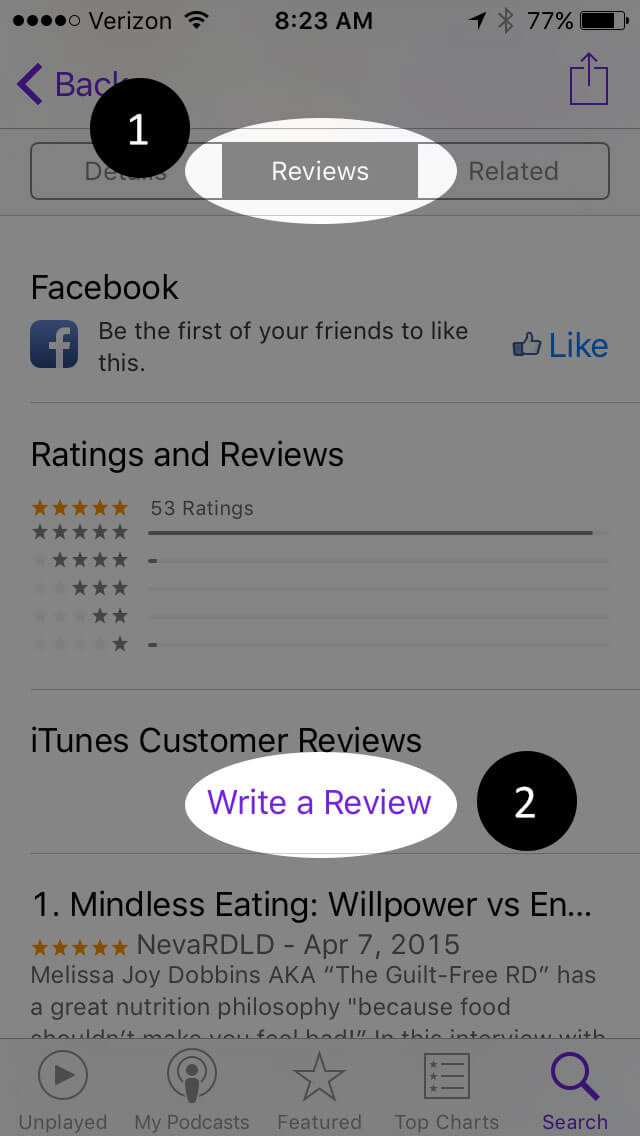
Write a Review
Click “Reviews”, then “Write a Review”.
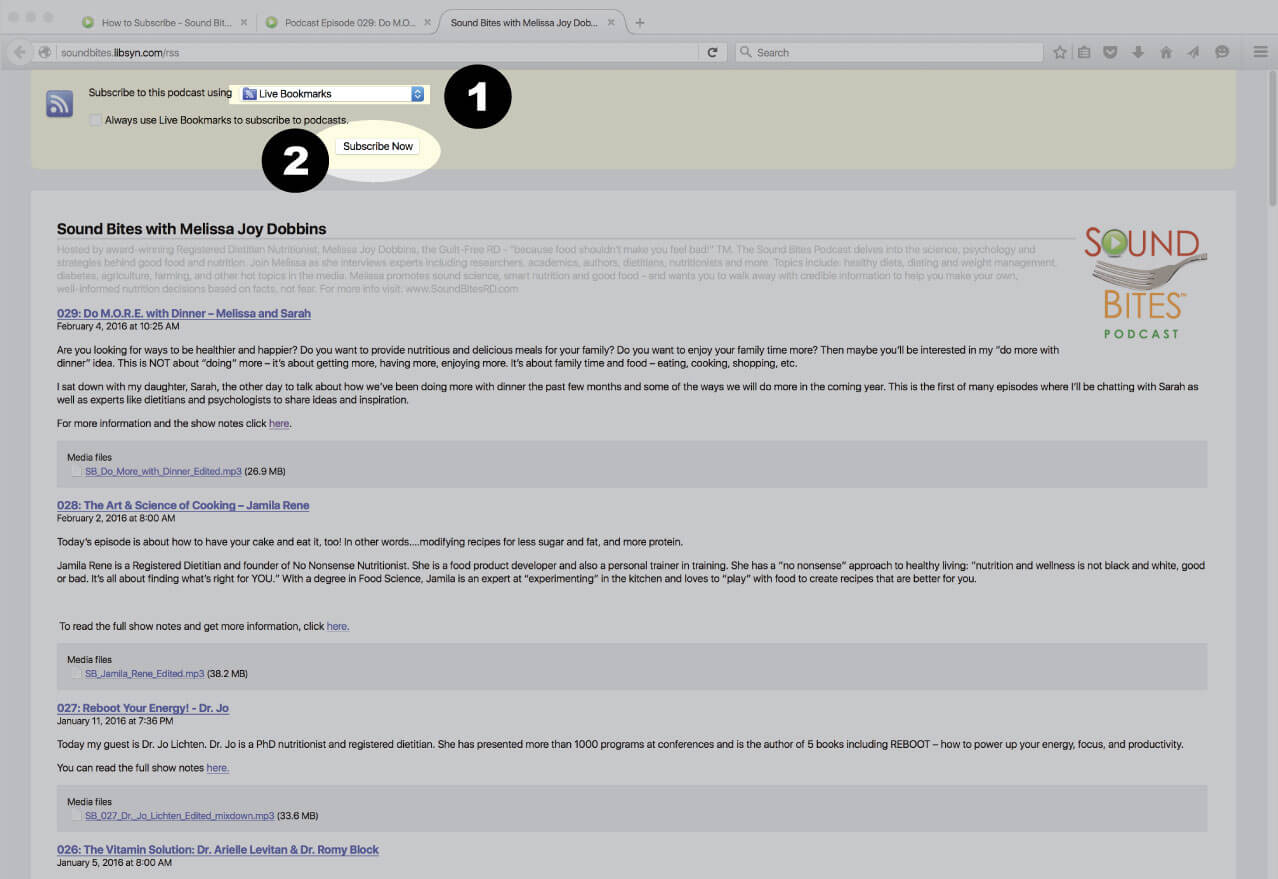
Subscribe via RSS Feed
Navigate to any podcast player . Click on the RSS feed icon.
Click on the RSS feed icon.
Click on RSS Feed
Choose which application you would like to use to receive the RSS feed
Click “Subscribe Now”
Confirm settings and subscribe.
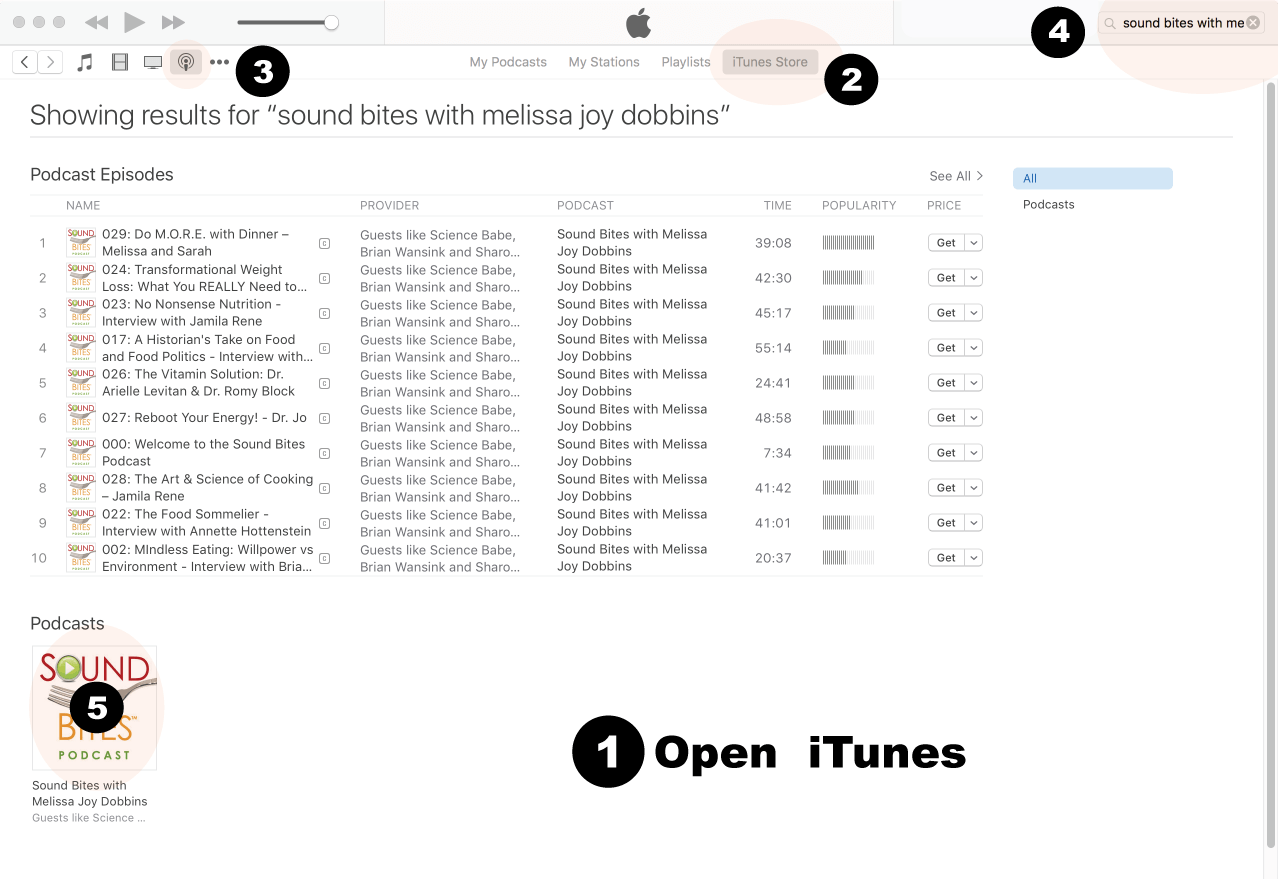
How to Review in iTunes
Open iTunes desktop application
Click iTunes Store
Click on Podcasts
Search for “Sound bites with Melissa Joy Dobbins”
Click on podcast image
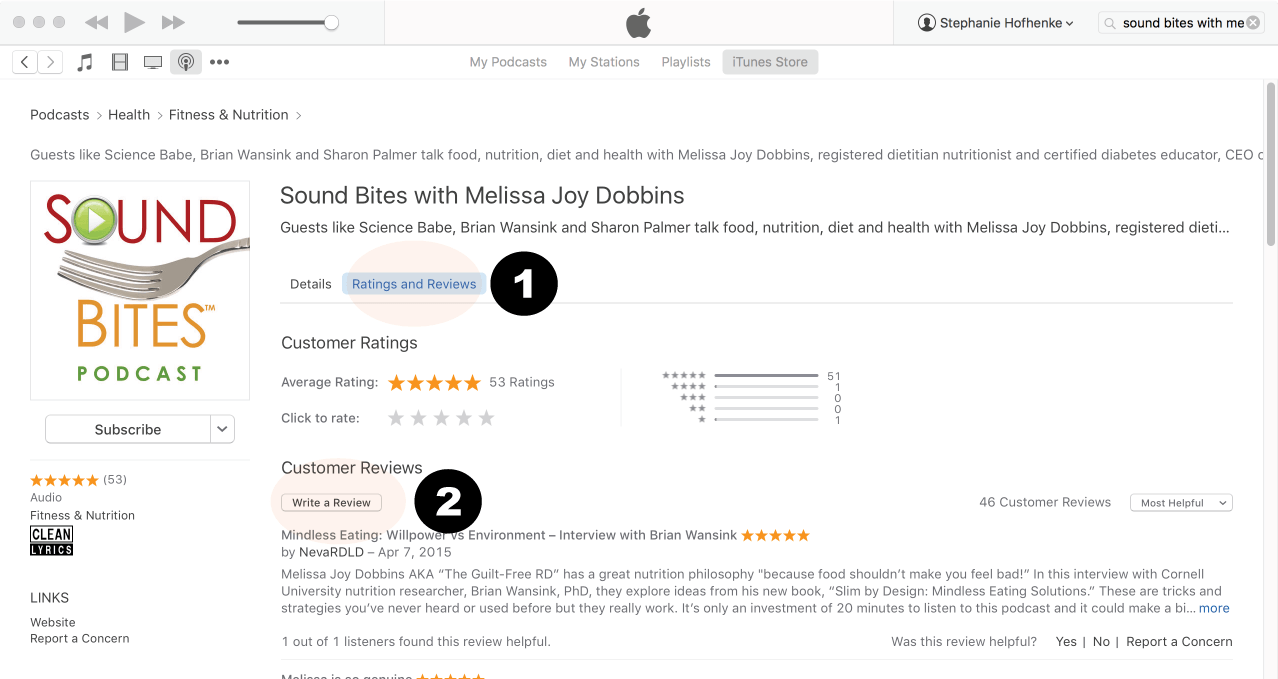
Search for Sound Bites podcast in iTunes
Click Ratings & Reivews
Click Write a Review
View reviews and write your own review.
Write your review…. Thank you!
Write your review!
How to subscribe via iTunes
Click here to view the Sound Bites Podcastin iTunes, then click the blue “View in iTunes” button. This will open your iTunes application directly to Sound Bites Podcast. Click the “Subscribe” button, and your done!