Celebrating over 1 Million Downloads and 50,000 Free CEUs on the Sound Bites® Podcast | NEW: Get 1 years’ worth of CEUs with the new 15-CEU Podcast Course
Make America Healthy Again (MAHA) is a public health-oriented slogan and initiative aimed at addressing the health challenges facing Americans led by the Secretary of Health and Human Services, Robert F. Kennedy, Jr. Scientists, medical professionals and public health officials have criticized the movement, citing concerns about Robert F. Kennedy Jr.’s past remarks and views regarding vaccines and public health.
Tune into this episode to learn about:
a nutrition and public health expert’s reflection on the first 6 months of MAHA
funding cuts to various nutrition programs, research and landmark trials such as the Diabetes Prevention Program
the administration’s focus on food dyes, seed oils and the FoodPyramid
how health professional societies are responding so far
opportunities for meaningful changes in public health nutrition
what the new DGAs might look like
resources for more information
Kevin C. Klatt, PhD, RD
Kevin C. Klatt, PhD, RD is an assistant research scientist and instructor in the Department of Nutrition Sciences and Toxicology at the University of California Berkeley. Kevin received his PhD in Molecular Nutrition from Cornell University and completed his dietetic internship at the National Institutes of Health Clinical Center. He completed postdoctoral training at the Children’s Nutrition Research Center at the Baylor College of Medicine and the Department of Nutritional Sciences and Toxicology at UC Berkeley. Dr Klatt’s research aims to better characterize nutrient metabolism, signaling and requirements using in vitro and animal model systems, as well as human intervention and controlled feeding trials. In addition to research, Dr Klatt teaches undergraduate and graduate level courses in molecular metabolism and dietetics, is an Associate Editor at the American Journal of Clinical Nutrition, and a Section Editor of the graduate-level textbook, Biochemical Physiological and Molecular Aspects of Human Nutrition, 5e.
Resources
Some links may be affiliate links. As an Amazon Associate, I earn from qualifying purchases.
Welcome to Sound Bites, hosted by registered dietitian nutritionist, Melissa Joy Dobbins. Let’s delve into the science, the psychology and the strategies behind good food and nutrition.
Melissa Joy (00:23):
I’ve been getting a lot of questions from listeners about the continuing education credits that dietitians can get for some of my podcast episodes. So, I wanted to clarify that I do offer free CEUs for some episodes, but not all the episodes.
I have about three years’ worth of free continuing education credits as well as some very low cost CEUs, and a package on sale for one full year’s worth of CEUs. If you want the convenience of taking just one quiz and getting one certificate for all 15 credits.
This is a fun and easy way to get your credits, so be sure to check it out. And you can get all the details on my website at soundbitesrd.com/freeceus.
Hello, and welcome to the Sound Bites Podcast. Today’s episode is about MAHA, Make America Healthy Again.
For anyone listening who isn’t familiar with MAHA, it’s a public health-oriented slogan and initiative aimed at addressing the health challenges facing Americans, and it’s led by Robert F. Kennedy Jr. who is the Secretary of Health and Human Services.
It’s important to note that scientists, medical professionals and public health officials have criticized the movement, citing concerns about Robert F. Kennedy Jr’s previous remarks about vaccines and public health, among other concerns.
This episode is not sponsored.
My guest today is Dr. Kevin Klatt. Kevin is a registered dietitian and a PhD researcher in metabolism. He received his PhD in molecular nutrition from Cornell University and completed his dietetic internship at the National Institutes of Health Clinical Center.
Welcome to the show, Kevin.
Kevin Klatt (02:13):
Thanks for having me on. Good to be back. It’s been like 10 years.
Melissa Joy (02:17):
I know, right.
[Laughter]
Oh my gosh, I’ve been wanting to have you on the show again so many times, and the reason that I was like I can’t put this off anymore — not that I was putting it off, but that I just had to put you to the front of the line was this MAHA Substack article you wrote. But before we get into all of that, please share with our listeners more about your background and the work you do and any disclosures to note.
Kevin Klatt (02:44):
I always wanted to do sort of a mix of what we would call preclinical as well as clinical nutrition research. So, that’s a sort of a mix of how do we know what we can possibly know about human nutrition and metabolism from everything from cells in a dish to a mice that we’ve knocked down a gene from, to humans that we control everything about the diet from, and so that’s sort of my primary areas of research.
I’ve done a little bit of things in pregnancy, micronutrient requirements, looking at choline supplementation, also do some work in vitamin B12, and have done some fatty acid work. So, I like to very much say I’m not a one trick pony or a one nutrient pony by any means.
So, I very much on the experimental nutrition side, I’ll collaborate with sort of epidemiologists on occasion, but very much in what we control, the diet and change it up, like what happens to cells or whole-body physiology, and how do we kind of translate that to health.
Melissa Joy (03:38):
Your work is a little mind boggling to me (laughs), it’s pretty intense and very scientific. But in addition to this day job or your day jobs you have, you write on Substack, and you’ve written on other platforms over the years.
I just remember seeing a lot of longer social media posts or engagement on social media. I don’t know, I feel like you are kind of known for helping people better understand research in general, nutrition research, obviously, research studies, processes involved in research. Would you say that’s a fair characterization?
Kevin Klatt (04:13):
Yeah, I think there’s always people in the social media space who are trying to tell you the conclusions, and they’ll tell you the conclusions in 50 different directions. And I think I’ve sort of just tried to orient around, well, how do we know what we think we know and how do we break down sort of the methodological nuances that lead people to say, make one conclusion over another, why this study said what it said, and sort of the strengths and limitations are.
That’s sort of how I got my start, was just breaking down, this is what this study said, this is the strengths, this is the weaknesses. And then over time, depending on the platform, I mean, we’ve seen Twitter rise and fall, and now replaced with X and Bluesky, and WordPress bloggers.
I’ve bounced around different sort of venues for this, and also, hosted a podcast at The American Journal of Clinical Nutrition. So, you can find the social media things that I’ve done in various formats.
I always liked it because it was a two-way street of learning for me. Particularly, there’s a golden era of probably 2013 to 2017, 2018 on Twitter where there were tons of scientists … I always used to joke, I learned more in grad school from paying attention to scientific conversations on Twitter than I probably learned in my classes in grad school. But it was very formative for me and shaping how I think and just getting exposure to things. When you go to the lab every day in a single department at a university, you just get those perspectives there.
And so, social media was I think really great for my development as a scientist, but I tried to make it a two-way street of sort of seeing a bit of a vacuum where there weren’t many nutrition scientists who also had the kind of dietitian training talking about the methodological stuff all the way to the practical stuff to consider sort of the molecules to population sort of thinking approach.
Melissa Joy (05:58):
Well, you do a great job of it, and I share your feelings about Twitter. Are you doing much on Bluesky? You mentioned it.
Kevin Klatt (06:06):
Yeah, I still use X and Bluesky. I was not part of the entire exodus of X, maybe controversially. I still talk there despite who ends up in my mentions, but I try not to just be in echo chambers — I think it’s important not to be and still get your voice out there a little bit.
I have noticed a drift back of some people restarting their X accounts now as they’ve sort of realized that we shouldn’t all be in a silo to media ecosystem. It’s a nice prelude to some our MAHA conversation maybe (laughs).
Melissa Joy (06:35):
Yes. And some of my regular listeners will know we talk about narrow casting versus broadcasting, and that’s a really good reminder that although it’s challenging sometimes to hear other perspectives, it’s important too, and you do such a great job of that and you do such a great job of engaging in professional, respectful dialogue online and in person, so thank you for that.
So, you recently published a Substack article on MAHA, specifically it’s your take on the first six months of MAHA, and then I think your subtitle is a reflection and call to action. So, that’s why I have you here today.
You also, I think was yesterday or the day before, published a Substack on what to expect which had a really cute title, it was like What to Expect When You’re Expecting, which we all know is a famous book about pregnancy. But what to expect when you’re expecting the forthcoming dietary guidelines for Americans. So, I’d like to touch on that at least briefly as well. But why did you decide to write the MAHA piece?
Kevin Klatt (07:36):
It was sort of a six-month check-in, I guess. I think I published it around six months depending on when you benchmark MAHA sort of … I mean MAHA’s been I guess around as a slogan for a while but six months of the administration.
And I think right after the election, I saw a lot of enthusiasm. I know you have a big dietitian audience and I saw in dietitian LinkedIn people saying this is the time for nutrition and we could go back deep into various levels of history here.
But at least, in recent history, you think back to around 10 years ago, Michelle Obama really tried to make a bunch of changes in school nutrition, and sort of got lambasted by political opponents. And I think the movement … I mean, she did a great job and nothing against her, but it got watered down to I think a significant degree and it was just like even getting sodium down in school lunch.
I mean, there was many cascading political avenues and offshoots from that that I don’t think we’ve made nearly as much progress as we hoped. But there was this energy around nutrition 10 years ago, and then all that political opposition, I think there was a feeling that people just didn’t want to touch nutrition because it meant you were going to get articles saying that you were the food police or whatever.
But we still have had these high rates of chronic diseases related to nutrition: Obesity is still very overly prevalent, same with overweight, cardiovascular disease, diabetes. I mean, it’s still taking its toll even though it’s became sort of politically taboo.
And so, I saw a lot of, I guess, understandable enthusiasm that nutrition feels so forgotten to many or so left behind, or so relegated to a wellness ecosystem online, but not nearly as much federal happening.
So, I do want to give credit. There were federal happenings, I think just quieter. There was a second White House conference on nutrition that the Biden administration did, they were making moves on front of package labeling, but it wasn’t clearly the forefront of the messaging and talking points was not, oh my gosh, obesity and nutrition related chronic disease rates are unacceptably high and we’re not doing anything on them.
And I think there’s probably heightened anxiety from seeing pharmaceutical therapies like GLP-1 receptor agonists and related incretin therapies really take center stage and be really effective, arguably more effective than a lot of lifestyle interventions have been.
And so, that added, I think to some degree of anxiety around nutrition and changing the food system is not the forefront of the political message. And now, it seems like pharma’s coming in with a solution, and there’s a lot of I think a bit of a moral panic that nutrition’s not going to matter anymore. And so, people saw the MAHA movement and RFK getting tapped as HHS Secretary by Trump as this opportunity for nutrition to enter the spotlight a bit again.
I fully was worried about this. I mean, RFK Jr. has a long history on saying things about vaccines. I sort of privately said to friends and colleagues, “I don’t think there’s any nutrition win that is worth measles outbreaks and these sorts of things rollbacks and vaccines.” So, I was quite reticent and very curious to see whether they would have sort of a tangible plan.
And I started my article this way, if you go back in the history even further, the sort of 60s and 70s sort of era was when we got the first White House conference on nutrition, and there was a huge political fervor at the time.
There was like a Hunger in America documentary, it was sort of a little bit overblown but made it seem to the public, like malnutrition rates were super high and they started to do a lot more nutrition surveillance at the time, and there was this concern of growing issues of overweight and obesity, rates increasing. At the same time, you still had concerns about micronutrient inadequacies and food insecurity.
50 years ago, nutrition was very much in the spotlight of the public, and then you saw a congressional response. And there was quite a bit of political theater at the time with people doing hunger tours and senators doing hunger tours. And so, obviously, they didn’t have TikTok to blast it on at that time.
But the engines of how you enact government level change and nutrition have always I think involved some political theater. And so, there was a part of me that’s like, “Alright, that’s good faith sort of see whether the current energy can lead to some of the successes of the last energy where you get expansion of the school lunch program and WIC, like Women, Infants, and Children. And so, you saw tangible wins that we can point to.
Some of the USDA human nutrition research centers popped out at this time, some of that energy from the Senate committee that was pushing a lot of this leads to the development of the dietary guidelines ultimately. So, a lot of things we think about now that we just grew up with and maybe particularly younger trainees or anybody who’s younger than 60 probably just takes that’s just our system.
Well, it’s like the genesis of that system was that a time point around 50 years ago that took this political fervor around nutrition and turned it into substantive meaningful programs and change coming from the federal government.
And so, I have read this history a lot in the past and I had just written the big review on the dietary guidelines that came out on annual review of nutrition this year and just for fun, had read a lot about a lot of that history, and I couldn’t stop thinking about it during the early era of MAHA because it was like, maybe I’m wrong, maybe my skepticism that this will be something potentially useful. There was a 0.1% chance in my mind that we’ll get a bunch of tangible good from this.
I was sharing on social media things that were happening and being critical of DOGE, and I guess I had a lot of private conversations with people and seeing things publicly who were still super enthusiastic. This is the time for nutrition.
Melissa Joy (13:27):
Like seeing it as an opportunity.
Kevin Klatt (13:29):
Yeah. And I mean, especially dietitians who are I think still seeing it as an opportunity, like maybe finally we’ll get Medicaid coverage of dietitian services and expansion beyond type two diabetes and chronic kidney disease.
And from a professional trade group perspective, I think people don’t take a particularly wide view of what’s happening to health overall. They’re just like, “Is the dietitian perspective being boosted by this?” And so, there’s still people holding out that MAHA will be good for dietetics as a profession.
But as DOGE happened, I’ve done a little bit of stuff in global health, so seeing USAID get completely decimated, it was I think devastating watching I think a billion dollars of USDA funding for local fruits and vegetables for school lunches got cut. You’re seeing Kevin Hall leave the NIH, he was a major researcher there. You’re seeing proposed budget cuts to NIH, you’re seeing proposed cuts to WIC and SNAP, and you’ve now seeing basically the decimation of SNAP-ED, which employs a ton of dietitians.
I watched all of these things happen slowly, and I was having calls with reporters and things who reached out to me, and they’re like, “Why is no one in the nutrition world talking about this?” I was being a little bit loud about it. Dr. Jessica Knurick, who’s a PhD RD as well, many people probably know her. Huge followers, you should follow her if not.
Jessica Knurick is a PhD RD and we were both being I think kind of loud about it.
Melissa Joy (15:01):
She’s very vocal on Instagram. She is just crushing it.
Kevin Klatt (15:07):
So articulate, yeah.
Melissa Joy (15:08):
So articulate, so smart. So, for everybody listening, follow her on Instagram.
Kevin Klatt (15:15):
But when I talk to the reporters, they’re like, “We’re having a hard time finding nutrition researchers to go on the record to say things about this.” I mean, understandably, I think a lot of researchers, their funding is coming from the federal government, nobody wants to stick their head above the crowd and get it chopped off.
But tangible bad was happening, and I was still seeing this holdout of enthusiasm and things like people thinking this is still the moment for nutrition. Maybe what we didn’t say it in sort of the history leading up to this, but there is a whole other history that I’ve written some about of nutrition funding has been pretty bad the last 20 years.
You’ll see numbers quoted from the Office of Nutrition Research that are I think quite inflating of how much money the NIH actually funds nutrition, they have very crude metrics for how they come up with those numbers.
But if you actually go through them to look to see how much money are we actually putting into understanding how food impacts health, it’s really not that much, and a lot of it I think is historically relegated to USDA funding.
And so, you’ve seen the closure of tons of metabolic kitchens, you’ve seen faculty at nutrition departments turnover to be much more basic science sort of cells in a dish and mouse work, and then more global health kind of stuff because NIH will fund the basic discovery stuff and things like the Gates Foundation and USAID would fund global nutrition, but old school kind of like we’re going to change the diet and figure out what happens to chronic disease risk factors or energy intake or whatever’s doing that kind of work requires a lot of facilities that are expensive and a lot of work.
Nutrition’s much harder and more expensive in many ways to study at scale than pharmaceuticals are, you can put it in a pill or an injectable. And so, with waning money over the past 20 years where you could argue the previous NIH director was not particularly kind to nutrition science, I think a lot of people were holding out for maybe there’ll be change, maybe money will come our way as there’s money taken away from things like USAID, maybe it’ll get refunneled back.
And so, I understood to some degree the maybe mental gymnastics to say this can still be good for us. But it just got to the point for me where I was like we’re seeing some performative action on food diets, which we can unpack at some point, and we saw all the infant formula operation stork speed, which is just a review of updating the Infant Formula Act which is needed, we can unpack those details a bit more.
But I think I saw it as relatively hollow, minimally impactful, mostly performative things being touted as MAHA wins. While you saw these demonstrable tangible cuts in everything from public health nutrition to nutrition research funding, and then kind of silence from the Academy of Nutrition & Dietetics, the American Society for Nutrition.
American Society for Nutrition had a pre-conference spotlight for the NIH director, and this was amidst all of these cuts, and they sort of kind of lobbed him some easy questions, and I’m like you have a whole part of your membership at ASN, who just lost all of their USAID funding.
Truly the field of global nutrition has been faced with an existential question here and all their studies have been decimated, and they’re all members of your society, and we’re kind of freely spotlighting co-conspirator at least.
And I’m sure there are people who are like this is strategy to suck up and make sure that the government sees our society with a good light and we’re going to try and get them to fund nutrition. I think for me, we’re at the point where that’s a pipe dream.
And so, I wrote this piece to try and say I understand why some people were happy, there’s this history of political theater getting turned into action. But read the room, the writing is on the wall kind of in blood, and you can point to many, many, many, many things that are getting rolled back. And it’s sort of what’s our bottom, what’s the point?
I guess the other thing that’s happening, all of this is you’re finally seeing American Academy of Pediatrics, American College of Obstetrics and Gynecology really getting vocal, pushing back.
Melissa Joy (19:30):
Yeah, they filed a lawsuit, right? AAP?
Kevin Klatt (19:32):
I think so. Yeah, I haven’t been able to like … oh my gosh, there’s so much happening in the news on a daily basis, I’m not sure where things are at.
Melissa Joy (19:39):
It’s hard to keep up.
Kevin Klatt (19:41):
Yes. It’s hard to know what was instituted and where the status of everything is if you’re not-
Melissa Joy (19:45):
Yeah, I had heard that and I was like, “I need to fact check that.” And yes, recently, the AAP filed a lawsuit against HHS, and I don’t remember the specifics but I think it has to do with their vaccine recommendations.
Kevin Klatt (20:00):
Yeah. And they just published their own vaccine recommendations independently. I think American College of Obstetrics and Gynecology announced they’re not taking federal funding for anything anymore.
So, you’re seeing these professional medical societies be like we’re not going to be bullied, we’re still going to base things on science and we’re going to figure it out, and really kind of standing up to what they saw as substantial, anti-scientific, anti-public health, anti-expertise overreach of the government.
And then you look at the nutrition space and I’m like, guys, every other medical profession is being like, “Yeah, this is terrible.” And the nutrition space is like kind of, maybe this will be good and you’ve got top nutrition scientists working on the infant formula operation stork speed.
And I’m like you could do all of the operation stork speed stuff independently through a society and say, yeah, we’re not going to be … I mean you’ve got pediatricians on the operation stork speed who are helping them update infant formula while they’re doing demonstrable harm on vaccinations.
And I’m like are we bedfellows as nutrition scientists? Is history going to look back at us and see how nutrition and dietetics were complicit while like everything was just bad? Like all the bad was happening.
And so, I just sort of wrote the question of what’s the standard at like how many more cuts? When you lay it all out it’s easy to get lost in the news cycle. I was like let me lay out everything tangibly bad that’s happened, and talk about the few supposed wins. And then call out that everybody else seems to be freaking out about the obvious bad that’s happening. What is our bottom? Where is the point at which we go, “There’s no allyship here?”
Not to be insanely adverse, I didn’t call for anyone to be adversarial, but I was like we should maintain our independence, we should really use our scientific authority to whatever degree we have it to make sure that we’re putting out recommendations on what policy should be, where we’re seeing a lot of focus on just food additives and pretending these are massive public health wins.
What’s it going to take for us to start to redirect that energy towards things that might really matter? But those involve really hard questions, picking economic winners and losers, getting Congress on board with policy, and I haven’t seen anything like that, which is really what it’s going to take I think to even do some pretty basic stuff.
But it’ll probably be deja vu for everyone because it started to look like what Michelle Obama was trying to do, and I’m not sure there’s actually energy for that. So yeah, I guess it was kind of a challenge to the field to like what are we doing here guys?
Melissa Joy (22:41):
Pay attention here.
Your article has a lot of great history at the beginning, some I didn’t even really know. So, I do encourage people — of course, we’ll have a link to it in the show notes at soundbitesrd.com.
But you do a really nice recap of history, and then you do detail to date when the article was published about some of the specific … you said it’s a non-exhaustive list of cuts that have happened and you referenced some of those in your comments just recently.
The USAID thing was I think one of the first things that I saw that really kind of made me pay attention even more, and when the diabetes prevention program funding was cut as a diabetes educator that rocked my world, of course, and then, yeah, our colleague Kevin Hall stepping down from NIH.
I don’t know if there’s anything more specific you want to get into about some of these specific cuts just for people who may not be up to speed on all of that. Because let’s be clear, as you said, it’s hard to keep up with it all. There’s a lot going on every day. I think some of that is by design, and we can certainly talk about the infant formula and the food dyes. I like to say red dye number three is a red herring that like squirrel.
Kevin Klatt (24:00):
I think one thing to say maybe about the collective is there might be someone who comes from a more conservative perspective on this and is a fan of small government, and I think there’s a deregulatory agenda that is happening and that is everything from cutting back federal funding for a lot of programs and things. So, I would ask people what is the kind of libertarian solution to all these things?
Like you’ve got kids with Medicaid cuts, there’s going to be a ton of people unenrolled from free school lunch programs, and this will demonstrably prevent kids from getting free school lunch. If you care about nutrition and education, like getting people to use their SNAP dollars more in line with dietary guidance is a major role of dietitians in the SNAP-ED program.
And so, I would like at least people like that to acknowledge that there’s going to be harm and then really propose, okay, what are the small federal government solutions? Because a deregulatory state is fundamentally at odds with our current public health system.
Even if you agree with that basic premise, but still want a smaller federal government, I think you would have to start offloading and outsourcing all of these things somewhat slowly over a several year time period to say, “Okay, churches are going to take up this and we’re going to work with states to take over these things.”
But this process was not delicate. I mean, it was like shutting off the HIV meds for patients abroad with no clear backup plan, and other funders had to scramble to kind of come back in, and there’s just been chaos in the courts and everything.
And if you really wanted to make a smaller federal government, if that’s your kind of ethos, I think that’s at odds with most public health goals fundamentally. But if you wanted that, you would think, okay, well, government, currently, it’s made itself the cornerstone over decades of key public health nutrition programs.
And if you’re still a person who cares about public health nutrition but wants a small government, you have to think about, okay, what’s the five-year phase out plan here that we are going to institute to start offloading what the government currently does to states, to other actors, to philanthropists, to local community things, churches, and make sure that you don’t cause demonstrable harm in the process.
Because this is the government of the right that has people who are religiously oriented voting that are supposed to be caring about all these things, and it’s just doing demonstrable immediate harm. And I really struggle with that as a person who grew up in the church. And yeah, it’s an immediate harm, whatever your political ethos is. The way that this has happened I think is just unquestionably bad.
Melissa Joy (26:35):
You’ve mentioned the term public health several times, and I think at the crux of this is public health nutrition is being so impacted like you said, and public health, not just public health nutrition — public health is being impacted so intensely (laughs), I don’t know what the word is.
Some of the actions that RFKs’ team is taking with this MAHA movement are really talking more about taking personal responsibility and making lifestyle changes and wearing biohacking devices and things that I feel like are completely tone deaf to food insecure people, food deserts. When somebody has trouble having access to food, it just seems so out in left field to me.
Kevin Klatt (27:27):
Right. I think the perfect example I always bring up is they’re worried about the soybean oil and infant formula, not the lack of paid family leave. It’s well one of these is kind of a red herring as you said, and one of these is a major policy that we don’t have that prevents women, people who can breastfeed from being able to breastfeed for the recommended amount of time because they’re pressured to go back to work, they’re stressed.
One of the things is demonstrable harm for mom and baby, diets and one of them is a phantom fear that’s influencer logic. And we have our HHS focused more on the phantom fear and I’m not surprised by that.
I mean their advisors are pretty clearly all podcasters, and so they’re not people trained in public health and they really haven’t engaged with anybody from either academic expertise in public health really through learned …
In fact, I’m told MAHA folks have not reached out to past government folks from Michelle Obama’s time to try and engage them and be like, “Hey, what are all the things you tried to do and what are the barriers you ran into, and now that we have all the levers of government, how can we circumnavigate that?”
For anybody who was in MAHA and wanted it to do good, I think it should be extremely frustrating that people have been trying behind the scenes for years and then just ran into mostly political interferences.
And so, if MAHA really is this united front or the administration really is a united front pushing MAHA, then it should be able to fast track a lot of these things, really shoehorn them through. But I think we all know that the commitment to MAHA supposedly would really fracture the moment it had any actual tangible impact.
And I mean, you’ve seen either things I didn’t put in that list or the EPA science teams have been cut, the FDA, like a bunch of their food toxicologists have left. It’s like the things that you would need to do to achieve a real MAHA agenda to make sure that the chemicals that we’re exposed to in our environment are below actual safety thresholds and that we’re always kind of getting closer to less and less exposure.
I think on the food additives front, they keep talking about closing the grass loophole, which is the generally recognized safe loophole that allows companies to register additives as safe themselves, and not have the FDA review.
It’s well, if you cut the FDA’s funding and then all the food toxicologists leave, you really can’t close the grass loophole because if you wanted to close the grass loophole, you need to 10x increase the toxicologist staff, not lose them, and take away their funding. And so, it’s very much look at the right hand over here while you ignore that the left hand is doing all the opposite things, is what the whole kind of administration …
And this again, it just comes back to the deregulatory small government agenda is completely at odds with what MAHA says it wants to do. And so, the only rational thing to do is to blame the individual, to say, you’ve got to have personal responsibility, you’re not educated enough, you don’t know your CGM blood glucose spikes after a meal enough, and I think-
Melissa Joy (30:25):
You’re not following the food pyramid.
Kevin Klatt (30:27):
(Laughs) Yeah. Yes, there’s a lot of this … I think the most concerning part of it all for me is that a lot of what they’re doing and all of that is that you mentioned the food pyramid. They are the public health establishment now, but all of the energy and fervor that they’re trying to cultivate is this anti-public health establishment of the past.
And so, they are saying, “Oh, they told you mRNA vaccines were safe.” They told you the eat the food pyramid (they, they), like this mythical they that has led you astray. And so, at some scapegoating all past advice pretending it’s all bad because “they” told you so, and now we are going to tell you the right thing to do.
31:10
I don’t think we’ve ever seen a federal administration that relies on this level of fomenting distrust in any sense of expertise. And that to me is self-defeating because they are now the experts in power, so shouldn’t be trusting them either but it’s a very kind of authoritarian playbook, right out the authoritarian playbook actually.
31:31
And so, if at the end of the day the only thing that comes out of this is just telling people to be more personally responsible, well, society’s been doing that and shaming people for being overweight and eating cheeseburgers and drinking soda for decades while telling people eat less sugar and things, and really if it was a knowledge deficit, we would have been healthy 10 times over, but it’s not.
And I think we’ve also clearly seen the free market approach to addressing obesity and nutrition things has been green tea extract for weight loss. Oh my gosh, we’ve got dozens of gimmicky things that don’t work and people are desperate. And so, I don’t know that there’s really a free-market approach when human biology is just very complex.
Obviously, we like sweet, salty, starchy, fatty foods. Like our biology is sort of misaligned with our food environment for sure, and the free market kind of approach is just to sell more of that. Obesity takes a very long time to manifest and cause sort of demonstrable harm.
It’s not like any one food or any one thing is killing people acutely. It’s a very complex exposure with a very complex disease process. I think you need some sort of governmental approach combined with good medical care and all these sorts of things.
I don’t see that coherent, “This is what we’re going to do at the food policy level, this is what we’re going to do at the individual health level, this what’re going to do at the medical level.” I think for dietitian audiences will be quite frustrated that they’re all about personal responsibility and individual health, and then it’s okay, are you going to reimburse now for RDs? Yeah (laughs).
Melissa Joy (33:06):
Right, right. So, what can we expect with the dietary guidelines coming out? They were supposed to be out already, I believe. Talk to us about that Substack you wrote.
Kevin Klatt (33:18):
So, we had a normal dietary guideline process with the dietary guideline advisory committee creating their kind of expert scientific report, like 450 some pages detailing the most up-to-date evidence on key questions, and current dietary patterns. And so, that was submitted under the normal process, and 2025 should have been the writing, and planned release at the end of the year.
And we have been told on multiple occasions that well, one, they’ve mocked the dietary guidelines report, calling it kind of this industry shield document basically. And also, there’s a lot of flubs. I think the people in charge don’t really understand the dietary guidelines process, what a dietary guidelines advisory report is versus what the dietary guidelines are, and who the intended viewership of the dietary guidelines is.
So, for anybody who don’t know, the dietary guidelines advisory committee is supposed to be a very long, scientifically and justified report. RFK Jr. has mocked it for being 450 pages and said we’re going to do a four-page report. And it’s okay, well, that report is supposed to be the scientific backing. You want it to be long, justifiable so that when any policies-
Melissa Joy (34:27):
This isn’t what we’re handing to the public, this is the basis of the guidelines.
Kevin Klatt (34:33):
Yeah. It’s the science behind it. So, it’s a feature, not a bug, that it is 453 pages long and full of systematic reviews and things. And then they’ve sort of mocked that and said we’re just going to do a four-page report, it’s super simple, and I think there’s tons of implications of that.
But because they’re saying it’s going to be this short report, they were like we’re going to produce it early. And it was supposed to come I think even before July, and then there was a July date, and now it’s been pushed back again until the fall. The whole process of turning The Dietary Guidelines Advisory Report into what ultimately the dietary guidelines will be, has never been all that transparent, I think it’s always been an opaque thing.
But within HHS and USDA, there’s supposed to be a writing committee that actually formulates what the current edition of the dietary guidelines will be. And so, that should have just been going on as normal, and we should have expected it.
But we have gotten, in various press conferences, pretty limited information other than to say, “We’re going to talk about eating whole foods, no ultra-processed foods.” I think we can expect some additive bad-guy lists.
And then they’ve been talking about seed oils, and then they recently held some event with the dairy industry to say that they were announcing that they were rolling out … a new food dye was approved, a blue food dye, and one of the natural ones had just been approved.
And that their industry was going to say at the same time, that they’re taking artificial colors out of ice cream, not the sugar or the fat content or any of that, just the colors. And then they said at that event, that they were rolling back the ITER guidelines on saturated fat, and claimed that Ancel Keys led us all astray, which is citing some diet books that are out there.
I think most people who are in the know, know exactly who they’re citing and why. And so, this is going to become quite politicized that you’re going to have this very short document that’s four to six pages long, and then who knows what it will actually contain within it besides talking about eating “whole foods,” and producing ultra-processed foods and additives.
And apparently, they’re going to roll back explicitly the saturated fat guidelines that have been there since the first iteration, which the evidence on that really hasn’t changed as much as often, some people pretend it has. So, I wrote about just what’s the point of the dietary guidelines? They are really a policy document.
The audience, you could read this, it’s in the executive summary. I screenshotted the Substack piece of the executive summary from the chair of the dietary guidelines says that, “This is for the health professional audience and for policy makers, and people who run federal programs.”
So, despite how the government is currently talking about it, the dietary guidelines aren’t intended for Americans to read this 150-page document. There’s a lot of other things they do with MyPlate and food guides and handouts, and informational-type stuff.
Melissa Joy (37:28):
More consumer-facing stuff.
Kevin Klatt (37:30):
Yeah, the DGAs still have to get turned into a consumer-facing thing.
Melissa Joy (37:34):
Education initiative, I guess.
Kevin Klatt (37:36):
So, you have to then ask, “Well, what are the consequences of taking a policy document and turning it into a four to six-page thing? So, that has this dramatic potential to really disrupt and probably cause a lot of chaos in almost all federal nutrition policies, which federal nutrition policy is touching on things like SNAP, WIC, The School Lunch Program, the Military, programs for older adults.
The effects could be pretty far-reaching. I could probably spend all day and way too many words on the Substack opining about all the potential impacts. But I think school lunches (because there’s been a big focus on children in MAHA), is probably going to be an area where we’ll see some changes.
And so, that I think has huge impacts. So, the school lunch standards are based around the dietary guidelines, and I think a lot of people might think, “Oh, dietary guidelines always say these things, like less than 10% of your calorie is from sugar, and who’s adding up their grams of sugar and multiplying it by four and dividing by their calories?”
And that’s not the intention of it. It is getting that specific quantitative information in the DGAs allows it so that when people who receive money from the federal government to feed school meals have to show the federal government that they are planning meals that on a weekly basis hit the dietary guidelines for serving some fruit, for serving some vegetables, for serving some lean proteins and legumes or nuts and seeds, and dairy.
And so, when you put in there that there’s a limit on sodium and there’s a limit on saturated fat and there’s a limit on added sugars, that really restrains what can be served to children in The School Lunch Program to force the foods to be healthier.
And what it often does is it forces companies that formulate foods to be sold to school districts and competitive contracts. Because there are some pretty huge wealthy school districts in the U.S. I actually did my dietetic training at a school … our community rotation was at a school lunch of I think it’s like the third largest school district.
And you see companies come to them and say, “We formulated these things, what do you think? Would you buy this? And they’re all perfectly made to fall right below that sodium threshold, right below one serving of whole grains provided.”
And so, that’s what leads them to basically take an Ilios frozen pizza, and you see pizza being served in the school lunch program. You’re like, “Oh, why are we feeding kids pizza?” If you actually taste that pizza, though, it is very low sodium sauce, it’s low sodium bread, the bread is whole grain, the cheese is lower fat.
And so, those quantitative restrictions in the DGAs require that foods that are sold in The School Lunch Program actually meet specific standards. So, the question is, when we see that four to six pages, is it going to contain enough detail to actually hold any weight in advising what school lunch will be?
Because you can imagine if it says, “No UPFs” (ultra-processed foods), which depends on how they actually define that. They had a call to ask how to define it. So, I think the definition that is used in the literature is not really the definition that they might use at the end of the day, but it’s anybody’s guess.
And they say, “Okay, saturated fat can be liberalized if they don’t retain the 10% of calorie cap on added sugars,” and just say something vague about “eat whole foods,” which is not defined at all. Then all the federal policies and things like what are the actual restrictions of what we can feed kids will kind of go up in the air.
And that matters a lot because school districts are operating on the shoestring budget. They get like a dollar a day or so to feed kids (maybe a bit more), but you have to consider that there’s massive economic disparity within the U.S.
And so, some school districts are really operating on a thin budget. Some have a bit more of a fancy budget that they might be able to meet whatever ultra-processed food things are, but a lot of these school districts were stressed by the limited changes that Michelle Obama made.
So, if you just remove all of the standards, they’re to make ends meet, probably going to feed kids that are maybe not as nutritionally good for them or that we would see as nutritionally good for them as what they’ve been feeding them while restricted by the current DGAs.
And the flip side is also possible. So, it could be that kids get less healthy things, but it could also be that now you can’t do anything that’s prepackaged and ultra-processed because you said, “Feed kids whole foods and don’t feed them ultra-processed foods,” and then you have to make chef-made meals.
And so, school districts would go bankrupt if you did that because most of them don’t even have the infrastructure or the money to do it. And so, there’s going to be huge questions, and I think chaos that comes about from whatever the changes are if they’re not super specific in those four to six pages.
So, lots of uncertainty, but it’s very hard for me to imagine what is conveyed in 140-page document of the DGAs — the important stuff of that that really is the meat behind federal policy, is going to be present in a four to six-page document, and that the four six-page document won’t introduce new things that people just have no idea how to follow.
Another example I give is there’s a lot of federal labeling initiatives going on right now, redefining whether companies can use the voluntary term “healthy.” So, they have to basically meet some dietary-guidelines-derived standards for that.
As well as front-of-package labeling, which is a big thing all over the world that has really driven a lot of food reformulation to get things like sugar down, or on the front of the package it’ll say, “This is high-end sodium.”
Our proposed one is it’ll say whether it’s high-end sodium, saturated fat, and added sugars. And so, with that front-of-package labeling, it sort of puts almost a warning label (a little bit less dramatic than a warning label), but something of a warning label to alert consumers, like, “Hey, this is really high in sodium and added sugar.”
But on the saturated fat front in particular, if they remove that from the dietary guidelines, and that means all these federal policies that are right at the finish line to redefine healthy and to define what frontend packaged labeling looks like would be thrown up in the air.
And it’s not clear to me what the workaround would be. Are they just going to put only added sugar and sodium maybe as front-of-package labeling? Is that enough? And I think the saturated fat stuff, I talk about that a whole bunch more in the piece, but I think it’s – unfortunately, a lot of people are like, “Well, we’ll just feed whole milk to kids,” and sure, it’s probably not the best thing in the world, but I don’t care about it that much.
But the reality is it’s probably going to be food manufacturers are going to switch to palm oil, which is now cheaper than soybean oil. So, you’re going to get ultra-processed foods that are already low in fiber, low in lots of the good stuff, higher in other things like refined grains and added sugars that we don’t want much of that are just going to swap out the unsaturated fats for much more saturated fats. Which I don’t know that that’s a health win at the end of the day. So, yeah, it’s a concern for sure.
Melissa Joy (44:41):
Well, in the interest of time, I just wanted to say that we’ve touched on like seed oils, red dyes (things like that), and ultra-processed foods, and I have several related episodes to that that I’ll throw links into the show notes at soundbitesrd.com.
And I noticed on X, you took a seriously deep dive on seed oils and infant formula, and just engaging, going back and forth with people asking questions. And I just wrote a 3000-word CEU article on seed oils for the Food & Culinary Professionals Dietetic Practice Group of the academy, it hasn’t been published yet. But that’s something that we’re hearing a lot about.
But I just want to reassure the listeners that neither one of those three things is the villain, short story. So, the red dyes are typically in what we used to call junk foods, I’ll call them indulgent foods, foods that aren’t nutrient-rich. So, they’re safe, but is taking them out really moving the needle and making America healthier again?
And I noticed in one of your articles or one of your posts, you were talking about the natural dyes, they’re not necessarily safer than the artificial or synthetic, and there may be food sensitivities or food allergy issues with some of those because they come from plants.
Kevin Klatt (46:01):
Yeah, yeah. I think there’s a big question from them both on whether there’s food sensitivities and allergies that are either known or will emerge. And then there’s also a concern that they are potentially sources of heavy metals.
So, the good manufacturing protocols that actually isolate those, and what the standards are at the end of the day for what the final product will have because they’re often extracts of plants. How pure they are at the end of the day is a big question. Of which having more heavy metals is not really on the MAHA agenda.
One thing I wanted to say though, there’s a lot of … okay, we’re focusing energy on the wrong things maybe or things that are really low impact. I don’t really care if we take out artificial food dyes. I mean, it’s like they’re just brightly bare, they don’t add anything nutritious, they make them more appealing to kids.
But I also don’t think taking them out is any panacea, but I think there are areas where we start to get into genuine risks. And so, anything in nutrition, if you just don’t eat one thing, you typically eat something else instead.
And we’re seeing very dangerous proposed alternatives. And so, part of why I’ve talked a lot about a whole article on the history of infant formula and how it was formulated over time and why there are seed oils in it and where we’re at now, and there’s genuine progress to be made on the fatty acid composition of infant formula. Hands down, it is embarrassing we haven’t done more on that.
The industry has led efforts to have an international codex that they follow. So, I don’t think the state of infant formula is nearly as bad as you might think it is based off of our regulations and what the mineral mixes are for specific nutrients.
But those are very academic debates in the media, and even coming directly from MAHA advocates like Casey Means, who are holding the levers of power and have RFK Jr. by the ear, he’s tweeting out that, “You can feed an infant toddler formula, and that the only way to get infant formula that’s free of seed oils is to feed them toddler formulas.”
Which, just to be clear, toddler formulas, for anybody who doesn’t know, the electrolytes or the mineral mixes are not ideal for an infant whose kidneys are still developing and can only handle a certain amount of protein. So, there’s real demonstrable risks.
I’m sure there’s RDs in the audience who have seen the metabolic abnormalities that happen when infants are fed not infant formula. We’re talking about risking infants’ lives by telling them to drink toddler milk, which is just, it’s designed for toddlers, it’s not designed for infants. You don’t have to know a lot about infant formula to know.
But the fear around seed oils in infant formula has been inflated to such a degree that you are getting not only Calley Means telling people to do this, but I went to ChatGPT just to see which brand of infant formula can I feed my infant that is seed oil free.
And it cites the exact same toddler milk formula that Calley Means recommended. And that has taken off all over the internet that you can feed your infant this specific brand of a grass-fed, milk-derived toddler formula to infants.
And so, I’m like some of these things, I think a lot of people throw up their hands and are like, “Okay, whatever.” You can probably lower the amount of seed oils a bit from where they’re currently at if you really wanted to just to make people happy and say MAHA could have an easy win here.
They need some seed oils for the linoleic and alpha-linolenic acid, but we’re lowering them fine, whatever. But we are getting worse alternatives that are demonstrably more dangerous, promoted en masse because of a phantom fear. So, yeah, I’m at the point where I’m hoping MAHA just doesn’t cause harm. I’m not really holding out for it to do good.
Melissa Joy (49:54):
To do anything good.
Kevin Klatt (49:56):
That may be pessimistic, but.
Melissa Joy (49:58):
Oh, I mean, you bring up a lot of very interesting points and food for thought. So, what’s your call to action? What do we do about all of this? And is this, every man for themself, is this an organizational call to action?
I’ve done action alerts through the academy and also through the American Diabetes Association. I’ve contacted my representatives about SNAP and other research funding and things like that. But I feel a little helpless. What can we do? I
Kevin Klatt (50:26):
I think there’s a lot of things we could potentially do. I would encourage everyone to think locally right now. So, it can feel like you’re tweeting out into the void. And this is totally insurmountable, but all of this is, I think, flourishing in an environment where we’ve just seen a total breakdown of community.
I think that was already happening with social media, but COVID catalyzed it, and people scream and shout on Twitter, but there’s local MAHA meetup groups. Look for them in your area. Go have a real conversation with someone.
Make sure that you’re clearly establishing shared values. Probably didn’t do a good job of that in this podcast, but I want the food system to change. There’s so much pressure just waiting to burst through and explode if there was actually an administration that wanted to tap actual food policy experts and nutrition scientists and be like, “What are all the things that we could do? How do we make them happen?”
There are so many people out there ready waiting for that. That’s not what’s happening right now, unfortunately. But I think engaging within your local community is really important. There’s a good podcast, I think it’s, Why Should I Trust You?
That is bringing together experts and MAHA advocates to try and come to the table and talk a whole bunch more. And I think there is an understanding of local MAHA community groups that they’re very dedicated to RFK Jr., and I’m not going to try and even convince them otherwise.
But they think that the administration’s making a mockery of the MAHA movement and feel like their votes have been co-opted. And I think that’s a totally fair feeling. But I think whether you can redirect that energy towards here’s the FRAC (The Food Research and Action Coalition), I think it is.
Or here’s CSPI, here’s these orgs that have been talking about this stuff for a while, which you may or may not know about. And so, lots of people care that what we’re feeding our kids isn’t toxic and poisonous, and there is a lot of science around what is what.
Yeah, some of it’s uncertain for sure, but there’s a lot of science out there about things that we could tangibly do to improve health across lifestyle interventions, at the one-on-one level, food policy at a national level.
Taking this moment’s energy and making sure it’s not spent on just being used as a front for a deregulatory state, but making sure people get educated about the systems that we have in place, the systems that are being removed, so much of public health has been silenced.
So, doing that education, whether it’s with your family, whether it’s with your local community, whether you want to write about it on LinkedIn — I mean, I think people just were silenced a bit in the beginning because they were worried about the consequences.
But part of why I wrote that article again is we’ve already lost a lot (chuckles). There is not much more to go … if you were holding back, making your voice be heard, I think now is really the time to talk about what is in (there’s a lot of dietitians listening) your specific purview.
Whether that’s your clinical dietitian who wants to see pregnant women with gestational diabetes and you can’t get insurance coverage for it. Tell that story, let that be known. I think a lot of people are really shocked to hear how much U.S. has not really committed to public health nutrition in the past or to medical nutrition.
There’s so much dietitians could do to tell their stories and nutrition advocates could do to be like, “I’ve always wanted this change, and I was hopeful MAHA would do it and they’re not, and I’m really disappointed.” It doesn’t need to be flaming blue-haired liberal stuff, it can just be, “I’m disappointed, and this is why I voted for this.”
Melissa Joy (54:06):
And concerned.
Kevin Klatt (54:07):
Yeah, and concerned is very fair. I think I try and stick to what I’m an expert in, but I do know a lot of people who are experts in infectious disease, and everyone is unilaterally concerned about vaccines. And I think where we can – I’ve encouraged people in the academy to ally with other medical organizations.
There’s a false dichotomy out there that there’s infectious-disease-risk, and then there’s chronic-disease-risk that’s impacted by nutrition. But infectious diseases are major drivers of chronic disease risk, and infection impacts nutrition, and nutrition impacts infection. And these things are not these camps that they’ve been falsely dichotomized into.
And so, I think there needs to be a marriage of the nutrition and lifestyle-oriented communities with the medical communities to really come together and use this opportunity to be more visible than we’ve ever been. And it’s not just saying, “We hear you, enough has not been done. There are historical failures.” But this is not … right problem, wrong solution.
Melissa Joy (55:06):
This is not the answer. Well, thank you because you inspired me to do this podcast. I’ve been kind of quiet about it. When I saw your article, I’m like, “Okay, now’s time for me to do an episode on this.” And I’ve got a couple other interviews scheduled about how MAHA is impacting farmers.
And I did interview our colleague, Chris Taylor. He was on the dietary guidelines advisory committee. I interviewed him a little while ago, and I haven’t released that yet. So, I might have to do a two-part with him: “This was before they came out, now that they came out, what’s your reaction?”
Kevin Klatt (55:42):
What was it supposed to be, and what is it now?
Melissa Joy (55:45):
Yes, and that episode’s just about the process and his role in it and just trying to make that a little bit more transparent and educate people. But yeah, so, thank you for being so vocal and sharing all of your thoughts with us today. You know a lot, and I’m learning so much from you. Where can people connect with you online, your Substack, social media?
Kevin Klatt (56:08):
I try and keep everything easily branded around my first initial K, my middle initial C, and then my last name Klatt, K-L-A-T-T. So, it’s kcklatt.substack.com, Kcklatt on Instagram and Twitter and Bluesky.
I talk about most of the same things across all of them, but with maybe a little bit of a different flavor just based off of their own platforms. But then I also publish in the literature. You can type in “kcklatt” into PubMed and look at the science that I’ve done.
Melissa Joy (56:38):
And doing some reels not too long ago, thank you. I know that’s not a fun thing to do. At least I don’t think it is, but it’s great to see you.
Kevin Klatt (56:47):
It’s so much time (laughs).
Melissa Joy (56:47):
Oh, I know, I know. So, I’ve had a goal on my list for a couple of years to do one short reel for every podcast episode. Something as simple as, “Did you know blah, blah, blah, check out this episode,” (laughs), I just can’t get around to it. So, keep up the reels.
Kevin Klatt (57:04):
They really favor the reels. I didn’t realize how much more reach that they get. But I’m too much of a perfectionist too. I’m unwilling to let one stutter get through, and so I rerecord the whole thing. That has to change, I think.
But if you want to hear more of my voice, if you haven’t gotten annoyed by it from this podcast, I host a podcast at the American Journal of Clinical Nutrition. We do it as needed, and as we have an author that wants to come talk about their science. We have 20-something episodes up just talking about some of the more recent science that we published at the time with author interviews as well as a couple case studies.
I’ll plug that extract for the dietitians in the audience that we are doing more case studies that you can get CEUs and submit for them. And they’re really great, complex, fun case studies with clear learning objectives. And so, if you’re a dietetic educator, it’s great to use in your class and also take them yourself.
But the American Journal of Clinical Nutrition, we are doing our best to put more of that C in there. We do a lot of nutrition epidemiology, and really hardcore science, but we’re trying to get more of the true clinical inpatient nutrition vibe there.
Corey Best is a PhD RD that has been co-leading that with Nancy Krebs, who’s an MD RD. So, it’s a really great opportunity to kind of learn. And some of the first few cases I was like, “Ooh, I’m learning a lot from just reading about this.” And they really walk you through the medical process on some things.
Melissa Joy (58:22):
Okay, because you’re an associate editor at the American Journal of Clinical Nutrition, right?
Kevin Klatt (58:27):
Yes, I am, yeah.
Melissa Joy (58:28):
Awesome. Well, thank you for sharing that. I’ll definitely check that out, and I’ll put links to all of those social handles and everything in my show notes at soundbitesrd.com along with like I said, the links to related episodes so people can take a deeper dive on seed oils, ultra-processed foods, food dyes, all of that good stuff.
Well, thank you again so much for coming on the show, it’s been a pleasure.
Kevin Klatt (58:51):
Yeah, it’s always good to be back on. Hopefully, we’ll do a hat trick and have another one in the future.
Melissa Joy (58:56):
That’d be awesome. I’d love that. And for everybody listening, as always, enjoy your food with health in mind. Till next time.
[Music playing]
Voiceover (59:05):
For more information, visit soundbitesrd.com. This podcast does not provide medical advice, it is for informational purposes only. Please see a registered dietitian for individualized advice.
Music by Dave Birk. Produced by JAG in Detroit Podcasts. Copyright Sound Bites, Inc. All rights reserved.
LISTEN, LEARN AND EARN
Listen to select Sound Bites Podcasts and earn free CEU credits approved by the Commission on Dietetic Registration (CDR) for registered dietitian nutritionists and dietetic technicians, registered. Get started!
Get Melissa’s Sound Science Toolkit here!
Partnerships:
Sound Bites is partnering with the Association of Diabetes Care and Education Specialists (formerly the American Association of Diabetes Educators)! Stay tuned for updates on the podcast, blog and newsletter!
Sound Bites is partnering with the International Food Information Council! Stay tuned for updates on the podcast, blog and newsletter!
Sign up for my monthly newsletter and episode eblasts so you never miss an update!
Listen on Stitcher (Android)
Install the Stitcher App
1. Search for “sound bites with melissa joy dobbins” 2. Choose Play Current Episode or Add to Playlist
Choose “Play Episode”
Subscribe & Review on iPhone
Open the “Podcast” app on your iPhone
Search for “Sound bites with melissa joy dobbins”
Open the podcast and click “Subscribe” and your done!
Write a Review
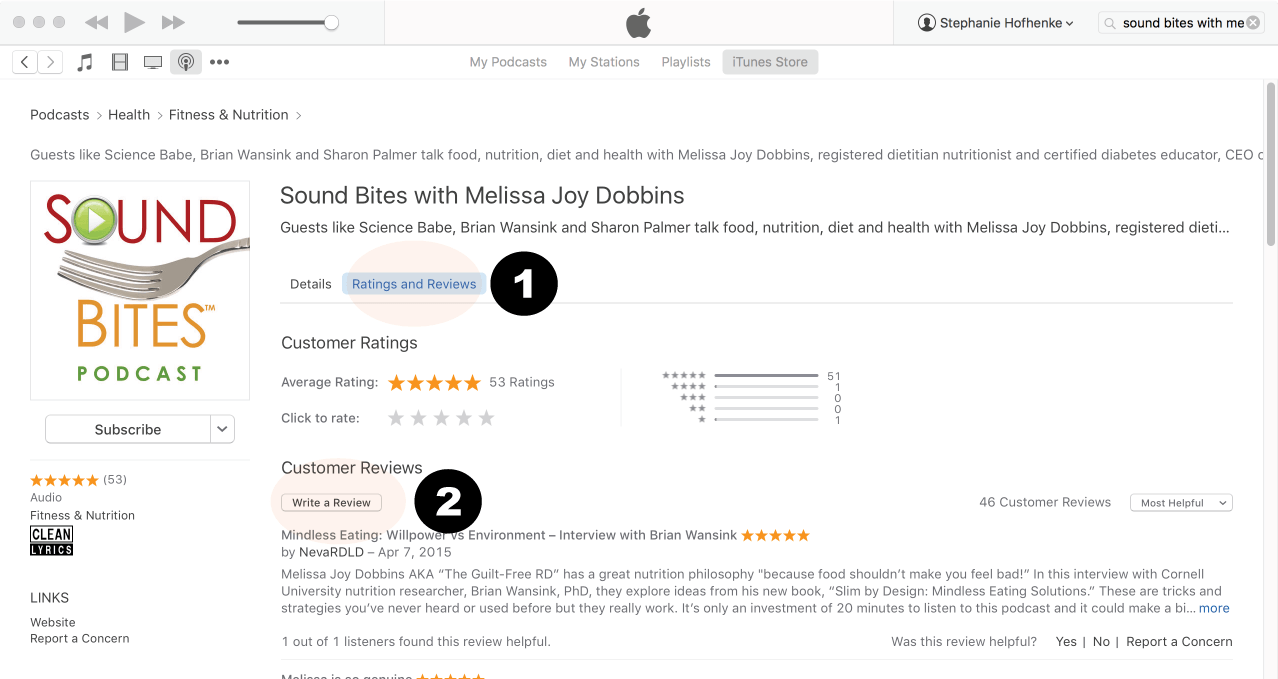
Click “Reviews”, then “Write a Review”.
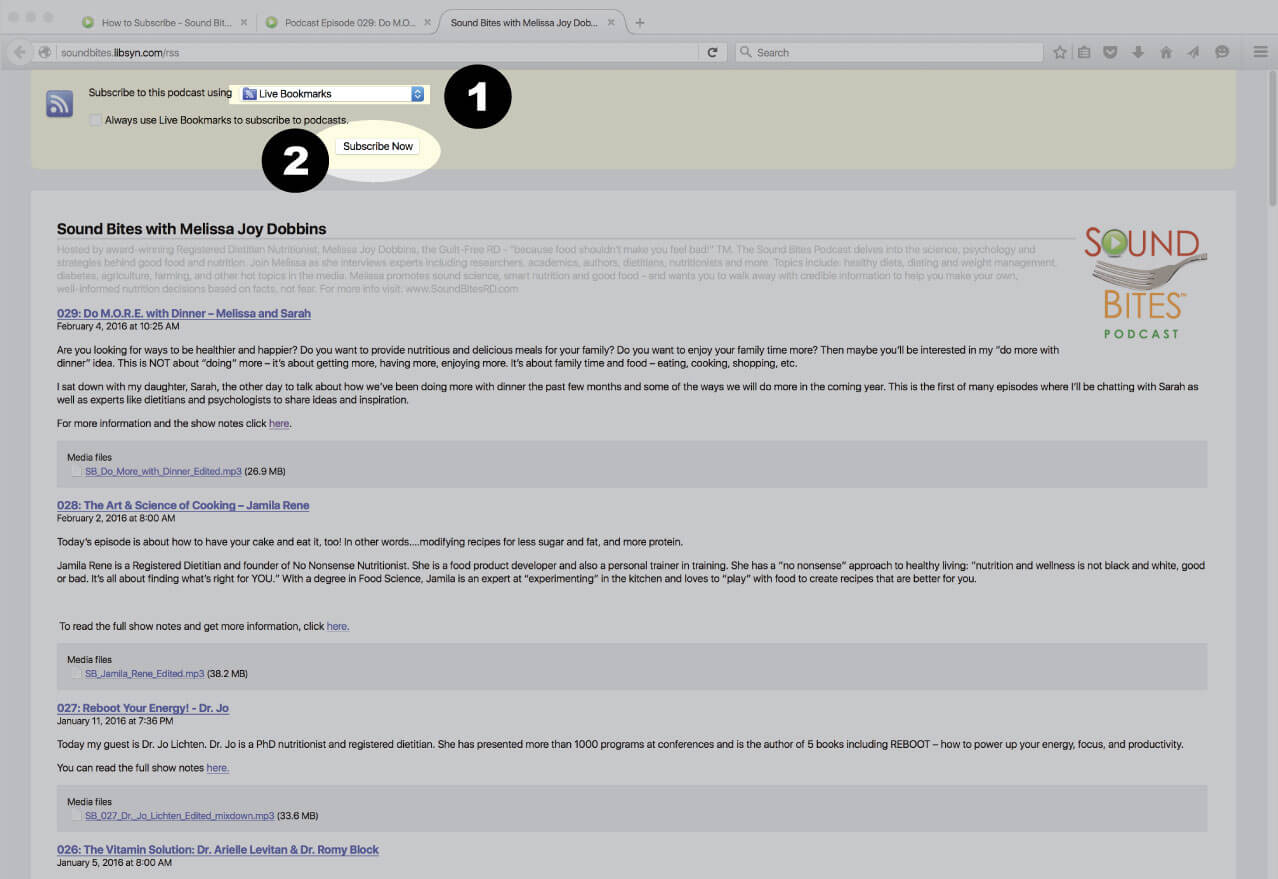
Subscribe via RSS Feed
Navigate to any podcast player . Click on the RSS feed icon.
Click on the RSS feed icon.
Click on RSS Feed
Choose which application you would like to use to receive the RSS feed
Click “Subscribe Now”
Confirm settings and subscribe.
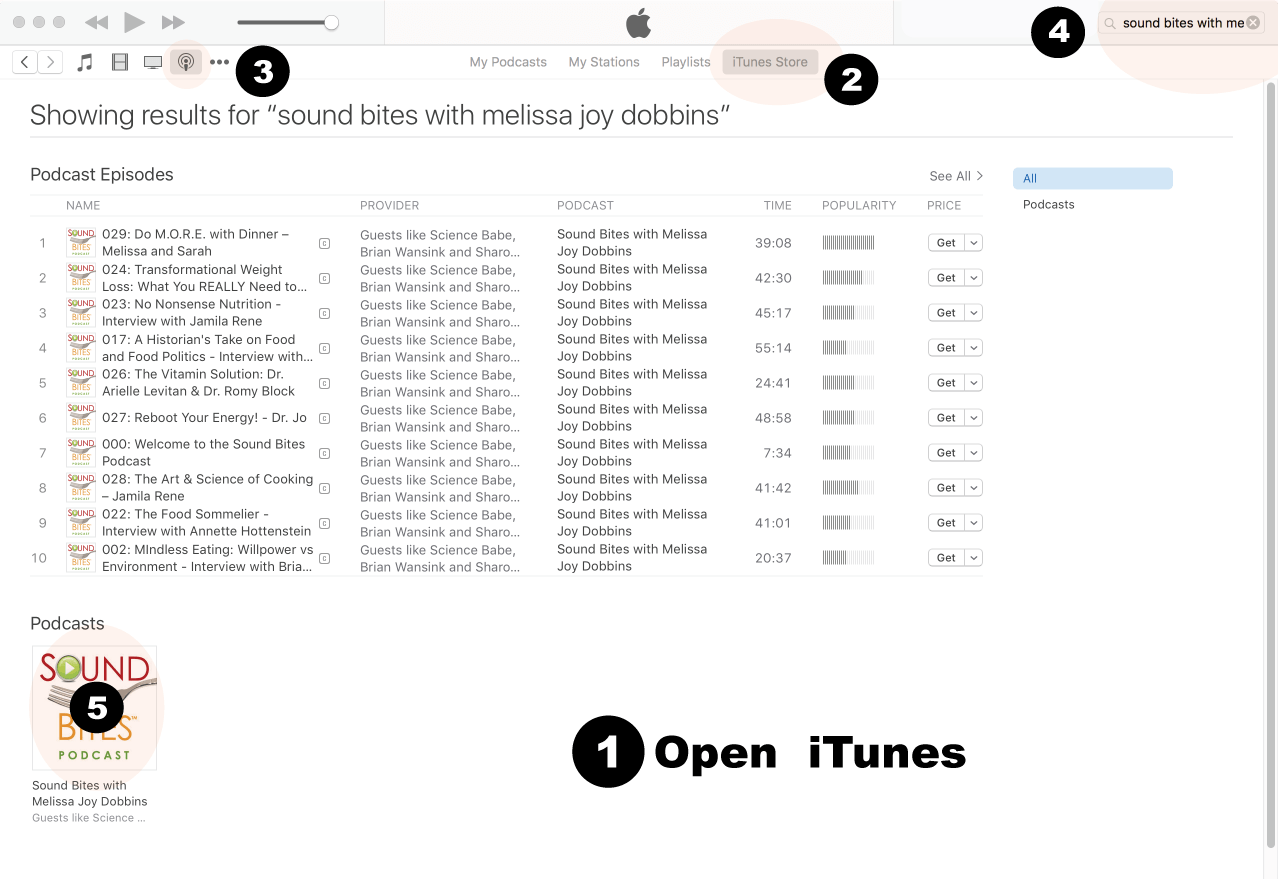
How to Review in iTunes
Open iTunes desktop application
Click iTunes Store
Click on Podcasts
Search for “Sound bites with Melissa Joy Dobbins”
Click on podcast image
Search for Sound Bites podcast in iTunes
Click Ratings & Reivews
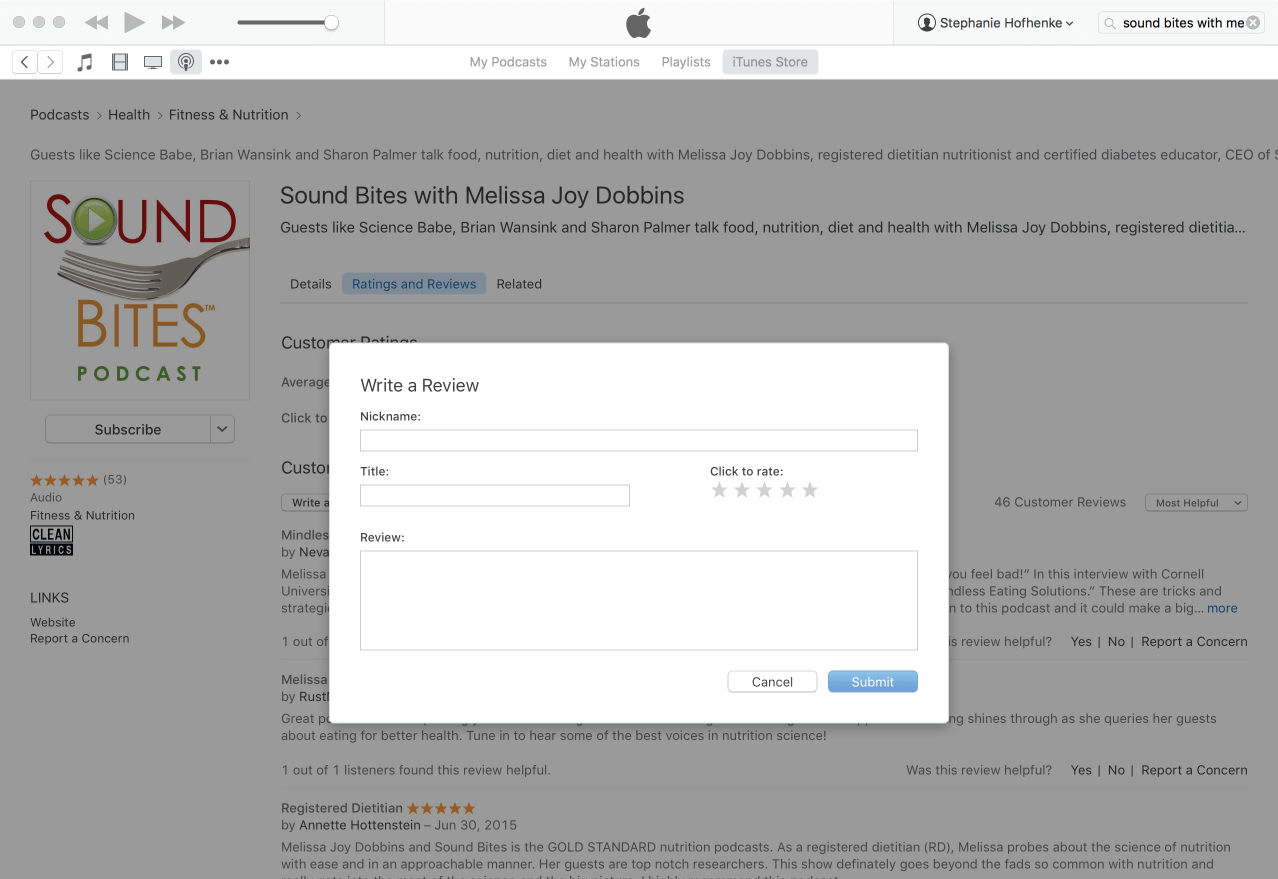
Click Write a Review
View reviews and write your own review.
Write your review…. Thank you!
Write your review!
How to subscribe via iTunes
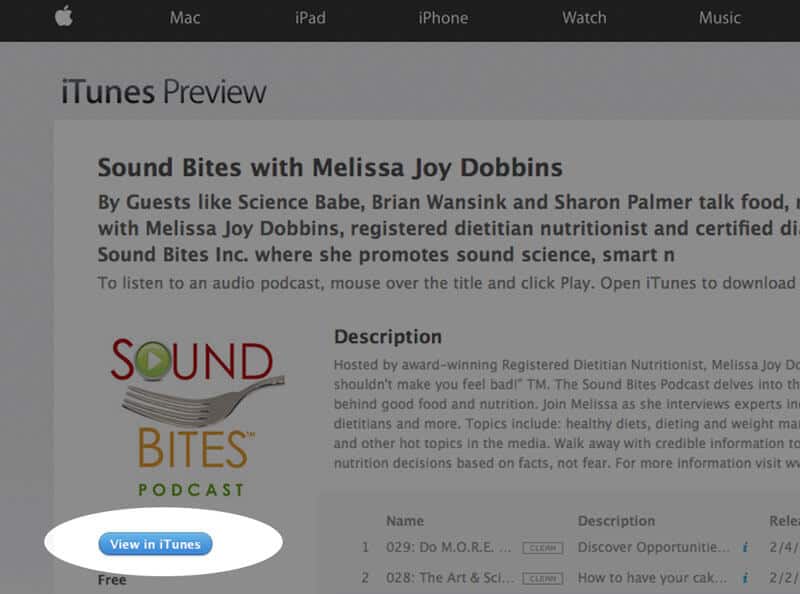
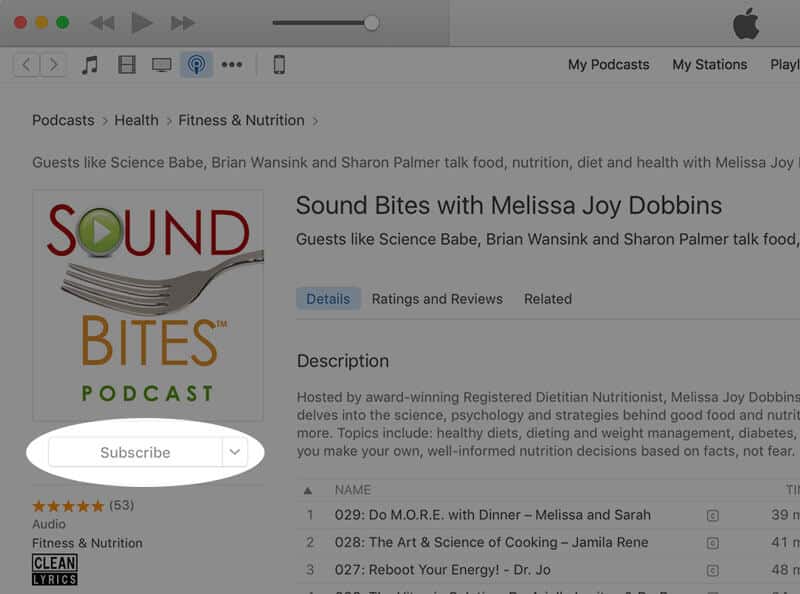
Click here to view the Sound Bites Podcastin iTunes, then click the blue “View in iTunes” button. This will open your iTunes application directly to Sound Bites Podcast. Click the “Subscribe” button, and your done!