Celebrating over 1 Million Downloads and 50,000 Free CEUs on the Sound Bites® Podcast | NEW: Get 1 years’ worth of CEUs with the new 15-CEU Podcast Course
Public trust has shifted. Once, experts like scientists were the go-to voices for credible information, earning trust through their ability to solve major societal challenges. Today, “someone like me” is considered just as trustworthy, while social media influencers and opinion-driven podcasts often reach larger audiences than traditional news outlets. Consumers are now “choosing their own adventure” when deciding what information about food and nutrition they believe.
In this episode, we explore groundbreaking findings from The Center for Food Integrity’s research study, The Evolution of Truth. By uncovering the core values, beliefs, and fears shaping consumer behavior around food, this research offers powerful insights to help listeners navigate a polarized world where truth is increasingly defined by perception rather than science.
Listen for underlying values and points of connection before offering advice and guidance.” – Charlie Arnot
Tune into this episode to learn about:
how truth is a social construct and what that means
the power of shared values in building trust
5 different consumer personalities and how to better connect with them
What different types of consumers think about MAHA
the inherent opportunities borne out of MAHA
nutrition misinformation and consumer behavior
social media influence vs. facts
truth in food and nutrition
Building trust vs. defending an interest
How to build trust in science
The role of science in building trust
MAHA has created greater awareness of the relationship between diet and health and we can leverage the increased interest to engage and be a trusted source to help shape a productive conversation.” – Charlie Arnot
Charlie Arnot
Charlie Arnot is recognized as a thought leader in food and agriculture. He is highly regarded as both a writer and sought-after speaker who engages audiences across the globe. Charlie has decades of experience working in communications, public relations and issues management within the food system. He is the founder and president of Look East, an employee-owned consulting firm. He also serves as CEO of the Center for Food Integrity, a non-profit dedicated to building consumer trust in today’s food system. He is a trusted counselor to CEOs, government leaders and executives, and a respected industry advisor on critical food related issues, and he is frequently sought out by media for his insight. He has been quoted in the Wall Street Journal, Forbes, Fortune, Time, NPR, CNBC, The National Journal, Entrepreneur, Yahoo health, Huffington Post, Grist and dozens of trade publications global
Science is essential, but it’s not sufficient to build trust.” – Charlie Arnot
Resources
Some links may be affiliate links. As an Amazon Associate, I earn from qualifying purchases.
Welcome to Sound Bites, hosted by registered dietitian nutritionist, Melissa Joy Dobbins. Let’s delve into the science, the psychology, and the strategies behind good food and nutrition.
Melissa Dobbins (00:23):
I’ve been getting a lot of questions from listeners about the continuing education credits that dietitians can get for some of my podcast episodes. So, I wanted to clarify that I do offer free CEUs for some episodes, but not all the episodes.
I have about three years’ worth of free continuing education credits as well as some very low-cost CEUs, and a package on sale for one full year’s worth of CEUs if you want the convenience of taking just one quiz and getting one certificate for all 15 credits.
This is a fun and easy way to get your credits, so be sure to check it out. And you can get all the details on my website at soundbitesrd.com/freeceus.
Hello, and welcome to the Sound Bites Podcast. Today’s episode is about navigating the evolution of truth in a polarized society and building trust when science doesn’t seem to matter anymore. We will discuss some really exciting new research insights about the core values, beliefs, and fears that are driving consumer behavior.
This episode is not sponsored.
My guest today is Charlie Arnot. Charlie is the CEO of the Center for Food Integrity, a non-profit dedicated to building consumer trust in today’s food system. He has decades of experience working in communications, public relations, and issues management within the food system.
He is a trusted counselor to CEOs, government leaders and executives, and a respected industry advisor on critical food-related issues, and frequently sought out by the media.
Welcome to the show, Charlie.
Charlie Arnot (02:11):
Melissa, it is always good to be with you.
Melissa Dobbins (02:13):
Thank you. We have known each other for at least 20 years.
Charlie Arnot (02:18):
That’s probably true. We were much younger then.
Melissa Dobbins (02:20):
Yes, we were, yes. And I’ve really had such an opportunity and pleasure to see you present at conferences and meetings, and most recently, on the topic that we’re discussing today, and I’m so excited to share this with my listeners.
I talk about consumer insights a lot on the podcast, but this really takes a deeper dive. And obviously, we know there’s so much that we could dig into and we’re not going to be able to share everything, but I’ve kind of pulled out some of the questions and ideas that I think would be most relevant to my listeners.
But before we dive into that, I would love for you to just share a little bit more about your background and the work you do, and about who Center for Food Integrity is.
Charlie Arnot (03:03):
Well, thank you. I appreciate that. It’s always great to work with you, and we’ve enjoyed working with you over the last couple of decades or perhaps a little bit longer.
So, the Center for Food Integrity is a non-profit dedicated to building trust in the food system, and we view trust as every organization’s most valuable intangible asset. And so, we do research on what’s driving trust, what are the threats to trust, what are the issues that consumers are most interested in, and then we develop tools and programs and coalitions to help our members address those specific issues.
And we’re somewhat unique in the fact that our organization spans the restaurant sector, the supplying sector, agriculture, food retailers, academics, NGOs, and others really across the spectrum, which we think helps provide a very diverse perspective on these issues.
Because we understand the perspective from a farmer’s point of view or from a retailer’s point of view, or from an input supplier’s point of view, and collectively, we think that helps us develop more effective strategies.
So, we’ve been doing this for close to 20 years, and it’s something that we are greatly passionate about, and really excited about this new research. And I know when I share this, some people look and, “Gosh, I’m so depressed about that,” but it’s an opportunity. I mean, the world continues to evolve, and so there’s always opportunity and volatility.
Melissa Dobbins (04:18):
Yes. And that’s one of the reasons (laughs) I wanted to have you on because you’re so articulate about the state of affairs yet you have this optimism and it’s rooted in reality, and I can’t wait to dig into all of this.
Let’s start off with where this information and research comes from. Tell us about the methodology, the purpose, anything that you think is pertinent.
Charlie Arnot (04:42):
So, the driver for this Melissa, was really an understanding that we continue to see this erosion of trust in science. We’re no longer the dominant foundation of how people evaluate what is and what is not true, but they continue to look for a multitude of sources. And so, much of that has been driven by changes in communication.
So, just a brief history lesson; if we go all the way back to the 1600s when Galileo launched the scientific revolution, that was in part powered by the communication technology at the time, which was the printing press.
So, the printing press allowed him to create scientific journals, to empower scientific societies, and again, it was mass communication, it was one too many. So, you can create this document, send it to a lot of people, they can read it, they can comment, and they can have a conversation.
We’ve relied on mass communication since that time and as you and I were growing up, we relied on kind of having three television networks and maybe one major newspaper in every city, a handful of radio stations, but there was control over what was said, how it was said, and the kind of content you could use.
If you owned a television station or a radio station, you had to have a license from the government. The federal government had specific standards, and you had to have a license and commit to operating within those standards. And as a former broadcaster, I personally had to have a license to say that I was going to abide by those standards.
And when we watched the evening news, we kind of got the same stories whether we were watching ABC, NBC or CBS. So, we had a common information culture and journalists were trained to basically undercover the facts and to get two independent sources and rely on science.
So, what Galileo started in the 1600s continued to be perpetuated and supported by mass communication. So, for however many centuries, we relied on that in Western society, facts and science to basically be the foundation for what we are going to consider to be true in society.
And truth is a social construct. We have to agree as a society what is going to be true and what is not going to be true. And we decided as a society over the last several decades, several centuries, that science was going to be how we were going to decide what was fact and what wasn’t.
In 2004, Facebook was launched, and now, all of a sudden, we no longer have these handful of mass communication. We’ve transitioned to masses of communicators where anyone who has a smartphone can connect with anyone else in the world.
They have a platform of their own whether it’s TikTok or X or YouTube or podcasts, where you can communicate your opinion to whoever happens to be interested, and they can engage with you in a way that might be of interest to them.
So, we’ve seen this infinite proliferation of microcultures, each of which is now empowered to decide what is true for them. And today, we know that that has fundamentally changed our information gathering and information sharing culture.
Today, Joe Rogan has three times the audience of MSNBC, CNN, and Fox News combined in prime time.
Melissa Dobbins (07:42):
Shocking.
Charlie Arnot (07:43):
So, that’s just an illustration of how much things have changed. That was then the catalyst for this research. If we are no longer relying on science and we have this multitude of sources, then how do we decide what is and isn’t going to be true? What do consumers think of in terms of truth and how their beliefs influence what they consider to be true?
So, that was the foundation of this. We did an initial study like this way back in 2017 before the pandemic and before MAGA. So, some fairly significant cultural catalysts that have changed the way people think about truth, changed the way they think about how information is going to be adopted and what’s going to be credible to them.
And so, all of that has kind of reshaped our information culture which then reshapes how we think about truth.
Melissa Dobbins (08:30):
Absolutely. So, was this a digital survey? Was this, I think you used the term ethnography — so talk to me a little bit about the nuts and bolts of that.
Charlie Arnot (08:41):
Absolutely. So, we’ll talk a little bit about the methodology and kind of the segments that we identify. So, every research methodology has its pros and cons. There’s value in quantitative, there’s value in focus groups.
For this research, we really wanted to dig into the belief systems that people have because it’s their beliefs and their identity and their motivations that help them determine what is true for them in today’s world.
So, belief-based research is a digital ethnography. So, imagine any consumer, one person, we find them across the variety of platforms they happen to be on in social media, whether it’s X or Reddit or YouTube, or whether they’re buying things or leaving reviews, et cetera.
Then we go back in their history for two years and we understand and study their social values, their political beliefs, where they work, live and play, what they buy, the brands that they affiliate with, what they read, what they’re advocating for, their general and specific content needs.
We know how much time they’re spending on YouTube versus TikTok versus Instagram versus X, we know the influencers they follow, we know again, what’s true, how they act on their beliefs. So, we have a whole range of information about what’s important to them, how they decide what is true for them, and then how they act on that truth.
So, through that, we identified these five belief-based segments: the progressive disruptor, the authenticity seeker, the rationalist, the comfort seeker, and the strategist. So, let me share with you just a little bit about each of those segments.
The progressive disruptor is 5% of the population but 12% share of voice. They believe that the food system is fundamentally flawed, it cannot be fixed, it needs to be completely reinvented. They’re highly politically charged and so they don’t have a lot of influence over others, but they are really powerful within that particular group because they’re ideologically determined that that’s the way things should be.
Then we go to the authenticity seeker. They’re 14% of the population, 18% share a voice, and they are interested in really that personalized experience.
“I understand what the science says, I understand other information, but I need to have some kind of experiential learning. My personal experience is going to be what is going to decide what is true for me or not. So, I’m not interested in corporate spin, I’m not interested in marketing, I’m interested in those relationships that I can establish with farmers or with dietitians or with those who are involved in the food system, and I want to see the good, the bad, the ugly.”
“I don’t want to see a farmer with pressed jeans driving on a very clean combine down a field during sunrise because I know that’s not the way the world actually works. I want to see somebody with muddy boots and calloused hands who’s talking about the challenges with weather.”
“I want to see somebody in a restaurant talking about the fact they can’t get enough help, the fact that their supplier shortened them on this ingredient or that ingredient, and I’m having trouble getting dinner out because that amount of reality, that authenticity resonates with the authenticity seeker and helps them understand that this is my truth.”
The rationalist, they’re 19% of the population, 15% share a voice. And for them, it’s all about data science and objective information. We love the rationalist, they are our people. We wish the entire population was rationalist, but they’re not, it’s only 19% of the population.
The comfort seeker is next. They are 43% of the population, 27% share a voice. So, the authenticity seeker, the rationalists, the comfort seeker combined are 76% of the population. The comfort seeker is simply overwhelmed by the amount of information and the conflicting information they get about food and agriculture.
They’re like, “I hear this study, I hear somebody else telling me something, I don’t know who to turn to for advice. So, I’m going to go to those places that are familiar and comfortable for me. I’m going to buy the brands that perhaps my parents purchased as well, I’m going to go to those particular sources because they feel comfortable to me.”
“I’m going to watch Good Morning America or the other ABC programs that happen to be on or the Today Show because those hosts make me feel comfortable and they give me reassuring information.”
So, they’re looking for comfort, they’re looking for someone who can help them make sense of a complex world without it being overly complex and without fearmongering.
So, one of the things we know from all of these (the authenticity seeker, the rationalist, and the comfort seeker), sensationalist claims and fearmongering actually turn them off but for different reasons.
Melissa Dobbins (13:01):
That’s good news.
Charlie Arnot (13:02):
So, if you try to scare me into believing something, I’m not going there. It doesn’t work for me.
Melissa Dobbins (13:06):
I love that. I’m so happy to hear that (chuckles).
Charlie Arnot (13:09):
Yeah, yeah, yeah, yeah, absolutely. And then the strategists, they’re 19% of the population but 28% share a voice. They’re looking for information that simply helps them win. They have a particular point of view, they have a particular agenda, they have specific objectives. If the information aligns with those, they will endorse it, they will embrace it, they will share it. If not, they simply reject it as not being true, because it’s not aligned with what I want to accomplish.
So, they too are fairly politically charged, and they don’t have as much influence. So, the progressive disruptor and the strategist are kind of ideologues, but we can work with, and we can engage successfully with the authenticity seeker, the rationalist, and the comfort seeker.
Melissa Dobbins (13:47):
Excellent, wonderful. And I just wanted to tell our listeners, even though my audience is a mix of the general public and healthcare professionals, dietitians, we’re speaking to everybody here, we’re all consumers.
Charlie Arnot (13:59):
That’s exactly right.
Melissa Dobbins (14:00):
When I hear this information, part of my dietitian brain lights up about, “Ooh, there’s an opportunity. Ooh, there’s a challenge. Ooh, I like that, I don’t like that.” But also, “Oh, which one am I and which one is my husband, and my best friend and my mom?”
[Laughter]
So, keep that in mind as we go through this conversation as you’re listening.
So, as you said, the progressive disruptor, the strategist, the ideologues, they’re not as likely to be engaged in a productive conversation-
Charlie Arnot (14:28):
Correct.
Melissa Dobbins (14:29):
If that’s a fair way to say that — then those other three categories and kind of like, I think we used to call them the movable middle or something like that. We’ve known for a long time that facts alone do not change hearts and minds, but this is really next level stuff here.
And we also know that when it comes to science, nutrition, food, there’s just going to be some people who you’re not going to change their minds or it’s just the ROI is not there, and you want to put your efforts where you can really make a difference.
So, again, I don’t want to put words in your mouth, but it sounds like those three categories are the people that we can really connect with and understand better and communicate better with.
Charlie Arnot (15:08):
No question. I think one of the things that’s important to remember is, yes, we can engage with those three groups, but they all have different motivations, they all have different content needs, they all have different identities, and so the way to engage with them successfully has to be targeted to those groups.
One of the other questions I get frequently Melissa, is, “Well, what generation are each of those?” They span generations.
Melissa Dobbins (15:29):
Interesting.
Charlie Arnot (15:30):
We’re looking at a belief system, not necessarily just demographics. We have full demographic information, so we know that the comfort seeker skews a little older, tends to be less well-educated. The rationalist has college education and beyond, they tend to skew a little older. The authenticity seeker skews a little bit younger, but the authenticity seeker and the rationalist tend not to have kids. The comfort seeker is the group that tends to have families.
And so, the demographic information is interesting, but it spans generations. So, we’re not looking at what do we know about Gen Z or millennials, we’re looking at specific groups that share similar beliefs around food and agriculture because we can engage with them based on their belief system, not just their demographics.
Melissa Dobbins (16:13):
Again, that’s why this goes deeper than a lot of consumer insights.
In your presentation, you talked about intrinsic motivation versus identity, can you talk to us a little bit about this?
Charlie Arnot (16:24):
Absolutely. So, your motivation, your intrinsic motivation really kind of defines who you are but how you appear can be different. So, for the authenticity seeker, it is all about living up to a specific standard, being able to understand what’s behind the curtain, and understand that. But they will appear curious, calm and refined.
For the comfort seeker, it’s all about providing for families. They are anxious, they’re confused, they’re overwhelmed, but they will appear reserved and family oriented and very caring. So, it’s kind of important to understand what motivates people, and then what is their external identity?
How are they going to appear because as you begin to observe those behaviors, you can go, “Okay, I can now affiliate this with this particular cohort and understand really what’s important to them, what’s driving them.”
Melissa Dobbins (17:14):
Excellent. So, let’s touch on what constitutes truth. Obviously, we can’t go through all five types with every question that I have so you can speak to whatever groups you think are most important and probably focusing on the three. I know that truth is different as we’re talking about their beliefs.
Charlie Arnot (17:31):
So, let’s think about truth for a couple of the different sectors. So, as we think about truth for a couple of different sectors, it’s also important to understand that again, because of the way we communicate, how we access information, truth is different for us.
We used to think about truth being something that was an absolute. Based on science, that’s not the case today. So, it’s important to understand that again, truth is a social construct, and it’s defined differently for each individual segment.
So, if we start with the authenticity seeker, for them, truth is about the authentic connection. It’s the opportunity to see behind the curtain, and understand this is not corporate marketing, it’s not spin, it’s something that I can see, people with whom I can connect whether that’s a farmer or a restaurant owner or somebody stocking the produce in a retail store or an RD. It’s that connection and understanding what is true for them helps me understand what should be true for me.
The comfort seeker, on the other hand, is really 180 degrees. They’re looking for someone to tell them what is true, simplify these complex ideas, help me make sense of the chaos, give me reassurance that I’m making the right decisions for myself or my family.
That could be the FDA, it could be the EPA, it could be USDA, or it could be an influencer, and that influencer could be an RD, but it could also be another kind of influencer like Food Babe or Casey Means that have a large social media presence and are providing information that could be interpreted as being more comforting to the comfort seeker.
Melissa Dobbins (19:03):
Interesting. So, we’ve talked a little bit about what truth is and who people are looking to. Can you say a little bit more about sources of information that each type might utilize or value, especially any dietitian-related insights?
Charlie Arnot (19:18):
Sure. So, their content needs again, are going to be very different, but similar to what I’ve described before. So, if I’m an RD and I want to engage effectively with the authenticity seeker or the comfort seeker, we would think about that somewhat differently.
Again, we know the channels they’re on, we know the brands that they buy, all of that information can then begin to inform how you want to engage. But what’s most important is you start by listening so you can uncover what are the motivations.
It’s not like, “Oh, they’ve got these three words out, I have a solution. Here’s what you need to buy, here’s what you need to avoid.” It is actually engaging with each individual person in these segments because it’s the engagement that helps establish you as a credible expert. That’s how you establish that credibility.
So, for the authenticity seeker, it’s going to be listening for cues about what’s really important to them, what is authentic for them, what is inauthentic for them, and then helping them understand the authentic choices they could make that would be supported by a registered dietitian.
So, great, I understand you want a connection with the source. Maybe locally grown would be more authentic for you, maybe organic would be a better choice for you. There are certain brands that carry that level of authenticity or opportunity to have a connection with that brand that’s going to be relevant to you and the values that you hold.
For the comfort seeker, it’s going to be, “I’m listening, I’m hearing that familiarity and security are really important to you. So, I’m going to talk about familiar brands, I’m going to talk about things in the center of the store that you may know, that your parents may have known, brands that you may have relied on, and help you integrate those as well as other ways to think about fruits and vegetables in your diet that you can integrate them into recipes or other things that would be more traditional and very comforting.”
So, it’s again, just a matter of listening and understanding how do we engage in a way that helps us understand kind of the drivers for each of these cohorts, and then engage with them in a way that is specific to their motivations, to their needs, and guides them to making healthy, responsible choices that are aligned with their values.
Melissa Dobbins (21:29):
It really parallels what we try to do with motivational interviewing one-on-one with patients. You have to start by listening, and I’m hearing the word listen so much more these days, and I think it is so important, and again, such an opportunity. Let’s dive into what these different cohorts think about Make America Healthy Again. How much can you tell me?
Charlie Arnot (21:52):
So, it’s really, really interesting. First of all, of them love the idea, and who doesn’t? Who wouldn’t want to make America healthy again? But there’s some healthy skepticism among the cohorts, but for different reasons.
So, if you think about the authenticity seeker, they’re like, “This is not a bandwagon we need to be on. We were on the bandwagon long before the MAHA slogan came along. We were questioning an industrialized food system, we were questioning processed foods, we were raising concerns about what’s happening in our food system long before this administration came along and coined the term MAHA.”
“So, we like the fact that you’re raising the profile, but we’re concerned about MAHA being confounded with MAGA and the messages that are coming through ,and whether this is really about preserving food integrity or if it’s actually about political positioning. So, we’re looking at this through a skeptical lens. We like the concept, we hope it’s going to be authentic, but we’re not sure, and we’re concerned about how it’s being unfolded.”
For the rationalist, they like the concept, they believe that AG and food deserve some important scrutiny, but they view this as pseudoscience, and people who are claiming to be experts that have no expertise. It’s not based on sound research, it’s not based on sound science, and they’re very concerned about the agencies being co-opted by the movement.
Because historically, they’ve relied on the scientific integrity and the scientific independence of the FDA, the USDA, the EPA, national institutes of health — all the other agencies that they’ve relied on to give good information, and they’re very concerned that the agencies are going to now be pedaling political propaganda and not scientific information. So, they’ve got a healthy dose of skepticism.
The comfort seeker really, really likes the idea because they want that simple, reassuring guidance of eat this, not that, avoid this, die, stay away from this product group, you can embrace the other product group. Especially when it comes from those familiar voices like Good Morning America or the Food Babe or Casey Means or others, they see those as reliable sources.
They become uncomfortable when it becomes overly politicized. When it starts to become politicized and there start to become fear tactics, and there start to become other things that create more discomfort for them, they will reject MAHA and look for other credible sources that provide that level of reassurance.
So, if MAHA stays calm and apolitical and offers practical advice, the comfort seeker is okay. But if MAHA does not stay calm and tries to engage in fearmongering, if MAHA becomes overly politicized, and if MAHA’s offering advice that is really not political or practical, then they’re going to reject it.
And so, it’s important to think about this in such a way, again, if we’re thinking about how do we become the trusted voice for each of these segments around MAHA, understand what’s driving their skepticism.
If it becomes overly politicized, if it becomes impractical, and if there are blanket bands on a category or a set of ingredients without talking about specifically why that pesticide or that ingredient or that food diet might not be healthy or might be a bad choice for the environment, then it also seems like it’s not based on reason, it’s not based on science, it is simply designed to achieve a specific political agenda, which alienates them but for different reasons.
It was also interesting in this research as we went back and looked at this just overall for MAHA, for each of them, they’re concerned about the impact of MAHA on farmers. That was really fascinating to see that, well, hang on, we’re concerned about the blanket ban on pesticides because we know that farming is difficult and farmers struggle to figure out a way to address all the different challenges that they’re facing whether it’s weather or pests or markets or tariffs, or, or, or — and taking away one of the fundamental tools without giving them other options doesn’t sit well.
And so, it’s just interesting to see how people sort through that to say, “We really like the idea, we want to Make America Healthy Again, we’re on board with that idea, but it feels like it’s becoming overly politicized, and it doesn’t seem like we’ve got science behind some of the recommendations, and then some of the recommendations change and the agencies we used to trust are now being questioned by the administration that oversees the agencies, and so now I’m not sure who I should trust.”
And so, all of that begins to erode support for how MAHA is actually being manifested. Again, everyone likes the idea. We’re supportive of the concept of Make America Healthy Again, every cohort says, “Yes, great idea,” and those are going to be the opportunities where other influencers and other credible sources can lean into that skepticism and say, “We agree with you. We want America to be healthy.”
“We spend more on diet-related healthcare than we do on food, that needs to change. That’s a problem in our country. Let’s have a conversation about how we can do that and here’s the information you can use personally to make your family healthier, to make your diet healthier, to make changes in your community, and make your community healthier that help achieve the objective of MAHA, but in a way that’s not politicized, is not fear-mongering, and actually provides practical solutions.”
Melissa Dobbins (27:25):
Oh, okay, that’s all very, very interesting. We’ve talked about how dietitians and healthcare professionals by relation can listen better and understand that there’s different motivations, and address some of this healthy skepticism.
Is there anything that you would say, just as a consumer, how we as consumers can maybe consume information better, be better critical thinkers? Is there anything that you can share regarding that?
Charlie Arnot (27:53):
Yeah, one of the things that we’ve seen as the MAHA movement has continued to grow is there are other voices in this conversation that are also gaining credibility and gaining significance and volume. There are a lot of people who are out there raising questions.
So, one of the things you can do when a claim is made about pick your issue, pick your topic, pick your messenger, is triangulate that information.
Bob said, “This is what’s happening, here’s why, and here’s the logic behind it.”
“That’s interesting, Bob, I appreciate that. I’m going to go look for a couple of other sources that can either validate or reshape what Bob is saying about this.”
“Here’s a claim that I’ve made about this product or this ingredient or this practice, and the impact it has on health or the environment.”
“That’s interesting, I’m concerned about it now because you’ve raised the topic, you’ve raised my awareness, but I’m not going to take your advice without validating it from a couple other sources.” And that would be true whether the advice comes from an RD or an online influencer.
You should go check that out with a couple of other independent sources ,and there are ways to do that. You can use Google, you can look other resources to try and find out how do I triangulate this and verify or question it through at least two other sources to validate whether or not this is something that I should embrace.
Part of the challenge, Melissa, I think, is we are also pressed for time that when somebody we trust says, “You should or should not do this thing,” it seems like, “Well, okay, then I will or won’t do that thing because somebody I trust said I should or shouldn’t.”
Melissa Dobbins (29:27):
They’re vetting it for us.
Charlie Arnot (29:28):
Yeah, they’re vetting it for us, and so that becomes the challenge in terms of encouraging people to really think critically whether it comes from those in the food system or it comes from other sources.
Melissa Dobbins (29:38):
I did episode 100 (I’m almost at 300) — but way back in episode 100, I interviewed Dietram Scheufele, which you probably are familiar with him, he’s at University of Wisconsin-Madison. And we talked about communicating in a modern media environment, and he talks all about those heuristics, those mental shortcuts that we have.
And I don’t know that that’s the same thing, but we have to take shortcuts, we can’t sit there and critically think about every little thing all day, so it’s human nature.
Charlie Arnot (30:08):
That’s exactly right.
Melissa Dobbins (30:10):
Is there anything else that you feel is important to share with our listeners about the research that you’ve done, about these different cohorts and how they believe and how they act?
Charlie Arnot (30:21):
Yeah, so one of the things I want to just step back and reinforce is, sometimes when I’m done, people come back and go, “God, I’m so depressed after hearing what you just said.” But the renewed interest, the focus on making America healthy again is a phenomenal opportunity.
If all of a sudden, there’s a spotlight on the relationship between diet and health, that’s a great opportunity for those in the health community and especially registered dietitians to lean into conversations that’s taking place today.
So, I think this is a fabulous opportunity. If now people are asking questions, they’re more interested, they’re more concerned, that means there’s a catalyst for effective engagement. It’s so much better than having them be indifferent or disinterested.
So, if there’s greater interest now, I view that as a terrific opportunity, so let’s capture that. Let’s take advantage of that opportunity and give people information, help reinforce their opportunity to make choices that are right for themselves and their families that will actually lead to America being healthy again.
Melissa Dobbins (31:22):
And as you’re talking, I am going back in time to one of the first CFI conferences or events that I attended where I learned something that I share on the podcast frequently, and I share in my media trainings frequently. Dietitians sometimes feel like, “Should I just keep talking about fruits and vegetables and fiber and all this stuff, it’s out there, does anybody care?”
What I learned from your conference was we’ve got to keep putting out the positive factual information because when people have questions and they hear something, or there’s a blip in the media about whatever it is, and they go looking for information, we’ve got to make sure that there’s plenty of credible information out there.
It is not a waste of time, it is not a waste of breath, and we can try different ways, and we have so many different more platforms than when I started off in my career. My background is a lot of live TV and radio and podcasts weren’t even around back then. So, it’s exciting that we have different platforms.
Not everybody needs to be on TV, not everybody needs to be a podcaster, some people write, some people are great at social media. We need all those credible voices out there to keep doing the good work (chuckles).
Charlie Arnot (32:33):
Yeah, no doubt about it. We used to assume, and I know a lot of organizations did at that time, that if I’m the council on popcorn, or I’m the pear association or whatever, I should be the single oracle for all information about popcorn or pears.
And that model has been blown up, and organizations that believe that they are best suited to keep all the information and facts to themselves are simply going to become irrelevant in this conversation because we need as many voices on as many channels sharing information, making information available because you never know when it’s going to be relevant.
I mean, that’s what we’re talking about, is people have been indifferent, they’ve not been interested, they haven’t had questions, they haven’t been listening, and now, all of a sudden, Make America Healthy Again is in the news, and it’s being talked about and people are interested.
Again, that’s a huge opportunity. I see this as a wonderful thing for dietitians and other credible experts to lean into that interest and say, “You’re absolutely right, we should be asking questions about our diet. We should be asking questions about ingredients. We should be asking questions about food dyes or pesticides or pick your topic.”
Those are important questions to ask. Let’s have a conversation. Let’s not be dogmatic and condemn or support anything without examining. Let’s have the conversation, let’s examine the issue, let’s understand your values, let’s look at the science, and then you can make a decision that’s best for you and your family.
But I see this as a terrific opportunity, and I understand the frustration of, have I been talking to you? I’ve been talking to you, I’ve been sharing the information, but until I’m interested, it’s not relevant. And the moment I become interested, I want a credible source.
And so, we have no idea when that catalyst happens. MAHA can be a catalyst for making those conversations relevant and impactful right now.
Melissa Dobbins (34:22):
Yeah, and maybe like a deeper conversation and that’s what this is all about. I mean, I can think of three topics off the top of my head that are MAHA-related that I’ve been seeing a lot of chatter about on social media, and I’m actually working on various projects on seed oils, infant formula, and CGMs for all (laughs).
There’s so many things to dig into with those, and by sharing all the nuances and the details, it gives people an opportunity. Like you said, let me consume the information, let me take a deeper understanding of this and make my own decision that aligns with my own values.
Charlie Arnot (34:59):
Absolutely. I think it’s also important to recognize that you need to encourage people to focus on the areas where they have domain expertise, and not to get too far afield because if you do, you damage the credibility on the other issues.
So, if you were to say, “Well, I’m an expert on pesticides,” people are going to go, “You’re a registered dietitian, I don’t see quite how that fits.” So, you might have some information you can share and that you kind of qualify it, and then direct them to other sources.
But I’m not qualified to talk about nuclear energy, so I don’t want anybody to ask me questions. If you want to talk about communication, building trust, yeah, I’ve spent 20 years on that, I’ve got a good deal of research, I can do that in a credible way. But I also need to make sure I’m talking about things where I have domain expertise.
Melissa Dobbins (35:43):
Absolutely, yeah. I always say in my presentations in media training, swim in your own lane and then the other aspect is only go as deep as your knowledge allows you to, and convey that. I just was attending the American Diabetes Association Scientific sessions and there was this really interesting debate on CGMs; should they be only for people with diabetes and pre-diabetes?
I mean, they are available over the counter but there’re pros and cons. And just watching that debate gave me a better understanding of how I can communicate to others about that topic, but also conveying like I don’t personally have diabetes, just conveying your level of understanding and how your voice can add to that, but other experts can be part of that conversation too.
Charlie Arnot (36:27):
Absolutely. One of the quotes that I love is from Mark Twain, it says, “It ain’t what you don’t know that gets you into trouble, it’s what you know for sure that just ain’t so.”
Melissa Dobbins (36:34):
Exactly.
Charlie Arnot (36:35):
And that’s where we have the opportunity to lean in when people are absolutely convinced that seed oils are the source of their inflammation or arthritis, or they’re convinced of something else, and then we get the opportunity to lean into that conversation. But again, it has to be when they have an interest, a willingness to engage in that conversation and dialogue.
Melissa Dobbins (36:54):
Absolutely. I would like to see more people not be so sure about everything and be open to the nuances and having that conversation.
Charlie Arnot (37:02):
That’s so interesting because gray is really out of fashion, it needs to be black or white, and nuance has been lost in so many of these conversations. So, it’s important when we have the opportunity to introduce it, but we’ve got to be careful not to be so nuanced that people are like, “I have no idea what you just said.”
Melissa Dobbins (37:21):
You lost me (chuckles).
Charlie Arnot (37:21):
Right, you lost me. You lost me somewhere in the gray. I know it’s not black, I know it’s not white, but you lost me somewhere in the gray. And it’s more challenging in this environment where, okay, this is going to be on TikTok, how much time do I have?
All of that has really created a very dynamic environment for nutrition communicators to be able to say, “How can I help people understand the nuance around this in a way that will actually be consumed and meaningful?”
Melissa Dobbins (37:46):
Actually, I have a related episode on digital health literacy that I’ll link to in my show notes at soundbitesrd.com that talks just about that, the limited time that we have for like 15 second reel, even a minute video or whatever — that’s why I love my long form podcast (laughs).
Charlie Arnot (38:00):
I know, it gives you a chance to have a much deeper, more meaningful conversation.
Melissa Dobbins (38:05):
Absolutely. Well, thank you so much. Where can people find more about this topic and connect with CFI?
Excellent. Thank you so much, I’ve so enjoyed having you on the show.
Charlie Arnot (38:21):
Melissa, great pleasure, always is.
Melissa Dobbins (38:24):
Thank you. And if you’re listening and you like this episode, please share it with a friend, tell others about the podcast, that’s how you can support me. Be sure to go to the show notes for the resources, including related episodes. And as always, enjoy your food with health in mind, until next time.
[Music Playing]
Voiceover (38:43):
For more information, visit soundbitesrd.com. This podcast does not provide medical advice. It is for informational purposes only. Please see a registered dietitian for individualized advice.
Music by Dave Birk, produced by JAG in Detroit Podcasts. Copyright, Sound Bites, Inc. All rights reserved.
LISTEN, LEARN AND EARN
Listen to select Sound Bites Podcasts and earn free CEU credits approved by the Commission on Dietetic Registration (CDR) for registered dietitian nutritionists and dietetic technicians, registered. Get started!
Get Melissa’s Sound Science Toolkit here!
Partnerships:
Sound Bites is partnering with the Association of Diabetes Care and Education Specialists (formerly the American Association of Diabetes Educators)! Stay tuned for updates on the podcast, blog and newsletter!
Sound Bites is partnering with the International Food Information Council! Stay tuned for updates on the podcast, blog and newsletter!
Sign up for my monthly newsletter and episode eblasts so you never miss an update!
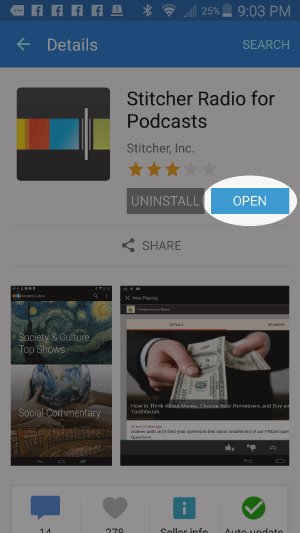
Listen on Stitcher (Android)
Install the Stitcher App
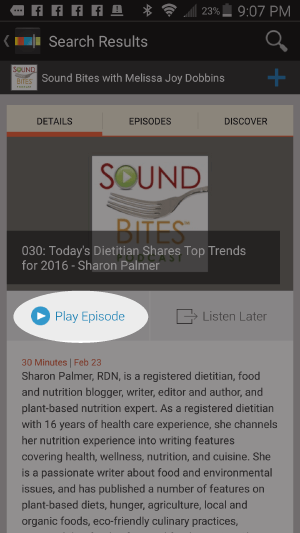
1. Search for “sound bites with melissa joy dobbins” 2. Choose Play Current Episode or Add to Playlist
Choose “Play Episode”
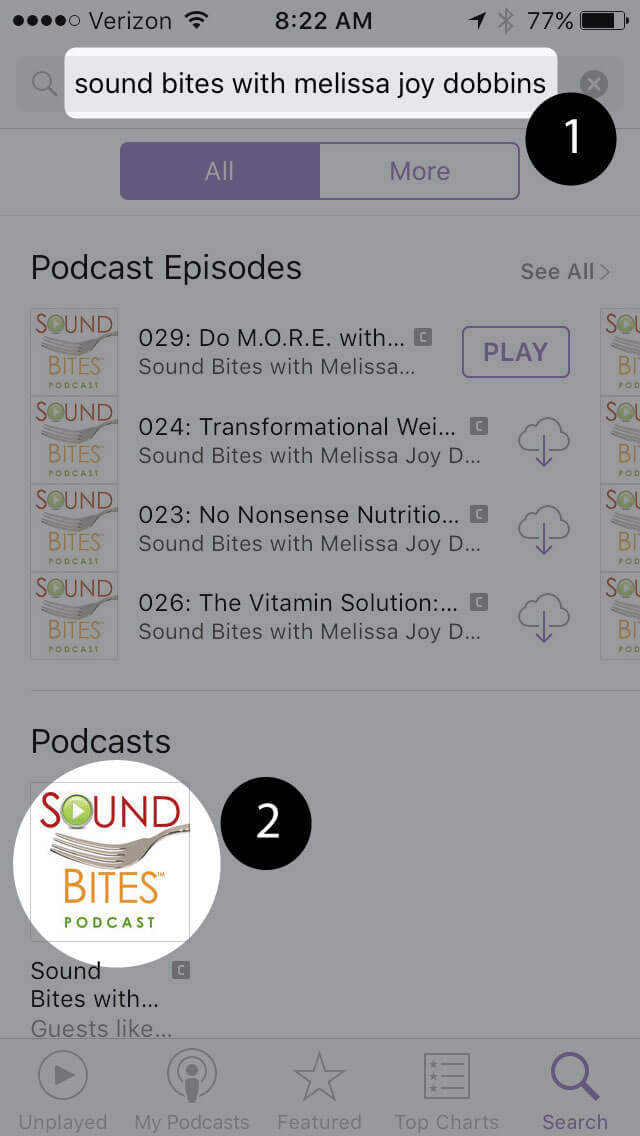
Subscribe & Review on iPhone
Open the “Podcast” app on your iPhone
Search for “Sound bites with melissa joy dobbins”
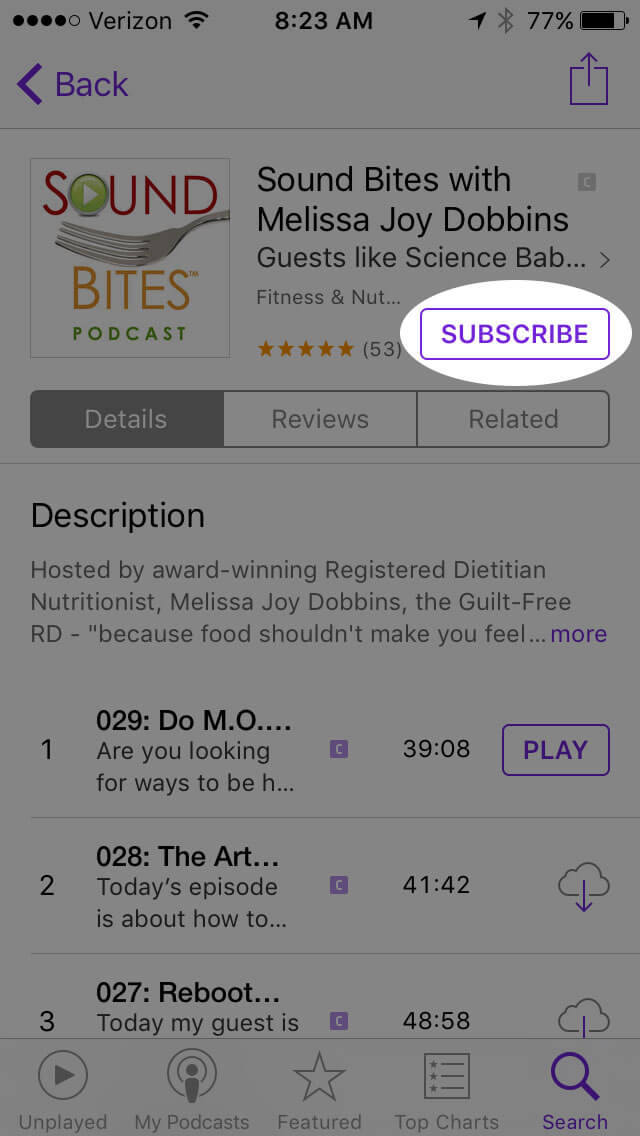
Open the podcast and click “Subscribe” and your done!
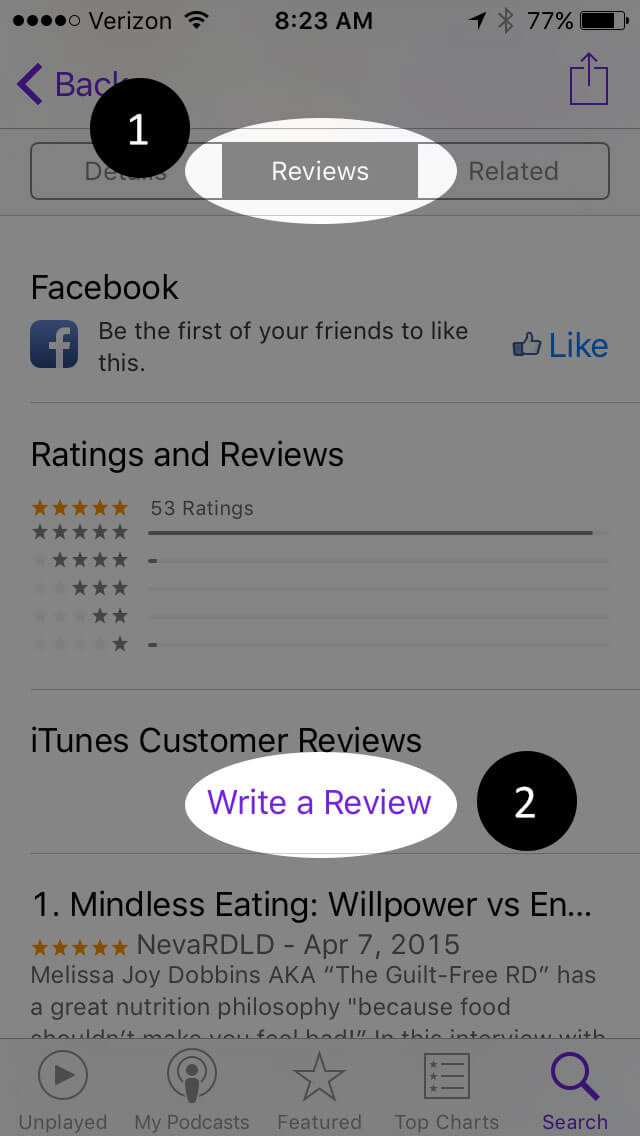
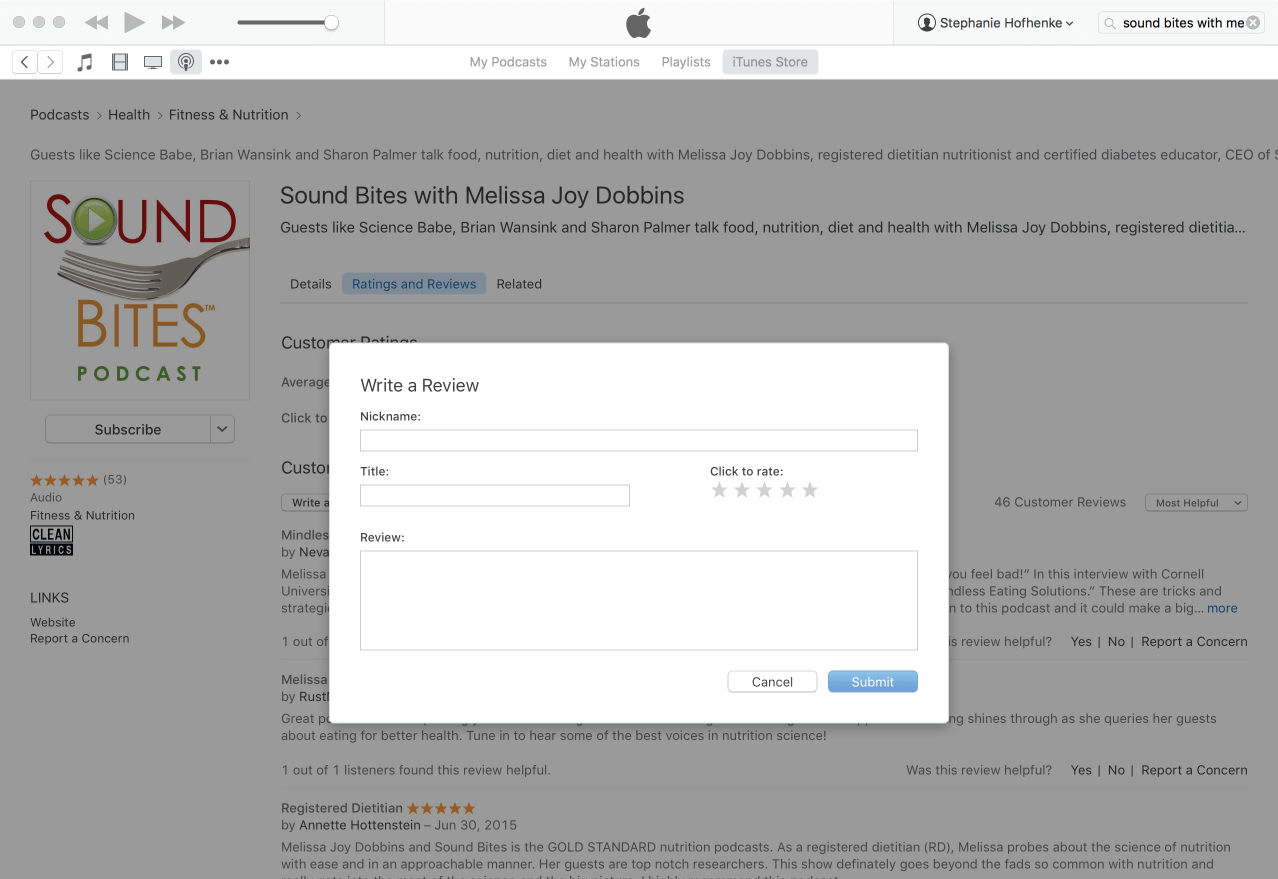
Write a Review
Click “Reviews”, then “Write a Review”.
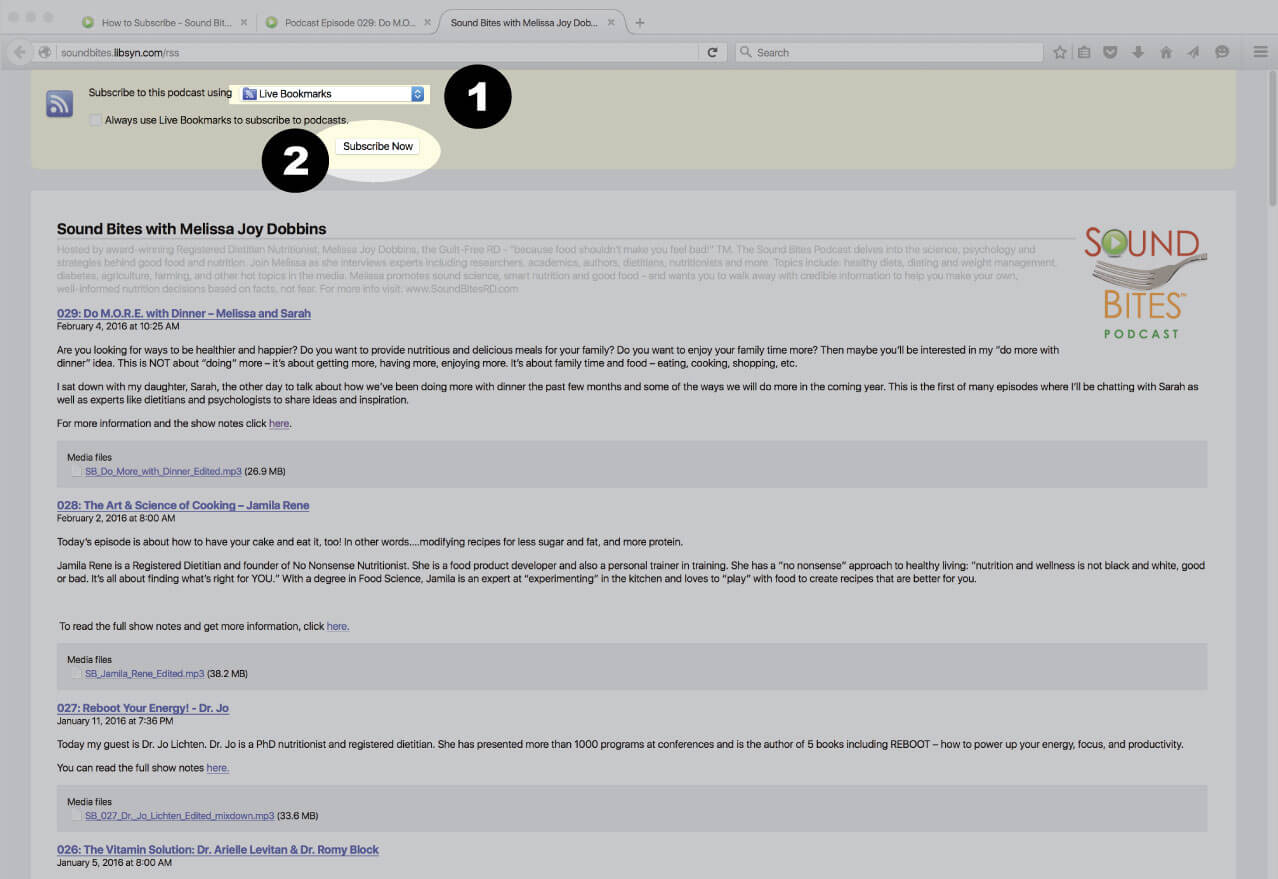
Subscribe via RSS Feed
Navigate to any podcast player . Click on the RSS feed icon.
Click on the RSS feed icon.
Click on RSS Feed
Choose which application you would like to use to receive the RSS feed
Click “Subscribe Now”
Confirm settings and subscribe.
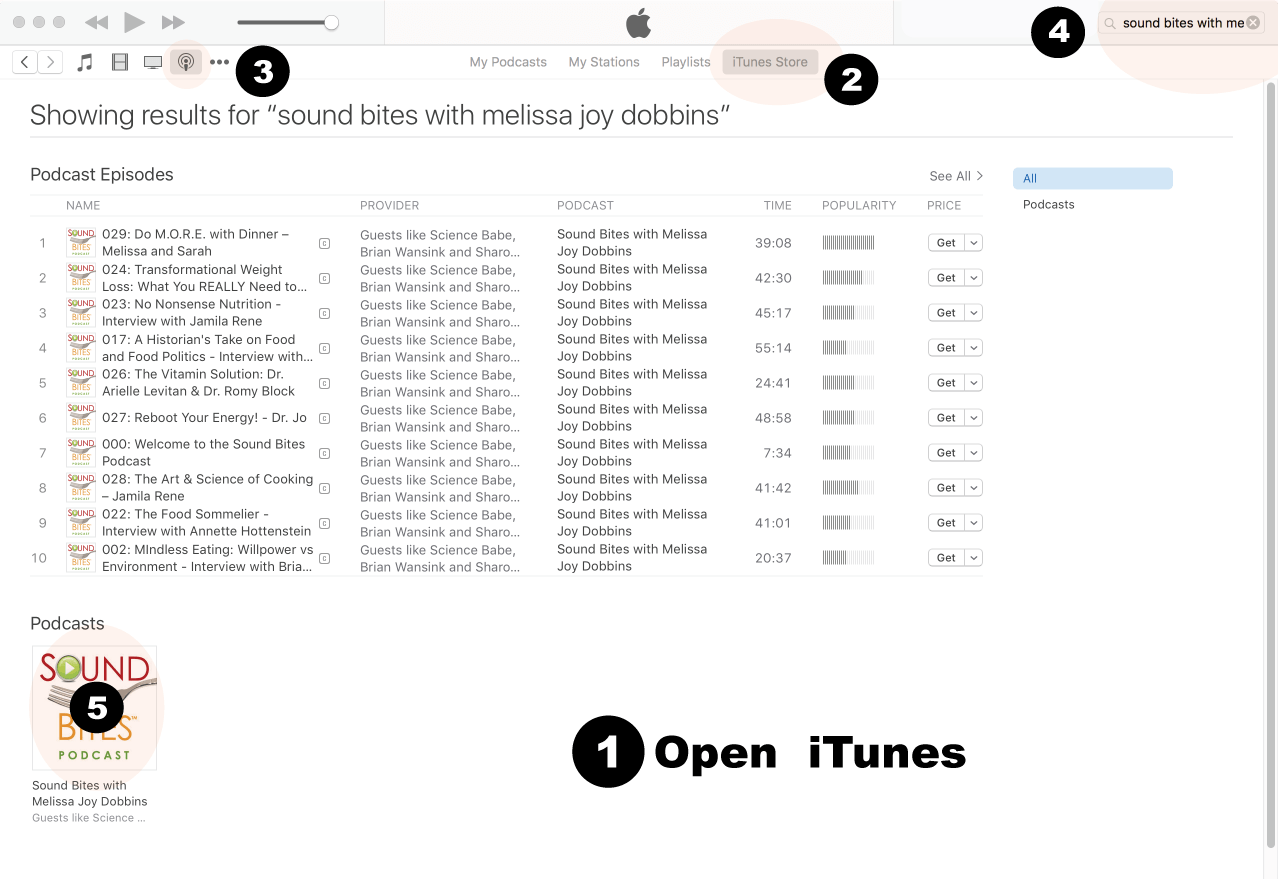
How to Review in iTunes
Open iTunes desktop application
Click iTunes Store
Click on Podcasts
Search for “Sound bites with Melissa Joy Dobbins”
Click on podcast image
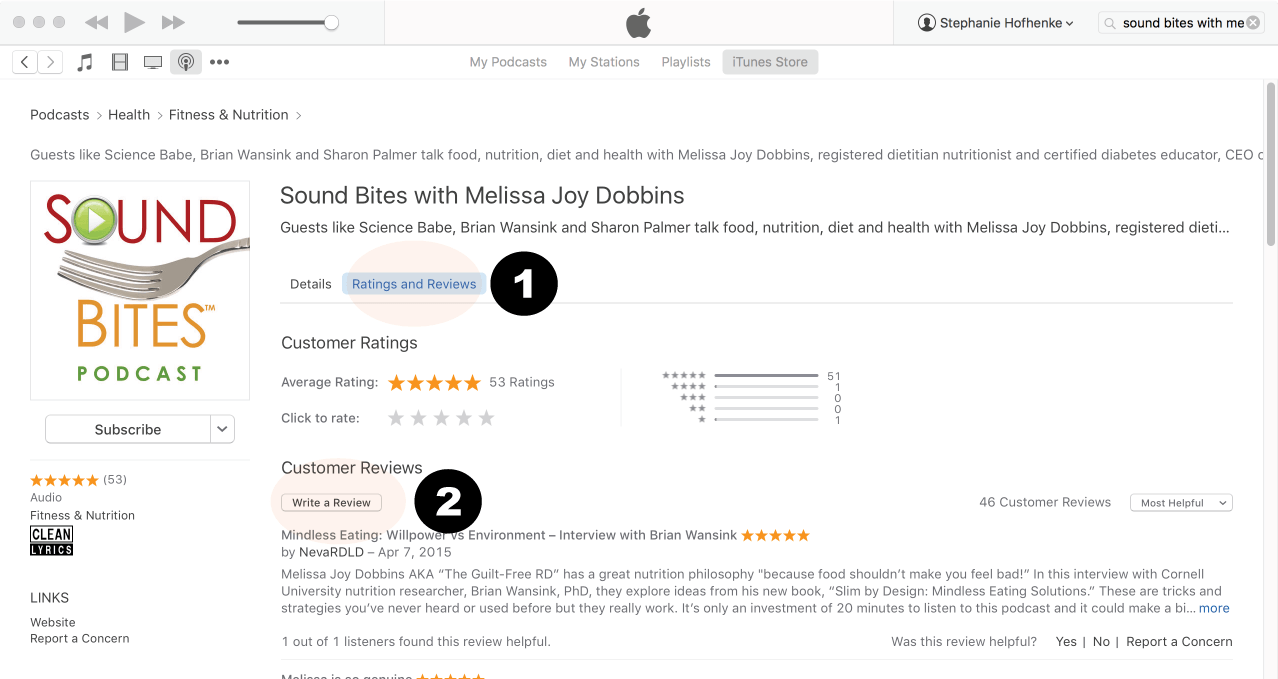
Search for Sound Bites podcast in iTunes
Click Ratings & Reivews
Click Write a Review
View reviews and write your own review.
Write your review…. Thank you!
Write your review!
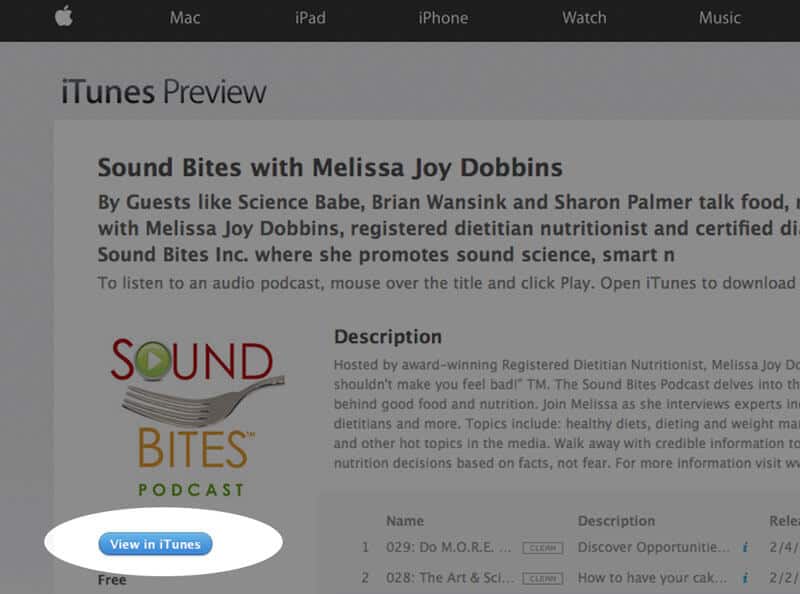
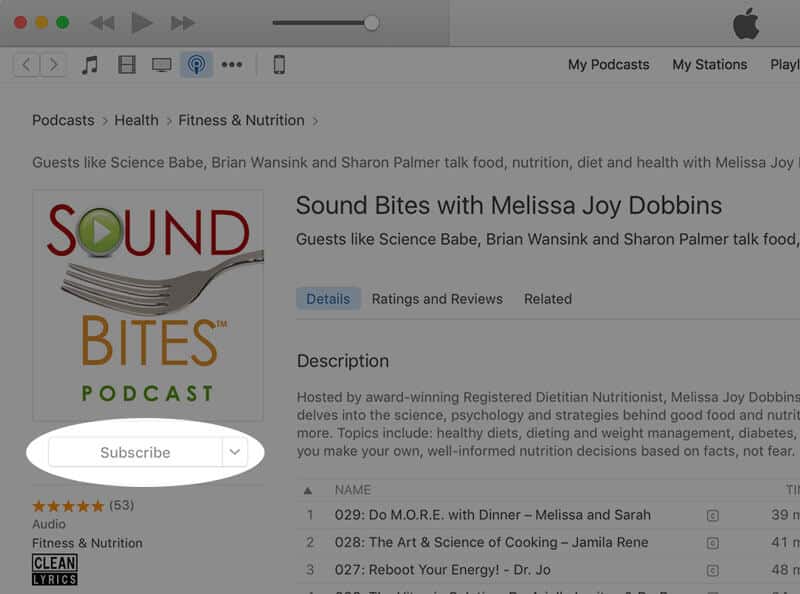
How to subscribe via iTunes
Click here to view the Sound Bites Podcastin iTunes, then click the blue “View in iTunes” button. This will open your iTunes application directly to Sound Bites Podcast. Click the “Subscribe” button, and your done!




 Charlie Arnot is recognized as a thought leader in food and agriculture. He is highly regarded as both a writer and sought-after speaker who engages audiences across the globe. Charlie has decades of experience working in communications, public relations and issues management within the food system. He is the founder and president of Look East, an employee-owned consulting firm. He also serves as CEO of the Center for Food Integrity, a non-profit dedicated to building consumer trust in today’s food system. He is a trusted counselor to CEOs, government leaders and executives, and a respected industry advisor on critical food related issues, and he is frequently sought out by media for his insight. He has been quoted in the Wall Street Journal, Forbes, Fortune, Time, NPR, CNBC, The National Journal, Entrepreneur, Yahoo health, Huffington Post, Grist and dozens of trade publications global