Celebrating over 1 Million Downloads and 50,000 Free CEUs on the Sound Bites® Podcast | NEW: Get 1 years’ worth of CEUs with the new 15-CEU Podcast Course
Click here to earn 1.0 FREE CEU for listening to this podcast episode!
This episode is not sponsored. However, Benexia, a company that makes chia ingredients, supported the CEU submission costs. I received a gift of chia oil from the guest on behalf of Benexia and their chia-based brand SOW Seeds of Wellness®. Dr. Bazilian is a consultant to Benexia.
The Science on Seed Oils & Practical Tips for Culinary Oils
Seed oils are often attributed to negative health effects due to their prominence in ultraprocessed foods and misunderstood science. In fact, a large body of evidence suggests that unsaturated fats – the type of fats in seed oils – are associated with reduced inflammation and a lower risk for cardiovascular disease. Seed oils are a primary source of essential polyunsaturated fats (PUFAs: omega-6s and omega-3s) and are encouraged in most dietary patterns. However, the typical American diet is higher in omega-6s than is recommended, and while adults are generally meeting the recommendation for omega-3 intake, new evidence indicates we may benefit from a higher amount. In addition, researchers once thought there was an ideal “ratio” of omega-3 to omega-6 but we now know it’s not that simple.
Different cooking oils have different nutrient profiles and culinary capabilities. While cooking oils have beneficial unsaturated fats, many are lacking in essential omega-3. Chia oil has a unique profile – high in omega-3 and low in omega-6. Avocado oil is high in monounsaturated fat (MUFA) and lower in omega-6. Furthermore, some oils are suited for a variety of cooking techniques – heat and no heat – whereas others are better for low heat or no heat techniques.
Tune into this episode to learn about:
What are seed oils and what claims have been made about them
Why we are hearing so much about seed oils in the media and on social media
Are seed oils are different from vegetable oils
What the research shows about the safety of seed oils
Recommended intakes compared with typical intakes
Factors to consider including nutrient profile, flavor, culinary uses
Fun and tasty ways to use different culinary oils
Resources and recipes
Wendy Bazilian DrPH, MA, RDN, ACSM-EP
Wendy Bazilian, DrPH, MA, RDN is a writer, educator, food enthusiast and award-winning journalist. She graduated summa cum laude, Phi Beta Kappa with a B.A. from Tufts University, received her M.A. from UC, San Diego, and completed her Doctorate in Public Health and Nutrition from Loma Linda University summa cum laude where she was awarded the prestigious Chancellor’s Award, the top university honor. She is a registered dietitian nutritionist and American College of Sports Medicine Certified Exercise Physiologist. Dr. Bazilian is author of Eat Clean, Stay Lean series (Rodale), The SuperFoodsRx Diet (Rodale), and has contributed to several books including the James Beard- and IACP-nominated Golden Door Cooks at Home, and the original New York Times bestseller SuperFoodsRx. She maintains a busy private practice with individuals from CEOs, artists, and actors, to professional athletes, parents and children seeking to improve their and their family’s nutrition, fitness and health. Wendy is an expert consultant to the spa industry, to start-up and established food and commodity groups, and to the health care industry. She is on the Board of Directors for the California Academy Foundation, and active advocate for students and others pursuing scholarships, fellowships, research and educational grants, and paid internships—and becoming part of mentoring relationships. She was honored nationally as Nutrition Entrepreneur of the Year for 2022. In 2023, she was awarded the prestigious 2023 Academy of Nutrition and Dietetics’ Distinguished Lecture Award “in recognition of [her] exemplary career and remarkable contributions to the nutrition and dietetics profession.” A frequent nutrition and wellness presenter at scientific, medical, corporate, culinary and public conferences and festivals, Dr. Bazilian’s expertise is featured in and she also writes for a variety of national print and digital media. She has been an expert contributor and returning guest on NBC’s TODAY show and GMA for many years. She is a frequent guest and nutrition expert on Live with Kelly and Mark.
This method for making sorbet can be used to make sorbet from many different types of ripe seasonal fruit. Peaches, strawberries, blueberries and bananas to name a few. The addition of chia oil not only bolsters the nutrients in this sorbet, it lends a silky mouthfeel and adds a background nuttiness. Anytime you have a bunch of fruit that risks going to waste, simply peel or rinse and slice or dice it. For every 3 cups of fruit squeeze over the juice of 1 orange and 1 lemon or lime. Freeze flat in a freezer bag. Then, whenever you are ready. Process with chia oil as directed below.
Servings: 6
Author: Chef Dean Rucker, James Beard Nominee and a Food Network's Chopped! Champion
1tablespoonhoneyoptional—depending on desired sweetness and taste of fresh fruit which can vary
1.5teaspoonsChia seedsfor garnish
Instructions
In a shallow non-reactive dish (or a large resealable bag), stir together the pineapple, mango and orange juice. Cover and place in the freezer for 3-6 hours until frozen solid. (If using the bag option, flatten so the fruit and juice is spread out and about 3/4 to 1 inch thick. It will freeze quicker and be easier to break up and process.)
When the mixture is frozen, remove it from the freezer and let it stand at room temperature for 10 minutes.
With a large metal spoon (or bending with hands if using the bag), break the frozen fruit into smaller pieces. Transfer the mixture into the work bowl of a food processor. Add SOW Chia Oil over the fruit. Process until smooth and creamy, about 5 minutes, scraping down the sides of the bowl occasionally.
Scoop into dishes and sprinkle about ¼ tsp of chia seeds over each serving and Enjoy!
Notes
Serve immediately or place back in the freezer for up to 1 hour before serving. The sorbet will freeze solid again but it can simply be processed again until creamy before serving.
Benexia is a vertically integrated company that specializes in chia seed ingredients. They have a brand called Seeds of Wellness (or SOW) which sells chia oil and chia milk to consumers.
[00:00:01] Host: Welcome to Sound Bites, hosted by registered dietitian nutritionist Melissa Joy Dobbins. Let’s delve into the science, the psychology, and the strategies behind good food and nutrition.
[music]
[00:00:23] Melissa Joy Dobbins: Hello and welcome to the Sound Bites podcast. Today’s episode is about seed oils. What are they and why are we hearing so much about them? Ultimately, are they healthy or not? We are going to discuss the science on seed oils and practical tips, including different kinds of culinary oils and how to use them in your own kitchen. My guest today is Dr. Wendy Bazilian. She is a doctorate in public health and nutrition, a registered dietitian nutritionist and an American College of Sports Medicine certified exercise physiologist.
She is also a writer, educator, food enthusiast, and award-winning journalist who maintains a busy private practice in San Diego with individuals from CEOs, artists, and actors to professional athletes, parents, and children seeking to improve their nutrition, fitness, and health. She is the author of several books and has contributed to many others. Welcome to the show, Wendy.
[00:01:24] Wendy Bazilian: Great to be with you, Melissa. Thank you for having me.
[00:01:26] Melissa: I call you Wendy because I know you. Would you prefer that I call you Dr. Bazilian or Dr. Wendy?
[00:01:31] Wendy: No, I mean, I appreciate that very much because it was certainly a hard-earned degree and I’m very proud of it, but hopefully that will manifest through a friendly conversation today. I have credibility for being here on this topic and we can leave it at that. Wendy is perfect.
[00:01:46] Melissa: Awesome. Thank you. I want to mention that this episode is not sponsored. However, I did receive a gift of chia oil from you. Thank you so much. When you tell us a little bit more about your background and disclosures, you can mention this chia oil and we’re going to talk about all kinds of oils, but specifically some interesting things regarding chia oil.
I would love for you to tell us more about your background. I know you have vast experience and I’ve seen you in many different capacities and you’re just a pleasure to watch, present, and to listen to and I learned so much from you. I would love our listeners to get to know you a little bit better and maybe how you got interested in nutrition or whatever you would like us to know about the work you do.
[00:02:35] Wendy: Thank you so much. Probably as with you, my career and who I am has evolved over time, even though my core identity has stayed the same. As a human, I am an avid eater, a spirited person, I love to communicate with others and that have been the universal truths of who I am. I live in San Diego, California, for 30 years now.
[00:03:02] Melissa: I’m so jealous by the way.
[laughter]
[00:03:04] Wendy: It is a nice place to be, but hailed from Connecticut originally, so I grew up on the east. I had a healthy dose of cold winters and beautiful falls, and we still go back and enjoy that as frequently as we can. I got into nutrition– Then I’ll give a few disclosures on what I do and who I work with, but I like to say I got into nutrition through the back door and straight into the kitchen.
I have always loved food, as I mentioned, and I’ve always loved and showed proficiency in science. I didn’t know how those connected for a very long time, by the way. For some reason that just didn’t link up and sync up until later. My first degree actually is in Spanish language and literature, of all things.
[00:03:49] Melissa: I know. That’s so interesting.
[00:03:51] Wendy: [chuckles] With a minor in Latin American studies. From there, I got a master’s degree in Latin American studies. The path now has shown to sort of why and where and how I am, who I am today, but at the time, I wasn’t quite sure. I just really thought that a great liberal arts degree that was multidisciplinary would somehow help me have a perspective on the world and allow me to talk with more people, which was the language part of it. It did.
When I did my master’s degree in Latin American studies, I actually did field research in Northeast Brazil. I picked up a language there because I thought if I’m going to study Latin America, I should learn Portuguese. I started doing field research with a public health group in a very impoverished, indigent area in Northeast Brazil around maternal health, around infant mortality, and around breastfeeding in the very, very interior of Northeast Brazil.
It was there that the intersection of public health and nutrition and how you can change and also learning that where we live doesn’t always have all the ideas or the right ideas sometimes. This was a very grassroots public health theater group that was re-promoting breastfeeding in an area where potable water was scarce and food was scarce and there was a perception going around that breast milk was not adequate somehow for infants.
It was from that point that I said, “Aha, nutrition is where I want to be.” I started backtracking a lot on the science. I had to go back to school on some of the things I was taking as hobbies, and pursued a doctoral degree in public health and nutrition, pursued the registered dietitian nutritionist credential, which you well know takes years of commitment and upkeep. Also, my health and fitness orientation became credentialed as an exercise physiologist through the American College of Sports Medicine.
Those are my creds, the letters that come after my name, but, really, it all comes back then to communicating about it. I won’t go through all of the where’s, paint my path, because we have a very important topic to talk about that’s very trendy and interesting. I do consulting today. I’m in private practice. I do consulting and presenting, and I do communication strategy. Some of my clients include one that I’m going to bring up just topically more than anything else, which is a company called Benexia, which makes chia ingredients. The chia oil that you received is from and through their brand.
Also a few others. I’ve worked with fresh avocados recently, with Hydrolite, which is– It’s a medicinal food that is one of those I call them hydration helpers. Not actively right now, but just to showcase a few that cross and intersect with my philosophical professional passion, lean into the evidence always in science when I work with them. Then I am a huge advocate of mentoring and scholarships. I’m on the board of the California Academies Foundation, so I work with the scholarships and students, mentor a number of individuals as well.
That is not a short answer for you, Melissa, but that’s who I am, at least sitting here today.
[00:07:05] Melissa: I love it. You have so much experience and passion in all these different areas, and I love to see how it does intersect and come together. I like to see, like with my career, like hindsight is 2020, all the choices and turns and twists that I made in my career at the time. I was just making the best decisions I could at the time, but looking back, it all makes perfect sense.
[00:07:30] Wendy: Yes, thankfully. You’re like on the path and it doesn’t have to be and rarely is straight.
[00:07:37] Melissa: Absolutely. Well, thank you. No, I loved learning more about you and having our listeners hear that as well. Let’s dive into the topic of seed oils. As you said, it’s very trendy. I’m curious how you got interested in the topic to begin with, and we’re going to get into the science and what they are and everything, but how did it come across your radar screen?
[00:07:59] Wendy: My professional education training is rooted in science and research, and I am the person who just loves the latest papers that come out and evaluating the quality of the science and reading about P values and all that when it comes to nutrition science. That’s part and parcel with what I’m scanning, as do you each and every day. The area about seed oils, I also really try to keep up on trends. Not just trends that I see being headlined about, but trends that start bubbling up.
The benefit of working with individuals and also working with big groups and working in health insurance companies doing some things is that you start to see things pop up that spark curiosity. I always think when it comes to nutrition, I haven’t seen an exception yet, but flag one if you know one. When people start talking about nutrition topics, it tells me they care. Even if it’s misinformed or partially informed or a little off track on what the science says, maybe I even don’t know all the science yet and I go digging, it tells me, “Well, this topic is interesting to them,” and so I start mapping that.
My brain, it just works like that. It’s got a lot of different spokes throwing out and putting things together in. I started seeing this topic about seed oils being bad. That’s sort of the topic. Before anything else going instead of like just going off, that’s phooey, that’s not right, or whoever that person is talking about got it all wrong, I was like, “That is curious, that perception. I wonder why?”
I started just asking why like the best four-year-olds out there, I have one of those, and I started digging around. I know a good amount about fats and the biochemistry of fats and how fats work. I worked with some premier researchers in that area personally. That’s where it comes in. Then in my desire to educate and help, hopefully, I tried to dig into the science and help communicate out, help balance the conversation, not disparage anyone or take them down. It’s what I love to do. It’s part passion, part interest, and part skill set, I guess.
[00:10:16] Melissa: Excellent. Let’s discuss what seed oils are. I’ll be honest, when I started hearing about them on social media, I was like, “What are seed oils? I don’t know this term. Is this a new term? Is this just a scientific term that just turned popular?” What are they, and are we seeing it in traditional media too?
[00:10:37] Wendy: Yes. Social media and it has definitely come into the traditional media. I’m happy to say that there has been a recent balancing act happening, which hopefully we’ll be talking about today, but it’s coming about. It’s a prominent conversation. Seed oils, we already know them, you already know them. They’re a collective term for sunflower oil and canola oil and cotton seed oil and corn oil and soybean oil.
These are seed, literally, oils that have been somehow processed to extract their oils. They are trending, in part because, and this will probably percolate over the course of our time together, but there’s some misinformation on it, because I think they’re in part a proxy at times for ultra-processed foods. Since we’re talking very often about ultra-processed foods these days and bad versus good, evil versus good, I don’t know, what these seed oils do feature some of them in some of these ultra-processed foods, they also– Some of these seed oils, some call them the hateful eight. I’m not going to recite what the eight are. I named a few of them. I did not name eight, and they weren’t exhaustive.
This list is not exhaustive, and so that’s where the opportunity is to play out, “Well, aren’t seeds good? How did they get into oil? Why did they get into oil? How do we use them?” Really, the seed oils that have been really tagged and targeted are the ones that are higher in the omega-6 fats. People are hearing omega-6 bad, omega-3 good. Not that simple, unfortunately.
[00:12:14] Melissa: Right.
[00:12:14] Wendy: I think it’s a convergence of the ultra-processed food, the omega-6 being bad, general confusion, and then a few very loud voices who have come out and, across the board, said, “Delete these from your diet, they are bad,” with a little bit, sometimes a lot of misinformation.
[00:12:31] Melissa: Right. I’m used to hearing the term vegetable oil. Is there a distinction between vegetable– Because I think of corn oil and soybean oil as vegetable oil. Is there a distinction?
[00:12:41] Wendy: Yes. Well, not a lot of distinction. I would say, if we’re getting granular, it gets down to the botany. like, “Botanically, are they coming from a seed source?” but it really could be any oil. A seed is in the plant kingdom, and I think that that’s where the nomenclature becomes a little bit more flexible on calling them vegetable oils. Corn oil or safflower oil, the fact that they’re being pressed from the seeds, I think that’s just like a level beyond and people are categorizing them. What’s not on the list, which we’ll talk about, and not heralding it better than in all cases, but chia is not talked about, chia oil, but it’s not something that a lot of us even know about.
I think when we’re looking at what we’ll discover and discuss is that it all starts with the seed. What are the nutrients in the seed? Next is, what is the processing? We will go through each one of these, but what is the processing that happens to the seed? What’s done after that determines some of the characteristics and the personality? Also, some of their culinary use. Some of them have positive attributes like neutral flavor and you can cook at high temperatures. At the same time, they may have some– The risk-benefit ratio, so to speak, that we have to look at when we’re using it on the plate in a culinary way.
[00:14:01] Melissa: Okay, great. That is very helpful. I know we’re going to talk a lot about what the research shows about seed oils, unsaturated fats. I have a related episode– Well, a couple related episodes, but one in particular is 218, Omega-6 PUFAs, polyunsaturated fatty acids, inflammation, and non-alcoholic fatty liver disease, with Dr. Martha Belury. I’ll link to that in the show notes. I also have done some episodes on processed foods and ultra-processed foods. Those links will all be in the show notes at soundbitesrd.com. We are going to talk about omega-3s and omega-6s quite a bit, but what does the research show, either in general or any specific studies that you want to talk about, about seed oils and unsaturated fats? Also, this is a double question here. What does the average intake look like for Americans?
[00:14:51] Wendy: These are two great questions, Melissa. I think in order to get to the research, which is not unanimous, research is research, so we want to see that not every study shows unanimity, we want the methods to be well organized and planned and quality. I’d like to anchor us briefly around why the topic is so important by looking at the fats in general. What’s really interesting is that we’re even talking about fats as being fascinating. I think that’s really cool in the first place.
[00:15:23] Melissa: Yes.
[00:15:23] Wendy: The idea about the essential fats, we hear about this. I think that most of your listeners will know this inherently or they know this from their training, but sometimes we glaze over the word. We hear essential fatty acids or essential fats. Certain fats are essential because the body does not make them. They do not endogenously produce them, so we have to get them from the diet. As a quick recap, I won’t go deep into the weeds here, but a fat is one of our macronutrients, of course. It is not a vitamin or mineral. It’s found in a lot of different foods.
Its primary action, aside from some nerve and other hormones and other areas where it plays in the body, is for energy. It’s for energy, it’s the calories, it’s for insulation of our body as well. In the essential fats, two major classes that are essential are the omega-3 and omega-6. We just have a tendency to make one better than the other or start looking at that. It’s important to anchor us in the omega-3s and omega-6s getting toward the essential fats, because that’s really where the seed oil controversy and claims come. I can talk about some of those claims that people are saying about them, if you’d liked, here in a minute.
[00:16:43] Melissa: Okay, great.
[00:16:44] Wendy: The essential fat is ALA or alpha-linolenic acid. That’s the omega-3 that comes from plants. It’s like the parent. From that, EPA and DHA are the siblings or the cousins that can be converted from ALA, but it’s also abundant and we hear a lot about this in marine sources, like salmon and other sources. The only essential one, though, is the plant one, because that one you literally can’t make. The other ones, you can make, and there’s questions about conversion and ratios. I don’t know how thick we’ll get into that, but the idea is that we have that omega-3 and we’re not getting enough. The question is, how much do we need to get? I’ll get to that in a second.
The other one is the omega-6s. Omega-6s also play an important and complementary and balancing act to the omega-3s, and they’re also essential. Just to throw them under the bus arbitrarily that anything with N-6s, they’re also called in science, omega-6s, are bad, is right out the gate, mischaracterizing this fat. The omega-6s do tend to be pro-inflammatory, but the bigger issue in the human diet is that we’re getting too much of them. This is queuing up on, where’s our intake? Our intake levels are adequate intake. A reminder, this is not a one-size-fits-all approach, but for most people, the adequate intake is about reached for the omega-3s.
Believe it or not, some people say we’re way deficient. Compelling research is starting to suggest that the adequate intake that’s set too low and that maybe it should be two to four times higher than what the adequate intake of 1.1 grams a day should be for the ALA omega-3. Too many numbers, I know.
[00:18:32] Melissa: No, that’s helpful.
[00:18:33] Wendy: Just keep in mind, we’re meeting it, but the compelling research for health benefit and health support and health promotion is suggesting we might need two to four times as much. This is not me saying it, this is what the science and leading scientists in this area are saying.
[00:18:50] Melissa: Got it.
[00:18:50] Wendy: At the same time, on the omega-6, we are getting too much. We’re getting too much of that. The idea of reducing consumption or finding places where it exists in the diet that you might either shift toward omega-3s or simply reduce some of these omega-6s may be warranted. We are getting in excess of our needs on the omega-6s. That’s the simple answer. I don’t think we shouldn’t go deeper into that.
[00:19:17] Melissa: Yes. No, that makes sense. Thank you.
[00:19:19] Wendy: Then on the research, you asked about that. There is a large and growing body of research on unsaturated fats in general. That would include these polyunsaturated fats, the omega-3, and the omega-6. I think that that’s where, even among registered dietitians that I’ve spoken to about this, we get in, not to group think, but we forget sometimes.
We know some of the functions that are not health-promoting of omega-6s, and maybe we’re just not up to speed on some of the research on the omega-6s. There is a good body of evidence, and the American Heart Association came out with a lead paper back in 2009 saying, “Omega-6 is actually our protective for heart health. They’re helpful for heart health in a number of ways. There’s many studies that have come beyond that.
The research on cardiovascular health probably being the strongest health-related association with the unsaturated fats for both omega-3s and omega-6s, anti-inflammatory benefits. Then the host of chronic diseases associated with diet that also may be linked to chronic inflammation.
[00:20:26] Melissa: That’s very helpful. I appreciate how you’re explaining this. We could take a deep dive on the science. I will say in Episode 218 with Martha, there were times when I was like, “Okay, wait. I’m trying to understand it’s very sciencey, but it’s very, very interesting.” I appreciate one of the main takeaways is it’s not that omega-3s are good and omega-6s are bad, that’s way oversimplified.
Even this ratio that we just clung to the ratios of omega-3s to omega-6s in the diet and just the awareness that there are some benefits, health benefits to the polyunsaturated fats with regard to the omega-6s because we know, everybody knows the omega-3s are good. It’s trying to tease out some of those benefits that we may not be aware of.
Let’s talk and maybe I’m jumping ahead here, but you gave a little bit of an overview of oils and fats in general, but I know one of the things that we wanted to talk specifically about is these different culinary oils and it goes beyond smoke point. That’s one of the things I’ve learned from you. What do we need to know or consider when we’re choosing different oils?
We’ve got a good resource that I’m going to put in the show notes as well because some of this, it helps to have a resource, a handout or something to go to because there’s a lot of different oils and there’s a lot of different factors to consider from my understanding. Where should we start with that whole category, that whole topic?
[00:21:55] Wendy: Where do we start? Imagine the supermarket aisle. I’m going to paint this the best I can to your ears, but the next time you’re in a major supermarket, walk down the aisle where the oils, the liquid oils are, not whip through it and grab the one you’re looking for or whizz by. Go look and take it in. It is a huge section. It’s a huge aisle sometimes. It’s tremendous.
There’s every shape of bottle, there’s every color of bottle, there’s every material made of bottle. It is top to bottom. There’s every price point of these bottles. There’s no surprise that it feels daunting and confusing and that we can stir some controversy around that certainly. With each of the oils, there could be 10 different options within that oil, olive oil which one, which press, which brand. It can certainly be confusing.
When we consider using them for cooking. Actually a colleague of ours, a registered dietician colleague of ours just told me yesterday about a conversation she had over the weekend with a friend who’s asked her, our colleague, “Why do you have five oils on your counter? I only cook with one.” She said, “Oh my gosh,” it opened up this great conversation. A lot of people still believe we just need one. Just choose one, use the one that can be multipurpose.
I would argue that there are different oils for different uses and hopefully I’ll leave you and your listeners with not the long list unless you’re really enthusiastic about your oils and yet you like to have lots and lots of different ones. Maybe the reason that you might have four or five different oils in your pantry. We want to be driven by flavor. I didn’t say nutrition first. We want to be driven by flavor. We want to be driven by the functionality of it. How does it fit into the food that we want to make and can we use it cooking. Smoke so point comes to play as well as some other factors. Does it have nutrients we’re interested in? Can we afford it?
Those are all factors that come in. Sometimes you want a neutral oil that can hit a high smoke point, and guess what? That may be a pretty refined seed oil. Is that problematic? In a balanced diet, we’re not only eating one ingredient. No, it’s not a problem. You might use that to serum and you might use other oils along the way for other culinary purposes. That’s a start on that. Cooking technique, flavor function. I hope a little bit of nutrition if you can get that in there as well.
[00:24:30] Melissa: That’s a great overview. I should back up and say because you had mentioned you could touch on some of the seed oil claims. Maybe we should go through some of that because if somebody’s not familiar with seed oils or the controversy, they might be wondering more. What’s the deal?
[00:24:47] Wendy: Why are we talking about this? Or who’s talking about this? To make a proof point, I’m going to read this one media outlet and I have this note in front of me. One media outlet reported while doctors and scientists peruse PubMed for evidence, laypeople report to places like TikTok where the war against seed oil rages on. Videos tagged with hashtag seed oils have been viewed over 31 million times on TikTok. Why are we talking about this and what are those claims? It’s created all kinds of buzz. One of them is inflammation. I mentioned that before.
When we learn about a nutrient, we hear about omega-6, usually we hear about the prominent one or it gets flagged for some reason in some headline and we just stick to it. That’s what it does. End of story. Some seed oils, not all, contain some pro-inflammatory omega-6s. There’s always a seed of truths to any claim, I imagine.
[00:25:44] Melissa: I love it.
[00:25:45] Wendy: Also, some people say it’s all about that ratio. We’ve got the ratio all wrong. You mentioned that before and it’s brought up. I’d like us to start using the word balance.
The ratio being how many omega-3s, omega-6s are in the diet. There’s no question that we’re over consuming the omega-6s, under consuming the omega-3s, but it’s not a strict ratio that we need to bring in. That’s the old school thought. It is more complicated than that. There are other functions. Another claim is that seed oils are toxic. It’s a word, it’s controversial in the first place. They have chemicals. That may mean they’re processed with different solvents or how they come to become the oil different on processing. That processing means harm.
Anything that we hear these days to make cheese, you’ve got to process dairy, but that one gets a pass. The seed oils don’t because process equals harm. The concept of refined versus unrefined and there’s some merit to this on the one hand, but refined another word that just triggers us and stable versus unstable. Actually some people feel that the refined oils are more stable and that hasn’t worn out actually in every way, but that some oils are more stable or less stable.
Like I mentioned before, that seed oils are a proxy or they represent ultra processed foods. Many times you’ll see people out on TikTok or the social media showing a food product or the label and say, “Look at these seed oils on the label.” They’ll be painting a picture of badness by association, the group it’s playing with in the ingredient list of that food. Then I think that everyone just loves a conspiracy theory every once in a while. We want to bash science or it’d be anti-establishment or that kind of thing. I shouldn’t laugh at that, but that definitely exists.
[00:27:38] Melissa: If we don’t laugh, we’ll cry.
[00:27:40] Wendy: Exactly.
[00:27:41] Melissa: That’s very helpful. Some of that I had heard, but some of that it was news to me and I love that there’s a seed of truth to that. I was thinking that earlier. Not necessarily in those terms, but I always love a play on words. Let’s talk about chia oil specifically. I had not heard of it before, so I think a lot of people haven’t heard of it. Tell us about it and maybe a little bit of the consulting work. Again, this isn’t sponsored, but this is an area that you’ve done a lot of work in. Also I can tell you how I used it in my own kitchen.
[00:28:14] Wendy: I can’t wait to hear about that, Melissa. I’m really excited. I love sharing ideas about how we use information and how we use ingredients. My introduction to chia goes back a while. I knew as probably you did that chia seed, which dates back 3,500 years. I don’t date back that far, but I like studying. Part of my background and fascination and it’s native to Latin America and prominent there is about food culture and indigenous foods to areas and that kind of thing.
Most of us learned about or experimented with chia pudding or chia. I knew that they were a source of omega-3. I already thought they were cool. I even knew how to use them in some ways. I still have in my garage two terracotta chia pet starters.
[00:29:05] Melissa: That’s funny.
[00:29:05] Wendy: If you’d like to see those brought to life, I could do that for you too.
[00:29:09] Melissa: I love it.
[00:29:09] Wendy: Send you pictures. I did a media segment. I was looking this up before we spoke because I was like, gosh, I even put in a media segment long before this back to 2010, I had done something about chia, so I knew about the science of fats. I knew two of my dissertation advisors on my committee research fats and omega-3s and that area.
I had done quite a bit with the nut studies and was well aware of some of the omega-3 containing nut, walnut in particular and the deep body of research there. That area was known to me. What I didn’t know, and as life has its circuitous path, I was introduced to Benexia, which is a company that does exclusively chia ingredients in Santiago. Chile is their headquarters, but distribution all over is. I didn’t know about the ingredients that come from it, and processing, and the journey on how it’s grown exactly.
How does it become oil? Those are things that I learned over time. I work with companies sometimes that bring me in, that I align with professionally and philosophically, that I actually use and enjoy, and that respect and want to lean in on evidence, science, and that I think my skill will fit their needs. That’s how we came together. What I didn’t know was that chia seed in this day and age where sustainability go part and parcel with nutrition priorities, I think, for global health, that chia has grown with regenerative agriculture. In the company that I’m working with that 50% of the owners of the company are the farmers.
[00:30:48] Melissa: Wow.
[00:30:49] Wendy: We can dive into every one of these aspects that zero water input except from mother nature goes into growing chia, and you’re only as good as your seed, that the purity is tested to ensure that the nutrients that come out of seed before anything is done to them is near 100%, 99.98% or something. These are things I’ve learned. The chia oil is cold crust, no food waste. The rest goes into chia fiber and chia protein, and it’s just wow. Then I got to taste it, and then I got to experiment with it and start using it, which really was, for me, what really sealed the deal on.
Wow this is something that can very simply– one teaspoon has your entire daily need of our essential fatty acid, ALA, one teaspoon.
[00:31:36] Melissa: Wow.
[00:31:36] Wendy: I use it because it tastes good. You can cook with it and these wow other things that I came to learn along the way.
[00:31:43] Melissa: Yes, the versatility. I used it. I got some tips from you on how to use it. I used it in roasted broccoli and I sauteed some zucchini with it, and I made a vinaigrette dressing, because one of the things that you told me. Typically I’ll use an olive oil, but as people know if they’ve made their own vinaigrette with olive oil, you put it in the fridge and it solidifies a little bit. Then you have to let it set out at room temperature before you use it. That’s not very convenient, I guess. You suggested I use it in a vinaigrette, and so I can make that, put it in the fridge. Get it out and use it right away because it stays liquid. That’s my favorite thing about it.
[00:32:24] Wendy: That’s great.
[00:32:25] Melissa: You also gave me a sorbet recipe. I did not make it, but I would love for you to talk about that a little bit, because I know you worked with a friend of yours, an amazing chef. I will put this recipe in the show notes at soundbitesrd.com so people can make this sorbet. Tell us about this recipe.
[00:32:42] Wendy: For sure. Oh my gosh. This is going to be hopefully a surprise, unexpected, and then we can back up, and all the other delicious ways to use chia oil. I tapped a longtime colleague and friend of mine, Chef Dean Rucker. I hope he’s listening.
[00:32:57] Melissa: I do too.
[00:32:58] Wendy: I’m sure he will. This longtime colleague of mine who is so innovative, and I worked with him for over a decade at a destination spa and resort up here in San Diego. We worked in tandem, day in, day out sourcing from the garden, talking about food and ingredients. Talking about how to bring health into delicious spa cuisine. Three meals a day to snacks, and add to support a modest calorie and five-mile hikes and all kinds of classes all day long. We really had a tall order. What he pointed out is a couple of things I’d like to share about oils in general, culinary oils which make I think this topic so exciting that we can bring it to the seed oil aspect of it, is you can use different oils for different functions as we know, different flavors and you can layer them.
You may not use just one single oil, so we can look at your salad dressing and other recipes in a second on that. When it came to sorbet, think about a sorbet. We think of sorbet as light and fruity, not typically with a cream or milk base. It’s usually basically fruit and sugar. What happens, and this is the chemistry that’s so cool, when you go into the freezer with fruit and sugar it crystallizes.
The result is high flavor and if you’re making it spa, and you bump up the nutrition, you’re not putting as much sugar in, it’s high flavor, but it gets crystallized a little bit. It’s not quite as creamy. There’s a few fruits that can make things creamy like bananas, but every smoothie and every sorbet doesn’t need to have a banana in it. What happens when you want to nectarine or pineapple or mango that we’re doing here sorbet. How do you get the mouthfeel back, or let’s say you don’t consume dairy either because you’re plant-based by choice and preference, or you don’t tolerate it for whatever reason.
The plant-based milks that may substitute in for nice creams, so to speak, they lose some of that creamy mouthfeel. What does fat do? It gives the mouth feel and it does that. People are like, “Whoa, that’s mind blowing.” What the chia oil does, just a little bit, is bonus nutrition, but it gives the mouthfeel. This is as much about creating a delicious experience as a really cool recipe. It’s pineapple, mango, chia oil, sorbet. I encourage people who are making mostly fruit sorbets, in general, and there’s a bunch of different, you’ll have the recipe up here. We always talk about substitutions.
Could you do this? Could you use frozen fruit? Could you use fresh? What if you don’t have this? Absolutely, but think about that when you’re bringing sorbet. What I loved about working with Chef Dean on this is, he always brings it one level further with me. It’s like, not just substitutions, but why are we doing this? What’s the purpose of this? That’s really what this is all about.
[00:36:04] Melissa: Excellent. Now I’m even more interested in trying it. As soon as you started explaining the function, I love that. Different functions, different flavors and I have to say the ways that I use the chia oil, I loved it. My family loved it. The flavor was really good there too. Do you want to talk about some good ways, or fun ways, or tasty ways to use other specific oils? If you have any other recipes that you want to mention, I don’t know that you have any on your website, or just favorite go-tos that you have.
[00:36:36] Wendy: Well, I think that laying the groundwork of the fact that different oils do different things. I think we can talk about how we might choose based on the flavor and the function. Before we were talking a little bit about smoke point. One of the things that I was inspired to do when I started doing this consulting work on chia oil was actually to serve the entire culinary oil population, because I felt what was lacking was a really solid document. One of the great links out that you’ll have for your show notes, Melissa, for your listeners, is what I call the smoke point document.
Really what it does is it spells out what you might use for finishing and drizzling or dressings. What you might be able to use for that, but also use at low sauté, or bring up to a medium high heat. What you really might want to use in terms of oils if you’re really wanting a high heat sear and safety. It also talks about how smoke point itself is not the only thing that determines the quality of the oils you choose. There are things like antioxidants that exist in some of these plant oils, which is incredible. Antioxidants actually make chia oil more stable. Impurities in some other oils make the oil less stable.
Not everything boils down to whether it’s refined, or unrefined, or whether it’s cold pressed. This document is really a good guide for getting the basics on what could I use where, and why does it matter? Then there’s the flavor angle. What are you making with this food? I’d like to think down the path both in terms of what meal are we talking here, but also what method am I thinking of cooking? If you’re going from room temperature, that would be like salad dressings and drizzles. I really like to use olive oil, but to your point, put it in the refrigerator, it starts to solidify. Why not make a blend?
That’s where I think chia oil and olive oil, or chia avocado and olive oil together make a really incredible emulsifying agent in your vinaigrette that will stay liquid in the refrigerator, off some of those polyunsaturated fats, be a good conveyor of flavor and so forth. What other things? Oh, Pesto’s, another great place. Another one that’s known for olive oil. I like to change it up a little bit. Sometimes you want a little more kick of flavor. Whether it’s olive oil and extra virgin olive oil that has a little more of that bite. I’d just gotten a little bit of an education.
I’m sure you’ve done olive oil tastings before where they say, “Is it a one cough or a three cough olive oil?” What level of antioxidants are coming through there which is pretty neat to think about. Sometimes you want a little bit more, or a different earthy note to your flavor. Sometimes you want neutral. If you’re searing fish that you want the flavor of the fish to really shine, and the quality of the fish to shine, you might want to have one of the high smoke point quality grape seed oils, or an avocado oil that does have a higher smoke point. The list goes on right to cold applications like sorbets smoothies and that kind of thing.
[00:39:51] Melissa: Interesting. I’m looking at this handout or this document while you’re talking, and it reminds me that we tend to forget also that all oils are a combination of polyunsaturated, monounsaturated, even saturated and we tend to think, oh, olive oil is monounsaturated, and that’s not the case. They’re all a combination and they have different levels. I’m looking at this, and I printed it out in black and white, but I can still see the different bars. We think of flaxseed oil as having a lot of omega-3s, but the chia oil is even higher, what I’m comparing on this chart, so that’s interesting.
[00:40:35] Wendy: Again, not one better than the other per se. Sometimes it’s like we need a little more information, but we can see. You wouldn’t use a flaxseed oil for cooking. It does have a relatively low smoke point.
[00:40:48] Melissa: Right. It’s at the bottom of the list as far as the temperatures.
[00:40:51] Wendy: Exactly. Yes, nice to point that out this way so that when you see it, and it will make sense, and it will give you maybe more confidence, at least with that level, because when I started working on this, and I’m so glad that you called attention to there’s not only one kind of oil. See, that’s another oversimplification. It’s not wrong that we speak in the priority one, but it’s a great example on how a little seed of truth can get blown out of proportion if someone that doesn’t know the science or have a more balanced perspective on it starts speaking about it. Maybe with good intentions, I really believe in good intentions with our humans out there.
[00:41:30] Melissa: Yes, that’s a great point. Yes, so I think that this document, this handout will provide a lot more depth to what we’ve been talking about and be a good resource for people to use in their own kitchens. Is there anything that you wanted to share with us top-line, like I’m in my kitchen, what are some basic go-to’s as far as use this type of oil for this, use this type of oil for that?
[00:41:57] Wendy: Yes, so one of the most common questions I get as a dietician, when I’m working with individuals or when we’re talking about this topic, is like then how many should I have in my pantry and which ones? I want to just give some guidance and some ideas real briefly. One, now you should know to be selective with choosing your oil. It’s not an afterthought. It’s not, oh I have oil, I’m going to use it.
Quality matters as well as some of these other factors. Number two, different oils have different flavors and uses. That goes to getting to know the flavor profile of them and what use are you thinking about. Have just a top few everyday oils unless you’re a big foodie enthusiast and you want to expand your repertoire. Maybe four. Have an extra virgin olive oil that you would not cook with.
It really is that special oil for dressings and blends and toppings and drizzles. Maybe an avocado oil. We know the great monounsaturated fats and healthy profile of that oil and it’s good for cooking high smoke point, neutral flavor, pretty neutral flavor. Coconut oil may be one. Again, these are all up to the individual, but coconut oil you can bake with it really nice. You can use it in place of butter sometimes. It does on purpose, it’s the chemistry stay semi-solid. It’s good for popcorn. It’s fun that way if you like the coconut flavor.
Then I would say chia oil because you can cook with it, you can blend with it, you can put it in all these different places and one teaspoon raise you an excellent source of that plant omega-3. The last consideration I would say in your pantry oils is don’t forget about blends and layering. You can use a couple of different oils in tandem. You can experiment with that and you can add an oil at the start of a recipe and an oil to finish at the end. I guess fats aren’t all bad. We know that they’re important, essential for our health.
[00:43:57] Melissa: Absolutely. Okay. I have to show my culinary, I don’t want to say limitations, but my basic culinary knowledge here. I have olive oil that I cook with frequently. I don’t know if it’s extra virgin or not. I tend to use that to sauté or to roast vegetables and everything. You said don’t use extra virgin olive oil. That’s more for drizzling and that sort of thing, but just regular olive oil, is that okay for cooking because that’s what I do.
[00:44:26] Wendy: Yes. This is a great question and I do not want the olive oil folks who I also love coming after me for this one. You can cook with your extra virgin olive oil. What I mean is sometimes if you apply high heat, so regular sautés, and they’ve been using it like that in the Mediterranean and we in the United States and in Spain and all over the world for a long time cooking with it, but it starts to change the characteristic when you apply heat to it.
A smoke point is actually a burning point. It’s when you see smoke come off of the pan. If you actually see a bluish hue come, probably too high of a smoke point, is it going to be harmful? If you did that regularly, it might become harmful, but not on a one-off. It just might make your food not taste very good. What I mean to revise my statement before, so thank you because a lot of people have this.
If you’re spending a lot of money on a very special extra virgin olive oil, with lots of labels and distinctions, I would suggest that one. Maybe you don’t cook with that one because you want it to come across, like you want the flavor to hit your tongue. You want that.
[00:45:28] Melissa: Right. You dip the nice bread in and drizzle on.
[00:45:31] Wendy: Yes, exactly. Yes, the one you dip in bread that you want to drizzle over the top that each bite on the fork you get a little hit of that peppery bite. That’s fantastic.
[00:45:41] Melissa: Okay. Thank you for clarifying that. I appreciate that.
[00:45:44] Wendy: Of course.
[00:45:44] Melissa: Is there anything else that you wanted to touch on or address regarding research?
[00:45:50] Wendy: Yes, there’s three categories, please be my guest to select from, that I have some notes on. One, if you’d like me to very briefly point to some of the health research and studies. There’s been a lot of very recent health research in the area that is coming about, looking specifically at the omega-3, the plant omega-3, ALA, including a 2022 meta-analysis and review about the alpha-linolenic, the plant-based omega-3.
This is a great paper. We can provide the link out and it talks about the mechanism action and what we don’t know and some newer mechanisms of action to start understand a little bit further. I’m very research-based, so if there’s any other research, we have a lot of research. There’s a lot that’s still not known, but there’s a lot of research on this area.
[00:46:40] Melissa: Okay. As we’re wrapping up, we’ve talked about the science, the kitchen, all kinds of things, but is there any bottom-line takeaways that you’d like to just summarize for us?
[00:46:51] Wendy: Yes. When we’re talking about something that can be so controversial, like the seed oil story, hopefully, we’ve made a balancing act of it to show where it nets out. What I’d like to share is a reminder really of some things. Number one, we know that a healthy diet is not comprised of one food ingredient or nutrient. We need variety, we need high-quality and nutrient-dense foods, and that we eat meals and patterns of meals over time.
Number two, I hope your listeners can feel confident cooking with and enjoying the plant-based oils either again or a new or new ones. The types of fats found in oils, the unsaturated, the essential fats that we talked about, those omega-6s and omega-3s are beneficial for health, especially when they’re eaten in place of some of the saturated fats in our diet.
Third I would say diversify the oils in your pantry a little bit. We talked about that for both nutrition and cooking capabilities. Hopefully, people will go away with function and flavor and nutrition as three key attributes to think about and have a small assortment of culinary oils in your kitchen. Finally, we can look for lots of easy ways to incorporate more omega-3s in our diet, those ones that we are seeking more of and in particular the central one in the plant-based form.
I think that the marine sources are delicious and wonderful and we get a lot of attention on that salmon and sardines, but think of things like chia and chia oil and walnuts and flax as well as the marine sources. Plant-based omega-3s have some overlapping and also some unique benefits that the research is showing for human health. That’s my wrap-up to synthesize all of this great information that you’ve queued up for our conversation today.
[00:48:46] Melissa: Oh, thank you so much. That is very helpful. I love it. Those are some excellent takeaways and just organizes everything that we’ve touched on. I really appreciate it.
[00:48:54] Wendy: You’re welcome.
[00:48:55] Melissa: Where can people find out more about this topic, the research, just connect with you if you could share your website, social media, any of that information would be great.
[00:49:06] Wendy: Sure. I love connecting. That’s what I love to do. My best connection on social media would be on Instagram Bazilians. It’s my last name spelled like Brazilian without the R, but you put the S, at Bazilians. My website is wendybazilian.com. You can email me straight from there and I will be in touch on that.
One of the things that I love about talking about plants in general and how they fit our nutrition including the fats, including controversial seed oils, and this I exclaimed at a presentation, but I have to say it now. It came out of my mouth and now I use it as something to underscore how I feel inherently. I love when modern science shows what mother nature knows. Very often there are the seeds of good health in our histories and traditions and cultures, things we used to do in the traditional table for good health or showed up for health.
Then, over centuries sometimes or millennia, as the case may be, scientists start discovering why, how, what is the nuance, what are the specifics, what’s the smoke point, all those details. I love when that can happen. If you want to talk flavor, culture, food, and of course, nutrition, I love connecting with others.
[00:50:28] Melissa: Awesome. Thank you. In addition to the links, we’ve already talked about, you did a food and culinary professionals webinar. I’ll have the link to that as well on this topic. There’s also an article on linoleic acid. I think it’s available through a link. If not, I should be able to put the PDF linked in there. Yes, just have everything that we’ve touched on at soundbitesrd.com and the related episodes as well. Are you working on anything else right now that you wanted to share with us before we say goodbye?
[00:51:00] Wendy: Oh, thanks. I am working on finishing a book that’s been a labor of passion for a long time and getting near the finish line on that. It’s almost ready. I’m working here in Southern California with a number of interesting topics, most notably, recently, a lot about sustainability and nutrition. That’s a really exciting area I think to tap on things like regenerative agriculture and upcycling nutrition. That’s a strong sustainability story, is something I’m very passionate about, and I may be actually working on a little podcast of my own. I might follow in your lauded footsteps in that direction.
[00:51:39] Melissa: Wonderful. What’s the book about?
[00:51:42] Wendy: The book is about our– and by our, I mean, my husband who works with me as a partner for many years here in San Diego and our health clinic about our central mantra and tenet, which is, “Eat well, move daily, be healthy,” those three key areas. There’s simple practices, 52 of them. Simple practices that are science-based that you can do in a self-care approach to help promote good health.
[00:52:10] Melissa: It sounds like week by week, if it’s 52.
[00:52:13] Wendy: You got it. [laughs]
[00:52:14] Melissa: There you go. Well, awesome. That sounds so exciting. Congratulations.
[00:52:18] Wendy: Thank you.
[00:52:19] Melissa: Thank you so much for coming on the show and sharing this information. I look forward to applying it in my own kitchen, and I hope the listeners will as well.
[00:52:27] Wendy: Thank you so much for having me on, Melissa, today with you.
[00:52:30] Melissa: Thank you. For everybody listening, as always, enjoy your food with health in mind. Till next time.
[music]
[00:52:38] Narrator: For more information, visit soundbitesrd.com. This podcast does not provide medical advice. It is for informational purposes only. Please see a registered dietician for individualized advice. Music by Dave Birk. Produced by JAG in Detroit Podcasts. Copyright Sound Bites Inc. All Rights Reserved.
[music]
[00:53:06] [END OF AUDIO]
LISTEN, LEARN AND EARN
Listen to select Sound Bites Podcasts and earn free CEU credits approved by the Commission on Dietetic Registration (CDR) for registered dietitian nutritionists and dietetic technicians, registered. Get started!
Get Melissa’s Sound Science Toolkit here!
Partnerships:
Sound Bites is partnering with the Association of Diabetes Care and Education Specialists (formerly the American Association of Diabetes Educators)! Stay tuned for updates on the podcast, blog and newsletter!
Sound Bites is partnering with the International Food Information Council! Stay tuned for updates on the podcast, blog and newsletter!
Hi Kim,
Thanks for reaching out. There are no CEUs for this particular episode. Only select episodes are submitted for CEUs.
If we decide later to submit for CEUs and they are approved, you can find the CEU activity on my free CEU page here: https://soundbitesrd.com/sound-bites-podcast-free-ceus/
Thank you,
Melissa
Sign up for my monthly newsletter and episode eblasts so you never miss an update!
Listen on Stitcher (Android)
Install the Stitcher App
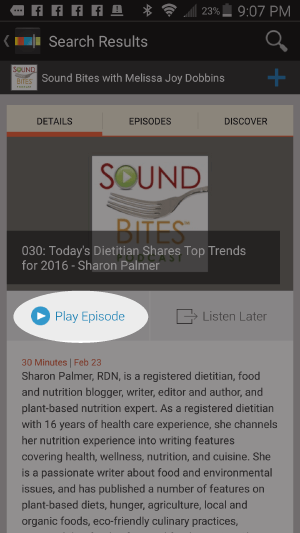
1. Search for “sound bites with melissa joy dobbins” 2. Choose Play Current Episode or Add to Playlist
Choose “Play Episode”
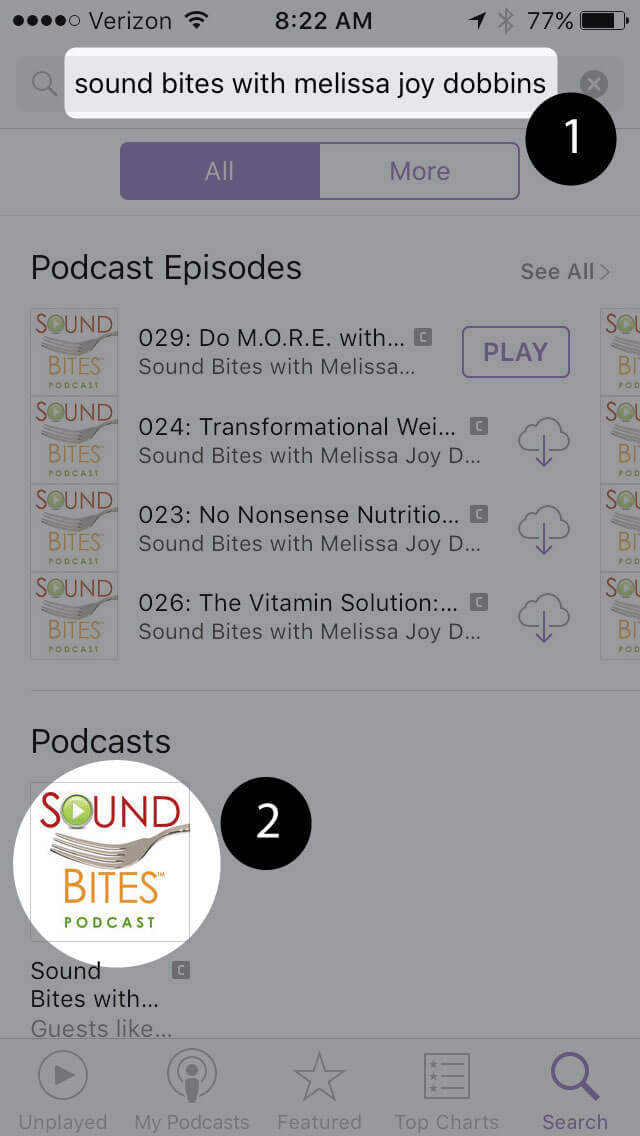
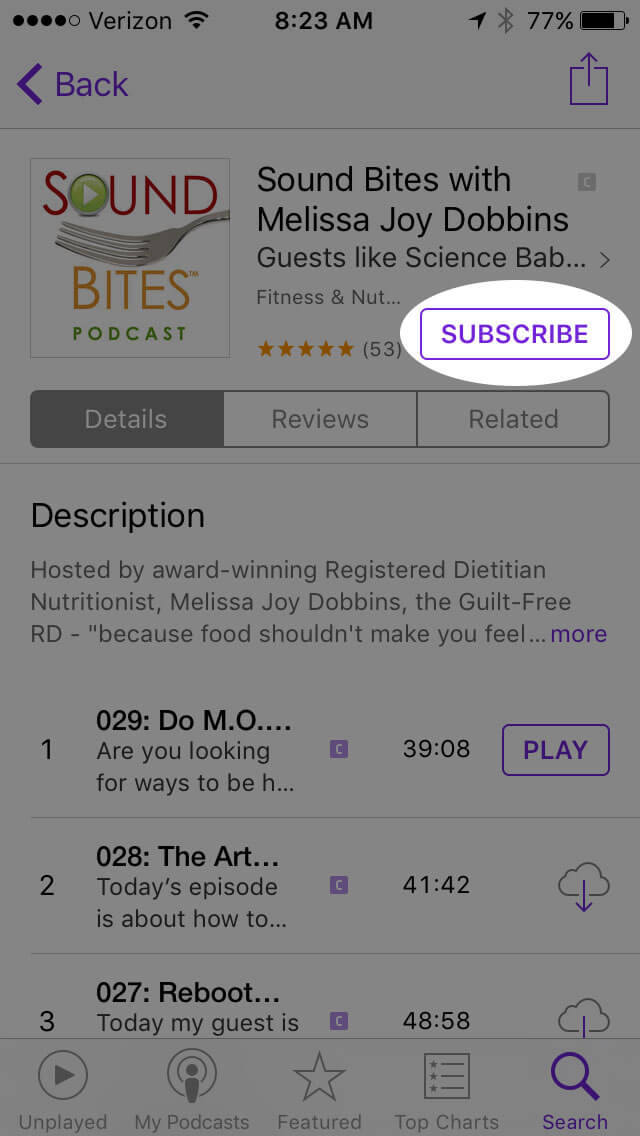
Subscribe & Review on iPhone
Open the “Podcast” app on your iPhone
Search for “Sound bites with melissa joy dobbins”
Open the podcast and click “Subscribe” and your done!
Write a Review
Click “Reviews”, then “Write a Review”.
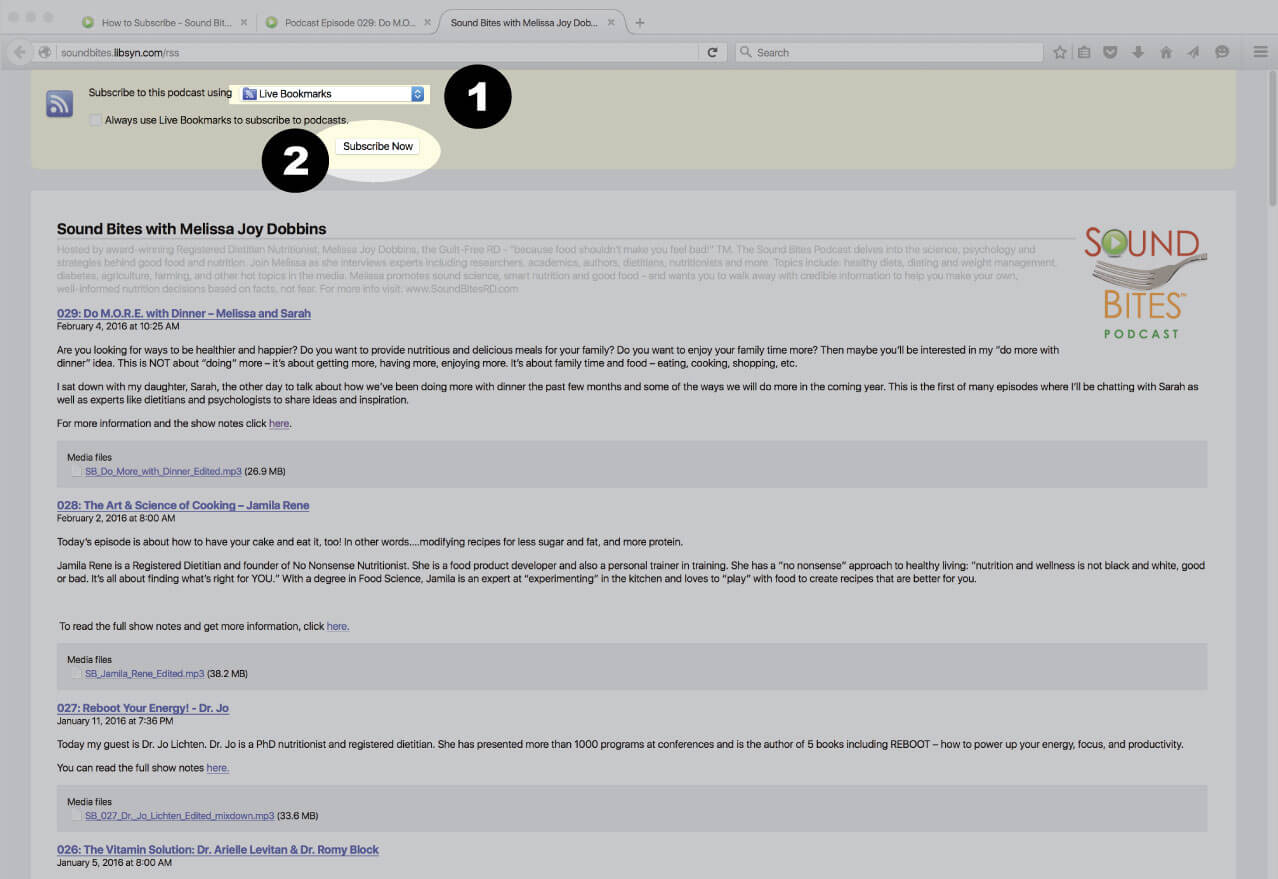
Subscribe via RSS Feed
Navigate to any podcast player . Click on the RSS feed icon.
Click on the RSS feed icon.
Click on RSS Feed
Choose which application you would like to use to receive the RSS feed
Click “Subscribe Now”
Confirm settings and subscribe.
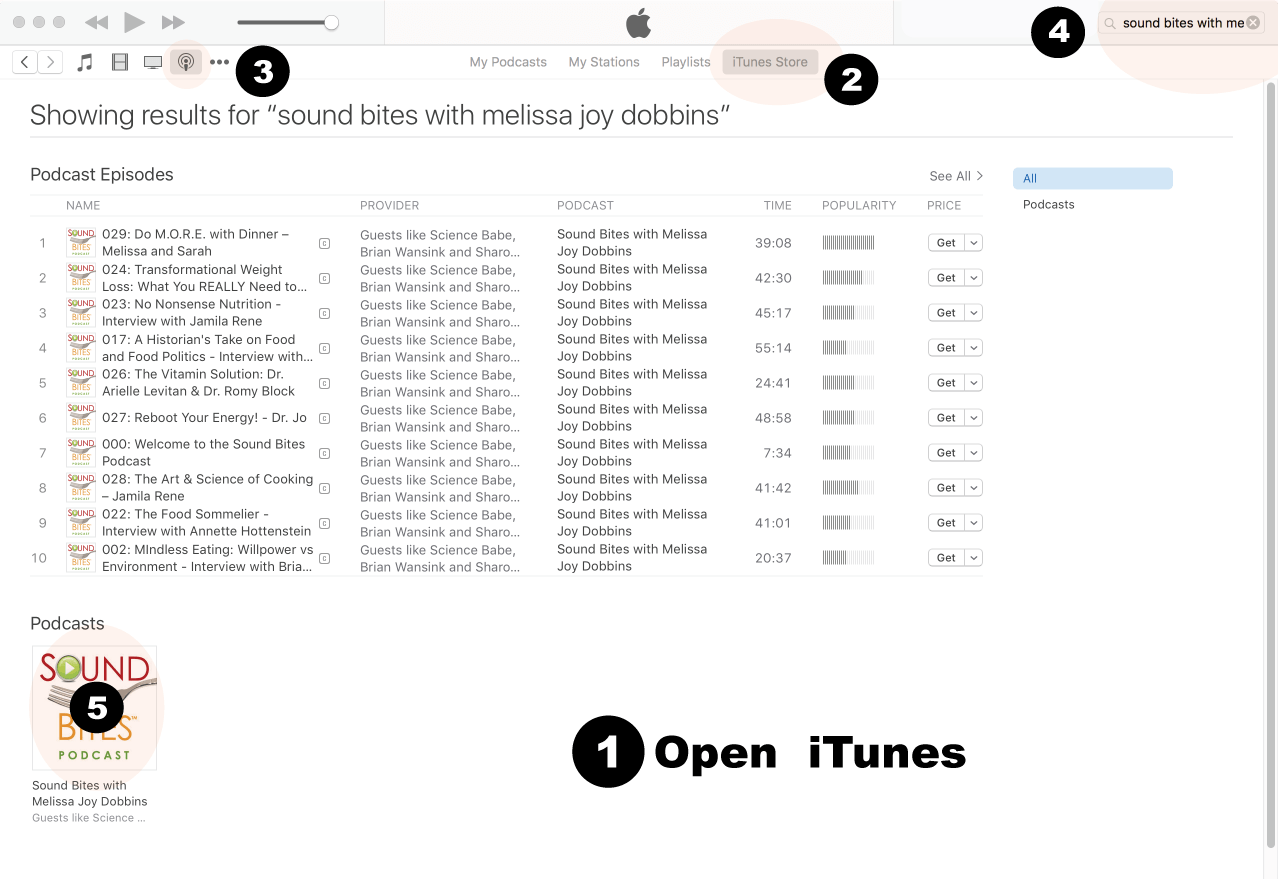
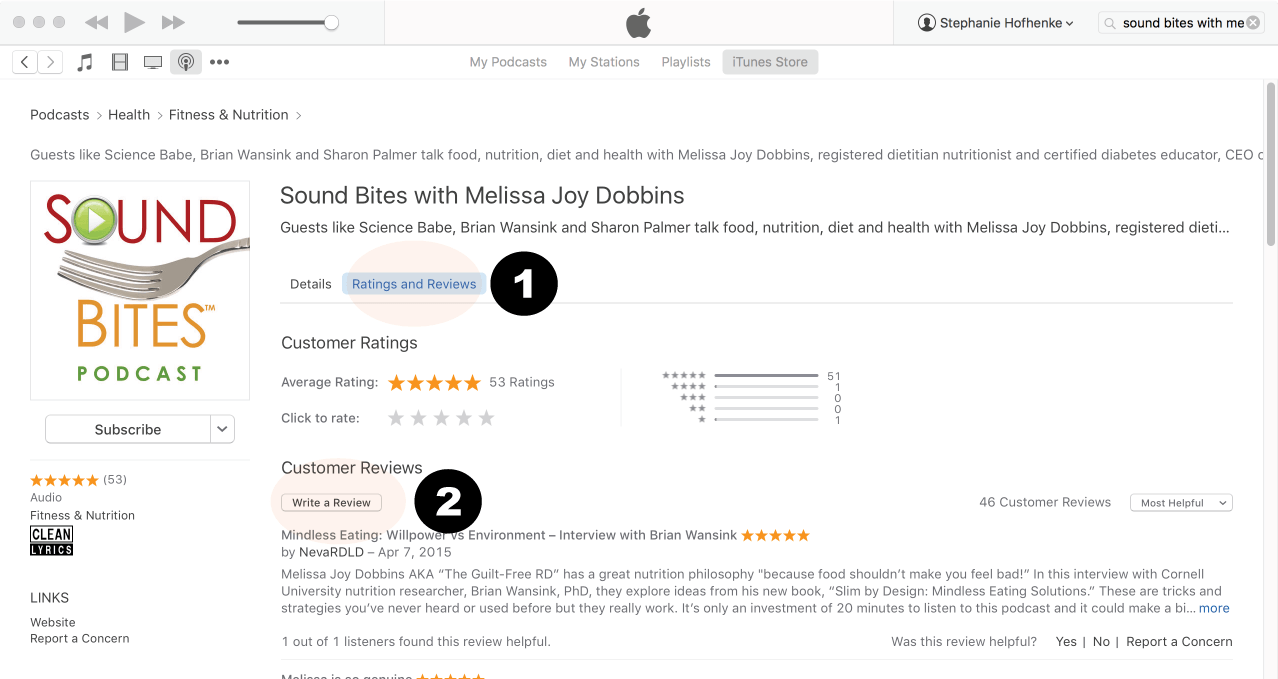
How to Review in iTunes
Open iTunes desktop application
Click iTunes Store
Click on Podcasts
Search for “Sound bites with Melissa Joy Dobbins”
Click on podcast image
Search for Sound Bites podcast in iTunes
Click Ratings & Reivews
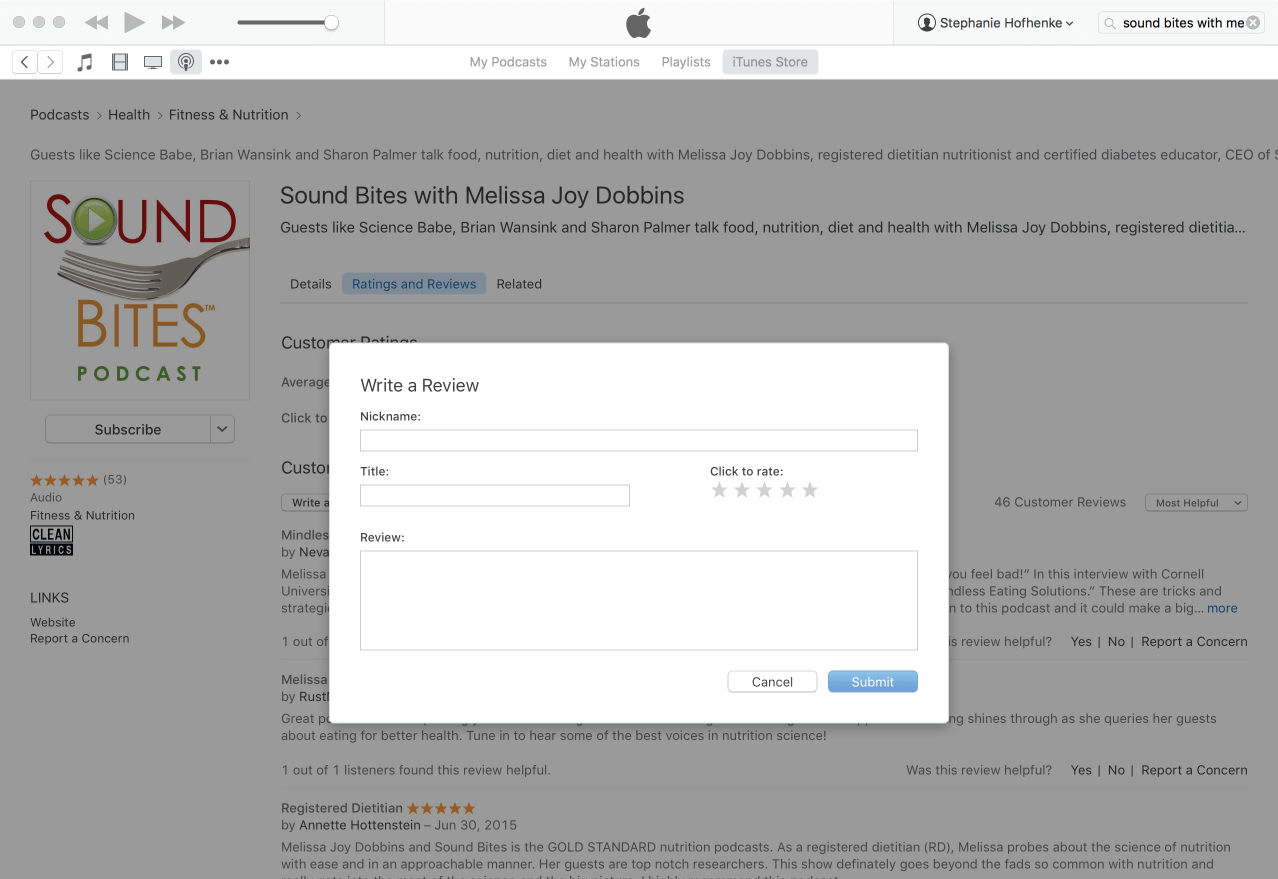
Click Write a Review
View reviews and write your own review.
Write your review…. Thank you!
Write your review!
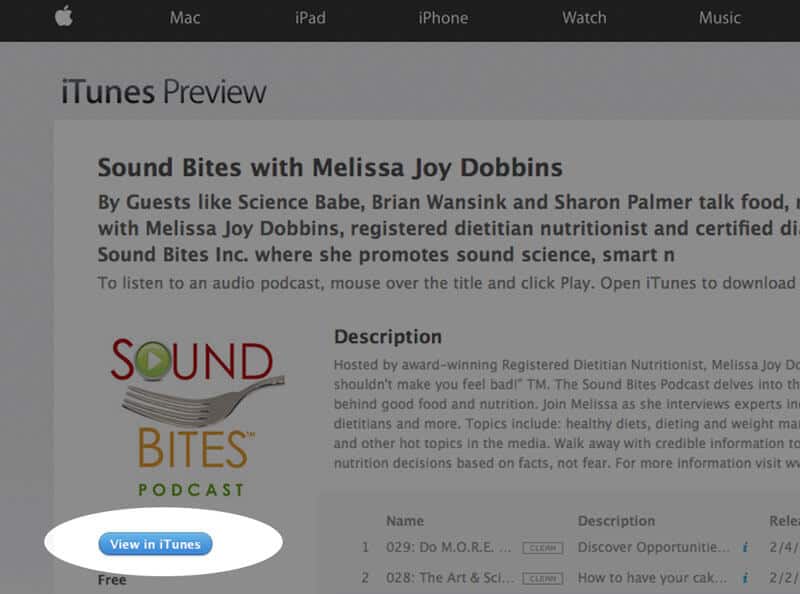
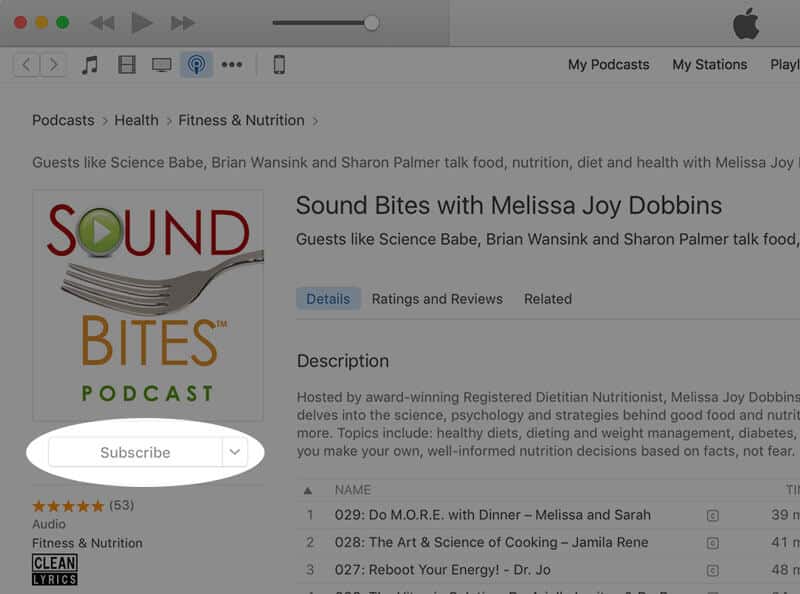
How to subscribe via iTunes
Click here to view the Sound Bites Podcastin iTunes, then click the blue “View in iTunes” button. This will open your iTunes application directly to Sound Bites Podcast. Click the “Subscribe” button, and your done!




















I could not get to quiz and certificate for this podcast. Please help
Hi Kim,
Thanks for reaching out. There are no CEUs for this particular episode. Only select episodes are submitted for CEUs.
If we decide later to submit for CEUs and they are approved, you can find the CEU activity on my free CEU page here: https://soundbitesrd.com/sound-bites-podcast-free-ceus/
Thank you,
Melissa
Hi Kim,
This episode has now been submitted and approved. You will see a link in the shownotes toward the top or you can access the activity here: https://soundbitesrd.com/sound-bites-podcast-free-ceus-episode-248/
Thanks,
Melissa