Celebrating over 1 Million Downloads and 50,000 Free CEUs on the Sound Bites® Podcast | NEW: Get 1 years’ worth of CEUs with the new 15-CEU Podcast Course
This episode was solely produced by Sound Bites® Inc.
Sound Bites, with support from Soy Nutrition Institute (SNI) Global, is offering 1.25 free CEUs for this episode.
Dietary fats and health outcomes: inflammation, cardiovascular disease and non-alcoholic fatty liver disease
We often hear that dietary fat is bad for us, that there are good fats and bad fats, and that the ratio of omega 3 to omega 6 fats in our diets is important. However, current research on the topic is more complex and nuanced. This episode addresses questions regarding how much fat Americans are consuming, what fat intake requirements and recommendations are and the current research on omega 6 polyunsaturated fats and health outcomes.
It is so critical that we got rid of trans fats from hydrogenation processing, but now we need to make sure our pendulum in nutrition doesn’t swing all the way over to the other side where we’re not getting our intake needs for polyunsaturated fatty acids.” – Dr. Martha Belury
Tune in to this episode to learn about:
Omega 3 vs omega 6 fats and the ratio of 3:6 fatty acids
Metabolic syndrome, adipose distribution and adiponectin
what NAFLD is and why it’s important to address this condition
dietary fats and inflammation
research on PUFAs and health
the role of oxylipins in fat metabolism and health
the different types of dietary fat and common food sources
fatty acid intake requirements and recommendations
essential fatty acids, linoleic and linolenic acid
data on U.S. fat intake
how different types of fat intake impacts health outcomes
The omega-6/omega-3 ratio was based on a nice simple pathway that you could write down with pencil and paper. But now we know that the ratio really isn’t relevant to the science that’s been done and to the clinical outcomes that we know polyunsaturated fatty acids play. So I am not a fan of using that ratio anymore – I think it’s outdated.” – Dr. Martha Belury
Martha Belury PhD, RDN
Martha Ann Belury, PhD, RDN, is the Carol S. Kennedy Professor of Nutritional Sciences at Ohio State University. Dr. Belury earned her BS in Nutrition/Dietetics and her PhD in Biological Sciences at the University of Texas in Austin. Dr. Belury conducts translational research to identify cellular targets of lipophilic bioactive compounds in the diet that affect energy metabolism and inflammation. With many wonderful collaborators and student mentees, Dr. Belury has authored over 120 peer-reviewed publications to reveal how dietary fatty acids and flavonoids modulate energy metabolism and inflammation in the contexts of cancer, obesity, type 2 diabetes and sarcopenia. Dr. Belury has mentored many undergraduate, masters and doctoral students. She is President of the American Society for Nutrition (ASN) and is an Elected Fellow in the American Association for the Advancement of Science (AAAS). The American Oil Chemists’ Society (AOCS) awarded her with the 2022 Ralph T. Holman Lifetime Achievement award for her work with dietary fats and health.
The world of polyunsaturated fatty acid science has gotten much bigger. We now know that the omega six to omega-3 ratio is simply not adequate to describe the amount of science that we understand behind polyunsaturated fatty acids. Polyunsaturated fatty acids really shouldn’t be split into a binary classification of either good or bad polyunsaturated fatty acids, because we know we need all those oxylipins to do their work to keep someone’s body healthy.” – Dr. Martha Belury
[00:00:00] Melissa: Hello, and welcome to the sound bites podcast. Today’s episode is about dietary fat, specifically omega six polyunsaturated fats and health, as well as health outcomes, such as inflammation, cardiovascular disease, diabetes, and non-alcoholic fatty liver disease. We often hear that dietary fat is bad for us and there’s good fats and bad fats.
But today we will discuss how much fat we are eating, what fat intake recommendations actually are. And the current research on omega six polyunsaturated fats and health. My guest today is Dr. Martha Belury. She’s a registered dietitian nutritionist with a PhD in biological sciences. And serves as the Carol S. Kennedy professor of nutritional sciences at Ohio state university. She conducts translational research to identify cellular targets of lipophilic bioactive compounds in the diet that affect energy metabolism and inflammation. She has authored over 120 peer reviewed publications to reveal how dietary fatty acids and flavanoids modulate energy metabolism and inflammation in the context of cancer, obesity, type two diabetes and sarcopenia. Welcome to the show Dr. Belury.
[00:01:17] Martha: Thank you so much, Melissa.
[00:01:19] Melissa: Would you like me to call you Dr. Belury or Dr. Martha or?
[00:01:23] Martha: Martha or Dr. Belury is perfectly fine.
[00:01:26] Melissa: Okay. Wonderful. I would love for you to tell us a little bit more about your background and your work, including any disclosures that you have to note regarding today’s episode.
[00:01:35] Martha: Okay. Let’s, let’s start with the easy stuff. First of all, I currently have a grant, a research grant funded by the United soybean board, The soybean nutrition Institute specifically, from that commodity group. I also am a scientific consultant for bath and body works. That’s very interesting. Yeah. And those are two, my, my two disclosures.
Okay. Thank you. Oh, I also am on the board of directors for the American society for nutrition.
[00:02:04] Melissa: Wonderful. So like I said, I’d love to hear about your background and the work you’re doing. And we’re going to talk about your research on polyunsaturated fatty acids. But we’d just like to get to know you a little bit more.
[00:02:16] Martha: Sure. Thank you. Well, a few decades ago, I was lucky enough to be a dietetic student at the university of Texas and was invited to do a summer research opportunity project as an undergraduate student. And at that point I had no intention of doing research, but the research project that I ended up working on was one looking at omega three fatty acids and omega six fatty acids in a mouse model for cancer.
And we hypothesized that omega 3 rich oil diets – omega three being cold water fish derived long chain omega-3 fatty acids would reduce the process of cancer formation in the mice. And we also thought the omega six rich oil diets would promote faster cancer development. But as we know in science, most of our hypotheses, while they’re based on very solid theories, don’t always pan out.
And in this case, we learned that the omega-3 fatty acids were not protective against cancer. And the omega six fatty acids actually were protective against cancer. So two very surprising findings. Wow. Really? Yes. Yes. And that’s not what you want your doctoral work to be. So when I found that we did publish, of course those data being opposite what we thought would happen, but important for the scientific community.
And that was really my first lesson in understanding that science very rarely is binary. It’s very rare that you see something works or it doesn’t work. Usually it’s somewhere in the middle. And that’s the case for polyunsaturated fatty acids that really I’ve been studying ever since then – only because they keep fascinating me and keep giving me findings that provoke more questions, and then make me have to study those questions.
[00:04:06] Melissa: Very good. Now like I said earlier there’s a lot of talk about dietary fat. We usually hear a lot about saturated fats and monounsaturated fats, and even the omega-threes, we don’t hear that much about polyunsaturated fats or the PUFAs – those omega sixes – the linoleic acid as well, but there’s a lot we need to know about it.
And as I mentioned, we’re going to talk about your research, but I think maybe a good place to start would be kind of just describing the differences in the various types of fats, saturated, unsaturated, the omegas and so on. So would you kind of walk us through a little primer or is it primmer on that?
[00:04:46] Martha: So it’s a great question. And there is a lot of confusion because the media uses different names based on what they think their readers or listeners are understanding – scientists even use different names. But there’s basically three types of fatty acids in the diet. There’s saturated, fatty acids as you’ve discussed.
And those are saturated, fatty acids or fatty acids that are in fats that are usually solid at room temperature. So if you work with say Crisco or lard or butter, or even the cream that might be on top of a non-homogenized dairy product, those are more saturated because they’re more solid. And then when you get unsaturated fatty acids, and there’s basically two types of unsaturated, there’s mono unsaturated, meaning they have just one double bond in their whole sequence of carbons.
Those start to be more liquid at room temperature. And then polyunsaturated, fatty acids are fatty acids, that when they’re in oils will be liquid at room temperature. And even if you put them in the refrigerator, they’ll probably stay as liquids for the most part. Okay. So those are the three main classes of fatty acids that are in all diets, but then there’s like sub categories.
So for polyunsaturated fatty acids, there are two sub categories and those are omega six fatty acids and omega three fatty acids. Okay. So for omega six fatty acids, We know most of those that we get in the diet are from vegetable plant sources. So all of our vegetable oils are primarily omega six fatty acids. Then omega three fatty acids can be in some of the vegetable oils, but then of the omega-3 fatty acids, there’s some that we particularly think are important in health.
Those are not as much in vegetable or plant derived sources. Those are the omega-3 fatty acids that we think of coming from cold water fish. Okay.
[00:06:45] Melissa: And really talking about solid at room temperature, liquid at room temperature. I remember talking with my patients about that. But then going even further to say most foods have kind of a combination of these fats, even oils have a combination.
They’re not all just one type of fat. So could you speak to that just real quickly?
[00:07:05] Martha: That’s right. And so you were completely correct about the fact that foods are a mixture of lots of different things. Even the oils that we consume are packages of nutrients. So if you think about corn, It has linoleic acid.
It has some mono unsaturated fat that we call oleic acid. It even has a tiny bit of saturated fat, even though it stays liquid at room temperature and it’s liquid because most of the fatty acids in corn oil would be polyunsaturated. But then corn oil has other things. It has some carotenoids, which give it a little bit of a yellowish color.
It has vitamin E and some other antioxidants that for the corn plant would help the corn, not oxidize. And so those, antioxidants are very important to the plant. And then we get those in the oils we consume, but then you’re right. Then you go to a mixed food, like a frozen chicken breasts, that’s frozen and maybe breaded for frying- it might’ve even already been cooked.
And that’s one of those things that you would warm up in your oven. Those will have of course other fatty acids in the breading around the chicken. The chicken itself has some oils that are rich in polyunsaturated fatty acids, the chicken will have different saturated fatty acids in different parts of the meat.
So foods get complicated.
[00:08:26] Melissa: Right, and I’d like to also talk about any insights or data you have on. How much fat and what type of fat we’re actually eating. I always kind of like to do a reality check with that because I think sometimes that information is a little surprising and it can lend itself to the conversation about – how does that compare to what fatty acid intake requirements and recommendations are?
[00:08:49] Martha: Yeah. So the fats that we’re consuming… for many years dietitians and other healthcare providers were telling people to reduce their total amount of fat. And we’ve learned that that was not probably the best recommendation – in part, because we know a lot of the fats we consume could be very healthful.
So we now recognize as the recommendation for most people to consume about a third of their calories or about 30% of their calories from fats, meaning fats that are in your foods, oils that you might add into dressings, et cetera. Of that 30% of your calories being from fat, less than 10% of those calories should come from saturated fat. And then the rest can come from mono and polyunsaturated fats. We know that people are in general consuming more than 10% of their calories from saturated fat, unfortunately. And this is true for people at all age groups. So even children are consuming more saturated fats than they should be.
[00:09:56] Melissa: And as far as total fat, do we know, are we consuming more than 30% of our calories from fat?
[00:10:01] Martha: That’s the good news. We’re actually pretty close to the 30% we hover around 34-35% on average. And of course that varies quite a bit with each individual, but on average in the United States, adults are getting about 30 to 35% of their calories from fat.
So that’s good. They are getting quite a bit of monounsaturated fat, almost 40% of the oils and fats we consume are monounsaturated fat. And then about another 25% are polyunsaturated fats. And again, the rest would be then saturated fat. So the monos and polys are okay to have in higher amounts. In fact, polys, we might want people to consume even more than they are – in place of those saturated fats that people are consuming too much of.
[00:10:48] Melissa: That makes sense. And we’re going to talk about the benefits of PUFAs, but I did want to ask you, because there’s been a long history of how dietary fats and cardiovascular disease have been studied over the past few decades or even longer. So I wanted to ask you, being in this space, what have you learned or what have we learned and what might be some maybe lingering misunderstandings or sometimes I think things kind of get oversimplified or maybe just outdated or unhelpful.
[00:11:19] Martha: Yeah, that’s a great question. So as science has evolved and our tools to study science and to study molecules has, has evolved and advanced, we have learned more and more about first of all, what causes some of our chronic diseases like heart disease, type two diabetes, some cancers. And so in the beginning of looking at heart disease and diet scientists recognized and discovered that vegetable oils, especially omega six polyunsaturated rich vegetable oils could lower total cholesterol in people.
And that significant finding was important because at that time there was a very strong correlation with total cholesterol and heart disease. Now jump forward that was about in the 1950s. So jump forward 70 years, we now know there’s several types of cholesterol that your body packages up into different lipoprotein types, like LDL, VLDL, HDL.
We know that some of those are beneficial lipoprotein cholesterol, some are not. So putting the whole understanding of – for instance, heart disease to a newer level. We now know that omega six fatty acids still are protective against heart disease, but it might be through some, some mechanisms that are much deeper than just lowering total cholesterol.
[00:12:42] Melissa: Yes. It’s not as simple as that. Right.
[00:12:43] Martha: It’s just not as simple as yeah. One effect.
[00:12:47] Melissa: Okay. Well, so let’s talk about fat intake and health. And one of the things that I learned from you is about non-alcoholic fatty liver disease. So I would love for you to explain what that is and why it’s so important for us to address this issue, how prevalent it is and what’s going on there.
And also some of the other benefits or just the research that you’ve been doing on PUFAs.
[00:13:12] Martha: Oh yeah. So that’s a great question. So some people have never heard of non-alcoholic fatty liver disease, partly probably because it’s such a long name for a condition. Where people who tend to have non-alcoholic fatty liver disease have basically lipids being stored or fats being stored in their liver, which is not where your fats should be stored. Your lipids or your fats should be stored in adipose tissue.
And so when the liver starts to accumulate fats, we call this non-alcoholic fatty liver disease and we associate this condition with central obesity and risk for both heart disease and type two diabetes. In fact the metabolic syndrome, which is a cluster of conditions that predict for both heart disease and type two diabetes – the liver manifestation of that is considered to be non-alcoholic fatty liver disease. So we know about a third of adults in the United States have non-alcoholic fatty liver disease. So it’s quite a prominent common problem. And currently one of the only ways to get rid of non-alcoholic fatty liver disease is to lose body fat or lose weight. Which is not easy for most people.
[00:14:30] Melissa: Right. What about children? I mean, we’re seeing increased risk of obesity or increased incidence of obesity and children.
[00:14:37] Martha: Yes. The scary thing is, is of course we’ve used to think of type two diabetes and even conditions that we know contribute to the metabolic syndrome.
We used to see these only in adults, but now we’re seeing all of these conditions in children, including non-alcoholic fatty liver disease. Where if a child is obese I think that the data say they have about a 50% chance of having fatty liver disease, unfortunately. Wow. Okay.
[00:15:06] Melissa: So how do polyunsaturated fats factor into non-alcoholic fatty liver disease and just fat intake and health overall?
[00:15:14] Martha: Great question. So we think actually both polyunsaturated fatty acids from the omega six family and the omega three family work to reduce fatty liver. For omega three fatty acids, it could be through the interaction of the omega three fatty acids with these proteins that turn on genes that then help the liver metabolize fats.
So that gets rid of the fats that are accumulated there. For the omega six fatty acids, we think the major one that people consume in particular, the linoleic acid, could be important again in increasing lipid metabolism to get rid of the lipids that are accumulating in the liver. We also suspect there could be some other mechanisms that we’re currently trying to understand.
[00:16:01] Melissa: Yes. So that’s a little counterintuitive that fat in the diet could actually help reduce fat in the liver.
[00:16:08] Martha: Yeah, it is. So often I tell people that we think of polyunsaturated fatty acids, both from the omega-3 and omega six families as not necessarily just substrates to make energy for the body, which is what we know fats are great for, which is why some people think fats are fattening, which is kind of a calorie is a calorie, is a calorie in general.
So that’s not quite true that fats are more fattening. They do carry a lot of energy within each molecule. But for polyunsaturated fatty acids, they seem to have a whole nother group of functions that are almost acting as signaling molecules in the cell. So they can tell a cell, for instance, to turn on how they metabolize fats as I just mentioned, they can tell a cell whether they want to use more carbohydrate for their energy source. Carbohydrates which are a different source of energy for your body. They can tell the cell whether the cell should change how it’s functioning. If it’s a liver cell, it might become less of a liver cell and more like a macrophage, which we’re learning cells can kind of adapt to their environments.
So fatty acids have a lot of – they have an active role in telling the cell how to respond to its environment. And that’s kind of exciting. So I consider – and I remind people that polyunsaturated fatty acids are more like signaling molecules, much like you would consider a hormone, say something like insulin or something else.
It doesn’t work like insulin, but it functions like that in terms of signaling and telling cells what to do.
[00:17:43] Melissa: Interesting. Okay. How does this tie in with inflammation? A lot of your research is focusing on inflammation. So explain that connection there.
[00:17:51] Martha: Yeah. So inflammation, it underpins a lot of the chronic diseases that adults are afflicted with United States and fatty acids is the polyunsaturated fatty acids, both the omega six and the omega-3 polyunsaturated fatty acids are metabolized to many different molecules, which we call Oxylipins.
These oxylipins get oxygen molecules integrated into the fatty acid molecule, and it actually helps your body process the fatty acids. So it can get rid of the fatty acid through an aqueous pathway like urinating or through defecation. So it helps the fatty acid be processed. So you can get rid of it because you’re constantly consuming fatty acids, which is good.
And then you want to get rid of them once your body has used the fatty acid and perhaps the fatty acid has undergone this oxidation. We know these oxidized lipids or oxylipins are also really important again, as signaling molecules to tell immune cells to work for instance, on wound healing or to work on opening up vasculature so that if you have a fever, more immune cells can flow into the area that might have an infection, say a viral, a bacterial infection to help get rid of that infected area of the body.
So inflammation is a good thing. When it’s the body responding to something that it has to get rid of, but then of course, the body has to resolve or get rid of that inflammation. And those same oxylipins that are derived from polyunsaturated fatty acids can do that too. They can help with resolution of inflammation.
[00:19:29] Melissa: We need inflammation, we just don’t want chronic inflammation.
[00:19:32] Martha: Exactly. And it seems to be that oxylipins are much more important as regulators of that acute or short-lived inflammation, but they’re not as important in chronic inflammation, which is sustained through other pathways. And I think there’s some confusion about that, that chronic inflammation is caused by oxylipins. The reason we know oxylipins are not the sole sustainer of this chronic inflammation is they’re very short-lived molecules. So in other words, once your polyunsaturated fatty acid is metabolized to an Oxylipin it is not sticking around very long, it is usually does its job as a signaling molecule, and then it’s excreted from the body.
[00:20:16] Melissa: Okay. And you mentioned metabolic syndrome and how with non-alcoholic fatty liver disease. You don’t want the fat in the liver. You want it in the adipose tissue. So I also wanted you to speak to – we’ve known this for a long time, sort of like the apple versus the pear shape. I would love for you to speak to that and kind of give us some more details. Is that still. The fat distribution matters, right?
[00:20:39] Martha: Yes. The fat distribution of our bodies matters so much. So if a person has a propensity genetically to gain body fat or adipose tissue around their mid region or trunk, or like you said, like an apple that is absolutely much more likely to increase chronic inflammation, increase insulin resistance and increase risk for heart disease and atherosclerosis. And we think that atherosclerosis – heart disease link is through that increased chronic inflammation. So what’s happening in, in people who tend to gain body fat in their trunk region is that that adipose or body fat is in between all of these organs that are very important in things like metabolism and respiration.
So things like your intestines, liver, pancreas, kidneys, lungs even a little bit higher, but that trunk region adipose seems to be a key part of what predicts for heart disease and type two diabetes. Whereas the pear shape type or pattern of weight gain also called gynoid because we usually associate that with premenopausal women’s tendency to gain body fat.
That one is actually not considered to be promoting risk for heart disease and type two diabetes. So pattern of, of weight gain or pattern of fat gain is still considered a very important predictor for chronic diseases and what we’re talking about with the metabolic syndrome.
[00:22:09] Melissa: And my guess is that peri and post-menopausal women, then that fat distribution is much more likely to be in the abdominal area.
And then that would speak to why we have increased risk for metabolic syndrome and cardiovascular disease, post-menopausal?
[00:22:25] Martha: Absolutely. You’ve got it correct. So we do think that postmenopausally, as, as women lose their estrogen, levels go way down during menopause and after menopause, we know that then women’s risk for heart disease and diabetes starts to spike up. And yes, you’re right. Unfortunately, that’s when we also tend to gain body fat in our mid regions.
[00:22:47] Melissa: Yup. Yup. I’ve seen that in myself, unfortunately, it’s definitely, definitely different. Well, you had mentioned about like the different types of saturated fat and unsaturated fat, and we talked a little bit about food sources, but I’d love for you to talk a little bit more about depending on the, the food source, for example, saturated fat, depending on the food source, does that have different impacts on our, in our body?
[00:23:16] Martha: Yes. So we know that of those three classes of fatty acids of saturated, mono and poly, generally saturated fatty acids promote basically actually weight gain in the mid region. They can promote fat accumulation in the liver and both of those things will then increase insulin resistance and have other negative impacts on one’s health.
And those would be linked to metabolic syndrome. We think that polyunsaturated fatty acids, just like I was talking about before the omega six and the omega-3 fatty acids could reduce fatty liver and may also reduce a person’s propensity to gain body fat in their mid region.
[00:23:59] Melissa: Okay. So shifting our diet, like you said, Trying to reduce that saturated fat intake and maybe have some more polyunsaturated fats could result in this shift inside our bodies with the metabolic health.
[00:24:12] Martha: Yep. And so it’s due to those signaling effects that polyunsaturated fatty acids have on cells that could help tissues like your liver burn more fat so that it doesn’t store fat there. We also know that polyunsaturated fatty acids signal muscles, like heart muscle, and skeletal muscle to use energy more efficiently to make ATP, to help your body move better while you’re exercising.
And many of the sources of polyunsaturated fats that are still available in the United States include things like soybean oil, which we see in most vegetable oils. So most of the time, if you look in the supermarket and you’re looking for an oil, that’s rich in polyunsaturated fatty acids, you might look at the vegetable oil labels, the ones that actually just say vegetable oil.
And if you turn the label to the backward gives you nutrient composition, it should say that more of the oil is polyunsaturated fat. And that way you know you’re getting a polyunsaturated fat, rich oil.
[00:25:15] Melissa: Right. And I, I learned that on a previous episode with Dr. Mark Messina. Years ago. I can’t remember which, which number it was, but I’ll link to it in my show notes.
But yeah, most of the vegetable oil that you see in the supermarket is in fact soybean oil. Yes. Yeah. Which we wouldn’t know – who knew? But there’s other types of fats too. But question keeps popping up into my mind because I remember hearing about the ratio of omega three to omega six. Is that a thing. And can you explain that?
[00:25:44] Martha: Great question because that omega six to omega-3 ratio was really what I was studying in my doctoral work. As I said, a few decades ago, it was three decades ago. So about 30 years ago. And at that time, we didn’t have a lot of information about all of the different metabolites that both omega six fatty acids and omega-3 fatty acids produce. Through Omex, which is this ability to generate lots of data.
So through lipidomics chemists have discovered that both omega six fatty acids and omega-3 fatty acids produced hundreds of different Oxylipin metabolites. When I started my doctoral work, it might’ve been about 20 to 30. So as you can understand, then maybe the world of polyunsaturated fatty acid science has gotten much bigger.
And we now know that the omega six to omega-3 ratio is simply not adequate to describe the amount of science that we understand behind polyunsaturated fatty acids. I like to remind my audiences, my dietitian audiences, and even my science audiences that science is complicated. It’s true. And polyunsaturated fatty acids really shouldn’t be split into a binary classification of either good and bad polyunsaturated fatty acids, because we know we need all those oxylipins to do their work to keep someone’s body healthy.
[00:27:13] Melissa: Okay. So the ratio is not, I’m trying to follow the science here. So the ratio, it was something that we were researching, but it just doesn’t play out as far as being effective?
[00:27:24] Martha: So the omega-6/ omega-3 ratio was theoretically, it was based on a nice simple pathway that you could write down with pencil and paper.
Now we know that the omega six omega three ratio really isn’t relevant to the science that’s been done and to the clinical outcomes that we know polyunsaturated fatty acids play. Okay. So I am not a fan of using that ratio anymore. I think it’s outdated. And it seems to be one though that doesn’t seem to disappear from the internet.
And I think it’s partly just because it gets propelled into new conversations.
[00:28:02] Melissa: Okay. And in your research, either your own research or just in the literature that you’re familiar with, I know this area very well, it begs the question that if especially all these decades of dietary fats and cardiovascular disease research, have you seen with a very low fat diet, because what I’m hearing from you is that the polyunsaturated fats, we should increase that a little bit, maybe decrease the saturated fat shift that balance a little bit, and that could provide some benefits. So if there was research on very low fat diets, what did you see there?
[00:28:35] Martha: So very low fat diets, which were very difficult for people to follow – most people. Some people could follow them without too much trouble, but they would lack in having polyunsaturated fatty acids sources because you’re limiting all fats, both solid at room temperature and liquid at room temperature. So those could have some benefits. But I would guess, and this wasn’t really to my knowledge done very well. If you’re following a very low fat diet or you’re following any diet at all, and you’re losing weight, it’s often difficult to tease out what was from the lowering your fat in the diet versus what is from actual weight loss in terms of how it benefited people for instance, for heart disease risk, or diabetes risk.
So I haven’t looked too much in the past few years, but when those research studies were coming out and that was about 10 or 20 years ago, there wasn’t a lot of good information to tease out again, whether the effects of the low fat diet were from weight loss were from the low fat itself. And again, those low fat diets, especially the very low fat diets were very difficult for people to follow long-term.
[00:29:54] Melissa: Right. So at the end of the day, if it’s not realistic, it’s not that effective. Exactly. What about linoleic acid? What is it? Why is it so special?
[00:30:03] Martha: Yeah, so linoleic acid is probably the simplest polyunsaturated fatty acid that you get in your diet. And the reason I say simplest is it is a poly unsaturated fat fatty acid has two double bonds.
So it’s a mono unsaturated, fatty acid would only have one double bond. So it’s the simplest poly, cause it only has two double bonds. And it’s one of the only two double bonded polyunsaturated fatty acids that you consume. So having only two double bonds gives it a good liquid kind of mobility as a molecule.
So at room temperature, and even in the refrigerator, linoleic acid, rich oils will stay liquid. It seems to be, it’s a precursor for many oxylipins, as I’ve already mentioned, those oxylipins, which are metabolites from fatty acids that act very potently as signaling molecules. And linoleic also has a function in serving as a structural component of the mitochondrial membrane.
And the reason that mitochondrial membrane is important is that’s where ATP is made ATP is that energy form that your body needs to use to make your muscles move, make your heart beat, make your body digest food, all of the different actions that your body has. Getting up from a nap, all of that is requiring energy and all of that energy is made in the mitochondria.
So linoleic acid being important in mitochondrial structure helps with your body burn energy in the mitochondria. So we think linoleic acid is important for many different reasons. As I mentioned, 70 years ago, people were showing that it lowers total cholesterol. And then jump forward a few decades, ww now know that it’s a signaling molecule and it produces hundreds of different signaling molecules. And now we’re understanding, it seems to be important in mitochondria membrane structure, which helps with energy metabolism.
[00:32:04] Melissa: And is it more stable because it has those two double bonds?
[00:32:07] Martha: So it, it seems to be it’s more stable than polyunsaturated fatty acids that have a lot of double bonds, meaning it will oxidize just like any double bond. It will pick up an oxygen, but once it does that, there aren’t any more places for oxygen’s to be picked up. Okay. So having only two double bonds, it can be oxygenated in two potential spots, but a fatty acid that has five or six double bonds can be oxygenated at five or six spots.
And that fatty acid with five or six double bonds, if it’s oxygenated, is a free radical promoting oxygenated fatty acid, which leads us down that path of oxidative stress.
[00:32:49] Melissa: Okay. So linoleic acid is a special polyunsaturated fatty acid that is less oxidative in the body. That’s true. I’m with you. Now there’s another type of fatty acid that we haven’t talked about yet that has gotten a lot of news in the past.
Oh, I don’t know, five, 10 years – the trans fats. So what do we need to know about those?
[00:33:14] Martha: Yeah. Trans fats are a type of polyunsaturated fatty acid or mono unsaturated fatty acids. So trans fats that we’re talking about, usually when we talk about trans fats and in the media, and in most science around trans fats are referring to trans fats that form upon hydrogenation.
So, let me back up for a minute. Think about when you’re using a liquid oil in baked products. It doesn’t do very well for things like helping the baked product form steam. For instance, if you’re talking about a quick bread, you want some steam to form in between the gluten so that the quick bread can rise a bit.
Well with saturated fatty acid, if you use something like lard, it will help those pockets form better. It helps the mouthfeel of the food. It also is more stable so that it can last longer, both in the food product on your shelf and the food product on the shelf, in the market in the supermarket. So when we hydrogenate oils, what we’re doing is we’re taking a liquid oil and we’re making it solid and that’s called hydrogenation or partial hydrogenation.
And you see partial hydrogenation on labels because it’s very difficult to get full hydrogenation of an oil. So some of the oil doesn’t get this process known as hydrogenation. But the problem with hydrogenation is, it does form more solid fat, which we have already discussed. We only need 10% of our calories from saturated fat.
So we don’t need a lot more of that in our diet already. But then the other problem that happens when oils are partially hydrogenated is that these accidental molecules form. So they’re not meant to form, but they do form and they’re called trans fats. We know that trans fats in animal models, but also in humans is highly highly correlated to increased risk for heart disease and possibly other diseases like type two diabetes. So these partially hydrogenated trans fats that form are definitely molecules we want to avoid. And they’re forming from synthetic processing of the oils to make them solid at room temperature.
[00:35:25] Melissa: Right, so we went through this phase years ago, trying to decrease the saturated fat in foods by replacing them with partially hydrogenated trans fats, and then realized, oh, that’s even worse.
And we need to get those out of the food supply. So manufacturers and food products had to take the trans fats out and zero trans fat on label. But there are trans fats that are naturally occurring in some foods though, right?
[00:35:54] Martha: Yeah. So by the way, that was a perfect description of how this has evolved.
And it’s another great illustration of we, we scientists came up with this great way to make an oil solid by hydrogenation. And it was really state-of-the-art when it was discovered. And through science evolving and producing more and more data and helping our understanding of how foods impact the body, then we discovered that some of those fats could promote trans fat formation and then in the body can promote disease risks. So that is a great illustration of the evolution of how science is always changing and nutrition science is always changing. Then there’s a whole nother class of trans fats that, it does get more complicated.
Right? I just was saying how science is complicated. There’s another class of trans fats that actually form naturally. In some animal derived fats that we get and fats and oils, and these are called conjugated dynoic fatty acids. These fatty acids can have trans bonds in them, but the way that trans bonds are configured in the double bond and with a double bond next to it – it’s hard to describe without showing it on a diagram, but these are different types of trans fatty acids.
And we think that some of these are processed like more naturally occurring polyunsaturated fatty acids that you get in naturally in foods. So there’s a synthetic form of trans fats, which we know are very promotive against to make your risk for heart health and maybe diabetes increase. And then these naturally occurring trans fats, as we call conjugated linoleic acid or conjugated, dynoic linoleic acid.
Those are natural and those don’t seem to promote a heart disease. And what foods are those in naturally occurring? Trans fatty acids are in foods such as ruminant derived meats, ruminant derived dairy products and so forth. And it’s because the rumen of ruminant animals, that set kind of extra part of the stomach contains bacteria that can make these naturally occurring trans fatty acids.
[00:38:08] Melissa: That is very interesting. So back to the is there anything else that we need to know? I know we’re going to talk about some practical takeaways and everything, but what’s going on in the research now? I think there’s high oleic acid oils, and I’m not sure what those are.
[00:38:24] Martha: Oh, okay. Yeah, that’s a very good question.
So because of these synthetic trans fats being discovered to have promotive effects for increasing risk for heart disease and other chronic diseases, there was a very stellar and I mean, impressive response from the food industry and the food industry has sought out and helped with reducing our trans fat content of our foods.
They did that in part because the FDA required that any food that had more than a half a gram of trans fat in a serving would have to label that very clearly that the product contained that trans fat, but they also did it because they knew longterm sustainability – they didn’t want trans fats in the foods of their consumers.
So what food manufacturing companies did was they helped the firming process of these sources of polyunsaturated fatty acid oils to become richer in mono unsaturated fatty acids, and particularly oleic acid. So by doing that, they’ve taken what used to be a good source of polyunsaturated fatty acids, something like sunflower seed oil and sunflower seed oil is now high in mono unsaturated, fatty acid, oleic acid.
That’s great because when one double bond is hydrogenated or partially hydrogenated, there still are a few trans fats that form, but it’s half as many as when there were two double bonds or even three double bonds in those vegetable seed oils, things like sunflower, canola, soybeans. So that’s the good news is now we have a very nice reduction of trans fats that are formed from hydrogenation in our food products.
Unfortunately, though, now we have oils that are sold in the United States that are not higher in linoleic acid and its other essential fatty acid partner, alpha linolenic acid. And so now we have oils that might be low in those two polyunsaturated fatty acids – that we know everybody needs a certain amount of per day.
So there’s a, trade-off, there’s a trade off. I do think people will be able to find enough essential fatty acid or polyunsaturated fatty acids that we need by looking at their labels and making sure that the vegetable oils that they’re buying, first of all, say vegetable oil on the front, and then on the back will show how much polyunsaturated fatty acid is in a serving of that.
But it’s going to be where I think people are going to have to be a little more intentional and have to have education to be able to do that.
[00:41:12] Melissa: For sure. Yeah. This is not something that you hear much about, like how to increase your PUFAs. Right. And that linoleic acid in particular.
[00:41:22] Martha: Right. And so I want to emphasize that it is so critical that we got rid of trans fats from hydrogenation processing.
Now we need to make sure our pendulum and nutrition and dietetic counseling doesn’t swing all the way over to the other side where we’re now missing, getting our intake needs for polyunsaturated fatty acids.
[00:41:44] Melissa: Right? So you’ve done a lot of your own research studies and then there’s other research studies that I know that you speak to when you present and yes, this is not a webinar, so we don’t have that visual aspect but was there a particular study or studies that you wanted to share some highlights with us?
[00:42:03] Martha: Some studies that really piqued my interest after some of -looking at some of our results in the lab. And then going back to the literature to try to understand why we found what we found, were really surprising or striking in that many studies.
It seems have come out to say that linoleic acid is not only protective against heart disease, but may have some protective role against type two diabetes. The reason that was surprising is I was not aware as a researcher or a dietitian, that linoleic acid could be protective or have an association at least for protection against type two diabetes development.
Yeah, I wasn’t aware of that either.
Some of the research studies that have shown that linoleic acid is associated with lower risk for type two diabetes, and also can cause the body to be more insulin sensitive, have pitched the idea that it might be perhaps through some of its Oxylipin metabolites, those things that develop from linoleic acid that could be helpful for signaling different tissues to respond to its environment, their environments.
One of the things that a recent study has shown is that in people with central obesity, so most likely they have some metabolic syndrome risk, and people with central obesity, when their diets were fortified with the linoleic acid rich oil, their liver fat or fat in their liver actually was reduced. And so maybe that’s one of the ways linoleic acid is reducing risk for type two diabetes and increasing insulin sensitivity.
[00:43:45] Melissa: Improving that metabolic health.
[00:43:48] Martha: Right. One of the main ways that type two diabetes forms is we know it it’s higher risk of type two diabetes and people with central obesity, but it’s when their bodies start to develop this condition called insulin resistance, where their pancreas can pump out insulin, but their tissues can’t pull up glucose in response to that insulin. And we call that condition insulin resistance.
[00:44:13] Melissa: Right. And then the pancreas puts more and more out and. It has to sort of flood those tissues in order to get it to uptake and then the pancreas can wear out.
[00:44:23] Martha: That’s exactly right. And then when the pancreas starts to get worn out the pancreas cannot keep up with all of the insulin resistance that’s developed, and that’s when we see that conversion from being a pre-diabetic person to one with full blown type two diabetes.
[00:44:38] Melissa: Yeah. Those blood sugars start increasing. Right. So you mentioned earlier that saturated fat contributes to this non-alcoholic fatty liver disease and that the polyunsaturated fats can help decrease the fatty liver.
So I’m just curious would it makes sense if we can decrease our saturated fat intake and increase those PUFAs a little bit, not only could we see metabolic improvements, but could we potentially see weight loss?
[00:45:05] Martha: Well, I think we could. There have not been long-term well powered studies, meaning studies that have enough people in them, to really look at full weight loss. There have been a few studies, including one in my lab. But studies by other investigators as well, showing that diets that are fortified with the linoleic acid rich oil can reduce trunk fat. So adipose in the trunk region, just like we want to do if we’re going to lower risk for diabetes and heart disease and can also lower the fat that’s in between all the tissues in the trunk, which is that visceral fat or that adipocytes between the things like liver, kidneys, intestines, pancreas, etc.
[00:45:52] Melissa: Well let’s, this has been a lot of science and I’m like I said, I’m following, but let’s try to wrap this up with a nice bow, if we can, with some practical takeaways for our listeners my audience is a mix of the general public and healthcare professionals, especially dietitians but there are nurses and physicians listening as well as diabetes educators – based on where the research is now, what would be some practical takeaways?
[00:46:19] Martha: I think that one of the things that comes back to me when I talk to my research colleagues and my dietitian colleagues and physicians and nurses is the understanding that things that we discovered or scientists discovered decades ago are still true. And we also need to recognize that science has gotten more complicated because we’ve learned more, we’ve developed more tools to study health and disease and nutrition.
That’s a great thing, but we don’t want to oversimplify the message so much that we’re giving our patients and our consumers and clients, the wrong message. And one of those messages that I really hear is interpreted, in my opinion, in the wrong way, is that there’s a good group of polyunsaturated, fatty acids and a bad group of polyunsaturated fatty acids.
It simply is not that simple. It’s not a black or white situation. It’s not a binary classification that we can still use. We now know that’s incorrect in the world of polyunsaturated fatty acids.
[00:47:26] Melissa: I love that. Simply not that simple. Yes. That’s a great soundbite, Dr. Martha. Thank you. So beyond that, I mean, that’s just a wonderful sort of top line, like you said, what we studied is still true, but it has gotten more complicated. We have more tools. We’re kind of getting in the weeds and we don’t want to give our patients and clients wrong advice or misguided advice, but I think we can all agree, we want to try to decrease the saturated fat in our diet.
Yet there’s different types of like, we touched on a little bit, but if there’s more, you wanted to say about food sources, I’m all ears. But we definitely don’t want to think about good fats and bad fats, just what those functions are in the body, but can we make a recommendation besides decreasing the saturated fat in our diets that increasing those PUFAs a little bit, but keeping our total fat reasonable around 30% of our calories?
[00:48:24] Martha: Yes. So some foods might be better than others for us. The same message is true for fats. Saturated fats provide lots of good qualities for our foods, our taste, and our enjoyment and pleasure of eating those foods. Absolutely important for compliance to eating healthy foods.
Healthy foods can have some saturated fats in them, but we do want to keep our saturated fats below 10% of our calories. And we want to keep our fat calories in general below 30 to 35% of our calories. So we want to keep our saturated fats below 10% of our calories. And we want to keep our total fats below 30 to 35% of our calories.
We also want to keep thinking about increasing our polyunsaturated fatty acids. And one way I remind people to maybe remember this recommendation is that poly means many. And we want many of those polyunsaturated fatty acids. Kind of like a variety. Yes. Yes.
[00:49:31] Melissa: Yeah, it just reminds me of how we need a variety of foods.
So we get a variety of nutrients.
[00:49:36] Martha: That’s right. And through all of the great wonders that our plant growers and our horticulturists have done to improve our food supply. We just need to make sure we don’t swing too far in one direction and get rid of all of our oils that have polyunsaturated fatty acids in them.
And soybean oil is one of the best sources because we know that’s one of the prominent oil sources for what is called vegetable oil in the marketplace. So if you see a bottle of oil on the shelf in your supermarket, and it says vegetable oil, most of the time, it’s either soybean oil or soybean and canola oil.
That is the kind that is still rich in polyunsaturated fatty acids.
[00:50:17] Melissa: Okay, great. And since you’re a dietitian, I wanted to take this opportunity to ask you what your thoughts are on dietitians counseling patients. I mean, we’ve touched on this a little bit. I’d love to hear more of your thoughts on how dietitians can counsel and maybe what the limitations might be there.
[00:50:35] Martha: Well, there was an American Heart Association paper that came out in 2017 and it likened the consumption of poly and saturated fatty acid rich oils to the impact of statins on reducing deaths due to heart disease. In that article, that almost took my breath away, because what that’s telling me is we have a very simple dietetic tool to reduce heart disease.
The number one killer in the United States. But we’re not getting that message to either our cardiologists, our clinicians or dietitians. And unfortunately, when it gets to dietitians, we don’t always get it to patients because of reimbursement. And I’m not sure that that’s the reason that, that message in that American heart association paper isn’t getting to our patients.
But I do suspect that if we can’t get dietitians into a patient’s room, because they’re not reimbursed through insurance needs, we can’t really have the impact that I think is possible in the United States to improve health with food.
[00:51:50] Melissa: Very powerful. Very well said.
[00:51:52] Martha: Thank you. Is that too opinionated?
[00:51:54] Melissa: No, it’s awesome.
[00:51:58] Martha: We need to get reimbursement, Melissa. How are we going to do this?
[00:52:00] Melissa: Right from your mouth to God’s ears, right? Or the insurance company’s ears. I
[00:52:06] Martha: dunno. Oh boy. I might be struck down. Actually. It would help them, I believe.
[00:52:13] Melissa: Right. So this has been a lot of information. Very helpful. Very enlightening. Where can people find more information about polyunsaturated fatty acids and perhaps your research and recommendations?
[00:52:26] Martha: Well, there’s a couple of places. I know some of the plant seed oils that produce our edible oils in United States. For instance, the soy nutrition Institute, the California Walnut commission, many of those websites have some really good information on polyunsaturated fatty yet. Okay. Great. In addition, the academy of nutrition and dietetics has an excellent resource of what fatty acids to consume.
And the American heart association does a really good job of keeping up their web information about current up-to-date science.
[00:53:02] Melissa: Okay. Great. So it sounds like it’s not really hidden away, so I will include links to all of those in my show notes. Thank you. Yeah, that would be great. And since we’ve talked about soybean oil and at the top of the interview, you disclosed that you have a grant with the soil nutrition institute,
I like to ask my guests this, when I have the opportunity is what do you say to people who criticize industry funded research as being biased?
[00:53:25] Martha: One of the things I usually remind people about industry funded research is that every drug that has been prescribed or is over the counter has also been industry funded.
And I’m not saying that with tongue in cheek, those research findings were done with, I hope and I suspect with a lot of rigor, the same is true for nutrition and food research that’s funded by industry. When I enter into a contract for a commodity funded project and this one being the soy nutrition Institute from United soybean board, I am entering into a contract that clearly states I am the designer of the experiments. I am the interpreter of the experiments, and I’m the person who disseminates our findings to the scientific community through peer reviewed publications. My reputation would be on the line if I didn’t do it with the utmost rigor that I was taught as a PhD student, and that I continued to uphold in my research lab.
So. I think it would be wonderful if our federal dollars could fund all the nutrition health research in United States but unfortunately that’s just not true. And so just like every other aspect of health research, there is some industry funded research and it’s for good reason because foods do change and they’ve changed quickly in the oil market. So the United soybean board has a very vested interest in really understanding how is their product impacting health. And that’s exactly what I’m testing is whether it does impact health. And in this case non-alcoholic fatty liver disease.
[00:54:58] Melissa: Well thank you again for sharing all of this enlightening information with us.
And like I said, I’ll have links to research your research and some of these sites that you mentioned that have practical takeaways for consumers and for healthcare professionals. I’ll put those in my show notes at soundbitesrd.com. But thank you again, Dr. Belury for coming on the show. I really appreciate it. You are very welcome, Melissa.
And for everybody listening as always enjoy your food with health in mind and some PUFAs. Till next time.
LISTEN, LEARN AND EARN
Listen to select Sound Bites Podcasts and earn free CEU credits approved by the Commission on Dietetic Registration (CDR) for registered dietitian nutritionists and dietetic technicians, registered. Get started!
Get Melissa’s Sound Science Toolkit here!
Partnerships:
Sound Bites is partnering with the Association of Diabetes Care and Education Specialists (formerly the American Association of Diabetes Educators)! Stay tuned for updates on the podcast, blog and newsletter!
Sound Bites is partnering with the International Food Information Council! Stay tuned for updates on the podcast, blog and newsletter!
Sign up for my monthly newsletter and episode eblasts so you never miss an update!
Listen on Stitcher (Android)
Install the Stitcher App
1. Search for “sound bites with melissa joy dobbins” 2. Choose Play Current Episode or Add to Playlist
Choose “Play Episode”
Subscribe & Review on iPhone
Open the “Podcast” app on your iPhone
Search for “Sound bites with melissa joy dobbins”
Open the podcast and click “Subscribe” and your done!
Write a Review
Click “Reviews”, then “Write a Review”.
Subscribe via RSS Feed
Navigate to any podcast player . Click on the RSS feed icon.
Click on the RSS feed icon.
Click on RSS Feed
Choose which application you would like to use to receive the RSS feed
Click “Subscribe Now”
Confirm settings and subscribe.
How to Review in iTunes
Open iTunes desktop application
Click iTunes Store
Click on Podcasts
Search for “Sound bites with Melissa Joy Dobbins”
Click on podcast image
Search for Sound Bites podcast in iTunes
Click Ratings & Reivews
Click Write a Review
View reviews and write your own review.
Write your review…. Thank you!
Write your review!
How to subscribe via iTunes
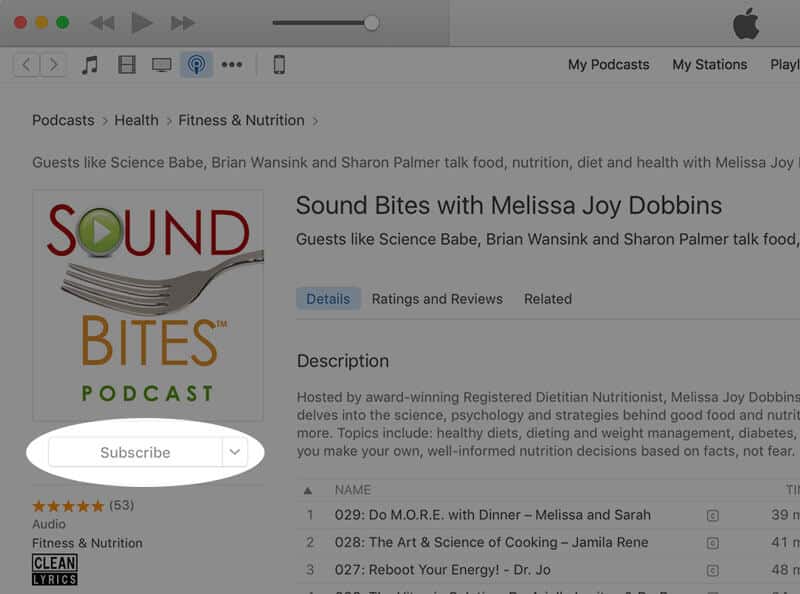
Click here to view the Sound Bites Podcastin iTunes, then click the blue “View in iTunes” button. This will open your iTunes application directly to Sound Bites Podcast. Click the “Subscribe” button, and your done!