Celebrating over 1 Million Downloads and 50,000 Free CEUs on the Sound Bites® Podcast | NEW: Get 1 years’ worth of CEUs with the new 15-CEU Podcast Course
The International Food Information Council (IFIC) conducts consumer research focused on attitudes and behaviors surrounding nutrition, food safety and food production. Their popular annual Food & Health Survey provides information about how Americans connect food and food purchasing decisions to physical health and overall wellbeing. Other consumer surveys IFIC conducts, called “Spotlight Surveys”, focus on various topics and also inform federal regulatory decisions, provide members with insights into consumer values and behaviors and help to shape public communications and education initiatives.
Tune into this episode to learn about:
key takeaways on surveys focused on three trending topics
why IFIC wanted to do a survey on snacking
if snacking is becoming more prevalent
what constitutes a “snack”
what consumers are looking for in a snack
opportunities to leverage snacking for better nutrition
how sodium impacts our eating experience beyond “taste”
how much sodium Americans are consuming compared to recommended intakes
the top sources of sodium
recommendations for decreasing sodium intake
where public sentiment is about the safety and healthfulness of low and no calorie sweeteners (LNCS)
what consumers think about Stevia and Monk Fruit
thoughts on where the evidence is on safety and effectiveness of LNCS
Milton Stokes, PhD, MPH, RD
Milton is the Senior Director, Food & Nutrition at the International Food Information Council where he focuses on science communication and consumer perceptions of health and nutrition. He has been at the intersection of food, agriculture, and nutrition for the last 10 years working on some of the most urgent issues facing people and planet–issues like food and nutrition security as well as sustainability. Milton has a master’s degree in Public Health from Hunter College – City University of New York, and his clinical nutrition training was conducted at Yale-New Haven Hospital affiliated with Yale University School of Medicine. His doctoral degree, from the University of Connecticut, is in Communication and Marketing with a specialization in Health Communication.
Resources
Some links may be affiliate links. As an Amazon Associate, I earn from qualifying purchases.
Transcript Speakers: Melissa Joy Dobbins & Milton Stokes
Voiceover: Welcome to Sound Bites, hosted by registered dietitian nutritionist, Melissa Joy Dobbins. Let’s delve into the science, the psychology, and the strategies behind good food and nutrition.
Hey there, if you’re a dietitian and you’re trying to fulfill your continuing education requirements, be sure to check out my free CEU activities. I have nearly three years worth of free CEUs you can receive by listening to my podcast I also have a CEU package on sale for one year’s worth of continuing education credits, which offers the convenience of taking only one quiz and receiving one certificate for all 15 credits.
Simply go to my website at soundbitesrd. com slash free CEUs for all the details.
Hello again. This is part two of my conversation with Milton Stokes. On this episode, we will discuss three different surveys conducted by the International Food Information Council with insights on snacking, sodium, and sweeteners. But be sure to tune in to part one to hear all about IFIC’s new science communication guide. Enjoy the show.
Melissa Joy Dobbins: So, let’s talk about snacking first. This report was in August of 2024. I’d love to hear some key takeaways. I would start off by saying, why did you even study snacking? Is it becoming more prevalent? What are you seeing there?
Milton Stokes: Yeah, sure, Melissa, thank you. And I also want to remind the listeners, I think some of your listeners are dietitians and they know IFIC, but there may be consumers or others who are not completely familiar with our organization.
So, we do all types of consumer research. We have our huge food and health survey that happens annually, we’ve done that for 19 years. This year, 2025 will be the 20th anniversary of the survey. So that’s a big, big undertaking.
We also do monthly what we call spotlight surveys or pulse-type surveys. They’re shorter, 10 questions, not a lot of real estate. We have to quickly get right to the point of what we’re interested in. And so, that’s what we have here, is we’ve got one on snacking and we’ve got a couple of others that I think we’re going to talk about as well.
So, just with that foundation, Melissa, you asked what was the motivation I think around IFIC doing this snacking survey. And that takes us back to why I was just spending a second talking about the food and health survey because when we did the food and health survey in 2024, what we learned is that 74% of Americans, they tell us that they’re snacking at least once a day. And just over half, 56%, they say that they’re replacing traditional meals with snacking or by eating smaller meals, many meals, for example.
So, what we are thinking, and others would agree, is that snacking is becoming (if it has it already) its own eating pattern. And I would say, and you might agree, Melissa, snacking or mini meals, small frequent meals, it’s been around for as long as I’ve been a dietitian. And I did a quick Google search earlier because I knew that I had covered this topic for Men’s Health Magazine.
So, 20 years ago, I was writing about this, and it must’ve been popular because my editor assigned it to me at the time.
Anyway, so snacking, we wanted to see what consumers/what were they thinking about when it comes to their snacking practices. And we also wanted to focus on snacking because as long as I’ve been a dietitian, Melissa, it’s one of those practices that often gets demonized or criticized: “Snacking is going to ruin your dinner, snacking is going to ruin your diet, snacking is going to ruin your whatever,” fill in the blank.
It gets blamed for a lot of things, but we were coming at this as maybe a way to close nutrient gaps and boost diet quality. So, just like a regular breakfast, lunch, and dinner, you could use your snack to meet other nutrient needs. So, that was what was behind our motivation and how we were approaching this.
Melissa Joy Dobbins: And what are consumers looking for in snacks?
Milton Stokes: We found a few things that were interesting. I know we’re just going to maybe go through some of the highlights of these surveys, but we do post all of these results, all of the reports info on our website, which I know you’ll probably provide in the show notes, foodinsight.org.
Melissa Joy Dobbins: Yes, absolutely.
Milton Stokes: Yeah. So, when you ask about what they’re looking for, probably no surprise – consumers mostly want something that’s sweet and then salty when it comes to their snacks. They also want something that they think is healthy and portable, so maybe it’s on the go, it’s easy, it doesn’t require a lot of fuss.
And then their favorite food group for snacking is fruit. And I think that ties back nicely to this idea of portability. I think it ties back to what we were talking about just a moment ago around diet quality and filling nutrient gaps.
Think about how many people in America probably have some sort of fruit bowl or fruit that’s out on their counter and it’s easy and it’s sweet. So, it checks a lot of boxes for them. So, fruit got a lot in our survey.
Melissa Joy Dobbins: I love that.
Milton Stokes: Yes.
Melissa Joy Dobbins: What other opportunities are there to leverage snacking for better nutrition? How can we help make it more of a focus of filling those nutrient gaps? And earlier you said people want something healthy, but then I thought you were going to follow up, “But also indulgent. They want it all.”
Milton Stokes: They want it all, and they do want indulgent, and that’s okay too, there’s room for that in the diet. But when it comes to this survey, just a couple of things that stood out for us. When I was in private practice and when I was working with clients, I noticed that as the day progressed, diet quality often went down.
And why is that? Is it because people are tired? Is it because they are rushed? Is it because they didn’t get to the grocery yet, so they just have to grab whatever they have at home? Are they making some of the decisions that aren’t planful and mindful? I don’t know.
But in the survey, what we saw is for snacking, diet quality does decline (or at least this is what consumers tell us) as the day goes on. And so, that’s one, I think salient point to think about maybe after dinner, what’s going on in the snacking department and do we need to make any nudges or suggestions, or help set consumers up for a little bit more success there?
The other thing, Melissa, that we saw is most people, they tell us that they snack spontaneously. Two out of three people, they snack whenever the urge strikes, and that makes sense to me. I mean, I work from home, and so the kitchen is downstairs from my home office, and I don’t plan what time I’m going to eat a snack. I wait until I feel like, “Oh, maybe I’ll go grab a banana or I’ll grab some raisins and some almonds.”
But maybe what we could do then with these couple of findings is think more about guidance on healthy portable snacks. I know there are a lot of resources on that, and even at IFIC, we’ve got tips and advice on our website. But Melissa, those were just a couple of the big takeaways from that spotlight survey on snacking.
Melissa Joy Dobbins: Very interesting. I love that the favorite snack is fruit. I did not know this, I’m very encouraged to hear this. I’m always saying on the podcast that 9 out of 10 people are not getting enough fruit and vegetables.
Milton Stokes: If you think about where we are in terms of diet quality, and nearly nobody in the United States gets enough fruits and vegetables, it’s like, oh, maybe the stars are aligning, and we could somehow take advantage of that when we’re planning and advising clients and patients.
Melissa Joy Dobbins: Yeah, absolutely. And a piece of advice that dietitians tend to give people that aligns with what you’re saying is, yeah, it makes sense that maybe you don’t plant all at two o’clock I’m going to have a snack and this is what I’m going to have like you would maybe plan a meal, but it makes sense to kind of have that intuitive, “Oh, I’m feeling a little hungry now.”
One day that might be at one o’clock, one day that might be at four o’clock, but to have a list of ideas and make sure you have those things from the grocery store on hand so that when hunger strikes and when the urge to snack strikes, you can have some healthy options to pick from. Like, “Oh, I’m feeling something salty and crunchy this time, I want something sweet” and you have options available.
Milton Stokes: I love that, Melissa. I try to practice that myself and try to teach that to my kids. Like a lot of kitchens, we have an island in our kitchen, it’s got a bunch of bananas on it. But it’s on the other side of the island, and so when I come in the kitchen, I don’t always look all the way at the end, I just look at the front.
So, what did I do this morning? I grabbed a banana, and I moved it over to the front. So, at least it’s there. So, what I’m trying to say is even me, even though I know nutrition and I know what I should be doing, even me, I need to nudge myself and help myself. And to your point around preparation, I still like to prepare as well.
Melissa Joy Dobbins: Okay, well, I’m going to share one of my recent wins in the snacking department. Growing up, we always had a candy drawer, but we sort of have a candy cabinet. And what’s nice is it’s sort of out of sight, out of mind, but when you have a craving, you know where to go.
So, we always open that cabinet and see what was there, and I don’t know, just one day I got the idea to put my canister of raisins there. I’m like, “Well, it can’t hurt for me and my son, whatever,” and I can’t tell you, 9 out of 10 times when I open that cabinet, you know what, raisins are going to do the trick for me right now. I was surprised that it was that big a deal.
Milton Stokes: Yeah, when you want a little something sweet and cheery, it’s perfect, I love raisins.
Melissa Joy Dobbins: Well, let’s talk about the sodium survey. This report was in July of 2024. What was of interest that you’d like to share with us?
Milton Stokes: Well, if we back up just a little bit back to the food and health survey, and I know you’re very familiar with the survey, Melissa. But just in case others are not, we always ask about drivers for food and beverage choices. What motivates you? What are you looking for? Why did you choose what you’ve chosen?
And time and time again, the number one reason is taste, and number two is price. I get it, people want to enjoy their food and then they want to be able to pay for it. So, that doesn’t surprise me, I’m sure that doesn’t surprise you.
Melissa Joy Dobbins: Right.
Milton Stokes: I will say I think it does call into question some of the frequent focus that I see on nutrient content: what’s the nutrient of the day, the vitamin, the mineral, whatever – is it vitamin D? What is it right now that everybody’s gaga over?
At the end of the day, people don’t make their food decisions solely on nutrition. We don’t eat nutrients, we eat
food. And so, that’s one of the key points that we always learn when we do our food and health survey.
But I think that also ties us into the survey that we did on sodium because when we did the food and health survey in 2024, we asked Americans what they were doing to try and manage their diet, their eating patterns, and about two-thirds, 66% of people, they told us that they were trying to limit their sodium intake.
So, okay, that’s interesting, but then when we went a little deeper with the sodium spotlight survey, we found that while most people are trying to do something to manage sodium, there’s also a lot of misunderstanding and confusion when it comes to sodium.
So, for example, about 4 in 10 Americans, 43%, they’re not sure how much sodium they are supposed to be consuming in a day, they just don’t know. And I think that’s understandable, the RDA, recommended dietary allowance for sodium, people might not have that in their back pocket.
Melissa Joy Dobbins: Yeah.
Milton Stokes: But here’s another stat that’s even a little bit more concerning. Only about 6 in 10 Americans know that the Dietary Guidelines for Americans, they recommend that you try
to limit sodium to less than 2300 milligrams a day. That’s the equivalent of one teaspoon of table salt.
And so, if the population doesn’t know how much to aim for, and most are consuming about 3400 milligrams a day, maybe that’s an opportunity for dietitians, maybe that’s an opportunity for IFIC and other communicators to say, “Alright, what can we do with this information and how can we help close that gap?”
Melissa Joy Dobbins: Very interesting. I guess I’m not that surprised, but that is disappointing to hear. But yeah, I think that the connection between sodium and hypertension, which I know IFIC has surveyed about in the past and I know there’s information about that in the guide, and just trying to connect the dots for people on health conditions.
People know about sugar and weight gain, they know about some of those connections, and I feel like the sodium and blood pressure connection is a little less known. And so, those are those opportunities to make it more tangible and understandable and actionable for people.
What do consumers think about salt substitutes?
Milton Stokes: Yeah, good question. So, we asked this question and we learned that a little over half, 54% of people, they tell us that they’re interested in learning more about salt substitutes. And then about one-third, 35%, they say that they are currently using salt substitutes.
So, people know about them, they’re curious about them, but there is also a lot of confusion. And I think that we see this with dietitians and healthcare professionals when we’re presenting at different conferences.
So, for example, there’s often a lot of questions around potassium salt, that particular kind of salt substitute. So, it tastes like salt, it performs like salt in cooking and baking, but it’s potassium chloride, and it’s not sodium chloride.
So, people often ask, “Well, is this safe? Who can consume this, who can’t?” And for people who have renal disease or chronic kidney disease, or there are other at-risk populations that need to watch potassium, maybe they need to talk with their registered dietitian and their doctor, and they need to consider that before they go ahead and start making big changes.
But what I will say is potassium chloride is on the U.S. Food and Drug Administration’s list of GRAS substances, generally recognized as safe.
Melissa Joy Dobbins: Thank you.
So, the last spotlight survey that I wanted to talk about was about low- and no-calorie sweeteners. And I feel like this could be a whole podcast episode on its own. What can you share with us from that survey?
Milton Stokes: I’ll try to keep it brief, and you’re right, it could be its own discussion. So, this particular spotlight survey, it got a lot of attention when we released it, and it remains a very popular survey. And that tells me that people are interested in learning more about this category.
So, in terms of the highlights, the biggest thing I would say is that confusion reigns when it comes to this category. People are curious, they’ve heard a lot of chatter, they’ve seen a lot of headlines.
But what did we see in our survey? Okay, about half, 52%, of people, they say that they’ve seen or heard something about the safety of low- and no-calorie sweeteners in the past year. So, there’s a lot of chatter.
We also see that some people are avoiding this ingredient. So, one-third of Americans, 34%, they say that they are avoiding it. And that’s consistent with what we’ve seen in prior IFIC surveys and it’s consistent with what we see in the food and health survey each year.
But then when you go deeper and ask people about their awareness of these ingredients, we see that even fewer people can name them. So, yes, they say they’ve seen headlines and they’re avoiding it, but when you say, “Can you name one or two?” A lot of people struggle to do that.
So, maybe that’s a potential opportunity for people to learn more about the category and how to use it. The category includes things like stevia, monk fruit, sucralose, aspartame, saccharin, and others, and they’ve been around for decades. They’ve all been declared safe by global regulatory agencies.
So, Melissa, I’ll leave it there for now. I could go on and on, and maybe we should revisit this topic together at a later date.
Melissa Joy Dobbins: Yes, that sounds good. There’s a lot of information about sweeteners in the guide as well.
So, Milton, this has been great. Thank you so much for all this great information. What’s next for IFIC? Any future surveys or resources you want to share?
Milton Stokes: Yes. So, I’ve already mentioned the spotlight surveys that we do, and we’ll continue to do those in 2025. In January, we’ve got one coming on obesity medications, and in February, we’ve got one coming on seed oils.
And then we also have the 2025 Food and Health Survey that we’ll release in May, and that’s our 20th anniversary of doing the Food and Health Survey. So, that’s a big deal, and I think we’ll have a lot of new and interesting insights to share with your audience.
But in the meantime, if folks want to follow along, our social media handles are all at @FoodInsight. We’re on Instagram, Facebook, Twitter (or X as it’s now called), LinkedIn, and YouTube.
Melissa Joy Dobbins: Excellent. Thank you again for coming on the show. It’s been a pleasure.
[Music Playing] Voiceover: For more information, visit soundbitesrd.com. Until next time, enjoy your food with health in mind.
LISTEN, LEARN AND EARN
Listen to select Sound Bites Podcasts and earn free CEU credits approved by the Commission on Dietetic Registration (CDR) for registered dietitian nutritionists and dietetic technicians, registered. Get started!
Get Melissa’s Sound Science Toolkit here!
Partnerships:
Sound Bites is partnering with the Association of Diabetes Care and Education Specialists (formerly the American Association of Diabetes Educators)! Stay tuned for updates on the podcast, blog and newsletter!
Sound Bites is partnering with the International Food Information Council! Stay tuned for updates on the podcast, blog and newsletter!
Sign up for my monthly newsletter and episode eblasts so you never miss an update!
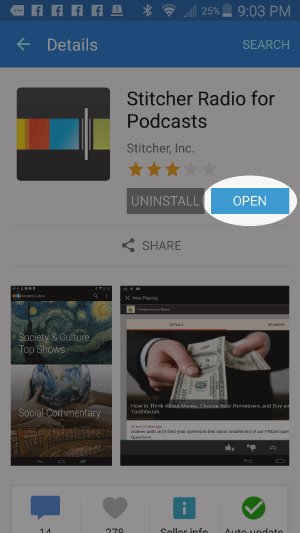
Listen on Stitcher (Android)
Install the Stitcher App
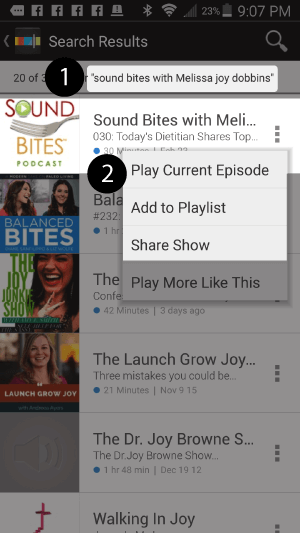
1. Search for “sound bites with melissa joy dobbins” 2. Choose Play Current Episode or Add to Playlist
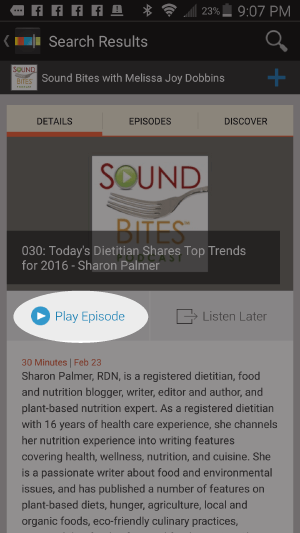
Choose “Play Episode”
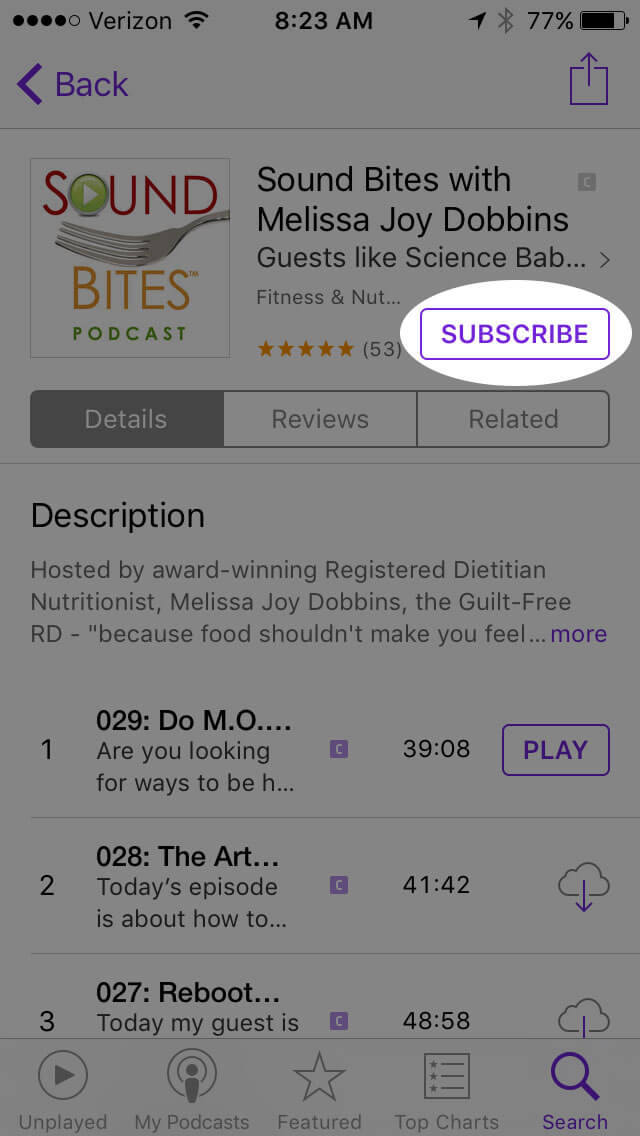
Subscribe & Review on iPhone
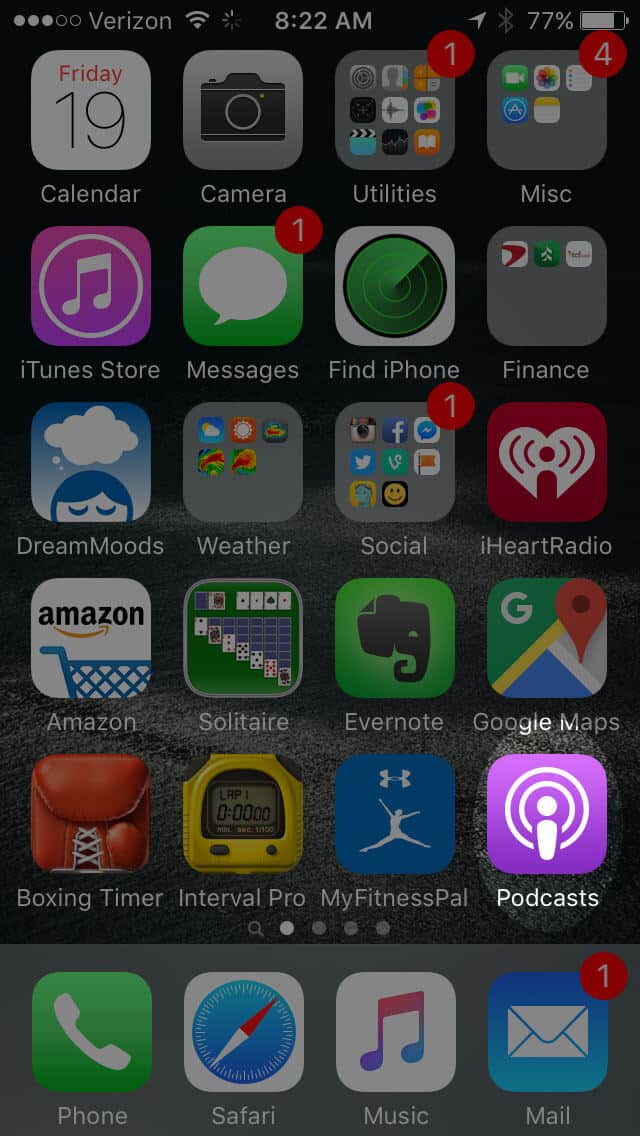
Open the “Podcast” app on your iPhone
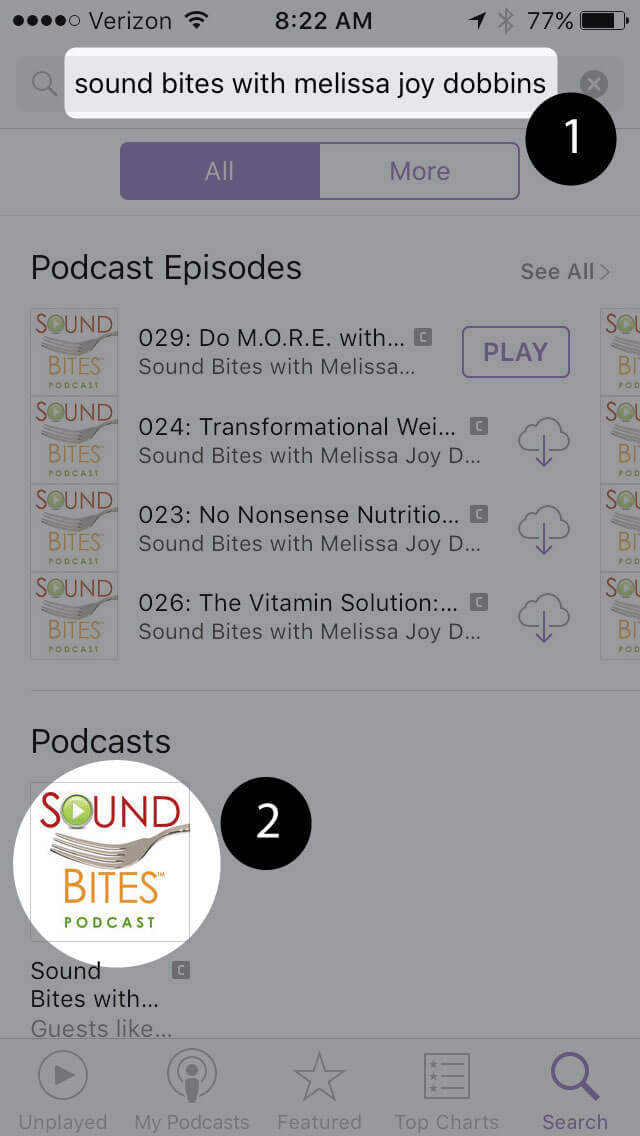
Search for “Sound bites with melissa joy dobbins”
Open the podcast and click “Subscribe” and your done!
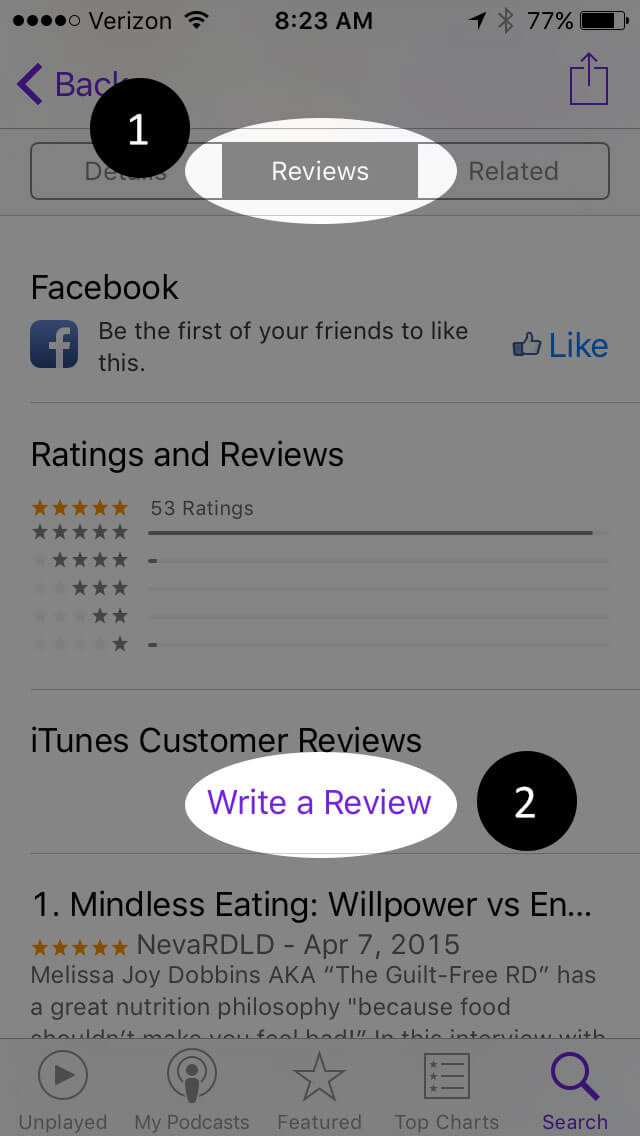
Write a Review
Click “Reviews”, then “Write a Review”.
Subscribe via RSS Feed
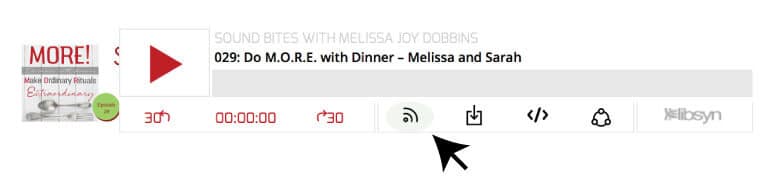
Navigate to any podcast player . Click on the RSS feed icon.
Click on the RSS feed icon.
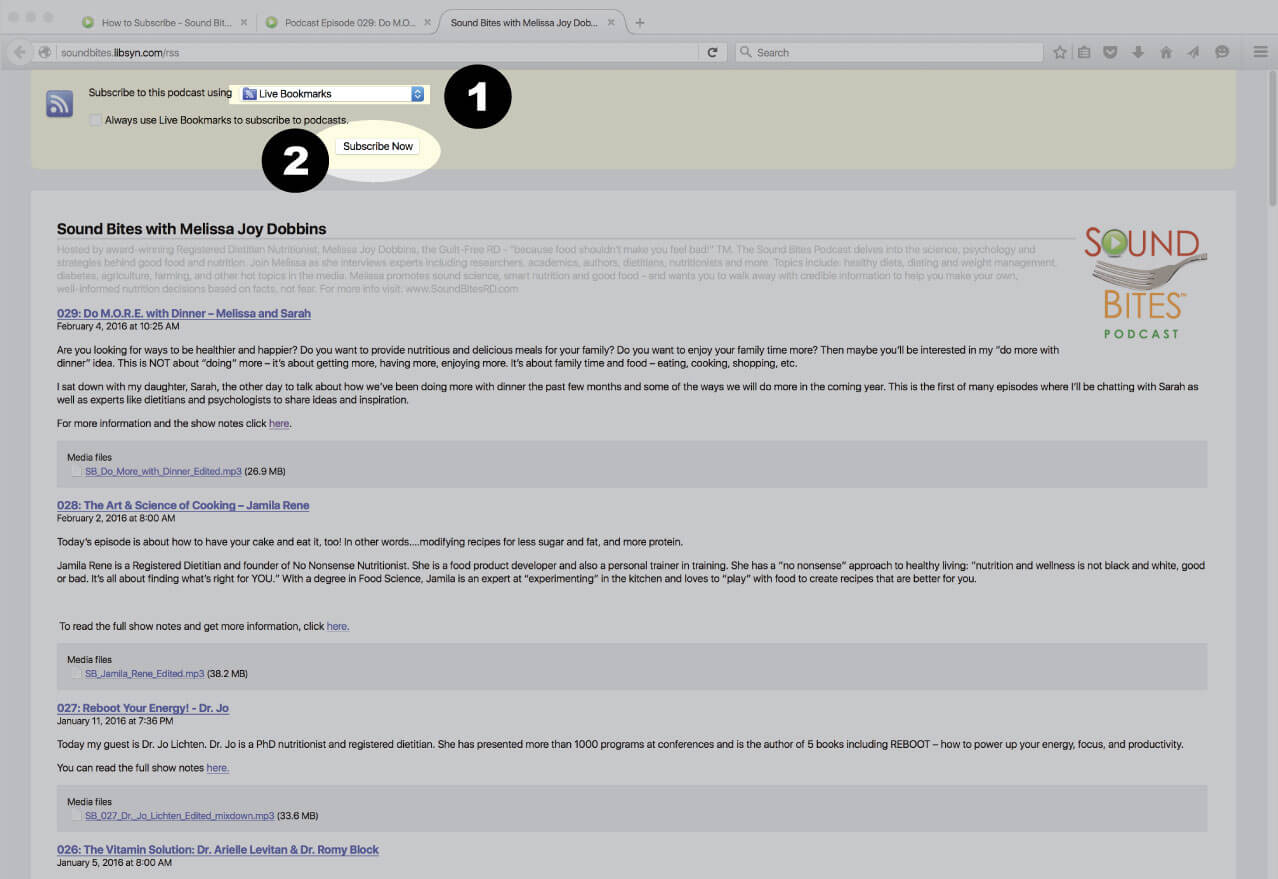
Click on RSS Feed
Choose which application you would like to use to receive the RSS feed
Click “Subscribe Now”
Confirm settings and subscribe.
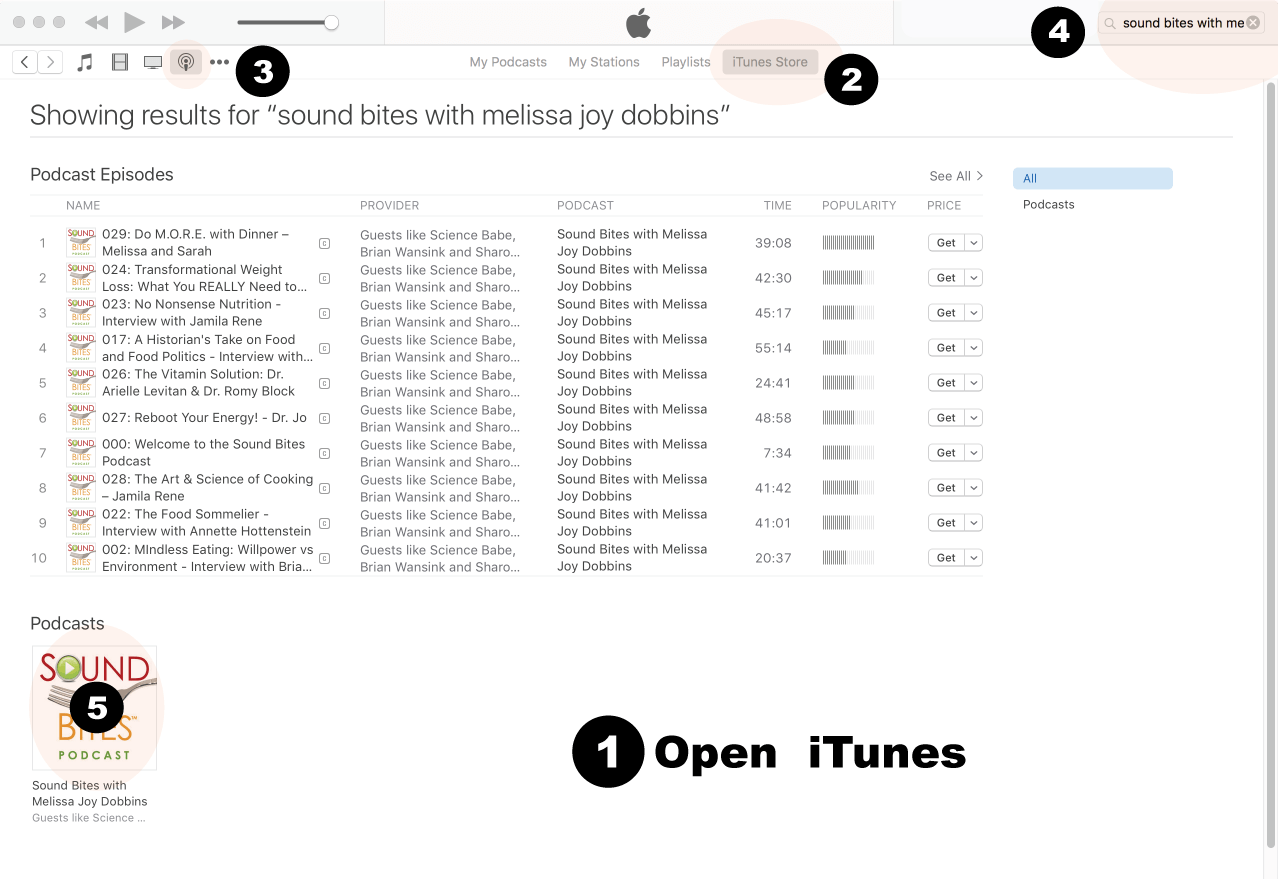
How to Review in iTunes
Open iTunes desktop application
Click iTunes Store
Click on Podcasts
Search for “Sound bites with Melissa Joy Dobbins”
Click on podcast image
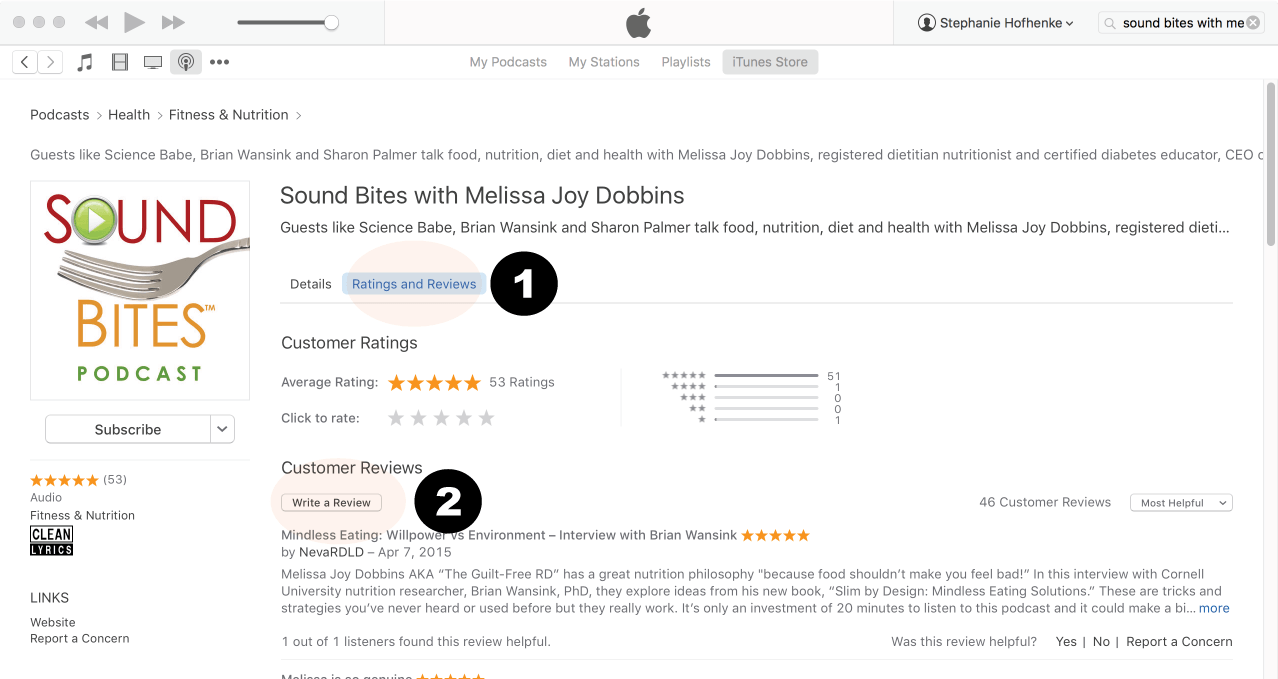
Search for Sound Bites podcast in iTunes
Click Ratings & Reivews
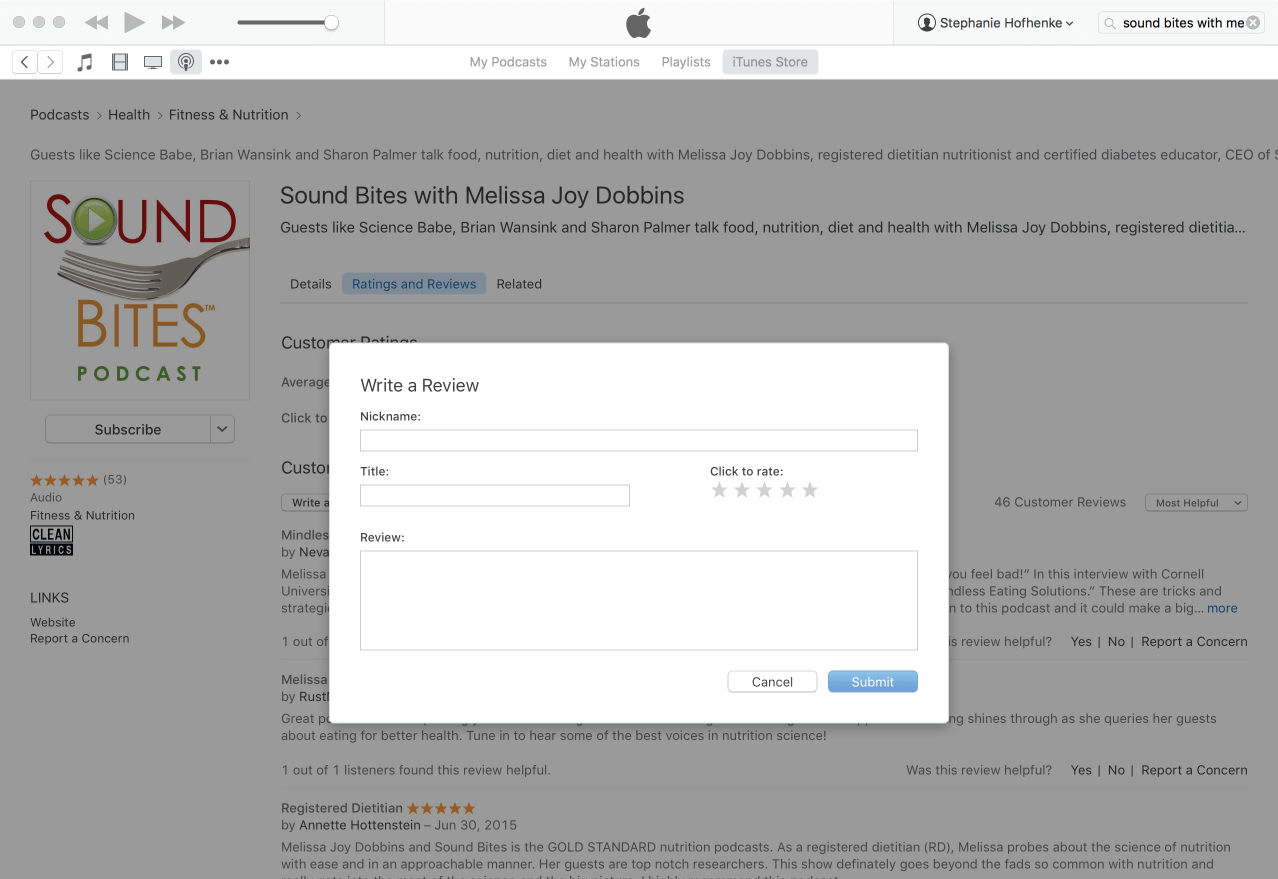
Click Write a Review
View reviews and write your own review.
Write your review…. Thank you!
Write your review!
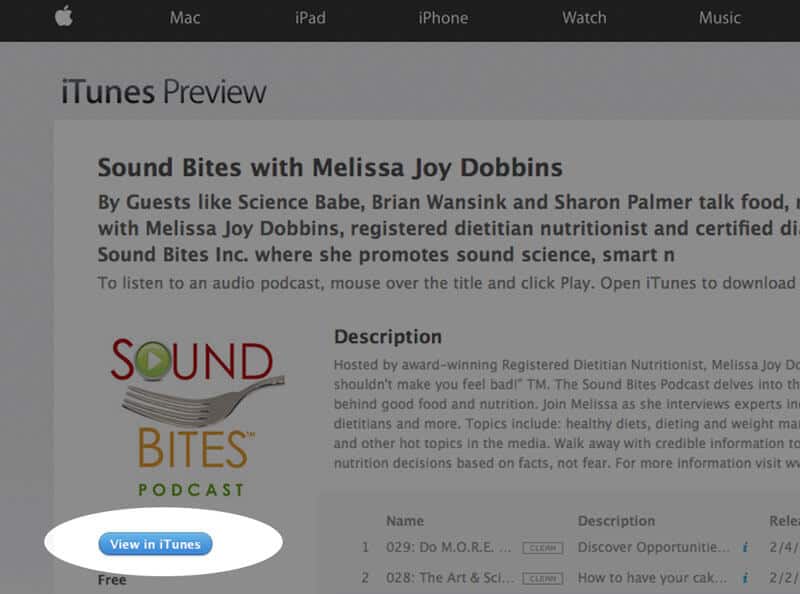
How to subscribe via iTunes
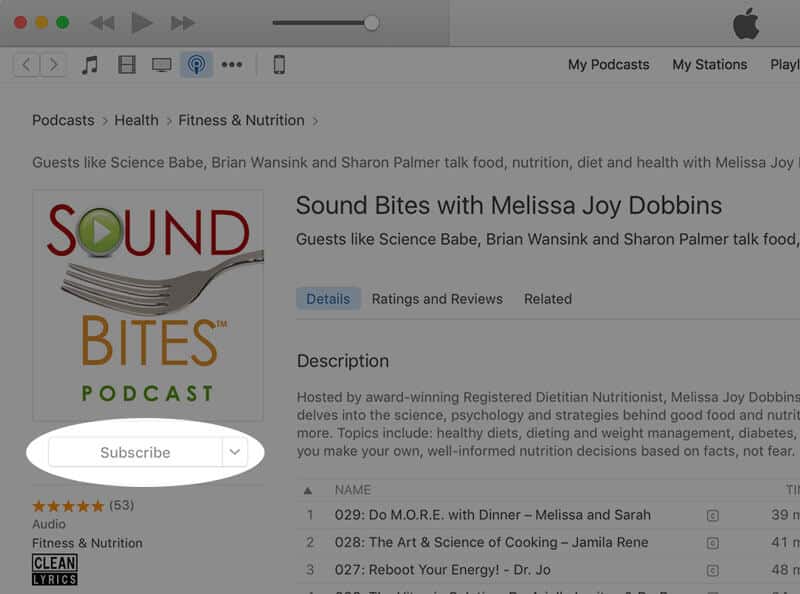
Click here to view the Sound Bites Podcastin iTunes, then click the blue “View in iTunes” button. This will open your iTunes application directly to Sound Bites Podcast. Click the “Subscribe” button, and your done!




 Milton is the Senior Director, Food & Nutrition at the International Food Information Council where he focuses on science communication and consumer perceptions of health and nutrition. He has been at the intersection of food, agriculture, and nutrition for the last 10 years working on some of the most urgent issues facing people and planet–issues like food and nutrition security as well as sustainability. Milton has a master’s degree in Public Health from Hunter College – City University of New York, and his clinical nutrition training was conducted at Yale-New Haven Hospital affiliated with Yale University School of Medicine. His doctoral degree, from the University of Connecticut, is in Communication and Marketing with a specialization in Health Communication.