Celebrating over 1 Million Downloads and 50,000 Free CEUs on the Sound Bites® Podcast | NEW: Get 1 years’ worth of CEUs with the new 15-CEU Podcast Course
Snack Trays Aren’t Just for the Holidays: How Fun Snack Trays Foster Healthy Eating
Charcuterie boards have become very popular and are certainly a fun way to entertain guests – but did you ever think this creative concept might be a solution to healthy eating? Snack trays can be a fun way for kids and adults alike to explore new foods and flavors while making snack time (and even mealtime) less stressful and definitely more playful. This approach to feeding your family – or friends – encourages a healthy relationship with food, can help fill nutrient gaps, and can decrease food waste, too!
Making dinner for your family every night can feel like a chore. Snack trays are an easy, fun and nutritious way to break up the monotony. Snack trays can also help picky eaters, both young and grown, experiment with trying new foods.” – Frances Largeman-Roth
Tune in to this episode to learn about:
Snacking trends
Child nutrition insights
Why some parents are so stressed about feeding their kids
How a snack tray helps people try new foods
The “rules” of snack trays (hint: there are none!)
Practical tips for building a tray
Tips for a balanced, nutritious tray
The difference between a snack tray and meal tray
Considerations for building trays for young children
Building a healthy relationship with food
Some seasonal, celebration tray examples
Recipes to enhance your snack trays
Frances Largeman-Roth, RDN
Frances Largeman-Roth is a Registered Dietitian Nutritionist, a New York Times best-selling author and nationally recognized nutrition and wellness expert. Frances is the author of Feed the Belly: The Pregnant Mom’s Healthy Eating Guide and Eating In Color: Delicious, Healthy Recipes for You and Your Family. She is also the co-author of the bestselling The CarbLovers Diet. Her latest book, Everyday Snack Tray, was recently released.
Frances is a contributor to several publications, including Today.com, SheKnows and Shape. She has appeared on numerous national TV shows, including The Today Show, The Dr. Oz Show, The Rachael Ray Show, Good Morning America, Access Hollywood Live, QVC and CNN. She received her undergraduate degree at Cornell University and completed her dietetic internship at Columbia.
Frances and her family live in Dobbs Ferry, NY. To learn more, visit her website, or follow her on Instagram.
Everyday moments and celebrations are easy to elevate with a snack tray.” – Frances Largeman-Rot
Resources
Some links may be affiliate links. As an Amazon Associate, I earn from qualifying purchases.
Welcome to Sound Bites, hosted by registered dietitian nutritionist, Melissa Joy Dobbins. Let’s delve into the science, the psychology, and the strategies behind good food and nutrition.
Melissa Joy (00:25):
Hello and welcome to the Sound Bites Podcast. This episode is actually a video episode as well. So, all of my episodes are audio, but occasionally I do some fun video ones. So, if you want to watch it on video, go to my YouTube channel, which you can find all of my social media links and handles at my website at soundbitesrd.com.
I also wanted to mention, in case you missed it, that I have a ton of free continuing education opportunities on my website, if you’re a dietitian or a diet technician or certified diabetes educator. And I also just launched a 15 CEU course that will give you one whole year’s worth of CEUs, including that required ethics, CEU. So, go to my website at soundbitesrd.com and check that out.
So, today’s episode is about having fun, exploring new foods and flavors by creating snack trays and using this fun approach to make snack time and even mealtime less stressful, also making it more fun, definitely more playful.
We’ll discuss how this approach works with picky eaters or just children in general, or teenagers and families, friends, holidays and more. And of course, we will sneak in some nutrition as well.
My guest today is Frances Largeman-Roth. Frances is a registered dietitian nutritionist, a New York Times bestselling author of five books, a nationally recognized nutrition and wellness expert, and also a mom of three.
Frances is a contributor to several national publications, frequently contributing to today.com and Shape, and has appeared on numerous national TV shows, including The Today Show, The Dr. Oz Show, and Access Hollywood Live.
Her latest book, Everyday Snack Tray was recently released, and I’ve got a copy right here. Welcome to the show, Frances.
Frances Largeman-Roth (02:17):
Thank you so much, Melissa. That was a lovely introduction.
Melissa Joy (02:21):
This is going to be so much fun because your book is so much fun, and you are so much fun. It’s just the perfect fit. I’ll be honest, I’m not familiar with your previous books and I would love for you to share more about your background and some of those books.
But first I want everybody to know that this episode is not sponsored, but I did receive this lovely complimentary book from you. So, thank you so much. I cannot wait to dive into it with you. But I would love for you to share more about your background with our listeners.
Frances Largeman-Roth (02:50):
Absolutely. Well, I intended to become a veterinarian. In fact, from the age of five I was set on that. I only applied to one school because they had such a strong veterinary program, and I did four years of animal science at Cornell but learned that Cornell also had an amazing human ecology program with this great nutrition program in it. And so, I stayed an extra year, took the counseling courses and all the other things that I needed to take.
And then went to Columbia for my dietetic internship, which was so great because I was in all the boroughs and I was in so many different settings that I had never experienced before, working with populations I had never experienced before. So, just a great learning experience.
And then I was always obsessed with living in California. And so, I moved to San Francisco and worked at a clinic that was a complimentary medicine clinic, and it was pretty incredible. We had two MDs on staff. We had a WATSU therapist, which is water therapy.
We had an acupuncturist on staff, a massage therapist on staff, and then me, and the reason why it was this complimentary medicine approach is because our clientele, our patients were primarily HIV/AIDS patients.
This was 1998. And so, the AIDS epidemic was not brand new. We had the cocktails that we were giving people, the medication cocktails, but it was getting sort of toward the end of the peak of the epidemic.
But it was fascinating again, a patient population that I hadn’t worked with before, but they were so receptive to information, and I loved making handouts for them. And I would try to make them sort of fun and quirky because that was what was appealing to them, so something about how to choose an energy bar or how to get protein throughout the day, things like that.
And I did have this love of writing that was sort of always there alongside my love of science and nutrition. And so, when my mom ended up getting sick and I wanted to come back to the East coast, I said, “Okay, let me see if I can find a job that’s going to actually put these two things together.”
And the Discovery Channel was launching Discovery Health, so an entire channel and an entire website on health. And so, I pitched myself to them,
So, this was in the DC area, and I went out and interviewed, and amazingly they gave me the job as a staff writer for the website.
It was such a dream job. I loved every minute of it, unfortunately then 2000 hit and the dot-com bubble burst and I lost that job, but I went on to do more in sort of food media and work at different websites. And then eventually I ended up at Health Magazine.
And that was an incredible experience too. I spent eight years there and I got to do so much TV while I was at Health Magazine, as well as writing, as well as going to photo shoots, learning how that all worked.
So, there were times, Melissa, that I felt like, “What am I doing? I’m a dietitian. I’m supposed to be working with patients. That’s what I know and understand.” But then you learn, I think especially these days that, hey, the more skills you have, the better.
Melissa Joy (07:55):
Totally agree. I can relate. When I started doing a lot of media in Chicago and getting a little bit away from patient care and diabetes care, which is my passion, I was kind of torn. I didn’t love the media stuff like I loved working with people, but I know it’s important.
I knew it was important then, and I knew that those skills were important and that could be transferable in a lot of different settings. And that we need stronger voices out in the media and social media. So, can totally relate to that. Well, thank you for — a lot of that, I did not know. Thank you for sharing that. So, tell me a little bit about your previous books.
Frances Largeman-Roth (08:32):
Yes. So, my very first book is calledFeed the Belly: The Pregnant Mom’s Healthy Eating Guide, which was really, really fun to write because I became pregnant with my first child while I was writing the book. So, that was great.
And then at Health Magazine, I co-wrote The CarbLovers Diet and The CarbLovers Diet Cookbook. We even had an app that went along with the book, and that became a bestseller. And we did a ton of media for that because, hey, who doesn’t want to lose weight while eating carbohydrates? But really it was based on resistant starch. And so, those are the types of carbs highlighted in the book.
And then I wrote Eating in Color because I felt like I now had two little kids, and I felt like, the approach isn’t really eat your broccoli, it’s good for you. The approach really has to be, oh my gosh, look at all the color on your plate. And then, by the way, this is all really fantastic for you.
So, it went through the rainbow and all the different foods in the red spectrum, orange, et cetera. And also taught people a lot about, okay, so if you buy tomatoes, how should you store them? What to look for.
So, not just the nutrition information, but also some real practical information about keeping these various foods in your home and the different formats they come in, canned, fresh, et cetera. And then I did a couple of smoothie books with prevention. So, those were fun in a totally sort of new and different way. And then my most recent book is Everyday Snack Tray.
Melissa Joy (10:16):
Given those previous book titles and concepts, what inspired you to write this one?
Frances Largeman-Roth (10:21):
Well, first off, I started making snack trays out of desperation, because when I had three little kids, five and under, what I noticed and what a lot of parents notice is, wow, you’re wasting a lot of food and what can you do to serve the food in a way that is more acceptable to little kids?
And my husband learned a lot too, because he was piling their plates very high with pasta and various things. And it was like, wow, okay, this is actually not working. They’re barely eating anything, and then we’re left with all this food.
But I decided I was going to save these foods. And then, instead of plating it, I started putting out the food in ramekins and little bowls and things like that. And I noticed, oh, they’re actually eating more when I present the food this way than if I plate it for them.
So, it was definitely an aha moment. And those little ramekins over the years turned into, okay, now the ramekins are on a tray now the kids are a little bit older and I’m spending a little more time on the presentation part of it, doing fun things with color, doing fun things with patterns and things like that.
And so, it just sort of morphed over time. And then lo and behold, also the charcuterie trend really was hitting big and different variations on that. And I said, you know what? I would really love to do a book on this because yes, there are tons of charcuterie books, but there wasn’t really anything with this family approach to it. So, that’s where the concept really came from.
Melissa Joy (12:12):
Very interesting. Yeah, it’s like the charcuterie trend is entertaining, but this is entertaining at home with your family. And as you’re talking, it reminds me that our fellow dietitian friend, Jill Castle, who’s been on the podcast several times, she always talks about, I think it’s called family style feeding instead of plating up for your Kids and everything.
And that was kind of counterintuitive for me as a parent to hear that the concept being let the child pick, you present the foods to choose from, and then the child can pick how much they want to eat, and it really helps them have more autonomy and learn to follow their hunger cues instead of it just kind of being, well, it’s plopped on my plate and I should nail the Clean Plate Club, which thankfully is an outdated trend.
But maybe you could speak to that, but it just popped into my head when you were talking so that it’s like this came out of a sense of frustration or convenience, how can I change this situation to work better? But there’s actually a good child nutrition strategy behind it too.
Frances Largeman-Roth (13:16):
Absolutely. And I think we’re all opening our eyes and learning a lot more about how to foster a healthy relationship, help our kids foster a healthy relationship with food. And unlearning, it’s a lot of unlearning for many of us who did grow up with the Clean Plate Club or just sort of a different philosophy, people calling certain foods good and certain foods bad, and this is a red-light food and this is a green light food.
And so, many different ways that we — diet culture, ways that we talked about food and which ones were elevated and which ones were demonized. So, for me, also, a snack tray is a great way to present a variety of food without saying this one’s better than the other. And letting people, whether that’s kids or adults, guests, whoever it is, take what they want and maybe be exposed to some new stuff along the way.
Melissa Joy (14:20):
Yeah. And again, there’s that fun factor and you’re such a fun person. It’s just like, it’s so fitting. Like I said before, you probably touch on this in the book, but I did a little snack tray sort of over the weekend.
I was planning to do one of yours, but then it just spontaneously happened that I just threw together my own because guests were coming over and I’m thinking snack tray in the back of my head. Because I’ve been prepping for this podcast and looking at your book and so inspired by all of it.
So, what I was thinking when I was throwing my snack tray together was it also helps use up food waste or prevent food waste, which is something you alluded to earlier. It’s like, well, the leftovers, what do we do with them?
So, I love that because yes, we can create a bowl where you put a bunch of things in the bowl together or do a frittata. Those are two of my favorite ways to use up leftovers, but some things don’t lend themselves to that. So, the little ramekins of the little bowls is a great way to do that.
Frances Largeman-Roth (15:14):
Yeah. So, what did you make?
Melissa Joy (15:16):
So, oh my gosh. And I didn’t even take a picture, but I pulled out the ramekins and I have these little … what are the little glass dishes that you use for mise en place.
Frances Largeman-Roth (15:26):
You can call those ramekins too.
Melissa Joy (15:27):
And we had these big trays, but I remember in your book you talked about like easy cleanup, you put the parchment paper down. So, I did that, and I just started pulling stuff out. So, I had like a little thing of olives, some cheese, some nuts, marinated artichoke hearts, some crackers or some Melba rounds, something like that.
And it was funny because it was like, it’s all kind of browns and gray … not grays, browns and greens and beiges and stuff. And in the past, I would think, “Oh, that’s kind of, it’s all one color, it’s all bland.” But in your book, you do like these color themes. So, in a weird way I was like, this is the color theme of this tray, and it doesn’t need to have any pops of color or whatever.
So, I can’t remember what else was on there. I think I threw out some raisins or I just grabbed a variety of things and people just ate it up. They loved it, especially my teenage son. I mean, I know this is what you want.
You just want to encourage people to throw stuff together, but you have such cute ideas and practical tips in the book, and we’re going to go through some of those. But I was going to ask you, you organize this by season, and it makes so much sense when I read through it, but I was just curious if you could kind of talk about that a little bit.
Frances Largeman-Roth (16:41):
Well, I think people think about holidays, they think about occasions, and usually there’s some sort of seasonal tie-in to that. And so, honestly, also as a writer, because there is a fair amount of narrative in the book as well, it just sort of made sense.
It made sense to sort of give a little bit of background about maybe some family memories from a particular season or, hey, you know those times when you’re basically snowed in and the furthest distance you can get is to your neighbors, so why not do a snow day train, invite them over and have some chili and cornbread and things like that.
So, it was a nice way to kind of tell the story. And also, I think people think, “Okay, yeah, so summer 4th of July, oh, there’s a 4th of July tray. That sounds fun. Let’s make that.”
Melissa Joy (17:36):
No, I, I loved it. In fact, there were four different trays that really stood out to me. And ironically, it’s one from each season. I didn’t plan that, but so I’m going to mention those as, as we talk a little bit later.
So, clearly this is fun, but there’s also a lot of meaning behind it. And I love your writing and the stories. I could just hear you talking when I’m reading it.
But let’s touch back to what you were saying. You know, the big inspiration for this was being a mom and trying to feed your kids right. And we’re dietitians, but a lot of people out there aren’t, of course there’s picky eaters, but there’s just child nutrition in general and some challenges that come along with that age group.
So, why do you think parents are so stressed out about feeding their kids? Can you speak to me about some, what’s going on in the family dynamics or in the age group?
Frances Largeman-Roth (18:28):
Absolutely. Well, I mean there are different stresses at different times, which now that I have teenagers, I’m learning all about that. About, oh, this one’s at a certain sport. So, they’re not having dinner with us basically for this whole semester. So, I need to make sure that I’m setting things aside.
But parents really are under a tremendous amount of stress and strain really more than ever before. And I do want to mention that Vivek Murthy, the U.S. Surgeon General just released an advisory last month on parenting and stress.
And he laid out that yes, there are always — we still have the stressors that we’ve always had, finances, schedules, things like that. But now we have technology and social media adding to that. We have the high cost of childcare, we have, I know a lot of people love working from home post pandemic, but that also opens us up to working 24/7 and being on call for clients and bosses and things like that, 24/7.
So, additional stresses, plus there’s school violence. And unfortunately, we have reminders of this all the time. So, work demands so many different things. And then you think about now we are not just comparing ourselves to our neighbors, we’re comparing ourselves to all these other parents on social media. Some of them look like they’re doing things way better than we are. So, there’s that comparison stress.
And then, as we know Melissa, there are so many influencers who might be making parents feel like they can’t have dairy, they can’t have gluten. If you give your child this, you know, product that might lead to ADHD.
I mean lots of scare tactics. So, it’s increasingly hard to just sort of present a meal and feel good about it. Plus, there are different — I have a daughter who is a pescatarian. So, much of what the rest of the family likes is not working for her. So, again, this whole snack tray, a way of presenting the food, allowed me to provide more variety without having to make entire meals for different people.
And something that I think you want to touch on at some point in the conversation is can you really use this concept to provide a meal versus a snack? And yes, absolutely, it works for both. And there are certain meals like tacos that are just so fantastic because you can provide a variety there and have things be flexible and have one filling be black beans and another filling be ground beef and another filling be sauté shrimp. So, there’s just a lot that you can do with a tray delivery system.
Melissa Joy (21:40):
Yeah. Yeah. It reminds me, I think the term is modular meals because tacos are the perfect where you build your own. I think that’s the term I learned years ago. And it is so much easier on the chef in the house, whoever’s doing that. And like you said, it provides that flexibility and variety without being a short order cook.
Frances Largeman-Roth (21:59):
Exactly.
Melissa Joy (22:00):
I mean, we touched on this a little bit, but did you want to say more about how the snack tray, or sometimes you call it a grazing tray, how does it help kids try new foods and maybe, whether you’re a picky eater or just a regular kid?
Frances Largeman-Roth (22:14):
Yeah, that’s a great point. So, a lot of times young children around the toddler age will just start to avoid and push away foods that they used to love, and I think many new parents had this experience where, oh, my baby eats everything. They eat avocado and mango and this and that and barley.
And then the kid gets to be a toddler and it’s no. No, no, no. And they often fall into these patterns of eating only certain foods, like a selection of 5 or 7 or 10 foods. And that’s when the parents start to panic and worry that their child is not getting the right nutrition.
And so, part of that is just child development and the kid becoming more independent, wanting to make choices for themself. So, one way that you can present these new foods or a new food, because we know, I’m sure Jill mentioned that it might take 15 to 20 times for a kid to even try, even try that new food, whether it’s broccoli or kale or sweet potato.
So, it is much less stressful for a kid, for them to be the one choosing that they’re going to take that little cube of sweet potato versus having it already on their plate. So, it encourages trying new things. It encourages them to take what they think is an appropriate amount for them of any food, whether it’s a new food or a beloved food.
And that’s the great thing is you can put these things both on a snack tray, things that you know they’re going to eat, whether that’s cheese or crackers or maybe a little bit of salami or banana or whatever it is, along with something new like edamame.
And you can present it in an age appropriate way, so obviously younger kids need to have things cut up in a certain way. They can’t have round items, you wouldn’t put out a whole grape, you would put out quartered grapes for a young child. You wouldn’t put popcorn on a tray, that would be for a kid that’s under four, I should say four and under, because popcorn is a choking hazard for kids four and under.
So, it just allows a lot more flexibility. And again, it’s all about making it sort of child centered and having them be the ones who feel like they’re in charge.
Melissa Joy (24:55):
They have a choice. That’s great. And experiment a little bit. I love that. And one of the chapters starts off with the rules of the snack trays. And I love this so much, it made me think of, it’s the rules of fight club. We don’t talk about fight club. The rules of snack trays. There are no rules. I love that. I can totally see you saying that.
And I’m a rule follower, but when I’m told there are no rules, it’s like, okay, the pressure’s off. You can just have fun. And these are just suggestions and things. But where do we begin in building a snack tray? You’ve got some practical tips, obviously we can’t share them all, but what would you want to share? Where would we start?
Frances Largeman-Roth (25:34):
Right. I mean it starts with the tools of the tray. What do you need to make a snack tray? Well, the good news is you don’t need much. You do need some kind of tray, but you don’t have to go out and get a fancy one, especially when you’re just starting this.
It can be a baking sheet, a clean baking sheet. And then you’ll need some things to put the food into or onto. And we’ve talked about ramekins, we’ve talked about little bowls. These are all things that you can find virtually everywhere from Amazon to target, all over the place.
And then as you start to think more about presenting things, you probably want some small spoons for jams and dips and things like that. Little forks, small spreaders for cheese and other things like that. So, it just depends on how elaborate you want to get.
I have quite a collection now of trays and lots of different serving things. And to have it look a certain way, be aesthetic as the kids say these days, but really to start with the basics, you just don’t need much. You need some kind of surface and some kind of bowls.
And I do recommend that whatever tray or sheet you’re using does have an edge to it because that’s just an easier and safer way to pick it up and carry it and not have everything slide off. And then you mentioned the parchment trick, which I really think is great, especially if you have a wooden tray just to protect your surface.
People are messy, not just kids. And it’s an easy, easy cleanup if you line your trays with parchment paper.
Melissa Joy (27:16):
I’ve participated in some of these charcuterie board activities and one of the first things I realized was even my large cutting boards, they’re just not that big. So, people might experiment and find, oh yeah, I want to look for a bigger tray or something that I could pick up at Target or whatever.
And it also reminded me when I was playing around with my snack tray over Labor Day was, and you mentioned you have a lot of different spoons and things, I have a lot of that stuff left over from my TV days and a lot of what I was playing around with reminded me of trying to set up my TV segment.
So, it was sort of a little flashback there, a little PTSD. No, because it’s a lot of work. But yeah, so you just kind of pick up these things as you go. And it doesn’t have to be all matchy. I had some of the white ramekins, I had some clear, I have some blue ones or whatever. And yeah, just little different utensils.
When we’re talking about some of the tools of the trade, was there anything that you think, this would really make a difference, or some people love this, but you don’t need to have it. Is there anything that you wanted to mention?
Frances Largeman-Roth (28:30):
I just think it really depends on where you’re going with it. I have found that smaller is better. So, I did have to over time get some tiny plates. If I didn’t want a bowl, I had to get some tiny plates because again, there’s only so much you can fit.
Also, my trays started getting bigger and bigger and I would be so excited when I would find one that was 20 inches wide.
Another thing I would say is you can have, especially if it’s not just for little kids, you can have non-food items on there as well. Like a little thing with flowers. A little vase with flowers. Or you can present your little napkins on the tray as well. You can keep it as contained as you want or something that I’ve started playing with more is not just a snack tray, but a snack table on a small table.
Or maybe it’s a credenza that you have. Maybe you have multiple boards on something like that. So, I guess I would say is it’s really only contained by your imagination and what you want to do with it.
Melissa Joy (29:39):
Even like we have an island in our house and if my snack boards were kind of small, then I could just create a space on that island and just put everything in there and people can come to that. You don’t have to carry it into another room or something.
Frances Largeman-Roth (29:54):
Absolutely. It’s a great way to entertain.
Melissa Joy (29:56):
Before we talk about some of the healthy aspects, I know we promised to throw in some nutrition. Let’s go through some of my favorite, the seasoned ones. So, I’d like to start with fall because that’s where we are now, back to school time. So, I love the spooky Halloween spread. That was on page 138.
Frances Largeman-Roth (30:14):
That’s so fun. It’s so fun.
Melissa Joy (30:17):
It is so fun. And also, not only did these catch my attention, but I thought, oh, I could do these. I mean really, it’s all very, very doable. And I’m going to do a little teaser here. You have some recipes too, and we’re going to talk about that. So, here’s the spooky Halloween spread fright night fruit skewers is the recipe that goes with it. Is that so cute.
Frances Largeman-Roth (30:36):
Yeah, and you’re right Melissa. It’s all very doable. I mean, when you put it all together, it does look I think pretty impressive. But each individual element is not tough. With the fright night fruit skewers, you can get edible pens. Wilton is a great resource for things like that. Amazon, you can get them too. And you can literally draw.
Melissa Joy (30:59):
Yeah.
Frances Largeman-Roth (31:00):
You can draw on food and make little faces and it’s a lot of fun. And then the mandarins that you see also on that spread, what I did with those is I just used a sharpie.
Melissa Joy (31:09):
So, they look like little pumpkins. One thing that I used in my snack tray, it’s just that concept of okay, I had saw what’s on this tray with the little baby bells. Well, I didn’t necessarily want to put them in a bowl, but I didn’t want to just randomly put them on the tray. So, you had this idea of patterns, like lines or shapes or whatever. And so, it just made it look more organized or just more planned than just throwing something on the tray.
Frances Largeman-Roth (31:40):
Yeah. Yeah. And you can do concentric circles, you can do rows. It really depends on what you’re putting on the tray. Some things lend themselves more than others to that kind of organization. But you can see that it’s a combination of there is a tray under all these things, but then some things are in bowls and then some things are just sort of placed creatively.
The little mochi that are made to look like mummies, those are on a plate. And of course, in the book everything is styled by a professional, not by me. And we had also a prop stylist too, who did an amazing job getting all these items together.
But still, you can do this, it can be fun. There’s a plastic bat on here. You can get these wonderful plastic baggies from Wilton and then fill them with … I filled them here with popcorn, but you could fill them with whatever you like. You could fill them with grapes, if you want. And that would look like a fun green hand on your tray.
And I don’t know where the stat came from, but apparently people are spending more on Halloween now than they are on Christmas, and other holiday things.
This is not just for kids. People really want Halloween.
Melissa Joy (33:01):
Yeah. Okay. My other one, so the next one was the winter which of course is the next season we’re heading into. Not quite yet. But I love the snow day tray. You talked about that earlier.
This is the first one that jumped out at me and I’m like, “Oh yeah, I am totally doing this.” It’s like chili and cornbread and you’ve got avocados and onions and cilantro and all kinds of fixings for the chili.
And I have a wonderful recipe that I’ve been tweaking over the years of my mom’s chili and actually won a contest with it. But chili’s big in our house. Yeah. So, that, yeah, you’ve got rice, you’ve got crackers sour cream cheese of course. It’s just like, oh yeah, this is an easy one to just load up and do.
Frances Largeman-Roth (33:50):
Exactly. And the concept sometimes comes from, okay, what’s the main thing? And then what do I want? What are all the possible combinations or toppings that I could put on this main thing? And getting back to the recipes, each tray or board only has one thing that you have to make.
So, only one recipe that’s made from scratch and everything else is stuff that you get at the store. Maybe you have to cut it up or something like that. But really, it’s meant to be doable. It’s meant to not take an entire day.
Melissa Joy (34:27):
Yeah, for sure. Yeah. The recipes they look very simple. I haven’t tried any yet. I definitely plan on it. And you don’t have to, all of this is like, I feel like it’s like, “Hey, here’s an idea.” Take it and run with it is the gist I got from this book, which was great.
And then the spring one is the taco night. Page 96 taco night. Again, we kind of mentioned this earlier. It was like, it’s easy to just set up and it’s so beautiful set up and have people pick whatever they want to put on their tacos. And then the last one summer-
Frances Largeman-Roth (35:03):
The movie night?
Melissa Joy (35:04):
So fun.
Frances Largeman-Roth (35:06):
And this is where I’ll bring in another element of why I think these are so great, budget. So, we do have one of those lovely theaters by us where you can order food and it’s great, but you end up spending a lot of money.
Melissa Joy (35:20):
And this just makes it so fun. You got nachos, you’ve got gummy bears, you got little containers of popcorn. It’s just so cute. Yeah. So those are my four favorite, and I hope anybody who’s listening, go watch the video.
So, you can see those or just go get the book and you can see all the beautiful, beautiful photos. Very fun and inspirational. So, we talked a little bit about health and nutrition and picky eating, but you mentioned it earlier, so what is the difference between a snack and a meal? A snack tray? Meal tray?
Frances Largeman-Roth (35:51):
Yeah. Well, I mean, in general, if it was just for snacks, it’s going to be smaller. You don’t have to put every element on your tray. And kids, little kids need about two snacks a day. Older kids need at least one snack. We know that 73% of the U.S. population is snacking at least once a day. That came from the IFIC Food Insights Survey.
So, we know that people are snacking, which is why I want to give them ideas for snacking healthfully or snacking in a meaningful way or in a balanced way. And so, yeah, even if we’re just talking about snacks, you want to have carbs, you want to have a healthy fat, and you want to have protein on that tray.
And again, it is up to the individual to take what they want, but those should all be presented. Of course, I love adding fruits and veggies because we’re not eating enough of those. So, the more we can snack on those, the better.
Melissa Joy (36:50):
Well, and even the movie night one, popcorn is a whole grain. You’re getting some fiber there, so Got to love that. I love just the idea of adding, make sure there’s some fruits and veggies there. Any other thoughts? Like, you’ve got a variety of foods, but how can I make sure that there’s some good nutrition on the tray?
Frances Largeman-Roth (37:09):
Again, you might be making this for meat eaters, you might be making this for vegetarians, you might be making it for flexitarians. So, you always want to have those elements both on your tray, but keep them separate. Sometimes I use these almost little chalkboard toothpick things that you can write on.
And so, I’ve done trays where I have beef burgers, but I also have plant burgers on the same tray and I just label everything. Or maybe if you know that you have somebody with a gluten intolerance, maybe you want to do that with the crackers or the breads, or obviously this will be a great time to use your kitchen island and to have maybe two separate trays.
So, I think you’re always trying to think about, as any host would do, you’re thinking about your guest, who it is that you’re feeding and how to accommodate them. But I think for me this is a very, very low stress way to entertain.
When I think about making a full dinner for a dinner party, it kind of puts me in a state of panic. Not that I can’t do it, I can do it, but it takes days to put together, it’s expensive. It’s a lot of various shopping trips. A snack tray, honestly, people are probably going to be just as delighted. And it’s so much easier.
Melissa Joy (38:33):
And as you’re talking, what freaks me out about entertaining with a meal is will there be enough food for everybody? How much food does everybody need? And you don’t have to worry about that with the snack tray. You don’t have to have enough of this for everybody. You just have a variety of things.
Frances Largeman-Roth (38:50):
Exactly. And you can always replenish.
Melissa Joy (38:53):
I love that. Yeah, so this isn’t just about assembling, you do have those recipes in there. They’re optional. Obviously, you can make the tray without doing the recipe, but I love that you have that additional touch to this.
We talked about your food philosophy about having a healthy relationship with food. Talk to me a little bit more about that because definitely there’s a fun factor to that, that I would love for you to share.
Frances Largeman-Roth (39:16):
Yeah, well, I mean, I think that as a parent, one of the biggest things is teaching your child how to take care of themself in so many different ways. So, I think about the relationship with food as something that is fundamental, fundamental.
So many people of our generation have spent too many years having to sort of relearn, retrain themselves and to be able to eat freely and in a way that nourishes their body where they don’t feel guilt, they don’t feel shame.
They can just eat and enjoy food and understand that, yeah, I do need more whole grains and fruits and vegetables than I need cupcakes. But there’s a place for cupcakes, there’s a role for cupcakes and you know, there’s celebration there, there’s fun, there’s joy.
And so, I think fostering that healthy relationship with food is so important. And I talk about in that food philosophy chapter how I don’t tell my family, “Okay guys, you better eat your baby carrots first before you eat the barbecue chips.”
It’s just, it’s there, it’s for you. Hopefully I’ve given you enough guidance over the years that you can make your own choices. I’ll be sending my oldest kid off to college in three years. I want her to know how to do her laundry.
I want her to know how to clean. I also want her to know how to put a meal together. And fortunately, she already knows how to put a snack tray together. So, there’s always-
Melissa Joy (40:54):
She can entertain too.
Frances Largeman-Roth (40:55):
Fall back on that. That’s right. She can always make a girl dinner.
Melissa Joy (40:59):
That’s so funny. I love that. So, we talked a little bit about the seasons and everything and how it’s organized and there’s a lot of other stuff. There’s other themes besides holidays. One of the things that you even include in here is making trays as gifts. So, I would love for you to talk about that briefly because that might be of something of interest to our listeners.
Frances Largeman-Roth (41:21):
Yeah, and I do actually have a lot of people saying, “Oh, I wish you could come to my house and make a tray.” And I obviously can’t do that for everybody. But when I can do that, it’s really fun to do because there’s a certain element of, again, wanting to make the person or the family or whoever it is, happy.
Maybe somebody will do this for me when I have my new baby in a few months. Maybe they’ll bring me a snack tray.
But try to find out a little bit about their likes and dislikes. Obviously if they have any food allergies or anything like that, you don’t have to spend a ton on a tray, go to Marshall’s, go to T. J. Maxx, you can probably pick one up for $12, maybe $15, and then go with an assortment.
And I do give kind of a starter of if you’re like, “Oh gosh, I just don’t know where to start.” Probably you want to include cheese crackers, nuts, as long as there are no allergies. Something chewy, something salty, something sweet, something crunchy so that there’s variety on that tray.
Melissa Joy (42:30):
I love that part. That’s very helpful.
Frances Largeman-Roth (42:32):
And again, maybe they love the Buffalo Bills. So, maybe you’re going to do some kind of Buffalo Bills, themed tray.
Melissa Joy (42:40):
Legos or something, just find out what they’re — are they into baseball or whatever.
Frances Largeman-Roth (42:47):
Exactly.
Melissa Joy (42:48):
When you mentioned the thing about the different textures and everything, that also reminded me one of your tips were having different heights to the train and everything. And that really reminded me of my TV days and just trying to have a lot of different variety. So, you have some really practical tips in the book about that.
As we’re wrapping up, is there anything else that you wanted to share about the book or snack trays, meal trays, anything I didn’t ask that you think is really important?
Frances Largeman-Roth (43:12):
I think just one thing I would want to point out is that even though this is for families, you don’t have to have a family to enjoy this book or to use this book because there are so many different occasions in it. Everything from the snow day snack tray to movie night, to spring fling, staycation. I mean, so many different ways to enjoy and entertain with these snack trays.
So, I just want everybody to feel like they can come to the table. And you don’t have to have kids to do this, but also it would be a great thing to give to grandparents who might be scratching their heads, why don’t these kids just eat meat and potatoes anymore? Who might need some new ideas, new concepts for providing food for their grandkids.
This would also be great for teachers and other types of caregivers. So, really, I hope that it’s helpful to a lot of different people.
Melissa Joy (44:09):
Yeah. I’ve got book club coming up and I could see saying, “I’m going to bring the appetizer,” and just putting together a little fun tray for my girlfriends. Yeah.
Well, you’ve inspired me. This is so fun and creative and as I said before, there’s such healthy relationship with food woven in and just the nutrition aspect too, that you can play up or down as much as you want. Right?
Frances Largeman-Roth (44:36):
Right, exactly. You totally get the concept, Melissa. I love it.
Melissa Joy (44:39):
I didn’t know what to expect when I opened the book, and I was just like, I love it. It’s beautiful. There’s wonderful pictures of you and your family too. And yeah, it’s … be a great gift actually.
Frances Largeman-Roth (44:50):
I agree.
Melissa Joy (44:51):
Is there anything as we’re wrapping up that you wanted to share as far as a bottom line takeaway? I definitely want you to share where people can connect with you and get the book as well.
Frances Largeman-Roth (45:00):
Yeah, well check out my website, which is franceslargemanroth.com. Frances with an E. And then on Instagram I’m at franceslrothrd, as well as on threads at the same handle. You can also find me on LinkedIn, and I would say it doesn’t have to be perfection, it doesn’t have to be Instagram perfect. Just get started. People will love it. They will appreciate it, and they will beg you to make more snacks.
Melissa Joy (45:33):
Absolutely. Yeah. I believe you said everyday moments and celebrations are easy to elevate with a snack tray and it’s so true. I love it. I should have taken a picture at least just to show you of the one I did over Labor Day weekend, but I did think, “Well, I don’t know, it’s not Instagramable, Instagram worthy,” but it sure was delicious and it was a hit. So, thank you for the inspiration.
Frances Largeman-Roth (45:54):
Well, you’re so, so welcome. And the next time you make one, I would love to see it.
Melissa Joy (45:57):
I will. I’ll take a picture just at least for you. Alright, thank you so much and for everybody listening, as always, if you like this episode, share it with a friend, share it with a family member, check out other episodes, tune in again. And as always, enjoy your food with health in mind. Until next time and a snack tray.
[Music Playing]
Voiceover (46:18):
For more information, visit soundbites rd.com. This podcast does not provide medical advice. It is for informational purposes only. Please see a registered dietician for individualized advice. Music by Dave Birk, produced by JAG in Detroit Podcasts, copyright Sound Bites, Inc. All rights reserved.
LISTEN, LEARN AND EARN
Listen to select Sound Bites Podcasts and earn free CEU credits approved by the Commission on Dietetic Registration (CDR) for registered dietitian nutritionists and dietetic technicians, registered. Get started!
Get Melissa’s Sound Science Toolkit here!
Partnerships:
Sound Bites is partnering with the Association of Diabetes Care and Education Specialists (formerly the American Association of Diabetes Educators)! Stay tuned for updates on the podcast, blog and newsletter!
Sound Bites is partnering with the International Food Information Council! Stay tuned for updates on the podcast, blog and newsletter!
Sign up for my monthly newsletter and episode eblasts so you never miss an update!
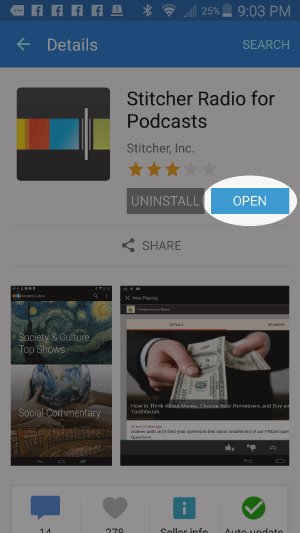
Listen on Stitcher (Android)
Install the Stitcher App
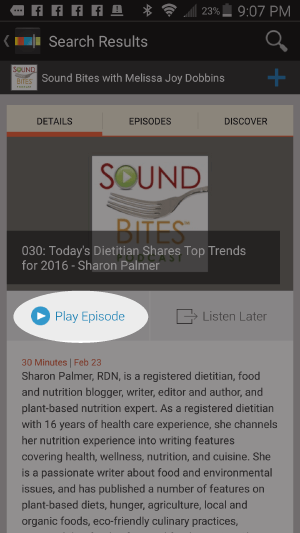
1. Search for “sound bites with melissa joy dobbins” 2. Choose Play Current Episode or Add to Playlist
Choose “Play Episode”
Subscribe & Review on iPhone
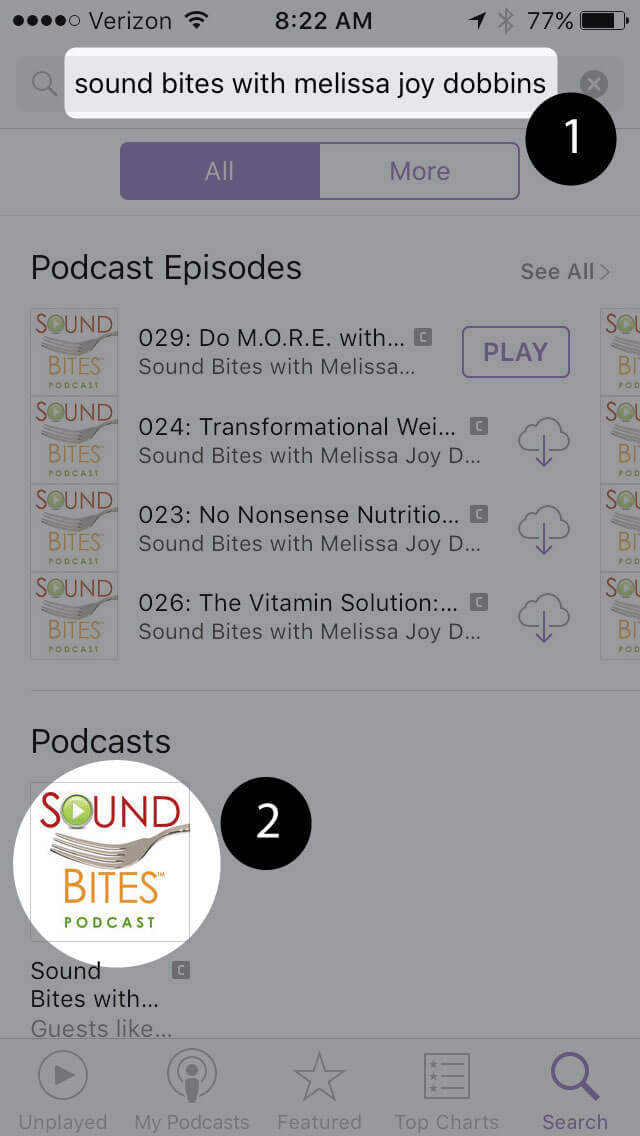
Open the “Podcast” app on your iPhone
Search for “Sound bites with melissa joy dobbins”
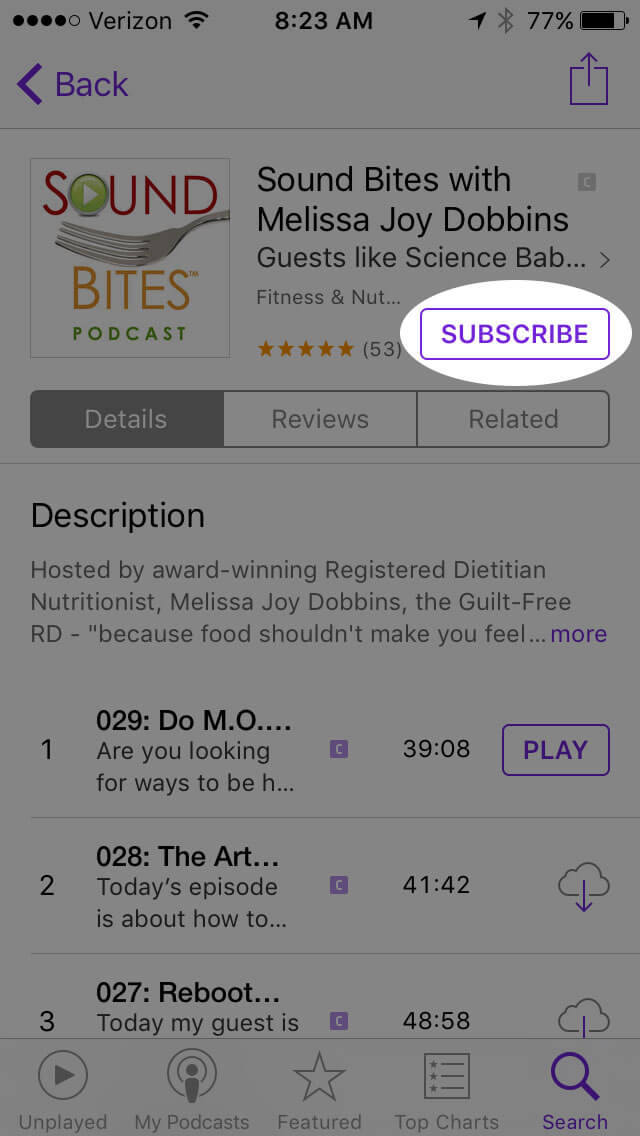
Open the podcast and click “Subscribe” and your done!
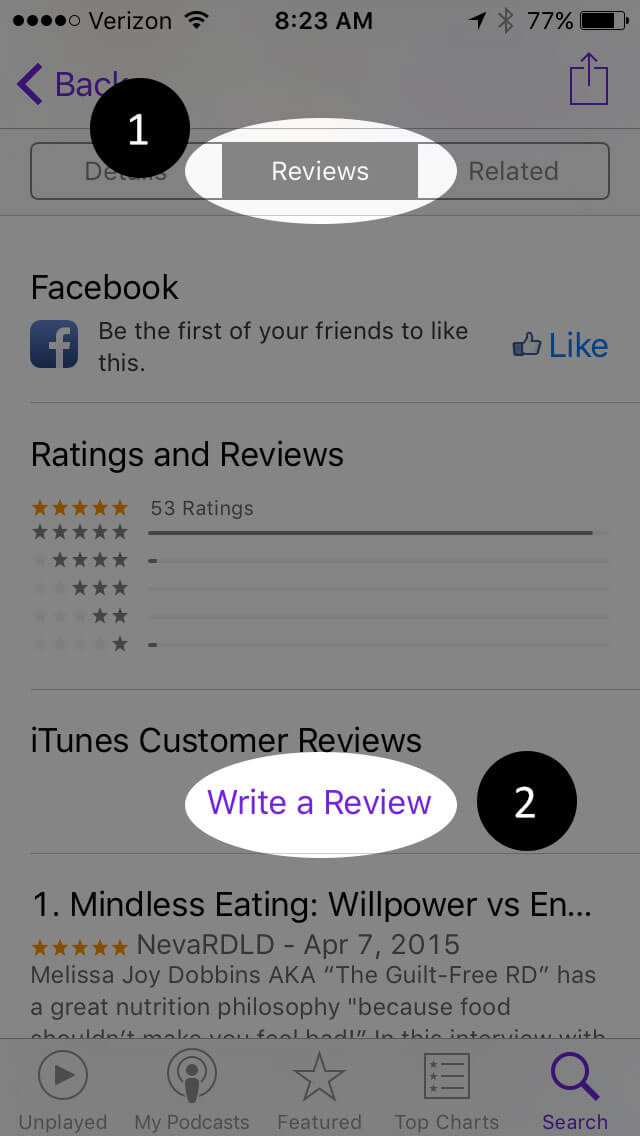
Write a Review
Click “Reviews”, then “Write a Review”.
Subscribe via RSS Feed
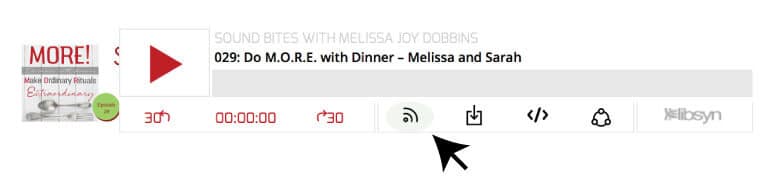
Navigate to any podcast player . Click on the RSS feed icon.
Click on the RSS feed icon.
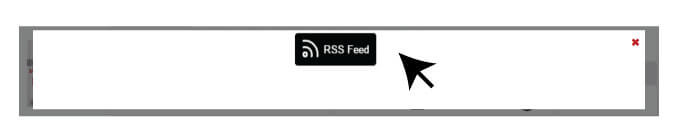
Click on RSS Feed
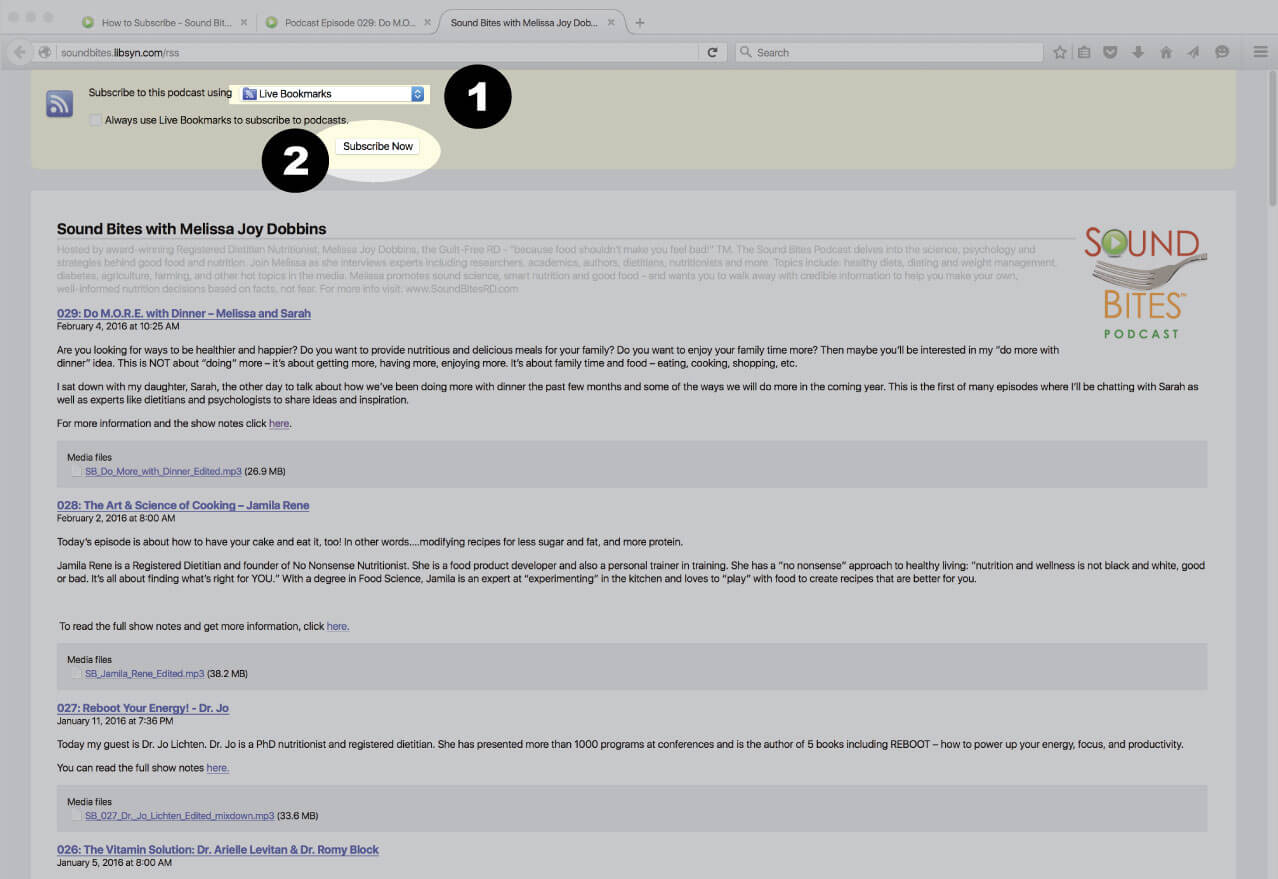
Choose which application you would like to use to receive the RSS feed
Click “Subscribe Now”
Confirm settings and subscribe.
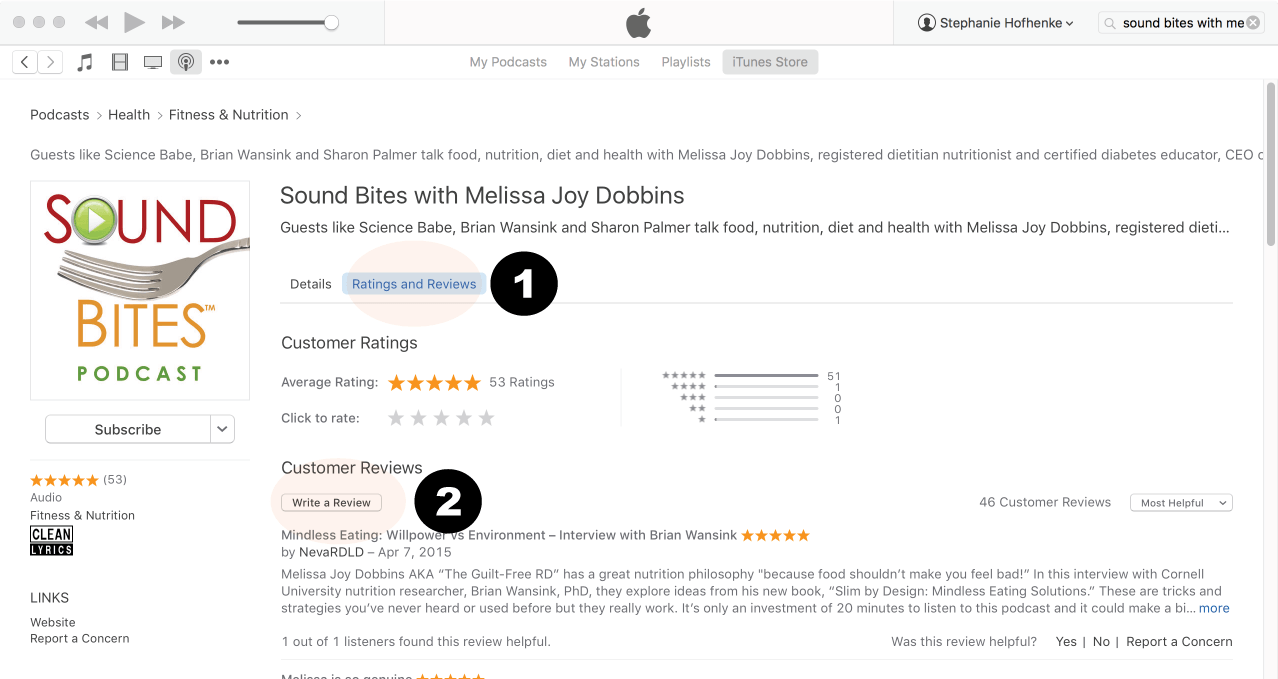
How to Review in iTunes
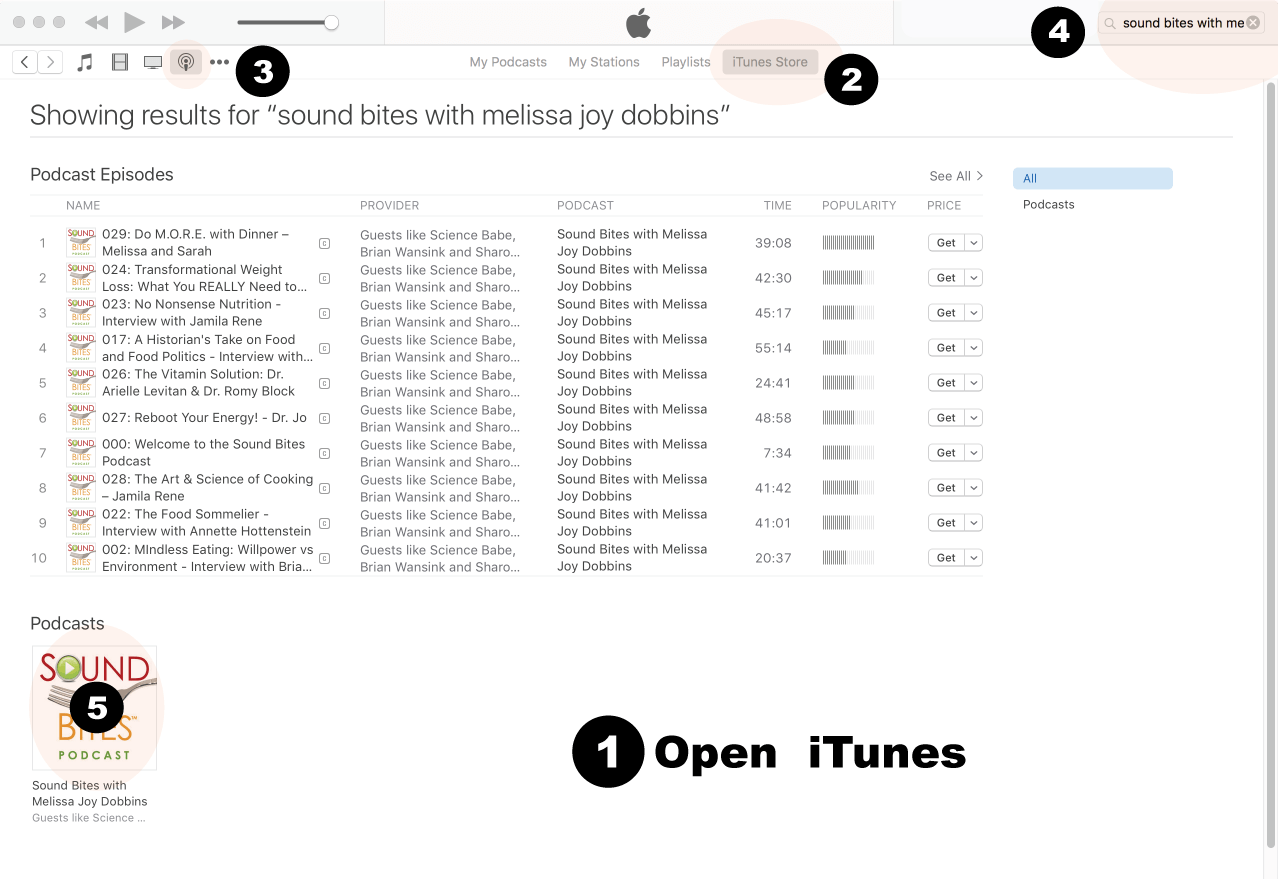
Open iTunes desktop application
Click iTunes Store
Click on Podcasts
Search for “Sound bites with Melissa Joy Dobbins”
Click on podcast image
Search for Sound Bites podcast in iTunes
Click Ratings & Reivews
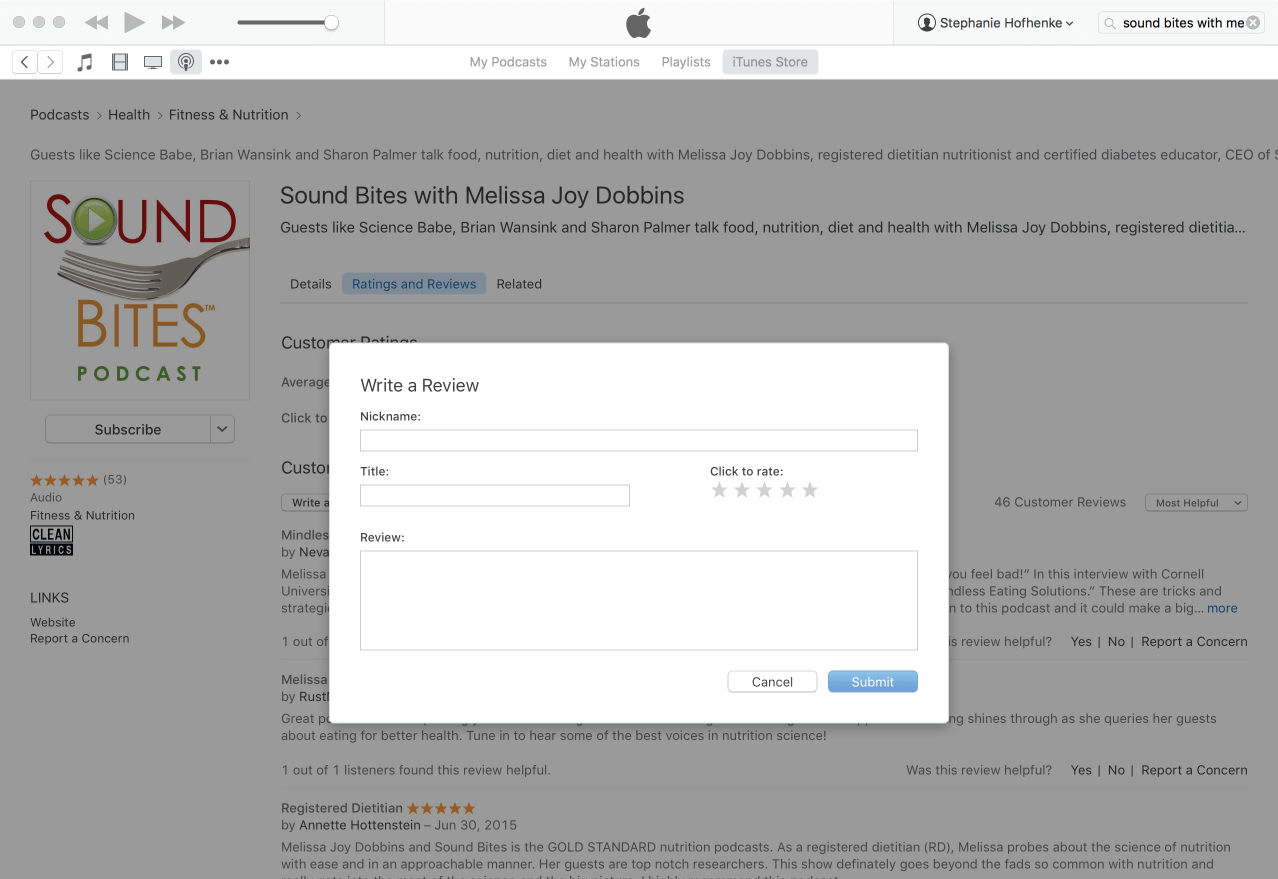
Click Write a Review
View reviews and write your own review.
Write your review…. Thank you!
Write your review!
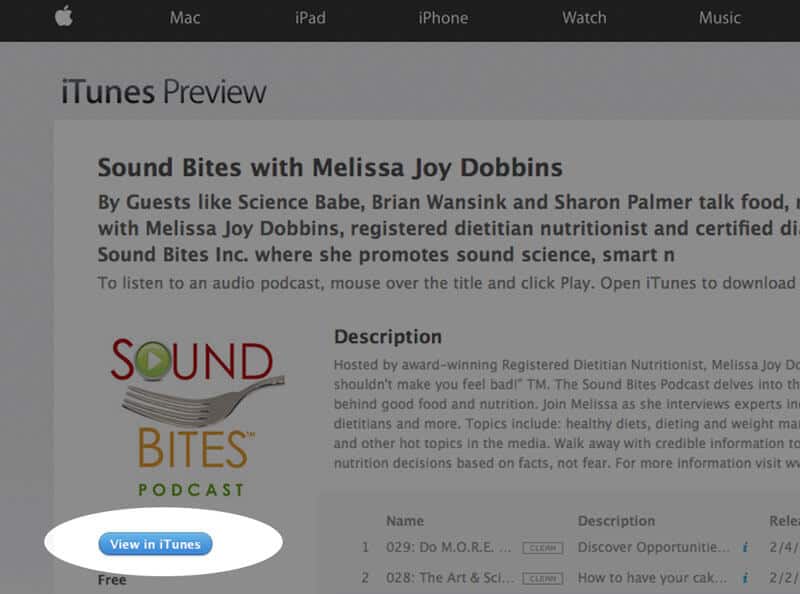
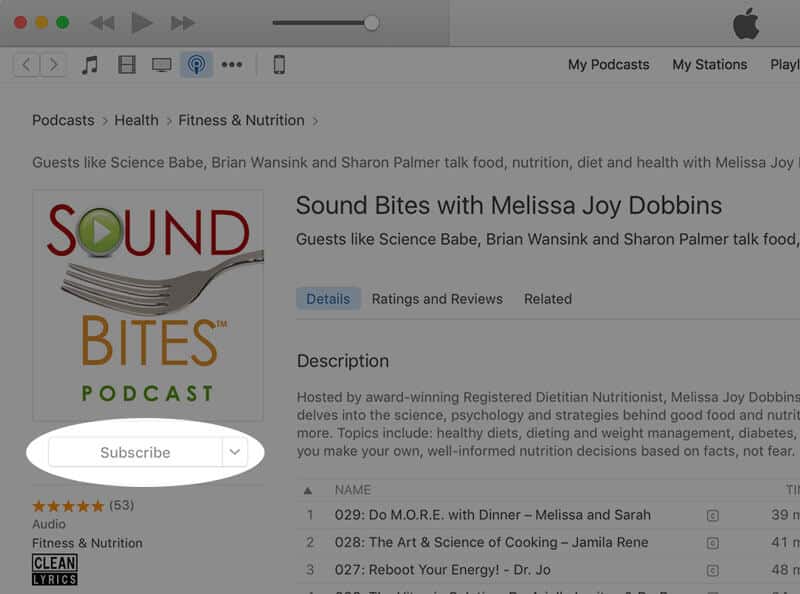
How to subscribe via iTunes
Click here to view the Sound Bites Podcastin iTunes, then click the blue “View in iTunes” button. This will open your iTunes application directly to Sound Bites Podcast. Click the “Subscribe” button, and your done!




 Frances Largeman-Roth is a Registered Dietitian Nutritionist, a New York Times best-selling author and nationally recognized nutrition and wellness expert. Frances is the author of Feed the Belly: The Pregnant Mom’s Healthy Eating Guide and Eating In Color: Delicious, Healthy Recipes for You and Your Family. She is also the co-author of the bestselling The CarbLovers Diet. Her latest book, Everyday Snack Tray, was recently released.