Celebrating over 1 Million Downloads and 50,000 Free CEUs on the Sound Bites® Podcast | NEW: Get 1 years’ worth of CEUs with the new 15-CEU Podcast Course
Why are some foods stigmatized while others receive a health halo?
Emotions often inform and influence the attitudes and beliefs people have about many foods, beverages and ingredients. Findings from a recent study suggest that in order for negative perceptions to shift, dietitians and other healthcare professionals must use both rational and emotional appeals to encourage people to reconsider what they truly know.
Human judgments are typically made quickly, yet our intuitions often feel very strong. We do not generally feel an urge to self-reflect on these intuitions, so we are often wrong without knowing it. Generally, we are more certain in our beliefs than we should be. Psychologists call this tendency “overconfidence.” Emotional reactions are also typically made quickly and so they often contribute to our early intuitions. Our reliance on emotions in decision making is called the Affect Heuristic and it can lead us to judge things that feel dangerous and unknown as riskier than things that feel safe and familiar. In fact, we are especially likely to rely on the Affect Heuristic when making decisions if our level of knowledge is low.
Tune in to this episode to learn about:
How we think about food and make food-related decisions
What is “critical thinking” and why do people underestimate the frequency of critical thinking errors
What is “affect heuristic” and how does it impact our judgement
How “overconfidence” plays out in food stigma
The Dunning-Kruger effect
A recent study that provides insights into how to shift perceptions around foods and ingredients
The human mind is not wired to optimize critical thinking. It’s put together to optimize fast decisions and getting along with the people in your tribe and so that’s what it does very well. Critical thinking failures are a fundamental part of human nature.” -Dr. Jason Riis
Jason Riis, PhD
Jason Riis is the founder of Behavioralize, a consulting firm dedicated to applying behavioral science to helping organizations solve consumer behavior challenges. He works across industries but most of his work is in food and healthcare. He has a Ph.D. in Cognitive Psychology from the University of Michigan, and he spent 10 plus years as a full-time faculty member at Harvard Business School and then at the Wharton School (at the University of Pennsylvania) where he taught courses in marketing and consumer behavior.
People share all kinds of information, whether they think it’s true or not. But if you first ask them how accurate it is they’re much less likely to share false information when they’ve taken a moment to reflect on it.” – Dr. Jason Riis
Brandon R. McFadden, PhD
Brandon R. McFadden, Ph.D. is an associate professor in the Department of Applied Economics and Statistics at the University of Delaware. He joined the faculty at UD in August 2018 after being on faculty in the Food and Resource Economics Department at the University of Florida since April 2013. Dr. McFadden received a Ph.D. in Agricultural Economics with a minor in Statistics from Oklahoma State University. His research often uses experimental economic methods to study food choice and behavioral economics to better understand consumer perceptions of food labels and production methods. He has authored over 40 peer-reviewed journal articles and several articles for popular press and given over 50 professional presentations.
More people die every year from vending machines than they do shark attacks. We have a lot of fear of sharks, but of course you wouldn’t be scared of a vending machine. That’s because our risk perceptions don’t always match the actual risk. We need to help the public match actual and perceived risk.” – Dr. Brandon R. McFadden
Melissa: Hello, and thanks for tuning into the podcast. Be sure to stay on after
the interview, to hear more about today’s topic, including some helpful resources
and more context about today’s interview. Plus an interesting tidbit about a
podcast series I did that NPRs this American life also did a segment on the very
same week. So some very interesting food for thought. Enjoy the show.
[00:00:00] Hello. And welcome back to the sound bites podcast. Today’s
episode is about food stigma, basically the opposite of the health halo and how
people think and why we make certain food decisions and how understanding
that process can hopefully better help us make our. Own Informed food
decisions based on facts and not fear back in episode 1 0 8, I interviewed Dr.
[00:00:27] Jason Riis about critical thinking and behavior change ever since
then. I’ve wanted to bring him back on the show for a follow-up episode. So I’m
really excited to share with you that I have two expert guests today. I have Dr.
Jason Riis. Who’s the founder of behavioralize, which is a consulting firm
dedicated to applying behavioral.
[00:00:46] To helping organizations solve consumer behavior challenges. He
works across industries, but most of his work is in food and healthcare. He has a
PhD in cognitive psychology from the university of Michigan, and he spent 10
plus years as a full-time faculty member at Harvard business school. And then
at the Wharton school, at the university of Pennsylvania, where he taught
courses in marketing and consumer behavior.
[00:01:12] My other guest is Dr. Brandon McFadden. He’s an associate
professor in the department of applied economics and statistics at the university
of Delaware. His research focuses on consumer behavior and interaction with
the food system. He received a PhD in agricultural economics with a minor in
statistics from Oklahoma state university and his research often uses.
[00:01:36] Experimental economic methods to study food choice and behavioral
economics to better understand consumer perceptions of food labels and
production methods. Welcome to the show.
[00:01:47] Thanks Melissa. Pleasure to be here.
[00:01:49] Pleasure to be here.
[00:01:50] You guys have actually worked together for about five years. now , I
would love for each of you to share a little bit more about the work that you do,especially as it relates to today’s topic and any disclosures you have to note, ,
Dr. Riis, why don’t we start with you?
[00:02:06] Yeah, sure. So, yeah, I mean, you mentioned Brandon and I have
worked together. It’s true. We’ve both been interested in critical thinking and
food kind of through separate academic research streams. My PhD is in
psychology and I studied consumer behavior in that tradition.
[00:02:21] , Brandon ends up touching on many of the same topics though, as
an economist and psychologists and economists are famous for poking jabs at
each other, , for the assumptions of the, of the respective fields historically, but
they’ve come much closer together. And psychologists have, , for a long time
been saying and demonstrate.
[00:02:42] That people aren’t perfectly rational, which is, , to any human that’s
kind of obvious, , we don’t make perfect decisions. We don’t make perfect plans.
We don’t make perfect use of our information. We all have goofball moments.
And of course even economists have known that, but psychologists
demonstrated some of the very specific and systematic ways in which people
diverge from perfect rationality that has been recognized in recent years.
[00:03:09] So it’s a lot easier for us to be civil than it used to be.
[00:03:13] Well, that’s interesting. Dr. McFadden, would you like to respond to
that?
[00:03:18] No, I think that’s pretty spot on as an economist. I do a lot of the
similar things. I just, I talked more about prices and incentives probably that’s
about that’s that’s probably the big difference. Yeah.
[00:03:29] Fun. How did you two get connected in the first place?
[00:03:32] We were on an advisory board, , for large food and ag company, ,
together. And the focus of that advisory board was just understanding
consumers, understanding stakeholders and how, how they think. , and through
that, we developed the collaboration around critical thinking, trying to
understand how it’s defined and how we should think about it in the food space.
[00:03:53] So our actually our initial collaboration was putting together just
some structured thinking around critical thinking, talking about some of the
ways in which we think it’s misunderstood or under appreciated as a challengein the food space. We actually did a large survey with registered dieticians. , and
the work is still published.
[00:04:13] I believe on the today’s dietitian website, a trade journal. I’m sure
many of your listeners will be familiar with, but we surveyed some 800
dieticians through that and ask them questions about where they saw critical
thinking failure. , what they thought about critical thinking failures. And of
course they also, they saw them almost on a daily basis from their customers
and clients and patients and such.
[00:04:37] But one of the things that we saw was that there was some under
appreciation of just how fundamental, critical thinking failures are. So we
asked, , what’s the cause of critical thinking failures and people piled onto the
media. , of course the media has lots to be accountable for there, , including
social media, but, , critical thinking failures have been happening forever.
[00:04:59] Well before there was social media well before there was media of
any kind, the human mind is just not put together or wired in a way to optimize
critical thinking. It’s put together to optimize fast decisions and getting along
with the people in your tribe So that’s what it does very well. , critical thinking
failures are fundamental part of human nature.
[00:05:18] And we think that often goes under appreciated. So that was the
topic of this piece we did in today’s dietician. And we talked about some
specific challenges of critical thinking that we see.
[00:05:28] Thank you. , just to maybe take a step back, can you just kind of give
us, , I talk about critical thinking on the podcast. And hopefully my listeners
have heard episode 1 0 8 with you, but maybe just for a little refresher, for those
who aren’t familiar, can you kind of just give us a top line explanation of what
critical thinking is?
[00:05:47] I would say what really peaked our interest to. In reference to critical
thinking is, , Jason gave a great explanation about kind of how we’ve evolved
over time to be reactionary and not necessarily so analytical.
[00:06:00] And now we live in a time where, , we live in an information
economy. There’s information nonstop. And so what we were interested in, I
think at some level, The fact that people get information, documentaries, social
media. And so how can, , you can kind of systematically think about how
people receive that information, , use that to form thoughts, and then where theykind of use that information that they’ve gained from this new source to kind of
form a opinion based on everything else.
[00:06:29] And to hopefully kind of appreciate what they don’t know. So I think,
, the way we really approach it is to realize that health professionals particularly
have clients who get a lot of information, likely a lot of bad information and
how to help them help a client parse through this information and think about it
more critically so they can be more independent and understanding and filtering
through the information we received.
[00:06:52] Excellent
[00:06:53] in a sentence. I think we’ve described critical thinking as, or in a
soundbite, Melissa. I should say we have described it as the ability to make
objective judgements based on available facts and information. Something to
that effect. Okay. And of course it has many aspects to it, but that’s roughly
what we’re talking about.
[00:07:12] And Brandon described that, , the rich information ecosystem that
we all live in, and it’s very hard to make objective judgments based on available
facts and information because there’s lots of it out there.
[00:07:24] So building on that, are there some specific aspects of critical
thinking. That you want to share with us.
[00:07:32] And then I know we’re going to talk about a study that you were
involved with and share some examples with food stigma.
[00:07:41] Yeah. So why don’t I start around one very fundamental piece of this
objective analysis of facts. Is understanding what you know and what you don’t
really know. And that’s just what you believe, but what you really know why
you know, it, what sorts of evidence you might have for it is what you know
calibrated to the truth and what ultimately ends up happening.
[00:08:06] So that’s a very fundamental piece and psychologists, and more
recently economists have been trying to measure people’s ability to do that. And
we’ve got some interesting measures of that. And I can talk about one of them.
Brandon and I’ve collaborated on a couple of versions of this, but I can talk
about one that we did pertaining to MSG.[00:08:26] Should I start with that? Sure. So there’s of course, quite a bit of
negative sentiment towards a variety of. Food ingredients and additives and
even products and manufacturing methods and such and production methods.
And in food, where did these negative attitudes or sometimes border on stigma.
Where do they come from?
[00:08:45] We were instant trying to measure this or, sorry. Brandon was not
directly involved in this project, but he knows the methodology. This was
around MSG. And we were interested to understand how well people kind of
knew what they knew and knew what they didn’t know. So did they have that
self-awareness that meta-awareness of, of their level of knowledge.
[00:09:03] So it’s a fairly standard test of that sometimes called an
overconfidence test because the direction tends to be that we are over-confident
or overly certain that we think we know more than we do. So the way it works
is this. You ask people a series of fact-based questions. So we did this for MSG.
We asked, , does this food contain MSG.
[00:09:24] Which of these ways is MSG actually produced, , when was MSG
first identified, things like that. So fact-based things where there’s not really
controversy about whether they’re true or not. And we can go to very good
sources to see if they’re true and it’s multiple choice answers. So you answer all
10 of these and you get a certain number of them, right?
[00:09:41] Let’s say. On average people were getting like 30% of the questions.
Correct. We then ask them, how many of those questions do you think you got
Correct. So if you’re answering the questions, do you find them difficult to
answer or you weren’t quite sure. , you should know that you shouldn’t say yeah,
actually I wasn’t sure of these answers.
[00:09:58] So if you actually got 30%, correct, you ought to be able to say,
yeah, I think I got about 30% of those. Correct. But that’s not what happens
when people get 30% correct? I think they got more like 50, 60%. We tend to be
overconfident and that’s true across people across domains. What was
interesting in the study that we did here is we found that people who tended to
avoid MSG were actually more overconfident about MSG.
[00:10:27] They got about 25 or 30% of the questions. Right. But they thought
they got like 60% of them. Right. Those who consumed MSG and weren’t
particularly worried about it, they were much less overconfident. So that’s astudy that’s suggestive of less rationality going into a particular type of food
avoidance.
[00:10:47] Okay. And that kind of reminds me of the Dunning Kruger effect. Is
that similar?
[00:10:51] Yeah, the Dunning-Kruger effect. It’s tied in here. So David Dunning
and Justin Kruger. Two psychologists who noticed that it seemed that the people
generally, who knew the least were the ones who were the most overconfident,
even the most certain about what they knew.
[00:11:08] So the people who are the most wrong are the ones who think they’re
the most. Right. , and they’ve observed that generally in a variety of domains. ,
and in some ways that makes sense because it’s not really, until you start to
understand things or get in the weeds of them that you realize, oh my gosh, this
is far more complicated than I ever thought.
[00:11:26] It’s one of the reasons. Graduate students often experienced this real
Gulf or drop in confidence because once they really start studying, they realize,
oh my gosh, the world is far more complex than I ever realized. There’s so much
that I don’t know. But at the very beginning of learning experiences or without
much self-reflection people kind of think they know more than they do.
[00:11:46] So the people who know the least tend to think that they know much
more than they really do. That’s the Dunning-Kruger effect. That’s consistent
with what we saw here, the people who were avoiding MSG were the ones who
actually knew the least about MSG, but we’re the ones that thought they knew
the most about it.
[00:12:02] Very interesting. And I’m glad you explained that because to me that
conveys, it’s not that these people are arrogant or they think they’re all that it’s
and I’m sure there’s a lot of psychology that goes into it, but the way you explain
it, it kind of sounds like we kind of take things at a simplest.
[00:12:19] Basic value until like you said, we start getting into the details in the
weeds and we’re like, our mind has kind of blown like, whoa, wow, there’s a lot
to this. And that makes perfect human sense to me.
[00:12:30] Yeah, no, it’s well said it’s not arrogance. It’s absolutely not arrogant.
So there certainly are arrogant people out there, but that’s not what this is about.[00:12:37] Human nature. The mind is designed to give us intuitions and fast
perceptions of the world and what’s going on. And those perceptions seem real.
As soon as we get them, , like I’m afraid of this, therefore it must be dangerous
when you have that palpable reaction to something. It just feels like it has to be
right.
[00:12:54] And it’s very hard to think through that. So we get these very strong
intuitions. That’s how the mind works and you’re right. It’s not arrogance. It’s
human nature.
[00:13:02] Arrogance can come into this. In one way, , the way Jason described
asking the question, , you give a test, how well did you do on the test?
[00:13:09] That’s really, , testing somebody’s overconfidence in their own
abilities. Another way. These questions are often worded is how well did you do
relative to other people who took the test when it’s framed like that? It’s a little
bit more towards arrogance. Of course then just kind of the within inability,
right?
[00:13:27] My own ability. It’s kind of, , I don’t know if you’ve heard the joke
that, , nobody’s a bad driver. Right. Everybody’s above the median.
[00:13:34] Yeah. We all think we’re above average. Everybody thinks they’re
above average. Yeah, that’s right. Yeah. So let’s talk about, and if there’s any
other like aspects you wanted to pull in, please do, as we go along, I know we
talked about a lot about risk perception in episode 1 0 8.
[00:13:51] Of course. When I wrap up, I’ve got some related episodes that I’m
going to share with people. And you’re talking about this thinking fast, thinking
fast and thinking slow. Book, , system one, thinking system, two, thinking it
gets really detailed. So we’re not going to do all that today, but there’s other
resources that I’ll share with people, but let’s talk about some sort of prime
examples.
[00:14:11] , you mentioned MSG, but maybe some other examples that we’ve
had in the past and maybe some newer things on our plates, quote unquote right
now. Cause I know for example, burger king. , a few months ago made an
announcement that they’re banning a bunch of artificial ingredients from its
menus.[00:14:33] Chipolte did this years ago. Panera has its no no list. , subway
probably led the charge back in 2014. I believe after a blogger whose name I
won’t mention was calling out the company for using. , chemical in their bread
that is also used in yoga mats. So, , , we have this sort of this like free from
these clean labels.
[00:14:58] So yeah, it could be ingredients that could be foods in and of
themselves, but are there any examples that you can share with us
[00:15:06] Interestingly, I think there’s some overlap there. With the MSG, ,
because. A lot of people are aware of MSG likely because of labels that say no
MSG, right?
[00:15:18] Food that’s labeled or restaurants that say we don’t use it. MSG that
implicitly communicates to a consumer that there might be something wrong
with MSG. Right? , same thing when I see it, you see a label that says, , less
sodium reduced sodium that communicate something to a consumer. And so the
overlap there is this kind of free from, or does not contain type of advertising.
[00:15:40] I think it can be highly influential because it doesn’t in any way
communicate any of the benefits or actual costs. It just tells you that it’s free
from something. Right. But that communication, the way someone might
receive it is, well, I should avoid this. Right. This is communicating to me that
there’s something possibly wrong with this ingredient or nutrient.
[00:15:57] There’s a reason it shouldn’t be in there.
[00:15:59] Yes. And particularly, as you said, if it’s got a chemical sounding
name. Consumers are going to double down. Right. And so you can imagine
though, from a consumer standpoint, This being very, , effective because ,
consumers are busy. It doesn’t matter what life stage you’re in.
[00:16:14] Right. If you’re a young, professional who’s career focus, or if you’re
a young family or whatever, you’re busy, you have a lot of other things to worry
about. And so in general, it’s a big ask to want the consumer to be concerned
about every little aspect of the food system. Now, , we kind of have this curse of
knowledge if you work in the food system.
[00:16:32] Cause we’re all very sensitive to these things because we think about
it a lot. But the average person. It doesn’t have a lot of time to dig into this. And
we know that people in general are more sensitive to costs right. Than they areto benefits. And so the idea that there could be this risk associated with this
food, even if I don’t understand it, or, , I don’t have time to really understand it
or look at the evidence.
[00:16:55] And so I’m just going to take this as a cue and, , I’m going to be
overly concerned, likely about the costs. And then I’m going to use that to make
a decision. And so I, I do think there’s some overlap there and definitely some
of the restaurants, like you mentioned, subway burger king are really playing on
that concern about chemophobia, , in a study that we’ve done before, where
we’ve asked people about things like GMO labeling,
[00:17:19] Do you want GMO labels? That’s often used as a reason for, , a
policy I needed policy, but, , we’ve asked people to, , do you want the food label
that contains DNA and you get about the same proportion, right? About 80%
say that they want food with DNA label, which of course. Would it be ridiculous
because as almost everything in the grocery store, then just be carrying a label
that would just become noise. Right.
[00:17:41] There’s food in this package.
[00:17:43] Right. And so it’s very effective or it can be, , one thing that’s
interesting, again, like I said, if you ask people something like GMOs, for
instance, if you ask people, , are you concerned about it? They say, yes. Do you
want to know if it’s in food? They say yes. But if you look at something like
scanner data, so you look at, , what people are actually purchasing, you see most
people are purchasing.
[00:18:03] Foods with GMOs, The market share in general for a non GMO
products or organic products is just much smaller than food that likely have
GMO ingredients.
[00:18:13] Right, right. What people say they want or that they’re doing versus
what they’re actually doing is always a fascinating concept to me.
[00:18:20] It
[00:18:20] is. And, , in general, , often when we ask questions, something like,
would you like food that contains GMOs to be labeled, , often those questions
aren’t accompanied with any actual cost to the consumer. So that’s another issueis there’s no cost imposed. And so if you ask somebody, if they’d like
information for free, sure.
[00:18:40] Even if they don’t plan on using it, they’d really be irrational to say
Right. Because then, , if it’s available, then you have every opportunity to
use it or not.
[00:18:47] Right. Interesting. What other examples can we use? I know, like I
said, there’s like GMO, we really don’t hear much about it these days, but
actually.
[00:18:56] there’s A new term, and I believe you’re an expert in this Dr.
McFadden. So if you want to speak to, , what’s going on with the GMO labeling
right now,
[00:19:04] I’ll try to get this policy name out is kind of clunky. I think it’s the
national bio-engineered food disclosure standard and it passed a couple of years
back and they opened it for public comment and essentially food for
manufacturers.
[00:19:18] And, sorry, I can’t recall the size. But there is. , size component here,
as far as the size of the company, , so firms over a certain size are required to
label food. That’s a GMO or it has GMO ingredients starting January one of this
year. Okay. So, , it passed a few years back.
[00:19:33] They had public comment and part of this is part of the public
comment was about how these labels can be done. And so, , you can use a
symbol, , text QR code. And I think there’s like a link you can provide and
you’re right. The term that kind of came out in the public comment was that
rightfully so a lot of people don’t like the term genetic modification because.
[00:19:55] There is some implicit communication there that perhaps we haven’t
modified food before, essentially the genes, , conventional breeding, previous
breeding techniques, don’t alter the, , the genetic makeup of things. And that’s
not the case. And we, and we’ve asked that actually in surveys before, like how
many genes are altered by these different production methods.
[00:20:12] And in general, people think more genes are altered by genetic
modification, which is actually not the case. So that’s why some people in the
scientific community, don’t like the term genetic modification. People don’tunderstand. And I say people in general, on average, don’t really understand the
way genes are passed on when things are bred.
[00:20:32] And so there was this push that maybe we should use some kind of
different language here, That communicates better and also more of an umbrella
term. Because if there are different types of Gene editing now, So it’s not just
genetic modification. So, yeah, we’ve got this term bio engineered and that was
kind of interesting to watch because advocates for labeling of GMOs, weren’t
happy with this option because they’re concerned that it might provide an overly
optimistic attitude instead of the negative attitude.
[00:21:02] that apparently they would like to come with a label, , we’ve did a
study recently. , we hope to have it sent to a journal soon for publication. And
we did an experiment where some people saw a label. And then some people
saw text and we’re trying to figure out not only the effect of bioengineering, but
the effect of using this label, because that was another thing that advocates
weren’t happy about it because it was kind of a, an attractive label.
[00:21:24] It’s, , it’s pretty, and we did find that people in this treatment that just
saw the symbol were more likely to choose that bioengineered option. Than if
they were shown text instead of the symbol. So it does appear that the symbol is
looked at a little bit more favorably. The nuance there is.
[00:21:43] Where does that really put the overall attitude about GMOs? Right?
Because it’s negative already, right? There’s a horn effect, With GMOs. And
there’s a bit of a halo effect for other things. For instance, like with organic
foods, typically people think they’re more nutritious. They’re safer, things like
this, but , local is even attached with it.
[00:21:59] There are all these attachments with organic. They kind of put it in a
better light. And there are a lot of things attached with the GMOs that provide
this stigma. And so one thing that’s really not clear. That’s interesting to me that
shaking out here is where should that perception be? And that’s something that
behavioral scientists are interested in
[00:22:15] Like actual risk and perceived risk, Because our risk perceptions
don’t always match the actual risk. Great example I like to use, as , from the
numbers, I’ve looked at more people die. Every year from a vending machine,
then they do shark attacks. But of course you wouldn’t be scared of a vending
machine.[00:22:32] We have a lot of fear of sharks, but all that to say, this is something
that I think a lot of people are interested in is helping the public match actual
and perceived risk. And it’s not clear where that’s at but we obviously know
there’s some stigma So there’s, there’s over concern likely about the risks.
[00:22:48] And then you’ve got this now this new label, maybe it decreases
some of that, but is there still a higher level of concern about GMOs and there
should be given the evidence and the actual risk.
[00:22:59] I mean, one way that psychologists try to judge. The appropriateness
of a level of concern is, , how tightly associated it is with fear and emotion.
[00:23:10] There’s a concept psychologists often talk about affect heuristic –
affect as being another word for emotion. The idea is that people judge the
riskiness of something by how it makes them feel. There’s the shark attack
example is a great one. You instantly feel afraid and therefore there’s a risk.
[00:23:25] And yeah, if you’re in front of a shark, there is a risk, but the overall
risk of dying by shark is incredibly low. We judged the risk of things by these
feelings. And this has been measured in the case of GMOs, many of the
strongest opponents to GMOs shown to have these very, very negative
emotional reactions that border on border on that actually include disgust
reactions.
[00:23:51] And when it’s disgust reaction, when it’s that emotional, You tend to
get away from more nuanced reasoning. Like people have these disgust
reactions actually even say things like, , this should be banned, no matter how
great the benefit or how small the cost, , doing twice as much of this is the same
as doing just a little bit of it, like a completely insensitive to the quantity of the
potential harm that’s being done.
[00:24:16] And , when you can’t talk about quantities and measurement and
objectivity that’s when you’re probably not thinking in a strictly rational sense.
You’re not thinking about uncertainties when it’s emotional like that. That’s kind
of when we start to think there’s a big Gulf between the perceived risk and the
real risk, and that’s been shown, , in the case of GMOs.
[00:24:37] So revisiting the labeling for products like that does seem like
potentially good opportunity for re-evaluation among the broader public of
these technologies, because it’s also the case that, , when people are very
emotional and passionate, They’re going to rant about it, , and others are goingto hear those rants and those angry words and prese that there is something
actually to be afraid of.
[00:24:59] And very often there isn’t and the nature of social media now is that
some of these stronger, , more fired up voices get amplified. And it’s very hard
to navigate those kinds of things. You tend to think if someone is fired up about
something, they’re probably onto something. Well, they might not be.
[00:25:16] And some opponents of GMO’s understand this affect heuristic very
well.
[00:25:21] Well, if nothing else, some of the imagery that’s been produced. It’s
very effective at invoking emotion, right? , you’ve likely seen images of
syringes and tomatoes, Or there was one, , an image that was going around, like
with an orange, with a pig face, That was like about citrus greening and using, ,
a GMO approach to citrus greening.
[00:25:41] But when you see these images, it evokes an emotion, And when you
start with that invoked emotion, , when you, when that’s a starting point, that
just makes it so much more difficult to actually think critically and parse out
What’s good information. What’s bad information and staying in a mindset that
really allows you to be analytical, to arrive at a decision about, , what you think
about the safety of something like a GMO.
[00:26:05] And so that begs the question. Are we getting any better at this?
And. What advice do you have with all of your insights and the work that you
do for us as consumers, for any health professionals listening to help their
patients and clients be better at this whole critical thinking and just thinking in
general?
[00:26:30] Yeah, I do think the world is continuing to navigate this challenge
and it is true that social media, the prominence of them have, I think, made that
more urgent. But also they do provide some hope, , with there being
possibilities of setting up social media in a way that they’re less prone to these
kinds of problems.
[00:26:49] , and I, , there are academics and scholars and consultants and the
companies themselves are, are still trying to navigate how to do that. But I think
at a, , at a high level, the things that they should be trying to do are, , sort ofdeactivate the emotionality of some of these debates emotion is essential and
human thinking.
[00:27:07] And has to be. But just creating an emotional balance, I think is
important. So understanding the emotions that can be on both sides of
something, , you may have strong opposition, strong, emotional reaction to
something like GMO or any kind of agricultural technology, but there should
also be emotional reactions to the benefits, especially in emerging economies
that some of these technologies can bring.
[00:27:31] We live in a global world. That’s the reality. Another high level
approach I think is extremely important is to try to get the right level of nuance
around uncertainty, how to talk accurately and appropriately about uncertainty
and, , scientists and their scientific work labor over this. They’re constantly
trying to provide the specific evidence for the degree of conclusion they have in
their papers and talking about the limitations, the things that we don’t yet know,
but it’s hard to express
[00:28:02] Uncertainty in a way that doesn’t completely undermine your
position. And I think we’re all still trying to figure out how to get better at that. ,
one suggestion I’ve heard is you’ve got to talk with confidence and belief, but
describe where the specific uncertainty is in your beliefs. what specifically
don’t we know.
[00:28:22] About COVID for example, , getting into the specifics, why you
believe what you believe rather than just, , we can’t just throw our hands up and
say, oh, there’s so much, we don’t know.
[00:28:31] More research needs to be done.
[00:28:33] Yeah. That’s not good enough. Right. We’ve got to talk about the
specific things that are not yet perfectly well known or understood and start
getting used to talking about degrees of confidence.
[00:28:44] , I’m 80% certain of X, and here’s why I’m about 80%. Certain 80%
is not 50%. It’s not a coin toss. I’m very much leaning in this direction. And
here’s why those are the kinds of things I think we need to get better at rather
than just insisting on complete certainty or complete uncertainty.
[00:29:05] Very interesting. Dr. McFadden, anything you want to add?[00:29:09] This is probably going to sound really pessimistic, but I don’t, I just
don’t know how you fix it. And specifically, when I think about the food system,
I just think as long as marketing works, there’s an incentive for food companies
to play on consumers fears, , in a competitive market.
[00:29:27] And this is one thing that’s really difficult for ag in general. It’s a
competitive industry, And you have a lot of different commodity groups. You
have a lot of different food manufacturers and have a lot of different food
categories.
[00:29:41] All these groups are in competition with one another.
[00:29:43] And, and so, , that’s what we get right from burger king or the
subway. The examples that, , we were talking about earlier, as long as marketing
works, companies are going to make these types of decisions. And perhaps
some of it is, , this is something that sometimes difficult to tease out how much
of it is really consumer driven,
[00:30:02] Like I’m trying to avoid this list, this ridiculous list that burger king
is removing. I forget how many different ingredients are on there 120, 120, So
do we believe consumers are worried about those 120 ingredients? And I think
that they know what,. So how much of this is actually consumer driven is the
market giving consumers what they want and how much of this is the market
telling consumers, , this is something you should be fearful about and we’re
looking out for you.
[00:30:30] And as long as documentaries make money. , , so all that to say, and
this is something that Jason and I, , we talked about a lot and a lot of people I
think are interested in is how do you make critical thinking sexy? ? And that’s
difficult, right? Because if you’re a critical thinker, you’re just going to disagree
with people around you.
[00:30:47] At some point, you’re going to disagree with everybody around you
at some point. And when we have, , there are a lot of incentives not to do that.
Right. And it kind of brings me back to this point about social media. , you can
have all the fact checking you want, you can have all the professionals on social
media.
[00:31:00] Disputing claims all day long, , whatever, whatever resources that
can be thrown at it, throw it at it. But that doesn’t change the fact that on socialmedia, I pick my echo chamber. And so, , as long as we think that we’re on
some team, whether it be political, , how, what our diet is, right?
[00:31:19] Whatever defines us in our groups. As long as we identify with these
groups and we find value in these groups. No, we tend to turn a blind eye to a
lot of things, especially things like GMOs it, , as an average person, what do I
care? And so until you can make critical thinking sexy, but again, that’s a big
ask.
[00:31:37] You’re asking people to spend time thinking about a lot of things and
then stand up for it
[00:31:43] and go against their tribe.
[00:31:44] Yeah.
[00:31:45] Yeah. Which is bound to happen. I think Brandon and I share. Much
of the skepticism or inevitability, but that’s really just from a human nature
perspective. I mean, I think, , this is how humans are, we are tribal and, , we are
drawn to fast reaction and fast, fast answers.
[00:32:02] That’s always going to be the case, but, , throughout history we have
developed institutions and practices that help us do better. I mean, science and
scientific method did not really always exist. Were not always articulated. Yeah,
but how’s trust in institutions doing? Well. Yeah, but like new institutions come
through and institutions get better.
[00:32:23] I mean, these things can change. I think we’re always going to need
institutions to help us with this. I mean, your institution of the economics
discipline is one that has gotten people focused on measurement, , including
measurement of uncertainty. I see opportunity for better systems of
communication, of uncertainty, better systems that help us self-reflect on our
own uncertainty.
[00:32:50] I mean, imagine if social media just had occasional frequent prompts
that asked you how accurate is this information? , like one in a hundred items
that comes through your stream, just to ask you for an honest assessment, how
accurate is it? I think there’s opportunities like that. And in fact, , I didn’t invent
that one.[00:33:07] That’s an idea that I think came out of the lab of David Rand at MIT.
, they showed that people share all kinds of information, whether they think it’s
true or not. But if you first ask them how accurate is this? They’re much less
likely to share false information when they take a moment to reflect on it.
[00:33:23] They’ve gotta be ways that institutions can help individual people do
that. , , I think journalists and any communicator also has an opportunity to help
people with that by finding, , useful, clear ways to express uncertainties, to help
us make trade-offs to help us recognize nuance. So I agree with you.
[00:33:43] Let me backtrack a little bit, cause you just said something, a word
that as an economist, of course I love tradeoffs, , so just nuance and context in
general, which take time, take time to provide. But I think if people, and as
Jason said, , there seems to be some evidence that sometimes with, , issues like
GMOs, no matter their benefits, how high they are or low, the cost is still
doesn’t matter.
[00:34:07] Nevertheless. I do think one, I don’t think anything’s going to change
one person’s mind. I think you have little likelihood of changing someone’s
mind you someone’s got to change their own mind obviously. But, so I think the
self-awareness has to occur first that somebody might be wrong. And Jason, you
were talking about people share something.
[00:34:26] They don’t think it’s wrong. No, but they shared it because it likely
agreed with a prior belief or it was non-intuitive. And they are blown away by
this possibility. To come back to the cost and benefits. , that is an issue that I see
is that people only think about costs. They don’t think about benefits.
[00:34:42] And when there is a cost associated with something, then it’s not a
good decision. And that’s not the case in life, Everything has a cost. Everything
has benefits and you have to weigh the costs and benefits of multiple things
together to figure out which is the better way to go.
[00:34:56] What’s the best decision to make. So I think if we could get people to
Really think more on a relative basis. Like, yeah, I understand this. Isn’t perfect,
but what’s the next best option, right? What’s the counterfactual what’s going to
happen if you don’t do this. And that’s true, even for, , things like inaction,
[00:35:11] Like what’s the cost of not doing something, , versus making some
kind of action. Yeah. There’s a negative consequence likely associated with
some costs, but that doesn’t mean that the net benefit. It’s still not the highest.And I see that a lot. Now that’s called a Nirvana fallacy, right? Where you kind
of start with this idea that some perfect world existed or can’t exist.
[00:35:31] And then you backtrack from there to see what’s wrong with the
world around you, Which the world around you still might be the best it
possibly can be. Although it’s not perfect. And so that’s a difficult behavioral
thing to get past
[00:35:42] Articulating trade-offs in these very specific and measured ways is
what your discipline of economics is so good at doing.
[00:35:49] What I think the discipline of psychology is trying to get better at
doing is understanding why it’s hard for people to think in trade off terms. But
now even more importantly, to get them to think again and try to think in those
trade-off terms, how can we get people thinking about Trade-offs and I use that
phrase think again for a reason, it’s the title of a bestselling book by Adam
Grant, perhaps now the world’s most famous behavioral scientist.
[00:36:14] It’s an absolutely fantastic book. One of the things that he talks about
is first, you got to change your own mind. It’s not easy to get other people to
change their mind, but one of the best tools that we have is a well articulated
question, , rather than just throwing information at people, what kinds of
questions can we ask them that would help them better think through the
trade-offs, , so I hear you on what some of those costs are, but what might be
some of the benefits of this technology, , or how are those costs going to play
out?
[00:36:44] There are lots of ways of asking people questions that can get them
to think again and, and reflect, but it takes time for sure, because we don’t
change our views on a dime.
[00:36:55] Wow. You guys are. I get to sit here and listen to you all day long.
You said so many things that are just like, my brain is exploding, but earlier on,
, Brandon, you had said the cost, , and you could use the term risk, but the cost I
think is less Negative in a sentence because it’s just more factual.
[00:37:15] And that concept explains so much about the food landscape. , I
don’t care if biotechnology can, , help improve the environment. It’s better for
the environment. If there’s a potential cost or risk to it, I don’t care. It doesn’t
matter. And you can apply that to all of these things, , MSG.[00:37:38] Oh, it can actually help us reduce our sodium intake. I don’t care.
Cause if there’s some potential risk or cost, I don’t care. So it can be applied in
all of those situations. It explains so much. And I, yes, the trade-off concept. I
love that concept. It’s so important. And to answer your question, Dr. Jason,
Riis, about making critical thinking sexy.
[00:38:01] I think that we just need to, , really. Show people that the smartest
people are the ones that know they’re not that smart or that they’re willing to, ,
not be overconfident.
[00:38:17] Yeah, no, that’s a great point. I mean, there are ways of being smart
that are very subtle and I think that’s the best way to be smart.
[00:38:24] It’s not arrogant. It’s not in your face. It’s not showing people up. It’s
not just, , aggressive myth-busting or sarcasm. It’s subtle, it’s gentle. It’s friendly.
And it savvy and communicators know a lot about how to do this well, and
we’re learning more every month with the new round of publications that come
through.
[00:38:43] So there, there is a lot out there. I mean, we’ve touched on bits and
pieces of it, but I do think I’ll say it again. Plug the book again, Adam, Grant’s
think again is a great deep dive into all this nuance and, , some of the ways that
we can help our audiences think more critically. Excellent.
[00:38:59] Are there other books or resources that you guys want to share as
we’re
[00:39:02] wrapping up?
[00:39:03] I might butcher this title, but it’s a, but it’s something like the power
of not being wrong. And the reason I bring that book up to is because actually,
Jason, the way you frame that and Melissa, the way you frame the question, it
made me think of it. Like how can you get people to be more concerned? About
not being wrong than they are about being right.
[00:39:22] That’s a great thing about social media, right? Everybody wants to do
the hot take. Everybody wants to be right. And that’s a different motivation.
That’s a different that then you become protective, right? When you were very
concerned about being right to become protective of that belief. And it’s a bit of
a different thing to be more concerned about not being wrong.[00:39:39] Very good. Well, I know you guys have to run, so I think what I’m
going to do is, , something a little bit different with this episode, I’m going to
share all the resources and links and where people can find more information
and follow me on social media. In a separate outro and just really so grateful
that you took the time to talk with me today.
[00:40:01] I’ve been wanting to do this episode for a really long time and also
give you an opportunity. Is there anything else you wanted to share before we
wrap up?
[00:40:09] Not me. I just appreciate you having us on, Melissa.
[00:40:11] Thank you.
[00:40:12] Yeah, I wish we could talk all afternoon. Thanks to this. Always try
chatting with my good friend, Brandon and, , Always good to talk to you
Melissa, I think you asked great question.
[00:40:21] I know your heads around this. I think, I just think the fact that
you’ve been researching and thinking about this. for so many years shows that it
is a difficult problem and all we can do is keep chipping away, but let’s not give
up the fight.
[00:40:35] Absolutely not. I love this. Like, , I’m pessimistic, I’m optimistic.
[00:40:38] I really think that there’s having a curiosity and learning and being a
lifelong learner is key to this. So let’s try to get more people in that space. So,
thank you both for all the work that you’re doing. I’ll continue to follow you and
wish you the best for you. Thank you. And for everybody listening as always
enjoy your food with health in mind, and some critical thinking till next time.
Hello. Again, here are the resources and related posts I wanted to share with you
as well as some more information and context about today’s episode.
During the episode Dr. Riis and Dr. McFadden used MSG and GMOs as
examples to illustrate these critical thinking concepts.
However, these failures of critical thinking are not isolated to MSG and GMO.
Emotions often inform the attitudes that people have about many foods,
beverages, ingredients, and other societal issues, for that matter. Besides MSGand GMOs, we could have been referring to perceptions of cultural foods,
unfamiliar foods, foods that your tribe does not eat or is not familiar with.
We could have also been referring to processed and ultra processed foods or
quote unquote artificial sweeteners or those free from foods and clean labels.
We also could have been talking about organic or non-GMO, farming and
production methods, such as free range chicken, cage-free eggs and grass fed
beef. And even buzzwords like plant-based and sustainable.
There’s a research summary of the study. Dr. Jason Riis talked about called
psychological underpinnings of MSG. Why is MSG shunned when experts say
it’s safe. So I’ll have the link to that PDF in my show notes, if you want to find
out more about that particular research, but I want to tell you a story about my
three-part podcast series on MSG and NPRs this American life podcast episode
on MSG that released the very same week back in February of 2019.
My series was actually on MSG and umami. Umami is one of the five basic
tastes it’s been described as savory. So you have sweet, salty, bitter, sour, and
umami. And the reality is that MSG and umami give us the same taste
experience while MSG may have a negative connotation and perception.
Umami has a largely positive one, but they actually use the same molecule, the
amino acid called glutamate, to activate our taste receptors.
So in my series, I spoke with four different experts to explore the largely untold
history of MSG research on the safety, culinary applications and even some
potential health benefits and current research approaches. The first episode
features Sarah Lohman, a culinary historian and author.
She shares how and why history has influenced our perceptions of MSG. And
the xenophobic roots of these negative perceptions. The second episode features
registered dietician, Mary Lee chin. She shares insights into MSGs connection
to Asian heritage and health topics, including the question of MSG and
headaches.
And the third episode features Dr. Tia Rains and chef Chris Koetke. They
discussed the past and current research on MSG and the culinary applications of
MSG and umami, including research that shows MSG can be used to
significantly reduce sodium in recipes. So after I released these three episodes, a
colleague reached out to me to tell me that this American life had released a
podcast episode that very same week about MSG and that I had to listen to it.So I did, and I will tell you I was on the edge of my seat the entire time. I don’t
want to give too much away. So I just highly recommend that you listen to my
three-part series and then the, this American life episode, I promise you will
find it very interesting, very compelling and very entertaining. I will have the
link in my show notes to all four episodes.
Or you can scroll way back in your podcast app about a hundred episodes to
number 111, 112 and 113. And then you can just Google this American life
MSG. And you’ll see a link that says 6 6 8, the long fuse, this American life.
And as a bonus, you can get three free continuing education units from my
MSG series if you’re a registered dietician, diet technician, or certified diabetes
care and education specialist.
The other resources I wanted to share with you are Jason’s website
behavioralize.com and Brandon’s website, Brandonmcfadden.org. I’ll also have
both of their Twitter handles in my show notes. All of these links are in my
show notes@soundbitesrd.com.
And then there are some books that we either talked about or that Dr. Riis and
Dr. McFadden shared with me to include in the show notes. The first is
Thinking fast and slow by Daniel Khaneman. Then there’s Think again, the
power of knowing what you don’t know by Adam Grant, How not to be wrong.
The power of mathematical thinking by Jordan Ellenberg and Misbehaving, the
making of behavioral economics by Richard Thaler.
I also have some related episodes, either that we mentioned during the interview
or once that you might enjoy, if you liked this one. So of course there’s episode
108 with Dr. Jason Riis, critical thinking and behavior change, Episode 181,
cultural humility and health literacy with Loraina Drago, Number 198
What you should know about processed foods with Dr. Bruce Hammaker and
Dr. Tanhia Gonzalez, Number 166 medical humanities, pandemics food
shaming, and social science with Dr. Kari Nixon and episode 100
communicating science in a modern media environment.
So that’s it for today. Thank you so much for staying on and listening to this
bonus content.
And as always, if you like the show, please share it with others. Or give me a
shout out on social media till next time. Take care.
LISTEN, LEARN AND EARN
Listen to select Sound Bites Podcasts and earn free CEU credits approved by the Commission on Dietetic Registration (CDR) for registered dietitian nutritionists and dietetic technicians, registered. Get started!
Get Melissa’s Sound Science Toolkit here!
Partnerships:
Sound Bites is partnering with the Association of Diabetes Care and Education Specialists (formerly the American Association of Diabetes Educators)! Stay tuned for updates on the podcast, blog and newsletter!
Sound Bites is partnering with the International Food Information Council! Stay tuned for updates on the podcast, blog and newsletter!
Sign up for my monthly newsletter and episode eblasts so you never miss an update!
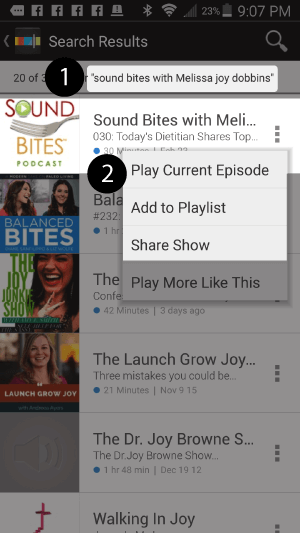
Listen on Stitcher (Android)
Install the Stitcher App
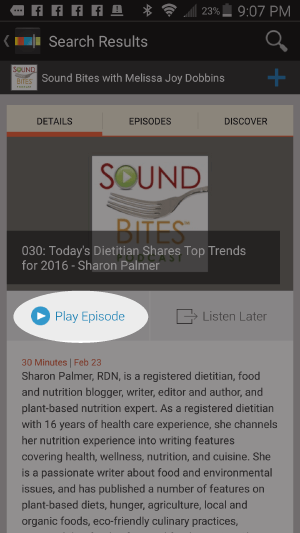
1. Search for “sound bites with melissa joy dobbins” 2. Choose Play Current Episode or Add to Playlist
Choose “Play Episode”
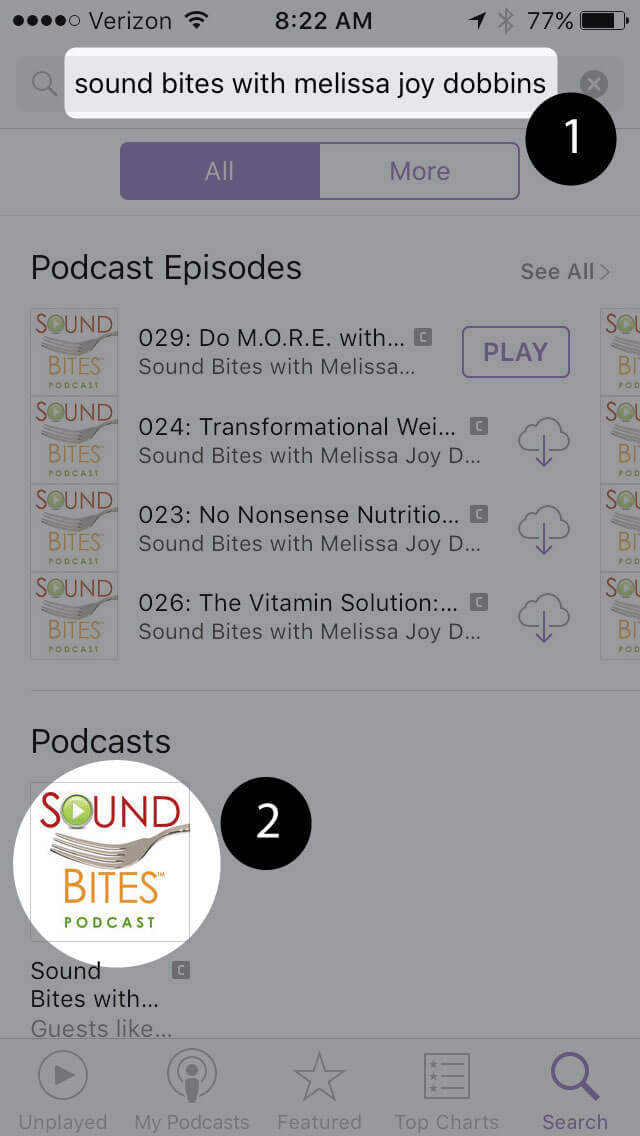
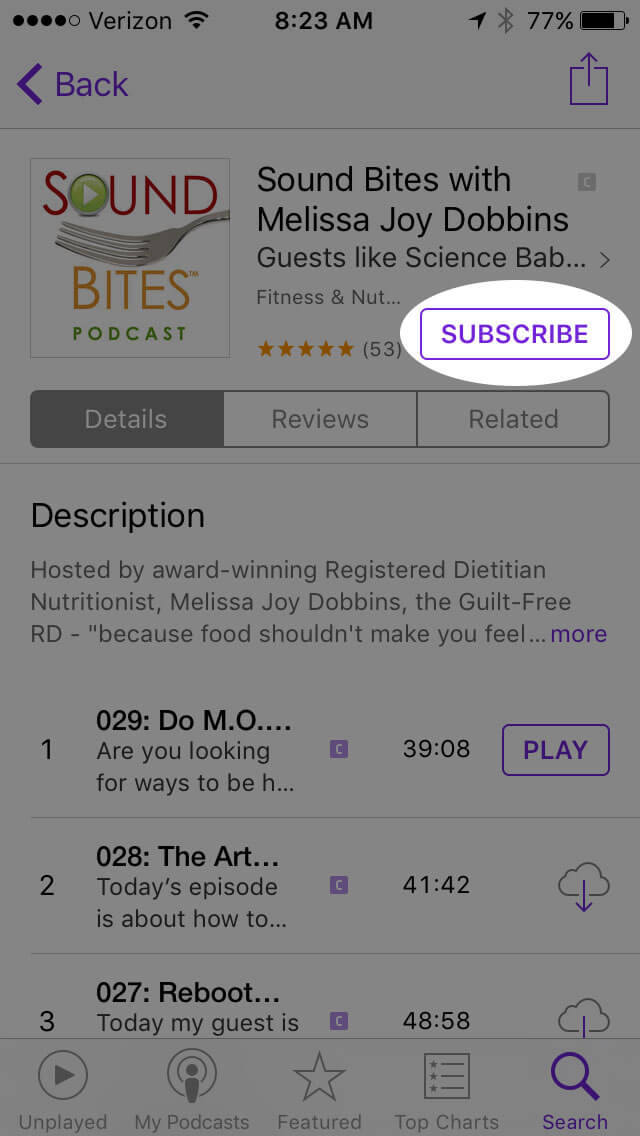
Subscribe & Review on iPhone
Open the “Podcast” app on your iPhone
Search for “Sound bites with melissa joy dobbins”
Open the podcast and click “Subscribe” and your done!
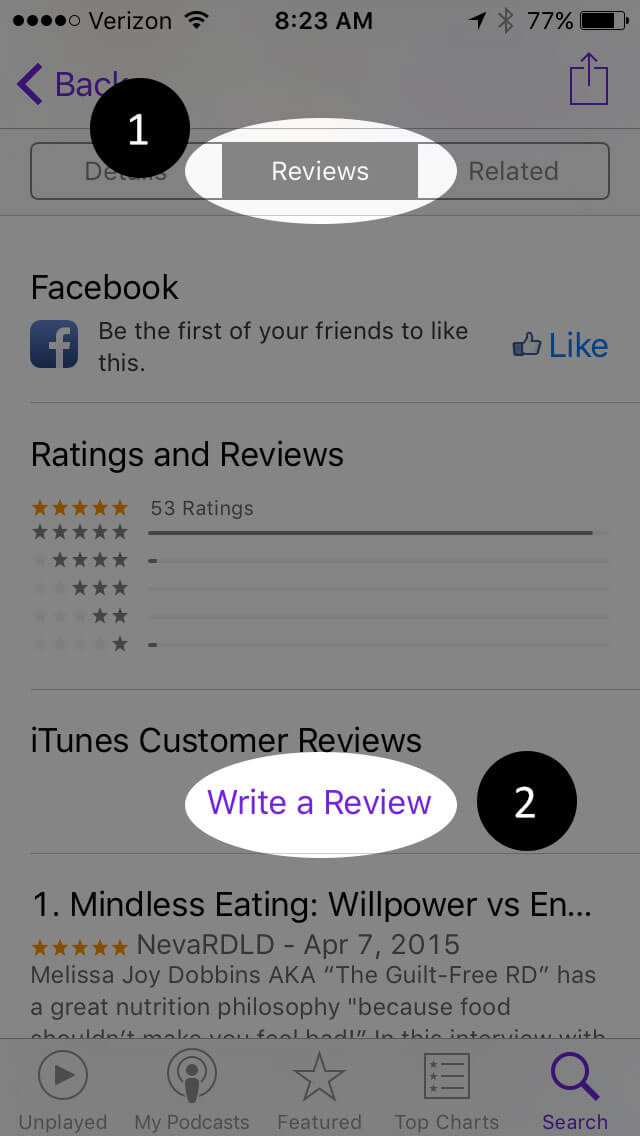
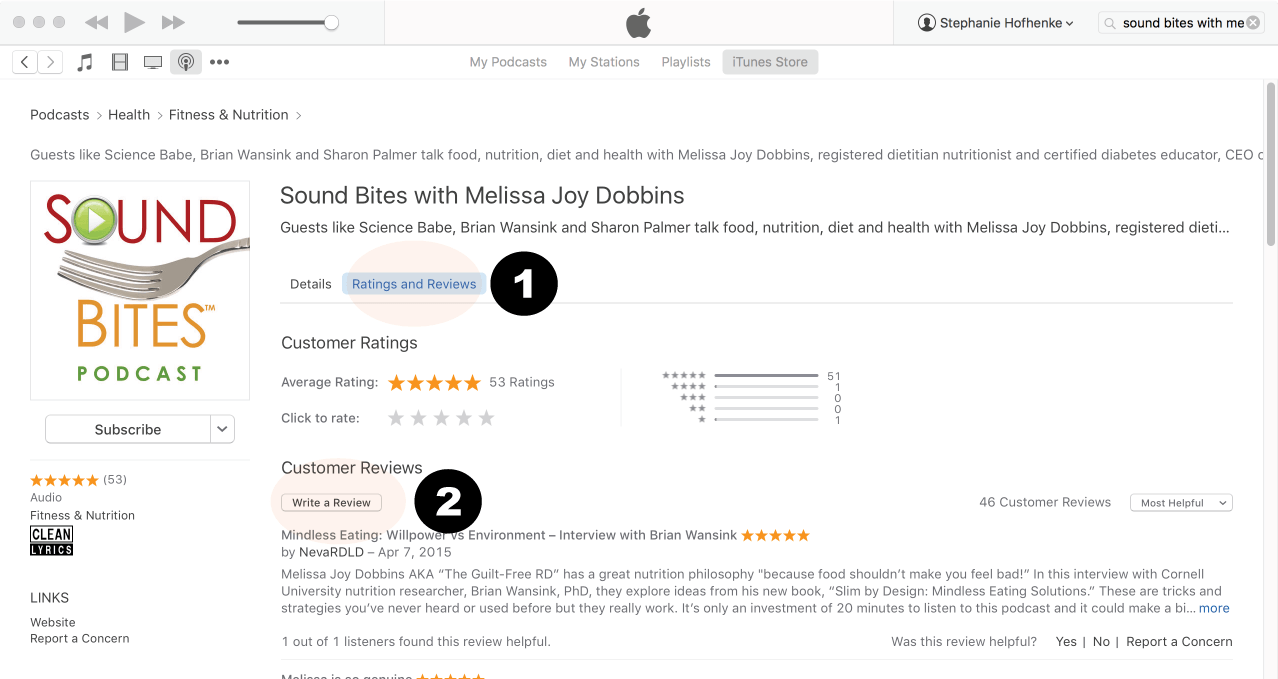
Write a Review
Click “Reviews”, then “Write a Review”.
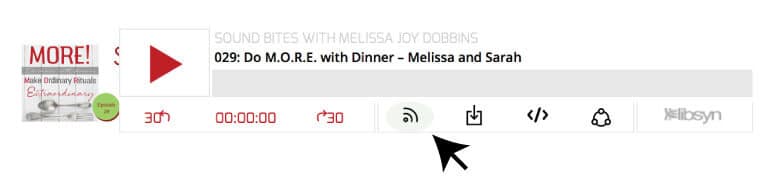
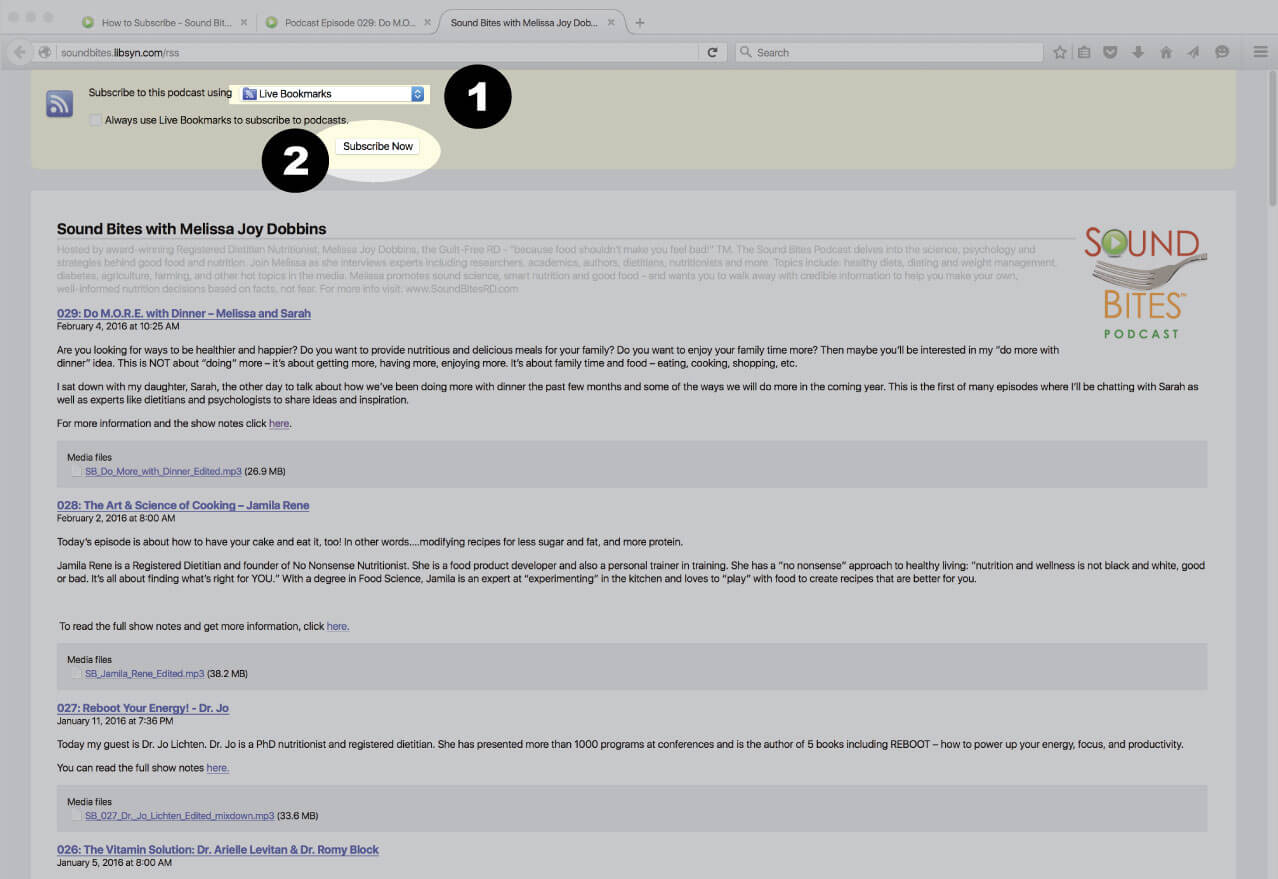
Subscribe via RSS Feed
Navigate to any podcast player . Click on the RSS feed icon.
Click on the RSS feed icon.
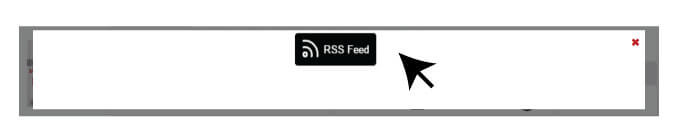
Click on RSS Feed
Choose which application you would like to use to receive the RSS feed
Click “Subscribe Now”
Confirm settings and subscribe.
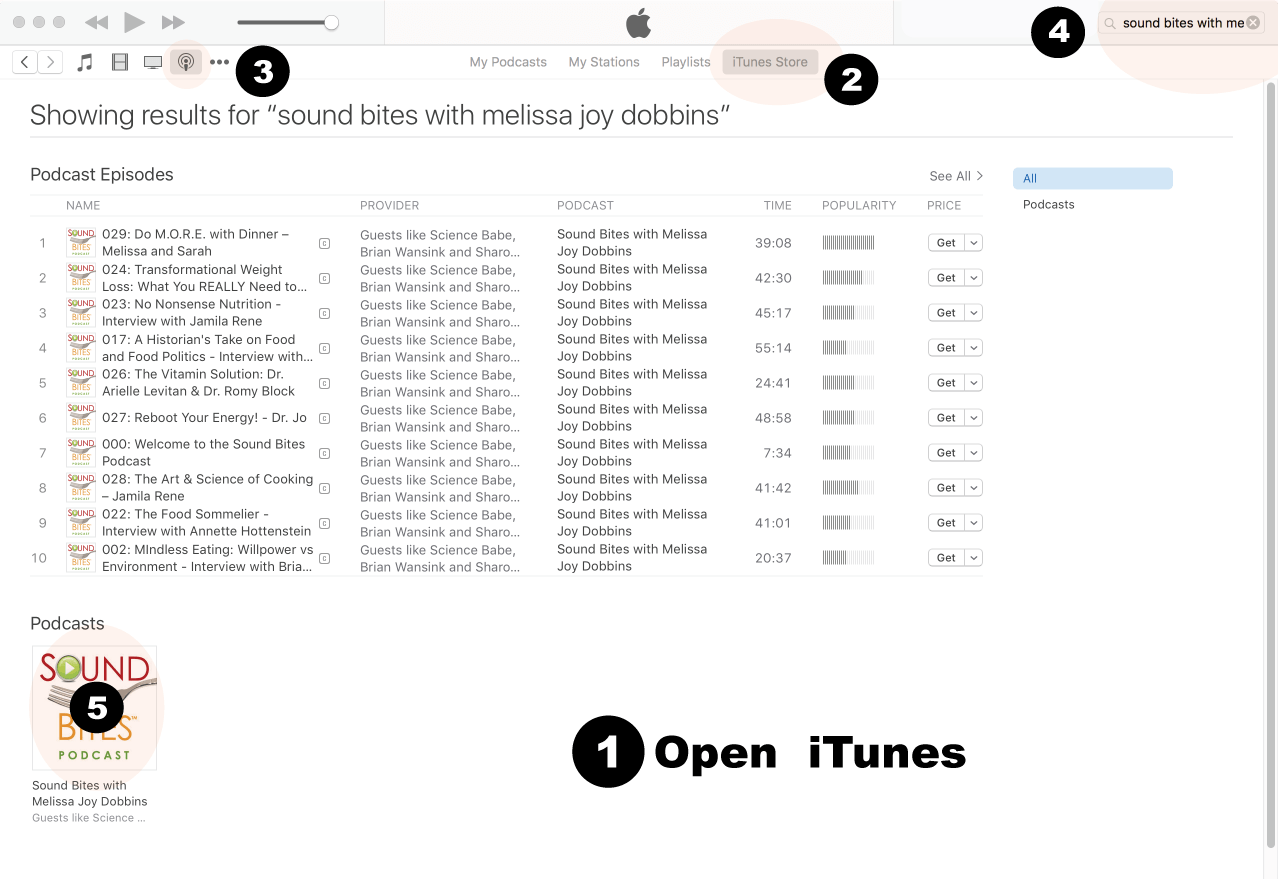
How to Review in iTunes
Open iTunes desktop application
Click iTunes Store
Click on Podcasts
Search for “Sound bites with Melissa Joy Dobbins”
Click on podcast image
Search for Sound Bites podcast in iTunes
Click Ratings & Reivews
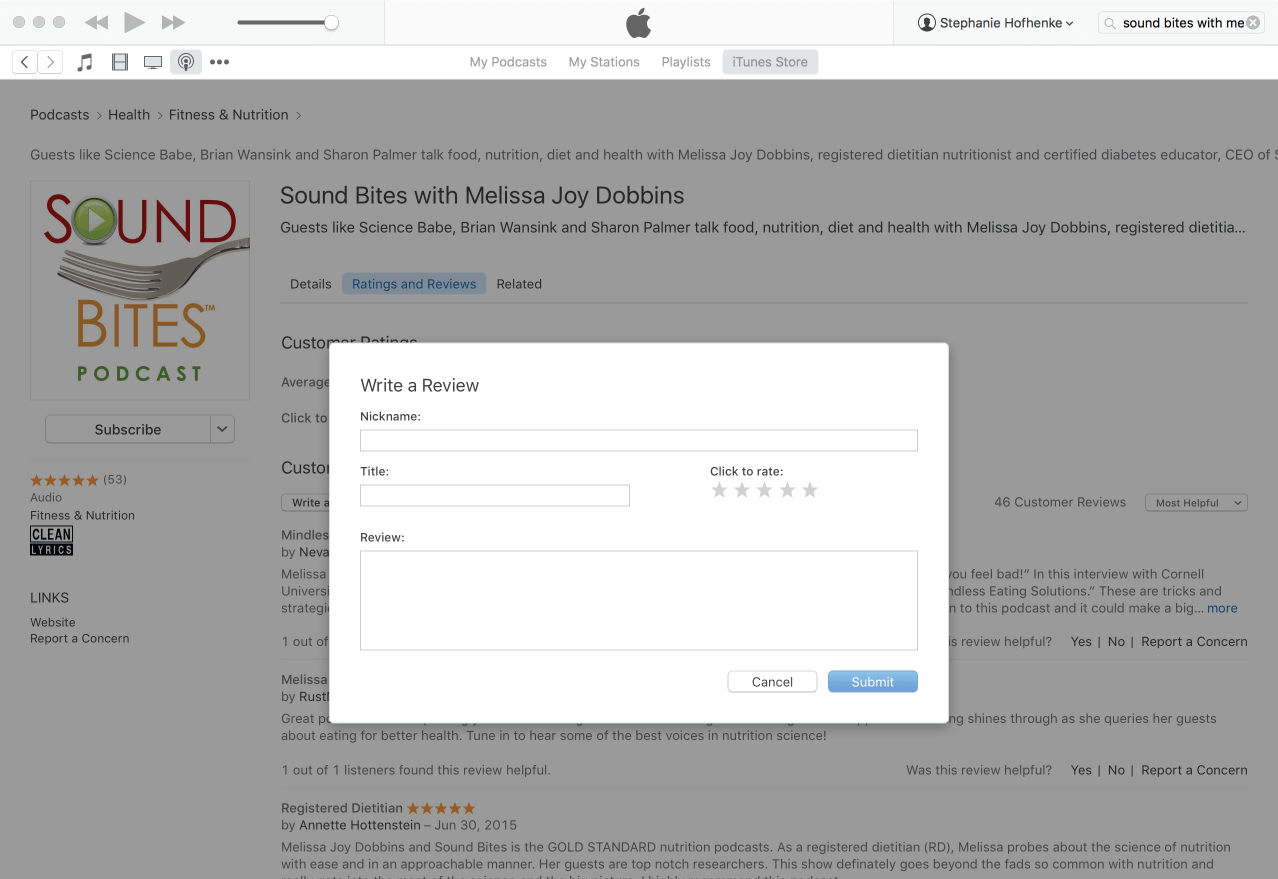
Click Write a Review
View reviews and write your own review.
Write your review…. Thank you!
Write your review!
How to subscribe via iTunes
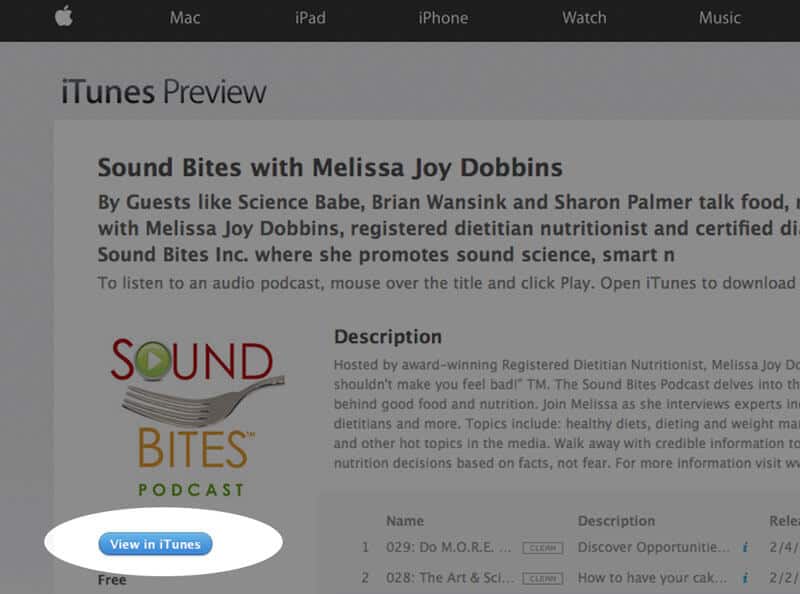
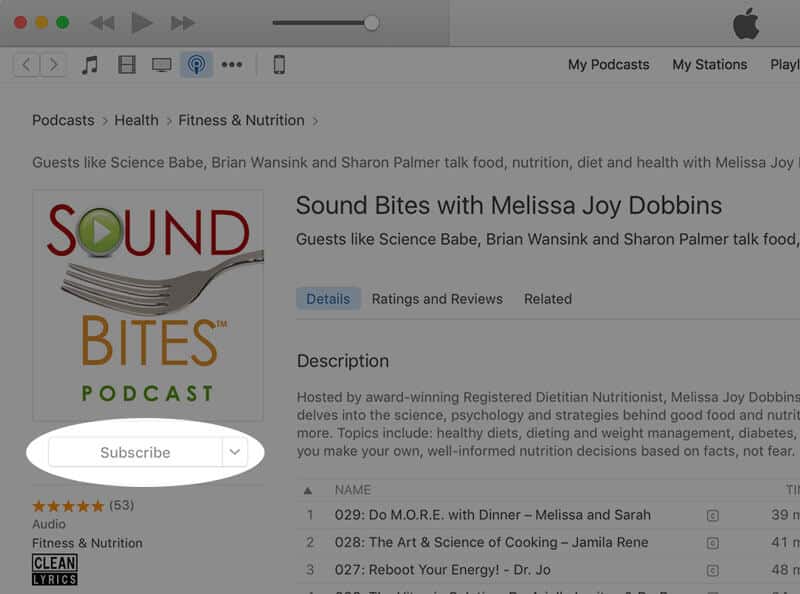
Click here to view the Sound Bites Podcastin iTunes, then click the blue “View in iTunes” button. This will open your iTunes application directly to Sound Bites Podcast. Click the “Subscribe” button, and your done!