Celebrating over 1 Million Downloads and 50,000 Free CEUs on the Sound Bites® Podcast | NEW: Get 1 years’ worth of CEUs with the new 15-CEU Podcast Course
Understanding & Interpreting Food & Health Scientific Studies
The public continues to have a strong interest in food and health information, yet media sources vary in their credibility. Health professional communicators help shape public knowledge and attitudes by translating complex information while facing the challenge of processing large and often complex amounts of information in order to provide clear guidance to audiences with diverse literacy levels. This transmission of information influences public health outcome trends, scientific understanding, and information-sharing. The International Food Information Council has created a scientific communication guide with the goal of enhancing communicators’ ability to interpret scientific publications, ultimately helping the public make informed food and health choices.
The nutrition information landscape is congested and it’s challenging to outcompete all the inaccurate information. IFIC has resources to help you understand and interpret food and health research studies.” – Milton Stokes
Tune into this episode to learn about:
who consumers trust for food/nutrition advice
the difference between misinformation, disinformation and malinformation
what it is about the scientific process that makes communicating science challenging hierarchy of evidence
different types of research studies and how those differences impact science communication
11 common fallacies in reasoning and thinking
critically reviewing scientific studies
communicating more effectively and communicating with context
Inaccurate information is something we all have to contend with. Either we consume it or our clients/patients share it with us. What action are we going to take? First, consider that it’s much more than just translating science for the public. We must focus on the principles of science communication and dig into resources such as IFIC’s science communication guidance document.” – Milton Stokes
Milton Stokes, PhD, MPH, RD
Milton is the Senior Director, Food & Nutrition at the International Food Information Council where he focuses on science communication and consumer perceptions of health and nutrition. He has been at the intersection of food, agriculture, and nutrition for the last 10 years working on some of the most urgent issues facing people and planet–issues like food and nutrition security as well as sustainability. Milton has a master’s degree in Public Health from Hunter College – City University of New York, and his clinical nutrition training was conducted at Yale-New Haven Hospital affiliated with Yale University School of Medicine. His doctoral degree, from the University of Connecticut, is in Communication and Marketing with a specialization in Health Communication.
Resources
Some links may be affiliate links. As an Amazon Associate, I earn from qualifying purchases.
Transcript Speakers: Melissa Joy Dobbins & Milton Stokes
[Music Playing] Voiceover: Welcome to Sound Bites, hosted by registered dietitian nutritionist, Melissa Joy Dobbins. Let’s delve into the science, the psychology, and the strategies behind good food and nutrition.
Melissa Joy Dobbins: Hello, and thanks for tuning into the podcast. As you may know, my audience is a mix of healthcare professionals and the general public. And while I delve into the science quite a bit on the show, I do try to make it digestible and meaningful for all listeners regardless of their background.
But if you’re a dietitian or a diet technician, I want to make sure that you know about all of the continuing education opportunities through my podcast. I have about three years’ worth of free CEU activities that you can access through my website, and I also recently created a 15-CEU package for one whole year’s worth of credits, including the required ethics credit that you can purchase. There’s only one quiz to take, and you get one certificate for the 15 credits.
I’ve provided over 30,000 free CEUs through my podcast, and I’m getting great reviews about the new 15 CEU course as well. So, head on over to soundbitesrd.com/freeceus to learn more. And if you’re not a dietitian, now you know more about the continuing education requirements that dietitians have.
Hey, I wanted to let you know that I decided to split this episode into two parts because it ended up being super long and there was a good point about two thirds of the way through that it seemed to make sense to end and start a new episode.
So I hope you enjoy both parts of this episode
Hello, and welcome to the Sound Bites Podcast. Today’s episode is about science communication and some consumer insights about snacking, sodium, and sweeteners. This episode is not sponsored.
My guest today is Milton Stokes. Milton is the Senior Director of Food & Nutrition at the International Food Information Council, where he focuses on science communication and consumer perceptions of health and nutrition.
He has been at the intersection of food, agriculture, and nutrition for the last 10 years, working on some of the most urgent issues facing people and the planet – issues like food and nutrition security, as well as sustainability.
Milton has a master’s degree in public health from Hunter College, City University of New York, and his clinical nutrition training was conducted at Yale New Haven Hospital, affiliated with Yale University School of Medicine.
His doctoral degree from the University of Connecticut is in communication and marketing with a specialization in health communication. Welcome to the show, Milton.
Milton Stokes: Hey, thank you so much. I’m so glad to be here. I love your show, and I have to say before we get into the meat of everything, just congratulations to you for a very successful, a highly sought-after program that you produce time and time again. I think I read you have over a million downloads or something. You are honestly the most successful podcaster that I personally know.
So, I was bragging to my kids today and they’re like, “Well, don’t mess up, Dad.” I’m like, “Okay, I won’t.” But I just wanted to say congrats.
Melissa Joy Dobbins: (Laughs) Oh, thank you so much. I really appreciate that. And you were on the podcast back in 2016.
Milton Stokes: That’s a while ago, yep.
Melissa Joy Dobbins: I mean, I launched this in 2015, so you’ve kind of been along for the ride (laughs), so thank you.
Milton Stokes: You’re saying I helped launch you? I’m part of your original success? I’m just kidding.
Melissa Joy Dobbins: The original success first year. Yeah, absolutely. Well, we have been friends for a long time, and you have had such an amazing career, and I’m just so excited that you are at IFIC.
Well, I would like you to share more about your background and the work you do both at IFIC and prior to IFIC. If people haven’t heard the 2016 episode or if they aren’t familiar with you, I would just love for you to share more.
Milton Stokes: Sure. Happy to talk a little bit about myself and also talk about the organization. I often think about the question of who am I and what am I doing here? I go to my purpose (laughs). How did I get here?
Yeah, a lot of luck and a lot of people who supported me, but also, I think about my purpose, and it tends to come back to advancing health and nutrition, and often, it’s through communication. So, if I consider where I’ve been over the course of my career, it’s focused on advancing health and nutrition, and then how am I doing that? What are my tactics? It tends to be through communication vehicles, and I’ve enjoyed a lot of different positions along the way.
So, right now, as you’ve told your listeners, I’m with the International Food Information Council (IFIC), and we’re a nonprofit 501(c)(3) consumer research and science communication organization. So, we measure consumer perceptions, we measure knowledge, attitudes, and beliefs. What do consumers think about food, nutrition, health?
And then from that, we analyze those results, we gather data and insights, and then we produce content or science communication mainly for health professionals, registered dietitians in particular – content that helps them communicate with and educate the public, the consumer, their clients, their patients, everyone else in the world that they serve.
We are a membership organization, and our members come from the food, agriculture, and beverage industries, but we don’t represent any one product, any service, we don’t lobby. What we do is we’re the science communication people, I said that earlier. That’s our mission, and our vision is one where science is informing food decisions.
Our board, how we’re governed is mostly academics from colleges and universities. So, some of them that you know, and I think have been guests on your show. We also have representatives from our membership, and we have representatives from federal agencies, U.S. Department of Agriculture, EPA, and FDA. So, we’ve got that three-part structure to our governance.
So, that’s a little bit about IFIC, and I know we’re going to dig in more into the research and some of the tools and resources that we offer a little bit later.
As far as myself goes in my background, I told you about my purpose. I’m a dietitian. Maybe I’ll go and I go back toward the beginning and try to do this chronologically without drowning the listeners in too many details about my career.
I grew up in Kentucky and owned a restaurant with my mom in southwest Kentucky. So, think traditional southern food, fried everything, high salt, high sugar, high fat, really, really good. Probably not the most sustainable, healthy way of eating for your health for a long term, but oh my gosh, it was such good food.
So, I did that for a decade while I completed high school, and I went on to college and studied dietetics. You’ve told your listeners already, I did my internship in Connecticut. I went to New York City and worked in traditional clinical nutrition, patient care, leading clinical nutrition teams. But my real love was communication.
And so, nights and weekends, I would pitch magazines, websites, and newspapers to write for them. And I kind of got my start by … my first pay writing gig was with Today’s Dietitian. I pitched them, they accepted my idea, and away I went. Things just kind of blossomed from there.
The other thing that really boosted my start was the Academy of Nutrition Dietetics back then was called the American Dietetic Association, but we’ll just say the academy for now. They asked me to do an interview with Men’s Health Magazine, and that interview led to a couple of more interviews.
And I finally said to my editor at Men’s Health, “Hey, you know me, I know you, we’ve been working together, can I just write for you?” And so, he assigned me an article to write. It was something like the 125 best foods, blah, blah, blah, et cetera, et cetera, who knows. But it turned out to be one of the most successful articles that year in terms of their clicks and visits and downloads, and website traffic.
Melissa Joy Dobbins: Nice.
Milton Stokes: And so, that then gave me the opportunity to keep writing for the magazines and communicating to consumers and getting more clips, and that just sort of became a machine. So, in the daytime, I was a traditional dietitian in healthcare, nights and weekends, I was pitching magazines, I was writing, I had columns, weekly columns, monthly columns, I did several book projects.
So, I was really, really focused on communication and offered a lot of other services, tested recipes for magazines, did some food safety consulting, and that was fantastic. Eventually, I moved back to Connecticut for grad school, and I became a professor in food and nutrition. Had a professorship, directed a dietetic internship, and I loved it. It was amazing.
I started in 2013 getting a lot of questions about plant biotechnology, GMOs, are they safe? Well, I gave them the one or two sentences that I had learned in school, and then what I did was I reached out to a colleague in the ag industry, and that phone call ultimately led to me changing everything.
I gave up my tenure track professorship, moved my family from Connecticut to St. Louis, Missouri. And I think that’s when you and I really got to know each other around 2014. And so, my work was focused on helping dietitians understand what are the challenges that farmers and growers face, and what are some of the tools that farmers and growers need to meet those challenges, whether it’s crop protection or biological also, or plant breeding, biotechnology, et cetera, et cetera.
And I did that for seven years, and it was a transformative experience and have since wound my way back through public relations and consulting with commodity boards and CPG companies. And now, here I am at the International Food Information Council.
Melissa Joy Dobbins: Excellent. Yeah, I’m glad you mentioned you’re a dietitian because it’s not really called out so much in the intro that I gave for you. So, thank you for sharing that and your fascinating background. It’s like, wow, that’s a lot. You’ve done a lot (laughs).
Melissa Joy Dobbins: So, let’s talk about the new Science Communication Guide that IFIC recently released. This is a wonderful resource. As you know, I’ve been promoting it ever since I found out about it. And it’s in my Sound Science Toolkit, which I’ll circle back, and towards the end, all the links and stuff that we talk about will be in my show notes at soundbitesrd.com, including my Sound Science Toolkit.
But tell everybody what this guide is, how it came to be, kind of what it entails, and then there’s a few specific things that I’d like to address in some of the different sections.
Milton Stokes: Sure. Well, I’d like to start by saying I tell people about your Sound Science Toolkit all the time.
Melissa Joy Dobbins: Thank you.
Milton Stokes: And number two, I quote you in almost every time I give a presentation, and I believe I’ve told you this before – but I’ve heard you say that the headline is not the bottom line, the headline is not the bottom line.
So, think of a newspaper headline or social media headline or whatever – often, we as in the public and consumers will take that quick couple sentences or one sentence or one phrase, and we’ll assume that that’s conclusive or that’s the action item, and it’s not the bottom line. And I love that you say that.
Melissa Joy Dobbins: Thank you (laughs).
Milton Stokes: And so, I’ve stolen that, and I do try to give you credit wherever I can remember to do so.
Melissa Joy Dobbins: Not necessary, but thank you.
Milton Stokes: Yeah, of course. So, I think of IFIC as science communication people, and it’s in our mission. It’s what we do, it’s who we are. Earlier this year on National Science Appreciation Day (so this was intentional back in March), we published IFIC Science Communication Guide.
And it’s a really comprehensive resource that helps communicators in food and nutrition, help them understand what are the different approaches to answering research questions or how do researchers, what do they do to test hypotheses? What kind of conclusions can be drawn from those different approaches through those different methodologies.
And then how can you communicate those findings, put them into a broader context so that the public feels like there’s something useful, something that’s informative and actionable. And the way I often think about the guide in a shortened view is it tells us how knowledge happens and how to communicate about it.
So, it is really a comprehensive resource, and we were so thrilled to see the reception was super positive. Within a minute of it going out, the press release going out, someone texted me and said she thought that this guide should be on the desk of every dietitian everywhere.
Melissa Joy Dobbins: Yes, absolutely.
Milton Stokes: I’m like, “Oh my gosh, that’s the kind of thing we were hoping to hear.” So, I keep telling that story because I feel so proud of the work that the IFIC team did to bring it to life.
The guide is peer-reviewed. We had it reviewed by two scholars, one who is Dr. Andrew Brown. I think you know him, Melissa, he’s probably been on your show.
Melissa Joy Dobbins: He has, poor man. He has, but the audio was bad, and we have not gotten around to redoing it, but I did reconnect with him at an adolescent health conference earlier this year. Apologized profusely, like, “You’ve got to come on the show.” (Laughs).
Milton Stokes: Yeah. Well, he’s amazing. He shows up at a lot of nutrition science conferences, and Andrew’s a research methodologist, and also, really just a master at communication. And so, he was one of our peer reviewers, and the other Timothy Sellnow who is now at Clemson University. And Tim is a communication scholar. He focuses on risk communication.
And so, those two folks helped us ensure that we produced something that was good quality and top-notch, and as I’ve said a few times now, super comprehensive. We also know that it’s just the nature of how people like to consume information today. We wanted to evolve that guide into more accessible, more digestible pieces.
So, in October, we launched a science communication content hub, and that is an online destination that houses the publication, but it also breaks it down into additional pieces that maybe you’re just looking for an infographic or maybe you’re just looking for an image to use in your newsletter or in your social media or in your presentation, or maybe you’re looking for a research that looks at or that focus on trust in science.
So, you can go to this content hub and find the pieces that just suit your needs, and you can always go back and dig into the full guidance document down the road.
Melissa Joy Dobbins: Great.
Milton Stokes: So, that’s a little bit about our motivation, that’s what it is. We have a webinar that speaks to the document, and we’ve got other resources all over our website and our hub specifically. But yeah, we’re really proud of that.
Melissa Joy Dobbins: Excellent. I don’t know if I was aware of the hub, I will definitely check that out. And yes, it’s very comprehensive, but I definitely want our listeners to know it is very digestible. It’s an easy read in the sense of the way it’s laid out. It’s not super long, I have it right here. I don’t know how many pages – you probably know off the top of your head, how many-
Milton Stokes: It’s about 40 something pages, but that includes the references and all the imagery. When people access the online version, the table of contents is hyperlinked. So, if you just want to go to this one little section, you just click that, it’ll take you right there.
So, you can read the whole thing if you want, I have done that many times (laughs).
Melissa Joy Dobbins: Me too.
Milton Stokes: Our reviewers did that many times, you’ve done it. But it’s also possible to just navigate through quickly to get exactly to what you need.
Melissa Joy Dobbins: Yeah, it’s definitely very easy to digest. Like you said, it’s just laid out well, it’s very easy. So, let’s talk about there’s the background section. I would like for you to briefly address what IFIC has been seeing regarding who consumers trust when it comes to food and nutrition information or advice. I know this is something that you guys look at a lot and I believe it’s evolved and shifted a little bit lately.
Milton Stokes: Yes. So, this topic of trust is really important to us because I’ve said this before, in addition to quoting, your headline is not the bottom line phrase, I often will say that the food nutrition landscape is quite congested. There’s just a ton of information out there, both credible and dubious. That’s sort of a spectrum.
So, it can be quite hard to out-compete all of that, even when your message is simple, even when your message is straightforward. And so, science communication for IFIC is yes, it’s science-based information if we’re going to be based on evidence and facts, and we’re going to get that right.
But it’s also the part two of that is it’s how you practice it, it’s how you communicate. So, that’s really behind or underlying a lot of our motivation to put that guide together, and also to do some additional consumer research around this topic of trust in science.
And I’ll tell you that IFIC is probably most well-known for doing its annual food and health survey. And that’s happened for 19 years, 2025 will be the 20th year of that survey. A lot of dietitians and health professionals who are in the media, they quote that survey, they cite that survey pretty regularly.
But we do monthly pulse-type surveys, or we call them spotlight surveys, shorter, a handful of questions. And they tend to focus on a contentious topic, on a hot topic. And so, we’ve got one on obesity medications that’s coming up in January, we’ve got one on seed oils that’s coming out in February of 2025.
But we did one on trust in science. And we know that not just from our work, but from other consumer research that’s out there, that trust is down across the board in a lot of areas. Trust insights being lower, it’s not unique, it’s not an exception, it’s not an aberration. Trust is just really reduced across the board.
But our particular spotlight survey showed that fewer than 4 in 10 consumers strongly trust science in food, nutrition, and diet. So, I think that’s something that your listeners probably have to … well, they probably care about it, but I also think they’re probably living it. They’re dealing with it in their practices every day. And I also think that’s why people come to you and your podcast and your resources, this whole trust piece.
We did learn that about 8 in 10 consumers think that recommendations for what to eat or drink are always changing. So, it’s like there’s this perception of a bouncing ball,
of, “What should I do? And oh, it’s going to change now.” And they tell us that perception makes them feel confused about their food choices.
You’re a dietitian, I’m a dietitian, you know that dietary guidelines don’t really change drastically. They don’t change all that much. And the Dietary Guidelines Advisory Committee just released its scientific report, and you probably accessed that, many of your listeners have accessed that.
It’s got some good information in it, but it’s not a complete 180 from what we’ve heard before. But that doesn’t stop consumers from feeling like things are always changing. That’s what I said earlier, 8 out of 10 tell us that that’s their perception. So, why are they perceiving that? Why do they think that?
Well, I think it’s back to what we said earlier, they’re seeing headlines. They’re seeing things blown out of proportion, they’re seeing findings taken out of context. They’re seeing people who maybe don’t have training or credibility in food and nutrition and health, trying to convey super simple messages that are based on personal feeling and belief, based on ideology, based on anecdote. You can go on and on, but I think there’s a legit reason for why consumers feel the way that they do.
Something else that we learned in that survey, Melissa, is that two-thirds of Americans say they’re more likely to trust advice if it comes from registered dietitians. Yay, that makes me feel really good, I’m an RD, you’re an RD. And when we asked people where they actually get their information, it’s mostly from medical doctors and nurses. That was number one. Number two was food nutrition scientists, which I find interesting. And then thirdly, they said friends and family.
So, dietitians weren’t in that top three, I have an explanation for that. I think doctors and nurses are first because, well, pretty much everybody sees a doctor or a nurse at least once a year. And so, that comes down to access.
There’s not enough dietitians to go around for everybody, and insurance doesn’t always cover our services, and maybe the public doesn’t always know how to find us. So, there could be a number of reasons for why doctors and nurses are first.
I am quite perplexed as to why food nutrition scientists showed up as number two. I do feel like scientists (even though I said trust in scientists), the people who are practicing science, there’s a halo. They do have a perception, they get a credibility boost.
And so, maybe our respondents said scientists because they thought, well, these are going to be trained folks, they’re credible, and maybe they’re reading quotes from scientists in the newspaper in whatever type of media they’re consuming. But I don’t really know why scientists show up so well, that’s just me hypothesizing.
And then lastly, friends and family, that goes back to who do you have access to? Who’s in your network? Who is in your house or who are you going to see at the next family get-together? It’s aunt so-and-so, or uncle so-and-so who’s tried a new diet and they’ve had success, or they saw something on a popular program, and so they’re conveying and communicating information.
Melissa Joy Dobbins: Yeah, it would be interesting to see if physicians referred more to dietitians, how that might shift the access (chuckles).
Milton Stokes: Oh my gosh, yeah, that’s become a little, I guess I’ll say a pet peeve of mine, so I’m probably biased. We want doctors to be everything to everybody. We want our doctor to be the smartest person in the world and have an answer for everything, including nutrition – I don’t think it’s possible.
If we want doctors to do more with nutrition in medical school, what do we want them to give up? I do not want my doctor to know anything less about medication. I want them to be the smartest person when it comes to drugs. And if it’s nutrition, I want them to know to refer me or the public to a registered dietitian.
So, I think we’ve got some work to be done there, and there are groups that are looking at this, the Academy of Nutrition Dietetics and the American Society for Nutrition, for example. They’re focused on – specifically ASN, the American Society for Nutrition is focused on physicians and nutrition education. And so, maybe we’ll see some progress there, but we just have to be realistic in what we want from them.
Melissa Joy Dobbins: Yeah, and I’d like to see that needle moved a little bit more in the span of my career. And I feel like the most important thing physicians need to learn about nutrition is that they can refer to a dietitian.
Milton Stokes: Yes. Here, here.
Melissa Joy Dobbins: Here, here. Alright. So, okay, moving on. The guide mentions misinformation, disinformation, and malinformation. And I’ve talked about mis and disinformation on the podcast quite a bit, but I haven’t talked about malinformation. So, can you just give a brief distinction between those three or an example if that fits?
Milton Stokes: Yes, absolutely. I tend to think of these three terms as falling under an umbrella called inaccurate information. Most people think and will even use as a synonym the term misinformation. Misinformation is something that is actually not true, but the person who is sharing that information, the person who’s disseminating it, that person believes it’s true.
So, there’s no negative intention, there’s no harm intended. That person who’s sharing it is trying to be useful. And so, maybe it’s somebody who sees a headline or shares something on social media and just kind of sends it on to their followers, but ultimately, the story is false, and the sharer didn’t know that.
Thank you.
So, in addition to misinformation, another term under this label of inaccurate information, another term is called disinformation. And that’s when the information is false and the person who’s sharing it, they actually know it’s false.
So, this is more of a deliberate or intentional action that is trying to disinform, they are trying to deceive, and maybe they’re trying to harm somebody or they’re trying to harm another group or competitor or even another country.
And so, for my example, I would go to something that’s focused on politically-oriented communication, political content, political ads even could be disinformation. So, we’ve got misinformation, we’ve got disinformation.
And then that third term is malinformation. That is a term, it’s also bad or harmful, but the information is actually based in reality and it’s true, and it’s something that is private information that should not be released publicly.
The information that’s real, but it’s being put out there to harm somebody, maybe to ruin their reputation or to undermine their credibility or embarrass them or shame them. And so, it’s publishing to get revenge, if you’re familiar with that concept.
Melissa Joy Dobbins: Okay.
Milton Stokes: There’s a really good paper that your listeners may want to check out, and it’s by Connie Diekman, Cami Ryan, and Tracy Oliver.
Melissa Joy Dobbins: Yes.
Milton Stokes: You’re familiar with the paper, I’m sure, it’s called Misinformation and Disinformation in Food Science and Nutrition, and it’s in the Journal of Nutrition, which is open access, and that was published in January of 2023.
Melissa Joy Dobbins: Yes. I actually did an episode with Cami and Connie, so I will make sure to link to that in the show notes at soundbitesrd.com, but yeah.
Milton Stokes: Perfect.
Melissa Joy Dobbins: It was such an important paper and important topic that yeah, I had to have it on the podcast for sure.
Milton Stokes: Great.
Melissa Joy Dobbins: Yeah, and that paper is a very easy read, it’s very digestible and every dietitian needs to read it.
Milton Stokes: Highly recommended.
Melissa Joy Dobbins: Yeah. I want to touch on the types of research studies because there’s a section about that. And I mean, I share some of maybe the lower-hanging fruit type of concepts on my podcast about different types of research studies and just kind of emphasizing which ones … like the hierarchy of evidence, I guess.
So, maybe you could kind of give a brief overview of that. And there is an image in the communications guide, and so I’ll make sure to detail that out in the show notes as well, so people can just go and look at that because we don’t have a visual on the podcast now.
But yeah, whatever you wanted to say about that section with the different types of research studies, and then also what our listeners need to know about either communicating nutrition related to those different types of studies, or consuming the information if you’re a consumer.
Milton Stokes: Yeah, thanks, Melissa. My answer goes back to our motivation for doing the paper, for creating that science communication guidance document, and it includes the understanding that science is not a final destination.
Science is a process, and it’s something that’s ongoing. And this is the point we tried to make in the paper. But for me, that means knowledge is impermanent. We know what we know now, but we could know something different, we could know something that completely changes our mind in the future, but what we know now is not the only thing that there is to know.
And so, because science isn’t a final destination, that is partly why I think consumers – earlier I said consumers feel confused, like it’s sort of a bouncing ball. We do change recommendations, we do evolve over time, and that’s just part of what is this larger process. Yes, the public wants definitive answers: “Just tell me what to do, tell me what to eat. I’m busy, I’ve got kids, or I’ve got pets, or I’ve got responsibilities and a job, and I got to get dinner on the table, what is going to help me do that in the least amount of time and fuss.”
And sometimes, we’ve got really succinct answers and sometimes we don’t. And so, that’s just something that we have to deal with as communicators. I just wanted to make sure I made that point, Melissa, because we do go into that in detail in the paper.
But you had asked now types of studies – I mentioned this just a little bit earlier we do focus on observational methods as well as experimental methods, trying to help readers understand or get a little bit of refresher into what are the different approaches that scientists and researchers will take to try and get them closer to the truth, whatever that looks like for that point in time.
But in terms of observational methods, that’s more about following a group just to see what’s going to happen or what happens, what does the group have in common, what travels with what. And I think generally, this is where we would see larger sample sizes and situations where it might not be practical or even ethical to say, “Hey, study participants, you all need to live in a hospital for six months, or you all need to eat soybeans only for six months.”
So, sometimes, we can’t do that because of practical reasons or ethical reasons or just other resource reasons. And so, that’s what makes observational research, I think so important.
Experimental research, that’s when the researcher is bringing some change or manipulating a variable to try and measure the effect on another variable. And here is where you could expect more control. Maybe those research subjects or participants are living in a research unit or maybe they are living in a hospital (not always), but researchers, they’re going after cause-and-effect relationships.
And the participants are randomized to see, “Okay, somebody’s going to get the treatment or the intervention and somebody’s just going to have constant or be more in this control group.” And that’s how researchers can test hypotheses and get closer to saying, “Well, something causes something else.”
So, we do talk about observational methods and experimental methods in the paper, and we point out the hierarchy of scientific evidence, which by the way, was quite a contentious topic in October when we were doing some public communication to various audiences, dietitians, but just the general consumer.
And so, if you’re interested in the hierarchy, we do depict an example of one in the paper, but really the gist of it is talking about what kind of evidence is the ultimate end-all-be-all evidence. And the very bottom of this hierarchy or this triangle or pyramid is more of anecdote and opinion.
So, evidence that isn’t that strong or evidence that is not going to allow you to generalize, and then it goes all the way up to led analysis, which is just studies of other studies at the peak of the triangle or the pyramid.
Melissa Joy Dobbins: And I think it’s been helpful for me. Actually, that triangle was one of the first things that I put in my Sound Science Toolkit, not the version that’s in here, but one that I had seen, which I believe was a publication way back in the day.
It was things like that that I wanted to put in my Sound Science Toolkit as just a quick reference point for people to go and refresh themselves on some of these concepts, critical thinking, which we’re going to talk about in a second.
But I think just understanding the different kinds of research, the nature of these different types, and the nuances lends itself to how do you communicate about them. So, could you speak to that briefly?
Milton Stokes: Yeah. So, in terms of communication, what we want our audiences to think about is what’s going to be the most credible, actionable message for the public or for the consumer or for the stakeholders that you’re serving as a communicator.
And Melissa, I’ve mentioned this already a couple times – you’ve said before that the headline’s not the bottom line. So, let’s start there for sure. We need to dig a little deeper, we need to go back to, if possible and feasible, go back to the original source and ensure that what we are thinking is in fact, correct, and a message that does apply, it is something that generalizes to the particular audience that we’re talking to or communicating with, or working with. Not all research applies to everybody, so we shouldn’t make that assumption. I think that’s a good place to start.
Other questions to keep in mind are what did the researchers do, and what were their methods? And as you consider that, that takes you down the path of what did they learn and is connected really, really closely with what we’ve said already around generalizability, but how do those findings fit into the broader context on the matter?
One study isn’t likely to revolutionize how we see food and nutrition, but one new paper probably isn’t going to change drastically what we do in terms of diet and health. Even if the media do try to communicate things with a lot of fanfare and a lot of flare and a lot of excitement and exuberance, they’re also trying to compete.
And so, I totally get it. I understand that they’re under a lot of pressure as well, but from our perspective as health professionals and dietitians, our task is to go back to the paper, dig into it, make sure we get all of our questions answered.
And by the way, the IFIC guidance document, we suggest 15 or 20 questions that are thought starters that can help listeners as you go through a scholarly publication to try and get to a point of, “This is what I want to take away from this paper and this is what I want to tell my audiences.”
Melissa Joy Dobbins: I feel like these are things that we hear about, and we talk about, but what’s nice about this guide is that it really walks you through all of that and adds some kind of clarification to this process, I guess is what I would say.
I talk about critical thinking a lot on the podcast, and there’s one page in this guide, the 11 common fallacies and reasoning and thinking. If you could just explain, maybe even just read that first paragraph (it’s a very short paragraph), just read that so that our listeners will understand why critical thinking is so important, that there’s many different types, and then they can go to the guide to learn about the different kinds. And there’s even a link at the bottom for even more examples.
Milton Stokes: We do spend some time in the paper thinking about thinking, and trying to get people to just slow down a little bit, pump the brakes. And this is one way to combat I think some of the, I mentioned earlier just the fanfare and the exuberance that’s around communication and claims related to food nutrition and health.
But we leaned heavily into resources by Melanie Trecek-King. She has a website called Thinking Is Power, and I highly recommend her resources. We do reference her in the paper and in this image that you’ve mentioned on page 15 of the guidance document.
Melissa, I also kind of saw her at least once speak on a webinar for dietitians. She’s herself an educator, so she just does a lot of work in this space and gives us some examples like what’s ad hominem, what are anecdotes, what are the appeal to authority or appeal to relevant authorities and appeal to tradition.
So, she walks through many of those and helps make sense of, “Okay, wait a minute, I should pause here. Let me ask a few more questions, let me ask so what does this mean?” And I think it’s so important for us.
Melissa Joy Dobbins: For sure. You’ve worked with Jason Riis. Jason Riis has been on the podcast.
Milton Stokes: Oh yes.
Melissa Joy Dobbins: In my mind, he’s like the critical thinking guru, and I’ve just learned so much from him. And it’s that sort of, I guess topic or concept that the more I learn, the more interested I get because it’s so fascinating. So, I’ll link to all my critical thinking-related episodes in the show notes as well.
There’s also quite a chunk in here on critically reviewing scientific studies, and I took a really deep dive into this on a recent episode with Karen Collins, but I did want to ask you if there’s anything in that section that you really think is important to share.
And I would love for you to talk briefly about communicating risk. Absolute risk versus relative risk or hazard versus risk, these are things that I love to talk about on the show too, because I think they’re very illuminating.
Milton Stokes: Yeah, no, great. I think I may have scraped myself a little bit by talking about the questions that we list in the paper. But in the guide, after each section, we close out each section by offering three to five or more questions that users or readers can consider as they review a published paper.
And so, some of those questions I’ve mentioned already, but they could include, okay, what’s the purpose of the study? What’s the scope of the study? Does the study have many limitations? And specifically, has the researcher or have the researchers, have they laid those out in the paper? Have they addressed them? Have they identified them and addressed them? What do you know about the sample and sampling methods?
So, that should be really, really clear from reading the paper. And a lot of this sort of ladders up to an overarching idea of have they been clear enough in this publication so that another team could replicate this study if they wanted to? So, those are some of the types of questions that we encourage readers to consider along with some of the others that I mentioned earlier in our discussion, Melissa.
Then there’s
also the topic of funding that gets quite a lot of excitement. It generates a lot of excitement, it generates a lot of discussion and debate. It also generates quite a bit of ad hominem attacks.
Just last week, someone messaged me on LinkedIn, and I felt like it was attacking me personally in my integrity. So, I had to ask them, “What are you really going for here? What are you trying to get to?”
So, people just feel so passionate about research funding and money has to come from somewhere to fund the scientists’ salaries and to pay for the interventions. And I mean just on and on and on. So, yes, ask the question of how it was funded, but don’t let that be your stopping point.
You want to know what were the methods? Are they the right methods to answer the question or test the hypotheses, and how was the work performed, and can another research team replicate that work? In my mind, I think those are more important questions. And so, that was a bit about what we have in terms of tools to help you evaluate the study.
Now, you also asked Melissa about communicating risk, and I said earlier that one of our reviewers for this publication, it’s Tim Sellnow who is now at Clemson University. Tim is our risk communication specialist. He’s published and performed quite a bit of work in this area, and we will continue to partner with him as we produce other resources.
But we define some of these terms in the paper, like absolute risk, the actual risk of something happening or a particular outcome coming to bear versus relative risk. And that tends to be the term that puts it more in what I would say a comparative perspective, giving the reader a comparator. So, comparing the risk for outcome for somebody who might be exposed to a factor that’s under question or consideration, and then comparing that to those not exposed.
In the paper, we do give an example by saying relative risk of greater than one, that conveys risk of that outcome being studied. And then if the relative risk is let’s say less than one, in that situation, you could expect decreased risk for the outcome. So, there’s absolute risk and relative risk.
And then another area of risk-related communication and conversation tends to be around the idea of hazard versus risk. And those are terms that I think in the media often get conflated. But hazard is the ability of a particular substance to cause an adverse effect, whereas risk is that looks more at the probability of the likelihood that the harm will occur.
And because you’ve seen the paper, you’ll know that we use that really common example of a shark in the water and the person is standing on the beach. That to me is where my mind always goes when somebody is talking about hazard and risk. And so, if you picture yourself standing on a beach and in the distance you see a shark in the water, that’s a situation that you could describe as a hazard.
So, there’s risk, however, if you are in the water and you are swimming alongside that shark or that shark comes up alongside you, so that’s a situation where the probability of harm, it is much increased and many people would say it’s pretty high. You’re in danger, you’re swimming with a shark, literally. So, that’s how people boil down hazard and risk. And we’ve got that explanation in the paper as well.
Melissa Joy Dobbins: Thank you. And there’s more in the guide of course, if people … that was just sort of a little teaser and they want to learn a little bit more. I think it’s really interesting, especially when we’re talking about things like cancer risk and things like that.
So, towards the end of the guide, it talks about communicating more effectively and communicating with context. So, I would love for you to explain what that means and why it’s so important.
Milton Stokes: Yeah, thanks, Melissa. So, I’ve said this earlier that people are often interested in or even distracted by findings of single studies. And a single study (we try to make this point in the paper) isn’t going to drastically alter, should not drastically alter how we think about health, nutrition, diet, food to eat.
Generally, it’s just not the case because we know that science is a process. We know that there’s a lot of different ways of asking questions, different methods, whether it’s observational or experimental methods. And that work tends to come together to form a body of evidence, to form a consensus statement, to form guidelines or dietary guidance, and it’s replicated in countries or jurisdictions around the world.
And so, when we say communicating with context, it’s a way of us trying to encourage communicators to take this new piece of information, this new finding, this new study, and be sure to put that into the full picture of what do we know about this topic.
If we can do that, I think it gets us closer to stability in how we are coming across to consumers. Because I told you earlier, most think that nutrition advice and diet advice, it’s always changing. And they think we can’t make our minds up and they think that we are always undermining ourselves or reversing ourselves.
One minute coffee’s good, the next minute, it’s bad. Or for a while, it was egg yolks, eggs, or butter. You pick a food, it’s whatever it is – white foods like bread and rice, it’s good, it’s bad, it’s good, it’s bad.
Well, in the eyes of consumers, if we don’t put things into context and if we don’t consider the body of evidence and just the depth and breadth of what’s there, I think we undermine ourselves and we are not helping them. We’re not empowering them to take action.
And that’s who IFIC is, it’s our mission and vision to communicate science and to do it in a way that helps people have informed food decisions. And we feel positive that all communicators could do that too. And we certainly want to help them. And that’s what we mean by putting findings into context.
Melissa Joy Dobbins: Yes, thank you. For me, what I’m hearing you say, the way you’re describing it, is when I say when we communicate, obviously, we need to be evidence-based, but there’s a difference between being accurate and being meaningful.
And I feel like putting things into context is that extra layer that helps you know that it’s meaningful – what do I do with this information, and definitely, decreases the chances of it being flip-flopping, and when I say whiplash in the media or whatever.
Milton Stokes: That’s right. While we’re trying to debate and discuss, people still have to put food on the table, they’ve still got to feed their family. And so, if we can put that into context, we do get to that point of being actionable, as you said.
Melissa Joy Dobbins: Yes. And another thing about that, and I talked with Karen Collins about this, and I’m really digging into this aspect recently, is communicating uncertainties. That’s a piece I think that, like you said, consumers want a black-and-white answer, they want the bottom line.
And healthcare professional communicators know that there are nuances and uncertainties. And I think if we can communicate those uncertainties in a confident way like Karen Collins talks about in the interview I did with her, then we can help the public understand that that’s part of the nature of nutrition science, is that there are some uncertainties, where are those?
If this research shows that now we still have questions about this aspect or that this needs to be researched further, that’s different than saying, “Well, just more research is needed.” And just having that broken record sort of answer to everything.
And so, I’m really geeking out on that aspect recently, is just like being more confident about communicating the uncertainties and helping the public to become comfortable with that.
Milton Stokes: That’s right. And we can tell them what we know, and we also may need to tell them what we don’t know, and what’s the plan to get there. So, people want to know definitives, everyone wants to know what’s the final, final.
And sometimes, it is evolving, but what I can say is it’s probably never revolutionized. Just one study is not going to blow things out of the water and totally cause us to do a 180. And if we can put our message into that broader context, I do feel like it helps with our credibility and it helps the public, it helps our various audiences feel like they can trust us, but it also feels like, okay, they know what to do, they’re going to take some action now.
{lease tune in to the second part of this episode to hear about the snacking, sodium, and sweetener surveys, as well as more info on where to access the science guide and other IFIC resources. All of which are also in my show notes at soundbitesrd. com.
[Music Playing] Voiceover: For more information, visit soundbitesrd.com. Until next time, enjoy your food with health in mind
LISTEN, LEARN AND EARN
Listen to select Sound Bites Podcasts and earn free CEU credits approved by the Commission on Dietetic Registration (CDR) for registered dietitian nutritionists and dietetic technicians, registered. Get started!
Get Melissa’s Sound Science Toolkit here!
Partnerships:
Sound Bites is partnering with the Association of Diabetes Care and Education Specialists (formerly the American Association of Diabetes Educators)! Stay tuned for updates on the podcast, blog and newsletter!
Sound Bites is partnering with the International Food Information Council! Stay tuned for updates on the podcast, blog and newsletter!
Sign up for my monthly newsletter and episode eblasts so you never miss an update!
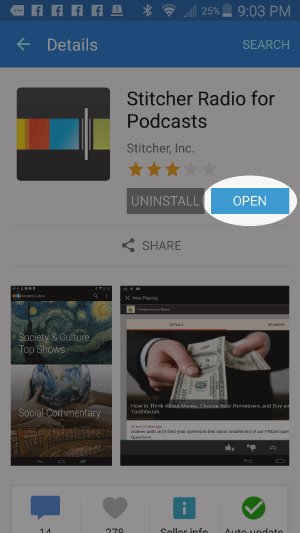
Listen on Stitcher (Android)
Install the Stitcher App
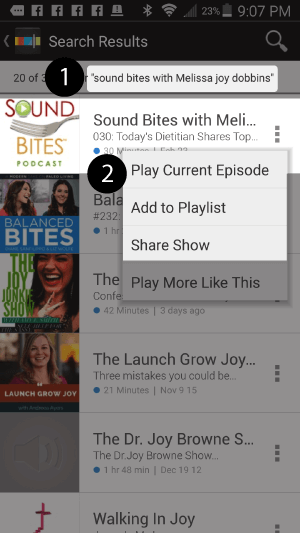
1. Search for “sound bites with melissa joy dobbins” 2. Choose Play Current Episode or Add to Playlist
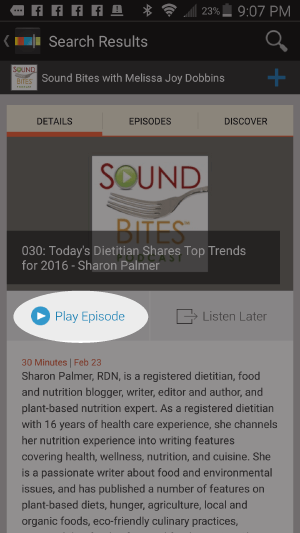
Choose “Play Episode”
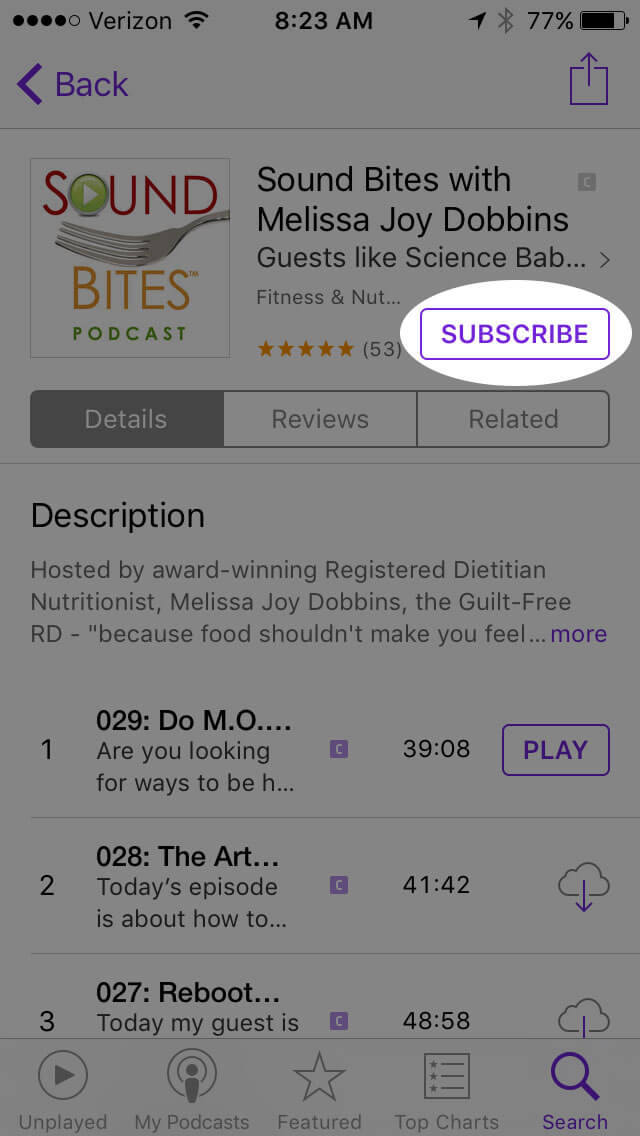
Subscribe & Review on iPhone
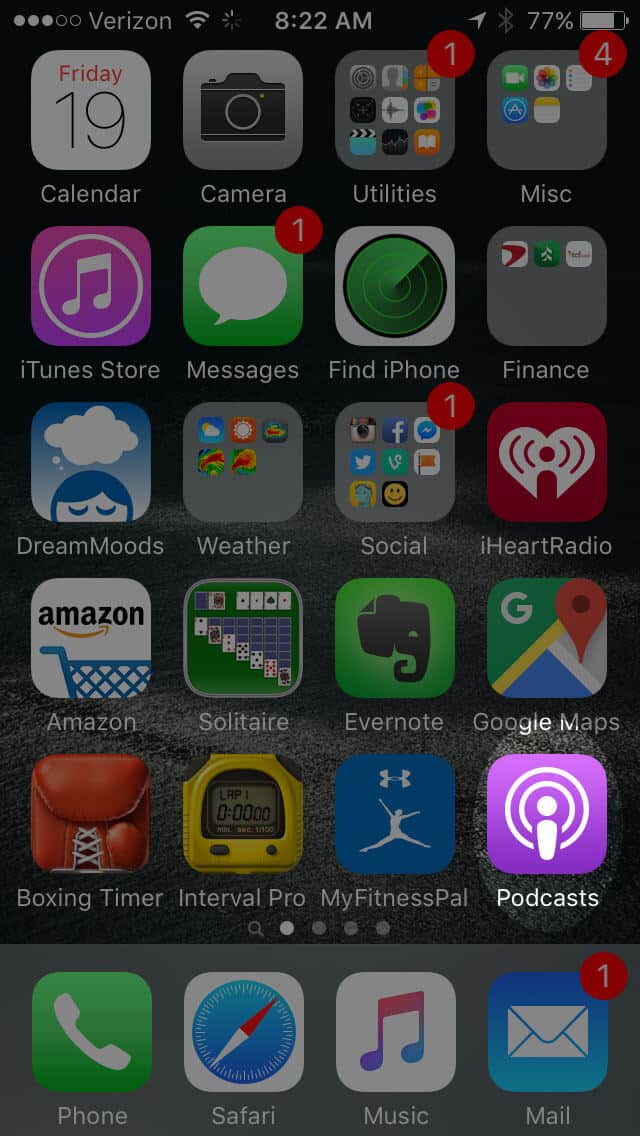
Open the “Podcast” app on your iPhone
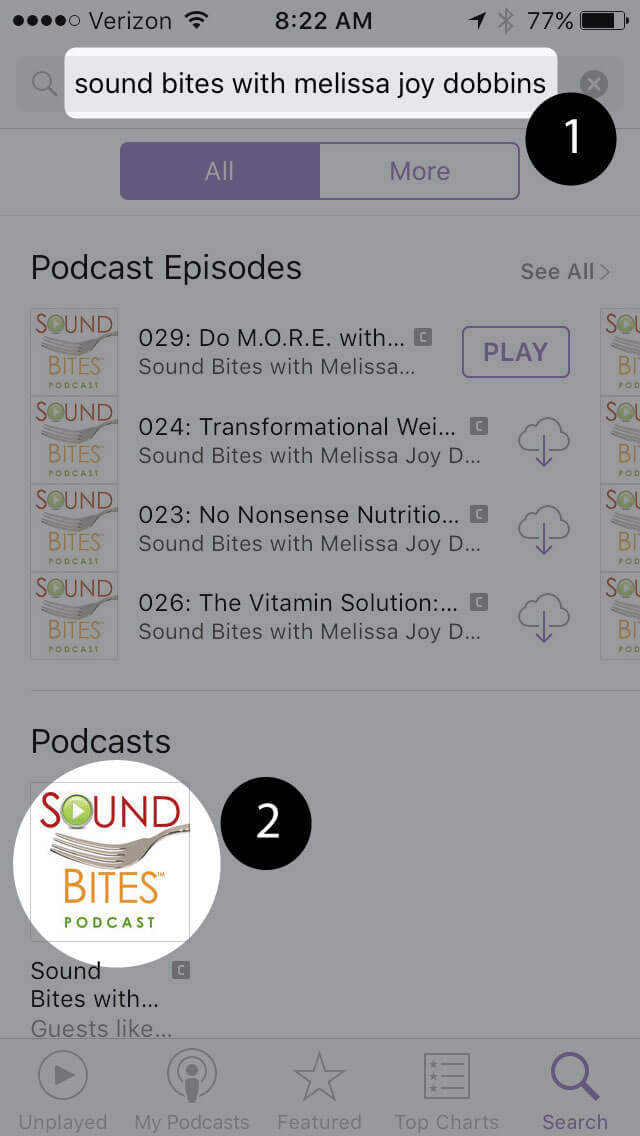
Search for “Sound bites with melissa joy dobbins”
Open the podcast and click “Subscribe” and your done!
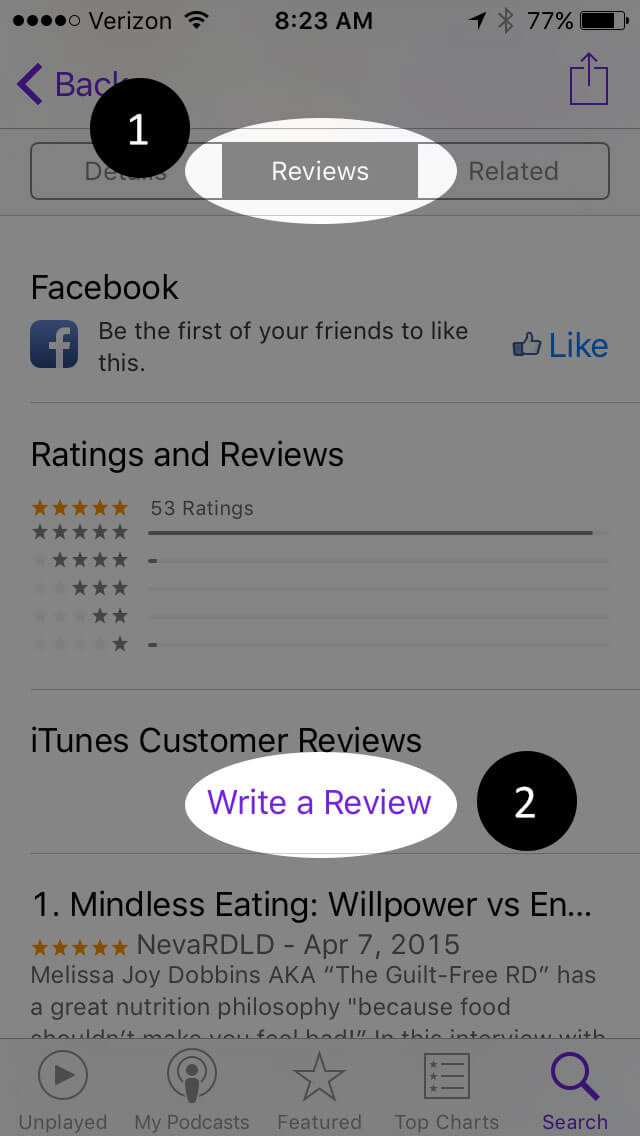
Write a Review
Click “Reviews”, then “Write a Review”.
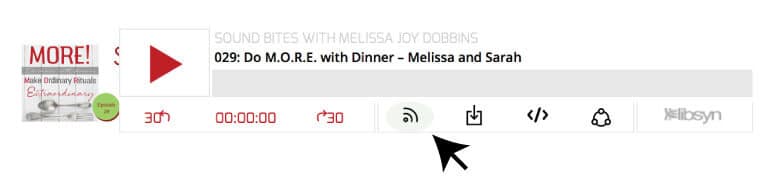
Subscribe via RSS Feed
Navigate to any podcast player . Click on the RSS feed icon.
Click on the RSS feed icon.
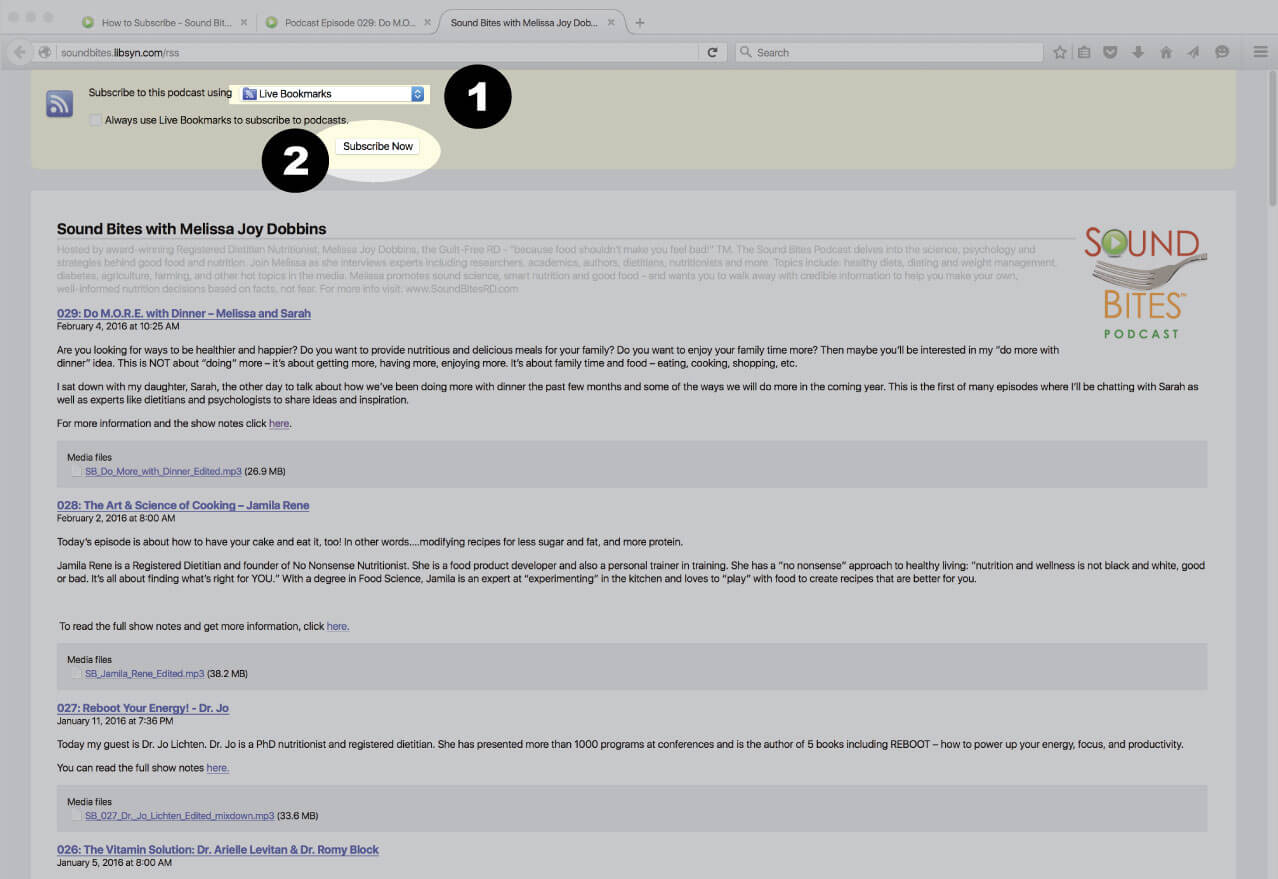
Click on RSS Feed
Choose which application you would like to use to receive the RSS feed
Click “Subscribe Now”
Confirm settings and subscribe.
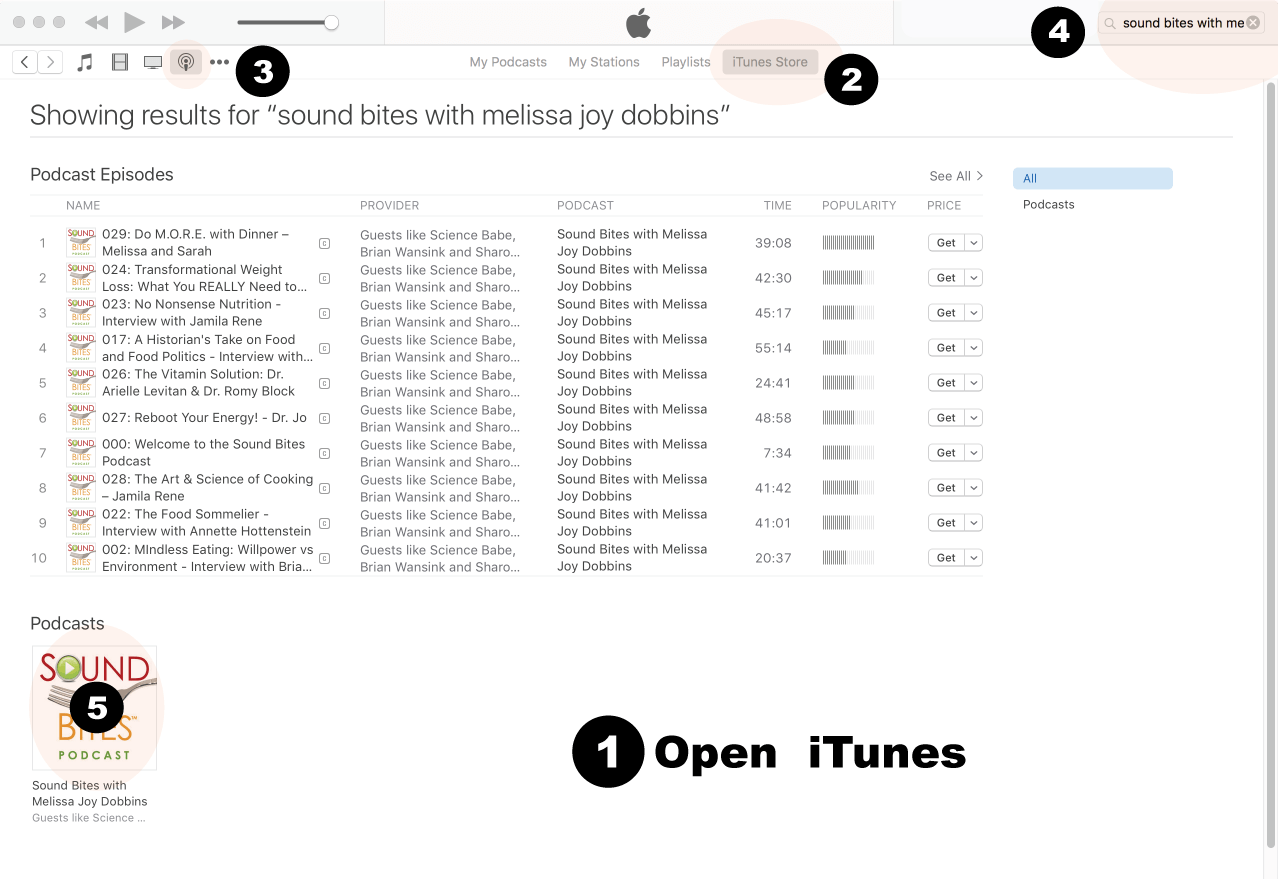
How to Review in iTunes
Open iTunes desktop application
Click iTunes Store
Click on Podcasts
Search for “Sound bites with Melissa Joy Dobbins”
Click on podcast image
Search for Sound Bites podcast in iTunes
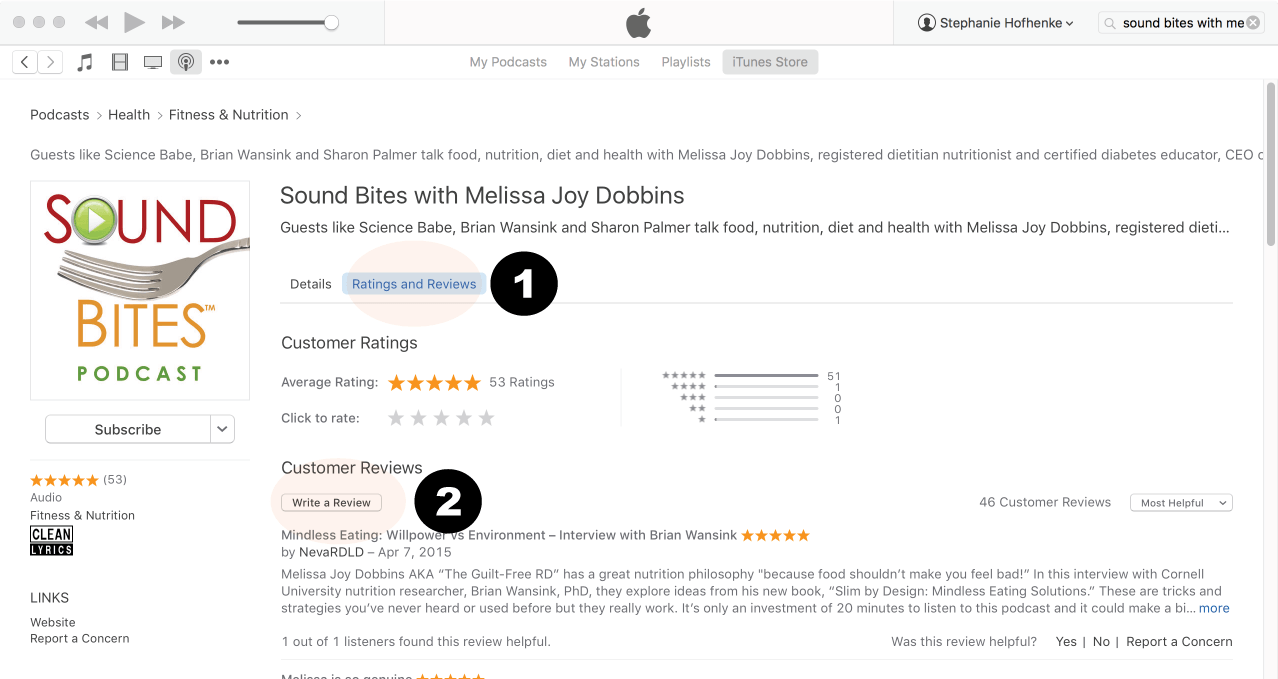
Click Ratings & Reivews
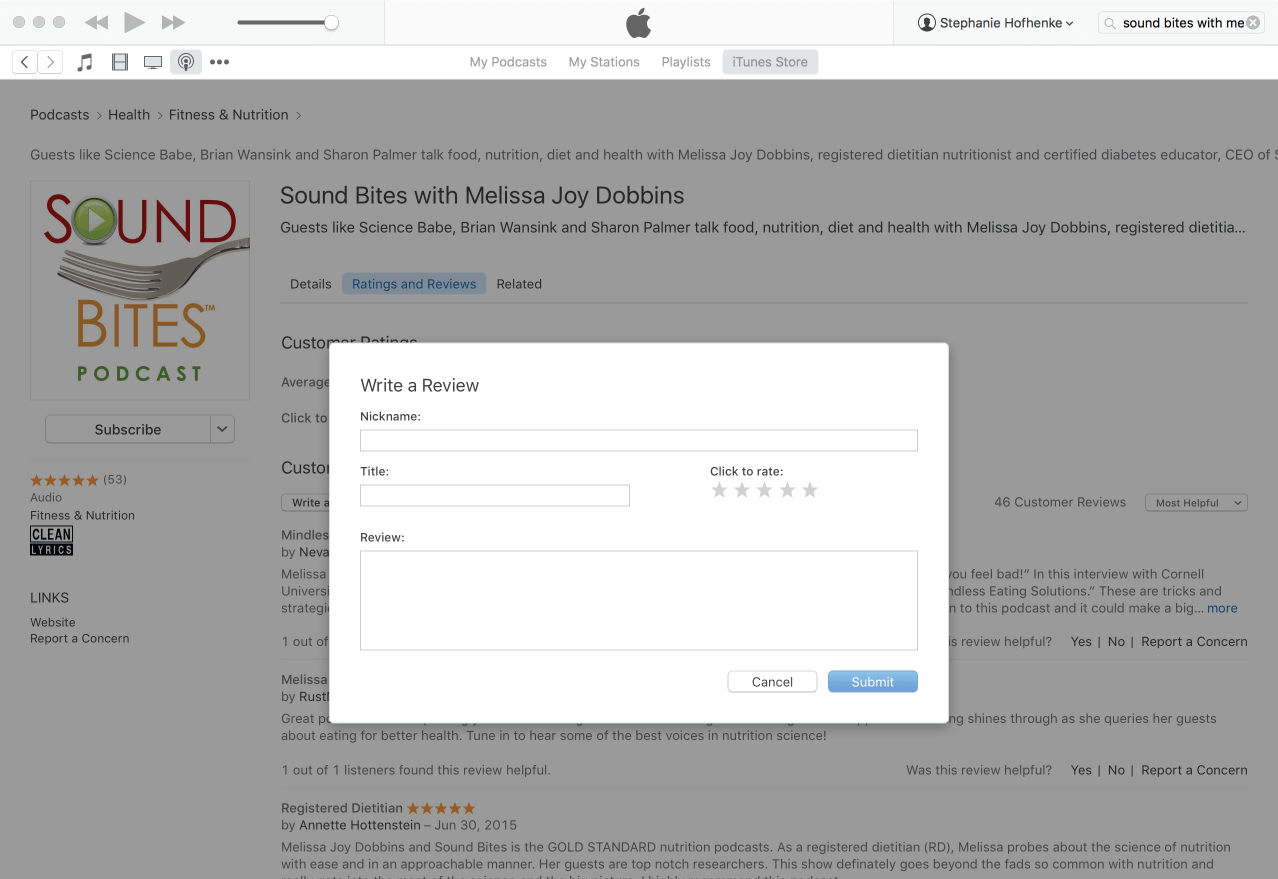
Click Write a Review
View reviews and write your own review.
Write your review…. Thank you!
Write your review!
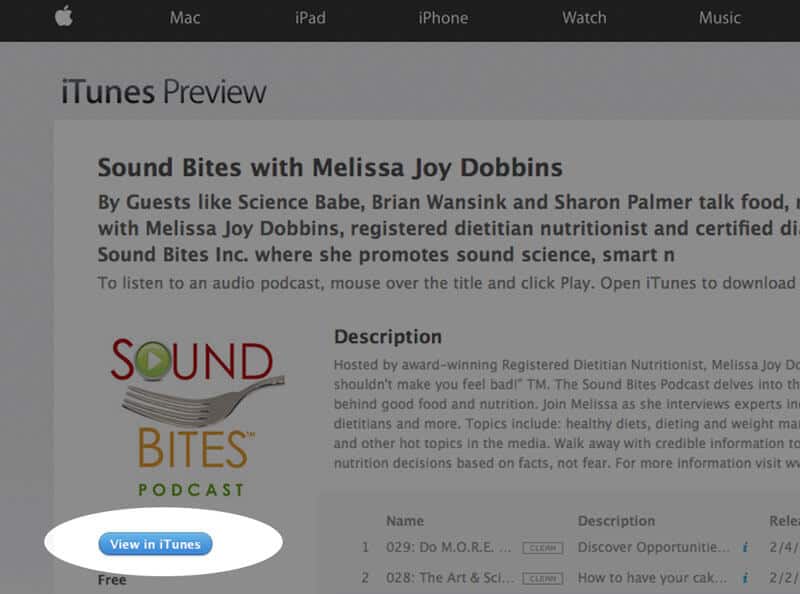
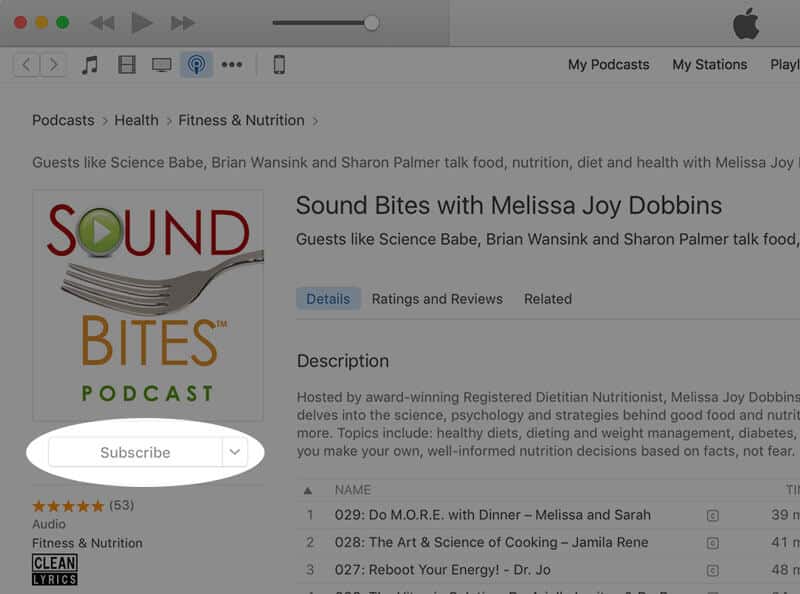
How to subscribe via iTunes
Click here to view the Sound Bites Podcastin iTunes, then click the blue “View in iTunes” button. This will open your iTunes application directly to Sound Bites Podcast. Click the “Subscribe” button, and your done!