Celebrating over 1 Million Downloads and 50,000 Free CEUs on the Sound Bites® Podcast | NEW: Get 1 years’ worth of CEUs with the new 15-CEU Podcast Course
Click here to earn 1.0 FREE CEU for listening to this podcast episode! Food, Culture, and Care: Type 2 Diabetes Risk Reduction & Management awards 1.0 CPEUs in accordance with the Commission on Dietetic Registration’s CPEU Prior Approval Program.
Disclosure: This episode is sponsored. Commercial support has been provided by Danone North America & Light + Fit. Constance Brown-Riggs is a paid consultant to Danone North America. No brands are discussed or promoted.
Culturally Relevant Care in Type 2 Diabetes
This episode explores how culturally relevant, patient-centered nutrition strategies can support Type 2 Diabetes (T2DM) risk reduction. Through an evidence-based lens, it highlights the role of flexible eating patterns and nutrient-dense foods in promoting sustainable dietary change across diverse populations.
Tune into this episode to learn about:
why culturally relevant care matters
what can happen when nutrition guidance doesn’t align with cultural foodways
what the science says about flexible eating patterns in T2DM
what the science says about the role of yogurt in supporting T2DM risk reduction
the qualified health claim regarding yogurt and T2DM
how RDNs can help patients navigate barriers to change
the role of patient centered care and communication
tips for empowering patients to adopt flexible eating patterns
how to emphasize achievable and enjoyable habits vs. restriction
building trust and supporting sustainable changes
how to approach culturally relevant conversations more confidently
resources for health professionals and the public
When we ask questions about a patient’s traditional, familiar foods and discuss how to include them in a healthful eating pattern, we are empowering them to make changes that are sustainable. That is culturally-relevant care.” – Constance Brown-Riggs
Constance Brown-Riggs, MSEd, RDN, CDCES, CDN
Constance Brown-Riggs is a registered dietitian and expert in diabetes care and education. She has worked extensively with African American and Caribbean communities to develop sustainable, culturally appropriate dietary strategies for managing and reducing the risk of Type 2 Diabetes. As a certified diabetes care and education specialist, she emphasizes patient-centered approaches that incorporate nutrient-dense foods like yogurt into flexible eating patterns tailored to the individual’s cultural and dietary preferences.
The FDA reviewed over 100 studies, ultimately drawing conclusions from 28 observational studies involving more than 860,000 people, and announced a qualified health claim, which states,‘Eating yogurt regularly, at least two cups that’s three servings per week may reduce the risk of type 2 diabetes according to limited scientific evidence. – Constance Brown-Riggs
Resources
Some links may be affiliate links. As an Amazon Associate, I earn from qualifying purchases.
American Diabetes Association Professional Practice Committee. Facilitating Positive Health Behaviors and Well-being to Improve Health Outcomes: Standards of Care in Diabetes—2025. Diabetes Care. 2025;48(Suppl. 1):S86–S127. doi:10.2337/dc25-S005.
Aune D, et al. Dairy products and the risk of type 2 diabetes: a systematic review and dose-response meta-analysis of cohort studies. Am J Clin Nutr. 2013;98(4):1066-83. doi:10.3945/ajcn.113.059030.
Chen M, Sun Q, Giovannucci E, et al. Dairy consumption and risk of Type 2 diabetes: three cohorts of US adults and an updated meta analysis. BMC Med. 2014;12:215. doi:10.1186/s12916-014-0215-1
Embree GGR, Samuel-Hodge CD, Johnston LF, et al. Successful long-term weight loss among participants with diabetes receiving an intervention promoting an adapted Mediterranean-style dietary pattern: the Heart Healthy Lenoir Project. BMJ Open Diabetes Res Care. 2017;5(1):e000339.
Gao D, Ning N, Wang C, Wang Y, Li Q, Meng Z, et al. Dairy products consumption and risk of Type 2 diabetes: systematic review and dose-response meta-analysis. PLoS One. 2013;8(9):e73965. doi:10.1371/journal.pone.0073965
Gijsbers L, Ding EL, Malik VS, de Goede J, Geleijnse JM, Soedamah-Muthu SS. Consumption of dairy foods and diabetes incidence: a dose-response meta-analysis of observational studies. Am J Clin Nutr. 2016;103(4):1111–1124. doi:10.3945/ajcn.115.123216
Institute of Medicine. Crossing the Quality Chasm: A New Health System for the 21st Century. Washington, DC: National Academies Press; 2001. See also: Beach MC, et al. Cultural competence: A systematic review of health care provider educational interventions. Med Care. 2005;43(4):356–373.
Jones M, Eggett D, Bellini SG, Williams P, Patten EV. Patient-centered care: Dietitians’ perspectives and experiences. Patient Educ Couns. 2021;104(11):2724–2731. doi:10.1016/j.pec.2021.04.008.
Satija A, et al. Healthful and unhealthful plant-based diets and the risk of coronary heart disease in U.S. adults. J Am Coll Cardiol. 2017;70(4):411–422. doi:10.1016/j.jacc.2017.05.047.
Savaiano DA, et al. Yogurt, cultured fermented milk, and health: a systematic review.Nutrition Reviews.2020;78(11):837–864.
Tong X, Dong JY, Wu ZW, Li W, Qin LQ. Dairy consumption and risk of Type 2 diabetes mellitus: a meta-analysis of cohort studies. Eur J Clin Nutr. 2011;65(9):1027–1031.
U.S. Department of Agriculture and U.S. Department of Health and Human Services. Dietary Guidelines for Americans, 2020-2025. 9th Edition. December 2020. Evidence summaries on health outcomes across lifespan.
Welcome to Sound Bites, hosted by registered dietitian nutritionist, Melissa Joy Dobbins. Let’s delve into the science, the psychology, and the strategies behind good food and nutrition.
Melissa Joy (00:22):
Hello, and welcome to the Sound Bites Podcast. I’m your host, Melissa Joy Dobbins, a registered dietitian nutritionist, and a certified diabetes care and education specialist.
Today, we’re coming to you live from the expo hall floor at the 2025 Food and Nutrition Conference and Expo, the annual meeting of the Academy of Nutrition and Dietetics, and the world’s largest gathering of food and nutrition professionals.
This episode is part of a special four-part series from Danone North America, with each episode supported by one of their brands. Today’s episode is brought to you by Light and Fit. Throughout the series, I’ll be sitting down with experts to explore the latest science and practical strategies that help people of all ages eat well and feel well.
And because we’re recording live here at FNCE, we’ll also be taking questions from the audience, so be sure to stick around until the end of each episode to hear these questions answered by our guests. Also, this episode has been approved by the Commission on Dietetic Registration for one CPEU for registered dietitians.
For more information about this continuing education activity go to my website at soundbitesrd.com/freeceus – that’s where you’ll get all the details about how to listen, learn and earn 1 free continuing education credit.
Today’s episode is about type 2 diabetes risk reduction and management, with a focus on how culturally relevant patient-centered strategies can make nutrition guidance more sustainable and impactful.
Joining me is Constance Brown-Riggs, a registered dietitian and expert in diabetes care and education. She has worked extensively with African American and Caribbean communities to develop sustainable, culturally appropriate dietary strategies for managing and reducing the risk of type 2 diabetes.
As a certified diabetes care and education specialist, Connie emphasizes patient-centered approaches that incorporate nutrient-dense foods like yogurt into flexible eating patterns tailored to the individual’s cultural and dietary preferences.
Connie and I are both paid consultants to Danone North America to share the science and support for yogurt’s role in a healthy eating pattern. Commercial support for this series has been provided by Danone North America.
Connie, welcome to the podcast.
Constance Brown-Riggs (02:34):
Thank you.
Melissa Joy (02:35):
I’m so excited to see you here at FNCE in Nashville. We are both certified diabetes care and education specialists and we’ve known each other for a long time. We’ve worked together in many capacities, so it’s so great to have you here. Let’s set the stage for our listeners.
When we think about type 2 diabetes management and risk reduction, I’d like to talk about why culturally relevant care matters so much. So, first, can you tell us how you define culturally relevant care?
Constance Brown-Riggs (03:04):
Sure. We talk about culturally relevant care, it actually means honoring the individual, respecting that individual and their food traditions; how they eat, the way they eat, why they are eating particular foods. So, we honor that, we respect that.
And we don’t just start in terms of just giving out a blank slate, so to speak, in terms of meal plans or anything else. We ask questions, we listen, we get to know the individual, what’s important to them in terms of their food. So, that’s culturally relevant care.
Melissa Joy (03:44):
Okay, thank you. When we think about culturally relevant care in the context of type 2 diabetes management and risk reduction, what might that look like?
Constance Brown-Riggs (03:53):
Well, if someone, for an example is from the Caribbean. So, we are going to look at what they typically eat, take those foods and see where we can, do we need to add anything else? Do we need to make it more nutrient dense? And tailor that for the individual?
So, I always think of myself as a facilitator of change, not telling them, no, you can’t have this, but let’s look at the way you’re eating. If it’s, peas and rice, what else might we add to that? Maybe we’re going to add callaloo to that to add more leafy greens. So, it’s really looking at what that individual eats on a daily basis and working from there.
Melissa Joy (04:42):
Excellent. So, why is this approach so important when we think about engaging patients in long-term changes? I mean, like what happens when nutrition guidance doesn’t align with someone’s cultural foods or lifestyle?
Constance Brown-Riggs (04:56):
If it doesn’t align, it’s not going to be sustainable. From the long-term perspective, we have to make sure that we’re including the foods that they eat, and if we’re asking questions and getting that information from them, we’re actually empowering them to go for the long haul for those sustainable changes. So, it has to be something they relate to. It has to be relative.
Melissa Joy (05:24):
So, we’ve talked a little bit about why it’s so important to ground diabetes care in culture and context. So, let’s shift gears a little and look at the science, and what the evidence tells us about flexible eating patterns, even specific foods like yogurt in supporting type 2 diabetes risk reduction. So, what does the evidence suggest about the role of diet quality and type 2 diabetes risk reduction?
Constance Brown-Riggs (05:49):
First, it’s important to recognize that historically, the dietary guidance tells us there isn’t one prescriptive eating pattern. In fact, there’s three flexible frameworks, if you will. There’s the US healthy diet pattern, then there’s a healthy vegetarian pattern, and there’s also the healthy Mediterranean pattern. And all three of those patterns include the dairy. That’s kind of like foundation to think of it in terms of that no prescriptive, it’s flexible, either pattern we can use for our patients.
And then in terms of broader evidence, the evidence consistently shows the diets that are rich in nutrient dense foods, fruits, vegetables, as well as legumes, whole grains and dairy, that they’re actually linked to the lower risk of developing type 2 diabetes.
Now, dairy has a unique nutrient package and that’s what contributes essential vitamins and minerals like calcium, iodine, riboflavin, B vitamins, and on down the list is actually 13 essential nutrients that are found in dairy foods.
One of the other things in terms of the dietary guidelines, also important to note is that the 2025 American Diabetes Association Standards of Care also include the Mediterranean diet. They highlight that in terms of its benefit for glycemic control.
Melissa Joy (07:33):
That’s true. I’ve seen that. So, talked a little bit about dairy, but yogurt has been receiving a lot of attention lately in this space with diabetes. What does the research tell us about the role of yogurt?
Constance Brown-Riggs (07:48):
Well, yogurt’s actually the dairy food most consistently associated with reduced type 2 diabetes, and cohort studies across diverse populations show the connection and decades of observational research as well. Plus, four major meta-analysis report show a reduction in diabetes risk, and those reductions range from 6 to 15%.
In fact, the FDA reviewed over 100 studies, ultimately drawing conclusions from 28 observational studies involving more than 860,000 people, and announced a qualified health claim, which states, “Eating yogurt regularly, at least two cups that’s three servings per week may reduce the risk of type 2 diabetes according to limited scientific evidence.”
Melissa Joy (08:47):
Excellent. Yes, it’s exciting to see this qualified health claim.
Constance Brown-Riggs (08:50):
It really is.
Melissa Joy (08:52):
So, clearly, the science is giving us this strong foundation, and we know that diet quality and certain nutrient dense foods can play a role in reducing type 2 diabetes risk. But I mean, knowing the evidence is only one piece of the puzzle. In real life people face barriers that can make change challenging.
So, let’s talk about what gets in the way, and how we as dietitians can help patients navigate those challenges. First of all, in your work as a registered dietitian and diabetes educator, what are the biggest barriers that you are seeing with patients when it comes to changing their eating habits?
Constance Brown-Riggs (09:33):
Some of the barriers are cost, accessibility. If they’re living in an area that fruits and vegetables aren’t accessible, maybe it’s just bodegas, they’re unable to actually get what they need, those are some of the major barriers. Also, misinformation, they’re confused.
There’s a lot of different sound bites, if you will, going around. They go on Facebook and all the social media, and they’re getting all this conflicting information. So, that’s one of the major barriers that I find.
Melissa Joy (10:12):
Yes. Are there any specific misconceptions around healthy eating that you think makes your job a little harder?
Constance Brown-Riggs (10:20):
For an example, they may think that they’re unable to eat yogurt. For an example, for someone with diabetes, they think that yogurt has too much sugar in it, and for that reason, they should stay away from it. So, of course it’s giving them the accurate information and showing them how they can include that. But that is one of the barriers.
And that’s significant for African American with minority populations who often may find that they have problems with lactose intolerance, lactose maldigestion, and so they need to understand the benefit of yogurt and how they can include that in their meal plan, and include it in a comfortable way in terms of lactose intolerance.
Melissa Joy (11:11):
Yes, because the yogurt is better tolerated than just regular straight up milk for many people with the lactose intolerance or lactose maldigestion.
One way that I’ve found that dietitians can help patients navigate these barriers without making them feel judged, adding any guilt is through patient-centered care.
And Connie, I know you’re familiar with this, but for our listeners, patient-centered care and communication is defined as providing care that is respectful of and responsive of individual patient preferences, needs and values, and ensuring that patient values guide all clinical decisions.
And patient-centered care is also reported to improve patient health and satisfaction outcomes, and may play an important role in providing culturally sensitive care. So, Connie, what strategies have you found most effective for providing patient-centered care in your practice?
Constance Brown-Riggs (12:30):
Well, we know that we have to translate the meal patterns into real life. And we know that can be challenging for our patients, as we mentioned earlier, in terms of barriers that they face; cost, the access, and that’s where patient centered care actually comes in.
And one excellent example in terms of patient centered care is the Med-South diet. Not many people are familiar with that. Hopefully, after today, we’ll have many more looking up that information.
But the Med-South diet was developed by researchers at the University of North Carolina in collaboration with community partners. And it was designed as a culturally adapted version of the Mediterranean diet. And this is for individuals living in the southeastern United States where there’s that large population in terms of diabetes, hypertension, and cardiovascular disease.
So, the goal was to make a diet with food that was familiar, affordable, and acceptable, and especially for African American adults, as I said, who are experiencing these high rates of diabetes, hypertension, and cardiovascular disease.
So, what makes the Med-South diet distinct is that it retains the cardioprotective elements of the Mediterranean diet, but at the same time, it’s emphasizing those foods that are regional and that southerners are more acceptable than what’s easily available for them, what’s accessible.
So, you might think in terms of what’s actually in the Mediterranean diet, leafy greens like collards and turnips, they would have that instead of spinach or kale. Sweet potatoes and Oprah as the vegetable staples in that diet. Canola oil replaces the olive oil, and that’s because of course canola oil is less expensive, that they’re still getting that cardioprotective value from the Mediterranean diet.
So, that’s definitely one way of adapting and it’s patient-centered. And it involved the patients as well, who know they help to formulate the Med-South diet. It’s also a cookbook, the Med-South cookbook, which the individuals in the study actually developed the recipes for that cookbook.
Melissa Joy (15:18):
Oh, very interesting. I have not heard of this. It sounds like the perfect opportunity for a dietitian to discover and listen to what foods that patient finds familiar and culturally preference. And then the dietitian would say, well, this kind of goes in this group, and this can substitute for this.
Constance Brown-Riggs (15:40):
Absolutely. So, there’s no one size fits all, it’s based on the individual, person centered.
Melissa Joy (15:50):
Yes. And we’re talking about healthy dietary patterns instead of a diet and certainly not a sample menu. People think they want that, but that’s only going to serve them for the short term. And even when you explain to the patient, “This is kind of what one day might look like.” They’ll say, “Well, I don’t like that food.” Or “Oh, I’m going to get bored eating this every day.”
Constance Brown-Riggs (16:13):
Every time.
Melissa Joy (16:14):
This is going to help us transition into your individualized meal plan. Yes. Very important. Earlier you had mentioned fear-based messaging, and of course, we’re talking about nutrition advice that doesn’t reflect cultural preferences in food ways.
When it comes to dietitians and other healthcare professionals trying to be more sensitive to culturally diverse populations and the foods that they eat, do you have any suggestions on how we can approach that? Just initially, like what our frame of mind should be.
Constance Brown-Riggs (16:51):
Well, the frame of mind should be open. I talk about implicit bias a lot, and that is something that sometimes it’s hard for RDs, any professional actually to really recognize the fact that they might have a bias of an individual.
So, the first step would be to recognize that we all have biases, and then to approach that individual with an open mind, no preconceived ideas of what foods they may eat or may not eat. We’ve got to ask the questions and listen to the patient. So, again, implicit bias can actually be a stumbling block. That could be another barrier, as we talk about the barriers that the patients face. Bias is one of those barriers.
Melissa Joy (17:47):
Yes. A lot of, like you said, being open listening, asking — I know for myself sometimes, even though I’m a podcast host and my job is to ask questions, I find it a little uncomfortable sometimes to ask questions. But I remind myself that that shows my interest and that I’m not making assumptions. And I think that that really helps patients feel valued and heard. So, I think that’s really important.
And you said also, not telling people what they should do, but you’re that facilitator of change and working together with them. Do you have any language that you typically share around that? Like when you’re talking with a patient about making changes, do you have any phrases that you could share with us?
Constance Brown-Riggs (18:32):
Okay, so rather than telling the patient what they should do, you want to help them set goals so that they feel motivated and capable or set goals that they feel they’re able to accomplish. And rather again, than telling them, you want to ask, “Well, what ideas do you have as far as addressing this challenge? So, you let them lead the way as opposed to you telling them what they should do.
And it’s important to remember that small gradual changes work best. We say that a lot, but it’s true. So, you ask them, “What small change do you feel you’ll be able to accomplish? How would you like to address this challenge?”
Melissa Joy (19:19):
Okay, yeah, that’s a good reminder, because if you just say, “What ideas do you have? And then they come up with a big idea,” then we can address like okay, that’s great, but could you break that down into smaller steps? Would that be a good way to approach that?
Constance Brown-Riggs (19:35):
Exactly. And it’s kind of challenging them: “Do you think this is the best goal? Do you think you’re going to be able to accomplish this? And sometimes, I just pull them back (laughs) and tell them-
Melissa Joy (19:51):
You don’t have to do it all overnight.
Constance Brown-Riggs (19:54):
Exactly. It’s not necessary, small gradual changes. And particularly when it comes to food and changing a recipe for an example, small tweak may be enough to make the necessary change.
Melissa Joy (20:10):
Yeah, very good. Well, I love what you’re saying about patient-centered care and communication and setting aside our biases, even being aware of our biases. Let’s talk more about how we can empower patients to adopt these flexible eating patterns that do feel achievable and enjoyable (not restrictive), and that also support diabetes risk reduction.
So, are there some common food myths around type 2 diabetes that you help patients overcome? You had mentioned earlier about like feeling like they can’t have yogurt, certainly we know that there’s a lot of fear factors involved with foods or food groups that they feel they’ve either been told that they should limit or avoid, or that they just assume that they can’t have. Are there any specific examples that you can share?
Constance Brown-Riggs (21:05):
Well, one is yogurt and the time of day or how to use yogurt. There’s the myth that it’s only available or should only be eaten in the morning for breakfast. And of course, we know that yogurt can be part of any meal. And so, it’s breaking down that myth, yogurt’s versatile.
I’d like to recommend that they use a savory dish, use yogurt with a savory dish. For example, use a little dollop of yogurt with the chili, and of course, really tastes good as well. And also, looking at what they’re already using in terms of foods and type of snacks. So, it may be roasted plantains to go along with yogurt. It could be roasted peas, lact beans, that type of thing along with the yogurt.
So, it’s just showing them it’s not limited to breakfast. It’s something that has a lot of uses throughout the day, different meals, different combinations.
Melissa Joy (22:12):
That and even just the savory aspect opens up a whole world of possibilities.
Constance Brown-Riggs (22:17):
Because they think of it as a sweet so to speak, but this is showing them other ways of preparing and utilizing the yogurt as well.
Melissa Joy (22:27):
And combining it with their culturing preferences. You mentioned small changes; how can these small changes make big impacts without people having to give up their favorite foods?
Constance Brown-Riggs (22:40):
There’s a couple of ways. It could be as simple as portion control. So, rather than having a large plate, I would ask them, “Well, do you think you will be able to have a smaller portion? What portion do you think you’d be able to eat and manage?”
I’m thinking of a woman that I was working with from the Caribbean, and of course, she loves rice and peas. And she thought when she came to me that she would no longer be able to include that in her meal plan. And I showed her, you can combine, its rice and peas, measure out a cup and let me know how that feels for you, are you able to comfortably eat that?
She was so happy, and she was able to be satisfied with the cup. I think I mentioned this earlier, she filled in with other vegetables with the callaloo, and she was able to keep that starch in check, basically (chuckles).
Melissa Joy (23:41):
Right. And yeah, I’m sure she was thrilled that she could include her favorite foods. A lot of people (ourselves included probably) have limited time, maybe even skills or motivation in the kitchen. So, what’s your approach when you’re working with a patient who has those limitations?
Constance Brown-Riggs (23:59):
To basically talk to them about shortcuts, if you will, how to use the foods, use canned foods, convenience foods, how that works. Not a lot of time, also, we talk about meal prep as a means and not … well, I call now meal prep, years ago, meal prep, when it was just simply a matter of making a pot and having leftovers as opposed to-
Melissa Joy (24:32):
Cooking once, eating twice or thrice instead of like cooking all day Sunday and putting it into little containers. You don’t have to go to that extreme.
We talked a little bit about the role that yogurt can play in type 2 diabetes risk reduction, but I’d like to hear a little bit more about how yogurt can play a role in supporting plant forward eating that helps reduce the risk of type 2 diabetes, but again, is also culturally responsive.
Constance Brown-Riggs (25:01):
One more example of yogurt and its versatility. It provides high quality protein along with calcium, and oftentimes vitamin D as well. So, when it’s paired with a fiber rich topping like berries, flax seeds, nuts, high fiber cereal, it actually makes a great breakfast or a snack for managing blood glucose.
Even sometimes, I will tell my patients to actually Chia seeds because you don’t have the taste, and they could sprinkle that well over yogurt or new place else to add a little more fiber.
Melissa Joy (25:43):
And yeah, that flexibility really helps the patients feel empowered. Again, that’s going to help us promote and encourage long-term success. So, we’ve talked about practical, culturally centered solutions that patients can use in their day-to-day lives, but of course, dietitians and other health professionals can play a critical role in helping patients put these strategies into action.
So, let’s talk about the unique impact registered dietitian nutritionists can have in building trust and supporting the sustainable changes. So, for dietitians, what skills would you say are most important when delivering culturally relevant care and how can they enhance those skills?
Constance Brown-Riggs (26:28):
Listening is one of the most important skills that is necessary to really have a cultural relevant conversation with the patient. And that is allowing them to tell their story and to really engage in listening as they tell that story. If you allow them to tell the story, they will tell you what foods they enjoy eating, how those fruits fit into their lifestyle on a daily basis, how they feel in terms of is it a celebration food or is it something that they only have on a rare occasion?
So, listening and asking open-ended questions, that’s how they will get that information. To enhance the skills, of course, continuing education and cultural competence. Also, building relationships with diverse communities. In terms of the DPGs that we have, that also will help as far as maybe becoming a member of NOBIDAN or what’s the Latino-
Melissa Joy (27:48):
LAHIDAN.
Constance Brown-Riggs (27:49):
LAHIDAN (laughs).
Melissa Joy (27:50):
And maybe even COGA, I’m a member of that.
Constance Brown-Riggs (27:53):
And that will help to open insights. Trying recipe from a culture that they wouldn’t ordinarily or necessarily make, but deliberately intentional going out and looking for these opportunities.
Melissa Joy (28:09):
Yes. You mentioned continuing education, and I know our dear diabetes DPG, that is near and dear to our hearts, there’s always great resources from them, and that’s a great place to look for cultural competence opportunities.
Building on that, how can dietitians build trust and rapport with patients from diverse cultural backgrounds? Any advice there?
Constance Brown-Riggs (28:38):
Again, it goes to asking those questions, open-ended questions, show interest, genuine interest and curiosity. Asking them to tell you what foods do you eat at the holiday time? What food is important to you? Those are the questions to ask.
And it’s the same questions that you would ask anyone, that you should be asking anyone out, I’d put it that way, is tell me about your lifestyle? You may just ask that question. Tell me about your lifestyle. Who’s in the kitchen? Who’s preparing the meal? Who else is in the household? Just ask them the questions.
Melissa Joy (29:26):
And maybe framing it up with, “I want to be sure that we can include your favorite foods” so that they know you can be honest with me and I’m not judging.
So, what does success look like when culturally relevant care is done well? How would a dietitian know that it’s making a difference and they’re on the right track?
Constance Brown-Riggs (29:49):
Well, one way certainly is outcomes. We’ll be able to see ideally a change in that A1C, the cholesterol level is coming down, and the person is coming back to you and engaging with you because now there’s that trust factor. They feel seen, they feel that you understand and that you’re not judging them, judging the food that they eat, that you’re helping them to include that food on a regular basis. So, it’s sustainable.
Melissa Joy (30:24):
Excellent. We’ve covered a lot today, but now, we’re going to take a couple questions from our live audience. The first one is, “Patients often tell me they feel pressure to cut out their cultural foods to either manage or reduce their risk of type 2 diabetes. So, how do you reframe that conversation?”
Constance Brown-Riggs (30:43):
So, let them know they do not have to cut out their cultural foods to manage their diabetes. It’s showing them, as mentioned before, it may be cutting the portion, smaller portion of the frequency in which they’re eating a particular food. Maybe tweaking the recipe just a little bit. But the most important thing is showing them how, not telling them they can’t. That definitely will not work, not long term.
Melissa Joy (31:16):
Great. The second question is, “Sometimes I feel unsure about how to talk about traditional cultural foods with my patients. I don’t want to say the wrong thing or make them feel bad. How can I approach these conversations more confidently?”
Constance Brown-Riggs (31:34):
Alright, so it’s important to start with curiosity and respect. Ask the patient to tell you about the foods that matter to them and how they usually prepare that food. You don’t have to be an expert in any cuisine, and certainly not every cuisine. Patients will appreciate when you ask them to teach you, “Teach me how you make that, what do you include in that particular recipe?” And then of course, build on the foods by suggesting simple ways that you can add making it more nutrient dense.
So, balancing the plate, again, I always say if they’re eating on a platter, it still makes a difference. If you show them that half that platter should be leafy green vegetables, and a quarter would be the starch and the protein. Of course, we hope they would put it on a smaller plate, but the fact is it still makes a difference. So, putting it in terms that they can understand.
Melissa Joy (32:41):
Excellent. Thank you. Well, Connie, thank you so much for joining us today and sharing your expertise in culturally relevant diabetes care. It’s so important. We’ve talked about how honoring cultural context, applying the evidence and focusing on these patient-centered strategies can empower individuals to support type 2 diabetes management and risk reduction.
And I really feel like letting patients know that they don’t have to give up their favorite foods is probably the most important thing in diabetes.
Constance Brown-Riggs (33:17):
Absolutely. I say every day I’m giving patients back their food, honoring their traditional foods, and telling them they can include it. It’s a matter of portion. And I always say strategic eating, not elimination, but strategic.
Melissa Joy (33:38):
Not elimination, not restriction. And again, when they can have their favorite foods, they’re going to be more successful long term.
Constance Brown-Riggs (33:46):
Absolutely.
Melissa Joy (33:47):
Well, thank you again, Connie, and thank you to our live audience here at FNCE and being part of this important conversation. This episode is part of a special four-part series brought to you by Danone North America.
Be sure to check out the other episodes where we explore child nutrition, gut health and weight management. Each episode brings new science and practical strategies for your practice.
And remember – go to my website at soundbitesrd.com/freeceus – that’s where you’ll get all the details about how to listen, learn and earn 1 free continuing education credit – and where you’ll also have access to resources related to this podcast episode.
Thanks again for tuning in, and as always, enjoy your food with health in mind. Till next time, I’m Melissa Joy Dobbins, and this is the Sound Bites Podcast.
[Music Playing]
Voiceover (34:22):
For more information, visit soundbitesrd.com. This podcast does not provide medical advice. It is for informational purposes only. Please see a registered dietitian for individualized advice.
Music by Dave Birk, produced by JAG in Detroit Podcasts. Copyright, Sound Bites, Inc. All rights reserved.
LISTEN, LEARN AND EARN
Listen to select Sound Bites Podcasts and earn free CEU credits approved by the Commission on Dietetic Registration (CDR) for registered dietitian nutritionists and dietetic technicians, registered. Get started!
Get Melissa’s Sound Science Toolkit here!
Partnerships:
Sound Bites is partnering with the Association of Diabetes Care and Education Specialists (formerly the American Association of Diabetes Educators)! Stay tuned for updates on the podcast, blog and newsletter!
Sound Bites is partnering with the International Food Information Council! Stay tuned for updates on the podcast, blog and newsletter!
Sign up for my monthly newsletter and episode eblasts so you never miss an update!
Listen on Stitcher (Android)
Install the Stitcher App
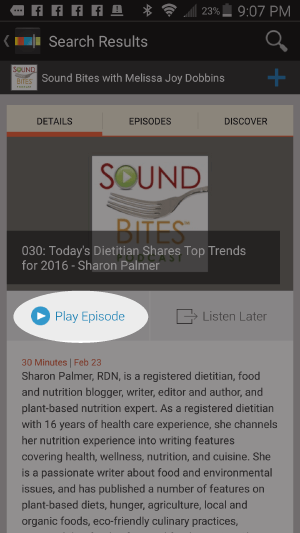
1. Search for “sound bites with melissa joy dobbins” 2. Choose Play Current Episode or Add to Playlist
Choose “Play Episode”
Subscribe & Review on iPhone
Open the “Podcast” app on your iPhone
Search for “Sound bites with melissa joy dobbins”
Open the podcast and click “Subscribe” and your done!
Write a Review
Click “Reviews”, then “Write a Review”.
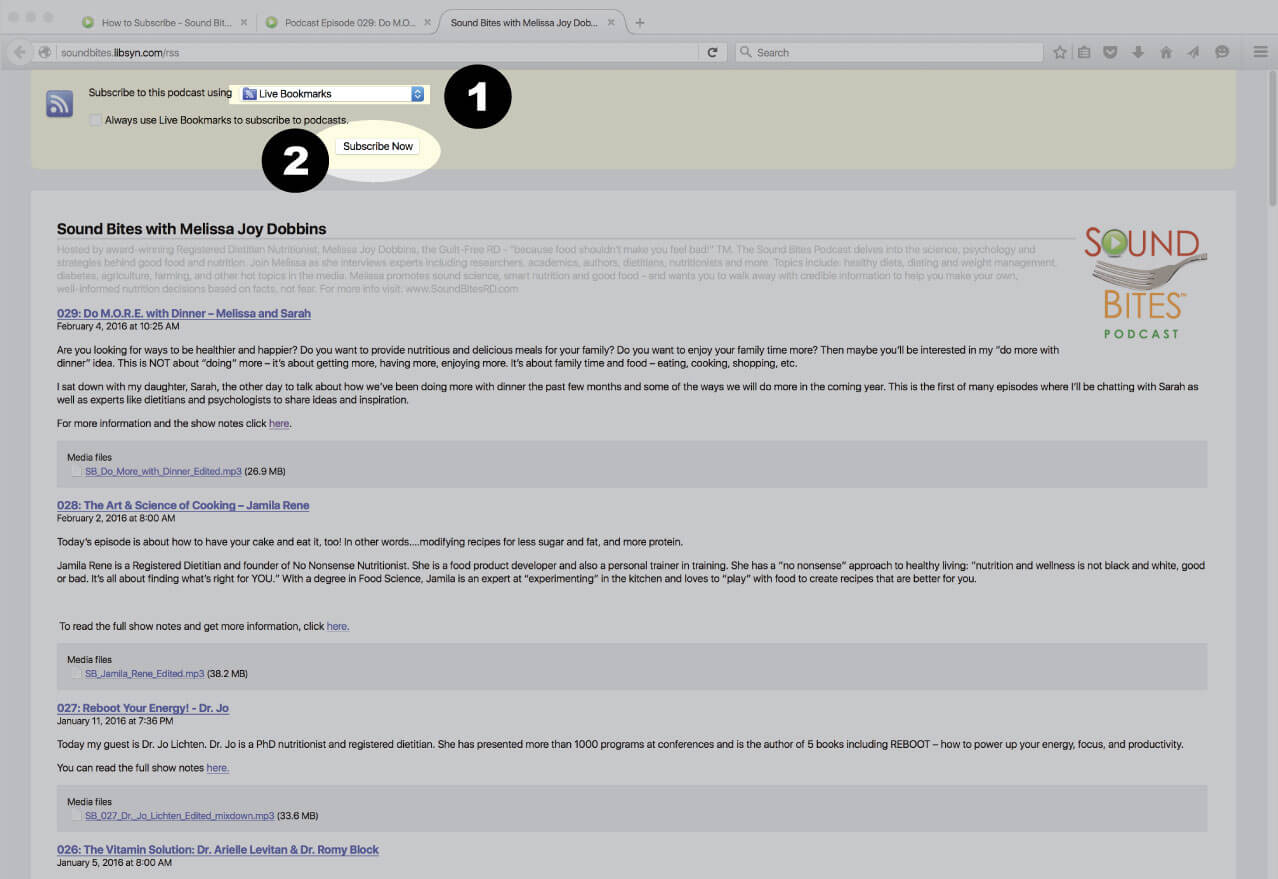
Subscribe via RSS Feed
Navigate to any podcast player . Click on the RSS feed icon.
Click on the RSS feed icon.
Click on RSS Feed
Choose which application you would like to use to receive the RSS feed
Click “Subscribe Now”
Confirm settings and subscribe.
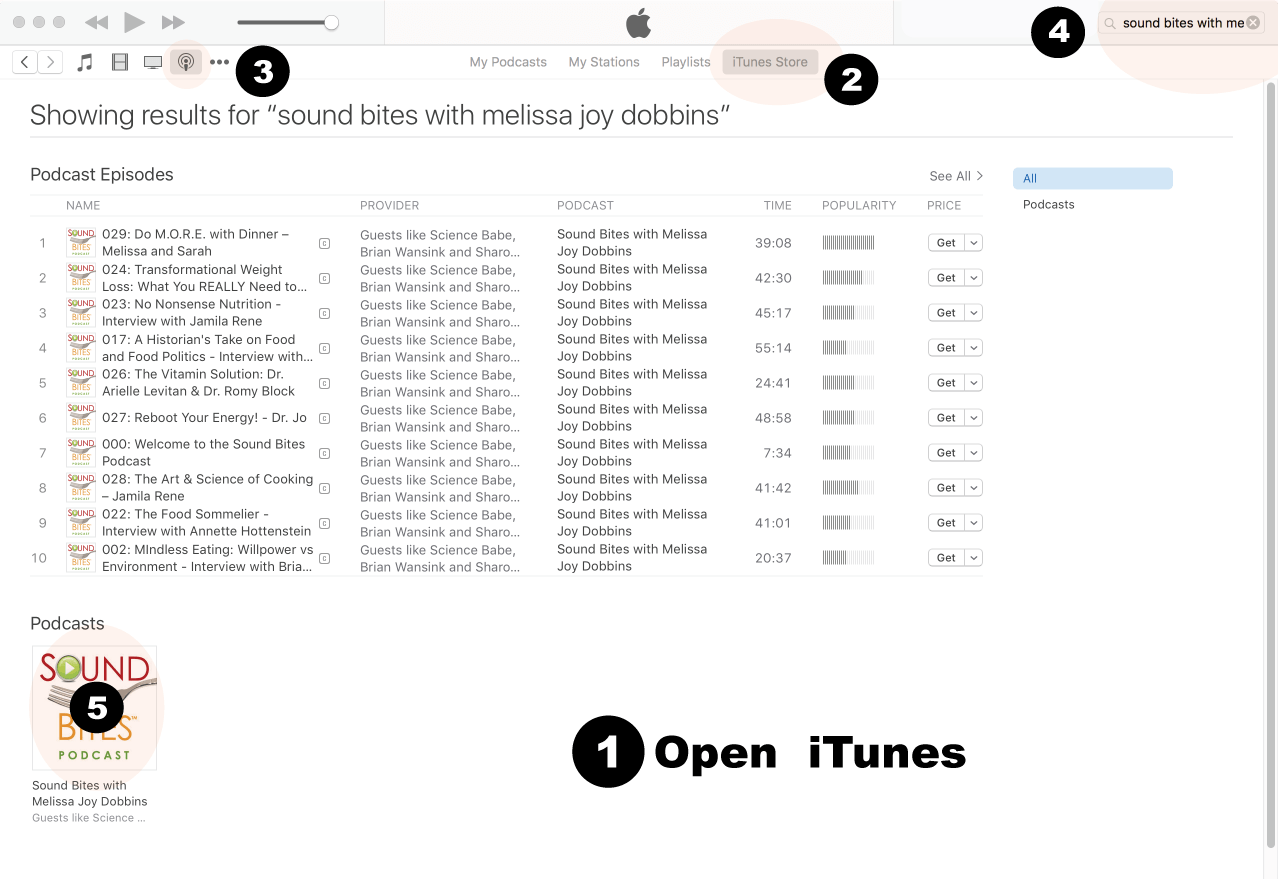
How to Review in iTunes
Open iTunes desktop application
Click iTunes Store
Click on Podcasts
Search for “Sound bites with Melissa Joy Dobbins”
Click on podcast image
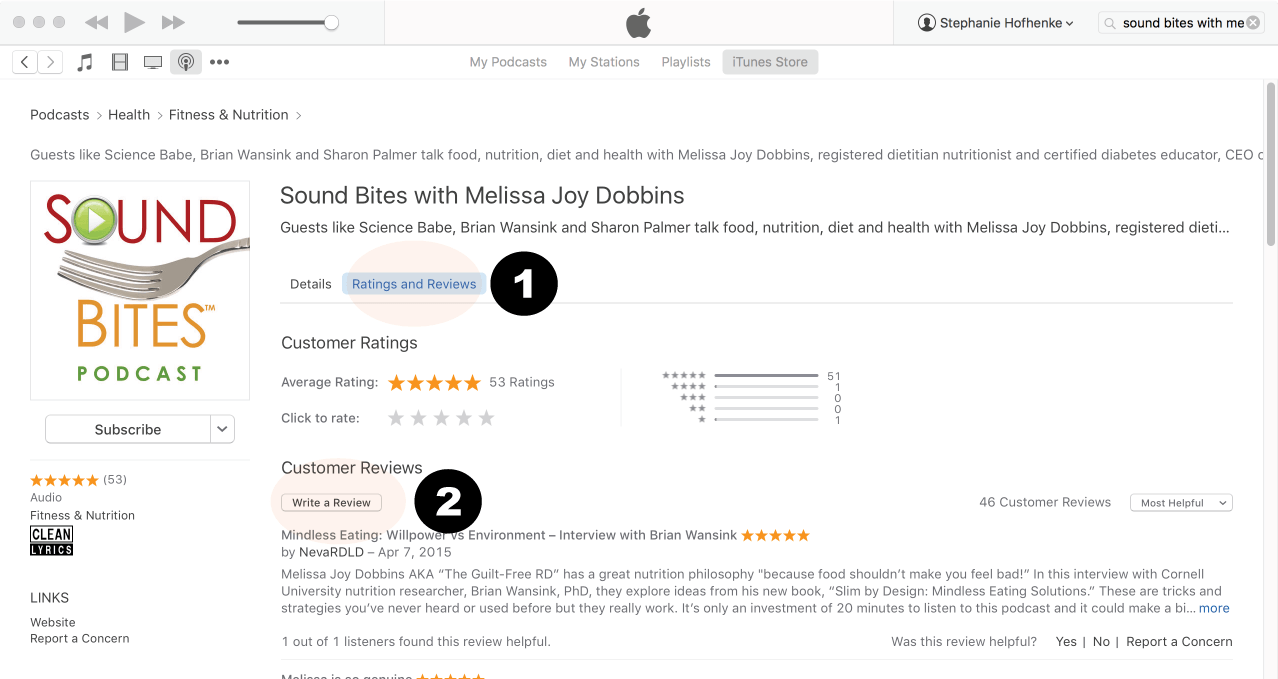
Search for Sound Bites podcast in iTunes
Click Ratings & Reivews
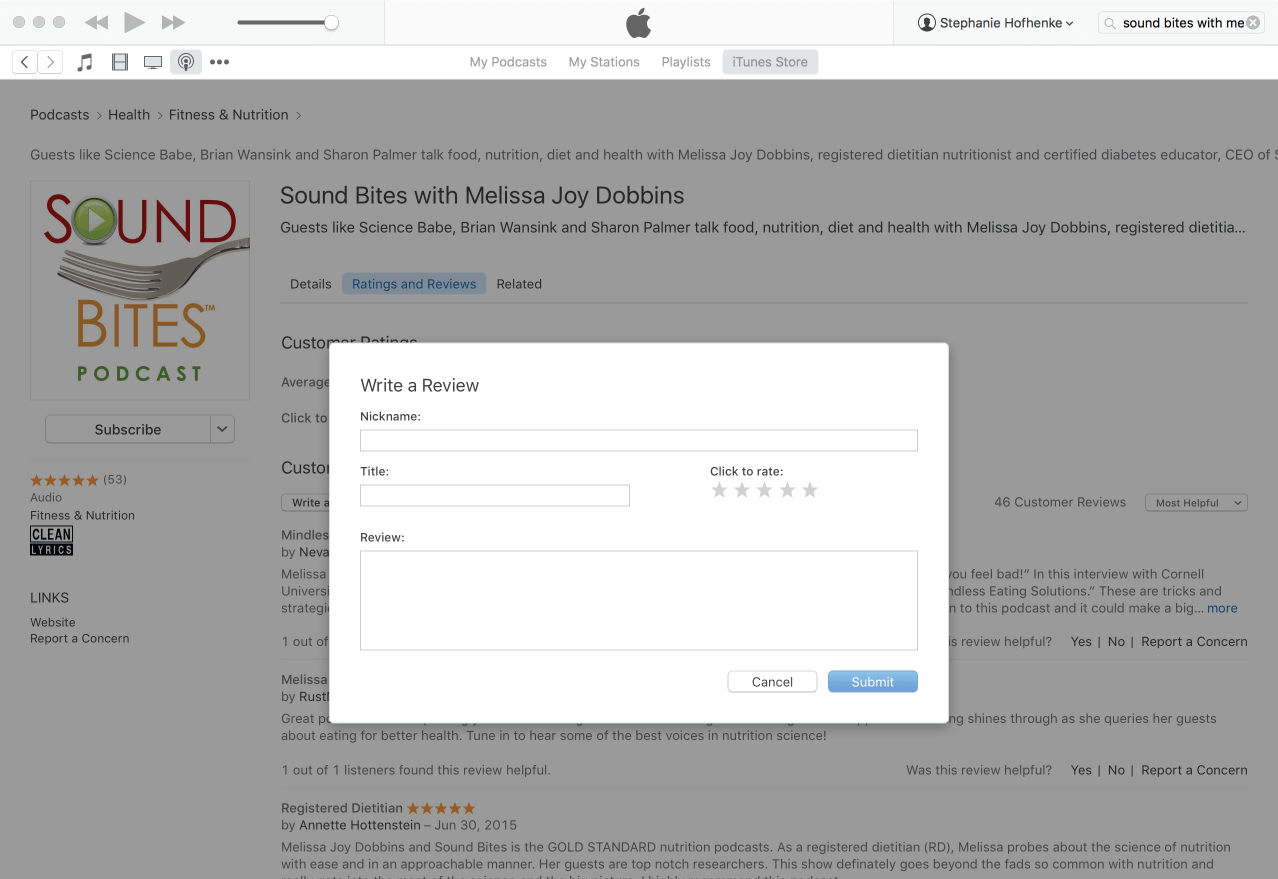
Click Write a Review
View reviews and write your own review.
Write your review…. Thank you!
Write your review!
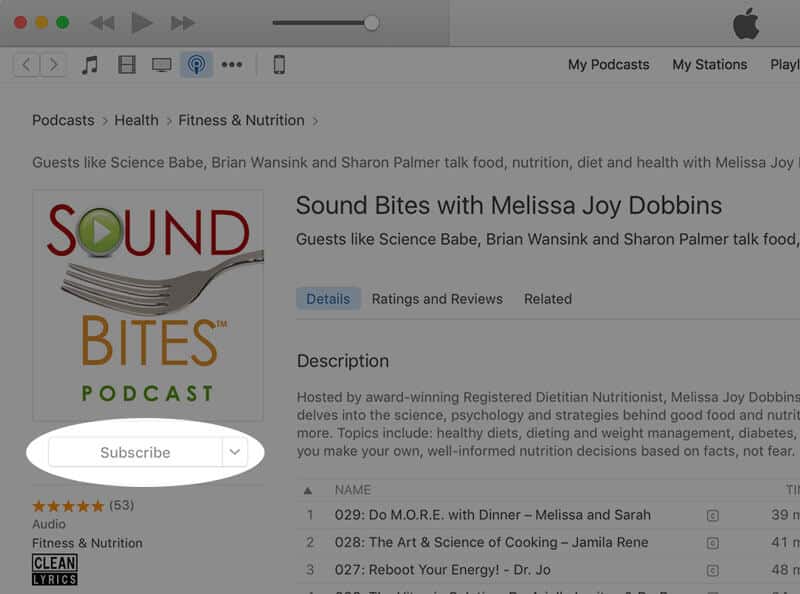
How to subscribe via iTunes
Click here to view the Sound Bites Podcastin iTunes, then click the blue “View in iTunes” button. This will open your iTunes application directly to Sound Bites Podcast. Click the “Subscribe” button, and your done!
























Thanks