Celebrating over 1 Million Downloads and 50,000 Free CEUs on the Sound Bites® Podcast | NEW: Get 1 years’ worth of CEUs with the new 15-CEU Podcast Course
There are many essential aspects of diabetes management, but it’s no surprise that one of the most common questions people have about diabetes is “What can I eat?” The American Diabetes Association’s nutrition philosophy is: “informed food choices are essential for living well” and there are 7 key meal patterns as well as the Diabetes Plate to help guide food choices. However, food is more than just simply nutrients – it plays an important role in our culture, communities and celebrations – and it’s only one of many factors that influence our health.
Living with diabetes is a journey and you build your skills over time. What you eat is only one part of your overall self-management.” – Stacey Krawczyk
Tune into this episode to learn about:
Seven key meal patterns for managing diabetes
the Diabetes Plate and who might benefit from using it
the ADA’s new sister organization focused on obesity
the ADA’s approach to “food as medicine”
diabetes distress and how it impacts behaviors and outcomes
fasting and diabetes
including cultural and celebratory foods into healthy meal patterns
lifestyle factors beyond food
benefits of medications
GLP-1s for diabetes vs weight management
important takeaways and resources for the public and health professionals
Informed food choices are essential to living well.” – American Diabetes Association’s Nutrition Philosophy
Stacey Krawczyk, MS, RD
Stacey Krawczyk is the Director of Nutrition & Wellness at the American Diabetes Association. She is a Registered Dietitian with significant experience in population health, wellness marketing, and partnership development. She holds a MS in Public Health Nutrition and a BS in Nutrition and Food Science from the University of Tennessee-Knoxville. Over the course of her career, she’s engaged audiences with nutrition and wellness information for billion-dollar global food brands, health associations, community programs, healthcare tech, and almost everything in between. A 5th generation farmer, she is grounded in food systems issues that drive her passion for mission-driven branding and social causes.
Resources
Some links may be affiliate links. As an Amazon Associate, I earn from qualifying purchases.
Welcome to Sound Bites, hosted by registered dietitian nutritionist, Melissa Joy Dobbins. Let’s delve into the science, the psychology, and the strategies behind good food and nutrition.
Melissa Joy (00:20):
Hello, and thanks for tuning into the podcast. As you may know, my audience is a mix of healthcare professionals and the general public. And while I delve into the science quite a bit on the show, I do try to make it digestible and meaningful for all listeners regardless of their background.
But if you’re a dietitian or a diet technician, I want to make sure that you know about all of the continuing education opportunities through my podcast.
I have about three years’ worth of free CEU activities that you can access through my website, and I also recently created a 15-CEU package for one whole year’s worth of credits, including the required ethics credit that you can purchase. There’s only one quiz to take, and you get one certificate for the 15 credits.
I’ve provided over 30,000 free CEUs through my podcast, and I’m getting great reviews about the new 15 CEU course as well. So, head on over to soundbites rd.com/freeceus to learn more. And if you’re not a dietitian, now you know more about the continuing education requirements that dietitians have.
Hello, and welcome to the Sound Bites podcast. Today’s episode is about food and diabetes, specifically eating patterns that help manage diabetes, the science behind those patterns, and really how food is more than just simply nutrients. It plays an important role in our cultures, our communities, our celebrations, and more. This episode is not sponsored.
My guest today is Stacey Krawczyk. Stacey is the Director of Nutrition & Wellness at the American Diabetes Association, where she leads the nutrition and wellness strategy for the ADA.
She’s a registered dietitian and public health nutrition expert with significant experience in population health, wellness communication, and partnership development. Welcome to the show, Stacey.
Stacey Krawczyk (02:20):
Melissa, thanks so much for inviting me to your amazing podcast.
Melissa Joy (02:24):
I’m excited to talk with you about my favorite topic: diabetes. I’ve done several diabetes-related episodes on the podcast, but nothing very recently, I don’t believe.
So, before we dive into all things diabetes and food, please share with our listeners a little bit more about your background and the work that you do, and anything you’d like to share with us about ADA.
Stacey Krawczyk (02:46):
That sounds great. Well, how about we start at the beginning – I learned about the nourishment of others in my grandmother’s kitchen growing up. When she was diagnosed with type two diabetes in the 1970s, I was intrigued by how she was told to eat to feel better, and what she actually did to kind of merge the two (food enjoyment and food for health).
I didn’t know it at the time, but that kind of laid the groundwork for my professional philosophy. She lived to be a hundred-years-old, by the way.
Melissa Joy (03:16):
Wow.
Stacey Krawczyk (03:17):
So, fast forward a little bit – after graduating with a master’s and completing my dietetic internship, I started my career as a public health nutritionist working for a state health agency. I focused on maternal and child health, population health programs, and developed training programs for healthcare professionals in the local health departments.
I spent about a third of my career in population programs, a third in local community nutrition programs, kind of boots on the ground education, and in this last third, I’ve been focused on marketing and communications for brands, commodity foods, and health.
In my current role, not only does it feel a little bit full circle moment on the why I got into food nutrition because of my grandma, but I also feel I have an amazing fit with my passions and expertise that I’ve really built over the years to kind of help create a food nutrition strategy and very streamlined communications and resources, and education for all of ADA stakeholders.
Melissa Joy (04:17):
Excellent. And you’ve been there in this role for about a year, right?
Stacey Krawczyk (04:21):
Correct.
Melissa Joy (04:22):
Wonderful. Yeah, I think there’s some exciting changes going on there. I know our colleague and friend, Toby Smithson, is working with you as well. I think she reports to you and she’s fairly new at the ADA, so that’s totally cool.
Well, as I said, it’s my favorite topic. I say I love diabetes and people give me a weird look, and what I mean is I love diabetes education. I love empowering people with diabetes, and that’s why I’ve maintained my certified Diabetes Care and Education Specialist certification (which is a mouthful) for 27 years, and it’s just my favorite population to work with.
There are so many important aspects of diabetes management, but no surprise, one of the most common questions people have about diabetes is, “What can I eat?” Or maybe what they’re thinking is, “What can I not eat? What foods are going to be taken away from me?” A lot of stress and distress involved there.
I understand the American Diabetes Association has some new research on seven key meal patterns that have been shown to help manage diabetes. So, I’d love to hear about ADA’s approach to diabetes and “diet,” and some of this current science about these different eating patterns.
Stacey Krawczyk (05:34):
Well, the guidelines we use to inform our education and resources are the annual ADA standards of care, as well as the nutrition therapy for adults with diabetes or prediabetes, a consensus report.
Now, that current version of the report (well, I’m going to refer to it as the Nutrition Consensus) was published in 2019, and the newest version is planned to be released in 2025, and that’s where you’ll see a lot of the new research review come about.
So, right now, we’re currently working off the 2019 version. Because we are the standard bearers when it comes to the what of diabetes practice, it’s important we always ground what we do in the totality of evidence and what it’s telling us.
Now, the meal patterns you referred to are the ones that are recommended for people with diabetes. They’re all listed out in the Nutrition Consensus, and we’re leveraging them more frequently now because we really understand that consumers and people with diabetes and their caregivers are really understanding that no one size fits all approach for diabetes management is as successful as we would love for it to be.
We are all our individuals with our culture, our social determinants of health, our personal preferences – having patterns that we can leverage as professionals as we work with individuals, really enables a more personalized approach, one that will work for the very person. A meaningful approach is one that someone can and will be successful at using.
Melissa Joy (07:10):
You said these seven meal patterns are listed out. Let’s review those.
Stacey Krawczyk (07:15):
So, the seven meal patterns that we refer to, not only our diabetes.org, but also our professional.diabetes.org website that really kind of give information on the evidence-based approach and meal patterning for people with diabetes.
The first one is the Mediterranean style, and this is an emphasis on plant-based foods: fish, seafood, olive oil, dairy products, mainly yogurt and cheese, typically about fewer than four eggs per week. Red meat is pretty low frequency in amounts. So, it’s that kind of typical Mediterranean style that people talk about.
The next one is vegetarian or vegan. So, a whole plant-based food meal pattern: low fat meal pattern, a very low-fat meal pattern. And so, the difference between the two low fat is the fat intake is less than or equal to 30% of the total calories, and sat fat is less than or equal to 10%. And then a very low fat really is more around the area of 70% carbohydrate, which is 30 to 60 grams of fiber inclusive and only 10% of the total fat from the diet.
Then we have the low carbohydrate meal pattern, and that is a range of carbohydrates between 26 and 45% of total calories, a very low carbohydrate meal pattern with similar to low carbohydrate, but it more targets a less than 26% of the total calories
Melissa Joy (08:50):
Of carbohydrate.
Stacey Krawczyk (08:51):
And lastly is the Dietary Approaches to Stop Hypertension or the DASH diet, and that’s again, a very plant-forward meal pattern, whole grains, fish, nuts, reduce unsaturated fat, red meats, and also maybe reduced in sodium.
Melissa Joy (09:07):
Great. Yeah, and it’s clear that some diets work better for … and when we say diet, we’re talking about meal patterns. For the listeners who aren’t healthcare professionals, that’s just the terminology that we use. Diet is what people eat, not necessarily a weight loss diet, sort of thing.
But clearly, these range quite a bit in how much carbohydrate is in the diet. So, these macronutrients, you’ve got carbohydrates, proteins and fats, and the distribution ranges quite a bit amongst these different patterns because some people do fine on plant-based higher carbohydrate intake, and other people find they do better on a lower carbohydrate intake.
So, what are you seeing with regard to the research and the science on these different meal patterns and then the impact on the diabetes management, the outcomes, the A1C glucose levels and so on?
Stacey Krawczyk (10:03):
Absolutely, and that’s why we do have this range of patterns because it’s based on the co-occurring conditions that people may have as well as diabetes.
So, if somebody is needing to have a more focused effort on cardiovascular disease, for example, then maybe pursuing a meal pattern or their healthcare team may pursue a meal pattern that is really going to try to help support those additional, whether it be the LDL or HDL total cholesterol, et cetera.
So, I think that’s why, again, we can’t necessarily have a one size fits all meal pattern approach because every person is different and it’s based on the additional layers of co-occurring conditions that they have that may help target a little bit better – are they needing to have a larger reduction in A1C or et cetera.
And so, that’s why we’ve got some basic information on that, on the professional.diabetes.org site for healthcare professionals that are looking. But we are going to be developing a toolkit for healthcare professionals to really help hone in on some of the more nuanced approach to meal patterning.
Melissa Joy (11:17):
Okay, great. Yes, and my regular listeners know that towards the end of the episodes, I always talk about resources and everything, but resources are such a big part of what the ADA offers to the public, to health professionals. So, we are going to be talking about those as we go through today, and then recapping at the end, of course.
So, one of those resources is the diabetes plate. Tell me about what that is and who might benefit from using that.
Stacey Krawczyk (11:46):
Sure. I’m going to first start out with our new food and nutrition philosophy because I think it helps to ground the conversation from the approach that we are thinking about when we’re developing tools and resources for our stakeholders.
So, our philosophy is we believe informed food choices are essential to living well with diabetes. These behaviors are personalized, equitable, shaped through the lens of culture and community, and are guided by national standards and recommendations for health and wellbeing.
So, that’s sort of our guiding star when we’re looking at developing tools and resources. We want to make sure we’re always leveraging national standards and recommendations, that that is providing the foundation for what we are doing, and that we’re always going to be looking at it from the individual perspective of making sure that it’s equitable, that we’re taking to account the person’s culture and situation. So, that kind of gives us the jumping off point.
Melissa Joy (12:42):
Okay, great.
Stacey Krawczyk (12:42):
And you specifically asked about the diabetes plate, and I love talking about the plate because having patterns we can leverage as professionals as we work with individuals really helps enable that more personalized approach. That meaningful approach is the one that somebody’s going to stick with, and be successful at using.
But in general, we usually start with the diabetes plate. If somebody is really not sure where to start, it’s great general guidance because it’s a visual representation of a low carbohydrate meal pattern. Diabetes plate actually has been used in this format with healthcare professionals for over a decade, and it’s really half of your plate is to be dedicated to non-starchy vegetables, one quarter lean protein, and one quarter from high-quality carbohydrates, and then non calorie beverages for hydration.
And those high-quality carbs are things like starchy veg, beans, legumes, fruits, whole grains and dairy products. And again, it’s a quarter of the plate. Because in my over 30 years of experience as a public health nutritionist and registered dietitian, I found that going from a high or moderate carbohydrate meal pattern to a much lower carb pattern for someone who’s not paid attention perhaps to their nutrition is extremely challenging.
This often requires a stepwise and incremental approach with the assistance of their healthcare team as we all learn new skills. And as we achieve success, we can add newer strategies to continue moving along that continuum for achieving health goals.
I’ve always found that helping people find accessible and sustainable ways to help them manage their own health is the key to success. I’m also a person that likes to focus on positive messaging, that uses scientific evidence to meet people where they are. And again, because food is more than nutrients – like you opened the podcast, it’s also our culture, our celebrations, our memories and our community.
What I found really interesting is the recent cycle of the National Health And Nutrition Examination or NHANES found that the average American consumes about 46% calories from carbohydrates. Again, that’s the average, that’s about 244 grams.
So, if you look at one quarter of a nine-inch plate coming from quality carbohydrates, according to the diabetes plate, that’s about 30 gram of carbohydrate. And so, if you follow the meal plan closely, it’s about 120 grams of carbohydrate per day, so 120 compared to the average of 244. Diabetes plate is considered low carbohydrate meal pattern, if it’s what’s outlined in the Nutrition Consensus.
But again, we come back to the conversation that nutrition is complex and personal, and people are also very passionate about their beliefs because nutrition is something that we hold very closely. Food, again, it’s tied to our culture, our personal preferences, et cetera.
So, rather than making people feel guilty, our role as healthcare professionals is to offer healthier ways to prepare and eat food they prefer, and when they gather with others to enjoy, and the diabetes plate is one practical way to help people living with diabetes and prediabetes to do just that.
Melissa Joy (16:07):
Great. So, for people who are familiar with my plate, let’s compare and contrast that a little bit. My plate, half the plate is fruits and vegetables. A quarter is protein and a quarter is starch, do they call it?
Stacey Krawczyk (16:21):
Yeah, they’re going to be more about carbohydrate in general, yes. But they don’t take into consideration the carbohydrate in starchy vegetables and fruits. It’s the starch/grain component within my plate from the dietary guidelines for Americans.
So, that’s the biggest difference, is that we’re specifically stating half of the plate rather than be fruits and vegetables, half of the plate is lower carbohydrate, non-starchy vegetables, and then you include the quarter of the high-quality carbohydrates includes all of those; the fruit, the starchy veg, beans and legumes, non-fat dairy, and whole grains.
Melissa Joy (17:05):
Emphasizing, yeah, the quality which maybe it has more fiber and-
Stacey Krawczyk (17:10):
Correct, bringing more things to the party.
Melissa Joy (17:13):
Yeah, excellent. When it comes to diabetes and obesity, what is the ADA focusing on there?
Stacey Krawczyk (17:21):
So, we launched a new division this year within ADA as the obesity association because we know obesity is a leading risk factor for developing prediabetes and type two diabetes. It accounts for about 53% of new cases of type two diabetes every year. And unfortunately, we know there’s a lot that goes in with that diagnosis. The stigma, shame, and blame, often keep people who need obesity care from pursuing it.
And right now, there’s no universal approach to obesity care, but it goes back to the tailoring to individual needs, including healthy eating, physical activity, medication, surgery, counseling, lifestyle, all of it wrapped up into whole person care.
So, that’s why we’re committed at the American Diabetes Association to really start building out a lot of the tools and resources that we can to support people in the obesity care journey.
Melissa Joy (18:17):
Great. So, speaking of obesity and weight management, I’m on the heels of our annual meeting FNCE, where I moderated a session on intermittent fasting and did a podcast episode with the speaker from FNCE, Dr. Krista Varady. And so, I’ll link to that in the show notes for this episode as well.
But does the American Diabetes Association have any information or perspective, or dare I say, a position on intermittent fasting?
Stacey Krawczyk (18:45):
Well, as you’ve mentioned, there’s a lot of recent research coming out about intermittent fasting, and I know that this is likely being reviewed by the Nutrition Consensus external expert panel. And so, I would assume that we would probably see something addressed in the 2025 version of Nutrition Consensus.
And I really see intermittent fasting as more of an eating approach that can leverage all of the various meal patterns that are recommended, because again, it’s about the timing as well as the overall pattern.
Melissa Joy (19:15):
Yes. And I should say intermittent fasting now is really being more referred to as time-restricted eating, but there’s certainly religious fasting, and I know there’s been a lot of research in that area. Can you share anything from the ADA perspective?
Stacey Krawczyk (19:31):
Well, yeah, we do have some tools and resources for those that specifically use fasting in their religious practices because that is a significant factor, that is part of their culture. So, how can we support them to be able to offer strategies to be able to navigate that?
Melissa Joy (19:51):
Okay, great. We’re also hearing a lot about the food as medicine concept. Are you guys talking about this at all at ADA?
Stacey Krawczyk (19:59):
Absolutely. I mean, diabetes nutrition management is grounded in the original food as medicine landscape. Inherent nature, the way the personal nutrition management actively contributes to the treatment of the disease and prevention of its complication. So, it really is kind of food as medicine and is medicine. Talking points from that really help to ground what we do.
From research and community programming perspective, we actively support several produce prescription programs, food equity, and access initiatives, and other community-based programming like gardens.
We also advocate and elevate the role of diabetes self-management education and support, and the voice of people with diabetes in the process, programs and policies related to food as medicine because we feel we need to make sure that their voice is heard in these programs.
Melissa Joy (20:52):
Great. I haven’t attended the ADA scientific sessions in a while, but I know that they pop up every year in different locations. I also see that there’s an opportunity maybe for more dietitians to get involved. So, what would you like to share with us about the ADA scientific sessions?
Stacey Krawczyk (21:10):
Well, first of all, for healthcare practitioners specializing in diabetes management, the ADA scientific sessions is the seminal professional meeting to attend. Not only because of the cutting-edge science that’s shared, but it offers an amazing opportunity to interact with other members of the diabetes care team.
We do have a nutrition track that highlights important discoveries and implementation successes across the diabetes, and now, increasingly, the obesity care nutrition spectrum. But you know what, beyond scientific sessions, we do have another great opportunity to learn practical implementation strategies, and that’s our clinical update conference that’s held in late January.
Melissa Joy (21:50):
Excellent. I’ve not had the opportunity to attend one of those, but I hope to. So, beyond the food, or like I say “diet” and other lifestyle factors such as exercise, medications are a significant part of diabetes management for most people.
And I’ve said this on the podcast before, I say it all the time, and I get concerned that so many people say that they want to get off of their medications because they think they’re bad, their diabetes medications. And of course, we always want people to avoid any unnecessary medications or be on the lowest dose that is effective for them and do their best with lifestyle modifications.
But there are so many benefits to medications and having that risk benefit conversation with your healthcare team is really important. But I don’t know, I find it interesting that maybe somebody might be on a blood pressure medication but not feel like they need to get off of that, but diabetes in particular, I don’t know if they feel like, well, then I must have failed with the diet or weight management and that’s why I’m on this pill, or there’s fear of side effects. So, I’d love to hear your thoughts on that conundrum.
Stacey Krawczyk (23:08):
Well, and also too, it’s not helped by the conversations that happen in social media too that can kind of have a reductionist view and fuel some of that negative self-talk about it.
What I tend to look at it, is all of these strategies are tools, and what tools do the best job to achieve our health goals. As we move through our journey, we modify the tools that are used for that stage of our journey, and it’s in partnership with our healthcare team. I mean, medications, meal patterns, eating approaches, physical activity, mindfulness, stress reduction, they’re all tools in the toolbox.
And that’s great about our education recognition programs because they use the diabetes self-management education and support curriculum to have this really whole person approach because you can take time to work on the specific things that are rising to the top, prioritize your list, your “problem list.”
So, I think helping people to understand that they can take charge and be their own best advocate in their healthcare journey, but they leverage the tools that are available to them, and the healthcare provider provides those scientifically based tools that are providing the most success for the greater population.
Melissa Joy (24:27):
I’m going to talk a little bit about diabetes distress a little later, but before we move off of the medication topic, GLP-1s, they’ve been used for about two decades, I believe, in diabetes, but now, they’re becoming increasingly popular for weight loss. And actually, I did a recent episode on that topic as well that I’ll link to in the show notes.
So, what are you seeing in this space from a diabetes management standpoint, concerns about the medications being available for people with diabetes or impacting relationship with food? What are you seeing there?
Stacey Krawczyk (25:01):
Well, ADA has a strong statement that anybody, people with a medical condition who can benefit from these medications should have access to them. But what’s really interesting is there’s definitely a space to keep our eyes on because, because of that intersection of obesity care and diabetes and almost an antecedent kind of approach to maybe the progression of the disease.
But I think also too, some of them, additional side benefits that are being found out in the use of some of these medications are really interesting. And I think we don’t have a totality of evidence-based yet. It’s still growing, but I think it is a very important place to really focus our critical evaluation on.
Melissa Joy (25:50):
So, you mentioned the side benefits. Let’s talk a little bit about that. Is it improved health outcomes that you’re talking about?
Stacey Krawczyk (25:57):
Some of the newer research that’s coming out that they’re looking at, some of the improved health goals that people have that are as we either reduce weight or improve A1C, that all of that comes together to be able to really improve the greater outlook and health, how people feel, how able they’re able to enjoy their life, quality of life – I think it’s really a great opportunity to be able to spend more time here and thinking about how we can best support our patients and clients in this area.
Melissa Joy (26:38):
And my understanding is, of course, since they’ve been used in diabetes for almost two decades, we have a lot of data there, but we don’t have as much data. We don’t have the data yet when it comes to the weight loss aspect. And is it because there’s a dosing difference? Is that the main difference for using GLP-1s in diabetes versus weight management?
Stacey Krawczyk (27:02):
There is a definite difference in the dosing that’s used for that, but I think it’s also too, the other factors that play, whether somebody is maybe not diagnosed with diabetes, maybe prediabetes, or they’re just on an obesity care approach. I think there’s a lot of other factors that are interplaying.
So, it’s like maybe it’s the meal patterns that they’re using, and a lot of people talk about their needs maybe for different macronutrients or the activity levels, et cetera. So, I think there’s just a lot that we still need to understand about not only the effects of the medication, but also, while people are on them, how best to support them from a food nutrition approach.
Melissa Joy (27:49):
Yes, I think there’s a lot of opportunities for dietitians, and this is something that we talked about in the episode that’s related to this, that, like I said, I mentioned that I will put the link in the show notes.
But instead of dietitians having to focus so much on managing food noise and how to decrease portions and manage hunger, that those things are kind of taken care of by this medication, and maybe dietitians can focus more of their energies on, okay, when you do eat, how can you get the most nutrition and how can you make sure that you’re getting adequate nutrition?
Because for some people, they just have no appetite and they’re really at risk for malnutrition. So, I think there’s definitely a huge opportunity for dietitians to play a major role in this.
Stacey Krawczyk (28:36):
Absolutely. And like you said, I think you could do a whole another episode just on this particular topic.
Melissa Joy (28:43):
So, I mentioned diabetes distress earlier, and I know that one of the resources within the standards of care, there are some infographics. So, again, I’ll link to those in my show notes. But one of the infographics was about diabetes distress, and I just thought it would be important for us to touch on that.
You can explain what it is and how it impacts people’s management of diabetes. For example, somebody who has high levels of diabetes distress that could impact how effectively they’re taking their medication, it could impact their blood sugars. I don’t know if you had anything that you wanted to share about that.
Stacey Krawczyk (29:21):
Well, I mean that is related to anyone who has a chronic disease that they’re managing. Anytime that you are diagnosed with something and you have this whole new world open up to you and you have to try to navigate it and either educate yourself or you have caregiver’s health – all of that plays a role in how well you are interacting with your healthcare team, and ultimately, the success that you have towards your health goals, because we don’t want the confusion or the potential miscommunications, or missed opportunities to be a barrier for people’s success.
Melissa Joy (30:04):
Yeah, absolutely. We want them to feel empowered.
Stacey Krawczyk (30:06):
Right. Something that people may not know, especially regarding diabetes distress, is that people with diabetes are at higher risk for food insecurity than the general population. And so, when they’re thinking about the food, their meal patterns and whether they have funds to be able to purchase the foods that they need, or if the food bank has the kind of foods that they need, or the food is medicine program, is it tailored to a person with diabetes – those are all things that we also need to consider in this space.
Melissa Joy (30:41):
That’s a really good point. One of the other lifestyle factors I’d like to touch on before we wrap up is sleep. And it’s a very important lifestyle factor. What are you seeing at the ADA with regard to how sleep impacts how we eat, impacts our diabetes management, and just impacts our quality of life?
Stacey Krawczyk (31:00):
Well, this is also another very interesting space to keep our eyes on, from the impact of circadian rhythms and how our body functions optimally with appropriate rest and restoration.
It’s interesting because my oldest is currently in the Air Force, and he works on the flight line, which requires him to work the third shift rotation regularly. And I see him struggling when he’s on his third shift, not only from a healthy eating perspective to appropriately fuel his continued physical activity goals (which are quite intense), but from an attention perspective, his attitude and outlook struggle when he’s on third shift. And this ultimately, adds to complications in his daily life.
So, I know when he’s not sleeping well, he’s not eating well, and he’s not making decisions well or making the time to make decisions well. And so, I can only assume when we think about it, sleep is vital for that, whether you’re on shift work or not. If you’re not sleeping well, then we’re not able to really focus or have the energy to do some of these more disciplined approaches to maintaining our health goals.
Melissa Joy (32:16):
Yeah, absolutely. Well, let’s dig into the resources. I have recently been on there looking at all of the handouts that you have for the public. You have handouts and resources geared towards health professionals as well, there’s a food hub.
But if you could share in as much detail as you can, what people can find at these different websites that you mentioned, diabetes.org, mention all of the websites. And what’s nice is if you just go to diabetes.org, if you go to the, I think it’s the top left side, you can get to the professional site, you can get to the food hub, and there’s just so much there. So, I would love for you to share that with our listeners.
Stacey Krawczyk (32:59):
Thank you very much. I’m very passionate about our communication with all of our stakeholders, and so you’ve mentioned them, and I’m going to go into a little bit depth just to kind of give listeners a better understanding of what each of these sites can do.
So, for practical food and nutrition solutions, we recommend you check out Diabetes Food Hub. We partner with some awesome chefs at Homemade to provide free cooking classes each month and a live Q&A with one of our staff RDs, and actually, it’s Toby. So, if you have questions that you want to ask during the live cooking classes, that’s a great place to show up and they’re free, but they also live on demand on the diabetes food hub as well.
We also have tons of recipes that as people are looking for practical strategies on incorporating foods that are better for you, along the particular meal pattern journey that you have, and that’s one area that we’re building out. We’re going to be building out a lot more recipes that are accessible that support each one of the meal patterns. So, that is one thing to be looking forward to in 2025 that we’re kind of excited about.
We also have a healthy living newsletter that has different articles on current topics in the area of diabetes, lifestyle, obesity care. So, that is another thing we encourage people to sign up for the newsletter, so that way they can get some of the most current, whereas some of our other websites are a little bit more evergreen, it’s more bigger order topics. You can get some of the latest breaking kind of topics on our monthly newsletter.
For healthcare professionals – we’ve talked about the professional.diabetes.org. We have tons of tools and resources there. I encourage people to become a professional member of the ADA to access the standards of care and our tools.
Melissa Joy (34:57):
I am a professional member.
Stacey Krawczyk (34:39):
You are?
Melissa Joy (35:00):
I am one. And yes, I get all the mailings and it’s wonderful.
Stacey Krawczyk (35:04):
Fantastic.
Melissa Joy (35:05):
Little plug there.
Stacey Krawczyk (35:06):
We actually created a new page on professional.diabetes.org just for the nutrition and wellness information. And so, right now, we’re still building it out, but that’s where you can find the Nutrition Consensus, and the key aspects of the recommended meal patterns. Again, that’s an area we’re going to continue to build out. That’s probably where you’ll see some of the toolkit pieces show up in early 2025 related to meal patterns.
And then lastly, for general diabetes information, especially for consumers, we direct them to diabetes.org, and that’s where you’re going to see a lot of, “Where do I start?” “I’m newly diagnosed, here’s my journey, and how do I understand some of the things that are going on as I’m talking with my healthcare team, and what do I need to be doing to support a family member with diabetes, whether they have type one, type two, or on an obesity care kind of journey themselves.”
So, I think the more that we kind of meet consumers where they’re at, of taking as standard bearers, the evidence, the information that we have and match it up to where consumers are, and helping to strengthen that communication channel, that I think is where we’re going to see a lot of results of really understanding how best to communicate the state-of-the-art practice to all of the stakeholders, whether it be somebody with diabetes or somebody who’s caring for a person with diabetes.
Melissa Joy (36:36):
Wonderful. And I also have how people can connect with you on LinkedIn. I’ll have that in the show notes as well. Is there anything else you’d like to share as we’re wrapping up? Some bottom-line takeaways? Anything else that’s in the works? I know you got a lot on your plate right now.
Stacey Krawczyk (36:53):
Well, you know what, I think what I’d love to leave the listeners with is we want to be a positive support to help our clients and patients achieve their health goals. Let’s partner to help them find strategies that work for their situations and help them set up a stepwise approach to get there.
A chronic disease diagnosis is hard to hear, but as practitioners, we can help interpret the science for strategies that help people make progress. Whether it be from a food nutrition perspective, it’s really important to understand where people are starting from and seek a path that can help them find their own momentum.
Melissa Joy (37:27):
Excellent. Well, thank you so much, Stacey, for coming on the show and sharing all of this very important information, and just want to inspire and empower, whether it’s somebody who has diabetes or prediabetes, or like you said, a caregiver or family member. There’s just a ton of really, really great resources and evidence-based information. So, thank you.
Stacey Krawczyk (37:48):
Melissa, thanks so much for having me. I so enjoy your podcast, and I’m excited to be here.
Melissa Joy (37:54):
Alright, thank you so much. And for everybody listening, as always, enjoy your food with health in mind. Till next time.
[Music Playing]
Voiceover (38:02):
For more information, visit soundbitesrd.com. This podcast does not provide medical advice. It is for informational purposes only. Please see a registered dietitian for individualized advice.
Music by Dave Birk, produced by JAG in Detroit Podcasts, copyright Sound Bites, Inc. All rights reserved.
LISTEN, LEARN AND EARN
Listen to select Sound Bites Podcasts and earn free CEU credits approved by the Commission on Dietetic Registration (CDR) for registered dietitian nutritionists and dietetic technicians, registered. Get started!
Get Melissa’s Sound Science Toolkit here!
Partnerships:
Sound Bites is partnering with the Association of Diabetes Care and Education Specialists (formerly the American Association of Diabetes Educators)! Stay tuned for updates on the podcast, blog and newsletter!
Sound Bites is partnering with the International Food Information Council! Stay tuned for updates on the podcast, blog and newsletter!
Sign up for my monthly newsletter and episode eblasts so you never miss an update!
Listen on Stitcher (Android)
Install the Stitcher App
1. Search for “sound bites with melissa joy dobbins” 2. Choose Play Current Episode or Add to Playlist
Choose “Play Episode”
Subscribe & Review on iPhone
Open the “Podcast” app on your iPhone
Search for “Sound bites with melissa joy dobbins”
Open the podcast and click “Subscribe” and your done!
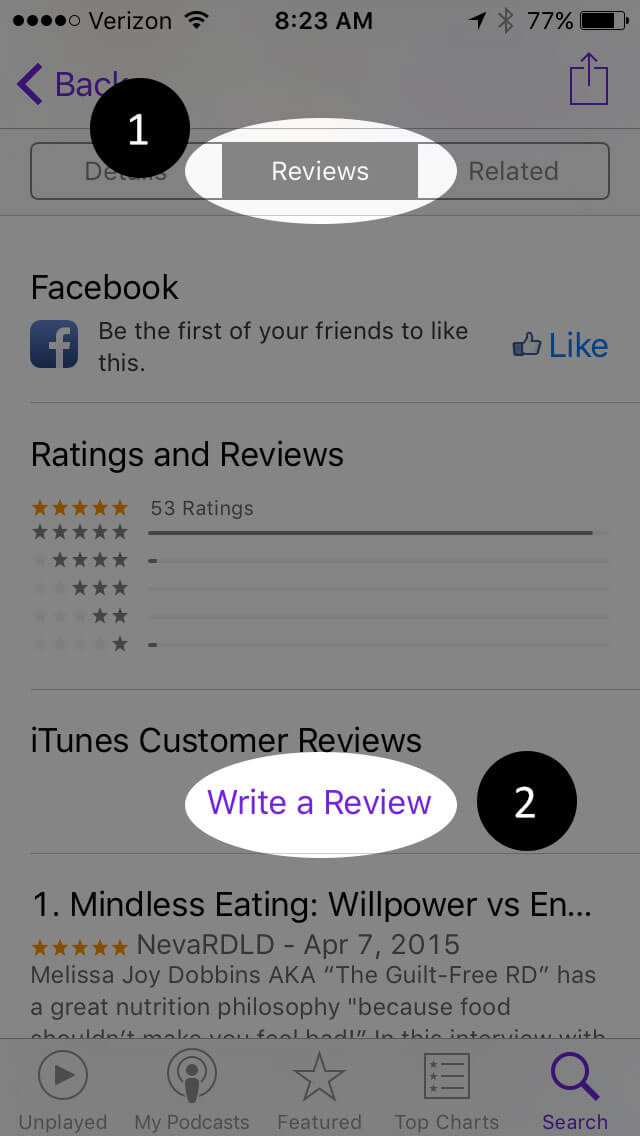
Write a Review
Click “Reviews”, then “Write a Review”.
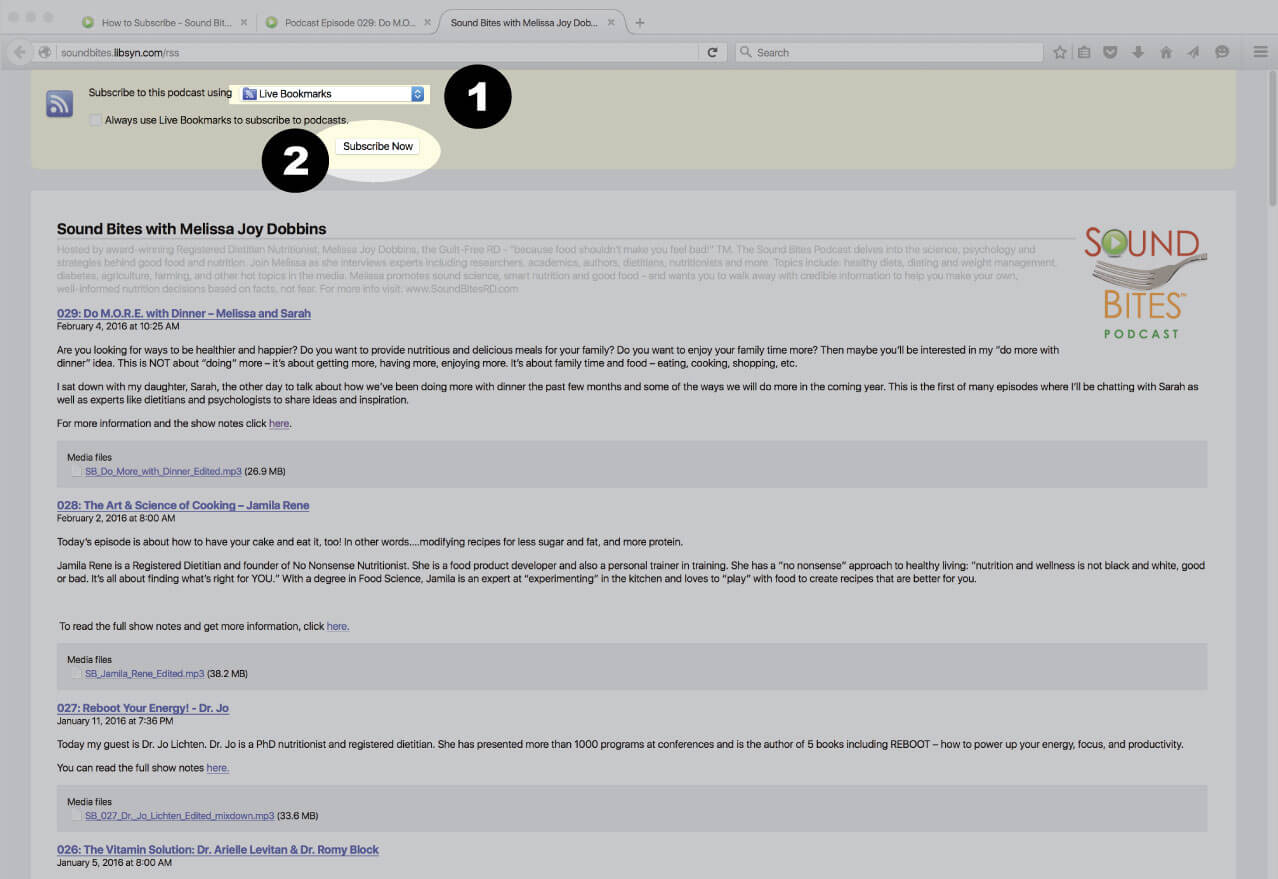
Subscribe via RSS Feed
Navigate to any podcast player . Click on the RSS feed icon.
Click on the RSS feed icon.
Click on RSS Feed
Choose which application you would like to use to receive the RSS feed
Click “Subscribe Now”
Confirm settings and subscribe.
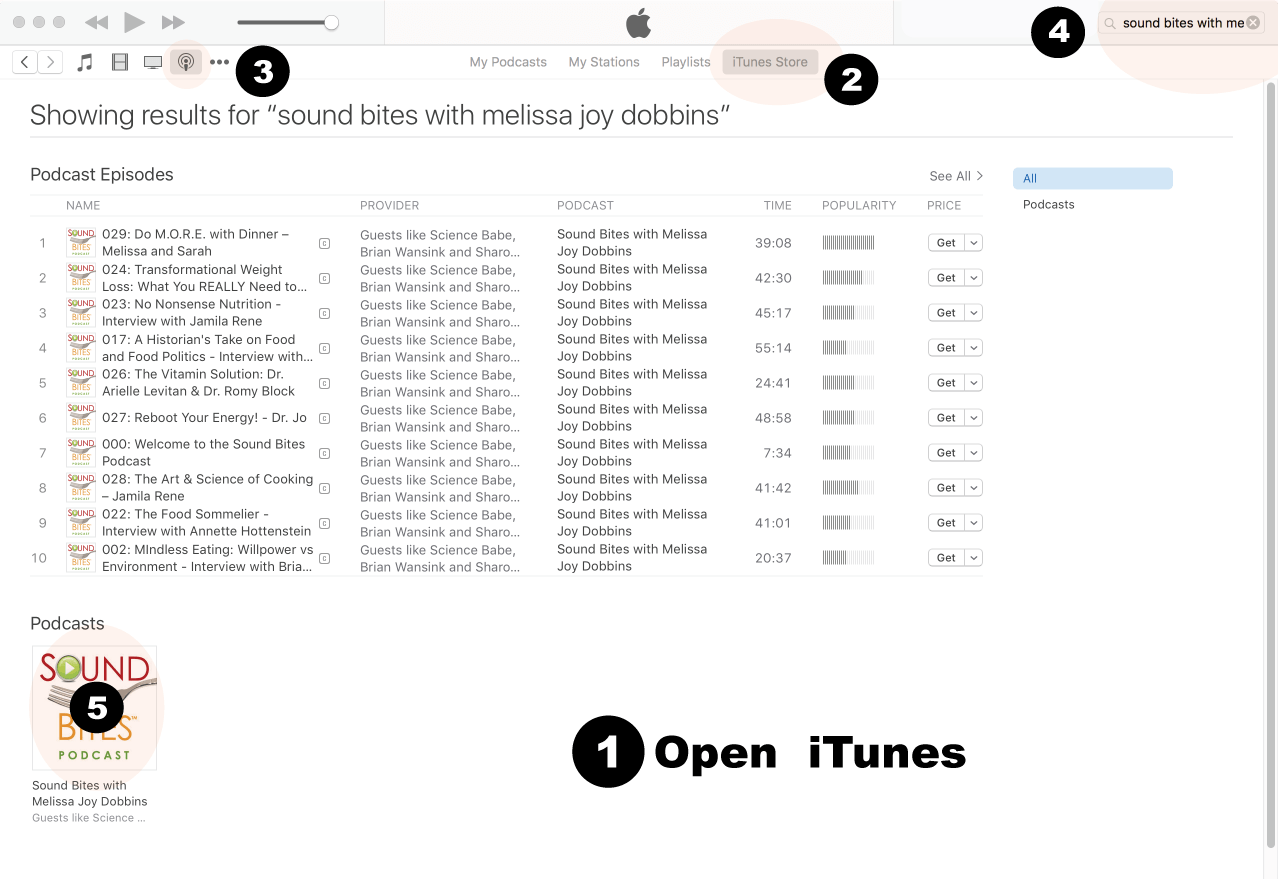
How to Review in iTunes
Open iTunes desktop application
Click iTunes Store
Click on Podcasts
Search for “Sound bites with Melissa Joy Dobbins”
Click on podcast image
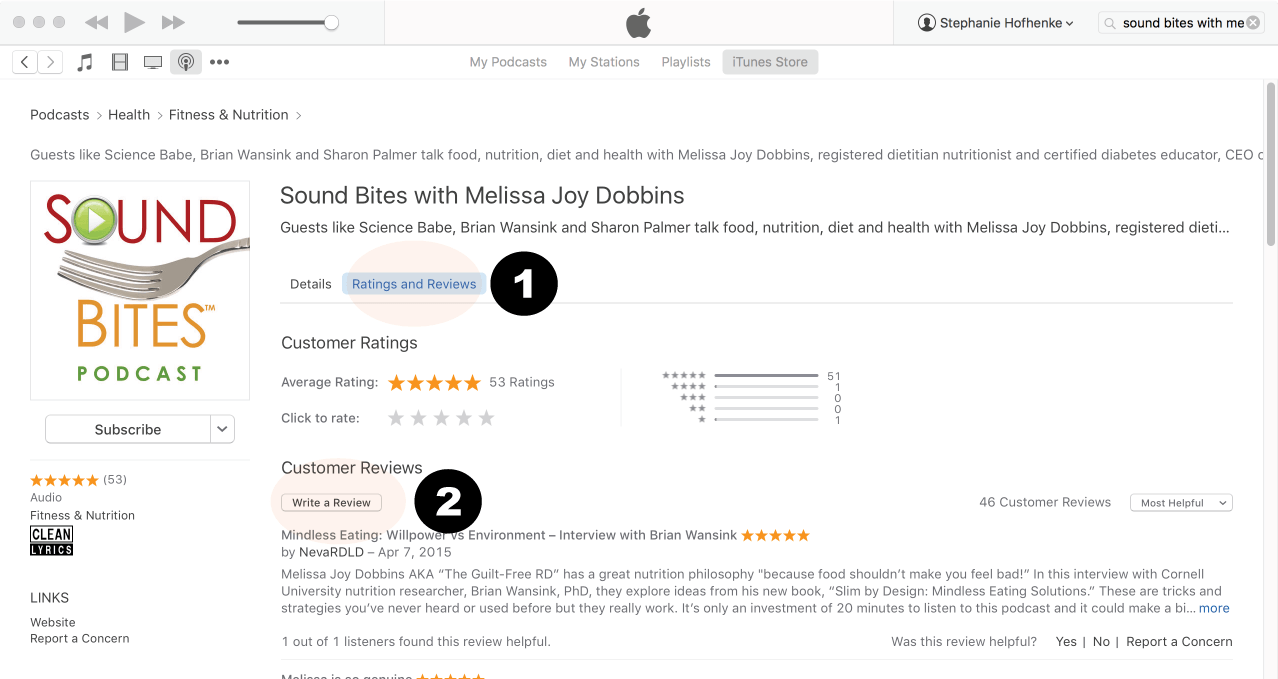
Search for Sound Bites podcast in iTunes
Click Ratings & Reivews
Click Write a Review
View reviews and write your own review.
Write your review…. Thank you!
Write your review!
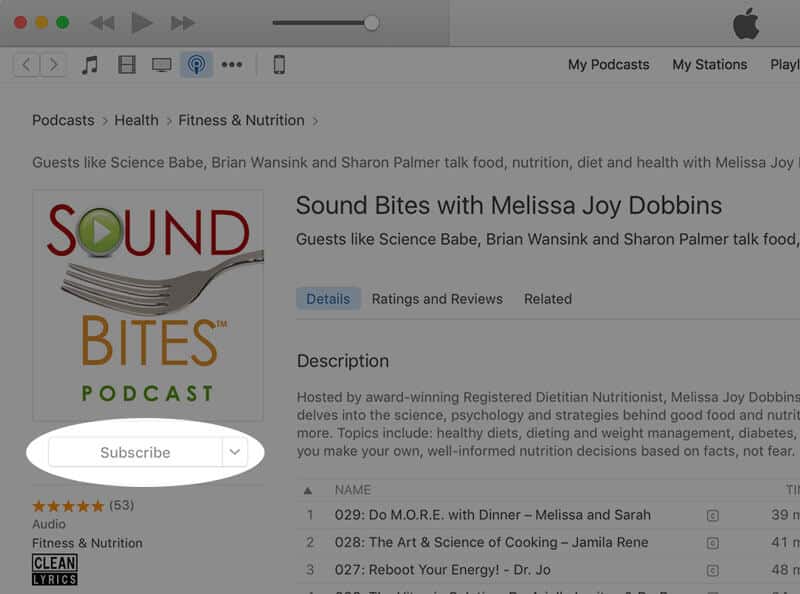
How to subscribe via iTunes
Click here to view the Sound Bites Podcastin iTunes, then click the blue “View in iTunes” button. This will open your iTunes application directly to Sound Bites Podcast. Click the “Subscribe” button, and your done!




 Stacey Krawczyk is the Director of Nutrition & Wellness at the American Diabetes Association. She is a Registered Dietitian with significant experience in population health, wellness marketing, and partnership development. She holds a MS in Public Health Nutrition and a BS in Nutrition and Food Science from the University of Tennessee-Knoxville. Over the course of her career, she’s engaged audiences with nutrition and wellness information for billion-dollar global food brands, health associations, community programs, healthcare tech, and almost everything in between. A 5th generation farmer, she is grounded in food systems issues that drive her passion for mission-driven branding and social causes.