Celebrating over 1 Million Downloads and 50,000 Free CEUs on the Sound Bites® Podcast | NEW: Get 1 years’ worth of CEUs with the new 15-CEU Podcast Course
Food Science: Creating Safe, Affordable, Accessible and Nutritious Food
Food brings people together, but food science brings the food system together. Food science is the critical middle sector of the food system that connects and brings forward safe, available, affordable, accessible and acceptable food.” – Anna Rosales
Tune into this episode to learn about:
the role of food science in food and nutrition security
how and why food processing is an essential part of the solution for sustainable, healthy diets
processed foods, food waste and food packaging
the White House Conference on hunger, nutrition and health
resources for professionals and the public
Anna Rosales, RD, MJ
Anna Rosales built her career by blending her love of cooking with her passion for healthy living. She is an expert on nutrition and culinary arts and has experience working with clientele from private individuals to multinational corporations. She offers a unique dual specialty in regulatory affairs/food law and nutrition communications. In addition, she has extensive experience working in multiple categories such as yogurt, bread, snacks, pasta, sauces, and packaged meal solutions. Overall, her diverse background and skill set allow her to work seamlessly with all types of constituents on any food or nutrition-related project.
Anna is currently the Senior Director of Government Affairs and Nutrition at the Institute of Food Technologists. Previously Anna was the Director of Nutrition and Science Communications for Barilla, one of the world’s leading Italian food companies. Prior to her work at Barilla she was the corporate dietitian for Yakult, the Japanese probiotic company, where she educated health professionals and consumers on the benefits of probiotics. Early in her career the California Health & Longevity Institute at the Four Seasons Hotel & Resort in Westlake Village, CA retained her as a chef instructor and consulting dietitian, and she was a food writer and cooking guide for About.com.
Anna developed her clinical expertise as a clinical dietitian at St. John’s Health Center in Santa Monica, CA. She completed her dietetic internship with ARAMARK in New York City.
[00:00:00] Melissa: Welcome to the Sound Bites podcast. Today’s episode is about food science and food technology, the role of food science in food and nutrition, security, and also the role of nutrition and dietitians in the field of food science and technology. We will touch on topics such as food and nutrition, security, processed foods, food waste, food packaging, and public health initiatives.
Regarding these, and I’ve said this before, but I feel like I could do an entire series on food science and technology topics, so I’m really excited to introduce you to my guest today. She is Anna Rosales. Anna is a registered dietitian, chef, regulatory and food law specialist and science and nutrition communicator.
She is the Senior Director of Government Affairs and Nutrition at the Institute of Food Technology. Welcome to the show.
[00:00:55] Anna: Good morning. Thank you for having me, Melissa. I’m so excited to be here today with you.
[00:00:59] Melissa: We first met back when you were the director of Nutrition and Science communications for Barilla, and that was your position for quite some time prior to your role at IFT, if I’m not mistaken.
So I’d love for you to share more about your background because you’ve had quite a variety of interesting positions and you have a very unique education and expertise with your master of jurisprudence degree.
[00:01:27] Anna: Yep. So let me tell you a little bit about it. My academic background and professional background.
I’m a registered dietitian. You noted my academic background with culinary arts, nutrition, and then food law before working in the food industry. I worked as a clinical dietitian way back ago and had a small private practice, and then I first entered the food industry working for Yakult. It was a Japanese probiotic company and I was a science communicator for them.
Educating on what were probiotics. This was well over a decade ago, so it was pretty new to the US market and to people’s understanding. Before joining IFT, which I’ve been at IFT or the Institute of Food Technologists for almost a year now. But prior to that I was with Barilla for a decade in varying roles from nutrition, regulatory science, communications.
I got to work in this really beautiful hybrid space where I worked both with the R&D team and the marketing and communications team, and within research on a global level. And I really love that kind of sweet spot of getting to be within science and communications. It’s where I find it most interesting as well as where I feel like we need more science communicators.
So that’s really where my passion is. A little bit about food science and kind of what brought me to the food science aspect with IFT as a dietitian. Before I entered the food industry, I had not a ton of awareness of food scientists and what a food scientist did. But working in food companies, I had that opportunity to work with many food scientists and I got to learn that they are these brilliant individuals that take ingredients and agricultural products and turn them into foods that are safe, delicious, and affordable.
But they’re also the brilliant individuals that get to take dietary recommendations. Whatever we dietitians can come up with and they take those recommendations to scale and to put ’em into products and things that people want to eat and will eat. And think of things like enrichment, Vitamins A and d, and milk, folic acid in grains.
All of those things are things that food scientists make the nutrition kind of come to life and scalable solutions. And I love getting to work with food scientists for that reason. I feel like they’re the middle sector that brings together the food. I have this saying that food brings people together, but food scientists really do bring together the food system both upstream and downstream.
It’s where the magic in the middle happens. So that is what brought me to IFT, is that I loved working with food scientists so much in my last roles that when the opportunity came up to work at the Institute of Food Technologists where I get to advocate and work on behalf of food scientists on the daily, that that was a no-brainer for me.
[00:04:01] Melissa: And again, with your long history at Barilla, you loved that job and they loved you so much. So that was, it was a big change, but what a great opportunity and just really excited that you are at IFT now and really looking forward to diving into all things IFT that we’ve touched on in our previous chats.
But before that, I wanted to just ask you, was it working with the food science folks? The food technologists? Or what that inspired you to get your Master’s of Jurisprudence and again, this is a very.
[00:04:34] Anna: It’s a niche degree. It’s a niche.
[00:04:37] Melissa: Yeah. Yeah. So tell us a little bit about that.
[00:04:39] Anna: You know, that came out of a need.
I joined Barilla working within nutrition and when I first joined them, they didn’t have a specific regulatory department at the time. And the nutrition team. We were responsible for nutrition labeling and claims and all of these things that I had, you know, one course on when I was doing my degree in nutrition and food studies back in the day.
And I was finding myself needing to quickly and rapidly understand regulatory and food law. So I started taking first a certificate course in it and then just stayed on to do a master’s in it because it was really applicable to the everyday work that I was doing and helped me just be much more efficient in my job.
So it was both an interest and a need that, consulting somebody every time I had a question wasn’t sustainable or efficient and I wanted to just learn it and learning it helped make me so much more efficient, both in my communication. Because I knew what I can say, what are the regulations, what can we not say.
It made me more efficient when I’m helping guide on product development. So a lot of times when you’re working in product development for a food company, you might be initially developing a product for, say, the US. But maybe often you’re thinking of that product in the future going to Canada or to Mexico or to other export countries.
And once you have a better awareness of the laws for those, it helps in that development process to have kind of what are the boxes you need to check to be able to say either the same or similar things or the things that you need to avoid depending on where you wanna bring that product to market.
So it was both an interest and a need for my job function that I went back for that.
[00:06:18] Melissa: Very interesting. I know as a former supermarket dietitian myself, very few dietitians have this regulatory expertise, let alone the degree that you have. So I like how you articulated it’s a niche degree. So let’s talk about IFT.
Tell us who are IFT? What is IFT? And also your role. I know your position there is fairly new. Maybe you’ve been there about a year.
[00:06:45] Anna: Yeah, I’ve been at IFT for almost a year. I absolutely love my work being within government affairs and nutrition at IFT. I joined last February because I’m passionate about IFT’s mission and vision.
It really just resonates with me, and I wanna help bring it forward. The vision at IFT is a world where science and innovation are connected. And universally accepted as essential to improving food for everyone, and the mission is to connect global food system communities to promote and advance the science of food and its application.
And I’m here for it. I really believe that we need to be breaking down the silos and working together as food system communities. And that food science is really that middle sector that can help bring together the various parts of the food system communities and bring things to scalable, sustainable solutions for the future where the goals of 2030 that were laid out from the national strategy on Hunger, nutrition, and health, as well as the sustainable development goals. We really have to work together across the food system to get anywhere, and I think IFT is at this really unique position to help bring together those food system communities.
[00:07:55] Melissa: Exciting. Now, was there a dietitian in your role before or is this a really new position?
[00:08:01] Anna: There was somebody who I believe she was a PhD nutritionist in the role for nutrition before. They had some individuals working in government affairs. And this is kind of a merged role of working in government affairs and nutrition.
And I get to be really leading advocacy efforts. So what that means is that I get to work on highlighting the essential role of food science. In various policies, legislation, et cetera. So whether that’s the dietary guidelines, for example, they released their scientific questions this past year and did a call for nominations, and I’m out there of saying, Hey, we need to have a food scientist on this dietary guidelines advisory committee. Especially if you’re gonna have topics or questions that they included around processed foods. We need to have an expert that understands food processing and understands food science to make sure that they’re part of that conversation and part of that dialogue to bring forward solutions and recommendations that are scalable, sustainable, and actually actionable.
[00:09:00] Melissa: Mm-hmm. And evidence-based.
[00:09:01] Anna: Absolutely. Our advocacy priorities at IFT are really grounded in science, advocating for the role of food science professionals on various committees and forums so that they’re part of the dialogue. And another big advocacy point for us is to advocate for more research funding for AgriFood, and that is across agriculture, food, nutrition.
It is chronically underfunded.
[00:09:27] Melissa: Wow. Yeah.
[00:09:27] Anna: Food science is really underfunded as a segment of that already underfunded group of AgriFood research, and we are constantly advocating for increased funding opportunities and sources for research funding
[00:09:40] Melissa: Wonderful. Now, I saw you last summer when I attended the IFT First. It’s an event and expo. And it’s an annual event and expo. And I attended with a press pass, which I was really excited about, and we had an opportunity to meet and talk about all of this exciting work going on at IFT. But I should say first for our listeners, ironically first, so it’s called IFT First.
First stands for Food Improved by Research, Science and Technology. And the event is for professionals to learn about the latest global trends, innovations, and solutions. And it was my first time attending. I just thought it was amazing, fascinating, learning from so many different food science experts and the expo hall, there was a lot of ingredient focused booths.
And most of the sessions that I went to, well, all of them really, were set up like a panel discussion. So it was really interesting to hear the food experts talk amongst themselves and really engage the audience. I didn’t know if you had anything in particular as an overview that you wanted to share about this IFT First Event and Expo. But I know that, we’re gonna touch on some of the highlights.
[00:10:59] Anna: Yeah, IFT first. It’s one of the largest food science conferences and expos in the US. We had over 14,000 individuals I think join this past year. And it brings together the science of food professionals that are working across various spaces and places. We have researchers and academics, we have product developers, we have nutrition scientists like myself and yourself.
It’s really across the food system and science of food community that joins IFT first and we have a number of different education sessions and pathways for all of those different individuals. And that’s where I think we met during some of those, during a few of the panel discussions. I think we were both in the panel discussion on the role of food science and food nutrition security.
So it’s an amazing conference and expo. It’s a place where you can connect with anybody in the food industry, but you can take away the latest and greatest science and you can see a lot of innovation. Ingredients and products and resources on the expo floor. I don’t know how much time you got to spend in the expo floor too, but that is always an exciting place to be able to walk around and see what is happening.
The Startup Pavilion was an amazing, amazing space just to learn about startups, what they’re doing there. There were several of them and there was a startup contest as well that was a pitch contest that was really amazing to see and had some great energy. And could see what’s coming, what’s next.
[00:12:27] Melissa: Mm-hmm. Very exciting. Yeah. And our colleague and friend, Mindy Herman was speaking in, I think in the pavilion. I wasn’t able to catch her presentation, but we did get to chat. So yeah, really, really innovative, cutting-edge concepts. And I think just in general, I saw a lot of plant-based, a lot about fiber, a lot about ingredients. Packaging. Sustainability, of course, was everywhere, and every session I attended, at least one person, whether it was a panel member or an audience member, at least one person made an important comment that it’s really crucial that food science and food experts communicate more with the public and with our peers. And so, that was my huge takeaway. It was like communication. Yay.
[00:13:21] Anna: Absolutely. There’s a need for science communicators across food and nutrition to communicate more, both within and amongst ourselves, , as well as externally to consumers. That is something that not only I saw at IFT first and heard individuals talking about, but that was really evident in the White House conference. And a lot of the dialogue from that this past year too.
[00:13:45] Melissa: Yes, yes. And I wanna hear about that. And I know that there’s a lot that we want to talk about with the role of food science in food and nutrition security, but maybe first, let’s talk about that processed foods debate at IFT First. That was the opening session or the opening debate.
Should we eat more processed foods? And it featured on the panel, Marian Nessel, Kevin Hall, Amy Webb, Mike Gibney, and it was moderated by ABC news correspondent John Donovan. The brief summary that they provided was, while some consumers avoid processed foods, other communities rely on them for affordability and shelf life.
So I’d love to hear, I know you and I chatted briefly about our sort of impressions of that debate, but I’d love to hear your thoughts on that.
[00:14:35] Anna: Yeah. You know, that debate, I think that we all entered into that debate thinking, wow, these are gonna be totally opposing viewpoints. And it sounds like it could be fairly contentious. At the end of the debate, I don’t know about you, Melissa, but I felt like the two sides were closer to agreement than anything that they all kind of were saying the same thing in the end. That while food processing and processed foods, and particularly they were noting ultra-processed foods, on the kind of should not eat more side.
It’s not the processing per se, it’s what they contain. It’s the sugar, the salt, the fat, the nutrients, what’s there, and they kind of agreed towards the end that we need to be very aware and cautious about what we’re consuming. I think that often that term of processed and particularly ultra-processed is now used. As kind of meaning, oh, foods that are high in sugar, salt and fat.
[00:15:34] Melissa: Devoid of nutrition.
[00:15:35] Anna: Yeah. And devoid of nutrition. And that honestly makes me a little bit crazy. Yeah. Because that’s not what that word means. But that’s how it’s used and that’s how it was referenced even in that debate. And in the end, both sides were saying, well, it’s really what the foods have that matter, right?
What they’re providing to an individual. Maybe the ultra-processed foods, there’s more of them that are high in sugar, salt, fat, and not the most nutritionally dense foods. But that doesn’t mean that all of ’em are that way. So it was fascinating that towards the end it was almost like, I don’t wanna say they were in agreement. But it almost felt like they were a little bit in agreement.
[00:16:15] Melissa: Yeah. It was not as, like you said, contentious. You know when you see some of the names on the panel, you’re thinking, oh, this’ll be, I’m not missing this. I think it was like at 7:00 AM on the first day and I was like, I’m not missing this.
Yeah. I was surprised. For anyone who’s familiar with Marian Nestle, let’s be honest, she’s not a fan of the food industry. She’s pretty negative about the food. But I felt that she was not during the session. And maybe she was like, well, I’m, I’m at IFT. Maybe I better be a little less, um, vocal. But she wasn’t negative about the food industry.
Like I kind of anticipated that she would be. And once they got past that processed food as sort of a word for unhealthy foods, and we got into, well, wait, wait, what about, you know, it’s processed if it’s enriched with vitamins and minerals or fiber is added or whatever.
[00:17:15] Anna: Exactly.
[00:17:16] Melissa: Once we got into, you know getting away from that label. But to your point, how much nutrition is it providing within the scope of calories? Fat, saturated, fat, sodium, then yeah, they couldn’t disagree because it was sort of the common ground that we need to come to. I was also surprised that when we talk about the ultra-processed foods, that Kevin Hall didn’t bring up the hyper palatability concept.
So I waited and talked to him afterwards and I thought, well, maybe he just didn’t wanna go off on a tangent or down a rabbit hole with that topic during the panel or during the debate. But he shared that he’s doing some really interesting research on hyper palatability. So, I touch on that topic in an episode.
Let’s see, um, 205, ultra-processed foods, hyper palatability and nutrition. So we won’t get into that unless you wanted to share anything about that. But if anybody’s interested, it’s a fascinating concept and I do encourage you to go listen to that episode. And as I find out more about Kevin Hall’s research, I’ll share that out on the podcast.
But yeah, it was really cool to see such diverse personalities kind of come together with that common ground.
[00:18:32] Anna: You know, that’s what, at IFT, we really seek to do, to bring together that food system community to have some of these tough conversations. Like those aren’t easy conversations, but they’re essential that we have those conversations and then we dialogue and we can talk, and not in a contentious way about these different sides of the coin and these tough topics.
I will be honest though that the term processed foods and the negative connotation, that is probably the thing that drives me most crazy within food science. You know, food processing, it’s what gets us from those raw agricultural products to foods that are on our dinner table. And I genuinely believe we shouldn’t get all caught up in the how it’s made.
But on what it provides is really essential. But I honestly was happy to hear that that’s almost where both sides landed in the end of that debate. So that gave me some hope.
[00:19:19] Melissa: Yeah. And another term that I hear sometimes people using in, in a similar way, is packaged foods. And it drives me crazy too.
And again, like label, I’m doing air quotes. It’s a label. It’s a negative connotation. And yes, foods can be in a package and be nutritious.
[00:19:39] Anna: Absolutely. I agree with you.
[00:19:42] Melissa: Canned beans, fortified cereals, like I could go on and on.,
[00:19:46] Anna: I am so with you, it’s like this Sentiment that if it’s made in a factory, it’s somehow not nutritionally dense, and that’s just completely wrong, right?
You can make the same thing in your kitchen that’s made in a factory. And it makes me particularly crazy, Melissa, as a mom. Because there’s that pressure and that stress that’s put on moms. I feel like you know that if we love our families and we love ourselves, that we would be scratch cooking.
[00:20:11] Melissa: You’re a good person.
[00:20:12] Anna: Yeah. Yes. It goes into all of these things beyond just the food, right? Like it’s a value of how good of a parent you are, that, if you’re just the most loveliest, wonderful parent ever, that you would scratch, cook, and process all your veggies straight from the farmer’s market.
That makes me crazy.
[00:20:32] Melissa: Yeah. And I say this all the time, but the best example of this is just produce, fruits and vegetables. What is it? Nine out of 10 people are not meeting fruit and vegetable goals. Like, hello, this isn’t changing. It’s not getting better. I don’t think it can get much worse. And if we think they have to be fresh and organic, I don’t know how we’re ever gonna meet that goal, even as a dietitian and a mom feeding my family.
So canned is fine. Frozen is fine. Dried juices, all of these things still provide good nutrition. It’s not black and white, it’s not good and bad, so you just always have to throw that out there.
[00:21:09] Anna: I agree. And I feel like we as dietitians need to get that message out, like loud and clear so that it takes some of the pressure off of those moms, busy parents, whoever it is, so that they don’t feel like it’s so difficult or unattainable, but it is accessible. You can have frozen, fresh, canned, whatever it is. Produce is produce, and it’s wonderful to get more of it into your diet.
[00:21:32] Melissa: Okay. Woo-hoo.
All right, So we mentioned the role of food science in food and nutrition security, and that touches on a variety of topics that I mentioned earlier, you know, processed foods, food waste, and so on.
And, and you also mentioned the White House conference. Where should we start with that conversation?
[00:21:51] Anna: Well, let me tell you a little bit about food, nutrition, security, and the role of food science. Because at IFT, we have this wonderful group that we brought together that we call our Food and Nutrition Security Steering Committee.
It is a group of seven science of food, food science experts that have come together to identify some of the challenges that we have in food, nutrition, security, that have potential food science solutions, They were inspired. There was this older paper that was written back, I think it was 1969, it was put out and it identified challenges within food science and they took that as inspiration because it was this, it was a book, you know. It highlighted all of these challenges within food science and they were like, wow, this was a really great, very out of date reference, and being inspired by that really great out of date reference.
They thought, wow, we have so many things that food science can do to help improve food and nutrition security that aren’t talked about. Maybe they’re not scaled yet. Maybe they need some more research that they wanted to bring those things to light and to share it out so that people have more awareness of those, so that researchers have more awareness of those so that policy makers have more awareness of those.
So the committee identified these challenges this past year, and they’re setting out to host a series of round tables on different topics. We hosted our first one in November on food Science Solutions for food. And valorization of waste strengths and each round table that we host will have a report out that will be published afterwards to be able to share out.
So we’re working on that report out of the first one, but it’s really an exciting group to get to work with because they’re identifying these kind of unsung, or not talked about solutions and trying to bring them to light so that we can get them to scale and bring them forward. So the role of food science and food, nutrition, security.
While there are a ton of different solutions like that. There’s also, I think we almost take it for granted, the element of food safety. That is always there and that’s always a role of food science. First, it’s a safe food supply. That’s first and foremost. So we have that as kind of table stakes, but then we have a lot of really innovative solutions and opportunities to bring things to scale that food science can help do for food, nutrition, security.
We are excited to bring forward those conversations with that group. So that is what we’re doing right now. I feel like it goes hand in hand with the White House conference, right? Because the White House Conference on Hunger, nutrition and Health this past fall, it was hosted and they asked for stakeholders to come forward and make some commitments.
And one of our commitments was to host those round tables and to get those reports out so that we can share more about food science solutions to many of the food, nutrition, security challenges that we have. So they go hand in hand. That was a fascinating conference.
What do you wanna talk about around the White House conference?
[00:24:36] Melissa: Yeah, so I’ve just heard bits and pieces here and there, and I don’t think I’ve talked to anybody after the fact to get their bird’s eye view or even just in the room where it happened. What stood out to you? What frustrated you? What excited you?
[00:24:53] Anna: Yeah, that’s a great question.
Well, I did attend, so I had the honor of being invited to attend the White House Conference, which that was just amazing. It was exciting to join the conference and feel the energy, like you have that many people in a room and you looked around the room and you knew everybody was there for a reason, and invited with great intentionality.
There was just this palpable energy of people who wanted to seek change and to seek improvements. So you saw people from across the food system, from government to private organizations, NGOs, and all are there to help and wanting to eliminate hunger and reduce diet related diseases by 2030.
So it’s a big goal and it’s gonna take a lot of big and small actions to make an impact. The conference though, it was just that it was a conference. A conference is never the end point. It’s just the start. It’s the spark of the conversation, so to speak. The hard work is what’s to come, and for that, there’s some changes that are needed.
As I noted, at IFT, we made commitments along with many other organizations. So hopefully many of those commitments together will help get us to a better place. But we need to continue beyond just organizations making commitments. It has to follow through with policy and legislation. So it’ll take some time to see the impact for sure.
I was happy, I would say, to see that the White House conference, while it was kind of that spark or that start of that conversation, it really did move along some things. We have to give credit where credit is due on that same day. I think as I’m waiting for the conference to start, the FDA healthy proposed rule, that was, years in the making dropped the morning of the conference.
I don’t believe that’s a coincidence. And now we get to see what’s gonna be next. We have a Farm Bill year this year in 2023 and the White House Conference on Hunger, Nutrition and Health also came together with the national strategy from the Biden-Harris Administration on Hunger, Nutrition, and Health.
And we have several pieces of that national strategy that will likely show up in the Farm Bill or in the farm bill discussions this year. Whether that’s the food is medicine and physician training, produce prescription. There’s various elements of that. So this is an exciting year to have, following up on the White House Conference to see how some of those priorities might come through in legislation and to help get to a different place than we were a year ago.
[00:27:14] Melissa: Very interesting. Yes. We’ll have to stay tuned. It definitely has created some excitement and a buzz. There’s a pediatrician in my ballet class. She was just like, are you listening to the White House conferences today, or are you gonna listen to it? And I was like, that’s awesome that you’re that engaged. That’s awesome.
[00:27:32] Anna: That’s fantastic.
[00:27:34] Melissa: I know, I know. She’s very into nutrition, and families and health and so, it was definitely on her radar, so that was really cool. And you mentioned these collaborations between different companies, and I talked about this a little bit on a recent episode with Clancy Harrison just talking about child nutrition and hunger, and sometimes it’s this corporation or company is doing great things and this one over here is doing great things, but when they come together between the two of them, they can fill a gap and meet a need that they couldn’t on their own. And so I think that’s really exciting.
[00:28:09] Anna: I couldn’t agree with you more. I will say that one of the things that I have talked about with others that was really abundantly clear during that conference and some of the follow up coming out of it is that there are a lot of organizations doing some amazing things. Big things, small things, like there’s some great work being done.
We’re not collaborating across the board from the food system and the great work that’s being done very effectively. We’re all working in silos. A lot of the funding is even funding the research and the pilots are being funded in silos as well. So we really need to be looking at more of systems approaches and communicating with each other.
And funding pilots and research in a way that it really promotes a systems approach so that we can get to even bigger changes and more impactful solutions.
[00:28:58] Melissa: Yeah. Just think about more of a cooperative model, how that money could go so much further.
[00:29:06] Anna: Yes. The money could go further. And even the knowledge, right? The knowledge sharing was huge.
That was a one day conference. and people were presenting and sharing what they were doing in their best practices, and somebody else would respond. Wow. That really provides me an insight that I can take and I can use it in my place in space and make it even better. So it’s the money, but the effectiveness too.
[00:29:28] Melissa: Yeah, absolutely. You know, we’ve touched on the food, nutrition, security. We talked about processed foods, but I was also curious what you are seeing in your daily work or what tends to catch your eye because of what you’re more interested in. I talked a lot about food packaging and recycling and sustainability in innovations in episode 222 with Dr. David Smith, who’s a food technologist. So if anybody’s interested, you can scroll back to that episode as well. I found it fascinating and it was proof positive that there’s so much we can talk about in general topic of food science and food technology. Again, that I could do a series on it, but we kind of scratched the surface on those topics.
But I was curious if you are seeing anything about food or food packaging that you wanted to share with our listeners?
[00:30:15] Anna: Yes. There’s a ton going on in food waste and the desire and need to significantly reduce food waste. It’s a clear part of the sustainable development goals, and we even hosted that round table I was telling you about on food science solutions for food waste.
There’s so many different elements to food waste. It sounds like it’s really succinct when you say food waste, but there’s food waste at every kind of step of the process, right? So you have it from cultivation to like when you’re picking the raw agricultural product to the processing to then consumer food waste, and at every step of the way there are potentials for reducing that and minimizing that, whether that’s innovative packaging so that it extends shelf life, or whether that’s. Valorizing what was a waste stream and making it into a new food product. There’s so many elements of that and I think that’s something that we are trying to shine a light on from the food science solutions to, and something that across the board we’ll be committed to helping bring forward more solutions and highlight in the conversations around that.
On the other side, one of the challenges around food waste, it’s not all that top of mind for consumers. Particularly if you’re saying, oh, this is an upcycled food or something like that. That’s not a top driver for a consumer. Looking at groups that are reducing food waste.
[00:31:38] Melissa: That they’re willing to put their money there.
[00:31:40] Anna: Yeah. So consumer education will be key to help driving demand for the those types of products and solutions.
[00:31:48] Melissa: When you say that, it reminds me, that was also something that was very clear. The sessions that I attended at IFT first was consumer education. Even, and I’ll be the first in line. I’m like, okay, how do I recycle this particular product? You’re seeing things now where you have to have the cap on the bottle, and I just, I was like, why is that? And somebody said, because the cap’s too small. And I don’t know if that’s true, but it makes sense like, oh, you gotta keep the cap on the bottle so that part doesn’t, isn’t too small for the machine or something. But even what they talked about at the conference was putting instructions and images on the label itself on how to recycle or how to handle the packaging or whatever. And definitely need more consumer education and hopefully there’s a lot of people out there like me who are hungry for that.
You know, we wanna do the right thing and we’re filling up those bins, but are we doing it in the right way? And then when it gets to your municipality, what are they doing with it because of their limitations, and so on. So hopefully that is becoming more of an interest and focus for consumers so that we can help drive those solutions as well be a part of it.
[00:33:01] Anna: Absolutely, and when we have that report, I will make sure that I share that with you. Melissa, if you would like to share that with your listeners as well on our food waste round table that we just hosted. I was reading it just this morning, the draft of it, so we hope to have it in the coming weeks available.
[00:33:15] Melissa: Okay, wonderful. Yes, I would definitely love to share that out. Let’s talk a little bit about why dietitians could be and should be members of IFT or how, and I think there’s different levels and different resources. I know that there are some resources that anybody can access. So tell me what is available and we’ll share that out with, the listeners on my website as well.
And as you know, I have my sound science toolkit. So there’s some things we could put in there as well.
[00:33:43] Anna: Ah, your toolkit’s fabulous. I absolutely love that resource that you’ve put together for people.
[00:33:47] Melissa: Thank you.
[00:33:48] Anna: IFT. It’s really this unique member organization where we bring together the science of food professionals across food science disciplines.
I think it’s a great resource for dietitians to join and to learn more about food processing and food science and technology. I don’t know about where you went to school, but I honestly did not learn a lot about food science and technology and the whole product development process. I didn’t, it wasn’t a curriculum focus when I was in school.
And most of my education on that came from working within the food industry and it really opened up my eyes. And I think it’s something that as dietitians we need to be more aware of so that we aren’t accidentally oversimplifying what we’re communicating. I think of myself, you know, when I was probably a young dietitian counseling patients. I probably said things that would make me cringe now, if I look back on it, I probably said, don’t eat processed foods because, I, I don’t know if I did, but I imagine I might have, I don’t know. And now I’m like, oh, why? I hope I never said that. I don’t remember.
[00:34:57] Melissa: All right. I’m gonna out myself. I promoted the dirty dozen once and then I, yeah, this is a long, long time ago, and I’m like, oh my God, the worst thing I’ve ever done in my life.
[00:35:08] Anna: That’s not the worst thing.
[00:35:10] Melissa: Oh, wait, how well do you know me?
[00:35:12] Anna: That’s hilarious. But you know, I don’t think it’s out of malintent.
It’s out of misunderstanding or a lack of knowledge of what is like food processing and food science. And these other elements that we just don’t necessarily learn. Maybe it’s in certain curriculums now and I hope it is. I hope it is cuz that would be absolutely wonderful.
[00:35:34] Melissa: For mine, I got that in graduate school.
Did not get that in undergrad, but my graduate research focus was food technology, biotechnology. And I was a food science TA, and I worked at the state extension office and I was at an agriculture institution, Mizzou. And so I got a lot of that and that’s probably, you know, I always say this. It kind of planted some seeds that even though I did clinical nutrition and outpatient nutrition and certified diabetes educator. But then working as a supermarket dietitian, working for the dairy council, and then all of my agriculture interests and food safety interests, I’m sure that, helped the trajectory of my interests and my career.
[00:36:16] Anna: Absolutely. And I am with you that I think that it just helps dietitians have a better understanding of food science and helps us be better communicators. Because now we’re not just communicating nutrition. We’re often communicating about the various products. Consumers have questions around all things food. They eat every day and they have so many questions. They wanna know about GMOs. They want to know about ingredients that they see in the food label. They want to know what is this additive that’s there? Why is it there? They don’t know when it’s a vitamin, right, that’s added, especially depending on what terminologies used on the ingredients and they wanna know that. And I think that it’s really important for dietitians to have a better understanding of those things. And IFT can offer a great resource for that. Provide a community of food science experts that can field questions if you have them too.
We have a wonderful online community that’s incredibly active where people will post questions when they don’t know an answer to something or they wanna learn more about something and the rest of the community kind of chimes in. And we have an amazing food science and technology magazine, which is always publishing up-to-date content, information, and they have multiple journals too around food science that you can hear about the latest food science research. I love the community. IFT members are what make it absolutely magical. They have this incredibly engaged membership with the most wonderful members that want to be engaged on food science and technology.
They wanna help each other. They want to be involved with the organization, and it just makes it the most wonderful place to work in the best community to be a part of. I really, I say that from the bottom of my heart. I don’t how I was not engaged with them for longer. Earlier in my career. I’m kicking myself later in my career that I didn’t engage sooner.
[00:37:58] Melissa: I totally feel that. And I’m so excited that we’re sharing this out because yeah, there are certain groups or organizations where you think, oh my gosh, I could have been a part of this years ago. But now I know. So it’s all good. Better late than never. And when you talk about communicating nutrition, most of the time, it really is the food science part of it. It really is. And to your point, you said it, but I was thinking it before you said it. The questions we get from patients and clients is all this stuff. It’s all this stuff.
And I say this all the time, especially as a media and communications trainer. You don’t have to be an expert in all of these things, but you do need to know where to go for reliable information. And if you find that you’re getting interested in some of these topics, go ahead and take a deep dive and learn more about sustainable food packaging or learn more about ingredients and vitamins and, food safety. Whatever it is that interests you, go for it. The more you learn, the more you’re probably gonna wanna learn about this topic. I just think it’s something that we can do a little bit better job at communicating nutrition and science. That brings me back to my sound science toolkit. I haven’t mentioned it recently on the show, but I’m so glad that you think it’s great, Anna, because it’s something that I need to go back in and add some more, resources.
But I’ve had it for several years now and it’s just, I’ve curated reliable evidence-based information that speaks to a variety of aspects of understanding science better, communicating science better, and it’s really geared towards dietitians and other health professionals, but anybody can access it. If you’re a listener and you’re not a health professional, you can access it a as well because you can understand nutrition in the news and science in the news better.
And you know what that means when they’re talking about hazard versus risk and all of these, different terminologies. So that’s on my website at soundbitesrd.com. You just enter your email address and you’ll have access to it. So I encourage people to check that out and we’ll add some of the information that Anna is sharing in the show notes as well at soundbitesrd.com.
So Anna, I ask a lot of my guests, when appropriate, if it’s fitting for their role and their background: What do you think of industry funded research? Or what do you say to people who criticize industry funded research?
[00:40:28] Anna: Yeah. You know, we have underfunding of research in general, so I don’t like to be overly critical of anybody who’s wanting to fund research.
I think funding of research and food science and nutrition is essential and we need to have more public-private partnerships. So we cannot just say, “Oh, it’s sponsored or funded by industry, it’s useless.” I don’t think that’s the solution. We need to have a broad array of research funding and people who are critical of it.
I think it’s important to be critical of all science, regardless of who’s funding it, whether it’s a government grant or industry funding. I think that we should look critically at all science and review it for what it is, and they’ll look at where the weaknesses, where are the strengths, and then to go forward, not just to simply dismiss something because of who or how it was funded.
I don’t think that’s the best use of anybody’s resources, time, effort, et cetera. So I think that there is absolutely a place in space for industry funded research, but I do think that it needs to come forward with transparency. And it has to have those kind of transparent guiding principles of how is the research being done.
In my last role, we had research transparency guidelines that we put with every contract that we did, whenever we were funding any type of research, it had this attached to the research funding contract where we didn’t have any say in the final research. We didn’t have any say in the development of the research.
We were giving you the finances for it and go forth and research. And we were also committed to publication regardless of outcome. You know, having transparency principles like that I think would help and go a long way for individuals to be more trusting of industry funded research if it had consistent transparency across.
[00:42:06] Melissa: Thank you. I always love hearing the nuanced and various responses that people who live and breathe this every day can share. Because I always learn on a new little tidbit and I think it’s important to share out with our listeners about being critical of all of it in a thoughtful way. Not in just a blanket, you know. Oh, well. It’s just about the funding. There’s so many different things to look at, and I appreciate your perspective.
[00:42:33] Anna: Absolutely. Thank you for asking.
[00:42:34] Melissa: What is the website address for IFT?
[00:42:37] Anna: Really simple. IFT.org.
[00:42:40] Melissa: There you go. IFT.org. Are they on social media? I’m sure that’s all listed on their website.
[00:42:45] Anna: Yes, we have a large LinkedIn community. I encourage people to join the LinkedIn community. It’s quite active as well, but we are on LinkedIn, Facebook, Twitter.
[00:42:53] Melissa: Excellent. So we’ll have all of those resources in my show notes as well, but you can go directly to IFT.org and check that out. So Anna, thank you so much for talking with me today. This has been a lot of fun. Probably it wouldn’t be a surprise if I invited you to come back and talk about some of these other topics in a deeper dive or just get an update on what’s going on in your world.
[00:43:16] Anna: I would welcome that. Melissa, thank you for having me today. It’s been a joy.
My pleasure. And for everybody listening as always, enjoy your food with health in mind. Till next time.
LISTEN, LEARN AND EARN
Listen to select Sound Bites Podcasts and earn free CEU credits approved by the Commission on Dietetic Registration (CDR) for registered dietitian nutritionists and dietetic technicians, registered. Get started!
Get Melissa’s Sound Science Toolkit here!
Partnerships:
Sound Bites is partnering with the Association of Diabetes Care and Education Specialists (formerly the American Association of Diabetes Educators)! Stay tuned for updates on the podcast, blog and newsletter!
Sound Bites is partnering with the International Food Information Council! Stay tuned for updates on the podcast, blog and newsletter!
Sign up for my monthly newsletter and episode eblasts so you never miss an update!
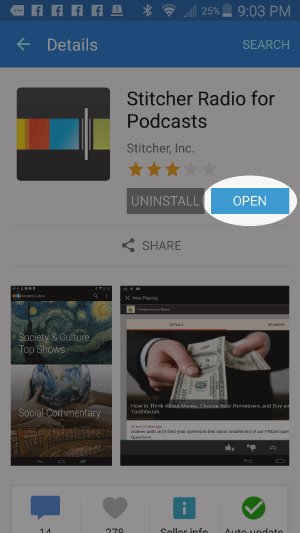
Listen on Stitcher (Android)
Install the Stitcher App
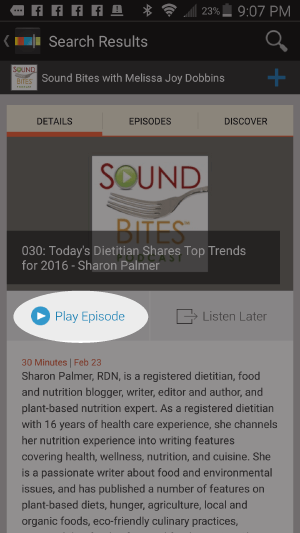
1. Search for “sound bites with melissa joy dobbins” 2. Choose Play Current Episode or Add to Playlist
Choose “Play Episode”
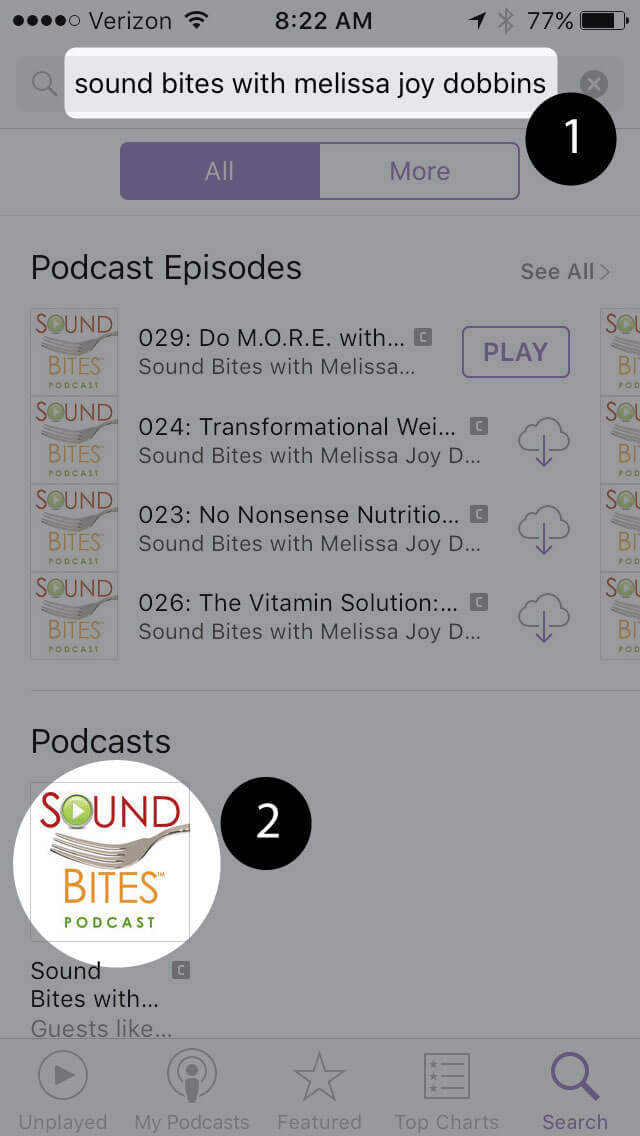
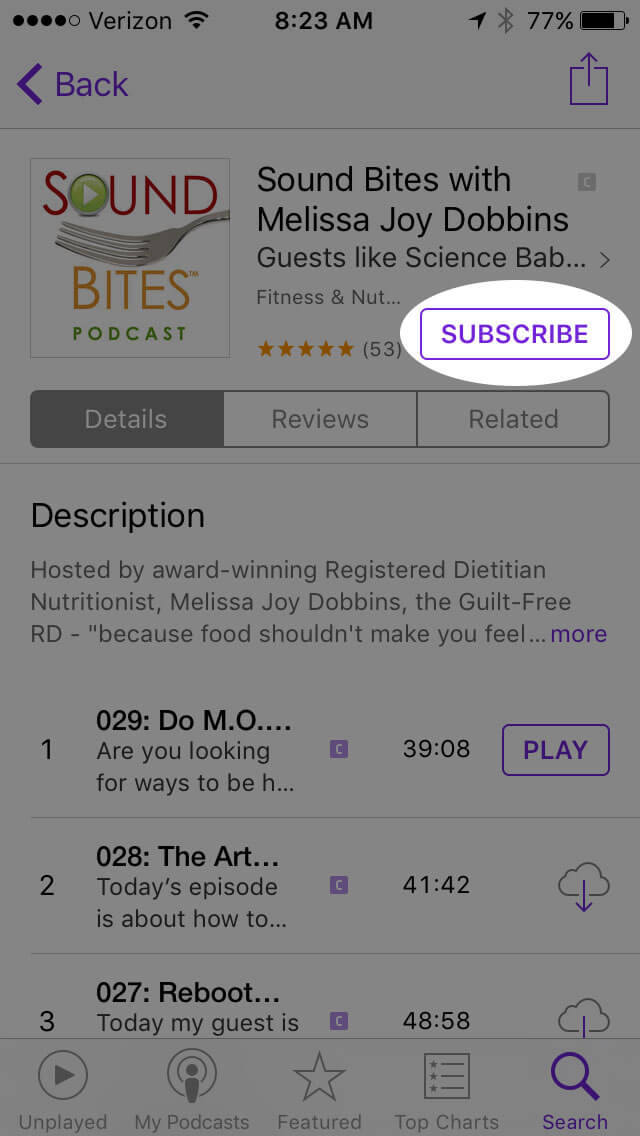
Subscribe & Review on iPhone
Open the “Podcast” app on your iPhone
Search for “Sound bites with melissa joy dobbins”
Open the podcast and click “Subscribe” and your done!
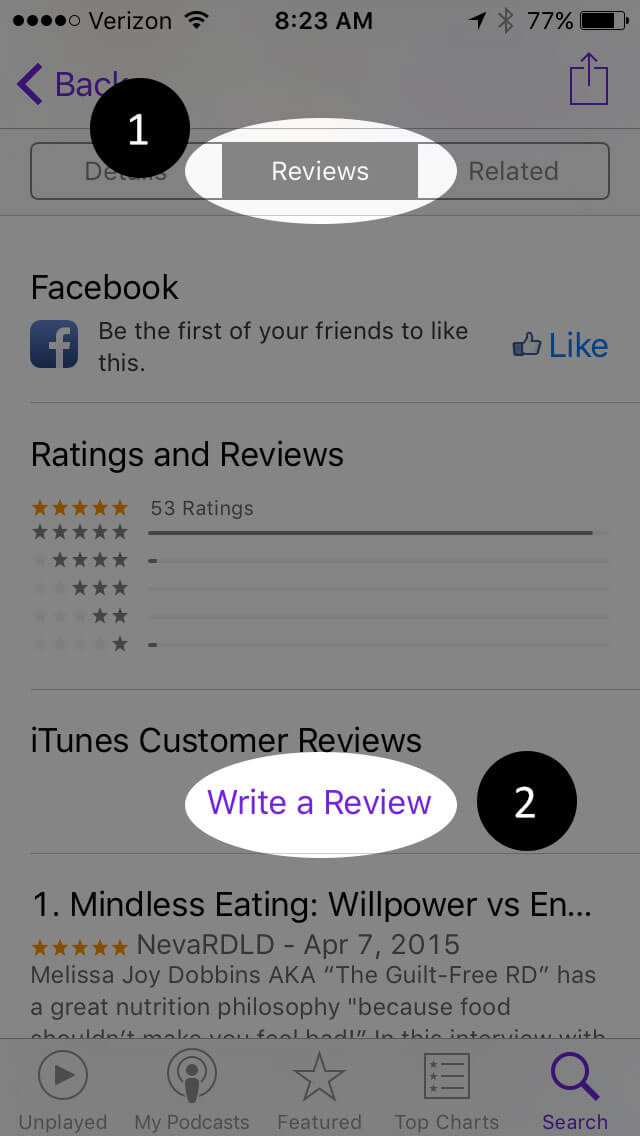
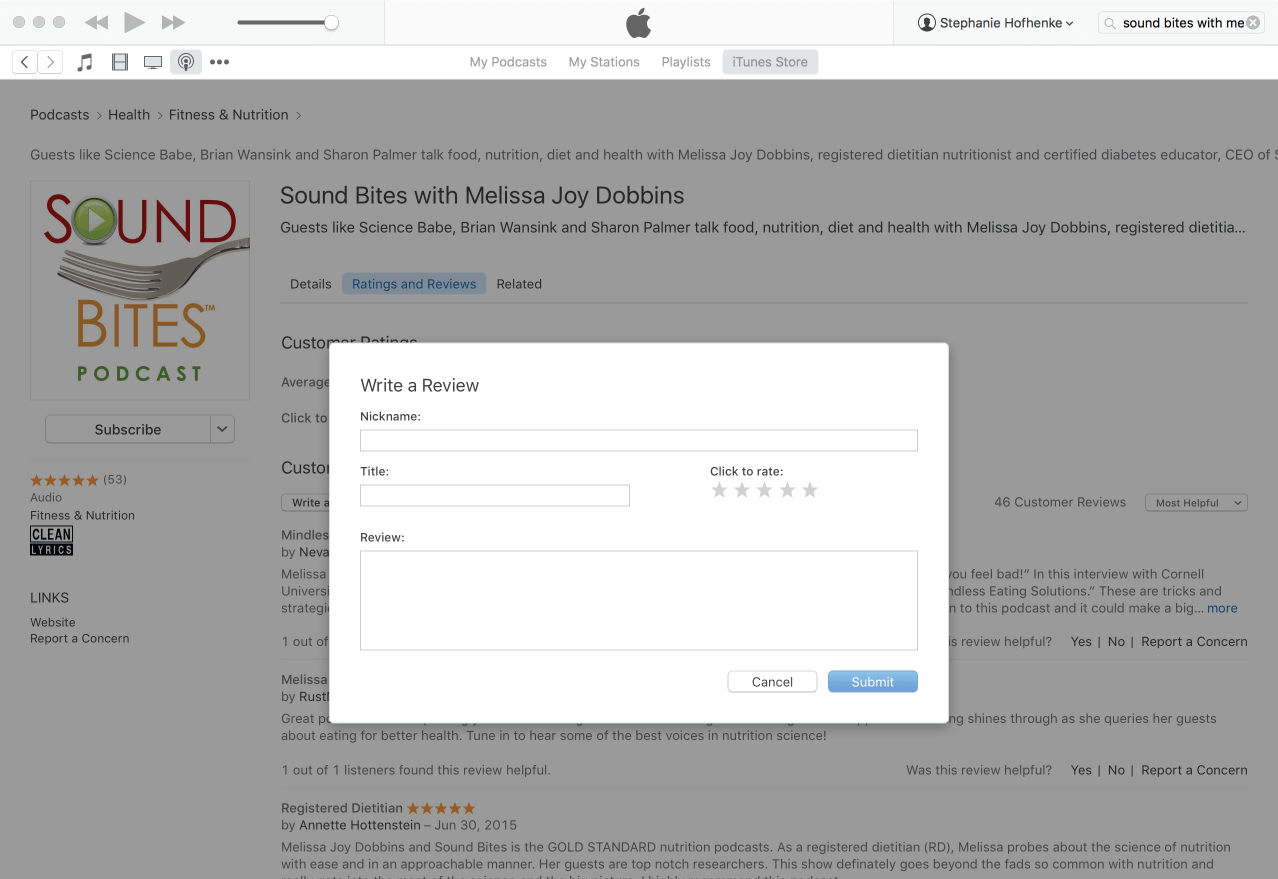
Write a Review
Click “Reviews”, then “Write a Review”.
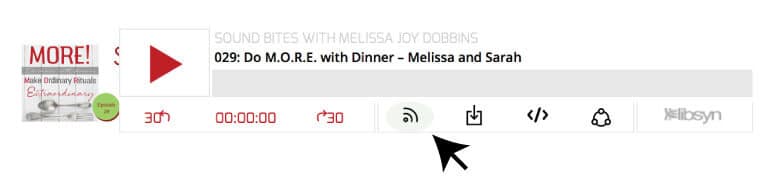
Subscribe via RSS Feed
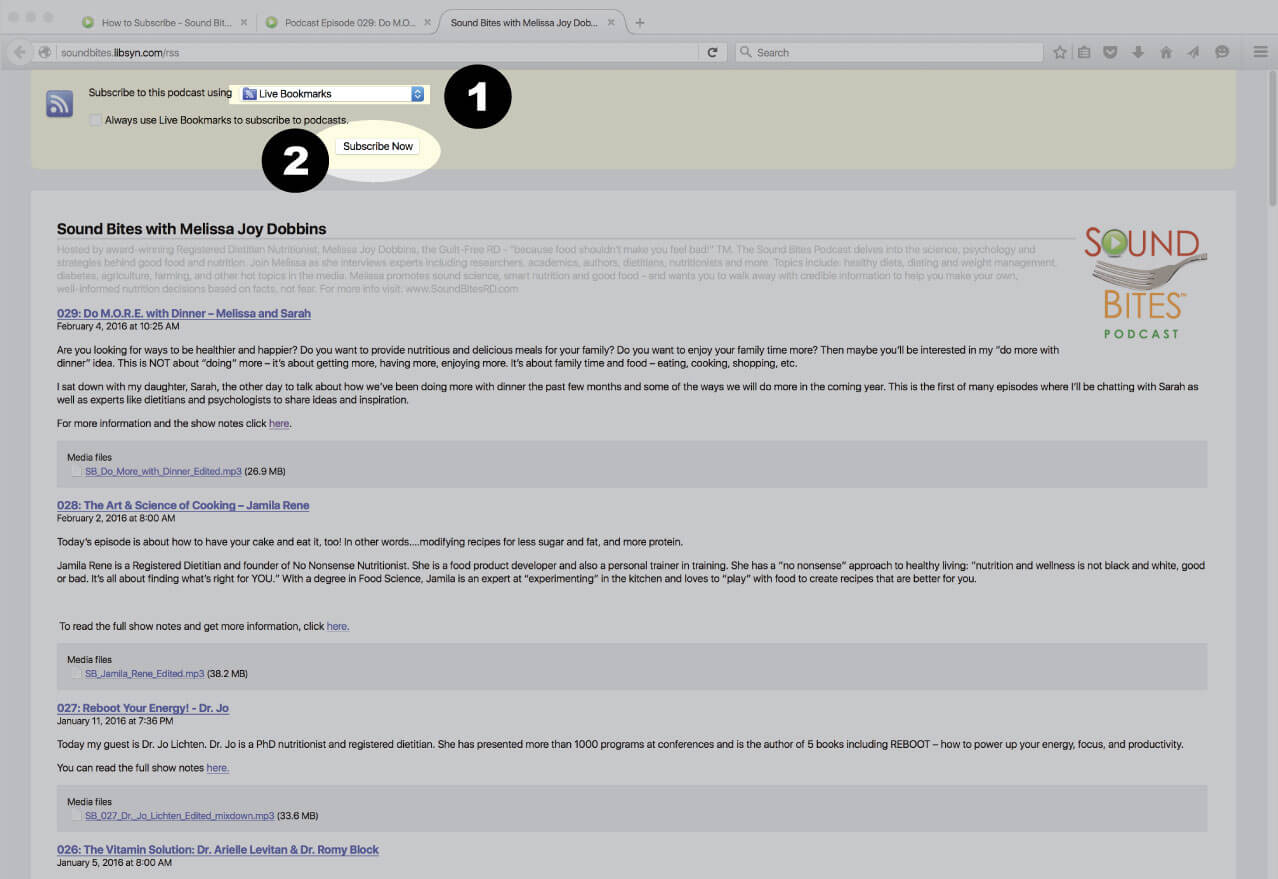
Navigate to any podcast player . Click on the RSS feed icon.
Click on the RSS feed icon.
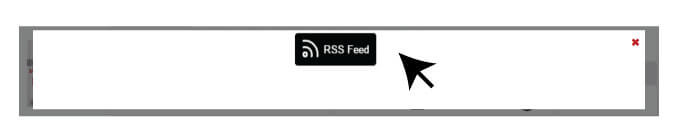
Click on RSS Feed
Choose which application you would like to use to receive the RSS feed
Click “Subscribe Now”
Confirm settings and subscribe.
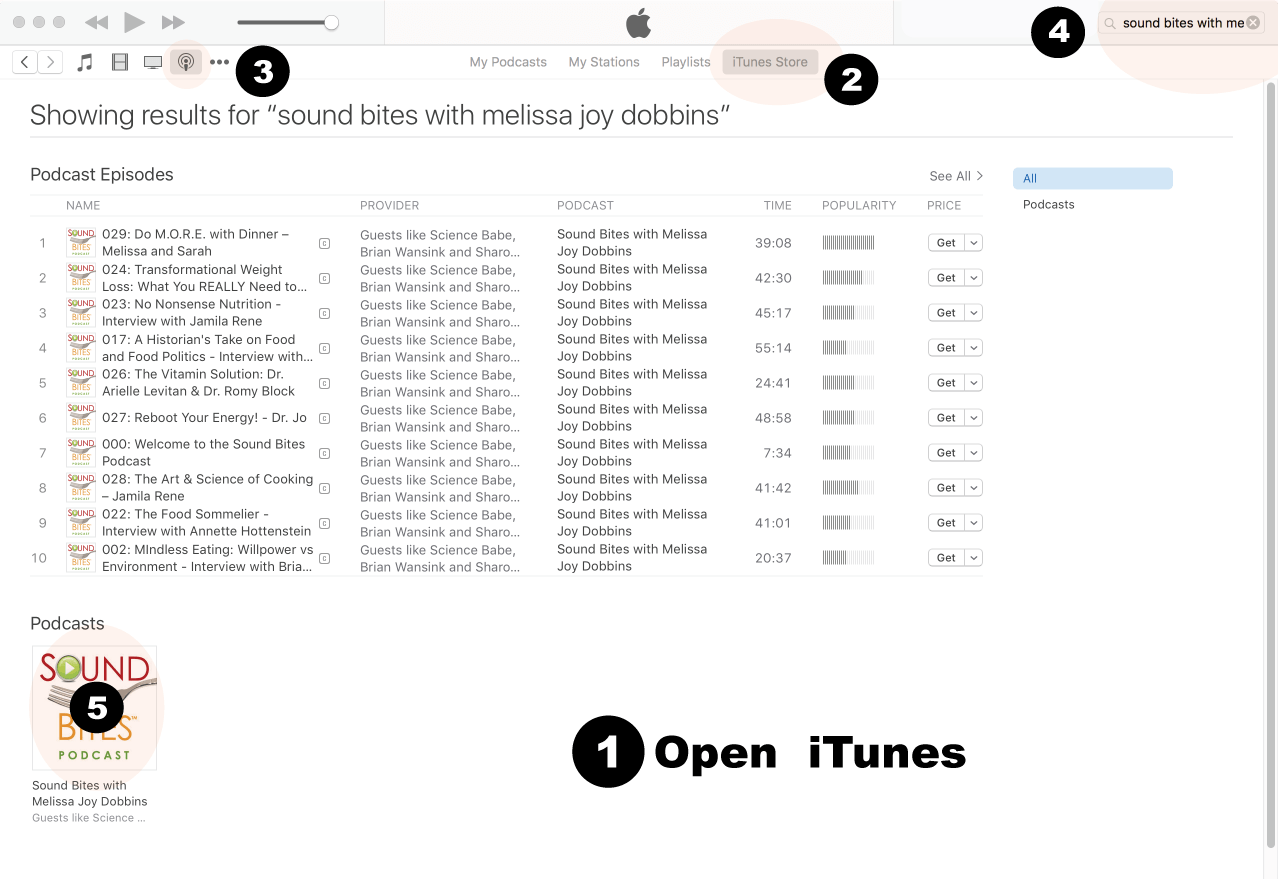
How to Review in iTunes
Open iTunes desktop application
Click iTunes Store
Click on Podcasts
Search for “Sound bites with Melissa Joy Dobbins”
Click on podcast image
Search for Sound Bites podcast in iTunes
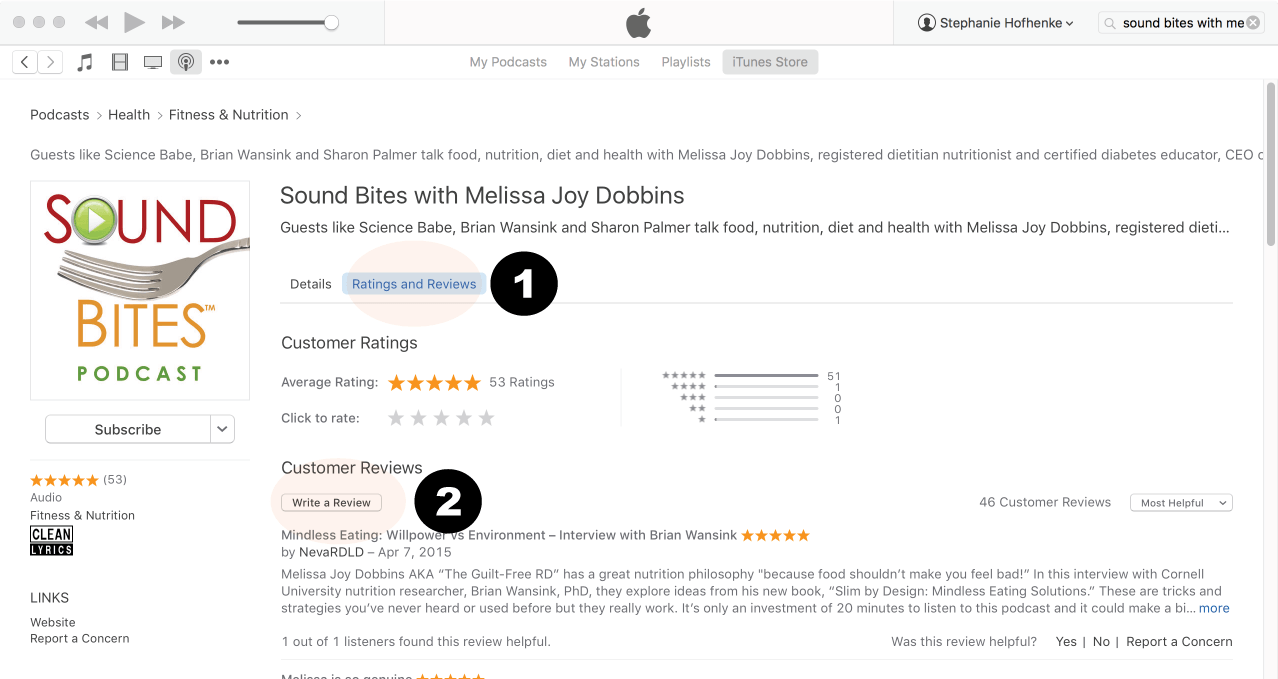
Click Ratings & Reivews
Click Write a Review
View reviews and write your own review.
Write your review…. Thank you!
Write your review!
How to subscribe via iTunes
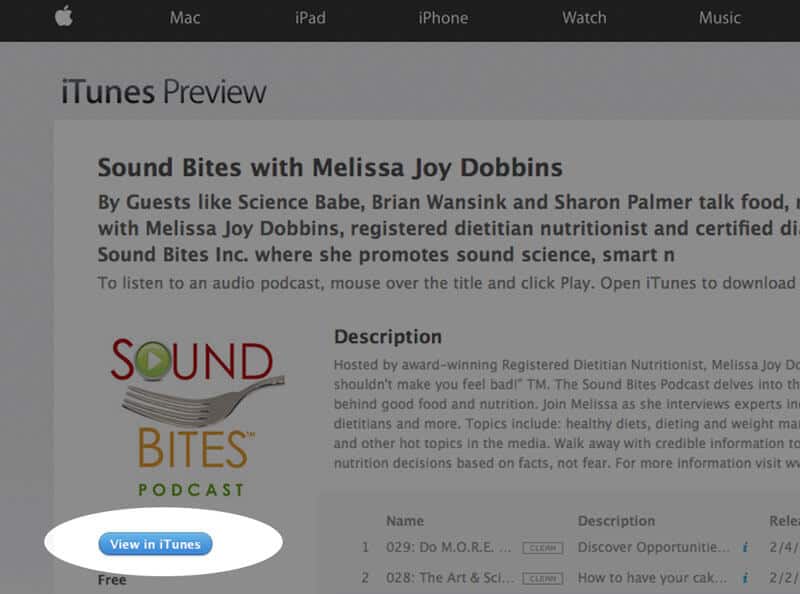
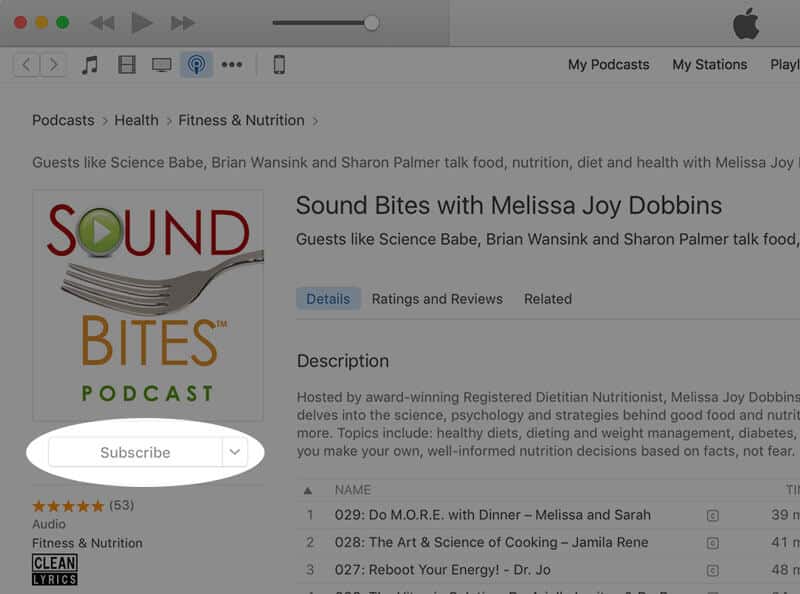
Click here to view the Sound Bites Podcastin iTunes, then click the blue “View in iTunes” button. This will open your iTunes application directly to Sound Bites Podcast. Click the “Subscribe” button, and your done!