Celebrating over 1 Million Downloads and 50,000 Free CEUs on the Sound Bites® Podcast | NEW: Get 1 years’ worth of CEUs with the new 15-CEU Podcast Course
The Future of Food: Making Sustainable Choices a Reality
In this episode, we explore the FoodMinds Conscious Consumption Index, revealing insights into consumer sentiment on healthy and sustainable food systems. Despite growing familiarity with the topic, less than half of consumers report purchasing healthy, sustainable options regularly. What’s driving this gap between awareness and action? Join us as we explore how people are thinking about healthy, sustainable foods. We’ll discuss how definitions of sustainable foods are evolving, the generational differences in engagement, and the main drivers and barriers to purchasing. Discover why price, taste, and skepticism about marketing claims are significant obstacles, and learn how stakeholders—from companies to individuals—can help transform our food systems.
Consumers are increasingly aware of the impacts their food choices have on both their health and the environment. However, the gap between awareness and action remains significant. At FoodMinds, we believe there are opportunities for education, transparency and industry leadership to help bridge this gap and empower consumers to make informed, sustainable choices.” – Lauren Hoffman, MBA, RD
Lauren Hoffman, MBA, RD
Lauren is a registered dietitian and Vice President at FoodMinds, a division of Padilla. She leads FoodMinds’ Healthy, Sustainable Food Systems platform, leveraging her expertise in public affairs, scientific research, food values, and strategic communications to support clients’ business and public health objectives. For over a decade, she has championed award-winning teams focused on insights, stakeholder engagement, and strategic thought leadership for global food, agriculture, and technology companies. She is passionate about helping clients bring together nutrition, sustainability, and health to create food systems of the future. A California transplant and foodie at heart, she spends her weekends frequenting local farmers’ markets and restaurants, and exploring the state’s natural beauty from coast to crest.
Resources
Some links may be affiliate links. As an Amazon Associate, I earn from qualifying purchases.
Welcome to Sound Bites, hosted by registered dietitian nutritionist, Melissa Joy Dobbins. Let’s delve into the science, the psychology, and the strategies behind good food and nutrition.
Melissa Joy (00:22):
I’ve been getting a lot of questions from listeners about the continuing education credits that dietitians can get for some of my podcast episodes. So, I wanted to clarify that I do offer free CEUs for some episodes, but not all the episodes.
I have about three years’ worth of free continuing education credits, as well as some very low-cost CEUs, and a package on sale for one full year’s worth of CEUs if you want the convenience of taking just one quiz and getting one certificate for all 15 credits.
This is a fun and easy way to get your credits, so be sure to check it out. And you can get all the details on my website at soundbitesrd.com/freeceus.
Hello, and welcome to the Sound Bites Podcast. Today’s episode is about consumer insights, about healthy and sustainable food systems. In particular, the gap between awareness and action. We’ll discuss how definitions of sustainable foods are evolving, and how price, taste, and skepticism about marketing claims are barriers to purchasing healthy, sustainable foods. And this episode is not sponsored.
My guest today is Lauren Hoffman. Lauren is a registered dietitian and Vice President at FoodMinds, a food and nutrition communications and consulting company. She leads FoodMinds’ healthy sustainable food systems platform, leveraging her expertise in public affairs, scientific research, food values, and strategic communications to support clients’ business and public health objectives.
Welcome to the show, Lauren.
Lauren Hoffman (02:05):
Thanks so much for having me, Melissa.
Melissa Joy (02:07):
We’ve been friends for a really long time (I don’t even know how long), but it’s so great to have you on the show, and I’m really looking forward to our conversation. I love consumer insights, it’s one of my favorite things to talk about.
But before we dive into the conversation, I would just love for you to share a little bit more about your background and the work you do, and if you have any disclosures. I mean, you’re an employee of FoodMinds, but I think that’s probably all that we need to disclose.
Lauren Hoffman (02:31):
Yeah, I am an employee of FoodMinds, but I’m here kind of in my professional capacity as a food minder. I’m very excited to talk about consumer insights today.
And for those who might not be familiar with FoodMinds, we are a group of roughly 20 registered dietitians and public health professionals. We all have this passion for evidence-based communications.
It’s a really special place to work, and I am thrilled to be here today talking about of the work that we do with the Conscious Consumption Index.
Melissa Joy (03:02):
Yeah, awesome. And also, a little bit more about your background and how long you’ve been at FoodMinds, and what you did prior to that.
Lauren Hoffman (03:09):
So, I am a registered dietitian by training, but I’m kind of, in a strange way, I’ve never worked in a clinical setting. I’ve always been really interested in affecting health on a population level as opposed to a one-on-one level.
I think there’s a lot of really important roles for registered dietitians all across the spectrum. But for me, right after graduating from my dietetic intern program, I pursued a master’s in business with the focus on marketing in Chicago, actually, which is I think Melissa, where we first met.
Melissa Joy (03:37):
Yeah.
Lauren Hoffman: (03:38):
(Chuckles) And what I learned through that process is the power of taking our technical background, marrying it with some of the interesting behavioral and awareness and attitudes and perceptions that we see in consumers, and helping them to make those changes, like I said, on a population level.
So, what are the messages that help to motivate them? What are the product attributes or designs that we need to be thinking about in order to get people to choose healthier options, but also just making those options easier for them to choose? And so, we’ll talk a little bit today about what does make it easier for them, what are they thinking about, and how that all comes together.
Melissa Joy (04:20):
Yes, absolutely. Making the healthy choice, the easy choice or the healthier choices, the easier choices. And really, want to emphasize this is one of the reasons it’s so important for dietitians to be involved in helping the food industry make healthier foods and market healthier foods. So, thank you for being one of the dietitians who are in that space in working with FoodMinds, which is a wonderful company.
So, yes, let’s talk about the Conscious Consumption Index. Tell us what it is and the purpose of it, and maybe a little bit about the methodology.
Lauren Hoffman (04:58):
So, the Conscious Consumption Index is our signature insights initiative at FoodMinds. It’s in its third wave. So, we started running this in 2018. The world looked very different in 2018. We ran it again in 2021, looked very different then. And then this most recent version from 2024, we expand on it every single year.
So, in 2024, we had a thousand U.S. participants and a little bit over 3000 participants globally representing the U.S., UK, and Canada. It’s the first time we ever fielded it in Canada. So, it was very exciting to have some of those different consumer insights in different regions.
And in each of those areas, we were looking at a nationally representative sample, which means that it is roughly applicable to the broader population. The respondents ranging from ages 20 to about 70, and all of them are primary or shared grocery shoppers.
So, the goal of this was to look and understand the evolving perceptions of healthy and sustainable food, the actions that people want industry and government to take or other various stakeholders to help build trust that they’re improving the health and sustainability of our food system.
What that also includes is what are those purchase drivers? How are they defining these foods? What are the potential barriers? And I think you’ll see some contradictions in some of those things, which is what makes consumer insights so very interesting to me, is weeding through, “Well, what did they really mean by that? So, that’s the Conscious Consumption Index.”
Melissa Joy (06:30):
Great. Yeah, I wasn’t aware that this was the third time, so thank you for that history. That is very interesting. 2018, 2021, and then 2024.
I thought about starting off touching on the key findings, but I think that’ll give away some of our conversation. So, let’s start off with these terms “healthy and sustainable.” I think both of these kind of are vague terms or they have varying definitions or evolving definitions, and I’ve seen data that indicate that more and more often people are defining for themselves what healthy means to them, which I think makes perfect sense.
If somebody has celiac disease, then they’re looking for gluten-free options, whereas somebody who doesn’t, that’s not even on their radar, it’s not even something to consider. And I also know from my background in agriculture that “sustainable” is more multifaceted than a lot of people think. And so, I think we’re going to touch on some of that as well.
But in your opinion or in the survey itself, what is the connection between healthy and sustainable, or perhaps nutritious and sustainable?
Lauren Hoffman (07:41):
I think you’re exactly right. People really are defining these things more personally because food is so personal. And that’s one of the things that’s been really fascinating over my career, is we know what the science says a healthy diet is. But you take that information and you apply it to what is most relevant for you, exactly what you said.
But when we look at what the survey showed, about half of people said they define healthy and sustainable food systems as nutritious and organic, and some other words that came up were planet-friendly, environmentally-responsible, plant-based. Those all ranked very highly.
If we look at the opposite end, terms that didn’t rank very highly, those were words processed and convenient. And I think that’s a really interesting tension in our modern food system. And that duality to me shows this evolving and multidimensional nature, like you said, of those terms. They’re not mutually exclusive, but they’re not really universally understood.
So, it seems, based on the data, that consumers are blending their health and sustainability values without this clear distinction between the two. For many, healthy is like nutrient dense, whole recognizable foods. Sustainable, a lot of times you mentioned, it’s more multidimensional, but I think a lot of consumers are still thinking about environmentally conscious production, ethical sourcing, minimal harm to the planet based on, again, what we saw in our survey.
And this is I think where the tension comes in. People need convenience in our modern world, but they associate that with being less healthy. And I think a lot of times, processed foods, those can be those more affordable accessible foods, but they’re not really viewed as sustainable even when they technically can be.
So, it’s just, to me, this really interesting … consumers, I think they know what the terms mean to them, but there isn’t, like you said, that universal definition that they’re all kind of using as a baseline because it is so personalized.
Melissa Joy (09:48):
Yes, I love that. And even just the word sustainable, I mean, obviously there’s the environmental aspect, and from an agricultural standpoint, there’s the economic aspect. A sustainable farm has to sustain their business. And then from a personal standpoint, is your diet sustainable? Can you live with it long term? So, it can be used in so many different ways, so I think that word in and of itself kind of throws a lot into the mix.
And one of the things that I noticed, like you said earlier, maybe some contradictions here and there, or some conflicting feelings or perceptions – in the survey, it talks about familiarity with healthy, sustainable food systems has increased since the last survey in 2021, but yet it also says that consumers report hearing less about and reading less about choosing healthy, sustainable foods.
So, talk to me a little bit about that. Is that just two different things completely, or is it part of this complicated space?
Lauren Hoffman (10:49):
I’m going to use the dietitian framing, which is, it depends.
[Laughter]
Before I do that, I want to get back to the open-endedness of the definition of sustainability real quick.
So, we purposely left it open-ended to see how people would define it. We didn’t want to lead our survey respondents down the path of how we defined it, because I think that is a big mistake that a lot of us make when we’re communicating, is we kind of impose the definition on others of what we think the definition should be.
And I think a lot of times that’s where some disconnect comes in when it comes to taking information and putting it into action.
Melissa Joy (11:30):
That’s a really good point because if you do that, then all the data (chuckles) coming after that is swayed based on that starting point.
Lauren Hoffman (11:41):
Right, and that’s one of the first questions we ask in the survey.
Melissa Joy (11:43):
Very good.
Lauren Hoffman (11:44):
So, yeah, familiarity is definitely up when we’re looking at healthy, sustainable food systems. Our survey showed 72% of people reported familiarity with the concept in 2024 compared to 60% in 2021. But like you said, there was this drop in engagement as far as people saying they’re hearing or seeing about this topic.
So, what we take that to mean is that people know the terms, they understand them as they define them, but maybe need a little bit more clarity and direction on what they actually mean and how to act on them. That’s what’s been dropping off over time, is that clarity and direction.
So, as the concept of sustainability becomes more mainstream, embedded in product marketing labels, media, people feel more familiar, they recognize it, but they may also feel less impacted and informed because they’re not receiving the information.
It’s not actionable, it’s not deep enough. They’re not seeing new or novel content on the topic. And the other thing, which I know we’ll get into, is they’re starting to grow skeptical of surface level information that they’re seeing.
Melissa Joy (13:00):
Yeah, I know that part of this survey, and perhaps part of the purpose of it or maybe what you’ve seen over time is the erosion of trust. So, I know we’re going to touch on that as we go through some of these questions that I have.
But as I’m thinking about these two perhaps contradictory findings, it reminds me of some other survey findings that I’ve seen before where just because there’s not a hot topic in the news or it’s not in the news as much as it was before, doesn’t mean it’s not top of mind for people or important to people, and that is also kind of surprising, but important to know.
So, what else have you found that you want to share with us?
Lauren Hoffman (13:44):
One of the things that as a dietitian and as someone who’s worked in this space for so long to motivate behavior change, I found a little disheartening but maybe a big opportunity, is that that increasing familiarity doesn’t always influence purchase behavior.
So, we saw that more than half of consumers say they’re purchasing healthy sustainable options less than half of the time, compared to that rising familiarity. I think for me, that’s a big gap that I want to understand, how do we close that? Are we miscommunicating? Are we not providing the detail or actionable advice that we need to give people to take that information and do something with it?
Maybe there’s other things outside of communication that are affecting those decisions that as registered dietitians, we can’t influence. So, that was a really interesting finding to me. I’m stoked that people know more about this (laughs), but I want to see them take that next step. And I think we all as public health and nutrition professionals, that’s what we want to see.
So, how do we do that? And I think we can talk more about that as we talk more about the findings.
Melissa Joy (15:03):
And it’s not uncommon to see that gap between consumer insights, what consumers say they want or say that they intend to do, or that they are actually doing. And then you compare it to purchase data and it’s not lining up.
So, this is the ongoing elephant in the room, and that’s where, like you said, it’s an opportunity to look at how can we bring those two things together, how can we bridge that gap? How can we help put these intentions into action? And of course, we dietitians really have an opportunity of course.
So, talk to me about what people were saying with regard to what they’re looking for when they’re looking for healthy, sustainable foods. What are they looking for?
Lauren Hoffman (15:50):
So, some of the top attributes that people use, they go with what’s familiar to them is kind of what we saw. So, terms like natural, organic, minimally processed, these are kind of mental shortcuts for people when they’re making choices in the grocery aisle.
I think what it shows is this trust and instinct approach and an opportunity for dietitians and communicators to fill in some nuance beyond just those terms that people recognize. Because we know there are more things that help to identify healthy and sustainable foods beyond just natural, which is not well-regulated; organic, which is regulated, but sometimes limiting, and minimally processed, which again, not well-defined.
So, I think these are some of the things people are looking for based on their value systems.
Melissa Joy (16:37):
Yes.
Lauren Hoffman (16:38):
The things that are personally important to them. And as communicators, as dietitians, we can help people to meet and translate those values into those tangible decisions. So, clarifying what some of those labels and certifications actually mean.
Maybe don’t look for minimally processed because it’s not well-defined, but if you’re looking for things like that, if you’re looking for something that has fewer ingredients maybe, or something that excludes certain things that you believe indicate the food is processed, maybe look for those things instead, because at the end of the day, minimally processed is a marketing claim.
And as a marketer, I understand there’s value in claims, but people are skeptical of marketing claims too, and that’s something that our survey showed. People are skeptical of healthwashing, people are skeptical of greenwashing, so what are the things that we can point to that feel like they’re grounded in evidence and truth, and meet people at their value system for what they’re looking for?
Another thing that I think is really important is helping to reframe the value of food for people. So, price is a big one, and we found that price is both a gateway and a roadblock for people. It’s one of the top things people look for when they’re making food purchasing decisions. It’s also one of the top things that they’ll find prevents them from making certain food decisions.
And so, I think reframing the value of a food, maybe why it’s a slightly higher price, whether that’s for a nutritional purpose or from a sourcing or environmental purpose, or offering some practical and budget aware guidance to people can help to reframe some of these things that they’re looking for so that it really meets them where they’re at and resonates with their value system.
Melissa Joy (18:36):
So much there that I want to react to (chuckles). Definitely, we want to talk about these top purchase drivers. I talk about the IFIC (International Food Information Council surveys) on the podcast all the time, and this is similar in the sense that you’re asking what are the reasons that drive your purchases – and price, taste, and healthiness were the top three, which is the same with IFIC, although taste I think always comes on top for theirs. But I’m sure the questions are asked a little differently, and it’s a different context here.
But we hear all the time that healthy food costs more, and my opinion is that I think that’s because people think that fresh and organic and specialty products and foods that have all of these fancy label claims, they do cost more. But then you’ve got a can of beans or a bag of beans, dry beans or other things that might be processed, like you said – minimally processed, maybe regularly processed, ultra processed, whatever, that could be affordable and still provide nutrition.
How do we address this perception or perhaps, reality that these healthy, sustainable foods are more expensive? I mean, that’s just been an age-old challenge for dietitians, right?
Lauren Hoffman (19:54):
Right. Our findings do closely align with IFIC and we look to IFIC as the North Star a lot of times with Consumer Insights. They do some great work. I think helping people overcome the price hurdle, you look at it and you’re like, “Oh, it’s just simple, you help to reduce that sticker cost.”
But it’s actually exactly what you said, it’s about helping them see the value behind the price tag and helping them understand, yeah, this costs a little bit more because organic certification costs money, but that doesn’t mean that something that doesn’t have an organic certification isn’t equally healthy, isn’t equally sustainable or comparably sustainable. It just means it doesn’t have that tag — tag, which is a shorthand for somebody at shelf.
So, what that looks like, I think, like I said, reframing value, showing how the product’s nutritional quality, sourcing practices and sustainability attributes contribute to that price is one option. I think you can also emphasize the long-term value of making some of these choices: health benefits, health outcomes, a lower waste, and times when you’re choosing frozen or canned, you can actually save money by choosing some things that are going to have that longer shelf life.
You can also look at how to enable some of those affordable. So, you can highlight some lower cost gateway items. Like you said, canned beans, frozen vegetables, whole grains (all nutritious). Legumes actually fix nitrogen in the soil, so also sustainable but not a claim that people are making on shelf quite complex.
[Laughter]
And you can encourage these smaller sustainable habits, so it doesn’t feel like it’s all or nothing. I think that’s a trap that a lot of people get into, is if I’m going to eat healthier and more sustainable, I have to do it all. I have to choose only organic, I have to shop at the co-op market near me only or the farmer’s market only.
Melissa Joy (21:52):
Only local foods.
Lauren Hoffman (21:53):
Exactly local foods, those are all great choices. They’re all good options, but just because you can’t do it a hundred percent of the time, doesn’t mean you shouldn’t do it 1% of the time. You have to try and do what fits your lifestyle.
And I think this goes back to the tension that we see with people defining sustainability or not defining sustainability as foods that are convenient or foods that are processed. Those foods can be sustainable for a lot of different reasons, but they can also be nutritious for a lot of different reasons.
I think we have to get away from this all or nothing mindset. 9 times out of 10, it goes to nothing for people, and we want people to make these smaller, more sustainable changes because as dietitians, we know that those are the changes that move the needle.
Melissa Joy (22:44):
And sustainability even just through the environmental lens, it could be water usage, it could be the packaging on the product. I think because it’s so complex, it’s really hard for the average consumer to evaluate all of those things or even be aware of all of those things at once. We are talking more about those different things than we were 15 years ago for sure.
The other thing though, kind of like with your all or nothing concept, sustainability isn’t like this product is sustainable and this product is not sustainable. It’s a continuum. And so, I think that can be applied in that sense as well – is this packaging more sustainable than that packaging, and that sort of a thing.
And as a former supermarket dietitian, that also reminds me that I would have people compare two different products. It’s not that this product’s healthy and that product’s not healthy. This one has more fiber than that one, but that one might have a little bit more fat than this one.
And those trade-offs, and your values and your priorities and what you’re looking for, “Hey, I’m going to go with this one, it’s higher in fiber. The fat content isn’t as important to me, and so that’s why I’m going to choose this particular product.”
And I think also, I don’t know if this was part of your survey at all or what you think about this, but the package only has so much real estate. So, I was a supermarket dietitian 20, 25 years ago, and things have changed so much. Like now, we can do a QR code, or we could even just drive somebody to that product or company’s website for more info information.
So, that is one more step, but at least it’s an option that we have now that we didn’t. Have you seen anything either in this survey or in the work you do regarding that?
Lauren Hoffman (24:32):
Yeah, the number one thing that I think about is how do you reduce friction for a consumer when it comes to making a decision? So, I love the idea of a QR code to give more information. But if you’re a busy mom and you have a kid in the shopping cart and you’re trying to just purchase groceries for dinner that night, are you going to take the time to scan a QR code, or are you just trying to get the things you need that meet your values and get out of the store before a temper tantrum happens?
[Laughter]
Melissa Joy (25:07):
That’s why I never brought my kids.
[Laughter]
Lauren Hoffman (25:10):
I don’t have kids. I think about my sister-in-law all the time with her high energy 2-year-old. But I think it’s great, provide people with more information.
But I think the information that people really need is the information to unlock an action. And to your point, there is a lot of crowding happening on the front of pack, back of pack, side of pack, online. I think we have to simplify things for people.
I think we have to help to bridge that gap, translate things into plain language, using messengers, trusted messengers outside of the supermarket that can help to empower choices in the supermarket, or in your case, in the supermarket for retail dietitians.
My take is reduce the friction as much as possible, make the choice easier for people, not overwhelm them with more information.
Melissa Joy (26:02):
Very true. How can we bring them to action.
Let’s talk about the skepticism around the marketing claims that you mentioned. What did your survey find about that, and any other thoughts that we haven’t already touched on?
Lauren Hoffman (26:17):
Yeah, so one of the questions that we wanted to understand is what are people using to identify these foods at point of purchase, like you said, and interestingly, as we asked about drivers and barriers, this is something that came up too.
So, 47% say skepticism of marketing claims is a barrier to purchase for them. Remember, they’re aware. They know what healthy and sustainable is, they go to the shelf, they see the claim, they’re like, “I’m not so sure about that. How do I know that that’s true?” Trust in marketing is eroding, trust overall is eroding, as you said.
That said, seals and certifications are one of the top decision factors that people look for. Talked a lot about USDA Organic, but some of the other ones, Fair Trade, there’s the American Heart Association, Heart-Check, that’s often on products. So, people look to that as kind of a shorthand for some of the things that they’re looking for.
I think what that tells us is that these third-party seals are a perceived independence from things like greenwashing or healthwashing that consumers are wary of. So, Rainforest Alliance, those external validators, not a brand-driven message. And even if consumers don’t know the details, they see them as the shorthand for legitimacy.
And so, as communicators, I think what’s important for us to keep in mind is providing clear messaging on what some of those seals actually mean for people. They’re seeing it as a shorthand, but is there a disconnect or is there a connection between what the shorthand means in their mind, and what it actually means with the seal or certification.
I think it’s important to help them understand that, and also, who stands behind those seals and certifications because people do need those cues they could trust, and you don’t want those seals and certifications to have unintended consequences.
We already talked about USDA Organic is a great on pack seal, but there are a number of organic seals with a number of different attributes that they certify for. And there are organic foods that don’t carry the seal for a number of reasons; price as a barrier to a lot of farmers.
So, I think it’s really important to provide clear messaging on what the seals mean, and just know that third party validation is the thing that people feel more likely to trust than some of those marketing claims that may feel like they have a little bit of bias.
Melissa Joy (28:53):
That’s a great point. You’ve mentioned healthwashing and greenwashing. For our listeners who aren’t familiar with those terms, can you just share that?
Lauren Hoffman (29:01):
Yeah.
Melissa Joy (29:01):
This kind of seems obvious, but I don’t want to just assume.
Lauren Hoffman (29:04):
It’s all good. So, when we’re talking about greenwashing, it’s providing this halo around a product that it has more sustainable attributes than it actually does. And when we talk about healthwashing, it’s the same thing, but for health.
I always laugh a little bit about this. My mom was fairly health conscious when I was growing up. High cholesterol runs in my family, and so she would go to the grocery store, and she would look at the snacks, and she would choose the ones that said low cholesterol or no cholesterol.
Pretzels (laughs) were one of those products. For those of you who know about cholesterol and where it comes from, it’s from animal source foods. Pretzels don’t contain animal products usually (laughs).
Melissa Joy (29:50):
Right.
Lauren Hoffman (29:50):
So, that’s what we mean when we say healthwashing. You’re calling out an attribute or making a claim or statement that just adds this perceived level of healthfulness to a food.
Melissa Joy (30:02):
Yeah, I remember always thinking, yeah, the bottle of vegetable oil says no cholesterol. Well, no, duh, we know that, we’re dietitians. Okay, it’s true, but it’s a little misleading (chuckles).
Lauren Hoffman (30:14):
Yeah, it’s true, but is it helpful?
Melissa Joy (30:15):
It’s true, but is it meaningful? Thank you for that.
Just to make your mom feel better, when I was a dietetic student in undergrad, this is before the food label came out in 1994 for sure. I was out of grad school before that happened (dating myself big time here).
But I remember that Taco Bell had the Taco Light or something. Now, I didn’t eat a lot of fast food, I didn’t have a lot of money, but it was like, okay, treat day or whatever, treat yourself. And we go to Taco Bell, and I would get the Taco Light because I thought it was lower in calories. This is before the term “light” was defined.
Well, no, that shell was deep fried, and so it was lighter and crispier. I’m like, okay, so we’ve come a long way (chuckles) from those days.
Lauren Hoffman (31:01):
And maybe that’s why people are skeptical of claims now, right? (Laughs).
Melissa Joy (31:06):
Yeah. Well, I like to hear that they’re skeptical of the claims, and I mean, I don’t want to speak for you, but it sounds bad, but it’s a good thing because they might look a little deeper and really dig into, like you said, what does it mean? What does it mean for them?
Lauren Hoffman (31:24):
I’m glad they’re skeptical of claims too. And I think a lot of the clients that I work with would say the same because a lot of them work really hard to make sure the claims they have are evidence-based. And so, when you’re out there and you’re just bombarded in the grocery aisle with all these claims, it’s hard to know which ones to trust.
And I think that’s why the seals and certifications are popping in people’s mind because they’re like, “That must be legitimate, I can trust that.” But there are some claims that you can trust too. The challenge is weeding through the ones that are junk versus the ones that are legitimate. That is where, again, registered dietitians and other healthcare providers can be a big help.
But I think I’m heartened to see that people are like, “I don’t know about that.”
Melissa Joy (32:14):
Using their critical thinking skills.
Lauren Hoffman (32:16):
Yeah, healthy skepticism is good, whether it’s to the information you see online or the information you see at the grocery store.
Melissa Joy (32:23):
Yep, absolutely. Got to love those critical thinking skills.
Well, along those lines, you asked about trusted sources of information, and I think there’s some not so good news, but also some good news. Walk me through what you found there.
Lauren Hoffman (32:39):
So, I do have to kind of caveat this and say this was in 2024. There has been a big change at some of our government agencies.
Melissa Joy (32:47):
No, really? I hadn’t noticed.
[Laughter]
Lauren Hoffman (32:52):
Wild stuff (laughs). But at the time, people actually did have trust in places like the FDA and the USDA. They were the top trusted sources from our consumer respondents that said trust is declining across those groups and declining across other groups too, including doctors, NGOs, food companies.
The one and only group that did not have trust eroding, the only group that had trust levels remain steady since 2018 was registered dietitians (chuckles).
Melissa Joy (33:31):
Yeah, we’re down on the list a little bit, we’re not quite halfway down.
Lauren Hoffman (33:35):
Yeah, we’re not at the top, but we are the only ones who have maintained credibility and trust, which I think is really encouraging. I think it’s a call to action for dietitians to step up as those science informed and value-based translators, because we are trained in the science, but we root it in kind of that real life application, as we said, seems to be where the friction comes in.
People are informed, but they’re not taking the action. I think that’s a place dietitians can come in. I think dietitians are generally perceived as independent and trustworthy as long as we’re adhering to all of our ethical practice guidelines and disclosures and the like.
Melissa Joy (34:14):
Absolutely.
Lauren Hoffman (34:16):
We’re everywhere. Hospitals, retail, community, media, social platforms. And then I’ll just close by saying I think that what’s the saying – with great power comes great responsibility (chuckles)?
So, we have this responsibility, I think as communicators, as professionals, to take that science and help to build the trust and use our platform for good, and when trust really is eroding across a lot of our institutions.
Melissa Joy (34:43):
Yeah, absolutely. So, the Food and Drug Administration or FDA and United States Department of Agriculture, USDA, both of those groups had higher trust in your 2018 survey and 2021. But yeah, it’s gradually going down. But it would be interesting to redo that survey right now.
Lauren Hoffman (35:03):
Right now, it would be (chuckles).
Melissa Joy (35:05):
It would be.
So, there’s a lot of players in the food system. Obviously, we are consumers, we’ve got the farmers and producers, government agencies, the food industry. What did your survey show regarding these issues that exist in our food system, and what each of these groups can or should do to help improve or transform our food system?
Lauren Hoffman (35:27):
This was a question that I was really excited to have in the survey, because I think a lot of times when we do consumer research, we kind of just ask them the state of how they’re feeling, what they believe, what they perceive.
And for me, this was a really exciting, “Okay, but what do you think people should do?” How you define something and the issues that you might see out there, but what do we do about it? What do you think we should do about it? (Laughs).
And what we found is that consumers overwhelmingly believe it is the responsibility of food companies and government agencies to lead the transformation towards healthier and more sustainable food systems.
Now, that doesn’t mean that other groups like farmers and individuals, which we also asked about, it doesn’t mean they’re irrelevant, but it doesn’t seem like they are seen as the ones with the scale, influence or infrastructure to drive systemic change, which makes a lot of sense.
That might also (I hadn’t thought about it this way before, but as I’m saying this right now) indicate why people are slow to take action on their individual choices compared to their knowledge about sustainable food systems. Some food for thought.
I will say when we look at what people wanted companies to do, because we did ask very specifically, “Well, what do you want these people who you believe are responsible for our food system, what do you want to see from them?”
So, overall, companies are expected to act with integrity and urgency to improve things like access, affordable pricing, wider distributions, culturally relevant options, transparency (that’s a word we’ve seen a lot of recently) explaining where and how foods are produced, what ingredients are in them, maybe why those ingredients are in them; improving nutrition, reformulating, educating, innovating. That’s not new or surprising, I don’t think.
And then people do believe that it is on food companies to improve environmental practices for the foods that they produce. So, things like regenerative agriculture, waste reduction, you mentioned sustainable packaging. Those are all things that popped as far as the actions people want to see companies taking.
So, they’re not asking for companies to be perfect, I don’t think, based on the magnitude of those demands that we saw and the data. But they do generally want companies to be proactive, transparent, and honest.
And I think that really comes through if you take a step back from the data and look at the environment that we’re living in today, and some of the grassroots movements that are popping up on social media or even in some of those federal agencies.
Melissa Joy (38:23):
Yes, a lot of these companies are already doing a great job at many of these things. And then it comes down to how do they let consumers know about that.
Lauren Hoffman (38:33):
Exactly.
Melissa Joy (38:34):
And that their values are aligning. As technology advances and systems improve over time, we adopt new practices and improve these processes. It’s an ongoing journey toward improving that.
I know you also asked consumers what they felt they should be doing to reduce food waste, because I know food waste – I’m just so excited to see that people realize these days that, again, going back to my supermarket days, I’m like, well, one of the things you can do to throw less cash in the trash (laughs), is one of my taglines – is like watch your food waste.
And we’ve connected those dots and people realize, okay, part of my grocery dollars when we’re talking about healthy foods being expensive is not letting those foods go bad, and decreasing that food waste, and then that is also good for the environment.
So, what did you find with regard to the question that you asked about how they can reduce their food waste?
Lauren Hoffman (39:43):
So, a couple of the top ways that people said that they would take action to reduce food waste, one is looking at those on pack date labels. So, best buy, use by, sell by, a lot of people get confused by those and just kind of make assumptions based on what they see there and will toss something in the trash before it really needs to be tossed.
So, I think people are paying more attention to that. I think there are more resources available to people to learn about that. I think a lot more people are getting creative with how to use leftovers. So, if that is, I make something for dinner, maybe it’s fajitas, for example. We’ve got some meat vegetables seasoning, and maybe I have enough leftover that I can’t have a whole meal out of it, but maybe I put it in an egg scramble, things to do (chuckles).
Melissa Joy (40:34):
That’s one of my favorite ways to use food waste too.
Lauren Hoffman (40:37):
Or using stuff in soups. My husband gets to be kind of a lab rat at my house for some of these ideas (laughs). And we purchased a device that you can put your food scraps in, and it will dry them out, and you can ship those food grounds back, and that will go and feed chickens actually. Super fun.
But now, when he does meal prep, he will keep a little bowl for the scraps and set them off to the side, and then he gets very excited to put them in the mill bin. That’s one thing you can do. You can use it for your gardening, you can use it for composting. You don’t have to have a fancy system to do that, or you can take those and freeze them, and then make a stock.
So, I think people are getting creative. We did see in the data that people, they understand the steps they can take, the things they can do, and they’re them to turn the scraps into the next meal, or to turn the leftovers into something new and exciting, or even just to prevent things from being thrown in the trash too early.
Melissa Joy (41:48):
And the other thing is, again, a little contradictory, but when they’re looking at reducing food waste, they are purchasing shelf stable foods.
Lauren Hoffman (41:58):
Yes.
Melissa Joy (41:58):
Brings this full circle to the beginning where they were like those foods we aren’t seeing as healthy and sustainable. But again, a great opportunity to help people, reassure them and make them feel good, like, oh, a packaged shelf stable food can be healthy and can be sustainable.
Lauren Hoffman (42:15):
And 9 times out of 10, especially when you look at canned or frozen, those fruits, vegetables are all picked at the peak of their freshness. So, super nutritious in that sense as opposed to something that maybe you’re growing out of season. And flavor is better too. People care about taste in addition to price, and so choose something that’s tastier and you’re more likely to eat it and enjoy it.
Melissa Joy (42:42):
Yes. You mentioned helping people see the value of their purchases. Are you still seeing that it’s kind of like their identity, where they shop, the foods they buy? Did you see anything about that in your survey?
Lauren Hoffman (42:54):
I think there were mixed results on this. I think there certainly are times when people are purchasing based on those values, but I do think that, again, with price being that number one thing, we could say price is a value of course. But like I said, price is that gateway and roadblock. People want to make those better, healthier choices that align to their values, but they get stalled out if something doesn’t meet a price that they need.
So, I think that it’s certainly on people’s minds, it’s certainly important, but I think all of those dots need to line up in order to drive the actual behavior. So, yes, people are looking for things that align to maybe a more ethical production practice, for example. But if that is three times as much as another thing, I think price is going to win out in that case, just in the environment that we’re in today.
So, yes and no (laughs). Another balanced dietitian answer, it depends.
Melissa Joy (43:59):
I don’t think dietitians are the only people using that phrase, just going to say.
Lauren Hoffman (44:04):
No, scientists use it too. Scientists use it too, to be fair (laughs).
Melissa Joy (44:07):
We have to provide context, right?
Lauren Hoffman (44:08):
Exactly.
Melissa Joy (44:09):
I did also note that you said the consumers are rating the healthiest and most sustainable food groups that they rated were fresh fruits and vegetables, beans, peas, and lentils. So, that’s good news too. I would love for you to address any of the generational differences that you think would be interesting to share with us.
Lauren Hoffman (44:29):
Yeah. One of the really interesting things that we did besides looking at general population results is we looked at the data based on age and generation. We also looked at it based on household income for people.
Melissa Joy (44:44):
I would assume that as income goes up, there’s less concern about healthy foods being expensive. But I know that some of the IFIC surveys have not borne that out. Did you see anything that would be easy to share regarding that?
Lauren Hoffman (45:02):
With household income, I think it also goes back to what individual value systems are. I think people just value different things depending on where you’re at. And we saw this too, with the generations, people value different things.
So, I don’t know that I would say that it was correlated in that way. Whereas income goes up, more people care about healthy, sustainable foods, I think they just care about different things. It’s a spectrum.
Melissa Joy (45:26):
Okay, interesting.
Lauren Hoffman (45:27):
So, what we found was Gen Z and millennials are most engaged with sustainability information, they’re actively seeking the information, they’re asking questions, they’re making values-based choices that align to sustainability attributes.
If you look at older generations, boomers, they’re more skeptical, less likely to purchase based on sustainability. For them, it’s really about fundamentals like taste, price, and health. That said, Gen Z and millennials, they’re not just the most engaged, they’re the future of food purchasing.
They’re setting the tone for a lot of trends, they have influence. They’re attuned to the third-party certifications and social causes. They want to know not just what a product is, but who made it, how it’s made, and what it stands for.
So, if brands and communicators aren’t speaking to their values now, they’re going to fall behind as these generations continue to gain buying power. Not everybody is targeting those particular generations.
So, I think the takeaway here is a one size fits all approach, it just doesn’t work. In order to connect, to really connect with people and drive that behavior change, that purchase decision, you have to know who you’re talking to and meet them where they are.
Melissa Joy (46:47):
Very, very true. My audience is a mixture of the general public and healthcare professionals, registered dietitians; what would you say would be sort of like one thing that you would want each of those two groups, those types of listeners, to take away from this conversation? And then also, where can people find more information?
Lauren Hoffman (47:05):
For the general public, I’m going to say two things wrapped up in one.
Melissa Joy (47:10):
That’s fine.
Lauren Hoffman (47:10):
One is you don’t need to be perfect. You have more influence than you think.
Melissa Joy (47:15):
I like it.
Lauren Hoffman (47:16):
Yeah. So, even though the individuals in our survey said, “We don’t have a lot of power, it’s on food companies and the government.” That is simply not true. Your grocery cart is a vote, the kind of food system that you want. Brands are listening, policymakers are listening (we’ve seen that borne out over the past several months) to what you care about. And so, by being intentional, you’re actually helping to shape the future of food.
For dietitians and communicators, I think it’s really important to focus on value-based communication. One of the pitfalls that we always fall into is wanting to provide more information, technical information, but we really have to focus not just on information delivery. Information is everywhere, connection is rare.
Melissa Joy (48:06):
Love that.
Lauren Hoffman (48:08):
Yeah, you have to speak to what connects with your audience to help bring meaning to your message, to help motivate the behavior change. And what that might mean is meeting people where they are, acknowledge those barriers, the costs, the skepticism, the time, and offer realistic actionable steps that they can take.
Melissa Joy (48:27):
Excellent. And where can people access more information and connect with you?
Lauren Hoffman (48:34):
So, you can find me on LinkedIn. You can also find more about the Conscious Consumption Index at foodminds.com/conscious-consumption-index. It’s a mouthful, but I bet you’ll put the link in the notes for people (laughs).
Melissa Joy (48:51):
I will, absolutely. Yes, it’s pretty straightforward, but yes, I will definitely include that link in my show notes and your LinkedIn as well at soundbitesrd.com.
Lauren Hoffman (49:02):
And what you’ll find there is we have a free download with some of the top takeaways from the survey.
Melissa Joy (49:08):
Oh, great.
Lauren Hoffman (49:08):
And you can also get in touch with an expert to dive deeper into the Global Insights, the U.S. Insights, the UK Insights, or the Canadian Insights.
Melissa Joy (49:16):
Okay, great. Thank you so much. So glad that you were able to come on the show and share this information. I’ve enjoyed this conversation, Lauren.
Lauren Hoffman (49:24):
Me too, thanks for having me.
Melissa Joy (49:26):
And for everybody listening, if you enjoyed this episode, share it with a friend, tell a friend or a colleague about the podcast. It really helps me get the word out about my podcast and just sharing evidence-based nutrition information, actionable tips for people, would really help me. So, please do that.
And as always, enjoy your food with health in mind. Till next time.
Voiceover (49:53):
For more information, visit soundbitesrd.com. This podcast does not provide medical advice, it is for informational purposes only. Please see a registered dietitian for individualized advice.
Music by Dave Birk, produced by JAG in Detroit Podcasts. Copyright, Sound Bites, Inc. All rights reserved.
LISTEN, LEARN AND EARN
Listen to select Sound Bites Podcasts and earn free CEU credits approved by the Commission on Dietetic Registration (CDR) for registered dietitian nutritionists and dietetic technicians, registered. Get started!
Get Melissa’s Sound Science Toolkit here!
Partnerships:
Sound Bites is partnering with the Association of Diabetes Care and Education Specialists (formerly the American Association of Diabetes Educators)! Stay tuned for updates on the podcast, blog and newsletter!
Sound Bites is partnering with the International Food Information Council! Stay tuned for updates on the podcast, blog and newsletter!
Sign up for my monthly newsletter and episode eblasts so you never miss an update!
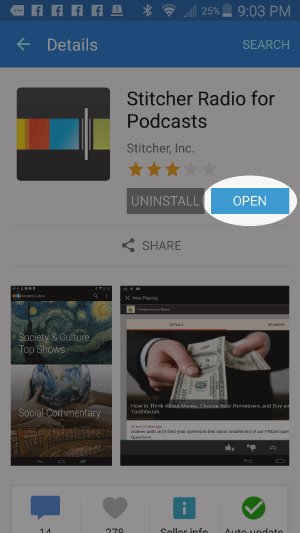
Listen on Stitcher (Android)
Install the Stitcher App
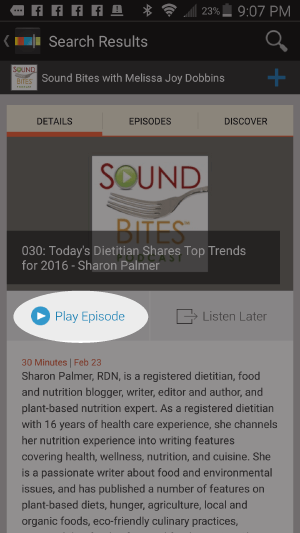
1. Search for “sound bites with melissa joy dobbins” 2. Choose Play Current Episode or Add to Playlist
Choose “Play Episode”
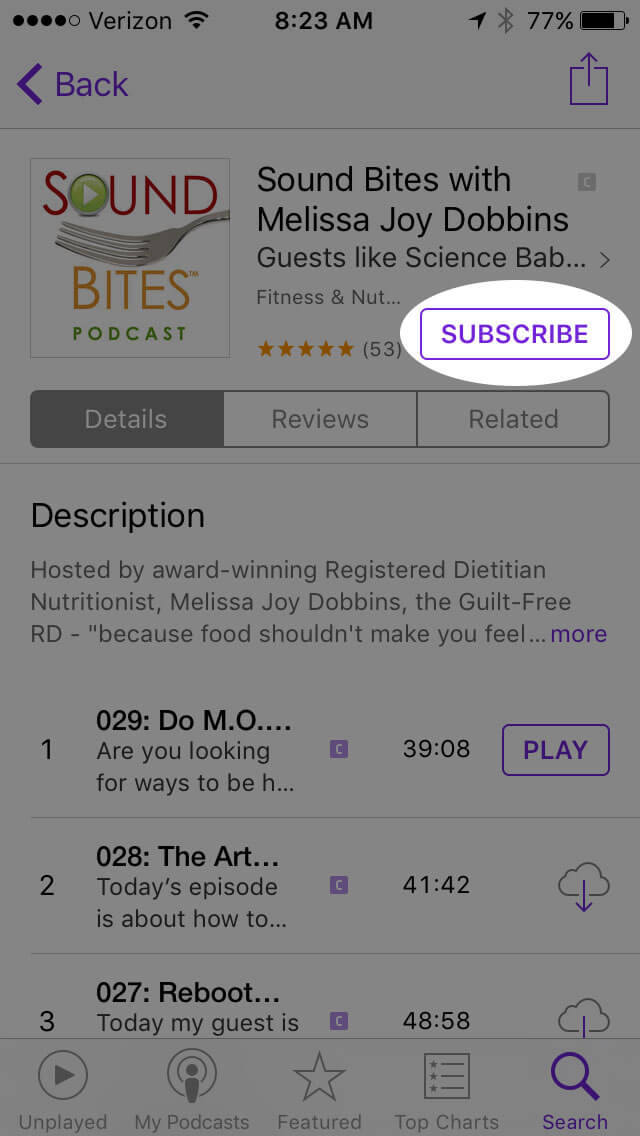
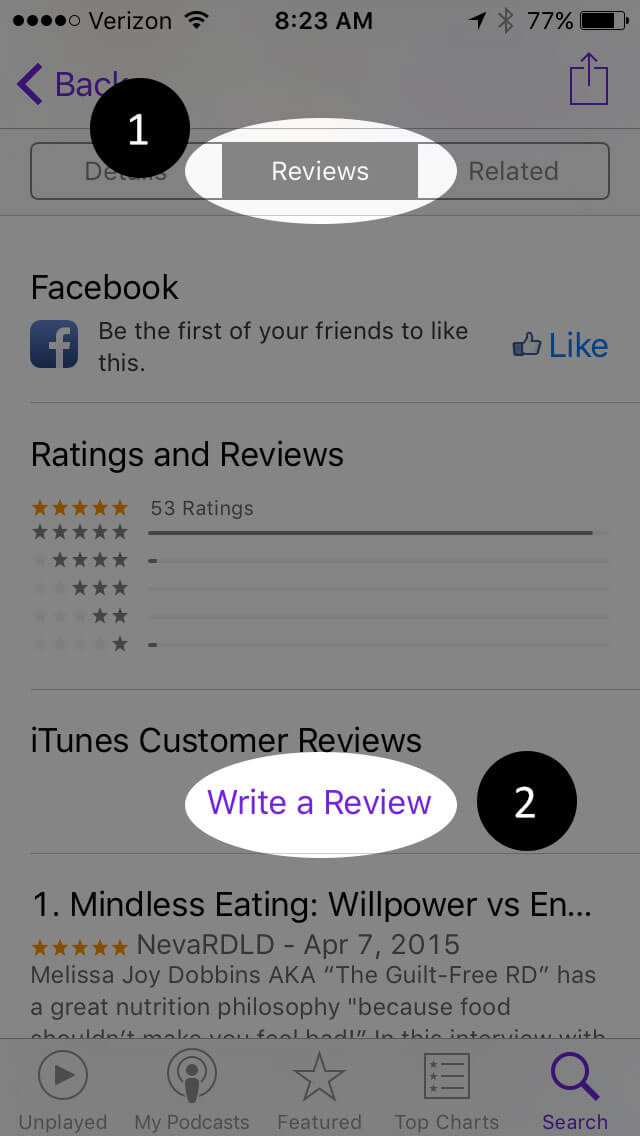
Subscribe & Review on iPhone
Open the “Podcast” app on your iPhone
Search for “Sound bites with melissa joy dobbins”
Open the podcast and click “Subscribe” and your done!
Write a Review
Click “Reviews”, then “Write a Review”.
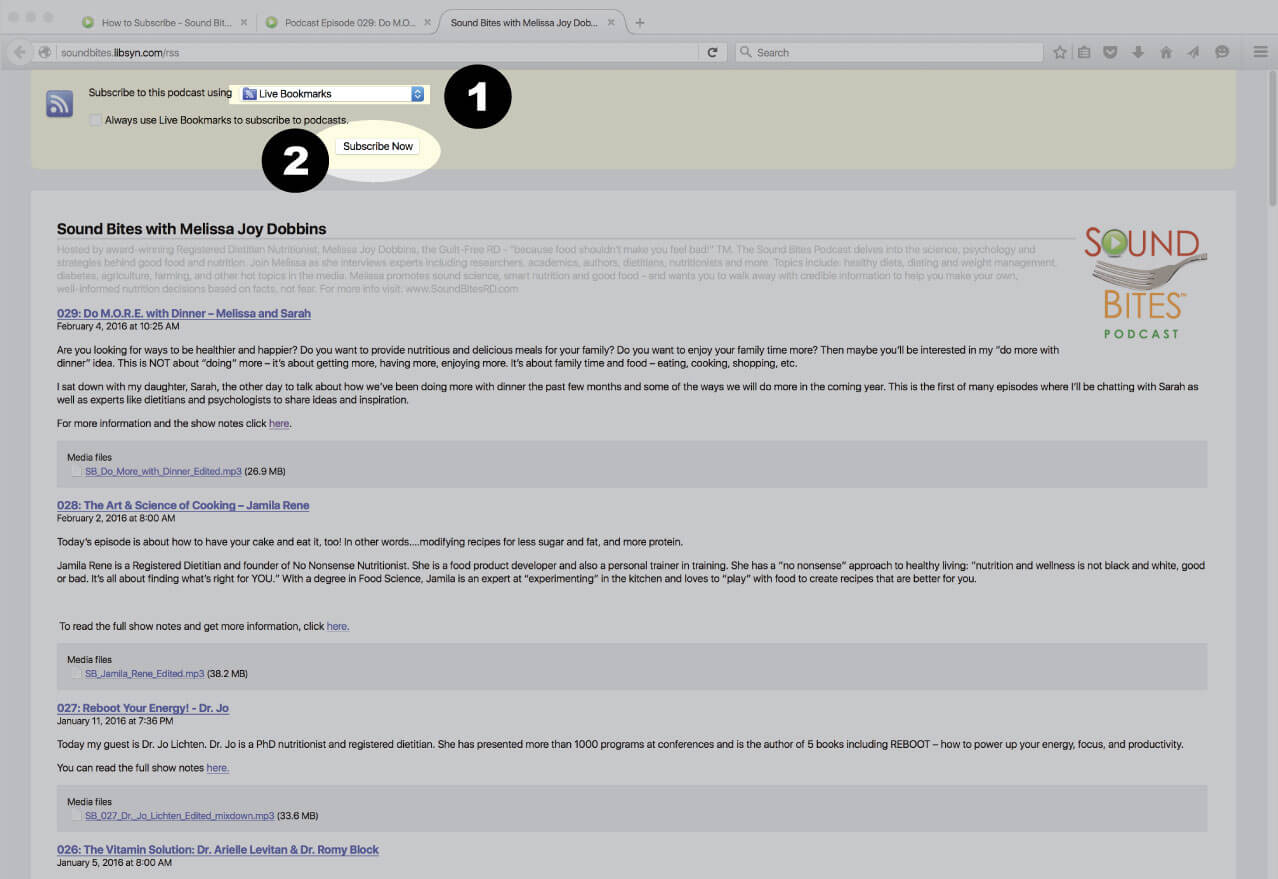
Subscribe via RSS Feed
Navigate to any podcast player . Click on the RSS feed icon.
Click on the RSS feed icon.
Click on RSS Feed
Choose which application you would like to use to receive the RSS feed
Click “Subscribe Now”
Confirm settings and subscribe.
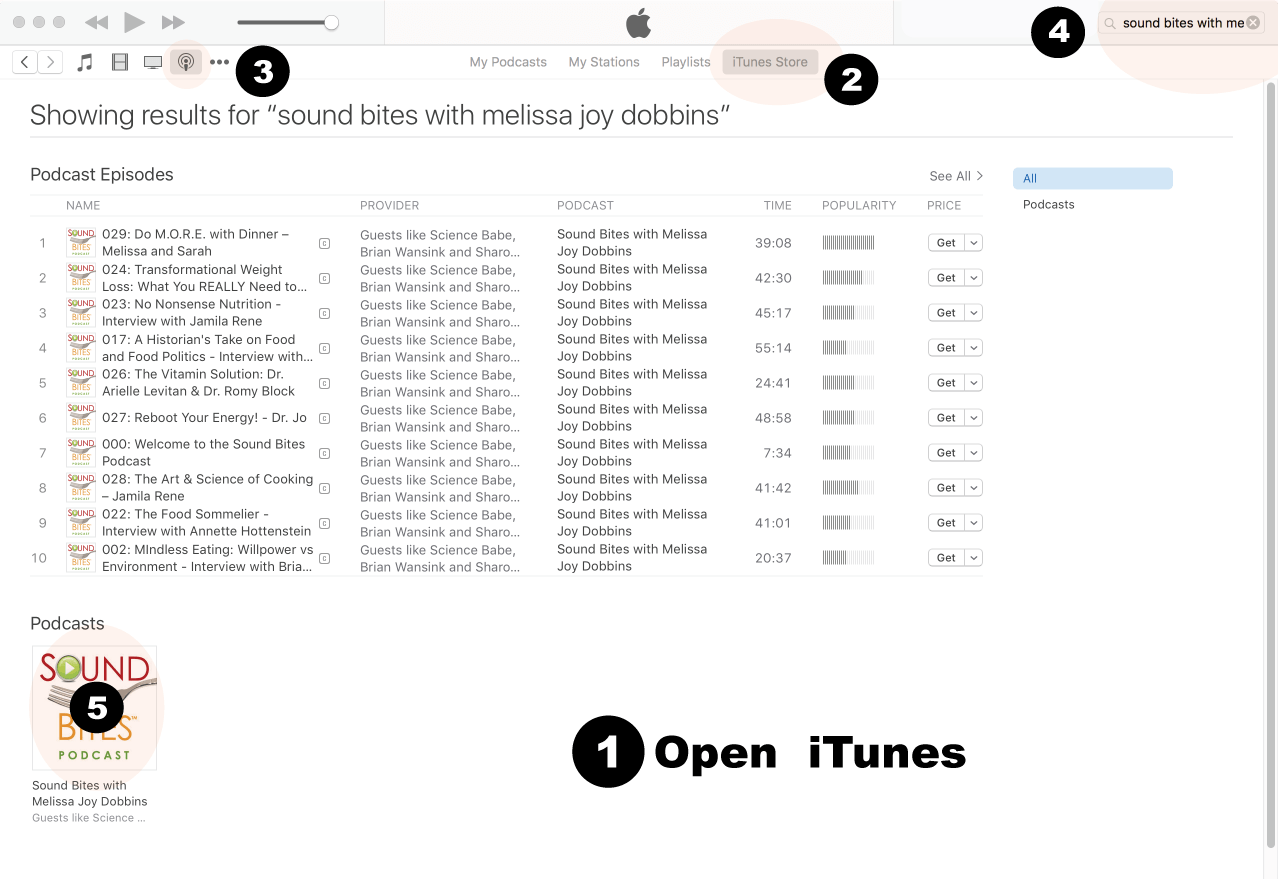
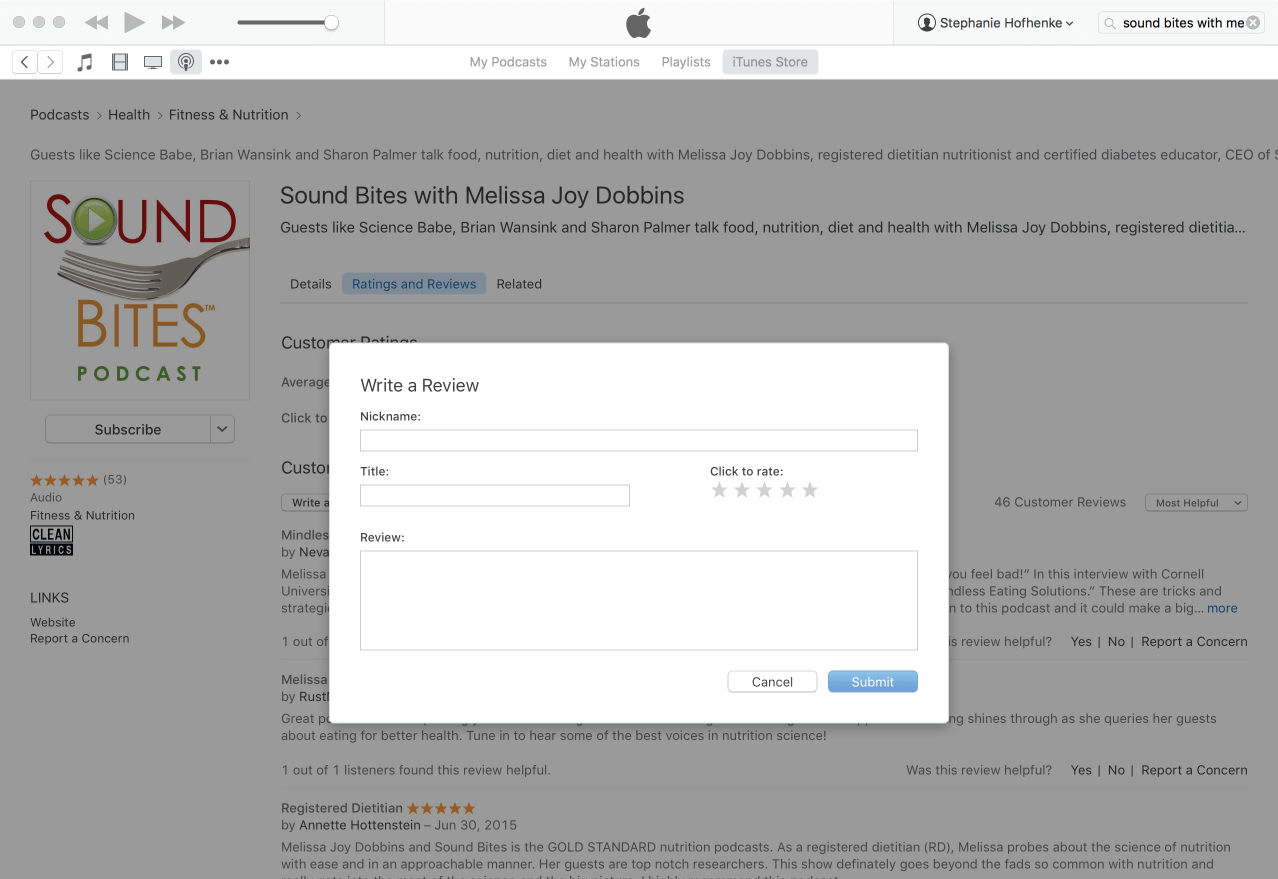
How to Review in iTunes
Open iTunes desktop application
Click iTunes Store
Click on Podcasts
Search for “Sound bites with Melissa Joy Dobbins”
Click on podcast image
Search for Sound Bites podcast in iTunes
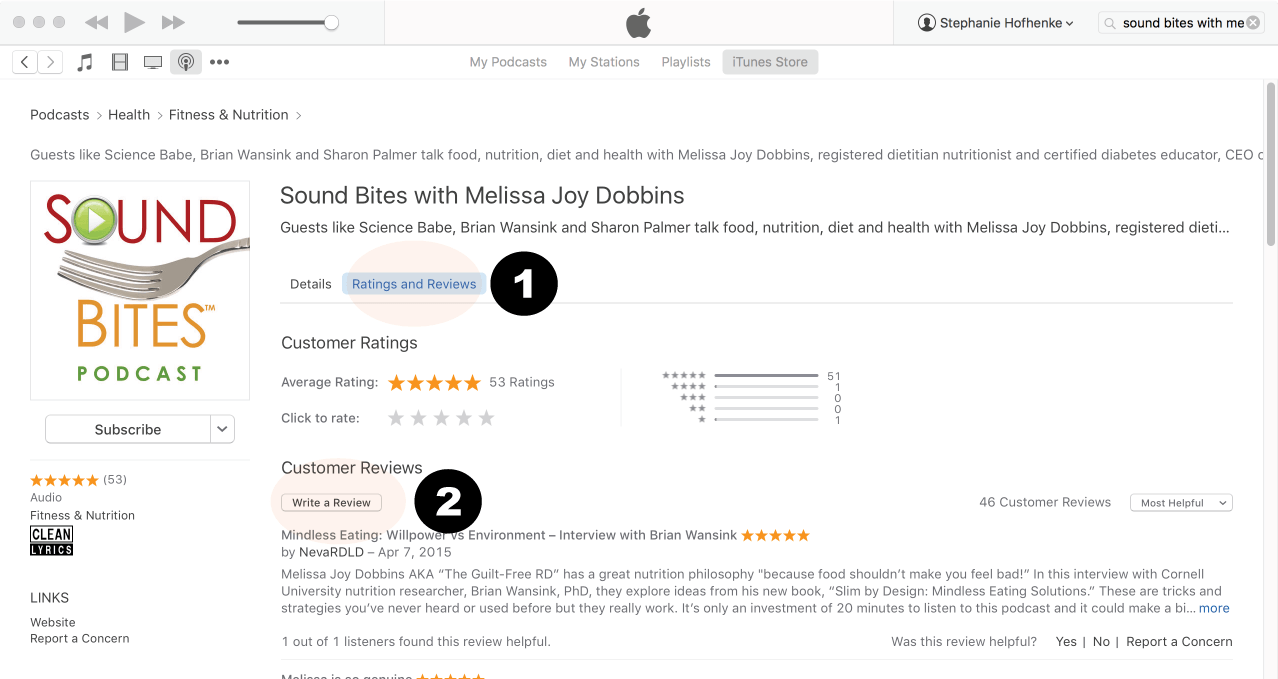
Click Ratings & Reivews
Click Write a Review
View reviews and write your own review.
Write your review…. Thank you!
Write your review!
How to subscribe via iTunes
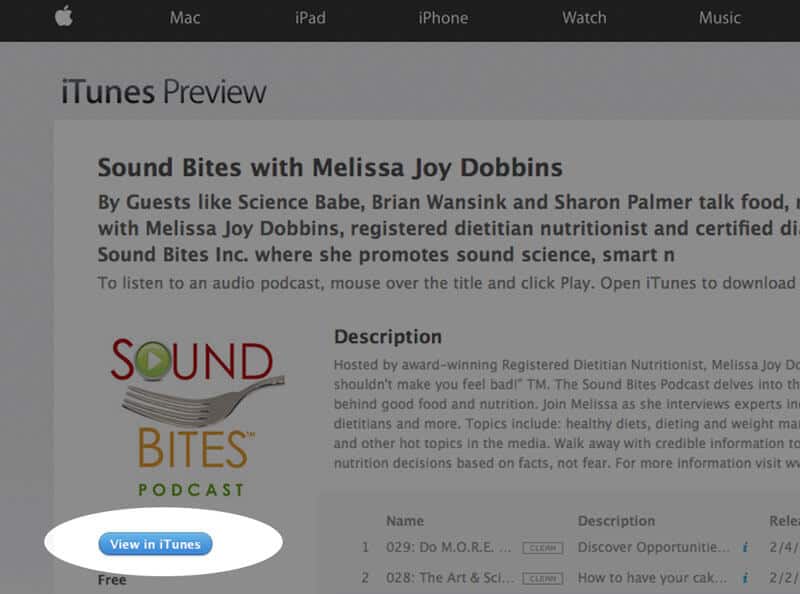
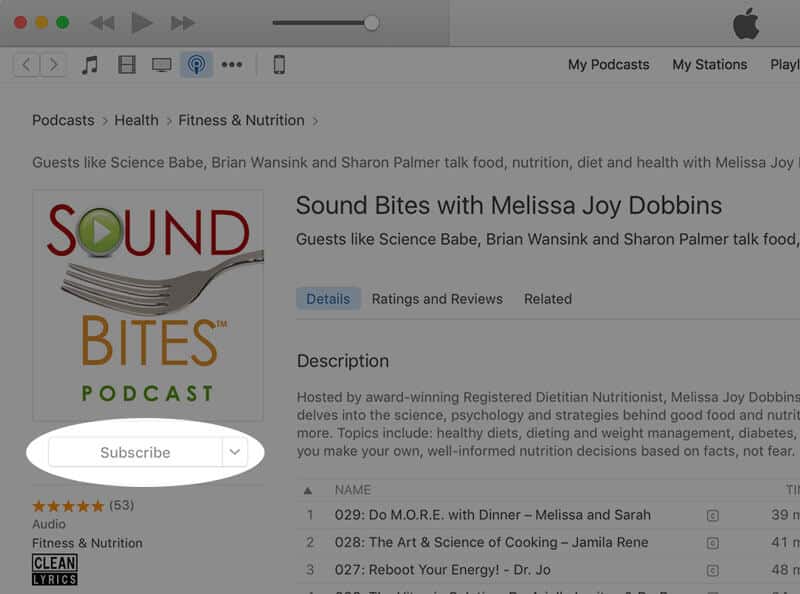
Click here to view the Sound Bites Podcastin iTunes, then click the blue “View in iTunes” button. This will open your iTunes application directly to Sound Bites Podcast. Click the “Subscribe” button, and your done!




 Lauren is a registered dietitian and Vice President at FoodMinds, a division of Padilla. She leads FoodMinds’ Healthy, Sustainable Food Systems platform, leveraging her expertise in public affairs, scientific research, food values, and strategic communications to support clients’ business and public health objectives. For over a decade, she has championed award-winning teams focused on insights, stakeholder engagement, and strategic thought leadership for global food, agriculture, and technology companies. She is passionate about helping clients bring together nutrition, sustainability, and health to create food systems of the future.
A California transplant and foodie at heart, she spends her weekends frequenting local farmers’ markets and restaurants, and exploring the state’s natural beauty from coast to crest.
Lauren is a registered dietitian and Vice President at FoodMinds, a division of Padilla. She leads FoodMinds’ Healthy, Sustainable Food Systems platform, leveraging her expertise in public affairs, scientific research, food values, and strategic communications to support clients’ business and public health objectives. For over a decade, she has championed award-winning teams focused on insights, stakeholder engagement, and strategic thought leadership for global food, agriculture, and technology companies. She is passionate about helping clients bring together nutrition, sustainability, and health to create food systems of the future.
A California transplant and foodie at heart, she spends her weekends frequenting local farmers’ markets and restaurants, and exploring the state’s natural beauty from coast to crest.