Celebrating over 1 Million Downloads and 50,000 Free CEUs on the Sound Bites® Podcast | NEW: Get 1 years’ worth of CEUs with the new 15-CEU Podcast Course
Click here to earn 1.25 FREE CEUs for listening to this podcast episode!
A Nutritional Powerhouse to Prioritize on Your Plate
Pulses are the nutritionally dense, dry edible seeds of legumes including dry peas, beans, lentils and chickpeas. They are high in fiber, folate, potassium and plant protein, and contain several micronutrients such as iron and zinc. While many people may not be familiar with the term “pulses”, chances are they are familiar with the food itself. Nutritious, versatile and affordable, pulses are also a climate-friendly crop. This episode dives into all things pulses with a farmer/agricultural economist and a registered dietitian nutritionist.
We believe USA Pulses can help end world hunger, revolutionize our food system, improve the nutrient quality of every diet, support family farmers and rural communities, lower carbon and water use in our food system, and improve the health of our soils, water, planet, and people.” – Tim McGreevy
Tune into this episode to learn about:
what pulses are
what the difference is between pulses and legumes
why chickpeas are also called garbanzo beans
current intakes vs. recommended intakes
the nutritional profile of pulses
benefits of pulses beyond nutrition
tips for preparing pulses
swaps and recipes to try
what makes pulses a climate-friendly crop
what benefits farmers experience by incorporating pulse crops into their rotation
the Coalition for the Advancement of Pulses
current research, takeaways and infographics
resources for the public and health professionals
Pulses are nutritional powerhouses. They are a good source of plant-based protein and potassium, they’re an excellent source of fiber and folate, plus they’re cholesterol free and low in fat and sodium.” – Chelsea LeBlanc
Tim McGreevy
Tim D. McGreevy is the CEO of the USA Pulses Coalition which includes the American Pulse Association (APA), USA Dry Pea and Lentil Council (USADPLC), U.S. Pea and Lentil Trade Association, The Pulse Foundation and the following state pulse organizations in WA, ID, MT, ND, SD and NE. The mission of USA Pulses is to double U.S. pulse crop consumption and production. In his role as the CEO of USA Pulses, Tim is responsible for international and domestic market development, research, policy development, and expanding the pulse crop coalition. McGreevy serves as Chairman of the Finance Committee of the Global Pulse Confederation (GPC), an international organization representing the global pulse crop value chain. Tim received his Master of Science in Agricultural Economics from Washington State University.
Chelsea LeBlanc RDN, LD
Chelsea is an award-winning registered dietitian, media personality, recipe developer, and nutrition expert in Nashville, TN. She runs a nutrition communications company and virtual private practice where she helps career-driven women plan and prep quick and easy meals on a budget. She frequently contributes to multiple media outlets––including Eat This, Not That!, Well + Good, MSN, and Eating Well.
With a diverse background encompassing clinical practice focused on heart health, outpatient nutrition counseling, and health coaching for a diabetes prevention program, Chelsea possesses a wealth of experience and expertise within the nutrition field.
Passionate about reducing food waste, she promotes sustainable meal planning and preparation, guiding her clients to make mindful decisions that save money, minimize waste, and simplify healthy eating. Through her virtual private practice and contributions to various media outlets, she empowers individuals to adopt simple strategies to reduce food waste in their daily routines while sticking to a budget.
Resources
Some links may be affiliate links. As an Amazon Associate, I earn from qualifying purchases.
Speakers: Melissa Joy Dobbins with Tim McGreevy and Chelsea LeBlanc
[00:00:23]Melissa: Hello, and welcome to the Sound Bites Podcast. Today’s episode is about pulses, what they are, how they stack up nutrition wise, as well as other benefits, how to prepare them, and how and why they are a climate friendly crop. Now this episode is not sponsored. We are submitting this episode to CDR for one free continuing education unit for dietitians and diet technicians.
My guests today are Tim McGreevey and Chelsea LeBlanc. Tim is the CEO of USA Pulses, and he is also a farmer. Tim owns and operates a small dry land farm in Eastern Washington where he raises peas, lentils, chickpeas, wheat, barley, and canola in rotation.
Chelsea is an award-winning registered dietitian, media personality, and nutrition expert based in Nashville, Tennessee. She’s known for her innovative approach to sustainable meal planning. She’s passionate about reducing food waste. She helps people make budget friendly, mindful decisions that simplify healthy eating and minimize waste through her virtual private practice and media contributions. Welcome to the show, Tim and Chelsea.
[00:01:33]Tim: Hey, great to be here.
[00:01:34]Chelsea: Thank you so much for having us. So exciting.
[00:01:38]Melissa: I’m so excited to talk with you both. We’ve had a few calls, try to get things coordinated and just love the fact that we’ve got a farmer and a dietitian. It’s such a fun topic that, you know, a lot of people don’t even know the term pulses. So, we’re going to start there. But first, I would love for each of you to share some information with our listeners about your background and the work that you do. Tim, let’s start with you.
[00:02:02]Tim: Well, first of all, I was born and raised in Pullman, Washington, and I farm as well. And I’m one of nine siblings, right? I’m second in line. And so, we had a really big family, and we had very thin budgets. And so, we ate a lot of pulses, and we grew everything on our farm. We had pigs and chickens, we had cattle. We, I milked cows all of my, young adult life until I went to college. Woohoo! I got out of milking cows, because I wasn’t living at home.
Okay. And so, I got a degree in just general agriculture, and then I got a master’s degree in agricultural economics, because there was this really cute girl who was a little younger than I was, and she said, I had to hang around just long enough for her to say yes, and we’ve been married for 41 years now.
And so, she’s the best. I don’t know if she’d say that about me, but she is the best.
[00:03:01]Melissa: And where did you go to school?
[00:03:02]Tim: I went to school at Washington State University, home of the Cougars. So, I really wanted to be a farmer, full time. And I did that for a little while, but remember I’m an agricultural economist and we don’t have a really big farm, so not a real economic unit. And so, one day when prices for wheat went down to $2.50 and peas went down to five cents a pound, my mom sent me this advertisement in the Lewiston Tribune, a local paper. And she said, hey, they’re looking for an executive director of the Idaho Wheat Producers Association of Boise, Idaho. And I went, okay, look, I had never worn a tie in my life and, not even for my wedding, okay, full disclosure. And so, I got on a plane first time I’d been on a plane in my life, traveled down to Boise and interview went pretty good, but when I was coming home, Idaho is a very mountainous state, right? And so it was really rocky. And this was back in the days where there was like a cigar tube airplane. And, there was just one seat on either side and it was really rough. And I got off the airplane, and my wife and I was green, and she said, “Oh, I guess it didn’t go so good.” And, but they offered me the job. And, surprise to me.
And, they, so we lived in Boise for nine years, and then I got an opportunity to actually come back home, basically. I actually farmed right behind the office. Which is kind of ironic. I had a radio show for six years at KWSU radio, public radio station. The show was called Farm Facts, and I used to interview my predecessor, Harold Blaine, and he held this position for 30 years, and gosh, they interviewed me, and surprise, they hired me. And so I have been here, for 30 years as the CEO of USA Pulses. And this organization is really a group of organizations all across the United States really united, to try to improve people’s health and the health of the planet. And that’s what we’re all about. So that’s a little bit, a little bit about me.
[00:05:14]Melissa: A few stories already there. I love it. And yes, for our listeners, we will explain all about pulses. But Chelsea, I would love to hear from you about your background and the work you do.
[00:05:25]Chelsea: Yeah, so I am so excited to be here and talk about one of my favorite foods, which is pulses. So, I am a registered dietitian based in Nashville, Tennessee, and have been an RD for nine years now. So, my career started in clinical nutrition, focusing on heart health. I worked on the cardiac unit of a hospital here in Nashville, and led their cardiac rehab nutrition classes. I’ve also worked in the outpatient care setting and with a diabetes prevention program. But now I run a virtual private practice, a nutrition communications company, where I have the privilege to educate thousands of people through TV, writing, content creation, speaking engagements, all those kinds of fun things. So, like Tim, you beat me, Tim, I grew up in a family of eight. So, I’m the oldest of six kids.
[00:06:18]All: Laughter
I’m the oldest. Oh yeah.
[00:06:22]Tim: I had an older sister. Thank God. Well, they really broke her in.
[00:06:25]Chelsea: It does, the oldest there’s, you know, high expectations there, but, because of that, I learned firsthand how important budget friendly meal prep and planning can be. So, my parents were masters at creating balanced, nutritious, and delicious meals for us, and they passed their tips and tricks down to me.
Then, when I graduated from college and kind of started cooking on my own, I really quickly realized, okay, groceries are expensive, and then they spoil really fast, especially if you’re only cooking for one, maybe two people. So that’s kind of where my mission came in. So, I help people plan quick, budget friendly meals using simple ingredients. My goal is to help them save time, reduce food waste, and make healthy eating easy and delicious. And, sneak peek! Pulses play a huge role in that.
[00:07:19]Melissa: Excellent. Wonderful. Yeah, so we reconnected, Chelsea, you and I a few years ago, and I’m just so excited to see all the work you’re doing in the media, because I met you in Tennessee 10 years ago?
[00:07:35]Chelsea: Probably, 2018, 2019, like, I think it was right after I had moved to Nashville and Melissa is a fantastic media dietitian, knows all things.
[00:07:49]Melissa: Oh, thank you.
[00:07:50]Chelsea: And was leading a training in media work and I like credit her for everything that I know in the media field, so.
[00:07:59]Melissa: Oh, thank you. Yeah. Shout out to Carmen Meyer for hosting that training and inviting me and, I know you two are good friends and she’s a great media dietitian too.
[00:08:09]Chelsea: Yeah.
[00:08:10]Melissa: Yeah. And then we bring Tim into the loop because we love pulses, and we want other people to love pulses too. Som let’s start off by saying what exactly are they, Tim? And why is this a term that many people haven’t heard before?
[00:08:21]Tim: So, pulses are dry peas, lentils, chickpeas and dry beans. That’s what the category pulses are. And there are dry edible seed of leguminous plants. And, you know, there’s a lot of different types of legumes. Alfalfa is a legume. Soybeans are a legume, right? Yeah, but they’re not pulses. These plants, they grow pods. All legume plants grow in pods. For example, a pea pod would be a legume where the pea inside would be the pulse, right?
So, fresh peas, right, that you get, in stores, they’re not really a pulse because these are dry. Edible seeds of these legume plants. So, pulses, dry peas, lentils, chickpeas, and dry beans. And kind of a fun fact, the word pulse itself. If you look it up in your Latin or Greek terms, it would say P-U-L-S. And the meaning of that is really thick soup.
So even, you know, back in the, in the Roman times, in those days when they were conquering the world, The reason they were able to conquer the world is because each of the Roman soldiers actually had pulses, lentils, chickpeas with a rice on their backs so they could travel really long distances without having to, you know, slaughter animals and all of that, and that’s why they were able to cover so much ground is they had this vegetable protein mixed with a cereal grain in their knapsacks, and they were able to travel great distances and of course, you know, they’re terrific for your health, but the term pulses is recognized globally, especially in India, though the term is still a little, you know, unfamiliar to Americans, we aim to change that. And, part of our organization’s work really is to build awareness, in Americans anyway, about the term pulses and the many benefits that they have. So, therefore the term USA pulses, dry peas, lentils, chickpeas, and dry beans.
[00:10:25]Melissa: Awesome. Yeah. And we’re going to talk more specifically about the similarities and differences between those. There are differences in how you prepare them, and which particular pulses lend themselves to different culinary applications. Correct me if I’m wrong. I mean, the term legume was probably more common than pulses, but still not a common term.
[00:10:44]Tim: Right.
[00:10:45]Melissa: And I think legumes that are not pulses, other than the ones you mentioned, just like green beans, and those fresh peas, right?
[00:10:53]Tim: Right. So green beans, fresh peas, soybeans, soybeans really have a high oil content. They’re in the legume family, right. And an important part of the family, but they’re not a pulse, right? Pulses have a really unique, you know, nutritional profile that is just terrific. And they deserve to be on the deus of foods. And we’ll talk about that. you know, I am sure, but you know, peanuts are also a legume,
[00:11:22]Melissa: Right?
[00:11:23]Tim: They’re not a pulse. And so, you know, soybeans and peanuts really high and well content, you know, lovely foods as well. Pulses, peas, lentils, chickpeas and dry beans, that is the genesis of their name. And you know why we call them pulses.
[00:11:35]Melissa: Okay, thank you. And just one more, while we’re on names. Sure. Chickpeas, garbanzo beans, they’re the same, right? What’s the deal with their name?
[00:11:44]Tim: Garbanzo beans, you know, are they chickpeas? And the answer to that is yes, right? And this is so primarily due to really regional linguistic, you know, differences. The term garbanzo is a Spanish term originating from Spain, and it’s used throughout Latin America as well. And the term chickpea actually comes from the Italian and the French translations through chickpea, and it’s more commonly used globally.
For example, again, pulses, it’s a Latin term for thick soup. Well, think of, you know, these were such important crops in the Roman empire that they actually named some of the famous families in Rome, and one of the more famous families in, you know, Roman orators, was Cicero. And the truth is, Cicero actually means Mr. Chickpea.
[00:12:37]Melissa: Really?
[00:12:38]Tim: Yeah. And so it’s Ci-cer Caesar Ci-cer, that means Mr. Chickpea. Wow. And so that’s how important they were to that culture, right? The Roman and that, you know, that Latin language.
[00:12:51]Melissa: Interesting. Okay.
[00:12:52]Tim: So chickpeas are garbanzos. It’s kind of redundant to say garbanzo beans. I mean, just so you know, garbanzos are not a bean, they’re their own separate category of pulse. And, actually, garbanzo is the proper term in our Spanish cultures and Latin cultures. Chickpeas is the translation.
[00:13:13]Melissa: Excellent. And I’m sure there’s more fun facts coming from you coming your way, listeners.
[00:13:18]Tim: Of course.
[00:13:19]Melissa: Okay, well, let’s talk about the nutrition profile and benefits, Chelsea, I think, you know, you’d be the best person to address this, but I’m sure Tim can weigh in with his knowledge. Why this is so important given like current dietary intakes of Americans, you know, I know, number one, we’re not getting enough produce anyway and enough fiber, but tell us about the nutrition profile.
[00:13:40]Chelsea: So like Tim was saying, pulses are nutritional powerhouses. So, they are a good source of plant-based protein, potassium, they’re an excellent source of fiber and folate, plus they’re cholesterol free and low in fat and sodium. So, this is extremely important because research shows that just 7 percent of Americans are eating enough fiber.
[00:14:05]Melissa: Mm hmm.
[00:14:05]Chelsea: And then potassium and iron have also been identified as nutrients of public health concern in certain populations, including pregnant women. So, pulses are, you know, a really, really good source of all of these things. And oftentimes, too, with the fiber content, I’ll have clients tell me all the time, I, you know, don’t really have trouble using the bathroom, like, why do I need more fiber? And I’m like, well, fiber has so many more benefits than just, you know, GI benefits.
[00:14:36]Melissa: Right.
[00:14:36]Chelsea: So it might help lower your risk for developing coronary heart disease, stroke, hypertension, diabetes, and even obesity too. So, there’s a study that even showed that for every seven grams of fiber eaten a day, your risk for heart disease can drop by 9%. So that’s like extremely significant.
[00:14:58]Melissa: Yeah.
[00:14:59]Chelsea: And the cool part about that is that a lot of pulses have around 7 grams of fiber per serving. So, it’s kind of an easy way to help you get those needs.
[00:15:09]Melissa: Excellent. So, Because there are several different types of pulses in this category, I’m guessing that the nutrition profile might differ slightly from one to another. I’m guessing, you know, like a lentil might be different than a chickpea. But there is a chart that I have from the USA Pulses website. That says that, pulses are a good source of protein and for our listeners, you know, good source means at least 10 percent up to 19 percent of the daily value, excellent source or rich source is 20 percent or more. So, they’re a good source of protein, excellent source of fiber, high in antioxidants. and as you said, iron rich, a good source of potassium and an excellent source of folate.
So I just wanted to throw that in there because, you know, like I said, I’m sure there’s some differences, but as a category we’re looking at those health claims, I guess that’s what I would say.
[00:16:02]Chelsea: Absolutely.
[00:16:04]Melissa: So, talk to me a little bit more and fiber for sure, like you said, there’s a lot of different benefits to fiber, and we are just not getting enough. And I think one of the barriers is. How do we know where to find fiber? How do we incorporate those foods into our diet? Also, you know, with budgetary considerations, and just like making that part of our daily habit, and sometimes that might involve oh, my gosh, getting in the kitchen and cooking, which has its barriers and challenges as well. But, talk to me about, obviously, it’s like you said, it’s a nutrition powerhouse, a nutrient powerhouse. What are some of the associated health benefits and Tim, maybe you can weigh in with this as well, some of the associated health benefits with this nutrient rich food.
[00:16:47]Chelsea: The USDA has their dietary guidelines for Americans. Everybody obviously is different. They everybody has their unique needs, but it has general guidelines, especially like for fiber. So, for women under 50, they are shooting for about 25 to 28 grams of fiber per day. Men under 50, 31 to 34 grams of fiber per day. Women 51 and older need to shoot for about 22 grams of fiber per day. And then, men 51 and older, about 28 grams of fiber per day. So, this is just a range, but everyone basically needs at least 22 grams of fiber per day. And pulses have around 7 grams of fiber per serving, which helps to make it easier to meet those needs.
[00:17:33]Melissa: Yeah. And a little later in the conversation we’re gonna talk about some research and some takeaways that also address this, but Tim, did you wanna weigh in on that as well?
[00:17:42]Tim: I just wanted to weigh in on, on Chelsea’s point that how important fiber really is in our diet. So, you know, we hear a lot about getting enough protein in our diets and man, we have protein drinks and we got let’s make sure our protein levels are real up. And, of course, protein is a building block and it’s terrific, you got to have it in your diet, but let’s be honest, right? In the American diet, we get a lot of protein. What we don’t get enough of is fiber. And I’m telling you, these are, as Chelsea said, these are an excellent source of fiber. And we just need to increase them in our diets and in our menus because they are such a terrific you know, source of fiber and, you know, it’s real important. It’s real important for me to stay regular. And I’m telling you what now, and we all know what regular means.
[00:18:30]Melissa: Yes, we do.
[00:18:32]Tim: I’m telling you, if you’re eating pulses consistently, and it has such a good fiber content in it, you will be regular and you will feel better.
[00:18:42]Melissa: Yeah.
[00:18:43]Tim: That’s my own expert you know, just for Melissa. Now, let’s be straight, but I’m just telling you practical experience. We need more fiber in our diets at really every age.
[00:18:53]Melissa: I know. I mean, like fiber kind of needs a makeover or a PR agent or something, because, as Chelsea said, we know that there are so many benefits to fiber beyond digestion, but that’s a very important one, gut health, which you would think with all the focus on gut health, fiber would be a bigger part of that conversation. So, yeah, there’s definitely some, I don’t know, communication challenges there or why it’s not ranking higher on people’s, priorities or radar, you know?
[00:19:22]Tim: Yeah.
[00:19:33]Melissa: What are the dietary recommendations now for pulses?
[00:19:28]Tim: The Dietary Guidelines for Americans today, right, the 2020, Dietary Guidelines for Americans, their current, recommendation for all pulse crops, peas and olives, chickpeas and dry beans, is a cup and a half per week for an average 1,800 to 2,000 calorie diet. Of course, they have a little bit higher recommendation, you know, if you’re a vegetarian, up to three cups, per week, but it’s generally a cup and a half, and we’re gonna talk a little bit later about that in the program, how we think that should be a little higher.
[00:20:01]Melissa: Yes. Yes.
[00:20:02]Tim: But, currently, it’s a cup and a half per person per week.
[00:20:06]Melissa: And any consumer insights on how much we think people are getting?
[00:20:11]Tim: Yes, indeed. So, you know, the consumer, you know, reports show that we’re really only getting about 0.6 cups per person per week. And not a cup and a half? And so, you know, we have a long ways to go to get up to the recommended level, but it’s starting to increase and that’s pretty exciting with the plant based food movement. We are seeing more pulses coming into our diet here in the United States. And that’s very exciting.
[00:20:38]Melissa: And I know Chelsea wanted to touch on versatility and affordability, if there was anything more specific that we wanted to address regarding that. And then I know you have some information to share with us about swapping pulses for other protein sources. So, I’d like you to speak to that as well.
[00:20:56]Chelsea: Yeah, absolutely. So that’s one of my favorite things about pulses is that not only are they nutritional powerhouses, but they’re also super versatile, affordable and convenient, so like Tim mentioned earlier, there are so many different types of pulses. And none of them have a super strong flavor profile, which makes it really, really easy to use and swaps and a lot of different recipes and I’ll kind of touch on that in a second. But the other thing too is like the affordability. So, like if we take lentils, for example. The U.S. cost per serving of lentils is about 10 cents versus beef, which is $1.49. So, like, that’s huge, especially, like I said, coming from a family of eight people, you know, you can feed a lot of people with lentils for a significant less amount than animal protein. So, they’re also extremely convenient. So, I mean, it really doesn’t get much easier than a can of beans. I like to look for no added salt or low sodium beans, and then you can rinse them off underneath the sink because that’ll actually help to get about 40% of the salt off of those.
[00:22:09]Melissa: Yeah, a lot of people don’t know that. That’s a great tip.
[00:22:12]Chelsea: And so, it just makes, you know, cooking and, and doing all those kinds of things so much easier.
[00:22:18]Melissa: Yeah.
[00:22:18]Chelsea: So I can kind of get into those, those swaps now, or?
[00:22:22]Melissa: Yeah, tell us about the swaps and I’m just gonna put a teaser out there for the listeners. Like, we are gonna talk more specifically about some of those nuances of preparing different types because they think when people think about dried beans, they think, you know, soaking them overnight and that’s not necessary for the canned ones, obviously. And then there’s different kinds of lentils and neither one of those require soaking, just a little teaser there to stay tuned for that. But yeah, tell us about the swaps that I think there was a study.
[00:22:49]Chelsea: Yes. So, research showed that swapping pulses for other protein sources in the American diet can help increase fiber. and can help decrease cholesterol. too. So. the recommendation is to swap a fourth of a cup of pulses for one ounce or which is about like one slice of deli meat, or other animal proteins. So, like if you’re making tacos, for example, you can add beans or lentils, so you can either swap the animal protein for beans or lentils, or if you’re not quite ready to completely give up your meat, go half and half, because that will help to decrease the animal protein, but will also help to save you some money, too.
[00:23:32]Melissa: Yeah, and we’re gonna touch more on that study in a little bit. And Chelsea, you’ve got this awesome recipe, this lemon goat cheese summer salad that we’re gonna talk about. Did you make it, Tim? ’cause I made it.
[00:23:46]Tim: I did it. I did. I, it is really good. I’m just, I’m waiting for Chelsea to talk about it. Yeah. Because I got my own comments about you,
[00:23:51]Melissa: Right, Yes. So, we’re gonna talk about that, but first let’s talk about why pulses are a climate friendly crop. Tim, what benefits have you and other farmers seen by incorporating pulse crops into your farming rotation and just why are they climate friendly in general?
[00:24:07]Tim: You know, peas, lentils, chickpeas and dry beans are really one of the most climate friendly crops you can consume or produce as a grower. They are really low emitters of greenhouse gases into the atmosphere, and they have a super low carbon footprint. And the reason they do have a low carbon footprint is because they are one of the very few and special crops in the plant kingdom that actually make their own protein. They create their own nitrogen in a process that’s called nitrogen fixation. So, pulses require little or no fertilizer actually to grow and produce a really good crop. So, what happens is they form little, you know, they have this symbiotic relationship with rhizobia that’s in the soil, and a rhizobia actually comes in and you could say they kind of set up shop, it’s kind of like setting up a manufacturing shop.
You know, you would say, “Oh, they attack the roots.” Nah, we like to think of it as, you know, they just set up a little garage and they say, “You know, we’re gonna use these roots, feed off the roots a little bit, and we’re gonna create nitrogen that feeds the plant and makes it grow really good.” But of course, because they’re such a darn good factory, they actually produce more nitrogen than they actually need, and that nitrogen then is left to the following crop, which reduces the fertilizer use for weeds or canola or whatever, barley, whatever the following crop is. And so, the reason in agriculture, one of the biggest culprits or reasons we have greenhouse gas issues, you know, 26 to 30 percent of greenhouse gas emissions come from agriculture and our food production system.
And one of the reasons it is that level, you know, that high is because of the use of nitrogen fertilizer, which takes a lot of natural gas actually to produce this nitrogen fertilizer. And so, wow, you know, that’s why these crops are so special in a cropping system. You know, they not only are helping themselves, you know, because they produce, basically, they produce their own lunch, right? And so, they like, they like create their own nitrogen sandwiches and they’re eating them while they’re, during the growing season. And then, you know, they’re like leaving sandwiches behind for the wheat crops and the canola crops that, corn crops, whatever, that follow them.
I mean, that’s how special, these are, these are giving plants, you know. These, these are charitable plants, they’re not just taking from the soil, they’re actually putting nitrogen back in the soil for, the following crops. And so, you know, as a farmer myself, right, these are just critical in my cropping rotation. So, the reason they’re the lowest greenhouse gas emitters is because they create their own nitrogen naturally and they leave it behind for the next crop.
[00:27:08]Melissa: I’ve never heard the sandwich analogy, I love that so much. I’m familiar with the term nitrogen fixing and crop rotation, but for people who aren’t and are curious, can you say a little bit more about the purpose of crop rotation? I mean, you know, you’re trying to improve the soil.
[00:27:24]Tim: It’s so important, you know, soil health, wherever you live in the world is really, it’s the lifeblood of our society. If we don’t have healthy soils, we are not going to have healthy people. And so, having good soil health, which means having good biodiversity in your soils, having different bacteria, which every crop, you know, you introduce into your cropping system, brings a little different, you know, bacteria to the soil.
And so having a pulse crop in your rotation, in your cropping system, like for example, my cropping system is a pulse crop, either peas, lentils, chickpeas, or dry beans, and then I follow that with a winter wheat crop, and then I would go probably to a barley crop or a canola crop, and then back to pulses again, back to a pea, lentil, or chickpea, or a dry bean, and so that cropping system, that mix of crops, it helps break weed and disease cycles, which is really important. If you’re a farmer, if any of you have even had a garden, okay, what’s the biggest pain about having a garden here, right? Let me tell you, it’s weeds. And if you’re in the South, right, it’s insects and it’s diseases, right?
So, every farmer has that problem, and having this mix of crops really helps break those weed and disease cycles. If you have pulses in your cropping system, you’re putting nitrogen back in the soil, so they’re just absolutely critical for soil health. And get this, on top of that, right, why we have these crops in our cropping system, they’re also a really low water use crop.
And what that means is, so they actually have fairly shallow roots, and you know, maybe two to three feet. But if you see a barley root structure, you know, those root systems, they go down five to six feet. And so the pulses have shallow roots. They still produce a great yield, because they need less water to produce a yield.
But the wheat crops, and corn, and Sorghum and canola, they have really, really deep roots, and so they go after that really deep moisture. And so, then you have a pulse crop that only takes the shallow moisture, and, so then the deeper moisture actually kind of gets in reserve for the following crop.
[00:29:50]Melissa: Another giving characteristic of this crop.
[00:29:53]Tim: Another charitable, I mean, these are like, These are poster children of, you know, of charitable, give them, they’re all 501c3s for sure.
[00:30:03]Chelsea: You just want to give them a hug.
[00:30:04]Tim: You just want to give these, these plants a hug, because it’s just so important to our cropping system. They’re so important to our soil health and they’re so important to our environment. So, if we were to just raise, just to be clear, as a farmer, if we were to raise, you know, peas on peas on peas or lentils on lentils on lentils, just because they’re such a terrific crop, that wouldn’t be good either, right?
Because, they would build up diseases in the soil, and the diseases would attack those plants and the yields would go down and we basically have a failure. And so, when people say well just raise pulses then to heck with all these other crops. No, you know, it’s all part of an ecosystem and you know that includes animal protein as well, you know, we’re not opposed to animal protein, they’re great food. We’re just saying to people “Look, we really need to increase Consumption of these crops for so many reasons.” Mostly we just don’t get enough of them in our diet, we don’t get enough fiber vegetable protein, all the other benefits that Chelsea talked about and Melissa talked about, but hey, these crops are also terrific for the soil and for the planet, and we’ve got to increase consumption of them and keep them, they need to be, more of them in the cropping system in the United States, and it’s certainly possible because they can be grown anywhere.
[00:31:19]Melissa: Really?
[00:31:20]Tim: Yes, they can. Fun fact, right, but the first pea breeder in the United States was Thomas Jefferson in Virginia, ok. And he was really quite good, and he was breeding peas in the South, that’s where pea production started in the United States was Thomas Jefferson’s farm, and he was actually breeding plants in the South. Som they can be grown all over.
[00:31:44]Melissa: Wow.
[00:31:45]Tim: There’s a pulse, you know, for drought conditions, there’s reports for tropical conditions, and everywhere really in between.
[00:31:52]Melissa: Interesting. I did not know that. Another fun fact from Tim McGreevey.
[00:31:58]Chelsea: I mean…
[00:32:00]Tim: As a little addition, another fun fact, right? When you, because I know this as a farmer, and farmers, you know, sometimes they go, “Oh, climate change, shmimate change, we don’t know about that, but boy, these crops…”, they will actually help us when we plant a pulse crop and follow it with a wheat crop, I have the data on my own farm, it actually increases the yield 10 to 15% of the wheat crop. And so, that’s how beneficial they are for overall soil health. Even the wheat loves them, everybody loves these crops. The barley loves them, the canola, they say, “Oh, we get to follow a bull’s crop. We love those people. We love those crops.”
[00:32:37]Melissa: That’s awesome. I love that. Well, when you were talking, I was thinking about something another guest had said on my podcast a while ago. We hear all about plant-based diets and we need more plants in our diets. And they said, actually, we, we have a pretty fairly plant-based diet. We need better plants in our diets. And so, I feel like pulses are like you said, the poster child for that.
[00:33:00]Tim: They are, they can be blended with anything. They should be sprinkled on everything you have on your plate, you know, you should just, it’d just be like, like pixie dust, just sprinkle them on everything because they go with everything.
[00:33:13]Melissa: And we have, we have quite a bit to talk about as far as like the culinary application and everything. But another teaser here is I did a TV segment on lentils, and you can use those in everything from an egg skillet bake to chocolate brownies. So, another just like amazing, I think it was Chelsea that said they have this flavor profile that is mild, I think is the term you used, and it takes on the flavors of the other foods. You know, some are more, softer than others, so there’s a texture variation there and everything. One more thing that I wanted to ask you, what is the Coalition for the Advancement of Pulses, and what are the primary goals of this coalition?
[00:33:55]Tim: Oh man, so I’m so excited to talk about this, right? So the Coalition for the Advancement of Pulses, also known as the CAP program, was an idea that was born out of USA Pulses. And, its mission, right, is to double consumption of pulse crops in the United States. And, our first goal, you know, if we’re going to double consumption, we had to start out with a project that would help us achieve that goal, and so we needed to take a look and, and start advising, or at least talking to the Dietary Guidelines for Americans Advisory Committee. Because, as we talked about earlier, currently the recommendation is one and a half cups per week, and our target is to get that to three cups per week. And people, when they say they say, “Whoa, I mean, one and a half to three. I mean, that’s a lot.” But, the truth is, in 2005, the dietary guidelines for Americans actually had three cups per week as the guideline.
[00:34:55]Melissa: I remember that.
[00:34:56]Tim: Yeah, and then in 2010, and I have to admit my own, my own shape for this, you know, because I didn’t do my post scrubs very well, because we really weren’t engaged in the dietary guidelines process at that point as an organization.
Since 2010, that has changed. And in this round in the 2025 dietary guidelines, we’ve really upped our game. And, one of the reasons that it was reduced is because we weren’t doing research, you know, on these crops, the health and nutrition research and the advisory committee, which is made up of folks like you, you know, all really smart, registered dietitian, you know, nutrition expert kind of people, they said, “Well, where’s your research?” And we really didn’t have any, but that’s changing, right? So now we are, we do have research that’s been published, and we can show that, hey, these crops are good for, you know, your dietary quality, they’re good for your health on so many levels. So, the Coalition for the Advancement of Pulses, its mission, right, is to double pulse crop consumption and to double the recommendation from one and a half cups to three cups, and to show the advisory committee who helps make that recommendation the importance of raising our consumption of pulse crops, in the United States, both for nutrient quality, as well as a positive health outcomes.
And, of course, the added bonus is great for the planet, even though the dietary guidelines doesn’t talk about that, but it’s really good for the planet as well. Som that’s the CAP project, and, it’s a great coalition of all pulse, interested pulse industry members, as well as some foundations actually that have said, “Look it, we need to take a look at increasing consumption of these really terrific foods, not only for nutrient health and the health of our citizens, but for the planet as well.”
[00:36:50]Melissa: Yeah, when you said increased consumption, I thought consumption and recommendations. And then you said, yes, it’s both.
[00:36:57]Tim: It’s both, absolutely both, and that’s the aim of CAP is to do the science and then also do the policy engagement that’s very important. You know, you got to be there putting in your comments and being at the table saying these are important foods.
[00:37:12]Melissa: Getting your voice heard.
[00:37:14]Tim: Yeah, getting our voices heard. And then the third leg of our stool is really doing education and promotion. In podcasts like this, like Sound Bites, I mean, how excited am I to be on this podcast to meet one of the royalty of the nutrition podcast game. So, thank you, Melissa, for this very, very cherished spot on your program.
[00:37:35]Melissa: Oh, my pleasure. When I met you and heard you speak, I said, “I need to hear more from this guy, absolutely.” And, yeah, no, just thrilled to have you both on. We have so much to cover, but I don’t want to make this podcast, you know, three hours long, but I do want to touch on, I mean, you know, we can stop recording and just continue to talk to here, it’s so much fun.
But, one of the things that I did want to touch on is some of that research that CAP has looked into or done. You can speak to, you know, did they fund this research? How are they involved in the research? And then, there are actually infographics that have come from this, there’s three studies and then there’s a scoping review, which I honestly had to look up what the definition of that was.
A scoping review seeks to present an overview of a potentially large and diverse body of literature pertaining to a broad topic. That’s what a scoping review is. And I was so excited to see some familiar names on these research studies. Dr. Vic Fulgoni, that research was titled “Effect of Adding Pulses to Replace Protein Foods and Refined Grains in Healthy Dietary Patterns”, and that’s what Chelsea was talking a little bit about earlier, but I want to talk more about the refined grains part because we’ve heard about swapping plant based proteins for animal protein, but I haven’t heard it so specifically with refined grains, which I think is really interesting.
And then there’s also research by Dr. Yanni Papanikolaou, who has been on the podcast before, two studies, adult dietary patterns with increased bean consumption are associated with greater overall shortfall nutrient intakes, lower added sugar, improved weight related outcomes, and better diet quality, and then another one, adding more beans to the U.S. typical dietary pattern can lead to greater intake of shortfall nutrients, and a higher diet quality in younger and older adults. And then the scoping review was by Dr. Taylor Wallace, who’s also been on the podcast a couple of times, Pulse Consumption and Health Outcomes, a Scoping Review. And Tim, you shared a document with me that maybe I can use some of that and link to it in the show notes, whatever you have to share with our listeners.
[00:39:47]Tim: Yeah.
[00:39:48]Melissa: But let’s touch on some of these sort of takeaway messages. And of course, I’m sure I can put the infographics in my show notes. Let’s start with the Vic Fulgoni research.
[00:39:59]Tim: Well, Vic Fulgoni, in our strategy for research, right, we wanted to show, the Dietary Guidelines Advisory Committee, well, what does it actually look like if you actually do increase to three cups per week from a cup and a half?
And Chelsea mentioned this a little bit earlier, but, in terms of, you know, swapping out for protein foods, just a quarter of a cup of pulses per day, right, in place of one ounce of whatever protein food it is. It’s going to increase your fiber, you know, which is a nutrient of concern by the way, right?
[00:40:32]Melissa: Mm hmm,
[00:40:33]Tim: And it’s going to decrease your cholesterol and we all want to get rid of the bad cholesterol, right? And it’s gonna do that each by more than 10 percent, so it’s gonna increase fiber by more than 10 percent and decrease your cholesterol and more than 10%. And, if you substitute a half of a cup of pulses daily for just one ounce of refined grains daily, right, it increases, get this, right, it increases fiber, magnesium, copper, potassium, all nutrients of concern by more than 10%. And so, if we increase our consumption of pulses, clearly, you know, the dietary benefit and the nutrient benefit, which this shows in this particular study, it’s really off the charts. So that is a look at, you know, Victor Fulgoni’s, study.
[00:41:25]Melissa: Excellent. Yeah. There’s two separate infographics, one focusing on adding half cup of pulses in place of one ounce of other protein foods daily, decreases cholesterol, increases fiber each by more than 10%.
[00:41:38]Tim: Right.
[00:41:39]Melissa: And then it has, the other infographic is substitute one half cup of pulses in place of one ounce of refined grains daily, one ounce of refined grains is approximately like a half a cup of cooked rice. That provides more fiber, magnesium, copper, and potassium, like you said, by more than 10%.
[00:41:56]Tim: Right. It was a great study. We certainly hope that the Dietary Guidelines Advisory Committee is reviewing it.
[00:42:02]Melissa: Yes.
[00:42:03]Tim: If they’re listening to this podcast, Melissa, make sure you race to that study and see what a terrific study that was.
[00:42:10]Melissa: Yes. Well, I hope they’re reviewing it as well. Then there’s one about eating beans and chickpeas is linked to better diets and healthier weights. And that talks about eating more beans and or chickpeas is associated with better diets and improved weight outcomes, and then also helping close nutrient gaps, again, we’re talking about shortfall nutrients, fiber, calcium, potassium, nutrients of public health concern. We’re talking about things that people aren’t getting enough of, as we’ve been saying already.
Oh, I also wanted to point out, because this is one of the things that’s, sort of called out in some of this research is that pulses can count in the protein group as well as the vegetable group, right? So that’s also something that a lot of people may not know and that can make things kind of confusing, but it’s also again shows the versatility.
[00:43:04]Tim: It shows that they play well with others.
[00:43:04]Melissa: That’s right
[00:43:05]Tim: It can be a protein, they can be a vegetable.
[00:43:07]Melissa: They’re the MVP, most valuable pulse. Have you heard it here? That’ll be your next campaign.
[00:43:15]Tim: Good idea. You’re not trademarking it, are you?
[00:43:17]Melissa: Nope. Nope. Okay. I’m sorry, Chelsea. What did you say?
[00:43:21]Chelsea: Oh, I was just saying it just makes it easy. You know, it falls into the protein and the vegetable category. Bam.
[00:43:27]Melissa: Check, check, check. So anyway, enough about the research because I want to get back to talking about the actual food. Chelsea, you had this lemon goat cheese summer salad, which I have to say, I made it on the first day of autumn.
[00:43:41]Chelsea: Well, you know,
[00:43:42]Melissa: Because I was like, summer is not over in this house. And it was delicious and easy, and my 16 year old son even loved it. My husband wasn’t here, so he didn’t get to try it. We just, we ate it all. Tim, what did you think of it?
[00:43:57]Tim: So, I just want you to know that I made this last night. This lemon goat cheese summer salad was awesome.
[00:44:08]Melissa: And you brought it with you to eat.
[00:44:10]Tim: No, I brought it with me because I figured I needed a snack for this long podcast.
[00:44:13]Melissa: Yes.
[00:44:14]Tim: I never worked very much with couscous, right? That’s not, that’s not something that that’s a regular part of our diet, which was really great. And then you add the chickpeas. And I just want to say, Chelsea, oh my God. We had, of course, fresh cucumbers from the garden. You know, we had, of course, avocados aren’t grown this far north, but that was terrific. But, the dressing.
I’m a huge mustard fan, all right. And the Dijon mustard with that little lemon juice, oh my God. Anyway, so I’m just going to have a bite as you explain this wonderful recipe, because it is worth your audience knowing how to make this because it’s simple. I mean, I could do it.
[00:44:58]Melissa: I agree.
[00:44:59]Tim: And so whipped it up last night and it was wonderful, wonderful. So thank you. Go ahead.
[00:45:04]Chelsea: Oh, thank you, Tim and Melissa. I’m so glad that I got to try it because, yeah, I mean, really, it’s my husband’s favorite salad that I make too. Like, he raves about it all the time, and I’m like, okay, well, and it’s nice too, cause like I have a strong family history of heart disease, so I really try to eat, you know, more plants and pulses because they just have a strong tie to, you know, helping reduce heart disease.
So, I try to swap, you know, animal protein in one of my meals, whether it be breakfast, lunch or dinner. And so, making like this lemon goat cheese summer salad, or another salad with pulses for lunch is a super, super easy way to do that, cause you just make it once during the week and then you have it to eat on.
So, this one is one of my favorites, it’s so easy. You just make, either some couscous. You can use quinoa. If you really, really, really wanted to amp up the pulses, you could do lentils.
[00:46:08]Melissa: Wow.
[00:46:09]Tim: Definitely.
So you have that cooked, then you’ll do a can of chickpeas. And so once again, I just rinse those off in the sink to get some of the added sodium off of them, pour that in there and then it has some basil. If you don’t have, like if you’re making this in the winter, for example, that’s okay, like, you know, you can use dried Italian seasoning, dried basil, whatever, that’s all right if you don’t have that. Let’s see. Then you make your dressing. So, the dressing is super, super simple.
I like to make it in a mason jar, because I think that that’s a really easy way to mix up your dressing. So, it just has some olive oil, some Dijon mustard, a little bit of honey, a little bit of lemon juice. Put that in a mason jar, oh, salt and pepper. Put that in a mason jar, shake it up, add it to your salad.
It does make a little bit of extra, so whenever I pour it on there, I just kind of like eyeball it, so that way you can see how much you need. And then, if you have extra dressing, you can always add that to the salad, if you’re enjoying it the next day, if it just needs a little bit of a refresher. But yeah, it’s so easy.
So delicious. Oh, and avocado, too, you don’t have to have it, but the avocado that kind of makes it a little bit more creamy.
[00:47:21]Melissa: Yeah. So Tim mentioned the cucumber, the goat cheese, the avocado, but there’s also the tomatoes, the cherry or grape tomatoes.
[00:47:28]Chelsea: Oh my goodness. I totally left off the veggies. Yes. Yeah. It’s the cucumber. We’ve got to have the other veggies too.
[00:47:37]Melissa: And I’ll say like, I love that dressing as well, but my son doesn’t really do dressings, he doesn’t like dressings. And so, I thought it tasted great without any dressing as well. Like, so I made the dressing and I kind of gave him, you know, some without, and then I tasted it, and I’m like, because of the avocado and the goat cheese, and I’m so glad you said quinoa is fine too, because my culinary brain would have no idea that quinoa would be a good substitute for couscous.
[00:48:05]Tim: Yeah, yeah.
[00:48:06]Melissa: And I happen to have some quinoa in the pantry that, you know, I had just the right amount to use up that container.
And, so it was still a little bit warm because I had just made it. And when you mix everything together, the goat cheese and the avocado just kind of makes it its own little sauce or, you know, it’s not sauce, but just coating in it. So yummy,
[00:48:24]Chelsea: Creamy and like…
[00:48:26]Tim: Really creamy. Don’t forget the minced garlic in that dressing.
[00:48:31]Melissa: Yes. The minced garlic in the dressing. You’re right.
[00:48:33]Tim: I’m a garlic fan. I love garlic and oh my gosh, that was such a nice touch on that.
[00:48:40]Melissa: Yeah, I know when I added it, I thought, Oh, that’s kind of a lot, but no, it’s, it tastes great.
[00:48:47]Chelsea: Because it’s a pretty, you know, dead salad.
[00:48:49]Tim: Chelsea, you had me at chickpeas, you had me at chickpeas on this one, but I mean, it was really, I can see, you know, I’ve met your husband, and I like him even more. I mean, no wonder you married this guy. If he likes this recipe, he’s, he’s…
[00:49:03]Melissa: He’s got good taste.
[00:49:06]Tim: He’s got good taste.
[00:49:08]Melissa: He’s got good taste. I was thinking the same thing. Well, of course he does. He chose Chelsea. And this makes, it actually makes a lot. It does. So that’s why Tim’s bringing it for snack today.
[00:49:18]Chelsea: I love it.
[00:49:20]Melissa: Yeah. So yeah, it’s very, very good. And Chelsea, you’ve got some other tips and swaps, but I did want to mention maybe a couple things that I had referred to. And there’s some great handouts and the USAPulses.org website that I’m going to put links in the show notes, but just basically, I just want to go through split peas.
You rinse them with water, no need to soak them. Beans, if they’re dry beans, you need to soak them. If they’re canned beans, obviously, you know, just, you know, drain them, rinse them. Lentils, no need to soak also, those need to be rinsed as well, just like quinoa. I know a lot of people don’t know that, it’s not on the directions, but you need to rinse that as well.
And then chickpeas, overnight soak, but obviously if they’re canned, you don’t have to do that. Something that I learned when I was doing all these lentils recipes is different lentils require different cooking times. And so, a lot of people don’t really know that. So the softer red ones require much shorter cooking times and they’re great for soups.
I have this, this wonderful recipe that’s like a curry red lentils, it’s so yummy, but the firmer lentils like black take a bit longer. So those are really nice for salads where you want something to kind of hold up and have some bite to it. Yeah, they’re just so versatile. Any other tips about preparation or with the different kinds of pulses that either one of you wanted to add? Because I was just reading off some of the obvious ones.
[00:50:47]Tim: Well, clearly, you know, the canned pulses are great and there, there’s actually canned lentils now too.
[00:50:53]Melissa: Mm-Hmm. . Yes.
[00:50:54]Tim: Although lentils, as you talked about Melissa, they’re really pretty easy to cook. You really don’t need to soak them and, you know, split peas are also, you don’t need to soak and they cook, you know, on about the same time as, as lentils, it’s kind of like cooking rice when you’re cooking lentils or split peas. You know, it’s basically, you know, one cup of lentils or split peas to two cups of water, and they cook up pretty quickly, right? But, of course the canned option is always super easy. Yeah. And we, we promote that, as well, but you can cook them yourself. It’s not that hard.
[00:51:29]Melissa: Yeah. The chocolate cupcake recipe that I made uses canned lentils. So…
[00:51:34]Tim: You bet.
[00:51:35]Melissa: And there’s a couple of other recipes that we got from your website, Tim, Chelsea, do you want to quickly address the trio of dips, and there’s some peanut butter chickpea energy balls?
[00:51:45]Chelsea: Yeah, absolutely. I did want to say to another tip with the preparing your own lentils or beans or anything, they freeze really well too.
So like, I really like to, if I am going to cook them, make a big batch, and then just freeze them. You can use it like throughout the week and then you have some in your freezer for later, too.
[00:52:05]Melissa: I didn’t know that.
[00:52:06]Chelsea: Like I was talking about earlier, pulses in general are so versatile. A lot of times people think of hummus that’s made from chickpeas, so that’s a delicious dip, but you can also use lentils or split peas and dips, too. So, pulses, pulses.org, I believe, has an awesome recipe or awesome three recipes for a trio of dips, and that can be a really, really great way just to get more pulses into your diet, but it’s also really good if you have any type of texture, you know, concerns like I’ve had clients tell me like, “I don’t really love beans or lentils or whatever because the texture”, and a dip is a really, really great way to kind of introduce those for the kids or if somebody has a texture issue with that with lentils.
[00:52:58]Melissa: Great.
[00:52:59]Chelsea: And then there’s also another recipe too. So, Melissa was talking about Enjoying them sweet like in brownies but Pulses.org also has a peanut butter chickpea energy balls…
[00:53:12]Tim: That’s right
[00:53:13]Chelsea: which is really, really fun, it’s a great way to incorporate more pulses, kind of get that like sweet fix in as well. and for me, anything with peanut butter is just like delicious. So, those are super fun.
[00:53:29]Melissa: Wonderful. Yeah, there, there’s a lot of beautiful recipes on that site, and like I said, there’s some handouts and everything. So I will have all those links in my show notes at soundbitesrd.com. As we’re wrapping up, Tim, I’d love to hear the story about, like, something about lentils for breakfast. Somebody told me that you have a story to share.
[00:53:50]Tim: Well, I’m a huge advocate of lentils for breakfast or pulses for breakfast for that matter.
I’m getting up there in age. I’m still young, you know, and I’m going to live forever because I’m one of those blue zone people that’s eating, you know, half to a full cup of pulses a day. But when I go into my doctor and they say, “Your cholesterol levels getting a little higher, you know, of the bad cholesterol, I’m going to recommend that you go on the meds here pretty soon.” And so I said, “I do not want to do that.” And so, you know, I was only following my own advice, which is to increase more pulse consumption. And, and so I started having, lentils for breakfast and cooked very simply, you know, on Sunday, I cook up a big batch of lentils, again, it’s not hard to do, so a big batch. And so, then in the mornings I can pull them out. And I just have a little, a little butter on them, not too much, but a little bit, a little salt and pepper. And then I’ll have them often with an egg or with an avocado or with a tomato, with a piece of toast. And I am telling you what, it just sticks with you all morning long.
And it’s very simple, it’s not difficult or hard to make. Just heat it up by the microwave, you know, in the morning after cooking it on a Sunday. But wow, it’s really carried me through, and the benefit has been that when I went back to my doctor, my cholesterol levels really dropped and, you know, she said to me, and of course this is not a scientific study or anything like that.
[00:55:29]Melissa: Results may vary.
[00:55:30]Tim: Yeah, results may vary depending on the person and all that kind of thing. But the truth is it really helped and I only really changed that. I started eating pulses for breakfast as my primary go to and, you know, having that half to a full cup in the morning. really helped, you know, that’s really pretty much the only thing I changed in my diet was just really going, hard and I really like it.
And I can go into lunchtime, and I can have a black bean burrito. So, come on, you know, you can’t beat this, right? Pulses for breakfast, pulses for lunch. And of course, try this lemon goat cheese summer salad because for dinner, it is unbelievable. Also, Chelsea’s Instagram page has a nice variations of this same recipe.
[00:56:33]Melissa: And Chelsea’s website is ChelseaLeBlancRDN.com. She’s also on Facebook and LinkedIn. And I’m going to link to that too, because you have a cute little video preparing this salad and other things as well.
[00:56:45]Tim: I think you should have your husband eating the, you know, the salad.
[00:56:49]Chelsea: He’s a little camera shy. He doesn’t like to be on that.
[00:56:55]Melissa: Tell him he’s got to get with the program.
[00:56:56]Chelsea: He’ll listen to this and be like,
[00:57:01]Melissa: That’s so funny. Well, that’s great. I mean, like, I think pulses are simple to prepare. I just think people aren’t familiar with that, so hopefully this will inspire people to try some of these, you know, simple ideas and swaps and recipes. Chelsea, any takeaway thoughts or bottom line takeaways for our listeners.
[00:57:21]Chelsea: Like I was talking about before, only 7 percent of Americans are eating enough fiber, and pulses have, depending on the pulse, around 7 grams of fiber per serving, which makes it so much easier to meet those fiber needs. And I think, like, Tim was kind of saying like one of the easiest ways to do this is swap your animal protein for pulses at one of your meals. So, for breakfast, like Tim was saying, do some lentils.
You can even add like some chickpeas to a smoothie or something. That’s super easy.
[00:57:54]Tim: Yeah.
[00:57:55]Chelsea: Lunch, nothing is easier than a bag salad and a can of either rinsed black beans or chickpeas. Dinner, you can make a veggie bowl. If you usually make like a bowl with like rice, swap that out for lentils. It’s so easy and this not only will help you eat healthier, but also helps you save money and time, too.
[00:58:16]Melissa: Absolutely. Well, thank you for all of this. It’s been a fun conversation. There’s a lot of links, like I said, we’ve got Chelsea’s Instagram, we’ve got Pulses.org, there’s a consumer facing website, there’s a website for industry and professionals, there’s also a USA Pulses Instagram page, LinkedIn.
There’s a CAP program overview or whatever I can share from that, Tim, I’ll make sure I get the proper links for that.
[00:58:43]Tim: Absolutely.
[00:58:44]Melissa: And Chelsea, you also have a nice gift for people if they want a free five-day meal plan, there’s a little link for that as well.
[00:58:54]Chelsea: I do. Yep. I’ve got a free five-day meal plan with just like 30-minute meals, so super, super easy. on my website that you can download from there too.
[00:59:02]Melissa: Awesome. Well, thank you both so much. This has been so much fun, and I can’t wait for my next meal where I’m going to have some of the lemon salad leftovers and think about how I can have some pulses for breakfast.
[00:59:15]Tim: Absolutely. You know, Melissa, I just want to thank you so much for, you know, inviting us to join your really terrific podcast and, you know, at USA Pulses, go to our websites, you know, our mission is to help you double your consumption of pulses. Because, if we can do that, you know, we can improve people’s health. We can improve the health of our soils, of our water, and of our planet. So, we are hopeful that people will give these crops a try and increase them in their diets because they are just really terrific foods on all levels.
[00:59:54]Melissa: Awesome. Well, thank you both so much. This has been so much fun. And for everybody listening, if you enjoyed this episode, share it with a friend, pass the word on to others, encourage people to get some pulses into their diet and just to educate them on what they are and why they’re so awesome and such a giving crop. And as always enjoy your food with health in mind, and some pulses. Until next time.
[01:00:20]VO: for more information, visit soundbitesrd.com. This podcast does not provide medical advice. It is for informational purposes only. Please see a registered dietitian for individualized advice. Music by Dave Birk, produced by JAG in Detroit Podcasts. Copyright Sound Bites Inc. All rights reserved.
LISTEN, LEARN AND EARN
Listen to select Sound Bites Podcasts and earn free CEU credits approved by the Commission on Dietetic Registration (CDR) for registered dietitian nutritionists and dietetic technicians, registered. Get started!
Get Melissa’s Sound Science Toolkit here!
Partnerships:
Sound Bites is partnering with the Association of Diabetes Care and Education Specialists (formerly the American Association of Diabetes Educators)! Stay tuned for updates on the podcast, blog and newsletter!
Sound Bites is partnering with the International Food Information Council! Stay tuned for updates on the podcast, blog and newsletter!
Sign up for my monthly newsletter and episode eblasts so you never miss an update!
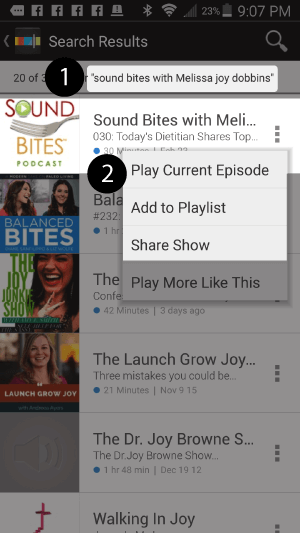
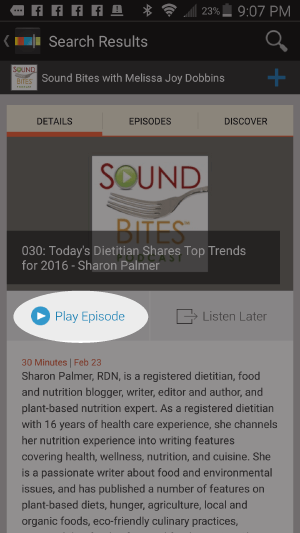
Listen on Stitcher (Android)
Install the Stitcher App
1. Search for “sound bites with melissa joy dobbins” 2. Choose Play Current Episode or Add to Playlist
Choose “Play Episode”
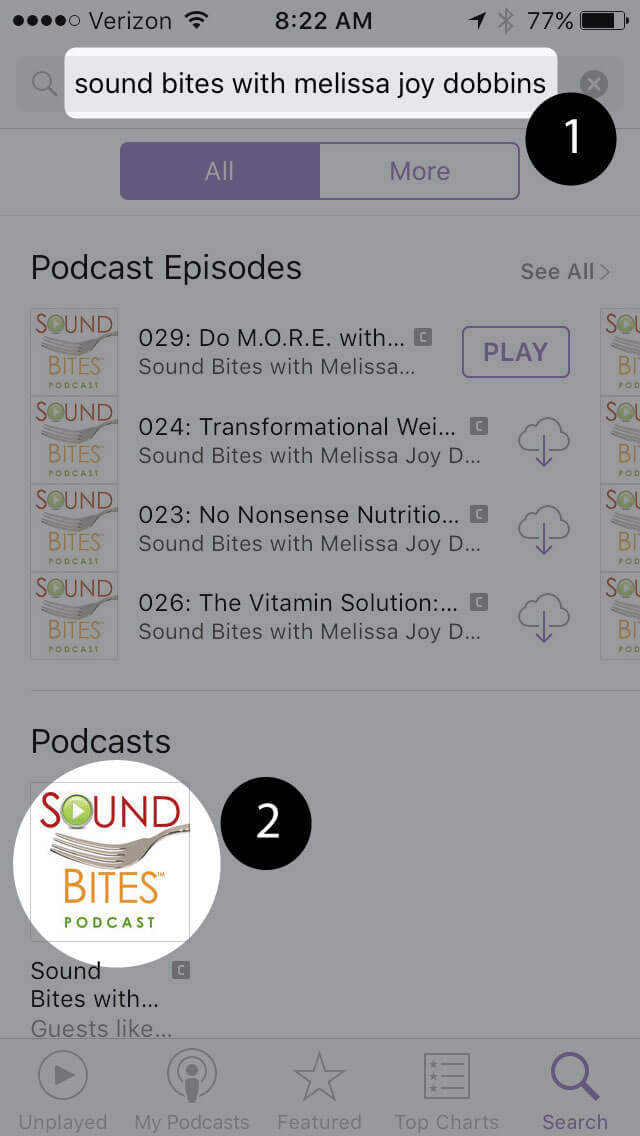
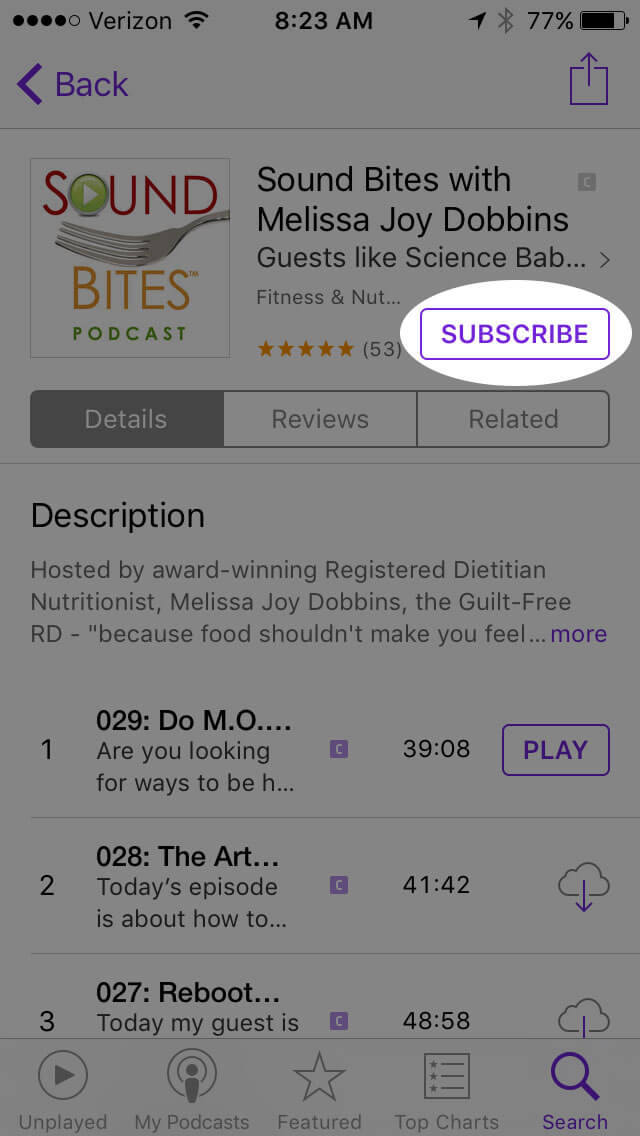
Subscribe & Review on iPhone
Open the “Podcast” app on your iPhone
Search for “Sound bites with melissa joy dobbins”
Open the podcast and click “Subscribe” and your done!
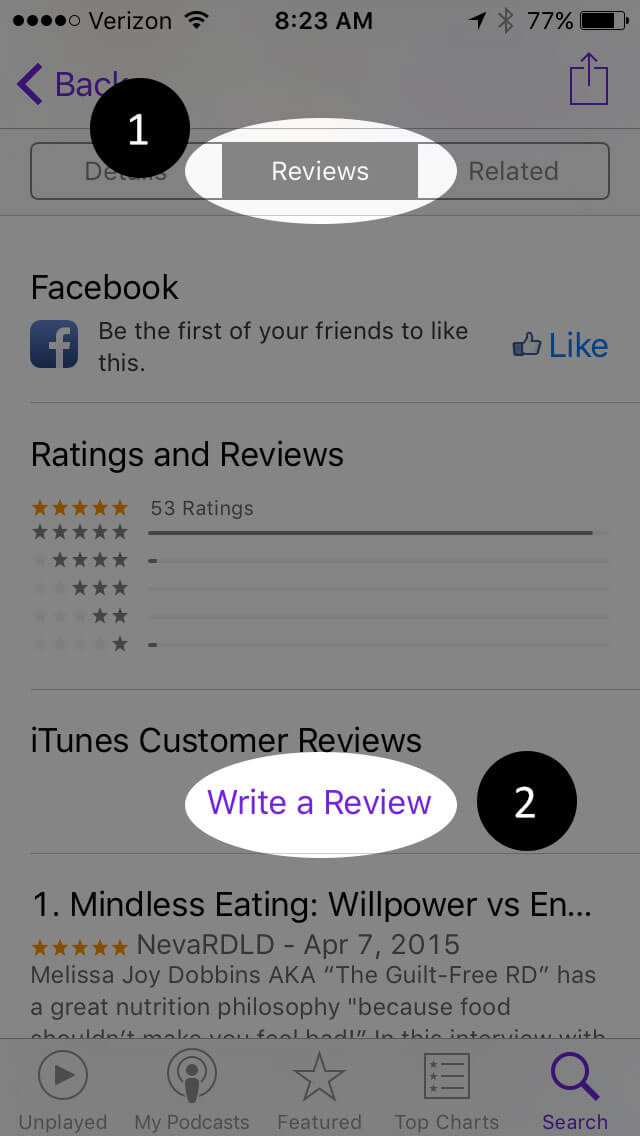
Write a Review
Click “Reviews”, then “Write a Review”.
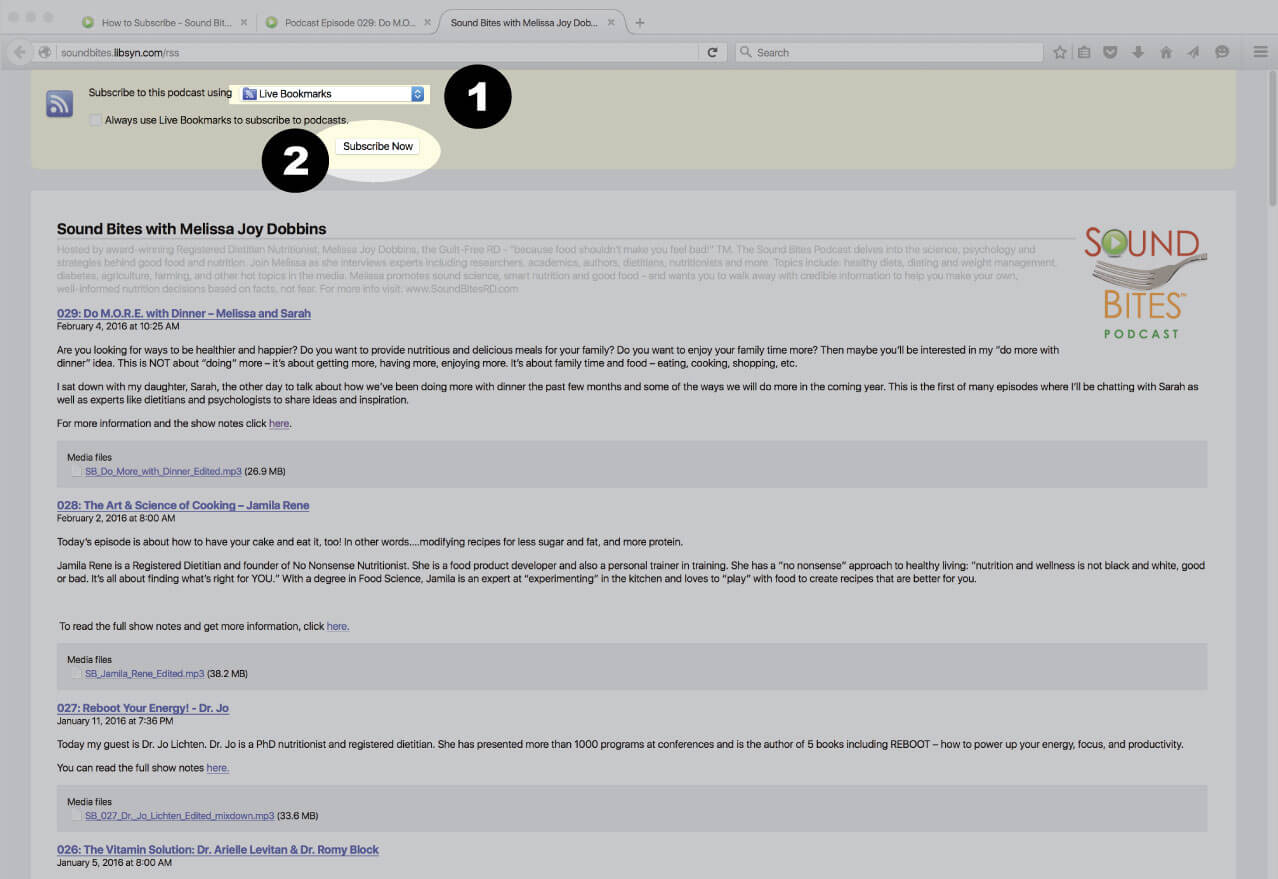
Subscribe via RSS Feed
Navigate to any podcast player . Click on the RSS feed icon.
Click on the RSS feed icon.
Click on RSS Feed
Choose which application you would like to use to receive the RSS feed
Click “Subscribe Now”
Confirm settings and subscribe.
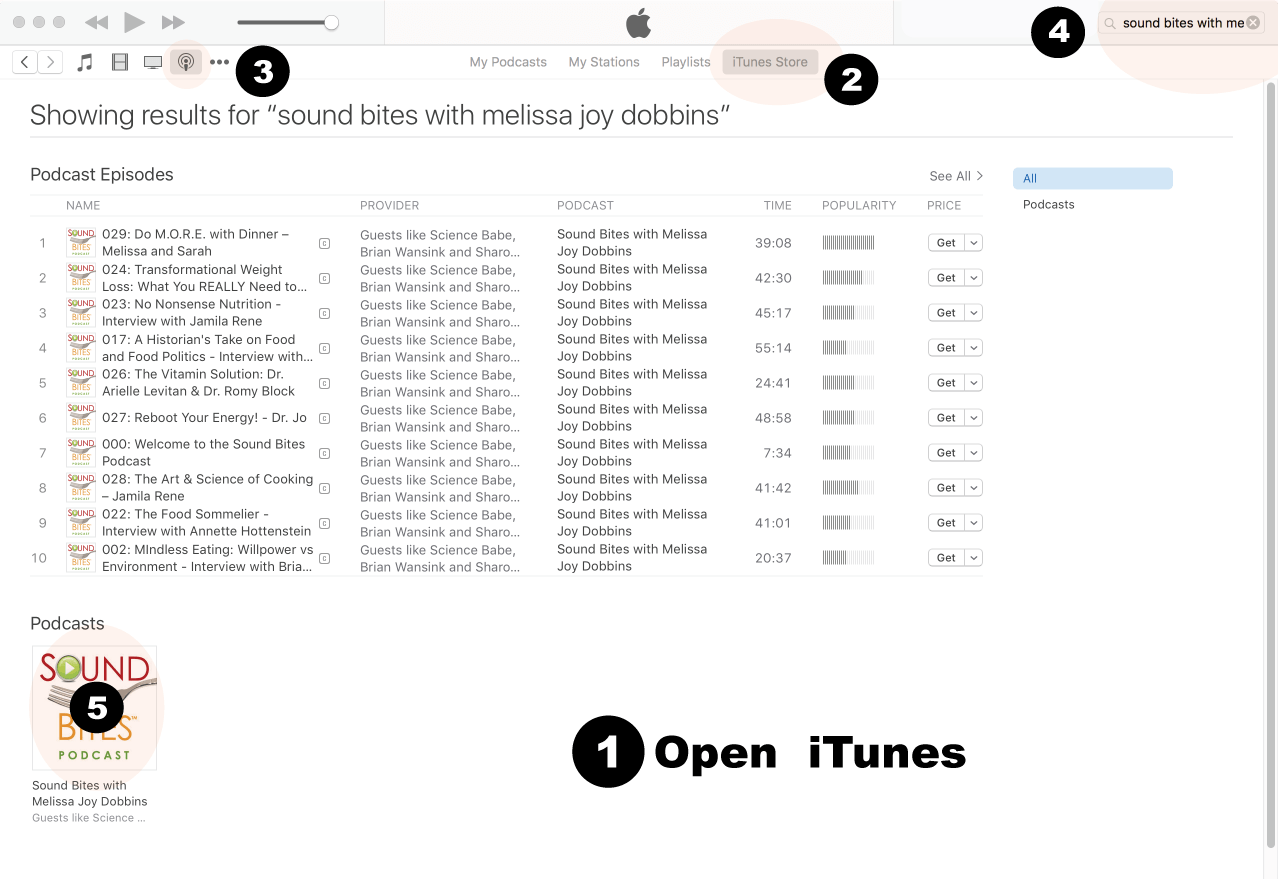
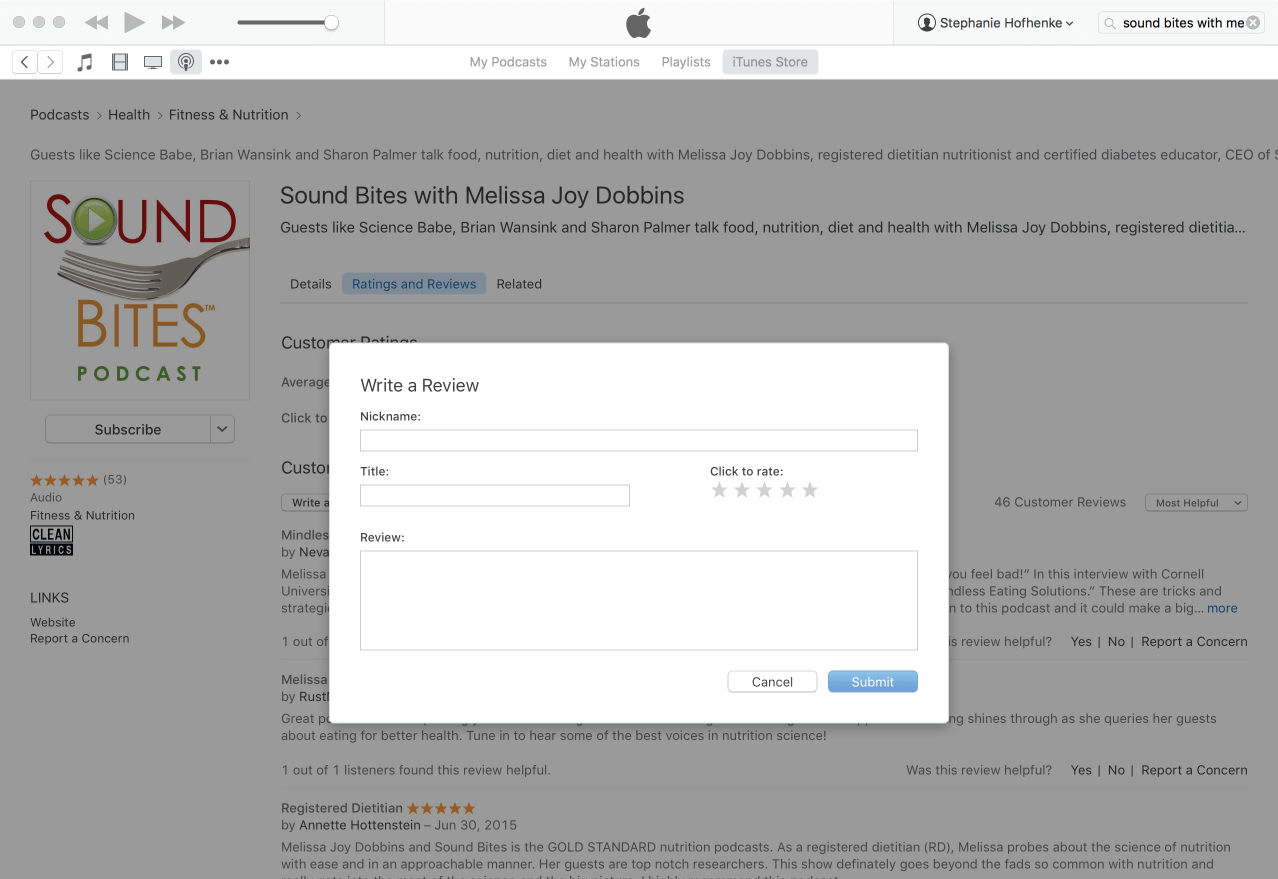
How to Review in iTunes
Open iTunes desktop application
Click iTunes Store
Click on Podcasts
Search for “Sound bites with Melissa Joy Dobbins”
Click on podcast image
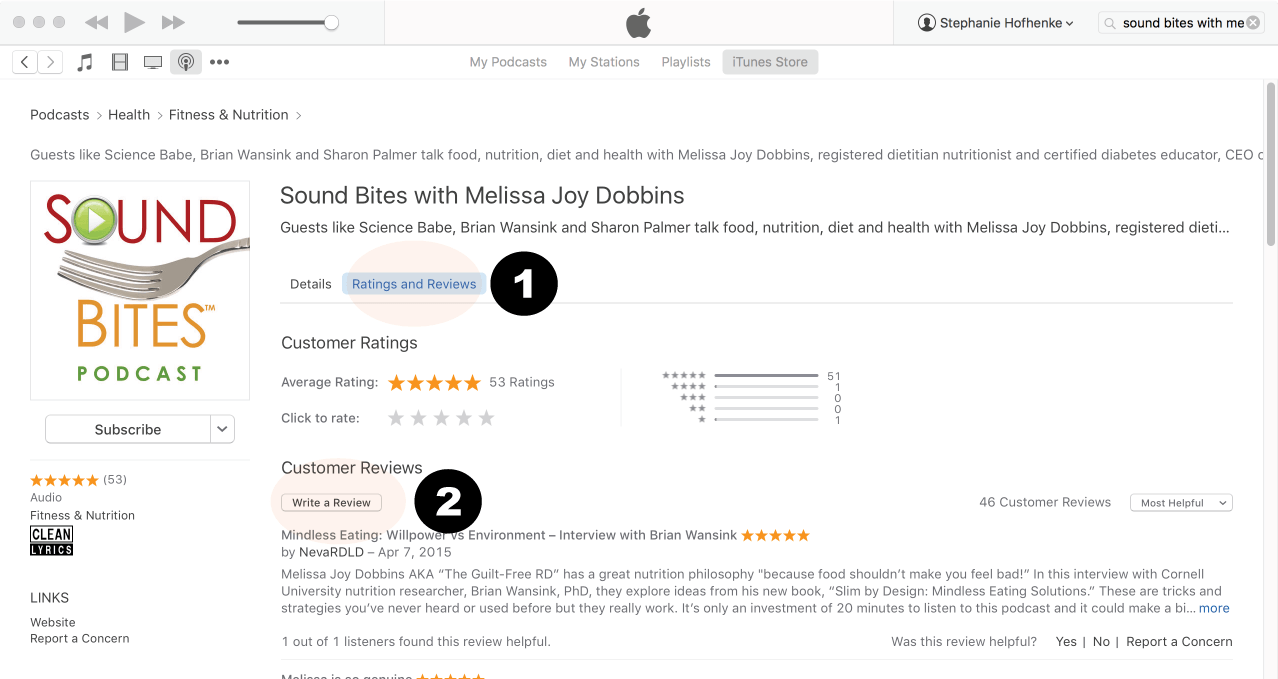
Search for Sound Bites podcast in iTunes
Click Ratings & Reivews
Click Write a Review
View reviews and write your own review.
Write your review…. Thank you!
Write your review!
How to subscribe via iTunes
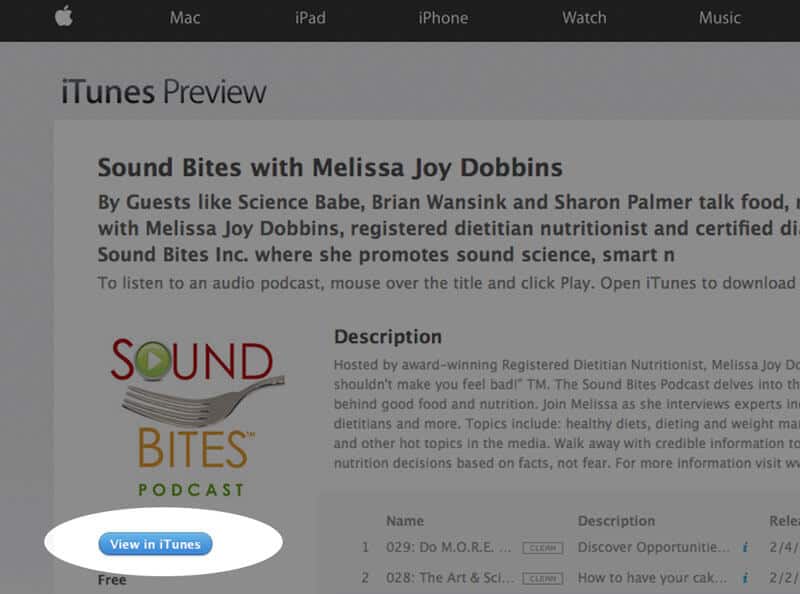
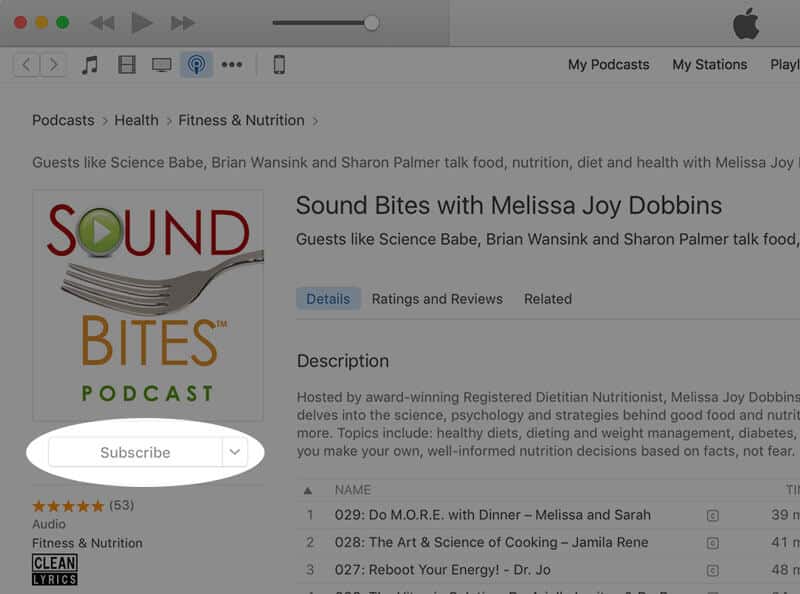
Click here to view the Sound Bites Podcastin iTunes, then click the blue “View in iTunes” button. This will open your iTunes application directly to Sound Bites Podcast. Click the “Subscribe” button, and your done!




 Tim D. McGreevy is the CEO of the USA Pulses Coalition which includes the American Pulse Association (APA), USA Dry Pea and Lentil Council (USADPLC), U.S. Pea and Lentil Trade Association, The Pulse Foundation and the following state pulse organizations in WA, ID, MT, ND, SD and NE. The mission of USA Pulses is to double U.S. pulse crop consumption and production. In his role as the CEO of USA Pulses, Tim is responsible for international and domestic market development, research, policy development, and expanding the pulse crop coalition. McGreevy serves as Chairman of the Finance Committee of the Global Pulse Confederation (GPC), an international organization representing the global pulse crop value chain. Tim received his Master of Science in Agricultural Economics from Washington State University.
 Chelsea is an award-winning registered dietitian, media personality, recipe developer, and nutrition expert in Nashville, TN. She runs a nutrition communications company and virtual private practice where she helps career-driven women plan and prep quick and easy meals on a budget. She frequently contributes to multiple media outlets––including Eat This, Not That!, Well + Good, MSN, and Eating Well.