Celebrating over 1 Million Downloads and 50,000 Free CEUs on the Sound Bites® Podcast | NEW: Get 1 years’ worth of CEUs with the new 15-CEU Podcast Course
There’s more to NASA than astronauts and engineers and there’s more to “space food” than freeze dried ice cream. Retired NASA food scientist Vickie Kloeris shares a sneak peek into her space food career with entertaining stories and situations that defy gravity.
Food scientists are the reason that you can walk into a grocery store and have hundreds and hundreds and maybe thousands of products to choose from, where that would not be the case if it weren’t for being able to process food. Food processing is important because it adds so much to the variety and the types of food products that are available to people everywhere.” – Vickie Kloeris
Tune into this episode to learn about:
the food science involved in feeding astronauts
the psychological importance of food in space programs
different strategies and technologies utilized to make food safe, convenient and tasty in orbit
challenges, solutions and stories about dining microgravity style
the role of registered dietitians in space food
why dietary monitoring in space is important
food science as a career path
the Institute of Food Technologists
Any profits I make from the book are going to go to food science scholarships for students.” – Vickie Kloeris
Vickie L. Kloeris, MS, CFS
Vickie L. Kloeris retired from NASA where she worked in space food systems for 34 years. For 29 of those years, she served as the NASA manager of first the Shuttle and then the International Space Station food systems. She has authored and co-authored numerous scientific publications and has received several awards including NASA’s highest civilian award, the NASA Distinguished Service Medal in 2019. During her career, she was twice awarded the NASA Exceptional Service Medal and received the Johnson Space Center Director’s Commendation Award. In 2017, she was given an Outstanding Alumni Award by the College of Agriculture and Life Sciences at her alma mater, Texas A&M University. She has authored a book about her career entitled “Space Bites: Reflections of a NASA Food Scientist.”
Resources
Some links may be affiliate links. As an Amazon Associate, I earn from qualifying purchases.
Welcome to Sound Bites, hosted by registered dietitian nutritionist Melissa Joy Dobbins. Let’s delve into the science, the psychology, and the strategies behind good food and nutrition.
Melissa Joy (00:22):
Hello and welcome to the Sound Bites Podcast. Today’s episode is about space food, space food, and the experiences and the career of food scientist and space chef Vickie Kloeris.
Vickie worked in space food systems for 34 years. She is the retired former manager of both the Shuttle and International Space Station food systems.
She has a bachelor’s of science in microbiology with a minor in chemistry from Texas A&M University, and a master of Science in food science from Texas A&M University.
She is a certified food scientist, which is a designation obtained from the Institute of Food Technologists, the professional organization for food science. And if you’ve listened to my show before, I have talked about IFT before. I love it and food technology is a very cool thing. But without further ado, welcome to the show, Vickie.
Vickie Kloeris (01:18):
Thank you so much for inviting me.
Melissa Joy (01:21):
I’m so excited to talk with you. You have a book out called Space Bites and your career is just fascinating, and there’s way more for us to talk about than we can cover in today’s episode.
I do want the listeners to know that the show is not sponsored, but I did receive a complimentary copy of your book Space Bites: Reflections of a NASA Food Scientist. So, thank you for that. It was a very fun read.
Vickie Kloeris (01:47):
You’re very welcome.
Melissa Joy (01:48):
We’ve had a call before this interview, and you were telling me how you stumbled upon food science your last semester of college. So, I’d really love for you to share that with our listeners. So, maybe we could start with how you stumbled upon food science.
Vickie Kloeris (02:04):
So, I was a senior microbiology major in the College of Science at A&M. And when I got ready to register for what I thought would be my last semester in college, I was short one hour of micro elective and my advisor in the College of Science said, “Why don’t you just go to one of your profs and do a white paper? It’s just an hour.”
And I looked at the list of approved electives and on the list was a food microbiology course over in the College of Agriculture and Life Sciences. And I said, “No, I want to take this course.” And he tried to dissuade me. He said, “Why would you want to do that? It’s a four-hour course with a lab and the whole bit.” I said, “No, I’m really interested.”
So, I went over and took the course and got very interested in the application of microbiology to the processing and preservation of food. And so, ended up going into food science for my master’s degree. And until that point I had never heard of food science as a degree track or a career. So, I definitely kind stumbled into it.
Melissa Joy (03:16):
And just curious, before you found out about food science and that whole career opportunity, what did you think you were going to do with your degree?
Vickie Kloeris (03:24):
Well, I really thought that I was going to end up being a clinical microbiologist somewhere. Like working in a hospital or something along that line in a hospital lab or something. Something of that nature.
Melissa Joy (03:37):
And then when you decided to go to grad school, there’s a interesting story about how that sort of kind of just happened as well.
Vickie Kloeris (03:45):
Yes. So, during this food microbiology course, over the course of the semester, they had some guest speakers come in. And one of the speakers that came in was Dr. Ranzell Nickleson, who ran the seafood technology lab at Texas A&M.
And so, he did three days of lectures on seafood microbiology. And at the end of the lectures he said, “I’m looking for graduate students. I’ve got two funded graduate positions; I’m looking for graduate students.”
And so, I took him up on his offer and that’s how I got my master’s with working in the seafood technology lab at A&M.
Melissa Joy (04:29):
Very cool. So, now I know that you grew up down the road from NASA.
Vickie Kloeris (04:34):
I did.
Melissa Joy (04:35):
Which is so crazy. Then you ended up working there for decades, how did you get that awesome job?
Vickie Kloeris (04:43):
Well, yeah, I mean I definitely was blessed to get the job that I got. And the way I got it was when I left A&M, I took my first job in Houston and I was working in a hospital there, and it was actually at the food plant for the hospital.
They made food for five area hospitals, and I was doing quality assurance, basically food safety for them. I had joined IFT as a graduate student and mainly I joined so I could get a cheaper hotel room at their conference.
But when I got to Houston and started working on a regular basis, I started attending the local IFT meetings, the local chapter. And I met some of the food scientists who were working down at NASA, and I thought, “That has got to be the coolest job that a food scientist could have.”
So, I said, “If you guys ever have an opening, call me.” And 18 to 24 months later I get a phone call and I went down and interviewed and went to work as a contractor in the food lab. And I was a contractor for four years.
And then when the woman who was managing the Shuttle food system, she got ill, unfortunately she had cancer and passed away and I transitioned over to become the civil servant manager of the Shuttle food system.
Melissa Joy (06:15):
Wow. Yeah. So, you manifested that job. And this is what I tell people all the time, because I mentor a lot of dietitians. Things happen when you just communicate with other people and you say, “Oh gee, it’d be really cool to work there.”
That’s how I got one of my favorite diabetes educator jobs. I just — some random person I met at a meeting, I said, “I would love to get back into diabetes education sometime.” And when she left the job, she emailed me, “Do you want to interview for this job?” This is how things happen.
Vickie Kloeris (06:49):
Yeah. Networking is huge.
Melissa Joy (06:52):
Yes. It really, really is. And I tell people this too, like at the end of the day, everything, it just comes down to people and connections and relationships. So, this is a proof positive of that.
So, before we dive into some of the stories and experiences of your amazing career at NASA, I want to talk a little bit more about IFT. You and I are both huge fans of IFT and we heard the story about why you joined, which I love it.
I just wanted to save some money on a hotel room, and then you’re like, “Wow, this is a pretty cool organization.” And you attended meetings, got involved.
And then fast forward to most recently, I mean, you were on the board of directors for three years and you are immediate past president.
Vickie Kloeris (07:38):
Yes. Well, I actually just rolled out of that position. So, in August of last year, I finished six years on the board of IFT, first three years on the board of directors and three years in the office of president.
It was an amazing six years. I learned so much about the organization and I learned so much about the food industry because of the people that I served on the board with. Because they came from a huge cross-section of the food industry.
Melissa Joy (08:09):
Right. And there’s certainly so many job opportunities, they mean that weren’t even there when I, when I got out of school. But this passion you have for food science and your support and investment in IFT and wanting people to know about this, I mean, this is really part of the reason you wrote your book, which we’re going to talk about.
But I don’t want to put words in your mouth, what do you want our listeners to know? My listeners are a mix of dietitians and other health professionals and the general public as well. You kind of have a mission to let people know about this whole world that a lot of people aren’t aware of.
Vickie Kloeris (08:50):
Well, yeah. One reason I wrote the book was to make especially students aware of food science as a potential career path. I think a lot of people know about culinary, they know about chefs. A lot of people know about dietetics and dietitians.
But not too many people know (I have found), about food science as a degree path and as an occupation. That these are the folks that work out in the food industry and develop new products. These are the folks that do quality assurance and food safety for food companies.
These are the folks that work for the government, USDA, FDA, do regulatory work. So, the demand is out there and there are good paying jobs in this field, but I find that not too many people know about it.
Melissa Joy (09:45):
I agree. So, thank you for all the work you’ve done and the work you continue to do to spread the word. Okay. So, let’s talk about your book. One of the reasons you wrote it is to let people know about this incredible opportunity to work in this space. But why else did you write it?
Vickie Kloeris (10:02):
Well couple of reasons. One, I think what initially put the spark in me was my first employer, my first boss at NASA on the contractor team. He passed away in the fall of ‘19. And I thought, yeah, at that time I got this little spark that it would be nice to write a book and dedicate to him.
And then when COVID hit in the spring of ‘20 and we were shut down, I thought, “Well, if I’m ever going to do this, now is the time.” And so, I probably wrote 90% of it during the COVID lockdown. And then after I got busy again with IFT and stuff it took me until the end of ‘22 really to finish the last 10%.
But I also wrote it to make people aware that there’s more to NASA than just astronauts and engineers. Because I had never really thought of NASA as an employer.
And one of the things that I learned, and I talk about in my book is there’s so much different expertise besides just engineering and being an astronaut that it takes to make a successful space flight.
And so, to me, writing the book and talking about food was just my way of showing off one of the areas of expertise that is required that people don’t really think about or aren’t aware of.
Melissa Joy (11:31):
Absolutely. As I was reading your book, it kind of dawned on me, people probably don’t think food is important or just kind of an afterthought for astronauts, but it’s really important because let’s face it, food is personal. Even an astronaut has food preferences and their habits and how they like to eat and want to eat can impact their emotions and their job performance.
Vickie Kloeris (12:01):
Yeah. And I talk about in the book how during the shuttle program when the missions were short, food was not a really big deal for most of them. But there were still some even during shuttle that still put a high priority on it. But that was a very small minority.
It wasn’t until we transitioned into long duration space flight that the psychology, the importance of the food from a psychological perspective became so huge.
Melissa Joy (12:33):
Right. And when I first was reading your book, I’m geeking out on the food science part, but then it just is really like, Oh my God. No, the psychology aspect is huge, and you bring stories and experiences out in the book that are just very compelling.
And we’re going to talk about some of those. But to your point, that’s what I realized as I was going through the book, is as the missions got longer, that provided more challenges from a food science standpoint and from a psychology standpoint.
Vickie Kloeris (13:08):
Yeah. I mean, shuttle missions were so short, we just didn’t need a real long shelf-life on any of the food items. But when we transition to space station, now NASA has to have a fairly large supply of food, usually three-to-four-month supply on board at all times. Because if something happens to a cargo flight, they have to have that reserve.
And so, by the time you produce the food, and you get it to orbit and it’s part of the reserve, and then they eventually get to it and eat it, they really need about a two-year shelf life on all the stuff that they’re sending as part of the core menu to ISS.
Melissa Joy (13:53):
I was thinking that I would dive into food science stuff first, but I think I want to build more on the food psychology conversations that we’re having.
And as you said, as those missions got longer and shelf life became more of an issue, and we’re definitely going to touch on some of the food processing aspects that are interesting as well.
But the logistics that you talk about in this book, it’s just like the planning involved and shipping food overseas and all kinds of different things. I don’t know how many of the stories we can get to, but that was a whole other piece to it.
But one of the things that was interesting in the book, you said that the astronauts as a group would have to kind of agree on some of the common food that was available and sort of negotiate with each other. Which was-
Vickie Kloeris (14:41):
Yeah. Now that was during the shuttle program because on the shuttle, in addition to their regular menu food, they usually had one to two trays of what we called fresh food. And it was added specifically so that things like apples, oranges, other citrus products that could last a while without refrigeration, that was where those went and that would go on …
Prior to launch we would put the fresh food items on, but in addition to fresh fruit and stuff in there, it was also a way for them to put their preference food on board. So, maybe their favorite candy bar, if it wasn’t part of the regular menu or their favorite beverage, maybe they liked a certain type of tea that wasn’t part of the menu. It could get packaged and go in there.
But on the typical shuttle flight, you had seven crew members and only one to two trays of fresh food. So, they had to agree as a crew how they were going to divide up that space. And so, that led to some interesting negotiations. But the commander of the flight always had the final say.
Melissa Joy (15:58):
Yeah. I’d like to be a fly on that wall. That’s very funny. And then tell us about the preference containers.
Vickie Kloeris (16:06):
So, for ISS, because the food gets sent up well in advance for the International Space Station, we started out trying to do a personal preference menu on space station, which we had done that on shuttle, and it worked well. The crew members would choose what they wanted for breakfast, lunch, and dinner each day.
And they would choose it from the list of available foods. And that worked great for shuttle because the crew member and the food were on the same vehicle, and they never got separated.
Well, when we went into the space station at ERA, we tried to continue to do that. And it, it really failed because the crew would go up, but the food would go up on the cargo vessels separately. And so, what would happen is the cargo flights would get delayed.
And so, we were not able to get all of the food that the crew member had chosen to him or her at the appropriate time. And so, they would come back and at the debriefs they would complain and say, “You promised me I was going to get what I selected. And part of the time I had to eat Joe Blow’s food and Joe Blow had terrible taste in food.”
And so, it became a real bone of contention, it was a problem. And so, when the first European cargo vehicle was going to fly, it was a brand-new cargo vehicle, had never flown. And so, NASA wanted to load it up with food and clothing.
They did not want to put any like one-off science equipment on there because they basically considered it a test flight and they were worried it might not get there. So, we knew there was going to be a lot of food on it, and we knew it kept slipping that flight kept slipping.
And so, we had no idea who was going to be on board. When that cargo vehicle docked. And so, the dietitian in our lab came up with a … we worked together to create a standard menu and presented that to the astronaut office and said, “This is what we’d like to put on this cargo vehicle since we don’t know when it’s going to get there or who’s going to be on board.”
And much to my surprise, they came back and said, “Not only do we want you to use the standard menu for that vehicle, we want to use it from now on.” And so, at that point, they agreed to the standard menu, but it’s packed pantry style.
So, that means there’s eight different categories, like all the meats are together, all the vegetables together, all the fruits together. So, even though it’s a standard menu, they’re not eating per the standard menu, they have all those eight categories open and at mealtime they go pick from those eight categories what they want.
But the caveat to get them to agree to this was that each crew member would have a certain amount of preference containers. And so, for a six month stay on the International Space Station, they get nine containers that are food preference containers, and they get five that are beverage preference containers.
So, that means NASA has 14 containers that they have to get there at a certain time, versus if they were doing a full preference menu, personal preference, it would be more like 70 or so containers.
And so, 14 is much more manageable. And so, that’s been the protocol since Expedition 16. And I think we’re on 69 or 70 now. I’ve kind of lost track. So, for a long time we’ve been doing this standard menu and it has worked really well.
Melissa Joy (20:01):
Yeah. And no one else is allowed to eat out of that particular crew member’s personal-
Vickie Kloeris (20:07):
Out of the preference. Right.
Melissa Joy (20:08):
Preference one. Right.
Vickie Kloeris (20:09):
Unless they give them permission. Yeah.
Melissa Joy (20:11):
Yeah. And so, this solution to a problem to have the standard menu actually turn out to be, hey, this is a good way to handle the menus moving forward. Because prior to that, it was all the crew members would select from a menu and they would get to taste everything and kind of rate what they liked and didn’t like, which would help them then select their menus. Right?
Vickie Kloeris (20:34):
Yeah. And they still taste everything on the ground prior to launch and they score it. We use the nine-point hedonic scale where nine is the top of the scale the best. And they still have to taste it on the ground because otherwise they would be tasting it for the first time on orbit. And we don’t want that to be the case.
And they use those scores because many of them, if they particularly like something from our menu and they want to eat it often, they’re going to have to put some of it in their preference containers because the standard menu is being shared by all of the crew members on board.
So, NASA feeds everybody but the Russians, the Russians send up food for the cosmonauts. NASA sends up food for everybody else that’s on board. Now they trade food back and forth all the time because it increases the variety that’s available to them.
But they are sharing those eight categories with the rest of the crew. And so, if they have their favorites, they want to eat a bunch, they’re going to have to put extra in their preference.
Melissa Joy (21:50):
And then there was the fellow that had shrimp cocktail three times a day every day.
Vickie Kloeris (21:55):
Yeah. That was during the shuttle program. So, shuttle crew members would do it differently. Like if it was a 10 dang flight, say some of them would choose 10 separate menus, 10 breakfasts, 10 lunches.
Others would just say they’d choose three days’ worth and say, repeat it for the duration of the mission.
But we had one crew member who chose the same menu, he was very unique. He was one of a kind in wanting to repeat the same menu every day and in having the shrimp cocktail be a part of every meal.
Melissa Joy (22:39):
Yes. And you even received thank you calls from the International Space Station, that had to be wild and crazy.
Vickie Kloeris (22:49):
Yeah. I mean, at first what I would get would be emails with thank you notes, but then along the way they added the capability for crew members to be able through mission control, to actually call people and talk to them on the phone.
And so, I was very surprised one day at my desk to pick up my phone, say hello, and realize that the person that I was speaking to was calling me from the International Space Station. And the way I could tell is because you definitely had a lag. There would be a silence in between. So, it was definitely obvious, but it was a big surprise.
Melissa Joy (23:37):
Wow. And they were thanking you for going to all the trouble to have their favorites and their food preferences.
Vickie Kloeris (23:44):
Yes. So, I can’t remember specifically what we had done for that crew member, but yeah. I mean, all crew members were grateful for the stuff that we did for their preference containers. Especially when it involved something a little more out of the ordinary than what we would normally put in there.
Melissa Joy (24:05):
Well, before we start talking about more of the food science aspect, one of your favorite stories in the book is a crumb story. And this ties in with some of the, the crew member preferences.
Vickie Kloeris (24:17):
Yeah. So, during my career, I never had a request for chips to fly because in bags they would just get crushed and be a mess. And so, I can remember when Pringles first came out in the can, some of the crew members were like, “Oh boy, we can take chips now.”
And so, we tried to advise them against that because they said, “Well, it is better protected in the can, but there’s still a lot of crumbs in the bottom of that can.”
And sure enough, after a couple of them had … we didn’t forbid them to take them, but after a couple of them had taken to orbit, the feedback came, “Oh yeah, we should have listened. That was a big mess.” And after that, we didn’t get requests. So, word got around, we didn’t get requests for those again.
Melissa Joy (25:11):
Because you have all these crumbs floating in the air basically. Right?
Vickie Kloeris (25:14):
Yeah. And they always talked about the fact that if you were the one that made the mess, you were the one that had to clean it up, whether it be with the shop-vac thing they had on board or a towel or whatever. But if you made the mess, you had to clean it up.
Melissa Joy (25:30):
And they said it just wasn’t worth it.
Vickie Kloeris (25:32):
That’s right. It wasn’t worth it. Yeah.
Melissa Joy (25:35):
Right. That’s funny. So, that also ties into one of the sections in the chapter, just dining microgravity style. So, tell us a little bit about what that was like for the astronauts, the crew members to dine with everything floating around.
Vickie Kloeris (25:51):
Well, there’s a reason that there was Velcro on the dining table and Velcro on all the packages because yes, they had to restrain things. And so, different crew members would do different things. A lot of them reported that they would just eat one thing at a time, hold the package in their hand, eat that, finish it, and move on to the next thing.
But some people would restrain packages on the table so that they could switch back and forth while they were dining.
But you’re definitely eating out of packages. And so, that affects how much aroma you get from the food. And down here, when you heat food, all the heat rises, and it brings the aroma with it to your nose.
In microgravity, that’s not so much the case. Heat can dissipate in different directions. And so, that’s another thing that kind of limits how much aroma they’re getting from the food. And they’re in a closed environment with a lot of other competing owners.
And I think we can all attest to the fact that when you have a cold and your nose is congested, that food doesn’t taste the same. Because you’re losing that aroma that comes through the back of your nose when you’re consuming something.
We’ve all had experience with that. And so, it’s the same for them. Anything that inhibits their ability to get aroma is going to make the food taste different than it does on the ground.
So, a lot of crew members anecdotally recorded that they felt like their taste buds were somewhat dulled on orbit. I really think that’s because they’re getting less aroma. And so, because of that hot sauce, very popular on orbit.
Our shrimp cocktail that had horse radish sauce in it, very popular. Other condiments, very popular on orbit because of that.
Melissa Joy (27:54):
That makes a lot of sense. Okay. So, let’s talk about some of the food science aspects and the freeze-dried food. I think this is what most people think about when they think about space food. It’s all freeze-dried.
Vickie Kloeris (28:04):
Sure. And that’s not, I think I said earlier, it’s about 25% ish of the standard menu.
Melissa Joy (28:13):
And then also tell me a little bit about the beverages.
Vickie Kloeris (28:16):
So, if you include beverages, those aren’t really freeze-dried, those are powdered or spray dried. So, it’s a little bit different process. So, if you included beverages too, as well as the traditional freeze-dried items, it would be more than 25% of the menu. It would be more like 40 or so, something like that.
But the obvious advantage of the freeze drying is the fact that the food weighs less. You remove the water, and you remove enough water to get the water content low enough that the bacteria that’s in the food cannot grow.
So, it’s not sterile though. So, we would sometimes have to remind crew members of that fact because the thermostabilized pouch products, those are really, you’ve killed when you heat treat the food in the can, or in our case in the pouch, you’ve killed all the bacteria in there.
And so, they’re called commercially sterile. They’re basically sterile, but the freeze-dried, that’s not the case. We test them to make sure there’s not pathogenic bacteria in there, but there’s spoilage bacteria.
So, as soon as they add the water, they either have to consume it or they have to throw it away because they don’t really have a refrigerator for leftovers. So, there were times when we would have to remind them of that fact that it’s not sterile once you add the water back, it can spoil.
Melissa Joy (29:47):
Interesting. So, how do they add the water into these freeze-dried packets?
Vickie Kloeris (29:52):
Okay. They have what’s called a rehydration station on the galley. And that basically consists of a dial where they can dial up the number of milliliters of water that they want to add to the product. And that the label tells them how much to add. They can dial that up and they can also choose whether it’s hot water they’re adding or it’s room temperature, ambient water that they’re adding. So, those are their two choices.
And the rehydration station has a needle on it. And the needle is designed to interface with the adapter on the package so that they can insert that needle into the septum that’s inside the beverage package and inside the freeze-dried package.
And so, that septum is a little slit, it’s a plastic valve, it’s got a little slit in it, and that needle inserts and hold that slit open so that the water can be injected from the galley into the package. And then once the needle is removed, that slit closes off to prevent the fluid from flowing back out of the package.
Melissa Joy (31:03):
Right. So, what types of foods would be freeze-dried?
Vickie Kloeris (31:07):
It can be a broad spectrum of foods. There’s entrees, main dishes that are freeze-dried. So, meat dishes, there’s vegetables there’s fruit there’s also desserts. So, it covers the gamut pretty much of the different types of food.
Same way with the thermostabilized. So, it’s not just entrees or it’s not just veggies. It’s some of everything.
Melissa Joy (31:35):
Interesting. And then there were some foods that you called intermediate moisture foods and natural form foods. Tell us about some of those and why they’re different.
Vickie Kloeris (31:45):
Okay. So, one big way that they’re different is they’re commercial off the shelf. Those are cots items. Those are not custom formulations done by NASA. They’re commercial items that NASA buys and repackages to send to orbit.
Intermediate moisture means that that product has had enough moisture removed that it can last a long time at room temperature, but it is still moist enough that it can be consumed without adding water back.
So, that’s like dried beef, dried fruit, things of that nature. Then natural form we really just called them that because they fly in their natural form. We don’t do anything to them other than repackage them.
And so, that’s your cookies, your crackers, your candies, your nuts, and your powdered beverages. Those are, I mean, even though we call them beverages, they’re still flying in their natural form.
The reason we repackage, there’s a couple of reasons we repackage. One is that any material that you put in the spacecraft in any significant quantity has to be tested for off gassing. They’re concerned about the chemicals that that material might give off since it’s a closed environment and the crew’s going to have to breathe whatever that gives up.
So, rather than testing all the different manufacturers’ packages, it is more cost effective and easier to package in a already approved material.
The other reason we repackage is to make them single serving because many of those products, almost all of those products are dried. So, they’re going to tend to float in microgravity. If you have them in a big bulk package, they’re going to be very difficult to deal with in microgravity because when you open a bulk package, everything’s going to tend to want to float out.
So, putting them in a single serving portion makes it much easier for the crew members to just cut that package open and work one or two items out at a time, rather than having to deal with a large quantity of food trying to float out.
Melissa Joy (34:04):
Thank you for explaining that. I was going to follow up and ask that. So, one of the chapters is called Pass the Bread Please. And so, I want to find out why tortillas and how tortillas became such a staple.
And it’s interesting because on the cover of your book, the astronaut is holding like a taco. And there was a certain crew member who introduced this idea and it just took off.
Vickie Kloeris (34:28):
I’d love to share it. So, when I first came to work there as a contractor, they were sending on the shuttle flights in the fresh food tray, they were sending sliced bread for the crew members to make sandwiches with.
And shortly after I came to work there, Rodolfo Neri flew. He was a payload specialist from Mexico. So, he flew on just one flight, but he asked to take corn tortillas with him. And so, we were able to put those in the fresh food locker for him, short duration flight. So, it was fine.
And when his fellow crew mates saw how easy it was to take a tortilla and roll it up and it was like having a sandwich without having to deal with two pieces of bread and all the crumbs that that bread made. And so, from then on, it was like, “We want tortillas,” except it was flour tortillas, not the corn tortillas that he took, but flour tortillas is what they wanted to take.
And so, we started sending those and it was interesting. We went out and we took samples. Houston has obviously a lot of tortilla places that are manufacturing tortillas. That was not the case at the time near Kennedy Space Center in Florida.
So, we went out in the Houston area, got samples from a lot of different manufacturers who were making tortillas and chose the one that had the lowest yeast and mold content, the best bacterial profile so that they would last the longest.
So, what would happen is the morning that the crew was going to leave for Florida on the NASA jets, one of our folks would go out, go to this facility, buy the tortillas, put them on the plane, and they got sent down to Florida and packed in the fresh food locker for that mission.
And so, that worked for a very long time because the missions were short enough that the tortillas would last.
But when the shuttle flights started getting longer, the crew members were like, “Well, we want tortillas all the way to the end of the mission.” And the fresh ones weren’t lasting that long. And so, we decided to look into an extended shelf-life tortilla.
Now the military made extended shelf-life bread products. They had a variety of bread products that they made for the meals ready to eat program for the rations for the troops out in the field. But they didn’t make a tortilla.
But we knew the technology that they used and what they did, the way it works is that you want to package the bread anaerobically without oxygen because that’s typically how bread goes bad or gets yeast or mold growing on it.
So, if you take away the oxygen, those things can’t grow. But there’s always a catch, there’s always a but. And in this case, the catch is if you take a regular old bread dough and package it anaerobically, you run the danger of anaerobic pathogens growing. And those can be pretty nasty.
So, what you have to do is you have to formulate the dough and put binders in it that bind the free moisture so that you reduce the amount of free water in the dough. And when you do that, then you can safely package it anaerobically and nothing can grow. Because if you get the free moisture, the free water below a certain level, no bacteria can grow.
We knew that’s how the military did their bread products. So, we did our own in-house, extended shelf-life tortilla. So, we were in the tortilla manufacturing business for a few years there, had the dough divider, the dough press, the whole thing and packaged them.
And then not too-too long, maybe a couple years, I can’t remember the exact duration, but a tortilla, a soft tortilla kit hit the grocery store shelves and it included the tortillas in the kit. It was for making tacos for soft tacos.
And it had a nine-month shelf-life on that kit. And we’re like, “That has got to be a low water activity. That’s got to be a low water activity tortilla.” So, sure enough, we got samples, we tested them, and they were low water activity. We found out who was making them for that kit and started buying those in package them. So, we were able to get out of the tortilla manufacturing business.
Then probably maybe five years ago or so, the military started having a extended shelf life tortilla that they were packaging. So, actually a company in San Antonio, Texas that has the contract for the extended shelf-life breads. And they were now producing a tortilla.
And so, we got samples of that and compared it to the ones we had. And it was interesting because we got all the food scientists in the lab, and we did a taste test. And some people said they thought ours were better. Some people said they felt the military one was better, some said they couldn’t tell the difference.
Well, when we did a little research, we found out that the people who couldn’t tell the difference were the ones who had it. Because the military wasn’t actually making them, they were buying them from the same people we were buying them from and packaging them.
So, now NASA can buy them prepackaged, so it’s even less, they don’t even have to package them now. And those tortillas have about a two-year shelf-life, which is perfect for the International Space Station.
Melissa Joy (40:34):
Very cool. Thank you for that story. In the book you talk about monitoring the food intake of the astronauts and/or the crew members. I don’t remember if it was both. Why do you do this?
Vickie Kloeris (40:46):
Well, it’s important from a health perspective. So, the flight physicians, the flight docs really like to be able to monitor what the crew … how they’re doing nutrition wise. And especially fluid wise, it is really important to stay well hydrated on the orbit. That’s a big deal.
But the dietary monitoring really got started because of some of the science, some of the medical science experiments that were aboard the shuttle. So, there were some experiments that required that the crews keep track of everything they ate, not for the whole flight, but for certain days or a certain length of time during the shuttle flight.
And so, in order to facilitate that, when they first started doing that, they were literally having to log it in some kind of log by hand. And so, we pretty quickly, the nutritional biochemistry lab we got together and said, “Okay, we need to put barcodes on these products,” so that rather than them having to log it by hand, they can use a barcode reader and scan the barcode of the things that they eat.
And so, now we do have a barcode. That’s when we instituted the barcode on all the packages. But after that, several years after that, they created an app that allows them to use those barcodes, scan them, and it will automatically record everything they eat.
So, now it’s even better because they were just during the monitoring, during experiments, but now they can do it all the time if they want to. And their flight surgeons encourage them to do that because then the flight surgeon has that data available to make sure that they’re getting enough of the critical nutrients and especially enough fluid intake.
Melissa Joy (42:45):
Interesting. And you mentioned a little bit earlier about the dietitian involved with some of the menu planning. Were dietitians involved with any of this monitoring in the data collection and maybe what they do with the data?
Vickie Kloeris (42:59):
Absolutely. In the food lab, we’ve always had a dietitian and she would help with menu planning, and she or he would help when we were developing new products to look at the nutritional profile of the things that we were developing.
But NASA has a separate nutritional biochemistry lab where all the research, the nutrition research is done. And those dietitians are the ones who supported the medical experiments when they needed to collect data.
And then they would interpret all that data when they got it for use in the research to give to the researchers who were doing the medical experiments. And they were involved in helping, of course they had computer people, but they were involved in helping develop the app and how it would work and how they could interpret that data from the app.
So, the people on the ground, the nutritional biochemistry lab gets that data, but then also the flight surgeons get that data.
Melissa Joy (44:01):
Very cool. I would love to hear a few more stories. I think one of the funniest things that made me laugh out loud in the book was, I believe it was when you were working with some of the Russian cosmonauts, but I’m not a hundred percent sure, but you had labeled the Fiesta Chicken.
Vickie Kloeris (44:20):
Yes. In the early 90s, when we partnered with the Russians and started having cosmonauts fly on the shuttle, all of our shuttle crew members would come in because shuttle was a 100% personal preference menu. So, they got to choose from the list of available foods exactly what they wanted.
So, we would do taste panels for them. We would bring them in and do food sessions where they got to try all the different foods and we would do multiple sessions with them. And so, it was interesting to understand, like when we first started doing food sessions for the cosmonauts we could not get them to try a separate vegetable.
So, the green beans, the whatever veggies we had, they were used to that being part of a casserole in their cuisine, not a free-standing package of green beans or something like that.
So, at first, we had a hard time getting them to even try some of those products because it was so different from their culture. And the names were a problem because we had a product, specifically you referred to as Fiesta Chicken.
And when we started having cosmonauts on board, they asked us to add Cyrillic, the Russian words to the label as well. And so, when the cosmonauts looked at Fiesta Chicken, now most people in the U.S. would know that Fiesta Chicken probably meant that that had spices from the southwest in it, a southwestern flare to the cuisine. But the Russians looked at it and asked us, “What is a party chicken?”
Melissa Joy (46:12):
That’s so cute.
Vickie Kloeris (46:12):
What is party chicken? And we had the same problem the other way too, because I remember there was a product that when you translated the Russian name into English, it was appetizing appetizer. And so, that told you nothing about the product.
Melissa Joy (46:32):
That’s a great, I’m going to use those terms moving forward somehow, the appetizing appetizer. I love it.
What would you say were some of the biggest food science challenges you faced at NASA? I know we talked about kind of the running theme here is like the longer the missions were posed some challenges, but were there any other like, major challenges that come to mind that you can share with us?
Vickie Kloeris (46:58):
Well, I think I briefly mentioned before, but part of it was educating the crew members about what they could and could not do with the food. Because not all of them, like I said, completely understood that some of those things could spoil, just kind of training them to focus on what the potential food safety hazards were if the food was mishandled.
And to explain to crew members I remember in particular a shuttle flight was going to take off, go up to the ISS and bring back a crew member who had been on orbit for some time.
I don’t remember if it was four months or six months but during quarantine for that shuttle launch, one of the crew members came up to me and said “I’ve been emailing with this crew member and what he really wants is a hamburger. He’s just dying for hamburger. Could we possibly put a hamburger in the fresh food locker and take it up with us to give to him?”
And I was so taken aback by that I didn’t quite know what to say, because what I wanted to say was, “Now think about it, if we put that hamburger in the fresh food locker, best case, it would be two days old by the time it got to him. Would you really eat a hamburger after two days of it sitting on your kitchen counter?”
I mean, if you thought about it logically, you would say, “Heck no. I wouldn’t do that.” But he so wanted to give his friend what he wanted, but I had to just carefully say, “We will have a delicious juicy hamburger waiting for him at Kennedy when he lands.”
Melissa Joy (48:53):
Wow. Yeah. So, a lot of food safety education that’s fairly interesting.
Vickie Kloeris (48:56):
Yeah. And go, going forward, the big challenge for NASA for a food system for Mars is shelf life. Because the Mars mission is going to take so long, right now, best case scenario, propulsion wise, it takes about six months to get to Mars and you’ve got to wait until Mars and Earth are close together so you can make that trip.
And so, after they get there, they’re going to have to stay there something on the order of at least 21 to 24 months before the Earth and Mars get close together again so that they can come home. And then it’s another six months coming home.
So, you’re looking at roughly a three-ish year mission. And they’re not going to be able to take all that food with them. A lot of that food’s going to have to be prepositioned before they get there.
And so, because of that, the food that they eat on the return trip could be on the order of five-years-old at least. And depending on how they pre-position it, whether they do that with a chemical rocket or a solar powered rocket, it could even be older than five years.
And so, that is the challenge because from a food safety perspective, these technologies freeze drying, thermostabilization, spray drying, those could make foods that last and are safe to eat for that length of time.
You can stop the microbial growth. What you can’t stop is the chemical changes that occur in the food. So, over time, the color’s going to degrade. The texture’s going to degrade. The nutrient content is going to degrade. Not all nutrients, but some nutrients are susceptible to degradation over long storage periods.
So, the challenge is how to have food that still looks and tastes really good for that return six months back from Mars so that the crew members will continue to eat and have enough variety that they’ll continue to consume enough calories, and from a psychological perspective, have it be a food system that’ll support them so that they can be at high performance even on that return trip.
Melissa Joy (51:22):
Wow. Well, and that reminds me, you have a story in there about how you had the opportunity to eat some really old food. What happened there?
Vickie Kloeris (51:30):
Yeah. So, not too long after I came to work there, the building that we had been in, they moved the food lab out of that building because the building got really crowded. They needed extra space. So, they moved us to another building on site at the Johnson Space Center.
And it was kind of a plus for us because they renovated an area for us. So, we got a really nice, nicer facility than what we had before. But when we moved from the old building, there were number 10 cans, so large cans of the old, cubed food that they had flown during the very early Apollo and Mercury and Gemini missions. And we no longer had space for those.
And so, we had to open all those cans. We couldn’t just dispose of them because they were concerned that somebody might pick them up and try to do something with them.
So, we had to open them up and discard them. And in the process of opening them up, we tasted all of them. And so, this food some of it was a decade old. So, it was interesting. And most of it still was quite palatable. It still tasted pretty good.
Some of the stuff that had a higher fat content, you could tell that the fat was a little bit on the rancid side. So, it had a little bit of an off taste to it, but they were off certainly safe to eat from a microbiological perspective, but it was a very interesting opportunity to try some of that stuff that was really, really old.
Melissa Joy (53:13):
Yeah. Wow. Very cool. And very interesting and very rare, I would say. So, a lot of the work you ended up doing over your decades at NASA, you talk about, it was a little unexpected, this outreach very early on in your days, you did a CNN interview.
And I know there’s a lot of different ways that you did outreach. I’d love for you to kind of recap some of that as we’re wrapping up. Because I know that it’s kind of interesting. As a dietitian, I didn’t think about communication being a big part of my job, but my regular listeners know that on the first day of my second job as an outpatient dietitian, TV crews came, and I did a TV interview and it sort of set the stage for the rest of my communications experience.
But you really enjoyed doing that, whereas a lot of people don’t. So, I would love for you to talk about that.
Vickie Kloeris (54:07):
Yeah. So, my very first opportunity came just a few months after I came to work in August of ‘85. And Thanksgiving came around and being a new employee and a new contractor employee, I didn’t have any vacation for the holiday period. And everybody else in the lab pretty much did.
So, all of our veteran technical people, food scientists, packaging engineer, et cetera, they were gone. And so, we happened to have a shuttle flight up and CNN wanted to do an interview.
And so, I got tapped on the shoulder and the next thing I knew, I’m over in the mockup talking about food. And with John Holman from CNN. It was scary at first because I had never done anything like that. But I did find over time that I really enjoyed doing the tours.
We did a lot of tours for students, for teachers, for other people within NASA who needed to know about our operation, like the people who did shipping for us and those kind of things so that they knew how our system worked and what our needs were.
So, tours were a huge part of what I did. And then the public affairs people also called on us many times to do different events. We did a show with Rachael Ray, did some filming for her for one of her shows. We did an event with Emeril Lagasse and others over the years.
The food lab was kind of a showcase for our people coming in. If we had VIPs or people coming to tour NASA and spend a day at NASA or maybe two days at NASA, very often, part of that would be a lunch in the food lab where they would come in and we would serve them a flight food lunch.
But of course, it would be a little more elegant in that they would be eating it off of plates versus out of packages. But we would do briefings for them while they ate lunch. We had one center director who, it was his favorite thing to bring people to the food lab.
And I think we did more space food lunches during his tenure as center director than maybe all the others combined that we did during my career. So, there was a lot of outreach involved and I’ve out that I really enjoyed it.
And so, I volunteered to do a lot of it because some of my colleagues in the lab, they would do it and they would do a good job of it, but they weren’t necessarily as interested in doing it as I was.
Melissa Joy (57:07):
Great. And you had a lot of fun too. You met some pretty big stars.
Vickie Kloeris (57:11):
Yeah. One of the most memorable for me is the Apollo 11 cast came before they did the movie. They were scoping out places to film. And so, in this case, we did a space food breakfast and Tom Hanks and Ron Howard came. And it was interesting.
I can remember when Tom Hanks came in, one of the first things he did was to show us his tennis shoes because he had on his Forrest Gump tennis shoes. And Ron Howard had his wife and one of his daughters with him.
And so, it was interesting. They were very, very interested in what we were doing. I mean, they were very nice, very interested. And I always enjoyed that because we had some visitors who would come to the lab and we would do the space food luncheon and they would listen attentively.
But you could tell the ones who were genuinely interested in what we had to say and the ones who weren’t as interested. So, it was always a thrill to find someone who really wanted to learn about what we did and were excited about what we had to say.
Melissa Joy (58:29):
Well, that’s wonderful. And in your retirement phase here, you’re still doing a lot of outreach. Tell me about some of the programs that you’re working with. I think you’re working with some students. I think you’re still doing some stuff for IFT, what do you got in the works?
Vickie Kloeris (58:45):
Well, this summer with my book, I’m actually going to be visiting several different space camps this summer, like the Kansas Cosmosphere and some museums that are doing programs for kids. And so, I’m going to be doing some lectures talking similar to what we’re talking about, some of the anecdotes from my career.
And I really like to talk to kids and make them aware of food science as a career path. Not space food science per se because there’s not a huge demand for space food scientists, but there is a big demand for food science graduates in the industry and in government.
So, I think it’s important to make people aware. And I was just looking online, IFT has a chat room as part of their website. And I just read something yesterday where a lady was saying, “I’m doing stuff for my kids’ school and middle school and high school and nobody’s aware, food science or very few are aware of food science as a career.”
So, we need to make a big effort to get the word out. And so, this is my way through the book of getting the word out.
Melissa Joy (01:00:05):
Yeah, absolutely. And I’ve said this on the show before, but I don’t think I’ve said it in our conversation. Whenever I have attended the IFT first conference that’s in Chicago, every summer in almost every session I go to either one of the speakers or one of the audience members brings up the fact that food scientists need to communicate more.
They need to do more with communications, whether it’s, like you said, to let people know about the careers available, but also just what they do and, and all the different types of aspects to the career. And just getting people to know more about food science in general.
Vickie Kloeris (01:00:46):
Yeah. And food scientists, food processing, if you will, which is what food scientists facilitate is food processing has gotten kind of a bad reputation right now. I mean, there’s a lot of stuff in the press. And I’ll admit, you know, not every processed food is good for you, but it’s kind of all things in moderation too.
But I think it’s important for people to understand, yeah, it’s great. Locally grown food, locally obtainable stuff, fresh stuff, yeah. That’s the healthiest, but we can’t all get that. And usually what we can get locally that’s fresh off the farm or whatever, it’s going to be limited in variety.
Because you can only get what’s growable in your particular climate. Food processing is important because it adds so much to the variety and the types of stuff that’s available to people everywhere.
So, food scientists are the reason that you can walk in a grocery store and have hundreds and hundreds and hundreds, maybe thousand of products to choose from, where that would not be the case if it weren’t for being able to process food.
And it’s a fine line because there are things that are added to foods that probably aren’t that good for you. But at the same time, when people are concerned about a particular ingredient and say, “This has been shown to cause cancer,” well, you have to look at yeah, but how much of that ingredient had to be there before it was an issue.
When studies come out people don’t often get to the fine line on the study and really look at what it’s saying. They just look at the headline. And so, that can be a problem in interpreting that. So, there’s good and bad to food processing.
Melissa Joy (01:02:51):
Right. Well, thank you for sharing that. I, I talk about processed foods a lot on the podcast and the importance of food processing from a food safety standpoint. From like you said, a variety accessibility standpoint and some of the food processing enriches the nutrition, fortified and enriched foods from a public health standpoint. Yeah. That’s really important.
So, thank you for putting a finer point on that. I appreciate that. As we’re wrapping up, what do you want people to know about the book? It’s a fun read and I really enjoyed it but tell us what you want people to know about the book and where they can connect with you and get the book.
Vickie Kloeris (01:03:32):
So, what I want them to know is that, like you said, it’s a fun read. It’s appropriate for middle school and up. It’s a paperback, so it’s inexpensive. I deliberately did it that way because I wanted kids to make it afford as affordable as possible for students.
And I want them to know that any profits I make from the book are going to go to food science scholarships for students. And it’s available at ballastbooks.com, but it’s also available on my website, vickiekloeris.com. There’s a link to Ballast Books to be able to buy the book.
Melissa Joy (01:04:12):
Excellent. Thank you. And thank you for donating all the profits to such a great cause. And I will of course have all the links to that in my show notes at soundbitesrd.com. Is there anything else you wanted to share with us before we sign off?
Vickie Kloeris (01:04:27):
No, I don’t think so. I just want to thank you for giving me this opportunity to tell my story and I appreciate the work that you do.
Melissa Joy (01:04:36):
Thank you so much, Vickie. I have enjoyed this so much. You have become the most interesting woman in the world to me right now.
Thank you for writing the book and thank you for coming on the show and for everybody listening, if you like this episode, share it with a friend. Tell someone about the podcast, check out some of the other episodes.
You can listen on any podcast app wherever you consume podcasts, or on my website at soundbitesrd.com. And as always, enjoy your food with health in mind. Until next time.
[Music Playing]
Voiceover (01:05:12):
For more information, visit soundbitesrd.com. This podcast does not provide medical advice. It is for informational purposes only. Please see a registered dietician for individualized advice. Music by Dave Birk, produced by JAG in Detroit Podcasts, copyright Sound Bites, Inc. All rights reserved.
LISTEN, LEARN AND EARN
Listen to select Sound Bites Podcasts and earn free CEU credits approved by the Commission on Dietetic Registration (CDR) for registered dietitian nutritionists and dietetic technicians, registered. Get started!
Get Melissa’s Sound Science Toolkit here!
Partnerships:
Sound Bites is partnering with the Association of Diabetes Care and Education Specialists (formerly the American Association of Diabetes Educators)! Stay tuned for updates on the podcast, blog and newsletter!
Sound Bites is partnering with the International Food Information Council! Stay tuned for updates on the podcast, blog and newsletter!
Sign up for my monthly newsletter and episode eblasts so you never miss an update!
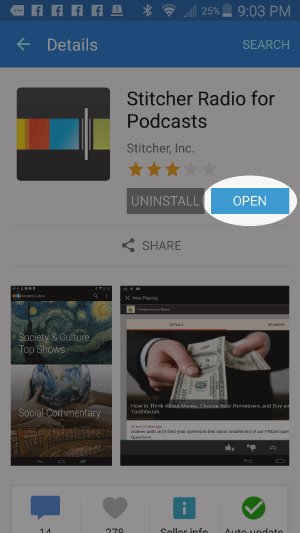
Listen on Stitcher (Android)
Install the Stitcher App
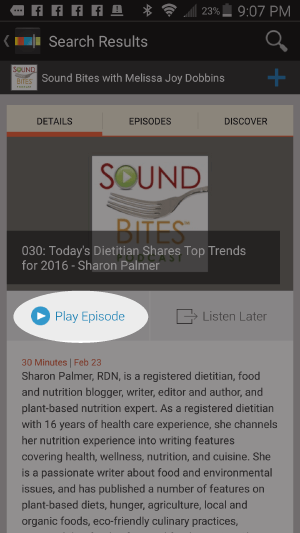
1. Search for “sound bites with melissa joy dobbins” 2. Choose Play Current Episode or Add to Playlist
Choose “Play Episode”
Subscribe & Review on iPhone
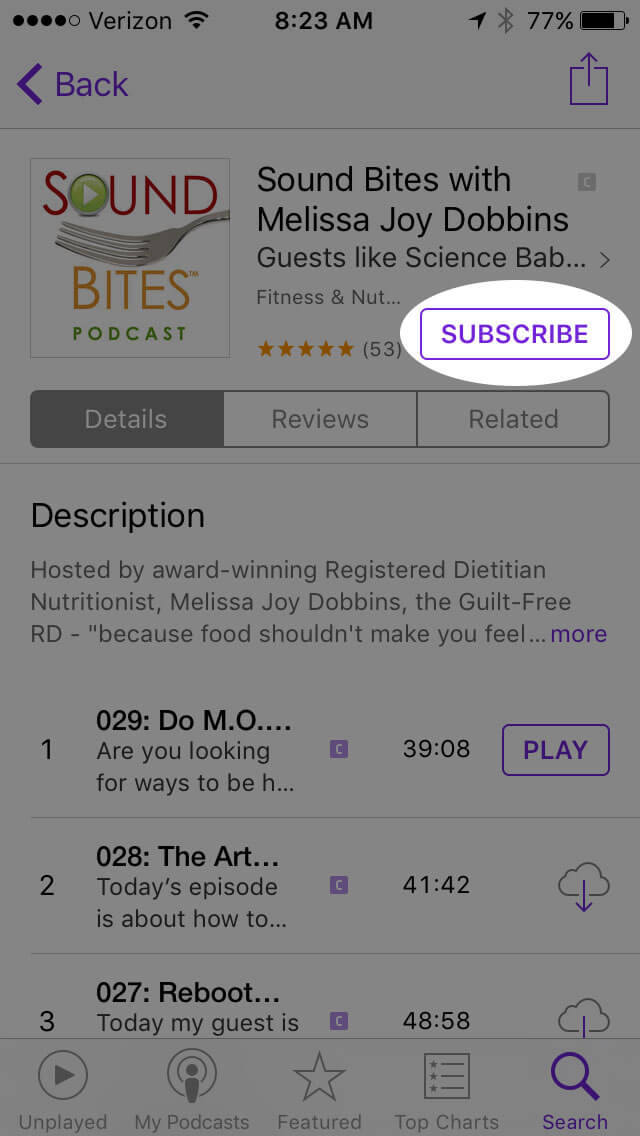
Open the “Podcast” app on your iPhone
Search for “Sound bites with melissa joy dobbins”
Open the podcast and click “Subscribe” and your done!
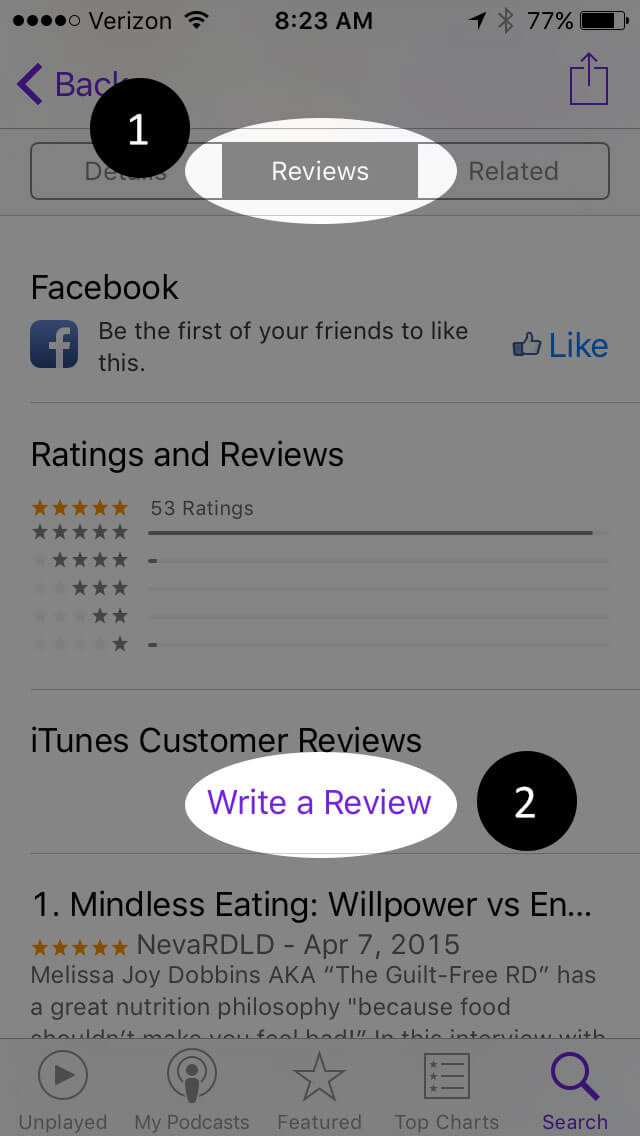
Write a Review
Click “Reviews”, then “Write a Review”.
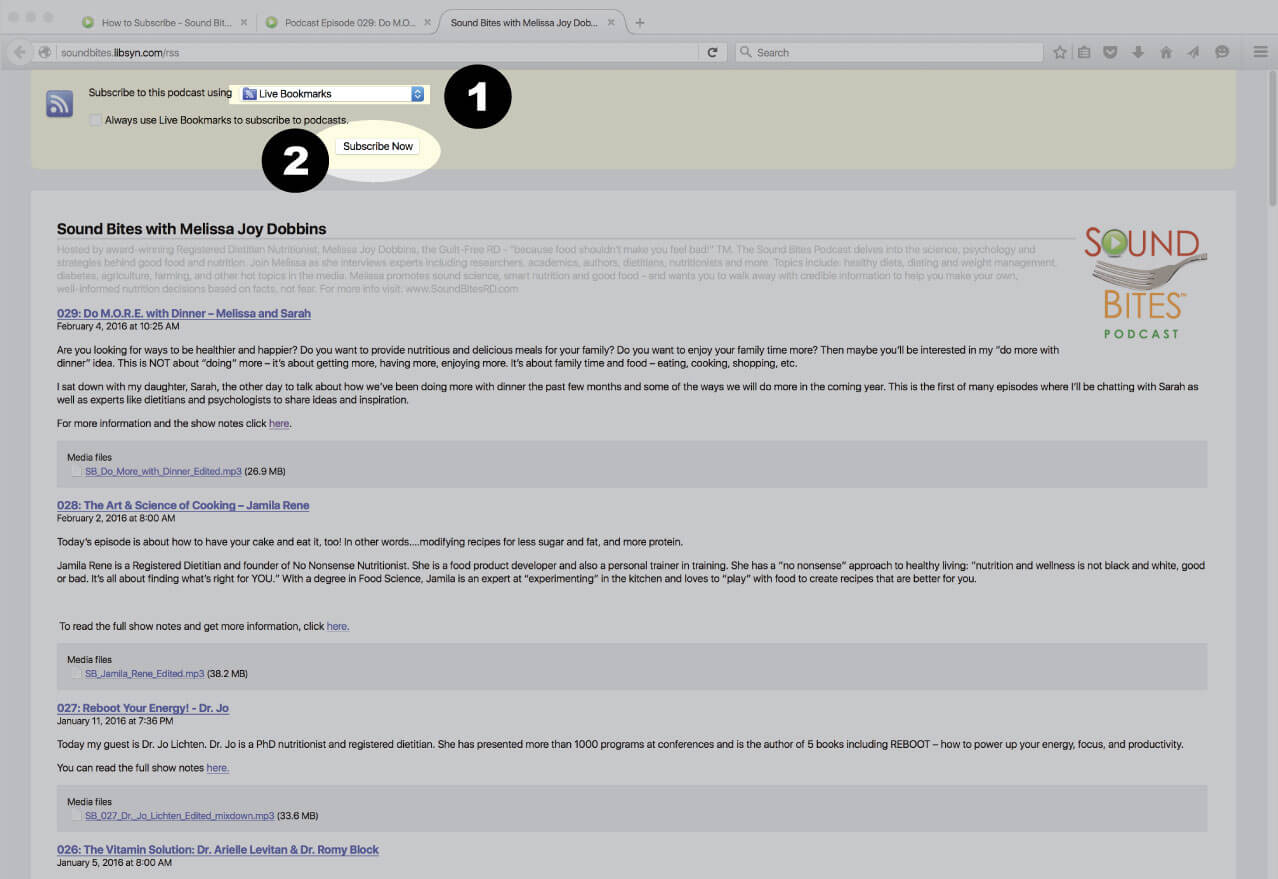
Subscribe via RSS Feed
Navigate to any podcast player . Click on the RSS feed icon.
Click on the RSS feed icon.
Click on RSS Feed
Choose which application you would like to use to receive the RSS feed
Click “Subscribe Now”
Confirm settings and subscribe.
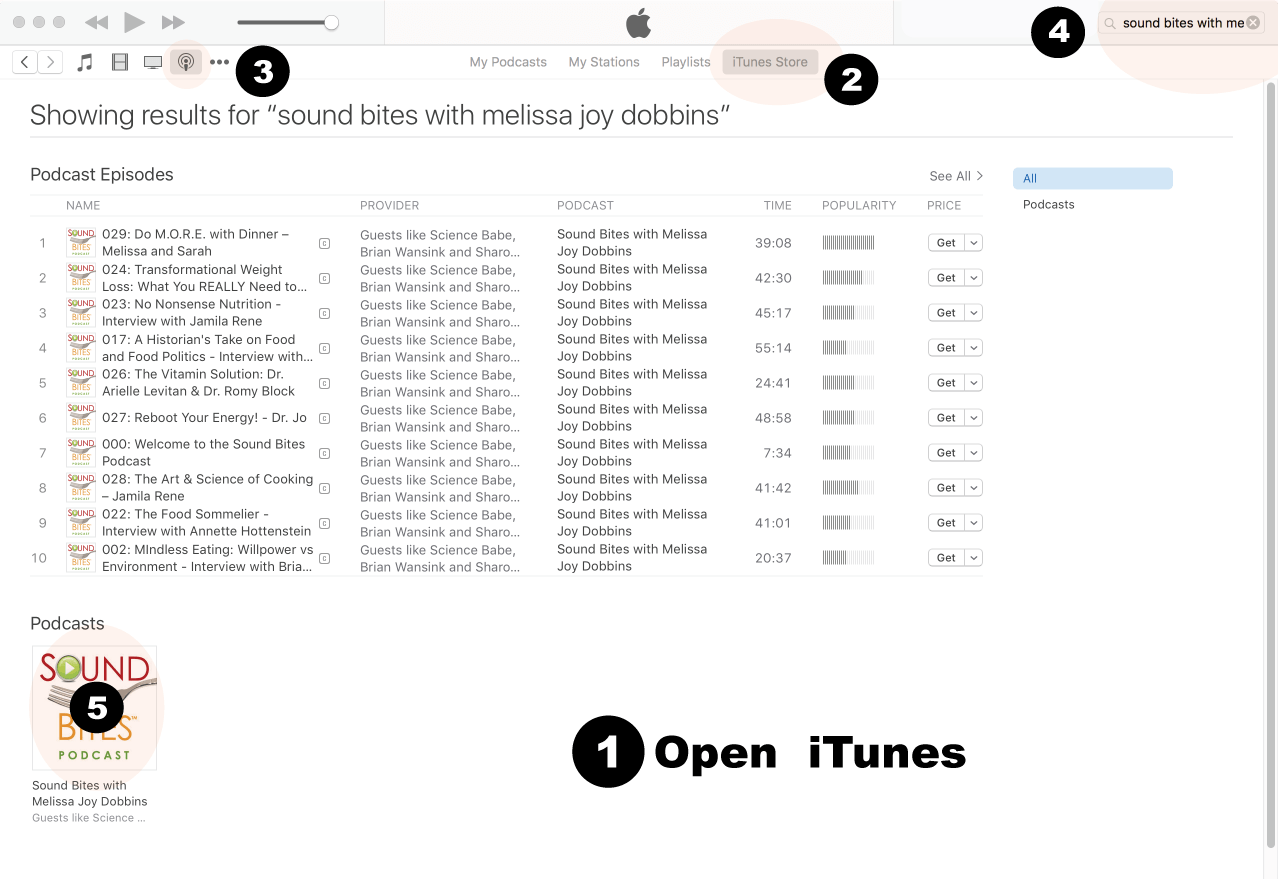
How to Review in iTunes
Open iTunes desktop application
Click iTunes Store
Click on Podcasts
Search for “Sound bites with Melissa Joy Dobbins”
Click on podcast image
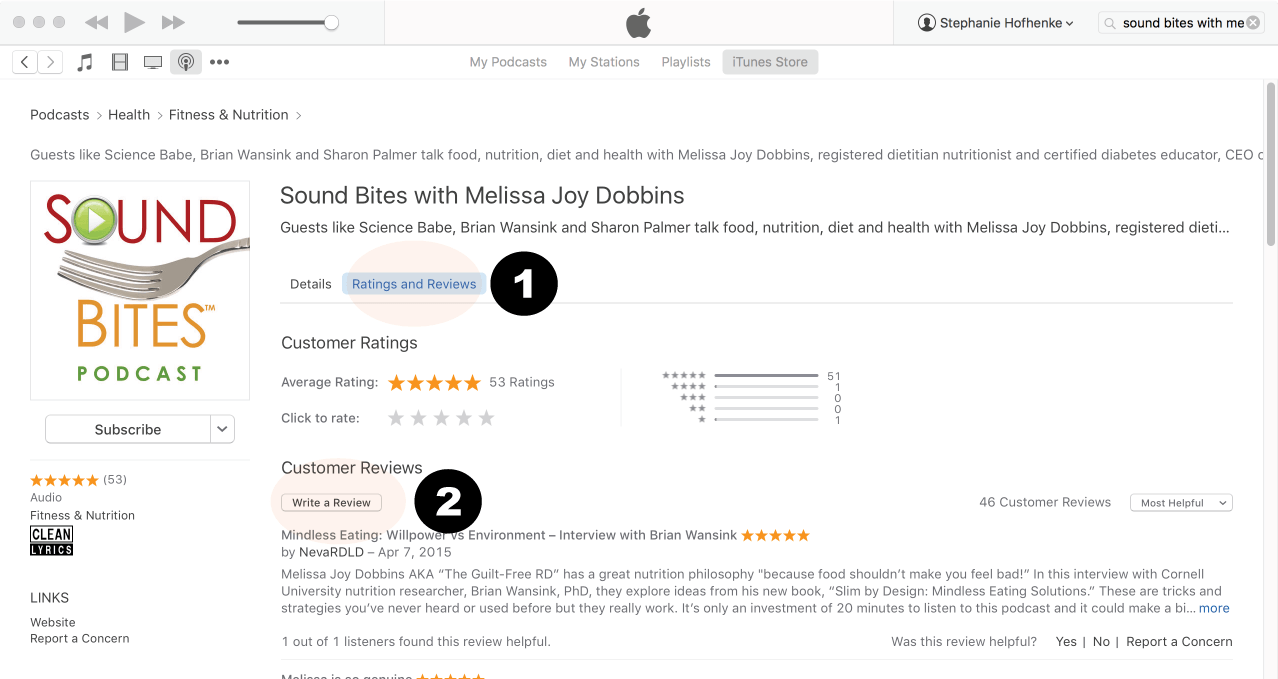
Search for Sound Bites podcast in iTunes
Click Ratings & Reivews
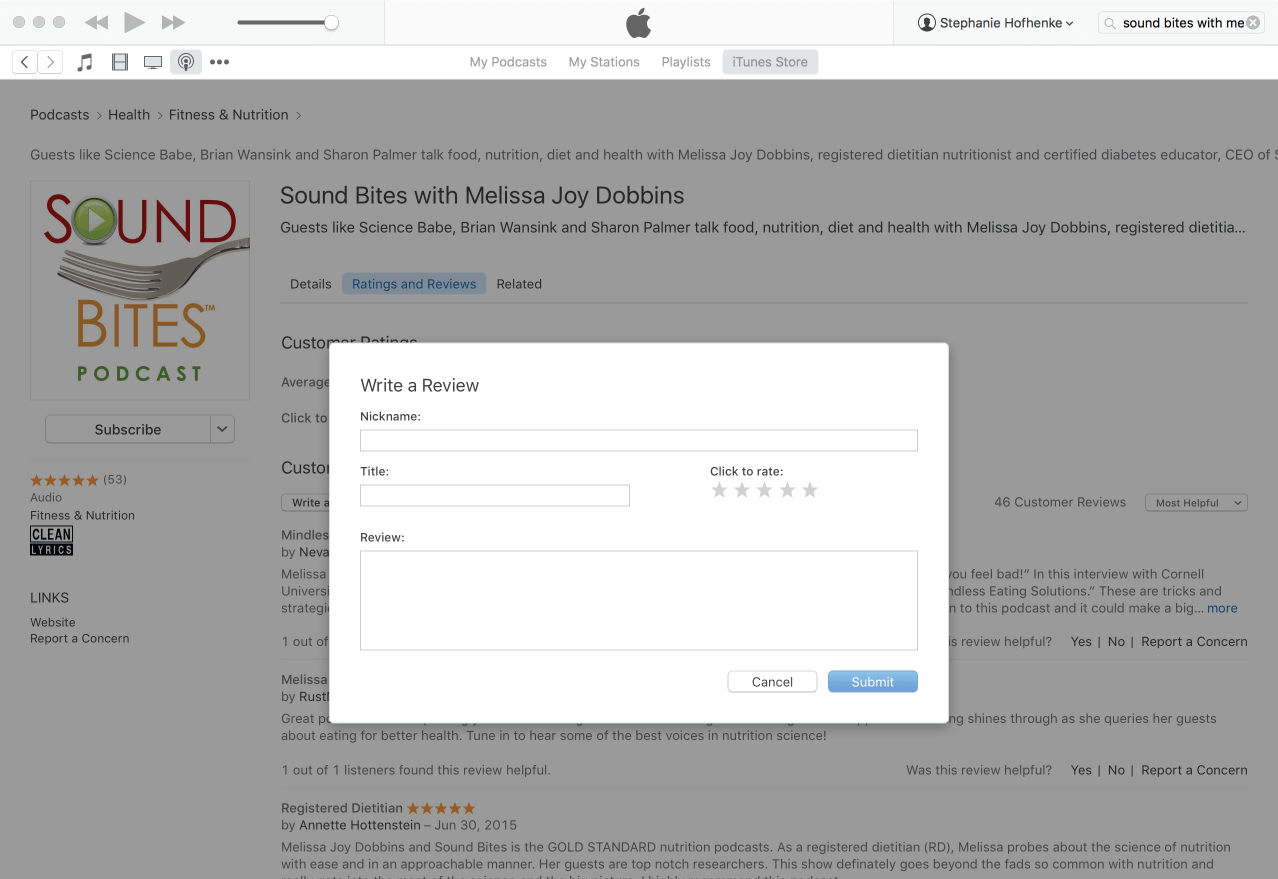
Click Write a Review
View reviews and write your own review.
Write your review…. Thank you!
Write your review!
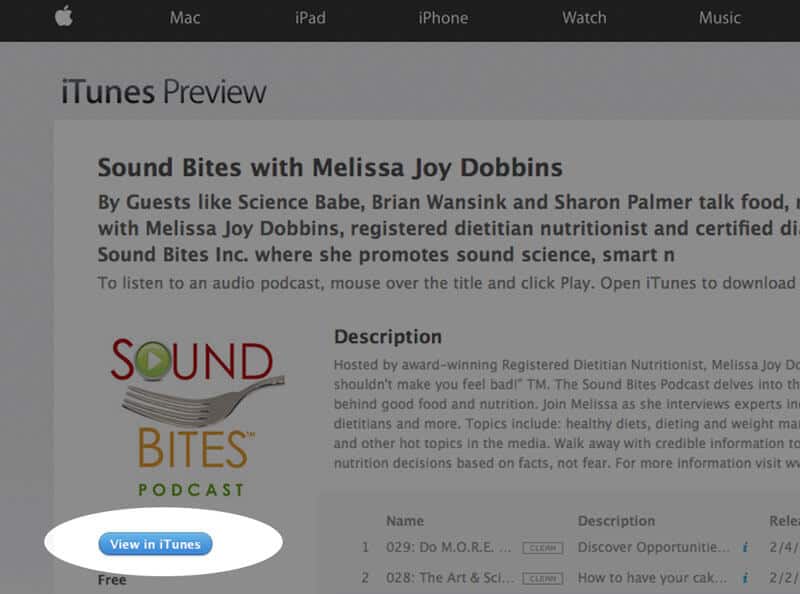
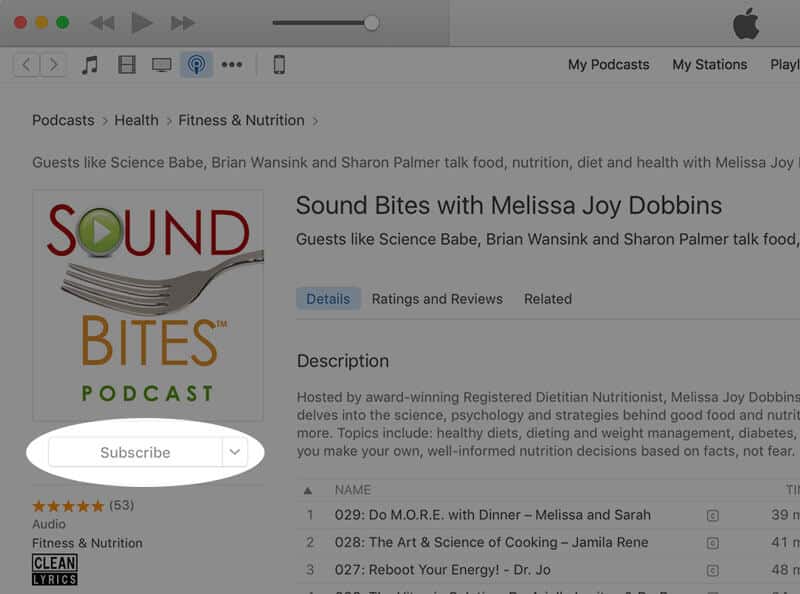
How to subscribe via iTunes
Click here to view the Sound Bites Podcastin iTunes, then click the blue “View in iTunes” button. This will open your iTunes application directly to Sound Bites Podcast. Click the “Subscribe” button, and your done!




 Vickie L. Kloeris retired from NASA where she worked in space food systems for 34 years. For 29 of those years, she served as the NASA manager of first the Shuttle and then the International Space Station food systems. She has authored and co-authored numerous scientific publications and has received several awards including NASA’s highest civilian award, the NASA Distinguished Service Medal in 2019. During her career, she was twice awarded the NASA Exceptional Service Medal and received the Johnson Space Center Director’s Commendation Award. In 2017, she was given an Outstanding Alumni Award by the College of Agriculture and Life Sciences at her alma mater, Texas A&M University. She has authored a book about her career entitled “Space Bites: Reflections of a NASA Food Scientist.”