Celebrating over 1 Million Downloads and 50,000 Free CEUs on the Sound Bites® Podcast | NEW: Get 1 years’ worth of CEUs with the new 15-CEU Podcast Course
Click here to earn 1.25 FREE CEUs for listening to this podcast episode!
Watch the Video Episode
Food for Thought – Literally
If a food or dish is healthy but it doesn’t taste good to you, let’s try something else. Nutritious should always be delicious.” – Deanna & Serena
Research on the Mediterranean diet continues to show an association with various health benefits including reduced risk of heart disease, diabetes and cancer. Newer research shows that it is also associated with cognitive health and mental health benefits, specifically a lower risk of cognitive decline and neurodegenerative diseases such as Alzheimer’s and potentially reducing the risk of depression and anxiety disorders.
Eating according to the Mediterranean diet may help preserve our brain health, may reduce the likelihood of depression, and has benefits for memory and cognition.” – Serena Ball
Tune into this episode to learn about:
Current research on nutrition, diet and brain health
Specific foods such as spices, herbs and seeds to include in the diet and why
If/how the Mediterranean diet can be affordable
How to fill your “smart” shopping cart
Pantry and freezer basics
Healthy kitchen hacks
Easy ways to incorporate the Mediterranean diet into your lifestyle
Simple, delicious recipes and meal plans
Resources for health professionals and the public
Eating and cooking the Mediterranean Diet way CAN be affordable, accessible and do-able.” – Deanna Segrave-Daly
Serena & Deanna
Serena Ball, MS, RDN (left)
Based out of St. Louis, Serena Ball, MS, RDN, LDN is a registered dietitian, food writer, and co-author with Deanna Segrave-Daly of the best-selling The 30-Minute Mediterranean Diet Cookbook, and the Easy Everyday Mediterranean Diet Cookbook, The Sustainable Mediterranean Diet Cookbook, and the newly released The Smart Mediterranean Diet Cookbook.
She is Dietitian Contributor to FoodNetwork.com and her work also appears in several other consumer publications. Serena created and co-authors the Healthy Kitchen Hacks column in the Academy of Nutrition & Dietetics Food & Nutrition Magazine.
Serena cooks up healthy recipes for her regular appearances on The Morning Show on FOX TV2, St. Louis. As a Culinary Instructor at the Kitchen Conservatory, she leads Mediterranean cooking classes.
Serena is blogs at TeaspoonOfSpice.com about delicious recipes and time-saving Healthy Kitchen Hacks and she produces bi-weekly Facebook LIVEs to demonstrate simple and fun ways to put Healthy Kitchen Hacks into practice; tune in at 11:30 AM Central on Thursdays to the Teaspoon of Spice Facebook page.
She is happiest in her bright aqua-blue kitchen developing healthy recipes for her regular kitchen customers: her five children and her husband.
Deanna Segrave-Daly, RD (right)
Based outside of Philadelphia, Deanna Segrave-Daly, RDN, is a food-loving dietitian who co-owns Teaspoon Communications, a food–focused nutrition communications group that has consulted with a variety of national and regional health and food organizations for over 15 years.
Deanna writes, develops recipes, and dabbles in food iPhoneography and videography for her popular blog, Teaspoon of Spice. She also regularly live streams on Teaspoon of Spice’s Facebook page along with her business partner, Serena Ball, where they are known as “two dietitians who love food as much as you do.”
Spanning two decades of recipe development, traditional and social media communications experience, Deanna has honed her culinary nutrition skills in the Mediterranean lifestyle and has co-authored three books, the best-selling 30-Minute Mediterranean Diet Cookbook, Easy Everyday Mediterranean Diet Cookbook and The Sustainable Mediterranean Diet Cookbook. Her fourth cookbook focusing on brain health and mental wellness, The Smart Mediterranean Diet Cookbook will launch May 2024.
Deanna has a B.S. in Nutrition and a B.S. in Marketing both from Penn State. Her teen daughter and tricky eater husband keep her inspired to create appealing, good-for-you family cuisine at home in Havertown, PA where they live with their two rescue cats.
Resources
Some links may be affiliate links. As an Amazon Associate, I earn from qualifying purchases.
Speakers: Melissa Joy Dobbins, Deanna Segrave-Daly, & Serena Ball
[Music Playing]
Voiceover (00:01):
Welcome to Sound Bites, hosted by registered dietitian nutritionist, Melissa Joy Dobbins. Let’s delve into the science, the psychology, and the strategies behind good food and nutrition.
Melissa Joy Dobbins (00:22):
Hello, and welcome to the Sound Bites Podcast. Today’s episode is about the Mediterranean diet with a specific focus on brain health and mental health.
And this episode is a video podcast in addition to the usual audio episode. If you want to watch the video version you can go to my You Tube channel “Melissa Joy Dobbins”
My guests today are Serena Ball and Deanna Segrave-Daly. They are two dietitians who love food as much as you do. They’re also, the co-owners of Teaspoon Communications.
Teaspoon Communications is a food-focused nutrition communications group that has consulted with a variety of national and regional health and food organizations for over 15 years.
They are also, blogging at teaspoonofspice.com and co-authors of four Mediterranean diet cookbooks, including the brand new, The Smart Mediterranean Diet Cookbook: 101 Brain-Healthy Recipes to Protect Your Mind and Boost Your Mood. And we all have our books in front of us.
Welcome to the show, ladies.
Deanna Segrave-Daly (01:31):
Thank you, Melissa.
Serena Ball (01:33):
Hey, thank you for housing us.
Melissa Joy Dobbins (01:35):
I just said this before we jumped on, but it’s not every day that you get to interview colleagues who are also friends. We go way back, and we’ll touch on some of that in a little bit.
But I want all of our listeners to know that this episode is not sponsored. However, I did receive a complimentary copy of The Smart Mediterranean Diet Cookbook and was honored to be invited to write one of the endorsements on the book. So, I’m just really excited. You can see how many recipes I’ve flagged. We are going to talk about the recipes and everything else.
We are also, submitting this episode to CDR for continuing education credits for registered dietitians, diet technicians, and certified diabetes educators. So, if that is of interest to you, stay tuned for that.
And you can always check out my free continuing education activities on my website at soundbitesrd.com under the CEU tab.
Now, Serena and Deanna, like I said, we go way back. I would say like 20 years plus. We all worked for the Dairy Council different state and regional Dairy Councils, but we also, did a lot of work with the National Dairy Council.
And so, we’ve collaborated on a lot of projects and work. And not many people know this, but when I had the idea to start my Sound Bites business, Deanna, you were one of the very first people I called to bounce this idea off of seriously. And you were like, “Go for it. Do it. It sounds great.” And 11, 12 years later, here we are.
Deanna Segrave-Daly (03:06):
So, I’m going to take some credit.
Melissa Joy Dobbins (03:07):
Yeah, absolutely. You had already kind of spread your wings and launched away from the Dairy Council and I was still at the Dairy Council at that time. And of course I was impressed with what you were doing and I thought, “She’s got this business sense, I just need to bounce this off of her.”
And actually, both of you have been on the podcast before, not together. It’s the first time you’re on together. But Deanna, you were way back in Episode 51, Healthy Kitchen Hacks and More, and it was kind of related to my Do More with Dinner campaign that I talk about from time to time.
And Serena, you are on more recently, Episode 173, Anti-Inflammation Diets. So, I’m glad to have both of you on together.
I just did a very brief introduction for both of you, but I would love for each of you to share a little bit more about your backgrounds and the work you do. So, Serena, let’s start with you.
Serena Ball (03:58):
So, Melissa, it’s so fun to be here with you today. It really is. It’s quite an honor. I listen to your podcast all the time, so it’s nice to be on the other end.
I have had a great career. I really have enjoyed what I’ve done practically every day. I started at Concordia College in Morehead, Minnesota. Did my undergrad and did my dietetic internship at Massachusetts General Hospital in Boston.
Stayed for the communications master’s degree at Tufts and then started working for the Dairy Council right away for a couple years in Boston. And then moved to Chicago and worked for the National Dairy Council.
And then, yes, Deanna and I started our business in 2009 and have been together ever since and had fun almost every day.
We didn’t do a lot of projects together at the beginning of our business. We just worked on our own projects and that’s worked really well. But then collaborated for things like insurance and other things. And just to have somebody bounce ideas off of, that’s been the most fun, but … well, that’s not true.
The most fun has been our cookbooks. It really has. I mean, she has a brain that’s amazing for food and flavors. And our very favorite parts of doing the four cookbooks that we’ve done together has been when we just get on the phone, or Zoom, or whatever and talk through our recipe grids.
And so, we would put together a recipe grid for every cookbook and then just start filling it in with flavors, and recipes, and ideas that we have in our head from travel, from reading, food literature, from research.
So, it’ll go kind of like this. It’ll be like we’ll say, “Well, we need an eggplant recipe.” And then we’ll say, “Well, how about maybe mint?” And then one of us will say, “Well, we’ll put some couscous in there.” And then we’ll be like, “Oh no, we already did that recipe in like one of the earlier books.”
So, it’s just fun. We just talk through recipes and talk through food. And it really has been the most fun of my whole career, is doing these recipe books with Deanna.
So, it’s fun to be talking about them today. And we are happy to talk through more of the process and of course the science, because that’s where it sort of all started is with the science. But we’ll talk more about that now before I let Deanna talk.
Melissa Joy Dobbins (06:26):
Yeah. And Serena, you’re in St. Louis now. You’ve been there for quite some time.
Serena Ball (06:29):
Yeah, I’m in the Midwest and Deanna’s been on the East Coast and we still have collaborated for 15 years now. It’s great.
Melissa Joy Dobbins (06:36):
Yeah. We’re going to talk a lot about this process and of course, the Mediterranean diet. But I don’t know how you guys come up with all of these different recipes. I know it’s inspired by the flavors.
And I was just thinking, because I’ve made several of the recipes, we’re going to talk about that, “Oh, I bet one of them was in a restaurant somewhere and tried something and thought, ‘Oh, this is an interesting combination.’”
I mean, I’m just like visualizing on how you guys do it. But it’s great, it’s wonderful work and just thank you for the work that you do.
So, Deanna, let’s hear about your background.
Deanna Segrave-Daly (07:10):
Well, so far this is just such a fun podcast when you get people just boosting your ego here and there.
Well, you can see from how Serena talks, how amazingly lucky I am to have her as a business partner and a co-author and collaborator and all over just an amazing friend.
But yes, so my background is I’m in Philadelphia and I went to Penn State for my undergrad and actually was a marketing major, didn’t know what I wanted to do.
And junior year, I started getting interested in nutrition because I gained the freshman 15 and more and then started taking a nutrition class as an elective and loved it so much that I ended up graduating with two bachelor’s. I stayed for extra three semesters and got a bachelor’s in marketing and a bachelor’s in nutrition.
Now, at the time I didn’t even think of it as like a good combination, but it served me so well in what I did. But believe me, that was not like part of some master plan, that was kind of by luck.
So, I did my internship in Boston, so Serena and I have that in common, but we weren’t there together. And then I knew I didn’t want to be just a clinical dietitian that back in the day, again, Serena and I, we always say it just ages us.
And I know Melissa feels the same way sometimes that this is before the internet, this is before social media.
And so, I knew I wanted to like talk to people and educate them before they ended up in the hospital or sick because food is just such a part of preventative care, but the enjoyable end of food and not just the nitty gritty science part of it.
So, the only kind of job you could do like that was really an education spaces. And Dairy Councils traditionally hired dietitians to do a lot of that kind of thing.
And I actually ended up working for the Mid-Atlantic Dairy Association doing public relations, which I had no experience in doing. I learned it all on the job, but the marketing major helped. And just decided I loved it.
So, doing that as we all started in that arena, I think that’s where we found a lot of like-minded dietitians who wanted to talk to people about food and the enjoyment of food and how you can be healthy and nutritious by eating good food. And just the love of culinary was just like a side note too.
So, after being for Dairy for a while, was ready to step on my own, but just thinking it just seems so scary. And Serena was already doing it. We were friends. We had another dietitian we started teasing communications with. And this is before social media.
We were doing communication work for all different types of commodity groups, food companies, but doing like TV spots, radio ads, developing recipes. It was all print magazine kind of thing. And then the internet started.
So, well, I’ll never forget Serena’s like, “We need to start a food blog.” And this was like in 2011 and I remember thinking, “Oh, everyone has a food blog.” I mean, that was 2011.
And so many times Serena has pushed the envelope to be like, “Oh no, we should do this.” And we started it and that was the best thing we ever did.
Because we knew we needed to understand food blogging. And then from there, social media as it started, if we were going to help our clients communicate.
And from there we just developed opportunities with another like-minded dietitian, Regan Miller Jones where we started something called the Recipe Redux with other dietitians that loved food and loved being on the internet and had food blogs.
But we wanted to just kind of compete with the people out there that did not have dietetic degrees and was promoting misinformation about food, but they would get followers because they had beautiful pictures or they were really good at engaging on a blog.
So, we got a collective group of dietitians who were doing the same type of thing and kind of educated ourselves together on how you could communicate on the internet to people and reached them through beautiful pictures and great recipes, et cetera.
So, that was kind of the catalyst eventually to our cookbooks because we have a food blog and we have many, many recipes on there.
And when we were approached by a company about six years ago to do a Mediterranean diet cookbook, we thought, “Wow, a lot of our recipes are Mediterranean just by preference and what we know about the diets.” And it was a really tight turnaround.
The only way Serena and I always talk about we would’ve ever been able to do that cookbook as we had each other. And we were able to pull recipes from our blog to start. So, it wasn’t like starting from square one.
So, that was our very first cookbook, The 30-minute Mediterranean Diet that continues to be a bestseller on Amazon. We’re at about almost 250,000 copies have sold in six years.
And this was just a great catalyst for then us to continue on doing more cookbooks from there. And just was a great shift in our career because we were feeling a little burned out in the social media world and the blogging world and just a natural place to put our energy.
Because we were finding we were getting pulled away from recipes. We were doing more on SEO and way to market our social media accounts and we’re like, “Wait, we want to step back and really go back to the food and go back to cooking and educating people.”
So, from there, the career in the last five years has been cookbooks and then doing demos on Facebook live to people about our recipes. And like Serena said, it’s been just the absolute joy of the career, and I can’t imagine doing it with anyone but her.
But so many of our recipes and that’s why we love writing in our head notes come from exactly what you’re saying, Melissa, we’re out at a restaurant, we’re like, “Ooh, this is fun, but how can we make it so it’s affordable, and doable, and inexpensive?”
Like that not you have to get the most high-end thing from a restaurant. How can you make that at home type of thing.
Or something from our childhood that our grandmother’s cooked and it comes back to it has some Mediterranean roots or do a twist on it. Or our travels that we’ve gone over.
We always say we’re not natives obviously to Mediterranean countries and we don’t claim to be, and we respect obviously the people that are in that space but from our travels and what we’ve tried to eat like the locals do interpret some of those experience with the countries we visited back into our cookbooks too.
So, that’s really kind of where we’ve gotten to here and our fourth cookbook, Smart Mediterranean.
Melissa Joy Dobbins (12:57):
Wonderful – thank you both for sharing your backgrounds.
I did want to say real quick that in honor of our dairy council days I’m wearing a special t-shirt created by dietitian friend Lisa Andrews aka Nutrigirl who is the master of food pun swag. The shirt says Praise Cheeses and has pictures of cheese like swiss, gouda, parmesan. If you’re watching this video on YouTube you can see how cute it is. If anyone is interested in purchasing one of these from Lisa I’ll put the link to her website shop in my shownotes at soundbitesrd.com
Ok let’s dive into the Mediterranean Diet.
I did do a recent episode on the Mediterranean diet Number 254 with guest Pam Fullenweider. If people want to scroll back and listen to that. We really kind of focused on common myths about the Mediterranean diet.
And I think this episode will be a nice build on that because we’re going to have more of a focus on the brain health, and mental health, and as Serena said, the research to date. Where is that, where are things with the research on those aspects? And then also, of course, the food, the culinary aspects.
So, one of you want to kind of give us an overview of the Mediterranean diet and one of the things that, it was one of the myths that I hear a lot that Pam and I talked about, but I’ve seen this in your book in the recipes that I tried, is there are foods like cheese that you can have on the Mediterranean diet. It’s really flexible and it’s not restrictive. So, I’ll just throw that out there.
But I would love to have you guys talk a little bit about what is the Mediterranean diet and also, maybe a little bit of the evolution of the four books and how you got to the brain health and the mental health and why that was so important to you.
Serena Ball (14:22):
Sure, I can take a crack at that. So, I think that when Deanna and I got this first cookbook deal we said, “Oh, that really is what we do.” I mean, I have five kids but not at that time and Deanna has one and we feed our families in the Mediterranean fashion.
And I think that’s what a lot of people don’t realize that it’s really doable. And that’s again and again why different dietitians and healthcare professionals often recommend the Mediterranean diet because it is so doable.
And I wouldn’t say it’s easy because diet changes are hard, but it is probably you’re already doing some aspects of that in your life and you can incorporate … I mean, Taco Tuesday is still being part of the Mediterranean diet because of the basis of the foods that are part of the Mediterranean diet.
So, let’s go through those food. I mean, lots of lentils and beans. Eat those a couple times a week. Lots of fruits and vegetables. They can be frozen, canned, or fresh.
Fish twice a week. It can be tuna fish sandwiches or those little tuna packets that you get in the grocery store. That’s what my kids eat twice a week and we’re done with our fish unless we happen to have it another time.
It’s whole grains. It can be brown rice, it can be whole grain bread, it can be whole grain pasta.
And then from there, some meat maybe a couple times a week. Definitely dairy foods, low fat or full fat or especially fermented aged cheeses, yogurt. Those foods are definitely daily foods that are part of the Mediterranean diet.
And then from there also, like we already said, some red meat. And let’s see, did I cover everything Deanna?
Deanna Segrave-Daly (16:20):
You did.
Serena Ball (16:21):
Oh, olive oil.
Deanna Segrave-Daly (16:22):
Oh yes. The stable.
Serena Ball (16:24):
Olive oil as our main fat that we use in cooking, to drizzle on top, in salad dressings. And mainly I wouldn’t say everything is homemade but trying to cook more at home because it is easier to control what you’re putting on your plate when you’re making it yourself.
But we have a 30-minute cookbook. We know that time is tight and most of our recipes actually are pretty close to 30 minutes. Again, time is tight, trying to cook it more at home. And seasonality.
Another part of the Mediterranean diet that Pam really went into and that we don’t want to forget is the slowing down and enjoying your food.
And while that does sound kind of hard, we like to say and pseudo some of our colleagues, our friend Sally at Real Mom Nutrition says, “You can still have a family dinner even if it’s in the car. You need to just kind of focus on your food, maybe bring some of that food from home, talk, sit, be together and slow down.”
And that really is a part of the Mediterranean diet. And Deanna and I have found that more than ever with the research that we do for The Smart Mediterranean, that is one of the reasons why the Mediterranean diet is good for brain health because it’s part of that de-stressing of your everyday life that helps your brain recover and be healthy when you’re able to slow down, de-stress, and enjoy your food.
So, that is really a very big part of the Mediterranean diet, especially when you’re talking about brain health.
Deanna Segrave-Daly (18:07):
Yeah, and just to jump on too, I mean, Serena just hit upon everything. And the other thing that sometimes might get lost in the shovel that we talk a lot about in our books and especially it’s going to be tied into the brain health is spices and herbs. And using that and just being introduced to different ones.
And we’re not saying you have to go out and buy an exotic spice that’s expensive that’s going to sit in your spice drawer and you use it once you never use again.
Now, we’re talking about things that you would use daily where it’s fresh herbs and we always talk about using fresh herbs. If you’re going to buy fresh herbs, use them in cup fulls, not teaspoons or tablespoons. Use as much as like cilantro, or basil, or parsley. Use it as much as leafy lettuce you would use in a salad.
And then spices, which we’ll talk a little bit more in a bit about the power of antioxidants and their ties to helping with brain health too. But that’s a big part of it is how we season our food.
And it doesn’t have to be crazy tricky spices if you don’t like super hot spicy or I know you’ve told us in the show notes, Melissa, you’re not a big fan about black pepper, that’s fine. We love talking about substitutes for everything. We always say there’s so many foods that we don’t love. So, we find a substitute for that.
And that’s again tying back to why the Mediterranean diet’s so popular because sometimes people don’t realize it includes over 20 countries.
The majority of people, when they hear Mediterranean diet, a lot of times, especially maybe if you haven’t traveled over there, they think Italy, Greece, France, Spain. But those are only four countries.
The whole north Africa continent is bordering the Mediterranean Sea. Turkey is a part of it. Certain eastern European countries too, like Croatia are a part of it and they all bring different … there’s a lot of similarity with the basis of food like Serena talked about.
But there’s different combinations of flavor profiles with maybe in this dish we’re going to pair like a meat with a dried fruit in a certain herb or spice. And you might have never thought of putting them together before, but you eat those food separately. So, that’s a traditional from one country.
So, we like to kind of educate with that as well to just show you might have a lot of these staples in your house but just maybe putting a couple different things together all of a sudden brings on a new dish. So, that’s really a big part of the Mediterranean way too is with the spices and herbs.
Melissa Joy Dobbins (20:20):
Excellent. So, I know as we go through our conversation, I think Serena’s going to touch on different research and how it connects to brain health.
But is there anything that you wanted to say just in general about the research to date on where it is regarding diet and brain health and mental health? Because we’re talking about like brain health cognition but also, the mental health aspect.
Serena Ball (20:46):
In general, it’s exciting. Some of the research is very new in terms of mental health and also, cognitive health. And when I say new, that means the last decade or so in terms of cognitive health. But mental health, some of those studies are even newer than that in the last five years or so.
And it really is pointing to the fact that there’s a couple different mechanisms that they think that the Mediterranean diet can help in terms of brain health. Some of that is just the high, high antioxidant content of food in the Mediterranean.
So, that’s all the fruits and vegetables, the herbs and spices and especially the olive oil. Because when you think about that you’re incorporating high phenol content, olive oil in your food every single day, that’s a lot of antioxidants.
So, is coffee. Coffee is generally the food that is most consumed with the highest amount of antioxidants for most people. So, coffee is a part of the Mediterranean diet.
It’s not usually as usually seen that way, but most people in the Mediterranean do have a cup of coffee. Actually, the sweet swap is probably closer to two or three cups of coffee, but they usually drink smaller cups than we do.
And then also, like I said, seasonality. So, when you’re eating foods that are seasonal, they’re generally higher in antioxidant content.
But that includes frozen food because as you know, frozen food and canned is picked at the peak of freshness. And so, those foods are higher in antioxidant content. And so, that’s why we really stress that they are absolutely a part of the Mediterranean diet.
But over in the Mediterranean countries, seasonality and maybe it’s easier to go out and forge for fresh herbs that it is for us. So, that’s why we’ve seen that in the research that the seasonality is important too because it’s higher antioxidant content.
So, that’s one thing. Higher antioxidant and plant phenol content.
Secondly, when you eat Mediterranean diet, the reason why it’s better for the heart is it just helps with circulation. So, we’ve got all those good fats, we’ve got it from the fish, and we’ve got the omega threes, and we’ve got it from the olive oil.
And so, when your circulation is good, heart health is good, you’ve got good blood flow going to the brain. And so, that leads to brain health.
Because what we’ve seen is for Alzheimer’s disease and other different brain problems, when we don’t get good blood flow to the brain, that’s what can lead to some of those brain health issues.
And then I would say thirdly, gut health. We’ve really found that gut health and brain health are so closely tied together with the brain gut axis.
And so, when we eat those foods that are high in fiber, which the Mediterranean diet is, many carbohydrate foods like whole grains, dried fruits, and different yogurts and fermented foods, that’s a big part of the Mediterranean diet.
And so, including those in helps gut health, which helps with brain health, which is what makes this overall diet such great just framework for long-term brain health.
Deanna Segrave-Daly (24:07):
Yeah. To jump on Serena’s point too, I think a lot of us and even doctors because this is the diet they recommend, even though they might not know what it is, they tell their patients, “Go follow a Mediterranean diet.”
And then a lot of times that’s when they find us because doctors might be like, “Yeah, you have to have olive oil and that’s what we know.”
But the research from the start with the Mediterranean diet back from the ‘50s was all tied to cardio vascular hearts health.
So, it makes sense that what Serena’s saying is because of it, now, we’re finding out more with gut being tied to your heart and then obviously with the blood flow and making sure anti-inflammation, you’re eating foods that cut down on inflammation.
Having the good blood flow to the brain, it makes sense that if the Mediterranean diet has been promoted as being so good for your heart for so long, that okay, yeah, now, the research is showing with your gut, with brain health.
And that’s tying back … we didn’t answer your question before, Melissa, when you were saying the evolution of our cookbooks. The more we started diving in and learning more, we’re like, “Oh my gosh, this is just a great lifestyle.”
And we almost like hate to use the word diet because it’s continues to be sometimes a negative connotation. But it’s the lifestyle of the Mediterranean is just so good for so many reasons. Research tied to helping with diabetes or pre-diabetic, if you’re prone to possibly developing and helping with that, with so many different areas of health beyond just the couple we’re talking about.
So, it’s just the more you dive into it, you’re like, “Oh yeah, this is just such a great way to eat and an enjoyable way.” We always keep tying back to, and that’s the common theme through all our books …
This is probably the heaviest research focus with the science end of it because our other books have been more just generally talking about the Mediterranean diet or one before this was sustainability. So, talking about things you could do at home to be friendly to the earth and cutting down on food waste, et cetera.
But again, I feel like we could do books for on and on and on to the benefits of it really.
Melissa Joy Dobbins (26:12):
You might. We might be talking again of book number eight. Yeah, I often say what’s good for the heart is good for the brain. And it’s like at its most basic level.
And Serena, you mentioned the seasonality. One of my favorite topics maybe because of a former supermarket dietitian is the affordable aspect. And when you shopping for foods in season, they’re more affordable, not only more nutritious. So, I wanted to throw that in there as well.
And I know you guys are both true, true foodies and it just comes through. You mentioned, what is it called? The intro before each recipe?
Serena Ball (26:48):
Oh, the Healthy Kitchen Hacks.
Melissa Joy Dobbins (26:49):
Well, you’ve got the hacks, which we’re going to talk about. I love those. But like when you’re introducing the recipe, you called it something.
Serena Ball (26:54):
The headnote.
Melissa Joy Dobbins (26:54):
The headnote, yeah. I don’t know these terms. I loved all of those. I can hear you talking. They’re so well done. They just draw you into, okay, this is like a real story. It’s a story about the recipe. So, I love those.
But my question for you is, so you’ve got the headnote, the story about the recipe, and then I think with every single recipe there’s a hack. Well, you guys collaborate together on the Healthy Kitchen Hacks for Food & Nutrition Magazine. Is that correct?
Serena Ball (27:23):
When the Food & Nutrition Magazine ran, we had a Healthy Kitchen Hack column and it was, again, ways to get in and out of the kitchen quicker, ways to do recipe substitutions, but quicker. And then just to encourage you to get into the kitchen because it can be really fun.
It can be really fun to just experiment and also, you feel so happy when you can provide for your family from something that you made and then be able to sit down and enjoy it yourself.
It’s just kind of a little gift that you can give to yourself and your family when you take that time and try to de-stress. So, basically, it’s trying to help you de-stress when you get into the kitchen.
Deanna Segrave-Daly (28:07):
Well, we started that series too, like Serena said, from the Food & Nutrition Magazine, but also, on our blog we were doing was short little videos for a while of Healthy Kitchen Hacks. So, those were started even before the cookbook.
So, once we had a cookbook, we’re like, we need to … because we just feel like again, the more options we can provide for people, if you are like, “You know what? I do not like this ingredient.” Well, most likely The Healthy Kitchen Hack going to give you a substitution. Or a new way you can make this dish in a different way. It’s almost sometimes they’re like mini recipes.
And a lot of it is (that’s what we love about this) we have been doing this for so long, we continue to learn from each other and our community. That’s why we love doing Facebook Lives, we love doing cooking demos. We always have a takeaway from an audience member.
So, that’s what we just love the community of it. People always have a tip to give us. And a lot of times it turns into a healthy kitchen hack that we want to share with more people.
Melissa Joy Dobbins (29:00):
No, I love those. You guys both know, I’ve really grown a lot over the last eight or nine years doing the podcast because of my Do More with Dinner initiative and hacks. I mean, I’m your target audience because it’s like, “Oh, that’s a shortcut or an alternative.”
And back when I started doing more with dinner in my own kitchen, I really didn’t know how to make swaps or oh, I don’t like dills so I don’t have to use that or I maybe try something else. So, I’ve flexed those muscles a little bit and gotten a little bit better at it.
And those hacks, I love them, and I feel that it really does give you some flexibility and you learn also as you go.
And I have to say, we’ll talk more about the recipes that I tried, but they were all easy. I find it hard to believe that the, let’s see, one, two, three, four, five, six that … I actually did more than six. That-
Yes, they were easy, they were interesting. Some were sort of new to me like the olive oil berry cake thing. Probably said the name wrong, but the olive oil breakfast cake thing, it was very unique. It’s got quinoa. I can’t wait to talk about that. And then like the slow cooker lasagna was more familiar to me.
But I think this is a testament to you guys. One of the reasons I was willing to try so many is you are great at testing your recipes. They turn out. And when you find a book like this or people who develop recipes and you know that those recipes turn out, you are willing to take more risks.
So, thank you for that because they all turned out. I usually like follow a recipe to a T the first time I do it, and then make some modifications and-
Serena Ball (30:52):
Smart.
Melissa Joy Dobbins (30:53):
… I don’t have to make any modifications on yours because they turned out perfectly. So, we’re going to talk a little bit more about that in a bit.
But let’s dive into some of the specifics. Maybe we should just talk about what people find in the book and then I know we’re going to talk about some specific foods more in depth, like the spices and maybe coffee and chili I think is one of the chilies that we’re going to talk about.
But just in general, obviously people can find recipes and we talked about the head notes and the hacks and stuff. But if you want to just give us an overview like what’s in the book.
Serena Ball (31:26):
Sure. We do give a little bit of an overview at the beginning of the Mediterranean diet and then we talk through why it’s important to eat for your brain and why the Mediterranean diet is a great way to do that.
And then we dive right into you may have heard of the MIND diet versus the Mediterranean diet and why the MIND diet is great, but the Mediterranean diet has a lot of the same approaches of it because obviously the MIND diet is a combination of the Mediterranean diet and the DASH diet.
But we find that for people that we know, Mediterranean diet may work a little bit better in terms of being able to follow it. Some of the DASH diet and the MIND diet can be seen somewhat restrictive and just not as easy to follow.
And again, when we say diet, we mean lifestyle because again, it’s something that you should be able to incorporate it into your own diet but also, into your friends and families too. And so, that’s why we love the Mediterranean diet.
Then we go through how to fill your smart cart, which is your shopping cart with foods that are smart, I. E. The Smart Mediterranean Diet Cookbook that we have here. And so, we go through specifically what should you fill your cart with?
And that is basically spices, herbs and seeds, extra virgin olive oil, coffee, berries. And that can be fresh, dried, or frozen. And a lot of peoples don’t realize that the dried can be also raisins or berry, so are grapes. So, that includes those. And then fiber rich and probiotic rich foods. And then lastly, fish and shellfish.
So, we specifically go through each one of those foods and talk about ways to incorporate them and why they should be incorporated and what is the research behind them. So, it really is pretty comprehensive. And then lastly, we have a great chart.
So, for people who love charts, I’m going to hold that chart up. This is our smart chart foods. So, if you love to see why you should eat hot chilies and crushed rib pepper, harissa paste, it’s because it contains capsaicin.
Well, capsaicin is a powerful anti-inflammatory, but it also, specifically researchers have found that it’s such a powerful anti-inflammatory and such a powerful antioxidant that maybe people who are at risk for Alzheimer’s (so, if it’s in your family) maybe they should be consuming it every day as sort of a preventative measure.
We have all those different studies in there and some of that research and explanations for the reason why you should include those in your diet.
But they aren’t long, like it’s long enough to fit in a chart so you can just kind of flip through it and see what the Mediterranean food is, what the nutrient is, and what is the potential benefit.
Of course, these are foods so it’s not like one nutrient is the reason why you should include it in your diet.
And that’s why we say overall, the Mediterranean diet altogether is packed with the different variety of fiber because of course we know a variety of fiber and a variety of probiotics is important. Same with nutrients. That variety is important.
And so, you’ve got lots of ways and lots of exciting recipes to be able to include that different variety of all sorts of Mediterranean foods in your diet. And then we have all the recipes.
Deanna Segrave-Daly (34:58):
That’s what I was going to say. I just want to point out if that kind of stuff even seems overwhelming because we have people who want to read every single thing and want to know every single research or they like the chart and all that.
But I’m even the kind of person, if I was new to this and I just read that for me, the type of person I am, that would still feel overwhelming.
So, if that even feels overwhelming, flip through the book, find some recipes that speak to you and in every recipe, either it’s in the headnote or the healthy kitchen hack, we’re going to tell you what ingredient in there that has that nutrient in it or has that specific food.
So, you can start learning that way too if you want to learn more through the recipes versus, “Oh gosh, I got to put all this stuff in my cart. Now, I don’t know what to do with it.” Maybe if you want to work from the recipes too.
And then the other thing we have is we do acknowledge special diets. Let’s say you or your family’s gluten free, all the recipes are listed on the recipes or in the back if you can’t eat eggs or dairy, gluten, there’s also vegetarian and vegan listings as well.
And then even that, if that seems overwhelming too, like, “Well, I don’t even know where to start.” People love our — they just always say we keep them in every book, like doing a meal plan. And Serena works on these. She’s so good at these, this is her forte.
Melissa Joy Dobbins (36:09):
The five-day meal plans.
Serena Ball (36:10):
I love it.
Deanna Segrave-Daly (36:11):
It’s not a new recipe every single day necessarily. It’s what we do is the next day you might eat the leftovers from the day before or incorporate this into this. So, it doesn’t have to feel like, “Oh, I’m making 20 new recipes in a week.” So, it’s just to give you like an idea.
So, those are all different ways you can approach it depending on how you like to digest it for patients, or cook, or shop when it comes to food.
Serena Ball (36:35):
And one more thing, you got to check out the photographs because we had the most fun with our photographer. So, just a little inside scoop on us on how we did the photographs. It was so fun.
Melissa Joy Dobbins (36:46):
Absolutely gorgeous.
Serena Ball (36:47):
So, our friend, Elise, who lives in Philadelphia near Deanna … but Deanna didn’t go to the photo shoots every day. What Elise would do was for example, this is the ginger butternut squash soup with tahini swirled on top, and she would say, “Hey, Deanna, Serena, I’m going to shoot the squash soup this week. Are you guys around?” “Sure.”
So, on that day, she would shoot it and then through the Voxer app, she would send us pictures that she was putting together and we’d say, “No, we need a little more swirl. We need a more little more swish, or we need a little more roasted squash seeds on top.”
And so, we would be able to be a part of every single photograph in here in part of the photo shoot. So, that part was really fun. And we think that these photographs are just amazing. I mean, she’s a true photographer, but she’s also a very home cook, home cook.
Melissa Joy Dobbins (37:41):
So, she made the recipes herself?
Serena Ball (37:43):
Yes. She even made all of them herself. So, not only did we test them, but she tested them and she is not a chef, she is a true home cook and she has to follow the recipe too. It’s not like she can improvise at all. She’s like, “I am a by the book kind of girl.”
So, she tested all these recipes and then of course, as a bonus we sent them out to our massive, massive group of recipe testers across the country who are past fans or just want to help test them. So, they tested them as well.
So, we appreciate that they all work for you. They gosh, are better because they have been tested so many times.
Melissa Joy Dobbins (38:22):
No, you’re right. These photographs are just beautiful. The book is gorgeous. Absolutely.
Yeah, and what you mentioned too about the five-day meal plans, like having leftovers the next day or incorporating this and using it a different way, that helps people learn meal planning like by doing. They’re learning those skills by following that meal plan that you provide. That’s really cool.
Deanna Segrave-Daly (38:45):
Absolutely. And it’s to your testament, honestly. I mean, I think Serena and I will talk afterwards like just be giddy about, you’re like saying all the things we want to come out of someone using this cookbook of just not being intimidated.
Especially this would be me if I was gardening. I love looking at beautiful flowers and all that. I don’t know where to even start. It’s overwhelming to me kind of thing.
So, where do you start? And in a lot of cases with these, again, even the photographs, they’re exactly what’s in the cookbook and they’ve been tested time and time again. And if something didn’t work with someone, we changed it and we switched it.
And we always talk about Serena lives in a rural area, like 45 minutes outside St. Louis. And if she cannot find it at her local supermarket, it is not in the book.
So, we just have to make it just accessible to as many people as possible, affordably like you were saying. And making sure that it’s the access of not feeling overwhelming and that you learn from it.
And to the point of what you were saying about learning about meal planning and you even said it yourself, our goal is you do a recipe, maybe you do it a couple times and then you feel comfortable enough, you have that recipe and you know you’re going to throw this in instead of this.
And you are all of a sudden you are kind of cooking, not even from a recipe, you almost have a formula.
Melissa Joy Dobbins (39:56):
Yeah, exactly. And one other thing that you mentioned, it’ll say this specific ingredient is providing this particular benefit, that helped me decide, “Oh, maybe I don’t want to swap that ingredient out because that’s one of the powerful ingredients in this particular recipe.”
Deanna Segrave-Daly (40:10):
Good point.
Melissa Joy Dobbins (40:11):
Just very simple too. You keep it simple, yet the flavors, there’s the variety. Like one of the simple ones, and I keep jumping ahead to the recipes, but the sauteed Brussels sprouts. Well, I roast them all the time.
Well, this was easier. And it had like this lemon sauce. I don’t even call it a sauce, like lemon dressing and hazelnuts, like what? I would never think to that. But it was simple. So, just love stuff like that.
Deanna Segrave-Daly (40:40):
A shout out on that because everyone likes to hear where the recipes come from. We had this most amazing intern, Kevin, and he worked at Trader Joe’s for a while and I think it says it in the headnote. Like this was like based on a bag salad he loved and make all the time. And he is like, “I just want to make this at home.”
So, during his internship, he had to come up with a recipe and we loved it so much we’re like, “We’re putting this in the book, Kevin. This is fantastic.” So, like that’s where that came from.
Melissa Joy Dobbins (41:06):
And the shaved Parmesan on top and it was just, yeah, wonderful.
So, let’s get back to some of these specific foods. Obviously, we don’t have time to go through every single one, but Serena, I know that you wanted to talk about certain ones in the research on them. So, tell us what you want to share.
Serena Ball (41:23):
Sure. We talk a lot about specifically spices. Deanna talked about that a little bit. So, I’m going to move on to seeds and thinking about why are seeds so healthy for you?
Well, it’s an entire plant in one tiny, tiny little package. And so, you know that you need all the parts of the plant. So, you’ve got a little bit of fiber, you’ve got some protein, you’ve got all those antioxidants that the seed needs to begin a new life when it’s popped into the ground.
And so, we like to talk about how use as many seeds as possible in your cooking, and in your eating, and in your snacking.
So, it’s everything from peanut butter and tahini, which is of course sesame seed butter to sesame seeds themself, sunflower seeds, also herbs and spices. A lot of them are seeds as well.
There’s black pepper, not your favorite. But if you’ve ever tried old cumin seeds, those are amazing. And they have so much pop, they’re easy to find just in the regular spice section of the store.
But it doesn’t even have to be cumin seeds. It could just use be ground cumin. It can be ground cinnamon.
But whenever you find them in a recipe, try always using a little bit more than the recipe calls for. Not necessarily in our book because they’re pretty well tested. And we pretty much use the max that we think is commonly acceptable for most people.
But in other recipes that you have, that’s just another way of making your meals more Mediterranean by adding a little more spice. Deanna already talked about adding more herbs. As she said, if you can use a tablespoon of that herb in a soup or a stew or a salad, you can almost always use a cup full.
And that helps you get rid of those herbs quicker, they don’t go brown. And as you can see, they’re bright green. So, they’re super high in antioxidants.
But I did want to talk about chilies, Melissa, because most people don’t think that the Mediterranean diet is full of chilies. But if you look at this little chart here that we have, we have tiny little pictures of all them on page 15.
And we go through each one of them and how they’re so differently. There’s Urfa chili from Turkey, there’s Aleppo pepper from Syria. There’s smoked paprika from Spain, crushed red pepper from Italy. Shatta, which is a paste, which is a chilies, and olive oil, and salt.
And then harissa, which is Tunisian, which is also a paste of chili, spices, olive oil, and salt. So, it has spices in with that chili pepper oil.
And I already talked about how capsaicin is not the only ingredient in these spices, but it’s probably one of the strongest components in chilies that is good for brain health. And that again is because of the antioxidant content, the anti-inflammatory content of the capsaicin.
And researchers have found in dozens and dozens of studies that when people consume it, their risk of brain disease or Alzheimer’s or cognitive decline, several research studies have shown that that risk goes down.
And so, it really is something that we tried to focus a little bit more on in this book. It doesn’t have to be spicy. But it can’t be red bell pepper because red bell peppers actually do not have any capsaicin in them.
They do have vitamin C and that could be the component that is really helpful in helping your body absorb this capsaicin is that chili peppers do have vitamin C in them. So, that’s another antioxidant. So, that one, two pop of the chili peppers may be what is so powerful.
But any amount of spice can not only bring a little bit of sparkle to your dish, but it can also, bring some brain health benefits.
Melissa Joy Dobbins (45:21):
At least a couple of the recipes I tried did have a little bit of the crushed chili pepper, crushed red pepper. And that’s something in a recipe I’m usually apt to omit.
But again, I followed these to a T because I know you guys had them tested and yeah, it wasn’t spicy, it added some flavor and I was just so thrilled that again, I followed it, it worked. I didn’t cut something out. Well, you said it was okay to skip the black pepper, so I did.
Actually, some of them, I did use a little bit, just less. But I did the red chili pepper flakes and they turned out great. And so, I’m just excited about that.
Deanna Segrave-Daly (45:55):
I’m glad to hear that too because I tend to be more, I mean, I like it, but I’m on the mild side. And what we did, I think, Serena, didn’t we do this for almost all like kind of the chili she’s mentioning, we gave a range in the recipes because we know people’s like heat level as far as the spice is different.
So, like okay, anywhere from one fourth to half teaspoon or whatnot. So, then you know the next time you make it and then maybe it’s with the other things you’re absorbing.
But to Serena’s point too, I think what happens a lot of times if people hear this, they’re like, “Oh my gosh, I have to go out and put like hot chili, these chili peppers in everything I eat. And Serena said that sweet bell peppers don’t have the capsaicin so I shouldn’t eat more of that, shouldn’t eat that anymore.”
But it’s like, no, everything brings something to the table that don’t forget the sweet bell peppers give incredible fiber and so many other like vitamins, et cetera. So, you’re going to eat both of them or maybe incorporate a little bit more of the chili if you don’t use it at all.
So, remember keeping that in mind again because that’s the thing, sometimes when we focus on these food lists, we just know that’s what people tend to do. Like, “Oh my gosh, I’m going to just do everything just on the food list and kind of forget everything else.”
No, let’s just take a couple things and start incorporating them a little bit more into your diet and that’s the key here.
Melissa Joy Dobbins (47:07):
Yeah. Is there anything else you wanted to say about chilis before I move on?
Serena Ball (47:11):
Again, you don’t have to get them all, you don’t have to buy new ones. Just don’t forget that these chilies are a part of the Mediterranean diet and we wanted to just kind of highlight that because it’s not often highlighted and I think it is an important part. Doesn’t mean you have to every day, just don’t be shy.
Melissa Joy Dobbins (47:29):
And you mentioned coffee, I don’t know if there was more you wanted to say about that specifically because I know there’s a ton of coffee fans out there.
I have one quick question about it is I’m probably one of the very few people on the planet who just, I don’t need the caffeine, I don’t have to have my coffee, but I do like a cup of decaf. Would I get the same benefits from decaf coffee?
Serena Ball (47:49):
So, as far as I know, and I’ve had people ask this before and I think it’s kind of gone back and forth. In general, what happens with coffee is you’ve got the coffee berry and people also, don’t realize that the coffee berry is actually, you may have heard of the coffee cherry, but the coffee seed that is roasted is inside of that coffee cherry.
And so, what happens to that coffee seed basically, it’s fermented. So, you get some of that benefit of that fermentation. It’s not necessarily the entire fermented food that gets to your gut, but some of those components from that fermentation eventually do make it into your body.
So, it’s fermented and then it’s roasted, and then it’s ground. But as long as it still maintains that process, most of the antioxidant should still be inside of the decaf coffee. But it does go through a process where it is decaffeinated.
So, I’m not exactly sure, Melissa. But as far as I know, I would say some of it is still there.
What you are missing is the serotonin boost from the caffeine and that, believe it or not, is part of the brain health benefits.
Melissa Joy Dobbins (49:07):
Yeah, that’s what I was wondering.
Serena Ball (49:08):
Is that caffeine can provide some of that health, but in terms of antioxidant content and some of the fermented parts-
Melissa Joy Dobbins (49:15):
That’d be separate from the caffeine.
Serena Ball (49:17):
Because the bean is originally fermented, that part still remains. And people still, as I said before, it’s the single highest food source of antioxidants in people’s diet. And the research is compelling. I mean, there’s large scale studies.
There’s one that was done on 600 men in Italy who also, eat a Mediterranean diet and include that two to three cups of coffee a day over 10 years. Those elderly men were found that the ones that drank that sort of sweet spot of two to three small cups of coffee a day had less cognitive decline than those who did not.
So, it’s compelling and again, it’s something that people don’t think a lot about in part of the Mediterranean diet.
Melissa Joy Dobbins (50:00):
Absolutely.
Deanna Segrave-Daly (50:01):
And I think the point is, if you’re not a coffee drinker, don’t feel like, “Oh my gosh, now, I have to start drinking coffee and I don’t like,” because of this.
I think it’s more for, oh you are drinking coffee. There are some benefits to it. Don’t overdo it. Like anything we’re recommending here, anything that we’re promoting or the foods and all of this, it’s like okay, yeah, don’t overdo any of it.
But we even have some from recipes in here. Now, it’s not saying it’s the same as drinking two cups of coffee, but where it’s coffee flavored. Well, this would not be up your alley, Melissa, we have a black pepper coffee flavored roasted carrot dish, but like a coffee flavored yogurt dish. That kind of thing where we kind of bring the elements in.
Melissa Joy Dobbins (50:41):
I like coffee flavor.
Deanna Segrave-Daly (50:43):
Yeah, and that’s it.
Serena Ball (50:43):
Coffee flavor. Oh, you do? Okay, good.
Deanna Segrave-Daly (50:45):
Yeah. And if you like coffee flavor, you can try that. But again, to Serena’s point, I think if you’re a decaf drinker, don’t feel like you got to switch to caffeine. Yes, there’s some of the benefits that come with the caffeine too, but you’re going to still get some of those antioxidant benefits from the decaf.
Melissa Joy Dobbins (51:00):
Makes sense. Makes sense. Well, I have a few other questions before I do want to go through the recipes I tried, but are there any other specific foods?
I talk about seafood a lot on the podcast, so I don’t think we need to take a deep dive into that. But I also wanted to make sure you shared everything that you want to share about specific foods.
Serena Ball (51:17):
I will share one of my favorite studies and this is the one that I always share when people say, “Oh, you’re writing a brain health Mediterranean diet cookbook.”
And it was a research study. It was a double blinded placebo controlled study that was done in Iran. It came out in the Journal of the American Dietetic Association in 2021.
And it’s just such a practical study in my mind because what researchers did is they enrolled people who had symptoms of major depression. And for over eight weeks, they had them enjoy their food with a tablespoon and a half of olive oil every single day. And that was one of the only changes that they made.
And there was 73 participants. And one of the reasons why they did the research was they found that people a lot of times don’t want to take mental health medications. And there’s side effects and there’s other reasons they may not want to take them.
But after about eight weeks, they found that people who had major depression symptoms after eating just that tablespoon and a half of olive oil every day had significant improvement in their symptoms.
Now, they did not find that people who had mild to moderate depression had benefits, but maybe eight weeks wasn’t long enough.
I know that when I talk to people about making diet changes, I say you have to wait at least three months. It’s not like popping a pill. You are not going to get a pharmaceutical effect from changing your diet after a few days. You are going to have to stick with it for a couple months.
But these people found effect only after about eight weeks. Again, it’s something that you can enjoy. It’s something that’s positive, it’s something that is not that hard really. And just encouraging to people who want to make those diet changes that there really can be some big benefits.
And again, olive oil is a major part of the Mediterranean diet so it just kind of confirms what we’ve been talking about.
Melissa Joy Dobbins (53:25):
Okay, great. We’ve touched on a couple of these questions that I have for you a little bit, but I wanted to make sure that we covered everything that you have to share on this.
So, what do you say to people who feel like the Mediterranean diet is expensive? You talked a little bit about a smart cart and so maybe you could tie that in with like the cost of foods and also, maybe share some pantry or freezer basics or hacks.
Deanna Segrave-Daly (53:49):
So glad you bring that up because that’s one of the big myths that it’s this expensive exotic diet.
And in some cases, we are like talking about okay, you eat salmon. Okay, yes, salmon is not native to the Mediterranean, but it has very similar properties to some fish that is common in Mediterranean that we might not get over here in America.
So, in some cases, we’re doing things like that, which helps with things that we just physically can’t get here, it would be very expensive. But the idea of the properties in that food are very similar and the flavors are similar, going back to the flavors.
But I know we’ve talked this several times, but we just can’t emphasize enough about frozen and canned varieties of so many of these foods.
Of course, fresh is wonderful, especially in season because it’s going to taste better and that’s probably when back to your grocery store days, supermarket days, it’s going to be less expensive.
But if you first of all want to eat some of those foods year-round, tomatoes are a great example. I’m in Philly so we have our amazing jersey tomatoes, but all the rest of the year, I’m doing canned tomatoes. Maybe I’ll do a grape tomato here and there but they’re fantastic.
Everything that’s canned or frozen as Serena’s mentioned is at the peak of freshness. And a lot of times too people might even … even the nutritional end if they’re still okay with that, let’s face it, sometimes a canned vegetable is not going to taste the same as a fresh, we understand that.
So, we always have tips if we’re using that kind of substitute even when it comes to like a canned chicken versus a fresh or whatever, we incorporate it into a recipe where it’s going to taste delicious.
Okay, maybe you’re not going to just eat it out a can on its own, but we’re going to put those spices and flavors in to make it work in your recipe and it helps reduce some food waste too. And it’s more apt that you are going to then eat these fruits and vegetables. It is such a great, great … it’s for fruits and vegetables mainly and especially fish.
And one of our healthy kitchen hack tips we love talking about is especially fish. I think the barrier with that, a lot of times it’s even if people do like a fish filet or whatever is when you buy the frozen, which we totally promote, sometimes that is fresher than it is what is at the grocery store because it’s been thawed and it’s just sitting there where it’s frozen on the boat.
A lot of times the barriers, you might even have it in the freezer but you’re like, “Oh my gosh, I forgot to thaw it.” You can stick frozen shrimp …
Melissa Joy Dobbins (56:07):
Yes, that’s me.
Deanna Segrave-Daly (56:09):
Me too. We do it. Frozen fish directly from the freezer into the oven. You can skip the thawing process. We have that as a tip in there and that is just can be such a-
Melissa Joy Dobbins (56:19):
Game changer for sure.
Deanna Segrave-Daly (56:20):
A game changer for sure. Like that’s one of the barriers of the freezer is sometimes with like a fish, you have to dethaw it. Well, no.
I even have recipe with frozen gnocchi, which we use and we mix up with some vegetables and stuff where you can take it right from the freezer and put it into the oven. I mean, normally you boil it obviously, but there’s cases where you can do that too, which it really helps. So, keeping that in mind.
And also, with fish, again, with the barrier and I know you’ve talked a lot about it, but it still becomes a barrier I think with some people with taste, texture, that kind of thing. We talk about a lot of the tin options. There’s so many amazing beyond your can tuna, which is fabulous, but a lot of different options that are smoked, that have a little flavor.
We always talk about heat adds flavors. If you’ve ever had roasted red peppers, you know what an amazing flavor that is. Or Brussel sprouts that are roasted. Heat is adding a flavor. Well, it’s the same for like a smoked fish kind of thing, that can add flavor too. So, looking at different like canned options.
If you like crab cakes, well, a lot of times we take like it sounds like some people are like, ooh sardines, but we mash them up into a sauce or like a burger or whatever and serve it to people and they don’t even know that it’s a sardine.
Like you don’t have to eat like some piece of fish if you’re looking at it and you’re like, “Oh, I don’t like that.” There’s ways to incorporate into maybe you do like a crab cake or you like a taco night and we make it into something like that too.
But getting back to the inexpensive. So, looking at the cans and the frozen options, we can’t promote it enough.
Melissa Joy Dobbins (57:52):
Excellent. There’s a couple more things but I definitely want to talk about some of these recipes. Might make the episode a little longer, but that’s okay. I was cooking up a storm this weekend and I loved it.
So, I tried the olive oil berry breakfast cake and that was so easy and I’m not going to walk through all the recipes and everything, but what caught my attention was I read through and I’m like, “Okay, this involves a few steps but they’re pretty simple. I think I can do this.”
And it’s made with quinoa, it was so interesting. Like you cook the quinoa and then you put that in the blender and mix it up with some things and that’s like the batter for the cake. So, I thought that’s so interesting.
And it reminded me to make quinoa as a side dish sometimes because I had it in my pantry, I just kind of kept overlooking it. So, that was really cool.
Chef Lorenzo’s snack sandwiches, that was also very easy. Chef Lorenzo is amazing. But my favorite part of that sandwich, so it’s like you toast the Italian bread … and of course I bought the wrong kind so I didn’t do it right. But it still turned out. You rub the toasted bread with the garlic clove. That is so easy and so flavorful.
But the arugula spinach you put, was it olive oil and lemon. Oh my god, that was so good. I would have that as a side all the time. And I think that was one of your suggestions in the book.
Because like my husband and I all make sandwiches for lunch sometimes and we do like the red onions, the pickled onions. And so, we always have those on the side like to throw onto sandwiches and I think I would always have this on the side to throw onto sandwiches, get a little bit more greens on your sandwich.
I also, did the stracciatella soup with chicken and spinach. So easy. That uses canned chicken, that’s super easy. I haven’t done the roasted potatoes and beets yet, but I’m going to do that.
But the slow cooker lasagna, can we talk about this? This reminded me of the veggie crock pot lasagna that we did at the Dairy Council. I demoed that on TV so many times. But there’s no meat in it and I’m like, “It’s good.” It is been a go-to for me.
But this is a slow cooker version that has ground beef in it. Ironically, I use ground Turkey because that’s what I had in my freezer, but I use ground beef all the time. It just didn’t happen to have any.
And this is going to be my new go-to lasagna. It was so easy. This is one of the ones where I was tempted to like maybe put a little bit more meat or a little bit more cheese, but I told myself, “Don’t do anything different. Just do it like it is.” And it turned out perfectly so thank you. I loved it.
Serena Ball (01:00:27):
Oh, you’re welcome. I’m glad you liked it, Melissa.
Deanna Segrave-Daly (01:00:29):
What veggies did you put in it?
Melissa Joy Dobbins (01:00:31):
Good question.
Deanna Segrave-Daly (01:00:32):
Yeah, because you can do a variety of … we leave it up to you, we give you ideas.
Melissa Joy Dobbins (01:00:36):
And I loved that you were like you could use broccoli, or cauliflower, or zucchini, or spinach. There was a couple other things in there. And so, I just used what I had in my fridge. So, to decrease food waste, I did the zucchini and the spinach and it just turned out great.
That’s what’s in the Dairy Council veggie crockpot lasagna too. So, it’s just kind of funny. It was so good and it makes a lot. Yes, it’s a substantial amount, which is nice too.
Serena Ball (01:01:03):
Yeah. It’s serves eight. It’s supposed to be made and then you can just either put leftovers in the freezer so they’re ready to go. Or you can feed a crowd and it just cooks in the slow cooker. And it’s your pretty typical lasagna recipe.
But it’s amazing because it’s still even in the slow cooker, did you find that even around the edges sometimes it still gets a little bit crispy, which you wouldn’t expect in the slow cooker, but I love the little crispy edges.
Melissa Joy Dobbins (01:01:27):
Yes, it was perfect. And that’s another one, like I really tend to add a little bit more cheese. I’m like, “Yeah, I’m not going to do it.” And it was perfect. Because a lot of times I’ll deal and be like, “Ah, next time I’d add more cheese.” It was just perfect.
Another thing I loved about it is it’s the perfect option for me. Like I don’t have to do it first thing in the morning. So, it’s cooking all day. I could prep everything and it’s only two and a half hours on high and it’s ready at dinner time.
So, it was just, I loved that as well. So, I don’t know, so many things. I could talk forever about these, but like I said, I showed you all of the different recipes that I flagged on this book.
Deanna Segrave-Daly (01:02:03):
That makes our hearts so happy, Melissa.
Melissa Joy Dobbins (01:02:06):
Thank you. It’s wonderful. I highly recommend it.
One thing I’m curious about is if any of these recipes, like you already have them online on your website or anything or any plans to do so, just to get people a little taste of what’s in the book.
Deanna Segrave-Daly (01:02:21):
Yes, actually. So, right now, we’re promoting the book. It comes out on May 7th. So, by the time everyone listens to this, we’ll have a good handful of recipes on our Facebook page on Teaspoon of Spice. That’s our Facebook page.
Because we do live recipe demos every Thursday and the videos are still up there. So, we’re doing a sneak peek of each recipe. So, there are several of them up there you can check out.
Melissa Joy Dobbins (01:02:46):
Okay, great. Wonderful. And as we’re wrapping up, if you want to share any takeaways or bottom line messages for everybody listening, but also, want to share all of your information, like your website, your social media handles, LinkedIn. And I understand you have a discount code for our listeners.
Serena Ball (01:03:06):
Yes, Melissa, there is a discount code for 20% off and Melissa will share the code and the link in her show notes. But basically, it’s SOUNDBITES and the link is to BenBella Books, which is our publisher. So, you need to order it there, but then you’ll get 20% off.
So, we’re very excited about that and very excited to be able to offer that to your listeners.
Melissa Joy Dobbins (01:03:30):
Thank you. Yeah, and people can go to soundbitesrd.com and then the show notes are under the podcast tab, and you’ll find this episode and then all of the information is there.
And then any takeaways or parting words in addition to your websites, your social media, all of that?
Serena Ball (01:03:47):
Well, so, I’m @tspcurry on Instagram and also, on our Teaspoon of Spice Facebook page. And teaspoonofspice.com is our website.
And I think I would just encourage people that it’s just fun to, hopefully you get a chance to use our book, but also, we have a lot of these recipes on our website as well. So, if you just want to dip your toe into it, you can go there.
But I’ll got to tell you, the photographs in the books are like amazing and you’re probably not going to find those on our website. Well, Deanna and I love to take food photography.
Melissa Joy Dobbins (01:04:22):
Yes, you guys do.
Serena Ball (01:04:24):
They’re not as fancy as the ones that Elise has in our book, as in beautiful colors and swishes of tablecloths and so on.
Melissa Joy Dobbins (01:04:31):
Well, at first, I thought you guys did do the food photography because you do it all, you do that stuff too. And I was like, “Wow.” But I’m still impressed because like you said, you put input into it needs a little bit more of this or that and you guided the photographers. It was your vision that came to life here.
Deanna, any parting words?
Deanna Segrave-Daly (01:04:50):
Well, one little fun fact about the cover is the color. We’ve always wanted a yellow cookbook and we finally got one in our fourth cookbook and this is the exact color of my front door.
Melissa Joy Dobbins (01:05:01):
Oh.
Deanna Segrave-Daly (01:05:02):
Our photographer, Elise, she always would joke, “I have so many cool colors.” I’m like, “Elise, I’m going to bring you into the Mediterranean.”
So, my husband took some of the extra painted aboard. So, anytime you see the yellow throughout the book, it is the paint color of my front door. So, that was just a fun little thing.
So, on Instagram, I am tsp_basil. But like Serena mentioned, if you can’t remember anything, teaspoonofspice.com has the links to everything. It has all four of our books. If this sounds appealing to you, we have, here’s all four of our books, which can’t believe we’re saying all four of our books.
Has links to basically they’re sold anywhere they sell books. Barnes and Nobles, Amazon, Walmart, Targets, independent bookstores too as well.
And if you ever make any recipes or have any input, we love to hear from you. The last thing is on our website is we do a weekly newsletter that just comes to your books on Sunday afternoons. It just gives you a recap of anything exciting we might have done.
Like we’ll promote the podcast in there or any promotions we have going on. And then it just always has a couple recipe links and just kind of keeps you up to date the links to our most recent Facebook Lives. And it’s just once a week.
And you can subscribe for that on our website too, if you want to just stay in touch with what we’re doing and the latest recipes we’re talking about promoting and just maybe giving you some inspiration for what you might be cooking in the upcoming week.
Melissa Joy Dobbins (01:06:30):
Absolutely, yeah. So, easy teaspoonofspice.com, soundbitesrd.com, you can find all of the links that we’ve talked about.
Serena and Deanna, thank you so much for coming on the show. It’s been so much fun. I’m just so excited for you guys and this book and all the work that you do.
And for everybody listening, if you like this episode, share it with a friend, tell a family member or a colleague about the podcast. And again, thank you guys so much for coming on.
Deanna Segrave-Daly (01:06:56):
Thanks, Melissa. It was so much fun. And thanks for being like such a great fan of ours. We so appreciate it.
Serena Ball (01:07:03):
Thank you.
Melissa Joy Dobbins (01:07:03):
I am super fan, super fan. Oh, and for everybody listening as always, enjoy your food with health in mind and check out some of these tips and recipes to protect your mind and boost your mood. Till next time.
[Music Playing]
Voiceover (01:07:18):
For more information, visit soundbitesrd.com. This podcast does not provide medical advice. It is for informational purposes only. Please see a registered dietitian for individualized advice.
Music by Dave Birk, produced by JAG in Detroit Podcasts. Copyright Sound Bites Inc. All rights reserved.
LISTEN, LEARN AND EARN
Listen to select Sound Bites Podcasts and earn free CEU credits approved by the Commission on Dietetic Registration (CDR) for registered dietitian nutritionists and dietetic technicians, registered. Get started!
Get Melissa’s Sound Science Toolkit here!
Partnerships:
Sound Bites is partnering with the Association of Diabetes Care and Education Specialists (formerly the American Association of Diabetes Educators)! Stay tuned for updates on the podcast, blog and newsletter!
Sound Bites is partnering with the International Food Information Council! Stay tuned for updates on the podcast, blog and newsletter!
Sign up for my monthly newsletter and episode eblasts so you never miss an update!
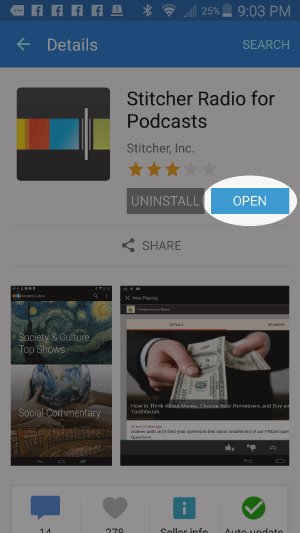
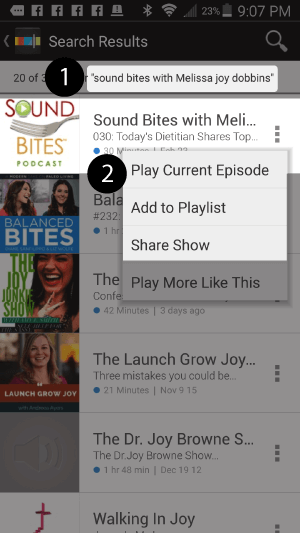
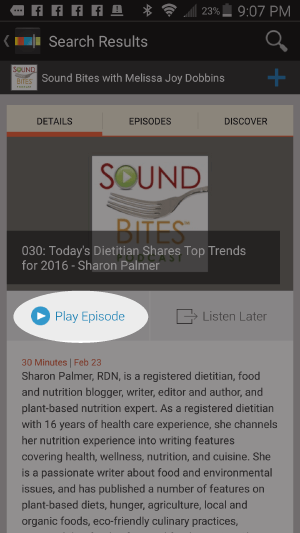
Listen on Stitcher (Android)
Install the Stitcher App
1. Search for “sound bites with melissa joy dobbins” 2. Choose Play Current Episode or Add to Playlist
Choose “Play Episode”
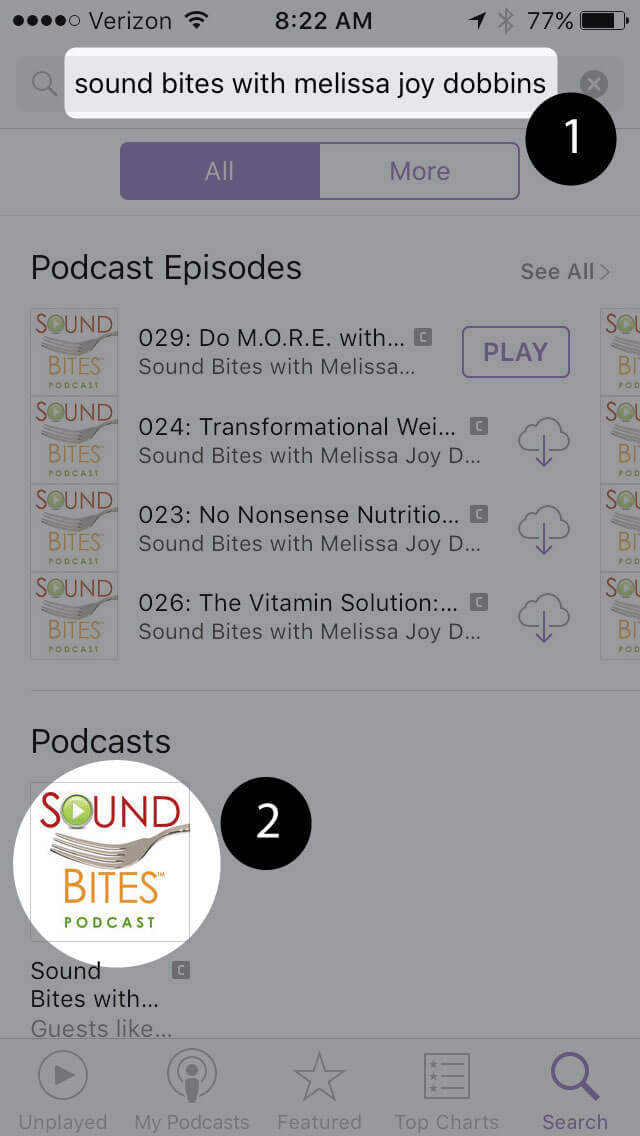
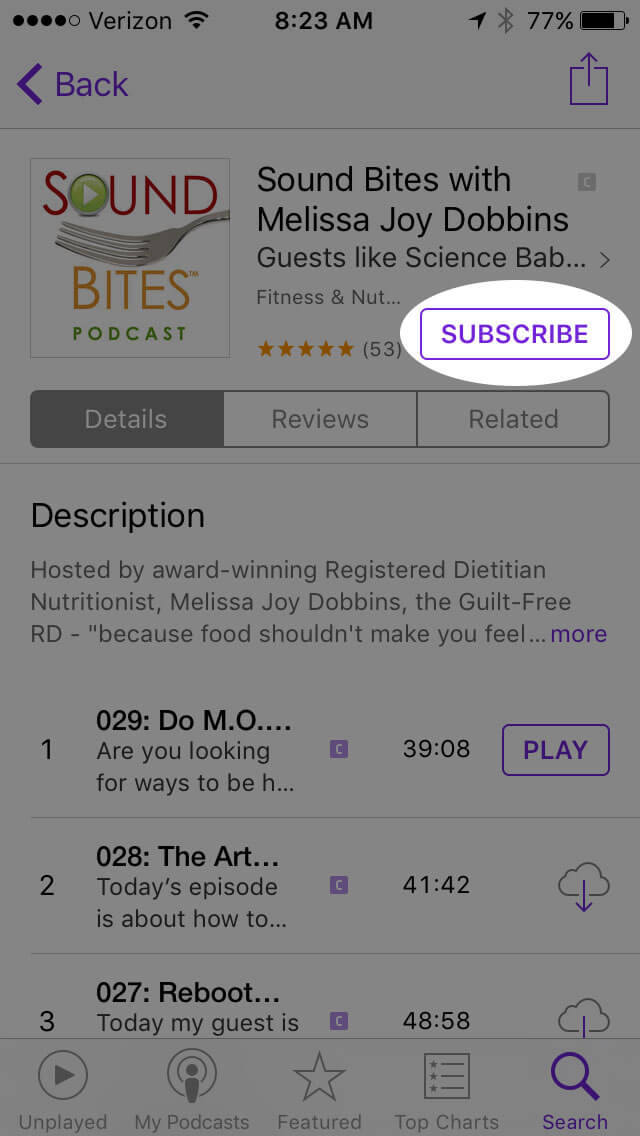
Subscribe & Review on iPhone
Open the “Podcast” app on your iPhone
Search for “Sound bites with melissa joy dobbins”
Open the podcast and click “Subscribe” and your done!
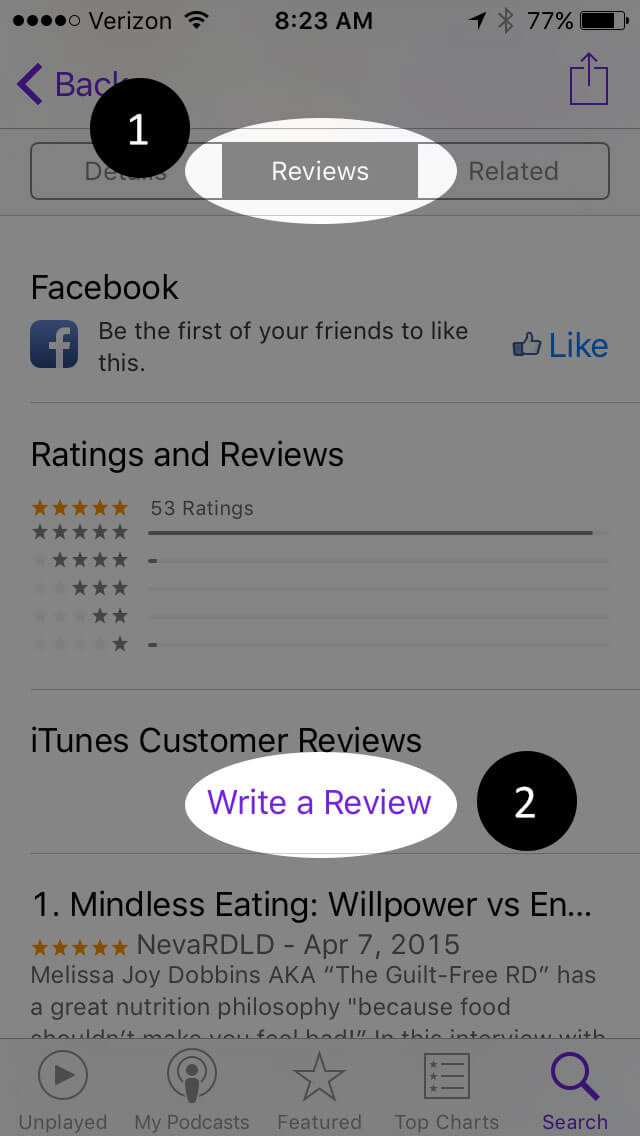
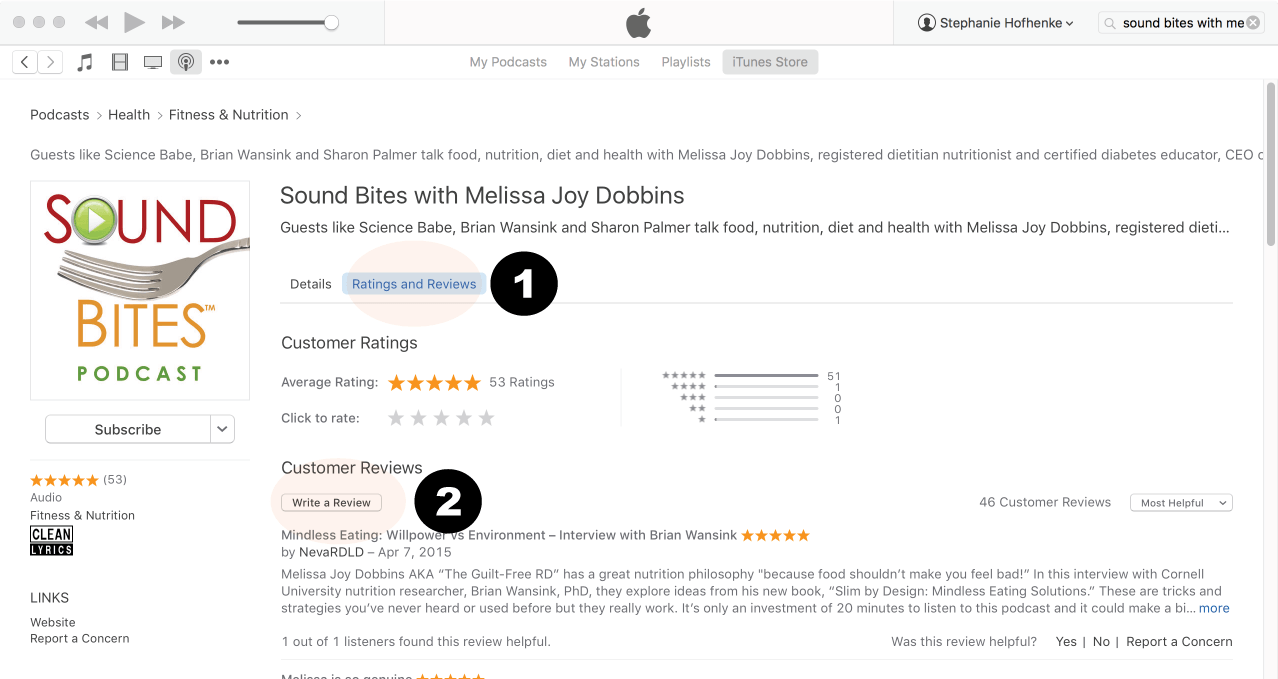
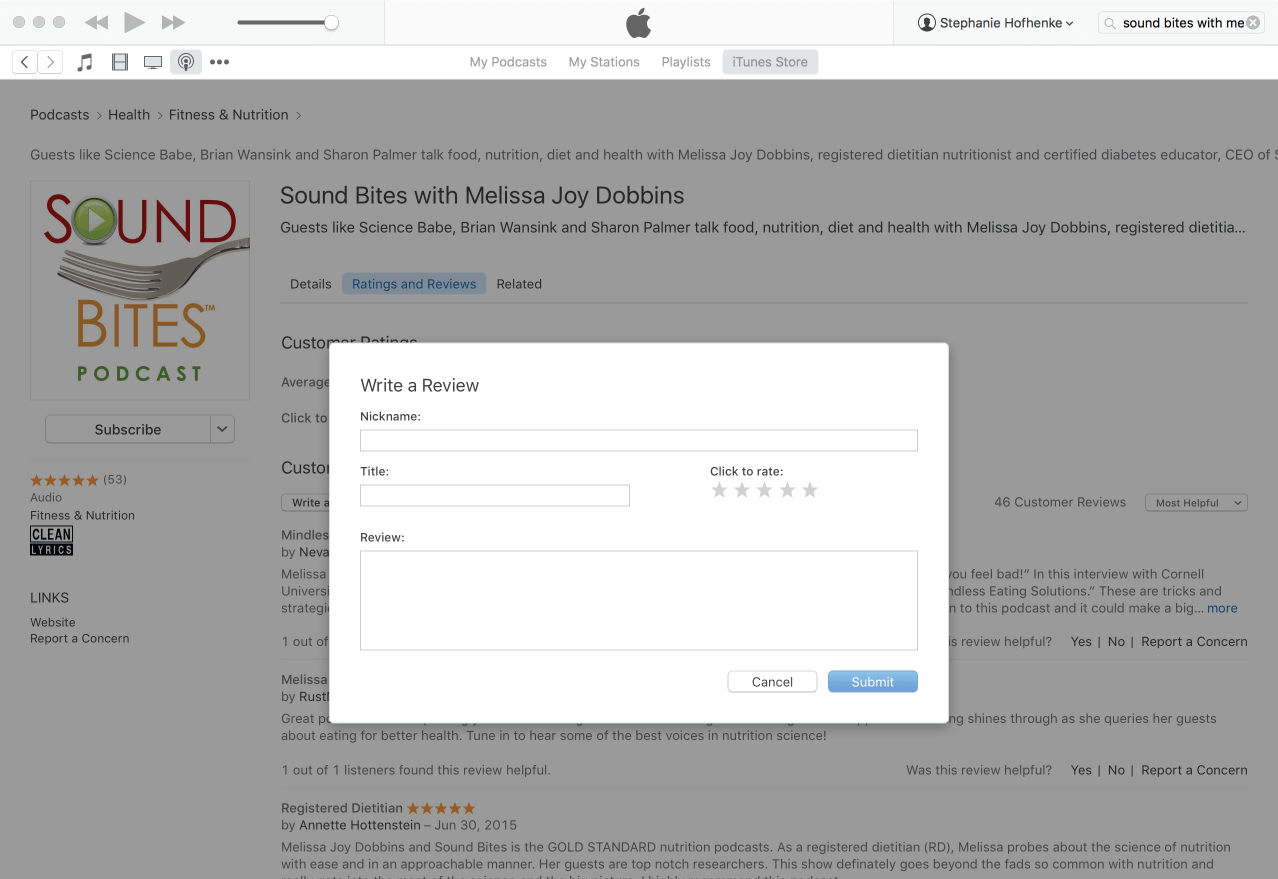
Write a Review
Click “Reviews”, then “Write a Review”.
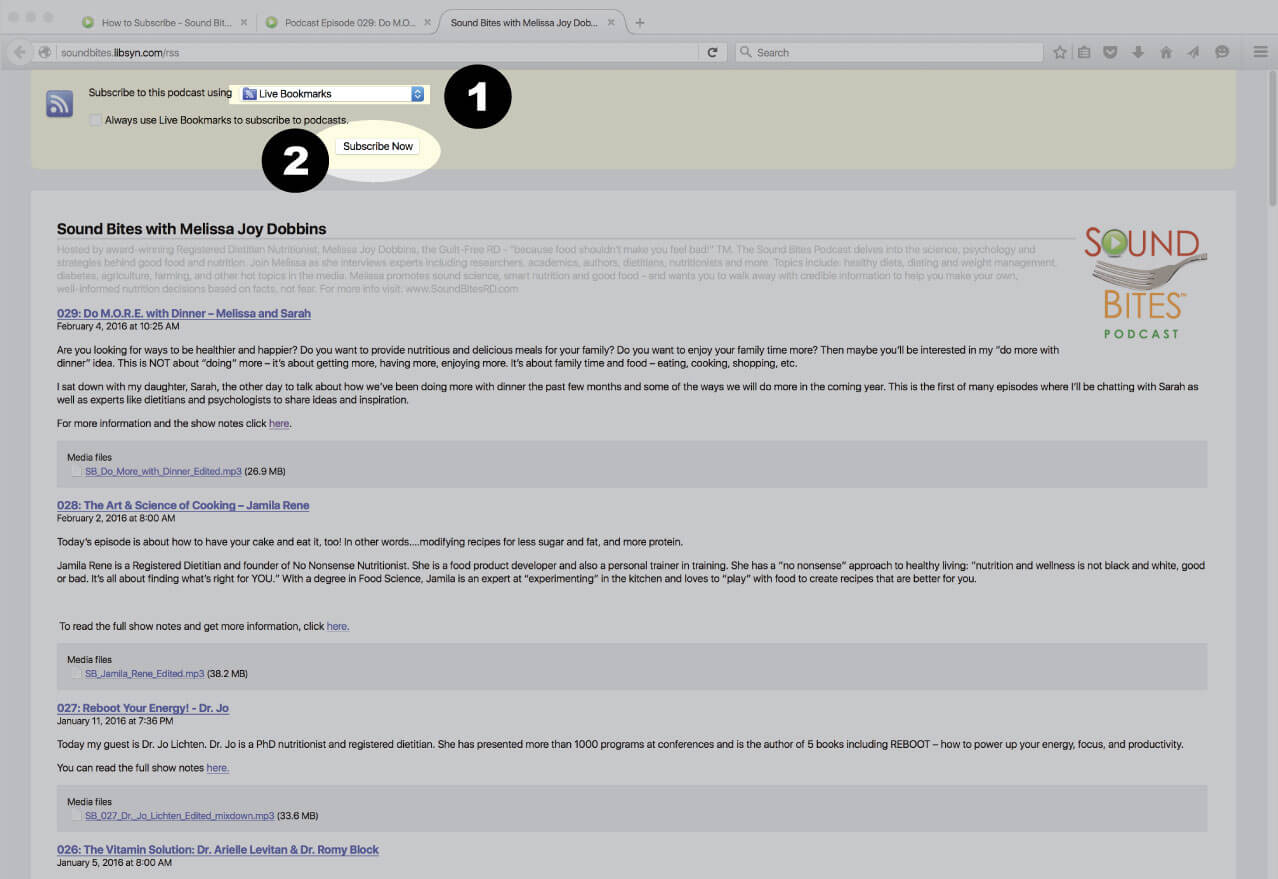
Subscribe via RSS Feed
Navigate to any podcast player . Click on the RSS feed icon.
Click on the RSS feed icon.
Click on RSS Feed
Choose which application you would like to use to receive the RSS feed
Click “Subscribe Now”
Confirm settings and subscribe.
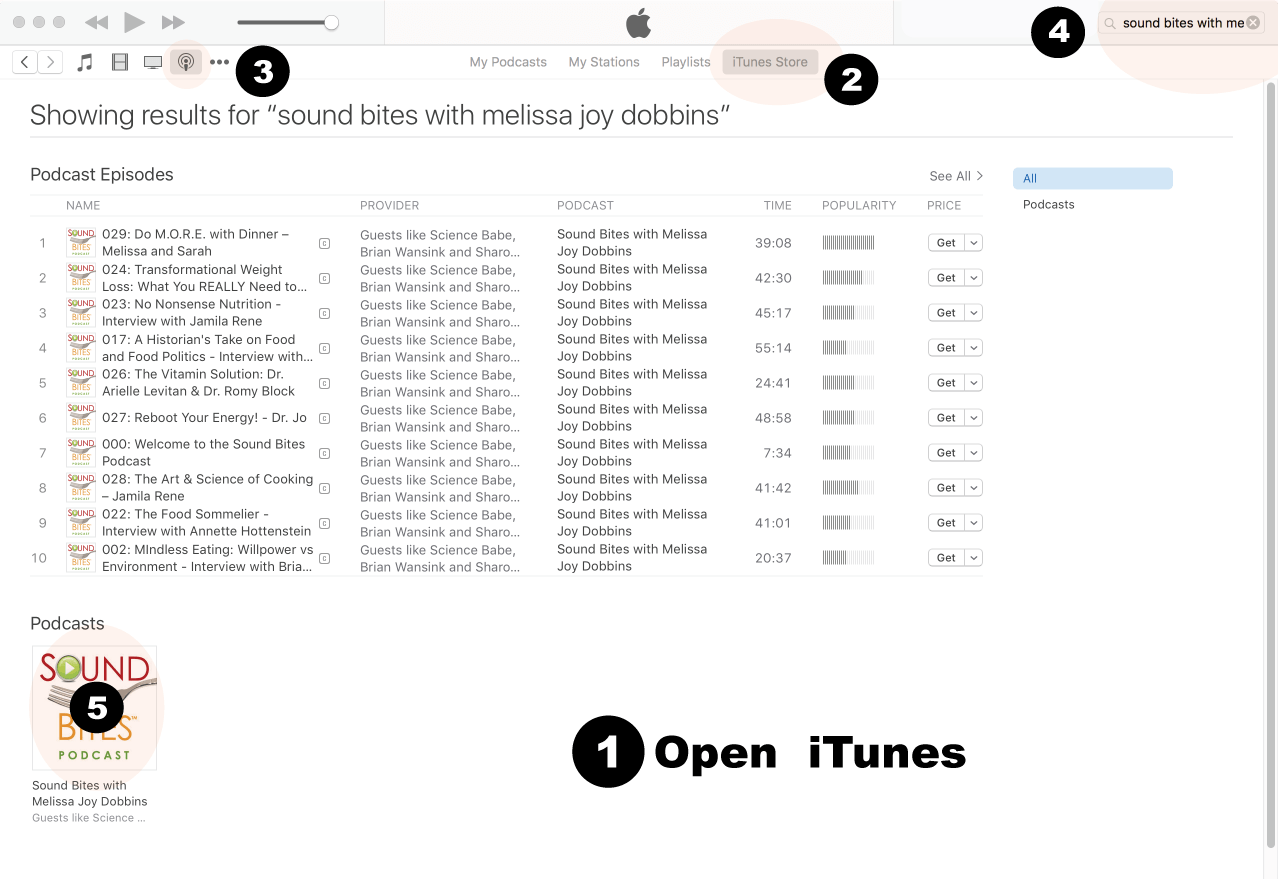
How to Review in iTunes
Open iTunes desktop application
Click iTunes Store
Click on Podcasts
Search for “Sound bites with Melissa Joy Dobbins”
Click on podcast image
Search for Sound Bites podcast in iTunes
Click Ratings & Reivews
Click Write a Review
View reviews and write your own review.
Write your review…. Thank you!
Write your review!
How to subscribe via iTunes
Click here to view the Sound Bites Podcastin iTunes, then click the blue “View in iTunes” button. This will open your iTunes application directly to Sound Bites Podcast. Click the “Subscribe” button, and your done!