Celebrating over 1 Million Downloads and 50,000 Free CEUs on the Sound Bites® Podcast | NEW: Get 1 years’ worth of CEUs with the new 15-CEU Podcast Course
NOURISH: Plant-Based Recipes to Feed Body, Mind and Soul
Try one plant-based recipe a week. Focus on the foods, tastes and colors that you’re not getting in your diet now, add something fermented, and if there’s any way at all, share the journey with somebody else.” – Terry Walters
Rethinking buzzwords like clean eating, superfoods and vegan, Terry Walters shares her life’s work through her newest cookbook and inspires others to explore and embrace plant-based cooking.
Tune into this episode to learn about:
How and why Terry became a self-taught plant-based chef
Terry’s “clean food approach” and how her focus has shifted to “nourish”
Fermented foods, brine ferments, and how you can make them at home
What “superfood” means to Terry
Tips for incorporating more plant-based foods in the diet
How cooking classes can open the conversation about health and wellness
The recipes Melissa made from the book and how they turned out
Why Terry felt it was so important to have a robust index in the book and how decreasing food waste is just one of many benefits of this resource
True nourishment comes from arming ourselves with knowledge, recognizing when we have a choice, and acting with intention to serve our unique needs.” – Terry Walters
Terry Walters
Terry is a self-taught plant-based chef and wellness coach with over 20 years of experience inspiring and empowering healthy home cooking. She is the author of 4 best-selling and award winning fully vegan and gluten-free cookbooks: CLEAN FOOD, CLEAN START, EAT CLEAN LIVE WELL, and most recently, NOURISH: Plant-based Recipes to Feed Body Mind and Soul. She is a James Beard Foundation Award finalist, recipient of the Nautilus Gold and Silver Book Awards, and recipient of the World Gourmand “Second Best Vegetarian Cookbook in the World” and “Best Vegetarian Cookbook in the United States” Awards.
Welcome to Sound Bites, hosted by registered dietitian nutritionist, Melissa Joy Dobbins. Let’s delve into the science, the psychology and the strategies behind good food and nutrition.
Melissa 00:23
Hello, and welcome to the Sound Bites podcast. Today’s episode is about plant-based recipes to nourish your body, mind and soul. My guest today is Terry Walters. She is a self-taught plant based chef, an author of four best-selling and award winning cookbooks, and a James Beard Foundation Award finalist. Welcome to the show, Terry.
Terry 00:47
Thank you so much for having me.
Melissa 00:50
I’m so excited to talk with you today. I first learned about you and was introduced to you virtually through our mutual friend, Kurt McKenzie, who actually did the design for your new book, Nourish, that we’ll be talking about today. And he also gave me a copy of the book. It’s beautiful.
Terry 01:08
Thank you.
Melissa 01:09
But before we dive into your new book, and all things plant based cooking, I would love for you to share a little bit more about your background, the work that you do, maybe how you got interested in cooking and how it became such a big part of your life. And also share a little bit about your previous cookbooks.
Terry 01:27
Sure. Well, it was really quite by chance. I was in college, and my father had a heart attack. And my mother said, go have your cholesterol tested. And when I went, I’ll never forget, they actually turned me away. They said you’re in what they considered a quote, unquote, “non-risk category.” He said, “You’re young, you’re female, and you’re an athlete.” And I went home, I told my mom, she said, “Go back.” And I did and they took my blood and tested my cholesterol. And none of us could believe that it was really through the roof. And I was active, I was leading a healthy lifestyle. It took all of us by surprise. And I knew right then and there that at the ripe old age of 20, I did not want to go on any drugs. So I moved off campus and I got myself an apartment with a kitchen and started teaching myself how to cook. And from day one, I thought if kale and brown rice and these vegetables are quote, unquote, “real food” then I have to figure out how to make them taste delicious.
One thing led to another and honestly, I started feeling great. When my children were born, they had some health issues, and I started treating them and myself with diet. And it became a passion. But it was always on the side. And I’ll never forget moving back to Connecticut from the Chicago area and reconnecting with friends. And they kind of looked at me like, “What is she eating? What is that she’s doing?” And honestly, probably 90% of them thought that I was crazy. And the other 10% said, “Can you show us where that is, where that quinoa is in the grocery store, and then take us back to your house and show us how to cook it?” And 23 years later and I don’t even know how many hundreds of cooking classes later. It became more than my side passion, it really became everything that I’m about and making those conscious choices and empowering others to do the same. And I do that through classes, through health coaching, through my books, and what a journey it’s been. Thank goodness, because constantly talking about it and constantly having this at the forefront of my mind keeps me on my path. And I need it. It’s not easy to make the healthy choices especially when the environment is always changing, and our bodies are always changing. So I think of it as being quite a blessing.
Melissa 03:50
Wow, thank you for sharing your story. That’s a life changing for sure. And not many people I talk to who are really into food and so culinary are self-taught. Usually there’s a relative or some influence in their life. So that’s very interesting. Now you talk about knowledge, denial and judgment. So I want you to share this with our listeners, because I think you and I connected on the whole guilt free approach. And we’re going to talk more about your food approach – you have a clean food approach and want to know what that means to you and so on. But I think talking about this knowledge, denial and judgment is a good place for us to start.
Terry 04:32
Well, knowledge, I think is everything. And I think what’s important about knowledge is understanding that it’s going to be different for each person. Part of that knowledge is knowing your own body, your own resources, your environment, and your belief system. And the other part of it is understanding the food system that we’re working in. And so what does my body need and what are my options and the time that I have to serve myself and make this. And so I think knowledge ultimately is what empowers us to make good choices or to make choices. Because sometimes we make choices that don’t serve our best nutrition, but they serve something else. And I feel like there should be a place for that too. Hopefully that we have the flexibility with our health to afford that. So to me, the more knowledge you have, the better choice you can make. Where judgment comes in is in that, “Oh, no, I can’t eat these salt and pepper potato chips because they’re processed. And I’m not eating processed food.”
Again, I like to just think that, well, especially as women, we don’t need more ways to judge ourselves. But judgment interrupts our ability to make good choices. If I were to say, this category of food over here, it constitutes breakfast food. And so in that breakfast food, I should have cereal or carbohydrate, or French toast or a bagel. Well, that is not necessarily the best fuel for me to fuel my day ahead. Whereas last night’s dinner leftovers that come in a rainbow of color, and have all the tastes, and I have protein and complex carbs, and my grains, that might be the best fuel for the day ahead. So that judgment of what breakfast foods are, isn’t really serving me, or my ability to make a good choice. And I also think that it’s hard to make good choices, it’s hard to eat well, and I don’t have the expectation on myself that I’m going to be 100% all the time. In the same vein, I don’t want to be beating myself up, when I make choices, or if I go out to eat and I want to get something that’s a splurge. A splurge serves me. And so I think we judge ourselves, we judge the food system. I see in my health coaching practice, many people will come to me, because they have all the knowledge, they’re trying not to judge, and they basically have paralysis by analysis, what else can I eat? And so I just don’t think that sometimes that judgment serves us, nor does denial. When I deprive myself of something that I love, I want it twice as much. And so I try and not deny myself, if it’s something that is a splurge, I try and have less of it. Or maybe I just focus on bringing in the good foods so that those foods that don’t serve me quite as well move to a healthier place in the mix. And sometimes they fall to the side completely. But I focus on bringing in and not denying myself.
Melissa 07:45
Okay, thank you. Yes, I’m all for informed choices. That’s where the knowledge comes in. And we know that restriction and deprivation does not work. And I love talking about adding nutrient rich foods to our day. So thank you for sharing that. You mentioned your health coaching and I was going to ask you about this a little bit later. But I think I’ll just move that up in the conversation. What kind of education or certification did you receive? And how would you say that this might be different from what someone would get by sitting down, say with a registered dietitian.
Terry 08:17
Actually, someone might sit down with a registered dietitian, or a naturopath or a physician before they come to me. And so as you mentioned earlier, at the top of the podcast, I’m totally self-taught. And what my coaching is doing is walking beside somebody, and helping them make the transition. They might come to me and say, “I can’t eat this, I’m not supposed to have this. What is left? And how do I prepare it?” And what I try and do in my coaching, as well as in my books, is give the information so that what they can have, they’re preparing well. The difference it makes between cooking your brown rice, or quinoa or legumes on the stovetop, versus in a rice cooker versus in a pressure cooker. And how the pressure cooker for instance, almost gets rid of the lectins completely because of the high heat, if we soak, we can get rid of phytic acids. And so I’m trying to really support their journey and make it doable, and make it delicious. So again, that they’re not feeling deprived, so that they’re feeling empowered, and most importantly, so that they’re able to eat a diet that’s not only healthy for their unique constitution, but so that they’re satiated when they do that and really satisfied with it.
Melissa 09:35
Yeah, and the pressure cooker saves time too.
Terry 09:38
It does.
Melissa 09:39
Yeah. And you mentioned people coming to you and saying, I can’t eat this or I can’t eat that, sometimes they’ve gotten maybe oversimplified advice from a quick visit with their physician or misunderstood some recommendations. So I can appreciate being able to dig into that a little deeper.
Terry 09:56
And sometimes actually, there’s one group that I see a lot of, and it tends to be nurses. And I always think that’s so interesting because I often wish that when they came in and sat with me that I had a mirror. Because they come in and they tell me “Well, I know I shouldn’t have this or this and I only have one cup of coffee.” They’re actually telling me, they already know what they need. And so, to me my job isn’t to make that determination. It is to help guide them to find those answers, but also to empower them to be able to live that lifestyle.
Melissa 10:33
Yeah. And something you said earlier about listening to ourselves. I talk about that a little bit on the podcast here and there. But I think it’s really important that we learn how to listen to our own intuition.
Terry 10:45
Important and boy, is it hard, because sometimes we hear and sometimes our body is telling us no. This isn’t a need. This is a craving or this is an addiction. We don’t know, “Am I craving salt because I need to have more salt? Am I craving salt because my adrenals are spent?” It’s pretty hard to listen to the body. It likes to trick us sometimes.
Melissa 11:07
There’s a lot going on there. That’s for sure. Yeah. So you use this term, the clean food approach, and all three of your previous books have clean in the title. And the new book is called, Nourish, Plant Based Recipes to Feed Body, Mind and Soul. So I’d like to hear from you what does clean mean to you? And maybe how you’ve sort of transitioned to nourish? When was your first book published?
Terry 11:35
My first book, Clean Food, came out in 2007. I remember when I titled it clean food, people thought I was crazy. What does that mean? I already washed my food. And for me, it always, and still does means, minimally processed, for maximum nutrition. And I think of these foods, my books they’re all plant based. They’re all gluten free. I don’t think of them yet as a diet, I think of them as the foods we all need more of and what else is on your plate is up to you. And I don’t feel like it’s my place to determine that or judge it. So that’s what clean has always been. It’s always been a rainbow of color. It’s always been the five tastes sweet, sour, salty, bitter and pungent.
In more recent years, I’ve added the need for super foods to that. But super foods to me are not like those expensive bags of whatever. Fill in the blank, maca powder or chia or hemp. You could put those in the super food category as well. But to me a super food is whatever color and taste you’re not getting. For one person it could be blueberries, it could be greens, it could the leeks, like there’s some garlic. So whatever your unique super foods are, and then fermented foods for gut health. Those living probiotic rich foods that support every system in the body. And so to me, the concept of clean hasn’t changed as far as how I’ve defined it. But the slow move towards nourish is just, well, two things. One, I felt just like clean got taken and used by so many different people that it started losing its meaning. And I felt like the more I continued on my own journey, that clean didn’t acknowledge that it is a lifestyle choice, and there’s lifestyle with it. And that healthy food doesn’t just keep us, God willing, healthy. It actually feeds us emotionally, it dictates our mental state, our mood, our behavior, and our immune support. And so I felt like nourish encompassed that more holistic approach and the power of food in that.
Melissa 13:57
Okay, beautiful. You mentioned fermentation, there’s an entire section in your book on fermentation that we’re going to talk about, and it’s very interesting. And of course, gut health is all the rage, it’s a long time coming. In dietitian school, we learn if you don’t have a healthy gut, you don’t have health. So it all starts there. But I want you to first share, you have a little black dress theory. So I want you to talk about that.
Terry 14:23
I love my little black dress theory. Thank you. I speak of diet, like the little black dress and that you wear a little black dress and I don’t own one. So I’m going to ask you to borrow it. And when I do, I’m going to put it on and I’m really short I’m going to need to take it up here and maybe let it out there. And so we can wear the same black dress with little tweaks. And that’s my approach to diet and nutrition as well. It does serve all of us to fill our plate with as much fresh produce like vegetables as possible. But one person might have animal protein where the other one might do better with legumes, nuts and seeds. Or you might not like kale, and I love it or vice versa.
So people always say to me, do I have to eat kale? I hear that so many times. I don’t know why clean food brings that out in people. But I’m like, “No.” You don’t have to eat kale, there are so many different greens. And that’s the thing, I remember when I was growing up, the plate had the protein, the starch, a salad, and then another vegetable. As if salad and vegetables were different things. But regardless. And there’s so many categories of vegetables. So when we say, you want your plate to have, however many servings of vegetables, I like to really break it down in my books like, there’s root vegetables, there’s cruciferous vegetables, there’s, our allium. There’re so many different categories in that one greater category in vegetable. And we’re all served to dive deeply into that area.
Melissa 16:04
I love that. Everybody’s unique, and they have different preferences and different needs. So you mentioned your cooking classes, I’d like to hear a little bit more about that. And in particular, what you find that your students or your clients are maybe most confused about, or are most curious about when it comes to cooking, and especially plant based cooking and eating.
Terry 16:26
Well, I’d like to tell you that my cooking classes are all about the culinary. But I really think of the food as what brings us together to have the conversation about the health. And early on, when I started teaching, I found that people would come and say I was so inspired by your class, I went home and I got rid of everything in my pantry. And I switched over to this. And I don’t really ever recommend that. I actually think, if you picked one recipe from my book a week and just tried it, you would probably have to buy one or two ingredients you have never bought before in the beginning. And then after a few weeks, you would start using the same ingredients over and over. And at the end of the year, your pantry would have transitioned more slowly and more sustainably. And your diet, if you like only half of the recipes you made, you’d have 26 new foods in your diet. And so when we talked earlier about not depriving ourselves but thinking about bringing in, that actually is a lot of nutrition that you’d be bringing into your diet. 26 new recipes, you could live on that alone.
So I like to think of it as a little bit of a slower, more sustainable transition. The classes – whenever you’re talking about food, everybody comes from a different place and a different level of understanding. And they bring different traditions from their own backgrounds. And so even though I’m teaching the class, I like to facilitate the conversation because I find that there’s so much wisdom in the room, whether it’s personally in the room, or virtually on the screen. And everybody has such wonderful experience that I like to make sure there’s the opportunity for all of that to come to the table. I’ve been teaching for 23 years. So we do hands on workshops, like fermentation and sourdough bread. And we do cooking classes that are always in season. In the beginning, I got so tired of people asking me what I was going to make that I used to say, “This is a cooking class, and you can come or not. And I’m not telling you the menu until you get here.” And I did that for about 10 years and classes filled. It’s going to be seasonal, the topic is going to be appropriate to the season, the food’s going to be locally grown, the cooking methods are going to be about how we prepare the food to maintain balance with our environment in that season. So it was really fun and to some degree, I still do that today. But I give a little more information now.
Melissa 19:08
So I had the opportunity to make a couple of your recipes and several things that you just mentioned are definitely true. I want to thank you for introducing me to some new flavors and ingredients. I made the roasted broccoli two ways. So it’s basically roasted broccoli, but then you have two different flavorings that you could use. The shallot miso or a Tahini Gomasio. Am I saying that right?
Terry 19:33
Gomasio
Melissa 19:34
Gomasio. Okay, yes. I preferred the shallot miso, but I would definitely make those again. I also made the basmati rice with wild mushrooms, kale and thyme and I really liked that. My whole family liked that. I would definitely make that again. But as you know, Terry, I emailed you in the process saying, “I can’t find these four or five ingredients.” And I think the problem is my Whole Foods is a little on the small side. But I also talked with our friend Kurt about this and he was like, “Oh kombu.” I say, “Kombu.” And the ume plum vinegar. He’s like, “You’ll definitely use those in other recipes, and you’ll use those again.” So, to your point, I think that the hardest part of your recipes was finding the ingredients. But I was able to make some substitutions, based on Google and your advice. And I just appreciate learning something new. I kind of stretched my skills a little bit. And my regular listeners know, I’m not the most culinary person. But I have come a long way over the course of the podcast with my “do more with dinner initiative”. I have to do an update on how it started and how it’s going. But I have tried a lot of new recipes. And some of those have become regular weekly dishes that I prepare for my family. But when we were talking before you referred to yourself as sort of, a dump and stir cook.
Terry 21:01
I was going to say, you’re making it sound so hard.
Melissa 21:02
No, but it’s true. Like, the techniques and everything to prepare it were simple. Very doable for me. So talk to us about the dump and stir approach.
Terry 21:12
Well, I want to talk about a few things because you touched on them. But absolutely, I did not go to culinary school. And as a matter of fact, when I’m making recipes, if I look around the kitchen, and I’m partway through, and there are too many pots and pans out, I scratch the whole thing. Because as much as I like the recipe to be easy, I like the cleanup to be easy too.
Melissa 21:31
Amen.
Terry 21:32
I’m all about one effort and here’s your meal. And so there’s nothing contrived in the book, even the section on fermentation, like I tried to really spell it out. So it’s super, super easy, because I know it’s a little intimidating. And so I think part of my job is taking away one, the intimidation factor and two, making sure that it’s going to be successful no matter what. But the other thing is that you mentioned these ingredients like kombu and ume plum vinegar which most people haven’t heard of. And I swear that has been a really wonderful outcome of the pandemic. Because people are used to going to their grocery store and not finding the most basic things that they could always depend on because of supply chain. And so they’re used to going online and as a result, it’s really not that big a deal to go online and and buy a bag of kombu, even though it’s even at my local – we have stop and shop here.
But in the front of this book, I really slaved over the section of my favorite ingredients and tools and why. And not only mentioning that kombu is a seaweed, but what kombu is in the recipe, how it tenderizes legumes, how it reduces gaseousness, how it increases minerals when we cook our legumes and our grains so that even though they’re complex carbohydrates, they’re less acid forming and more alkaline. It is not expensive and it’s available at almost any natural food store. And it will be plum vinegar, that’s just like, crack. It’s like I’m well aware that when I say the tastes are sweet, sour, salty, bitter, and pungent, that most people disagree with me. Most people think that umami is one of the tastes and I don’t. I think umami is when you have the perfect combination, and all the tastes in balance. And that gives something umami. And Ume plum vinegar, it has umami. It’s one of those ingredients. It has sweet, sour, salty, bitter and pungent all right there. It’s a fermented vinegar, so that it’s a little bit of a digestive aid as well.
Melissa 23:43
I was going to ask you about umami when you said pungent. So thank you for clarifying that.
Terry 23:49
Well, pungent could be heat, but it’s movement, and it is circulation. And so it could be hot peppers or it could be cinnamon, or one of my favorite pungent herbs is cumin. So I think of that as just taste and umami has that perfect combination. And when the tastes aren’t necessarily equally represented they’re just perfectly in balance.
Melissa 24:13
Interesting. Well, you started telling a little bit about what’s in your book and that was my next question. There’s 200 recipes, plant based but really vegan and gluten free. What else can people find in the book? And also you decided to self-publish this one, so I’d love to hear a little bit about that decision.
Terry 24:32
Well, yes, they’ll find 200 vegan and gluten free recipes. And while they’re vegan, they might find a recommendation to make something and serve it with a piece of grilled fish or a piece of something else off the grill. So there are options on how to make it fit into any menu. They’re all organized by season. They’ll find my own poetry between the seasons as well. And in the back of the book, they’ll find an index. I think it might be almost 20 pages. It is a long index. Kurt does not like me when I say, “Okay, we’re ready to design the index. It is a labor of love. But it’s so important to me, because I want people to be able to go to a farmers market or get their CSA share or wherever they get their produce, or just look in the produce drawer to see what’s left, and say, “Okay, this is what I have, and what can I make with it.” And I often recommend to people just start from the back of the book in the index. And you go to the carrots, and here are the 15 recipes that have carrots in them. And now I can see what exactly I’m going to make from there.
Melissa 25:40
Exactly. That really helps with food waste.
Terry 25:43
Yeah, absolutely. And speaking of food waste there, in the front of the book, there’s a recipe for scrap stock. So you can take all the trimmings and learn how to make your own stock, which I think is just the best, because you’ve already paid for that. And now you’re not buying stock, and you’re making the best stock that you can. And it’s really easy. There’s as I mentioned, a section on ingredients that is quite in depth about the ingredients and the health benefits of the different ingredients. So you might come across a use of arrowroot as a thickener, and say well, I don’t know what it is. So you go to the front, and you read about it and you’ll see, this is an alternative to cornstarch. So I can use my cornstarch. But here are the health benefits of arrowroot. And when I run out of cornstarch, I think I’ll buy arrowroot next time. So really helping people make that transition and some information on the lifestyle. And as we already mentioned, knowledge and suspending judgment and not depriving ourselves and of course, the whole section on fermentation.
I love that section on fermentation. And the reason I put it in the front is because to me, it’s the foundation upon which everything else unfolds. We should have fermented foods in every season and every day. I talk in that section not only about the value of probiotics, but I think something that’s often overlooked, which is what are prebiotics, because to have that good gut bacteria is one thing, but we have to feed it as well, and that comes in with the prebiotics, whether it’s garlic, or onion, or bananas, or prunes. And so there’s quite a bit of information there.
Why did I self-publish it? Well, for so many reasons. The first is, as you know, because you’ve seen it but your listeners do not yet, is that it’s an O binding, so it lays flat on the counter. And it’s so important to me that it will be usable. That when you’ve got your hands in something, or you’re juggling all these different things, you’re not seeing where the page fell and the book has flipped close. So I really wanted it to lay flat, it makes it super user friendly. And then I just wanted to get the book out into the world using the same values that I actually talk about in the book. So I wanted to support my local farmer and my local printer. I didn’t want to be printing overseas.
To me, there’s nourishment in handing the book to somebody and knowing that they’re going to love it and saying, please, enjoy and the thank you and that connection, I feel since the pandemic almost starved for. So it was really, really nice to produce the book. And it’s been really lovely to be able to share it with people. So personally, in my previous books, I remember someone made a comment I think on Amazon about some ingredient that I use throughout the whole book that they didn’t like. Except the one little flaw was that it was an ingredient that wasn’t anywhere in the book. And so someone said, “You can’t take this stuff so personally.” And I totally disagree. Like, this work is all personal to me. It comes from my heart. So this self-published book really represents that in every way. And to be able to work with our mutual friend Kurt. He’s actually designed all four of my books. And I think they’re brilliant in every touch that he’s put into them that makes them so user friendly. That the ingredient list is so easy to grasp, you can see just by looking at it like oh, this recipe is two paragraphs. It’s easy. So I wanted it to be exactly what I would want it to be if I were buying it. And so we self-published it.
Melissa 29:38
Wonderful. Thank you for sharing that. So let’s talk about the fermentation. You talked a little bit about it. I find it so interesting. I should have tried one of those but I don’t know, I chose the broccoli and the rice because they caught my attention first. But I think the next one I’ll do one of the fermentation ones. And actually, you have a couple of recipes to share with our listeners that we can talk about. And one of them is about fermentation. And I just think it’s really cool that you show how to do it. And so I just love to hear more about that.
Terry 30:10
Well, the first thing I want to say is that all the recipes in the book are brine ferments. So there are lots of ways to ferment foods that require other cultures. It could be a starter culture to make miso or to make Kefir or whatever it might be, or kombucha. So I’m not doing that in this book. These are all brine ferments. And the beauty of that is you just put everything in the bottle, you cover it with salt-water, and everything below that level of brine is going to ferment and everything above it could rot. So it is a little bit of a science experiment. And I know when I first started making fermented foods, I thought, I’m going to put this on the counter and intentionally let it rot in order to make it more nutritious, like this doesn’t feel right to me. And so I really wanted to talk about what to look for, how to approach it, you don’t need special equipment, a nice clean bottle is all it takes to do any of these ferments. And the recipe that I sent you that we were going to share with your listeners is a very simple vegetable ferment. It’s got some sugar snap peas, watermelon radishes, I like to add jalapeno for that little bit of heat although fermentation neutralizes a lot of the heat.
But they could put green beans in it. And if you couldn’t find watermelon radish you could put regular radishes in it, or peppers or carrot sticks or cauliflower or broccoli stems. You can ferment almost anything. And it’s a simple 3% brine solution. So that heaping teaspoon of salt and a cup of water is all it takes. Put everything in your jar, and now it’s going to be in salted water. So what happens with salt water? Everything wants to float to the top. So you put all the little floaty pieces like your dill and your red pepper flakes or small things on the bottom. You wedge all those vegetables in there, you mix together and pour in your brine and screw on the lid and leave it on the counter for three, five days. I call it, burping it. Each day you want to go and undo the lid and let the gases out, the sealer, leave it away from direct sunlight and heat. And then when it tastes delicious to you, it’s done. And then you move it to the refrigerator.
Now the goal is to actually eat it. And I feel this way about fermented foods because they have really big taste. But I feel this way about everything. If there’s something you’ve never had, just sitting down to like a bottle of fermented sauerkraut or kimchi with a fork really might not be the best approach. But if you can mix it with something you know you already love, and develop a taste slowly. So I try and tell people all the time, take your favorite salsa, and chop up a teaspoon of kimchi or sauerkraut and mix it in with that salsa. And now you’ve added probiotics to the salsa. And it just tips the scale a little bit towards the taste of the ferment. And maybe you don’t even notice it. So next time you put in two teaspoons and before you know it, you might be like me where you’re sitting down to the bottle of kimchi with a fork. But that’s not required for anybody.
Melissa 33:33
Very interesting. I’m definitely going to try that one. You have another recipe that I’d love for you to talk about, this pizza.
Terry 33:41
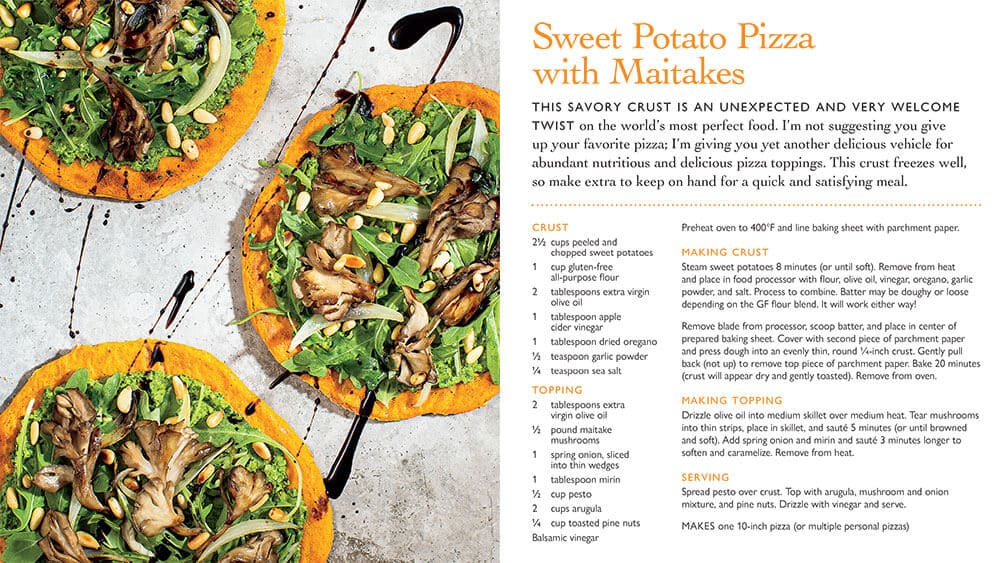
Yeah, I love this pizza. Every now and then when I’m making recipes I’m creating because I have a craving. And in this case, it wasn’t a craving as much I really was just curious and everyone makes a cauliflower pizza crust. And I was like, that’s tasty and I like that too, but I just wanted to do something different. So I started making a pizza crust using steamed sweet potato and it makes an orange pizza crust. And I started making it with the steamed sweet potato and a gluten free flour blend and a little bit of apple cider vinegar, which activates the baking soda and makes it rise and get a little bit puffy. So I took them out of the oven the first time. That very first go I was absolutely hooked. And I’ve tried them with all different flour blends because they’re all really quite different. And if you’re not gluten free, you can use just regular all-purpose flour. You put everything in your food processor and the sweet potatoes and the flour. And sometimes it’s runny and sometimes it’s pretty thick, and it just doesn’t even matter. It comes out delicious every single time. And what I do is I just line in my baking sheet with some parchment paper, and I scoop the batter out onto the parchment paper. And sometimes I’d make one big pizza. And sometimes I do little small ones.
I drizzle a little olive oil, a little bit on them, and put parchment paper on the top so that I can just smooth that really easily and you can feel. And then you just pull the parchment paper away and you have your perfect pizza crust. And the great thing about it is, you could take that recipe. Well first of all, you can take the pizza crust that you make and freeze it. Or you could make them small, almost like Taco Shells and use them like as a little wrap for a burrito. And you can freeze those too and just divide them with a little parchment paper and put them in a bag or put them in the freezer. Take them out and they defrost in just moments. And the recipe in the book, I use a pesto with some nice sautéed Maitake mushrooms, and some arugula like so, so delicious. But you could take that same thing and sprinkle on a little cinnamon and some candied nuts and some dried figs or fresh figs and drizzle a little balsamic vinegar or maple syrup and have a sweet version too. It goes in so many directions and it’s just so delicious and easy.
Melissa 36:13
I have to try that one too. And I know you said with the watermelon radish and sugar snap peas, the fermented vegetables you said they’re fool proof. It is one of the things you sold me on that.
Terry 36:25
Yeah, fool proof.
Melissa 36:26
Thank you for letting me share those with the listeners in the show notes at soundbitesrd.com. As we’re wrapping up, I want to know what your sort of takeaways or best tips for people who want to start eating and cooking a little bit more plant based. And also, I know we can only get the book through you. So I want you to share your website and your social media handles.
Terry 36:47
Well, my website is my name, terrywalters.net. And my social media is clean food on Facebook, and Terry Walters Cooks on Instagram. And the book is available at terrywalters.net. And free shipping. And my tips, so many tips. But I think my top tips would be number one is just to be mindful of where you’re at. Pay attention before you take any steps. Just look at what you’re doing. I can’t tell you how many times I’ve gone in to see a doctor or naturopath and they said well, what did you eat yesterday? And I think I’m not sure. Because sometimes it’s just so unconscious and I have that disease where I pick on things and I just put them in my mouth, like all day long, because I’m passing through the kitchen, and I’m thinking about food all day long. It’s not good. And so I think just look and see where you’re at. And that might mean journaling for a few days, writing it down. And then when you write down, and you step back and look at it, you can see, these are the colors I can check the box on, these are the tastes I do well with, what prebiotics, probiotics am I getting, if any? And that will hopefully direct you to where to start. Filling in those missing links.
For fermented foods I often tell people because I think it’s so critical, like if they changed nothing else in their diet, but added something fermented, which could be as simple as a teaspoon of apple cider vinegar with the mother in it – that nice, healthy, alive apple cider vinegar. That’s a great place to start. And I don’t recommend a big change. Because I think it doesn’t matter how healthy the food is, or if you’re moving to something healthier, that’s fantastic. But change is hard on the body. It’s hard emotionally, it’s hard on our moods, it’s not always so easy to make a big change, nor is it sustainable. So I really think taking it slow. And like I said, one recipe a week is a great way to do it. So start with something fermented, focus on one recipe a week, focus on the foods that you’re not getting, the tastes and colors that you’re not getting, add something fermented and if there’s any way at all, share the journey with somebody else. It doesn’t have to even be somebody in your immediate family or household but if there’s somebody else who’s interested and working towards the same goal that you can talk about it, with go for a walk, I think that makes it all the more nourishing.
Melissa 39:40
Oh, I love that idea. And that’s a great way too if you are trying new ingredients and new flavors, that you could share that with a friend as well. Say hey, maybe I won’t use this whole I was saying ume plum vinegar but it’s ume?
Terry 39:55
It is ume or short ume.
Melissa 39:58
Like “Hey, I bought this, it’s great. Do you want to try it? And if you like it, then you can buy it too.” So that’s a great idea to share that journey.
Terry 40:06
Yeah. And maybe it’s, “I made this recipe and I loved it” or “I made this one. But when you make it, I think you should try it with this ingredient”. Every body is different. And that means our tastes are going to be different, too. And maybe it’s, I’m going to make something once a week, and you’re going to come here for lunch. And you’re going to make something once a week, and we’re going to go there and have breakfast, or maybe we’ll just meet in the middle and go for a walk and talk about how it made me feel. And that’s good, too.
Melissa 40:35
Absolutely. And I love how you mentioned too with your index, I hadn’t noticed how long it was. But I really like that concept of going there first and seeing what’s in your refrigerator that needs to be used up and starting from there. All about the food waste reduction.
Terry 40:52
Yeah. And the index, if you’re in a recipe and you’ve stumbled across something that you’re not familiar with, you can go to the index and look it up there too, and say, here’s the page where I’m going to learn about what kombu is, or apple cider vinegar, or whatever the ingredient might be.
Melissa 41:08
Great. Thank you so much. Well, thank you for taking the time to talk with me and for writing this beautiful book and sharing it with me. And another shout out to our mutual friend Kurt. He’s one of my very best friends. He’s just a wonderful human being.
Terry 41:22
Agreed.
Melissa 41:23
And I’m happy that he introduced me to you. Just thank you again for everything and for our listeners: As always, enjoy your food, with health in mind, and with nourishment in mind. Till next time.
VO 41:36
For more information visit soundbitesrd.com Music by Dave Birk. Produced by Jag in Detroit podcasts.
LISTEN, LEARN AND EARN
Listen to select Sound Bites Podcasts and earn free CEU credits approved by the Commission on Dietetic Registration (CDR) for registered dietitian nutritionists and dietetic technicians, registered. Get started!
Get Melissa’s Sound Science Toolkit here!
Partnerships:
Sound Bites is partnering with the Association of Diabetes Care and Education Specialists (formerly the American Association of Diabetes Educators)! Stay tuned for updates on the podcast, blog and newsletter!
Sound Bites is partnering with the International Food Information Council! Stay tuned for updates on the podcast, blog and newsletter!
Sign up for my monthly newsletter and episode eblasts so you never miss an update!
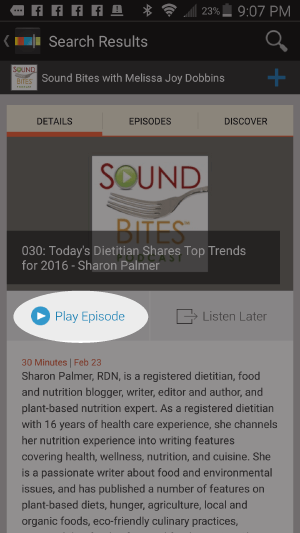
Listen on Stitcher (Android)
Install the Stitcher App
1. Search for “sound bites with melissa joy dobbins” 2. Choose Play Current Episode or Add to Playlist
Choose “Play Episode”
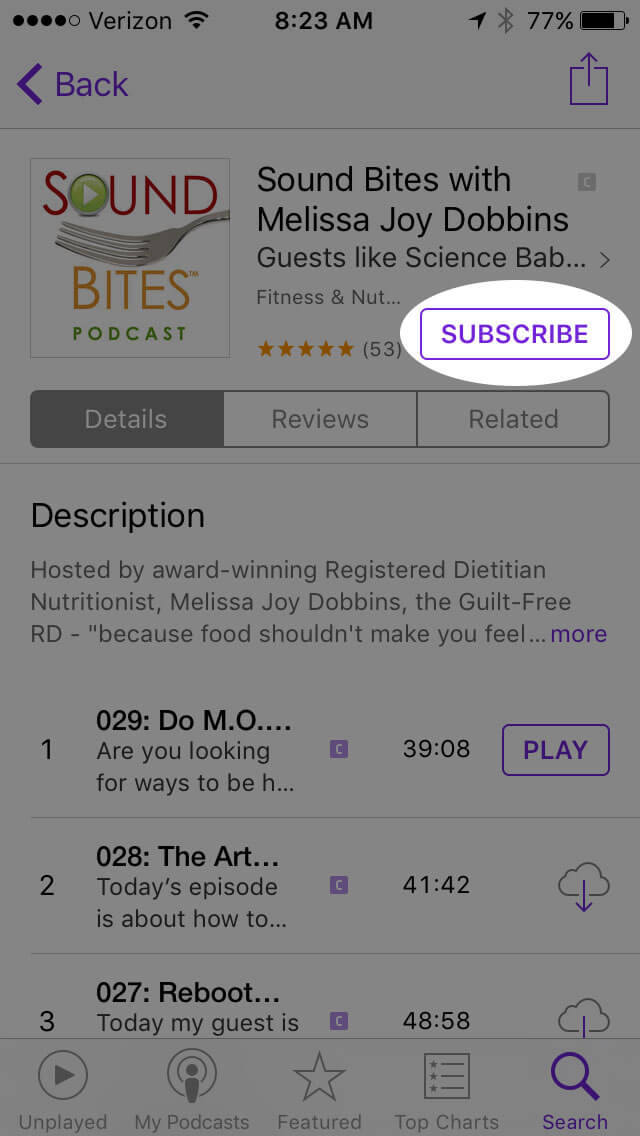
Subscribe & Review on iPhone
Open the “Podcast” app on your iPhone
Search for “Sound bites with melissa joy dobbins”
Open the podcast and click “Subscribe” and your done!
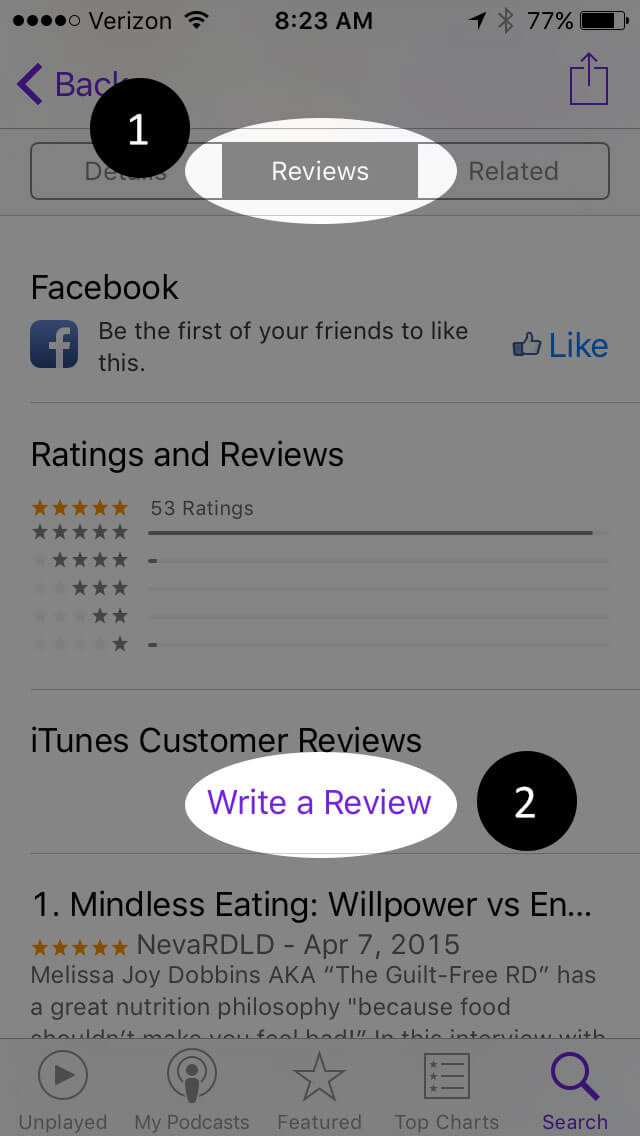
Write a Review
Click “Reviews”, then “Write a Review”.
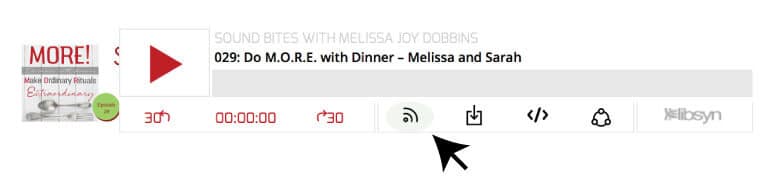
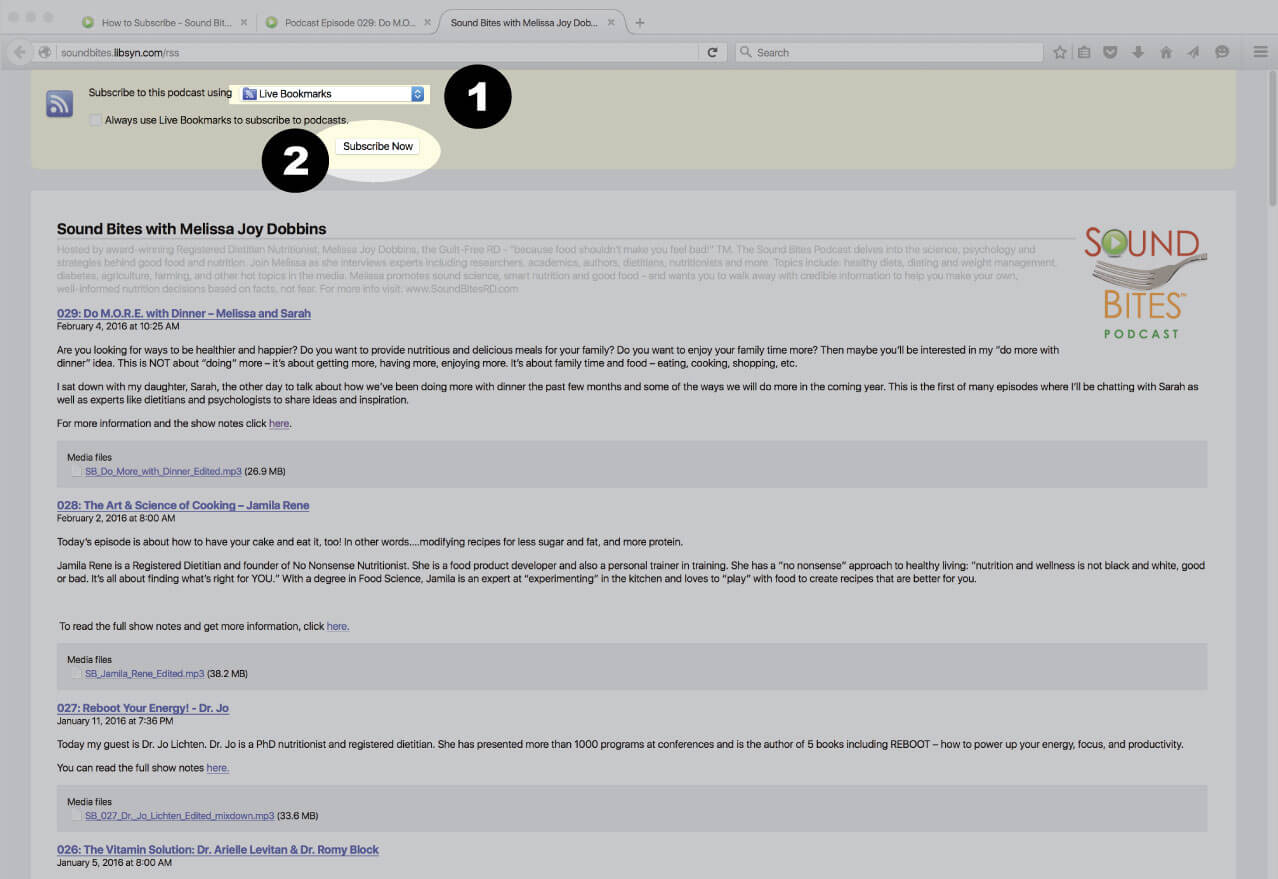
Subscribe via RSS Feed
Navigate to any podcast player . Click on the RSS feed icon.
Click on the RSS feed icon.
Click on RSS Feed
Choose which application you would like to use to receive the RSS feed
Click “Subscribe Now”
Confirm settings and subscribe.
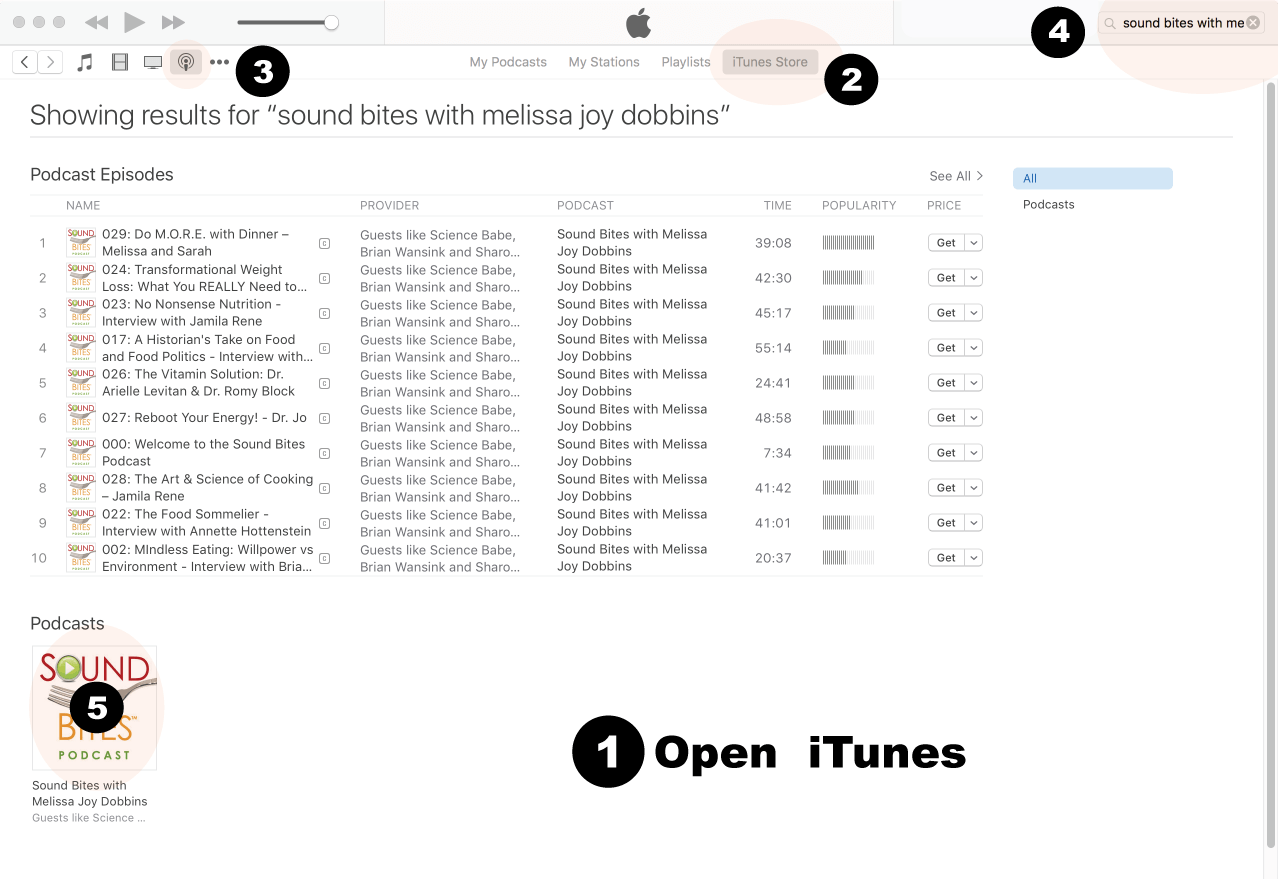
How to Review in iTunes
Open iTunes desktop application
Click iTunes Store
Click on Podcasts
Search for “Sound bites with Melissa Joy Dobbins”
Click on podcast image
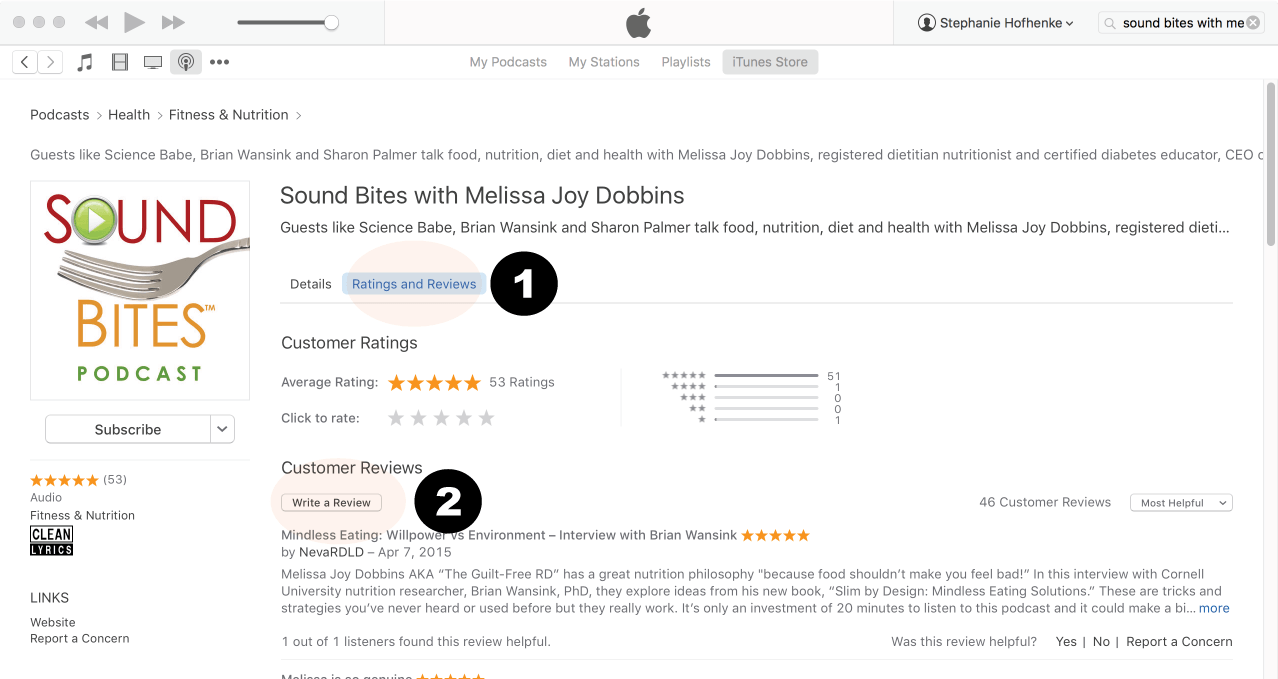
Search for Sound Bites podcast in iTunes
Click Ratings & Reivews
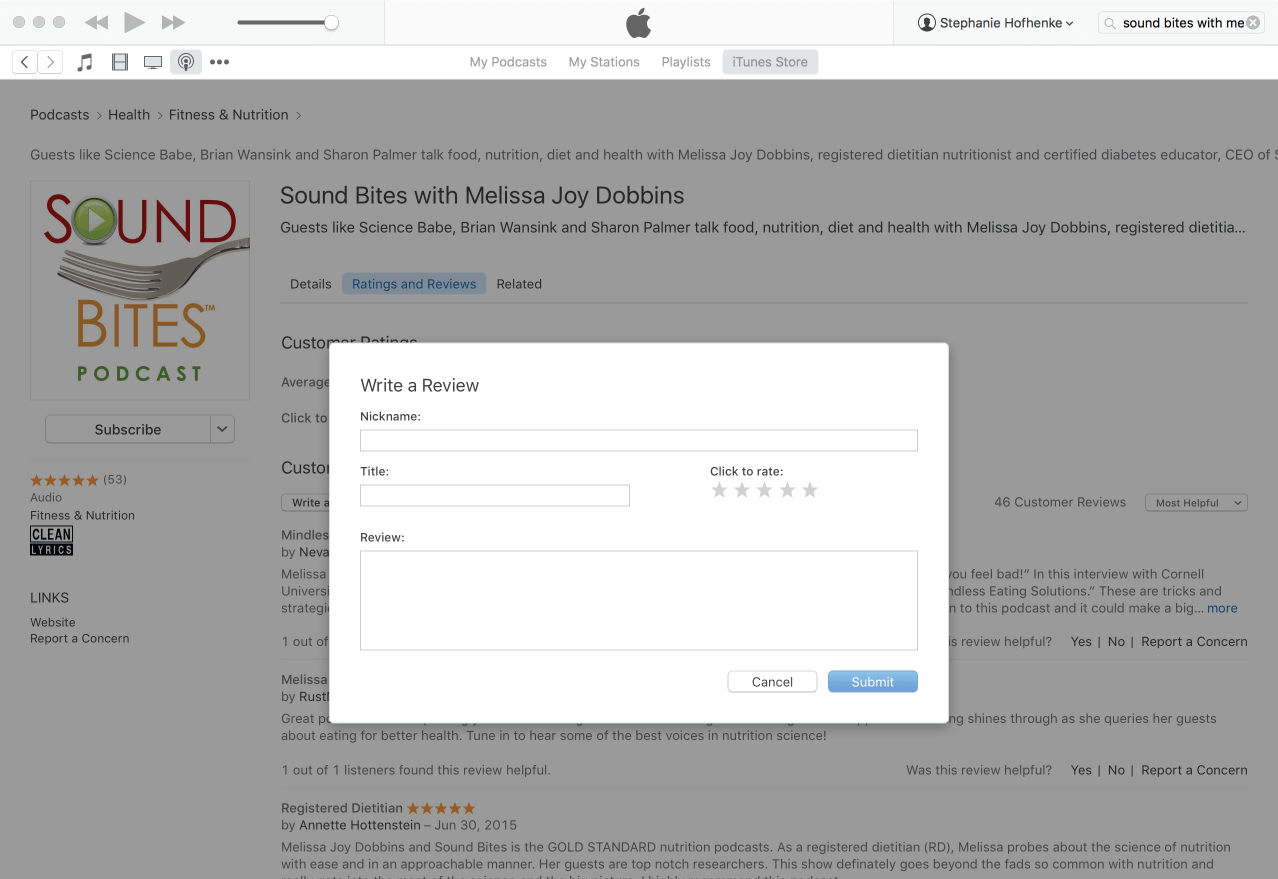
Click Write a Review
View reviews and write your own review.
Write your review…. Thank you!
Write your review!
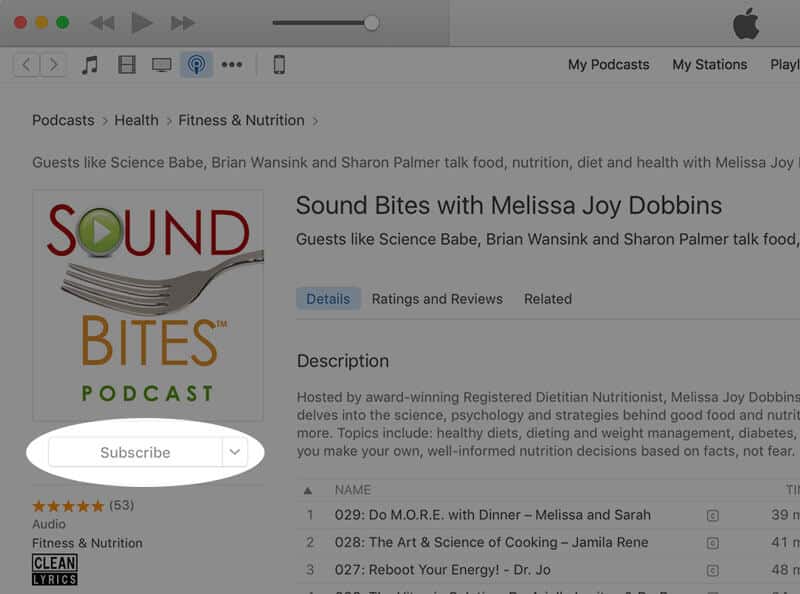
How to subscribe via iTunes
Click here to view the Sound Bites Podcastin iTunes, then click the blue “View in iTunes” button. This will open your iTunes application directly to Sound Bites Podcast. Click the “Subscribe” button, and your done!