Celebrating over 1 Million Downloads and 50,000 Free CEUs on the Sound Bites® Podcast | NEW: Get 1 years’ worth of CEUs with the new 15-CEU Podcast Course
Click here to earn 1.0 FREE CEUs for listening to this podcast episode!
Disclosure: Commercial support has been provided by the American Pistachio Growers. Cynthia Sass is a paid consultant for the American Pistachio Growers.
The Science Behind Plant-Based Performance Nutrition & Strategies for Success
Athletes continue to explore plant-based eating patterns to enhance athletic performance and more and more research shows the numerous benefits, including improved cardiovascular health, reduced inflammation, and maximized recovery. We explore the science behind being a plant-based athlete and discuss practical strategies for optimizing athletic performance.
Eating more whole plant foods is the ultimate bio hack because it has the potential to positively impact mental and physical performance, mood, digestive health, sleep, anti-inflammation, immune health, and more.” – Cynthia Sass
Tune into this episode to learn about:
different plant-based terms and definitions
definition of athlete
benefits of plant-based eating patterns for athletes and exercisers
potential challenges athletes might encounter
nutrient needs and concerns for athletes
foods to include for important nutrients
complete protein status of pistachios
how pistachios may help aid exercise recovery
tips for transitioning to a more plant-based diet
tips for cooking more plant-based
tips for grab-n-go meals and snacks
advice for fueling up pre and post workout
foods to limit or avoid
potential supplements to consider
recipes and resources
Cynthia Sass, MPH, MA, RDN, CSS
Cynthia Sass is a three-time New York Times best-selling author, writer, certified plant-based cook, and plant-based recipe developer with master’s degrees in both nutrition science and public health. Cynthia was in the first group of registered dietitians to earn the CSSD credential (Board Certified Specialist in Sports Dietetics), which she has held since 2006.
She has consulted for six professional sports teams in the NBA, MLB, and NHL. Through her Los Angeles-based private practice she has counseled Oscar, Grammy, and Emmy winners, and has worked one-on-one with pro athletes in a variety of sports. She is also the nutrition consultant for UCLA’s Executive Health Program. Sass has appeared on numerous national TV shows, including The Today Show and Good Morning America, and is a long-time freelance writer and media interviewee.
Pistachios are a complete protein and a good source of nutrients such as fiber, copper, phosphorus, B6, thiamin and manganese and can easily be incorporated into daily eating patterns. Plus, research shows they can aid in post-exercise recovery.” – Cynthia Sass
Resources Some links may be affiliate links. As an Amazon Associate, I earn from qualifying purchases.
Welcome to Sound Bites, hosted by registered dietitian nutritionist, Melissa Joy Dobbins. Let’s delve into the science, the psychology, and the strategies behind good food and nutrition.
Melissa Joy Dobbins (00:23):
Hello, and welcome to the Sound Bites Podcast. Today’s episode is about plant-based athletes and plant-based performance nutrition.
This episode is sponsored. Commercial support has been provided by the American Pistachio Growers, and we are submitting this episode to the commission on dietetic registration for continuing education credits for dietitians, diet technicians, and diabetes educators. So, stay tuned for that if that is of interest to you.
My guest today is Cynthia Sass. Cynthia is a three-time New York Times bestselling author, writer, certified plant-based cook and plant-based recipe developer with master’s degrees in both nutrition science and public health.
She was in the first group of registered dietitians to earn the CSSD credential, which is Board Certified Specialist in Sports Dietetics, which she has held since 2006. Cynthia has consulted for six professional sports teams in the NBA, MLB, and NHL, and has a Los Angeles based private practice with a specialty in plant-based performance nutrition.
Welcome to the show, Cynthia.
Cynthia Sass (01:35):
Thank you so much for having me, Melissa. I’m excited about our conversation today.
Melissa Joy Dobbins (01:39):
Me too. It’s been a long time coming to have you on the podcast, and I’m just thrilled to have you here.
I would love for you to share more about your background and the work that you do. It sounds very fascinating. I haven’t done this topic on the podcast at all, and I’m really looking forward to learning from you.
But I’d love to start with more about your background and the work you do. Oh, of course, and any disclosures to note.
Cynthia Sass (02:03):
Absolutely, yes. I do want to say upfront that I am a consultant for the American Pistachio Growers, and I am being paid for my time here today to be a guest on the podcast.
But as you listen to our conversation, I hope you’ll note that I’m always invested in the science and the evidence as it relates to sports nutrition and nutrition overall.
But I’m happy to tell you a little bit more about my background. So, I would say that all or mostly plant-based eating has been a part of my personal journey since I was in high school.
And back in high school, I participated in track, and cross country, and cheerleading, and I definitely made some pretty big nutrition mistakes or missteps then not knowing that much about nutrition as a plant-based athlete then.
And I will say that when I was in high school, I kind of fell in love with nutrition as a profession. I heard about it from my health teacher. I found out that dietitian was something that you could do for a living. So, I went to college knowing that I wanted to become a registered dietitian.
I went to Syracuse University, and I ended up doing my bachelor’s and master’s degrees there in nutrition science.
And I was fortunate enough in graduate school to be the teaching assistant for a professor who was really a pioneer in sports nutrition. And she encouraged me to follow that path because I really knew that I wanted to work in fitness and wellness and disease prevention. I wasn’t as attracted to clinical dietetics. So, she was really encouraging to me.
And that’s when I really started to marry my love for plant-based nutrition and my love for sports nutrition.
So, back then, starting out on the sports side as a new dietitian, I just had to get some experience. I would go give free talks to local gyms, local runners groups.
And I really had to work my way up the stepladder from engaging with recreational athletes, to high school athletes, then collegiate athletes, and eventually semi-pro, and finally pro athletes and pro team. So, it was really a process for me to kind of work through that level of experience.
But I will say on the personal side, (so, this is like over 25 years ago when I first started out) I was really discouraged from telling athletes that I was personally plant-based.
And I think it was a different time , you know, it was a little bit more stigma associated with it back then. I think that people saw it as a little bit more extreme way of eating, or there was even maybe some concern that I might be judgmental of people that weren’t fully plant-based.
And of course, as a dietitian, that was never my way of coming at it. I was always looking at it not as do as I do, or everyone should follow the same path, but what’s right for that particular individual. But I did kind of keep it under wraps, I would say, for the most part.
And then fast forward to now, especially over the past five years or so, it’s been really exciting to see that plant-based nutrition is more embraced. There are a lot of pro athletes that talk about being mostly or all plant-based and how that is part of their strategy for sports medicine and performance.
So, it’s really exciting to see that change and there’s a lot more that I can share both personally and professionally with the people that I work with now, with my own history as well as my knowledge of this space.
Melissa Joy Dobbins (05:13):
Excellent. Yeah, that’s very interesting and I can appreciate what you’re saying. I mean, just being a dietitian and working with different types of clients, two things come to mind.
One is you do have that personal experience that you can share. It’s like, I’m a certified diabetes educator. I don’t have diabetes. But some diabetes educators do, and they do bring that experience to the table.
Whether we’re working with somebody who is a carnivore or a vegan, we as dietitians need to meet them where they are.
And I think there is a lot of maybe curiosity out there, I guess, as far as well, if you’re a dietitian and you do X, Y, Z, are you trying to get your patients to do the same? And as you know, Cynthia, that’s not what dietitians are supposed to be doing. That’s not what we do.
Cynthia Sass (06:02):
That’s right. That’s one of the things that sets us apart I think from influencers is that we are professionals and we are experts, and we are meeting people where they are.
I sometimes have people reach out and ask me, “I see you have a lot of information about plant-based nutrition, plant-based eating. Do you only work exclusively with people that are plant-based?”
And I’ll say, “No, I will work with anyone who’s even wanting to become more plant forward or learn about the roles of plants in performance.” And so, we’re very-
Melissa Joy Dobbins (06:30):
Yeah, non-Judgmental and-
Cynthia Sass (06:31):
Exactly.
Melissa Joy Dobbins (06:32):
Excellent, thank you. I love that.
Well, let’s start off with some definitions. I’ve talked about plant-based on the show many times, and I know that there’s like no official definition. This term is becoming more popular. The definition can vary and maybe it’s just a very personalized thing.
But for the purpose of our discussion today, let’s talk about what we mean by plant-based, and also, what is a plant-based athlete? And I guess for that matter, let’s try to define what an athlete is.
Cynthia Sass (07:02):
Yeah. So, as you noted, there’s really no one universally accepted definition of plant-based. I think some people would define it as a hundred percent whole food plant-based diet. Other people define it as a mostly or primarily plant-based diet.
I think most people would accept that it is an eating pattern made up mostly or entirely of plants, but with a focus on whole plant foods. So, produce, and whole grains, and legumes, nuts and seeds as the primary focus.
And as far as athletes, that’s really interesting about the definition of that. I actually came across a 2021 paper that was published in Frontiers in Physiology. And they had an American Heart Association definition of athlete, which I had actually not seen before. And then they also defined exerciser.
And really, the difference between the two is about the athlete being focused on competing and really trying to achieve a level of excellence in their sport or with how they train.
Whereas an exerciser may be someone who participates in physical activity just for fitness or their own personal health, or maybe to change their physique, but maybe it’s not necessarily as focused on competition or as organized.
But when I work with people, I’ll say I’ve worked with people at all ends of the spectrum. As you mentioned, I’ve worked for six professional sports teams. So, these are athletes that are getting paid to participate in this sport at a very high level. Definitely, many of them are elite athletes.
And then I’ve worked with former professional athletes who are now retired, but they still consider themselves athletes even though they’re no longer competing.
I’ve worked with executives or entrepreneurs who surf first thing every morning, and they’re never going to compete in surfing, but they do consider themselves athletes. And that is definitely a very athletic endeavor (surfing), especially that frequently.
I’ve worked with people who were athletes in high school or college, and now, they have a full-time job, but they maybe still participate in that sport, not at a professional level, but at a competitive level. And they still train for that sport. And I think they would consider themselves athletes.
And then I work with exercisers, people who are just trying to improve their strength, or their endurance, flexibility or all of those things in some sort of a training capacity. But they’re not competing on any level, they don’t necessarily have a goal of achieving excellence. They just want to improve their own performance.
So, for me personally, I think maybe there’s some importance of having these definitions for research purposes or other purposes.
But when I work with an individual, I just want them to know that I’m there to help them understand how whatever they’re doing, however they’re moving their body, how to match up their nutrition to improve or optimize their performance, give them all the nutrients that they need, and allow them to fully recover from the stress and the wear and tear that that physical activity is putting on their body.
It’s interesting that how someone thinks of themselves may be more important.
Melissa Joy Dobbins (10:00):
Yeah, no, that’s really interesting. Thank you. So, then regarding the plant-based, I mean, there may or may not be animal products, and that’s very clear. It’s not necessarily vegan, but it can be.
And then I’m glad you found this definition for the athlete versus exerciser. And as you’re talking, obviously every client that you work with, they’re all unique individuals and have unique needs.
But we’ll be talking about some of the general things that athletes in particular or exercisers can benefit from plant-based performance nutrition.
Cynthia Sass (10:32):
Yeah. And I think that the reason that the words plant-based has become more utilized is because it’s more inclusive.
So, I do have athletes or active people, or people I work with who they want to be almost all plant-based, but they want to have that option of maybe having sushi every once in a while.
Or when they’re traveling, if it’s really difficult to find a plant-based meal, maybe they will eat salmon or something like that. Whereas if someone identifies as vegan, it’s pretty exclusive to any animal-based options.
So, I think it’s more of a flexible way. It’s not necessarily flexitarian. And that flexitarian may include more frequent consumption of animal products, but plant-based is more, I think, practical for many of the people that I work with.
And some of them are 100% plant-based as well. And do still use the term plant-based instead of vegan.
Melissa Joy Dobbins (11:19):
Okay. So, let’s talk in general, or maybe in an overview what the benefits of following a plant-based eating pattern would be if you’re an athlete or an exerciser.
Cynthia Sass (11:30):
So, I think that really does come down to how you execute this plant-based diet. Is it well planned? Is it providing all the nutrients that you need? Is it consistent? So, that’s going to make a big difference on the impact it has on performance recovery and outcomes like muscle building, et cetera.
But we do have some good research to show that a plant-based diet may improve both athletic performance and recovery time post-exercise. That’s really important.
And there is some interesting research to show that eating more plant protein supports better sleep quality. And we know that sleep is really crucial for athletes and for recovery specifically.
And people who eat a plant-based diet tend to have lower BMIs than people who don’t eat a plant-based diet. In certain sports, that may be very advantageous.
And then just overall health-wise, a plant-based diet is associated with reduced rates of cardiovascular disease, type 2 diabetes, obesity, some cancers, and a reduced overall mortality. So, there are a lot of benefits if you do it correctly.
Melissa Joy Dobbins (12:31):
Okay, great. I can imagine there are challenges though. So, let’s talk about some of the challenges that a plant-based athlete might encounter. And of course, if you have any stories, you’ve kind of shared some examples as we’re going, but I would love to hear more stories and examples as we talk.
Cynthia Sass (12:46):
Yeah. So, athlete active or not, it can be a challenge being a plant-based eater, because you do have to be more mindful of how to meet your nutrient needs.
I do have many clients who just start omitting animal-based foods, and they really don’t know how to replace those with plant-based foods that provide similar nutrients. So, that’s one challenge, just being more mindful of are you meeting all of your needs?
The other one though that’s really interesting with plant-based eating that I’ve encountered many times is that whole plant-based foods are fiber rich, they’re pretty filling. So, many people will not hit their total calorie or total protein goals because they’re full.
I’ve worked with people who I’m going through their food diaries or talking to them about their usual eating routine and their diet sounds fantastic. Lots of varied whole plant-based foods, lots of nutrients.
But when I actually calculate what they’re taking in compared to their needs based on their training or performance, they may be only getting 60% of their needs met. That can be fairly common because they’re filled up before they hit those targets.
And so, that’s another challenge just to be aware of, is that yes, a primarily whole food plant-based diet is wonderful, but if you’re not hitting your targets, you may not perform or recover as well as you could.
And then the Academy of Nutrition and Dietetics has said that plant-based athletes should have about 10% more total protein than their calculated needs, because plant proteins are less well digested than animal proteins.
So, if I’m calculating someone’s protein needs, let’s say it’s 1.2 grams per kilogram is what I’ve determined that would be optimal for them. I’m going to add 10% to that just to account for that digestibility difference.
Now, some people like that because they’re like, “Oh, I get to eat more food.” Other people find that challenging because they have to eat more food. So, it depends on someone’s schedule.
And so, we may need to get strategic about how we increase snacking or providing more compact nutrition, the same number or more calories with a smaller portion, and get really creative with some of their meal and snack options on a day-to-day basis. And I think tracking can be really beneficial.
Melissa Joy Dobbins (14:49):
Right, yes. I find it challenging to get my protein needs, even with animal protein. So, I can’t imagine. I’m not a big eater and I don’t get many calories at my age or in my specific metabolic circumstances, I guess. But yeah, I can appreciate that. That’s interesting about the 10% increase for the total daily protein.
So, let’s talk about some specific nutrients, maybe key nutrients for athletes. Maybe you could share some of those and then we could focus on what those nutrients do for the athlete.
Cynthia Sass (15:24):
Yeah. So, there are a lot of nutrients, macro and micronutrients that are really crucial for athletic performance and recovery.
And these include the macros, carbohydrates for fuel, protein for muscle maintenance, recovery, and even muscle building if that’s a goal, fat intake for fat soluble vitamin absorption and for cell membrane maintenance. And then a lot of the vitamins and minerals.
So, we need iron to carry that oxygen around the body. We need calcium for bones and muscle contractions. There are so many of these nutrients, electrolytes for hydration and fluid balance, specific minerals.
But I think for the purposes of our discussion, the most important thing (and we can go through the rest of these if you’d like to and kind of each one of them and what they do) for people to keep in mind is that all of these can be met on a well-planned plant-based diet.
So, this is one of the questions that I get sometimes is, do I have to get iron from animal-based foods or is it okay to get it from plant-based foods? Or same with calcium.
You may need some strategic supplementation with things like vitamin B12, but for the most part, all of these nutrients can be met or obtained from plant-based foods.
And what I like to talk to people about is that there are some plant-based foods that provide several of the nutrients that are important for athletes in one single food. So, for example, pistachios, they provide protein, but they also, provide some B vitamins, antioxidants, iron, magnesium, and potassium just in this one single food.
So, the foods that you do choose throughout your day, whether you’re incorporating them into meals and snacks, can give you more of what you need maybe than another food that is less nutrient rich.
Melissa Joy Dobbins (17:06):
So, with the plant-based approach, you mentioned B12, most people know that that’s only found in animal products.
Are there other nutrients, like you said, you can get them from iron or calcium, you can get them from plant-based foods. But are there any other nutrients that come to mind from a plant-based perspective that people should be a little bit more purposeful about?
Cynthia Sass (17:28):
Well, vitamin D is definitely one because the only real plant, and I guess it’s not technically a plant, but fungi, can help meet that need. But-
Cynthia Sass (17:37):
That may be another one that people may need to supplement. And obviously, it’s really important to have your vitamin D level assessed.
I have certainly had people who are taking far too much vitamin D and have no idea that’s even possible to get too much. Too much of a good thing, I guess you could say. And when they go get their levels tested, it’s really off the charts and we don’t want that to happen. So, I always really encourage testing when it comes to that.
But certainly, plant foods are rich sources of a lot of these nutrients, the whole grains, pulses, vegetables, leafy greens can provide a lot of these key nutrients. Calcium, zinc, magnesium are all going to be obtained from B vitamins. And as we already talked about, healthy fats from things like nuts and avocados and extra virgin olive oil.
One of the main benefits of a plant-based diet for athletes is that it’s really abundant in carbohydrates. So, there’s plenty of fuel to go around from a lot of these plant-based foods that have a high carbohydrate content along with that antioxidant and nutrient rich package.
Melissa Joy Dobbins (18:35):
And I can imagine some athletes might be concerned about getting enough protein and of course high-quality protein from a plant-based diet and I know that’s one of the main things that we want talk about today.
So, what do they need to know to focus on so that they can make sure they’re getting high quality protein and adequate protein?
Cynthia Sass (18:53):
So, I think what’s important for protein is three things. Quality, variety, and quantity. All three of those have to be a focus.
And so, it is important for a plant-based athlete to know that all plant foods do contain all 20 amino acids, including all nine essential amino acids. But some plant foods are low in some of those amino acids and there are other plant foods that may be higher in that particular amino acid and vice versa.
So, it’s really important for the athlete to get a wide variety of plant foods so they can collect throughout the day all these wide array of amino acids so that they can really achieve a full amino acid profile that would allow them to be able to use those amino acids for muscle protein synthesis and recovery, et cetera.
So, the name of the game really is variety. I want to see people eating not only just the same few vegetables over and over again, but a wide variety of foods within each food group, different whole grains, different legumes, different nuts and seeds, to achieve a wider variety of those amino acids.
But also, what’s really important here is that the quantity must be achieved. So, I have worked with people who, they’re just so focused on protein that they’re tracking their protein intake. And let’s say that they’re trying to get a hundred grams of protein a day and they’re very diligent about that and they’re hitting 25 grams four times a day. Alright, I’ve got my total protein down.
But then when I look at their overall intake, they’re may be missing 20 to 30% of their total calories. So, without both total protein and total calorie needs being met, some of that protein is going to be utilized for fuel, ah, and pulled away from its job of maintenance, healing, and repair of protein tissues in the body. So, that’s really important is that both of those goals have to be met.
And then quality wise, we really want most of this protein to be coming from whole plant-based foods. Again, the vegetables, the whole grains, the legumes, the nuts, and seeds.
So, we have got quality, we have got variety, very, very critical. And then quantity meeting all of those needs by the end of the day.
Melissa Joy Dobbins (21:11):
Well, as you’re saying that, I remember learning that. Yes, if you don’t have adequate calories, the protein will be used as calories. But that’s a really, really important point.
And as you’re talking with the different amino acids, this concept of like complimentary proteins or combining proteins, I think that’s outdated. But can you just speak to that since you’re the expert and I’m not. Do you have to have them all at the same time? Or it sounds like you can get them throughout the day, but I’ll let you answer that.
Cynthia Sass (21:41):
That’s right, you can get them throughout the day. And that’s such a relief for most people because there was older concept of combining proteins where they had to be eaten at the same time within the same meal. So, you had to have your beans with your rice.
And it really led to some stress for some people that they had to figure out what were the food combinations and they had to always make sure they had those, whether they were dining out or preparing food at home.
Now, we know that our body’s able to collect these various amino acids from different foods. They do not have to be consumed at the same time or complement each other within the same meal. And as long as you have that variety and those total calorie and protein needs are met, those amino acids can come together and sort of build that puzzle to create the protein in the body that is needed.
So, yeah, it’s a little bit of an outdated. Sometimes I see things like that coming back on social media, “Make sure you eat this with that in order to compliment your proteins.”
But also, the other thing to note is that there are some plant foods that are complete proteins themselves, meaning they have high levels of all nine essential amino acids in that one plant food. And it doesn’t mean that you have to only exclusively eat complete protein foods, but it is important to know sort of which ones are providing more of these essential amino acids.
Melissa Joy Dobbins (22:53):
And what foods would those be?
Cynthia Sass (22:55):
Well, pistachios, believe it or not, is one of them. I think many people are surprised to learn that pistachios are a complete protein. So, again, meaning they have high levels of all nine essential amino acids.
So, just in 2020, the protein quality of pistachios was assessed for the first time at the University of Illinois Urbana-Champaign.
So, what researchers did is they measured the protein digestibility corrected amino acid score or the PDCAAS I like to call it, or I think most people refer to it instead of its long terminology. But that evaluates protein quality based both on amino acids and how well the body digests the protein.
So, the roasted pistachios have a PDCAAS score of 81%, and that is more than quinoa, it’s more than chickpeas, it’s more than roasted peanuts. In fact, pistachios are the only nut that is a complete protein.
And so, I think most people are like, “Wow, yeah, it’s news to me. I didn’t know that.” Even some health professionals may not know that information, which is relatively new information.
So, to put that in perspective, the PDCAAS score of milk is a hundred percent. And I mentioned that roasted pistachios is 81%. So, that’s pretty good from a plant-based food.
Also, just to give a little bit more perspective, legumes on average are somewhere between 50 and 70%. And so, again, pistachios are above that number.
Melissa Joy Dobbins (24:16):
Yes. So, I did know about the pistachio being a complete protein, but I didn’t know the story behind it. And so, I found that very interesting. So, thank you for sharing that. And it’s recent information, it’s very exciting.
So, you had mentioned recovery in the beginning. Performance recovery, sleep, weight, and I know recovery is so key.
I know that I didn’t know what I was doing with recovery when I trained for my triathlon. And I didn’t have any injuries thankfully but I could have done a whole lot better in that department. And I was a completer, not a competer. So, it’s all good.
But I find this topic very interesting. So, can you tell us about some of the research on how pistachios aid in exercise recovery?
Cynthia Sass (25:07):
Yes. And as you noted, recovery is so crucial. It’s a very big piece of the puzzle. The way that I like to explain it to clients is that if you don’t fully recover, you go into the next training session or competition at a disadvantage, a little bit weaker.
And that can have a snowball effect over time. Before you know it, you may be injured. So, I’m glad that you didn’t get injured, Melissa, in your training.
But there was a study in 2022, so just a few years ago, published in Metabolism Open and this focused on strength training. And it found that raw, shelled, unsalted pistachios helped with subjective ratings of pain. So, that self-scoring of what’s your pain level after doing strength training.
And also, these athletes maintained muscle force production after eccentric exercise. So, those are the slow controlled contractions that involve lengthening the muscle that often causes that soreness.
And so, this research indicated that pistachios can reduce delayed onset muscle soreness and help athletes maintain muscle strength. And that can lead to improved exercise tolerance. Meaning you can stick with it, you can keep going, you can keep training, and you can then get those training adaptations. So, it was really exciting news for pistachios.
And as I mentioned, Melissa, pistachios also, provide antioxidants which are important for exercise recovery. And they’re actually antioxidant powerhouses, rivaling blueberries and pomegranates.
So, when you think about pistachios as an antioxidant source, that’s a really important step for exercise recovery. And they also supply a lot of key nutrients that support immune function, including B vitamins, zinc, magnesium, selenium, copper, and fiber, and even lutein and zeaxanthin.
Those may help reduce inflammation and also increase the activity of some immune cells in the body. So, they provide this really nice recovery package.
Melissa Joy Dobbins (26:59):
Excellent. So, in addition to this, is there anything else that sets pistachios apart from other plant-based foods or nuts?
Cynthia Sass (27:08):
Well, when we’re talking about that PDCAAS score, I think it’s interesting to note that the score for pistachios is higher than for almonds, Brazil nuts, peanuts, pecans, pine nuts, and walnuts. And again, they’re the only nut that qualifies as a complete protein because they have those high levels of all nine essential amino acids.
And with that high level of antioxidants rivaling foods that people think of as antioxidant sources, including cherries, blueberries, and pomegranates, they provide this really nice package. But they’re also, in my opinion, very beautiful to look at. They have this gorgeous color.
And you mentioned it when you introduced me that I have completed some plant-based culinary certificates and pistachios are one of my favorite ingredients to work with because they’re also very versatile. They can be used in both sweet and savory dishes.
And they do provide that classic crunch, but they can also, be pureed or ground into pistachio butter or things like pestos and other types of ingredients.
So, they have this versatility both in their composition in terms of like the texture, but also, that adding that beautiful color and nutrients.
And then I think a lot of people think of them though as a classic snack. I know for myself and some of my clients, just that ritual of opening the unsheltered pistachios one at a time is something that they really enjoy.
And that does slow you down and it can help support more mindful eating of just one by one opening and eating them versus just grabbing a handful of something and putting it in your mouth and kind of being distracted.
Melissa Joy Dobbins (28:39):
Right. More mindful for sure, yeah. That’s my husband’s favorite snack.
Alright, well, let’s discuss some practical applications for plant-based eating for athletes. One thing that I often think about is like, okay, how can you recommend some tips on transitioning to more plant-based diet?
Cynthia Sass (28:57):
I think there are a few different ways people approach this. And I like to talk about what works for that individual person because there is no one way to approach this.
So, one, some people I work with like to just focus on one meal at a time. Maybe they’re looking at just breakfast and like, okay, I’m going to take my breakfast. I’m going to think through all my typical breakfast options, and then how can I swap out animal-based ingredients for more plant-based ingredients in my breakfast meal?
So, someone might, for example, replace a yogurt parfait with a chia seed pudding. Or instead of having an egg scramble, they might have a tofu scramble or a scramble made from chickpeas or white beans or something like that.
Once they’ve sort of plant-based their breakfast options, then they can move to lunch and then maybe snacks or dinner.
But another way to approach it would be just to think about what are the most frequent go-to meals throughout the week. And looking at the makeup of those meals, the ingredients and saying, “Okay, within each of these meals, how can I replace the animal-based ingredients with plant-based ingredients?”
So, for example, tacos or bowls are very popular with my clients. And they might replace the ground meat whether that’s ground beef or turkey with something like a filling made from lentils or beans and pistachios. So, that combination of the legumes and pistachios is going to give more total protein, a wider amino acid profile, more total overall nutrients.
And that’s something people often tell me, “Oh, I wouldn’t even have thought of that. About making that change.”
So, because sometimes, like I mentioned, they’re taking things out without thinking about how to replace those. So, the replacements are just as important as the eliminations.
Melissa Joy Dobbins (30:34):
Yeah. I like that. Especially because I know some people might say, “Okay, well, I’m not going to have this burger or this taco and I’m going to replace it with like a whole new dish that isn’t comparable to that at all.” Which is fine, but this seems like an easier way to kind of transition.
Cynthia Sass (30:50):
Yeah. And sometimes they just replace it with more vegetables and that’s not providing adequate protein levels and it’s not providing enough variety in the diet.
Melissa Joy Dobbins (30:58):
Well, and with your culinary background, I’m sure you have some cooking tips for cooking more plant-based.
Cynthia Sass (31:05):
Yes. Some of these are really easy swap outs. When I work with people, sometimes I go to their homes and we go through their kitchen cupboards and pantries and refrigerators and freezers and we identify items that we need to replace.
Sometimes it’s just as simple as using extra virgin olive oil instead of butter when sauteing or in certain dishes. It can also be replacing something like chicken broth with a vegetable broth. Even with garnishing instead of garnishing with shredded or crumbled cheese, someone can garnish with chopped nuts or even with chopped up avocado.
So, it’s these little tiny, like let’s look at all what you use on a day-to-day basis when you’re preparing your meals and make some simple strategic swaps.
But I think where people are most intimidated, honestly, is the proteins. So, I’ve had so many people tell me tofu, or tempeh, or even pulses, they’ve never purchased and brought it home and had to figure out what to do with it before. So, they’re a little intimidated.
But what I have found is I provide some simple recipes. There are a lot of recipes online that are really easy. I’m really generally recommending minimal ingredients and few steps.
I’ve had clients go out and buy really nice beautiful plant-based cookbooks, but they’re so intimidated by the number of steps and ingredients that they don’t make any of the recipes. So, I’m trying to keep it simple.
But what I find is when people work with these things, tofu, tempeh, or pulses, or even whole grain sometimes just a few times, their comfort level really skyrockets. It doesn’t take a long time to sort of adapt to that and then they start to feel more comfortable.
But another thing I like to recommend is dining at plant-based restaurants to get some inspiration. Or just even looking at menus. Even if you’re looking at a menu from a plant-based restaurant that’s in a different city from where you live, it can help you think about, oh, I could do that with tofu, or I could do that with lentils, just to provide some ideas.
Melissa Joy Dobbins (33:00):
I love that. Very good. Yeah, I was at a conference recently and they’re talking about plant-based alternatives. And somebody made a really great point about, hey, why do we — I mean, I don’t want to say why do we need a chicken nugget that tastes like chicken nuggets, but they’re not chicken.
There might be some people who want that, but let’s try to make that taste better and taste like chicken when you could do something with tempeh and tofu and it’s just its own thing. It’s not trying to mimic something else.
Cynthia Sass (33:29):
Yeah, that’s right. It is unique. I do have a lot of clients who are turned off to meat substitutes sometimes because they taste too much or look too much like meat.
Melissa Joy Dobbins (33:37):
Right. That makes sense.
Cynthia Sass (33:39):
Yeah. And so, they want something that has that meaty texture but that doesn’t resemble the animal product.
Melissa Joy Dobbins (33:45):
Yeah. And certainly, some people want it to taste like … so, different strokes for different folks.
Any tips for like grab and go meals or snacks? Obviously, pistachios are a great portable snack, but.
Cynthia Sass (33:58):
That’s right. One thing I love about them is they’re portable and non-perishable. So, a serving of 49 pistachios is going to provide 6 grams of protein. That’s as much complete protein as an egg, but you don’t have to worry about keeping it in a cold pack or refrigerating.
So, you can just grab those, put them in your backpack or your bag and have them with you. So, it’s a great portable high quality protein option for whether you’re an athlete or not, someone who’s on the go.
But what I have found these days is that there are a lot more fast casual restaurants that offer fully plant-based options.
Also, in terms of snacks, hummus and vegetables is pretty easy to get. I also like making energy balls with old fashioned rolled oats and nut butter and maybe other nuts or seeds in there, little cinnamon, a little chopped up dark chocolate. Those can provide a lot of different nutrients and they’re very filling.
And also, for myself, when I’m thinking about something to make ahead and take with me, I really like to make some chilled protein salads. So, this could be like a mock egg salad, but made with tofu instead of hard-boiled eggs. Or it could be like a chilled chickpeas salad.
You can do a lot. Instead of using mayo, there are some vegan mayos out there now as well that are fully plant-based. But you can use things like a fully plant-based pesto as the coating instead of a mayo. You can use hummus, you can use seasoned tahini.
So, once you have that chilled protein salad, you can take it on the go maybe with just some raw or leftover roasted veggies, some whole grain crackers. And that can be a great on the go meal. And it can also be something that you could take to a get together.
Melissa Joy Dobbins (35:36):
Oh, that all sounds so good. I’m getting hungry.
I know we talked a little bit about recovery, but if you have any more specific advice for fueling up pre or post-workout? I know that is a very common question. Like what should I eat before I workout? What should I eat after?
Cynthia Sass (35:52):
Yeah. So, pre-workout is all about carbs and I have my list of go-to whole food carbohydrates. Like bananas are certainly a great go-to, dates are helpful for many people. Also, oatmeal, leftover roasted potatoes whether it be skin on fingerling potatoes or sweet potatoes can be fantastic.
I really encourage people to experiment with what works for them, what helps them feel the best digestively, what helps them perform their best. And maybe try a few different options.
And then post-workout for recovery, it’s really all about providing, again, variety and enough quantity of protein and calories with a lot of variety and the quality of mostly whole foods.
So, I love grain bowls and they’re really popular right now. I know there’s a lot of restaurants you can go to and build your own grain bowls, but you can certainly make them at home.
But what’s great with a plant-based grain bowl is you’re getting protein and you’re getting nutrients from all the components of the bowl.
So, you’re getting a grain, say quinoa, a plant-based protein source like lentils, vegetables in there. And then for a healthful fat, it could be something like a pistachio pesto, for example, that’s going to give you, again, more protein and more antioxidants and nutrients. So, that would be a fantastic recovery meal.
Melissa Joy Dobbins (37:04):
Oh, that sounds wonderful. Are there any foods that should be avoided or limited? I know we try not to tell people that certain things are off limits or whatever, but is there anything that should be?
Cynthia Sass (37:16):
Well, I mean, I’ve certainly met my fair share of people who go plant-based and then end up eating a lot of highly processed plant-based foods and really not prioritizing the whole plant-based foods.
So, I think that it’s important that the majority of what you eat be very nutrient rich, whole plant-based foods. And that you are not just constantly relying on things that are convenient.
I mean, there are ways to make whole plant-based foods convenient. And so, sometimes when I go to people’s homes, that’s part of what …
In fact, I go to grocery stores with people, walk around the aisles together, and talk about, okay, if you only have 15 minutes to put together a meal, here’s some things that we can essentially what I call assemble. Where you’re not having to cook per se, but you’re just putting these things together in a way that would give you much more nutrition and not be as highly processed.
Melissa Joy Dobbins (38:07):
Okay. I like that. I like to assemble. My skill level. No, yeah, that makes sense. And it could be vegan, gluten-free, blah, blah, blah, whatever, but a chip is a chip and a cookie is a cookie.
We talked about some nutrients, and especially like B12 and vitamin D with regard to supplementation. Is there anything else we need to know regarding supplements for plant-based athletes that we should consider?
Cynthia Sass (38:33):
If someone’s going to be even mostly plant-based and certainly someone who’s going to be all plant-based, vitamin B12 supplementation is a must. Iodine salt is also, recommended to help meet iodine needs.
And then I think everything beyond that can be personalized to the individual because it’s really important to take a look at what someone is eating. And I’ve had clients that were a little bit more challenging where when I first start working with them, they have “Oh, I don’t really like beans. I don’t really like tofu. Here’s the list of vegetables that I eat.” And it’s like a very short list.
And fortunately, some of those people over time become more open-minded to trying things and expanding the variety of the plant-based foods that they eat.
But whether someone needs additional supplementation is really largely determined by their usual diet. Do they have any dietary restrictions? Do they have any conditions that impact their ability to meet certain nutrient needs?
But I will say that the Academy of Nutrition and Dietetics Vegetarian Nutrition Practice Group offers a really great guide, it’s called the Plant-Based Starter Kit, and it’s a great resource for people who are more perhaps new to plant-based nutrition. So, it’s a great resource.
Melissa Joy Dobbins (39:42):
Great. Thank you for mentioning that. I know you develop a lot of plant-based recipes, but I think you have a recent favorite one that you wanted to share with us.
Cynthia Sass (39:51):
I do. So, I will say when I was in college and graduate school for nutrition science, I loved that I couldn’t get enough of learning about food science and nutrition science, but I felt like I didn’t really learn that much about culinary arts.
So, I did go out and complete these plant-based culinary certificates, just to learn a little bit more about that and how to use certain spices and how to combine different flavor profiles.
So, one of my more recent favorite recipes that I developed is a chickpea pistachio tahini slaw. So, I take some tahini and then I season it with little maple syrup and some spices, and then toss that with roasted chickpeas, and then a slaw mix just made from red and green cabbage and some shredded carrots, and then add pistachios into that.
And it’s just so colorful. It’s just beautiful. I mean, I think we eat with our senses too. We need a feast for our senses to enjoy our food.
I love when I hear dietitians talking about the importance of flavor and enjoyment. So, it’s not just this bland, something that’s steamed with no seasoning and no flavor. So, I really enjoy sharing those kind of recipes with people.
But what I like about this recipe is it’s got a lot of varied ingredients but also, it’s satisfying, but it’s also energizing at the same time.
And those are the kind of recipes I like to develop where you feel like I feel good digestively, I don’t feel overly full. I don’t feel sluggish or stuffed and I feel really energized, but yet I’m satisfied and I’m not going to be hungry again for the next couple hours.
Melissa Joy Dobbins (41:19):
Yeah, it sounds light yet it’ll hold you. And I’m a texture person, so that looks like it has some really nice different textures that I would enjoy. I have to try that.
As we’re wrapping up, is there anything else that you’d like to share with us about plant-based athletes?
Cynthia Sass (41:34):
Well, I think there’s a number of reasons why someone might decide to go plant-based. I mean, I certainly do ask that question when I work with people is what made you decide to make this change?
And I hear all different kinds of responses, but what I’m really excited about is that plant-based eating has now become more well accepted.
I would say, again, when I was first starting out, a lot of coaches or strength and conditioning people were very anti going plant based, or there was this idea that you absolutely had to include animal products or certain animal products in order to meet an athlete’s needs. And we definitely have more research in support of a plant-based diet, even for athletes.
So, I’ve had a number of people though tell me that they tried to go plant-based on their own, and they had to give up on it because they weren’t performing well, they weren’t feeling well. They did feel like they were losing muscle mass, they were getting run down. And it was because they weren’t working with a professional.
So, I think one of my biggest takeaways for anyone is whether you’re an athlete or an exerciser or an active person, if you’re going to go plant-based, really work with a registered dietitian who is familiar with plant-based diets, who can help educate and counsel you just to make sure that you are meeting all of those needs nutrient wise, calorie wise, protein wise.
Helping you plan your meals, helping you be very strategic about how you go about this. Because we want to see people do this and feel better, perform better, recover better, and have all these benefits versus struggling through it.
Melissa Joy Dobbins (43:02):
Right. Absolutely! Do you have a bottom line takeaway for us?
Cynthia Sass (43:04):
Bottom line, a plant-based diet is a safe, achievable, and effective eating pattern for athletes. And it really should focus on nutrient dense foods like pistachios to be incorporated into that lifestyle.
Melissa Joy Dobbins (43:16):
Excellent. Where can people find more about this topic and connect with you? I’m sure there’s some websites, I know there’s a lot of research and handouts and resources, and of course your social media handles as well.
Cynthia Sass (43:28):
Well, you can visit americanpistachios.org and there are a ton of great resources there. You’ll find research, recipes by registered dietitians, including some of my recipes, toolkits, informational handouts, information about the health benefits of pistachios, the nutrition profile of pistachios. So, I think that’s really a wonderful place to go for more information.
And then I can be found through my own website. Just my name, cynthiasass.com, or really Instagram is the only social media that I’m active on.
Melissa Joy Dobbins (43:56):
Good for you.
Cynthia Sass (43:57):
And my handle there … somewhat.
Melissa Joy Dobbins (44:00):
You’re very active on there though.
Cynthia Sass (44:02):
Not super active, but I try, but it’s a full-time job sometimes to juggling all these different things and trying to even post somewhat regularly. But my handle there is cyn_sass. So, Cyn is my nickname, a lot of people call me Cyn. So, cyn_sass is my Instagram handle.
Melissa Joy Dobbins (44:19):
Excellent. Yes. And we’ll have the link to your recipe, the Chickpea Pistachio Tahini Slaw. Have a link to that as well.
And when I was searching around, I noticed that there’s a post on benefits as a recovery snack and a specific handout with the pistachio power nutrients.
And actually, I’m doing a workshop later today with ballet dancers in downtown Chicago. I do this workshop every summer. And they’re always asking about recovery and nutrition. And so, I’m bringing this information to them today and I’m sure that they will appreciate this.
And as I said, I’ll have all the links and resources we discussed in the show notes at soundbitesrd.com, including some research articles that people might want to check out.
So, Cynthia, thank you so much. Is there anything else that you’re working on that you’d like to share with us?
Cynthia Sass (45:10):
Well, there’s always new and exciting research being done about pistachios. In fact, there’s a study underway now, that is looking specifically at recreational athletes to see if pistachios also benefit that group, since most of the research has been done on elite athletes. So, stay tuned for that.
And then I’m just continuing to do my thing and put good information out there. And so, again, if someone wants to visit me on Instagram or via my website, I love to connect with people.
Melissa Joy Dobbins (45:38):
Absolutely yes. We will stay tuned. And yes, people connect with Cynthia, follow her on Instagram. And thank you so much for the work that you do. It’s been lovely having you on the show. I have learned a lot and I have the utmost respect for you and just appreciate everything that you do.
Cynthia Sass (45:55):
Thank you so much, Melissa. Thank you for doing this podcast. Thank you for all that you do and all that you’ve done in our field. And it’s been really a pleasure spending some time with you today.
Melissa Joy Dobbins (46:02):
Thank you. And for everybody listening, if you like this episode, share it with a friend, tell a friend about the podcast. And as always, enjoy your food with health in mind. Till next time.
[Music Playing]
Voiceover (46:16):
For more information, visit soundbitesrd.com. This podcast does not provide medical advice. It is for informational purposes only. Please see a registered dietitian for individualized advice.
Music by Dave Birk, produced by JAG in Detroit Podcasts, copyright Sound Bites Inc. All rights reserved.
LISTEN, LEARN AND EARN
Listen to select Sound Bites Podcasts and earn free CEU credits approved by the Commission on Dietetic Registration (CDR) for registered dietitian nutritionists and dietetic technicians, registered. Get started!
Get Melissa’s Sound Science Toolkit here!
Partnerships:
Sound Bites is partnering with the Association of Diabetes Care and Education Specialists (formerly the American Association of Diabetes Educators)! Stay tuned for updates on the podcast, blog and newsletter!
Sound Bites is partnering with the International Food Information Council! Stay tuned for updates on the podcast, blog and newsletter!
Sign up for my monthly newsletter and episode eblasts so you never miss an update!
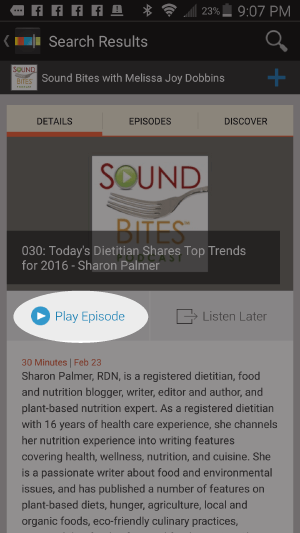
Listen on Stitcher (Android)
Install the Stitcher App
1. Search for “sound bites with melissa joy dobbins” 2. Choose Play Current Episode or Add to Playlist
Choose “Play Episode”
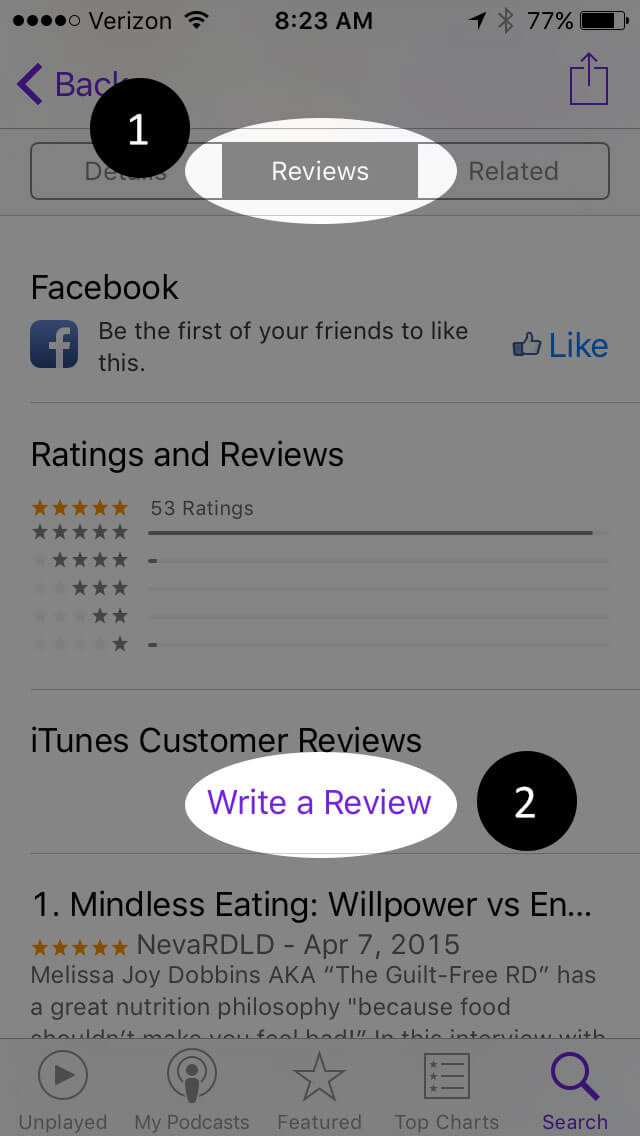
Subscribe & Review on iPhone
Open the “Podcast” app on your iPhone
Search for “Sound bites with melissa joy dobbins”
Open the podcast and click “Subscribe” and your done!
Write a Review
Click “Reviews”, then “Write a Review”.
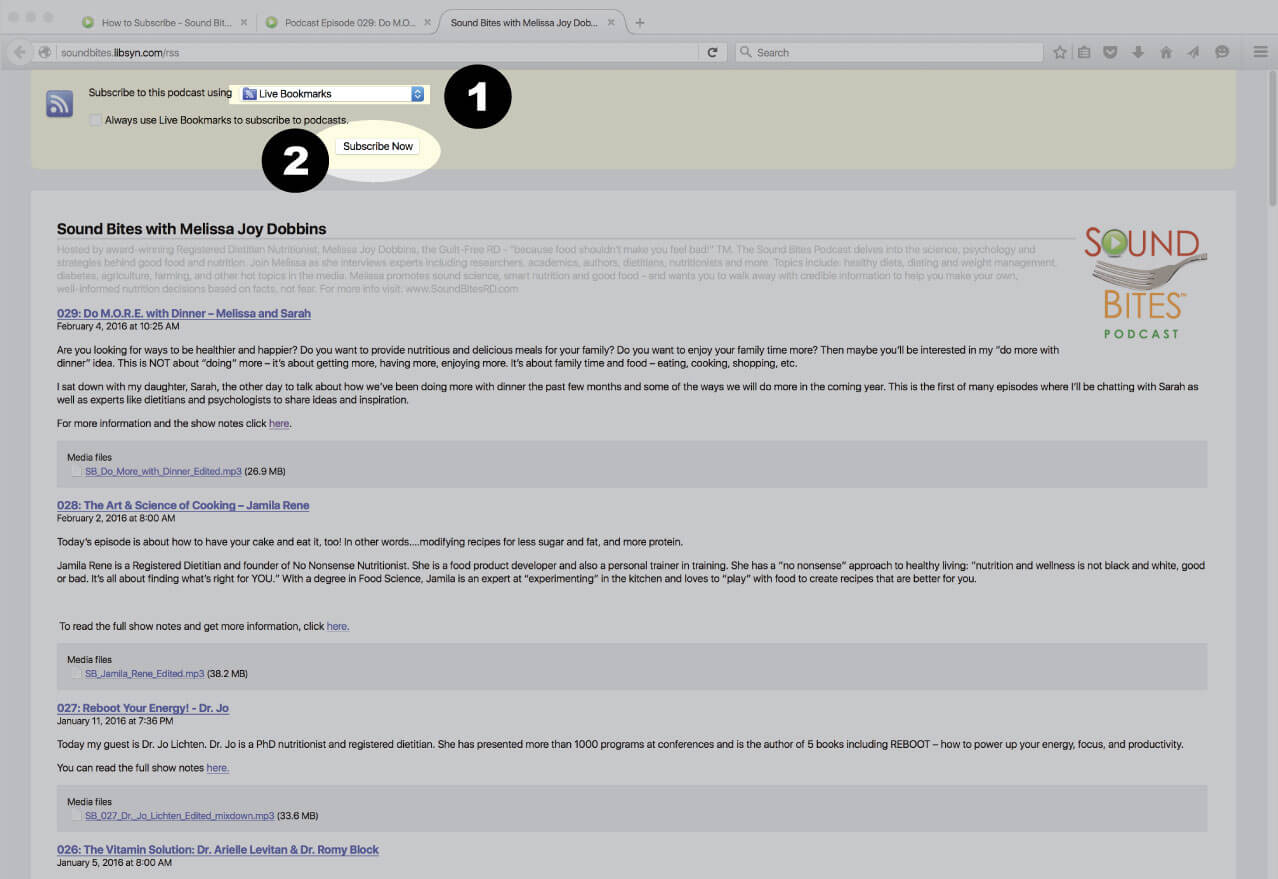
Subscribe via RSS Feed
Navigate to any podcast player . Click on the RSS feed icon.
Click on the RSS feed icon.
Click on RSS Feed
Choose which application you would like to use to receive the RSS feed
Click “Subscribe Now”
Confirm settings and subscribe.
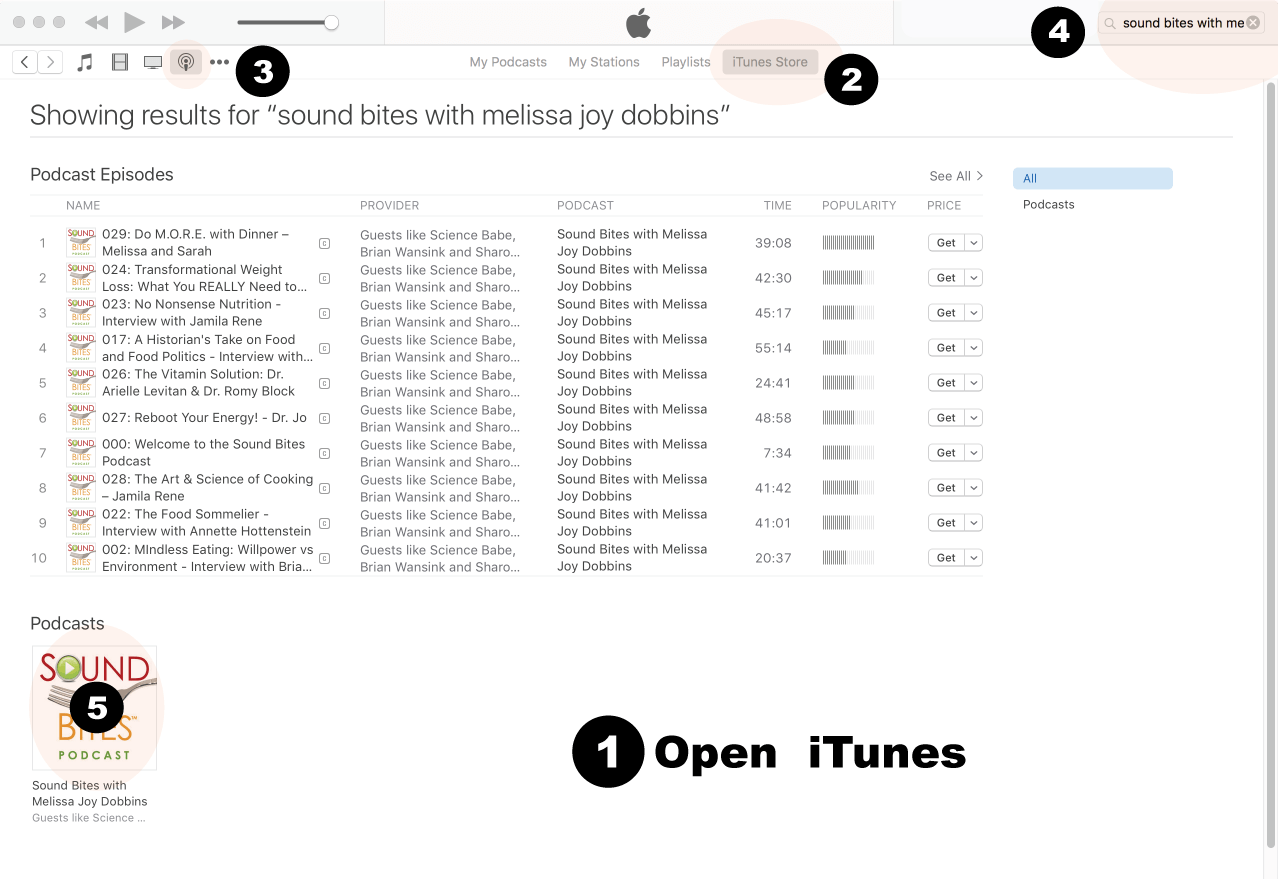
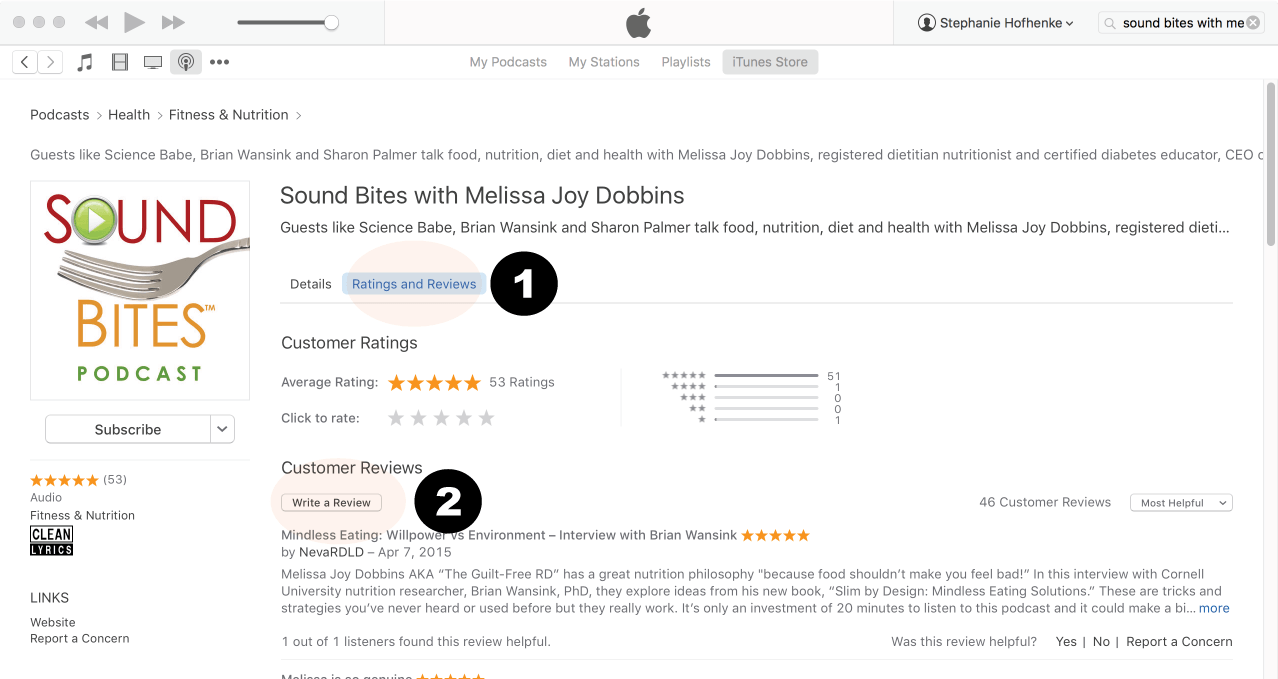
How to Review in iTunes
Open iTunes desktop application
Click iTunes Store
Click on Podcasts
Search for “Sound bites with Melissa Joy Dobbins”
Click on podcast image
Search for Sound Bites podcast in iTunes
Click Ratings & Reivews
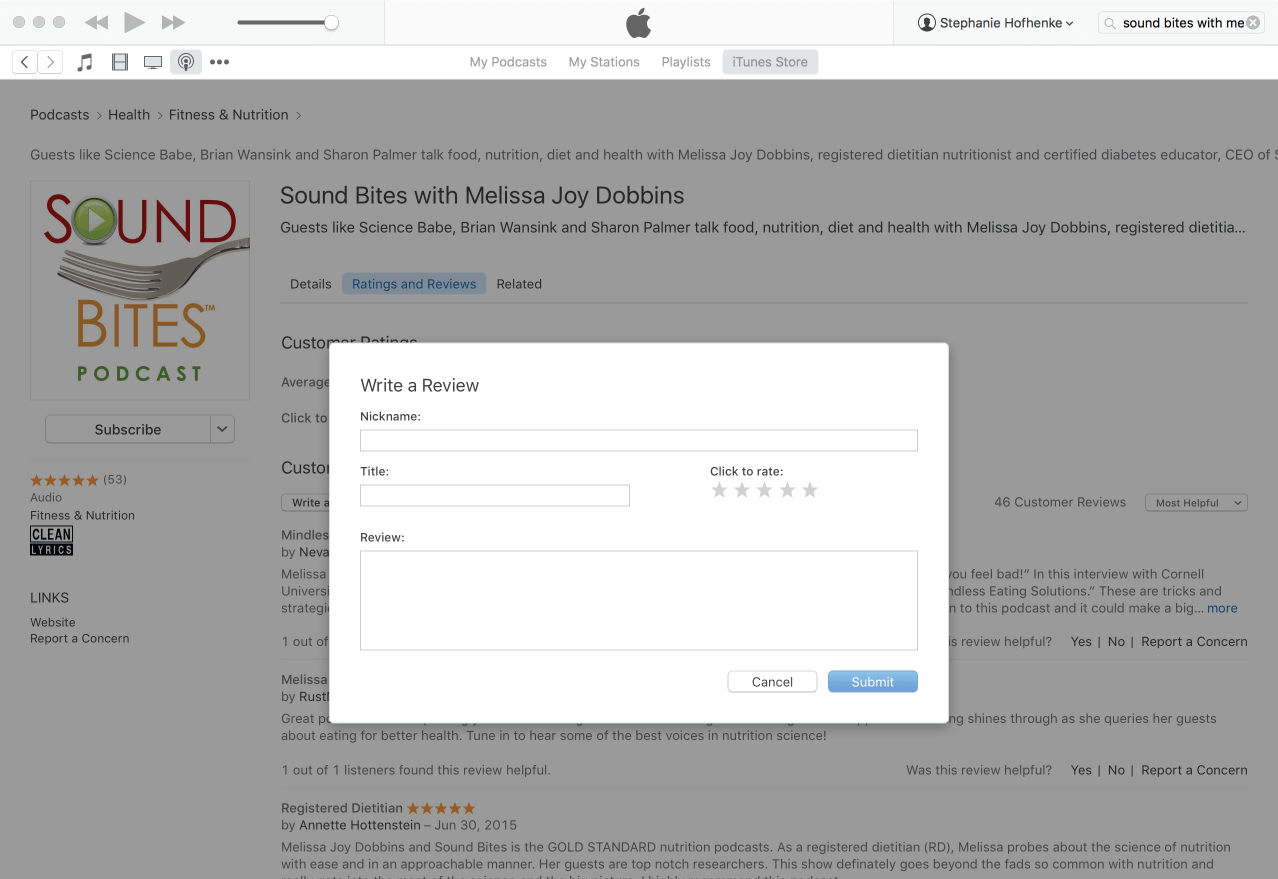
Click Write a Review
View reviews and write your own review.
Write your review…. Thank you!
Write your review!
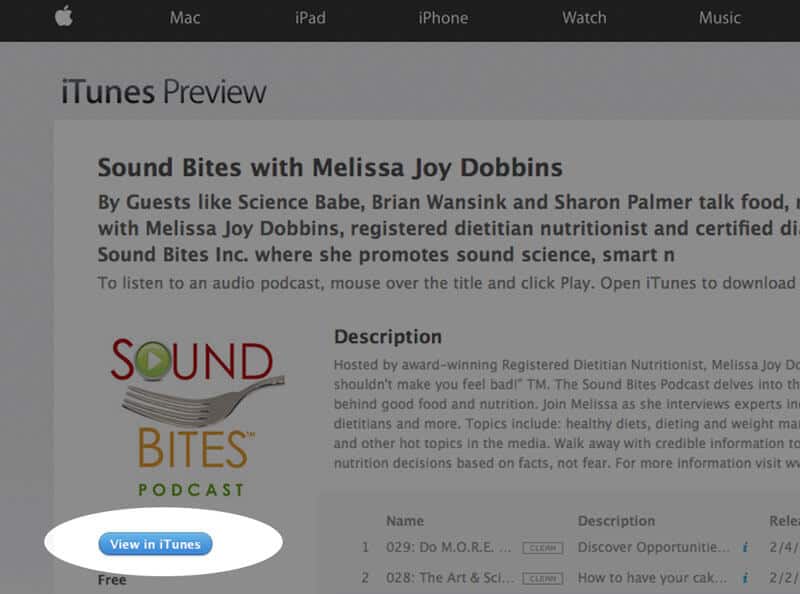
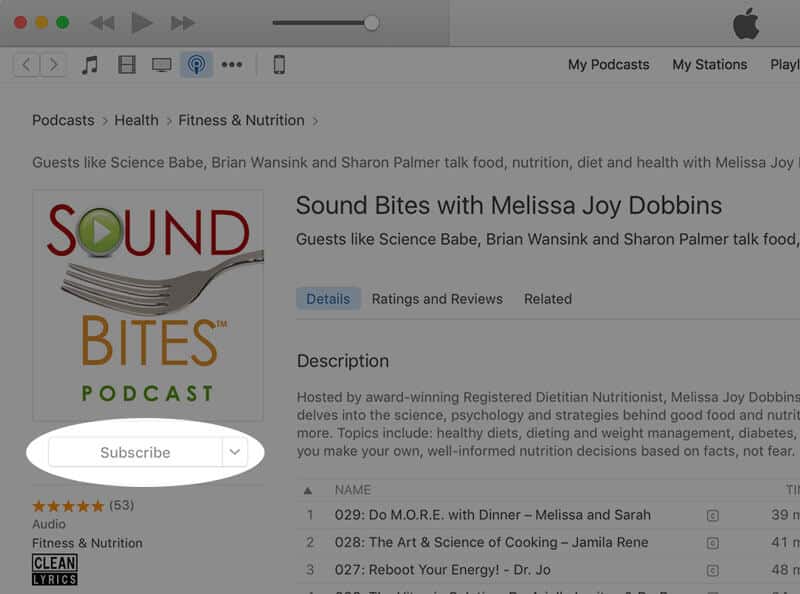
How to subscribe via iTunes
Click here to view the Sound Bites Podcastin iTunes, then click the blue “View in iTunes” button. This will open your iTunes application directly to Sound Bites Podcast. Click the “Subscribe” button, and your done!




 Cynthia Sass is a three-time New York Times best-selling author, writer, certified plant-based cook, and plant-based recipe developer with master’s degrees in both nutrition science and public health. Cynthia was in the first group of registered dietitians to earn the CSSD credential (Board Certified Specialist in Sports Dietetics), which she has held since 2006.