Celebrating over 1 Million Downloads and 50,000 Free CEUs on the Sound Bites® Podcast | NEW: Get 1 years’ worth of CEUs with the new 15-CEU Podcast Course
This episode has been submitted to CDR for CEU approval. Check back here or the CEU page to see when it has been approved.
Healthy Weight Gain – It’s Not Just About Protein
I help people understand why they’re having a hard time gaining weight. Why they need so much more food than everybody else. It doesn’t change anything, but it normalizes it.” – Nancy Clark
Certain populations find it difficult to gain weight and keep it on – especially in a healthful way. In particular, teen athletes may struggle to add muscle mass in hopes of improving their sports performance and think they need to consume large quantities of protein and supplements.
Tune into this episode to learn about:
Different types of people who struggle with gaining weight
Common questions and myths about healthy weight gain
The role of different macronutrients (carbs, protein, fat) in weight status
How much protein is really necessary for weight gain
How much carbohydrate in relation to protein to aim for
The role liquid calories, especially juice, can play in weight gain
Simple strategies to boost intake at meals and snacks
Tips on what to AVOID if you’re trying to gain weight
An easy recipe to make your own sports drink
When someone should consult with a registered dietitian who specializes in sports nutrition
Resources for the public and health professionals
Athletic performance isn’t always based on weight or building up muscles. So much of it is genetic. So if you’re genetically gifted, and you’re well fueled, and trained wisely, you can excel in sports. It’s the mind that makes a really good athlete, not those 10 pounds of extra muscle.” – Nancy Clark
Nancy Clark MS, RD, CSSD, FAND, FACSM
Nancy Clark counsels both competitive athletes and casual exercisers in her successful private practice in the Boston-area. Her sports nutrition knowledge is respected and trusted both nationally and internationally. She has extensive experience helping thousands of active clients—from “ordinary mortals” to Olympians—win with good nutrition. Her nutrition advice and photo have even graced the back of the Wheaties’ box!
She has been Team Nutritionist for the Boston Red Sox. Her best-selling Nancy Clark’s Sports Nutrition Guidebook has sold over 750,000 copies and now is available in a 6th edition. Nancy also writes a monthly nutrition column called The Athlete’s Kitchen, which appears regularly in over 100 sports and fitness publications and websites.
In addition to inspiring sports-active people to win with good nutrition, Nancy educates dietitians, trainers, coaches, and other health professionals about how to effectively teach the sports nutrition message.
Welcome to Sound Bites hosted by registered dietitian nutritionist, Melissa Joy Dobbins. Let’s delve into the science, the psychology and the strategies behind good food and nutrition.
Melissa 00:23
Hello, and welcome to the Sound Bites podcast. Today’s episode is about weight gain, specifically people who are trying to gain weight. And it’s a topic that doesn’t get as much airtime as weight loss, or when we’re gaining weight and we’re talking about that. So I’m really excited to have Nancy Clark join us again. She was on the show about a year ago talking about exercise, food and weight, one of my most popular episodes. But you may be familiar with Nancy, she’s a certified specialist in sports dietetics, and the author of the best-selling book, Nancy Clark’s Sports Nutrition Guidebook. Welcome to the show, Nancy.
Nancy 01:03
Thank you, Melissa, for inviting me back.
Melissa 01:05
It’s always an honor talking with you. I’m very excited to get a glimpse into something that, like I said, it doesn’t get talked about as much. Certainly we know there are people who struggle to gain weight. And we’re going to talk about those different groups or populations, and help anybody listening, whether it’s themselves or a family or a friend or a healthcare professional to help these people gain weight in a healthy way. Like I said, you were on the show about a year ago, it’s a very popular episode that was a more common topic. We were talking about how does exercise impact our weight? How does our eating habits impact our weight? And how do we do that in a way that promotes a healthy weight. But as I always say, I’m not a sports nutritionist. I’m not an expert in this area. So I’ve always find it fascinating. And we are submitting this episode to the Commission on Dietetic Registration for one free CEU for registered dietitian, nutritionists, dietetic technicians registered and certified diabetes care and education specialists. So if that is of interest to you, stay tuned for that. Now, Nancy, I would love for you to share a little bit more about your background. And you’re famous to a lot of people, but some people may not be familiar with you. And I just always love getting to know my guests a little bit and sharing that with my listeners, so that we can appreciate what you’re bringing to the table in our conversation today.
Nancy 02:28
I’ve been doing sports nutrition for about 40 years now. So I’m one of the pioneers in the area. And when I first started, people had very little knowledge about sports nutrition, like what do you do, you must cook spaghetti or something like that. But through the years, I have been working with a whole variety of different people from ordinary mortals, to Olympians to a lot of high school and college athletes, to moms that are trying to feed their teenage athletes to fitness exercise. So there’s a whole broad spectrum of people that are interested in what do I eat to have more energy and very often it’s tied up with how to manage weight. In today’s show, we’ll be talking about how to gain weight healthfully. I have a private practice in the Boston area where I work a lot with people one on one. I also give a lot of workshops to coaches and to dietitians, health professionals, just trying to resolve some of the myths surrounding food, exercise, sports, and how to have the most energy that you can and how to reach your athletic goals.
Melissa 03:37
Absolutely. As you were talking, I was thinking about that “performance”. That’s a big part of fueling your body for performance. I’m just curious too as you were talking, I got to thinking, over the span of your career it seems to me like fitness and exercise has become more en vogue. And so just curious if you could reflect on that a little bit. If you’ve seen just a lot more variety, more people getting active, different types of activity, different aspects that have impacted your practice.
Nancy 04:07
For certain there’s a heightened awareness of the importance of exercise on health. Unfortunately, my practice really focuses on the people who come to me and they are just very much the frustrated people. With like, I’m doing all this exercise, why aren’t I losing weight? And that’s a big part of sports nutrition. I’m not going to be focusing on that so much today. But there’s such a tight connection between exercise and weight that I’m actually working hard to just disconnect because the “E” in exercise should stand for enjoyment. And for so many people to “E” in exercise stands for excruciating. Or I was bad I got to go the to gym and burn off calories. We have to separate exercise and put it into the enjoyment category because then it’s sustainable for the rest of your life.
Melissa 04:56
Absolutely. So interesting that you say that and of course, it’s so true. I’ve seen this for myself, I remember exercising for weight management, and then that transitioned into exercising for stress management. And now I’m in that realm where I do it for fun. And of course, I get those other benefits. But what motivates me and keeps it top priority for me is that I enjoy it. I love it, the ballet, the karate, all of that. So I’m glad you mentioned that, because that is so important. And actually, I did a recent episode on fitness, and what motivates us. Whether it’s shame or something called “enoughness”. So I’ll link to that in the show notes, if anybody wants to check that out. Because it gets into the psychology of fitness and how the goal should be to find something that we enjoy, and that enjoyment can lead to health versus trying to be healthy, and that leading to happiness. So I just wanted to mention that too. So as we’re transitioning to the focus of our topic today, maybe a good place to start would be sharing some perspective, or misperceptions about weight gain. Again, since we talk about weight loss, weight management or unwanted weight gain, give us some perspective on this. I’m assuming it’s a smaller population of people who need to gain weight, want to gain weight or are trying to gain weight in a healthy way. Who are these people? How common is it? And just maybe an overview of the different populations who struggle with this?
Nancy 06:29
Yeah, I see weight gain primarily among high school kids, whose coaches are saying, “Hey, if you gain 20 pounds of muscle over the summer, you’ll be a better football player or a better athlete.” So a lot of the weight gain focus is among high school boys. And unfortunately, they are getting the media attention, the social media pressure that they’re supposed to look, hulkey and muscular. They’re just like 15 year olds who don’t have the testosterone to bulk up yet. So weight gain among the high school population for certain. And then there are people that are really fidgety, and they’re just tall, skinny, string beans. And they’ve always seen themselves as just being scrawny. The issue is more the body image than the body itself. There are elderly people who have lost weight through maybe they got ill. And when people are older and get ill oftentimes they lose weight. But they don’t bounce back and regain it the same way that younger people do. When your kids get sick, they might lose some weight, but boom, they gain it back. But when people get older, they don’t tend to respond in the same way. So I happen to live in an area where there are a lot of older retired people, or I have friends with older parents like, my mom’s wasting away to nothing. This often happens with cancer patients. So there are specific populations of people who struggle to gain weight and they are frustrated, just the same extent that the people want to lose weight. So many of the people that want to lose weight is like, “Boy, I wish I had that problem.” But the people that are hard gainers feel the same frustration.
Melissa 08:20
Absolutely – hard gainers, that’s the technical term?
Nancy 08:23
Sure.
Melissa 08:25
Okay, those hard gainers, I like that. You mentioned the elderly, losing weight, when they lose weight, they lose muscle mass. That contributes to coordination and overall health. I was a clinical dietitian, we look at status of their albumin and their muscle wasting, the sarcopenia, is bad for overall health, not just how you look or how you feel. And that’s not going to be the focus of our conversation today. But you mentioned 15 year old boys who don’t have the testosterone to bulk up. Hormones play a big role in this and growth hormones. As younger people are growing and developing, they’ve got all these great body processes, like hormones that are doing what they’re supposed to do. But as we age, I know that changes a lot. That’s something that I talked about with Dr. Layman in a previous episode about aging and muscle maintenance.
But again, I just want to make a distinction that different populations have different needs, and different physiology going on there. But because the bulk of what you’re seeing are young high school boys, maybe girls as well, in athletes, in sports, and you mentioned the social media aspect. We’re really going to be focusing the bulk of our conversation on that. But as things come up as we talk, if you want to make a distinction, like, by the way, this works great for these other populations that struggle with the weight gain as well.
So, given this broad range of people with different needs, but our focus on maybe this bigger group, that’s more common. What are you hearing from patients or just the general public that they’re most confused about or curious about when it comes to trying to gain weight?
Nancy 10:06
Let’s just start with a case study of a client who came to me and again, a high school kid whose coach is just sort of saying, “Well, if you bulk up and gain some muscle, you’ll be a better athlete.” And the first thing that high school kids turn to is protein. And they think that if they eat a really high protein diet, that the protein will turn into muscle overnight. So if you have a big steak for dinner, turns into bicep by breakfast. No, that doesn’t quite happen that way. But in this day and age where food is expensive, any parent of teenage eating machines isn’t wanting to serve their kids tons of meat, because it’ll just break the budget. So the first myth that I dispel is that you have to eat a really high protein diet in order to build up muscle. You need adequate protein for certain, but excess protein does not turn into extra muscle. In fact, if you fill up on excess protein, you’re eating more meat, or chicken or fish, and less potato or rice or pasta. And the carbohydrates are what fuel your muscles. And in order to do the strength training, the resistance exercise that builds muscles, you need to have a carbohydrate based diet. I see a lot of high school kids, and this doesn’t relate to just high school kids, but anyone that wants to gain weight, that’s just eating way too much protein, and they aren’t fueling their muscles the way that they should to be able to get the most out of their weight workouts. So exercise builds muscle. Resistance exercise is the best.
Working with a trainer is helpful. But in order to have the energy to do a really good weight workout, that’s where you need to still be eating oatmeal for breakfast. Bread – sandwiches for lunch. Having potato or rice or noodles for dinner. So that carbohydrates get stored in the muscles as glycogen. And if you do a heavy weight workout, you deplete that glycogen. And in order to replace it, you need to have grains, fruits, vegetables. So when people fill up on extra chicken, actually, they should be filling up on extra rice. So I start by figuring out how much protein does this body actually need. Protein needs are based on body weight. So for someone who is active and growing, a teenager might need one and a half at a high range two grams protein per kilogram of body weight, which is about a half to one gram protein per pound. This is a very generous range, given that the RDA is like 0.4 grams protein per pound. So it is true that when you’re building muscle, you need a little bit more protein, but you don’t need carbs more, that’s where people make mistakes.
Melissa 13:23
That’s the biggest misconception you’re seeing out there.
Nancy 13:26
That is the biggest misconception. And so by telling them, okay, so I estimate their protein needs. Say, if you take a high school kid who weighs 140, they might need 70, just on a very generous level 70 to 140 grams of protein per pound of body weight. And then I look at what are you eating? Well, they’re having eggs for breakfast, they’re eating yogurts for snacks, they’re drinking milk with their meals, and they’re having two or three chicken breasts. They’re having this really high protein diet. They’re already getting double what they need. So it’s a “Whoa, what makes you think you need protein powders and protein shakes now? You’re getting plenty through food.” And unfortunately, people seem to trust protein powders more than they trust food these days. But it’s not just food. It’s the food matrix. That food comes with more than just protein. When you have chicken it’s not just protein. It’s got other vitamins and minerals and nutrients in it. If you get protein from hummus or from chili, again, there’s other nutrients that come along with it. So I’m a real big advocate of teaching people that food works. And that even athletes who want to gain weight can get the protein that they need through food. If they feel as though they need a supplement, if that’s how they want to spend their money, who am I to argue. And for some people, it’s convenient. But for the most part for growing teenagers who are eating machines, they’ll get more than enough protein through their diet.
Melissa 15:13
Right. So it sounds like if they include some protein and some carb at every meal, and maybe have more carbohydrate rich snacks, then maybe that would be a better balance.
Nancy 15:26
I always look for carb protein combinations, because carbs fuel the muscles, protein builds and repairs the muscles. And your athletes actually want three times more carbs and protein. But what do they do, they have three times more protein than carbs. So the other piece that’s missing that really needs to be addressed is protein timing. So if you see eating as a timeline, most athletes eat 4, 5, 6, 7 times a day. They have breakfast, snack, lunch, snack, dinner and snack. And if they have some protein at each of those eating occasions, they will have a steady stream of amino acids that are in their blood, and that are readily available to be used for building muscle. When people get older, we sort of shift gears looking at grandma, who needs to gain weight. What does she do? She has toast for breakfast, vegetable soup for lunch, and chicken for dinner. And the only time that she eats protein is with dinner at the end of the day. And she’s missing many, many hours without adequate protein to help keep her muscles from breaking down to say nothing of building up.
So different populations, again, there are different discussions regarding their protein intake. Now, grandma, perhaps could benefit from a protein supplement, maybe it’d be easy for her to mix some protein powder into her oatmeal, or maybe to sip on a protein shake, instead of just having some tea. With her, I might consider a protein supplement as a quick and easy option. That’s better than nothing. Whereas with the teenager, I say, whoa, let’s just make sure you’re having some banana with peanut butter on it. Having your apple with cheese with it. Snacking on trial mix and having them think about putting peanut butter on their toast instead of butter, and having more milk with their meals. There are lots of just food strategies that a teenager might not think about. So for them again, I really focus in on the food aspect.
Melissa 17:47
Thank you for that explanation and that distinction. It is interesting. I’m not grandma yet, but I’m in my mid-50s. And I found, oh, gosh, a glass of milk with a meal can bring me up to that protein level that I need. It’s like, wow, that’s kind of by design. It’s kind of interesting.
Nancy 18:10
Let’s say when I work with my clients, one on one I estimate their protein needs. So let’s just say an average woman a generous amount of protein would be 80 grams a day. And you divide that into four meals, breakfast, lunch, afternoon snack and dinner, then you’ve got like a target of 20 grams protein per meal. Then you start reading food labels. And you see “Oh, three eggs.” That’s 20 grams of protein right there. Maybe I don’t need that protein shake along with my breakfast. Or you’re looking at a canned tuna fish. Oh, there’s 25 grams of protein there. I guess I don’t need a protein bar for dessert.
Melissa 18:47
Yeah, I’d much rather eat a can of tuna than a protein bar for sure.
Nancy 18:51
It’s giving people a context and targets. The kids that I work with that want to gain weight, they appreciate the nutrition education, because all they’re hearing is the headlines. Eat protein, build muscle. No, you are eating protein. Let’s do the exercise component of it. That’s what builds muscle. And to have the energy to do that let’s give you some grains and fruits and vegetables.
Melissa 19:18
Oh, yes. Anybody who’s trying so hard and making so much effort is thrilled to get the education I would think and be able to make the most of their efforts. I have a quick question for you before we move on to more about specific carbs. I know you’ve got some interesting thoughts on juice that I want to hear about. But what about refueling after the workout? You mentioned protein timing throughout the day. I know that this was a downfall for me when I did my triathlon I did not refuel properly after I worked out. But with these teenage boys and girls, maybe as well. But this age population if they are doing strength training and other types of workouts, do they need to think about anything after that workout?
Nancy 20:02
Well, certainly recovery refueling is important. Say they’re working out after school, and then they go home and they have dinner, that dinner will refuel them. If they’re working out, and then there’s going to be two or three hours before there’s a meal, they certainly need to eat something a little bit sooner than that. An excellent recovery food is chocolate milk, because it’s the perfect ratio of carbs and protein, its three times more carbs than protein. And so it gives a really high quality protein, which you get in milk. People buy whey protein powder. Well, they don’t know whey is in milk. When you drink milk, you get whey and you also get casein. Plus you get all these other nutrients that you need for good health. After people work out, they tend to be thirsty. And when people want to gain weight, I’m a big advocate of fluids, because they may not be hungry yet, but they would be thirsty. So chocolate milk is an excellent carb/protein combination. But in general fruit juices are one of the easiest weight gain drinks around. Because I see these athletes that are walking around with their jugs of water, they’ll carry around a gallon of water, and they’re drinking water.
Now if they replace that water with juice, they’re getting water, but along with it, they’re getting carbohydrates to fuel their muscles. And they’re getting nutrition. A glass of orange juice gives you all the vitamin C you need for the day. Juices come in many colors. You’ve got blueberry juice, you’ve got yellow pineapple juice, you’ve got orange-orange juice, you’ve got red cranberry juice, They’re all these different colors, and each color represents different phytonutrients that knock down inflammation that are health protective. So despite the reaction of juice, it’s filled with sugar. Isn’t that bad for you? It’s like no, as an athlete, that sugar fuels your muscles. And the body of athletes is very different from the body of a sedentary couch potato. So do I recommend that inactive unfit people drink quarts of juice? Of course not. Because their bodies just don’t take up sugar the same way that the body of a healthy person does. Whereas the body of an athlete their muscles are little Pac Man saying like, “Where’s the sugar to refuel these depleted muscle glycogen stores.”
So I had one soccer player who over the summer, instead of carrying around his half gallon of water, he carried around a bottle of cran-apple juice. And he said that he gained 13 pounds over this summer, 13 pounds of good weight. And it was simple, because instead of swiggingwater he swigged calories, and those calories fueled his muscles, and so he was able to do heavier lifting. It was a no brainer. But nobody thinks about juice as the perfect weight gain drink.
Melissa 23:11
No, they don’t. In fact, when we had our little chat before this interview that was a big aha for me, because we do hear that excessive intake of juice is not good for people, but it makes perfect sense the way you explain that juice fuels an athlete different than a non-athlete. And I’m wondering too, like, do you recommend that juice be watered down a little bit or just straight juice? Or does it depend on the person?
Nancy 23:40
It’s interesting if they want to take juice during exercise, I would recommend that they water it down. There’s an interesting study that David Nieman has done looking at the health benefits of actually drinking juice during extended exercise. He did a study comparing water versus sugar water, which is like a sports drink versus I don’t know what kind of juice he used, but fruit juice that had been diluted down. And if you exercise on empty, inflammatory markers spike, if you have a sports drink the sugar in that sports drink knocks down some of those inflammatory markers. But if you have a fruit juice that has these phytonutrients that fight inflammation, it knocks down the inflammatory markers even more. So I’d like to think that in the future, athletes will have that chance to fuel wiser with natural fruit juices during exercise. And you will probably want to dilute them down depending on the sport just to enhance their rate of absorption.
Melissa 24:49
Now you brought up a couple of things that are bringing more questions to mind. First of all, it’s great that kids these days are carrying around water. I refill my son’s water bottle every day before he goes to school, just as a nice gesture for him. But when I was growing up doing ballet, we’d have two hour long ballet classes at the top of a building in the heat of the summer with no air conditioning, and maybe we would go get a drink from the water fountain once, maybe. So things have changed a lot. And we’re all about hydration, which is great. But hydration for most people, the bulk of it should be water. But again, that’s not the population we’re talking about. But you mentioned sports drinks. And it sounds like from what you’re saying, juice can be a replacement for sports drinks and a better replacement in many, many ways.
Obviously, it’s going to have potassium, but not the sodium. And this next question is, I just came off of a mission trip in the Dominican Republic with my son, where we were trying to reduce the use of single use plastics. So we’re trying not to do the Gatorade, trying to do like your homemade Gatorade. Long story short, I think we didn’t have the right kinds of packets. There’s a lot of different things out there that you can use to hydrate, some are loaded with B vitamins or C vitamins. And there’s only one vitamin C, but there’s a lot of different B vitamins. And it’s not necessarily replacing sodium and potassium. But if you could just – beyond the juice versus sports drink – if you could just speak briefly about sports drinks, or if people do need something like a Gatorade and they want to make their own. I don’t know, is that sacrilegious? But it’s something that I’ve thought about for my own son.
Nancy 26:32
Oh yeah, it’s easy to make your own sports drink and very budget friendly as well. So to make the equivalent of a Gatorade sports drink with similar nutrition profile – you take a quarter cup of sugar and dissolve it in a quarter cup of hot or warm water because sugar doesn’t dissolve in cold water. A ¼ cup of orange juice, a ¼ teaspoon of salt and fill it up to a quart.
Juice of any flavor for that matter.
You can also do the same thing with maple syrup. Just a ¼ cup of maple syrup, a 1/4 tsp of salt and fill it up to a quart. Which gives you the sodium that you’re needing which is the key electrolyte of concern. Some people worry about potassium but that’s really not an issue for endurance athletes. And these recipes are in my Sports Nutrition Guidebook so if you’re looking for a lot of sports foods of any type it’s a good reference for you.
Melissa 27:04
Thank you. I love Gatorade, I love Gatorade zero. But in the summer months when my son is doing baseball and we’re going through a lot of it, it does make me want to not do all the single use plastics. So I thought there’s got to be a way and of course I should have just emailed you. But now I will share that out with my audience. We all have the magic trick.
Nancy 27:25
That’s interesting, homemade sports drinks to avoid single use plastic. That’s good. But for people that want to gain weight, a lot of people that are hard gainers, they might drink a sports drink, whereas I much rather have them drink chocolate milk, or a natural 100% fruit juice, instead. They just get more calories in it, because a sports drink tends to be 50 calories per eight ounces. Whereas a glass of milk or juice might be 100 calories or more. And so they still get the same amount of fluid. You don’t have to drink water per se, to get water. You need to drink fluid. And for these athletes or people that are hard gainers that want to gain weight, let’s say they can just swap out water for fluids with calories. And they can easily take in an additional 500, 700 calories a day. If you drink a whole half gallon of extra juice that can be, some juices have more calories than others. So if you have a pineapple or crane raspberry or a grape, those have more calories than like an orange or grapefruit juice or tomato juice. So that even within juices, there’s some that have more calories than others that can effectively help them to reach their goals.
Melissa 27:28
Yeah, and that’s a great point about the fluid. I’m glad you mentioned that. As we’re talking about athletes, I’m wondering is my son, an athlete. He has baseball practice or open gym or workout three times a week. Sometimes we do an additional workout with a strength trainer twice a week. He’s got gym class in school. At what point is your child considered an athlete?
Nancy 29:03
That’s interesting, because I can remember, I’m pre title nine. So I didn’t grow up thinking I was an athlete. But I did all the same sports that kids do these days. Whereas my daughter, she considered herself to be an athlete. Like in third grade, she was an athlete. So this information is for anyone, recreational exercisers, it’s for anyone who wants to add some bulk to their body in a healthy way. And there are people who aren’t athletes, there’s people that are just naturally tall and skinny. I have clients come to me who they’re just ordinary mortals. But the conversation generally is “Oh, I’ve always been skinny my whole life. I can’t gain any weight.” And as they’re sitting in their chair, their leg is twitching. They’re animated. They’re shifting all around. They’re just exuding burning calories as they sit in the chair and they think, “Oh, I have such a high metabolism.” Well, the truth is metabolic rate is actually quite stable.
It takes a certain amount of energy to pump blood, to grow hair, to grow fingernails or whatever. So your metabolic rate is quite stable. But what varies is the fidget factor. And people who tend to be hard weight gainers, tend to be very fidgety and very animated. And so I’ll just observe my clients as they’re sitting there, twitching and moving all around, even though they’re just sitting. And tell them, “A good fidgeter burns off a good 300 to 700 extra calories a day, where would you put yourself on that spectrum?” And inevitably, the people that are hard gainers will say, “Well, I burn off at least 700 calories a day. Ask my wife, my fidgeting drives her crazy.” And this is just something genetic, it starts at birth. How some babies just sit and coo and are very happy, barely moving, whereas others are like, moving all over the place. So it’s just a genetic trait. It’s not a right or wrong. But for people that are hard gainers I suggest that they just mellow out, just calm down, and meditate.
Melissa 31:21
I was going to say meditate.
Nancy 31:23
Yeah, if they can just understand why they’re having a hard time gaining weight. Why they need so much more food than everybody else. It doesn’t change anything. But it normalizes it. Of course, I need more calories. Of course, I’d burn off more, because I just never stop. The hard gainers can work really hard and gain weight. And sometimes they can successfully keep it on. But a lot of them the minute that they take their foot off the pedal, they lose the weight again. Because the body has a genetic weight that it has a blueprint that its designed to be at. I was working with the Red Sox for a while. And there was a picture that was really tall and skinny. He had always been tall and skinny. And my job was to bulk him up. And so we worked on a weight gain diet with extra juices and extra meals and having a sandwich before he goes to bed, fruit smoothies that were filled with, bananas, and all sorts of good stuff. So we worked on his weight gain program, and he gained the weight, but then boom, offseason, he lost it right away, because it wasn’t his natural weight. And talking with him afterwards, he said, “You know, I didn’t feel good in that body. That bigger body was not my body.” And here he was, he was a major league ballplayer with a skinny body. He was doing something right, because he had made it to the major leagues.
Melissa 32:55
Performance wise, it was working.
Nancy 32:57
Yeah, so athletic performance isn’t always based on weight. And that’s another message that I give to the teenage boys that want to gain weight. The body they have when they’re 14 is not the body they’ll have when they’re 15, or 16, or 17, or 18, or 19, or 20, or 21, or 22. They need to understand that their body is going to change. It’s going to mature and fill out. And when you’re in your teens, your job is to work on skills and improve your performance by training and working on the skills and not put so much focus on building bigger muscles. That just won’t happen unless you have the right hormones. And that will happen with time. But to work on the skills and the drills that stuff is where they can improve their performance. And then with time they will acquire the body that this their dream body.
Melissa 34:04
And the strength.
Nancy 34:05
Yeah, but in the meanwhile, whenever I watch football, I noticed the short smaller players. It’s like they made it to the pro level, even though they aren’t like 300 pounds of muscle.
Melissa 34:18
Great point. We talked about carbohydrates and protein, where does fat fit into all of this as the other macronutrient?
Nancy 34:27
People that want to gain weight focus a lot on protein. I try to get them to focus more on carbohydrate to fuel and I hate the word carbohydrate because it is so tainted. It has such a negative connotation. Whereas in the sports world, carbs are like carbo loading, this is an important fuel. But when I talk with my clients, I try to talk about grains and fruits and vegetables just so that they can get beyond the carbs as evil, the common belief. I’m telling you to eat quality carbohydrates, and not just sugary carbs. But fat is an important part of a sports diet. And fat is calorie dense, its energy dense. But yet, I just saw a very interesting abstract for a study that was done looking at how do you gain weight healthfully? And in this study, they wanted to see if nuts or peanut butter, like peanuts, peanut butter. If you eat 500 extra calories of peanut butter or nuts a day, does that contribute to more weight gain than 500 calories of carbohydrate foods? And what was interesting is that both the carbs and the high fat peanut butter contributed the same amount of weight gain.
Melissa 35:47
There you go.
Nancy 35:48
And so that was sort of surprising to me, because you think, oh, eat fat, get fat. But that is not true from this study. And peanut butter is just so compact that you can eat a lot. And if your goal is to take in an extra 500 calories a day, a quarter cup of peanut butter, you can easily eat that on a banana or on apple slices. I don’t know if you’d put a quarter cup of peanut butter in the sandwich, that would be a pretty thick sandwich. But you have two peanut butter and jelly sandwiches. It’s a doable amount. It’s easily doable. You have that with a glass of milk and boom, you’ve got your extra calories for the day. So I think that fat can be very helpful because it’s concentrated calories. When we get back to grandma, and feeding her, for certain to put more fat into her diet, because she may not be eating large volumes of food. You could put peanut butter in her oatmeal, or you could put extra cheese in the macaroni and cheese. You could put extra dressing on the salad. And that would be a way to boost calories in a smaller amount of food.
Melissa 37:08
For athletes in general, does it matter? Heart healthy fat, any kind of fat, is it that important for that population?
Nancy 37:16
Even athletes get heart disease. Many people think oh, I exercise a lot. I’m immune from getting a heart attack. It’s like I can count on many fingers the number of marathon runners that I know who have dropped dead during a marathon or during a long run. So yes, even athletes get heart disease. So of course, I look for the healthier fats. That’s where nuts, peanut butter, olive oil are excellent. But that said, the research with dairy is showing that people that have high intake of cheese or full fat dairy, they aren’t dropping dead of heart attacks, more than anybody else is. I think we need to learn more about the dairy matrix. Again, all the food and is the saturated fat in the dairy bad or is it ok? You might have a viewpoint on that, Melissa.
Melissa 38:14
Actually, I’m going to be interviewing somebody on the dairy matrix. Funny, you should say that. And definitely going to get into the saturated fat or the fat content of full fat dairy, I should say, because I’ve seen the reports as well. And even though I worked for dairy council for eight years, I don’t know the answers to those questions. So I do think it’s interesting, but we’ll be talking about that.
Nancy 38:37
So what I’ve seen, is the unhealthy food is a lot of ultra-processed baked goods, essentially. So I don’t want my weight gainers to be filling up on chips and tons of cookies and that sort of stuff. But I want them to eat more 85% to 90% quality calories. And then 10% to 15% banana bread or oatmeal raisin cookies or ice cream with nuts on top of it. There are ways to have fun foods when you’re gaining weight for certain. For example, Apple crisp, and fig newtons. There’s a lot of fun foods that also can provide calories, but they aren’t the foundation of the diet. But once you’ve got the fundamental foods and to add those in is a wonderful way to add in those extra 500 to 1000 calories a day.
Melissa 39:33
Those are great examples because they also provide some nutrition too. So I love that. Those are great examples.
Nancy 39:39
That’s the goal. Always to be thinking about nutrition, health, preventing injuries, and performance.
Melissa 39:47
You mentioned the 85% quality calories, 15% fun foods again, great examples. I love those. Maybe this is a good segue into having you sort of recap, what are sort of the points that people need to think about, like how often they’re eating, how much protein, exercise, liquids, things like that.
Nancy 40:06
Sure. So if you’re the parent of a, we’ll just use the example of a high school kid who wants to bulk up and wants to gain weight and is pummeling you to buy protein powders, protein bars, protein shakes, what you want to remember is that the body can use just so much protein, but he really needs extra grains, fruits, vegetables, oatmeal, bagels, bananas, dried fruits, to provide the carbohydrates that fuel the heavy lifting. Weight training, lifting heavy weights is what builds up muscles. But that said, your teenager needs to have the right hormones in order to build muscles. He might get stronger with weightlifting, but he might not develop the bulkiness that will come with age. So adequate protein, some protein at each meal, probably within 20 to 30 grams of protein per meal would be plenty. Two, get extra calories by drinking extra milk or extra juice. 100% fruit juice of different colors offers different anti-inflammatory benefits, because when people are exercising, things get inflamed. So that drinking juice instead of water is a really good swap for someone who wants to gain weight, great way to get extra calories as well as the water that they need.
They want to eat on a timeline, not skip meals, and not skip breakfast, not skimp on school lunch just because they forgot it or they don’t like it. To have breakfast, launch, and a second lunch in the afternoon. Maybe it’s not a huge lunch, if they’re going to be doing sports, but they certainly want to fuel up before sports. Every athlete should always surround their workout with food so that they fuel up, they refuel. So maybe they have a half a peanut butter and jelly sandwich before they exercise, and maybe a half of it afterwards. So to be responsible with their meal timing. And during the day, they want to make sure they’re eating enough so that they aren’t in energy deficit, which is muscle breakdown mode. They always want to be having protein in each of their meals so that there’s a steady supply of amino acids that they’re needing. And to take what they’re eating now and figure out how they can add an extra 500, 800, 1000 calories a day.
That’s an extra two to four pieces of pizza the equivalent on a daily basis. And sometimes people that are trying to gain weight, they eat a lot one day, then the next day, they’re not hungry. So you have to do this consistently. But this is where I really don’t like to force feed, because it deregulates instinctive eating practices. And more often than not the people that are really skinny when they’re young, have trouble with weight when they’re older, because they’re used to eating whatever they want. And then their body start changing, they become less active if they’re used to eating whatever they want. And they get so frustrated. As one person kind of waddled in my office said, “Would you believe I used to be the skinny high school kid? And now look at me.” His body had probably added an extra 50, 80 pounds. And he was just so frustrated because he didn’t know how to manage his food intake.
Melissa 43:41
Yeah, I know that you had mentioned to me before that you see that with some parents coming to you with a skinny kid. And you caution them not to really force feed, as you said, because it can cause problems later.
Nancy 43:52
Yeah, I really don’t like this idea of thinking that, Oh, you have to build up muscle to be a good athlete. You have to work on your skills, and athletic performance. So much of it is genetic. So if you’re genetically gifted, and you’re well fueled, and trained wisely, you can excel in sports. That’s the mind that makes a really good athlete, more than 10 pounds of extra muscle. There are examples in every sport of a leaner football player, a lighter hockey player, so that they’ve got the skills, they’ve got the genetics, they might not have the muscle or the weight, but they still can perform at a very high level.
Melissa 44:32
Great point. And something you said earlier, I wanted to come back to you’re basically talking about how upsetting it is for someone who’s trying to gain weight just as upsetting as it is for somebody who’s trying to lose weight. And this example of the baseball player who did gain weight wasn’t able to keep it on, didn’t feel like himself when he had the extra weight. And I think it’s so important explaining to these people why they’re having trouble gaining weight, just like we’re explaining to people why they’re having trouble losing weight, and just honoring that genetic predisposition and that set point if you want to call it that, that the body likes to be at. I think that’s so important regardless of what size somebody is. Different sizes, different shapes. I’m sure you’ve heard the analogy, but I love this, we wouldn’t do this to a dog, a Chihuahua is never going to be a Great Dane. So we’ve got to honor what we were born with, and be the best that we can. And I think that’s where body image comes in as well. And you mentioned body image early on in the conversation. It affects boys too, social media, and even just comments that family and friends make. I did do an episode on boys and body image quite a while ago, might have to do a 2.0 on that. But I’ll link to that in the show notes as well, if somebody wants to take a listen, because we tend to think it’s just girls, but it definitely impacts boys as well.
Nancy 45:56
Yeah, and there’s data to back that up. The boys want to gain weight, the girls say that they should lose weight, but for the boys is as impactful for them. And particularly in this day of social media. I was just talking to someone the other day who had a really bad body image. It was a guy who wanted to bulk up. I said, “Do you spend a lot of time on social media?” And goes, “Yeah.” “Do you think it helps you?” “No” Hang it up.
Melissa 46:25
Yeah, for sure. It’s so pervasive. And I am glad that my son probably won’t have as much of an impact from social media as my daughter did. But it’s still an issue. And I’m glad I didn’t have it when I was growing up. But I digress. A lot of the tips and recommendations that you shared about gaining weight, you have a wonderful handout, would it be okay if I included that in the show notes for our listeners?
Nancy 46:52
Sure.
Melissa 46:52
Great, awesome, thank you. And I guess it also begs the question, when should somebody consider sitting down with a dietitian, obviously somebody who specializes in sports nutrition for help?
Nancy 47:03
I think that every person who exercises or has a focus on trying to perform at their best should meet with a registered dietitian who specializes in sports nutrition. And this professional he/she can really address all the myths and misconceptions and give them budgets, like how much am I supposed to eat? “Oh, I’m supposed to have the equivalent of like three pieces of pizza for breakfast, that much food?” Meanwhile, they’re eating a granola bar. Or, “Oh, I can make my own sports drink.” If they aren’t going to be sitting down one on one, I have a Sports Nutrition Guidebook. It has a very strong chapter on how to gain weight healthfully. It has a strong chapter on body image. And it’s just, tell me what to do and I’ll do it. And that’s the pleasure of working with sports active people. They are just, tell me what to do and I’ll do it.
Melissa 48:02
They’re highly motivated.
Nancy 48:03
Yeah, they’re highly motivated and they just want to be able to perform with high energy and feel good about themselves.
Melissa 48:12
And I think it’s so reassuring the point that you’ve made several times during this conversation that the performance does not necessarily match up with the body size. So that’s the good news, you can still have performance and like for people my son’s age, 14 years old, just work on those skills that comes first, then more strength and more size after that, but just working on your skills, and knowing that you can fuel your body for performance, and maybe let go of some of the perceptions of what size you should be.
Nancy 48:42
Precisely.
Melissa 48:43
Awesome. I got it. So I’m glad you brought up your book again. I will definitely have more information in the show notes. But people can also go to your website, and also just find the book on Amazon. So tell us a little bit about where people can go.
Nancy 48:58
People can follow me on Twitter, which is NClarkRD. I managed to get banned from Facebook, somebody hacked my account. My website is nancyclarkrd.com. N-A-N-C-Y-C-L-A-R-Krd.com has a blog that people might find helpful information there. And if you just Google the Nancy Clark, RD Sports Nutrition, you’ll probably find a whole bunch of information of different articles that I’ve written or talks that I’ve given. And I am just so pleased that people are interested in fueling for performance these days. That was not always on everybody’s agenda.
Melissa 49:41
Absolutely. Great book. Great resources. Definitely just Google Nancy, you’ll find it. But I’ll also have the links in my show notes at soundbitesrdcom. Thank you so much for coming on the show again. It’s always a pleasure to talk with you. I hope I get to see you in person at a conference soon.
Nancy 49:56
Well, that would be fun.
Melissa 49:58
That would be. Thanks, Nancy. I appreciate your time and all the wonderful work you’re doing and for everybody listening as always enjoy your food with health in mind, and fuel your body for performance. Till next time.
VO 50:12
For more information, visit soundbitesrd.com. Music by Dave Burke. Produced by JAG in Detroit podcasts.
LISTEN, LEARN AND EARN
Listen to select Sound Bites Podcasts and earn free CEU credits approved by the Commission on Dietetic Registration (CDR) for registered dietitian nutritionists and dietetic technicians, registered. Get started!
Get Melissa’s Sound Science Toolkit here!
Partnerships:
Sound Bites is partnering with the Association of Diabetes Care and Education Specialists (formerly the American Association of Diabetes Educators)! Stay tuned for updates on the podcast, blog and newsletter!
Sound Bites is partnering with the International Food Information Council! Stay tuned for updates on the podcast, blog and newsletter!
I’ve used that analogy before when teaching college level classes.
I pick the largest athlete in class and do the math and show them that eating just a healthy diet will meet their needs.
I saw you speak in person when your first book was published – 93-94?
Sign up for my monthly newsletter and episode eblasts so you never miss an update!
Listen on Stitcher (Android)
Install the Stitcher App
1. Search for “sound bites with melissa joy dobbins” 2. Choose Play Current Episode or Add to Playlist
Choose “Play Episode”
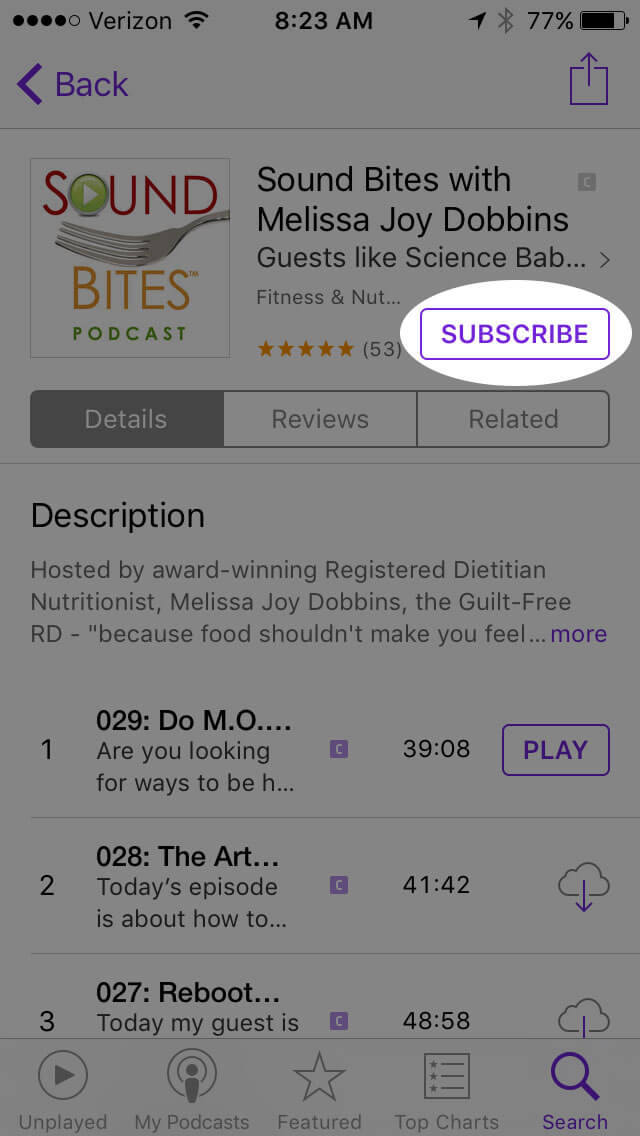
Subscribe & Review on iPhone
Open the “Podcast” app on your iPhone
Search for “Sound bites with melissa joy dobbins”
Open the podcast and click “Subscribe” and your done!
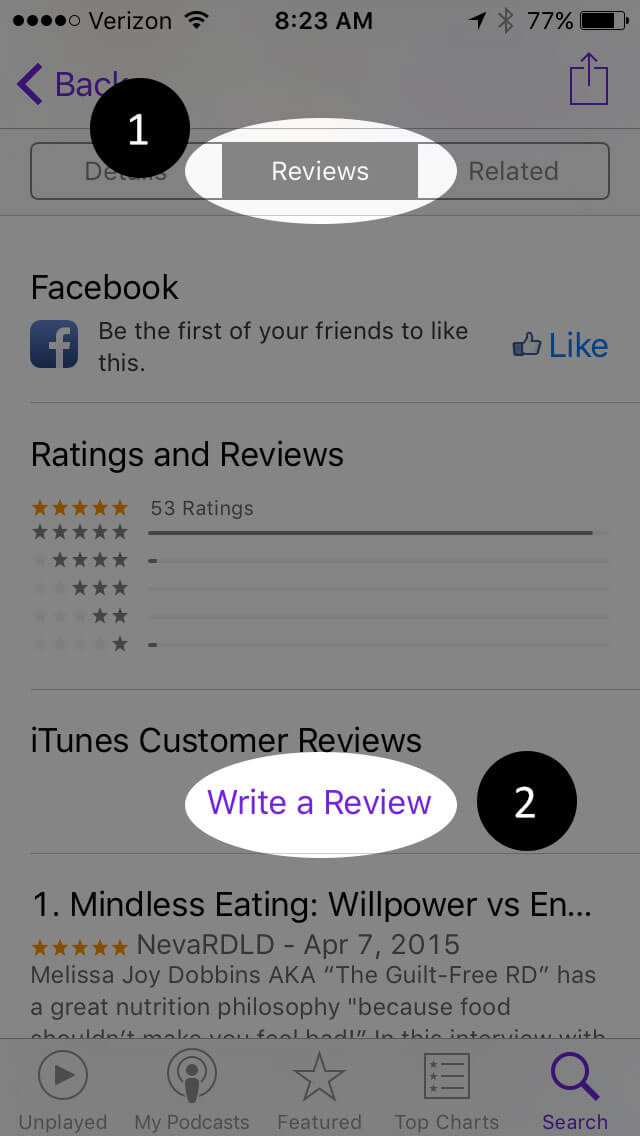
Write a Review
Click “Reviews”, then “Write a Review”.
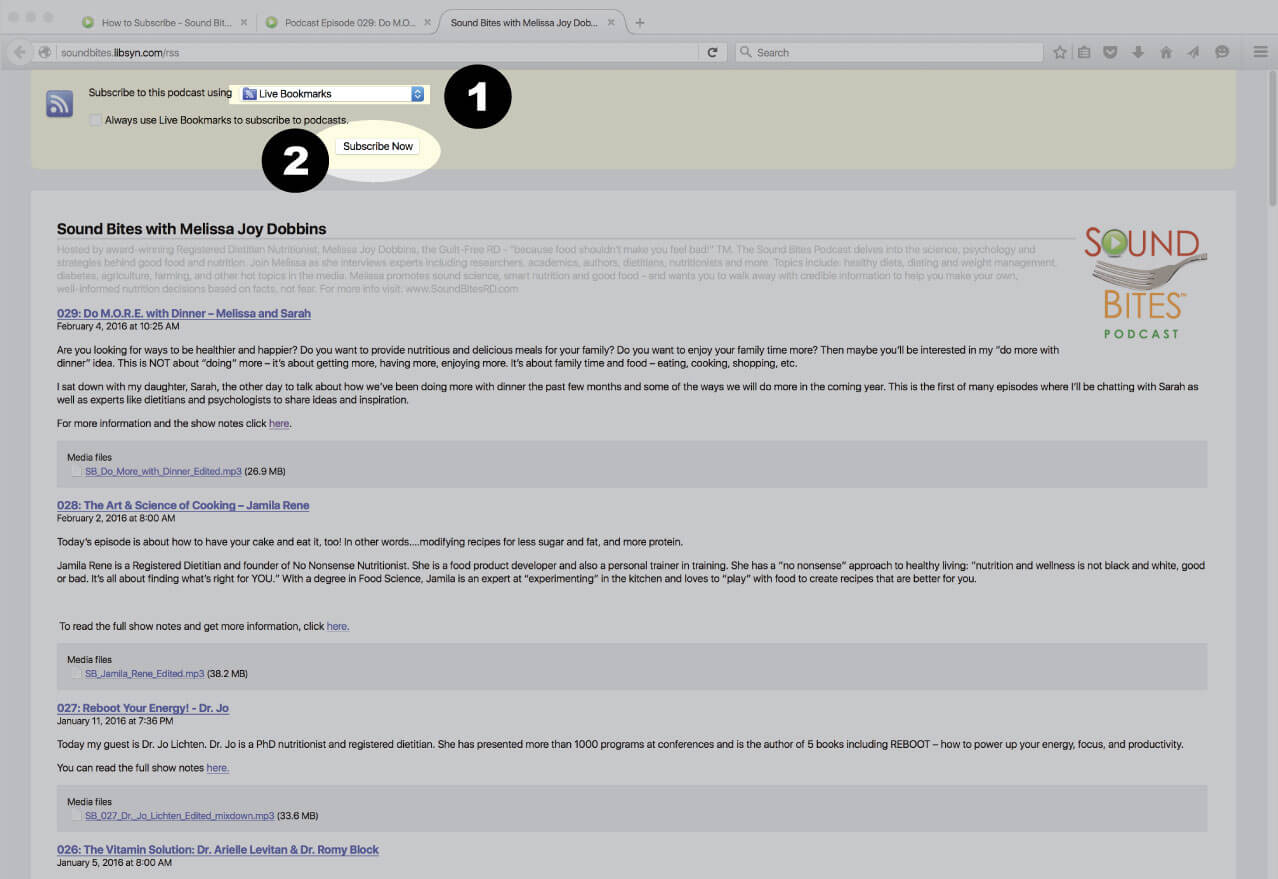
Subscribe via RSS Feed
Navigate to any podcast player . Click on the RSS feed icon.
Click on the RSS feed icon.
Click on RSS Feed
Choose which application you would like to use to receive the RSS feed
Click “Subscribe Now”
Confirm settings and subscribe.
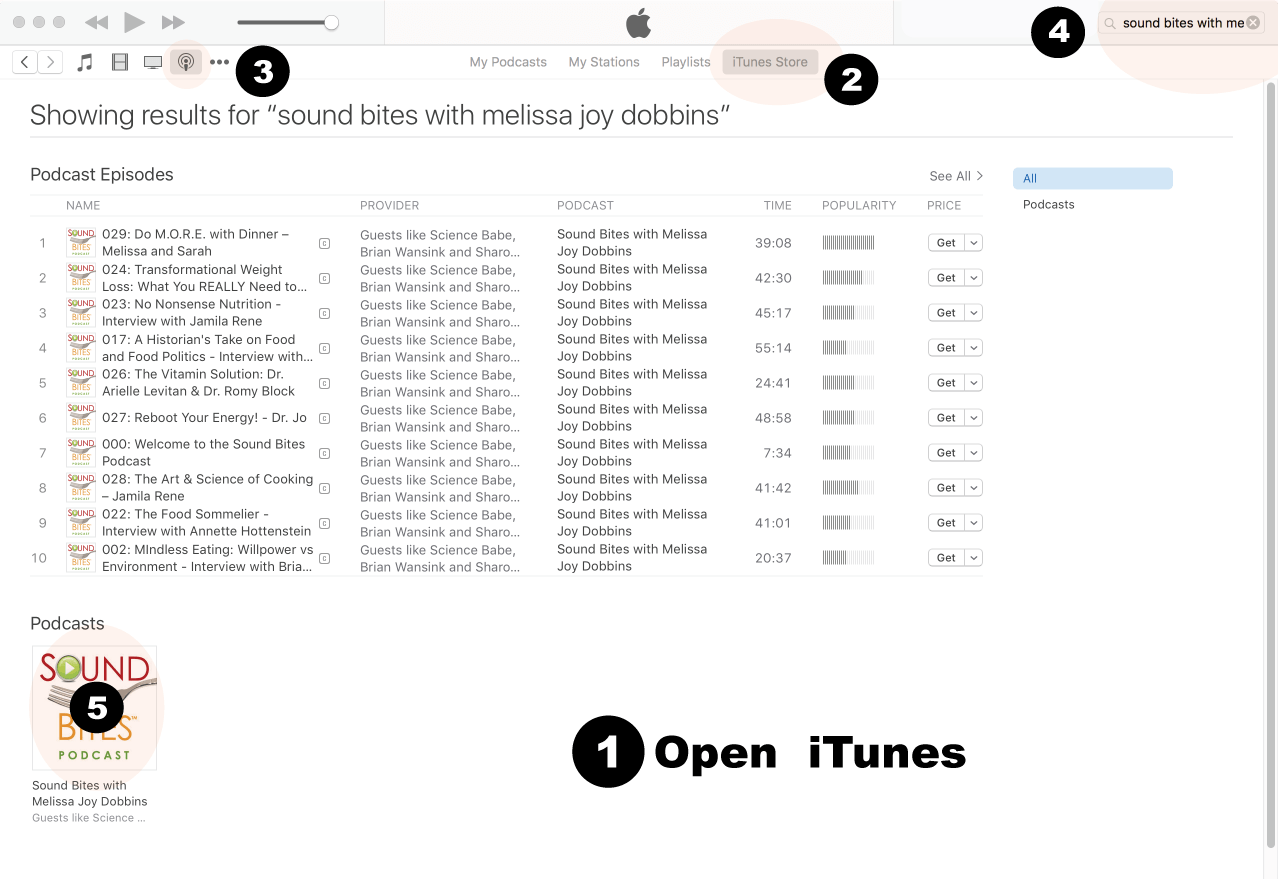
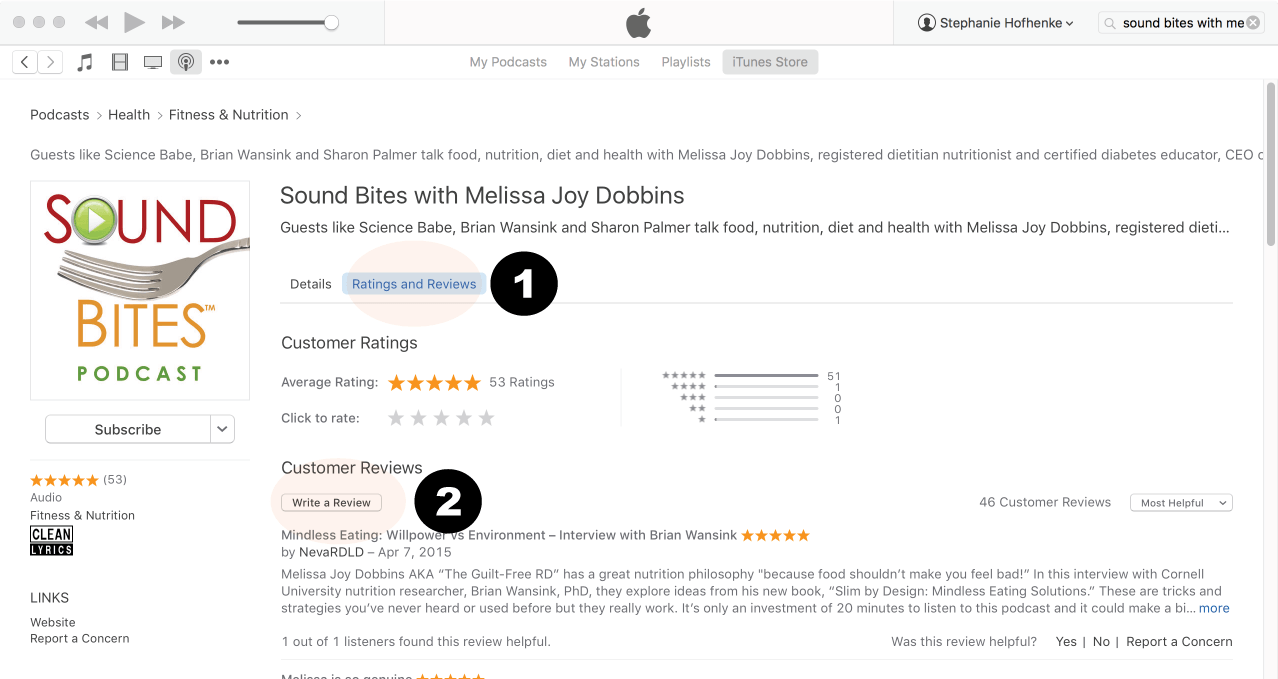
How to Review in iTunes
Open iTunes desktop application
Click iTunes Store
Click on Podcasts
Search for “Sound bites with Melissa Joy Dobbins”
Click on podcast image
Search for Sound Bites podcast in iTunes
Click Ratings & Reivews
Click Write a Review
View reviews and write your own review.
Write your review…. Thank you!
Write your review!
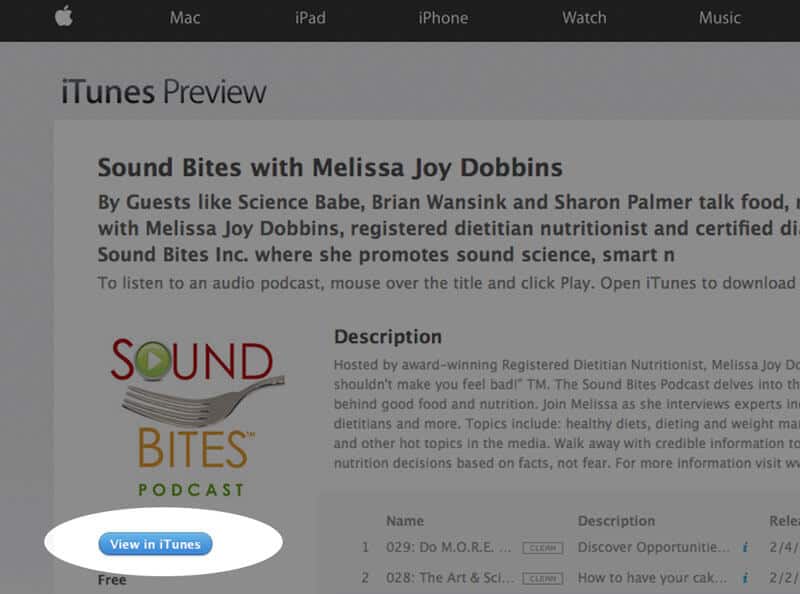
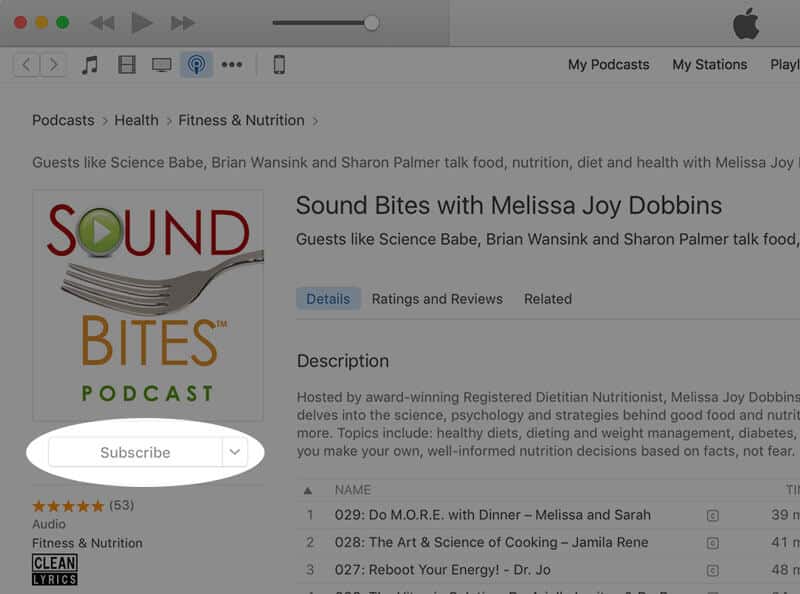
How to subscribe via iTunes
Click here to view the Sound Bites Podcastin iTunes, then click the blue “View in iTunes” button. This will open your iTunes application directly to Sound Bites Podcast. Click the “Subscribe” button, and your done!





















I’ve used that analogy before when teaching college level classes.
I pick the largest athlete in class and do the math and show them that eating just a healthy diet will meet their needs.
I saw you speak in person when your first book was published – 93-94?