Celebrating over 1 Million Downloads and 50,000 Free CEUs on the Sound Bites® Podcast | NEW: Get 1 years’ worth of CEUs with the new 15-CEU Podcast Course
Unbottled Potential: From Sober Curious to Sober Serious
As the sober curious movement gains traction, more people are reevaluating their relationship with alcohol and changing their habits. Challenging societal myths around alcohol’s role in relaxation, celebration and socializing can result in mindset shifts to begin exploring an alcohol-free lifestyle and discover how sobriety can impact core areas of life and enhance both personal and professional success.
Tune into this episode to learn about:
the sober curious movement
how sobriety impacts life pillars
why alcohol can be a barrier to success
perceived norms about alcohol
alcohol, sobriety and weight
how drinking impacts women in particular
how to address shame in a healthy way
a quiz to assess your feelings about drinking
tips for embracing an alcohol-free lifestyle
common challenges and how to stay on track
information on moderation, portion sizes, ABV and more
Amanda Kuda
Amanda is an alcohol-free lifestyle expert. She’s a holistic life coach, speaker and author. As a coach, Amanda helps ambitious, soul-centered women stop drinking and start manifesting the life they deserve and desire. She teaches a modern approach to personal development, self-actualization and spiritual enlightenment through the lens of elective sobriety. Amanda’s first book, Unbottled Potential: Break Up With Alcohol And Break Through To Your Best Life is out now (Penguin Random House / Avery) is available now wherever books are sold. Her work has been featured on CNN, Business Insider, and The Skimm.
You don’t need to have a problem with alcohol for alcohol to be a problem in your life.” – Amanda Kuda
Resources
Some links may be affiliate links. As an Amazon Associate, I earn from qualifying purchases.
Amanda’s Free 21-Day Challenge: Go to amandakuda.com/challenge and either buy the book and enter the receipt or if you’d like to get a taste of what the challenge is like before grabbing the book, listen to this episode to get the coupon code!
Welcome to Sound Bites, hosted by registered dietitian nutritionist, Melissa Joy Dobbins. Let’s delve into the science, the psychology, and the strategies behind good food and nutrition.
Melissa Joy (00:25):
Hello, and welcome to the Sound Bites Podcast. Today’s episode is about alcohol-free lifestyles. We’re going to talk about understanding and changing your relationship with alcohol, and how being sober curious or sober serious may help you achieve your personal and professional goals and dreams. This episode is not sponsored.
My guest today is Amanda Kuda. She’s an alcohol-free lifestyle expert, holistic life coach, and author of Unbottled Potential: Break Up with Alcohol and Break Through to Your Best Life. She helps ambitious soul-centered women stop drinking and start manifesting the life they truly desire.
With her work featured on CNN, Business Insider, and The Skimm, and she’s very active on Instagram, so definitely want you to check her out there.
Welcome to the show, Amanda.
Amanda Kuda (01:17):
Hello. Thank you for having me. I’m so excited to talk to you today.
Melissa Joy (01:20):
Thrilled to have you on the show. Please share a little bit more about your background with our listeners and sort of your journey and what brought you to this work that you do.
Amanda Kuda (01:30):
Absolutely. Well, I am an alcohol-free, life and spiritual coach, and I work specifically with women who either are currently or have in the past drank in the gray area, which is kind of that messy middle that doesn’t quite qualify as having an addiction, but also isn’t someone who is a very take it or leave it every now and again drinker.
And I started this journey quite by accident because that was my story ages and ages ago. About a decade ago, I set out on this personal wellness journey that I really wanted to achieve this spiritual awakening as well as just live in my best life, my best body, my best mentality every day. And that’s where I was starting from.
I was starting from digging myself out of a hole of being overworked, of being heartbroken, of being in some really bad health patterns where I wasn’t really being very mindful about my health at all because I was young and that didn’t matter, and I would figure that out some other day.
And right around the time I turned 28, which I don’t want to scare anyone with that age because I came at this journey rather young. Most of the people who I work with are starting this journey in their late thirties, forties and fifties. But something happened when I turned 28 that I just had this epiphany that things weren’t going right and I had to make a change.
And so, I started out on this holistic wellness journey where I was working with some holistic practitioners who really turned me on to the new age spirituality and personal development movement. I started really being mindful of what I was putting into my body in terms of food, and I really started being mindful about how it was moving my body.
And after several months and honestly several years of doing this, I only saw really modest improvements in what was happening. And so, I started to wonder if there was maybe something wrong with me, but what I didn’t want to look at were the habits that maybe were not really even eat out the scale or maybe doing some damage on the scale, if you would.
And I don’t mean the scale, like the scale where you weigh yourself, but the scale of how’s the math working out here in this equation of all of these wellness things that I’m doing? And when I looked at that equation, the thing that really was detrimental to my health was my relationship with alcohol, which for better or worse was very, very normalized.
I was a normal, average social drinker. I drank mostly on the weekends, albeit somewhat heavy at that time because of my age and my social surroundings. But that was the thing that it seemed might be a game changer, and I really didn’t want that to be the option.
I’ll tell you that because I had put so much of my identity and my social life was built around alcohol. And you know how it is that even wellness activities, I was going to yoga and wine, run club and beer. I didn’t really go to run and club, full disclosure, but that’s the thing, would happen. I still to this day, “I made it to run club,” but I was going to all of these activities and still the centralized point was alcohol.
So, it was a really difficult thing for me to consider giving up, particularly because I didn’t have a problem. And so, at some point in 2017, actually, January 1st, I decided this is ridiculous. I tried to moderate, I had tried to drink less. I had tried all of these tricks to make my relationship with alcohol work out for me, and it still seemed to be a thorn in my side.
So, I decided I just need to quit and see what happens, even if it’s just for a few weeks, I need to quit drinking alcohol and see if it moves the needle. And after 30 days, I realized that 30 days wasn’t quite going to be enough to make any change, and so I set a stretch goal for 90 days.
In that 90 days, something just clicked for me. And I can’t explain what it was, but all of a sudden, I just had this epiphany that alcohol was indeed getting in the way. And so, I stretched that 90 days to six months, to a year. And I would love to talk with you today about some of the things that just completely transformed because of this one small but also really profound change that I made in my life.
Melissa Joy (05:21):
Yeah, absolutely. We’re going to dive into all of that for sure. And you have a saying that I love: “You don’t need to have a problem with alcohol, for alcohol to be a problem in your life.”
So, I’d like to start there, but just real quick, since the focus of our conversation today is really about the lifestyle behaviors, psychological aspects versus research on alcohol and health, I do want you to share a little bit of information for our listeners because I really want everybody to kind of feel included.
We don’t want to exclude people who choose to drink in moderation, which is defined as up to two drinks a day for men and up to one drink per day for women. But we do want everybody to just kind of feel included, sit back, listen with a curious or sober curious mind, and just kind of try this on and listen to more about Amanda’s journey. You can tell she’s a very positive person.
But just yeah, from a health standpoint, obviously, healthcare professionals do not recommend that people start drinking if they’re not already drinking, and that people who do choose to drink understand the definition of moderation, understand the different types of alcohol, know about ABV, which is alcohol by volume and serving sizes, and just what the research shows about including alcohol in a moderate diet.
The dietary guidelines has many different healthy eating patterns, and one of them is the Mediterranean diet, which is always ranked like the number one best diet, and of course, that has a place for alcohol. So, I’m going to put some details about the research and the serving sizes and moderation in the show notes at soundbitesrd.com for anybody who wants to take a closer look at all of that research.
So, back to the alcohol-free lifestyle journey, and this quote that you have about it doesn’t have to be a problem. And I know with your story, you shared quite a bit of it there, but you’re saying, “I didn’t feel that I had a problem.” And we hear a lot of people saying, “Well, it’s not really a problem, or is it a problem, that gray area, the messy middle,” I think you called it.
So, talk to me more about that quote that you have because I feel like that’s really the foundation of the work you do, it seems to me.
Amanda Kuda (07:28):
It is because when I was considering quitting drinking, the only formulas out there for quitting were recovering 12 steps, and those indicated that you needed to be powerless over alcohol, that you needed to be someone who was drinking at a certain rate.
And when I looked at it, I mean truly, alcohol is … I didn’t really look at it from this perspective because I’m a very soul-minded person versus a science-minded person. But the science says alcohol is a neurotoxin. It affects you on the cellular level and changes the way that you fundamentally operate in your mind and in your body.
And when I looked at that, I realized that alcohol was permeating every other area of my life. It was affecting how I showed up in my personality day-to-day, because as a drinker, I had really put on this facade of who I was supposed to be.
And that wasn’t just on Friday, Saturday, Sunday, when I was going out as a party girl, this facade that I was wearing was carrying over. I mean, I wasn’t the party girl persona throughout the week, but I had a whole other persona that I was operating under, and I was really just walking around with blinders on.
So, I wasn’t being my authentic self, which also meant that I had chosen a career that wasn’t actually the career that I deeply desired. It was the career that I considered to be monetizable and scalable because it had a specific path, it had a degree plan, it had a ladder that I could climb, and my friendships were there because of what I thought was good ride and popular.
I was hanging out with specific people because I thought that that’s who I was supposed to rub elbows with. And not that there anything wrong with those friendships, I still have a lot of friendships that I have retained from those days, but a lot of them were very surface level and unfulfilling because they revolved around alcohol.
My romantic relationships, same thing. They tended to be very adolescent in content and didn’t really fulfill me in terms of the connection that I desired and deserved. And so, there were all of these areas in my life where I realized I don’t have a problem with alcohol, but I really feel like alcohol is keeping me stuck in some patterns and in some places that I otherwise wouldn’t want to be.
And what I found out is once alcohol was out of the picture, all of a sudden, I had this new level of mental clarity because my brain kind of started to come back into its fullest capacity. And with that clarity, I had creativity. And with creativity, I started to get courage, and I started to get curious about what I could explore, what I could change, and what I could do.
And I started really working on improving myself and my relationships, getting really curious about what I wanted in my career and my professional life. And when I look at it in hindsight, I can see that alcohol was keeping me stuck, it was keeping me complacent in all of these areas where I was basically settling for good enough when I’m capable of so much more, I’m capable of great.
And that’s what I’ve seen across the board with the thousands of women who I’ve worked with over the years, is that alcohol keeps us complacent. It keeps us stuck in a place of good enough when really, our deepest desire is to have so much more.
Melissa Joy (10:19):
So, the sober curious movement has been happening for quite some time, trending, I guess. What do you think is driving this? Is this a generational thing, and how do you see it changing our culture regarding alcohol?
Amanda Kuda (10:37):
It really started to kick off and take off during the pandemic because people had to reckon with a lot of habits and a lot of things that were going on with their life. And what I found is that during those few years, that people went a couple of different ways.
If you were an emotional drinker, someone who drank primarily to manage stress, you kind of doubled down on your drinking because heck, that was a really stressful time. And what most people did was double down and realize, “Wait a second, this is kind of out of control. This is not the life that I want to be living. I need to make a change.”
And so, they approached the sober curious movement from, I’m using this as an unhealthy coping mechanism, it’s gotten a little heavy, I really want to do something different. Or we had people who were more social drinkers who realized that, “Oh, wait a second, there is no socializing happening right now, maybe this is an opportunity for me to explore my relationship with alcohol. It’s something that’s been on my mind, and now, I have the perfect breeding ground to perhaps take a step back in this relationship.”
And so, what you had were a lot of people who got curious for a couple of different reasons; one out of convenience, and one out of kind of necessity. And at the same time, you also had an active audience on mostly Instagram, but also TikTok and other social media platforms where people like myself were really starting to talk very clearly about the fact that they had changed relationship with alcohol void of a problem.
And so, here are these people for different reasons that are curious about this lifestyle, energized, exciting people who are talking about it from a new non-addiction, non-12 steps non-recovery. And of course, there were still plenty of resources for people in those situations, but people talking about sobriety from a different perspective, and it just created this perfect storm of people were curious, and then there were also people who were leaders in this space who were showing up to be inspirational in that way.
Melissa Joy (12:22):
Yeah, it seems like a lot of the stigma has gone away. It’s been more normalized to have this conversation, and as you said, there were a lot of people who didn’t see themselves as fitting with that 12-step situation. They just didn’t identify with it. Right?
Amanda Kuda (12:41):
Yeah.
Melissa Joy (12:41):
Are there any myths or social norms or perceived social norms, if you will, that you think we should be more aware of?
Amanda Kuda (12:49):
In terms of alcohol? I think the one that is so damaging is that you won’t be able to have fun or be fun without alcohol. And kind of the hard-hitting truth that I realize is that if something isn’t fun without alcohol, be that a person or a situation, it’s probably just not fun for you.
And what we do with alcohol is we doll our minds, we dumb ourselves down and dilute our senses so that we can tolerate situations that otherwise, wouldn’t be incredibly fun to us. And I found that probably about 90% of the time, that’s very true.
Now, there are certainly situations and things that I used to do as a drinker that I can still have a lot of fun with, but there are a lot of things that I look at, I’m like, “Oh, that’s actually not fun and exciting at all. I don’t want to go into a loud bar where I can’t hear anyone, and no one can hear me. And all I can do is scream over the music or over lull of the room.” Those things aren’t fun to me anymore.
And so, I think that realizing that the things that you did with alcohol in the picture actually just weren’t fun, period. And that’s a hard-hitting truth that a lot of people kind of gasp a little bit when they hear, but I’ve seen it across the board for myself and most other people who I’ve worked with as well.
Melissa Joy (14:01):
Yeah. Tell me more about you focus mostly on women, and I don’t want to exclude men, but that’s where a lot of your focus is. And I think a lot of my listeners are women.
Amanda Kuda (14:09):
Sure.
Melissa Joy (14:11):
I’m guessing there’s some unique aspects that you’ve seen in your work about … talk to me about women’s relationship with alcohol.
Amanda Kuda (14:19):
Well, I mean, specifically women in our generation have been taught to show up and be good, polite, demure — not to be too big and too bold. And alcohol is one way that we can keep ourselves kind of small or give ourselves a permission slip in certain situations to be that big, bold persona that we’ve never been allowed to be.
So, it’s kind of a double-edged sword. It not only dilutes our potential and keeps us from shining too bright in terms of our outward achievements. I was not able to, in my career, perform at my very best because I wasn’t cognitively super clear, even on the days where I wasn’t hungover.
So, alcohol has this residual effect that keeps us from performing at our best in our day-to-day, but it’s almost imperceptible. And then in terms of when we are drinking, it allows us to be this big, bold, outgoing personality that maybe we don’t feel that we have the permission to be in our day-to-day life because we were told to be quiet and good and not take up too much space.
And what I find with women, specifically, the type of women who I work with is that they’re incredibly ambitious and they’re really capable, but alcohol is something that they’ve used to keep themselves playing a little bit smaller than they would be capable of otherwise.
I also find that they’re typically highly sensitive individuals, very empathic, very in tune with the world around them. And sometimes, that can be very overwhelming. We have big emotions, and we feel big emotions, and most of us weren’t taught to process and experience and talk about those big emotions from our families. And so, alcohol is one way that we kind of bypass those emotions that we don’t know how to deal with.
And I also find that a lot of the women who I work with are really yearning for some sort of spiritual connection, and that alcohol has kept them from being able to have that in the most profound way possible.
So, I see a lot of things happening with the women who I work with that they’ve kind of lost touch with their authentic truth, they’ve lost touch with their ambition, and they’ve lost touch with that soul-centered nature that they feel called to.
Melissa Joy (16:18):
Yeah. When we were talking before this interview, you had mentioned category helpers and healers, and guessing that probably a lot of my listeners might fall into that category. So, could you speak more about that?
Amanda Kuda (16:31):
Yes. I have noticed over the past couple of years that a lot of the women come to me are in careers that I would classify as helpers and healers. So, people like therapists, doctors-
Melissa Joy (16:43):
Dietitians.
Amanda Kuda (16:44):
Dietitians, yeah, I’m losing my train of thought here. People who are helping and showing up to support other individuals, they’re holding a lot of space. And so, these are very stressful jobs where throughout the day, you’re responsible for a lot of other individuals.
We have yoga teachers or people in the health and wellness space, and by five o’clock or whatever time you get off the clock, you barely have any energy to stand up and hold space for yourself. And so, what do these women do but zone out with a glass of wine or several glasses of wine. And the problem with this is it creates this dissonance that, “Oh, well, I’m saying one thing and I’m doing another.”
So, they start to feel incredibly out of alignment with the person who they’re showing up as in their day-to-day. And yet, they also don’t feel like they have the tools to get past that. They’re exhausted and no one’s taught them how to emotionally regulate and really down regulate their nervous system or process emotions.
So, they’re coming at their evenings with a deficit, not to mention the fact that they’ve been holding space all day. And so, really what these women are needing is someone to teach them how to really manage their natural empathic come from, and also to process emotions and relax on their own instead of just trying to use a shutoff valve.
Melissa Joy (17:55):
Yes. Like to truly meet their needs, not just go on autopilot. It seems like shame would be a big factor for many people when it comes to their drinking habits. And that came to mind when you’re talking about these helpers and healers too, and sort of that disconnect of what I’m doing during the day versus how I unwind or reward myself or whatever. Do you deal a lot with shame, and if so, how do you address this?
Amanda Kuda (18:23):
When it comes to shame, I think that even if it’s not deep-seated shame, there’s at least a little level of incongruence there, where these women who are doing these helping healing fields during the day feel that, “Well, I’m not living up to my own standard, and so I don’t feel good about that.” And that does manifest as some level of shame regardless of how intense it is.
And so, what we want to really impart in someone who’s having that experience is that shame is sometimes a productive mechanism for change as long as you don’t use it to beat yourself up, as long as you use it for a source of inspiration.
So, I’m feeling out of alignment with the me who I’m supposed to be, and I’m not feeling good about that. So, either I can sit here and wallow in it and beat myself up, or I can decide to make a change. And if you’re someone who likes to be really proactive, this is a really great opportunity to say, “Great, I’m going to use this as a way to make a change. I’m going to use this as a way to show up differently and shift the way in which I come at the world.”
And let me tell you what, it’s not going to be easy. I’m not going to glamorize this and just be like, “Oh, you quit drinking and all of a sudden, you sleep like a baby, you’re dropping weight and everything improved.” It will require you to do a little extra work because you have to rebuild skills that you were using alcohol to bypass.
But then imagine if you are someone who’s in one of those helper or healer fields, how in alignment you’re going to be when you not only are teaching those skills day-to-day, but you actually have those skills and are implementing themselves. You’re going to be a million times better at the work that you do because you’re going to have unlocked a whole another level of authenticity and alignment that you didn’t have before.
Melissa Joy (20:00):
Yes. So, there’s a lot of parallels with what you’re talking about and food and diet. The shame aspect and coping with food, using food to cope with emotions and things like that. And you mentioned weight. I know a lot of women say, “Well, I think I’m going to cut back on drinking or stop drinking so that I lose weight.” And it usually doesn’t actually work that way.
Talk to me about, I think you have an opinion on sobriety and weight.
Amanda Kuda (20:30):
Yes. Sobriety is not a weight loss solution, let me tell you that. Of course, alcohol is not good for you. It is not helping your digestion, it is not helping … certainly for me, it was not helping the things that I ate because that midnight Taco Bell was not doing anything for me, or the hangover food that I was eating the day after. I was drinking, whatever your particular flavor of that is.
But what I want you to know is that you will be really disappointed if you’re using sobriety and hoping that that’s going to just shed the pounds. Now, for men, we do find that actually that works. And usually, when I have couples who I work with the wife, that the husband will be just shredded and losing weight, and all of a sudden, he’s this ripped grief Adonis (that’s a little exaggeration).
But all of a sudden, he’s losing all this weight, and the wife hasn’t really done anything. And that’s because the hormonal makeup, all of these things, the way that we sore fat, the way that we process things are very, very different.
But what I find more often than not is that women will get a couple of months into their alcohol-free journey — I have someone right now who’s three months in, hasn’t lost a pound, and is so upset about this lack of transformation. And it is because sobriety is not a weight loss cure. It is not a quick fix.
You have so many things in your body that have to repair after alcohol is out of the way, that you’re actually giving yourself a better fighting chance. You’re giving your body the chance to repair and process things at a really high level that it does not have while drinking, but it’s not a one-stop shop, snap your fingers, get alcohol out of the way, and all of a sudden, the pounds fall off. That’s simply not how it works.
And I’m sure that you could probably explain it more from a food and scientific perspective, but I just want to kind of give everyone some tough love that that is not going to be a helpful strategy, and you’ll actually end up feeling really disappointed, really discouraged.
And I see a lot of people throwing the towel because they haven’t lost a lot of weight after several months in, but that’s simply, it’s just not the way it works.
Melissa Joy (22:21):
Yeah, I think you’re setting yourself up for that disappointment and frustration if that’s what you’re hanging your hat on, for sure.
What are the other challenges that you’ve seen with yourself or with your clients? Like you said, this isn’t like you wave a magic wand, you stop drinking, you have all these amazing benefits. What are some of the common challenges people face, and how do you guide people to just stay on track and keep going or a couple steps back, more steps forward? Talk to me about that.
Amanda Kuda (22:54):
One of the ones that I’m really seeing profoundly right now is that when you stop drinking, you have a lot of old versions of you that you need to shed, and you have to do that before you can become the next version of you.
So, there’s typically kind of this cocoon phase where you’re rewriting your social life, you’re rewriting how you show up, you’re learning new emotional coping skills where you need to have a little bit of silence, where you need to go within, where you need to take a step back and really get quiet and really get still.
And that stillness is uncomfortable. That’s why we eat emotionally, because the stillness in the quiet, and the time to ruminate and process our thoughts feels very uncomfortable and overwhelming. And so, with alcohol out of the picture, what we tend to do is start to shed and step away from some of those old personas, some of the social life, some of the social connections, some of the ways of being, but we haven’t quite figured out who we are becoming yet.
And so, we really need that time of quiet. And it’s just like a caterpillar, you go into the cocoon, become a butterfly. It’s not comfortable, but you have to be brave enough to sit with it. And I think that’s the biggest challenge that I see right now, is knowing what was is no longer for you, but not knowing what’s next, and having to be very humble and learn some new skills, and also set some boundaries, and be comfortable in the uncomfortable, for lack of a better word.
And I’m happy to go into more depth about any of those different areas, but it’s really that stage of cocooning and transforming that has started to feel really challenging for people.
Melissa Joy (24:26):
It makes me feel like you’re talking about an exploration and just giving yourself that time. It sounds like what you’re saying is that for a variety of reasons, everybody’s got their own unique situation. But I know you have a quiz that I took that we’re going to talk about in a little bit.
But it sounds like what you’re seeing is people tend to use alcohol to sort of cope or compensate, or in a lot of different ways, that when you take that out of the picture, it reveals whatever that person may need to address and work through and process and heal in order to get out of their own way.
Amanda Kuda (25:10):
Absolutely. I think that there’s very rare cases where there’s someone who drinks just only because they like the taste, and it’s every now and again, and they don’t have any sort of issues with alcohol.
But what I see is that bigger middle area where people are drinking to either avoid a personality piece that they don’t find to be favorable, so they drink to avoid being sad, lonely, quiet, depressed, frustrated, angry, stressed, whatever it is — they’re drinking to avoid a certain way of being, or they’re drinking to achieve a certain way of being that they perceive to be more favorable, more fun, more sexy, more flirtatious, more energetic.
And if you’re always ingesting a substance as a way to get at or get away from an emotional state, what you’re telling yourself silently is that, “Oh, Melissa, you don’t know how to do that on your own. You’re not capable of happiness, you’re not capable of relaxation. You don’t know, you don’t deserve to do that. You don’t know how.”
And that’s a very disempowering message, even though that’s not literally what we’re saying when we pick up a beer or a glass of wine or a margarita, that’s the subconscious message that we’re sending to ourselves. So, we’re really disempowering ourselves in that way. And I found very, very few instances where that is not the case.
And so, yeah, there’s a lot of self-exploration and self-discovery and skill rebuilding that needs to be done when you’ve been drinking as your way to achieve happiness, losing track of social anxiety or releasing social anxiety, or being more fun, or being less boring or being less-stressed. You actually have to figure out how do you manage stress? How do you figure out how to navigate a social situation?
And it’s not hard, you just are out of practice, and you’ve been cheating for probably a decade or more, and you have a little catching up to do.
Melissa Joy (26:51):
You’re kind of using a shortcut that really doesn’t actually solve the issue, it’s just a temporary solution. And I like how you said either you’re trying to achieve or avoid something, that’s really interesting.
And I’m sure there are some people who (like you said, it’s kind of rare) decide, oh yeah, I’m going to do the dry January or 30-day challenge or 60-day or whatever. And it’s like, oh, now that that’s out of my way, I have more energy, and it is pretty straightforward.
But it does sound like that gray area for a lot of people, they may not realize that that’s the role that alcohol is playing in their lives. And once you get that out of the way, then you can actually start working on real solutions and real change.
Amanda Kuda (27:34):
Yeah, absolutely.
Melissa Joy (27:36):
Talk to me more about how you’re seeing the benefits and the mind shifts, and again, how people can stay on track. I think we tend to start off really strong, whether it’s New Year’s resolutions or it’s Monday, the clean slate approach. Like, okay, this is my plan and I’m gung-ho, and then life kind gets in the way, and we’ve got all these little roadblocks, and we start kind of losing steam.
Amanda Kuda (28:07):
I think that the one thing that you need to remember is that this isn’t an overnight solution. And so, I really encourage people to not go day-by-day because those are kind of throwaway goals, that if it’s just the old adage for recovery is one day at a time. And for ambitious individuals, one day is a throwaway goal.
So, I always recommend not choosing something small, but also not just saying, “I’m never drinking again, this is forever,” because that’s very intimidating. So, can you set a reasonable but challenging goal. I always start with the a hundred-day mark to just give yourself something to stretch into. That way, you are giving yourself a fighting chance.
That also tends to be the kind of timeframe where you start to process and recalibrate after alcohol is out of the picture. And so, I always just try to be mindful about, alright, if you only have to head down white knuckle it, can we get through a hundred days and see what started to improve at that point?
If you have the capacity to add in a little bit of self-reflection and inner growth work during that time, great. But if the only thing that you do in that 90 days is remove alcohol, and then we build upon that foundation, that’s great because that is a very sturdy foundation to build upon in terms of your own personal and emotional physical wellness.
Melissa Joy (29:22):
I mean, a lot of people can do the dry January, they can go a certain amount of time, but it’s that extra layer of awareness and dare I say, work. Got to do the work. That if you don’t look at that piece, then it was just a period of time where you just didn’t drink alcohol.
Amanda Kuda (29:41):
Which is great, by the way.
Melissa Joy (29:43):
But there’s so much more that could happen with that. And maybe that’s the piece that a lot of people just haven’t thought about, is it’s taking alcohol out of the picture, whatever that looks like for you for whatever certain amount of time. But then also, that exploration or that process.
Amanda Kuda (30:01):
Yeah.
Melissa Joy (30:02):
Well, tell people what they can find in your book, and we’ll talk about where they can connect with you and the quiz, and whatever else you’d like to share.
Amanda Kuda (30:10):
Absolutely. So, my book, Unbottled Potential is about breaking up with alcohol so that you can break through to your best life. And I really have set it up as a self-help book with the foundation of elective sobriety as kind of the anchor point for how you can shift your career, your relationships, your personal desires and goals, your health, your spiritual connection, and how alcohol has really affected all of those areas in your life without you really even knowing it.
So, I really want to educate that really ambitious, connected, driven individual and help them understand how alcohol has been holding them back kind of silently and maybe imperceptibly, and give them the permission slip and also the tools to start to rebuild and stretch into their potential in those areas of their lives.
And it’s really my passion to help people who are kind of curious about what life would be like without alcohol, to help them see maybe their story and their journey and their experience in my story and the stories of my clients, and just giving them hope and possibility, and like I said, a permission slip to do life in a different way where maybe they haven’t been permitted to take that action before.
Because we do live in a society where alcohol is a solution for celebrating and commiserating, and they’ve just been told to keep doing things the way that they’re doing it. And really, I just wanted to be the voice for someone like myself who knew that the way that I was doing things wasn’t getting me anywhere, but no one was saying anything about it.
And so, I just was really inspired to make sure that other people who were in my situation have the knowledge and the inspiration to make a change if they want to. And it doesn’t have to feel like this dismal, dark burden of a path or a punishment.
Melissa Joy (31:49):
And as you’re talking, I’m reminded because I read this somewhere, and it seems to make a lot of sense too — is like I think in addition to what I described before, people just taking alcohol out of the picture but not looking any further is also acknowledging what you’re getting from alcohol can really provide some clues to, okay, if you’re using it for stress management, how can you manage your stress in healthier ways and things like that.
So, I think that that’s something that people don’t think about a lot because it’s just like, oh, it’s just all the bad stuff that alcohol gives me. You’re using it for a reason if you are making those connections in your mind, right?
Amanda Kuda (32:30):
Definitely. And I guide the reader through that as well. I really want you to understand why you uniquely have turned to this so that you can find the solutions and rebuild the skills that you need that you’ve been using alcohol to cheat with, essentially.
Melissa Joy (32:42):
So, where can people find you on social media?
Amanda Kuda (32:44):
You can connect with me — typically, I’m on Instagram at Amanda Kuda, and the last name is spelled K-U-D-A. And I love to hang around there and talk, so you can just lurk around or feel free to message me or comment or interact with me if that feels good too.
Melissa Joy (32:57):
Yeah, I love your Instagram. You do a really great job with that. It’s one of the reasons I wanted to do a video episode with you.
So, the quiz, I’ll have a link to your book and all your social media stuff in my show notes at soundbitesrd.com. My listeners are always like, “Where’s everything?” It’s at soundbitesrd.comand everything’s there.
So, the quiz, it’s a very short quiz. We’ll have the link in my show notes, but it’s right on Amanda’s site. It’s a very short quiz. Will take maybe not even 10 minutes. So, I took the quiz, and I won’t get too personal here and I won’t take up too much time, but I do want to share a little bit because I felt like it was really spot on.
So, I don’t know if you want to say avatar or archetype or whatever — I was the authenticity alchemist. People like me like to stay in their emotional and social comfort zones, and yet we’re feeling this call to dive deeper into vulnerable and authentic relationships with yourself and others.
You’re highly empathic and able to sense what others need to feel comfortable, quickly attuned to the emotional needs of others, but perhaps not taking care of your own emotional needs.
Your biggest challenge is reprogramming years of patterning and limiting beliefs and narratives about how you should behave and get along in the world. And you likely have invested a lot of time and energy into fitting in with others around you.
So, I just felt like, oh, wow, yeah, that really sounds like me. So, I encourage everybody to check that out because I think it’s the more you can uncover about your unique personality or habits or tendencies, I think the more you understand the whole picture and how alcohol is impacting your lifestyle.
Amanda Kuda (34:50):
And my feedback from that quiz, Melissa, is that most people who take it feel tremendously seen by the result because I’ve spent thousands of hours on thousands of calls kind of dissecting the different archetypes of individuals who I work with and why they drink, and what kind of tiny, imperceptible things are keeping them stuck in that pattern.
And for women like you, I’m also really highly ranking in that same archetype, it’s you’ve worn masks to show up as who you think you should be. And now, you’ve realized that’s not satisfying, that’s not who I am, and it doesn’t feel good to have worn a mask for so long, but it’s also really difficult to take off a costume you’ve suctioned yourself into for decades.
And so, really, I’m really passionate about helping women who find themselves in that situation, dissect it, and rewrite their authentic narrative.
Melissa Joy (35:39):
Yeah. Well, I agree. I think that you just have such a positive approach and getting rid of the shame, getting rid of the negative, don’t beat yourself up. It’s easier said than done, but it sounds like you’re really talking with people either one-on-one in your groups, through your social media, through your book, just really trying to give people a healthy perspective that they can really start digging in and doing the work.
Amanda Kuda (36:08):
Yeah, thank you. I think so too.
Melissa Joy (36:09):
Excellent. Was there anything else you wanted to share with us before we wrap up?
Amanda Kuda (36:14):
Absolutely. One of the components that I offer with my book is a free 21-day challenge. So, if you’re someone who’s interested in the book and you definitely want to get the challenge, all you have to do is go to amandakuda.com/challenge. And if you buy the book, you enter the receipt.
But if you’d like to get a taste of what that challenge is like before grabbing the book, if you just enter Melissa into the coupon box, I’ll go ahead and let you into the challenge in advance.
Melissa Joy (36:37):
Oh, thank you so much. I’m so excited that you’re sharing that with our listeners. It’s very valuable.
Amanda Kuda (36:42):
Absolutely.
Melissa Joy (36:42):
So, we’ll have a link specifically to that, but again, you said it’s amandakuda.com/challenge. Okay, awesome.
Amanda Kuda (36:52):
You got it.
Melissa Joy (36:53):
Well, thank you so much. I just appreciate the work that you’re doing and have really enjoyed learning from you and sharing this out with my listeners in such a positive way.
Amanda Kuda (37:01):
Awesome. Well, thanks, Melissa, I appreciate it.
Melissa Joy (37:03):
And for everybody listening, as always, enjoy your food with health in mind. Till next time.
[Music Playing]
Voiceover (37:10):
For more information, visit soundbitesrd.com. This podcast does not provide medical advice, it is for informational purposes only. Please see a registered dietitian for individualized advice.
Music by Dave Birk, produced by JAG in Detroit Podcasts, copyright Sound Bites, Inc. All rights reserved.
LISTEN, LEARN AND EARN
Listen to select Sound Bites Podcasts and earn free CEU credits approved by the Commission on Dietetic Registration (CDR) for registered dietitian nutritionists and dietetic technicians, registered. Get started!
Get Melissa’s Sound Science Toolkit here!
Partnerships:
Sound Bites is partnering with the Association of Diabetes Care and Education Specialists (formerly the American Association of Diabetes Educators)! Stay tuned for updates on the podcast, blog and newsletter!
Sound Bites is partnering with the International Food Information Council! Stay tuned for updates on the podcast, blog and newsletter!
Sign up for my monthly newsletter and episode eblasts so you never miss an update!
Listen on Stitcher (Android)
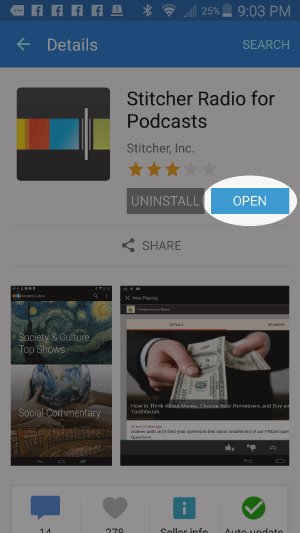
Install the Stitcher App
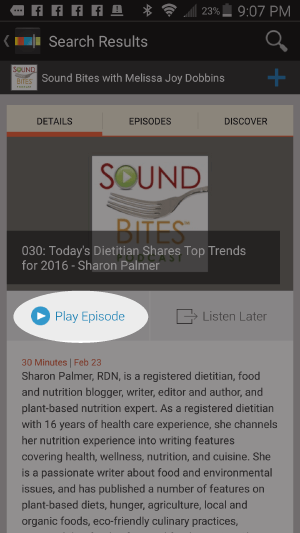
1. Search for “sound bites with melissa joy dobbins” 2. Choose Play Current Episode or Add to Playlist
Choose “Play Episode”
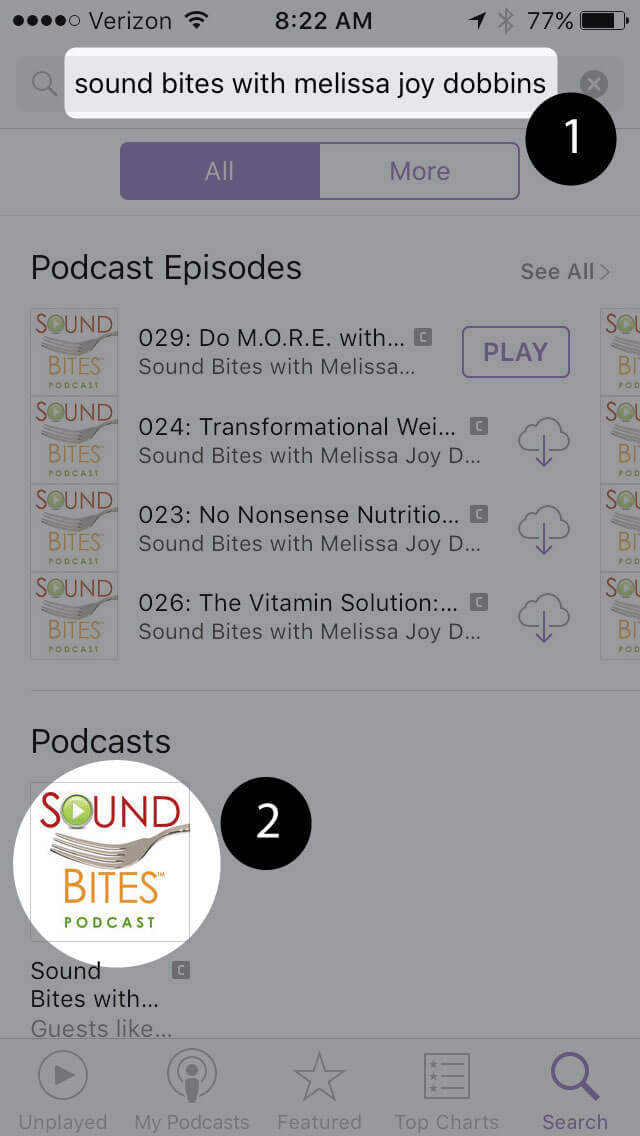
Subscribe & Review on iPhone
Open the “Podcast” app on your iPhone
Search for “Sound bites with melissa joy dobbins”
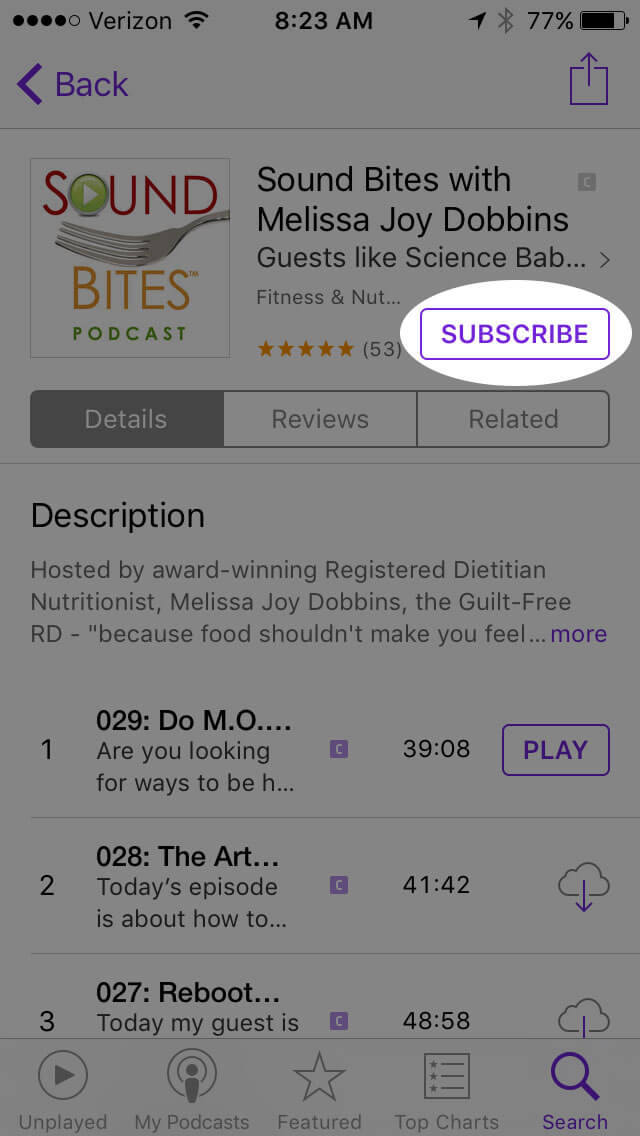
Open the podcast and click “Subscribe” and your done!
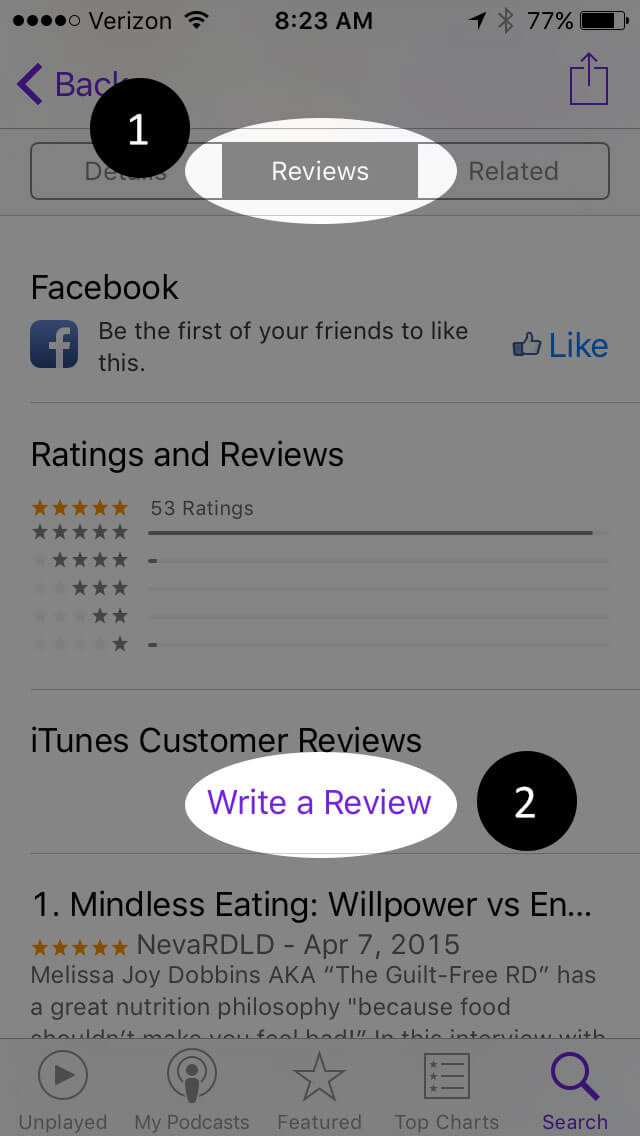
Write a Review
Click “Reviews”, then “Write a Review”.
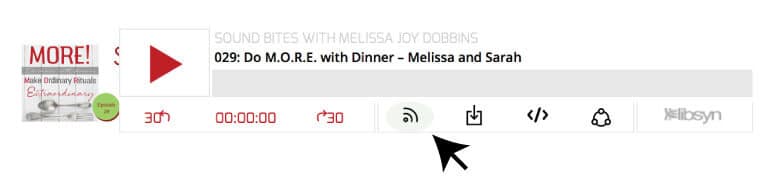
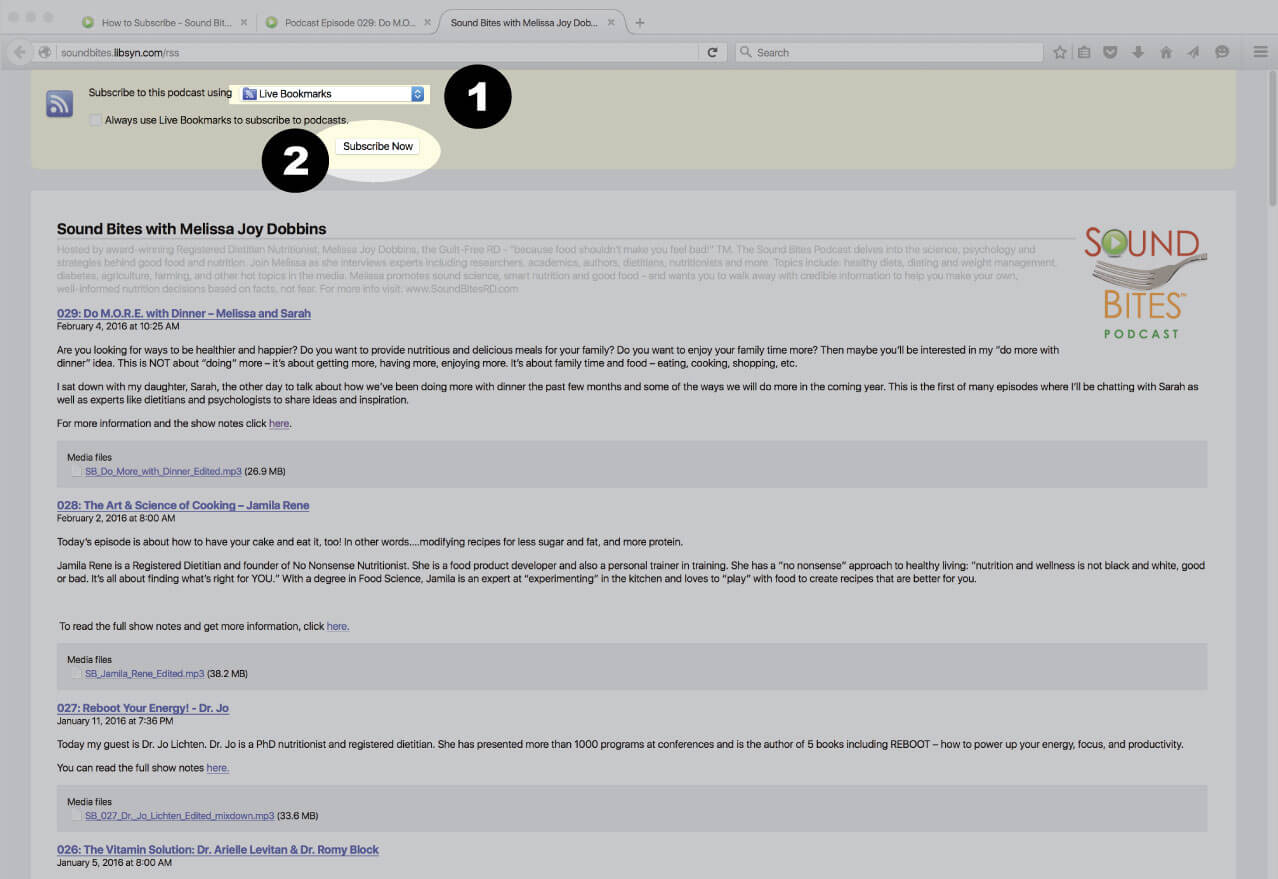
Subscribe via RSS Feed
Navigate to any podcast player . Click on the RSS feed icon.
Click on the RSS feed icon.
Click on RSS Feed
Choose which application you would like to use to receive the RSS feed
Click “Subscribe Now”
Confirm settings and subscribe.
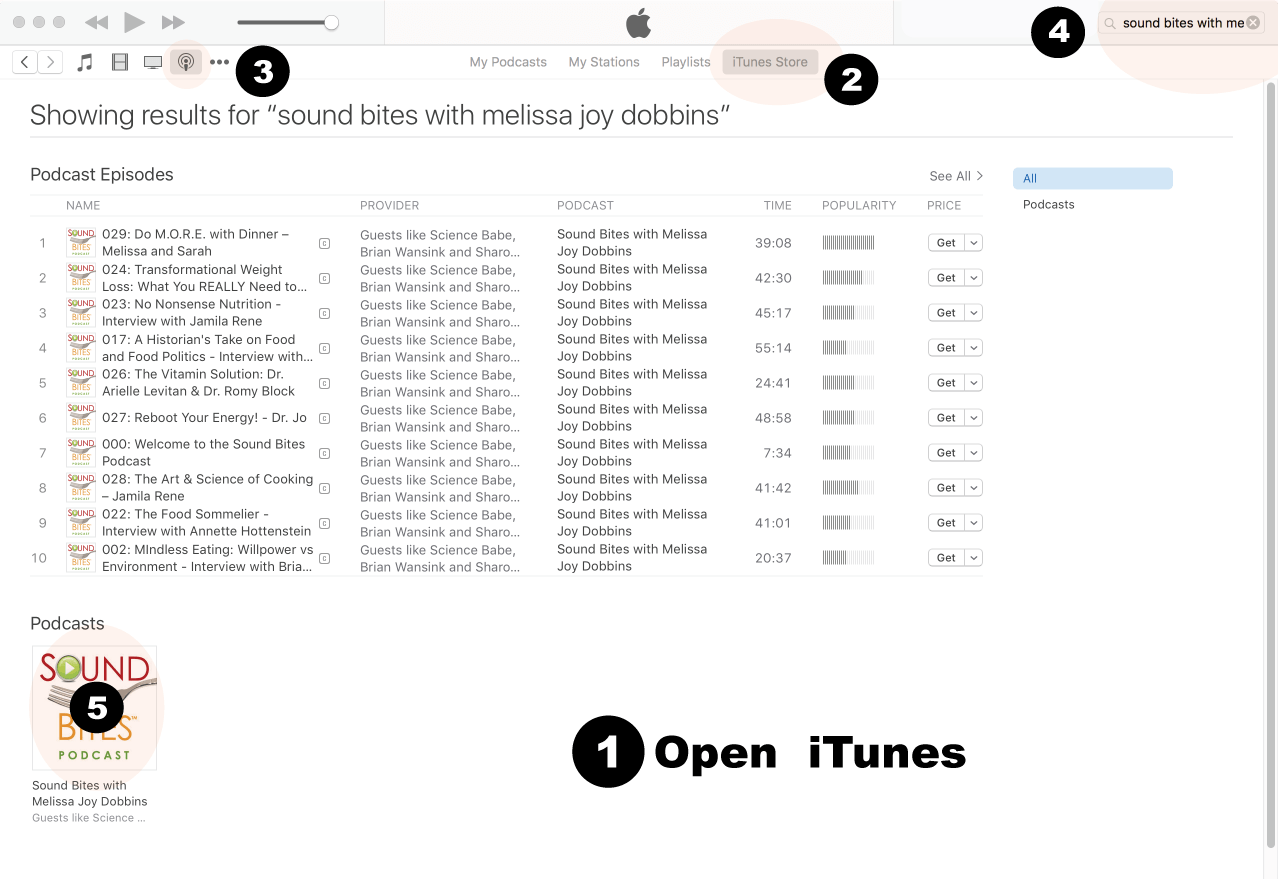
How to Review in iTunes
Open iTunes desktop application
Click iTunes Store
Click on Podcasts
Search for “Sound bites with Melissa Joy Dobbins”
Click on podcast image
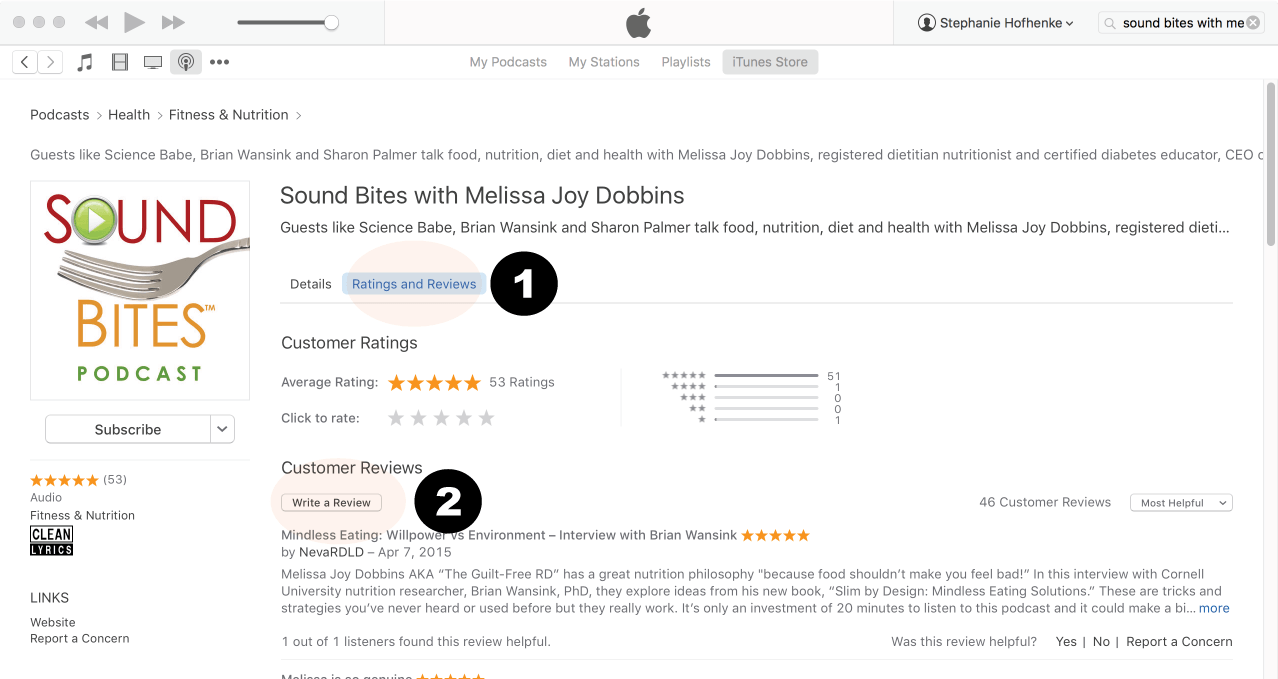
Search for Sound Bites podcast in iTunes
Click Ratings & Reivews
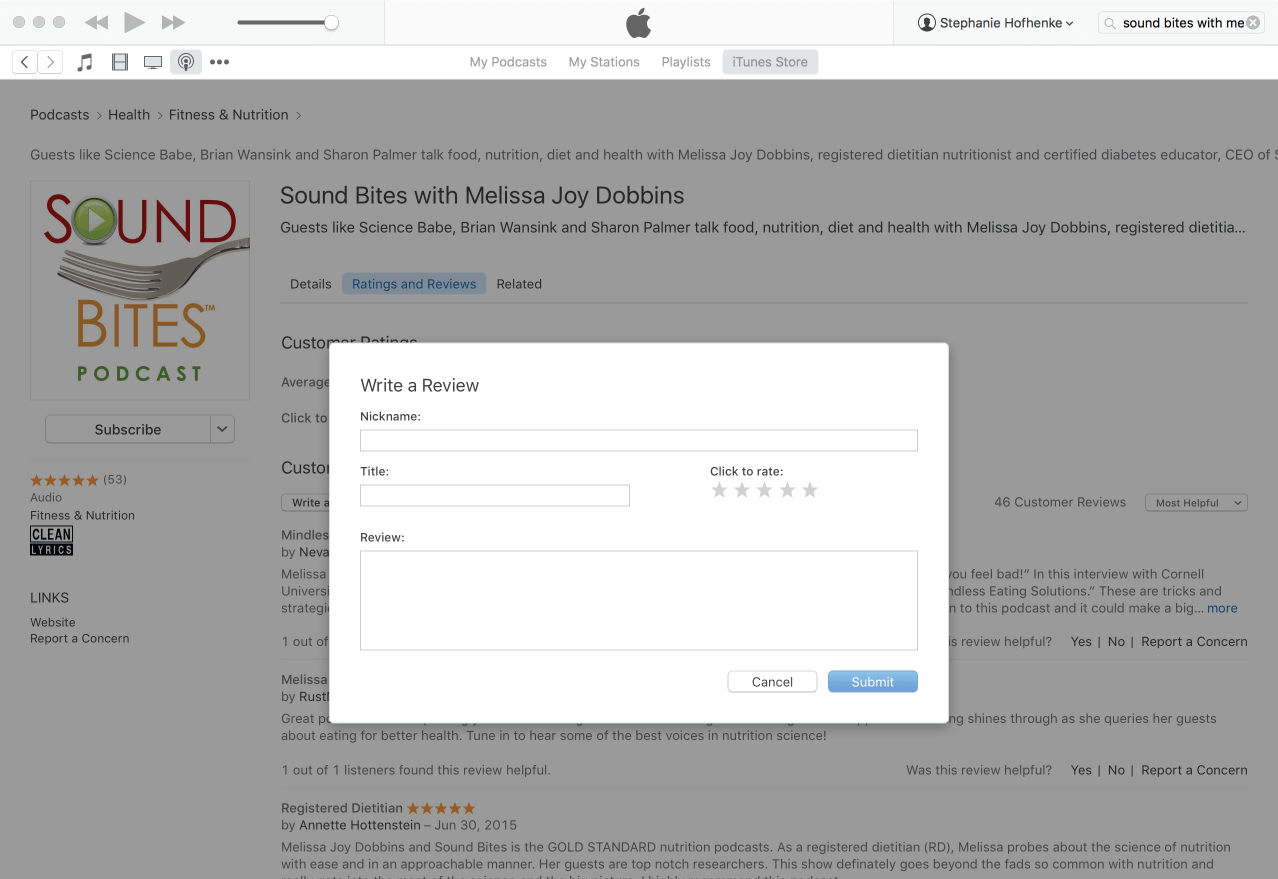
Click Write a Review
View reviews and write your own review.
Write your review…. Thank you!
Write your review!
How to subscribe via iTunes
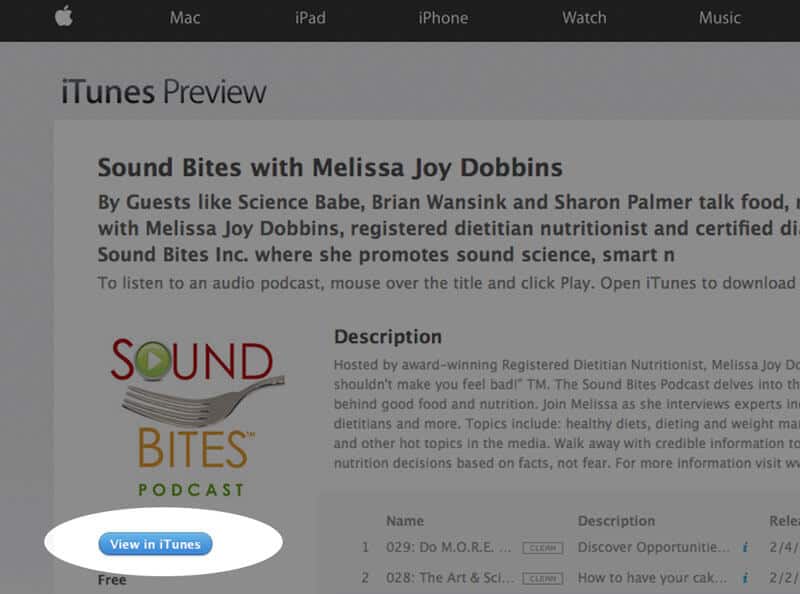
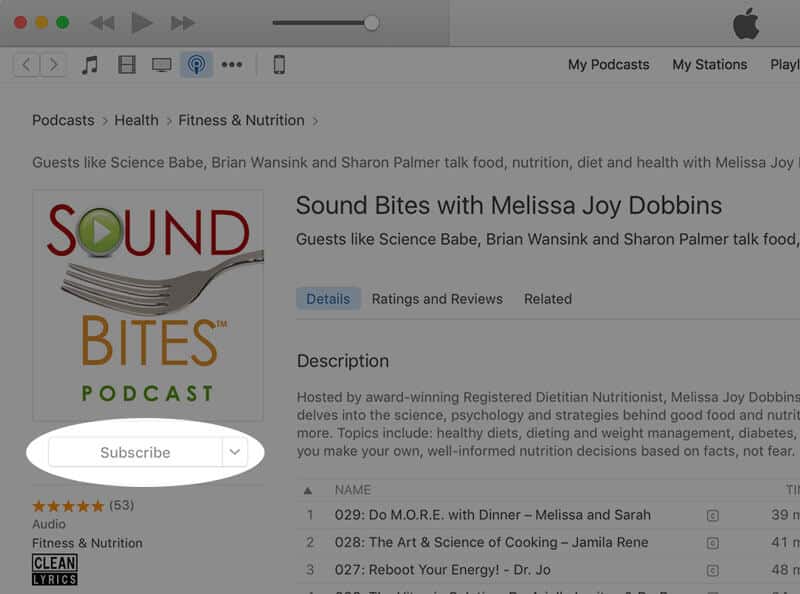
Click here to view the Sound Bites Podcastin iTunes, then click the blue “View in iTunes” button. This will open your iTunes application directly to Sound Bites Podcast. Click the “Subscribe” button, and your done!




 Amanda is an alcohol-free lifestyle expert. She’s a holistic life coach, speaker and author. As a coach, Amanda helps ambitious, soul-centered women stop drinking and start manifesting the life they deserve and desire. She teaches a modern approach to personal development, self-actualization and spiritual enlightenment through the lens of elective sobriety. Amanda’s first book, Unbottled Potential: Break Up With Alcohol And Break Through To Your Best Life is out now (Penguin Random House / Avery) is available now wherever books are sold. Her work has been featured on CNN, Business Insider, and The Skimm.