Celebrating over 1 Million Downloads and 50,000 Free CEUs on the Sound Bites® Podcast | NEW: Get 1 years’ worth of CEUs with the new 15-CEU Podcast Course
Disclosure: This episode is not sponsored. I attended a sponsored conference where I saw Dr. Adesogan speak earlier this year.
Protein Quality, Nutrient Bioavailability & A Global Perspective on Animal Agriculture
While plant-source foods provide important nutrients in our diets, animal-source foods contain more bioavailable sources of multiple critically needed macro- and micronutrients that can contribute to proper physical and cognitive growth of children. In rural parts of developing countries, these animal-source foods are vital for preventing undernutrition and allowing proper growth and brain development in children.
Tune into this episode to learn about:
The latest research on animal-source foods in healthy and sustainable diets
Nutrient intake of children in developing countries
How developing countries approach sustainable agriculture differently than the U.S.
Protein quality of different foods and food groups
Bioavailability of micro and macronutrients
Global biofortification efforts
Challenges in increasing consumption of animal-source foods in developing countries
A global perspective on animal agriculture
The Dublin Declaration of Scientists and the societal role of meat
Climate-smart approaches to livestock production
Pros/cons of cultured meat
The Dublin Declaration of Scientists now has over a thousand signatories from many different countries, and they have emphasized the important role of livestock in nutrition and health, in preventing nutritional problems like stunting, wasting, underweight, in contributing to environmental stewardship, and also looking at some of the societal importance for livelihoods, employment, and cultural aspects as well. Hopefully, we can all work towards improving livestock production in sustainable ways that addresses the food security needs, but in ways that are supportive of a healthy environment.” – Dr. Adesogan
Adegbola Adesogan, PhD
Dr. Adegbola Adesogan is Associate Vice President of the Institute of Food and Agricultural Sciences at the University of Florida, Professor of Ruminant Nutrition, Director, Global Food Systems Institute. Before his current job, he was the Director at Feed the Future Innovation Lab for Livestock Systems which manages over 60 projects that use animal-source foods to improve nutrition, health, and incomes in nine African and Asian countries. He earned his BS, MS and PhD degrees from Universities of Ibadan, Nigeria and Reading, UK, and has published over 160 journal papers and book chapters.
[00:00:02] Speaker 1: Welcome to Sound Bites, hosted by registered dietitian nutritionist Melissa Joy Dobbins. Let’s delve into the science, the psychology, and the strategies behind good food and nutrition.
[00:00:22] Melissa Joy Dobbins: Hello and welcome to the Sound Bites Podcast. Today’s episode is about the latest research on animal source foods in healthy, sustainable diets, specifically related to nutrient intakes of children in developing countries and with a special emphasis on how developing countries address sustainable agriculture differently than we do in the United States. My guest today is Dr. Gbola Adesogan. He’s an Associate Vice President of the Institute of Food and Agricultural Sciences at the University of Florida.
He’s also the Professor of Ruminant Nutrition, Director of the Global Food Systems Institute. Before his current job, he was the Director at Feed the Future Innovation Lab for Livestock Systems, which manages over 60 projects that use animal-source foods to improve nutrition, health, and incomes in nine African and Asian countries. He earned his Bachelor of Science, Master’s of Science, and PhD degrees from Universities of Ibadan, Nigeria, and Reading UK and has published over 160 journal papers and book chapters. Welcome to the show, Dr. Adesogan.
[00:01:35] Dr. Gbola Adesogan: Thank you so much, Melissa, it’s a pleasure to be here.
[00:01:38] Melissa: Pleasure to have you on the show. I do want our listeners to know that this episode is not sponsored. However, I did see you speak at a sponsored conference earlier this year. We’ve been communicating and planning this for quite some time and I’m just so excited to have you on the show.
[00:01:53] Dr. Adesogan: Thank you.
[00:01:53] Melissa: Should I call you Dr. Adesogan?
[00:01:55] Dr. Adesogan: You can call me Gbola.
[00:01:56] Melissa: Thank you. I would love for you to share with our listeners some more about your background, education, and the work you do and as always, any disclosures that you would have to note.
[00:02:08] Dr. Adesogan: Thank you. I’m originally from Nigeria. I did my graduate degrees in Britain and then worked on the faculty at the University of Wales for about six years before I came to Florida. In Florida, I’ve been here about 22 years. My first 15 years, was working on ways to improve the diets of livestock so that they would grow well and remain healthy, and so on. In the last seven years, I led a global research project funded by USAID and the Gates Foundation which was focused on using animal-source foods to improve nutrition, health, incomes, and livelihoods. I just stepped down from that position a few months ago. I lead the Global Food Systems Institute which engages with different partners across the world with our faculty here at Florida to address food system issues, particularly in the global South.
[00:03:09] Melissa: Yes, I’m very interested in your global perspective. I’ve been curious about this for some time. When I heard you speak and spoke with you afterward, I was like, “We got to get this on the podcast because I’ve not addressed much of this on the podcast before.” Maybe a good place to start is with you sharing with us, what are you seeing regarding current or the latest research regarding animal ag, sustainability, and human health. I realize that’s a broad question, but specifically related to the work that you’re doing.
[00:03:42] Dr. Adesogan: When we think about animal ag, we often think about the environment. I think it’s also important to think about food security. About 144 million children under the age of 5 have stunted growth, stunted physical growth as well as cognitive development. When this stunting occurs their brains don’t develop well. It’s very difficult to reverse this condition so many of them suffer a lifetime of underperformance and underachievement.
They’re more susceptible to different diseases and this is an intergenerational condition so they can pass it on to children. Most of these children subsist on plant-based diets, diets based in starchy foods, things like yam, cassava, rice, maybe with some vegetables but certainly, not enough. They have this condition which not just affects their development as individuals but affects the development of entire nations. Animal-sourced foods are very important because they have some macro and micronutrients that are very important for ensuring proper physical and cognitive development.
There’s been a growing body of evidence over the last few years that is showing that these animal-source foods can really help contribute to preventing nutritional problems like stunting, wasting, underweight. Helping to reverse these conditions. There’s, of course, also been a lot of research on the environmental impact of livestock production and strategies to mitigate, to reduce those adverse environmental impacts. There’s work going on showing the importance from a food security standpoint and also that livestock can be part of the solution to environmental challenges.
[00:05:39] Melissa: Thank you. I definitely want to talk about protein. I talk about protein a lot on the podcast but I also have a somewhat related Episode Number 219 where we talked about micronutrient deficiencies and dietary diversity with Dr. Tai Beal. I was wondering if you could just maybe give us an overview. You mentioned these macro and micronutrients that children in some of these developing countries or other countries might be lacking in and if you could maybe give us kind of an overview of what those nutrients are.
[00:06:05] Dr. Adesogan: Yes, there are a number of them. From a macronutrient standpoint, there are some that the protein type and the protein quality is very important and maybe we’ll come back to that in a minute. Polyunsaturated fatty acids are very important in brain development and many other processes within the body, but then things like iron and zinc and calcium, and vitamin A. These are among the most deficient micronutrients across the world and they are critically needed.
The animal-source foods have either the more biologically available forms or the natural forms in the diet so that they are much more easier to assimilate. There are many others like choline, vitamin D3, vitamin B12, which is one that’s very important for things like cognition but is not available from plant foods in general. Then there are a host of others like thiamine, riboflavin, and so on and so forth. Many of these are really important for the developing brain of the infant, particularly in that first thousand days.
If they’re not readily supplied, they can contribute to this problem of stunting. This is one of the reasons why these animal-source foods have been described as one of the best types of food for infants by the World Health Organization.
[00:07:28] Melissa: Great. Let’s focus more on the protein then. Like I said, talk about protein a lot on the podcast but not so much about the global perspective that we’re addressing today. Tell us about protein quality, does it matter? I think I know the answer to that and which food groups have the highest quality protein and anything else that you wanted to address regarding that?
[00:07:50] Dr. Adesogan: Thank you. Protein quality matters a lot. We often see that different food items in the supermarket will have an indication of how much protein they contain. That’s not enough because there are different types and qualities of protein. One of the current measures of looking at protein quality is the digestible indispensable amino acid score. Proteins are made up of amino acids, those are the building blocks of growth. Some proteins have a full complement of amino acids some don’t. Some are more digestible and available for absorption and others are not.
This D-I-A-S-S score helps to identify those with the highest quality, those that can promote growth the best. The animal sources generally have higher DIASS scores than other sources of protein. This is partly because many of them have the full complement of the amino acids, but they are also more digestible.
[00:08:56] Melissa: I know that there’s a new term that I think it’s a new term to me when I was doing some research called biofortification. Is this basically food fortification? Could you just define that and then tell us how that fits in with using animal-source foods, just trying to get more nutrients?
[00:09:15] Dr. Adesogan: Fortification, the idea was the approach to enrich foods with certain often micronutrients, to enhance the nutritional supply, whether it’s children or whoever is consuming the food. Biofortification refers to nutritionally enhancing food items by breeding the crops to improve their nutritional value or using modern biotechnology techniques or agronomic practices. It’s biological fortification. Fortification and biofortification efforts are very important.
Fortification has been used for decades in Europe since the ’40s, consumption of milk, fortification of types of food has been encouraged to enrich the diets of children. In developing world, there’s a lot of efforts by different NGOs and donors to fortify diets. In the recent years, there have been a lot of efforts on things like vitamin A-enriched rice and so on. Supply missing nutrients. These efforts are important and they are laudable, they are vitally important.
The challenge is that most of them supply only one or a few micronutrients and then many or most of them are also short-lived in many cases because they are dependent on donor funding. The edge that animal-source foods have over those approaches is that animal-source foods supply several different micronutrients that are missing in the diets of the vulnerable in developing countries simultaneously. They are supplying many, at the same time, they also supply very readily available for us.
In many of those contexts, there’s also already livestock production but there are issues with livestock consumption that we can discuss. If we can address those issues of livestock production, we can have a more sustainable supply of those micronutrients and macronutrients in the diets of the vulnerable.
[00:11:23] Melissa: Great. That’s a great transition. Let’s discuss the challenges to increasing consumption of animal-source foods. Our listeners may not be familiar with the term animal source foods, but it just means food that’s animal-based.
[00:11:37] Dr. Adesogan: Correct. Yes. It’s eggs.
[00:11:40] Melissa: Yes. It’s kind of an obvious term, but it might be new to some of our listeners. Let’s talk about those challenges to increasing the consumption of animal-sourced foods in the developing world.
[00:11:49] Dr. Adesogan: Yes. The first challenge is affordability. Those animal-source foods tend to be more expensive than staples, particularly in the last few years as feed costs have escalated with fertilizer costs. Many of these animal-source foods are unaffordable. You hear of people in some rural areas, some developing countries who only eat meat once or twice a year in very special locations. Affordability is an issue. Part of the issue with affordability is availability. The levels of livestock production are a fraction of what we have in the West.
A cow in a country like Nigeria may produce 5 liters of milk, 2 to 5 liters of milk for many of the smallholder farmers, whereas here in the US, you’re talking of maybe 30 liters of milk. There are huge differences. Because of that low productivity, the availability is low and so the affordability is a challenge. Accessibility can also be an issue. Transport, road infrastructure is poor in many of those countries so getting livestock products from where the livestock are raised to the markets can be an issue.
In addition to that, there are social-cultural factors, issues with religion, issues with cultural taboos. In Ethiopia, where we’ve been working for instance, religious fasting among the Orthodox Christians is the norm. People will fast for over 200 days a year and that means avoiding animal-source foods in their diets. These are some of the challenges that people face in these countries that limit consumption of these foods.
[00:13:37] Melissa: Right. You’ve touched on several interesting aspects that I’d like to take a deeper dive into some of them if we can, and also begs the question then about the production practices. If it’s one thing I’ve learned, just the tip of the iceberg is that what we do in the United States isn’t necessarily feasible or appropriate, or effective in other parts of the world for a variety of reasons. You mentioned the cultural differences. I’m sure just like in different parts of the US, there’s different climate issues.
We were just talking before the recording that you’re in Florida where it’s hotter and more humid in some parts than it is in Nigeria. I’m in Chicago, the windy city. If we could take a deeper dive in a couple of these examples with anything from climate to culture, just to paint the picture for our listeners, the complexities of this issue.
[00:14:33] Dr. Adesogan: Yes. Thank you. It’s very interesting to reflect on how livestock and livestock production is viewed in the West versus in the global South. In the West, what we often hear of is issues with environmental pollution, with health concerns, antimicrobial resistance and animal welfare. There’s been a general reduction in the levels of the growth in consumption of these livestock products and some people have even turned away from them completely.
In the developing world, in many parts of the developing world, there is a great appreciation for livestock and livestock production. Number one, huge portions of the population are involved in livestock production, sometimes up to 80% in one way or another. Agriculture contributes tremendously to the GDP of some of these nations. It’s seen as a form of employment but it’s also a form of status. So the more cows people have the higher status they have in the society.
Animals are also a means of empowering women in many cultures that don’t do that because the women have a few, maybe one cow or a few goats or some chickens. That is a source of income, that’s the only source of income that the woman has that she can call her own. It’s a way of empowering the woman. If she’s empowered, the children get better nutrition, their likelihood of going to school is better, and so on and so forth. Livestock also play a very important role in culture, in ceremonies, and even in contributing to conflicts.
If we think about in many of the traditional cultures, livestock would be used for paying dowries. When men can no longer afford 20 cows to pay a bride price, that can make them go and steal from the neighboring village which would cause conflicts. I say all that to show how vital livestock is in many of these contexts. Now, from a climate standpoint, one of the striking issues is that if you look at how much emissions are produced per unit from livestock, for instance, how much methane is produced per unit of milk or meat, the emissions from the developing countries are much higher. That stands to reason because the productivity of their livestock systems is much lower.
It’s important for us to look for strategies to improve the productivity so that there are lower emissions per unit of meat, per unit of milk and so on. We’re tackling both the food security and environmental goals simultaneously.
[00:17:19] Melissa: Wow, very interesting. You touched on one of my big questions that I had heard that basically in developing countries, that agriculture, all agriculture I’m assuming, but especially animal agriculture is less efficient. That’s the greenhouse gas per unit of food that you’re referring to. I think that’s where we talk a lot in the US about improving sustainability and not pointing fingers, but just in an effort to look at the full picture in perspective.
I don’t know how you would look at it portion-wise or percentage-wise, the amount of greenhouse gases from agriculture and animal agriculture from the developing world is much higher than the US. It seems that there’s a lot of opportunity in the developing world to maybe make a bigger impact through improved sustainability. I would love to hear your thoughts on that and also just sharing what are we doing in the US to improve sustainability. Also, how does that maybe compare and contrast to what the possibilities are in the developing world? Again, what we do here doesn’t necessarily translate because of all these factors that we’re talking about.
[00:18:33] Dr. Adesogan: Yes. If we compare 2007, if I just take the example of dairy production and we compare 2007, 2017, in fact, if we start by comparing 1944 to 2007, the emissions, total emissions per unit of milk production have more than halved. If we look at 2007 to 2017, we find that there was a great reduction in the percentage of cows, the amount of feeds, the land, the water, all by the tune of 70 to 80% and yet there was more milk produced.
This is the kind of thing that’s needed in the developing world. The amount of methane produced in 2017 was 80% of that in 2007 when considered per unit of energy-corrected milk. This shows that this is largely due to improved efficiency. In the developing world, the challenge is that systems, the productivity is low, efficiency is very low. However, there is a huge growing demand for livestock products in those countries. Currently, the goal in most of those countries in Africa and Asia is to meet the growing demand by increasing livestock numbers and increasing herds. That’s not the right approach.
The right approach should be to focus on efficiency, improving productivity per animal. There are things that can be learned from the US in terms of better feeding strategies, better health strategies, breeding strategies, best management practices. But at the same time, we can’t just copy and paste everything we do in the US in the developing world. For instance, here, culling of animals is a vital tool to make sure that once animals are no longer productive, they’re taken out of the herd.
In some of the developing countries, you have religious issues. In India, in Kenya, for instance, the cow is worshiped. Because of that, old cows that are no longer productive are retained in the herd. The religion is an important part of the societal values and so that cannot just be copied and pasted. Other strategies have to be used to improve efficiency. Another example is that in the US now, two of the top additives that we’re looking at for reducing methane emissions are things like 3-nitrooxypropranolol or NOP and then the red seaweed, Asparagopsis.
These have been shown to be some of the most promising additives for reducing emissions. The cost implications are such that they would not be applicable for developing countries for the foreseeable future.
[00:21:21] Melissa: When you say additives, you mean into the feed?
[00:21:23] Dr. Adesogan: Yes. These are additive supplements that reduce methane production. In those contexts, other strategies, some of which we have used here in the US successfully and effectively for many years have to be employed. Things like formulating rations to be balanced, matching the nutrient supply from the diets to what the animals need. Things like using improved forages in the diets, using better breeding strategies, improving preventative health, and also having better health systems in place. There are strategies that will help but we have to be careful about what we take from the US and what we deploy in those contexts.
[00:22:06] Melissa: Fascinating. It sounds like the animals need to be better nourished and so the people need to be better nourished as well. That parallel is interesting.
[00:22:16] Dr. Adesogan: Absolutely. Yes. In fact, feed is widely thought of as the number one constraint to the productivity of animals in these countries. That’s something that we and many other groups across the world have been working on.
[00:22:31] Melissa: Okay. Maybe now is a good time for you to tell us about the Dublin Declaration of Scientists. I found this very interesting. It was new to me earlier this year when I heard you speak about this and so I’d love to share it with the audience.
[00:22:45] Dr. Adesogan: The Dublin Declaration 2022, there was an important meeting which was held in Dublin on the societal role of meat. The meeting was convened because when you read the news and read some academic publications, there is a impression of livestock production that is presented as very negative that often only shows that livestock product consumption is harmful to health, is harmful to the environment, and so on. This was a meeting to bring together different scientists to look at the evidence and provide a balanced viewpoint on the status of livestock production and the impacts on society.
After that meeting, the organizers organized this Dublin declaration which was an opportunity for scientists from all over the world to voice their views on livestock production. This was basically trying to set the record straight and provide a strong voice that shows that there are a lot of scientists who believe that livestock do contribute to environmental pollution but they are part of the solution.
There are mitigation strategies that have been developed that are being used, and others are in the pipeline and are being developed that some of the negative impressions that we hear about livestock and health are not taking the whole body of research into account. There are other studies that show that livestock product consumption can be part of a healthy diet. The idea was to invite scientists from all over the world to voice their views. This has been done.
Now we have over a thousand signatories from many, many different countries, and they have emphasized the important role of livestock in nutrition, and health, in contributing to environmental stewardship, and also looking at some of the societal importance for livelihoods, for employment, and cultural aspects as well.
[00:24:59] Melissa: Okay. Very interesting. I believe there’s a website or there’s some information online that I can share in my show notes.
[00:25:05] Dr. Adesogan: Absolutely, yes.
[00:25:06] Melissa: Wonderful. I usually ask this at the top of the interview but I didn’t ask this. I’m very curious how you got interested in the work that you do and in the studies that you did. Something when you were growing up as a boy or a young man. I’d love to hear this.
[00:25:22] Dr. Adesogan: Yes, it’s interesting. My dad was a professor so we grew up on a university campus in Nigeria. One of my best friends was German, and his dad was a professor of animal science. He would take us to the farm and we would watch him taking measurements on the animals and working with them. I think that’s where I developed my love for animals and animal science. In 2013, when I watched a video that showed that in Kenya, adding meat to the diets of schoolchildren increased their test scores by 45% across all subjects, that really challenged me.
That changed my life, and really motivated me to be part of the solution to amplify the fact that animal source foods can be very important, are really important for growth and for cognition, especially in a context where people don’t have the pharmacies and the drug stores, supermarkets where they can get supplements that we have here.
[00:26:24] Melissa: Fascinating. I’m glad I thought to ask that. Is there anything else you wanted to tell us about the importance of animal source foods in sustainable healthy diets? I have a few other minor questions for you that are somewhat related.
[00:26:39] Dr. Adesogan: I think it’s important to note that even here in the West, animal source foods can be part of a healthy diet. They supply multiple micronutrients simultaneously. They’re very energy-dense which means that you don’t have to consume as much of an animal source food as you would other sources. There are many different ways in which they do contribute to health. I think another thing to emphasize is that there are different strategies that have been developed to address the environmental concerns.
In fact, if you look at the meat industry, the dairy industry, and many of the allied industries in the US, in the West, in Australia, in the UK, Canada, they have pledged to be carbon neutral by 2050. This is leveraging some of the strategies that have been already developed to address the environmental concerns. In the developing world, there is a need for a lot more work to address the high emissions intensity so the high emissions per unit of meat or milk.
That can be done through sustainable intensification, looking at strategies that improve production efficiency so we have more productivity from the same unit of feed. The other thing I think I would like to emphasize particularly in the context of developing world is this vital role of the animal-source foods in cognition, particularly in that first thousand days. Many times in those rural areas, there is no other option for supplying those missing nutrients.
The parents often will raise livestock but they sell the livestock products rather than consume them because they don’t realize how vital they are for the cognition and growth of their children. That’s another critically important point.
[00:28:32] Melissa: Okay. Interesting. Certainly, there are populations within the US that are at risk for nutritional deficiencies. Teen girls with iron. I’ve spoken to some of those on various podcast episodes as well. Thank you. This is very, very interesting. This might seem a little off-topic but I asked you beforehand if I could ask you about this. I went to IFT conference earlier this year, the Institute of Food Technology, and there was a lot of conversation about cultured or cultivated meat. I was curious being a meat expert, we might want to define what this is for the audience but also is it the meat of the future? What do you think?
[00:29:13] Dr. Adesogan: I’m going to share my views or my thoughts. Cultured meat is meat that’s grown in the lab. The idea behind it is that this type of meat will have less of an environmental impact than conventionally grown meat. I’ll share my views about cultured meat. Of course, everybody’s entitled to their own opinions. I think it’s fine that people are conducting research so that people have options. But from my standpoint, I think one of the things that’s important to realize is that their missions from cattle are mainly methane and nitrous oxide.
Many times they’re calculated as carbon dioxide equivalents but the true emissions are methane and carbon dioxide. It’s important to distinguish between the methane and the carbon dioxide and the nitrous. Methane is short-lived in the environment, lasts for about maybe 12 years, and then it dissipates, whereas CO2 two accumulates. There was a study which was done that showed that if you look at short-term emissions, you get the impression that cultured meat is much more environmentally friendly, produces less emissions compared to conventionally produced meat.
If you look at a long-term horizon, the reverse is the case because the cultured meat production is very energy-intensive and produces a lot of CO2 in the process. This study was actually one of those that stands against that idea that cultured meat is more environmentally friendly. I think more studies need to be done on the whole aspect of the environmental impacts. In addition to that, cost is a major factor now, it’s a huge factor. I think over time, we’ll see. We’ll have to wait to see how the price changes and whether the taste is considered to sufficiently mimic the truth thing.
The other thing I think is important to mention is that, at least as far as I know, there hasn’t been any real large-scale production of cultured meat. That would present some food safety issues. There are regulatory issues, there are cultural issues. My personal thought is that cultured meat will be a niche product for a niche market in the future. That’s what I think.
[00:31:40] Melissa: Very interesting. Thank you. You brought up many aspects that I hadn’t thought of, and certainly, there’s a lot to think about there. Yes, anytime we’re talking about sustainability and greenhouse gases and methane and CO2, we’ve got to look at the whole big picture. I do have a related episode with Dr. Frank Mitt Lerner talking about the biogenic carbon cycle. If anybody’s interested in that, take a deep dive. I can’t remember the episode number, but I’ll put it in my show notes at soundbitesrd.com. Well, this has been very enlightening. Thank you so much. Is there anything else you wanted to share as far as a bottom line, takeaway, or parting words of wisdom?
[00:32:18] Dr. Adesogan: Yes, maybe I’ll just emphasize once more that here in the US, animal-source foods can be important parts of healthy diets. Obviously, moderation is important. I remember a study that looked at what would happen if livestock are removed from the US. It showed that the reduction in greenhouse gas emissions would be only about 2.6%. It’s not anywhere as high as people think.
[00:32:46] Melissa: That’s a great point. I’m glad you brought that up.
[00:32:48] Dr. Adesogan: Yes. Well, what they discovered was that micronutrient deficiencies that were common many, many years ago, many decades ago would then become prevalent. They play an important role in our diets. They’re very important, not just for infants, even for the adult, for laying down muscle so that they avoid falls, for teenagers, for supplying important minerals for bone growth. They’re really important. Then in the developing world where there are no options, there are absolutely vital. They can be a lifesaver, they can be the difference between having a stunted brain and having a normal brain.
I think those are important points to leave the audience with, and hopefully, we can all work towards improving livestock production in sustainable ways that addresses the food security needs, but in ways that are supportive of a healthy environment.
[00:33:43] Melissa: Well, thank you for the work that you are doing in identifying these climate-smart approaches and increasing livestock production in developing countries. We do have some websites and social media handles where people can learn more about these topics. I’ll have those in my show notes at soundbitesrd.com. If there’s any specific ones that you want to share, they’re not short, sweet little soundbite URLs, but if there’s anything you wanted to share now, I’d love to hear that.
[00:34:14] Dr. Adesogan: Well, I think the Livestock Lab is one where we’ve published a lot of the work that we’ve done over the years. The International Livestock Research Institute website is another one. The Global Agenda for Sustainable Livestock, those are just a few. I’ll share a few more with you.
[00:34:31] Melissa: Yes. Any links that you want to share with our listeners, I’ll include those. Yes, there’s, like I said, websites, social media handles, and so on. Everybody can check those out in the show notes. Thank you again so much, Dr. Adesogan.
[00:34:44] Dr. Adesogan: Thank you. Thanks for the opportunity.
[00:34:46] Melissa: I look forward to continuing to follow the fascinating work that you’re doing. Again, thank you so much.
[00:34:52] Dr. Adesogan: Thank you.
[00:34:53] Melissa: For everybody listening, as always, enjoy your food with health in mind. Till next time.
[background music]
[00:35:00] Speaker 1: For more information, visit soundbitesrd.com. This podcast does not provide medical advice. It is for informational purposes only. Please see a registered dietician for individualized advice. Music by Dave Burke, produced by Jag and Detroit Podcasts. Copyright Sound Bites, Inc. All rights reserved.
[music]
[00:35:27] [END OF AUDIO]
LISTEN, LEARN AND EARN
Listen to select Sound Bites Podcasts and earn free CEU credits approved by the Commission on Dietetic Registration (CDR) for registered dietitian nutritionists and dietetic technicians, registered. Get started!
Get Melissa’s Sound Science Toolkit here!
Partnerships:
Sound Bites is partnering with the Association of Diabetes Care and Education Specialists (formerly the American Association of Diabetes Educators)! Stay tuned for updates on the podcast, blog and newsletter!
Sound Bites is partnering with the International Food Information Council! Stay tuned for updates on the podcast, blog and newsletter!
Sign up for my monthly newsletter and episode eblasts so you never miss an update!
Listen on Stitcher (Android)
Install the Stitcher App
1. Search for “sound bites with melissa joy dobbins” 2. Choose Play Current Episode or Add to Playlist
Choose “Play Episode”
Subscribe & Review on iPhone
Open the “Podcast” app on your iPhone
Search for “Sound bites with melissa joy dobbins”
Open the podcast and click “Subscribe” and your done!
Write a Review
Click “Reviews”, then “Write a Review”.
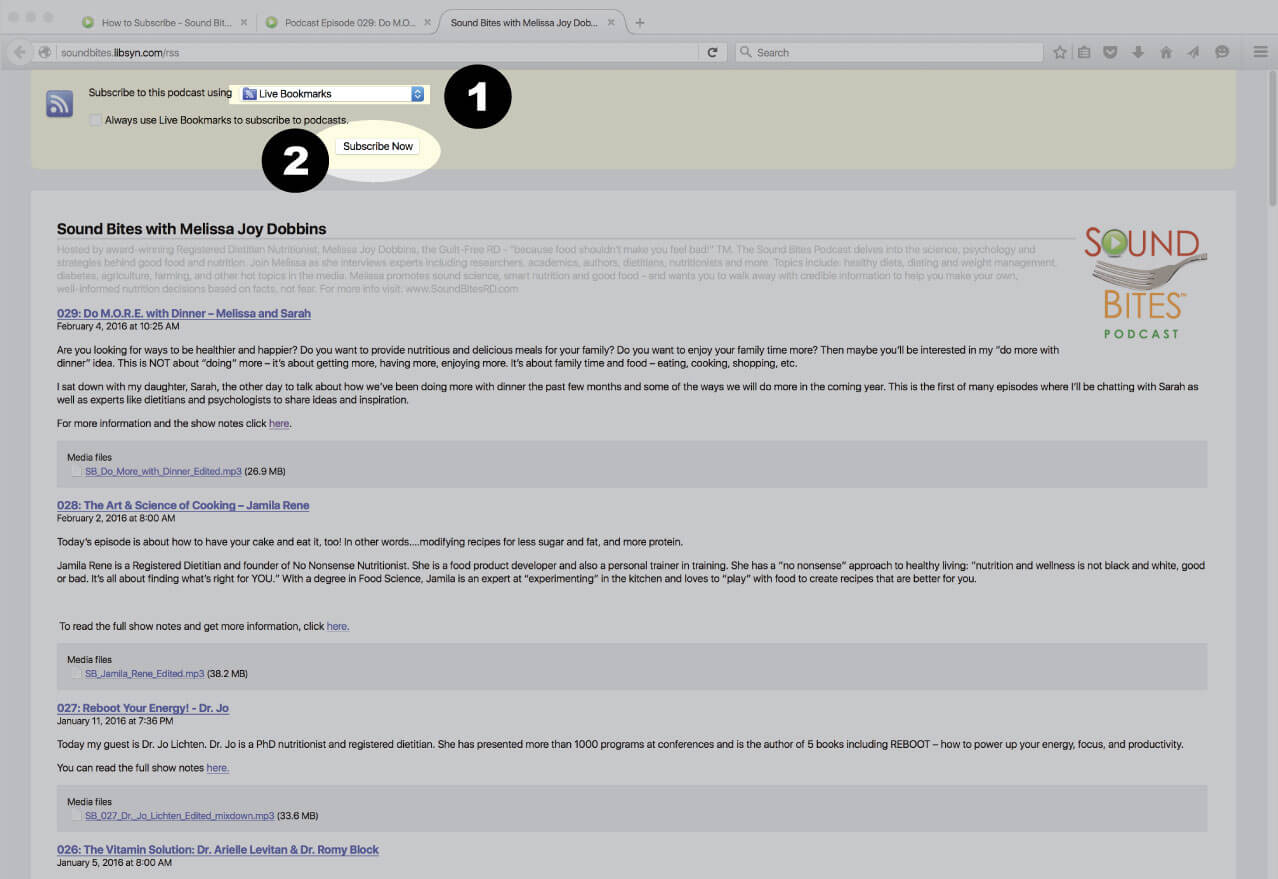
Subscribe via RSS Feed
Navigate to any podcast player . Click on the RSS feed icon.
Click on the RSS feed icon.
Click on RSS Feed
Choose which application you would like to use to receive the RSS feed
Click “Subscribe Now”
Confirm settings and subscribe.
How to Review in iTunes
Open iTunes desktop application
Click iTunes Store
Click on Podcasts
Search for “Sound bites with Melissa Joy Dobbins”
Click on podcast image
Search for Sound Bites podcast in iTunes
Click Ratings & Reivews
Click Write a Review
View reviews and write your own review.
Write your review…. Thank you!
Write your review!
How to subscribe via iTunes
Click here to view the Sound Bites Podcastin iTunes, then click the blue “View in iTunes” button. This will open your iTunes application directly to Sound Bites Podcast. Click the “Subscribe” button, and your done!



























Our General Federation of Women’s Clubs donates to Hefer International which donates small animals -chickens, goats, pigs to 3rd world countires.