Celebrating over 1 Million Downloads and 50,000 Free CEUs on the Sound Bites® Podcast | NEW: Get 1 years’ worth of CEUs with the new 15-CEU Podcast Course
Animal Agriculture, Animal Welfare & Animal Rights
There is a difference between animal welfare and animal rights. The term “animal welfare” refers to an animal’s current state of being, including whether the animal is healthy, calm and well-nourished. In contrast, the idea of “animal rights” is that animals should enjoy rights analogous to those we have as humans – including that they should not be used for food, regardless of how well they are cared for.
Tune in to this episode to learn about:
The many differences between animal welfare and animal rights
Common misunderstandings about animal rights organizations
Examples of animal rights organization activities such as pressure campaigns
How the animal ag community handles and responds to these tactics
How the public and health professionals can understand the animal ag industry better
Where people can access accurate, balanced information about animal agriculture
The animal ag community is dedicated to and invested in continuous improvements in animal welfare.” – Hannah Thompson-Weeman
Hannah Thompson-Weeman
Hannah Thompson-Weeman leads the development and implementation of communications strategy for the Animal Agriculture Alliance as the vice president, strategic engagement. Her role includes coordinating industry-wide responses to emerging issues, engaging with key influencers, advising members on handling crisis situations and representing the Alliance on state, regional, national and international platforms through speaking engagements. Hannah also leads the Alliance’s media engagement efforts, connecting regularly with both trade and mainstream media outlets. Hannah holds a B.S. in agricultural communication and an M.S. in agricultural and extension education from The Ohio State University. While pursuing her education, Hannah completed an undergraduate thesis based on agricultural policy and a graduate thesis focused on crisis communications and planning within the dairy industry.
If we ascribe human values and motivations to animals then we are not really looking at their welfare and what benefits them. Treating animals humanely and with high standards of animal welfare does not mean treating them like a human would want to be treated.” – Hannah Thompson-Weeman
About the Animal Agriculture Alliance
Founded in 1987, the Animal Agriculture Alliance is a non-profit organization that brings together farmers, ranchers, veterinarians, animal feed companies, animal health companies, processors, allied associations and others involved in getting food from farm to table. Their mission is to safeguard the future of animal agriculture and its value to society by bridging the communication gap between the farm and food communities. They connect and engage key stakeholders on emerging issues and promote consumer choice by helping them better understand modern animal agriculture.
Melissa: Thanks for tuning into the Sound Bites Podcast. What you hear on
today’s episode might surprise or disturb you. This is not a typical episode – but
I feel that it is very important to help raise awareness.
I have touched on animal welfare on some previous episodes but have not
discussed “animal rights”.
There is a difference between animal welfare and animal rights. The term
“animal welfare” refers to an animal’s current state of being, including whether
the animal is healthy, calm and well-nourished. In contrast, the idea of “animal
rights” is that animals should enjoy rights analogous to those we have as
humans – including that they should not be used for food, regardless of how
well they are cared for.
I’ve learned so much about animal welfare over the past 20 years working with
various agriculture groups and visiting many farms and ranches including beef,
dairy, chicken and hog farms. And I’ve also heard some things about animal
rights organizations over the years but it wasn’t until I heard today’s guest speak
on the topic at a conference that I gained a much better understanding of these
groups, their agendas and their activities.
Having an opinion and standing up for what you believe is one thing. But
crossing the line into extreme, deceptive and illegal tactics is something else
entirely, and it can actually put the health and welfare of livestock and poultry at
risk.
Please take a listen and share with others to help raise awareness of the
difference between animal welfare and animal rights.
Hello. And welcome back to the sound bites podcast. Today’s episode is about
animal rights organizations and how they’re attempting to shape the narrative
around food and agriculture and how we as consumers and health professionals
can ensure access to accurate balanced information so that we can make our
own well-informed food decisions based on facts and not fear.
My guest today is Hannah Thompson-Weeman. She’s the vice president of
strategic engagement at the animal agriculture Alliance. Hannah leads the
development and implementation of communications strategy for the Alliance.
Her role includes coordinating industry-wide responses to emerging issues,
engaging with key influencers, advising members on handling crisis situations
and representing the Alliance on state,Regional, national and international platforms through speaking engagements
and also media engagement efforts, connecting regularly with both trade and
mainstream media outlets. Hannah has a BS in agricultural communication and
an MS in agricultural and extension education from the Ohio state university.
Welcome to the show, Hannah.
Hannah: Thanks so much for having me. I’m excited to dive in.
Melissa: Oh, me too. I had such a pleasure meeting you in person at the north
American meat Institute’s animal care and handling conference, where I spoke
about connecting with today’s consumer about animal protein. And it was really
exciting because it was my first in-person speaking engagements since COVID.
I had done a lot of virtual speaking engagements and media trainings and a
couple of in-person media trainings prior to this, but it was just really nice to be
up on the stage and have a real live audience and then to get to see you present
on this topic that we’re going to talk about today and also get to sit and talk with
you at lunch and get to know more about you. So your presentation on animal
rights organizations was really compelling and eye-opening. So I’m just so
happy to have you on the show to share your insights directly with my listeners.
But before we jump in, I would love for you to share more about your
background and your work. Obviously including any disclosures you have to
note. But, you know how you got interested in agricultural communication and
how you came to the job that you’re in today,
Hannah: Well as you mentioned, I’m with an organization called the animal
agriculture Alliance.
And our mission is to safeguard the future of animal agriculture and its value to
society by bridging the communication gap between the farm and food
communities. So I’m really excited to be having this conversation. I really
enjoyed hearing your remarks at the meat Institute meeting as well. Because
you sit exactly in that same space of bridging that gap between the farm and
food communities and helping answer questions and share information about
food, which of course includes
Animal agriculture I’m from Maryland originally. So I grew up with a dairy
background on more of the Western side of the state, was involved in
agriculture, four H, FFA. I actually did the agriculture communications career development event when I was in FFA. And obviously it worked because I
developed a career in ag communications.
So I went on to study ag communication at Ohio state. And did several
internships while there working in different parts of the industry. So I did some
media work. I did an internship at a PR and marketing firm. I also did
internships in, again, sales, marketing, and PR all different facets of the
industry.
And, but really found that I was passionate about working on issues and putting
my knowledge and my passion for communications to work on behalf of the
agriculture committee. And of course with my background being in dairy,
particularly my passion is in animal agriculture. So after pursuing my master’s
in ag and extension education, and while I was doing that, I did my thesis on
crisis communications and planning in the dairy industry in Ohio.
My first full-time role was in PR and marketing for farm credit Mid-America
based in Louisville, Kentucky. And while I really enjoyed that role, and loved
the people I worked with, getting to help farmers and ranchers at the end of the
day, marketing loans and financial support wasn’t something that I was
personally passionate about.
And that’s what helped lead me back to the Alliance. So I’ve been with the
Alliance for seven years now. I’ve been back on the east coast. Our office is in
Arlington, Virginia, so in the DC area, but I live out on the Eastern shore of
Maryland. My husband is a large animal veterinarian. So he works with a lot of
farms in this area, which is why we live a ways outside of the city, because
obviously there aren’t any large animals in the immediate DC vicinity.
So my role at the Alliance and my part of that bridging the gap between farm
and fork is vice-president of strategic engagement. So that means I’m
responsible for all of our external outreach. So when we reach outside of the
animal agriculture community to connect with key stakeholders is what I’m
responsible for along with leading all of our communications strategy.
And we describe all of our work in the areas of connect, engage, and protect.
The connect part is bringing together everyone in the animal ag community. So
we have members over 400 members representing every part of the barn yard,
every part of food production. And then the engaged part is when we do reach
outside of the animal ag community to connect with external stakeholders.So folks like dieticians, restaurant, retail, foodservice brands, the media to help
connect them with resources and the primary issues we focus on are animal
welfare. So how are animals raised? How are they treated? Those types of
things as part of that responsible antibiotic use. And then these days more and
more we’re spending time in that sustainability realm.
So the environmental impact, and then as part of that, communicating about
nutrition, because that sustainability conversation tends to involve some groups
calling for alternatives. So we need to be able to explain the nutritional value of
meat, poultry, dairy, and eggs. And then lastly, and very relevant to our
conversation today is protect.
So that’s monitoring the adversarial voices out there who are spreading myths,
sharing misinformation about animal agriculture, because they just don’t believe
there’s any way to ethically and responsibly raise animals for food. So we have
a lot of information on those animal rights extremists organizations that are
advocating to take choices off of our plates,
Security resources and other things for our members. So we were founded back
in 1987, had more than 30 years of history in this area. And again, I’ve been
with the organization a little over seven years now and just really enjoy the
work that we do both on that positive, proactive engagement side, and helping
secure the future of the industry.
Melissa: Very good. Thank you. Yes. So I know we’ve talked several times and
I’m just struck by, you know, you’ve been connected to agriculture for almost
your whole life. And obviously the communications aspect is, you’re combining
that with the agriculture, which is just so exciting to me. But your thesis sounds
especially interesting, you know, having worked for the dairy council for eight
years and then also I was on their crisis communications team for six years, I
believe. And in fact, my very first national TV segment was with Fox news and
I had to address questions and issues about unfortunately farmers who were
euthanizing dairy cows during a recession. So it was really a tough interview,
but with all my crisis communications, I was prepared to do that.
And not exactly a dietician’s dream segment, but I lean on that crisis
communications experience so much, especially when I do my media trainings,
because I tell everybody. Well, you won’t have to sit there and answer questions
that are that tough. It’s usually going to be if you can address things at that level,
it’s a lot easier to talk about everyday issues, so to speak.So I really respect your background and your education and the work that you’re
doing. Let’s start with animal rights 1 0 1, the basics. What do we need to
know? Where’s a good place for us to start with this conversation.
Hannah: So, things to initially understand about the animal rights extremist
movement is first to kind of get the scope of what’s going on out there.
So as I mentioned previously, unfortunately there’s a very small, but very loud
segment of the population who just don’t believe there’s any way to ethically
and responsibly use animals for any purpose, including for food. So really
critical to understand that for this Extremist segment of the population that
we’re talking about it is not about animal welfare. It is not about how animals
are raised, what standards are in place. If at the end of the day, we are using
them for food. It doesn’t matter how well they’re cared for what that process
looks like. They just don’t believe that that should be done. And certainly people
are entitled to their own views, their own beliefs, but when it crosses over to
being problematic is when they choose to advocate for everyone to adopt that
mindset.
And they tend to do that relying on myths and misinformation. So we are
talking about a small segment of the population out there, despite what we
might be hearing about how everyone’s going vegan. And it’s so trendy to ditch
animal protein, the number of self-reported vegetarians and vegans in the US is
around four to 6% and that number is stable. It has been for decades and that
aligns with activist groups, own research. And also, certainly I want to be
crystal clear, I am by no means saying that everyone that chooses to eat a
vegetarian or vegan diet is an animal rights extremist and is spreading
misinformation.
So it’s an even smaller segment of that small segment that we’re talking about
here today. So, first of all, understanding that it is a very extreme, very small
part of society that we’re talking about. And then secondly, I think making that
distinction between animal rights and animal welfare, because that line can get
blurred and that can get blurred intentionally by some of these extreme voices.
So of course, animal welfare. How an animal is handling the circumstances that
it’s in. Are they healthy? Are they stressed? You can measure things like eating,
drinking, their activity to get a really solid idea of an animal’s concept of
welfare. It’s a very scientific concept. Something that farmers ranchers,
veterinarians are clearly committed to, but it’s very different from the idea of
animal rights, which is that animals should be afforded rights that are analogous
to those enjoyed by humans.And you are speciesist if you view animals as different from humans. So animal
welfare is a very, very different concept from animal rights. And that’s
something to understand as well that what we’re talking about, our concerns
about these organizations by no means, are we talking about advances in animal
welfare.
That’s something that the animal ag community is really dedicated to and
investing a lot of time and resources in because we share the value. That it’s
really critical to invest in continuous improvement and animal welfare. So
again, understanding the difference between an animal rights mindset and
animal welfare mindset.
Melissa: Very good point. Thank you so much for clarifying that. And I talk
about agriculture on the podcast a lot, and how farmers and ranchers are very
committed to treating their animals well, and the veterinarians are involved. The
nutritionists are involved, everything to make those animals as healthy and
comfortable and well-treated as possible.
And one of the things that I learned along the way in my working with the dairy
council and other organizations, is that animals don’t necessarily like to be
treated like humans. And so the humane treatment of animals doesn’t mean that
we treat them like humans. So I always like to kind of share that out as sort of
an aha to some things that we might learn about how animals are treated might
seem bad, but when you learn
the reason behind it or the purpose behind it, that makes all the difference. So I
wanted to just reiterate that and thank you for explaining the difference.
Hannah: That’s the thing one of our members who’s in the poultry community
has said that, you know, she wants to research this because nobody’s ever asked
the chickens what the chickens actually want.
There’s a lot of people saying they’re speaking for the chickens, but have we
actually stepped back and studied you know what affects their growth, what
affects those stress levels, things like that. Because if we ascribe human values
and human motivations to animals, then we’re not really looking at their welfare
and what benefits them.
So it is really important to think that treating an animal humanely and treating
an animal with high standards of animal welfare does not mean treating them
like a person would want to be treated or even like companion animals. Even if
we think of our cats and dogs, they’re very different from animals that werebred and raised for a purpose, which is food production. Now there is a lot of
misinformation out there about what animal welfare actually means because
these organizations we’re talking about that have that animal rights mindset.
They’ve realized that just saying, go vegan doesn’t work. Again, we’ve said that
number has stayed stable.
People still enjoy incorporating meat, poultry, dairy, and eggs, and their diet feel
that that makes them feel healthy and feel good. So that go vegan message
doesn’t work. So now they’ve turned a focus on animal welfare and what they’ve
done is target certain practices that are commonly used in production in order to
have them be either banned via legislation or by restaurant retail, food service
brands, adopting policies.
But the actual point of those policies is to reduce efficiency and drive up costs
in hopes that those costs would be passed along to the consumer. And there’ll be
forced to choose fewer animal proteins when they’re shopping at the grocery
store or ordering off of the restaurant menu. You also don’t have to, you know,
take my word for it.
These are strategies that these groups have explained in their own conferences.
They talk about the incremental changes approach and they talk about needing
to drive up the cost of animal protein to make people consume less of it as a
way of getting to their end goal. So they might present themselves as concerned
with animal welfare.
They might be talking about animal welfare practices, but it’s all through that
lens of animal rights which means that it’s coming with a certain agenda and it’s
not actually about continuous improvement or innovation and animal welfare.
Melissa: Right, right. Yes. It’s really important to understand their motives or
their agenda.
And I think a lot of us just take it for face value that. What they’re saying, but as
you said, it’s kind of common knowledge and, and I want you to speak to the
big business aspect and maybe share some specific examples that once you start
seeing all these connections and you start listening, they’re not hiding this.
But they are a little bit I don’t want to say Wolf in sheep’s clothing, but they’re
not coming right out and saying that they’re against animal source foods, you
know, that they don’t want us to eat animal foods. They’re using this animal
rights lens to try to get attention, but can you give some more specific examples
about the big business aspect of that this network, this connectivity between all of these different organizations and some of the specific examples, like maybe
with the restaurant settings.
Hannah: One thing that’s important to understand is although I said, this is a
small segment of the population. They are very strategic and very well
coordinated.
The Alliance has profiles on nearly 200 different organizations that are targeting
animal agriculture in one way or another. And a lot of those organizations are
using different approaches to get to the same goal. So some groups like PETA
are very upfront about what they want. They will be very clear.
We want animal liberation. We want everyone to go vegan. That’s our objective.
While other organizations will depict themselves as more moderate, more
professional, maybe more focused on animal welfare. As a way to be taken
seriously and get in the door to be able to influence the media, influence key
brands, influence the end consumer by depicting themselves again, as more
professional, more moderate and not actually having that animal rights mindset.
Although if you look on their websites, if you look back to past quotes and
discussions, you’ll see. They’re talking about things like the abolition of animal
agriculture, ending animal agriculture. And we also have an interesting graphic
on our website, the activist web, as we call it where we show the connections
between these organizations.
So just the top 30 or so most prominent groups that web shows a line between
each of them. That’s connected by funding, project collaboration, or staff and
volunteers. So it’s really eye opening how all of these groups are connected.
Although some are very upfront about being extreme. Others are again, more
publicly facing professional, but as you can see, they are all connected the same
players, the same projects going back and forth that they’re all working in the
same direction.
Just intentionally adopting a different strategy to get there. Some might be
focused on legislation. Some might be actually going to farms stealing animals,
doing protests, some might be pressuring brands. And again, that’s a very
intentional way of attacking the same issue from different angles and they talk
about the strategy of mainstreaming.
So that’s where they have those groups that are very extreme, that are doing
protests and disruptions and break-ins, but them being that extreme, make some
of the other groups seem more palatable to people and seem like, oh, it’s a compromise. So we should work with this other organization. Who’s just as
extreme.
They’re just more strategic in how they approach it. There is definitely also a
financial incentive here. This is not just a grassroots group of passionate
individuals, just those top 30 or so organizations that I mentioned, they’re
bringing in more than a $550 million in income annually. And some of that is
coming from those individual donations.
We’ve all seen the commercials with the dogs and cats. And although they
market on that a very small minuscule amount of their budget actually goes to
any kind of on the ground programs, helping animals. It’s typically more for
staffing for lobbying for large scale projects. But in addition to those individual
donations, there’s also a lot of foundations out there that are channeling a lot of
big money into the activist movement.
One of those is called the open philanthropy project and it was started by one of
the founders of Facebook. So obviously they have a lot of money to invest and
animal welfare became one of their pet causes, pardon the wording. And they
hired some staff members formerly with activist groups to run their farm animal
welfare division.
And they are pumping tens of millions of dollars into these groups in just quote
unquote operating funds or for specific campaigns. So there’s a lot of money
going into the activist movement that makes them so strategic that makes them
so well-funded. And able to operate unfortunately, sometimes very effectively in
their attempts to
affect the way that we all make choices each day, when it comes to what we’re
going to eat and how farmers can raise animals. A lot of their efforts have been
targeted at the restaurant retail for food service community, because they’ve
realized that if they can target a certain brand to make a policy, you know, a
household name, large nationwide brand making a policy for their supply chain,
that’s going to be a lot faster than trying to get legislation passed all across the
country, which has been one of their previous strategies.
So a lot of their efforts right now are targeted the restaurant, retail food service
community, and trying to push them via different pressure campaign tactics to
make certain policies for their supply chain.
Melissa: So a couple things. You mentioned PETA, which most people are
familiar with people for the ethical treatment of animals.Are there other names you you’ve alluded to? You know, like the shows with the
cats and dogs, can you name other ones that people might be surprised to hear
that they’re animal rights based.
Hannah: A few of the other major groups that we monitor in addition to PETA,
who again, is very upfront about what they’re doing. They really thrive on
publicity stunts and trying to get media coverage. Some of the other primary
groups that we monitor quite a bit include the humane society of the United
States. So that’s another organization that publicly facing is very focused on
companion animals. They talk a lot about animal welfare, but they do a lot
legislatively and in the restaurant retail food service arena to try to impact
animal agriculture and they promote meatless Mondays and other meat
reduction and ultimately elimination strategy.
ASPCA is another organization that again is very publicly focused on
companion, animals, dogs, and cats, disaster rescue type things. But they also
have a farm animal welfare division that calls for an end to animal agriculture
promotes consuming less and ultimately no animal proteins as a way to achieve
goals.
And both of those organizations are not affiliated with your local shelter. So
people hear the humane society and they think of their local humane society, but
there’s no connection there. So they tend to get funding support from people
thinking they’re helping the national branch of their local humane society.
But that’s not really the case. Other organizations include the humane league,
mercy for animals, animal equality. Those are all groups that we’re monitoring.
You might’ve heard of the good food Institute. They do a lot of promotion of
alternative proteins, whether it’s plant-based or cell culture, they’re actually a
sister organization to mercy for animals.
So they came out of the animal rights movement, and all of their efforts are
grounded in that belief, that animal agriculture shouldn’t have a place in society.
And then the last one I want to mention is called direct action everywhere. And
that is one of the most extreme organizations when it comes to on-farm
activities.
So trespassing on farms, stealing animals, holding large-scale protests. They’re
one that’s doing a lot on the farm and plant level that causes us a lot of concern.
Melissa: Right. And I want to ask you about some of these on-farm examples. I
mean, we’ve all heard and seen things in the news, but I think hearing it from your perspective, explaining exactly what these people are doing and how
they’re doing it will be enlightening for us.
But before that, I would love for you to share you know, we touched on the
retail and restaurant environment, but like a really specific example that our
listeners can really understand, like, for example, with the animal source food,
versus plant-based like, I’m thinking maybe like cows milk versus almond milk
or whatever. Is there a specific example you can share with that?
Hannah: Of an activist campaign?
Melissa: Maybe it’s these pressure campaigns is that it?
Hannah: Yes, I think when it comes to pressure campaigns, probably the best
examples are more focused around specific production practices. That are
widely used across animal agriculture or across a certain sector of animal
agriculture.
One that immediately comes to mind was the push for cage free eggs. So
roughly, maybe 2014, 2015, several activists groups came together and it was a
little bit of a departure in strategy. Previously, these groups would come to
restaurant retail and food service brands with campaigns, but they would all be
demanding something different.
So it was relatively easy for the brand to kind of fend them off. But in this
instance, several groups came together and said, our issue is cage free eggs. We
want to push for restaurant retail and food service brands to commit to only
sourcing eggs from operations that do not employ cages. Now they depicted this
as a slam dunk for animal welfare, kind of saying that cage free is better for
again, the animals, but it’s really not a foregone conclusion. Actually several
members of the animal ag community, as well as from the restaurant side,
funded some research from an organization.
called the coalition for sustainable egg supply that looked at different housing
methods to say, you know, what are the pros and cons? And that was really the
outcome is that there are pros and cons to each production method, whether it’s
conventional cages or something called enriched colony cages or the cage-free
system that activists groups were advocating for.
So when it comes to food safety, worker health and safety, the animals showing
aggression to one another, again, there’s trade offs and there’s significant cons to
cage free system. So actually that research pointed at enriched colony systems as potentially being the best way to go to move forward. When it comes to
animal welfare in the egg community.
But of course that’s not what activist groups were actually concerned about.
They wanted the cage-free conversion because it was going to be very
expensive, very difficult for the egg community to comply. So that’s what they
pushed for. So they employed various campaigns, things like social media
activities, taking billboards out in times square, taking huge ads out in the New
York times, protests, disruptions, a lot of different pressure campaign tactics.
And ultimately were successful in getting more than 250 restaurant retail and
food service brands to commit to sourcing only cage-free eggs within a certain
timeframe. The number of brands that made that committed equals about 75%
of the egg-laying production, which is a significant, significant increase over the
amount of cage free eggs that were produced back when these commitments
started.
So it was calling for a drastic overhaul in the way eggs were produced, which
of course comes with a major price tag. And in doing this companies have had
to start making that switch, start producing more cage free eggs. But right now,
when both options are still available, consumers are purchasing conventional
eggs.
So brands are having to sell cage-free eggs as conventional at a loss just to get
them out the door. So if consumers really were motivated and really wanted
only cage free eggs, that’s kind of how the market would have gone naturally, if
they were making that purchasing decision without these external factors of
activist groups getting involved.
So that’s a really prime example that push for only cage free eggs to be
available. And that’s something I want to highlight is that at the Alliance, we’re
all about choice. So, you know, we are not even a checkoff organization. We’re
not an organization that our role is promoting eating animal protein or trying to
get you to eat more meat.
We just want you to have accurate information when you make choices and we
want those choices to be available. So we get really concerned with these
activist campaigns that are focused on taking choices away. You know, if these
groups wanted to promote certain production practices wanted to promote cage
free eggs in a positive way,That’s all well and good, but it’s when they want only one choice to be available.
It becomes very problematic, especially when those choices tend to come with a
higher price tag. And when we know they’re going to move the goalposts, as
we’ve already had activists saying, well, cage-free is actually not that good.
We need pasture raised. They’re just going to continue to move the goalpost
until it’s completely unsustainable.
Melissa: And unattainable as well. You know, one of the biggest concepts I’ve
learned about agriculture is this concept of trade-offs and those pros and cons
that you were speaking to and at the heart of why I’m in agriculture and
nutrition communications is that choice for the consumer, but also the choice for
the farmer to determine the best practices and tools for their particular farm or
ranch.
And it’s situations like this where those choices get taken away and yeah, things
start getting really scary in my opinion. Well thank you for that specific
example. So that’s called a pressure campaign. These tactics and strategies can
be quite extreme. Let’s talk about some of the, the on-farm activities that you’ve
seen in your seven years there, and maybe even prior.
Like I said, we hear and see these things in the news, but we’re only getting one
side of the story. So I’d love for you to kind of paint the picture for us. You
know, some of these activities, how, how extreme they can be and what the
result is when these things happen?
Hannah: I think one of the first things to help people understand if you’re not
overly familiar with agriculture, animal agriculture, is that farmers live on their
farm.
So where their operation is, where their farm is, most of the time, at least the
farmer lives there. So it’s their home, their families there. It’s not just a business
for them. So when we see activists taking these very extreme measures to
actually trespass on farms, that’s something we’ve seen a lot of is activists going
to farms, trying to find doors that are unlocked and they’ll go in and here’s some
examples of how they’ll take things out of context.
So in one example, they went into a broiler chicken house. So those are
chickens that are being raised for meat. And if you’ve ever been in a chicken
house taking a farm tour, when you open the door, a lot of times the birds will
flock together as you hear to one side of the barn. So they would film that side
of the barn where all the birds were standing really closely together by choice, ignoring the fact that the other side of the barn was empty. And they’ll say these
birds are packed in here. They have no room. Another example. They went to a
Turkey farm and they filmed the hospital pen. The birds that were in there were
injured. They were facing difficulties. That’s why they were in there getting
specialized treatment.
But they claimed all the birds on the farm looked like those handful of birds that
were receiving specialized medical attention. So those are some of the examples
of how they’ll kind of cherry pick things and take them out of context to try to
appeal to an audience that doesn’t really know what they’re looking at.
So those stealth visits as they call them where they would go into farms and
trespass. And in addition to being a security issue, it’s also a massive biosecurity
issue. So in animal agriculture, And actually we’ve all learned a lot about
biosecurity over the past two years with the COVID-19 pandemic.
That’s what wearing a mask is. That’s what social distancing is. It’s all about
biosecurity and those are not new principles to animal agriculture whatsoever. If
you’ve ever been to a farm, you might’ve had a shower in shower out. You might
have to walk through a foot bath to go into a farm. Maybe if you’ve already
been to another farm recently, they don’t want you to come in because they’re
concerned about things that you might be tracking in and disease introduction.
And if you heard about avian influenza, it was an extremely infectious disease
in the poultry industry. That was very transmittable from farm to farm. So
biosecurity is really top of mind. So having people unauthorized going from
farm to farm, trying to get in, trying to access is a biosecurity nightmare.
And that’s something that these groups will do, and then they’ve actually
escalated to stealing animals. So that’s something they’ve done to target
individual farms we’ve also seen and probably some of the most extreme
examples is these massive, large scale protests. And that’s mainly the group I
mentioned direct action everywhere
Who’s epicenters in Berkeley, California, but they have pockets of supporters all
across the country and they will mobilize during their annual conference and
take hundreds of activists to farms, to protest. And they’ll typically be there
protesting live streaming. And while the protest is going on
They’ll have a smaller group, a trespass go in and steal a whole bunch of
animals. And they’ve done those kinds of large-scale incidents three or four
times over the past several years. And this past year outside of a poultry processing plant, they adopted a new strategy called the sleeping dragon
technique and in their press release about that event, they came out and said, we
want to disrupt the supply chain.
So we want to make poultry not available. We want this plant to not be able to
operate. And after the past two years of supply chain disruptions, it’s kind of
shocking to me that they would admit that they want to take food out of the
supply chain, but that’s something they’re up front and admitting which is really
a again, eye opening about what their true agenda is.
It’s not about animal welfare. It’s about getting attention and disruption. But the
sleeping dragon technique is where they will attach themselves to one another
using specialized devices. They’re learning this protest technique from pipeline,
protesters, and other major protests that we’ve had in the us and these devices
they’re using to chain themselves to one another require specialized equipment
and specialized training for law enforcement to
be able to remove them. So that’s something that’s again, a major concern. This
incident, it was in California. So law enforcement there had the training, they
were able to get the equipment and remove them. But if they were to do
something like that in a more rural community where law enforcement didn’t
have the required training, it could go on for a very long time.
And unfortunately could cause disruption to supply chain and undermine food
security, which is a major concern.
Melissa: Hmm. Wow. Okay. So along those lines of when we see something in
the news and it looks one way, and then we learn what’s really going on. Like
you said, things are taken out of context, even things to the extent of, well, you
know, the person got this job on this farm and maybe they were the one harming
the animals, or they knew that these animals were being harmed.
There’s bad actors everywhere. I shouldn’t say everywhere, but there’s bad
actors. These things happen. And they would see these animals being harmed,
but they wouldn’t report it. Those are some of the stories that I’ve heard. Can
you speak to that?
Hannah: These quote unquote undercover video campaigns are something the
activist community has employed for a very long time and certainly are not
going away.And that is where an activist group will pay someone to go get hired on a farm
or get hired in a processing plant. And their only intention there is to capture
pictures, capture video footage that they can use against that farm or that plant,
but also the reputation of animal agriculture as a whole.
It’s problematic for a lot of different reasons. One is that when you hire
someone and you train them, you are trusting that they are there with the right
intentions and to prioritize caring for your livestock and poultry. Obviously,
someone who is getting paid by another organization has an ulterior motive is
not there in good faith to uphold your standards and provide proper care.
So in some instances, those individuals that have been hired on the farm have
actually been accused of egging on whatever they’re seeing, contributing to it,
even financially incentivizing employees to act and appropriately, or it was part
of their role to prevent whatever issue it was that they were filming.
In other instances, what they’re finding is science-based veterinary supported
practices, but they take them out of context and they add the dark lighting and
the Sarah McLaughlin song and the dramatic voiceover. And it starts to look
like something nefarious to Who’s never seen this before and who isn’t familiar
with animal agriculture.
So those campaigns are highly concerning. And usually the activist, if they do
actually witness examples of mishandling that should be reported., they choose
not to report them. They allow them to go on for weeks. Sometimes it’s up to a
year before they release anything, because what they really care about is the
media cycle or whatever legislation they’re trying to push for, not actually
stopping any miss handling.
So, you know, if there is anything that anyone witnesses, we encourage our
members to have anonymous tip lines, have ways for employees to report their
concerns and that that culture of care has to be so ingrained in all of their
employees and all of their farm and how they live every day that any of their
employees, if they see anything inappropriate, they would report it right away
and they can handle it.
Versus again, someone with an ulterior motive, either contributing to it, or
actually finding something that shouldn’t be happening, but not letting the
appropriate people know so it could actually be stopped. Melissa: Right. So how has the agriculture community responded to these
tactics in the past and currently? What have we learned about how to respond or
manage these extreme efforts?
Hannah: One thing, the animal agriculture community has been really
committed to is increasing transparency and that’s increasing transparency to the
right people. So we explain to our members a lot that again, this extreme
segment of the population is not who we need to focus on. The vast majority of
people do not have that animal rights mindset.
They don’t have that background in animal agriculture. So they’re having to sort
through all these myths, all this misinformation and decide what’s fact and
fiction. And that’s who we need to be focusing on. Not wasting our time
preaching to the choir and talking to each other, but also not wasting our time,
trying to engage with people who we’ll never find common ground with
because they just don’t believe animal agriculture should be done.
So finding those people in that movable middle and making sure they have the
accurate, balanced information is really critical and that transparency. So the
only way we inoculate people against believing things that are inaccurate is if
we’re there first and we’re there proactively talking about what we’re doing.
I think a lot of farmers and ranchers for a long time just took for granted that
people liked agriculture and supported agriculture and, you know, they didn’t
study communications, so that’s not part of their day job, but we really tell the
agriculture community that communicating about what we do and sharing what
we do and what goes on inside barns is absolutely critical and needs to be part
of our business plan.
So I would say that one of the best trends is that increasing transparency to the
right audiences, so that people have other sources of information and accurate
sources of information in addition to, or as a response to, or hopefully
proactively to whatever issues are out there being risen by those adversarial
voices.
The agriculture community is also becoming much more aware of security and
just making ourselves a harder target. So employing things like motion sensor
lighting, and no trespassing signage, and our own cameras and those sorts of
things. And it can be frustrating because again, we want to be transparent.
We don’t want to have to employ these measures, but unfortunately when there
are people so dedicated to doing the wrong thing and acting in bad faith and getting access to facilities for a negative reasons, we have to take security
measures. So the industry as a whole is becoming much more mindful and
employing those security measures, but also increasing transparency so that the
right people have access to our side of the story and can make an informed
decision rather than only hearing negativity.
Melissa: Absolutely. I started working for the dairy council in 2003, and it’s
just, it’s so wonderful to see how this trend has evolved with farmers and
ranchers, really being more out in the communications realm just on Instagram
and Twitter. And of course they’re not all, but we’re seeing so many more now
doing that.
And I’d like to say I was one of those early folks who was, you know, working
with the farmers and saying your voice matters. Yes. We know that this is the
last thing you want to do. You just want to go out in your field and do your
work, but it’s so important. And so it has been really exciting to see that growth
and that shift. And to your point about the security aspects of the cameras I
heard recently a situation had happened. I won’t share the details and promote it,
but the owner of this farm had chosen not to put in cameras because they
wanted their employees to feel trusted and they didn’t want them to feel like
they were being watched.
But after this incident happened, they realized, we don’t have that luxury and we
should have put cameras in and we need to explain to our employees that it’s
not, that we don’t trust you. We’re trying to protect you so – very important.
Hannah: Absolutely. And that’s something we encourage our members as well,
is that, you know, we can’t take anything for granted.
We can’t assume anything as common sense because in a world where people
are so disconnected from agriculture, and there are so many voices trying to
take advantage of that disconnection, there is no such thing as common sense.
So having your animal welfare policies, providing your animal welfare
trainings, doing your own video monitoring, your own audits, you know, we
have to have this mass base of evidence, so that if we ever are called into
question, we can demonstrate that culture of care and that commitment to doing
the right thing. Because unfortunately there are those groups out there looking
for vulnerabilities and looking to exploit them. And that’s something we talk to
the animal agriculture community a lot about as well.
You have to find those vulnerabilities. You have to think about, you know, if
there’s absolutely anything going on on your operation that you would not want on the front page of the New York times or livestreamed on Facebook, you need
to do something about that. Whether it’s, you know, getting more comfortable
explaining a practice that you think people might have concerns about or
changing the way you do things on your operation.
Because everything we do, we have to be a hundred percent confident to stand
behind and explain. And explain proactively because otherwise we’re going to
be letting those other voices set the tone of the story.
Melissa: Absolutely. So how can we as consumers be more aware of what’s
going on behind the scenes and make more informed decisions?
Obviously I’m doing this episode to raise awareness to consumers and health
professionals, but if you have any suggestions beyond this episode for both
consumers and health professionals to be more aware of what’s going on and
make more informed decisions.
Hannah: I would encourage the healthcare community, the dietetic community
to build more of those bridges with the agriculture community as a whole.
And certainly with animal agriculture specifically. So social media, as you
mentioned, is a great source for that. I know a lot of consumers and a lot of
folks in the healthcare community are building up more of a social presence and
really using that as a tool. And it’s an excellent way to make connections within
animal agriculture.
There are a lot of farmers and ranchers and organizations within agriculture that
have a very active presence on social media. So just following those type of
voices to make sure they’re showing up in your feed, make sure you’re hearing
about what issues are out there in animal agriculture. You’re learning about what
those producers are doing,
what’s happening on their farm and ranch, and just building up someone you
can ask questions of because a healthy dose of skepticism is perfectly
encouraged. So anytime you see something that makes you uncertain, or maybe
you have a question, if you have a farmer or rancher or someone in the animal
ag community, you can go to and say, Hey, tell me straight.
I saw this on social media. Do people actually do this? Or why? You know, why
do people separate dairy cows and calves while you know, that seems so sad.
Can you explain that? Why that would happen then that gives the farmer the
opportunity to say on my farm, we’re concerned about disease prevention. We’re concerned about providing one-on-one care to dairy calves and those really
critical early stages.
So we do need to provide those individual housing setups so that we’re able to
do that. So just giving the animal ag community a chance to respond to those
concerns is really valuable. So I would encourage you to again, make use of
social media, make use of newsletters you can sign up for. We have a newsletter,
a lot of our members, those national organizations representing animal
agriculture, have things you can sign up for so that you’re staying in the mix.
You’re understanding what’s going on and you know who to go to if you do
have questions or concerns.
Melissa: Excellent. Yes. And that leads me into where can people find more
information? I’ve got a bunch of links I’m going to put in my show notes, but if
you wanted to share a few websites and social media handles, that’d be great.
Hannah: You can find the animal ag alliance at animalagalliance.org. We’re
also active on pretty much every social media platform, primarily Facebook,
Instagram, and Twitter. Our handles are all animal ag or some form of animal ag
Alliance. You can follow me on Twitter at BuckeyeHannah. I’m also on
LinkedIn would welcome you to connect with me there. On our website we
have our animal ag Alliance blog, where we’re regularly posting columns about
issues. Actually our most recent one is about how animal protein can be part of
the plant-based diet by Nicole Rodriguez, a registered dietician. So a lot of great
content on the Alliance blog, but you can find us on social.
And also we have a blog post about farmers and ranchers to follow on social.
So encourage you to check that out and find some of those voices.
Melissa: Excellent. And you’ve got a really exciting new program that I’m
helping you out with a little bit. So I would love for you to share that as well.
Hannah: We launched the animal ag allies program in mid 2020 as a way to
help farmers, ranchers, and practicing veterinarians, be outspoken advocates for
animal agriculture online and in their communities because we’d be around
giving presentations and as you heard me say today, one of my calls to action is
always to be involved, be part of this dialogue, engage. And very rightfully so.
Sometimes we get the question.
Well, I don’t know how to do that. I’m a salesperson or I’m a veterinarian or I’m
a farmer. I have a science degree. I don’t know how to communicate. So that’s just too intimidating. I don’t know how to step into that world. So we created the
animal ag allies program to help take folks who have all that passion, all that
knowledge
and help them translate that into effective communication skills. So the animal
ag allies program consists of five self-paced online modules, and those modules
cover an introduction to each sector of animal agriculture. They cover the
current hot issues and topics. So things like antibiotic use, sustainability, animal
welfare, all the latest information on those subjects.
And then they kind of move into communication strategies. So how to talk
about contentious issues, where there’s a lot of differences of opinion, how to
grow your following on social media and make sure you’re reaching outside of
the choir to appeal to different audiences. And then how to take advantage of in
person engagement opportunities like media interviews or public speaking, or
farm tours.
So we launched that program for the animal ag community back in 2020 and
have great participation – more than 110 folks have completed the training since
then. And then we actually had a few registered dieticians go through the
program and tell us how valuable they thought it was. So we are doing a
program right now, actually we’re having a class of dieticians who
will be starting with those modules very soon to give them that exposure to the
animal ag community and some of the resources that we have to share. So it’s
really exciting to get dieticians as part of that conversation. Because again, our
role at the Alliance is bridging that gap between farm and food communities.
And this is going to allow us to do just that. Once folks have gone through the
allies program, they can join a private networking group to interact with other
participants. So it’ll be really great to get some dieticians in that group. Hear
their perspective, hear what issues they’re getting questions about and
allow us to all collaborate. So the program is called animal ag allies. If you do
visit our website, animal ag alliance.org, you’ll find information under the
initiatives tab. We have classes throughout the year, so that current class is
getting ready to start working through the modules. But you, if you’re interested,
you can go ahead and sign up to be considered as part of the next class.
Melissa: Yeah, and I mean, it’s complimentary, it’s not, you don’t charge for this,
but you do have to apply to be a participant, correct? Hannah: You have to fill out an interest form. And for dieticians, it is
complimentary. For farmers ranchers and industry professionals, there is a
sponsorship requirement. But for the dietician community, it is complimentary.
And we do ask you to fill out the interest form mainly because this program is
intended for folks who have already started in some type of advocacy journey.
So if you don’t even have a Facebook account or I’ve never written a blog or
never given a presentation, it’s probably not a good fit for you.
It’s intended to be kind of a next level training. Once you’ve already started
down this path. Maybe you’ve already done something like the masters of beef
advocacy program through NCBA, but you’re looking for more of a cross
species opportunity. So we ask you to fill out that interest form just so we can
make sure the program was a good fit for you.
But if you are in the dietetic community, you do have a vested interest in
communicating about animal agriculture and you do have some kind of online
or advocacy presence already established that you’re looking to grow. You’d
certainly be a great fit. So you just have to fill out the interest form and we’ll
reach out to you from there.
Melissa: Excellent. Thank you. Well, is there anything else that I didn’t ask or
that you wanted to share about this topic with our listeners as we’re wrapping
up?
Hannah: I would just encourage you to visit our website animal ag alliance.org.
A lot of our more in-depth security resources and information about activism are
available only to Alliance members, but you are more than welcome to reach
out to me
if you’re dealing with a particular issue or looking for more specific information
about a certain group or a certain campaign please do reach out to me at H
Thompson at animal ag Alliance dot.org. But in addition to all that activism
information, we also have a lot of great resources on the issues. So on things
like animal welfare, sustainability, one of those I want to highlight is our
sustainability impact report.
So we release that report each spring, and it’s kind of the high level overview of
all the great things going on in terms of food safety, environmental stewardship,
animal welfare, all of those hot topics. So if you’re looking for a high level
overview of what’s going on in animal agriculture, that sustainability impact
report is a great place to go.You can find it on our website, under the sustainability tab.
Melissa: Excellent. I gotta go check that out. I’ll put the link in my show notes
too. Well, thank you so much. This has been very enlightening, a little
disturbing, but you know, we need to raise awareness and we need to make
those informed decisions that we talked about.
So thank you so much, Hannah.
Hannah: I get that a lot. People don’t tend to leave my presentations happier
than they came in, but hopefully they leave with some tactical ways to protect
themselves and also advocate in a positive way.
Melissa: Yes, absolutely. Thank you so much. And for everybody listening as
always, enjoy your food with health in mind. Till next time.
LISTEN, LEARN AND EARN
Listen to select Sound Bites Podcasts and earn free CEU credits approved by the Commission on Dietetic Registration (CDR) for registered dietitian nutritionists and dietetic technicians, registered. Get started!
Get Melissa’s Sound Science Toolkit here!
Partnerships:
Sound Bites is partnering with the Association of Diabetes Care and Education Specialists (formerly the American Association of Diabetes Educators)! Stay tuned for updates on the podcast, blog and newsletter!
Sound Bites is partnering with the International Food Information Council! Stay tuned for updates on the podcast, blog and newsletter!
Sign up for my monthly newsletter and episode eblasts so you never miss an update!
Listen on Stitcher (Android)
Install the Stitcher App
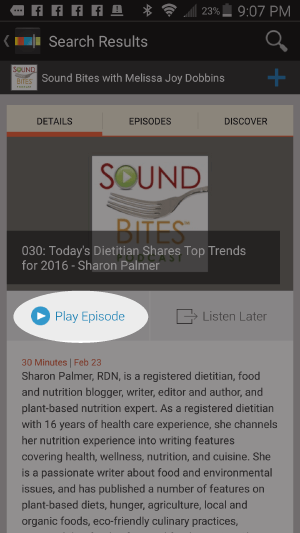
1. Search for “sound bites with melissa joy dobbins” 2. Choose Play Current Episode or Add to Playlist
Choose “Play Episode”
Subscribe & Review on iPhone
Open the “Podcast” app on your iPhone
Search for “Sound bites with melissa joy dobbins”
Open the podcast and click “Subscribe” and your done!
Write a Review
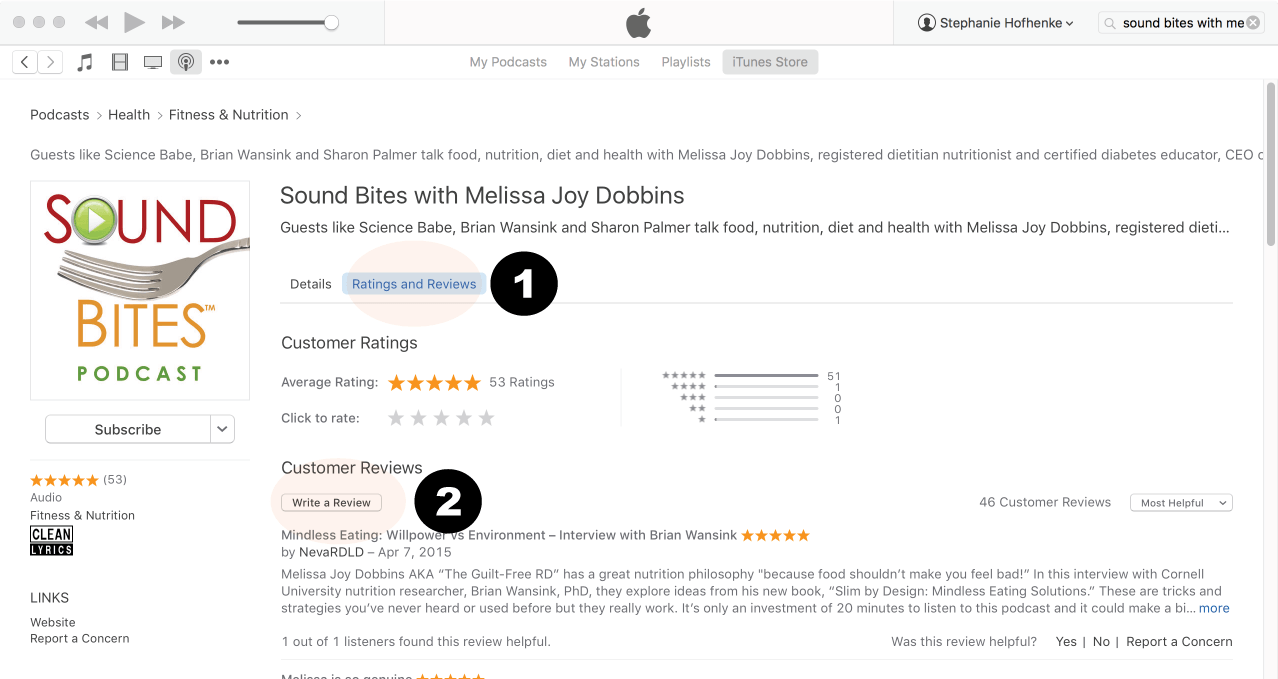
Click “Reviews”, then “Write a Review”.
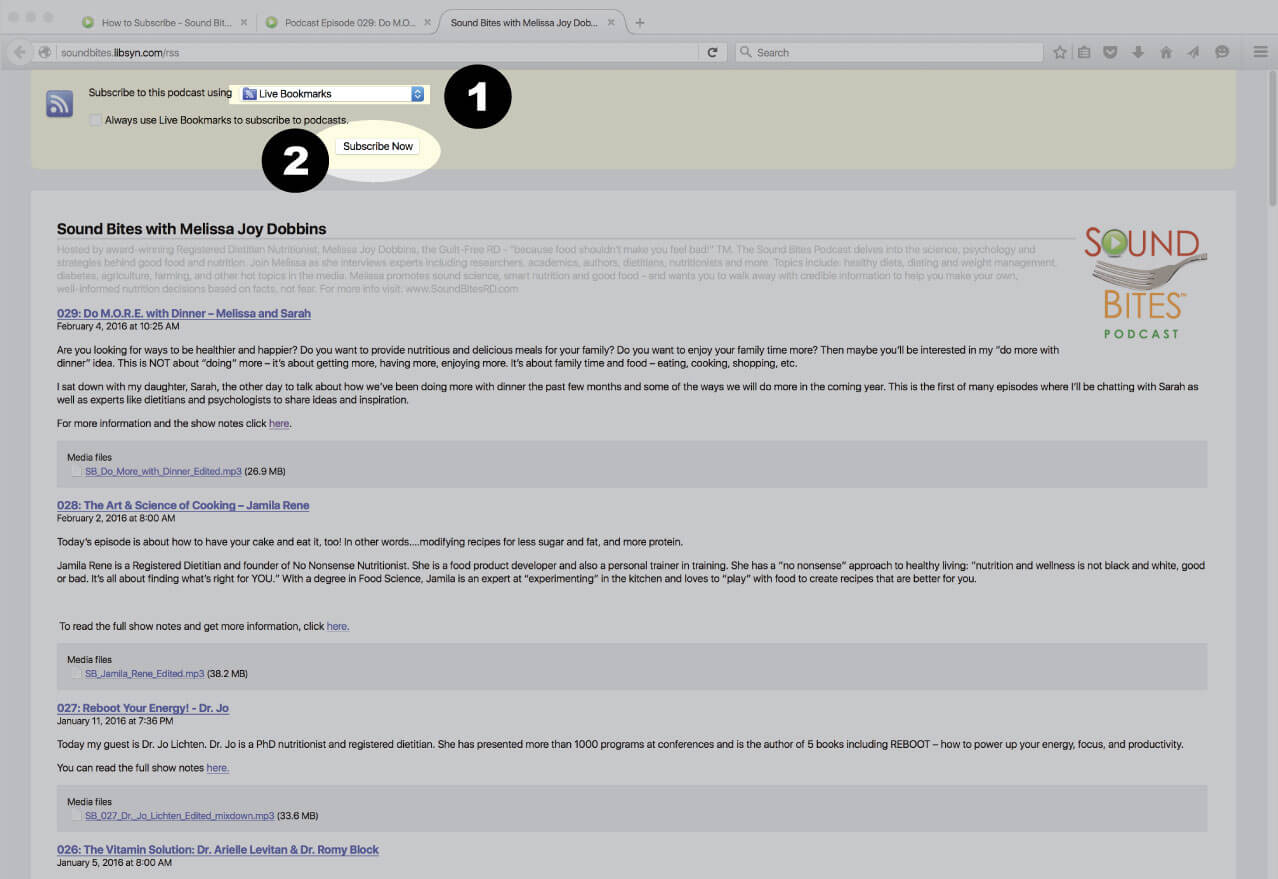
Subscribe via RSS Feed
Navigate to any podcast player . Click on the RSS feed icon.
Click on the RSS feed icon.
Click on RSS Feed
Choose which application you would like to use to receive the RSS feed
Click “Subscribe Now”
Confirm settings and subscribe.
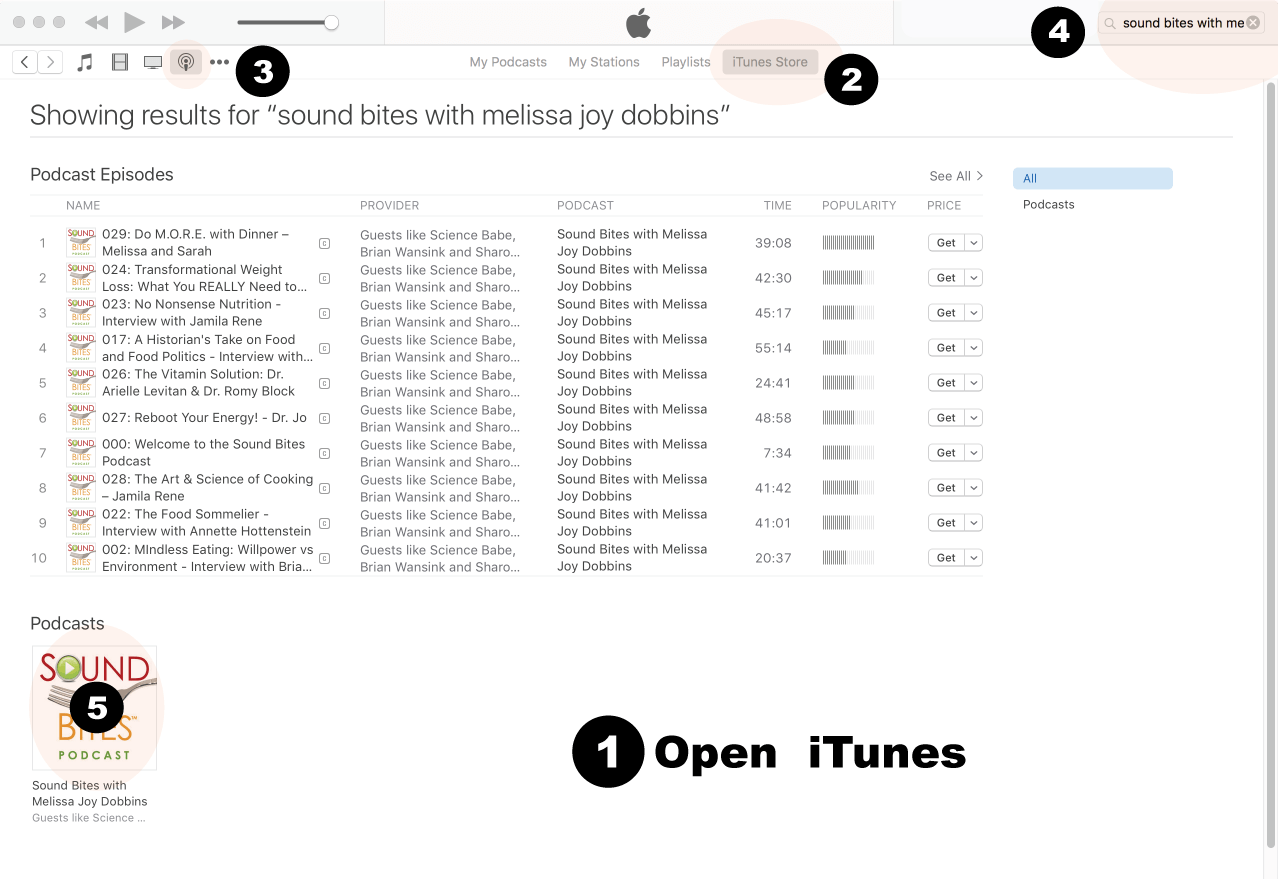
How to Review in iTunes
Open iTunes desktop application
Click iTunes Store
Click on Podcasts
Search for “Sound bites with Melissa Joy Dobbins”
Click on podcast image
Search for Sound Bites podcast in iTunes
Click Ratings & Reivews
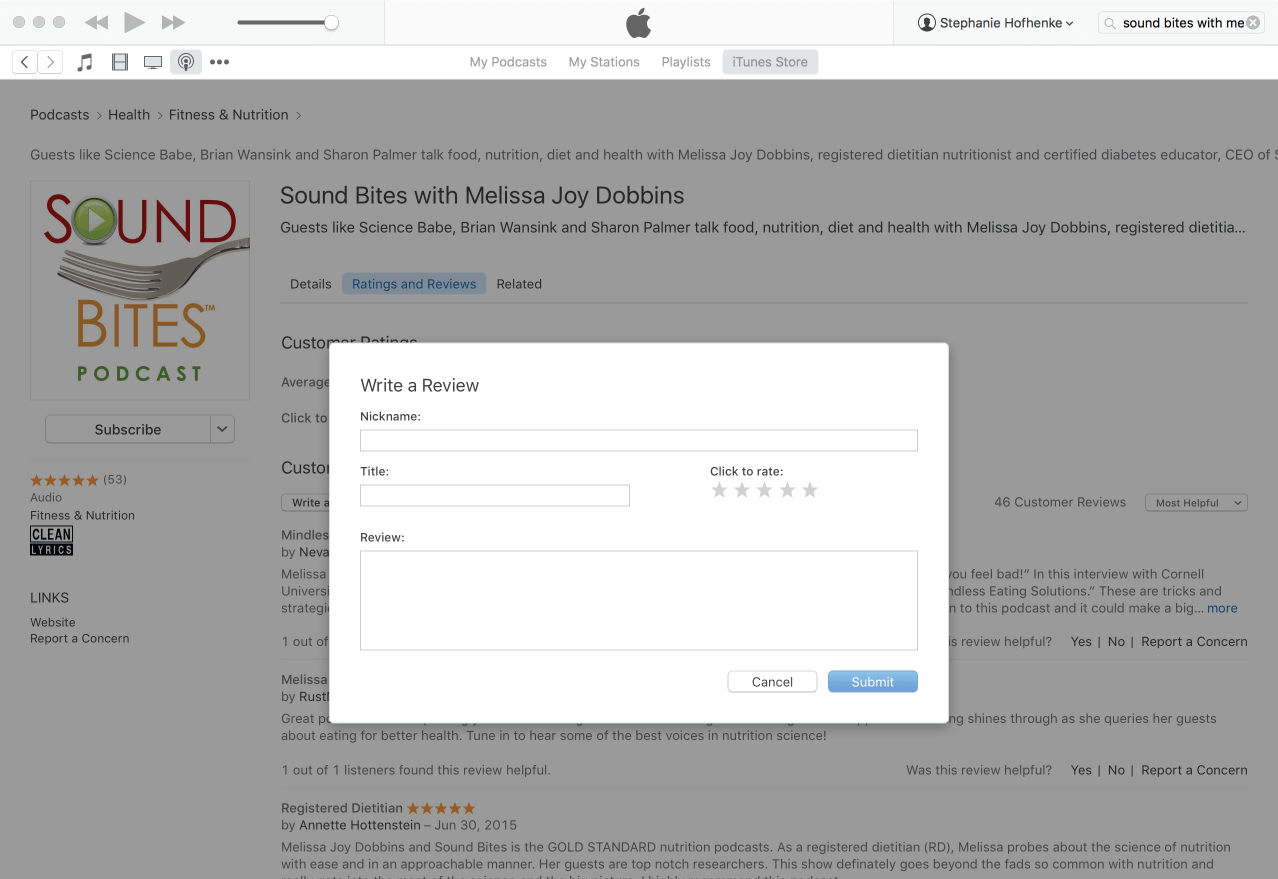
Click Write a Review
View reviews and write your own review.
Write your review…. Thank you!
Write your review!
How to subscribe via iTunes
Click here to view the Sound Bites Podcastin iTunes, then click the blue “View in iTunes” button. This will open your iTunes application directly to Sound Bites Podcast. Click the “Subscribe” button, and your done!