Celebrating over 1 Million Downloads and 50,000 Free CEUs on the Sound Bites® Podcast | NEW: Get 1 years’ worth of CEUs with the new 15-CEU Podcast Course
Disclosure: This episode is not sponsored, however I attended a sponsored conference virtually where I saw the guest present on this topic. In addition, I received an honorarium to present at a NAMI conference in October 2021 on the topic of animal protein in the diet.
The Protein PACT: A Sustainability Framework for the People, Animals & Climate of Tomorrow
Through the Protein PACT, the North American Meat Institute and partners across the supply chain are uniting in the largest-ever effort to strengthen animal protein’s contributions to the people, animals and climate of tomorrow. Committed to improving the sustainability of meat and poultry (including sustainable animal feed, corn and soy), the PACT has five focus areas: environment, health and wellness, animal welfare, labor and human rights, and food safety.
Tune in to this episode to learn about the sustainability metrics and targets for these five areas:
Environment – optimize contributions to healthy land, air and water
Health & Wellness – provide wide variety of high-quality protein for balanced diets
Animal welfare – provide the most humane care and raise healthy animals
Labor & Human Rights – support a diverse workforce and ensure safe workplaces
Food Safety – produce safe food without exception
Meat, poultry, dairy and eggs aren’t just foods we enjoy – they provide meaningful nutrition as well. Enjoy these foods – it’s your plate and your choice for what fits best in your lifestyle and it’s our priority as producers of those products to make them in a way that aligns with your expectations and values.”
– Eric Mittenthal, MS
Eric Mittenthal, MS
Eric Mittenthal is the Chief Strategy Officer at the North American Meat Institute, previously serving as the organization’s vice president of public affairs and vice president of sustainability. He leads the Meat Institute’s Protein PACT strategy focused on implementing a framework for continuous improvement throughout the industry and a commitment to greater transparency to meet consumer and customer expectations. Mittenthal joined NAMI from the International Food Information Council (IFIC) where he worked closely with food industry communications leaders, led IFIC’s efforts in connecting with journalists and influencers and launched many of IFIC’s successful social media platforms.
Mittenthal moved to Washington D.C. following a career as a television reporter and producer in several markets around the country including Atlanta, Jacksonville, NC and Idaho Falls, ID. He graduated from Cornell University in Ithaca, NY with a Bachelor of Arts in Psychology and also received a Master’s degree in Biomedical Sciences from Eastern Virginia Medical School in Norfolk, VA.
[00:00:00] Melissa: Hello and welcome to the sound bites podcast. Today’s episode is about the protein PACT. A sustainability framework for the people, animals and climate of tomorrow. My guest today is Eric Mittenthal, chief strategy officer for the north American meat Institute. He leads the meat institutes protein PACT strategy, focused on implementing a framework for continuous improvement throughout the industry and a commitment to greater transparency to meet consumer and customer expectations.
Welcome to the show, Eric. Thanks so much for having me. It’s really great to have you on the podcast. We met several years ago at a conference and have been talking about doing a podcast interview ever since then. So I want my listeners to know that this episode is not sponsored. However, I recently spoke at a north American meat Institute meeting back in October.
And a little bit of a fun fact. I had the incredible opportunity to sort of share the stage with Temple Grandin, who is an animal behaviorist and is famous for her groundbreaking work in the field of animal agriculture and animal welfare specifically. So she spoke before me that morning and I have to say she is a tough act to follow.
I’ve seen her present twice now. And I always learned so much from her. I’m sure you’ve seen her and met her several times, Eric.
[00:01:20] Eric: Many times. Yeah. And one of the great things is that Temple Grandin is the kind of unofficial permanent chair of our animal welfare committee. So we have a really great relationship with her.
And, you know, we talk about animal welfare in the meat industry. She really is the top expert, the guiding star. And so we, we lean on her heavily and very much respect and value her opinions and participation in our work.
[00:01:45] Melissa: Absolutely. And just so nice and so smart and just an incredible person for sure.
Well, I would love for you to tell us more about your background. Maybe a little bit about your education and the work that you’ve done and the work that you do today.
[00:02:01] Eric: Yeah. I have a, a bit of a unique background. I actually, I have a master’s in biomedical sciences from Eastern Virginia medical school. I was on the medical school track.
So I’ve got that health background, but I realized while I was getting my master’s that going to medical school was not going to be something that I was going to enjoy. So I decided I had done some radio work in college and really enjoyed it. And so I decided to take more of a communications interest and
So I got a job as a television reporter in various markets around the country. I worked my way through that. My last job was in Atlanta and realized that in that case I wanted a job that was a little bit more offered a little more stability, better paying. And so I wanted to combine my health background with my communications background, and I landed at the international food information council here in Washington, DC, talking about nutrition and food safety and working with dietitians and media on that.
And that got me connected to the food industry and the meat industry. And so I got the job working in communications at the north American meat institute 10 years ago. Wow. Hard to believe. And so since then I did that for many years. I learned sustainability through communicating about it and became our vice president of sustainability and have since become our chief strategy officer, really leading the overarching strategy for the meat Institute, which is sustainability based. And it’s all about the protein PACT, which I’m excited to talk about today.
[00:03:31] Melissa: Excellent. Yes. Oh, I forgot about your communications background. That’s so fun radio and being a TV reporter.
Must have been really interesting and I love how you’re using your communications expertise in your work at IFIC. And then now here at the north American meat Institute. And I love the fact that you worked with IFIC. I think actually that’s when we had first met was even way back then. And I love – I talk about IFIC all the time on the podcast.
I actually interviewed Kris Sollid, who is their senior director of communications on the podcast back in episode 153, talking about the work that IFIC is doing with consumer research trends and communications. So another shout out for awesome IFIC. So let’s dive into what the protein PACT is and how it came into being.
[00:04:21] Eric: Yeah, it’s been a process of several years for us, and we were challenged by our leadership a few years ago to think about how as an organization and how as an industry, we can better align with what consumer expectations are for our industry, how we can increase our transparency and be more proactive when it comes to continuous improvement.
And so that’s led us on a sustainability journey over the last few years to work with our members and partners throughout the supply chain to better identify what does continuous improvement look like? What are the key issues that consumers are identifying with the meat that’s on their plate and how can we specifically set out to measure our progress in those areas?
And so we are focused on five focus areas. Those are animal welfare, environmental impact, food safety, human health and wellness, and labor and human rights. And it’s really about delivering outcomes for healthy people, healthy animals, healthy communities, and a healthy planet, and doing so through specific measures that we have developed, but also doing so in partnership with the supply chain.
And so what we’re doing at the meat Institute is not unique – is being done really throughout all of food and agriculture, to an extent, but we know in the animal protein sector, there’s work occurring in the beef sector, through the U S Roundtable for sustainable beef. Through the pork sector through their we care program in the poultry sector, through the U S Roundtable for sustainable poultry and egg, all identifying what are the continuous improvement measures that can be worked toward in that specific sector over the next decade.
And the PACT element of it as an association, we feel like we have all of those proteins under our umbrella and we can align them all and really work together as a whole, bringing them under our umbrella to tie them together and then work to share our progress together. And so that really is our goal for the rest of this decade is, is measuring our progress,
setting metrics for what we want to achieve and then showing how we’re achieving it and telling that story to consumers because everything we’re doing is aligned with what consumers are looking for from the industry.
[00:06:49] Melissa: That leads me to one of my first questions is, you know, you had mentioned consumer expectations and how do you know what those are?
We hear a lot of different things in the media and I guess not so much around the water cooler anymore, but uh social media, friends, family, that don’t always necessarily line up with like some of the consumer research that I hear from IFIC. So how do you know what your consumer expectations are?
[00:07:15] Eric: Yeah, we’ve, we’ve done our own research and look to other research from groups like IFIC and others as well. I think often what you see in the media is not necessarily reflective of what consumers are looking for, I mean, certainly the media captures some, but the media tends to be a very black and white all or nothing perspective on issues.
And we know that our world doesn’t exist in black and white, our world exists in the grays. And so we want to make sure that we are capturing the full spectrum of what all consumers are looking for. You know, we want to reach the people who, who have questions, who are consumers of animal protein products and have questions and are hearing things and provide the answers to give people the permission that they’re seeking to continue to enjoy our products.
And so we’ve done research and it shows pretty clearly that, that those focus areas of animal welfare, environmental impact, Food safety, human health and wellness. And that includes nutrition. That includes food security, as well as worker safety, diversity, equity, inclusion, those issues are all really important.
And our customer base amongst retailers and restaurants are looking for those as well. And so everything that we are creating really aligns pretty specifically with some of those measures that are being sought by restaurants and grocery stores, but they’re serving consumers more directly. And so we know that that those are the things that the consumers are seeking.
[00:08:44] Melissa: And I understand from a recent survey that IFIC did actually that about three in four people surveyed, identified themselves as omnivores is that kind of what you’re seeing with the data that you’re looking at?
[00:08:58] Eric: Yeah, You know, there’s a lot of different definitions of different food categories.
And so we actually recently did a survey. We, asked about flexitarians and I think it’s about a third of people identify themselves as flexitarians. We do know that pretty consistently over the last couple of decades and probably going back even further, that 95% of Americans eat meat about 5% are vegetarian.
Two percent-ish tend to be vegan. And those numbers really have not changed over an extended period of time. And so we know that people are very interested in incorporating meat into their diets, but we want to make sure that we are giving them the reasons to feel confident in the meat that they’re consuming and answering those questions and showing how we are improving to align with those expectations and meeting the 95% of Americans where they are on their plates.
[00:10:00] Melissa: You mentioned a few programs earlier. There’s already a lot of programs and a lot of standards in place. Obviously, this is going to provide more continuity, but could you speak a little bit more to all of the work that the industry has been doing? You know, whether it’s the beef industry or the dairy industry and how this new protein PACT will help pull this all together and streamline things maybe.
And then also, who are the members and partners that you had mentioned who is involved in the protein PACT?
[00:10:30] Eric: Yeah, so we have partners really throughout the supply chain. For the meat institute our members are the meat packers and processors who produce 95% of the beef, pork, lamb, and veal, and 70% of the poultry in the U S so companies that most, everybody has heard of like Tyson and Smithfield and Hormel, Cargill and then all the way down to uncle Charlie’s sausage company and everybody in between.
So it is really a wide spectrum of member types. You know, our other partners are in beef, pork, and poultry. We’re working with partners in feed and corn and soy. So we want to be able to share the commitments that are being made in all of those sectors, including our own part of the supply chain and do so in a consistent way.
And the real message behind what we’re sharing beyond just the continuous improvement aspect is, people have their choices, they can make their own choices for the foods they want. It’s their plate. It’s our priority to make sure that we are meeting expectations. And we’re going to share that as we make progress and the commitments that we’re doing
[00:11:38] Melissa: Ok, great. Now you mentioned the five focus areas, and obviously we can’t dive into every one in detail. Maybe we’ll talk mostly about the health and wellness and maybe the environment one, but if you wanted to kind of give us that top line of those five goals, those five areas and maybe comment about each one.
[00:11:58] Eric: Sure. Yeah. We can start with health and wellness. Our goal is to provide a really strong, balanced nutrition for people’s plates. And one of the things that we’re setting out to do is better measure the nutrition that we do provide, both in a protein content of foods, as well as other micronutrients like vitamin B12 iron zinc, you know, meat is a very nutrient dense food, and we want to be able to better capture from a data perspective, the nutrients that meat provides.
At the same time we want to look at issues like food security and how we are able to feed hungry Americans and fill the protein gap that exists. There’s currently a greater need for protein than is being supplied at food banks. And we feel like one really tangible step we can take to make a difference is to help fill that protein gap, working with groups like feeding America and USDA.
And so our specific target as it relates to health and wellness is to work with those organizations to fill that protein gap and make sure that we are providing enough protein to feed hungry Americans on an annual basis in line with the dietary guidelines for Americans. Within environmental impact that’s been an area where we’ve put a lot of focus and we want to really commit to tangible improvements on our greenhouse gas emissions, but also thinking about how we improve on food waste and packaged waste and what’s going to landfills and making sure that we’re minimizing our impacts there as well as water use, land use and, and all of those areas.
But real specifically, our target is to set science-based targets through the science-based targets initiative, which are in line with the Paris climate agreement goals.
So each individual company can make their own commitment for greenhouse gas reductions that is verified by a third-party standard and is then tracked over time. And that is specifically to the Paris climate agreement, so that we’re limiting warming below 1.5 degrees Celsius, which is what the Paris climate agreement says.
On worker safety, we made a lot of amazing progress over the last couple of decades, and we want to continue that through adopting more widely best practices across the industry. And we feel like we can reduce our injury rates and other 50% across the industry. And then within food safety it’s about producing safe meat products without exception and making sure that all our facilities are implementing all the best practices that we know work when it comes to reducing illnesses.
And finally on animal welfare, working with folks like Temple Grandin and ensuring that standards that she has developed are in place throughout the industry and auditing with third parties to ensure that those are being implemented and applied throughout the industry and working with our partners on farm to ensure that the standards that have been created there are being implemented and applied through our suppliers.
So there’s a lot there. It’s a whole lot of work, a lot of measures, and we want to be able to specifically measure participation and progress throughout the industry so we can tell the story of where the industry is succeeding, where we’re challenged and show that progress.
[00:15:15] Melissa: Thank you for that sort of overview of the different five areas and goals.
Let’s talk a little bit more about the health and wellness area then, you mentioned hunger and better measuring nutrition in the protein that you provide. I also want to hear a little bit about nutrition science and research.
[00:15:32] Eric: We also want to be contributing to more research. One of the things that we’re setting out to measure is our research contributions and making sure that we are contributing extensively to the greater nutrition understanding and understanding of the role that meat plays in the diet.
And so we want to specifically set out to measure that, and then also measure how our products are contributing different nutrients to the diet. As I mentioned is a real major focus of ours and I think will help hopefully consumers understand the variety of nutrients that meat provides and the different types of products that they can look to for specific dietary needs.
If it’s lower in sodium, lower in fat, higher in protein. There’s such a wide variety of products that are available and we want to be able to show exactly which products meet those needs.
[00:16:21] Melissa: Excellent. Yes. And my regular listeners know that I’ve talked about protein quite a bit on the podcast and also sustainability.
So I will have related episodes linked in my show notes at soundbitesrd.com. But do you want to give a shout out to one of my most recent episodes on protein number 203, with Dr. Donald Layman. We talk about muscle centric health, and that is just an episode not to be missed. So definitely encourage people to check that out.
So with regard to the environment, energy, greenhouse gas emissions, I’ve had Dr. Frank Mittloehner on the show who, you know, explains it as well as I’ve heard it. But is there anything you wanted to say specifically about what you’re measuring, timelines? I know that there’s a lot under the environment bucket that you’re looking at.
[00:17:11] Eric: Yeah. We have a lot there and I think that that’s the topic that for people around the world, they’re most looking to the industry to make improvements on. And I think we have opportunities to make progress and we specifically set out because we currently don’t have a baseline for what our emissions are through our own membership.
Which is why we want to rely on a third-party standard through the science-based targets initiative which is run by the UN global compact, the world wildlife fund, the climate disclosure project and the world resources Institute. So our companies will be submitting their emissions and their reduction goals to those groups to verify how companies can make reductions.
And our goal is to have all of our membership is 370 members. Do that by 2030 and advance the reductions through that, that is just one piece of the puzzle for our industry. Other groups have made a substantial commitment, including the beef sector has committed to becoming climate neutral by 2040 and the dairy sector very similarly climate neutral I believe by 2050, in the pork sector they’re set to announce here very soon that they’re going to be reducing their emissions by I believe 40% by 2030.
So it’s something that the entire industry throughout the supply chain is working on. And so we’re trying to tie together what all that means for the meat on a person’s plate and making sure that there’s meaning behind those reductions.
And so by working together throughout the supply chain, we feel like we can really make a substantial impact.
[00:18:47] Melissa: You know, as I’m listening to you, it just brings to mind the fact that each different sector, like I said earlier, and then you verified, they already had a bunch of programs and standards in place, and it just seems like this next step to work together even more – It’s almost like that’s what’s needed to move the needle a little bit more. Is that correct?
[00:19:09] Eric: Yeah. I think there’s been so much work that’s, that’s kind of siloed in each individual sector and when people are buying animal protein products they’re not making a decision to buy beef, pork, poultry, dairy, eggs, until they’re first making a decision that animal protein aligns with their values.
And so we felt like as an organization that unites all those under one umbrella, that we could bring all of these efforts together and be the voice of animal protein and show how all of this ties together for the animal protein sector as a whole, and how people make that initial decision more confidently.
And then they can decide if they want beef, pork, poultry, dairy, whatever, from there, and look at some of those specific standards, but we’re, we’re here to be representative of the whole of the industry.
[00:19:54] Melissa: Right. And you know, when we talk about sustainability, oftentimes we just think environment, but clearly there’s a lot more to sustainability with these five areas.
And so you’ve got your work cut out for you and there’s, there’s a lot going on and a lot of measurements, different timelines that you’re all trying to pull together.
[00:20:12] Eric: It is a very holistic approach. And when we talk about sustainability, we are not just talking about environment. Environment is a key piece, but it is all of the topics that we’ve been talking about.
Nutrition being key amongst them. We want to share the nutrition that we provide. And I think nutrition gets weaved into discussions with environmental impact, more and more on the worldwide stage. And so we want to be able to. Show that nutrition and be able to show how the nutrition and the environmental impact are linked positively from our industry and, and show the improvements that are being made and what that means for people in their diets.
[00:20:48] Melissa: Hopefully this will have more visibility and more consumers will be aware of all of these efforts. In your opinion and your experience, what do you think the biggest thing that people don’t know about animal foods and nutrition is.
[00:21:01] Eric: Well, I think there’s so much of a either or message out there that, you know, you either should eat animal proteins or you shouldn’t.
And it’s not so black and white, our products meat, dairy, poultry, eggs are products that are part of a balanced diet. And so it’s not all or none. It’s both. And so, you know, our products are very nutrient dense. We’ve talked about protein, iron. Vitamin B12 and, a unique, natural source of vitamin B12 that’s really crucial in our diets. And so, you know, recognizing the nutrition that is provided but also recognizing that when that nutrition is combined with other foods you know, fruits, vegetables, grains, there’s amplification to an extent, particularly when you talk about nutrients like iron there’s amplification that occurs.
And so there should be combined as part of healthy diets. It’s not about solely meat or no meat.
[00:22:00] Melissa: Right. Plants and animals together. It’s what I always say on this show. Regarding the environment and sustainability, I know efficiency is really an important factor in being more sustainable, but we hear these terms, you know, factory farms.
And then we talked to ag experts and you know, they’re talking about family farms. So can you speak to those buzzwords and the efficiency aspect, which relates to sustainability.
[00:22:27] Eric: There’s farms of all sizes and types around the country. And I think there’s a notion that big is bad and that’s not necessarily the case.
I mean, there’s a place for farms of all sizes and types. There’s value in large operations that provide a lot of efficiencies from a number of different perspectives – a lot of environmental benefits there in terms of minimizing our greenhouse gas emissions, water use, land use, and things like that. But the size itself does not dictate the quality.
There can be really poorly run, small operations, a really great run, large operations. It’s really about ensuring that the right practices are in place on the different facilities and it’s being done effectively. And so the size of the operation really should not be the dictator of good versus bad.
[00:23:21] Melissa: Right. And what do you think the biggest thing people don’t know about animal agriculture’s impact on the environment is?
[00:23:27] Eric: Well, we’ve made great progress over the last several decades to produce more meat using fewer animals, water, land than ever before. And we’re continuing to improve that. And so I think that’s the key thing is that sustainability is not a new concept for the industry.
What’s new is our ability to measure and an interest in better measuring that progress and setting some substantial goals in all of those areas. And I think one of the areas, the elements that gets very confusing is in the debate over the environmental impacts of animal proteins, is that you see international figures being used to indicate the industry’s impact when there’s an enormous amount of regionality and differences in regional impacts both country-wise, but even down to regions of the country, just based off of the nature of the land and specific regions.
So, when you take those international worldwide numbers and try to tell the story, it really doesn’t tell the story of, of what’s happening here in the U S and the progress that we’ve been able to make.
And so we know here in the U S that according to the environmental protection agency, all of agriculture is about 10% of our emissions. Animal agriculture is about 4% of that. And so it is far less than elsewhere around the world. And we’re very proud of that. We know that we have less impact than many places, but we know that we can continue to improve that as well.
[00:25:02] Melissa: Absolutely. And part of the sustainability story, you know, you said sustainability is not new to the industry, but it’s part and parcel of being stewards of the land and animal care. But the telling of the story is not brand new, but it’s certainly newer in recent years. So you’re being more proactive in that sense.
And I think that’s really important.
[00:25:22] Eric: Yeah, and we have to match the telling of the story with the proof points of improvement. And I think that’s one of the things that we’ve been missing being more data-driven as an industry. And so that’s really the new elements for what we want to bring to the table is, is have more data to back up our progress and align that with what people are enjoying on their plates.
[00:25:44] Melissa: And one more question. What’s the biggest thing you think people don’t know about animal care?
[00:25:49] Eric: The critics of, of the industry, like to paint the industry with a broad brush, but the fact is is that treating our animals well is simply good business. If animals are not treated well, it impacts the quality of the meat.
So beyond just being the right thing to do, to treat animals well and, and the fact that it a livelihood for farmers and ranchers, treating animals properly does have an impact on what people consume. And so it makes business sense for us to do it. It is a commitment from the industry to do that. And I think we are incredibly successful that. Are there opportunities to improve?
Of course there always are, but we’re starting from a, I think a place of a very high success rate in terms of animal welfare progress, working with folks like Temple Grandin and other experts. And so we’re very proud of that.
[00:26:41] Melissa: You mentioned livelihood, that’s something that we don’t talk about that often.
And so I’d love for you to speak to that a little bit about. How many jobs this industry provides.
[00:26:51] Eric: It’s a lot of jobs. I don’t have the latest figures right in front of me, but it’s hundreds of thousands of jobs around the country and actually contributing more than a trillion dollars to the economy every single year.
I think one of the things in general that is really hard to grasp is the overall scale of our food system and the people who participate in our food system, the amount of food that our food system in general provides, it’s somewhat incomprehensible to think about the amount of food that we produce.
And having been in processing plants many times over the years, you see the amount of food that comes out and it’s really stunning that we’re able to produce as much food as we are, as effectively as we are to feed such a large population every single day. And we take that for granted sometimes – the size of our food system and the way we’re able to produce food, but it really is a modern miracle. And again, we can improve everything, but the fact that we’re able to feed our population as effectively as we are with people throughout the country and feed a good portion of the world too, is incredible.
[00:28:03] Melissa: It’s definitely incredible. That was the word that was on the tip of my tongue.
And then you said that, and you know, some of that was brought to light during the pandemic. We saw a supply chain disruptions, and that was, you know, a phrase most of us didn’t even have on our radar. And so it’s a big industry, provides a lot of jobs, contributes to the economy and there’s a lot going on there.
So what do you say to people who say we don’t need to eat or should not be eating animal source foods.
[00:28:32] Eric: Well, I think everybody is free to make that choice for themselves. I will not dictate a choice for anybody. I think one of the other things within our system is that we have the opportunity to make whatever choices align with our own values and our family’s values and meet our nutrition needs.
But animal protein provides a really great nutrition and there is incredible value in the nutrition that our products provide. And so I think, again, it’s not an all or nothing thing. It’s about providing nutrient dense products that provides a great nutrition and we are very proud of that nutrition that meat products provide and think that people should feel confident in that choice to enjoy animal protein products because the nutrition is there and has been there and will continue to be there.
[00:29:19] Melissa: So I don’t know how visible this protein packed initiative is going to be to the consumer. But if people, whether they’re consumers or healthcare professionals – if they want to find out more about the protein PACT, could you share some resources?
[00:29:33] Eric: We will hopefully be very visible to consumers moving forward. We’re just getting to a launch phase right now where, where we have new social. That people can go to. So if you look us up on Facebook the protein pact or Instagram same thing, the protein pact also online, theproteinpacy.org is where you’ll find all of our information.
And there’s going to be a great deal, more detail being added to all of those moving forward and looking forward to sharing all of that, but check us out online. The social channels and our website is a great first step.
[00:30:06] Melissa: And somewhat related, I’ve been talking with the folks over at the animal ag allies program.
And I’ve been taking their self paced online modules. They cover introductions to each sector of animal agriculture, hot issues and topics like antibiotic use, sustainability, animal welfare, and also communication strategies. So I’ve been going through these modules and learning a lot – it’s a ton of information and resources.
So I’ll continue to share information out about that on the podcast, but is there anything else that you wanted to share regarding the protein PACT as we’re wrapping up?
[00:30:41] Eric: No, I think check us out online, www.theproteinpact.org. And this is a journey through 2030, at least for us. This is not a short term effort for the industry.
And so we will be working on this for the rest of the decade and we expect to see and show great progress from the industry over the rest of the decade.
[00:31:00] Melissa: Great. Well, we’ll keep in touch and maybe you can share out some updates as the decade goes on. All right. Well, thank you so much for being on the show, Eric.
I appreciate it.
[00:31:10] Eric: Thank you.
[00:31:11] Melissa: And for everybody listening as always enjoy your food with health in mind. Till next time.
LISTEN, LEARN AND EARN
Listen to select Sound Bites Podcasts and earn free CEU credits approved by the Commission on Dietetic Registration (CDR) for registered dietitian nutritionists and dietetic technicians, registered. Get started!
Get Melissa’s Sound Science Toolkit here!
Partnerships:
Sound Bites is partnering with the Association of Diabetes Care and Education Specialists (formerly the American Association of Diabetes Educators)! Stay tuned for updates on the podcast, blog and newsletter!
Sound Bites is partnering with the International Food Information Council! Stay tuned for updates on the podcast, blog and newsletter!
Sign up for my monthly newsletter and episode eblasts so you never miss an update!
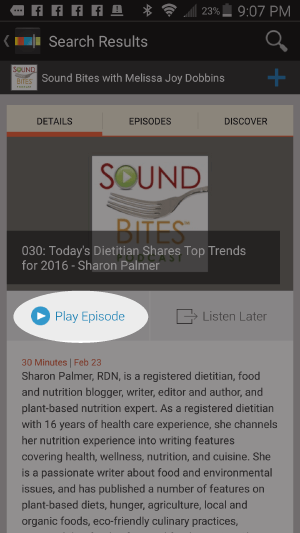
Listen on Stitcher (Android)
Install the Stitcher App
1. Search for “sound bites with melissa joy dobbins” 2. Choose Play Current Episode or Add to Playlist
Choose “Play Episode”
Subscribe & Review on iPhone
Open the “Podcast” app on your iPhone
Search for “Sound bites with melissa joy dobbins”
Open the podcast and click “Subscribe” and your done!
Write a Review
Click “Reviews”, then “Write a Review”.
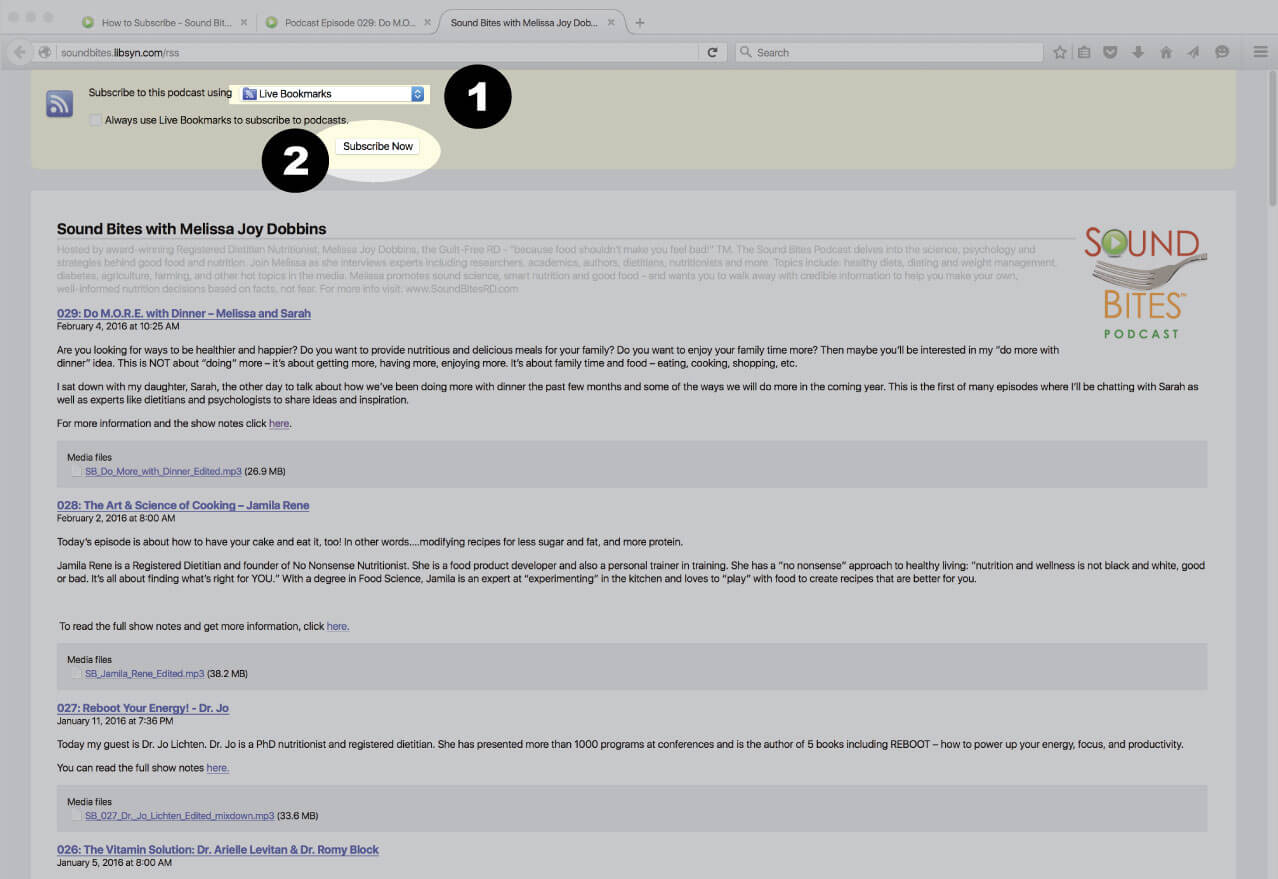
Subscribe via RSS Feed
Navigate to any podcast player . Click on the RSS feed icon.
Click on the RSS feed icon.
Click on RSS Feed
Choose which application you would like to use to receive the RSS feed
Click “Subscribe Now”
Confirm settings and subscribe.
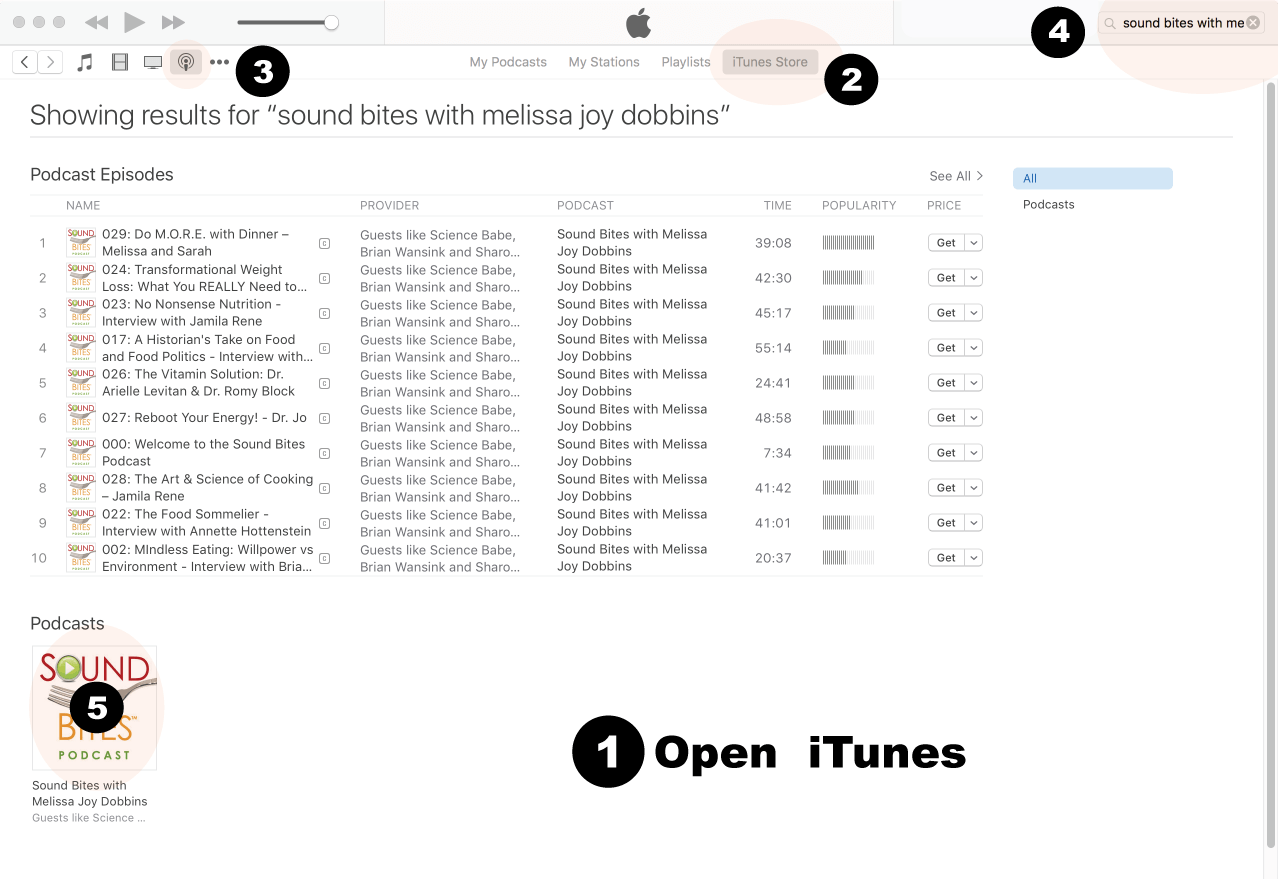
How to Review in iTunes
Open iTunes desktop application
Click iTunes Store
Click on Podcasts
Search for “Sound bites with Melissa Joy Dobbins”
Click on podcast image
Search for Sound Bites podcast in iTunes
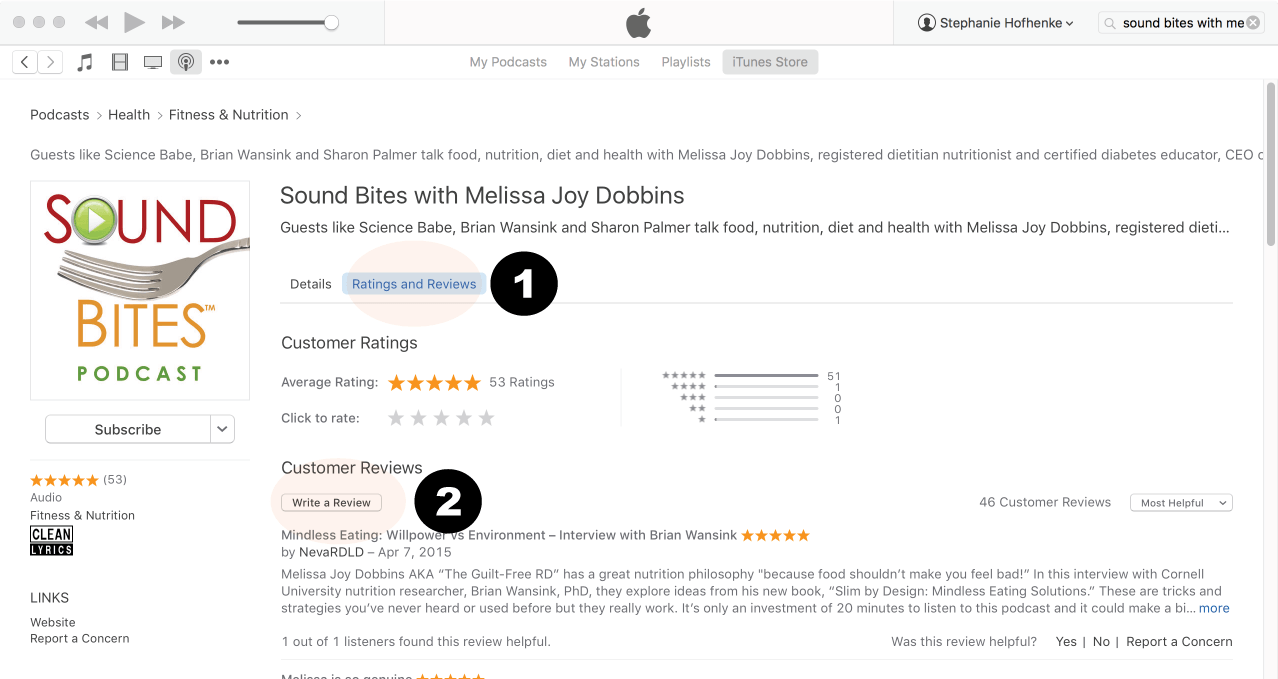
Click Ratings & Reivews
Click Write a Review
View reviews and write your own review.
Write your review…. Thank you!
Write your review!
How to subscribe via iTunes
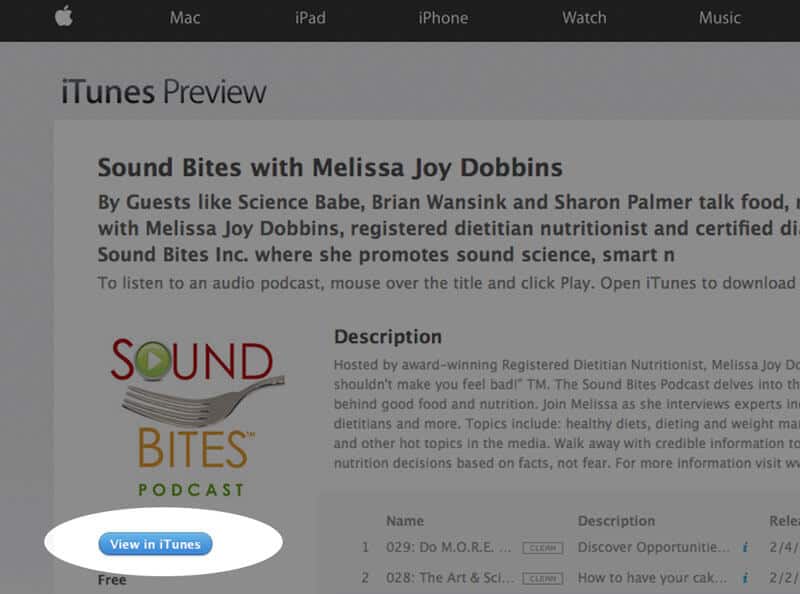
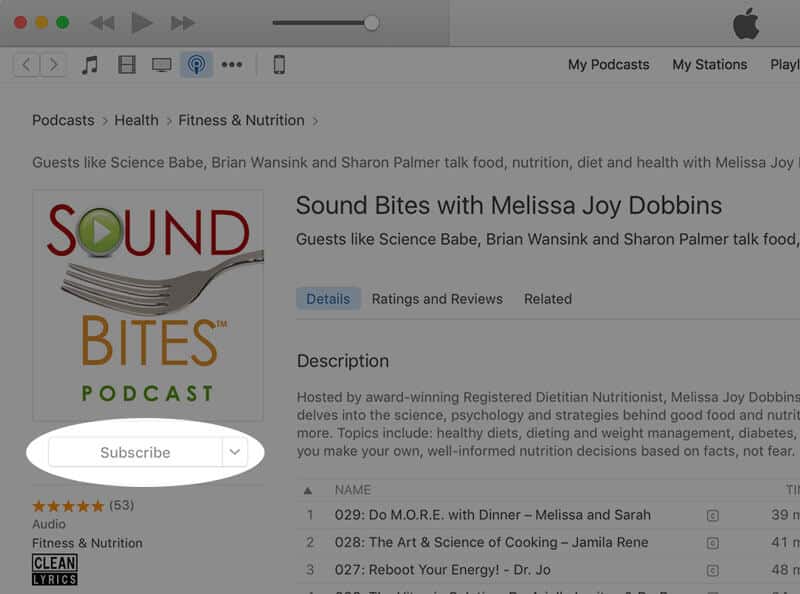
Click here to view the Sound Bites Podcastin iTunes, then click the blue “View in iTunes” button. This will open your iTunes application directly to Sound Bites Podcast. Click the “Subscribe” button, and your done!