Celebrating over 1 Million Downloads and 50,000 Free CEUs on the Sound Bites® Podcast | NEW: Get 1 years’ worth of CEUs with the new 15-CEU Podcast Course
This episode is not sponsored. I received a complimentary copy of Cooking à la Heart from the publisher, The Experiment.
A Flavorful Approach to Heart Healthy Cooking
With Cooking à la Heart in your kitchen, eating healthier isn’t difficult or boring – it’s an essential investment to keep you enjoying good food for many years to come!” – Amy Myrdal Miller
The newly released “Cooking à la Heart” is a cookbook aimed at promoting better health through simple, delicious recipes. Co-author and Registered Dietitian Nutritionist Amy Myrdal Miller, who has managed Type 1 diabetes for over 45 years, emphasizes a flavorful approach to heart healthy eating patterns. Amy’s culinary passion and conviction that cooking doesn’t have to be difficult, boring or time-consuming is evident throughout the book.
Tune into this episode to learn about:
Why flavor is the most important “ingredient” in healthy cooking
Easy ways to make delicious foods with convenient ingredients
Ways to increase your kitchen confidence
The 5 principles and 4 practices of cooking à la heart
The importance of and tips for reducing sodium intake
Sustainability and food waste
I like reshaping people’s thinking about what healthy eating is. It’s not about dieting, it’s not about deprivation. It’s about thoughtful ingredient selection, finding things that you love and look forward to eating. This shouldn’t be a lifelong sentence of deprivation. It should be a lifelong celebration of good health, great flavor and enjoyment.” – Amy Myrdal Miller
Amy Myrdal Miller, MS, RDN, FAND
Amy Myrdal Miller is an award-winning dietitian, farmer’s daughter, public speaker, author, and president of Farmer’s Daughter Consulting, an agriculture, food, and culinary communications firm founded in 2014. During her 25-year career, Amy has worked for Fleishman Hillard, the Rippe Lifestyle Institute, Dole Food Company, the California Walnut Board & Commission, and The Culinary Institute of America.
Today, Amy works with a variety of clients across the food system, including seed companies, grower cooperatives, commodity boards, national brands, campus dining operations, and restaurants.
Greek-Inspired Baked Chickpeas with Tomatoes & Feta
Prep Time15 minutesmins
Cook Time45 minutesmins
Servings: 4Servings
Ingredients
15ozTwo (425 g) cans chickpeasdrained and rinsed
14.5oz(411 g) can diced tomatoes
4oz(113g) crumbled feta
60ml¼ cup extra virgin olive oil
2tbsphoney
1tbspdried oregano
1/4tbspredpepper flakes
1pcquartered lemonoptional
Instructions
Preheat the oven to 350°F (180°C).
Combine the chickpeas, tomatoes, feta, oil, honey, oregano, and red pepper flakes in an 8-inch (20 cm) square baking dish. Bake for 45 minutes, until much of the liquid has evaporated and some pieces of feta have started to brown.
Serve with lemon wedges on the side for an optional burst of bright acidity to balance the flavors.
Notes
This delicious recipe is very easy to prepare. Simply combine all of the ingredients, bake for 45 minutes, and dinner is ready. This dish can be enjoyed on its own or paired with roast chicken, grilled shrimp, or grilled lamb chops. Having a piece of hearty whole grain bread at the ready for sopping up the sauce is a wonderful way to enjoy every morsel.Per Serving:Calories 409; Protein 12 g; Carbs 40 g; Dietary Fiber 9 g; Added Sugars 9 g; Total Fat 23 g; Sat Fat 6 g; Omega-3s 220 mg; Sodium 655 mg; Potassium 346 mgCredit line: Recipe from Cooking à la Heart: 500 Easy and Delicious Recipes to Help Make Every Meal Heart Healthy Ⓒ Linda Hachfeld, MPH, RDN, and Amy Myrdal Miller, MS, RDN, FAND, 2023. Reprinted by permission of the publisher, The Experiment. Available everywhere books are sold. theexperimentpublishing.co
[00:00:01] Announcer: Welcome to Sound Bites, hosted by registered dietitian nutritionist Melissa Joy Dobbins. Let’s delve into the science, the psychology, and the strategies behind good food and nutrition.
[theme music]
[00:00:23] Melissa Joy Dobbins: Hello, and welcome to the Sound Bites podcast. Today’s episode is about heart-healthy eating and cooking. My guest today is Amy Myrdal Miller. She’s an award-winning dietitian, farmer’s daughter, originally from North Dakota, public speaker, author, and President of Farmer’s Daughter Consulting, an agriculture, food, and culinary communications firm founded in 2014, and based in Northern California. Amy is also the co-author of Cooking à la Heart: 500 Easy and Delicious Recipes to Help Make Every Meal Heart Healthy. Welcome to the show, Amy.
[00:01:01] Amy Myrdal Miller: Thanks, Melissa. I am so happy to be here with you today.
[00:01:05] Melissa: I should say, welcome back, because you’ve been on the podcast several times, two, three times, I think, and it’s always a fun conversation. I’m just thrilled to have you on the show again and to talk about your new book. I do want to let our listeners know that this episode is not sponsored, however, I did receive a beautiful complimentary copy of Cooking à la Heart from the publisher, The Experiment, in New York City. Also, for our listeners, you can tell my voice is not my normal. I had a little bit of laryngitis, I feel fine, just don’t sound great, so please bear with me, and I’ll have Amy do most of the talking.
Amy, you and I have known each other for many years now, and I’ve had the pleasure of getting to know you and working with you on various projects. I would love for you to share with our listeners more about your background and the work that you do, how you got interested in nutrition and agriculture, and we’re definitely going to dive into how you got interested in this book, this topic, and how that came about.
[00:02:07] Amy: Yes. Well, my business is Farmer’s Daughter Consulting, and I often get, “What a great name? How did you come up with that?” I always smile and say, well, it’s because it’s who I am. I am a farmer’s daughter. Grew up on a farm in northeast North Dakota right up by the Canadian and Minnesota borders. When I was seven years old, I got diagnosed with type 1 diabetes, which gave me an intense interest in food and nutrition from a very early age. I was blessed that I had a mom who was patient enough to invite me into the home kitchen to cook with her.
I know for a lot of moms, that creates even more tension of having to slow down to show someone what you’re doing and be sure that a child is using a knife carefully and thoughtfully, but my mom was willing to do that. She gave me a great gift because she instilled in me this early kitchen confidence, and it’s led to a lifelong interest in cooking, recipes, reading cookbooks as if they were novels. I’m really excited to be here with you today to share more about my latest project, my baby, Cooking à la Heart.
You asked more about my background and the work that I do. Farmer’s Daughter Consulting does consulting work for a lot of big companies in our food system. Today, my largest client is a 125-year-old Dutch potato breeding company. I do work for them to help educate chefs about potatoes and the variety-specific traits that can make a potato smell buttery or taste buttery, even with no addition of butter, to have a smooth, creamy texture. I also do a lot of work here in California, where I live today, on behalf of California agriculture. I work for an organization called the Buy California Marketing Agreement, and our brand is California Grown.
I have the joy of talking about and helping inspire people about California agriculture for more than 390 crops that grow here. Specifically, specialty crops, which are fruits, vegetables, herbs, flowers, wine grapes, honey, extra virgin olive oil, I could go on and on. Those are the big two entities right now for which I spend a lot of time and have a lot of fun doing my consulting business.
[00:04:28] Melissa: Excellent. Yes, you are a very busy gal. You travel a lot. We’ve been on several trips together. I don’t know if we’ve been on any trips since the pandemic. Have I seen you since? I don’t know.
[00:04:39] Amy: No, I don’t think we’ve seen each other live and in-person since 2019.
[00:04:43] Melissa: Oh my gosh. Well, I hope we get to do that soon. I would love for you to share a little bit more about your culinary background because I know that that plays a role in this book and a lot of the work that you do, and it’s just fascinating to me, so if you could do that would be great.
[00:04:58] Amy: Yes. Well, like I said, my mom got me into our home kitchen probably when I was about eight years old. When I was in high school, I worked at a little, I call it lovingly, a greasy spoon diner near the farm where I grew up that brought in a lot of farmers for their noon meals and families for dinner after church on Sundays. I then, in college, cooked for a fraternity house, which was wild, intense. Each night I’d have the 24 guys living in the fraternity house to feed, and on Friday nights, all 80 members of the fraternity along with other people who would drop in. That was a really intense opportunity to learn how to cook for larger volumes of people.
I’ve always pursued opportunities to learn more from chefs and cooking. When I worked for a clinical research firm in the late 1990s, the cardiologist that I worked for, Dr. James Rippe, he wanted to write a few books on cardiovascular wellness, and I helped him write the The Healthy Heart Cookbook for Dummies. We collected recipes from chefs from all over the country. Dr. Rippe also wrote the foreword for Cooking à la Heart, so I’ve had a long-term relationship with him as a friend and mentor, and a really great boss.
Before I started Farmer’s Daughter Consulting, I worked full-time for seven years for the Culinary Institute of America, which was an overwhelming blessing for me because it gave me opportunities to work, not only with the talented men and women on faculty at the CIA, and people laugh when I say I worked for the CIA. The joke is always, well if I gave you the recipe, I’d have to kill you, but I also got to work with guest chefs from all over the world. Part of my job there was helping plan programs, conferences, and leadership retreats for food service professionals and healthcare professionals.
Chefs were from China, Japan, India, Singapore, other parts of Southeast Asia, all over Latin America, all across the US, and many parts of Europe. It’s really interesting to learn about how cultures develop around food, how that notion of what grows together goes together. I had all of this opportunity to immerse myself in really interesting discussions about food and recipe development, and that was to develop new friendships and find new mentors in the culinary world through my time with the CIA.
[00:07:29] Melissa: Wonderful. Thank you. Well, let’s dive in and talk more specifically about your book, and again, thank you for the complimentary copy. Tell us why you wrote this book and about your co-author and maybe the story about I believe there was another book before this. We talked about this a little bit before the interview, so I would love for our listeners to hear about how this came about.
[00:07:52] Amy: Yes. I think that question of, how did she get a book deal, has been on a lot of people’s minds. When people actually ask me that, they’re often almost as stunned as I am of how I got this opportunity. Back in January of 2021, I did a webinar for Today’s Dietitian on behalf of USA Pulses. Linda Hachfeld was sitting in her home in Mankato, Minnesota listening to me during that one-hour webinar, and she said, “That’s who I need in my life right now.” The backstory was that Linda had a publishing company that she had started in the mid-1980s, called Apple Tree Press.
She is the original co-author on Cooking à la Heart, and it was first written and published in the mid-1980s as part of a National Institutes of Health-funded research study, modeled after the Framingham study. It was three communities in Minnesota where they were going to follow people living in those communities over the course of four years to see what lifestyle habits led to better cardiovascular outcomes. Linda and the other dietitians working on the team in Mankato, Minnesota said, we need to give the participants some sort of gift or Thank you, and they came up with the idea of a community cookbook.
You can imagine a community cookbook from the mid-1980s was very much akin to a church cookbook. Where I grew up in North Dakota, every little church had their church cookbook, and so there was a lot of hot dish-type items that people thought were following the best science at the time. It was based in Minnesota, so I joke with Linda about how much walleye and wild rice appeared in that first edition. When the study concluded, Linda had the opportunity to buy the copyright for the cookbook and do an updated edition, which is what caused her to launch her publishing company.
She did a second edition of the book in the mid-1990s, a third edition in the early 2000s. Then, in 2019, she decided it was time to retire, to sell her publishing company and the rights to her many, many books to The Experiment, a publishing company in New York City. They quickly came back to her and said, we’d love for you to update a few of the books, and one of them was Cooking à la Heart. The book had sold over 110,000 copies in its earlier editions, and they said this is a book that needs to be updated for today’s market. Linda agreed that, yes, it needed updating. Then when she really looked at it with a critical eye, she said, it needs more than just a little bit of updating. It needs a complete rewrite.
She had planned on retiring at that point and was a little overwhelmed with the amount of work, so when she found me, and I’ll never forget the day I picked up her voicemail, and here was this offer to co-write a book with her. It kind of overwhelmed me but I was very joyful in saying yes. We started, we worked for about 16 months together. We did it via Zoom. I actually didn’t meet her in person until about two months ago, earlier in the summer of 2023. The book published on February 7th of this year, 2023, and we’re just watching our little baby out there in the world and doing everything we can to support her.
[00:11:16] Melissa: Wonderful, yes, and I’m happy to get the word out and help spread the good word. Why the focus on heart health and heart-healthy eating patterns? We know that this is a topic that impacts all of our lives, but I would love to hear why the focus on that from you.
[00:11:33] Amy: Well, I think the reason why this book has so much meaning for me personally and professionally stems from the fact that I have type 1 diabetes, so my risk for cardiovascular disease is greater than folks who do not have diabetes. My father also had type 1, he died very suddenly of a massive heart attack when I was 29 years old. He had lived at that point with type 1 diabetes for 56 years. He had done the very best he could with the advice and guidance that he grew up with, so that’s a painful part of my family history. My mom’s side of the family, most of the women in her family, grandmother, great-grandmother, they passed away from sudden heart attacks in their early fifties. I’m a 52-year-old woman thinking about family history and thinking every single day, what can I do to make sure that I maintain great health?
The other part of this book, in terms of heart health, it’s our whole cardiovascular system. How do we keep our brain healthy? How do we keep our brain healthy as we’re aging, reduce risk of dementia, reduce risk of Alzheimer’s and other forms of dementia? Well, my mom is 94, and guess what? She has severe dementia, Alzheimer’s. My family history is not great but here I am as somebody who is very optimistic and determined and committed to doing everything I can to preserve my health and wellness.
I think I’ve talked with you before about my bucket list and one of them is to have a 50th wedding anniversary. I got married a little later in life, so if I want to have a 50th wedding anniversary, I have to be a nice kind woman to my dear husband. I also have to live long enough and that means I need to live until I’m at least 88 years old. That’s ambitious for somebody who was diagnosed at age seven to live potentially for 80-some years with this chronic disease that gets a little bit more challenging every year.
Enough about me, let’s think about women’s health in general. Women are 10 times more likely to die of heart disease than breast cancer, for example. Yet what gets more media attention out there, more play, better jewelry, I’m joking about the save the boobies bracelets, but cardiovascular disease, it’s the number one killer. As we age, our risk increases no matter what our risk profile is. Just aging puts us more at risk of having arteries that become a little stiffer, maybe a little more prone to becoming clogged on the way to our heart, and that’s all the bad news.
The good news is most of cardiovascular diseases are largely preventable based on not smoking, being physically active, paying attention to your eating habits, having a good attitude about all of that, reducing stress, getting good quality sleep, getting enough sleep. I like to be a big advocate for all the ways that we can be advocates for our health and wellness.
[00:14:40] Melissa: Excellent. Yes, and thank you for connecting those dots. We’re talking more and more these days about what’s good for the heart is also good for the brain and that whole cardiovascular system, and tying in the women’s health too. I know that the majority of the research out there is done on men and women have different symptoms and so on. Yes, just the aging process itself puts us at increased risk. Even though we’re talking about heart health, it’s the whole cardiovascular system and the brain health is a huge part of that.
There’s five principles in the book and they’re spelled out very nicely, I think, on one or two pages. I think that might be a nice overview for us to start with, in general, what those guiding principles were for the book.
[00:15:26] Amy: Yes. The first one really focuses on the fact that there is no one best diet. You know how every year in January there’s that publication of the top diets in the US. We’re all different people. There are different dietary patterns or eating patterns that are going to be beneficial based on a lot of different factors. Research shows us that a healthful eating pattern does not have to be low in fat. The traditional Mediterranean dietary pattern contains more than 40% of calories from fat. Much of that from things like olive oil, nuts, and seeds.
There’s no reason to eliminate entire food groups when it comes to healthful eating patterns. You can eat and enjoy foods from all the different food groups without feeling guilt, without worrying that you’re doing something bad, and I’m using air quotes when I say bad. There’s abundant research to support all of this, that you can eat a diet that has a little more fat if that fat is from plant-based sources. You can enjoy things like beef if you’re choosing lean beef, you can enjoy dairy, and dairy fat is a whole other interesting topic to focus on, right?
[00:16:35] Melissa: Yes.
[00:16:36] Amy: I like to talk about eating patterns, whole foods, but there’s that one nutrient that both Linda and I were very mindful about as we were creating recipes for the book, and that was added sodium or salt. Why is that so important? You’re nodding your head. We both know this, that there’s a relationship for many people between the amount of salt in your diet, or the amount of sodium, and blood pressure. While not everybody is “salt sensitive”, there’s no great diagnostic tool. You can’t go to a doctor’s office and give a blood sample or something and say, oh, you’re salt sensitive. You have to limit your sodium. We take the approach of saying let’s limit the amount of added salt in our recipes and let’s focus on other ways to develop flavor.
The final principle, and I haven’t called them out very specifically yet because this is kind of–
[00:17:32] Melissa: An overview, yes.
[00:17:34] Amy: Yes. There’s also no like superfoods and I’m known as a hashtag kale hater which is a joke. I don’t really hate kale, I just don’t think it’s any greater than any other dark green leafy vegetable. There’s no superfood that’s going to be your savior, but there are these super dietary patterns. What do they have in common? A lot more fruits and vegetables than the average American is eating. They have other plant-based ingredients like beans and chickpeas. They have more whole grains that are typically eaten in the US and they don’t exclude animal products.
Animal products like lean beef, dairy products, seafood, those have important nutrients. Seafood in particular, thinking about omega-3s and brain health, as well as cardiovascular wellness. Okay, let me back up. Let me just say I’m a proponent of eating patterns that you enjoy, that celebrate foods of all types, that celebrate food cultures from all over the world.
[00:18:37] Melissa: That variety aspect is important too. You need a variety of foods to get the variety of nutrients that we need. I just wanted to have that overview as we dig more into the specifics. People listening know that this is not a “diet”, this is not restrictive, this is not eat this, not that sort of a thing, and that it depends on the person. Before we talk a little bit more about sodium, there’s also some principles and practices of Cooking à la Heart that I would love you to touch on.
[00:19:08] Amy: We picked four of ’em, and the first one is focus on flavor. We’ve really leaned into that because we want people to develop a few strategies for creating delicious food that you want to eat time and time again that doesn’t rely on taking that salt shaker and just adding salt. Things like using more spices and herbs. We have a whole chapter in the beginning of the book developed just to spice blend recipes. I think there are 28 recipes in that chapter. 25 of the 28 don’t have any salt in them. They’re just spices and herbs that you can add to food to bring in new flavor profiles, bring in deliciousness.
We also focus on things like great fats to add when you’re cooking. I’m a huge advocate for extra virgin olive oil because it contributes flavor plus beneficial types of fat, plus something called phenols, which are plant compounds that are beneficial for cardiovascular wellness.
Our second principle after focus on flavor, the second one is prioritize plants. Really, anybody who picked up this book, if I could have one hope for everyone, it would be that they’re just eating one more fruit and vegetable a day. That’s all I ask. Add it to a smoothie in the morning, slice a banana on your peanut butter toast, add some carrot sticks to your lunch. I could go on and on about that but prioritize plants. Think about ways to get more plants. Linda and I have sections of the book that are dedicated to certain things like fruit and vegetable salads and a whole chapter on vegetable recipes. I get a lot of feedback from readers about the vegetable recipes. That they finally found a way that makes a vegetable more exciting and interesting to them and their families, which is awesome.
The third principle is pick powerful proteins. Thinking about things like protein from beans, chickpeas, protein from nuts, protein from lean beef, lean pork, seafood, thinking about those proteins that are really powerful because they’re providing that essential protein that we need, especially as we get older, we want to maintain muscle mass, we need a little more protein in our diet, and also thinking about proteins that bring something else along. That could be enjoyment.
My husband loves burgers so we make burgers at home at least once a week, and that’s something that I bring along on a burger. It’s that lean beef plus maybe a veggie topping. There’s a recipe for a Southwest burger that has a roasted pepper that you just lay on top of the burger, a whole grain bun, or we have wrap recipes that use lean pork where it’s a lettuce wrap, so you’re eating a little more vegetable there. Picking powerful proteins that bring along some fiber. The beans and chickpeas do that. Picking powerful proteins that you love. The power comes from not just nutrition, but also enjoyment which brings us to the fourth point, embrace enjoyment.
As someone with type 1 diabetes, as I’ve gotten older, I’ve stepped away from having dessert less and less often. It’s just how I’m managing calories and carbohydrates, but Linda loves dessert, like just loves it. She’s like my mom. My mom, up until she developed Alzheimer’s, always had dessert with meals. It could be something like a bowl, for my mom, of homemade applesauce with a dollop of fresh whipped cream. Linda and I worked very thoughtfully on chapters about sweet treats and desserts where the emphasis is on maybe more fruits, nuts, whole grains, less added sweeteners, added sugar, and having something that has such great flavor that you enjoy it maybe in a smaller amount.
Another favorite recipe in the book that people are a little startled by are the à la Heart olive oil brownies. People are like, “You can’t eat brownies if you’re thinking about your heart health.” Well, yes, you can. Do you want to know how and why? Cocoa is great for us. It contains these phenols that relax our arteries that enhance blood flow and reduce blood pressure. Walnuts in a brownie, walnuts provide those plant-based omega-3s and that delicious crunch. The brownie recipe also uses olive oil. Lots of benefits there that we’ve already talked about, uses whole grain pastry flour.
I think reshaping people’s thinking about what healthy eating is. It’s not about dieting, it’s not about deprivation. It’s about thoughtful ingredient selection, finding things that you love and look forward to eating. This shouldn’t be a lifelong sentence of deprivation. It should be a lifelong celebration of good health, great flavor enjoyment.
[00:23:58] Melissa: Yes. Thank you. I love the flavor theme is very clear and I’m going to have to try that brownies recipe. I can’t believe I didn’t try that yet. I did try a few recipes that I want to share with everybody. I asked you what would you suggest that I try because you know my culinary level, and you said the Greek-inspired baked chickpeas. I made that and I had family in town and everybody just devoured it. It’s got the chickpeas and diced tomatoes and feta cheese and olive oil, and it was just delicious and easy. As you even say in the recipe, you just combine all of this, pop it in the oven and it’s ready to go.
I also tried the simply roasted green beans and simply Spanish-style mashed potatoes because you had said any of the recipes that are simply cooked or simply whatever, they are so easy. I have to tell you, I’m a huge potato fan, mashed potatoes in particular and I thought, “There’s no butter in these mashed potatoes. How’s this going to turn out?” Oh my God, they were so good.
It’s just olive oil, potatoes and we’ll talk about the sea salt, or kosher salt, one of those it was. I didn’t have to add any salt to them. I didn’t have to add any butter, any salt, anything. They were so flavorful. My family loved them. That’s just like three, boom, boom, boom, check, check, check. They all turned out great and they were very easy. That’s just my endorsement there.
Let’s talk more about the sodium. You said, not everybody’s salt sensitive, but that’s a great point, there’s no way to find out, right? We know that people are getting way more sodium than is recommended. I have some notes here that I can read so I don’t get it wrong. The American Heart Association recommends no more than 2,300 milligrams of salt or sodium per day. They say 1,500 is even better, but we know that’s really hard to do. Most Americans get well over 3,400 milligrams. I’d love to talk with you because I think it’s in the book where you say if I have one tidbit to tell you about the salt, it’s the type of salt to use. Also, I want to ask you about MSG because there’s a lot of information or misinformation out there about MSG. Tell me about the type of salt that you’re using in the cookbook and why.
[00:26:23] Amy: This was one of the biggest battles with the editor on Cooking à la Heart. She did not want us to call out any brand-name products. I went 10 rounds with her because I am so committed to promoting a certain product for whom I have no financial relationship with, but gosh, I wish I did because every time I mentioned them, if I got a nickel, I’d have a few bucks. The product is called Diamond Crystal Kosher Salt. It’s made by Cargill Salt. The brand is Diamond Crystal and that brand name refers to the crystalline structure of these sodium chloride crystals. It’s large, fluffy. I call it the cotton candy of the salt world.
Most sodium chloride crystals are very dense, tightly packed, but the big fluffy shape of these means that it’s less dense. When you measure a teaspoon of fine-grain table salt, it weighs 6 grams. When you measure a teaspoon of Diamond Crystal Kosher Salt, it weighs 2.4 grams which means it’s 60% less weight and 60% less sodium. It’s the most amazing product because you can use it measure for measure without changing anything else. You can use it in baking. You can use it in something like mashed potatoes. You can use it as a finishing salt if you want. If you’re making a salad or something and you want to put some salt on the dark leafy greens.
I can’t say enough about that product. I was introduced to it when I worked at the Culinary Institute of America. It’s used in professional kitchens all across the country. Many restaurant chains use it. It’s a very powerful way to cut back on sodium when you’re cooking in your home because you don’t have to change anything. You don’t have to do any calculating. Just buy that product instead of the regular salt you’re using. The secret isn’t that it’s kosher salt. It’s the crystalline structure, that’s the secret. A lot of people ask me about sea salt. Well, isn’t that better? No, it’s the same amount of sodium as regular salt. If you get something like a pink Hawaiian salt, it’s pink because it has a little bit of copper in there that gives it that pink hue which replaces just a tiny fraction of the sodium.
The other thing I’d say is that people will ask me about potassium chloride salts. Potassium has a very bitter flavor. People don’t like bitter. You’re shaking your head and I agree with you. Using those kinds of products, if you don’t taste bitterness in them, that’s a fine way to do it but a lot of people who taste bitter won’t enjoy food as much if you’re using a potassium chloride salt versus a sodium chloride salt. The final question I get is, where do you buy it? I buy it online from Amazon. Again, no affiliation. It’s just the best price, always available. Grocery stores will carry it but you might not always find it in your local store.
[00:29:23] Melissa: Okay. Yes, and so going back to the fluffy structure of it, not only does that take up more space in that teaspoon or whatever, but from the taste buds’ standpoint, is there a function there that it tastes saltier because of the structure of the flake?
[00:29:39] Amy: No. It’s interesting, there’s been research done by the Monell Chemical Senses Center in Philadelphia. We only perceive on our taste buds about 20% of the sodium in our food. The rest of it just goes down into our stomach, dissolves, gets into our bloodstream. This Diamond Crystal Kosher Salt gives you that same perception of salt, but things that can heighten our perception of sodium in foods, capsaicin, which is the compound in chili peppers, or the packet of red pepper flakes that you get when you order pizza, that’s capsaicin. Capsaicin in food makes us sense that there’s more salt than there is in something.
If you like spicy foods, celebrate the use of things like more chili peppers, great way to get vegetables in, great way to add flavor, great way to use a little less salt in your cooking, and have that heightened perception of sodium.
[00:30:34] Melissa: Interesting. That’s why there’s a fourth a teaspoon of red pepper flakes in the Greek-inspired baked chickpeas.
[00:30:41] Amy: Yes.
[00:30:41] Melissa: Ding, ding, ding, ding. I got it. That’s so cool. Okay. Let’s talk about MSG before we talk more about the 500 recipes in your book. My understanding, I’ve done a few MSG-related episodes and actually just a side shout-out. I think you’ve seen my three-part MSG series, Amy. I interview a food historian in the first episode, I interview our lovely colleague, Mary Lee Chin, in the second episode, and then I interview a chef and a PhD in nutrition in the third episode. It was available for continuing education but it recently expired, but I encourage people to listen to that three-part series because I found it just fascinating. There’s so much to talk about with MSG.
Just a fun side note, after you listen to that three-part series, I encourage you to Google NPR, This American Life MSG because the same week I released my three-part series, they released an episode that will blow your mind that talks about this letter to the editor for The New England Journal of Medicine and it’s a crazy story. I just think it’s very entertaining. I’ll put the link to that in my show notes at soundbitesrd.com, but if people want to Google that, they can. There’s so much we could talk about with regard to MSG, but from your culinary standpoint and what you’ve learned about MSG, what would you like our listeners to know?
[00:32:07] Amy: Well, I would like people to know that MSG, the G, stands for glutamate, and you can find glutamate in mushrooms, aged cheeses like parmesan, onions, carrots, soy sauce. This is a naturally occurring substance that makes food more savory and delicious. It creates that umami, the fifth taste that’s become more part of our vernacular when talking about food and flavor. There is no need to be fearful of it. There is no need to look for that “No MSG” sign in the windows of Chinese restaurants. The other thing that people should know is just like capsaicin enhances our perception of the sodium in food, glutamate does the same thing.
There was brilliant research done by a soy sauce company about 10 years ago showing that you can use soy sauce to add delicious flavor to food and they’ll have less sodium in the end because that glutamate enhances the perception of sodium. I’m glad you did the three-part series. I am weary of the misinformation about MSG and I encourage people, gosh, to honor the science here on these naturally occurring compounds in food that are so beneficial.
MSG, if it’s been purified, that’s wonderful. Now you have a way to control the amount. I have it in my home kitchen. When I make fried rice, I will often add in a pinch of the sample that I have from one of the big companies that produces it because it’s powerful flavor enhancer that just creates this richness that it’s hard to find in other ways.
[00:33:53] Melissa: Okay. Thank you so much. I know just from what I’ve learned that, and we talk about this in the third episode of that series, is how you can use it to reduce the sodium in your diet, but just love the information you shared about this Diamond Crystal Kosher Salt. Correct?
[00:34:08] Amy: Nailed it.
[00:34:09] Melissa: Awesome. Thank you. Okay. We talked about some of the recipes but there’s more than recipes, there’s also cooking tips in here. First of all, how did you wrap your brain around 500 recipes? That’s a lot. Just tell us about some of your favorite recipes or things that people might want to try.
[00:34:27] Amy: Linda and I, when I said we worked on the book for 16 months, part of our weekly meetings was focused on chapter by chapter, looking at the existing recipes in the third edition and saying, what could we keep? What needs to be adapted for today’s marketplace or what needs to be created to round out the section? We had this very thoughtful process. We didn’t need many recipes. There were a few that were just wildly popular in previous editions.
I think the most popular recipe by far that was published in the first edition and now carries into the fourth edition is something called Berries with Cannoli Cream, a way to enjoy fresh berries with ricotta cheese, shaved chocolate, pistachios, orange zest, really great simple dessert that’s very elegant as well. We also said what didn’t appear in previous versions that should appear, things like burgers, tacos, handheld pizzas, piadines, and flatbreads. Piadine is just an Italian term for a flatbread that often has the pizza plus the salad on top.
We had a lot of back and forth, and then we went to decide, well, how are we going to divide and conquer? Linda loves, loves baking much more so than I do, so she took over the entire breads chapter. I think I just contributed one recipe in that. To be truthful, Linda did more of the recipe development than I did. She did about 60% of the recipes. I handled writing the first two chapters, writing chapter intros, writing all the recipe headnotes. It was a 50/50 effort, but different areas of focus. Some of the recipes like the baked chickpeas, my gosh, that one, I thought of the concept, I wrote it down. I went into the kitchen and tested it. My husband Scott, who doesn’t love chickpeas, he tried that and he said, “When are you going to make this again?”
[00:36:24] Melissa: There you go.
[00:36:24] Amy: He was hoping it would be a recipe that I would have to test repeatedly, but I nailed it the first time. That didn’t happen often. I had these worksheets and I was like, okay, what’s my testing schedule? Sometimes it would be three days a week. Someday I’d devote entire weekends to testing. Some of the recipes made me crazy and they got dumped because after the fourth or fifth attempt, I couldn’t get it right. Whereas others, two, three attempts, and it was good. Well, Linda invited a lot of people from her community to come in and taste test. I invited neighbors. I’d just say, “Hey, at five o’clock we’re doing a pizza tasting. Come on down. The door is open.”
[00:37:02] Melissa: Fun.
[00:37:03] Amy: That was fun. Yes. There was a lot of collaboration, a lot of joy, and a few days of tears and frustration.
[00:37:10] Melissa: I can imagine. Very good. Do you have any tips for– Now, my culinary skills have greatly improved over the past eight years doing the podcast and my Do More with Dinner initiative. I’m so excited about that. I’m almost to the point where I look forward to getting in the kitchen and taking a break from work. I’m almost a rebel about it. I’m like, “I’m done working. I’m going in the kitchen.” Now I have to get away from taking a picture or video of everything I do because I was like, “Okay, that’s annoying. I just want to cook.”
But, one of the things that I’ve been learning more about that was a complete foreign concept to me before is substituting. I could do those recipe modifications, those traditional ones about less fat, less salt, whatever, but substituting like a different kind of herb or onion, or anything like that. I was just reading the recipe and if I don’t have that particular ingredient or I don’t like a particular ingredient, I’m like, “Well, I can’t do that one.” Any tips for people like me to be more adventurous in the kitchen and try some substitutions?
[00:38:15] Amy: What you’re really asking is how much is a person willing to risk in terms of loss of time, money, or admiration from friends and family you might be feeding, right?
[00:38:27] Melissa: Yes.
[00:38:29] Amy: For me when I’m cooking at home and I get a wild hair idea about trying something new, it’s Scott and I that are going to be eating it. He’s learned to like it or lump it. I’m like, “Listen, buddy, if you want to do all the cooking, you can take over.” Scott is pretty polite. He definitely celebrates things he loves. One of the things that guided me when I was developing recipes is the idea of flavor profiles.
Let’s go back to the Greek-inspired baked chickpeas. The Greek flavor profile, ingredients that they will often use are herbs like oregano, lemon juice, olive oil, honey. It was very much inspired by a Greek flavor profile. Are there things that are interchangeable? Could you make the Greek dish and put in cilantro instead of oregano? Yes, but it would no longer be Greek-inspired. Now you’ve gone into an Indian cuisine-inspired pathway or Mexican-inspired cuisine pathway, and then maybe there are some other things that might need to be adapted.
This is very much second nature to me and I’m looking at you on screen right now and you’re giving me that look like I’m overwhelming you. I think my advice is think about what you love, what are the spices you love, the herbs you love, the ingredients you love, and then feel free to experiment. One of the experiments I did, gosh, it didn’t get published in the cookbook. I think I did it after we’d finished up the manuscript, but making Jambalaya with farro. My husband’s from Louisiana, you would’ve thought that I killed a baby.
[00:40:06] Melissa: Oh, God. [chuckles]
[00:40:07] Amy: Because you do not make Jambalaya with farro. Then after I made it a few times, he settled down and he’s actually admitted he likes it better because the farro, which is a relative of wheat, it’s a little chewier and the rice can sometimes start to get a little soft, lose it’s toothsomeness, whereas the farro does not even if you’ve got it for leftovers two, three days later. Things like that are antithetical to being authentic, but there may be a reason to do it, try it, and do it again.
Why did I use the farro? Well, A, we didn’t have any rice when I was making Jambalaya that night, and B, it’s a whole grain, and I’m kind of meh when it comes to brown rice. I’d rather eat white rice, but I am gangster in love with farro because I love chewy texture. It’s like I like the steel-cut oats versus instant oats because I love texture in food.
[00:41:02] Melissa: It’s very interesting. I love texture and the chewy in particular as well, so I’ll have to try that as well. Your book also addresses sustainability and food waste. Is there anything you want our listeners to know about those topics? I know they’re huge topics, but just with regard to if there’s one thing you want them to know or anything you want them to know from what you have in the book.
[00:41:23] Amy: Sustainability, as you just pointed out, is such a massive topic. I think a lot of what goes on in our food system does not get recognition for being sustainable. I’m talking about things that happen on-farm, in food processing, in restaurants, and retail operations, but by far the largest source of food waste is what happens in people’s homes. That’s why we developed just a mere paragraph to this topic of ways to reduce food waste. Because it’s a very powerful way for all of us who shop for, bring-home food, put it in our pantries, in our refrigerators, in our freezers, to have an impact on having a more sustainable food system.
We had some tips in the book about ways where you can cook once, eat twice, ways to pair recipes, use ingredients in different ways. That’s how I love cooking because A, it helps me reduce food waste. We’re never throwing away leftovers in our home, but it also relieves me of cooking. I don’t cook dinner seven nights a week. Scott and I go out at least once a week, date night, and usually, we end up at Home Depot, God help me. I like making one-pot meals that then can be reheated for lunch the next day because when I’m busy working, I maybe take a 15-minute lunch break most days that I’m home in my office. That’s part of making my life easier as a home cook but it also makes me feel good about the work I’m doing to support a more sustainable food system.
[00:42:56] Melissa: Excellent. Thank you.
[00:42:58] Amy: Just for anybody who’s interested in reducing food waste in their home kitchen, check out our colleague Rosanne Rust’s book on Zero Waste Cooking For Dummies. That’s a really great book for anybody who wants to explore this topic in more detail.
[00:43:12] Melissa: Yes, absolutely. I will put a link to that in my show notes and actually have interviewed Rosanne on that topic on the podcast, so I’ll link to that as well. I’ve touched on sustainability a lot and food waste quite a bit in different episodes so I’ll pull all those resources together for people as well but yes, it’s an excellent book. What was the best part about writing this book and what was the hardest part?
[00:43:37] Amy: By far, the best part for me was getting to learn from Linda. I call Linda, my sister from another mister. She grew up in Minnesota about two hours south of where I did. I was on the North Dakota side of the Red River Valley. She grew up on the Minnesota side of the Red River Valley. Once I started working with her, I felt like I’d known her my entire life. She is incredibly smart, incredibly kind, positive, gives compliments very generously, and shared so much of her business knowledge and acumen.
She’s also one of those rare people who can tell me when I’m being a big fat baby and I need to put on my big girl pants and grow up. Some days we have these attitudes of being whiny little kids. Linda could put me in my place in a way that I didn’t even feel it happening. I didn’t rage against it. I just embraced her wisdom and tried to move forward. Linda was the big blessing. What was the hardest part? Reading editor’s notes and comments destroyed me.
[00:44:42] Melissa: That’s so hard.
[00:44:43] Amy: Absolutely destroyed me. I will say, I’m just going to share this. When I say destroyed me, the managing editor, a lovely young woman named Olivia Peluso. Olivia had a gentle hand when we would be on Zoom meetings. She wrote thoughtful feedback for Linda and me to consider. We had one copy editor who asked me repeatedly what was the lengths and diameter of the English cucumbers I was recommending for certain recipes.
[00:45:11] Melissa: Goodness.
[00:45:12] Amy: I kept just writing, it does not matter. Just whatever size English cucumber you buy, use the whole thing. Recipe says use half, use half. It does not matter. I think that’s one of the things that if you are baking, pay attention to every measurement. If you are doing savory cooking, if you are making a fruit and vegetable salad, oh my gosh, feel free to riff a little bit. You don’t have red grapes, great, use green grapes. You have cherries instead of grapes? Fantastic, use those. I think that you can have much more freedom and flexibility in savory cooking compared to the art of cooking, the science of baking, right?
[00:45:53] Melissa: Oh, absolutely. Great. I love it. Did anything surprise you during the process of writing the book or getting it published or the promotion? That’s a whole other can of worms, right?
[00:46:04] Amy: Yes. I am continually shocked by my attitude that I thought writing the book was going to be the hardest part. It is much harder to have it out there in the world, in a world with a lot of competition, and to get attention for it. Since it’s published in February, I have probably spent two to eight hours a week working on finding ways to get opportunities for book signings at local events to talk about it, to arrange interviews with folks like you, and Melissa, thank you for this opportunity today to share the story of the book.
I think to be really forthright, when I heard that this book had sold more than 110,000 copies, I had dollar signs in my eyes. The fact of the matter is I did get a small advance, but I spent twice what I got in the advance on just buying the groceries to test the recipes. That doesn’t count the thousands of hours that I put into the writing, grocery shopping, recipe testing, going through edits, reviewing the manuscript, doing the nutrition analysis. This was a labor of love.
Every time a book sells from the distributor to a book retailer, I get somewhere between 42 and 70 cents. Writing and publishing books does not make you rich, but it provides other opportunities. For me, the opportunity is inspiring more people to do something that brings them joy through delicious food, through cooking, through feeling better about what they’re doing for their friends and family for whom they share love through food.
[00:47:46] Melissa: That’s wonderful to have that as your goal. It is a labor of love and I wish that we could just shout it from the rooftops, but hopefully, this will help a little bit. Is there a bottom line takeaway for our listeners and why they should consider buying the book for themselves or as a gift to a family or friend?
[00:48:10] Amy: Sure, so if you know somebody who is interested in learning how to cook, this book has more than 30 recipes that have simply in the title, and those are the ways to learn how to cook an ingredient very simply or to cook a recipe using a simply cooked ingredient. We have a lot of simply cooked recipes for beans, for whole grains, you’d mentioned the simply roasted green bean recipe. There’s simply quick pickled red onions, which are amazing on tacos as a topping, not as a filling. That’s one way.
If you know somebody who perhaps recently got a diagnosis of the beginning stages of elevated blood pressure or slightly high LDL bad cholesterol, here’s a chance for them to read through the first two chapters on the science behind what is a heart-healthy eating pattern to get inspired with a few new recipes. If you know somebody who loves to bake and wants to start baking with some new ingredients like whole wheat pastry flour or the olive oil brownies, the olive heart, olive oil brownies, those brownies turn out differently. Fudgy versus cakey, depending on the Cocoa powder you use. Because there are different properties depending on where the cacao beans come from. It’s fascinating food science and now I’m geeking out.
[00:49:30] Melissa: Yes. I love it.
[00:49:31] Amy: If you know somebody who just likes cooking and wants to serve more delicious food, recommend this book. Final thing is if you love chicken wings, whoo, and you like spicy food, try the habanero spiced chicken wings. It’s a baked chicken wing recipe. The habanero spice blend is off-the-charts delicious if you like spicy food. Like if you’re a buffalo wing lover-
[00:49:55] Melissa: Oh yes. I am.
[00:49:57] Amy: -try the habanero, the dry rub.
[00:49:58] Melissa: Okay.
[00:49:59] Amy: Just, oh, yes. You’re getting a twinkle in your eye. Yes, I’m a wings girl, so.
[00:50:03] Melissa: I’m a buffalo aficionado. Yes, I love it. I will definitely try that, and again, those à la Heart brownies. À la Heart, olive oil brownies that is?
[00:50:12] Amy: Yes, it’s a mouthful, right?
[00:50:14] Melissa: No, I’m definitely trying those. Great. Where can people find more about the book, this topic in general, and just to connect with you? Tell us about your website, social media, and any specific resources.
[00:50:25] Amy: The book has a Facebook page, so Cooking à la Heart on Facebook. I am on Instagram @alaheartamy. The book has a page on my website and that’s farmersdaughterconsulting.com. If you go to the main landing page, you’ll see the link for the book. You can find the book presumably everywhere books are sold, that’s what the publisher likes me to say, online sources, in-store. If you have a local bookstore and you go in, any local bookstore can order it for you. If you like shopping local, local bookstores need our love and support.
[00:51:04] Melissa: Great point.
[00:51:05] Amy: I think the final thing I’ll say, for any of your listeners who aren’t based in the US, we also put in metric measurements. For folks who like to go with grams and milliliters versus our cups and teaspoons measures, we’ve got that in the book for international folks.
[00:51:21] Melissa: Oh, I noticed that. Thank you for mentioning that. That’s great. This is just wonderful. Thank you so much. Is there anything else you wanted to share with us about the book, about any projects that you’re working on, or any parting words of wisdom?
[00:51:34] Amy: I would love to read the dedication in the book.
[00:51:38] Melissa: Okay. Great.
[00:51:39] Amy: Cooking à la Heart is about the joyful mindful pursuit of great food enjoyed with people you love in settings that relax and inspire you to do more good things for your health. We’ve honored plant-forward eating patterns inspired by cultural traditions and referenced the science that supports these eating habits to produce a book we hope will build confidence and competence in your home kitchen. We support and encourage you to do the very best you can every day in pursuit of better health.
[00:52:11] Melissa: Oh, I love that. That’s wonderful. Thank you for sharing that and thank you for being on the show and I hope I do get to see you in person sometime soon.
[00:52:21] Amy: I hope so as well. Thanks for this delightful conversation, Melissa. It’s always a joy being here with you.
[00:52:27] Melissa: Thank you, and for everybody listening, as always, enjoy your food with health in mind. Till next time.
[00:52:36] Announcer: For more information, visit soundbitesrd.com. This podcast does not provide medical advice. It is for informational purposes only. Please see a registered dietitian for individualized advice. Music by Dave Birk, produced by JAG in Detroit Podcasts. Copyright Sound Bites Inc. All rights reserved.
[00:53:04] [END OF AUDIO]
LISTEN, LEARN AND EARN
Listen to select Sound Bites Podcasts and earn free CEU credits approved by the Commission on Dietetic Registration (CDR) for registered dietitian nutritionists and dietetic technicians, registered. Get started!
Get Melissa’s Sound Science Toolkit here!
Partnerships:
Sound Bites is partnering with the Association of Diabetes Care and Education Specialists (formerly the American Association of Diabetes Educators)! Stay tuned for updates on the podcast, blog and newsletter!
Sound Bites is partnering with the International Food Information Council! Stay tuned for updates on the podcast, blog and newsletter!
Sign up for my monthly newsletter and episode eblasts so you never miss an update!
Listen on Stitcher (Android)
Install the Stitcher App
1. Search for “sound bites with melissa joy dobbins” 2. Choose Play Current Episode or Add to Playlist
Choose “Play Episode”
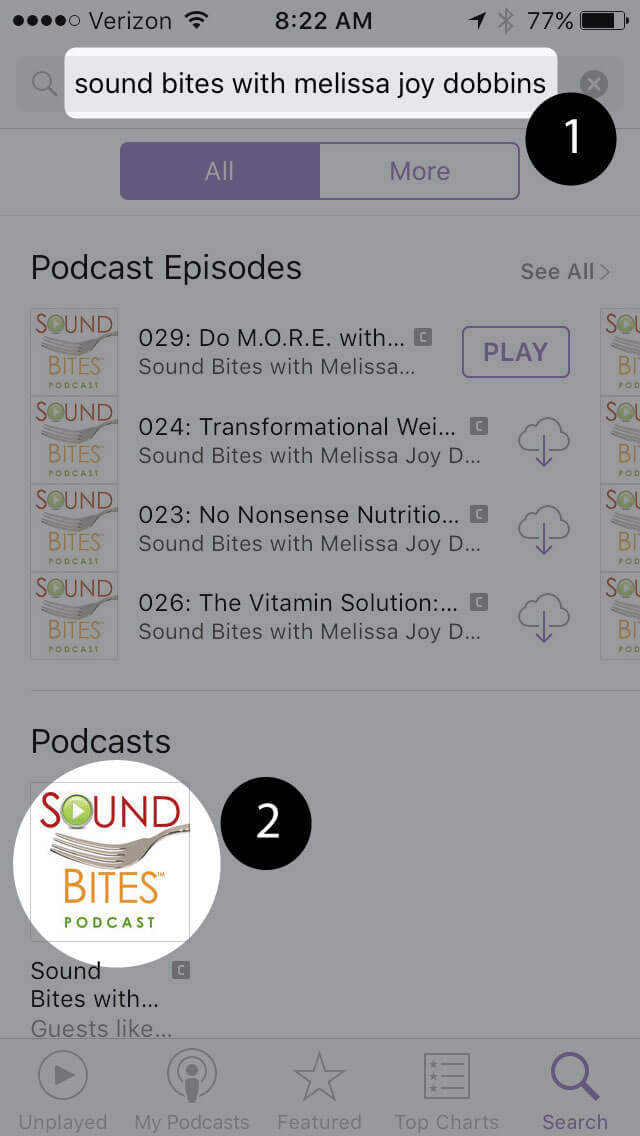
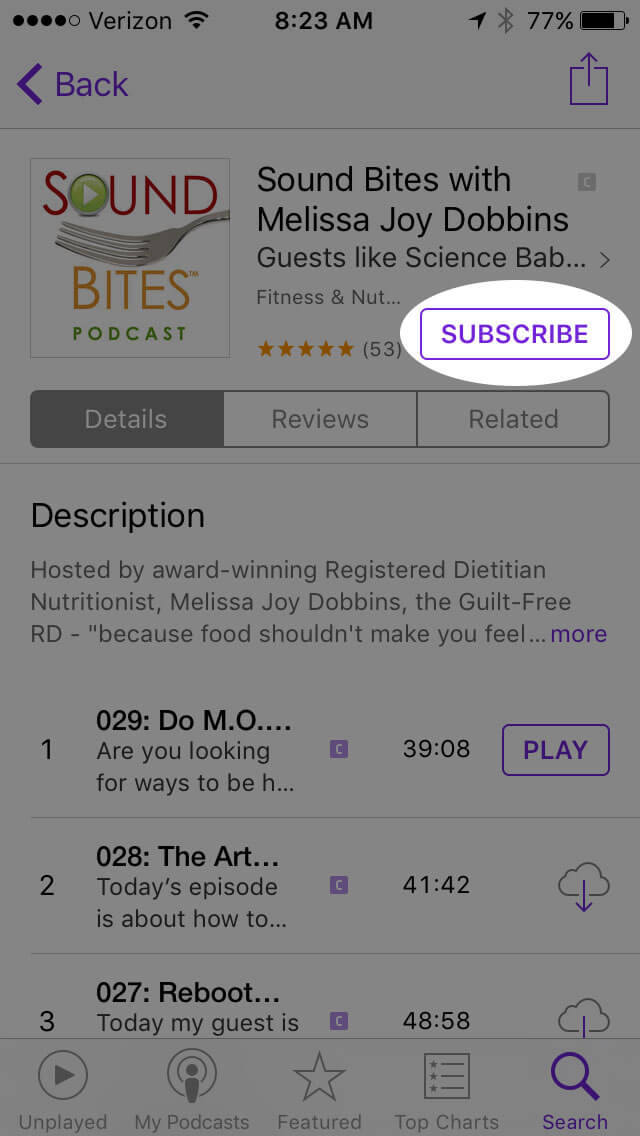
Subscribe & Review on iPhone
Open the “Podcast” app on your iPhone
Search for “Sound bites with melissa joy dobbins”
Open the podcast and click “Subscribe” and your done!
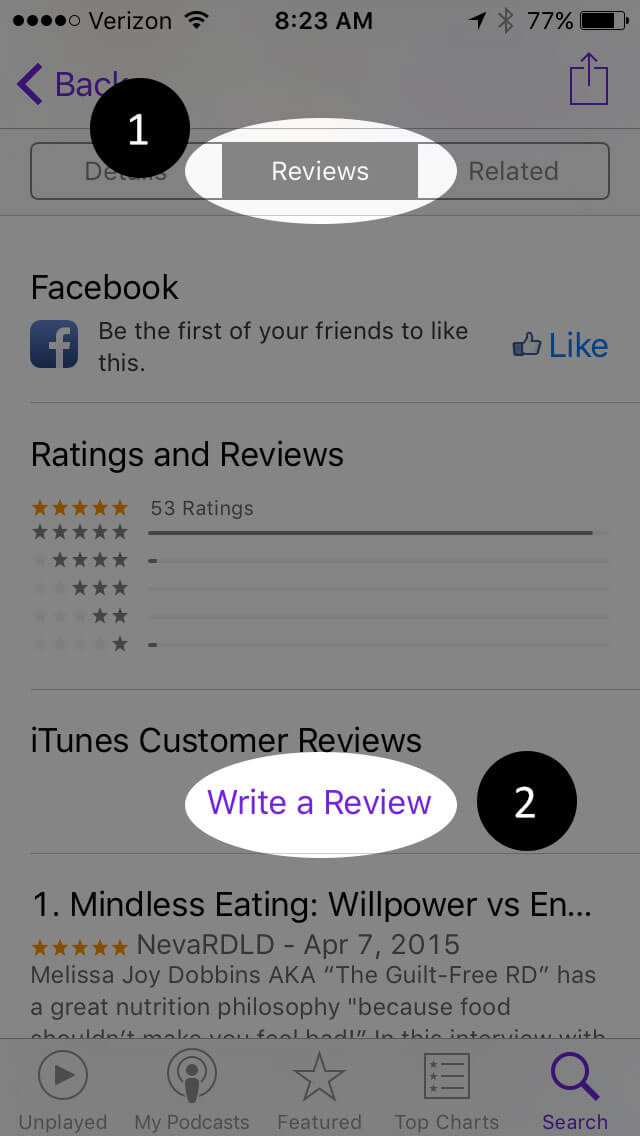
Write a Review
Click “Reviews”, then “Write a Review”.
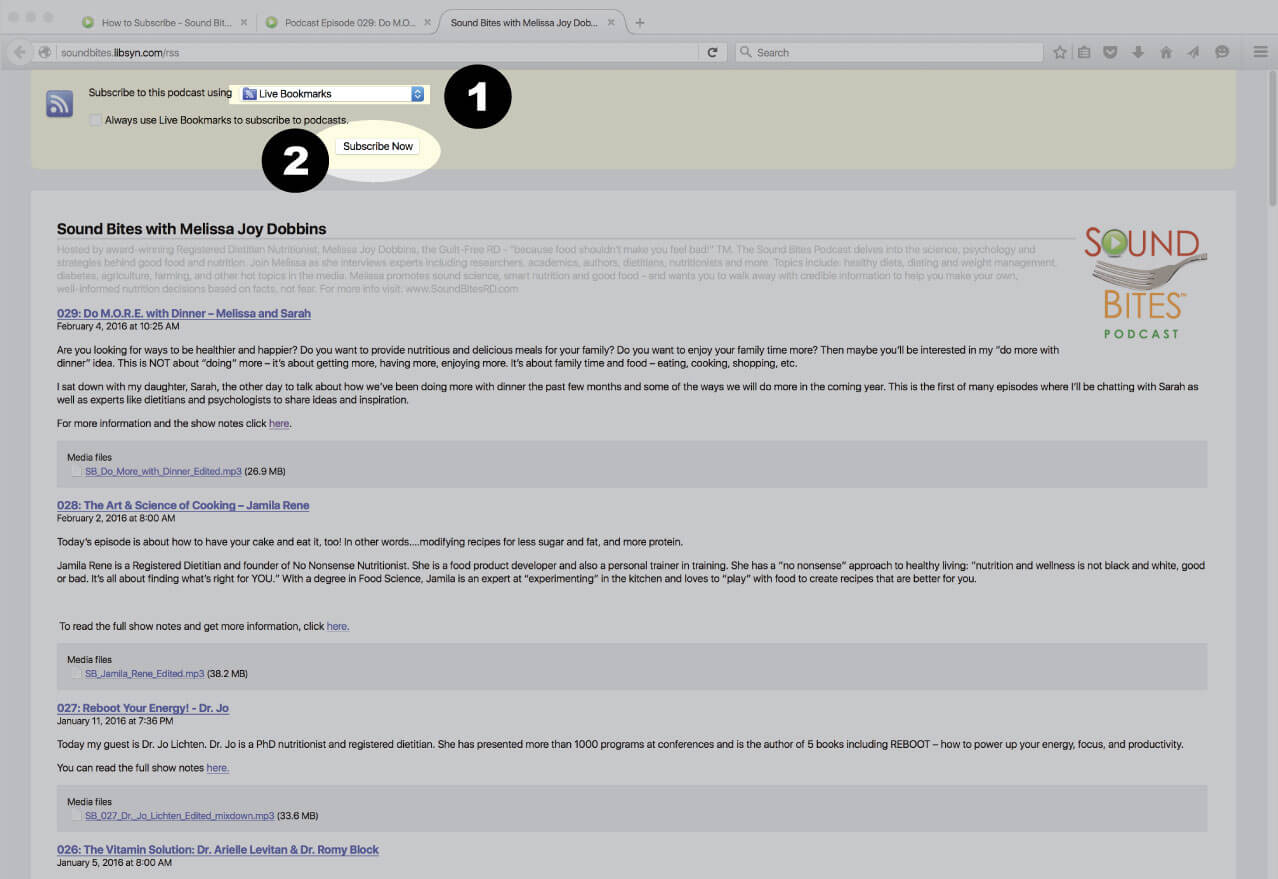
Subscribe via RSS Feed
Navigate to any podcast player . Click on the RSS feed icon.
Click on the RSS feed icon.
Click on RSS Feed
Choose which application you would like to use to receive the RSS feed
Click “Subscribe Now”
Confirm settings and subscribe.
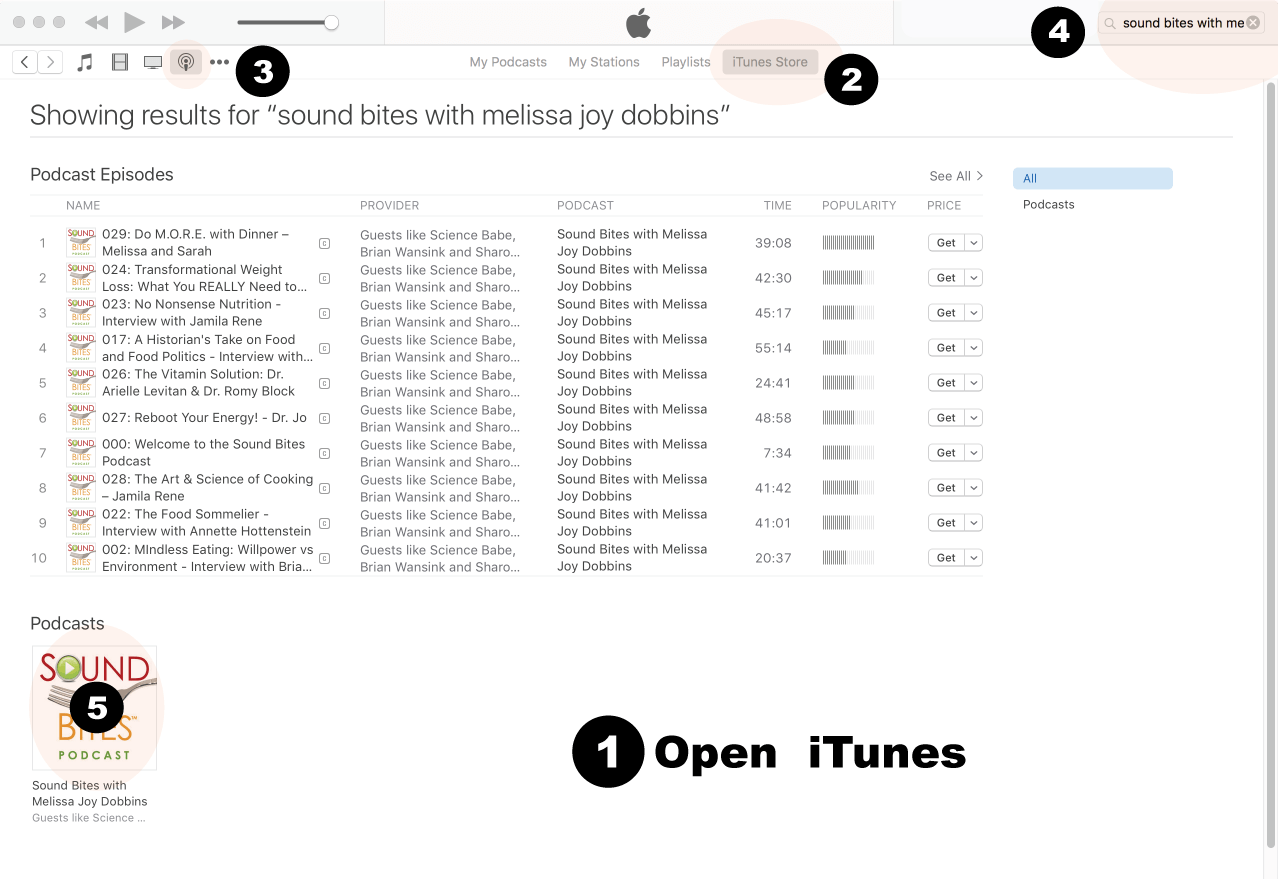
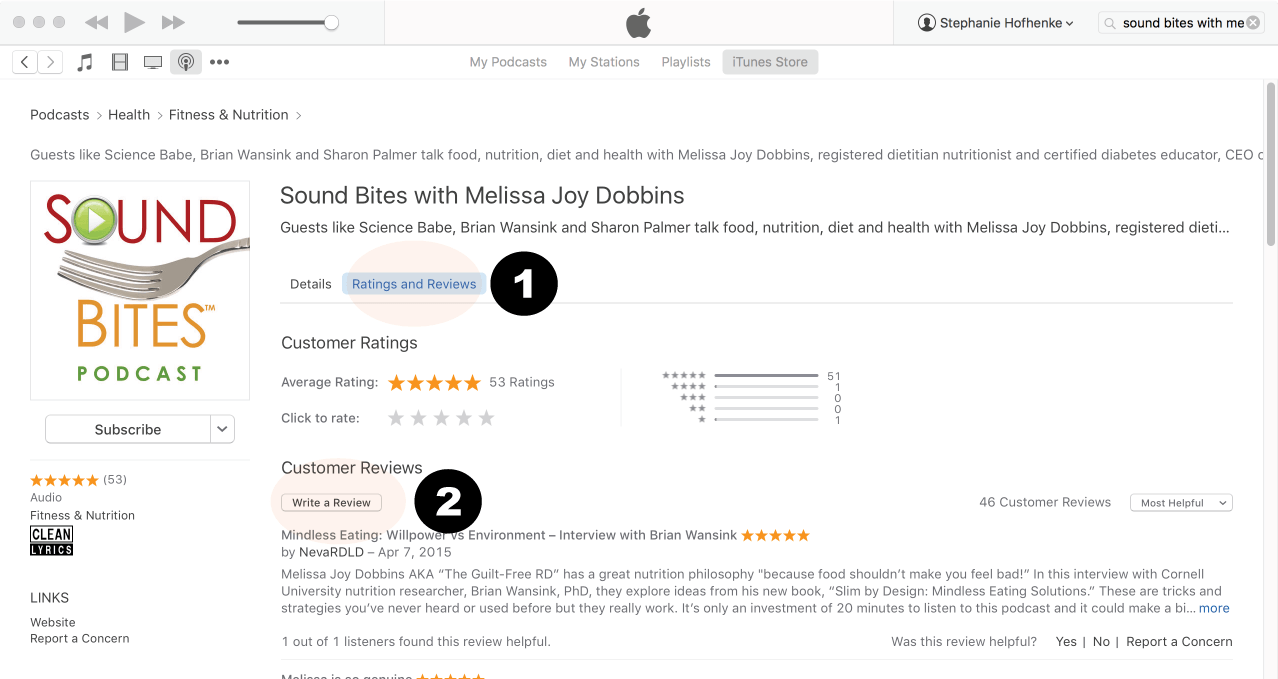
How to Review in iTunes
Open iTunes desktop application
Click iTunes Store
Click on Podcasts
Search for “Sound bites with Melissa Joy Dobbins”
Click on podcast image
Search for Sound Bites podcast in iTunes
Click Ratings & Reivews
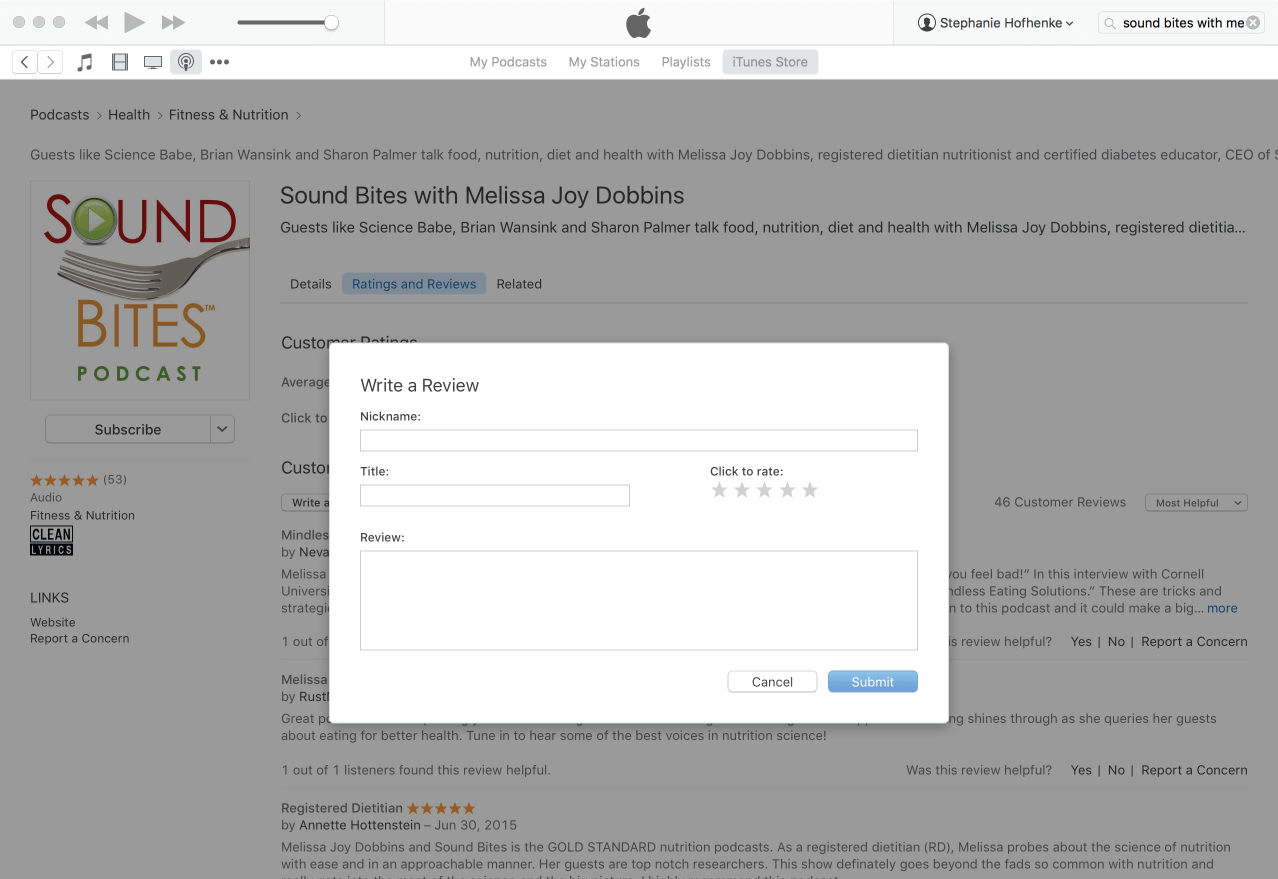
Click Write a Review
View reviews and write your own review.
Write your review…. Thank you!
Write your review!
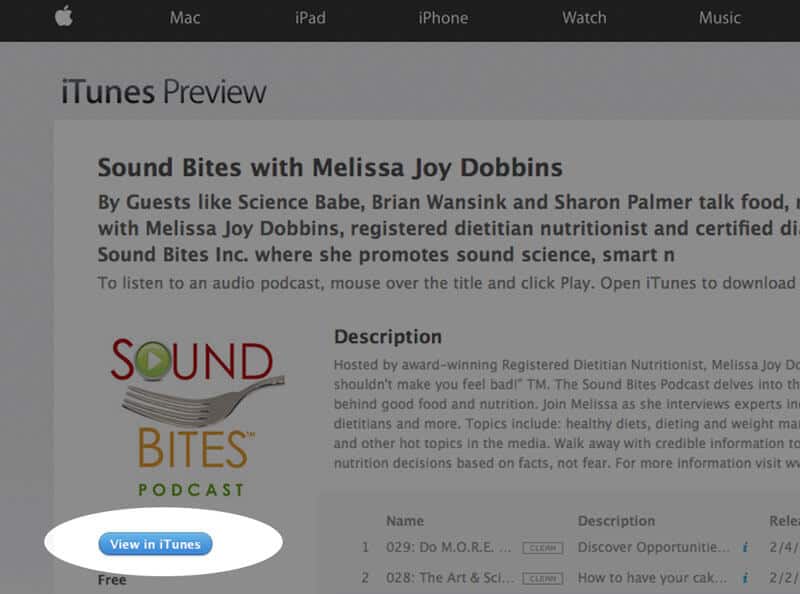
How to subscribe via iTunes
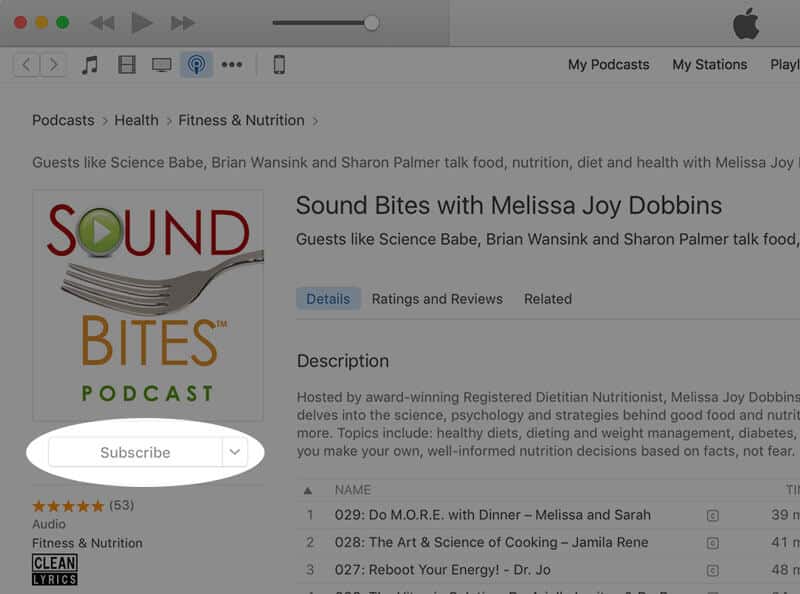
Click here to view the Sound Bites Podcastin iTunes, then click the blue “View in iTunes” button. This will open your iTunes application directly to Sound Bites Podcast. Click the “Subscribe” button, and your done!