Celebrating over 1 Million Downloads and 50,000 Free CEUs on the Sound Bites® Podcast | NEW: Get 1 years’ worth of CEUs with the new 15-CEU Podcast Course
Disclosure: This episode is sponsored by the National Pork Board, a USDA-sponsored program created by Congress to educate consumers, fund research, and promote pork products. The board is funded by U.S. pork producers and importers.
What You Should Know About the Most Consumed Protein Worldwide
Pork fits into a variety of different cultures – think about all the different tastes and flavors that go along with that. And there are hundreds of different flavor nuances to pork, which is why it makes such a good friend to all foods and makes such a nice pair to so many plant-forward dishes.”
Lean, fresh pork is a source of eleven key nutrients and pork is the most consumed protein worldwide, making it an important part of many different cultures and eating patterns around the world. Yet, some health professionals and consumers remain unfamiliar with many of its health benefits, cultural applicability, culinary versatility and environmental sustainability.
Pork & Partners is all about building connections, building community, and building your knowledge and skills. We’re very excited to create this program for health professionals because I believe we all have a lot to learn from each other, and we can all help each other grow.”
Tune into this episode to learn about:
Kara’s background growing up on a farm and ranch in rural Nebraska and experience in retail nutrition, communications and marketing
the National Pork Board’s efforts in promoting evidence-based information
the role of lean, fresh pork in healthy eating patterns across cultures, life stages and socio-economic status
the nutrient profile of pork beyond high quality protein including important nutrients such as choline and selenium
why pork is considered a “carrier” food and makes it easy to follow a plant-forward eating pattern
consumption data, sustainability factors and new research on affordability
consumer and health professional insights about the nutritional value, preparation methods and versatility of pork
resources for the public and health professionals including a new program called Pork & Partners
Pork could be that perfect carrier of under-consumed vegetables or fruits and nutrients that can actually help people eat better. If you’re cooking something like an egg roll in a bowl, ground pork is the protein that brings it all together, along with a bunch of vegetables, like shredded carrots and cabbage and red peppers.”
Kara Behlke-Ungerman RD, LD
Kara was the Vice President of Nutrition, Health and Wellness at the National Pork Board, headquartered in Clive, Iowa.
In this role, she provided strategic direction and oversight for human nutrition, health, and well-being initiatives, including Checkoff-funded research projects, communications, and marketing. Kara had a passion for integrating agriculture, food, health and nutrition concepts into her work with both a consumer focus and science-relevant perspective.
Prior to the National Pork Board, Kara worked at Schnuck Markets in a variety of positions, as well as Hy-Vee as a Registered Dietitian, and the New York Beef Industry Council as the Director of Nutrition Education.
Kara was a member of the Academy of Nutrition and Dietetics and was a member of the Retail Dietitian Business Alliance Advisory Board and CEOs Against Cancer. Kara obtained a bachelor’s in Dietetics from the University of Nebraska-Lincoln and completed a dietetic internship at Yale Medical Center.
Kara sadly passed away in the summer of 2023. She will be incredibly missed by the nutrition community for her kindness, drive, and visionary leadership. This podcast episode remains available to honor her memory with the blessing of Kara’s loved ones and the National Pork Board.
2010 Nutritional Nutrient Database for Standard Reference, Release 23. Based on 3-ounce cooked pork tenderloin. “Excellent” source: 20% or more of Daily Value; “Good” source: 10-19% of Daily Value
National Nutrient Database for Standard Reference, Release 23. Based on 3-ounce cooked servings (roasted or broiled), visible fat trimmed after cooking.
S. Department of Agriculture, Agricultural Research Service. FoodData Central, 2019. fdc.nal.usda.gov.
S. Department of Agriculture and U.S. Department of Health and Human Services. Dietary Guidelines for Americans, 2020-2025. 9th Edition. December 2020. Available at DietaryGuidelines.gov.
White RR, Hall MB. Nutritional and greenhouse gas impacts of removing animals from US agriculture. Proc Natl Acad Sci. 2017;114(48):E10301. doi:10.1073/pnas.1707322114
Hello, and welcome to the Sound Bites podcast. Today’s episode is about fresh, lean pork’s role in plant forward eating patterns and what you may not know about the role of pork in many cultural cuisines all over the world. We’re also sharing an exciting announcement and Sound Bites podcast listeners are some of the first to hear it. More on that in a bit. My guest today is Kara Behlke-Ungerman, Vice President of nutrition, health and wellness transformation at the National Pork Board. In her role, she provides strategic direction and oversight for human nutrition, health and wellbeing initiatives, including research projects, communications and marketing.
In addition, she integrates agriculture, food, health and nutrition concepts into her work with both a consumer focus and science relevant perspective. Kara is a former supermarket dietitian just like myself. And prior to the National Pork Board, Kara worked at Schnucks markets in a variety of positions, as well as Hy-Vee as a registered dietitian and the New York Beef Industry Council as the Director of Nutrition Education. She has a bachelor’s in dietetics from the University of Nebraska Lincoln and completed a dietetic internship at Yale Medical Center. Originally from Benkelman, Nebraska, Kara currently resides in Des Moines, Iowa. Welcome to the show, Kara.
Kara 01:25
Thanks, Melissa for having me. It’s a pleasure to be here.
Melissa 01:27
I am looking forward to our conversation. And we have a lot of synergies and similarities in our backgrounds besides being supermarket dietitians. I was born in Iowa and I lived in Nebraska. So I’m looking forward to hearing more about your background. But before that, I want our listeners to know that this episode is sponsored by the National Pork Board. And we are also submitting this episode to the Commission on dietetic registration for one free continuing education unit for registered dietitian nutritionists, dietetic technicians registered and certified diabetes care and education specialists. So if that is of interest to you, stay tuned for that, you can always check my free CEU page at soundbitesrd.com/freeceus to see what episodes are currently available. So Kara, I would love for you to share more information about your background and your professional experience. We’ve chatted about this a little bit before and I find it very interesting. So I want our listeners to get a glimpse into that as well.
Kara 02:30
Yeah, I would love to. I think my professional experience, I always love hearing from other dietitians and the paths that they’ve taken. So I think you gave good headlines of all of that, and would love to dive into that a little deeper. But I think first a little bit unique about me we’ll go way back, let’s go way back to growing up and where I grew up, because I think it’s a bit unique as a dietitian and brings a different perspective to the work that I do each and every day. But I actually grew up on a farm and ranch in rural Nebraska. So we had row crops, cows and lived the farm life. So I had two older brothers, I just remember always being outside playing with them, spent time roaming around the farm, playing hide and seek in our trees, that stretch as far as the eye could see out in front of our house. And we had so many animals.
I can remember as a three year old, I had more cats than I could count. And as a three year old, I couldn’t count very many. But we had a lot of cats. And just playing on the farm I think led to a lot of my creativity and just the expansiveness of thinking and trying to create solutions with what you had. Because you’re out on the farm away from town. And so what kind of fun creative things could you come up with. So a few things I remember is my brothers and I, again, we’re always constructing something on the farm. So when we got older, we got into building zip lines from our apple tree. So we created a zip line, again, to have some fun and just being ingenious with what we had available to us. But then we’d construct land skis to pull behind our four wheeler, we’d be playing basketball in the building. And then one winter, I remember this vividly.
I will admit, I always thought I was going to be a world famous ice skater and go to the Olympics. And so for Christmas, my brothers built me an ice rink out front. They moved some dirt, they tried to fill it with water and let it freeze so I could fulfill my Olympic dreams. It did not work. But we had fun trying. So I just think about all of these different things that we did on the farm, and it just helped foster my creativity. And really, I think inspired my zest for creative solutions. Then of course, you have the obvious where it really grounded me in the understanding of what it’s like to grow up on a farm. And not every dietitian or health professional has that experience.
Melissa 04:55
Right, for sure. And that’s why it’s so important to have voices like yours in this space. I really value your experience and perspective that you bring to the table. And I had two older brothers too. So we have another thing in common. How much older were they?
Kara 05:07
Oh, my goodness, two years and four years, we were all spaced out evenly two years.
Melissa 05:12
Okay. We were a little closer in age than that. But yeah, it’s kind of interesting being the youngest and being a girl. I’ll just leave it at that.
Kara 05:19
Yes, it is.
Melissa 05:20
We had lot of fun. That’s great.
Kara 05:22
And sometimes, that’s when I would go in boss mode and telling them what to do. It was either the youngest or the oldest. The one in the middle is always a mediator. But the oldest and youngest it was, who’s in charge around here?
Melissa 05:34
That’s funny. Our middle one was always the instigator. So I’m going to leave that there. But we love him. So how did you first become interested in nutrition? Tell me a little bit more about your education path.
Kara 05:46
I became interested in nutrition just through I wanted to be pre-med and become a doctor. And so I really liked the side of Preventative Medicine. So obviously you have the need. And I think many dietitians have the desire rather to help people. And pre-med becoming a doctor was the route I saw. And of course, you take those personality tests in high school that match you with the ideal career, and it sends you down a path. And so that’s where I started off. But when I got to school, I realized, oh, wow, there’s a whole side of preventative medicine and understanding more about nutrition is where I really began to resonate and feel like, oh, this is a good place for me.
So that’s where I got my interest. And I’ve always loved food. I’ve always enjoyed cooking. And I always enjoyed the connection and happiness that would bring to people if you take them food, or you cook for them. I learned that from my mom. And to this day, she is always cooking things, whether she’s cooking a chicken noodle soup for a wedding, whether she’s baking a pie for someone’s birthday locally, like she is always cooking, and she finds so much pleasure and meaning in that that I think, again, it was just natural for her to instill it into me. I feel like I owe a lot of that credit to her and that’s where my interest in food came from.
Melissa 07:00
Oh, it’s wonderful. Is there anything that you wanted to share about your previous jobs? I know you were at Schnucks for quite a while when you are working beyond the dietitian, realm and you were doing a lot of marketing. I’d love to have you share a little bit about that.
Kara 07:14
Yeah, I would love to share more about that role. That was fascinating. And I would say not the journey I expected to be on as a dietitian. Like I said, not the traditional route that I envisioned for myself, but loved the journey that I was on. So when I started out there at Schnucks, we were building an in store dietitian program, I came from Hy-Vee and was an in store dietitian in the Cedar Rapids area. And so went to Schnucks and was helping build out what their program looked like, they didn’t have a dietitian. And so I started out doing that. And then after about a year, I was recruited to come into marketing, and not as a dietitian reporting into marketing, this was actually a marketing role overseeing the brand strategy and overseeing advertising marketing. So all of your TV, radio, outdoor ads, all of that stuff and going through a brand relaunch. So I actually wasn’t practicing as much as a dietitian, where I was full time trying to figure out marketing.
Taking online courses, in person classes, reading books, podcasts, just trying to figure out as much as I could about brand marketing, but I was really helping lead those efforts under a new chief marketing officer at the organization. Really, again, taking my nutrition knowledge, and it was a big change for people. They were like, why are you going into marketing? And really, the way I thought about it, some of the underlying principles of nutrition and marketing are kind of similar, and it’s about behavior change. So if you use marketing for good, you’re trying to create a behavior change in a consumer. Same thing with nutrition, when you’re trying to get them to eat healthier or support their current lifestyle, you’re helping them create a healthier behavior change. So I saw a lot of similarities and also the reason that really interests me was there was actually a lot of science to marketing that I never realized.
Melissa 09:01
Interesting.
Kara 09:02
Yeah, I really enjoyed that. And I would say, again, it was just diving and trying to figure it out and learning as quick as I could on my feet. And I’ll never forget the first TV commercial I made. It wasn’t actually one commercial, it was seven vignettes within one. So it’s like I produced seven commercials in one. And the casting list was huge. I had puppies, I had children, I had probably everything you shouldn’t start with but so proud of that work. Creating a commercial and seeing it on air there’s nothing like it. But again, it was enhancing my skills along the way. And I could bring that nutrition, dietitian mindset to it, but also grow within an organization as well.
Melissa 09:46
Very cool. So let’s talk about the National Pork Board and your role there. How long have you been there and what do you focus on in your role as VP of nutrition, health and wellness?
Kara 09:59
Well, I’ve been here just about three years this summer, and I oversee and provide strategic direction for all things related to human nutrition, health and wellness initiatives and programs here at the National Pork Board. And really I represent the 60,000 Pork Producers in America through the Pork Check off Program. And what that means is these pork producers, I represent them through the check off dollars that they pay. And we invest those dollars in human nutrition related activities. We’re looking at doing good work and the good work that’s already being done in the health and wellness space. The work that you’re doing, others listening and how can we amplify those efforts. And my role specifically is really primarily focused on fresh lean pork versus processed pork. So lean cuts like pork tenderloin, loin roast, pork chops, all those lean cuts. How do they fit within a healthy eating pattern and healthy diets and what kind of research needs to be done on that? So that’s a primary focus of what I do in most of my efforts.
Melissa 10:56
Yeah, and I’ve talked about check off programs on the podcast before, not necessarily always using that term, but it’s where the farmers pool their money together so that they get more leverage with just investing in research and marketing, because they don’t have much of a margin to do that on their own. So they’re stronger as a group. That’s the same as it was when I worked for the Dairy Council. I know that’s how that is with the Beef Council. But you can correct me if I said anything wrong, Kara?
Kara 11:24
No, I think that’s a good description of it. And on behalf of the industry, we’re looking at the long term, and when it comes to health and wellness, how can we improve our practices or improve our product and do our part to create a better world. And that may sound lofty, but truly, I mean it. Because we think the National Pork Board and on behalf of the industry, that putting health at the heart of what we do is the right thing to do. It’s just a modern way of doing business. And we really want to be part of the solution because we’re helping to feed and nourish the world. And we want to be part of that solution. We don’t want to be a source of the problem. So again, our investments in health and wellness is, we want to know what we can do better. We want ideas for improvement. And then we want to partner with people who can help us make that work happen. And so again, really looking at the long term viability of the industry is a lot of the work that we do.
Melissa 12:18
Absolutely. And before we move on to other questions that I have for you, I’d like to talk a little bit more about dietitians like yourself who are working in the food industry. I’d love for you to share some of your thoughts and perspective on the importance of that and the role that dietitians can play in the food industry. And also a little bit more maybe about the research in general that the National Pork Board helps fund. I always like to talk about industry funded research on the podcast just to help our listeners understand whether they’re the general public or other healthcare professionals, the landscape of industry funded research and the importance of that.
Kara 12:56
Well, as a dietitian, it’s always important. And we all I think listening would agree that we lead with the science. That’s what our profession is based upon. And that’s what I agree with here at the National Pork Board. So we have to lead with the science. We also again, being a dietitian having worked in the food industry, and now at the National Pork Board, we produce a product for consumption. So it’s our responsibility to understand specifically here how pork fits into a healthy eating pattern. And so, when you’re a dietitian representing a food or a commodity board, I think it’s important to again, start with the science, lead with science, understand that products role within consumers eating habits and looking for ways to enhance it and ways to adapt it into a healthy eating pattern. In regards to industry funded research, we have developed Research Integrity guidelines that help guide and direct us.
So we have a commitment and a focus on continuous improvement from farm to fork, and our check off research funds are investing in independent research studies focused on human nutrition as well as other key areas like animal welfare, disease prevention, and genetics. But in order to maintain the integrity and transparency in the conduct of this research, and of course, help minimize the potential for bias the National Pork Board abides by research integrity guidelines, and one example of that is requiring the controllable study, design and research itself remain with the researchers.
Melissa 14:24
Okay, great. Thank you for sharing that. And I know we’re going to continue this conversation throughout the rest of this interview. But is there anything specific that you wanted to share about areas of focus that you have right now?
Kara 14:36
Yeah. Well, when I first came to the National Pork Board, again, we were evaluating how we want to invest in human nutrition research. There was a question of should we be investing or are we investing too much, are we investing too little? And it stimulated a lot of different discussions, and what we discovered is that there is a lot more that needs to be discovered about our product, so our board did recently commit to investing more in nutrition research. So we completed about three phases of nutrition research strategy to help develop where we focus and what key questions that we wanted to answer.
Again, that was conducted with a lot of input from registered dietitians, health professionals, industry folks just trying to get a landscape assessment of what are the key questions related to pork and health that we wanted to research. And we even went outside non-traditional aspects. And I remember talking with anthropologists and food historians, and really diving deep and even looking globally, like what are some of those big global questions? Even though we serve US pork producers, pork is actually you might be surprised to know, the most consumed protein worldwide. And of course, that means it’s an important component of so many cultures, meaning that it is an important food for many different cultures, even within the United States.
So again, this was probably about six months to a year’s worth of work, just trying to evaluate what are the key questions that we want to ask ourselves, and we did come up with our focus areas. And one of our first focus areas for human nutrition research is establishing pork’s role in healthy eating patterns across cultures, across life stages, and across socio economic status. Like I said, many don’t know that pork is so widely consumed across the globe. And so how do we look at those healthy eating patterns across cultures is a big part of our focus area. We’re also focused on understanding pork’s role as an environmentally sustainable protein, because we believe pork can deliver on that nutritional quality. It’s also highly accessible and affordable. And then if you factor in the cultural applicability, how does that all play into a sustainable nutrition conversation instead of just looking at carbon or greenhouse gas emissions and framing up sustainability that way? But how do you start to bring nutrition into those conversations to supplement that knowledge.
So that’s another big focus area for us. And then our last research focus area is pioneering new research methodologies using precision nutrition. So in doing so we want to explore the nutritional value of pork specific to health outcomes. So this is where you dip your toe in the water a little bit, and you explore what’s out there. So we’re doing some work in the areas of cognition, that’s quite exciting. But again, trying to lean into precision nutrition, and see where our role is, and what health outcomes we can measure related to pork consumption. It’s kind of funny, because some of my producers, they’ve been doing Precision ag on the farm for so many years. And so it’s exciting for them to see how we’re leaning into precision nutrition.
Melissa 17:40
Yes. And I know we’re going to talk a little bit about agriculture and on farm questions that I have to share with the listeners. But can you say a little bit more about precision ag, is that dealing with technology in the business of agriculture?
Kara 17:53
Yeah. When it comes to precision ag, I think the easiest example for people to understand when I have friends or cousins come to the farm, and you’re out on a tractor or combine and now you have GPS that can guide and direct when you’re on a combine harvesting the crops and it’s telling your bushels, your moisture, your yield, and it’s telling you all of this live in real time. And it’s actually even guiding the tractor where you don’t have to necessarily steer. So I think all this technology, people are always surprised that agriculture has so much technology. I don’t know why it’s a surprise, again, when you grew up with it, you’re used to seeing that, but I think it’s been a discussion within the ag industry for a long time. And the other great example was more recently, so we were conducting a virtual farm tour.
We had some agency partners, and they were surprised when they saw how the pigs were fed in the barns and the precision that goes into exactly how much is fed, what the rations are, how much feed and everything is just precisely calculated and delivered based upon that specific pig with the exact nutrient requirements. So again, the precision to which it’s calculated, and then distributed, I think always surprises people. Because we always ask ourselves, why can’t you do that with humans? Well, I think it’s very different for many, many reasons. But I don’t think they understand the technology and the savvy that producers and farmers have on their farm.
Melissa 19:19
I agree. One more question. Before we get into some details about pork, including some common myths and misperceptions that might surprise our listeners. You guys are launching a new program called Pork and Partners. Can you tell me a little bit about that?
Kara 19:34
Pork and Partners, this is all about building connection and building community. And so we’re very excited to create a program for health professionals. And it’s also about networking to grow your skills. And of course, it’s about knowledge building and sharing your knowledge. Because I believe we all have a lot to learn from each other and we can all help each other grow. We just need a place and a platform to do it. So really, that’s what Pork and Partners is all about. It is to help healthcare professionals meet the demands of everyday practice, while also providing opportunities for dietitians, to connect and earn those continuing education credits. Through Pork and Partners, we are going to be launching a website where you can stay up to date with all of the latest topics where we’ll be providing meaningful resources to help expand your knowledge. And again, this is based on topics of interests.
So we actually went out asked dietitians. What is it that you want to know more about? What skills are you missing or even what skills are missing from the profession that we can help build and provide those opportunities to dietitians? So that will be on the website. There will of course be other resources, there’ll be on demand webinars, there’ll be handouts and recipes. We will also host in person events. So if you sign up for Pork and Partners, you’ll be the first to hear about these in person events that we will be doing, we’ll have dietitian to dietitian chat series. So again, all sorts of fun and engaging ways to come together as a profession and talk about these topics. And we’ll also have a presence on Instagram to maybe dive a little bit deeper and to topics in a place where we feel comfortable sharing and discussing because again, we want to be part of the solution and helping to develop dietitians. So we want to know what topics are important, and what we can provide to help grow dietitians within our profession.
Melissa 21:45
Very cool. And I look forward to seeing more about that and hearing more about that. So this is one of my favorite questions that I like to ask what might surprise our listeners whether they’re a general public individual or a dietitian or some other health care professional. What might surprise them to learn about pork? My interest is piqued at several things that you’ve already said. But what have you found in your consumer and health professional research?
Kara 22:14
Hands down for consumers when I tell them that pork tenderloin is as lean as boneless skinless chicken breast? That surprises them. That has been a sticky message that I’ve had multiple people -they just can’t get that out of their head when they go to the grocery store. So I found that that even though I think as dietitians I’m like wow, we’ve heard that a lot. Pork tenderloin is as lean as boneless skinless chicken breast. But I think there’s a lot of people out there consumer wise that actually don’t know that. So that’s a surprising statement as simple as it may seem. But when it comes to registered dietitians, internal research indicates that dietitians highly rated the nutrients found in pork, but are less familiar with pork compared to other animal proteins. So they understand the nutrition but they’re just less familiar. So it’s something that they don’t consume as often. And then interestingly, too, they rate pork lower in nutritional value. So if they’re forced to rank it compared to other proteins, they actually rank pork lower, but they respond very positively to nutrient-focused pork messaging. So it’s a bit of a paradox. But I think, again, it shows that there’s a learning opportunity there as well for how we educate consumers and clients.
Melissa 23:27
A lot of times, it’s how you ask the question, and I love getting into insights like this, because usually there’s a surprising factor there. But then also it provides information on what do we do moving forward? Where do we need to fill some of these gaps, whether it’s awareness or knowledge or just practice?
Kara 23:46
Well, exactly.
Melissa 23:47
So with the pork tenderloin, being as lean as boneless skinless chicken breast and very easy to cook. We talk about seafood on the podcast all the time, and people are afraid to cook it when it’s very easy to cook. But pork is maybe a little bit more forgiving like chicken where you still have to cook it to the proper temperature and things like that. But it’s easier to maybe not overcook it from my own personal experience.
Kara 24:14
Yeah, that’s actually quite common again among registered dietitians and they’re not always familiar and they’re not very comfortable with how to select and cook pork. So it comes down to selection. And again, having worked for the beef industry selecting meat is always a challenge for consumers and I think even dietitians sometimes struggle with how to select it and then how to cook pork. Again cooking it to 145 degrees if you’re cooking a pork tenderloin that’s a perfect temperature that you want to cook it to for a safe eating experience. But then like you said, if you’re not comfortable with it how are you going to counsel patients on it so that was a big learning we saw from the research is we need to help familiarity when it comes to selecting and cooking pork. And again, it’s really tasty, and it’s the most consumed protein worldwide.
It’s obviously an important component of so many cultures. So that’s another opportunity for us. It’s important food for many different cultures within the US because if you look at it globally, and how highly consumed it is, well, there’s a high chance that dietitians are counseling or interacting with patients that come from diverse backgrounds. So how can we teach dietitians how to cook with pork from different cultures and cuisines to build their confidence in their skills?
Melissa 25:29
Absolutely. That was one of the surprising things that I learned from you is that it’s the most consumed protein worldwide. So I’d love to hear a little bit more about how it is a key protein food for different cultures within the US and globally, if you can share some of that.
Kara 25:45
Yeah. Well, let’s go way back. Because for centuries, pork has been an essential part of diets around the world. Even the Romans, I think it fueled their strength. Because it provides a delicious, nutrient dense foundation for meals and many types of cultures, and benefits the health of people of all ages. So the current consumption of pork globally is around 22 kilograms per capita. So pretty high consumption. Just think about the culturally specific recipes that are developed throughout the world, and making those a key source of protein. So a few of them that we like to talk about – the Kalua pig, is a traditional Hawaiian preparation of a whole pig, inside a large pit heated with lava and rocks and covered with banana leaves. So that’s a very traditional Hawaiian preparation. You also have the Cubans who continue to eat a lot of pork. And Lechon Asado is a pork roast made by Cubans. It’s both a tradition and a feast.
If you look at Korea, they eat a lot of fresh pork as well. And so we’re actually looking at some research that looks at how Asian cultures eat pork differently with more of a focus on fresh pork consumption. And again, we’re trying to see what we can learn from that, and what can then be applied to the United States in practice, and helping enhance our knowledge. And then we look at America, we think about barbecue. So we look at smoked pork shoulder cooked with hickory or oak and wood chips, and the popularity of smoking it continues to rise. So that’s just a few examples of how pork fits into a variety of different cultures. And I’m sure as you’re listening, you can think about all the different tastes and flavors that go along with that. And I think one thing that was unique that I learned, and again, what was very interesting is a flavor of pork. So there’s hundreds of different flavor nuances to pork, which is why it makes such a good friend to all foods and makes such a nice pair to so many dishes. And it’s really one of those foods that you can eat at breakfast, lunch and dinner that you can’t do with all proteins.
But I think it’s the flavors in pork that really differentiate it. So we’ll do some more research around flavor just to understand why is it so unique to pork? And how does eating pork actually help you consume more under-consumed nutrients or fruits and veggies just by the addition of that to one of your dishes. So we’re looking at pork as sort of what we call this carrier food to see if you can in fact eat more fruits and vegetables just by including pork. I also want to mention that fresh pork fits a variety of budgets. Some of our new research looks at the nutritional value and affordability of a thrifty food plan that features fresh pork. Fresh pork actually fits into the lowest cost healthy diet that meets all the nutrient requirements, followed by dietary guidance, and is respective of existing eating habits.
Melissa 28:36
Melissa 29:29
Well that brings me to my next question. I talked about protein a lot on the podcast. But we know that pork is not just a source of protein. It has other nutrients but I would love to hear you detail that out for our listeners. What else comes in that nutrient package? What nutrients vitamins, minerals, and high quality protein do we get with fresh lean pork?
Kara 29:51
I think this is a great conversation to have because seeing how not only the profession but just overall the conversation is beginning to shift from just focusing on nutrients. So focusing the research or communications or education efforts just on nutrients to looking at the effect of foods. So looking at the food matrix and understanding what effects food have on health. So again, I think as dietitians we’ve probably all seen that transition and understand that there’s more to food than just the nutrients that it contains. So we are looking at research to understand the whole role of pork as a food in the diet. But when it comes specific to nutrients that people might not be aware of to be honest, pork actually contains 11 key nutrients.
It’s obviously an excellent source of protein, I think most people know and understand that. But it’s also an excellent source of thiamin, riboflavin, niacin, vitamin B6, B12, and selenium. And again, I’m talking about fresh lean pork. And this is a composite score, where we derive these daily values from. But when it comes to selenium, fresh lean pork provides 68% of the daily value of selenium. So it’s just extremely high sources selenium that I know. It is a surprise to many people, even dietitians, when you talk about pork. And then when it comes to being a good source, we have pantothenic acid, phosphorus, zinc, copper, and then choline. Which again, choline is a little bit of a surprise I think to some people, freshly in pork provides about 10% of the daily value of choline. And I think in recent years, we understand more about the importance of choline when it comes to maternal and baby health. And so, again, a little known fact that not everyone knows or understands about pork.
Melissa 31:41
Yes, and I’ve talked about choline a few times on the podcast. So it’s nice to know that pork is a good source of choline as well. And you mentioned selenium, I haven’t really talked about that on the podcast. So can you share briefly why selenium is important? What does it do?
Kara 31:57
Well, low selenium status may be linked with age related declines in brain function, and cognition, possibly due to less availability of the anti-oxidant roles selenium plays in brain health regulations. So again, related to brain function, and cognitive decline in older adults, but as mentioned earlier, pork is one of those richest food sources of selenium, and an important part to add to your diet.
Melissa 32:23
Just random fun fact, when I was in graduate school, at the University of Missouri in Columbia, our food and nutrition department was doing a bunch of research on selenium. So not a nutrient that you hear much about.
Kara 32:34
It’s not and what’s interesting and fun about working at the National Pork Board when you start talking to swine nutritionists and you talk about like the feed and what the animals are consuming and then how that translates to the product. It gets really interesting as we talk about these nutrients that we know as we look at the nutrition facts, but then also how that can be impacted. At least in pigs it’s different than in cows because they are monogastric. So again, what they eat and how that translates into the food is just fascinating, I think, especially when it comes to selenium.
Melissa 33:07
Yeah. I mentioned in the introduction about plant forward eating patterns. So I would love to hear more about this, we’re talking about pork and animal source food. How does it help people follow a more plant forward eating pattern?
Kara 33:23
Well, I think pork makes it easy to follow a plant forward eating pattern. And as mentioned earlier, this whole idea of a carrier food, pork can be that perfect carrier of under-consumed vegetables, or fruits and nutrients that can actually help people eat better. So if you think of pork as a really tasty ingredient, when you’re cooking something like an egg roll in a bowl, where ground pork is the protein that brings it all together along with a bunch of vegetables like shredded carrots, and cabbage and red peppers. It’s again, one of those carrier foods that helps you maybe consume those vegetables or nutrients that people struggle to eat. So that’s just one example. But the whole idea of pork being a perfect pair to all foods.
Melissa 34:09
Yeah, It makes sense. You’re going to pair it with dishes that you could encourage an intake of, especially other vegetables and things like that. It’s making me hungry, actually, as we’re talking. So we’ve been talking about fresh lean pork, and you’ve mentioned a few cuts by name, but I wanted to make sure that we’re explaining, like what exactly does a lean cut of pork mean? How many cuts are there? Even with lean, there’s still some fat in the pork. So can you speak to the amount of fat, the type of fat and anything else regarding that that you think is important to share?
Kara 34:46
Well, there are actually eight cuts of pork that meet USDA guidelines for lean and lean meaning that they contain less than 10 grams of fat per three ounce serving. So some of the more popular cuts that most people have heard of would be the pork tenderloin, and then when it comes to chops, you have different types of chops, but most of those qualify for Lean. And then when it comes to ground pork look for the 96% lean ground pork. And of course, you can’t forget the pork roast, such as the New York pork roast. And we also have a few cuts that qualify for the American Heart Association heart check certified foods, because those actually classify as extra lean. And that’s the boneless pork sirloin roast, as well as the pork tenderloin. And I think another little known fact that people don’t know and I’m excited to share today is that pork is actually 16%, leaner, and 27% lower in saturated fat compared to about 20 years ago. So not a lot of people know that. But our pork producers have been working really hard over the last few decades to make this change happen based upon consumer demand. So they’ve made a leaner product that’s out on the market.
Melissa 35:52
Awesome.
Kara 35:53
And in fact, primarily, the type of fat found in lean pork is a mono unsaturated fat, called oleic acid. So of course, we know the same fat that’s found in olive oil or avocados. But that’s a primary type of fat found in lean pork that a lot of people don’t know, and they don’t understand either.
Melissa 36:09
Okay, thank you for sharing some of those nutrition facts. I do think they’re really interesting, especially the unsaturated fat, and it’s maybe not top of mind for people. So it’s always a good refresher if we did know this. And if we didn’t, I think it’s really interesting. I also wanted to ask you, I have had the opportunity to visit a small hog farm once, but most people don’t have that opportunity. So glad to hear that you’ve got some virtual tours that you’ve done, at least in the past. But what can you tell our listeners about hog farming, especially for those of us who may not get the chance to go visit one in person?
Kara 36:46
Well, first of all, I would say pork producers work hard day in and day out to produce a safe, nutritious and affordable protein. This is just part of what they do each and every day. And it’s something that they’re extremely passionate about. I’d also say that farming is generational. So good practices means a sustainable future that you can hand down to future generations. So this isn’t a business that you get into when you just want to get in and get rich quick and cut corners and then get out. It truly is a long term investment and part of a legacy that producers want to hand down to their children and their grandchildren. So many farms and ranches are multi generations even working together. And so my farm and ranch in Nebraska, we actually hit 100 years that it’s been in the family. So this isn’t uncommon. And I think people don’t understand to the business side of the investment that farmers and producers are investing in.
They’re in it for the long haul. So good practices and producing a safe nutritious product is built into what they do, because they know it’s the right thing to do. And then they’re also invested. Because when it comes to farming the equipment alone, you could spend a half a million dollars on a piece of equipment that you use one, two times a year. So I’m thinking about a combine when you harvest corn and wheat or soybeans. You know it’s a $500,000 investment. So it’s not something where you get in and you cut corners. This is their livelihood. This is what they wake up to day in and day out. This is where they don’t take the days off. And they’re working on their farm with the animals and doing what they love because they truly are passionate about it and they love doing what they do. And I will tell you, they feel a sense of pride in being part of feeding and nourishing the world. That’s something that they take to heart and they do for their own family. So I think a lot of people don’t understand that because they haven’t had that experience, just having been on a farm. But just like you and me, we care about what we do, as do they.
Melissa 38:46
Yeah, absolutely. And I just have to give a shout out to our dietitian, hog farmer friend, Charlotte Rommereim and her husband, Steve Rommereim in South Dakota. When you give a shout out to somebody, then you run the risk of excluding other people. But I have to say thank you for all the hard work that they do on behalf of the pork producers and all of the pork producers. Thank you for all the hard work that you do. And I understand that you have some kind of interesting research that you’ve done regarding methane. Can you share that with us?
Kara 39:19
Oh, yes. Wow, that takes me way back to college. I was actually doing some research and who would have known it would be so trendy now. But again, I told you at the beginning, I was a pre-med major. So I thought well, I have to do research, this would be a good experience, and it would help boost my resume for med school. So I actually accepted a role in Animal Science department to do research because it was close to all my nutrition classes. Oddly, all of our classes were over on a campus that was close to the animal science building. So it was super convenient. And the research that I was doing is we were looking at ways to reduce methane production in cows. So I feel like a little bit I was ahead of my time but also again, interesting to see how the worlds of sustainability and nutrition are coming together.
As dietitians, we have to stretch ourselves and our expertise to understand more about sustainability, and how that comes together to complete the story with nutrition. So I just think that one thing we talk about not only is important and good for you when it comes to providing the nutrients and nutrition that we need, but it’s also good for the planet. And the sustainability of US produced pork keeps improving. So you talked about Charlotte and Steve, and what they do in South Dakota, and they’re not alone. The 60,000 producers across the US continue to improve the way they produce pork, and per pound of pork produced since 1960, farmers are actually using about 75%, less land, about 25%, less water, and 7% less energy is used, while 7% less carbon is emitted. So again, that commitment to continuous improvement, and something that they’re invested in to hand down generation to generation, and something they want to be sustainable for their family and futures to come. So really interesting stuff when it comes to sustainability.
Melissa 41:14
Yeah, absolutely. And one of the things that I’m always saying on the podcast when it comes to sustainability, it’s not is it sustainable or not? It’s are we heading in the right direction? Are we better than we were yesterday? And there’s a lot of tradeoffs. And there’s a lot of complexity to it. But kudos to all the farmers and producers out there who are doing all the work to continually improve sustainable nutrition, and sustainable agriculture. And Kara, that’s one more thing that we have in common because I did my master’s research on cows. So I talk about that a lot on the show. I’m not going to get into that, but more on the biotechnology side than the sustainability side. But there were factors that involved the sustainability aspect. So I won’t get into that now. But is there anything else that you wanted to share about the nutrition, the research about fresh lean pork, Pork and Partners, any takeaways for people listening, whether they’re a health professional or not?
Kara 42:17
Well, I do actually want to make a final point when it comes to sustainability, because I like how you frame that up. And when it comes to sustainability, we can’t just look at one piece of the puzzle, but looking at the environmental side, looking at the nutrition, looking at the economics, the accessibility, affordability, you kind of have to look at all of these pieces. Because what happens if one piece is missing? So what could those unintended consequences be? And we are looking at some research that shows the unintended consequences, if you were to remove pork from your diet, there’s a lot of factors to consider. But we always have to look at what are those unintended consequences.
Melissa 42:57
Yes. And I like how you also mentioned earlier the cultural aspect too, and that’s the human aspect of sustainability. It’s not just the environmental impact. It’s that whole picture.
Kara 43:09
Absolutely. And when it comes to the cultural applicability, another area of focus that I haven’t mentioned, but because you bring it up, it’s really important to us is looking at research that not only understands how do we create more culturally relevant foods? And again, we’ve talked about pork being widely consumed. So what’s our role in this? How can we help develop better research and clinical trials that have culturally relevant foods? Because once that research is done, how do you then translate that and how does that translate into action for the consumer? So how are health professionals translating it? But then how is the client then able to maintain it? So if you start off in a research trial with food that’s unknown to specific cultures, your adherence and acceptability rates are going to be really low. So we’re also really championing and trying to find ways to create more culturally relevant foods that are in clinical trials, and then how do we then translate that so that you can get recipes and ways for clients to be able to actually apply those in real life scenarios?
Melissa 44:16
Absolutely. Well, thank you for that. We’ve touched on a lot of different important aspects about pork and cultural healthy eating patterns. But I did want to ask you, since you have this interesting background, working in the food industry, a lot of students or other dietitians are also interested in working with commodity boards, like the National Pork Board. So if you have any advice for them and how they can take their career in that direction, I would love to hear that.
Kara 44:48
Well for students, I would say, say yes to things that scare you. So when it comes to new opportunities, we’re quick to think that there’s a very clear path because we’ve heard it from our mentors, or professors. There’s a very clear path that you must take. But I think if something scares you a bit, say yes. See where it goes. See what challenges are ahead of you, and what skills you can build out of it. Because that’s the path I took. It was saying yes to things that I didn’t know much about and trying to find the necessary skills to complement my nutrition background. So I would say that’s a big thing to say yes to things that might scare you. But then also making connections, we know that. So looking for summer internships and job experiences, where you can make connections and see where your interests lie, that’s always really important.
Just again, looking to build those necessary skills outside of nutrition. So I was doing animal science research back in college, I was working at a grocery store, I was even a waitress in food service and I worked in a hospital in the dish room. So again, just trying to find what really interests me, because again, I was told there’s a very clear path and one plus one equals two, and this is what you need to do. But as I had all these different experiences, I began to find what it was that I truly was passionate about. And then once I found that I just started seeking out those opportunities. And even when an opportunity wasn’t available, I would create the opportunity and say, “This is why you need to hire a registered dietitian, and what value I can bring to your organization.” So that’s my best advice.
Melissa 44:48
Great. The more you talk, the more we have in common, it’s hilarious. As we’re wrapping up, please share where people can find more information, websites, social, I’m sure there are recipes, I’m sure there’s research, but let us know where we can find more information and what we might find there.
Kara 46:45
Well, I’m going to encourage all of your listeners to go to pork.org. That’s where you’re going to find more information about the Pork and Partners Program. So get signed up, become a partner, I want to get to know you, I want to get to know you better and hear about the great work you’re doing. So that will be pork.org/porkandpartners. We will also be on Instagram, again, that will be Pork and Partners. And of course connect with me. I would love to connect with more dietitians or aspiring healthcare professionals or people inside and outside of the industry. So we’d love to connect with you personally on social media.
Melissa 47:19
Excellent, thank you and I will have all of those links and any resources that we talked about in the show notes at soundbitesrd.com. So Kara, thank you for coming on the show and sharing all of this information with us. For everybody listening as always, enjoy your food with health in mind. Till next time.
LISTEN, LEARN AND EARN
Listen to select Sound Bites Podcasts and earn free CEU credits approved by the Commission on Dietetic Registration (CDR) for registered dietitian nutritionists and dietetic technicians, registered. Get started!
Get Melissa’s Sound Science Toolkit here!
Partnerships:
Sound Bites is partnering with the Association of Diabetes Care and Education Specialists (formerly the American Association of Diabetes Educators)! Stay tuned for updates on the podcast, blog and newsletter!
Sound Bites is partnering with the International Food Information Council! Stay tuned for updates on the podcast, blog and newsletter!
Sign up for my monthly newsletter and episode eblasts so you never miss an update!
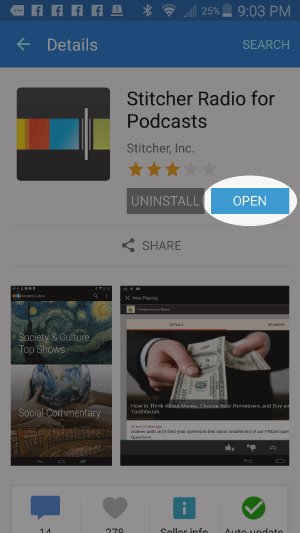
Listen on Stitcher (Android)
Install the Stitcher App
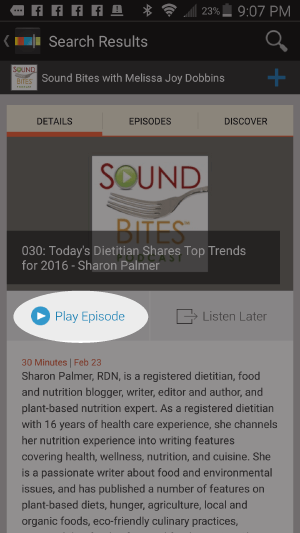
1. Search for “sound bites with melissa joy dobbins” 2. Choose Play Current Episode or Add to Playlist
Choose “Play Episode”
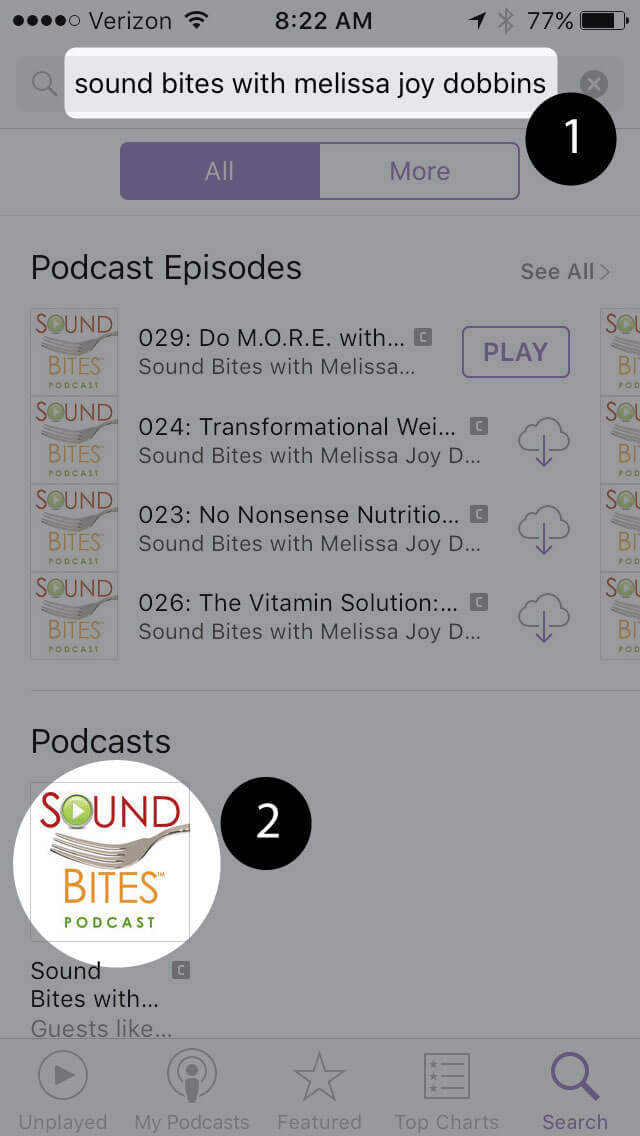
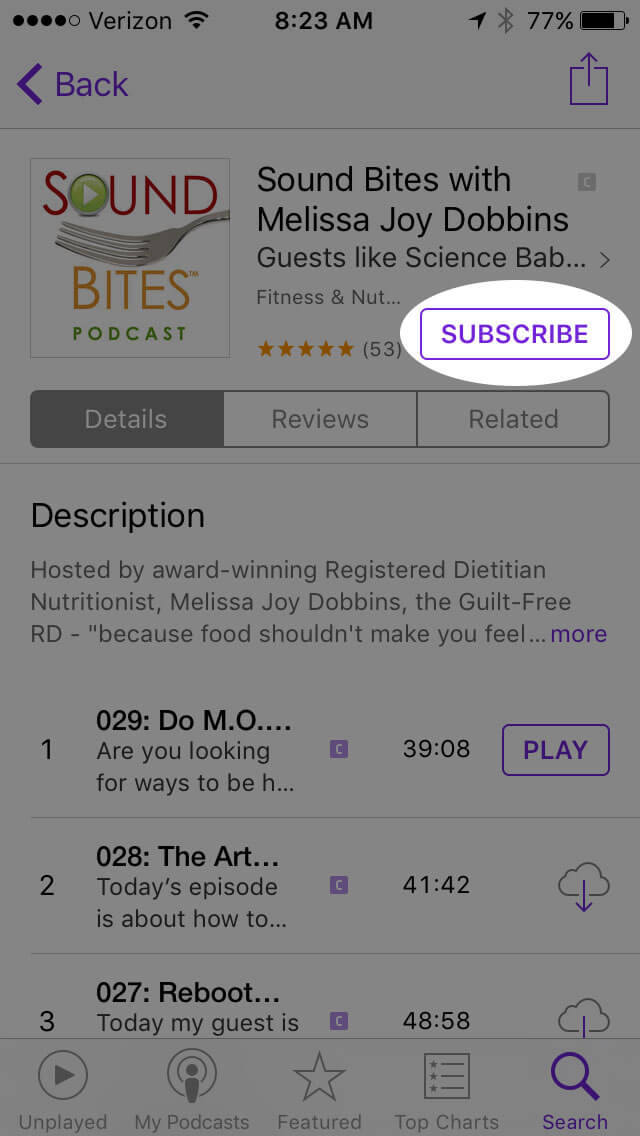
Subscribe & Review on iPhone
Open the “Podcast” app on your iPhone
Search for “Sound bites with melissa joy dobbins”
Open the podcast and click “Subscribe” and your done!
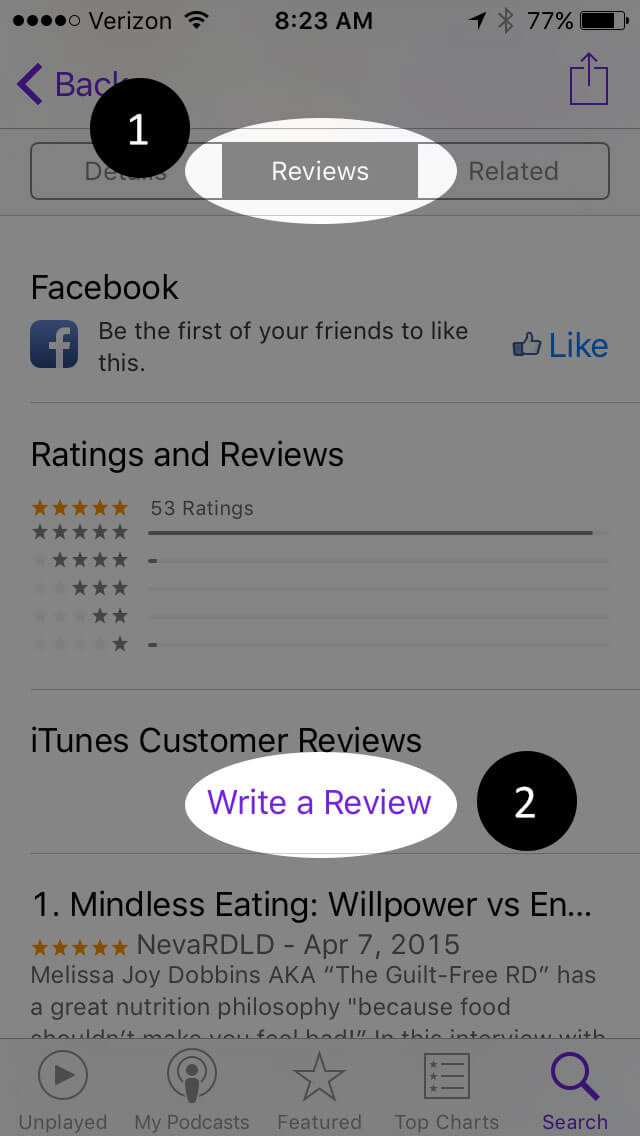
Write a Review
Click “Reviews”, then “Write a Review”.
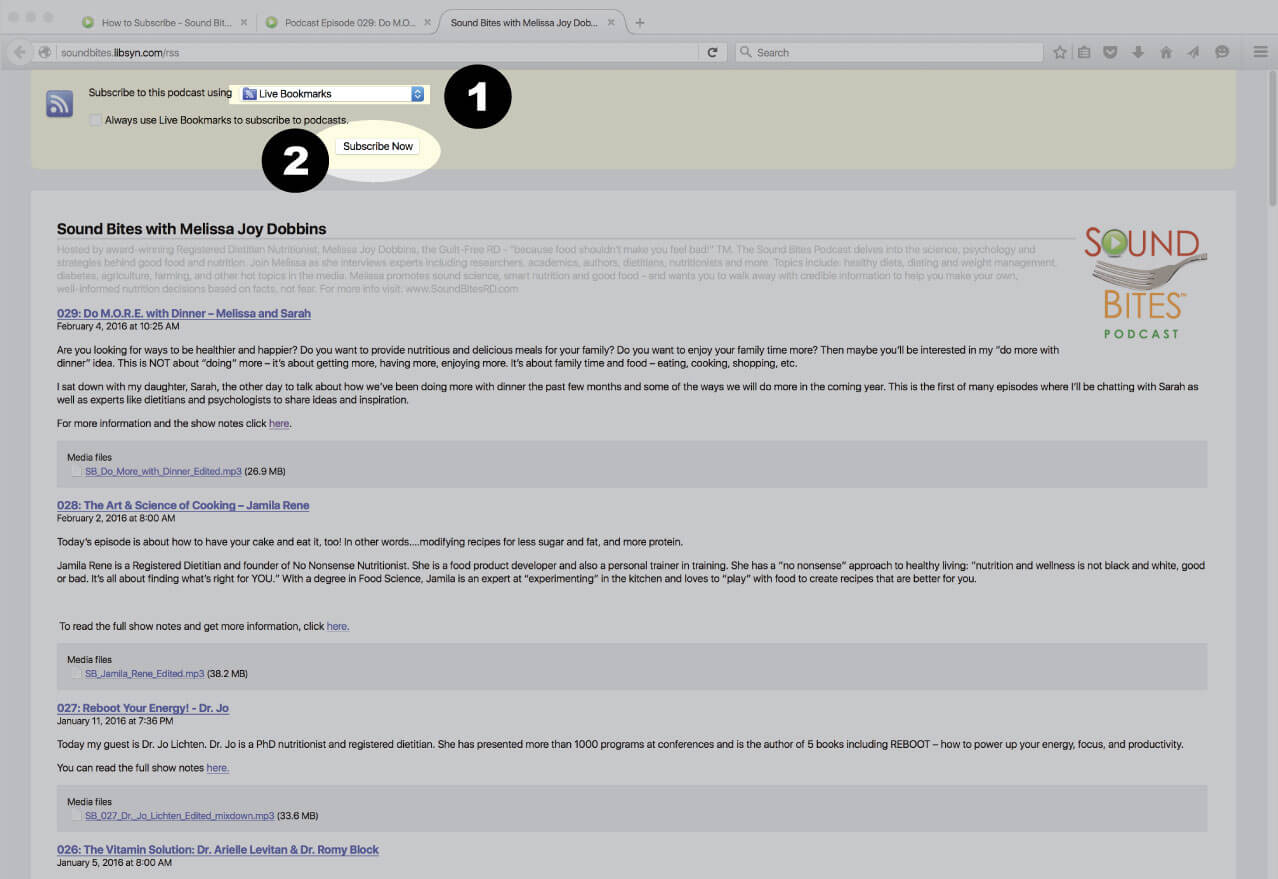
Subscribe via RSS Feed
Navigate to any podcast player . Click on the RSS feed icon.
Click on the RSS feed icon.
Click on RSS Feed
Choose which application you would like to use to receive the RSS feed
Click “Subscribe Now”
Confirm settings and subscribe.
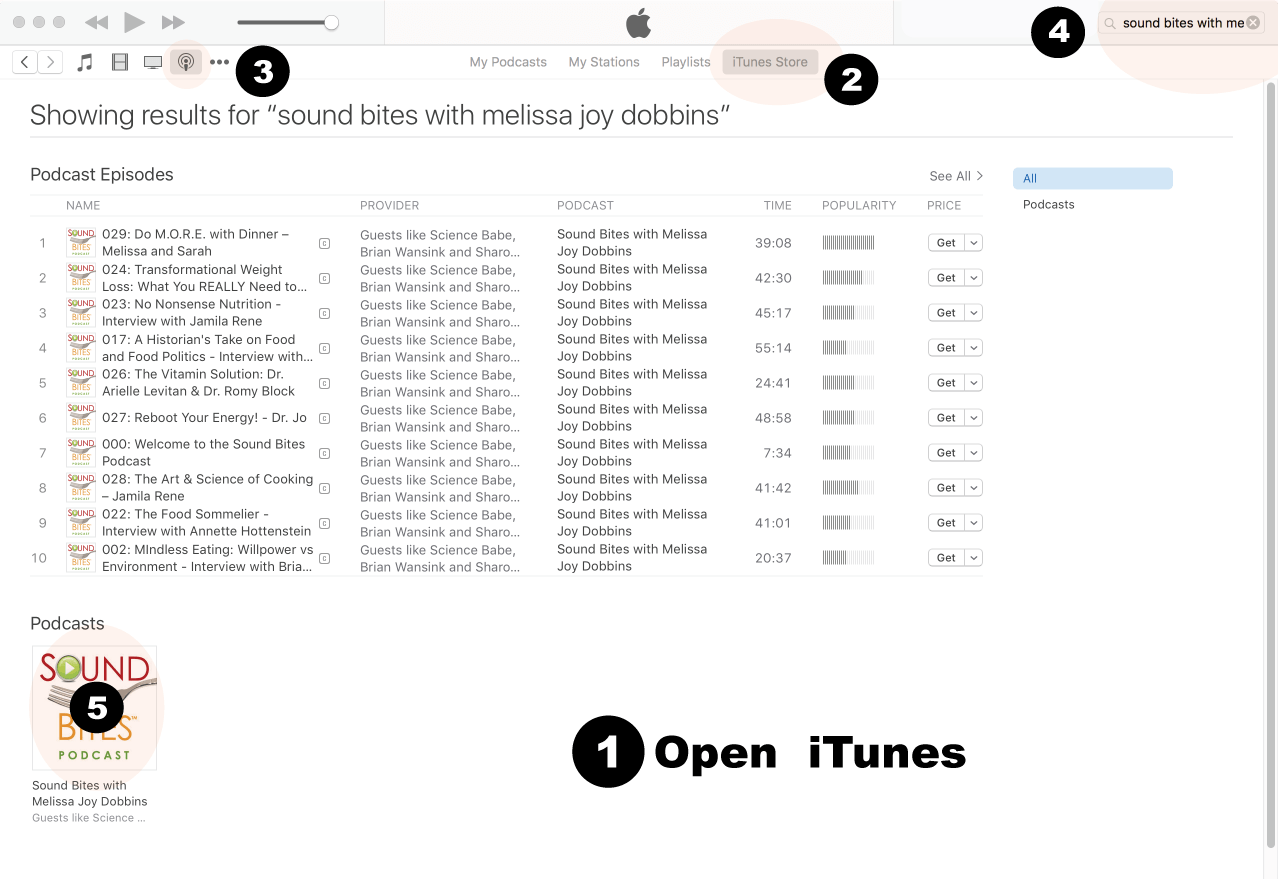
How to Review in iTunes
Open iTunes desktop application
Click iTunes Store
Click on Podcasts
Search for “Sound bites with Melissa Joy Dobbins”
Click on podcast image
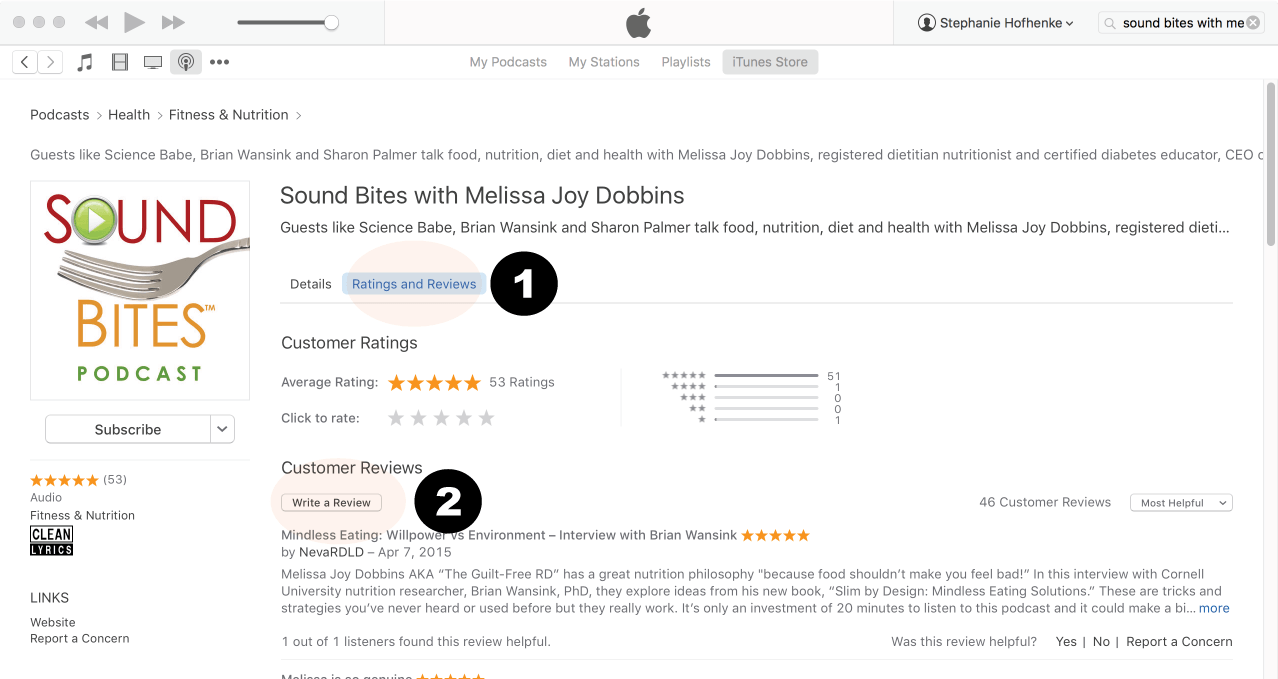
Search for Sound Bites podcast in iTunes
Click Ratings & Reivews
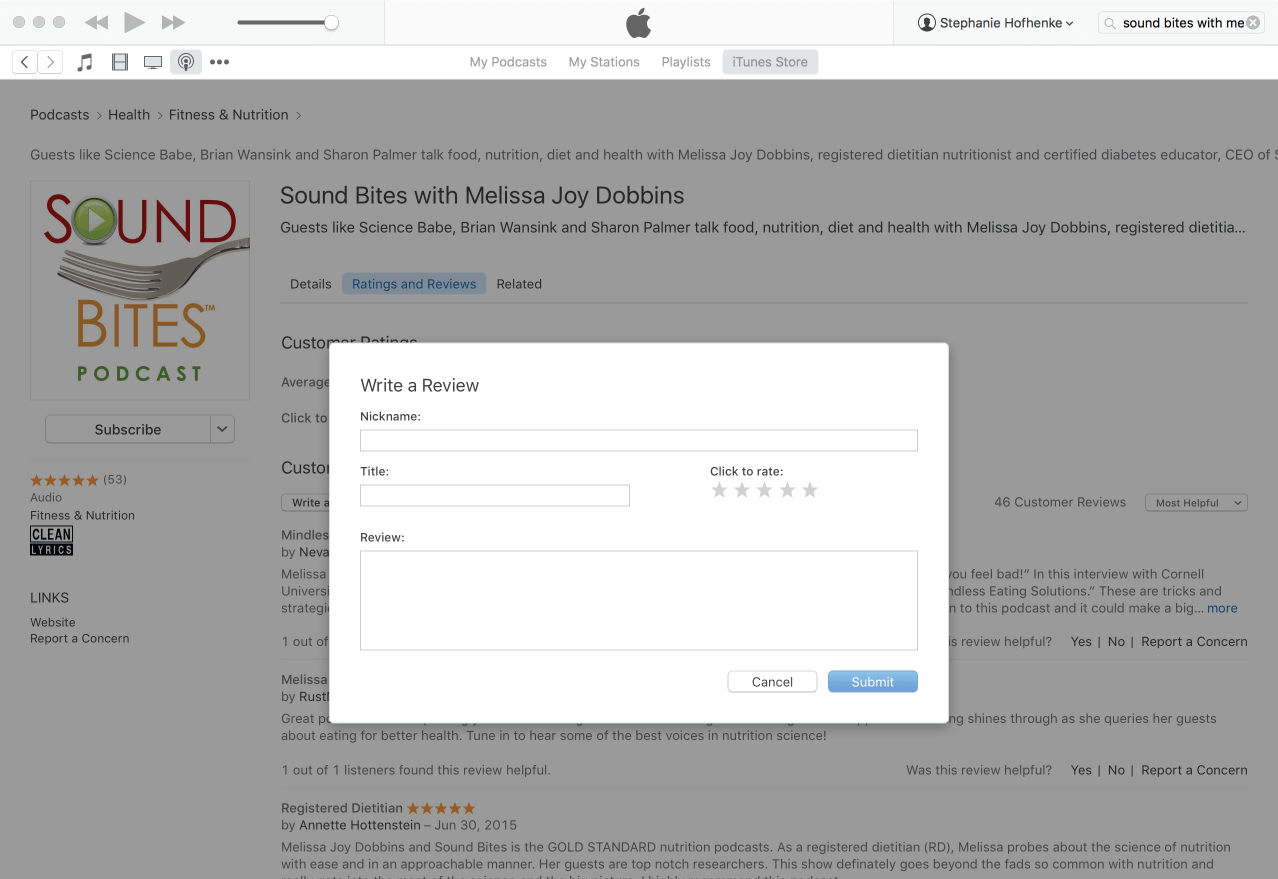
Click Write a Review
View reviews and write your own review.
Write your review…. Thank you!
Write your review!
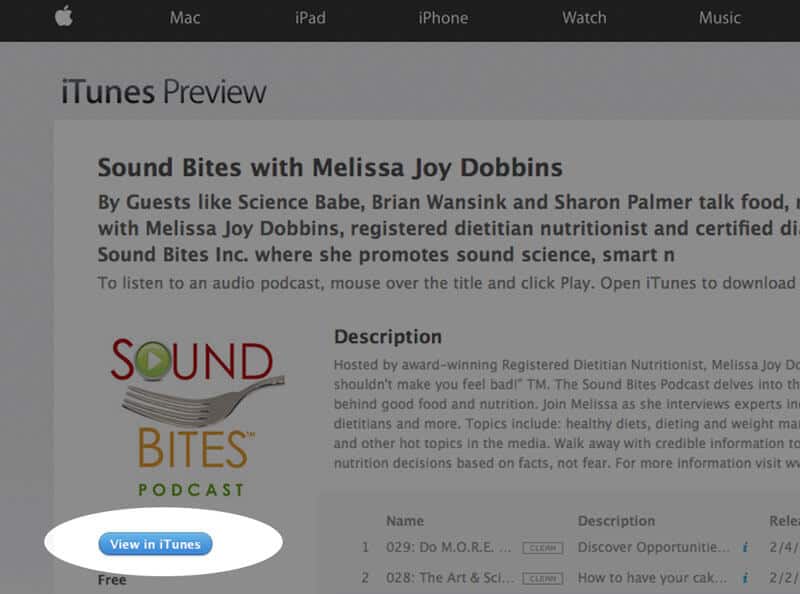
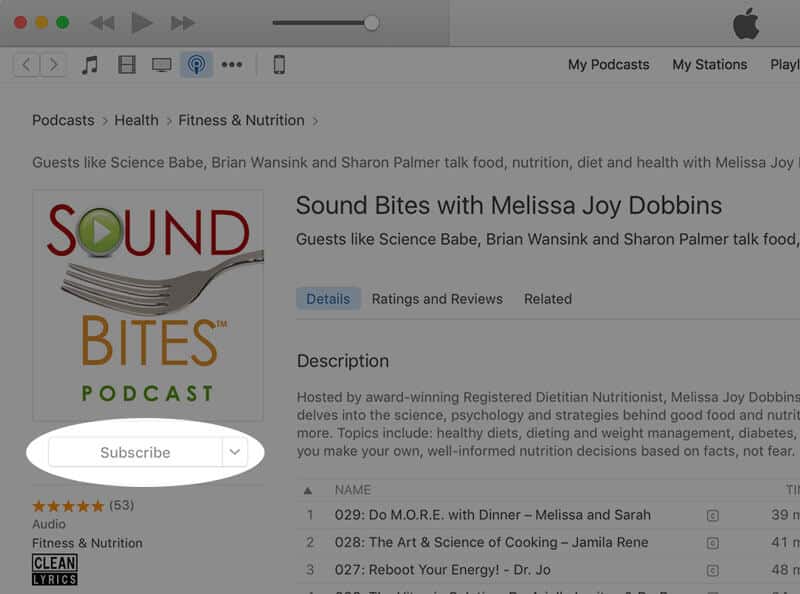
How to subscribe via iTunes
Click here to view the Sound Bites Podcastin iTunes, then click the blue “View in iTunes” button. This will open your iTunes application directly to Sound Bites Podcast. Click the “Subscribe” button, and your done!















Great podcast,, I have listened to them before,, how do you get the CEU form and is there a post test.?
Thanks Anne,
The CEU activity/quiz is here: https://soundbitesrd.com/sound-bites-podcast-free-ceus-episode-232/
Then you’ll get an email and a prompt to download your certificate.
You can find all of the current/available CEU activities here: https://soundbitesrd.com/sound-bites-podcast-free-ceus/
Thanks!
Melissa