Celebrating over 1 Million Downloads and 50,000 Free CEUs on the Sound Bites® Podcast | NEW: Get 1 years’ worth of CEUs with the new 15-CEU Podcast Course
Disclosure: This episode is not sponsored, however I did receive a complimentary copy of the book Eating From Our Roots: 80+ Healthy Home-Cooked Favorites from Cultures Around the World
An Inclusive and Diverse Way to Think About Healthy Eating
To be clear, we all have culture, and culture is not something to be assigned only to racial and ethnic minorities. Each of us was born into groups that share similar values, social norms and histories. It is these lived and inherited experiences that contribute to our cultural backgrounds.” – Maya Feller
There is a growing disconnect between mainstream notions of “healthy” foods and the fact that traditional, cultural foods can be, and often are, inherently nutritious. This narrow view of healthy eating is misguided at best, with traditional foods often being left out of the conversation or even demonized. When you consider a more inclusive and diverse way to think about healthy eating, you realize the importance of exploring and embracing culturally relevant foods in healthy dietary patterns.
Tune into this episode to learn about:
an inclusive and diverse way to think about healthy eating
the culture of wellness and healthy eating
foodways (the intersection of culture, history and food)
how history, trade and agriculture influenced flavors and foods in different regions across the globe
how social determinants of health impact access to the variables needed to express optimal health
what it means to decolonize your plate
why it’s important to explore different cultural foods and flavors
why it’s important to embrace and include favorite traditional cultural foods without feeling shame
the role of processed foods and recipe modification in healthy eating patterns
I intend for this book to be your first step of many in decolonizing your plate, exploring your own cultural roots around food, welcoming heritage and traditional ways of eating into your home, and discovering the amazing flavors from cultures around the world.” – Maya Feller
Maya Feller MS, RD, CDN
Maya Feller, MS, RD, CDN is the founder and lead dietitian at Maya Feller Nutrition. Maya believes in providing nutrition education from an anti-bias, patient-centered, culturally sensitive approach to help people make informed food choices. Maya shares her approachable, food-based solutions with millions of people through regular speaking engagements, writing, her social platforms, and as a national nutrition expert on Good Morning America, is a Healthline Medical Advisor and on the advisory board for SHAPE and Parents, as well as appearing on Good Morning America, Pix 11, TODAY Show, Tamron Hall, and in The New York Times, mindbodygreen, Well+Good, Food Network, Martha Stewart, Real Simple, Good Housekeeping, Cooking Light, Eating Well, Prevention, Glamour, SELF, and more. She is the author of Eating from Our Roots: 80+ Healthy Home-Cooked Favorites from Cultures Around the World (goop Press, January 24, 2023).
[00:00:01] Announcer: Welcome to Sound Bites, hosted by registered dietitian nutritionist Melissa Joy Dobbins. Let’s delve into the science, the psychology, and the strategies behind good food and nutrition.
[00:00:22] Melissa Joy Dobbins: Hello and welcome to the Sound Bites podcast. Today’s episode is about the disconnect between mainstream notions of healthy foods, which don’t typically resemble or include traditional or cultural foods, and the fact that traditional cultural foods can be and often are inherently healthy and nutritious. Ultimately, we’re going to be talking about an inclusive and diverse way to think about healthy eating.
My guest today is Maya Feller. She is the lead dietitian and founder of Maya Feller Nutrition and the author of Eating from Our Roots: 80+ Healthy Home-Cooked Favorites from Cultures Around the World. Maya believes in providing nutrition education from an antibias patient-centered, culturally sensitive approach to help people make informed food choices. She shares her approachable food-based solutions with millions of people through her regular speaking engagements, writing, her social platforms, and as a national nutrition expert on Good Morning America.
She is in the traditional and social media space all the time. You may have seen her on GMA or The Today Show, and she’s regularly in the print publications, The New York Times, Mindbodygreen, online, in print, everywhere. Welcome to the show, Maya.
[00:01:50] Maya Feller: Thank you so much for having me, Melissa. Wow, what an intro. I feel very welcome. Thank you.
[00:01:56] Melissa: My pleasure. I think it’s so cool whenever I see little behind-the-scenes stuff of you going on the big TV shows. My regular listeners know I used to do a lot of regular TV in Chicago, which is the third largest media market, but I’ve never been on The Today’s Show and stuff like that. I just think it’s so cool.
I have had the pleasure of meeting you and seeing you several times over the past year. I just really have enjoyed getting to know you and learning about the work that you do. Then when you published this new cookbook, which is way more than a cookbook, I said, “Okay, I got to have you on the show.”
As always, I always want my listeners to get to know the guest, but you have a very interesting background. I definitely want you to include the theater bit because I think it’s just crazy wild. I love it when my guests have a background in the arts in some way. Tell us a little bit more about you, your background, how you got interested in nutrition, and by way of the theater, by the way.
[00:02:57] Maya: Yes.
[laughter]
I, too, have enjoyed getting to know you and seeing you over this last year. It’s so refreshing to be among like-minded dietitians, and so every time we’re at a conference or we’re in an intimate workspace together, it’s truly a pleasure for me.
[00:03:18] Melissa: Thank you.
[00:03:20] Maya: My background. I was born in Cambridge– Actually not in Cambridge, but I was born in Massachusetts and grew up in Cambridge, Massachusetts. For anyone that is listening, you know that the Northeast has its own particular vibe. At the time, you’re going to appreciate this. When I was growing up, it was still very, very funky, so it was more the Vermont/ Maine crowd.
I remember when I was younger, going to Moosewood Kitchen with my moms, and it was just like, “Yes, that’s what we did.” One of the jokes was, we were eating in my family whole wheat pasta before it actually tasted like palatable. Kids would come over, and they’d say, “No, we’re good. We decline dinner.” We don’t need any of your food. They were like, “We’re okay. We’re fine. We’re fine.”
I have this vivid memory. I didn’t actually even plan to say this, but when we moved to New York, my mom had a pizza delivered from some health food store, and this lumberjack-looking person arrives at our door with a box, and he hands over the pizza. I’m so excited because we’ve just moved to New York from Massachusetts, and I get into the dining room, and I open up the box, and it is, like, dense whole wheat flour has to be like four inches thick just with tomato sauce and fresh spinach on top. Where’s the cheese? Literally, I was like, “This is not New York pizza.” I feel like that sums up my childhood right there.
[laughter]
[00:04:57] Melissa: Oh, my God, that’s hilarious because it’s pretty much the opposite of what I was raised on. However, I will say my stepmom Joy, which I think is really funny because that’s my middle name. She was very, what I like to say, granola. So I do have some experiences like that from visiting her.
[00:05:16] Maya: We would have gotten along. We would have gotten along. We would have been like, “Yes, I see you.” It’s kind of funny, and I bring that up because my childhood was very much like Massachusetts granola but mixed with a lot of the Caribbean. My biological mom is from the English-speaking Caribbean, Trinidad and Tobago. My biological dad is from Haiti, but I was raised in a home with two women, so I have this Afro-Caribbean background but then also this very radical upbringing. Think of any feminist from the ’60s and ’70s. They were definitely passing through our kitchen as I was growing up over a plate of pilau or curry chicken or roti.
Then in the mornings, it was granola that one of my moms had made or some sprouts from the windowsill. It was really this academic mashup mixed with the most delicious food and tons of community.
Then when I went to undergrad, I actually studied experimental theater. As you know, experimental theater, avant-garde theater, it’s not like when people think, “Oh, I went to theater school, and we were in a traditional black box, and everyone got up, and they read lines and did a scene.” Experimental theater is more along the lines of you’re going to roll around on the floor. There may be some verbalized emotion. It was avant-garde. It’s theater of the absurd. That’s what I did, and I studied philosophy.
[00:06:55] Melissa: What got you interested in experimental theater?
[00:06:58] Maya: I have always been a really interesting human from the beginning.
[laughter]
[00:07:06] Melissa: I love it.
[00:07:06] Maya: I was like, “This sounds great. I definitely want to spend four years in a studio doing spinal undulations and exploring alternative methods of performance.” I was really drawn to it. I thought it was very deep and meaningful, and it is. We’re not laughing at it. No, we’re not laughing at it, but it is highly creative and expressive, and it’s interesting. People say to me, “Oh, that’s why you feel comfortable on air.” I say, “It’s not actually the experimental theater, it was the study around it.”
Also, I think it informed my patient work. We had these exercises where you would do partner work in New York City, and one person would be blindfolded, and the other person had to safely navigate their partner through Lower Manhattan, just like a few blocks around NYU, bring them back, and then we’d talk about the experience. It really gave me the perspective of being reliant on someone else and having to use different senses as the blindfolded person.
Then it also gave me the perspective of really having to care and see the world in like a 360 because I had someone who I knew I had to get them back safely. It was experiences like that that I actually think informed how I practice as a dietitian years later because we don’t get stuff like that in school when we’re an RD. You have to pretend like you’re living on food stamps, and that’s it, but we don’t really have walk in someone else’s shoes to see what it feels like. That was my undergrad.
When I was finished because I lived in Williamsburg, Brooklyn, at the time, and I had this vivid memory of spending time with this director who I absolutely looked up to. Going to their house and walking 11 flights up in the middle of summer, no AC, getting to the building to sit and have a conversation about this upcoming experimental show, he’s like, “Would anyone like ramen?” No shade on ramen, but I was like, “That’s the only choice? That’s it? There’s nothing else?
[00:09:24] Melissa: Not like ramen like we get today?
[00:09:26] Maya: No, ramen like packet. Just straight up. That’s it. In that moment, I realized that the struggle around being an artist was one that I wasn’t up for. It wasn’t merely the finances, but it was everything. It’s these shows are so out there that it’s like a very niche group of people who come to see you. I thought, “Oh no.” I was like, “Now that I’m done, and I’ve done the whole study, I have to do something else.” I just got a regular job–
[00:09:59] Melissa: Which by the way, I have to say I had the same epiphany with ballet.
[00:10:01] Maya: Oh, tell me.
[00:10:01] Melissa: I had a little earlier that I wasn’t going to go to college. I went to a performing arts high school my sophomore year, which darn near killed me. No, it was definitely that realization of the academics were horrible. It was a boarding school, and I was a straight A student. I had to work for my grades, unlike my brother who was genius. I don’t know. I just thought, “I don’t want to give up everything for this. I sure don’t want to give it up to be in the cort de ballet because if I’m not the next female Baryshnikov, then what’s the point?” I just was like, “I’m not giving up.”
It was painful. I’ve said this, I think on the podcast before, but this is coming from– I don’t know if your moms were in the arts or anything, but both my parents were. My dad was an actor, director, playwright. My mom was a graphic artist. By the way, she could build a Shakespeare costume from scratch. She sewed my prom dress from scratch. Anyway, here I was raised by people who were living the arts, breathing the arts, loving it. I was like, “No, that’s not me. I don’t love it like that.”
[00:11:15] Melissa: Similar? Yes, I’m not giving all that up.
[00:11:19] Maya: That’s so interesting. My parents are all academics.
[00:11:23] Melissa: That does not surprise me.
[00:11:25] Maya: I never understood– I’m grateful that I had the opportunity, but I never understood how my parents were like, “Sure, go to NYU for four years and major in experimental theater.” I have kids. I suppose if my son did say he wanted to major in experimental theater, I would say, “Interesting.” I don’t know that that’s something that I would like actively fund.
[00:11:49] Melissa: Do you think that they said that because they knew you would learn so many things in that environment?
[00:11:56] Maya: I’m sure, and I’m sure that I would support my son through experimental theater should he so choose.
[00:12:02] Melissa: You’re talking yourself into it, and I hear that.
[00:12:04] Maya: Exactly.
[laughter]
[00:12:06] Maya: It is the reason why I went for a master’s, my parents, and their academic background. When I was trying to figure out what I wanted to do, I was volunteering for the Junior League in New York City, which is this wonderful volunteer organization. I remember I became the chair of the playground committee, and we were refurbishing a playground in Harlem. I was in the Junior League, I think, just two years.
All of the women in the league with me were very frustrated because they were like, “Where did she come from, and how is she the chair, and now she’s gone?” They were like, “This is terrible.” No, they were quite friendly with me.
At that time, I just had a regular job, and it was awesome. I was working at a place where I had accounts, and I was handling high-end mailers for Christie’s and Sotheby’s, and I loved it. It was so straightforward. We would do these campaigns, and I knew exactly what I was doing, and I knew who my accounts were. I had time to volunteer, and then I started running. I was running, and I was thrilled. I had this life that didn’t have much responsibility, and it was really straightforward, 9:00 to 5:00.
Then, I remember training with my best friend and running partner. She ended up in the hospital twice. Once she had hyponatremia, and then once, she had hypernatremia until we were having a really hard time with hydration. At the time, I was a vegetarian, and I was just like hungry.
When I tell you hungry when you’re training for races and running, it’d be like I’d eat breakfast, we’d hit mile six, and I was like, “Where’s food?” There was no goo or gummy or maple syrup packet that was doing it. I remember I’d just get off the train and get two falafels and eat it and then be, two hours later, hungry again. She was in and out of the hospital, and I’m just like, “I’m always hungry.”
[00:14:15] Melissa: You’re starving.
[00:14:15] Maya: We didn’t know what we were doing. I went, and I googled nutrition for runners, and then all this nutrition school came up. I was like, “This is a thing. People study this.” Then, I was like, “I’ll get a certificate so I can figure out how to fuel my runs.” I remember talking to my dad, who’s PhD master chair of the music department at Wellesley College. I’m like, “I’m going to get a certificate in nutrition.” He’s like, “A certificate?” He’s like, “No, you’re going to get the terminal degree.”
I was like, “No, I’m not getting a PhD in nutrition, but I will consider going to school and getting a master’s.” He was like, “Okay.” That’s how I actually ended up. You’re going to love this because my undergrad was in theater and philosophy. There was no hard science anywhere. It was all the soft sciences. I also didn’t want to take the GRE because I was like, “That’s not happening.” I was like, “Nutrition schools don’t require the GRE in New York.”
I was really specific because I was like, “I’m going to do this, but I’m not spending four years preparing myself.” In the end, I went to NYU, and I did two years of all the prerequisites because I did all soft sciences, no math, nothing. Then, I fell in love with clinical nutrition.
[00:15:42] Melissa: Clinical. Really?
[00:15:43] Maya: Yes. I loved it. I really loved it. I was at Sloan Kettering for my rotation, and it was so awesome. When I came out, I ended up going into the community, but I worked with a high-needs population, HIV, AIDS, Hep C. There was a lot of MNT that was happening. It was a community program. However, we were dispensing oral nutrition supplements because there was so much cachexia in our population. Then there were a number of comorbidities because people had challenges with medication management.
We had a really at-risk population, and it was from a clinical and medical perspective.
[00:16:30] Melissa: It was like clinical public health?
[00:16:32] Maya: Yes. It was really powerful work, and I learned a ton there.
[00:16:37] Melissa: Making a huge difference too.
[00:16:39] Maya: Yes. The only reason I left, and I probably only started saying this recently, was because I couldn’t actually afford to stay once I had my daughter. I was making $53,000 a year in New York City with two kids. When we did the math, my salary would’ve gone 100% to preschool and childcare. No groceries, no mortgage. Forget vacation. That wasn’t even on the table. That salary alone for two kids in New York City was preschool and nanny, babysitter. Even babysitter share whatever at the time.
We actually decided that I would stop working because if I went into private practice, we did the math and we were like, “I could make the same amount of money working three days per week, and maybe I could make more and actually contribute to our family.”
[00:17:35] Melissa: Wow. When was that? How long have you been running your own business?
[00:17:39] Maya: I should know this on the nose because it was such a like, “Oh, my goodness. Switch?” It has to be–
[00:17:46] Melissa: You can think about how old your kids were because that’s how I remember–
[00:17:49] Maya: It’s been 10 years. Perfect. Thank you. That was easy.
[00:17:53] Melissa: Oh, my gosh. I’m like, “Maybe 11 years.” Because I remember exactly what was going on. I wasn’t seeking to have my own business, but as you say, when the family needs you, you want to be there for your family and everything, and you want to try to make it work and have that flexibility. We better jump into the topic. We had a lovely conversation getting to know you. This is so much fun. I know. I can’t keep you too long either.
Let’s talk about– Because again, this book is more than a book. It’s more than a cookbook. Let’s talk about the concept of culture because you talk about it in a way that I think really helps lay the foundation and open our minds to this broader understanding. I’m just going to turn it over to you. Tell us about the concept of culture.
[00:18:39] Maya: One of the things that I always say when talking about culture is that culture is something that we all have, every single one of us. It’s fascinating because sometimes I walk into spaces to have this discussion, and people say like, “They, someone other than the individual, they have culture.” This is especially the case for people who are part of whatever the dominant or mainstream is.
In the US, people who are non-American, we think of that as being culture. However, there is American culture. Then, within overall American culture, there are a number of varieties of how people express culture. There’s a culture in New York. There’s a total culture for living in Brooklyn. Even within Brooklyn, there’s a culture among the international schools and families. There’s a culture for people who come from English-speaking Caribbean or from Scandinavia. Culture are those social norms really that any group agrees upon. It’s an unspoken agreement.
If we realize that there is culture all around us– I often say that’s one of the reasons I love to live in New York is for the culture, and I mean the accessibility to the arts and to the diversity. Then when we start to think about culture as something that moves through social groups, then we realize that culture can be related to race which is a social construct, and that culture can also be related to ethnicity, like our origins from where we come from, our lineage. Then we also realize that culture gets tied into history and things that are passed down and what we think of as our individual truth, our group truths, and more.
Then there’s definitely culture related to food in terms of who we are, who we aspire to be, the culture of food in the homes that we grew up in like we both vibed on the granola-eatenness of my family and your stepmother Joy. Culture informs many parts of our multiple identities. Because I’m a dietitian, I think about the culture of wellness and what does it mean to be in part, and that’s in air quotes of wellness culture. Then what does it mean to be on the outs of wellness culture, with no quotes, because you’re just out if you’re out.
I feel like in the book, one of my desires was to invite and bring readers into this idea that when we think about the globe, and we think about foodways, so the intersection of culture and history and food, that we expand how we define what is “in and healthy redefined.” There’s a redefinition of what’s in and what’s healthy.
In my book, I want to add recipes that are heritage recipes from all around the globe. Because I was born in the US, there’s a significant amount that’s representative of certain parts of the US. Again, I’m really careful to say that this is not exhaustive. Of course, it’s from my lens, born in the Northeast of this country with a particular experience. Again, that’s from my lens. Then I worked with chefs who either have roots in places that the recipes come from or have done extensive research.
We move through the American South, we have a little bit of the Midwest, and then the West Coast, and we’ll see that it’s not monolithic. Depending on whoever’s home kitchen you’re in or whatever restaurant you’re in, all of these flavors change. There may be similarities, but it’s tastes of all those places, and then we move around the globe. I think about culture from all of the different angles that we can come to a place and say like, “Uh, the culture of food here is kind of like this with variability.”
[00:23:08] Melissa: That variability is something that I think is really key. I remember getting a glimpse into that concept years ago, just even thinking about Hispanic foods and education materials. We couldn’t just take a handout and translate it into Spanish because there are different dialects and there are different– Also, not all Hispanic cultures eat rice and beans, or not all of them eat tortillas, and it’s very, very different.
I learned a lot of that from our friend and colleague, Lorena Drago, which by the way there is a related episode that I did with her, and I’ll link to all of those in the show notes for anybody who’s interested. Like you said, it’s not monolithic. There’s a lot of variability. I guess that whole melting pot idea, too, like, you grew up in the Northeast, but you have Caribbean and Haitian roots, we’re complex. It’s not simple.
[00:24:04] Maya: Super complex.
[00:24:05] Melissa: By the way, thank you for the complimentary copy of your book. It’s gorgeous. I love, the photos are just outstanding. You’ve got photos of your family in there too. It’s lovely. As you know, I intended to try to make a couple of recipes before the interview, but I ran out of time looking for some of the ingredients, but I’ve got a lot of the ingredients. There’s just a couple that I have to hunt down yet. We’ll talk about some of the recipes that you recommend.
You mentioned a little bit about your intention with this book and your purpose of this book. Was there anything else you wanted to say about how it came about? Did you pitch this idea and anything with regard to publishing or anything that you wanted to share with us?
[00:24:50] Maya: I was approached. It was actually quite fascinating. The imprint is through Goop. In the shutdown of the pandemic, I had done a panel with one of the Goop food editors and had written for Goop. They approached me and asked if I was interested in thinking about writing a cookbook. The talk that I’d done was with Kate O’Malley, and then I thought, “Sure, I’d love to.” I was kind of surprised.
I’m a very expansive thinker when it comes to food and nutrition. I always am clear to be inclusive and really come from this anti-bias perspective in terms of thinking about how we talk about nutrition in marginalized communities. I thought, “Sure, I’d be more than happy to. Interesting.” I had a few meetings with Goop and Random House, and they asked for my ideas. Then they came back and said, “We have an offer for you.” I was like, “Sure, this sounds great.” Originally, I wanted to travel all over the world.
[00:26:02] Melissa: [chuckles] To do your research for the book?
[00:26:03] Maya: Yes.
[00:26:04] Melissa: I love it.
[00:26:04] Maya: Into like all the aunties and uncles. I would be in your stepmother’s kitchen.
[laughter]
[00:26:10] Maya: Like, “All right, let’s talk being earthy-crunchy,” but I couldn’t because the shutdown happened. It shifted how we worked on the globe. That was how the book came to be. I’m incredibly grateful that I was approached. I honestly do think that part of the reason that I was approached is because I’m fairly straightforward when I talk, and I’m honest, and I share just enough about who I am so that people like your listeners can say like, “Oh, that resonates. I recognize that.”
[00:26:44] Melissa: You’re super smart.
[00:26:45] Maya: Oh, thanks.
[laughter]
That’s the Massachusetts Afro-Caribbean. I have to give all the credit to all the people who were involved in raising me. [laughs]
[00:26:56] Melissa: They did a good job. We’re going to talk about what people can find in the book and how it’s laid out. You had mentioned the eight chefs, and I know that you have developed hundreds of recipes on your own you mentioned a little bit about the eight chefs and their purpose and their influence. I wondered if you could talk a little bit more about how you worked with them and how they helped develop the recipes, that whole collaboration process.
[00:27:21] Maya: When Random House approached, and we had the conversations because it is a cookbook and they’re a worldwide global publisher, they said that one of the ways that they work is that they usually have a recipe developer. I said, “Well, absolutely not.” I was like, “I don’t want a recipe developer.” They said, “Then the recipes have to be chef tested.” There was some concern, which is interesting.
Part of backlash in publishing is that truthfully publishers are frightened that there will be co-opting happening when people are having discussions around ethnicities and cultures that are not their own. They wanted to make sure that I wouldn’t– Do you remember that restaurant in New York City where there was a couple that opened up a clean Chinese food restaurant? That is in air quotes. They were like, it’s better for you?
[00:28:25] Melissa: Yes.
[00:28:25] Maya: Exactly. It was a total debacle. I said to them, I said, “Guys,” I said, “I am a very sensitive person.”
[00:28:32] Melissa: I am the last person who would do that.
[00:28:34] Maya: There was still concern, especially because I’m not a chef, and we were moving around the globe, and there was a lot of concern. I wasn’t going into the kitchens of aunties and uncles and grandparents and all that to pull the family recipes. We said, “Well, okay, what if the chefs represent these places? They submit recipes, I modify them,” and they said, “Sure.”
We found with my dear, dear friend, Chef Silvia Barban, who is Italian and probably, in my mind, one of the best chefs ever, she helped me source these talented chefs. I also did a lot of research. I reached out to Bill Telepan, who’s the culinary director of The Met in New York, and that’s a metropolitan museum, not the opera. He hooked me up with a bunch of chefs that I actually interviewed, and I talked to them about food, how they think about food.
I started to pull ideas. Then some of the chefs that I interviewed, I asked for their contributions. It was between my connections and people that I interviewed and Chef Silvia that we got this core group of chefs together. We told them the regions, and we chose people based on their background and expertise. We told them the regions, then I went ahead, and with Sylvia, we modified them, and we tested every single recipe in my home kitchen because we wanted to make sure that home chefs could do this.
I’ll never forget one of them submitted a recipe that had sous vide. Exactly. It was like, full stop no. It’s like, absolutely not. I was like, love the flavors. I just remember reworking it with her to get a similar mouth feel. It was hilarious.
[00:30:31] Melissa: For our listeners who don’t know what sous vide is, can you explain it briefly?
[00:30:35] Maya: Sous vide is basically very low temperature, cooking in a pouch, but in boiling water. There are-
[00:30:42] Melissa: You can buy sous vide kits that are very expensive.
[00:30:46] Maya: Super expensive.
[00:30:47] Melissa: Or if you do it on your own, you really have to know what you’re doing. It’s not–
[00:30:50] Maya: You can create botulism.
[00:30:52] Melissa: There you go. [laughs]
[00:30:56] Maya: Absolutely not. That’s really how we got to some of the recipes, and then some of the recipes Sylvia and I developed together, and then some of the recipes I developed completely by myself. Then I had to make them three, four, or five times for Chef Sylvia. She’d taste it and say, “Okay, this is great, but go back again.”
[00:31:19] Melissa: Interesting.
[00:31:19] Maya: Then she’d say, “That’s good.”
[00:31:21] Melissa: Wow.
[00:31:22] Maya: I was running it from my place to hers. I had a group of testers that would come and give feedback, and 10 people that were just coming and picking up Tupperware.
[00:31:35] Melissa: Was this during the shutdown, or was it– Oh, gosh.
[00:31:39] Maya: Yes. We were in a bubble. It was in my house. It was me, Chef Sylvia, her girlfriend, my husband were the only people that were in the kitchen. Right? Otherwise, it was a closed kitchen because it was COVID.
[00:31:50] Melissa: Yes. Oh, my gosh. All that work. Like I said, it’s a beautiful book. The two recipes that I’m looking very closely at was I had asked you when we talked before, what should I make? You said, “Oh, the Peri Peri chicken.” That is actually, ironically, the very last recipe in the book. I’m turning to the page now. It’s from the region Portugal. At first, I thought, “This looks really fancy, but it’s very doable.” You just get the ingredients for the rub, no the marinade, and the herb sauce. It looks very impressive because you have this chicken, and you say the grocery store butcher can butterfly it for you. Is that the right term?
[00:32:33] Maya: That’s exactly right.
[00:32:34] Melissa: Yes. I’m going to make that. Then the Pad See Ew also caught my attention because it’s my favorite dish of all, and our favorite local restaurant closed, so I thought, “I could try to make it.” Tell everybody, besides, obviously, the recipes, how you have it organized, and the intro. It’s more than just an intro. It’s so well written. I hear your voice. I hear you talking when I read it.
Some of these concepts that we’ve been discussing about culture, diversity, inclusivity, but also want you to speak more after you tell everybody how the book is laid out and everything about some of these social determinants of health and so on. We’ll circle back with the health focus. It’s a gorgeous book.
[00:33:22] Maya: Thank you. I have to give the publisher and the art department huge, huge shout-out and props. The photographer, Christine Hahn, brought together the most incredible group to bring these recipes to life. We decided to actually set the cookbook up where to the Front Matter talks you through what you can expect. Then it’s things that you may commonly consume for breakfast. Then we have soups, stews, curries, plant- forward, fish, meat. It’s really broken up like that just for the reader.
Then in those sections, there are regions that are discussed, and there’s a little bit of historical tidbits. It goes pretty far back, looking at trade and some agriculture, why these flavors are in places. For example, the peri peri chicken, although Portugal is linked to colonization in Africa. By way of Angola and Mozambique, these flavors ended up in Portugal.
[00:34:33] Melissa: That’s interesting.
[00:34:35] Maya: There’s those little tidbits for people, and it’s in the head note. Then also there’s some little callouts and little research sections within the book, just so folks have this idea. Now, it’s interesting. I always say when I was writing this book, I was aware there are things in here that are expensive, right? Like lobster is expensive, point-blank; crab is expensive. As we went through the economic shifts in the US, these things became even more expensive.
When I was testing the recipe, I was able to get crab in my area for about $15, which would be a special dinner, right? Then I went back to test the recipe for a show that I did it on, and it was $50.
[00:35:24] Melissa: Wow.
[00:35:25] Maya: You ask about social determinants of health because in the front matter in the book, I actually have a discussion around the social determinants of health and how where we live, where we work, our access to health care, whether or not we’re insured or underinsured how we’re employed, the structure of our employment impacts, how we can access the variables that are needed to express optimal health.
When I say optimal health, I don’t mean living free from disease, but I mean if there is a condition that’s chronic, that it’s well managed. What we often see is that communities that are on the margins and people who are experiencing financial insecurity are the first to get hit whenever there’s something extreme that happens. The discussion in this book really looks at in the US. It is black, brown, and indigenous populations that experience these extraordinary health disparities. That’s just simply as a result of structural inequities.
I did a book talk at the beginning of the month in Massachusetts, and someone said to me, so how could someone from a marginalized community enjoy your group if they’re experiencing financial insecurity? I said, “Quite honestly, I have a discussion about it.” However, knowing that these recipes are expensive, I would believe that they’re reserved for special occasions, right? That they’re not everyday recipes.
If someone wanted to purchase the book and they were saying they spend all their food dollars very wisely, some of these recipes are going to be special. The things like the soups, the stews, the larger dishes, those could be made in bulk and then frozen or stored for later consumption. But I do recognize because food in this country and access to food that is safe, affordable, culturally relevant, and nourishing. I do say safe because you want fresh food. When I say fresh, not meaning boxed, canned, jarred, or frozen, food that’s not spoiled, right? I’m also aware that there are many places where people do not have access to safe food.
I’m aware that this access across the country, it’s not a given, right? It is a human right, but it’s not a given. I am very aware that, in many ways, it is a luxury, right? It is a luxury to be able to say I choose this over this.
I also say in the book that I know that the book is not going to change the structures that exist, but that I do believe that there needs to be a top-down, bottom up, right? coming from grassroots, but also policy shifts and changes to have an impact on these social determinants of health and to change the landscape of food access. Then I hope that what I can do with this book is add to the conversation. Because right now, the conversation is if you eat a particular way, you are “healthy,” you are therefore good, and you will be free from disease.
If you have diabetes or hypertension and you didn’t eat according to the recommendations, then it’s your fault. I want this book to have recipes that are full of flavor, come from all over the world, US included, that have an intentional and gentle use of sugar, fat, and salt because all of those things help to make our food taste better. But that expands how we’re thinking about what’s acceptable for the plate and increases conversation so that people say oh, this is a choice, right? I can eat this. It has nothing to do with the morality of who I am.
[00:39:36] Melissa: Yes, absolutely. I think that’s the main theme that I wanted to address and share with our listeners is even though we are talking a lot about diversity and inclusivity, to look at the plate and realize that there might still be some bias and judgment going on. And that really when you think about some of these traditional. cultural foods, they’re so inherently healthy, and we shouldn’t be shaming anybody for rice, beans, tortillas, and then of course, there’s other cultures.
[00:40:12] Maya: Even cereal-
[00:40:13] Melissa: Even cereal.
[00:40:14] Maya: -or even a pancake, and that’s the thing. In my book, I talk about the grains that were originally used to make pancakes. Depending on if you were in the northeast or the southeast of the US, or the center of the country, sometimes it was corn, and it was a hoecake, and sometimes it was a wheat grain. Now we think of pancakes as these things that are absolutely terrible, but pancakes are grains mixed together with water, salt, maybe an egg, sometimes milk. There’s absolutely nothing wrong with any of those ingredients.
If someone has an intolerance or an allergy, they can modify the grain to meet their nutritional needs, but there’s nothing wrong with a pancake, but it’s been demonized. It’s this thing that’s thought of as like a cheat.
[00:41:03] Melissa: Ultra-processed.
[00:41:05] Maya: Exactly, you’re cheating, but it’s a pancake. You’re not cheating. Even the word cheat day, like cheaters are people who do bad things. I cheated on a test, I cheated on my partner, I’m having a cheat day from school or from food. The language is so biased. There’s a pancake recipe in the book, and it’s like, this is food, right?
[00:41:33] Melissa: Right. We’re addressing why it’s important for people to explore different cultural foods and flavors, and it’s important for people to embrace and include their favorite traditional cultural foods without feeling the shame. While we’re talking about that, and I had a reaction to some things that you were saying about the expensive recipes or whatever. However, I would think my assumption is, for these traditional cultural heritage type foods and recipes, that they’re using what would be local to that region, local and seasonal. In that particular region in time, they wouldn’t be as expensive as we are trying to access certain things.
[00:42:21] Maya: Anytime anything was imported from anywhere, for sure. Even in the US, we’re experiencing an increase in our cost of grain, like, yes, there’s a waffle recipe. Some of them, I would say, are more affordable than others. If you’re able to buy a waffle maker, once you get pretty quick at making waffles, you can do anything to them. This particular recipe has, I believe, cheddar cheese and mushrooms. I chose, I think, I can’t remember, I should look at the recipe before I say this, but I believe that I did like a local Wisconsin cheese, which I think I did like an aged one that has like some alpine flavors, and then the mushroom together, and that’s a savory option.
That could actually be like a breakfast, lunch, or dinner. In the book, I play with how we think about putting foods together, and I think that also helps with seasonality and cost. Whatever is in season where you are, you can play with.
[00:43:22] Melissa: And the food waste aspect, too. Avocados are expensive here, but where they’re abundant, they’re not as expensive. I wanted to touch on that. Back to what I was saying, while we’re discussing that these traditional cultural foods can be healthy and nutritious, you do have a section in the book that addresses how to modify recipes for health conditions, although you’ve already modified them to some extent. Let’s talk about that a little bit, and also, I’m sure it was a conscious decision not to do nutrient analysis, and I’d love to hear your thoughts on that.
[00:43:53] Maya: Oh, yes, for sure, it was a conscious decision not to do nutrient analysis. The reason being, we have been trained to look at calories and make decisions based on whatever calories we see. We want something that’s a lower-calorie option. What I was hoping to do with these dishes is to actually think about nourishment. Many of the recipes have a combination of protein, fat, and carbohydrate together. There’s a lot of fiber. I was thinking about using herbs and spices in the recipes to bring out flavor, trying to minimize the salt, simply because we are in the US, and I know that a smaller proportion of the population is not navigating a chronic condition.
I believe it’s a 27% currently have no diagnosis with the rest navigating some diagnosis. I was really thinking about what’s happening population-wide in this country. I didn’t want to put the nutrient analysis because I want people to think about temperature, texture, flavor, and building a dish that they want to return to. If I tell someone this is low sodium, they may have a reaction, say, oh, that’s going to be gross. If it’s beautiful and delicious, and we’re not having an overt discussion about sodium, we might get the benefit of the person returning to the kitchen to make the dish more than once, which actually ends up being really beneficial for their desired health outcome. That was the reason for no nutrient analysis.
[00:45:37] Melissa: Very good. Thank you. Is there anything else you wanted to say about the section that addresses how to modify recipes?
[00:45:44] Maya: My practice, we’re a small team. We’re small but mighty. We work with people who have non-communicable conditions. A lot of diabetes, a lot of hypertension, cardiovascular disease, some autoimmune conditions. I wanted to think about actually having a conversation saying that, if this is something that you’re navigating, going into these recipes and saying, “Okay, I’m going to think about my carbohydrate literacy. I’m going to think about what does it look like if I’m being conscious of added sugars.” There’s not many added sugars in the recipes, but still, what are some of the things that are actionable that people can engage in if they need to modify a recipe further?
It’s not, again, demonizing. It is very clear to say, what is the additive nature? What can we add to this so that it meets your needs in a better way? I was also really clear that this is not a book expressly for said condition. These are tips that you can use anytime, in any place, so any other recipe book that you’re working with. There is a section of some straight-up swaps for people who don’t eat animal proteins, like, what are the mushrooms that give you that super meaty texture and flavor, tofu, various things that you can put in place of whatever animal protein because there are animal proteins in the book.
[00:47:22] Melissa: Great, thank you. Also, just real quick, I know there’s also a section about understanding processed foods. What would you like people to know about that?
[00:47:31] Maya: There are two things. Number one, if we’re going to feed the world, we do need processed foods, and that everything is processed to some degree. Once it leaves the farm, the orchard that’s a step of processing. I also say for folks that I want people to be informed and educated consumers so that they can make choices based on their needs. I also want people to know and understand that boxed, canned, jarred, frozen, freeze-dried, are all processed, and all have a spot in food preparation and eating, and that one is not better than another.
Only going to the farmers market doesn’t mean that you’re making an inherently better choice. It means that you’re supporting a farmer and going to the farmers market, which is a wonderful choice, and going to the grocery store and buying a box of pasta is also a choice. It means you’re going to the grocery store, and you’re buying a box of pasta, which is a wonderful choice, and both are choices. When we are able to make choices, that’s a great thing, and it’s a luxury and a privilege to be able to make choices.
I want people to know that these are all parts of putting meals together. I’m also acutely aware that in this country, some people don’t just have one job, some people have two or three jobs, and people may not just have one kid, and some people may have two, three, four, five, six, seven kids. Getting food on the table is really different for everyone, shift workers, 24-hour people.
If there’s a recipe that calls for beans, a barrier to entry could be that it only says use dried beans when canned beans actually reduce the cooking time drastically, and it’s a wonderful vehicle for getting a nutritious ingredient onto the platter. I want people again to know that there’s a spectrum of choices. If you go to the farmers market, awesome. If you go to the dollar store, awesome. These are all choices or options.
[00:49:45] Melissa: Excellent. One of my favorite things is having that choice when I go to the grocery store. I was on food stamps as a young child, and I feel like the richest person in the world when I have choices at the grocery store. I feel so grateful for that, and it’s very powerful.
Are there any favorite flavors or spices or herbs that you either loved before the book or discovered during the process of the book that you encouraged people to try? I recently discovered kombu, and that’s how you say it by trying it in a recipe, a recent episode that I did. I saw that in your book, and I was like, okay, I know what that is. I didn’t know what that was a few months ago.
[00:50:31] Maya: So funny, my Venezuelan friend put me onto it years ago we were cooking beans. He’s like, “Ah, you got to get the kombu.” I was like, “Okay, kombu.” A piece of ginger kombu in the beans. It’s like amazing. Favorite flavors. I love seafood. Melissa, I love seafood. Love, love, love seafood. That is a flavor that I love, but I also love spice. Any of the hot peppers or five spice powders or vadouvan curry, which is mild but has a little kick.
I love, like this morning for breakfast, I had a gigantic farm egg. Melissa, you know about my love and obsession with eggs. I’m such an egg lover. I had a jumbo farm egg. Sometimes it has two yolks, but today was only one. On a piece of sourdough bread with Aleppo pepper and smoked pepper, and then black pepper, which is like a regular for me. I will say in the book, people will notice that there’s like a lot of acid and a lot of heat. If you have GERD or GER, you’re going to have to turn it down.
[00:51:41] Melissa: Duly noted.
[00:51:43] Maya: Those are like you think of Maya flavors, it’s like spicy and briny.
[00:51:49] Melissa: I love vinegar, briny, acidity. The heat depends. It depends. Are there any recipes– You mentioned the peri peri one to me. Do you have any sample recipes from the book on your website or anything that could give people a taste, and maybe even– Is it available on Amazon?
[00:52:09] Maya: Yes, so the book is available everywhere that books are sold. I do believe that if you Google Eating from Our Roots and my name, there are some sample recipes that will show up in places like Well and Good, Mindbodygreen. I think there’s even one on Goop’s website. There may be even one in Taste, Bon Appetit. There are–
[00:52:35] Melissa: Sometimes Amazon has little preview things too.
[00:52:38] Maya: Exactly. Splattered around from interviewing and press push.
[00:52:44] Melissa: Yes. Okay. That makes sense.
[00:52:45] Maya: Oh, there’s one in People. There’s one for sure in People magazine. Yes, and we’ve had some features.
[00:52:50] Melissa: Well, I’ll do some Googling around and I’ll throw whatever links I find in my show notes @soundbitesrd.com Before we wrap up and give our listeners a little send-off with inspirational wrap it up with a nice bow, tell people where they can find you, your website, your social media handles and so on.
[00:53:10] Maya: Absolutely. So your listeners can find me on social. Instagram @mayafellerrd, Facebook Maya Feller Nutrition, and I just posted my second TikTok video.
[00:53:23] Melissa: Ah, you were inspired by our friends Liz and Rosanne?
[00:53:28] Maya: It was exactly.
[00:53:29] Melissa: They just did a talk about TikTok and reels that you can do on Instagram as well at Today’s Dietitian conference.
[00:53:37] Maya: That’s right. I’m on TikTok at mayafellerrd. My website is mayafellernutrition.com, and you can find Eating From Our Roots everywhere that books are sold. So hit up your favorite indie bookseller or go to Amazon, get a copy for yourself and for a friend.
[00:53:55] Melissa: Absolutely. It is. It would make a great gift. I got an extra copy when I saw you in Savannah at Today’s Dietitian, and had you sign it so I have a copy to gift away to maybe one lucky listener or maybe someone in my family. We’ll see. We’ve covered a lot of ground here. It’s a lot of important information. As we’re wrapping up. I know that you have sort of these nutrition or health pillars that are in the book that I think might be a nice way to say what’s the bottom line? What do we want people to know and do as we’ve had this conversation, clearly we want them to think about food in a more diverse and inclusive way and healthy eating too. What is considered healthy?
[00:54:39] Maya: There is no one-size-fits-all when we are thinking of healthy, and I’m laughing mainly because I have said this before. I’m like, when the guidelines for the word healthy comes out, they’re going to make me take it off my book because it’s going to be so stringent. It’s going to be so stringent that it’s going to actually scare people, I think, from food, but that’s an aside, and this is meant to be a positive exit. Oh, maybe we scratch that.
[00:55:12] Melissa: No, no. I think telling it like it is I have hope with the redefinition of healthy, but there’s a lot that remains to be seen with regard to that. It’s a long way off probably.
[00:55:28] Maya: That’s a round table. I think that that’s a round table. This is one thing that I will say, I do think that one of the reasons why folks have such a challenging time with healthy food or the word healthy is because it sounds restrictive. Really in this book, my entire focus is what can we add and how can we invite you back to the kitchen and to the table?
I don’t want to make you a Michelin-star chef, but I do want you to enjoy the food that you’re consuming, and I want you to shift how you’re thinking about nutrition. I want it to be something that doesn’t feel like a straight jacket because we eat. For those of us who are able to eat from our mouths, we do it multiple times per day. I want it to be something that is nourishing for the body but also makes you feel good because I do think that when we eat, we should feel good.
[00:56:23] Melissa: Absolutely. Well, thank you so much for sharing your time and insights with me and the listeners. I have enjoyed this tremendously and I’ll continue to follow you, and I will let you know how those recipes turn out. For everybody listening, as always, enjoy your food with health in mind and a little diversity, cultural, traditional food inclusivity. Till next time.
[00:56:49] Announcer: For more information, visit soundbitesrd.com. Music by Dave Birk, produced by JAG in Detroit Podcasts.
[music]
[00:57:12] [END OF AUDIO]
LISTEN, LEARN AND EARN
Listen to select Sound Bites Podcasts and earn free CEU credits approved by the Commission on Dietetic Registration (CDR) for registered dietitian nutritionists and dietetic technicians, registered. Get started!
Get Melissa’s Sound Science Toolkit here!
Partnerships:
Sound Bites is partnering with the Association of Diabetes Care and Education Specialists (formerly the American Association of Diabetes Educators)! Stay tuned for updates on the podcast, blog and newsletter!
Sound Bites is partnering with the International Food Information Council! Stay tuned for updates on the podcast, blog and newsletter!
Sign up for my monthly newsletter and episode eblasts so you never miss an update!
Listen on Stitcher (Android)
Install the Stitcher App
1. Search for “sound bites with melissa joy dobbins” 2. Choose Play Current Episode or Add to Playlist
Choose “Play Episode”
Subscribe & Review on iPhone
Open the “Podcast” app on your iPhone
Search for “Sound bites with melissa joy dobbins”
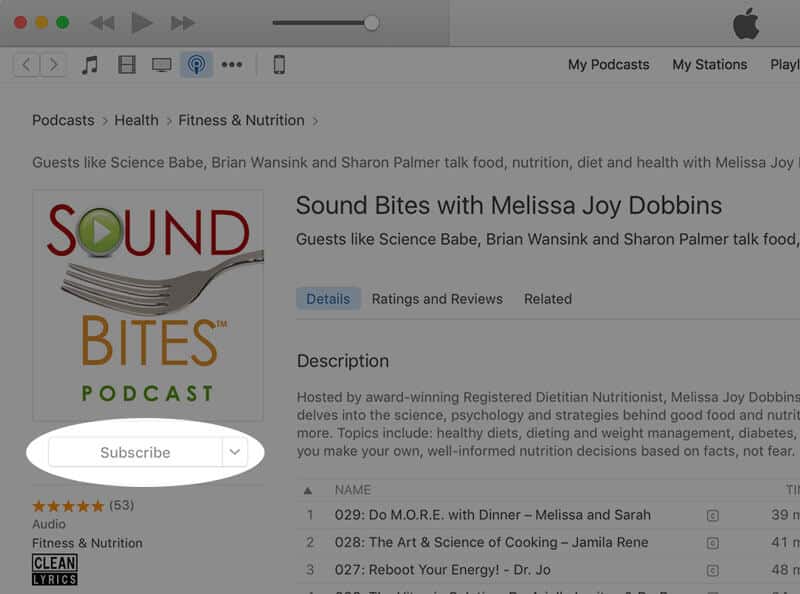
Open the podcast and click “Subscribe” and your done!
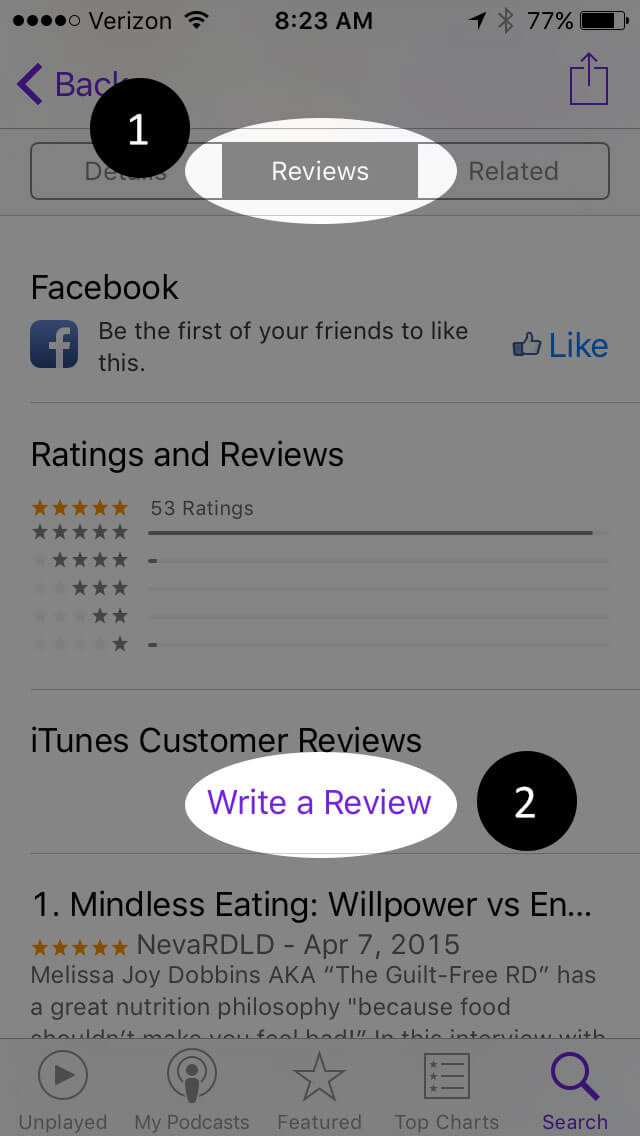
Write a Review
Click “Reviews”, then “Write a Review”.
Subscribe via RSS Feed
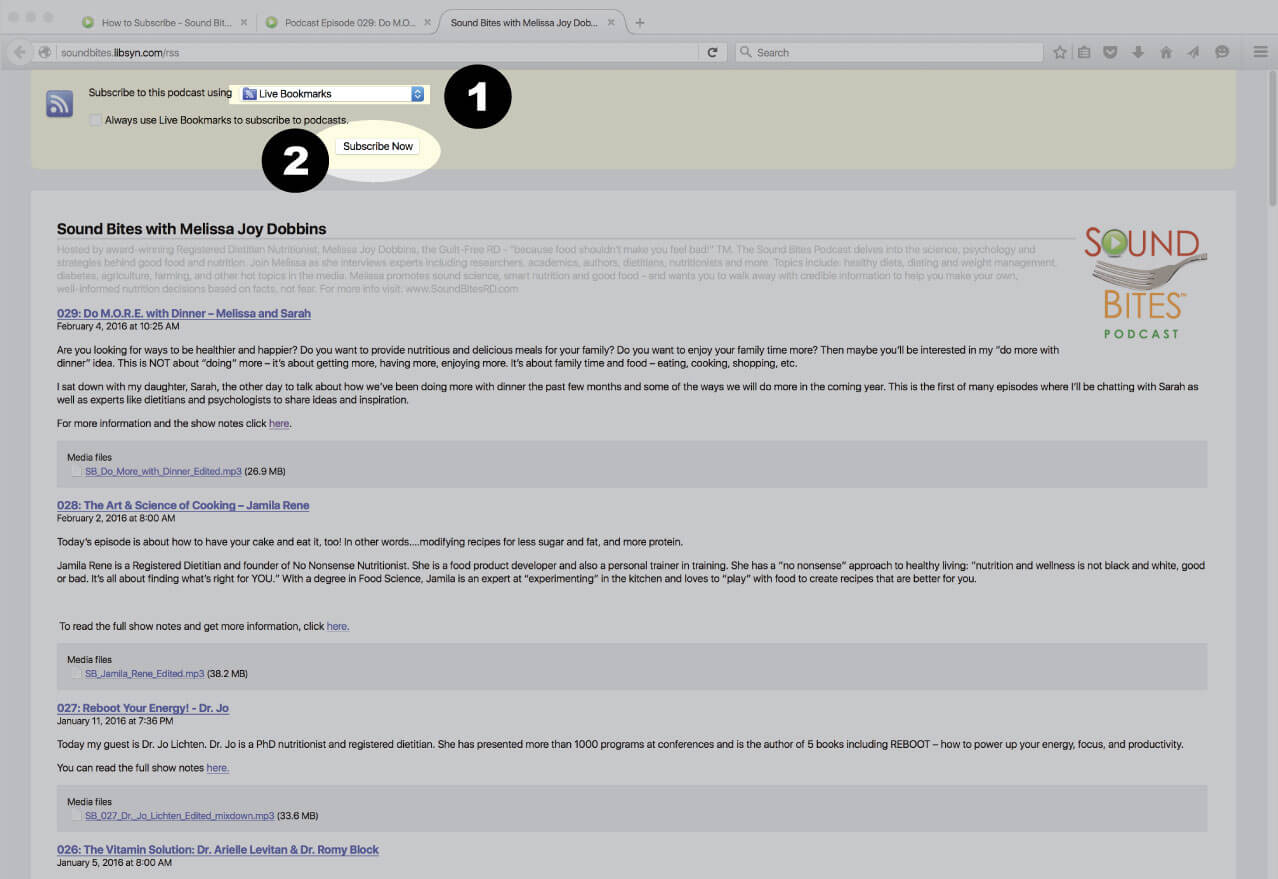
Navigate to any podcast player . Click on the RSS feed icon.
Click on the RSS feed icon.
Click on RSS Feed
Choose which application you would like to use to receive the RSS feed
Click “Subscribe Now”
Confirm settings and subscribe.
How to Review in iTunes
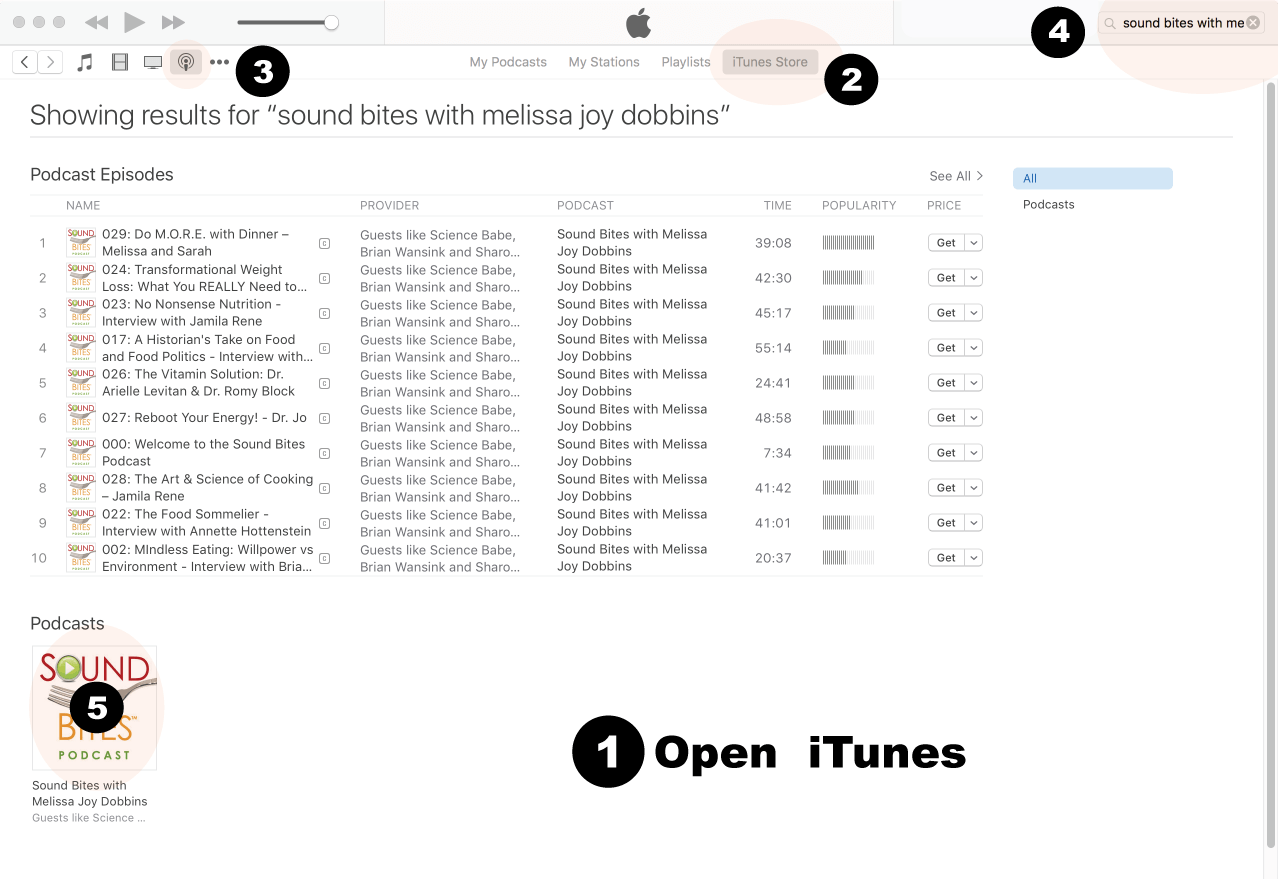
Open iTunes desktop application
Click iTunes Store
Click on Podcasts
Search for “Sound bites with Melissa Joy Dobbins”
Click on podcast image
Search for Sound Bites podcast in iTunes
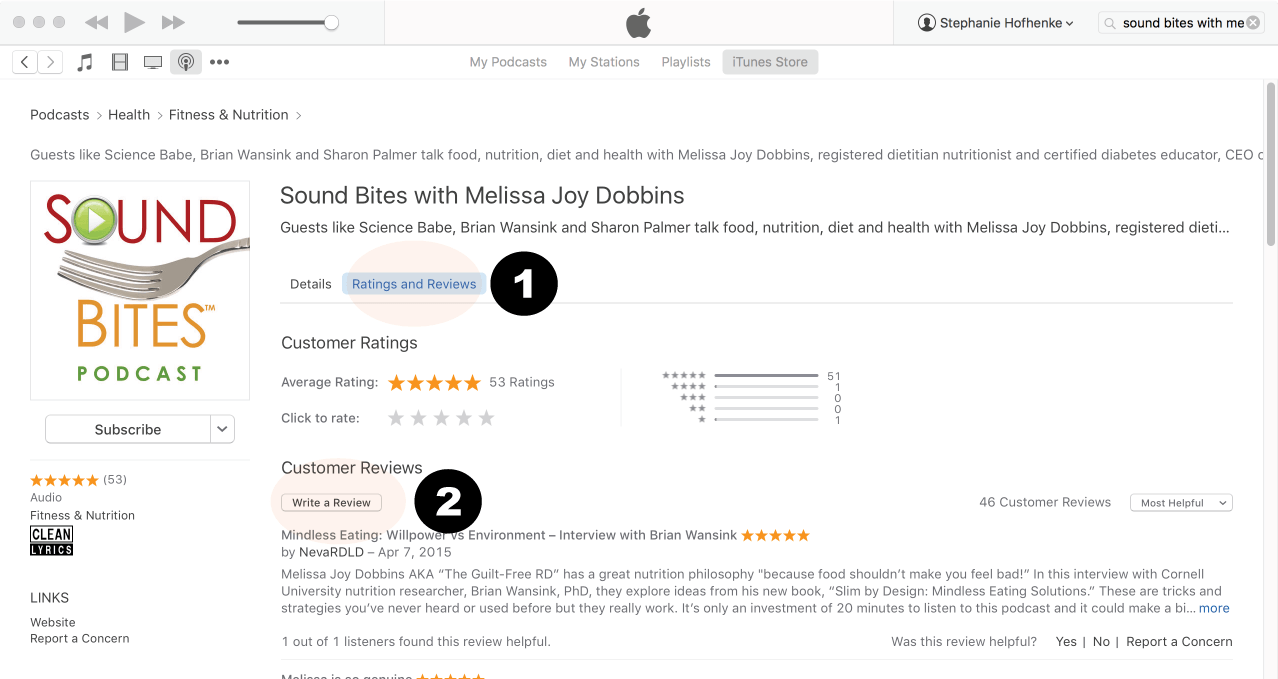
Click Ratings & Reivews
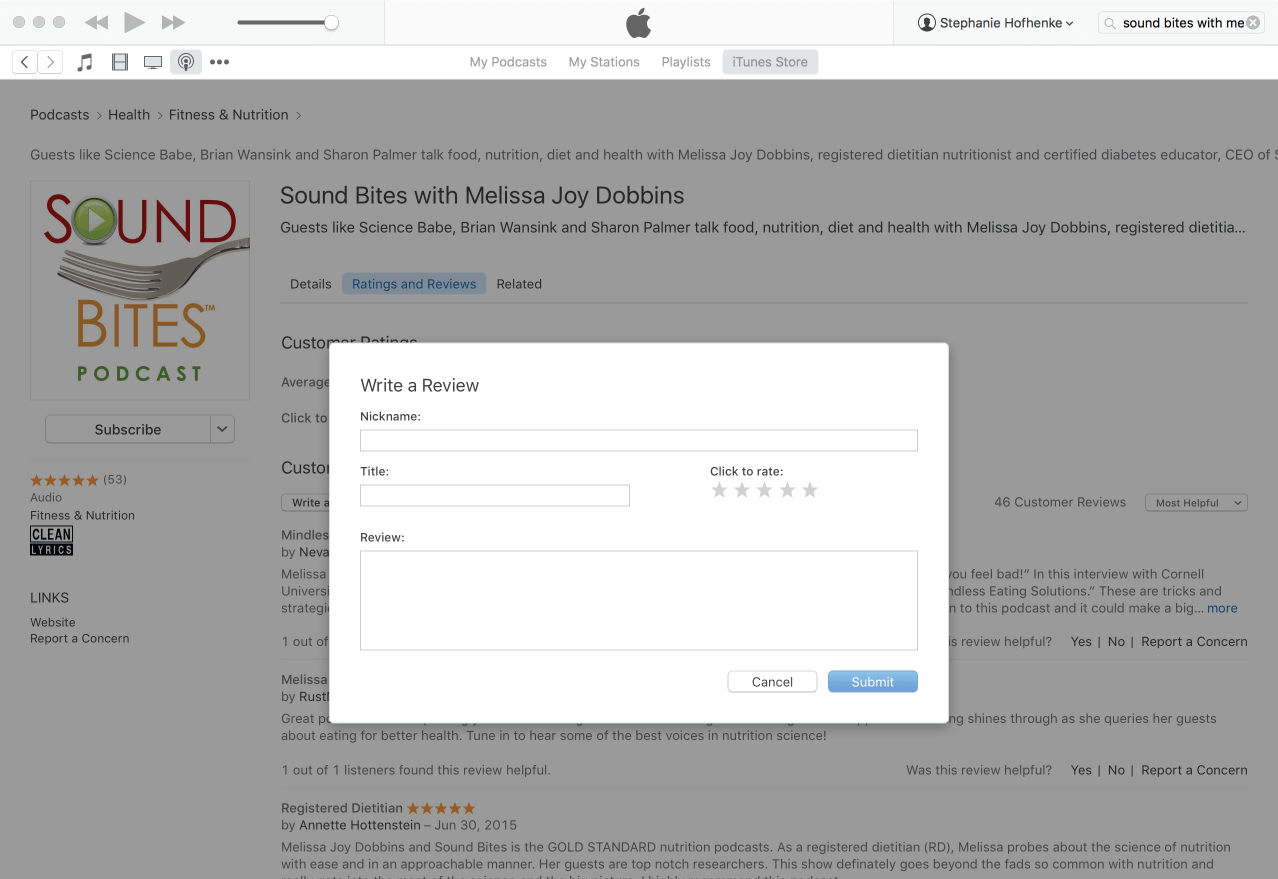
Click Write a Review
View reviews and write your own review.
Write your review…. Thank you!
Write your review!
How to subscribe via iTunes
Click here to view the Sound Bites Podcastin iTunes, then click the blue “View in iTunes” button. This will open your iTunes application directly to Sound Bites Podcast. Click the “Subscribe” button, and your done!
























I remember that pasta- it was like sticks.