Celebrating over 1 Million Downloads and 50,000 Free CEUs on the Sound Bites® Podcast | NEW: Get 1 years’ worth of CEUs with the new 15-CEU Podcast Course
Disclosure: This episode is sponsored by Fresh Avocados – Love One Today® and we thank them for their support of the podcast. Love One Today® is a leading source of the healthiest reasons and tastiest ways to enjoy fresh avocados. A science-based resource, it provides turnkey solutions that make it easy for health professionals to stay on top of the latest research and confidently recommend avocados. Andrea Mathis is a spokesperson for Love One Today®.
The Role of Satiety, Joy and Satisfaction in Eating and Overall Wellness
The consumer mindset around health and wellness has shifted and expanded with consumers focusing more on preventative measures instead of reactionary approaches to support overall well-being. These changes in attitudes and behaviors provide an opportunity to explore the concept of satisfaction from eating, including the role of satiety and our emotional responses, as well as the impact on one’s relationship with food, body and overall health.
Tune in to this episode to learn about:
recent consumer insights about health management
research on the relationship between nutrient intake, appetite and satiety
how a combination of fat and fiber (found in foods like avocados) can promote feelings of satisfaction
how a mindful eating approach can support health and wellness goals
Feeling satisfied helps in managing hunger cues throughout the day to keep your body adequately fueled. This satisfaction factor is so important because after all, we should be enjoying foods and when it’s enjoyable, you’re more likely to stick to that eating pattern that includes nutrient-dense foods that can support your overall health.” – Andy Mathis
Andrea Mathis, MA, RDN, LD
Andrea is an Alabama-based registered dietitian nutritionist and owner of the nourishing food blogs Beautiful Eats & Things, and Little Eats & Things. She is also the author of The Complete Book of Smoothies: 115 Healthy Recipes to Nourish, Heal, and Energize. Andrea has worked in several healthcare settings including clinical, public health and long-term care. Andrea believes in achieving optimal health by incorporating healthier eating habits into your lifestyle while learning to appreciate and accept your body in the process.
Her unconventional and practical approach to providing wholesome recipes and body-inclusive focused nutrition advice has been featured in the nation’s leading media outlets including Good Morning America, Women’s Health, Prevention, Huff Post, Shape and many more. She is a contributing editor for EatingWell, The Kitchn, Food and Nutrition Magazine and contributor to Mind Body Green, Well + Good, Parents, MSN, Healthline and others. When she’s not running after her two boys, she enjoys creating content to encourage self-love and promote body positivity.
[MELISSA]: Hello and welcome back to the Sound Bites Podcast.
In today’s episode, we’re going to take a deep dive into the shifting consumer mindset around health and wellness and what this means in terms of how we approach our relationship with our food and our bodies. As the Guilt-Free RD, my philosophy is to “enjoy your food with health in mind” – but as you all know, this can be more complex than it sounds. So today, we’re going to dig into the emotional and physiological responses connected to eating including how these responses shape our relationship with food and our bodies and can promote experiences of joy and satisfaction – which is what eating is all about or should be all about.
Today my guest is Andrea Mathis. She’s an Alabama-based registered dietitian nutritionist who is the owner of the nourishing food blogs Beautiful Eats and Things and Little Eats and Things and she’s the author of The Complete Book of Smoothies: 115 Healthy Recipes to Nourish, Heal, and Energize. Andrea believes in achieving optimal health by incorporating healthier eating habits into your lifestyle while learning to appreciate and accept your body in the process.
Andrea, welcome to the show! I’m so excited to be speaking with you today.
[ANDY]: Hi. Thank you so much for having me, I’m so excited to be here!
[Melissa]: Yes. Before we jump in, I want to note that this episode is sponsored by Fresh Avocados – Love One Today® and we thank them for their continued sponsorship and support of the podcast. Love One Today is a leading source of the healthiest reasons and tastiest ways to enjoy fresh avocados. As a science-based resource, Love One Today provides turnkey solutions that make it easy for health professionals to stay on top of the latest research and confidently recommend avocados.
If you’ve listened to previous episodes, you know that I’ve always been a big fan of fresh avocados and they are particularly relevant for our conversation today because of their nutrient and flavor profile. We’re going to discuss the nutrition and science behind the fruit in the context of satisfied eating.
This podcast episode is also eligible for one free continuing education unit through the Commission on Dietetic Registration for registered dietitian nutritionists, dietetic technicians registered, and certified diabetes care and education specialists. You can visit the show notes for this episode or my CEU page at soundbitesrd.com for more information.
[MELISSA]: Now Andrea, I see that you sometimes go by Andy so how do you want me to address you?
[ANDREA]: [Confirm preference.] You can call me Andy, all my friends call me Andy.
[MELISSA]: Ok cool. Love it. So, this is your first time on the show but I’ve seen you do other events and just think you are so full of joy and energy – positive energy, and so I’m really excited to talk about this really important topic with you today but first I would love for you to share more about your background, how you got into dietetics and what motivated you to come to this field of nutrition?
[ANDY]: Sure. Well, a lot of my interest and motivation for becoming a dietitian just kind of came from a few of my personal experiences. It started in high school which was a time when I felt a lot of pressure to fit in and just look a certain way and be a certain body size. And I’m like even at this young age, I started exploring you know fad diets trying to lose weight and while I was looking at this, I kind of came across the dietetic profession. And also, which was really funny, one of my high school teachers, she was a home ec teacher, and she was a dietitian at the time and she just kind of told me about the dietetics profession and made me realize there was so much more to nutrition than just weight loss.
And so even with that, my focus on weight loss continued as I got older, and I kind of developed a love/hate relationship with food. You know, so concepts like ‘moderation is key.’ I really didn’t understand that at the time and I loved food – and still do – and ate what looked and tasted good. I still do that but I do that with a different approach these days.
I realized I had zero knowledge about how to lose weight the right way and I also had no idea how to maintain a healthy weight and find a balance that made me feel good overall. So all of this kind of sparked my interest towards becoming a dietitian.
And I’ve been a dietitian for about 11 years now and I worked in a few different healthcare settings including clinical, public health and long-term care. So today, I share wholesome recipes and body-inclusive nutrition advice through my social media channels and I just try to help others and encourage others and this all comes from my personal experiences.
[MELISSA]: Wow. Thank you for sharing part of your story. I love that your home ec teacher was a dietitian – that is so cool! And you know I can relate to the fact that even as dietitians, we can have our own struggles with food and nutrition – we’re humans, we’re people, too, right? If you can pull from your personal experiences to support others, that’s always very helpful and relatable.
Can you talk a little more about the challenges/obstacles you’ve faced as a dietitian and as you were getting into the field?
[ANDY]: On a personal note, I hit a point where I realized that many of the weight loss approaches out there, they aren’t always helpful and can sometimes be harmful. Like I said, I’ve always loved food – the way it looks, smells, and of course how it tastes. I wanted to regain joy and satisfaction from eating rather than always looking at food through this restrictive diet lens. I worked really hard to find happiness while also being realistic and that’s how I got to where I am today.
I will add that my journey as a dietitian hasn’t been easy. I’ve faced discrimination from clients and also even a few colleagues due to my body size and I had many moments where I questioned my career path. Like at one point I considered choosing a different career path and not being a dietitian because of this. But, over the years, I had many clients share that they could relate to me, and this encouraged me and reinforced my path as a dietitian. I recognized I had valuable things to share that can help others realize that self-love, health, and enjoying food is possible.
[MELISSA]: Wow. Wow. Your experiences and perspective are very valuable for the nutrition world. It’s frustrating when people, and I’ll say you know both the public, general public, and health professionals, judge a dietitian’s worth or efficacy based on their weight – and I’ve seen it go both ways. Some people feel that dietitians who are not overweight cannot understand or help a person who is in a larger body and vice versa – that if a dietitian is in a larger body, they cannot guide patients appropriately. So it’s really frustrating and challenging.
A lot of my listeners know that I first became interested in nutrition when I was studying ballet in high school. I didn’t know what a dietitian was until college. But when I was in high school, you know, I saw firsthand how unhealthy habits could be detrimental to health and how susceptible we can be to fad diets and misinformation. And so many things in life can have an impact on your relationship with food and your relationship with your body.
I feel like it seems like there has been a greater emphasis on health and wellness over the past few years. The pandemic certainly brought a lot of this into the spotlight, and it seems like people are being more thoughtful about how they approach nutrition and overall health and wellness. I’m curious, what have you been seeing and hearing with your patients and clients in terms of people’s mindsets recently with health and nutrition?
[ANDY]: Yes, I totally agree with you! I think there has definitely been a shift in the way people are viewing health and wellness and it has me feeling a little bit more encouraged. I feel like people are looking at food as a way to satisfy themselves and as a way to nourish their bodies and I feel like that is a good direction in which we’re going in right now.
I recently saw a report from Mintel, a global market research firm, that collected insights about health management from 2,000 adults and looked at multiple sources of information to compile its data. The findings show that today’s consumers have started to expand their idea of what a healthy lifestyle looks like, and it’s no longer defined by food restriction or those grueling exercise routines, and they’re prioritizing health and wellness from the inside out.
And what’s even more encouraging, or at least in my opinion, is we’re seeing a shift to a more preventative stance on wellness, as opposed to like a reactionary approach. We have seen a gradual shift in this direction over the years, but I think is has certainly accelerated by the pandemic. People are starting to put a greater emphasis on factors such as immune health, improving sleep quality, maintaining energy levels, taking time for themselves, happiness, living longer, relieving stress, and eating healthy – and different generations are prioritizing different factors. And according to the same Mintel report, Gen Z (ages 18-24) tend to favor happiness and stress relief while older adults are more motivated by longevity and avoiding common illnesses.
[MELISSA]: Yes. I love to see the emphasis on mind AND body and that people are moving away from restrictive diets and or extreme exercise and I find it very interesting what the different generations prioritize – it does appear that the Gen Z generation has a strong focus on self-care. My daughter is in that age group and I feel like it’s a really positive thing. And whenever I look at consumer data, weight loss still inevitably comes up as a top motivator for people. So where do you see this fitting in?
[ANDY]: Like you said, while the mindsets may be changing, that topic of managing weight is still a priority among consumers. Many people still look at body weight as a motivational factor when it comes to their health, but they are putting a greater emphasis on more intrinsic factors like their happiness, managing stress levels, and just feeling more confident in their bodies and focusing on small, attainable steps to achieve their long-term health goals instead of prioritizing those quick fixes. So this new lens on wellness kind of leans more toward a sustainable lifestyle that takes both mental and physical health into consideration.
[MELISSA]: That is great because that is kind of what dietitians aspire to do from day one is to help people kind of have that healthy wellness approach and then their health outcomes and their weight would fall into place based on that healthy approach. But you know, I love hearing that. This data really lines up with the growing interest around body positivity and the connection between physical and mental health. I saw recently that Google shared that the phrases ‘body positivity’ and ‘how to maintain mental health’ were searched online in 2021 more than ever before.
[ANDY]: Yes and those search terms alone are so telling about where people’s heads are these days. As a body-inclusive dietitian, I talk a lot about developing body awareness which includes becoming more in tune with hunger cues and how food makes you feel. So all of this can help shape your relationship with food, mind, and body.
So according to the International Food Information Council, or IFIC, most consumers have some awareness around feeling satisfied from eating and listening to their hunger cues, but about half of Americans report feeling some guilt around the foods they eat or eating when they’re stressed. All this to say, people are making progress on how they approach health and wellness – wanting to accept and feel confident in our bodies and make positive, practical choices are all steps in the right direction. But the prevalence of negative feelings around food choices shows there’s still a disconnect and an opportunity to improve for the betterment of overall health.
[MELISSA]: Absolutely. Becoming more aware of physical and emotional responses connected to eating can help shape a positive relationship with food and body, and promote that joy and that satisfaction from eating, and support overall well-being. I want to go back to what you said about body awareness and becoming more in tune with hunger cues and how food makes you feel. We’ve been throwing around the word ‘satisfaction’ a lot and there’s so much that goes into achieving this. Can you talk more about satisfaction from a physiological standpoint?
[ANDY]: Sure. I’ll start by saying that satisfaction from eating can be achieved in different ways and all of it matters. You can feel satisfied after eating because you are physically full. You can also feel satisfied after enjoying a delicious meal with friends or eating something nostalgic.
So we’ll touch on more of the emotional response later, but in terms of the physiological response, based on nutrition science and research, we know that foods with fiber, fat, and protein provide satiation, which is the physical feeling of fullness. Fat and protein stimulate hormones that promote satiety and fat is a particularly potent stimulator of certain satiety hormones including CCK, PYY, GLP-1. And wow – that’s taking me back to the days of nutrition science classes! In addition, fats and some fibers also slow gastric emptying, or the process of moving food from the stomach to the small intestine, which can contribute to feeling full. For that reason, studies continue to explore how pairing fat and fiber enhance satiety and the feeling of fullness.
[MELISSA]: Right so I think understanding the physiological process of feeling full is really empowering in terms of making food choices. Now there aren’t a lot of foods that contain both unsaturated fats and fiber. Of course avocados is at the top of the list, my list. There is also things like pistachios and chia seeds.
[ANDY]: You’re right about there not being a lot of food that provide the satisfying fat-fiber combination. Avocados are unique because they are a good source of fiber and virtually the only fruit with unsaturated fats. So their mild flavor and creamy texture also makes them easy to incorporate into a variety of dishes. You can, of course, also combine foods likes walnuts and pears to get that combination as well.
[MELISSA]: Right. That’s true. So we continue to learn more new information about avocados from the research. And I’ve talked about avocados and satiety on the podcast before. But what can you tell me about the research on this connection between avocados and satiety, from the research standpoint?
[ANDY]: Well avocado’s fat-fiber combination actually sparked researchers to develop studies on their satiety benefits. For instance, in a clinical trial of 31 healthy adults with overweight and obesity, scientists found that eating a whole avocado as part of a breakfast meal, compared to a low-fat, high-carbohydrate meal with no avocado suppressed hunger and improved meal satisfaction.
And study participants ate three different meals on separate occasions. And the meals had a similar number of calories but varying levels of fat and fiber, and the control meal was higher in carbs whereas the meals with avocado were higher in fat and fiber. And after eating, the researchers used a tool called a visual analog scale to measure each person’s satiety for the next 6 hours. And this tool asked questions about feelings of fullness, hunger, desire to eat, and prospective consumption.
And researchers found that having a higher level of fat in the meal was associated with subjects feeling more satisfied, whereas increasing the avocado-derived fat and fiber combination offers additional satiety-inducing benefits.
The Avocado Nutrition Center funded the study, and although more research is needed to generalize the results to all people, the findings support the growing body of evidence connecting eating avocados to a positive impact on appetite management and satiety or feeling satisfied.
So what does this all mean? Feeling satisfied helps in managing hunger cues throughout the day to keep your body adequately fueled. This satisfaction factor is so important because after all, we should be enjoying foods and when it’s enjoyable, you’re more likely to stick to that eating pattern that includes nutrient-dense foods that can support your overall health.
[MELISSA]: Thank you. I love to hear about research. I always find it so interesting, and it helps me love avocados even more than I already do. You mentioned the importance of managing hunger cues and I want to come back to that in a bit. But first, can you talk about our emotional responses to eating especially in light of the data you shared earlier about feeling guilty about food choices?
[ANDY]: Yes, physical and emotional responses around food and eating can be so complex and are different for everyone. Eating can invoke all kinds of emotions ranging from positive to neutral to negative and these responses can have a significant impact on our relationship with food and our bodies, and in turn can have an impact our overall health.
Food can bring us joy and pleasure when something tastes good or when it’s associated with a special memory, but for some, food can also evoke feelings of guilt or shame especially when certain labels are put on it, or when someone doesn’t have awareness of hunger and satiety cues, or how food can impact their health.
Our relationship with food is dependent on so many factors so as dietitians, it’s important to help our clients recognize these responses and discover a non-judgmental mindset that can help to support them in their health journey while also promoting a more positive relationship with food and their bodies.
[MELISSA]: I agree one hundred percent. Now are there any specific suggestions or approaches you’ve used that can help someone address physical and emotional responses to food with the goal of improving their relationship with food and body? I know we are talking about this and it is easy to kind of stay topline with it but I would really love because you are the expert in this area, so I would love to hear any specific suggestions.
[ANDY]: Yes – I think before I dive into an approach let’s take a step back and first start to think about what can this look like in practice. This could be feeling confident in deciding to eat a slice of birthday cake with family and enjoying the moment without any guilt associated with that choice. OR choosing to listen to those satiety signals when eating at a restaurant and packing up any leftover food to eat at a later time. So honoring your body and taking manageable steps –both big and small – to feeling your best can support a positive mindset and overall well-being.
This isn’t an easy journey and takes work, but one approach that I suggest as a starting point, and even practice myself, is mindful eating. So what is mindful eating? It’s a non-judgmental, non-diet approach to food that focuses on individuals’ sensual awareness of the food, their experience of the food, and better connection to their mind and bodies. Mindfulness is actually a process-oriented, rather than outcome-driven, behavior. This approach has little to do with intake goals around those calories, carbohydrates, fat, or protein, and the purpose of mindful eating is not to lose weight.
However, as we know, secondary outcomes, like weight loss, can result from a change in eating habits or lifestyle factors. For our discussion today, I want to focus on how we can use it to support people in developing an eating pattern that promotes enjoyment and health.
[MELISSA]: Right, and I agree. I’ve experimented with mindful eating myself and have found it helpful. Just like being mindful with any behavior or habit – it really helps take you off of “auto pilot” and makes you slow down and pay attention to what you are feeling and doing in the moment. And I’m a process oriented person so I thought I would be better at mindful eating, but you’re right. It does take practice and it takes work. So for our listeners and perhaps some of the dietitians tuning in, can you talk about what this looks like in practice?
[ANDY]: It is really about focusing on your awareness and experience with food and becoming aware of the positive and nurturing opportunities that are available from food. This involves acknowledging that there is no right or wrong way to eat and we need to look at food from a neutral lens. All foods have value but not all foods provide the same nutritional value or elicit the same emotional response.
So for instance, some foods like fresh avocados and whole grains provide beneficial nutrients for your body that support your health and also provide enjoyment and satisfaction – and other foods like some desserts or fried foods can provide pleasure and be satisfying in a different way but don’t necessarily support health in the same way as nutrient-dense foods. So being able to recognize the value of foods across the spectrum can help someone make progress on their relationship with food, find a balance of foods that works for their body, and get closer to enjoyment and satisfaction from eating.
So in terms of focusing on the experience of food, this includes getting in tune with our body’s hunger and satiety cues. We talked earlier about the feeling of physical fullness after eating. And we know that when we’re hungry, our stomach tends to grumble and this is something that we’ve all experienced but other hunger cues can be an inability to focus, feeling light-headed or shaky, or having low energy levels, or a headache.
Using these cues, we can begin to recognize when we eat for true hunger vs reasons such as emotions. And this practice allows us to develop an awareness of the triggers that can drive the desire to eat, even when true hunger isn’t present. It can also help with understanding how food affects mood and energy throughout the day and what foods keep your body going at its best for work, movement, and other activities. Having greater awareness of your body may help some people have more acceptance of their body.
[MELISSA]: Really good point. I’m glad you mentioned hunger cues to look for beyond the stomach growling. This is something I struggle with personally and so I’m assuming others do as well When you’re trying to be more mindful and I’ve talked about this on the podcast before – I’ve shared a little bit about my menopause weight experience, if you will. I was just trying to be more aware of hunger levels, it helped me but it was also challenging because I don’t really notice those other “hunger” cues that you mentioned and I would wait for that stomach growling so I would either go a long time between meals or just eat at mealtimes because it was “time to eat”. Can you say more about how to get in touch with those other hunger cues?
[ANDY]: Sure. And it can be really challenging and it’s different for everyone. For me, when I was younger, I was taught not to listen to my hunger cues. In my weight loss mindset, I taught myself to ignore when I was feeling hungry because I believed that I had already had enough to eat. So I had to relearn these cues and then relearn how to give myself permission to eat when I was hungry. And I had to realize that it was ok to go back for another portion of chicken if I was still hungry. And I know this experience and behavior is not just unique to me.
What I’ve found is helpful is consciously pausing and removing distractions and evaluating how I feel. And some of us get caught up in emotions that come up throughout the day – there’s stress or maybe excitement from work or family stuff – and those emotions can be distracting. I’ve found that I need to consciously pause and assess how I’m feeling.
And one thing that may work is keeping a journal of how you feel in different situations. How you were feeling, or who you were with, or what you ate, etc. This can help you identify hunger cues over time. And the key there is over time. Just like any habit, it takes time to re-wire your brain to think differently.
[MELISSA]: That’s a really good point. I think sometimes when we think about emotional eating we think about like it’s the stress and just the negative stuff but excitement and good stuff, emotions, can also, like you said, be distracting. There are so many nuances here, but this is really helpful what you are saying. And I think it’s really easy to be on auto pilot when it comes to eating you know. Just a lot of decisions we make every day and we can’t just constantly be focused on every little thing – we do need to have some sort of routine. So it can be a real challenge when people are first trying to be mindful about their eating. Is there anything you suggest to help people stay focused while they are learning this habit and training this muscle?
[ANDY]: Yes. That’s a great question. A few things I recommend are:
First, I would suggest walk away from or turn off electronics. This is often the biggest source of distraction.
Start being mindful at one meal a day. This takes some pressure off from being mindful at all eating occasions and keeps your time focused.
Commit to just a few minutes. Sometimes it can feel like a lot of work when you have a busy schedule. And giving yourself just a few minutes each day to dedicate to this practice can be extremely helpful.
Consciously evaluate where your mind is at. When it wanders, bring it back to the present moment.
Try eating in a new setting. Sit somewhere other than your desk or kitchen table. May try sitting on a patio or a different room in your house.
[MELISSA]: Those are really great tips and a lot of this as we’ve talked it seems simple and common sense, but these are the little nuancey things that we need to think about in order to keep moving forward with that mindfulness Earlier you mentioned our emotions which can have an impact on eating. So I want to go back to that a little bit. We’ve all heard the phrase “emotional eating.” Can you talk more about how this impacts eating behaviors?
[ANDY]: Emotional eating is usually casted in a negative light but what it means is eating food for comfort or reasons other than physical hunger. Stress, anxiety, and sadness are all emotions that can trigger someone to eat outside of hunger but so can family gatherings or birthday parties where there are societal expectations to eat or where eating is part of the happy, joyous moment.
So emotional eating isn’t always a bad thing. Fulfilling these emotions is a part of life. However, if emotionally driven eating is becoming a regular habit, it’s important that it be recognized and addressed.
And going back to listening to hunger cues, these emotions can distract us from recognizing physical hunger. That’s where the mindful eating approach can be helpful – giving yourself a moment to evaluate how you’re feeling and assess hunger.
[MELISSA]: Thanks– this is another area that I was surprised to learn and explore further myself. I knew I wasn’t an emotional/stress eater in general so I didn’t think too much about how feelings could be impacting my food choices and eating habits overall, but I recently did some work with a dietitian to assess my personality traits and habits. Her assessment confirmed that emotional eating isn’t a common issue for me but it also revealed some behaviors and feelings that can present themselves including things like self-scrutinizing, procrastination, people pleasing, moving at a fast pace, being an overachiever and having some self-doubt. These small but significant thoughts and behaviors can add up and can impact my habits without me even noticing.
[ANDY]: [Andy to comment as appropriate.] Oh wow – that is really interesting.
[MELISSA]: Ya. So I know you mentioned that mindful eating isn’t driven by outcomes but are there any other benefits associated with this approach?
[ANDY]: Great question!
So we all may know about mindful eating, but the field of mindful eating still remains in the early stages of research. Whether mindfulness is the mechanism by which mindfulness interventions work remains to be determined but the evidence we have to date is encouraging.
Digestion could be impacted if you are focusing on eating and slowing down. Some research has shown that when our attention is not focused on eating, our digestive process is 30%-40% less effective than it should be, which can lead to gas, bloating, and discomfort. Mindfulness techniques have been associated with less emotional-driven eating because you’re becoming more in tune to your physical hunger cues and your emotions related to eating.
[MELISSA]: Right, ok. Earlier, you shared your journey to becoming a dietitian and some of the struggles you’ve experienced personally along the way. Aside from what you’ve share already, I’m curious how some of this has come to life for you and how you’ve regained joy and satisfaction from eating?
[ANDREA]: A really important thing that I learned is that long-term changes do not happen overnight, but the effort is definitely worth it. It takes time and is honestly a constant work in process and that’s okay.
Some people feel like diets are, in a way, easier than mindful eating because there are rules and foods to avoid and that helps to make fewer decisions. But, as we know, these diets don’t do much to support our mental and emotional state and can often do more damage. And I came across this realization myself and I like to remind people that an approach like mindful eating is an approach that supports mind and body and that has benefits in the long term.
I’ve also learned a lot from my kids and my interactions with them. Like, they are so good at listening to their hunger cues. They tell me when they are full or when they want more of a certain food. I often save their leftovers with their name on it. Like I’ll put it in the fridge for them later on so they know the food is there so if they are hungry later on they can just go right back to it and just enjoy that food a little bit later. And they really listen to their bodies and as a parent, I want to model that behavior and do as much as I can to help shape a positive, healthy mindset.
[MELISSA]: That is a really, really great example. I have similar experiences with my kids being in touch with their hunger – and even myself regarding leftovers. It’s kind of a funny story but again it seems so simple. I had been living on my own at college for years before I realized I was eating more than I wanted/needed because when I was growing up, I learned that my brothers would eat any leftovers they could get their hands on! I really think it’s a game changer to have a family agreement that if someone’s name is on the food it’s off limits to everyone else! These are the nuances like I said that until you really think about some of these things it can kind of fly under the radar and it may not be something really obvious but as you become more mindful and you go through this process you have these really kind of cool discoveries along the way.
[MELISSA]: Andy, I always like to share some actionable tips with my listeners. Alongside practicing mindful eating what are some tips you can share to help us experience more joy and satisfaction from eating?
[ANDREA]: Ok. I love this question because I have so many!
So the first would be to allow yourself to eat the foods you enjoy. So deprivation is not the answer and is not sustainable in the long run. Restricting your body from foods you enjoy also isn’t the way to show love for yourself.
We should also all try to leave perfection and the food rules behind. Let’s face it, curve balls are constantly thrown our way and having a flexible mindset when it comes to food and it can help reduce our stress and negative feelings towards eating.
Get creative and try new foods or cuisines! I love to experiment in the kitchen and I’ve found it can be a great way to spend time with others, time with your kids, and appreciate food in a different way. So for instance, I recently made pesto BLT stuffed avocados and they were delicious! They had several different ingredients – of course avocados, we had turkey bacon pesto for flavoring and it was so much flavor which made it such an incredible dish. Not only was it delicious, but it broke me out of my regular weekly meal pattern. Another dish included this chicken, basil, whole wheat pasta recipe and it contained several different ingredients. Whole wheat pasta for fiber, chicken for the protein and a nice vinaigrette for flavor. It was such a great dish and my family enjoyed that one as well.
Don’t try to do everything at once. Take manageable steps to feel your best and support a positive mindset.
Lastly, respect your body. Healthy does not have a certain look and all bodies aren’t meant to look the same. So Learning to have more awareness of your body and taking steps to honor it is an expression of self-love.
[MELISSA]: Those are all really great tips, some of which I’m definitely going to try out myself! For anyone that wants the pesto BLT stuffed avocado recipe, I’ll be sure to share the Love One Today link in the show notes at SoundBitesRD.com because that recipe is from Love One Today website right?
[ANDREA]: Yes it is.
Section 5: Closing
[MELISSA]: Awesome. All in all, this conversation reminds me that health and nutrition are complex. We touched on one piece today but there are so many other factors like sleep, movement, and social connection this all plays into well-being. I recently sat down with Dr. David Sabgir to discuss these components and I recommend checking that out that podcast episode, if you haven’t already.
Andy, it’s been an absolute pleasure having you on the show today. Thank you for such an insightful conversation.
[ANDREA]: It was my pleasure! It’s always great to talk and share things you’re passionate about and I’m also just a huge fan of your podcast.
[MELISSA]: Thank you! As a reminder, all links to the research, recipes and resources we referenced in the episode will be available in the show notes. You can find those by going to soundbitesrd.com and also via any podcast app or platform you use to access podcasts.
Don’t forget, this podcast episode is eligible for one free continuing education unit through the Commission on Dietetic Registration for registered dietitian nutritionists, dietetic technicians, registered and certified diabetes care and education specialists. Visit the show notes for this episode or my CEU page at soundbitesrd.com for more information.
Check out the Health Professional tab on LoveOneToday.com, where you can find the latest avocado nutrition research, free educational materials, as well as a collection of delicious and easy-to-make recipes that everyone will enjoy!
Thank you to everyone tuning in and thank you to everybody tuning in and thank you to Fresh Avocados – LoveOneToday® for sponsoring and supporting this podcast episode. Until next time…
LISTEN, LEARN AND EARN
Listen to select Sound Bites Podcasts and earn free CEU credits approved by the Commission on Dietetic Registration (CDR) for registered dietitian nutritionists and dietetic technicians, registered. Get started!
Get Melissa’s Sound Science Toolkit here!
Partnerships:
Sound Bites is partnering with the Association of Diabetes Care and Education Specialists (formerly the American Association of Diabetes Educators)! Stay tuned for updates on the podcast, blog and newsletter!
Sound Bites is partnering with the International Food Information Council! Stay tuned for updates on the podcast, blog and newsletter!
Sign up for my monthly newsletter and episode eblasts so you never miss an update!
Listen on Stitcher (Android)
Install the Stitcher App
1. Search for “sound bites with melissa joy dobbins” 2. Choose Play Current Episode or Add to Playlist
Choose “Play Episode”
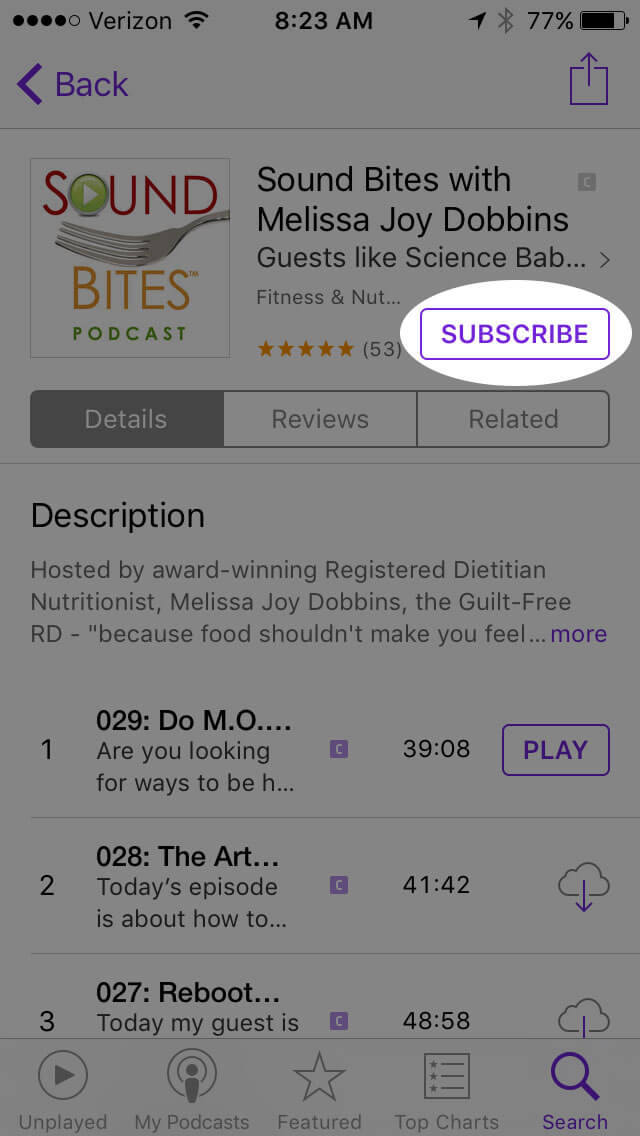
Subscribe & Review on iPhone
Open the “Podcast” app on your iPhone
Search for “Sound bites with melissa joy dobbins”
Open the podcast and click “Subscribe” and your done!
Write a Review
Click “Reviews”, then “Write a Review”.
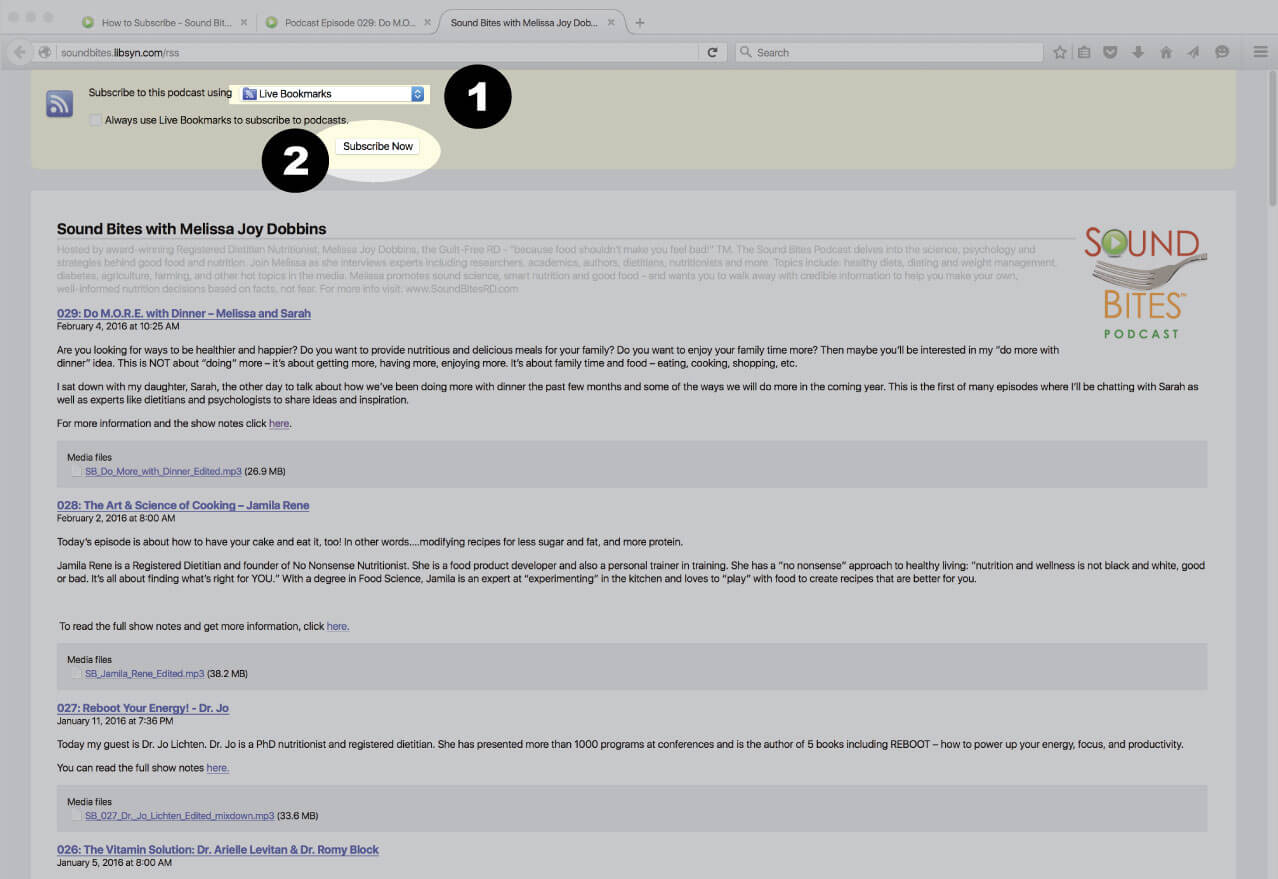
Subscribe via RSS Feed
Navigate to any podcast player . Click on the RSS feed icon.
Click on the RSS feed icon.
Click on RSS Feed
Choose which application you would like to use to receive the RSS feed
Click “Subscribe Now”
Confirm settings and subscribe.
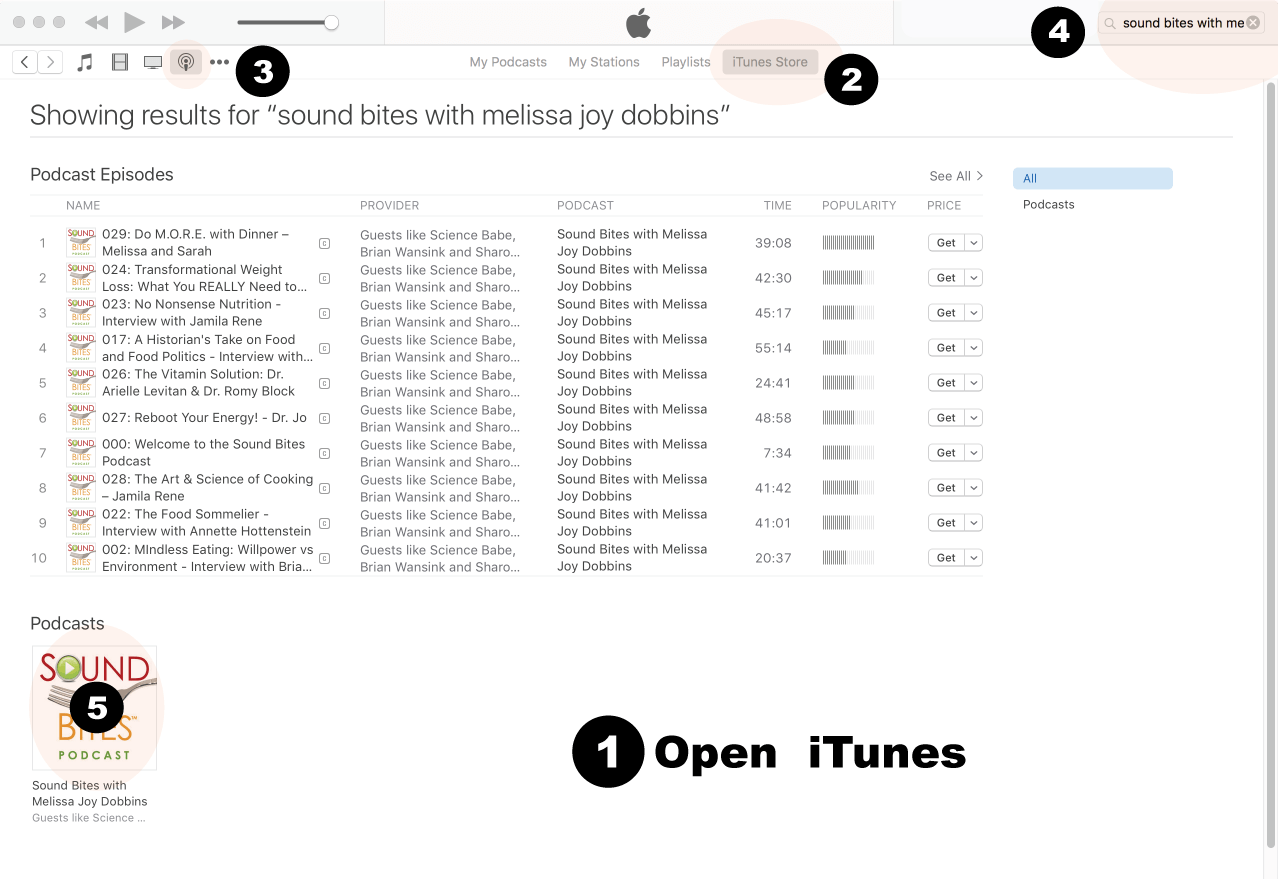
How to Review in iTunes
Open iTunes desktop application
Click iTunes Store
Click on Podcasts
Search for “Sound bites with Melissa Joy Dobbins”
Click on podcast image
Search for Sound Bites podcast in iTunes
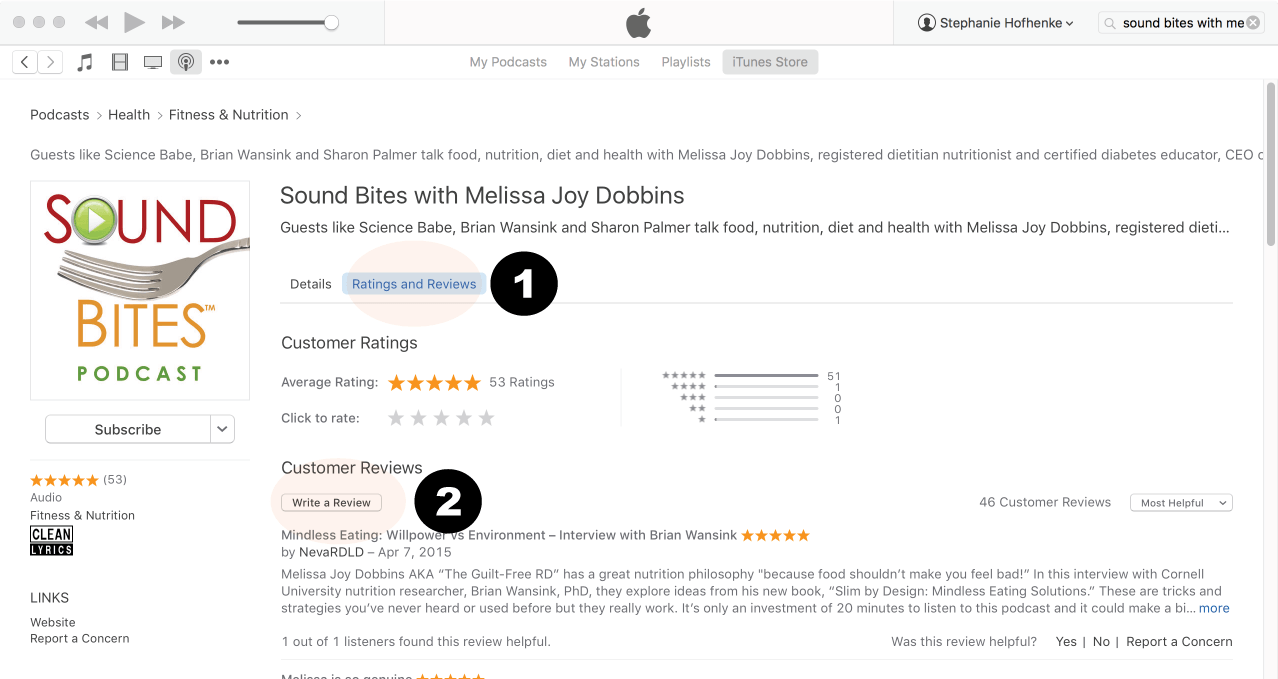
Click Ratings & Reivews
Click Write a Review
View reviews and write your own review.
Write your review…. Thank you!
Write your review!
How to subscribe via iTunes
Click here to view the Sound Bites Podcastin iTunes, then click the blue “View in iTunes” button. This will open your iTunes application directly to Sound Bites Podcast. Click the “Subscribe” button, and your done!