Celebrating over 1 Million Downloads and 50,000 Free CEUs on the Sound Bites® Podcast | NEW: Get 1 years’ worth of CEUs with the new 15-CEU Podcast Course
Click here to earn 1.5 FREE CEUs, including an ethics performance indicator, for listening to our 2-part series on oats!
Disclosure: This episode is sponsored by The Quaker Oats Company of which today’s guests, Danielle Dalheim and Steven Dominguez, are employees of its parent company, PepsiCo.
From Seed to Spoon Part Two
This episode will explore Quaker’s oat milling technology as well as the culinary versatility of oats, encouraging listeners to think beyond the breakfast bowl.
Tune into this episode to learn about:
an overview of the oat milling process
how different milling techniques impact texture, cooking time and culinary applications
the nutritional profile of oats and if that changes when milled into different forms
gluten-free milling technology
gluten-free claims, products
whole grain claims and other regulatory insights
tips for preparing oats in a variety of ways
culinary inspiration and savory oat preparation tips
innovations on the horizon
Steven Dominguez, Chef
Steven Dominguez is an Associate Principal Research Chef for PepsiCo, with an emphasis on innovative eating experiences; he is involved in the culinary efforts for many brands and oversees Quakers’ culinary journey. He explores the exciting world of snacks, meals, and wholesome ingredients through his work, showing how they can be combined to create delicious and diverse dishes.
Danielle Dalheim, RD
Danielle Dalheim is a registered dietitian and has been with PepsiCo for the past 17 years. She currently serves as the Director of Regulatory Affairs for PepsiCo US Foods. She leads US regulatory compliance for the Frito-Lay and Quaker portfolios, ensuring that products are compliant with all FDA regulations and have accurate ingredient and nutrition information.
[00:00:01] Announcer: Welcome to Sound Bites, hosted by registered dietitian nutritionist Melissa Joy Dobbins. Let’s delve into the science, the psychology, and the strategies behind good food and nutrition.
[music]
[00:00:22] Melissa Joy Dobbins: Hello and welcome to the Sound Bites podcast. Today’s episode is about Quaker Oats’ milling expertise to create high-quality oats that balance great taste and nutrition. We’ll discuss the difference between the variety of flakes and cuts, as well as oats’ culinary versatility, encouraging you to think beyond the breakfast bowl. This is Part 2 in a two-part series, so be sure to check out Part 1 when you get a chance.
I do want our listeners to know that this episode is sponsored by The Quaker Oats Company, and we thank them for their sponsorship and support of the podcast. Also, I was invited by today’s sponsor to attend an immersive food and nutrition experience back in the fall of 2022, where I toured the Agricultural Sciences facility in Rhinelander, Wisconsin, and learned about potato and oat breeding, technology, and innovation. I also toured the Culinary Innovation Center in Plano, Texas, where I learned about culinary innovations, sensory science, and more, and had the opportunity to meet both of you in person.
My guests today are Chef Steven Dominguez, and dietitian, Danielle Dalheim.
Steven Dominguez is an associate principal research chef for PepsiCo, overseeing the culinary efforts for Quaker, with an emphasis on innovative eating experiences. Through this work, he explores the exciting world of snacks and wholesome ingredients, showing how they can be combined to create delicious and diverse dishes.
Danielle Dalheim is a registered dietitian and has been with PepsiCo for the past 17 years. She currently serves as the director of regulatory affairs for PepsiCo US Foods. She leads US regulatory compliance for the Frito-Lay and Quaker portfolios, ensuring that products are compliant with all FDA regulations and have accurate ingredient and nutrition information.
Welcome to the show.
[00:01:44] Danielle Dalheim: Thank you, Melissa.
[00:01:46] Steven Dominguez: Thank you.
[00:01:46] Melissa: So excited to have you both on the show.
Steven and Danielle, I would love for both of you to share with our listeners a little bit more about your background and the work that you do, and also please include any disclosures to note. Steven, let’s start with you.
[00:03:00] Steven: Thank you for having us. I’ve been a research chef here at Quaker for, it will be seven years this year, and I’m very happy about that. I’m usually involved in very early-stage innovation, identifying new unique experiences for consumers to enjoy oats, and you mentioned earlier, thinking outside the breakfast bowl is my focus and what I love to do. I’m really excited to bring my years of restaurant and food knowledge and nutrition knowledge into every day for our consumers and to talk to you today.
[00:03:37] Danielle: Thanks for having us here, Melissa. It’s great to be here today. As you said, I have been with PepsiCo for 17 years in a variety of nutrition and regulatory affairs roles. In addition to generating those ingredient statements and nutrition facts on your Quaker products, my team is also responsible for substantiating a variety of claims, whether it’s gluten-free or a good source of protein or organic. And, in my role, I also get the opportunity to represent PepsiCo with external organizations as they provide input to future FDA and USDA regulations.
[00:04:16] Melissa: Excellent. Let’s start with you, Steven. If you could just walk us through a quick overview of the oat milling process, that would be great.
[00:04:25] Steven: Great. Taking you through the milling process of an oat from seed to spoon as we like to say, all oats begin as a groat or an oat berry, which is an oat without its outer protective hull. Internally, we joke that it’s an oat without its coat. These are later milled into different types of oat forms that they could be used for different culinary applications. For example, my favorite variety is the steel-cut oats. It gets its name because the oat groat that’s cut with a steel blade in thirds and that’s what gets us that toothyness, more mouth feel.
The classic beloved Old-Fashioned oat is steamed and rolled into the beloved breakfast staple that we all know. Those are the two main ways in which oats are milled. Then from there, we get smaller and they give us different varieties in different uses in the kitchen. Fun fact about our milling process is Cedar Rapids, which is our Quaker Oats facility in Iowa processes over 2 million pounds of oats daily. That’s just a fun fact that we like to share because it’s a lot of oats.
[00:05:40] Melissa: Wow. The more you know. Very good. Can you explain the variety of milling techniques used and how the differences in texture impact cooking time and culinary applications?
[00:05:55] Steven: Yes. Starting out with our Old Fashioned oats, these are the ones that we’re steaming and rolling, I’ll remind the audience as we talk about them, but those cook in about 5 to 10 minutes. Depends on how much water you’re using. If you like them extra gooey and smooth, you might use more water and that might take longer to absorb, but if not, that could take as little as five minutes. You could also use them in bulk ingredients. That’s great when you’re making homemade granola, for example. It’s a great texture for when you’re creating overnight oats because the large pieces absorb the moisture really well, your yogurt, or your dairy product, or your water. That’s Old Fashioned oats. Those are the ones that are rolled and steamed.
[00:07:55] Steven: Quick 1-Minute Oats are the same steamed rolled oats, but they’re rolled a little thinner and they’re cut, so now they can be cooked quicker on the stove in about a minute or even in the microwave. Quick oats provide a smoother texture, and it’s a great option for those who are in a hurry. They also work really well in baking applications where you might want less visual oats. Because they’re cut smaller, you don’t see them as much in your baked goods, but they still add this subtle toasty nut flavor that we know from oats without that much impact to the texture. I use quick oats in shortbreads, pie crust, and even cookies.
[00:08:39] Melissa: Interesting.
[00:08:40] Steven: Yes, but we even get smaller. Similar to Quick 1-Minute oats, we have our Instant Oatmeal, which are rolled thinner and chopped even finer. After they get steamed, the thinner roll, that finer chop is what helps them cook even faster. These are individual pouches. These are for when you are in a rush, you are throwing this in your book bag, in your gym bag, your purse, sometimes you keep in the car. This is the 90-second microwave. Honestly, sometimes I just add hot water as well. Apart from that, from a more culinary perspective, adding these to your smoothies, that’s a great option to add some mouthfeel and some nutrition.
or you can let them soak in a liquid of your choice, whether that be juice, dairy, and it gives this silky, smooth, mouthfeel that’s very similar in my opinion, to eggnog. I honestly keep a few pouches of Instant Oatmeal in my car for a case of emergencies when I get hungry in the morning.
Steel Cut, which is by far my favorite, and we can talk about that later, they’re the ones I mentioned have more of that toothy texture to them. They are a little more grainy. I like to use them similarly to some rice dishes or whenever I want to add just an extra texture. Those, because they’re not steamed nor rolled, there’s less surface area for the moisture and the heat to allow the oat pieces to absorb water. Those take longer from 20 to 30 minutes on the stovetop, but they could also be prepared in a slow cooker. Imagine you add them in the morning, you add your liquid, and by the time you get home, you have this silky smooth texture with whatever other flavors you added. Steel Cut oats are also sometimes known as Irish oatmeal.
[00:07:30] Melissa: Oh, yes, I’ve seen that.
[00:07:32] Steven: People are very familiar with those, but that’s what they are. It gets its name because the oat groat that’s cut with a steel blade in thirds. Now they know why they’re called Steel Cut, and they work really great in savory applications. I’ve actually cooked them in the same way we cook risotto, for example, because they give me that same toothy texture.
[00:07:49] Melissa: Excellent. I know we’re going to talk more about savory oats.
[00:07:52] Steven: Yes, I can’t wait to get there.
[00:07:53] Melissa: I know, me neither.
[00:09:49] Melissa: I love it. Great. Danielle, we touched on this question I’m going to ask you in Part 1 of the series, but if you could address whether the nutrition profile of oats changes when it’s milled to be Quick 1-Minute Oats versus Old Fashioned, for example?
[00:10:07] Danielle: That’s a great question, Melissa, and I have great news. The nutrition profile of the oats actually doesn’t change regardless of how it’s been milled. Quaker’s milling process is a change to the physical shape of the oat, but all forms of Quaker Oats, whether we’re talking Instant, Quick, Old Fashioned, Steel Cut, they’re all 100% whole grain. This means each of them still contains all three parts of the grain, the bran, the germ, and the endosperm after milling. All forms of oats are also a good source of soluble fiber.
[00:10:44] Melissa: Okay, great.
[00:10:45] Danielle: This means that, per ounce, all varieties of Quaker Oats provide similar amounts of fiber, vitamins, and minerals like thiamin, phosphorus, and magnesium. With similar nutrition profiles, like Chef Steven mentioned, the different oat forms are really about consumer choice, whether you want a different taste, a different texture, or a different cooking experience.
[00:11:09] Melissa: Interesting. Who knew that oats were so interesting and complex and wonderful and naturally gluten-free, which is my next question. It’s my understanding that oats are naturally gluten-free, but I’ve heard that there can be cross-contamination. If you could talk to us about your gluten-free milling technology and why it’s so important.
[00:11:33] Danielle: This is a question I get a lot when talking to dietitians and healthcare professionals, so I love that we’re able to talk about this today. You are right. Oats are inherently gluten-free, but the challenge is that they may come in contact with wheat, rye, or barley anywhere in their supply chain. It could be at the farm, in storage facilities, or during some point in the transportation. That’s why milling is really important to how Quaker ensures that our specially marked products meet FDA’s gluten-free standards.
We are those milling experts.Like you heard in Episode 1, we have over 140 years of milling experience, and a team of experts at Quaker developed a breakthrough sorting system to ensure that Quaker Gluten Free Oatmeal was able to be enjoyed and trusted by those following a gluten-free diet. Let me tell you a little bit more about how they did that. We have a mechanical and optical sorting system that seeks out and removes gluten-containing grains based on their length, their density, and color. We do all of this in a dedicated cleaning house that is just for making our Gluten Free Oatmeal.
To ensure that sorting process is working properly, we’ve implemented testing protocols across a variety of checkpoints during that milling process, so that we are verifying that our high-quality oats meet FDA gluten-free standards and also continue to deliver on Quaker’s very high standards for quality, taste, and texture.
After that sorting occurs, we also use dedicated cutting and flaking equipment during that milling process to make sure there’s no cross-contamination with any other grains. Any other ingredients that may be added during packaging are also validated to be gluten-free, and our packaging equipment is thoroughly cleaned with a validated procedure to prevent cross-contamination. You can see we really have a robust process in place to support the gluten-free claims on our Quaker Oats.
[00:13:47] Melissa: Excellent. Speaking of the gluten-free claim, I would love to have you talk to us a little bit more in-depth about what has your role been at Quaker in enabling these gluten-free claims.
[00:14:00] Danielle: Absolutely. I’ve had the privilege of working on gluten-free claims at PepsiCo going as far back as 2010, so I have a lot of history and a lot of passion in this space. As a regulatory scientist, my role has been to develop our US gluten-free protocol and ensure that our approach to substantiating claims meets all the FDA regulatory requirements. After we had a lot of success and were able to roll out those gluten-free claims in the US, our protocol also served as the basis for developing PepsiCo’s global gluten-free protocol. That was an excellent opportunity for me to learn about what gluten-free claim requirements look like in different countries and share our learning on oats from a US perspective.
[00:14:49] Melissa: Thank you. Yes, really appreciate your regulatory knowledge. It’s definitely a niche area that not a lot of dietitians have the opportunity to work in or have the knowledge to work in. Since oats are a whole grain, would also love to hear about the whole grain claim or any regulatory insights that might be of interest to our listeners as well.
[00:15:13] Danielle: Definitely. Quaker is a member of the Whole Grains Council. Many of you may see their stamp on our oat products and several products across the industry. One serving of whole grains is considered to be 16 grams, that’s the equivalent of about the amount of whole grain in a slice of whole wheat bread. The council allows products to carry the stamp if they contain at least 8 grams of whole grain per serving, so, half a serving of whole grains, and then that stamp can be used. Products with 16 grams of whole grain or more, so, a full serving, and where all of the grains are whole grain are eligible to carry the 100% whole grain stamp.
[00:15:59] Melissa: All right, thank you. Steven, just turning back to you to get more into the foodie side of things here. Oats seem pretty foolproof to prepare even for someone like me, but since I’ve got a chef on the show, I would love for you to share any tips for oat preparation that we may not be aware of. We teased the savory information earlier, but anything in addition to that, I’d be really interested in.
[00:16:27] Steven: Oats can be foolproof, but I think one of my biggest recommendations is just to consider the entire oat and its capability. If the mornings are tight for you, consider making overnight oats or rolled oats or putting the Steel Cut oats in a slow cooker overnight like we mentioned. Otherwise, don’t rush the process. Consider using different liquids to cook your oats in. Most people use water. We’ve heard from consumers that they’re using dairy products to create their oatmeal in the morning. Guess what? It creates a very silky, smoother texture.
The ability that we have to experiment is very wide. I personally, for example, like to add a couple apple pieces, cloves, and cinnamons to simmering water to make almost a light tea and then use that same water to cook my oats. Then I fold in some apples and some more spices. The oats absorb that apple spice flavor from the liquid, from that tea. That could be with anything, whatever liquid you decide to use; if you want to use coconut milk, if you want to use your alternative dairy, if you want to go savory, I’ve used mushroom stock or chicken stock to cook oats, so I think it would be really great for consumers to consider giving that a try.
[00:17:54] Melissa: Yes. Let’s talk more about the savory oats. I did have the opportunity to taste a recipe of yours, I believe, when I was at the Culinary Innovation Center in Plano. I don’t remember what it was, but it was delicious. Talk to me more about the different ways that we can have savory oats.
[00:18:12] Steven: Savory oats, they only happen because oats are a canvas for flavor, and they’re a nutritious canvas. Creating dynamic and compelling experiences is very easy. When it comes to savory oats, the liquid, my biggest tip, number one tip, is to use a different flavor liquid. The second one would be to treat it like any other grain, so, your mirepoix, (your onion, celery, carrots, garlic, sauteed), or your aromatics, whether it be leeks or green onions, whatever, and your pan. Feel free to fold in your oats with a little bit of olive oil, so, same way that you might treat some other grains.
Then go ahead and add your liquid. When it comes to, let’s say a risotto, I’m sautéing, and I am sweating my onions, getting them nice and flavorful and aromatic, adding my garlic. I’m folding in those caramelized mushrooms as I’m cooking my oats with some mushroom stock, and it is just the same way I would use our boiled rice, and the oats deliver.
They deliver, they absorb that flavor, they give me that texture that risotto also does, all while providing a different experience, if they have oats at home, and they want a new way to make it.
[00:19:31] Melissa: I love it. You had me at texture because I like things that have a little bit of a tooth to it, like al dente pasta. The oats can provide a little bit of a mouthfeel like you said. When you were talking about cooking with a liquid, I’m basic here, but even using maybe a chicken broth or something like that?
[00:19:53] Steven: Yes. I’m always trying something new and new ways to incorporate the latest flavor trends, or even just diversify the cultures in cuisine in which I use with oats. Most recently I was inspired by Asian cuisine, the way they’ve mastered the use of grains. I decided I wanted to explore and make an oat and mushroom congee with sesame seeds and ginger. Oh, Melissa, it was so good. I cooked it. I sauteed my aromatics. You got your onions, your carrots, your garlic, your celery. You just cooked it down in a little bit of oil, a little bit of sesame seed. Added my steel-cut oats. I coated it. Then like you said, you mentioned chicken stock, just add the chicken stock or any flavor stock and just cook it and cook it, and cook it, and cooked it down.
It was this delicious mouthfeel with some ginger. It was that inspiration from congee. I was able to do that because oats are a canvas for flavor, a canvas for the exploration of your cuisine, whatever part of the world you might be from. They don’t hold you back. Even if you’re new to oats, you’re a little oat curious, they’re always going to be there available for you to test and experiment with. They absorb that flavorful liquid so well. Just go out and try it. I hope that sounded good, and you are inspired to try this at home yourself.
[00:21:29] Melissa: I am very inspired. Thank you. We think oats may be a little on the sweeter side because we’re thinking of the breakfast bowl, but I can appreciate you said this canvas to take on all these other flavors. You’ve inspired my culinary thought process, which is a huge compliment to you. I’m even thinking, once you have that cooked, you could put some thinly sliced green onion on top, or even if you’re going with some other flavors. I love cilantro.
[00:22:01] Steven: Some ginger.
[00:22:01] Melissa: You can put some cilantro on top. There’s a lot you can do with that. Very interesting. I’m definitely going to try some of these ideas in my own kitchen.
[00:22:10] Steven: Well, let me know.
[00:22:11] Melissa: I will. I’m going to get you on speed dial for that, Chef Steven. Can you talk to us about how the culinary team supports innovations? Like I said, when I was there, I saw so much about innovation. It was really exciting, so I’d love for you to speak to that.
[00:22:31] Steven: Yes, the culinary team here is vast in their knowledge and expertise. We have a team of chefs, food scientists who explores food through the lens of what we like to call culinology, which is that blend of the arts as the art of culinary, but also the food science. Be able to speak the language that maybe our engineers or dietitians speak. It’s that blend. We are always looking for, exploring, pulling inspiration from the cuisines around the world to create new tastes and flavor experiences. We have chefs here in North America, we have chefs down in South America and the UK.
That allows us to really understand and dive deep with what consumers’ desires are at the moment. We know that people’s tastes change over the years based on locations and based on different demographics. We like to stay on top of it and really work on creating different dishes and recipes for them to create.
[00:23:41] Melissa: All the different flavor trends and all of that.
[00:23:44] Steven: Yes, and not just recipe, but also build a portfolio of knowledge for our consumers to use. One example is Oat Flour. Once we made Quaker Oat Flour available to consumers, we worked to create resources for consumers to better understand how to use Oat Flour. That involved a lot of baking, something that was exciting for me because I’m not much of a baker. It was great to get that experience, that opportunity to bake some more, understand Oat Flour, and understand baking, how consumers feel at home baking. Be more empathetic to the way consumers bake and the challenges that they face when they’re baking at home for themselves or for others.
Now we have this resource all available online where they can better understand Oat Flour and just oats in general and know how that works. That’s part of the work that we do as well. It is fun. It is tasty. It’s a lot of exploration, but it’s a lot of also developing tools and resources for our consumers so they feel we’re the sous chef next to them at home.
[00:24:51] Melissa: Right. Excellent. Tying into that, Danielle, is there anything on the horizon in your space that you can share with us?
[00:25:01] Danielle: Yes. I think one thing that dietitians and healthcare professionals should really be paying attention to is that last year, FDA started testing various front-of-pack labeling schemes with consumers. We’ve also seen some of these schemes already be implemented in other countries like Canada or the UK. I think this is really an important thing to watch and something we’ll see in the horizon, potentially in the next few years because if this is rolled out and made mandatory for front-of-pack labeling on food and beverage products, dietitians are going to play a really key role in helping to educate consumers. What does this new labeling mean? How are they supposed to use it? I’d watch out for that one.
[00:25:48] Melissa: Okay, very interesting. We’ll definitely stay tuned to that. As we’re wrapping up, I would love for each of you to share your bottom-line takeaways for our listeners, and then we’ll talk about where people can find more information.
[00:26:02] Steven: Yes, I think it doesn’t matter how nutritious something is. If it doesn’t taste good, it doesn’t matter. With that, I encourage all listeners and people who love oats, who are oat-curious to visit our website. Visit us @Quaker on Instagram, TikTok, X, Pinterest. We have many different recipes, and you might even see some familiar faces there, who knows? Ask questions, explore the recipes, give them a try, use the hashtag Quaker Oats, and reach out to us with any questions. We definitely have a lot of resources in quakeroats.com. Definitely get cooking, and don’t be afraid to go savory, don’t be afraid of different textures.
[00:26:48] Melissa: Excellent.
[00:26:48] Steven: I think the general tip is remember oats are a grain. Treat them as such across recipes, whether that is in salads as part of a grain salad. You can use oats in soups or even as a side. Get familiar with the different forms of oats. We talked about many of them today and how to cook them. Another tip is a small pinch of salt goes a long way when cooking grains, especially oats. Even in sweet applications, just that small tiny pinch of salt is really going to bring out the sweetness of your fruit, the sweetness of some of the other ingredients. If you are a sweet person in the morning, touch a pinch of salt, you’ll notice how it transforms your oats.
[00:27:42] Melissa: That’s very counterintuitive. I love that.
[00:27:45] Steven: Yes, and I think that’s just a culinary tip. I think as people learn how to cook they’ll run into that on their own, but sometimes it’s just good to hear, so give it a try. We actually haven’t talked about this one yet, which I’m glad we’re getting to now is, explore toasting your oats. Have you ever toasted oats?
[00:28:01] Melissa: No.
[00:28:02] Steven: You could toast them in the oven or toast them in a pan. I recommend the oven because you get a more even toast. It brings out this very nutty multi-toasty flavor out of oats. I think goes really well in granola, goes really well if you make it your own bites or bars. Also, for example, I like to toast my steel-cut oats before I cook them. It helps lower the cooking time, but also just it’s a new flavor. It’s a new dynamic. Yes, use oats as a grain, get familiar, use salt, and if you’re feeling adventurous, give them a toast.
[00:28:41] Melissa: That sounds really tasty. I’m definitely going to try that. It seems easy enough.
[00:28:45] Steven: Oh, and Melissa, just one more thing to add. I think it’s just in general cooking tips. It’s just, taste as you go. Even when you’re following a recipe, whether that be a recipe from us or your favorite blog, website or influencer, tasting as you go allows you to understand how flavor and texture changes and develops while cooking, which makes it easier to anticipate any nuance and evolution as a dish cooks. It’ll just make you a better cook, it’ll make you feel more confident to be in the kitchen.
[00:29:19] Melissa: Danielle, how about you? Any parting words of wisdom or takeaways for us?
[00:29:24] Danielle: Definitely. If you would like more information about the nutrition of any Quaker products, I recommend visiting pepsicoproductfacts.com. Not only does it have all of the ingredient statements, nutrition facts, allergens for all Quaker products, you can even filter by certain criteria such as gluten-free in case you have a client or a patient who needs to follow a certain type of diet. It’s a really great resource. I encourage you to check it out.
[00:29:50] Melissa: Great.
[00:29:50] Steven: Also, if I may add if you are searching the Quaker Oats website, if you find a recipe that you enjoy but it does not use gluten-free oats, check what kind of oats it’s using. If it’s using something like rolled oats, our oOd Fashioned oats. As long as there’s no other gluten-containing ingredients, you could easily replace it for our Gluten Free Oatmeal. Make sure you read the entire recipe, but sometimes it could be an easy swap based on the oats that we’re using on that recipe.
[00:30:21] Melissa: Okay, so just to clarify, are you saying as long as there’s no other gluten-free ingredients in that recipe, that you should just look for gluten-free oats on the label?
[00:30:32] Danielle: That’s right. We have a certain line of specially marked GlutenFree Oats that could be substituted into some of these recipes to make a gluten-free version. Like Steven said, as long as there’s no other gluten-containing ingredients in that recipe, it’s a great option.
[00:30:48] Melissa: Okay, great. All of the links that you mentioned, the websites, the social media, I’ll have all of those links in my show notes at soundbitesrd.com, and people can go to quakeroats.com and look around there as well and pepsicoproductfacts.com. Steven and Danielle, thank you so much for coming on the show and sharing this information with us. Really appreciate it.
[00:31:12] Danielle: This was such a pleasure. Thank you, Melissa.
[00:31:14] Steven: Thank you. Until next time.
[00:31:15] Melissa: You’ve listened to my podcast before. [laughter] For everybody listening, if you liked this episode, share it with a friend or tell a friend about the podcast. As always, enjoy your food with health in mind and be oat curious. Till next time.
[00:31:34] Announcer: For more information, visit soundbitesrd.com. This podcast does not provide medical advice. It is for informational purposes only. Please see a registered dietitian for individualized advice. Music by Dave Burke. Produced by JAG in Detroit Podcasts. Copyright Soundbites Inc. All rights reserved.
[00:32:02] [END OF AUDIO]
LISTEN, LEARN AND EARN
Listen to select Sound Bites Podcasts and earn free CEU credits approved by the Commission on Dietetic Registration (CDR) for registered dietitian nutritionists and dietetic technicians, registered. Get started!
Get Melissa’s Sound Science Toolkit here!
Partnerships:
Sound Bites is partnering with the Association of Diabetes Care and Education Specialists (formerly the American Association of Diabetes Educators)! Stay tuned for updates on the podcast, blog and newsletter!
Sound Bites is partnering with the International Food Information Council! Stay tuned for updates on the podcast, blog and newsletter!
Sign up for my monthly newsletter and episode eblasts so you never miss an update!
Listen on Stitcher (Android)
Install the Stitcher App
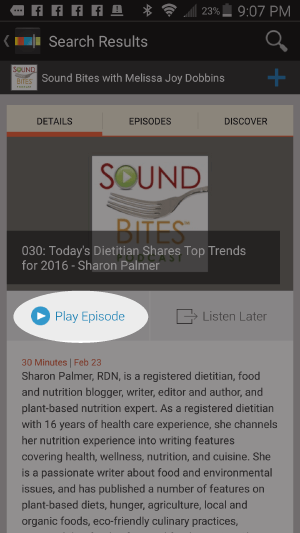
1. Search for “sound bites with melissa joy dobbins” 2. Choose Play Current Episode or Add to Playlist
Choose “Play Episode”
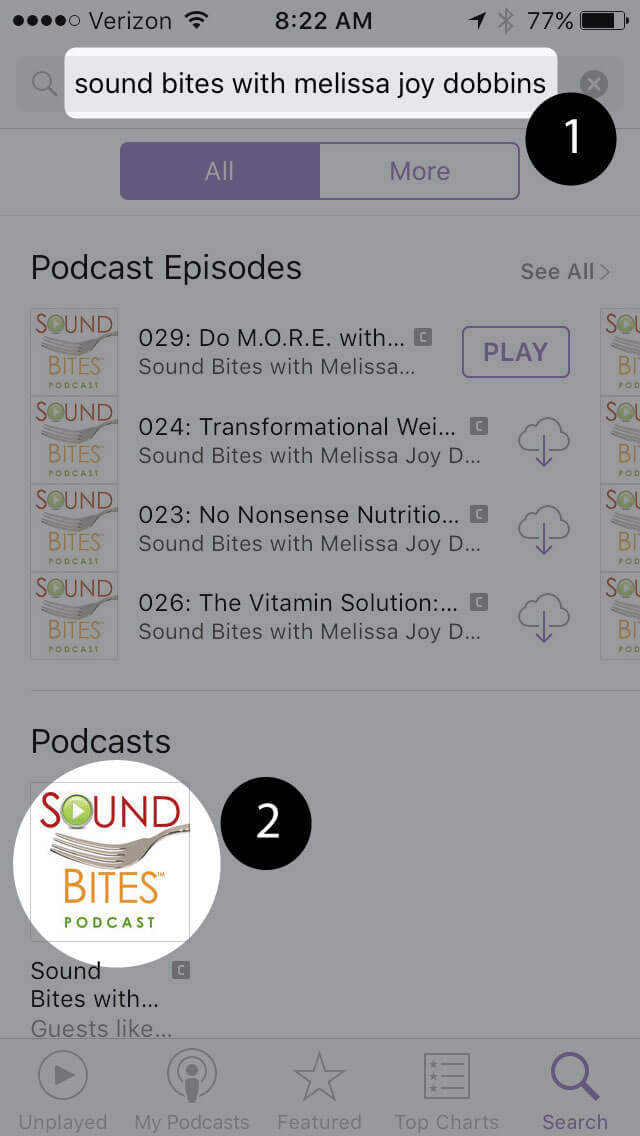
Subscribe & Review on iPhone
Open the “Podcast” app on your iPhone
Search for “Sound bites with melissa joy dobbins”
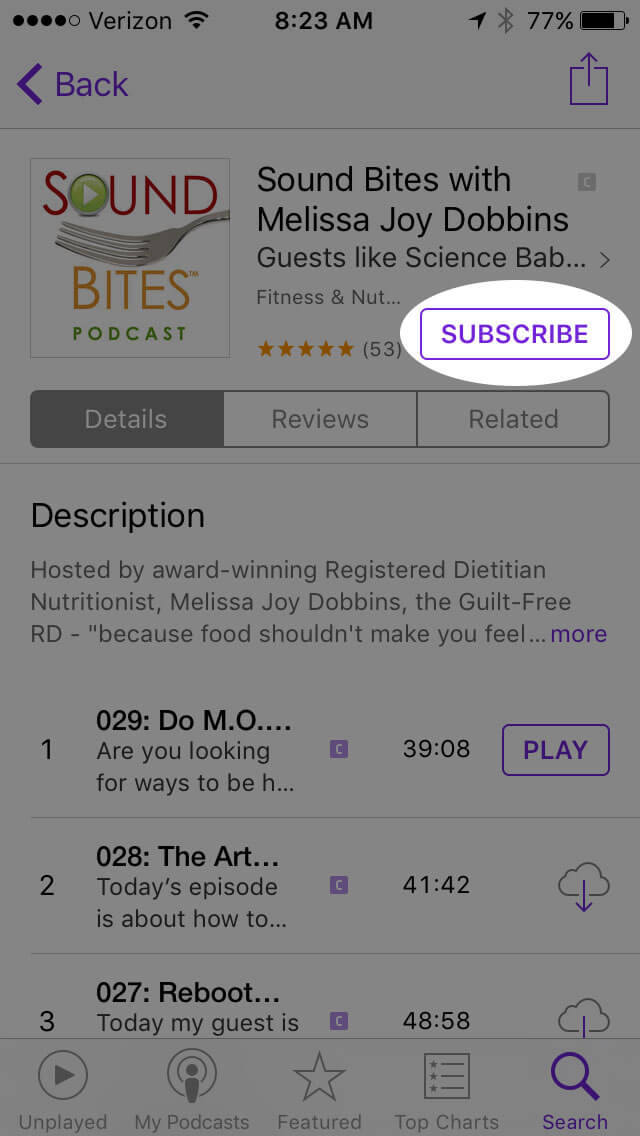
Open the podcast and click “Subscribe” and your done!
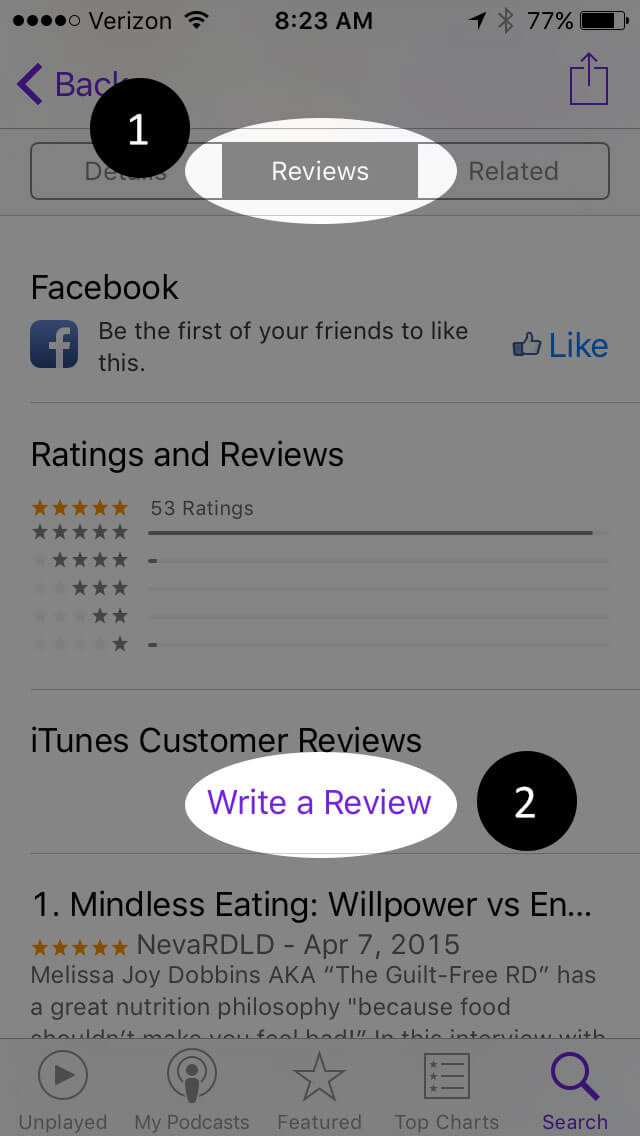
Write a Review
Click “Reviews”, then “Write a Review”.
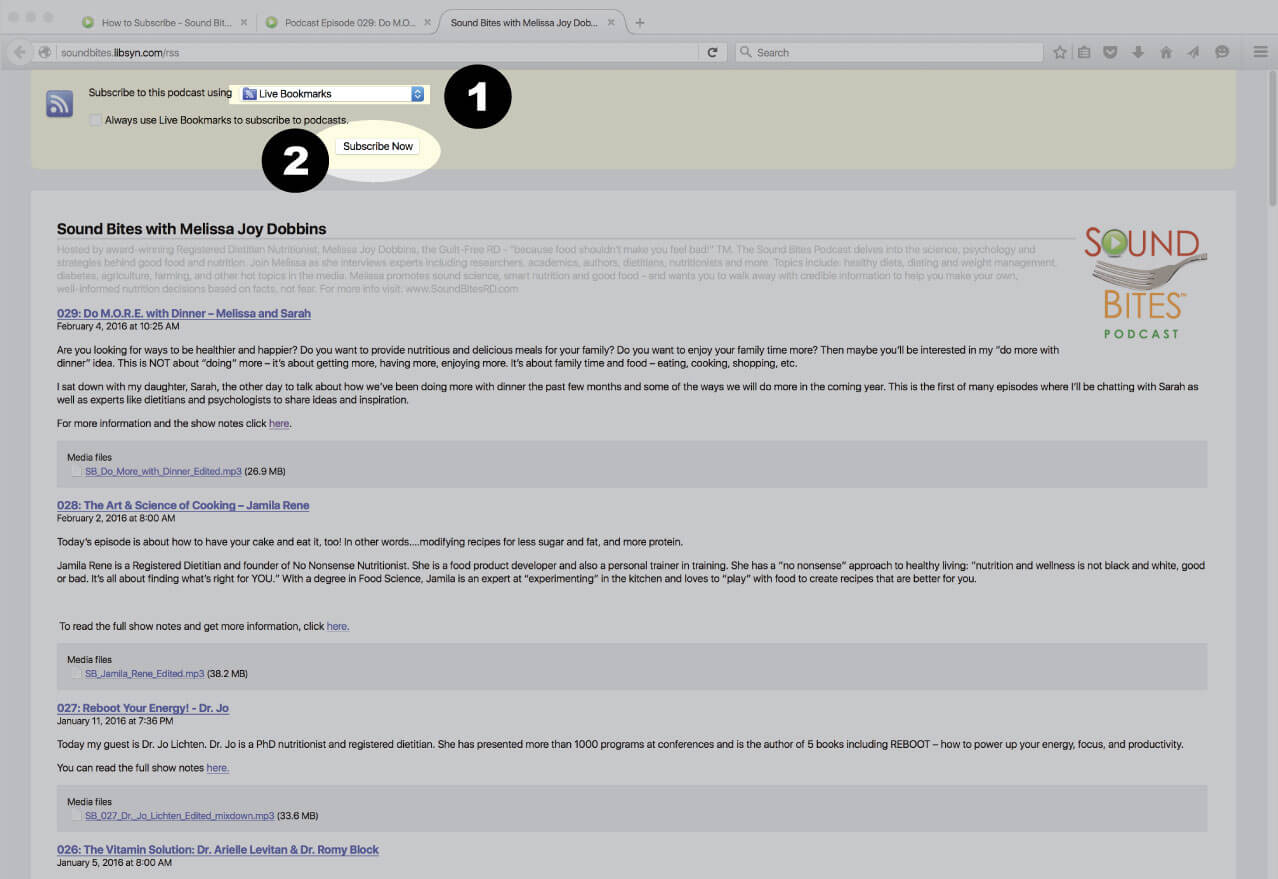
Subscribe via RSS Feed
Navigate to any podcast player . Click on the RSS feed icon.
Click on the RSS feed icon.
Click on RSS Feed
Choose which application you would like to use to receive the RSS feed
Click “Subscribe Now”
Confirm settings and subscribe.
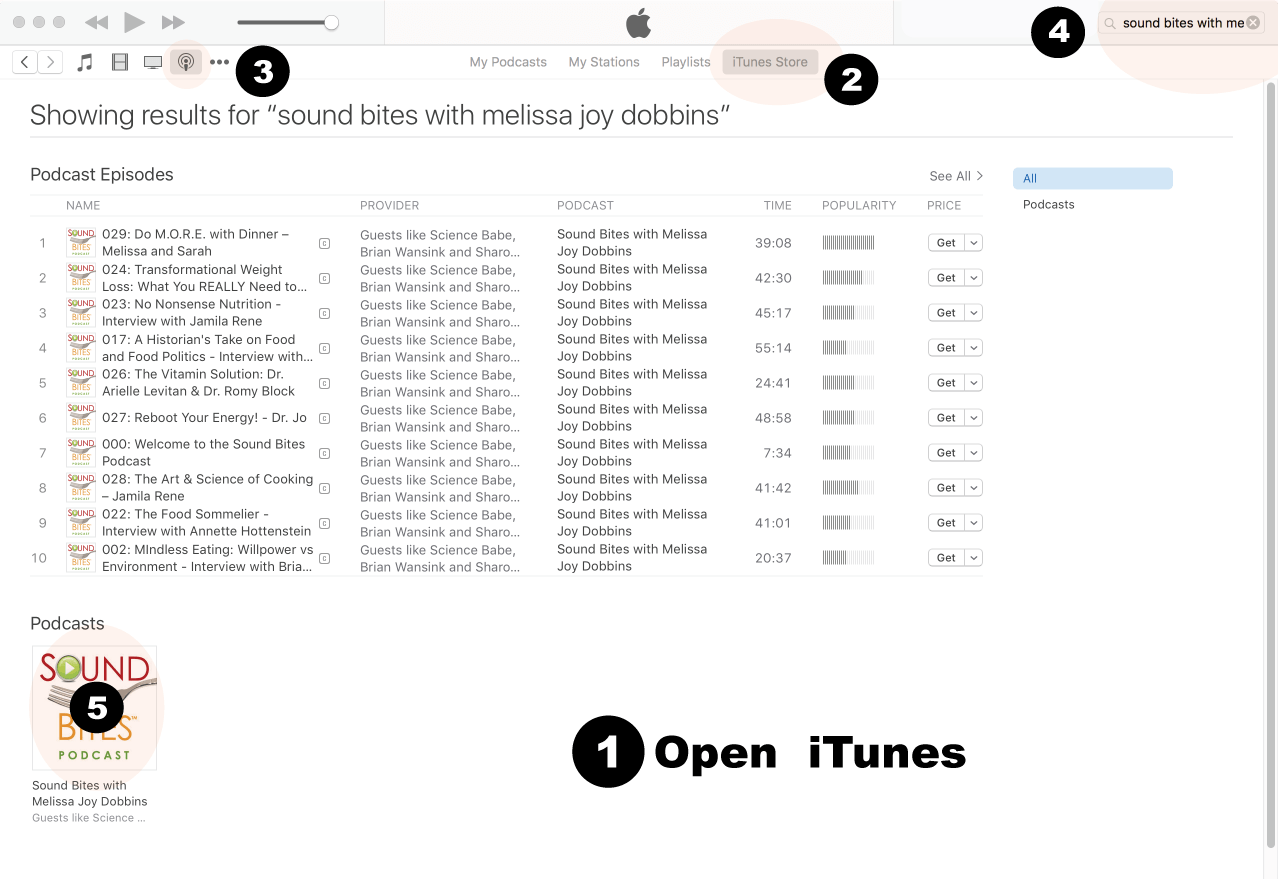
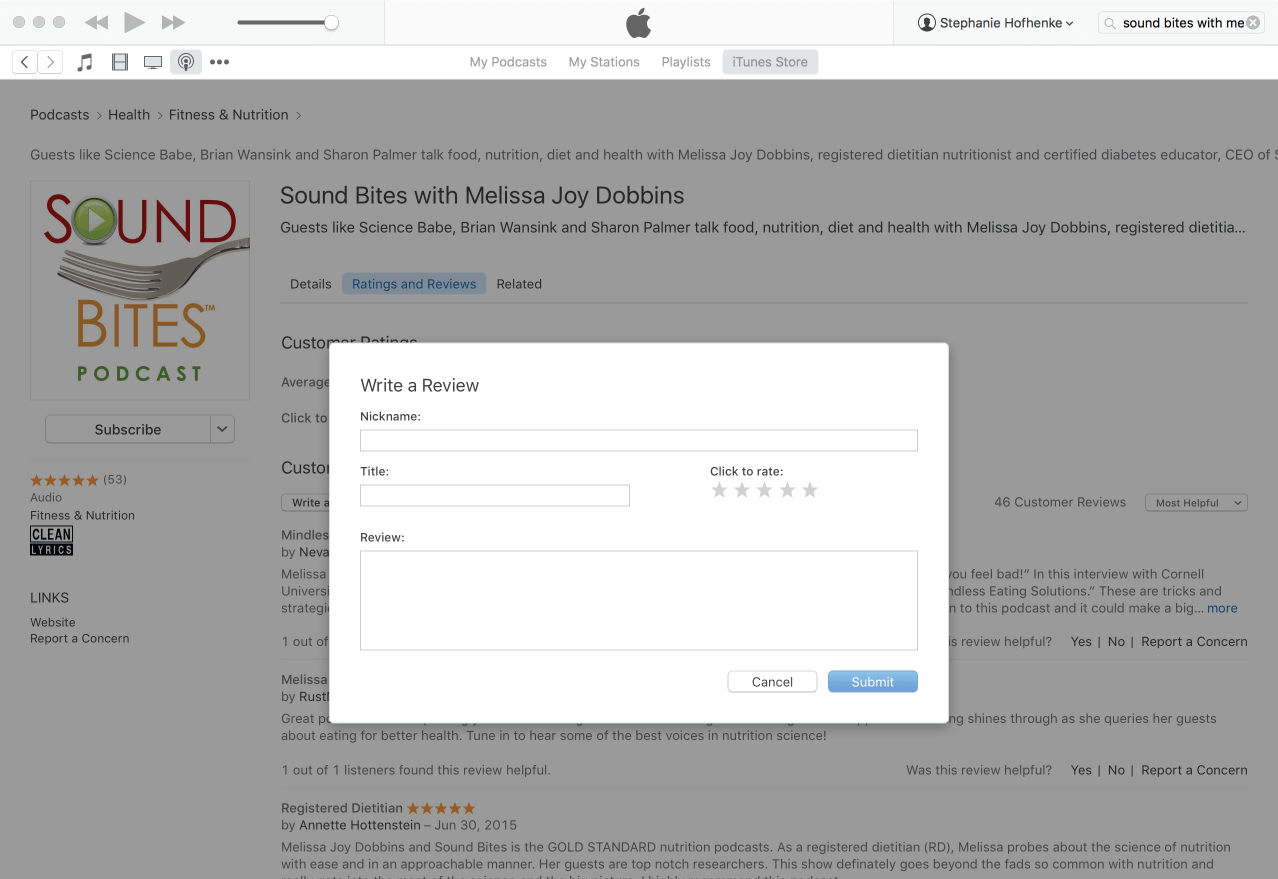
How to Review in iTunes
Open iTunes desktop application
Click iTunes Store
Click on Podcasts
Search for “Sound bites with Melissa Joy Dobbins”
Click on podcast image
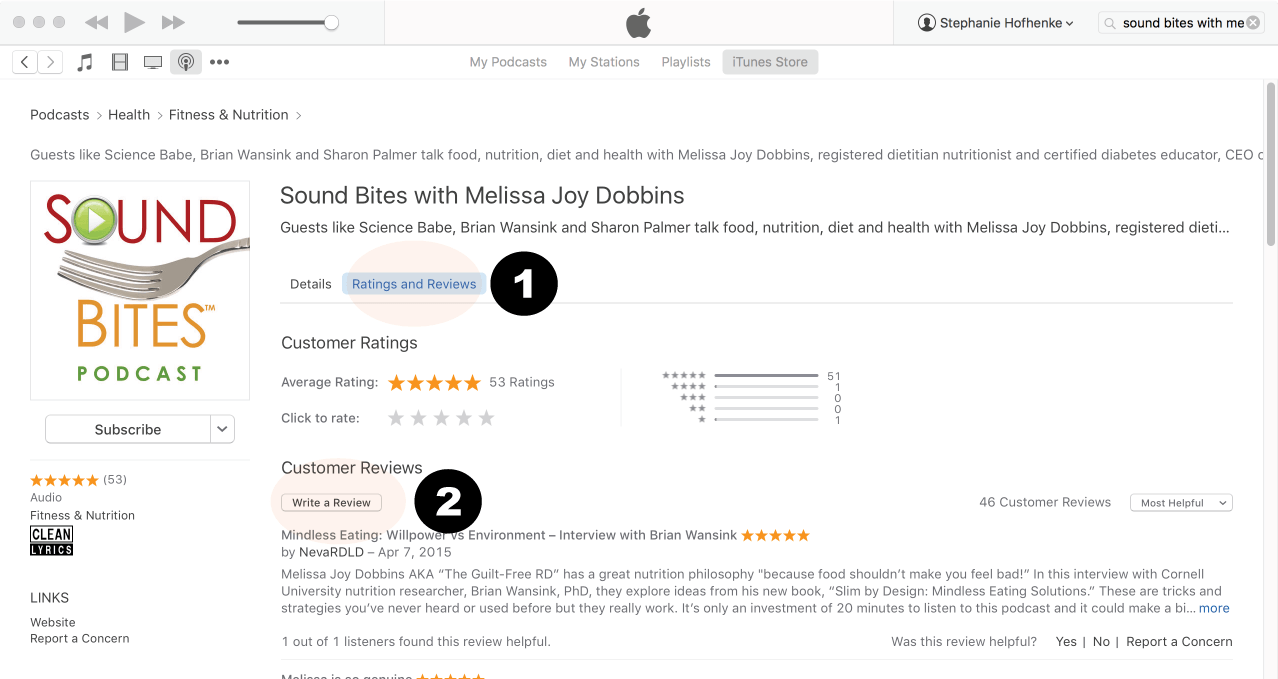
Search for Sound Bites podcast in iTunes
Click Ratings & Reivews
Click Write a Review
View reviews and write your own review.
Write your review…. Thank you!
Write your review!
How to subscribe via iTunes
Click here to view the Sound Bites Podcastin iTunes, then click the blue “View in iTunes” button. This will open your iTunes application directly to Sound Bites Podcast. Click the “Subscribe” button, and your done!