Celebrating over 1 Million Downloads and 50,000 Free CEUs on the Sound Bites® Podcast | NEW: Get 1 years’ worth of CEUs with the new 15-CEU Podcast Course
Click here to earn 1.25 FREE CEU for listening to this podcast episode!
This episode is not sponsored. I attended a sponsored conference where I saw Dr. Kaitlin Roke and Elana Natker speak earlier this year.
EPA+DHA Research: Diabetes, Cognition, Depression and Anxiety
Most people need around 500mg EPA+DHA omega-3s per day. You can get that by eating fatty fish at least twice per week and taking an omega-3 supplement from fish oil, krill or vegetarian DHA/EPA – algal oil.” – Elana Natker
Omega-3 fatty acids, specifically eicosapentaenoic acid (EPA) and docosahexaenoic acid (DHA), are important nutrients that play crucial roles in supporting healthy hearts, brains, eyes, joints, inflammation, as well as mental health. They also play an important role in fetal brain and eye development and reducing the risk of early preterm birth. However, 95 percent of Americans – and 80 percent of people worldwide – are not getting enough of these vital nutrients.
While it is possible to obtain EPA and DHA omega-3s through the diet from fatty fish, seafood and some fortified foods, dietary supplements may be helpful or necessary in some cases.
Before starting any supplement regimen, it’s crucial to consult with a healthcare professional, as individual needs can vary. Additionally, it’s worthwhile to choose high-quality supplements that undergo testing for purity and potency.
When you’re choosing a seafood source of EPA+DHA, think SMASH! – sardines, mackerel, anchovies, salmon, herring.” – Dr. Kaitlin Roke
Tune into this episode to learn about:
different types of omega-3s, recommended amounts and average intakes
health benefits of and common myths about omega-3s
food sources of omega-3s and barriers/challenges in increasing consumption
an overview of the amount of research and the GOED clinical study database
latest research related to diabetes, brain health and mental health
limitations of research and future research opportunities
practical tips for increasing intake of omega-3 rich foods
what to look for in a supplement
where to order at-home omega-3 index tests
resources for the public and health professionals
While there are many factors that impact our mood, there is good evidence that increasing our intake of EPA+DHA can support brain health across the lifespan.” – Dr. Kaitlin Roke
Kaitlin Roke MSc, PhD
Kaitlin Roke is the Director of Scientific Communications and Outreach for GOED, the Global Organization for EPA and DHA omega-3s, where she manages the organization’s Clinical Study Database. Since there have been over 4,500 clinical trials with omega-3s, she digs into the science to determine which health effects are evidence-based. Her primary skills are in science translation, research and data analysis, and collaboration with nutrition and health professionals and teams. Since joining GOED in 2022, Kaitlin has been part of in person and virtual webinars across the academic and nutraceuticals industry.
Elana Natker MS, RD
Elana is a nationally recognized food and nutrition expert and spokesperson with more than two decades of communications experience. Her first job was as an on-camera spokesperson, which then led to a thriving career in public relations, working for major agencies in Chicago, Denver and Washington, D.C. Her client work in the areas of food, health and wellness piqued her interest in nutrition, so Elana went back to school to earn a master’s degree and undergo the training and testing required to become a registered dietitian.
Elana’s work with GOED, where she manages the organization’s consumer and health professional education and outreach, began in 2015. She is adept at translating complicated science in a way that both consumers and health influencers would understand. Her primary skills are in nutrition strategy, science-backed messaging, content development and health professional education. An accomplished speaker, Elana has also presented at industry events and for health professionals, including dietitians and nurse practitioners.
[00:00:00] Voice Over: Welcome to Sound Bites, hosted by registered dietitian nutritionist, Melissa Joy Dobbins. Let’s delve into the science, the psychology, and the strategies behind good food and nutrition.
[music]
[00:00:23] Melissa Joy Dobbins: Hello, and welcome to the Sound Bites Podcast. Today’s episode is about the latest research on Omega-3s, specifically, EPA and DHA Omega-3s, and health, diabetes, brain health, and mental health. We hear a lot about Omega-3s, but what does the science really say? My guests today are Dr. Kaitlin Roke and Dietitian Elana Natker. Kaitlin Roke is the director of Scientific communications and outreach for GOED, where she manages the organization’s clinical study database, where she digs into the science to determine which health effects are evidence-based.
Elana is a dietitian and nutrition communications consultant with more than two decades of communications experience. Among her many roles is serving as the director of Consumer and Health Professional Communications for GOED, which is the global organization for EPA and DHA Omega-3s. Welcome to the show, ladies.
[00:01:22] Elana Natker: Thanks, Melissa.
[00:01:23] Melissa: I want everybody listening to know that this episode is not sponsored. However, I did see Dr. Kaitlin Roke and Elana Natker speak at a sponsored conference earlier this year, and we may be submitting this episode to the Commission on Dietetic Registration for Continuing Education credits for dietitians, dietechs, and diabetes educators. If that’s of interest to you, stay tuned for that.
Of course, you do not have to be a dietitian or nutrition professional to listen to the show, and to get all of the knowledge that my expert guests bring to the table. Welcome to everybody. Now, Dr. Roke should I call you Dr. Roke or Kaitlin or Dr. Kaitlin?
[00:02:04] Dr. Kaitlin Roke: Kaitlin is great. Thanks, Melissa.
[00:02:06] Melissa: Kaitlin and Elana, I would love for each of you to share a little bit more with our listeners about your background, maybe your education, how you got interested in this particular topic, and of course, the work you do, and any disclosures to note. Kaitlin, let’s start with you.
[00:02:24] Kaitlin: Thanks, Melissa. As you’ve mentioned and as you’ve introduced us, both Elana and I work for GOED, which is a short abbreviation but long name. For me, I’ve been with GOED for almost two years full time, and then two years part-time prior to that. GOED is a global Omega-3 trade organization, so it represents Omega-3 companies along the supply chain from fisheries to finished products.
Our goal at GOED is to support the science and encourage increased intake of EPA and DHA Omega-3s. We’ll talk a little bit more about those as we get into this. Then prior to joining GOED and prior to my life at GOED, I started my journey with Omega-3 fats in undergraduate and graduate school. I’ve told this story before, but I really do remember the lecture, the first time that we heard about EPA and DHA, and I just wondered how two nutrients could have such an impact on our health.
I specifically sought out graduate advisors who were looking at fatty acids and Omega-3 fats. I had the opportunity of doing my own clinical trials in graduate school, focused on EPA and DHA. As a longtime Omega-3 enthusiast, it’s really a pleasure to be working for GOED, whose focus is on these two nutrients as well.
[00:03:48] Melissa: That’s very cool. I remember hearing that story and thinking, wow, yes, you’ve really been focused on this topic for a while, and just to do your own clinical trial is just very cool. Maybe you can tell us a little bit about that as we go through our conversation. Elana, let’s hear from you and about your background.
[00:04:05] Elana: Absolutely. I am a registered dietitian and nutrition communication specialist. That means that I like to take the science and bring it to consumer base and health professional audiences in a way that they can understand and make some helpful decisions in their future. My background is actually in communications becoming a dietitian was a second career for me that I went back to school in my late 20s, early 30s, and decided to become a dietitian.
With that, I work with organizations such as GOED, where, as Melissa mentioned, I am the director of Consumer and Health Practitioner Communications. I do consult with some other organizations, so no major disclosures that would have to do with this podcast, but happy to be here. For the dietitians in the audience, I was a former chair of the Nutrition Entrepreneurs Dietetic Practice Group, so I like to mention that as well. I feel very strongly about dietitians working in their own spaces because we’re such an eclectic bunch.
[00:05:10] Speaker 3: Yes, and that’s a wonderful DPG. I can’t hide that it’s my favorite. I do collect DPGs, I have many of them, but NE is the best. That’s where you and I originally met years ago. We were on a little mastermind group, too, with a couple of our buddies.
[00:05:24] Elana: That is right.
[00:05:25] Kaitlin: Yes, we go way back, Elana. Maybe the first place to start is explaining Omega-3s and the different types. I find that I always appreciate a review and update. It can be a little confusing. Elana, would you like to kind of set the stage with that information for us?
[00:05:44] Elana: Absolutely. It’s funny, everybody thinks they know Omega-3s, but it’s actually, like you said, it’s a bit more complex than it sounds. Omega-3s are a type of polyunsaturated fatty acid, so a type of fat, but there’s three different types. There’s alpha-linolenic acid or ALA. Then there’s EPA and DHA. I’m not going to say what they stand for because it’s very Greek and very long, but ALA is the kind that you typically find in plant sources, like in seeds, and nuts, canola oil.
It’s the EPA and DHA that are found in fatty fish, or marine-based sources, primarily, that’s their natural place where you would find them. We know that our intake of ALA Omega-3s, generally plant-based, people are meeting or exceeding, usually exceeding their levels. We know this from NHANES’ research that gets done every few years, but their intake of EPA and DHA Omega-3s is way below what it needs to be.
I should go back a little bit. The science of EPA and DHA is really robust. We know that those fatty acids, which tend to be longer, there’s more carbon chains, and so there’s more kind of kinks in the carbon chains, and we can get all nerdy on that, but really, they’re more potent for the system, more potent for the body. They have a stronger effect on heart health, brain health, eye health, and prenatal health, and healthy pregnancy.
[00:07:12] Melissa: Than the ALA.
[00:07:13] Elana: Than the ALA, exactly. Which are the shorter chains. The ALA is a good source of energy. It’s a source of calories, the fatty acid calories that we can get, but it’s the EPA and DHA that really have these other health benefits in our bodies.
[00:07:26] Melissa: Okay, great. We are going to learn a lot more about, you mentioned this robust body of science on EPA and DHA, or Omega-3s in general. I’ll probably just say Omega-3s as we go through the conversation, and both of you can kind of specify when you’re talking about one or the other.
[00:07:45] Elana: Absolutely.
[00:07:46] Melissa: That’s a good place for us to start, as I said, but I’d also like to follow-up by asking, like I said earlier, we often hear about Omega-3s, and we know or we hear that they’re good for us, but what exactly does that mean? How do we begin to understand maybe the food sources or the supplements? It’s an essential nutrient, right? We don’t make it ourselves. We have to get it from outside the body through food and supplements, right?
[00:08:14] Elana: Yes, and yes*. Yes, Omega-3s as a nutrient, are essential. Your body can easily make them. What really is, the body cannot make the ALA Omega-3s.
[00:08:27] Melissa: Got it.
[00:08:28] Elana: There is a process in which the ALAs, the shorter Omega-3s, can be elongated and made into EPA and DHA. Like I said, those are the fatty acids, the Omega-3s, that are really good for a healthy heart, healthy brain, healthy eyes, and pregnancy and infant development. You really want the EPA and DHA. You really can’t depend on the ALAs to get you there, though, because the process to go from the shorter to the longer is very inefficient in the body.
It’s best to get those from the foods that you eat, and the foods for EPA and DHA are fatty fish. It’s not just fish. It’s a specific kind of fish too.
[00:09:09] Melissa: We’re going to list those out, but yes, so just to recap, and that’s why I know it’s essential nutrient, but I needed that nuance. Our bodies can take the ALA and make the EPA and DHA, but it’s just not really that robust. Yeah, it can happen, but okay. I also understand that most people are not getting enough Omega-3s in the diet. Can you tell us more specifically about what the data shows, and what the recommended intake is? Because I’ve heard that maybe that would be set too low.
[00:09:38] Elana: Yes, absolutely. The recommended intake from GOED’s perspective, we feel that based on the science and the literature that’s out there, and with the International Study of Fatty Acids and Lipids Society, they recommend for the average healthy adult to get 500 milligrams of EPA and DHA per day, combined, in whatever quantities, as long as those two numbers add up to 500 milligrams per day.
If you look in dietary guidance in America, for example, generally, they talk about eating two servings of fatty fish per week. Two servings of fish per week, preferably fatty fish, is what it says. If you do that, the average comes out to about 250 milligrams per day over the course of a week. If you take whatever you get from those two days, average it out over the course of a week, it’s about 250 milligrams intake per day, which even at 250 milligrams, that’s half of what GOED and the fatty acid societies recommend, and other recommendations around the world.
There’s even some research that shows intakes as you gradually increase, the benefits also increase. 500 is really a baseline, we could go even further. I’ll tell you though, also looking at the NHANES‘ data, that average intake is about 100 milligrams a day. Okay. We’re not getting even 20% of what we need on the average diet.
[00:11:01] Melissa: That’s very helpful. That difference between maybe the recommended minimum amount, that’s not the verbiage, but versus what’s optimal, we hear that with different nutrients in the diet, and also because it’s a fat, I know with fat-soluble vitamins, like vitamin D, you don’t have to have a certain amount every day. It’s more like it can average out over the week, so is that the same with this type of fat?
[00:11:27] Elana: Exactly.
[00:11:28] Melissa: Like you said, if you have fatty fish twice a week, it does average out. It’s like, you don’t have to have a little bit every day.
[00:11:33] Elana: Although, I will say I will later probably recommend, you can take your supplement every day just to make sure that you’re getting the right amount of what you need. You’re absolutely right. It will average out over time. You do store it in your body. That’s also, if you’re doing Omega-3 testing for your blood levels, you want to get a baseline test, and then wait about six months. Because it takes some time for your body to build up its stores, and then test again.
[00:11:57] Melissa: We’re definitely going to bring Kaitlin in to talk a lot about the research, but I have one more question, because I don’t want to just bury this later, let’s talk about what are those fatty fish, everybody knows salmon, but there are others, so what are those fatty fish? Then, I want to talk about the challenges in getting this into our diet, and why we might even be talking about supplements. Food first, but there’s a role for supplements.
[00:12:19] Elana: Absolutely. Yes, it’s funny, my background is in communications as well, so I feel like fatty fish needs a PR do-over, and we’re trying like oily fish, that sounds worse actually, but yes, it’s the fatty fish, and salmon is the most ubiquitous. It’s the one that everybody tends to think of first, but it’s definitely not the only. We like to say think SMASH, salmon, mackerel, anchovies, sardines and herring. Those are the five fattiest of fish. Many of them can be found in cans, which tends to be even more affordable, which is fantastic.
They’re not the only ones, but those are the ones that definitely give you the most bang for your buck in terms of Omega-3 intake, or Omega-3 levels, I should say. Mussels, a type of shellfish, also a good source, and oysters, a really good source as well. Tuna is a good source. A lot of people eat tuna. Canned tuna can be a decent source as well. Like I said, when it comes to, if you want, the most-preserving, it’s those SMASH fish.
[00:13:24] Melissa: Great. Very easy to remember and use. All right, that begs the question again, what are the challenges to getting enough Omega-3s in our diet? I talk about seafood a lot on the podcast, but there’s that recommendation a minimum of two times a week. There’s a lot of people who maybe they’re not– I think my personal bias or thought, number one is, they don’t know how to prepare it, or they don’t know what to do with it. Like you said, there are a lot of canned or tinned fish. What are you seeing in the consumer research as far as why people aren’t eating more fish or fatty fish?
[00:13:58] Elana: A lot of it, it’s exactly what you said. They don’t know how to prepare it. They think it’s too expensive. Actually, the cost is a big factor because they don’t want to buy it, and because they also don’t know how to prepare it, they don’t want to buy it and waste it. They just don’t really know what to do with it. Some of it, I know just personally in my own house, my husband hates the smell of it. He doesn’t like the smell of fish. If we’re going to make fish at home, we got to make it out on the grill outside, or we eat it in a restaurant, which we don’t go out to eat very much.
There’s a lot of unfamiliarity with cooking fish, preparing fish, and just enjoying fish, I guess. It’s also another one of those things that many of us, at least in our culture, we don’t grow up eating fish very much. Especially the fatty fish. I think shrimp, we eat a lot, but that has very little Omega-3s in it. Fish sticks, actually the white fish that tends to– the pollock in fish sticks is a pretty decent source as well. I’d love to see more of that incorporated into people’s diets.
[00:14:56] Melissa: Yes that’s a good point. When I go through periods where I kind of track, “Gee, how often am I getting seafood,” or, “How much protein am I getting?” I find that shrimp is most often what I would cook at home. Salmon too obviously, but shrimp, I feel like it’s easier to cook, and it’s a little bit more forgiving. I also do want to mention that I do have some Omega-3-related episodes that I’ll link to in the show notes @soundbitesrd.com, including one with Ellen Shutt from GOED, and that was way back in episode 74, Are You Getting Enough Omega-3s?
She just does a really great job of breaking everything down step by step. Not that we’re not going to do that today, or we haven’t already done some of that, but I do encourage people to take a listen to that just for maybe a deeper dive, and some more recent episodes related to Omega-3s and cardiovascular health, brain health, particularly concussions, and of course, I have some seafood-related episodes.
Let’s bring Kaitlin into the conversation. You manage GOED’s clinical study database. Talk to us about how much research has been done on Omega-3s, and what you’re seeing in maybe the current or latest research.
[00:16:06] Kaitlin: We’re so lucky, but also overwhelmed with the amount of science for EPA and DHA Omega-3s. As you said, with our database and other academic search tools, as of today, there’s over 50,000 studies on EPA and DHA, with over 4,000 human clinical trials. Compared to some other nutrients or supplements that we see, this is a huge amount of research. This presents us with some great benefits, but also some challenges.
Because, with so much research means we have a lot of research to sort through, and a lot of information to process in order to try and determine what some of these key messages and key areas are that are coming from the research. As Elana has mentioned before, we see some really strong evidence for heart, brain, pregnancy, prenatal, and then we see a lot of other emerging research, some looking at biomarkers, some looking at consumer interest areas.
We have a lot of research emerging, so it takes some time to really properly sift through, and I can give some examples of that as we continue our conversation. It takes a lot of work to evaluate the science. I know as dieticians and as scientists, we really want to make sure that we have a good handle on what the science is actually saying. The frustrating part to nutritional science is that it’s not always consistent, and sometimes it changes. If we could stand on our chair, or put a stamp on it to say, “Forever and always, this will be the message that,” would make everyone’s lives easier. We know with technology and innovation, our stories might change over time, and we have to be adaptable to that, and incorporating the latest evidence.
[00:18:00] Melissa: That’s a great point, and I was going to ask this later, but I think it fits really well here now. As an expert in research, this is your world, science translation, research, data analysis, I would love to hear your thoughts on a few things related to research, like nutrition research limitations, industry-funded research, and also the role of the dietician in industry. You could answer that all together, or take each one separately, whatever you prefer. There’s a lot of different thoughts and ideas about those three issues. Since you live and breathe this every day, I would love to hear your thoughts.
[00:18:37] Kaitlin: It’s such a great opportunity to talk about this question in particular, because it’s something that comes up all of the time, and I think it can be a bit of an echo chamber when nutrition scientists and dieticians are talking to each other about these issues all the time. You know they exist, but it’s important to share, I think, with this broad audience. I can mention some limitations specifically to brain health and cognitive research maybe when we address that. Overall, I think one big challenge is assessing the background diet of people coming into your studies, and trying to figure out a study population that’s relatively consistent.
When we think about EPA and DHA specific in our example, if we have a study of 100 people, what kind of foods are they eating? Are they taking any supplements? What kind of EPA and DHA levels do they have in their body before they start the study? If we know this information, we can measure changes that happen over the course of the study. Perhaps we’re seeing more robust effects in people who start with really, really low levels, and are able to increase their levels.
I think stratifying by these population groups from baseline diet intake is really important. Then when we think about a topic like brain health, I mean, everyone has different genetics, and health statuses. If you have dementia, do you also have cardiovascular disease? There’s just so many different combinations, and each of these combinations are important to consider someone’s nutrient needs, and not just for EPA and DHA, but diet in general. I think the other thing we talk about a lot in nutrition science is, in a cell culture and animal experiment, you have control over your experiment.
Some of the rats might be far more feisty than others, but they still live in a consistent environment, and your cells are being treated the same way every day. Whereas in a human experiment, if you give people their supplements, for example, or you advise them to eat fish twice a week, and then they go off into their world, and the exam season comes, or they have a family dinner, or all sorts of things happen. They start training for a marathon halfway through your study, as an example. There’s all of these other factors that humans are hard to control.
On the podcast you had with Dr. David Allison, he talked about some of the studies that he does where you bring people into the lab in a controlled environment. Boy, those are great studies, but how expensive they are to actually run, and those are very rare, very unique opportunities. Otherwise, we have to do our best, and people will go off and do their thing.
[00:21:33] Elana: I also want to add, a limitation especially with Omega-3-related research, EPA and DHA-related research, we know from meta-analyses of clinical studies that EPA and DHA intake reduce the risk of death from heart disease. For us to tell people, “Take your Omega-3 so you don’t die.” “How do you know if it works?” “Well, you didn’t die yet.”
[00:21:54] Melissa: Great message right there.
[00:21:56] Elana: That’s hard. It’s a limitation because we’re trying to promote health, we’re trying to get people to stay healthy, and so how do you prove that? It makes it really hard.
[00:22:05] Melissa: Yes, absolutely. Maybe we can address this later or now if you prefer, but you had mentioned testing earlier, and I remember in previous conversations on the podcast as well about Omega-3s is, it’s not typically in your annual physical blood panel. I always have beautiful lipids, but when I did the Omega-3 test, my levels were low, so I don’t know if you want to address that now?
[00:22:29] Elana: It’s a beautiful way of seeing if the diet that you have is working for you in terms of raising your Omega-3 levels to a point in which it’s good–
[00:22:40] Melissa: You can’t feel it. You don’t walk around and say, “Oh, I’m feeling like my Omega-3s are good today.” It’s like blood pressure, you don’t know if it’s high unless you test it.
[00:22:47] Elana: Exactly, exactly. You’re right that it’s not in your typical lipid panels or anything like that. Your desirable Omega-3 Index, we say Omega-3 Index, it’s really Omega-3 blood levels. Your desirable is around 8% to 12%. Most people are between a 4 and 6%. If you get the blood levels taken, and then you know, is your diet working for you? Maybe you need to incorporate a supplement into your diet, or if you’re already taking supplements, are you taking enough? It’s just a way to get some feedback to knowing if what you’re doing is working, and then you can go from there.
[00:23:23] Melissa: Yes. Is that something you can ask your doctor to include on the blood panel, or is that something that GOED offers or recommends a specific test that people can access?
[00:23:34] Elana: It can be done in the doctors’ offices in some places, I think, but it’s very, very easy to order. There’s a test that’s called the Omega-3 Index from Omega Quant, omegaquant.com. You can just order it yourself, or if you work with a dietician, a lot of dieticians offer the blood testing in their offices. It’s like $50 to get a blood test done, and it’s just a nice way of knowing if your diet is working for you, and if you need to add some supplementation into it.
[00:24:02] Melissa: Okay. Thank you so much. I will include that information in the show notes, for sure. I hadn’t thought about that until we were into this conversation, but I do remember taking that test before. Yes, I think I was around four or five, which was surprising. Since then, I’ve really amped up my Omega-3 intake, my EPA and DHA. Kaitlin, back to the conversation about, and Elana, weigh in as well too, you’re a dietician and in communications, but industry-funded research and the role of the dietician in the food industry.
[00:24:32] Kaitlin: Yes. I think this is a topic that we get into amongst like-minded and not-like-minded people on this topic. I think that the question that Elana and I have asked each other in conversations before is, if the industry doesn’t fund research, where would nutrition science be? I think that what we mean by that, and I can give an example from something we discussed, but let’s say a company wants to introduce a new product to the market, and they want to say something about their product, maybe say it’s good for heart health.
They need to test their product and see if it’s actually going to be good for heart health. In order to do that, they need to fund a research study to evaluate their product. If we don’t want industry-funded research, then we have more products and supplements on the market that are not scientifically validated at all. That’s concerning to me, I think we need to, if we’re going to be talking about benefits of a product, we need to know that they’ve been tested. A concern that I have is that if it’s not done with industry-funded research, what happens then if it’s done internally and doesn’t get published?
Then we have even less access to the information, and if it’s published with an academic research group, then it typically makes it into the peer-reviewed literature, and everyone can, I mean, not always because of open access, but then everyone has access to this information. If we have internal company-only studies, then we don’t really know what’s going on as a public. I think in that example, it’s really important to fund and publish research that funding is provided by industry. Then the other point I wanted to make too is that if we don’t want industry to fund the research, then who will fund the research?
[00:26:34] Melissa: Right.
[00:26:35] Kaitlin: There are some government grants, and these are extremely competitive, both in the United States and in Canada. These are an option for research groups to apply for these, but it’s not endless funding, and the government certainly can’t and isn’t expected to provide funding for all of this research either. I just want to challenge people who are really imposed to industry-funded research and just wonder what their suggestions are for other options because, I really see a benefit for industry being involved, and for testing these new products and supplements, and validating some of these scientific hypotheses that we have. I think the partnership is very important, and I don’t know where we would be without the funding from industry.
[00:27:21] Elana: Melissa, you were also asking about dieticians in industry, and so, I definitely have my thoughts on that. My feeling is, you want to have people at a company that have invested their knowledge and nutrition education into these products. Companies who actually invest in dieticians and value them are the ones that I personally admire, because they’re trying to bring the right people to the table to research or bring a product to market, and make sure that it’s like Kaitlin is saying, is validated.
The thing is too is, I think we forget that dietetics or the dietician, it’s a wide variety of things. We’re not just clinicians, and dietetics is not just about eating your fruits and vegetables, it’s about taking the nutrients that you need in order to prevent disease or early death. That can be a whole different way, it’s like getting right infant formula. You think formulas, it’s scientific, but it’s to get the right nutrients into an infant. Do you think of that as highly processed foods? Absolutely, it is, but that’s what we’re going to give our babies in order to give them the right shot at life. Dieticians work on stuff like that, companies research things like that, and it’s hugely important.
[00:28:38] Melissa: I agree. I agree. Thank you both for weighing in on all of that. Like I said, I usually ask it later, didn’t mean to pause the research conversation, but let’s turn our thoughts back to the research that you see come across your desk all the time, Kaitlin. In particular, I’m interested because I know that there are some updates or more recent research related to diabetes, brain health in general, and then mental health. Diabetes, of course, I’m interested in because I’ve been a certified diabetes educator for 25 years. Anything that you can share with that?
Then mental health, I have been wanting to talk about Omenga-3s and mental health on the podcast for several years, so I’m really curious about that aspect. I know just from our previous conversations that it’s really important to you and to GOED to share the science, but also the limitations, and maybe where things are, where things are headed. I am really interested to hear any of that that you can share with us.
[00:29:41] Kaitlin: Great. Science and Omenga-3s are my favorite topics, so if I go on and on, just interrupt me or stop me. Let’s start with diabetes, and I think it’s something, again, when we learn about EPA and DHA, we want them to do everything, but we have to be able to be realistic in that, maybe they can’t quite do everything. I liked how you framed this for, what the science really say, or what is the science saying, because not everything is experiencing a benefit. There’s a good example, really, just diabetes.
When we look at the scientific research, we find that EPA and DHA significantly reduce triglyceride levels. If taken in sufficient amounts, there’s a good relationship between increased EPA and DHA intake, and reduced triglyceride levels. This does not hold true for cholesterol. If we’re looking at these blood lipids specifically, if someone has high triglyceride levels, it could be an effective strategy.
If someone has cholesterol levels that need to be managed, it may not make a difference to that person specific to their cholesterol. I think that’s important to highlight. Then the other two, of course, related to diabetes would be glucose and insulin. From the human clinical trials, we don’t see a conclusive effect. We see some studies that show a bit of an increase, and some studies with a bit of a decrease. It’s not conclusive right now.
I wouldn’t be comfortable saying that there is a strong effect in either direction, because we really just don’t know. Sometimes not knowing is uncomfortable, and it’d be nice to just know, but I think it’s more appropriate in this case to say, it’s inconclusive. This is an area of research for clinical and in general. There will be more studies to evaluate this, but as of this point, we’re still learning more about the effect of EPA and DHA on glucose and insulin.
[00:31:41] Melissa: Okay. Great. Thank you. As you’re talking, it reminds me, maybe we didn’t spell this out so much at the beginning, but your job digging into all the research, you’re looking at all the research studies that are out there, the strengths and limitations, and the methodologies of every single study. I don’t want to put words in your mouth, obviously, correct me if I say anything wrong, but you are taking that body of research, and you’re trying to say, “How strong is the evidence in this particular question or area of focus?” Did I say all that right?
[laughter]
Or maybe you could say it better.
[00:32:15] Kaitlin: Yes, that’s exactly right. Yes, no small task. To evaluate the literature in a systematic way, it takes a long time, and is very difficult. I certainly can’t say that I’ve done this for every single topic, but the benefit is that we can rely on the hierarchy of evidence to help us as dieticians or nutrition scientists, to help us make these interpretations. We also have bodies like Health Canada, and the FDA, and FSA in Europe that also evaluate the science, and help people come to these conclusions without having to do it themselves.
Yes, nutrition scientists, we tend to look at the meta-analysis as the totality of evidence and bringing everything together. Those also have different strengths and weaknesses to them. Not every meta-analysis is a good quality meta-analysis. If it was only more simple, but I think it’s important to consider how all of that research builds together. Okay.
[00:33:19] Melissa: Great. Thank you. All right, drum roll. Let’s talk about mental health. What are you seeing in the research?
[00:33:26] Kaitlin: Yes, again, I think it feels like a simple question with a long answer, but generally, if we think about brain health, I’d like to call it brain health because if we think of heart health, the brain is another important body system. We know that specifically to EPA and DHA, and more specifically to DHA, the brain and eyes have a very high concentration of DHA, so we know that they play an important structural role in the brain and in our eyes. That gives us a hint as to how they might be important if our body is holding onto them in these body systems.
That’s the physiological side, but then we need to figure out what is it actually doing for our brain health? If we think about mental health specifically, I think this has been even more top of mind post-pandemic. Maybe this is just my perception, but I think people are talking about their mental health more often. They want to address their mental health in different ways. I think that diet is one way that we can try to enhance and improve brain health in general, but specifically mental health. In terms of the science for EPA and DHA, there has been a lot of science so far, but I think the next step for this research area will be to tease apart some of the nuances.
Again, as a scientist, that may not be unexpected for me to say, “Oh, more research is needed.” A typical end to every paper. [laughs] It’s especially true for this research area, because brain health is so dynamic. We have so many different conditions. There’s an image that I have in my mind that I put in some of my presentations that just even highlight some different areas. We might have anxiety, and ADHD, and depression, and mood, and that’s only four of a hundred different conditions that we might be thinking about. To explain that a little bit further, an example that I have is, let’s consider someone who has memory loss.
Maybe they’re an older adult who’s experiencing changes with age or cognitive decline. Then if we think about someone who’s experiencing anxiety, maybe this is a young adult in university, and who knows, but these two groups of people are very different. They might have different needs for EPA and DHA, whether that’s different doses or different amounts, in general, taking more might be helpful, but we’re still learning what the doses look like, and we need to be really clear in these research studies what the populations are that we’re actually examining, and how they might benefit.
That’s looking at the types of mental health, and brain health, and the populations. To make this run-on sentence even a little bit longer, I just had one more thing to add that makes this research complicated. The example I like to share is when I first started with GOED, the topic that I worked on was cognitive decline. I was new to brain health, so this is a new one for me to take on. You’d get ready for the day, you’d read your article, and think, “Okay, there’s five new assessments that I’ve never heard of before. Okay, I got it.”
I’ve like clocked them, I’ve added them to the system. Then you’d read a new study, and there are five different assessments. It’d be like, if the three of us published a study, and Melissa, you might use the sound bites assessment, and Elana might use the Natker scale, and I might use the Kaitlin classification.
This is great, because we might be really good brain scientists, but it makes our three research papers very hard to compare. Unfortunately, that’s where we’re at with the research, we might have three studies on memory, but because the assessments are so different, it’s very hard to compare. There’s a lot of these brain health areas that have inconclusive evidence right now, and it’s really gray because it’s very difficult to really sort through, and determine what the true effect is, because there’s a lot of variables right now. That was a long-winded answer, but there’s a lot to consider, and it’s not a cut-and-dry answer.
[00:37:58] Melissa: Yes, I appreciate that. That’s very interesting, and it makes a lot of sense. Yes. The more I learn about research, the more my head spins. Given that, and of course, I don’t know, I feel like I agree, post-pandemic, mental health is less of a taboo. It’s being more talked about, and that’s good. I just feel like with mental health, there’s more of a precaution to not overstate any benefits, but I think that should be the case with any health aspect. Not overstating, obviously, you wouldn’t do that, the benefits. Is there anything that you can say the research is strong in this area regarding Omega-3s and mental health?
[00:38:40] Kaitlin: Yes. Thank you for helping me to summarize that. I think we do see some good evidence for improvements to depressive symptoms. If someone is experiencing depression, there does seem to be a benefit when EPA and DHA are added to existing depressive medications. There seems to be an effect when together. There also seems to be a benefit for people experiencing clinical levels of anxiety.
Again, that’s specific to that population, but there does seem to be a benefit there. Otherwise, there’s some evidence for some other categories, but it’s hard to say, for sure. Some health claims will talk about healthy mood. Mood is really a hard thing to quantify, and truly the science behind those claims are related to depression and depressive symptoms. So I think that’s important to clarify as well.
[00:39:39] Melissa: Where do you see, obviously, more research is needed? Where do you see the research headed in this category regarding mental health?
[00:39:46] Kaitlin: Yes, I’m really optimistic about what we’re going to see in the next few years. That’s because I think we will have studies that more specifically define the populations that they’re interested in, use more consistent tests and assessments so we can draw some conclusions. Then I think we’re going to see some, if we can call them innovative areas as well.
There’s this new field that I’m still learning about e-gaming, and people are taking different supplements to improve e-gaming. People are taking supplements to improve their attention, and focus, and this mental edge that students are looking for, that CEOs are looking for. These are some fun areas of brain research that I wouldn’t have guessed even five years ago we would be investigating. I think there’s very important clinical groups that will benefit from enhanced research. I think there’s some special populations and some unique circumstances that we will learn more about as research evolves as well.
[00:40:48] Melissa: Interesting. Thank you. I do also want to mention, the Seafood Nutrition Partnership has a mental health toolkit. It’s a booklet, it’s digital. I have a hard copy, but you can get that online. It’s talking about seafood and mental health, and they referenced 13 research articles. I’ll put a link to that in my show notes at soundbitesrd.com as well. It talks about, obviously, seafood having the EPA and DHA, having anti-inflammatory properties. I know inflammation and anti-inflammatory can be a buzzword, but in this case, they’re talking about the anti-inflammatory properties and vitamins and minerals in seafood that are important for mental health, such as vitamin D, magnesium, and zinc.
It does talk about the antidepressant medication effect that you mentioned, that nutrients in fish may help them work better, and people who regularly eat fish are at least 20% less likely than their peers to have depression. Also, some things related to decreased rates of anxiety and depression. I’ll include that as well. I always appreciate what the Seafood Nutrition partnership is doing.
We talked about seafood, and fatty fish, and the SMASH and all of that. Again, if somebody isn’t able to or willing to try to get at least two servings of fatty fish per week, let’s talk briefly about supplements, because, I think, Elana, you said it earlier, but I want to really call it out, how much in adding up that EPA and DHA, because I find those supplement labels to be so confusing, and I’m like, “Is it me?”
[00:42:26] Elana: It is not you. I’ve been to nutrition conferences, and nurse practitioner conferences, and it’s a big aha when I actually break down what to look on on the front of a package, what to look on in that supplements facts panel. It’s not a nutrition facts panel, it’s a supplement facts panel. Slightly different.
Yes, what we recommend is for a healthy person, 500 milligrams of combined EPA plus DHA. You go to the supplement facts panel, you look for the lines that say EPA and DHA and you add them up. The individual numbers, I don’t really care much about. If you add those up, also look to see what the dosage is, because if the dosage is two pills, or whatever, you got to make sure that whatever that number is, is matching what you’re actually taking. That’s how you figure out what’s in your dosage, and what you should be getting.
[00:43:19] Melissa: Yes, because what’s on the front, I don’t know, I just ignore that after I learned your very good advice. Okay, what does it say on the back?
[00:43:27] Elana: Let me say, because I don’t want to make people be like, “Oh, the front is a bunch of lies.” That’s not true. What the front says, the front is, maybe Omega-3. As we just said at the beginning of the podcast, Omega-3s are a bunch of nutrients, not just EPA and DHA, or the front might say, “Fish oil milligrams,” and that’s the amount of fish oil, and that’s great, but EPA and DHA are parts of fish oil. That’s why the front will give you some information, but the back, the label will give you the information that you need to know.
[00:44:00] Melissa: I’m glad you said that. It’s not that the front is lying or anything. It’s just, it’s a different number that isn’t as important as adding up the EPA and DHA.
[00:44:07] Elana: Exactly. If you’re strolling down a supplement aisle, and you see numbers that look higher and higher, you know that there’s something that’s more potent, or is a stronger dosage of something, but it’s really what you look on on the side.
[00:44:21] Melissa: The other thing you want to look for on the label is USP.
[00:44:25] Elana: You can look for these certifying organizations like USP, or NSSF that they’re third-party tested. We also as GOED, I should mention, we are not a certifying organization, but our members, the members of GOED have all voluntarily signed an affidavit as part of their membership, this voluntary manuscript that states that they abide by standards of quality and ethics, ethical marketing that are as strict, if not stricter, than those you could find around the world.
I get a little nervous when we talk about, “Look for this USP logo,” or, “Look for the NSF,” because not all GOED members have those logos, but we know that they’re upholding standards of quality. That’s what you want out of an Omega-3 product, is that they are these quality things that say what they do, and they’re not overstating the benefits of their product. They base their claims on science. Anyway, there’s all kinds of information to look for.
[00:45:25] Melissa: Yes, I’m glad you clarified that, because I get confused on that as well. The USP and NSF, all of that. Then, if people go to the GOED website, is there a list of–
[00:45:35] Elana: Yes, if you go to goedquality.com, you can find the list of companies. At least I know that there’s a list of the brands. The supplement products that you’d find on the marketplace, you can find that list as well.
[00:45:47] Melissa: Great. Thank you.
[00:45:49] Kaitlin: Yes, I just wanted to add as well that when you’re looking for supplements, there’s actually a lot of different types. It can be hard to make a choice and to read, but there’s also lots of options. I think this also helps for people who may not be incorporating fish regularly into their diet, or may not like fish for various reasons. Also, when you’re looking at a supplement, there’s lots of different ways that you can take a supplement.
There are capsules, there are liquid, there are purees, and there are gummies. There’s a whole bunch of different formats actually that you can look for, and really pertinent to what Elana said, is still looking for that dose. Sometimes if you’re choosing a gummy because it tastes delicious and looks like a tiny little Flintstone or fruit, it just might not have as much as you’re going to get from a capsule or a liquid.
I think, again, for someone who’s new to increasing their EPA and DHA intake, it could be an interesting way to get started. If you’re looking for dose and potency, just make sure to look at those labels. I also wanted to mention that we’ve talked a lot about fish and seafood sources, and that still predominates the types of Omega-3 supplements that we’ll see, but there are some alternative options as well.
You might see krill oil, which have EPA and DHA, as well as algae and algal oil. This is a relatively new player to the market, and is a great plant-based alternative for people who might be vegetarian or vegan, or looking to try something different. When we talked about Omega-3 ALA, we said coming from plants, but uniquely, algae is a source of EPA and DHA. When you’re looking for that in the store, it could be an option for people to try if you’re looking for a plant-based EPA and DHA option. Yes, just wanted to add some alternative ways that we can get EPA and DHA into our diet, and in different formats. It’s fun to experiment and see what you like the most.
[00:48:00] Melissa: Yes, very interesting. I wasn’t aware of all of those different options, and I know some people are afraid of fish oil supplements because of the fishy taste or burps. I’ve never had that problem. I would just say if you have that problem with a certain product, try a different product and see.
[00:48:17] Elana: Try a different product, take it with food. Try a different format. Like Kaitlin said, there’s these swirlies that are liquidy, but they’re delicious.
[00:48:28] Melissa: I know there’s some capsules that you can just bite into and swallow. I’ve never tried that, but I hear that they’re tasteless, or some of them are flavored. I don’t know. Very interesting. Thank you. Are there any other Omega-3 tips, or myths, or areas of confusion that you’d like to clear up that we haven’t touched on?
[00:48:48] Elana: I’m going to jump in real fast with one just because we just talked about the supplements. People get concerned a lot about mercury and supplementation. I can tell you, we do test for that among our GOED members, and we find zero contaminants in issues with that. Honestly, the purification process to make a supplement takes away any of those impurities like Mercury, or PCBs, or anything like that. One myth, I will say, when I was pregnant 15 years ago, my gynecologist, I asked him like, “Should I start taking fish oils now?” He said, “Ooh, be concerned about the mercury.” I took vegetarian, even though they were at the time much more expensive. Now I’ve since found out that I didn’t have to worry about that because it’s really not a concern.
[00:49:35] Melissa: Wow. I never heard of that. We think of that with regard to fish. I worked in a maternal-fetal medicine clinic, and so we were always trying to get people to eat the forms of fish that were lower in mercury, but I never thought of it from a supplement standpoint. It’s good to know that we don’t need to worry about that.
[00:49:50] Kaitlin: Yes. Then I think from my side, I’m really glad that Elana brought up the topic of Mercury. I think it still remains to be a pretty strong fear. for a lot of people in our society. Another one that we hear quite a lot actually is related to bleeding. Almost always if we read a post about EPA and DHA, will say, “Talk to your doctor and ask about risk of bleeding.” If anyone has gone in for a surgery or a medical procedure, that’s often when this comes up in the pre-surgery checklist. They say, “Okay, now it’s your time to stop taking any vitamins or supplements.” Sometimes I’ve heard them say, “Specifically fish oil or Omega-3s.”
After having this experience myself and in my family, I thought, “Okay, we better see what’s going on here.” This is actually a project that myself and others at GOED took on this year in 2023 to address bleeding more specifically. We used our GOED clinical study database, and that allowed us to look for any research studies that had bleeding as an outcome. That could be a primary outcome, a secondary outcome, or even just an outcome in general that were measured as part of a post-surgery study.
What we found was that over 80 studies that measured bleeding in some way, there were no significant differences between the groups taking EPA and DHA, and the groups taking a placebo. This is really important, and something that we feel strongly about communicating. It’s going to take some time and effort to get this message, one, to the scientific community, and two, to the health practitioners that are delivering this message.
We think it’s important because EPA and DHA can be such an important part of heart health. If you’re in for a heart-health-related procedure, maybe EPA and DHA are important to remain part of that. But that’s another research question. What we need to do is communicate this null or lack of association between increased EPA and DHA and bleeding. Our plan for that would be to submit an academic publication probably at the end of this year or start of next year.
Then, of course, work with Elana to develop some messaging around that. An infographic and some other resources that we can start to share. That’s my favorite myth to talk about. Any chance I get, it’s great to bring that up. Thanks for asking.
[00:52:26] Melissa: Very interesting. I look forward to seeing that in the headlines, then coming out probably not soon, because I know these things take time, but you listeners heard it here first, right? As we’re wrapping up, I would love for both of you to share some bottom-line takeaways, or parting words of wisdom, and of course, where people can find more information, any website, social media. I will, of course, have those links in the show notes, but if you want to mention them.
[00:52:52] Elana: Absolutely. I think ultimately what everybody needs to know is make sure that you’re eating enough fish. I don’t think I gave this stat before, but most people, you’re supposed to have two servings of fatty fish per week. Most people have less than one. Make sure that you’re eating fish, that you’re eating the right kind of fish, remember the SMASH fish. Just for added assurance, take an Omega-3 supplement. You want to make sure you’re getting about 500 milligrams per day of EPA and DHA Omega-3s. You can actually go higher.
We didn’t talk about upper limit, but the studies that we’ve seen, people are taking Omega-3s up to like 5,000 milligrams per day. People with history of heart disease tend to take 1,000 to 2,000 milligrams. Both the US FDA and the European Federation, the EFSA that Kaitlin mentioned, they say that up to 5,000 milligrams per day is considered safe.
[00:53:49] Melissa: The safe upper limit.
[00:53:50] Elana: I still recommend only 500 at minimum. That’s a good place to start, considering most people only get 100. Make sure that you’re getting your Omega-3s because it will benefit your heart, and pretty much every cell of your body.
[00:54:02] Melissa: Thank you.
[00:54:03] Elana: To look for us online, you can find us at alwaysomega3s.com. That is our main website, the best one for consumers. Health professionals can go to fatsoflife.com, F-A-T-S of Life, Fats. We have a social media presence with our alwaysomega3s handle. That’s where we share out our infographics, and videos, and things like that to help educate consumers and informed health professionals and people like that to learn more about the latest on EPA and DHA Omega-3s.
[00:54:34] Melissa: Excellent. Kaitlin, any bottom-line takeaways for us?
[00:54:38] Kaitlin: Yes, stay tuned to GOED every year. Elana has launched a new series this year called Science Says, where she’s interviewed nutrition scientists and dietitians to break down some of these topics of science research into more bite-size takeaways.
[00:54:55] Melissa: I love it.
[00:54:55] Kaitlin: Yes, I’ve been pleased to be part of a couple of those. We have this amazing database. That’s something where we can work with groups, individuals, or organizations to answer questions or projects. If anyone has questions about EPA and DHA Omega-3s, please reach out to us. We like to keep on top of the science, and we might be able to provide you, I don’t know, a link to an article that we’ve seen, or help you answer a question for your group of interest. Keep us in mind. Yes, we look forward to discovering the science along everyone else.
[00:55:32] Melissa: Thank you so much. Thank you for your time, and all of the great information that you shared today. I feel like I have a better handle on this, and I really appreciate it.
[00:55:43] Elana: Thank you, Melissa. Thanks for all this great work that you do with this podcast. It’s one of my favorites. I really do love it.
[00:55:48] Melissa: Aww, thank you so much. For everybody listening, as always, enjoy your food with health in mind. Till next time.
[music]
[00:55:56] Voice Over: For more information, visit soundbitesrd.com. This podcast does not provide medical advice. It is for informational purposes only. Please see a registered dietitian for individualized advice. Music by Dave Berk, produced by Jag in Detroit Podcasts. Copyright Soundbites Inc, all rights reserved.
LISTEN, LEARN AND EARN
Listen to select Sound Bites Podcasts and earn free CEU credits approved by the Commission on Dietetic Registration (CDR) for registered dietitian nutritionists and dietetic technicians, registered. Get started!
Get Melissa’s Sound Science Toolkit here!
Partnerships:
Sound Bites is partnering with the Association of Diabetes Care and Education Specialists (formerly the American Association of Diabetes Educators)! Stay tuned for updates on the podcast, blog and newsletter!
Sound Bites is partnering with the International Food Information Council! Stay tuned for updates on the podcast, blog and newsletter!
Sign up for my monthly newsletter and episode eblasts so you never miss an update!
Listen on Stitcher (Android)
Install the Stitcher App
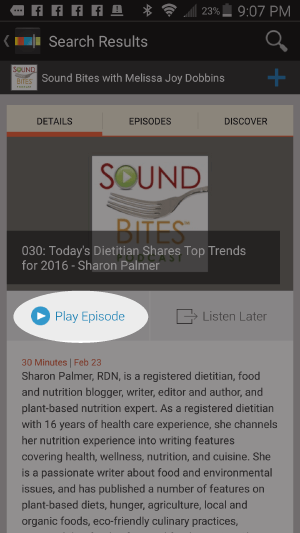
1. Search for “sound bites with melissa joy dobbins” 2. Choose Play Current Episode or Add to Playlist
Choose “Play Episode”
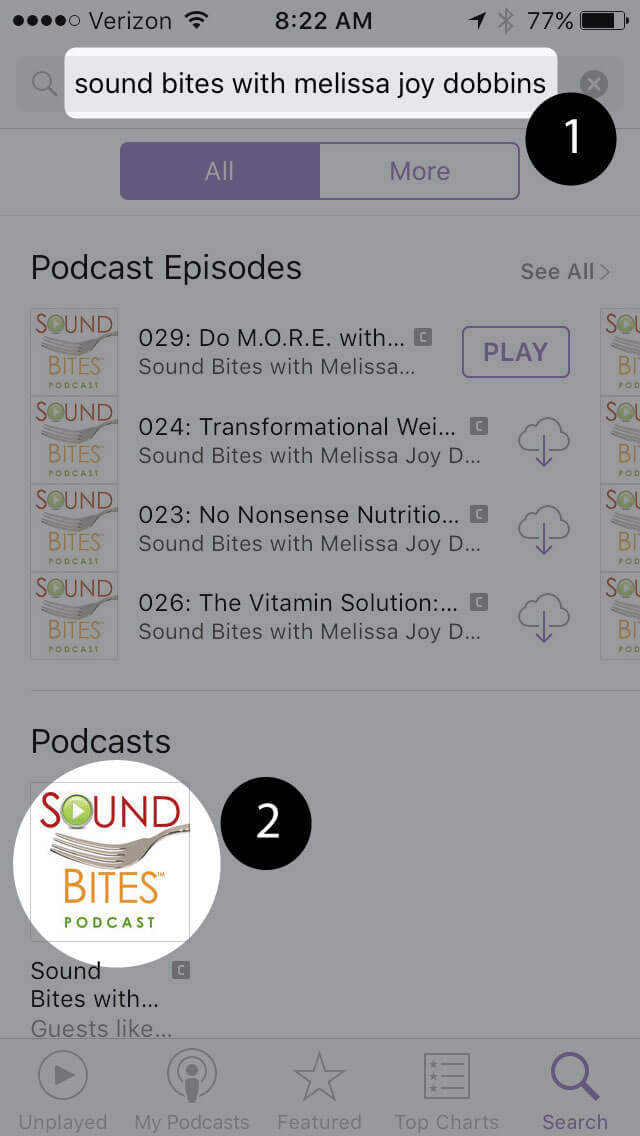
Subscribe & Review on iPhone
Open the “Podcast” app on your iPhone
Search for “Sound bites with melissa joy dobbins”
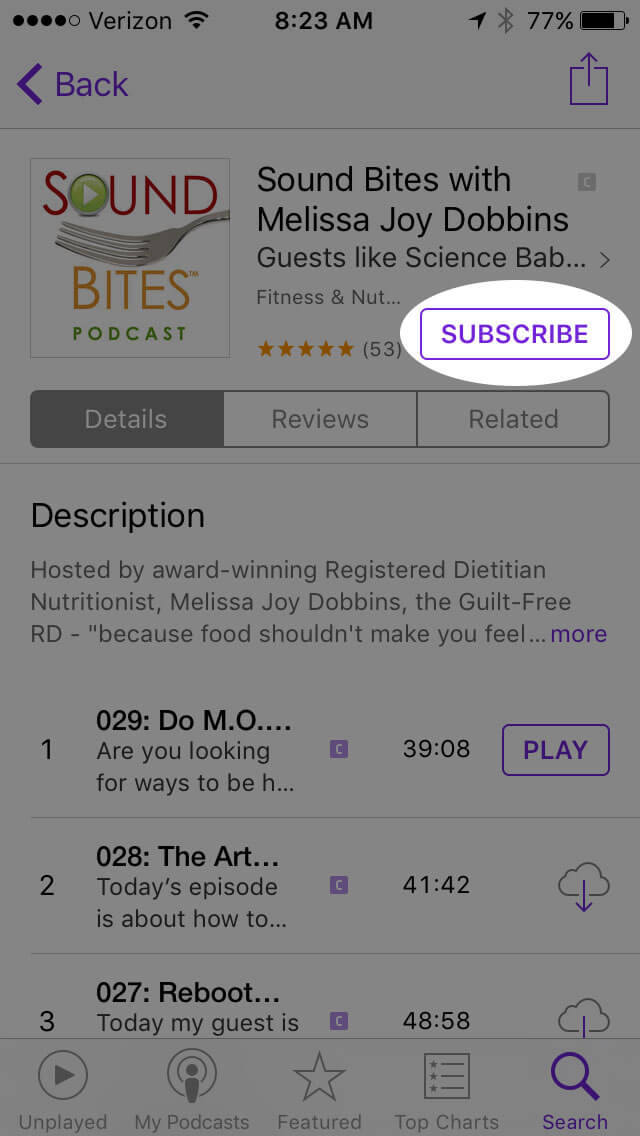
Open the podcast and click “Subscribe” and your done!
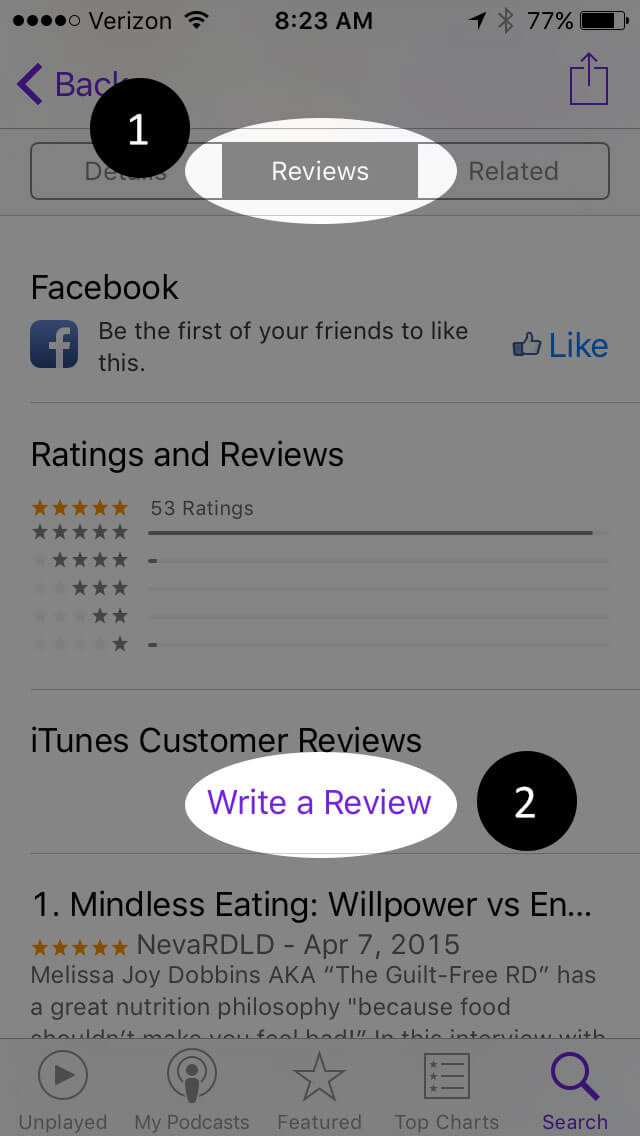
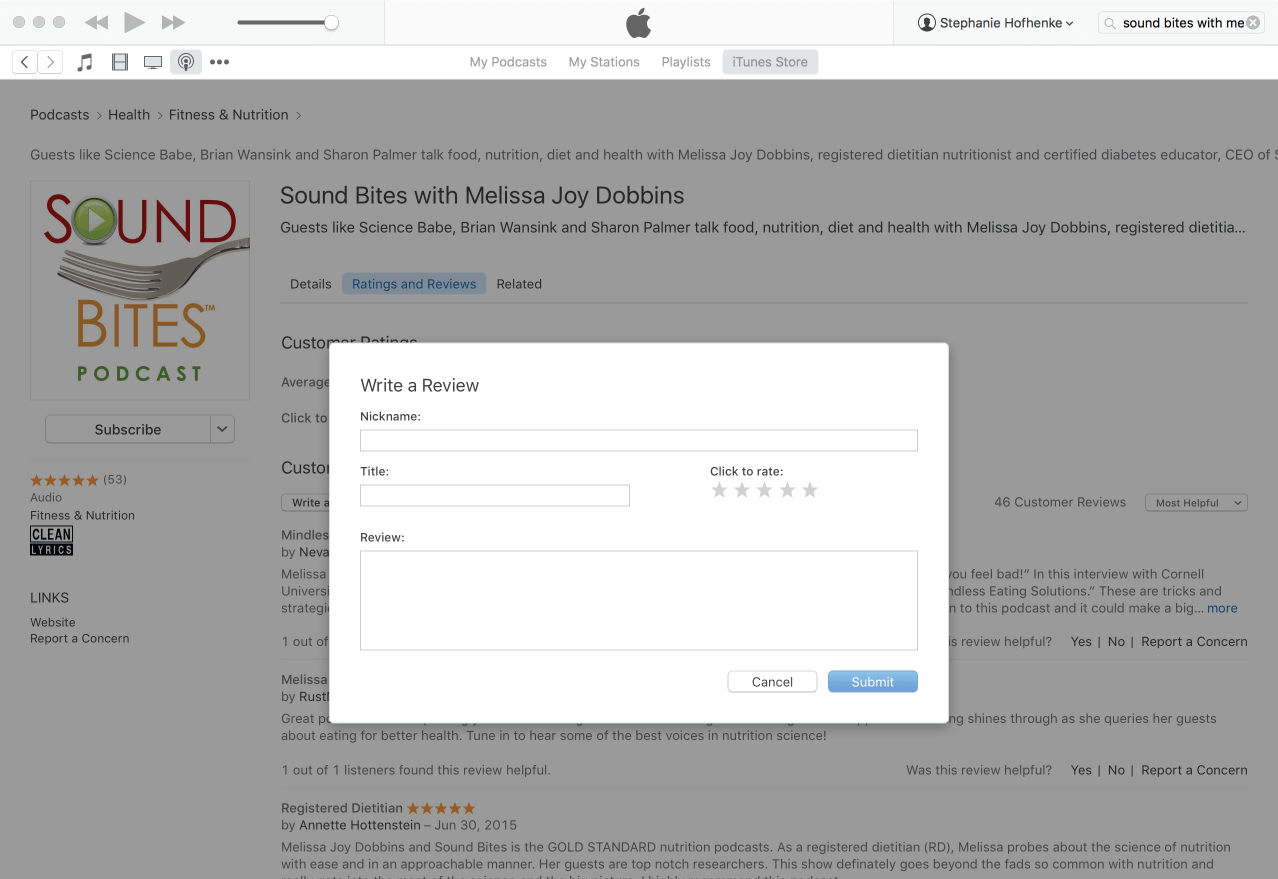
Write a Review
Click “Reviews”, then “Write a Review”.
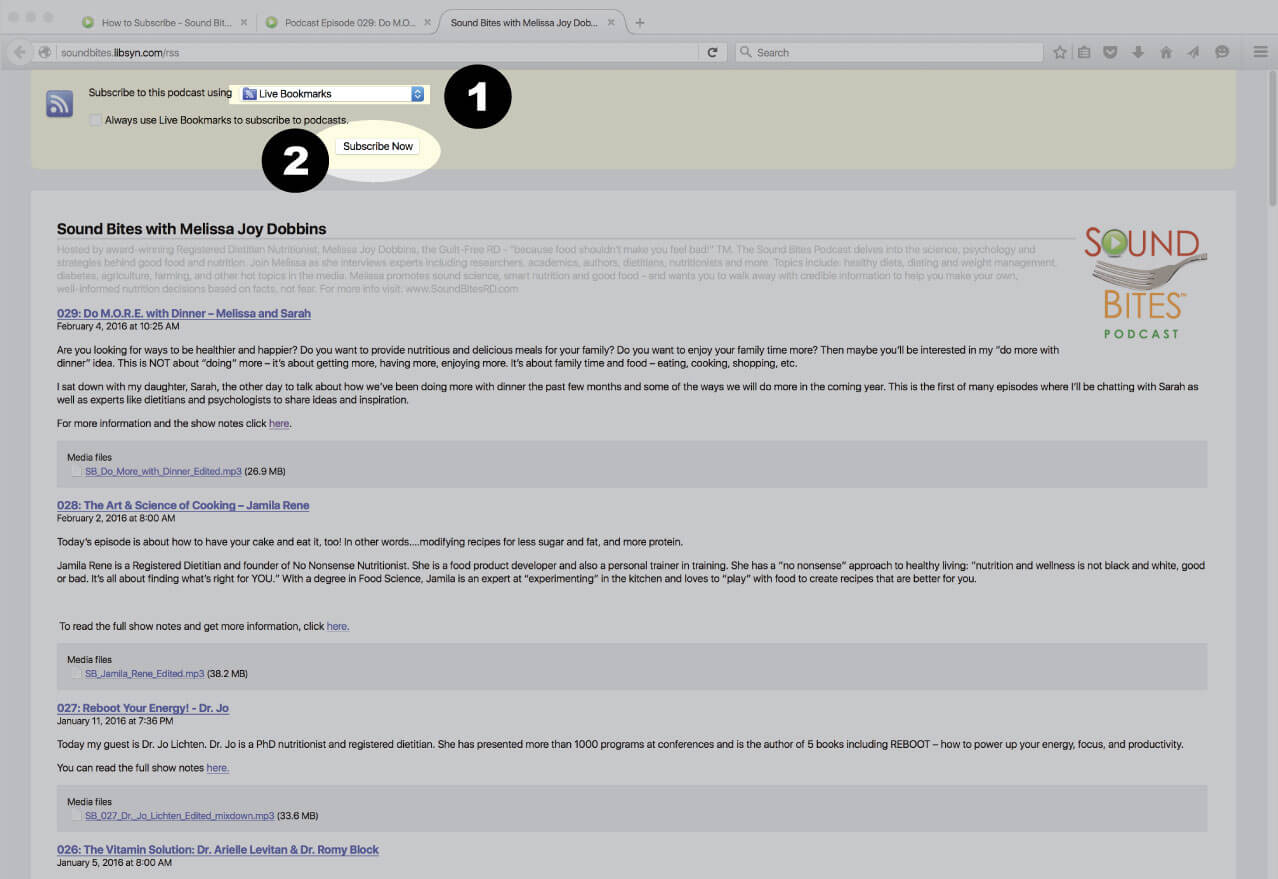
Subscribe via RSS Feed
Navigate to any podcast player . Click on the RSS feed icon.
Click on the RSS feed icon.
Click on RSS Feed
Choose which application you would like to use to receive the RSS feed
Click “Subscribe Now”
Confirm settings and subscribe.
How to Review in iTunes
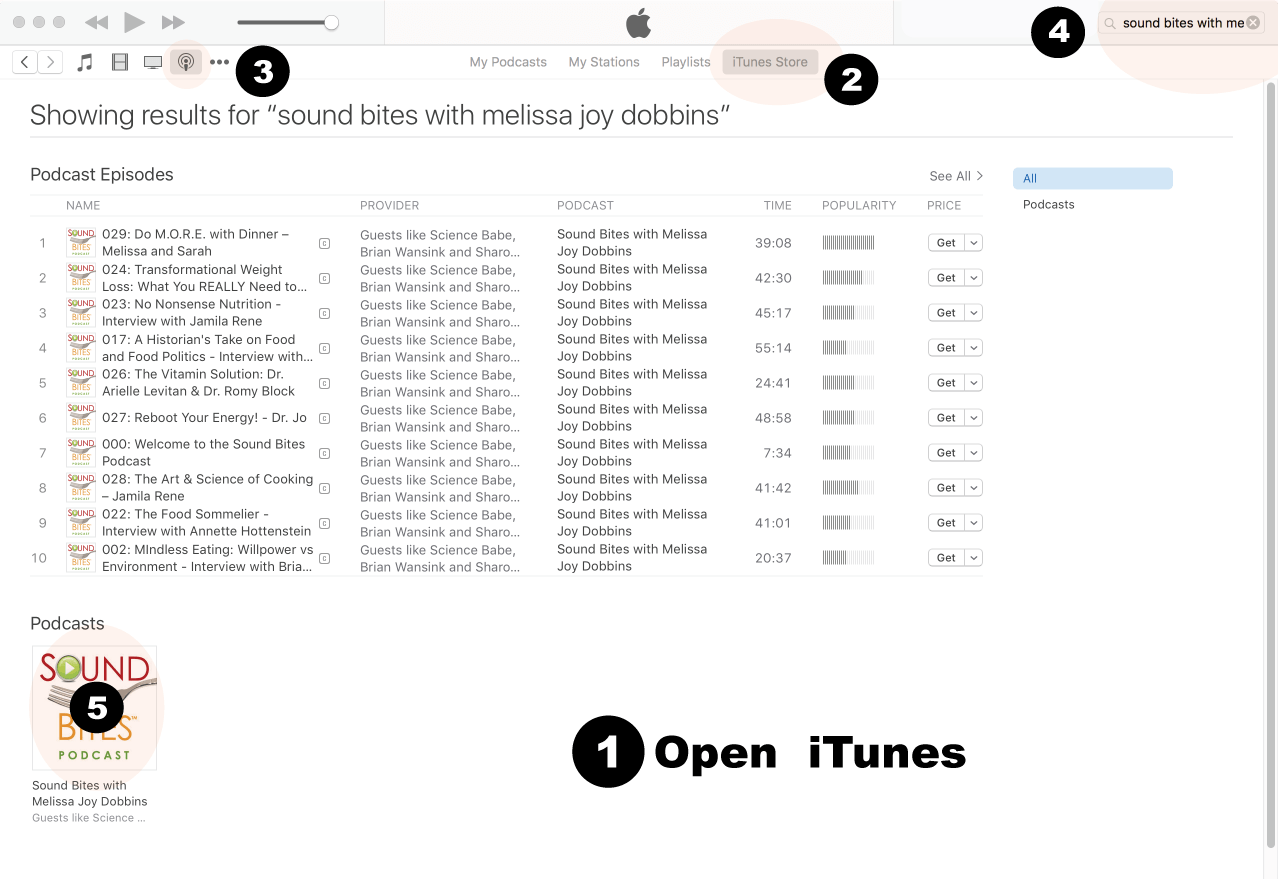
Open iTunes desktop application
Click iTunes Store
Click on Podcasts
Search for “Sound bites with Melissa Joy Dobbins”
Click on podcast image
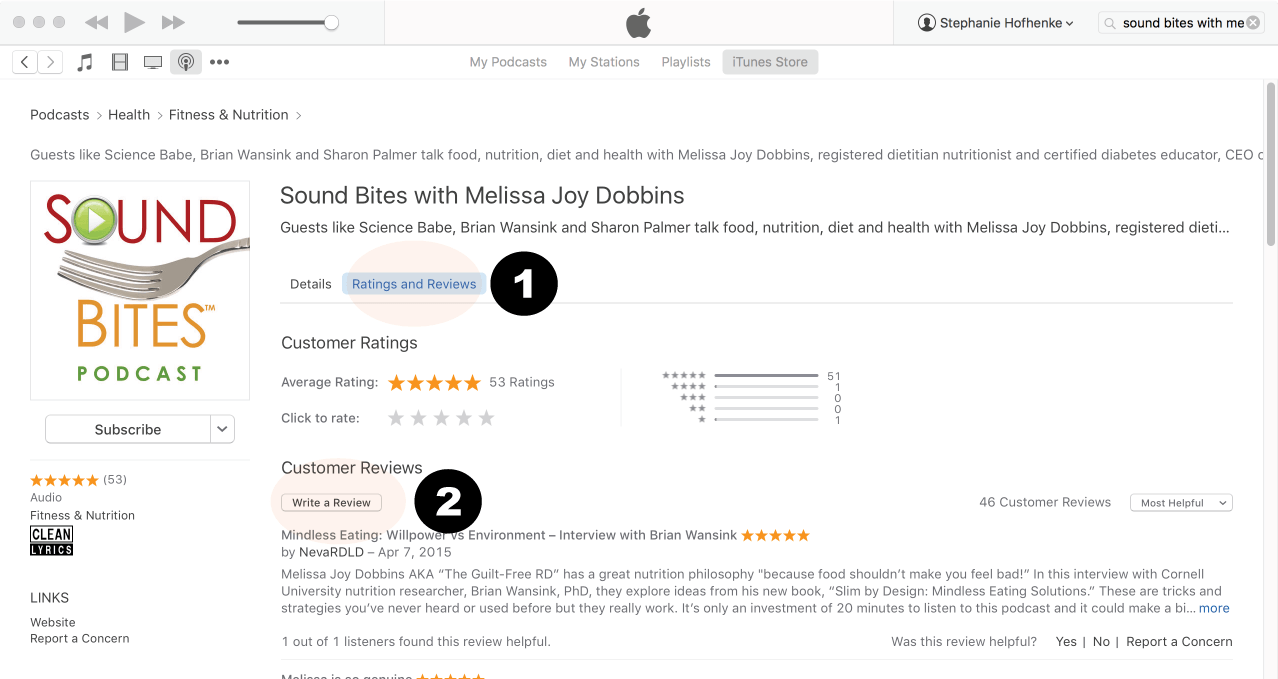
Search for Sound Bites podcast in iTunes
Click Ratings & Reivews
Click Write a Review
View reviews and write your own review.
Write your review…. Thank you!
Write your review!
How to subscribe via iTunes
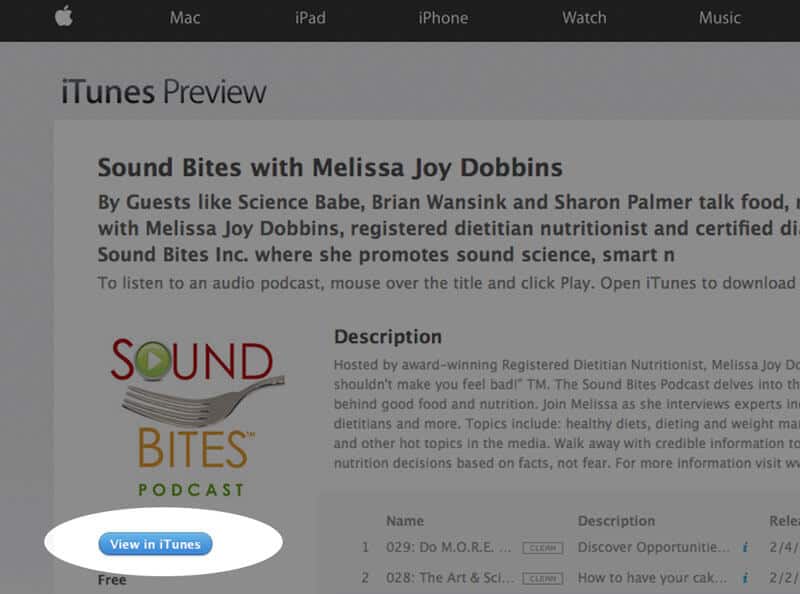
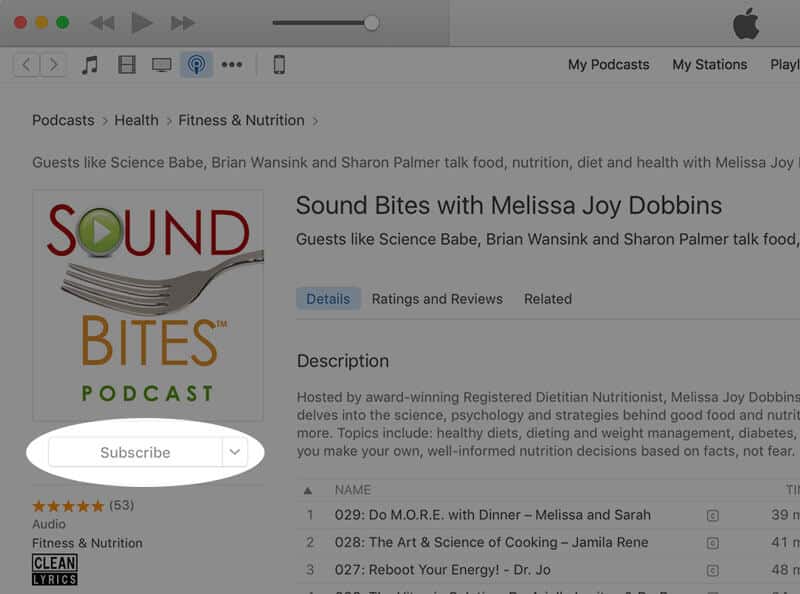
Click here to view the Sound Bites Podcastin iTunes, then click the blue “View in iTunes” button. This will open your iTunes application directly to Sound Bites Podcast. Click the “Subscribe” button, and your done!