Celebrating over 1 Million Downloads and 50,000 Free CEUs on the Sound Bites® Podcast | NEW: Get 1 years’ worth of CEUs with the new 15-CEU Podcast Course
Disclosure: This episode is not sponsored, however I attended a sponsored presentation and received a gift of cereal, meditation pillow and dish towel from General Mills.
Change Your Relationship with Fitness for Good
Don’t let anyone sell you on the idea that they can help you become enough. You are already enough. Start there.” – JC Lippold
Oversimplified messages and stigmatizing language about food and fitness often lead to shame instead of empowerment and sustainable behavior changes.
Tune into this episode to learn about:
consumer insights about what people think and tell themselves about fitness goals/failures
how fitness goals and failures can turn into a cycle of shame
sources of shame related to fitness
why some aspects of the fitness industry can feed into the cycle of shame
shifting the mindset away from shame-inducing mantras and self-talk
the concept of “enough-ness” and how it applies to behavior change
the four tenets of enough-ness
the power of limiting “minimizing language” and listening to intuition
how striving for happiness can lead to healthiness and not necessarily vice versa
resources and information to help change your relationship with fitness
JC Lippold, MA
JC likes to think he follows in his mother’s footsteps as a professional homemaker holding space for others as a nationally renowned teacher of movement and mindset, community engager and social movement trailblazer, story teller and musical theatre director. Born and raised in Brooklyn Center, Minnesota, JC entered the world as a highly emotional, unathletic child with little interest in competition. Through trials and tribulations, mile runs and middle school gym classes, JC started to question the rationale behind our culture’s use of physical experiences that leave most feeling less than enough.
JC earned a BA in Theology and Master’s Degree in Leadership, is a 1 Giant Mind Certified Meditation facilitator and holds credentials across many modalities of movement. The founder of 5K Everyday Conversations, a social movement designed to create access for all to daily conversation with strangers & TCO Local, monthly all are needed, all are capable connection events, JC is passionate about redesigning the fitness landscape in the United States to where the target audience is: everyone.
As a brand ambassador and consistent positive friction voice, JC works alongside brands like lululemon, CorePower Yoga, [solidcore], Orangetheory Fitness, allbirds and Fitbit to ensure they continuously explore ways they can shift the exclusionary and shame-inducing realities of the wellness industry to a more sustainable, happiness and health-giving part of our culture and economy.
Alongside his work in fitness, JC is a full time Leadership and Change consultant working alongside Fortune 500 companies, non-profits, civic and educational communities. You can often find JC on the Twin Cities’ ABC syndicate, KSTP-TV as their wellness expert.
[00:00:00] Melissa: Hello and welcome to the Sound Bites podcast. Today’s episode is about fitness and “enough-ness”. We will talk about what that means and how to address the fairly universal goals of happiness and healthiness in a new way. We’re going to talk about shifting our mindset away from exclusionary, shame inducing mantras about food and fitness and being the best you can be every minute of every day, and also gain some insight into the fitness industry and landscape that feeds into some of that.
Ultimately, we’re going to talk about how to tap into the power of the reality that you are enough and you can start from there. I’m really excited to introduce you to my guest today, JC Lippold. Hi there. Hey, JC. How are you? Good, how are you? I’m so excited to have you on the show. So you call yourselfa professional homemaker and it’s a very unique, unusual title that we don’t often hear used as this is my job.
So why don’t you tell us what that means, and I’m gonna share a little bit more about your
[00:01:18] JC: background. Yeah, absolutely. So my greatest anxiety is always having to answer the question, what do you do? So I’ve gotten into the routine of answering that I’m a professional homemaker, much like my mom. Making space where people feel at home.
Now also acknowledging that some people never feel home is a safe or a positive place. But with that idea of what home is ideologically and what happens to people when they find that space. So in all the worlds in which I live, I attempt to create that home space for
[00:01:50] Melissa: others. Thank you. You have quite an interesting education and background. It seems somewhat varied, but it all comes together and it does make sense. So you are a nationally renowned teacher of movement and mindset, a community engager and social movement, trailblazer, a theater director, and you are a full-time leadership and change management coach and consultant.
You earned a BA in theology and a master’s degree in leadership. And you are a one giant mind certified meditation facilitator and hold credentials across many modalities of movement. So that’s quite a unique and interesting mix of education and background. I wanna hear more about that, but I do wanna share some information about this episode with our listenersfirst. First of all, this episode is not sponsored, but I did see you speak at a sponsored conference, and I did receive a gift from the sponsor, which was a box of cereal with my name on it, Cheerios Box, with my name on it, and a cute little meditation pillow that looks like a Cheerio , and a dish towel.
And you have some videos that I watched that talked about how to use the dish towel for simple ways to move your body and the meditation pillow. And so we’re gonna talk about all of those things. But that sponsor was General Mills. So again, this episode is not sponsored, but I just wanted to disclose that.
But also we are submitting this episode to the commission on dietetic registration for one, free continuing education unit for registered dietitian nutritionists, dietetic technicians registered and certified diabetes care and education specialists. So if you’re listening and that is of interest to you, stay tuned for that.
You can always check my free ceu Page @soundbitesrd.com slash free ceus to see what episodes are currently available. I have quite a few there, about 50 episodes now and it continues to grow. Very pleased to offer the free continuing education. So JC back to your unique and varied and very interesting background.
I have a ton of questions. As I mentioned, I saw you speak at a sponsored conference, I think it was the night before you presented. We just connected, said hi, started talking and couple minutes in we’re in this like really in depth conversation about theater , because I also have a background in that.
I have to say. I was talking about you to my mom ‘cause she runs a theater in central Illinois. . And she said, oh, Melissa, you know that it’s not unusual to see theologians active in the theater. And I said, oh, yeah, really? Why is that mom? And she said a lot of plays are mostly about relationships and human conditions that we can identify with.
Greed, jealousy, divorce, love, dysfunctional families, all of that stuff. So I wanted to share that with you, JC. Oh, I love that. There’s places that we could start, but tell me a little bit more about what got you to the work that you’re doing today with this mix of your educational interests and your background.
[00:05:04] JC: And maybe where your mom touched is a great place to start.
Theater exists because there are stories to be told that can only be told by bringing in other elements that we normally don’t get to see in the reality of day-to-day life. We look at the fourth wall, the separation between the audience and the actors. Why do we use music and movement within theater?
I always make the point when we get to a place in the story where we cannot simply continue on using our spoken word to express what is happening in that moment. That is when music floods in, that’s when the body starts to move. So I look at my background in the movement world and movement meaning exercise, movement meaning feelings and excitement.
Movement meaning organizational structures of corporations and industries and societies. All of these things get to a place where we simply can’t speak about what’s happening. We need to bring in other elements of our humanity in order to fully understand the complexity of what’s going on.
[00:06:16] Melissa: I love that.
Like I said I grew up in the theater. My dad was an actor, director, playwright, and I was more the ballet dancer, but I did do some musical theater and loved just going to watch rehearsal every night. Usually it was something Shakespeare that my dad was working on or other shows, more plays versus musical theater in his case.
But it was just a very rich, wonderful environment. We could talk all day. And I do want to explain that this presentation I saw you do recently is actually a continuation of some previous sessions that General Mills had sponsored at this conference where we really took a deep dive into diversity, equity, inclusion, helping dietitians and communicators like myself make sure that we are not being tooexclusive and elitist with our communications. Yeah. Not everybody can afford avocado toast and a personal trainer. And it was interesting too, because I feel like as a dietitian, we are trained to think about the cost of food and food insecurity, different cultures, especially when we’re counseling people one-on-one.
We ask those questions, we have those conversations. My first job was in South Chicago in a very poor neighborhood, and I feel like my education prepared me for that. However, it’s a continual journey and learning process, so it’s not foreign to dietitians that obviously people don’t all eat avocado toast and have personal trainers,
But what we wanted to do with these sessions is again, learn more, be more knowledgeable about different cultures, different lifestyles. And when we’re communicating to the masses through media and social media, they call it adjusting our lens just to be sure that we’re thinking about how can this information be as accessible as possible to as many people as possible.
And so your presentation focusing on the fitness aspect and the fitness world, is a continuation of that. So I’m really excited to continue that conversation with you on the podcast today. I know that you’ve got stories and examples that we’ll touch on as we go through our conversation, but one of the places I think is a good place to start is how fitness can be – beyond the typical challenges and barriers.
We all know, usually the top three barriers to fitness and nutrition is time, cost, motivation, but there’s more to the story here and just like I’m the guilt-free RD because food shouldn’t make you feel bad. There’s a lot going on in the exercise side of our lives where. Maybe we feel shame or we don’t feel comfortable, whether it’s affording a gym or going to a gym or being able to have the proper equipment, shoes or yeah, the Peloton or something like that.
So let’s start there with fitness and shame and that exclusionary place that we find ourselves in.
[00:09:19] JC: Let’s dive in. And Melissa, I think you raised a really great parallel because that was the intent of our presentation, to look at the power of shame and the root of shame in the world of food and nutrition.
But knowing that what we put into our body and how we move our body are so intricately tied together that I think it’s perfect for how you just shared how do we look at communicating on food and nutrition? Here’s an element of our culture that is very much appreciated. And it’s not good or bad.
I’ll say this many times today. There’s a complexity to it, and here’s the complexity. We have a great desire because we care about our craft and we care about the people that it serves, to make messages be as simple as possible. So people can understand them, so they can then implement them into their lives.
And of course the world moves faster and we see more and more opportunity to touch and help more and more people that these messages get faster. They get simpler, and in doing so, they get diluted to a place that we forgetthat even though we understand what we are putting in the words that we are saying, the intent, the love, the specificity, someone reads them like a game of telephone, it gets passed again and again.
And what people end up reading or hearing is something that ends up being a detriment rather than an assistant and a support. Let’s look at the fitness world. Another parallel. We often hear something like shop the perimeter in the grocery store ‘cause that’s where the healthy food is. So that’s a really easy way to look at a grocery store.
In the fitness world. I say this: shopping the perimeter is like saying you have to go to the gym in order to accomplish moving your body in a nourishing way. People feel that they have to go somewhere and normally that place where they gois going to have a certain segment of the population, a certain age, most often a certain gender, a certain socioeconomic status.
They have a certain equipment, they dress a certain way, they move in a certain way. Whoever is facilitating that space are saying that they have to think and care in a certain way. And all of these things serve as barriersonce they’re in that space, which is often in great contradiction to that simple message of move your body every day.
Be 1% better than you were yesterday, it’s okay to, you can just do, and all of these things end up creating this static, this dissonance within a person who is starting their journey by hearing a simple message and that simple message very quickly drives themtowards a path of isolation, of guilt, of shame, and then of desperation, which then starts all over again.
So as an overview we see most often from a fitness professional, a food professional, someone who has a great care about the craft and about the people that it’s touching. That care often leads to us putting really simple messages out into the world that in essence lead people down a path of fallacy, of untruth because we know that there isn’t a one stop shop. Yeah.
[00:12:46] Melissa: Yes. And I’m often saying on the podcast, and I say this in my communications as well, especially when I’m doing media trainings with dietitians, is we obviously don’t wantthe information we share to be too complex or too complicated, but we also don’t want it to be oversimplified. And you mentioned a few phrases even little things that we might think to ourselves or say out loud can be very problematic.
Such as: You look great, did you lose weight? Or the fitness one. No pain, no gain. Yeah, and my favorite with air quotes, Move more and eat less. And even just what good bodies look like compared to bad bodies or diets. Good diets, good food, bad food. We’re all familiar with that dichotomy.
So you’re talking about this cycle of shame where people hear these simple messages and then they think their fitness and nutrition should be simple and then they start trying and things break down and go to hell in a hand basket from there . Yeah, exactly. And I also wanted to add during your session another speaker, Jessica Broome, who has a PhD in survey methodology and an MS in applied social research, which sounds fascinating.
she shared some consumer research insights that General Mills did. It’s, again, it’s things like when I can’t exercise, I feel guilty, or I don’t have the body type that’s found in a gym or a fitness studio setting, or they’re saying that they’re uncomfortable in their own skin and they’re embarrassed by the size of their clothes.
And they feel pressured by society to strive for certain physical attributes. So these are all of the things that we’re talking about, which I’m sure everybody listening can relate to. Regardless of your size, your shape, your anything. We can all relate to this with this cycle of shame. and we’re gonna talk more about the fitness industry and how that feeds into it.
But tell me first, ‘cause you talk about enough-ness and I said that in the intro. What do you mean by enough-ness and why?
[00:14:50] JC: Yeah. Us being people who care about our craft and the people it serves. We get to the place where we go, okay, I see the data, I understand the research. This makes me feel uncomfortable. I want to fix it.
What do I do? And I have this concept, enough-ness defined as the awareness of what you have that can be put to use with no attachment to what tomorrow brings. In other words, it’s this belief that right now, in this moment, you have everything that you need to accomplish something that is nourishing, that is focused, that is clear, that is within your power.
For goodness and for progression. Now of course, as people who are involved in people’s pathways to better health and to greater happiness. There’s an anxiety there that doesn’t enough-ness lead to complacency. And that’s what I always say, enough-ness is not complacent. We are not saying that we do not exist in a state of evolution.
What we are saying is that evolution starts with us being in a state where we see that we have power, where we have control, where we have hope, where we have autonomy within what we are doing. Because most people are sold this idea that if I start doing things now, if I show up and suck, if I be bad first, then I will arrive at a place where now I am worthy of considering that I may become a person who is enough. And that sounds awful to me. Yeah. But for the most part, that is exactly where a majority of people, as the research that we did shows. People think they need to become someone else before they can start becoming healthy or happy.
[00:16:43] Melissa: I like how you equated the go to the gym with shop the perimeter. And just to be clear ‘cause I know what you mean by this because it was in your presentation too, but I wanna make sure the audience listening understands, Shop the perimeter is an oversimplified message that actually is not helpful and it actually doesn’t even make sense ‘cause there are nutrient rich foods in the aisles.
And I like to say the bakery is on the perimeter and sometimes the alcohol is too. So it’s just being a former supermarket dietitian. I just hate thatmantra. But I love making those parallels between the food and nutrition and diet, with the fitness world.
There’s a lot of similarities there. A lot of connections there. Where I was going with that is we, as dietitians, we know when we’re talking with people about intuitive eating or just making peace with their food and their bodies, we know that they’re not gonna be real motivated to make healthier choices.
If you’re so focused on how, oh, I just ate that and it was bad, I shouldn’t have done that, or whatever. But when you are in a place of peace with that. It’s a lot easier to nourish yourself with food. You talk about nourishing activity, nourishing the body with fitness is one of the things that you say.
[00:18:00] JC: Yeah.
[00:18:00] Melissa: Again, just making that parallel.
[00:18:02] JC: So on this topic of enough-ness, there’s four tenets I use to calibrate people into what enough-ness looks like and you just raised one of them. Intuition, I define intuition this way. It’s the part of your being that says, hey – do that. That seems right and good.
If we consistently listen to that intuitive voice, which is a really rad part of our human organization, if we listen to that all of the time, our body is going to start telling us exactly what it needs with confidence. And sometimes that is going to be Taco Bell. And sometimes that is going to be stop at the bakery and sometimes that is going to be
us not stopping at the bakery or going to Taco Bell. But we get into this idea of, here’s one of those fitness things we hear when your body says, stop, just keep going. Actually, no. If your body says, stop, perhaps you should really consider why it’s asking you to stop. The mind will give up long before the body does. What we’re asking people to dois to stop trusting the most important information intake element of their being. So the idea of intuitive eating, or intuitive movement, or even having an idea or a whim or a feeling and acting on it, that is something that if we think about the power that it holds, by golly, how quickly can that recalibrate someone into taking some ownershipover their health and their happiness. So the other element that I raise up for enough-ness is communication. Minimize the minimizing language. Speak your truth quickly. So this is often a joke that I make ‘cause the two words that are pervasive in people’s language that they never pay attention to are only and just.
I was only able to work out twice this week. I’m just a walker. I got in a little movement today. It’s okay to take it easy. I’m trying to do a little bit each day and people listening may go, what’s wrong with those things? If we take out those words, I was able to work out twice this week.
I moved today, I walk. I am doing a little bit every day. Take it easy. and then here’s the joke. I always say, probably the most popular marketing phrase in American history, just do it. How much more powerful is that phrase if we take out that first word? Do it. right? Because here’s the deal. We train ourselves to minimize what we are doing in our language
to protect ourselves. I often share this story and I shared it in the presentation. I was that kid standing at the edge of the diving board, deathly afraid my toes hanging over the water, my life flashing before my eyes. And the kids standing down on the pool deck and swimming in the deep end with confidence and joy.
They said to me, just do it. Just jump. Just jump in. And I understand from their lens, their paradigm where they find joy and safety in the pool. It was a just act for them. It wasn’t a just act for me. So when we think about now as the professionals, and we may go just start small, just to do one little thing each day, we can accomplish the same sentiment by saying, do little things every.
Start small. Because then we are not putting into their mind that those actions are easy. We are allowing them to decide where they are, and we know those first steps for people, which they may take every day. It’s another challenge. It is a challenge for them some days and some days it’s not.
If they think it’s supposed to be just if they think it’s supposed to be something that is outside of their intuition. Then they return to that space of not enough-ness. And they are starting every day behind the starting line. They are showing up later than everybody else. And of course that is where the hopelessness and the shame present again and again.
[00:22:14] Melissa: Absolutely. Yes. I’m glad you brought up, because I definitely was going to ask you about the minimizing language because it’s so powerful and we don’t realize we’re doing it. Just like I tried to work on how often I say “um” – when you start paying attention, you can change that if you’re more aware.
Awareness is the first step. And it was funny because at the conference, throughout the whole rest of the, I don’t know, like two, three more days after that, we were hearing other sessions and people were asking questions and saying things and they would turn to you and say, I just said, just, I’m gonna take that out.
Like we were working that, we were using that right away. And I think it just is something so powerful. What we say to ourselves, again, whether it’s out loud to ourselves or to others or in our heads, is so powerful. And you’re tapping into that with this communication tenant of enough-ness. And I love the intuition as well.
We are trained to not listen to our intuition and it’s horrible. We really need to exercise that muscle. and listen to what our bodies are saying that we need right now. And like you said, sometimes it’s, I need to go for a walk. Yeah. Or I need a cupcake or I need to just sit and rest. So you’ve got intuition, communication.
What were the other two tenets?
[00:23:40] JC: And I didn’t bring them up in the presentation, but I think they’re really important. Number three is curiosity. It’s that part of our voice that risks to consider what they do not know. It’s bringing in those ideas of wonder, the ideas of experimentation, the ideas of imagination, because we know a lot of the trends in fitness and trends in our wellbeing.
They’re born of people who had an idea. and then they go, wow, this idea really worked. This idea worked for me, and then I shared it with someone else and it worked for them, and then all of a sudden it becomes the next fad, the next thing. Now that’s a little bit of a tangent, the idea growing, but when we tap into the curiosity of how we are, Again, we are the number one source.
We are truly our best teacher, our best coach, our best guide. So if we’re taking in information, if we’re seeing a world, if we’re seeing problems and we are responding to them with curiosity, a lot of times we will figure out how to establish the pathways to our health and our happiness. And then lastly, it’s presence.
Presence is a really hard place to exist. Culturally, we are encouraged to spend 48% of our time unpacking the past 48% of our time planning the future, which leaves us a little sliver of time actually acknowledging the only moment that we have any power. And that is right now. Now again, can we plan out a one year or five year, a 10 year?
Can we vision board, can we resolution, can we put healthy habits and say, here are my benchmarks. And yes, we can absolutely do those things. And maybe to a 99.999% actual realitybring those things into our being. Until the thing happens that makes the future we thought we were gonna have notcome into reality.
And of course, we plan that future based off of all the things that we’ve learned from our past. So the question is not, don’t focus on the past. Don’t focus on the future. But it’s actually flexing the muscle. And Melissa you said something really wonderful a few moments ago about exercising the muscle.
That’s it. Everything we’re talking about today is not a bicep or a quadricep. It’s not an intrinsic muscle that needs oxygen and to be micro teared down so it can rebuild again and again. But what we are talking about are these little muscles within how we habitually live life. That if we flex those muscles, a lot of the things that happen to us without us knowing, the words we say, the feelings we feel, that haunt us, that hold us, that trap us, they start losing their power.
I always say shame goes away when we shine light on it. It goes away to a place to where we see its reality. We see its root, we see its source. We see that it actually has some power, but not as much power as we give it. So flexing these little muscles of presence, of curiosity, of intuition, of communication bring us to a place where we are wonderfully sexy,
strong, enough.
[00:26:56] Melissa: I love that. And the whole time you were talking about curiosity, I was just like yes. Because that’s what I encourage people to do. Try different videos or things like that and find something that you enjoy, like experimenting. And I think that’s so powerful too. And then presence, when you’re talking about presence I know this has worked for me in my life is you talked about like the habitual ways that we live our life.
And I call it autopilot. And I think the antidote to that is that presence that gives you the opportunity then to listen to your intuition and what you need right now instead of just going on autopilot. So I just think that’s all really powerful. And like you said, this enough-ness. . It’s not about complacency, it’s not about being good enough.
We hear about that, but it’s really just a positive place to self-acceptance. Yeah, and if you have that foundation, then the possibilities are endless as far as what you wanna do with your time, your nutrition, your fitness.
I wanted to ask you, cause we’re talking about shame and when we talk about feeling bad if we ate something or not feeling comfortable in clothes to go to a gym and that sort of thing that sort of shame.
But there are lots of sources of shame that you shared in your presentation. So I wanted you toput a finer point on that and share that with our listeners as well.
[00:28:21] JC: Yeah, absolutely. And to put a little bow on the enough-ness, because you raised it up. Possibility presents when we’re in a state of enough, I always say it this way, enough-ness answers the question, am I worthy?
Am I valid? Am I capable? And once it answers that question, then it asks the question, so now what can I do? It’s another way of looking at how these four tenets tie together. So as we look at where shame presents, shame being this kind of unshaped, hard to pinpoint, hard to express how it feelssensation in reality, it presents in every single facet of our being and in where we do not feel safe or where do we not feel enough, or where we don’t feel like we are in the right place yet. Here’s another story, and notice that this is another story where I’m going back to my childhood, where a lot of these shame genesises in our life exist.
So I was a wonderfully quiet, highly emotional, highly feminine, artistic musical. Growing up in a family where baseball was enjoyed, and I loved getting to be a part of being a baseball fan, so in the backyard. My dad would throw the baseball to me and my brother and we would have our little bats.
And I’m four years younger than my brother. Finally when I was old enough to go ahead and start hitting the baseball around as well, I swung, made contact one time and my arms shook to a place that I started crying. , I did not like the feel of bat hitting baseball. So my dad got a rag ball and my brother would hit the hard baseball and I found a lot more joy in hitting the rag ball and didn’t make my arms shake.
And I felt empowered in that moment. So I grew my confidence on the inside and I’m like, I’m going to go play baseball with the other young male identifying human beings in my neighborhood. I go to the park and they were playing baseball. And I noticed in that moment that my wonderful confidence blinded me to the thought that, oh yeah, they’re gonna be hitting the baseball and I’m not gonna like that because it’s not the rag ball, because it’s not the rag ball.
And I disappeared, , I got out of there as fast as I could and I never played baseball. I’m one of those kids who I played T-ball when I was very young. . And then I did not play another sport until I started playing tennis very late. And the reason I started playing tennis is because I felt so much shame that, number one, I didn’t wanna hit a baseball.
And number two, the real shame as a young boy that I was not one who played sports and young boys play sports. So I found tennis where I could be in isolation. A nice individual sport. and I could do what I could do and deal with my shame by myself. So many people have the story of track and field day, or of running the mile, or doing the stretch test or the hang test or the dodge ball class.
All of these stories speak to the root of shame for so many of us. Wow. And then of course, we spent our lives being reaffirmed that we should feel shamewithin our fitness, within our wellness, within our happiness, within our responsibilities, within our work life, our family life, all of the things. And that’s the issue because we get to this place where we cannot pinpoint what we are feeling to a place where we don’t even ask the question anymore.
There is a story that I like sharing as we try to become good at pinpointing shame, and that is the story of every mother who takes their family, their children, to Disney World. And they’re there for a week and they come home and what is the first thing that the mother says?
[00:32:31] Melissa: I was thinking I need another vacation, but that’s not it.
[00:32:35] JC: And that’s why I was so happy in this room of wonderful dietitians. That was the first thing that everybody shouted out, I need another vacation. I am exhausted. That’s a wonderfully intuitive, healthy, joy-filled affirmationof the week past. It gave me so much hope to hear that response, because then I said now let’s think about that average person living in this world attempting to be enough.
And of course, what do we hear? Oh my gosh, I haven’t worked out in a week. Oh, I ate like crap. And my response is, I’m sorry, mother, you just luggedyour three children and your spouse around Disney World 10 hours a day. Walking miles upon miles, carrying kids upon kids and balloons upon balloons and going on rides and dealing with temper tantrums.
You exercised more in this past week than I guarantee you, you have ever exercised any other week in this past year.
[00:33:37] Melissa: Lots of steps. Lots of lifting.
[00:33:39] JC: All of it. All of it, yeah, because here’s the deal. We know this. We know that the body, if it does not feel safe, if it does not feel open in what it’s doing, It does not reap the benefit of the nourishment that we are giving it.
So if we don’t think that what we are doing is good for us, our body starts to tend to agree. So as we look at that, acknowledging the shame that we carry is that first step of allowing it to have less power in our lives.
[00:34:07] Melissa: Even just talking about it and realizing what a universal theme this is, because as you’re talking about all the gym class stuff, my son is a freshman in high school and he just started the swim unit, and I gotta tell you, everybody think back.
If you had to do swim class in junior high, high school, I mean it was stressful. It’s a lot. Obviously, we’re talking about fitness in our bodies. And I’m sure this happens in other arenas like growing up in school in our communities where there could be shame about, oh, I’m not the smartest kid in the class, or whatever.
But yes, since we’re talking about our bodies, it does bring up all of those thoughts about growing up. Gym class would be where we’re learning fitness, right? And with these sources of shame that we’re talking about it could be friends, it could be family. Obviously social media is a huge source of it, but you brought up something that I think is important about, it can also be fitness and nutrition professionals.
Oh yeah. It can be medical professionals and so that’s an important piece of this as well. We wanna try to be sensitive and I think this conversation that we’re having today is providing a lot more food for thought on that. But in that vein, you shared some terms with me that were new and I want you to explain those.
Shame deniers and shame shifters.
[00:35:35] JC: Yeah. And before we talk about shifters and deniers, There’s a quote I love to share by Edith Warton, where she talks about how light is shared, and she says light is shared in two ways from the candle and from the mirror. Here’s the thing to know about shame. Not everybody experiences it.
Our research showed around 35% of people have direct relationships where they go, this is where I was shamed. Either by family, by social media, by by coworker, by professional, or by themselves. And that’s the caveat. They go, oh, I’m actually the one who’s shaming myself. ‘cause I look at the world and I go, I deserve to feel shame.
But the big thing to remember is when we see it, we feel it. When we see it in someone else. We feel what they are feeling and how they’re acting in response to it. So the idea of what is the source of the shame is really important. Are we denying our relationship or our part of reflecting shame?
So often we can think about the older generations who’ve raised us and the things that either our parents or our grandparents or our other relatives have said to us about our bodies or about our food, or about our movement, or lack thereof. And you go why are they making comments about ourselves.
About us. And a lot of the times it is handed down on how we invite people to be happy or well, how do we invite others to take care of themselves? How do we teach good habits? And of course, it turns into these perverse ways of almost, well if shame gets someone to do something good for them, that’s not a bad thing.
If we shift shame, as I just said, if we look at shame as a tool to motivate people, to make people find the courage or the energy or the commitment to do the thing. , and again, all of this is circular, right? We go, it’s oh my gosh. Now we’re talking about enough-ness again. Now we’re talking about, no, don’t listen to your intuition.
Just keep going. All of these things tie into this cycle of shame that moves faster and faster. Here’s another one that ties in fitness. But also ties in personal responsibility. This is a quote from one of the interviews we did that Jessica Broome and team did with Southpaw Insights.
This person who was being interviewed said, I’ve been really lazy these last few months since school started. I’ve been so busy. I definitely should get back on a new plan. So this is a mom of two who went back to higher education further education. Think about that quote. I’ll say it again. I’ve been really lazy these last few months since school started.
I’ve been lazy since I went back to further my education as a single mom of two. I’ve been so busy. And here’s the last sentence. I definitely should get back on a new plan. What a weird statement I definitely should get back. That means going back in time to a previous reality. But then she says, on a new plan, what does this say?
That we’ve set up fitness in this world to be all right. My fitness journey is me doing a new thing all the time. And then once it doesn’t work, then I do another new thing and another new thing. But it’s always doing the new thing because the reality is the industry is set up to invite people to try another thing, to attempt to be enough to realize that they are not.
and then it drives ’em into isolation. They feel guilty about it, then they feel shame, and then they’re desperate. So then they start it all over again. If we see where shame shows up there with no judgment and we go, okay, we’re not gonna deny the root of the shame, we aren’t gonna shift it into being like it sounds like she needs a kick in the butt anyway.
So yeah, she definitely should get back on a new plan because it doesn’t matter if she’s going back to school, she should still be taking care of herself because X and Y and z and of course, . there’s truth and there’s segments of honesty and reality and positivity and love in all of these things, but if we do not acknowledge
the power of the shame that we are denying or that we are ignoring, then we know this doesn’t actually lead to any degree of healthiness or happiness that is sustainable.
[00:40:12] Melissa: And it’s not lost on me. And I remember during the presentation it’s wait, she’s been going to school and really busy and working hard.
But she still is referring to herself as lazy because she hasn’t been doing formal exercise. So what we say to ourselves is really powerful. Let’s talk about the fitness industry. We’ve already covered a lot of ground, but I definitely wanna hear at least briefly – I mean, you’re a Lululemon ambassador.
You are very entrenched in the fitness industry. I want to hear from you, from my perspective, it looks like the fitness industry is finally starting to at least provide clothing for different body sizes and trying to have fitness be more accessible to all body types and sizes. What have you seen there? And then I also want you to tell us about your sweaty nomad project.
Yeah. Because it’s an example of how we can remind ourselves what it’s like for some of these people to try. To be more active and the barriers that they hit.
[00:41:15] JC: Yeah, absolutely. So as you mentioned, I am trained and have held space in a lot of different modalities of movement in the corporate capitalistic drive to make the fitness industry sustainable and successful.
I’ve worked for a lot of the big national brands and local studios as well. The fitness industry has struggled to become, as Popular as, let’s say, apparel or let’s say any other commodity that is sold, and I think it’s because of who it chooses to market and who it chooses to serve. Think about the gym you go to.
If you go to a gym or the gym that you see on the TV or in the ad. Most of the time we see a very white, a very upper socioeconomic status, a very female, a very fit, and a community that appears to love. , kicking their butt, being pushed, sweating, huffing, puffing, while of course, in the marketing, smiling and being in a state of joy in the midst of these realities.
That is who fitness is marketed to by most brands. But then if we swing the pendulum to the other side we see the $10 gyms. We see the places that do pizza Tuesdays, and the places that attempt to be like, we are the gym for every. But of course in those worlds there is less an idea of community or of support or of excitement.
So it’s either attempt to fit into the place where you have to spend the big bucks and wear the right clothes, and do the right thing and care in the right way, or go to the place where it’s not gonna cost you a lot, you’re not gonna have a community. You’re gonna have to figure things out on your own.
And of course, a majority of people do not fit into either one of these buckets. What people are looking for is knowledge. They’re looking for community. They’re looking for space, and as you said before, the three drivers of what makes fitness work for people. It is affordable, it is convenient. In other words, it is close to where they are and it fits within their excitement.
It brings them into a place of motivation. More and more, as you said, gyms are realizing the pandemic was really hard for people because gyms couldn’t be open and they realized that they didn’t create a sustainable business model. This is a hard reality that I share because I’m invested in the industry.
We heard a lot of gyms saying during the shutdown, you need to let us open our gym because people need us for their mental health. They need us. And my response is, I’m sorry, gym, they do not need you. What they need is they need movement and they need community, which they can find lots of places. And we saw people going outside and moving and walking and finding opportunities to move in different ways.
They were finding community through online fitness communities, and all of a sudden we see more and more gyms going, okay, how do we create a space that istruly accessible. They could walk in as who they are and be a valuable part of that community and also get what they’re wanting to invest in, find that healthiness and that happiness.
[00:44:30] Melissa: Yeah, and you have a really important takeaway about healthiness and happiness that we’re gonna share as we wrap up, but tell us about the Sweaty Nomad project first.
[00:44:39] JC: Yeah, so as a person who lives with constant anxiety and panic disorder, walking into a new space, walking into a gym as a fitness professional is always an anxiety-inducing thing for me.
That is my root for thinking about what does the normal average person walking into the gym for the first time feel. So I did a little social experiment called the Sweaty Nomad Project. Every day for a month, I walked into a new house of movement, a different modality a different community of people every day I walked in with the perspective of a first timer. I will tell you this, it never got easier. I was clearly aware that most gyms ride on the assumptions that the people who are there know everything that they need to know. So once someone has been there for a while, the assumption is they don’t need help.
They don’t need guidance, they don’t need assistance, and especially if they are not getting it, and that first timer is getting to walk in into a space where it seems like everybody already knows what’s going on. It is a very hard space to walk into when you are truly that new person and the charge is to show up and suck and sooner or later it will get better.
Because I will tell you, being the new person in a space, you learn and you see things that the experienced person doesn’t know. So it’s one of those tenets from yoga philosophy where you know, the expert asks very few questions, the beginner asks many, let’s have the beginner beour guide, let’s have the beginner be the expert with in helping us shift how we look at the world.
And I attempt to hop back in that sweaty nomad mentality as often as I can because it keeps me rooted and grounded in understanding what that person who’s walking into a space with courage, probably not feeling enough, is feeling every single time they walk in.
[00:46:31] Melissa: Absolutely. And I would also like to hear about some of the projects that you’ve done.
Give us a couple of examples about some of the and maybe it was like during the pandemic I see you getting communities together, like you have this 5K conversation.
[00:46:46] JC: Absolutely. So 5K everyday conversations is a social movement that started January 1st, 2020. I did a trial month in 2019, but we started in 2020, without knowing everything that was gonna be coming up with within our country’s reality. Five K every day conversations is this. Each day we hold space for people who do not know each other yet. That’s what I call strangers to be able to move at a conversational pace with each other. In other words, every day people have an opportunity to show up.
To run with strangers outside. And of course in the pandemic, it worked wonderfully well. Because it provide people space and community. It created community. It created access to conversation. It created movement and fresh air. Conversation is the drive. It’s not a running group, it’s a conversation group.
People have to risk to go, hey, is this pace, a pace that you can keep this wonderful conversation that we’re having going at and all of a sudden you see people go, Hey, let’s slow down . And they don’t go, Hey, I’m doing my best, or, this is too fast. I’m sorry that I’m slowing you down. Or people find the courage and establish a new norm to say, Hey, let’s walk for a bit.
Because what they’re focusing on is not getting their miles in or their steps in. But they’re focusing on connecting with someone they did not know before. And I will tell you the amount of stories and connections that have come out of strangers sharing a pathway. whether it be 40 below or a hundred above, whether it be rainy, whether it be in the nice part of town, the hard part of town, whether they’re talking with someone who has the same political beliefs or different political beliefs, someone who is accepted physically in a fitness world or not accepted physically in a fitness world.
It created a space because we shifted the intent from maybe the lack of safety within a fitness space. To the opportunity that presents when people create something together, ‘cause that’s the cool thing. Everybody that shows up is saying, I am responsible for engaging in casual conversation with this other person.
That’s my responsibility. And everybody takes that seriously, which is really powerful to bring people into a space of whether they know it or not. They go – by me showing up. I’m saying that I’m enoughto be in conversation with someone and that I am enough to receive what someone else has to share with me.
[00:49:26] Melissa: Yes. Oh, the sense of community is so important. I remember almost crying. When my karate class got back together in person at some point during the pandemic, ‘cause we did virtual stuff for a while and I had just started karate before the pandemic hit. These people, I didn’t know them very well.
They weren’t my friends like I have in ballet that I’ve been doing longer. But it was so overwhelming in an emotional way to be like, oh my God, it’s the sense of community that I missed that you’re not getting through the Zoom. Oh, yeah. So it’s really powerful. So as we’re wrapping up, I do want to have you explain everybody wants to be happy.
Everybody wants to be healthy. Anytime someone has experienced an illness or an injury, we are reminded how important our health is. If you don’t have your health you don’t have much, but you have this really important takeaway that I want you to share about happiness and healthiness.
[00:50:27] JC: Yeah, absolutely. It seems to me that I hear more people who seek happiness, who find healthiness than people who are seeking healthiness, who find happiness. And with that in mind, again, this is not a either or, this is a where do we start our journey. I always suggest start your journey seeking happiness. ‘cause if you’re seeking happiness, what you end up finding is that journey brings you joy.
That journey leads to memories that are directly correlated with what you did rather than how you did. Success is measured by how it makes you. because you don’t have to be good at the thing because you’re doing it out of happiness. Listen, you just said you started karate, and again, that could be a, Hey Melissa, show up and suck Melissa.
Sooner or later you’ll be good enough. Oh yeah, there’s a lot of that . But again, within that you think it’s oh I wanna do something new. I want to find joy in something else. And that’s what happens when we start from happiness. Now, Here’s what I say about if you start your journey from a healthiness place, first of all, it’ll make you healthier and stronger.
Number two, it provides a pathway to greater accomplishments and new capacities. But here’s the interesting thing. It’s successes measured by if you accomplish what you set out to do, and most often if you start from a healthiness place. , you’re doing the things that you have to show up and suck. You have to earn your stripes.
You have to have the will and the guts. You have to stick with it, and sooner or later you arrive at that place where you are respected for your actions. We know a lot of people start their health journey and they fail at it.. If we are seeking happiness, it’s a lot harder to fail because the bar of what we are seeking is so much easier to access.
We don’t put happiness on a high shelf the way that we do healthiness. I think healthiness brings people to a state of happiness. So if people seek happiness, what do they end up finding? They normally end up finding healthiness throughout it.
[00:52:37] Melissa: Yep. I think that’s very true. So much just food for thought here. Fitness for thought here. What do you want to share with the listeners now that they can start doing today to get started on that Happier to healthier journey?
[00:52:55] JC: So I always call these my tactical and practicals because we can talk about the big ideas, but we get to the place where I go, what do I need to start doing?
Here are my three. Number one, limit the limiting language. We already raised it. Think about your justs. Your onlys. Listen to the words you are saying. and consider, do they make you feel good or do they make you feel like you’re attempting to place yourself in a little box?Take up space. Number two, listen to the voice that says, Hey, do that.
That sounds right. And good. Again, that intuition voice, you may scare yourself with what you start doing . And if someone says, why are you doing that? And all you have to say is something in me is telling me to. And guess what? Other people will follow your lead. Doing the things that their intuition is telling them.
And then lastly, number three, make one decision each day that is derived from your happiness and pay attention to how those decisions start to impact your overall health. It is amazing what happens.
Maybe keep a journal.
Yeah, keep a journal. Find those ways that you can take your quantitative data, study yourself because you truly are your best teacher, even though the world is often attempting to tell you to not listen to that voice or listen to how you’re perceiving your life.
So those are my three. Limit your limiting language. Listen to your intuition and then make one decision a day that is derived from your happiness.
[00:54:24] Melissa: I love that. And you know when I said keep a journal and you said, yeah, study yourself. I love doing that, but it can be really easy. I always tell my patients and clients if you wanna track your exercise, Sometimes all you need to do is put an X on the calendar.
The wall calendar – I exercised that day. Like whatever, yep. I write karate or ballet, or I did my physical therapy exercise, or whatever. I just jot that on the wall calendar. But with the journaling, with this one decision, it could literally just be jotting down really quickly what that decision was, and then, going back over and thinking about, oh yeah, what resulted from that?
Maybe you just felt more calm, you felt more at peace, you had more fun, you made a new friend. All these different decisions can have some really impactful results, so thank you for sharing that. I also want you to share your website and tell us a little bit about your videos and your app that people can access.
[00:55:18] JC: Yeah, absolutely. JCLippold.com. You can find access to 5K every day conversations and other things that I have going on and ways that you can connect with me. Then I also have an app. It has guided journaling, movement, meditation, walking, yoga, and lots of other things, right? It’s a nice way to think about not what we are doing, but why we are doing it.
So even as Melissa just rose about the idea of journaling, what’s the one decision you’re making today derived from your happiness? You may go, gosh, I don’t know what would make me happy number. Look at the things you wrote down in previous days and repeat. Or number two, engage in something that may inspire the ideas of happiness.
So I love connecting, I love being in conversation. Reach out to me on social media or you can connect with me through my website, JC lippold.com. Awesome. Yes. And
[00:56:07] Melissa: I’ll have the link to your website, the social media handles, your app and everything in my show notes at soundbitesrd.com. Thank you again so much, JC, for coming on the show and sharing this important information with us and giving us some really insightful things to think about.
[00:56:25] JC: Oh my gosh, it’s been an absolute joy. Thank you, .
[00:56:27] Melissa: Can’t wait to stay connected with you. I watched one of your meditation videos and one of your fitness videos this morning, and they’re just really great. So I encourage people to check those out and for everybody listening as always, enjoy your food with health in mind and enjoy your fitness with happiness in mind. Till next time.
LISTEN, LEARN AND EARN
Listen to select Sound Bites Podcasts and earn free CEU credits approved by the Commission on Dietetic Registration (CDR) for registered dietitian nutritionists and dietetic technicians, registered. Get started!
Get Melissa’s Sound Science Toolkit here!
Partnerships:
Sound Bites is partnering with the Association of Diabetes Care and Education Specialists (formerly the American Association of Diabetes Educators)! Stay tuned for updates on the podcast, blog and newsletter!
Sound Bites is partnering with the International Food Information Council! Stay tuned for updates on the podcast, blog and newsletter!
Sign up for my monthly newsletter and episode eblasts so you never miss an update!
Listen on Stitcher (Android)
Install the Stitcher App
1. Search for “sound bites with melissa joy dobbins” 2. Choose Play Current Episode or Add to Playlist
Choose “Play Episode”
Subscribe & Review on iPhone
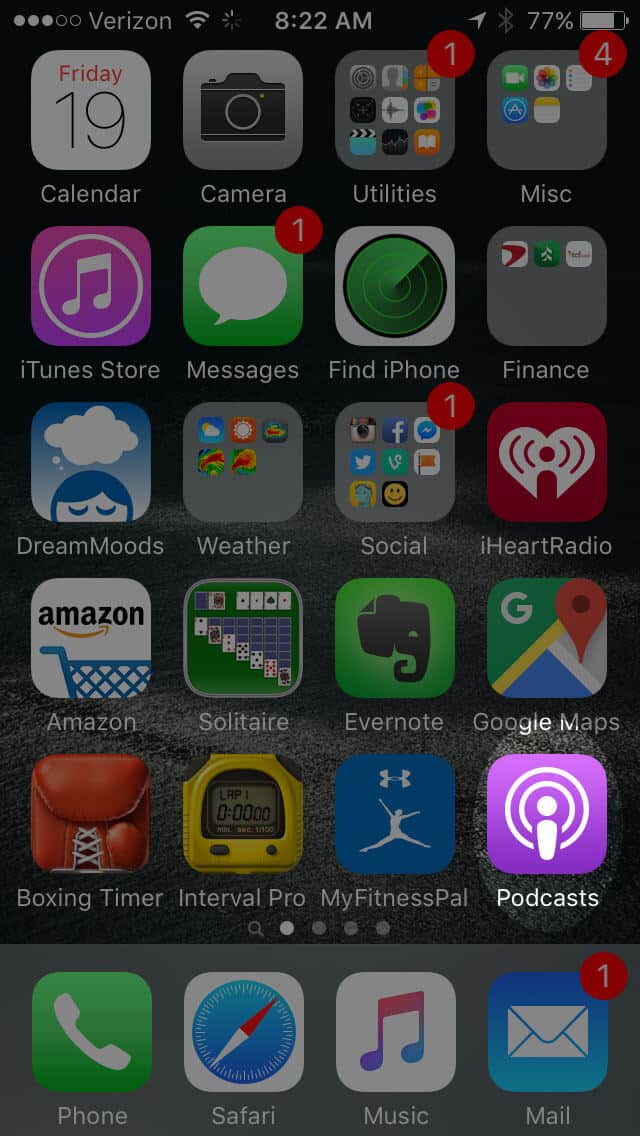
Open the “Podcast” app on your iPhone
Search for “Sound bites with melissa joy dobbins”
Open the podcast and click “Subscribe” and your done!
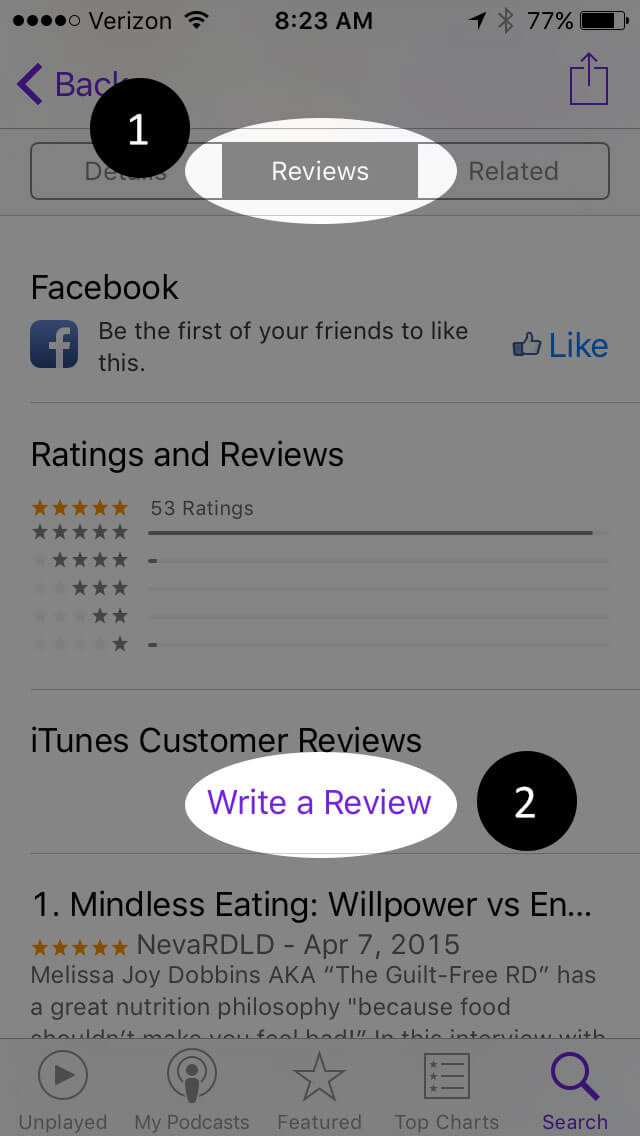
Write a Review
Click “Reviews”, then “Write a Review”.
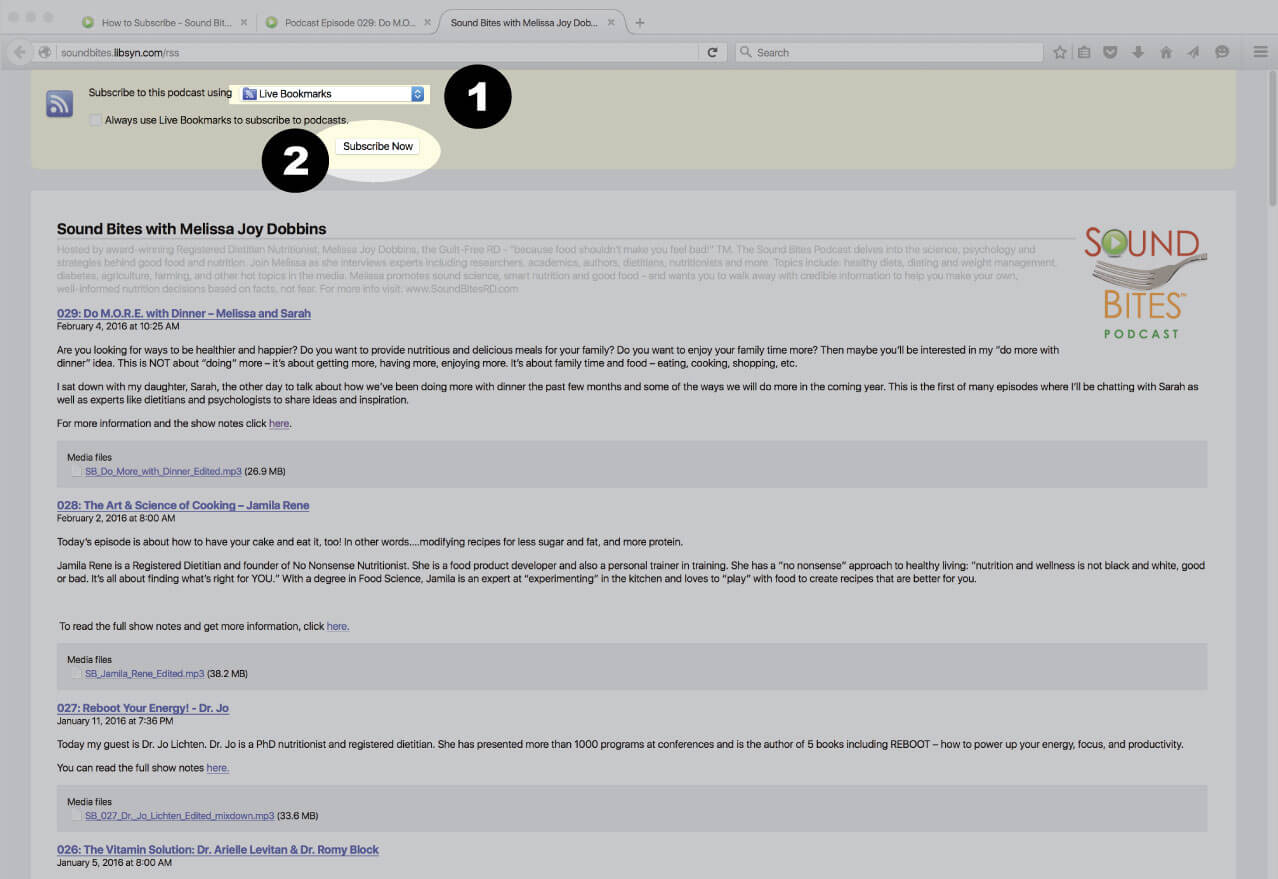
Subscribe via RSS Feed
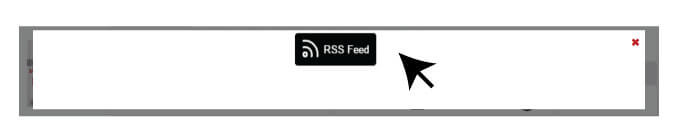
Navigate to any podcast player . Click on the RSS feed icon.
Click on the RSS feed icon.
Click on RSS Feed
Choose which application you would like to use to receive the RSS feed
Click “Subscribe Now”
Confirm settings and subscribe.
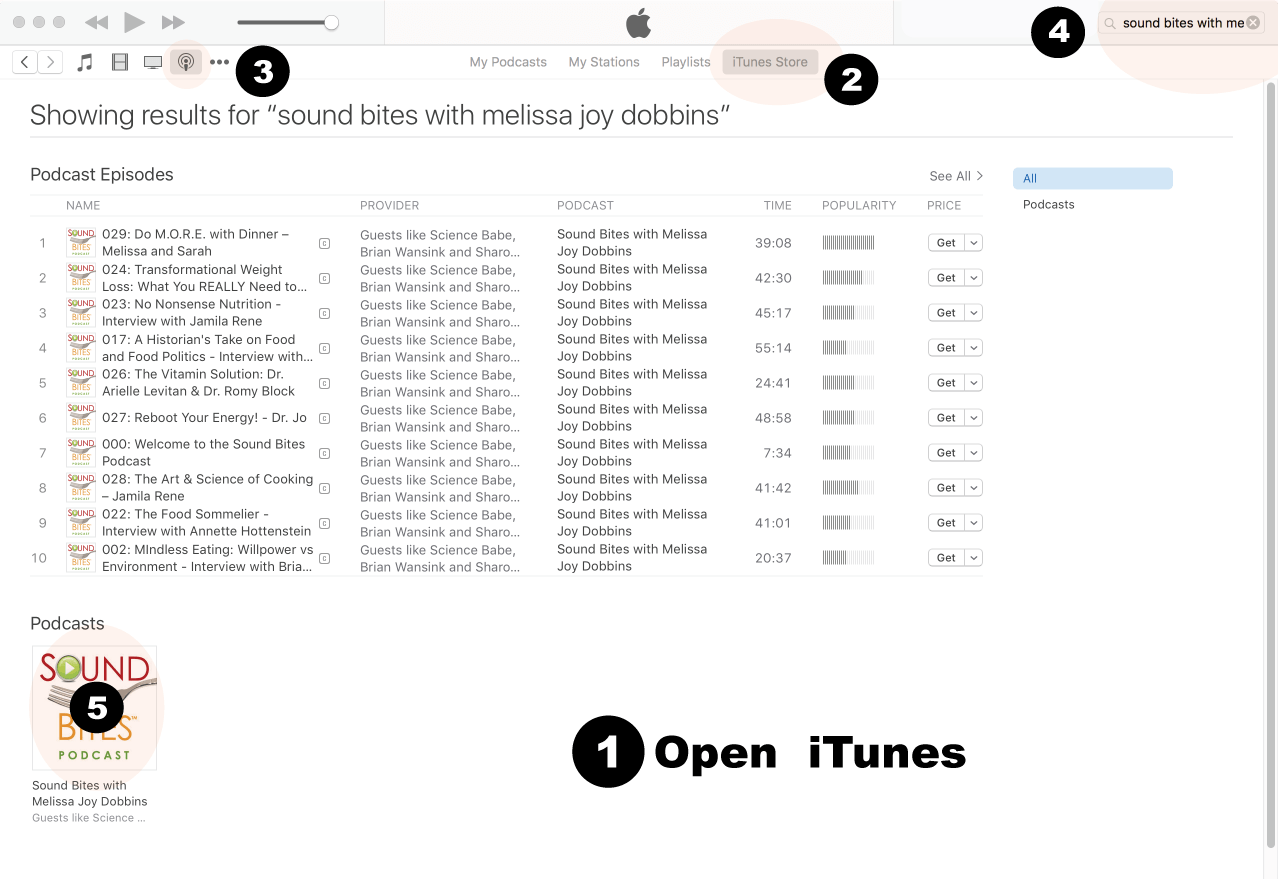
How to Review in iTunes
Open iTunes desktop application
Click iTunes Store
Click on Podcasts
Search for “Sound bites with Melissa Joy Dobbins”
Click on podcast image
Search for Sound Bites podcast in iTunes
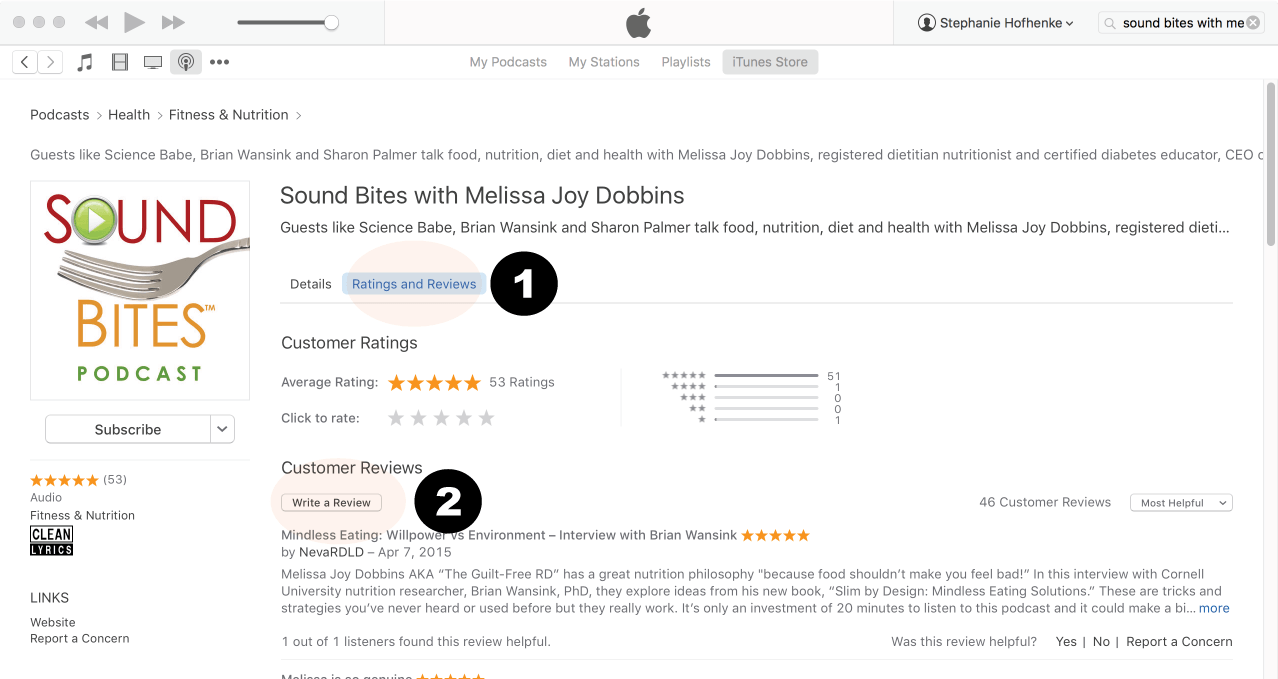
Click Ratings & Reivews
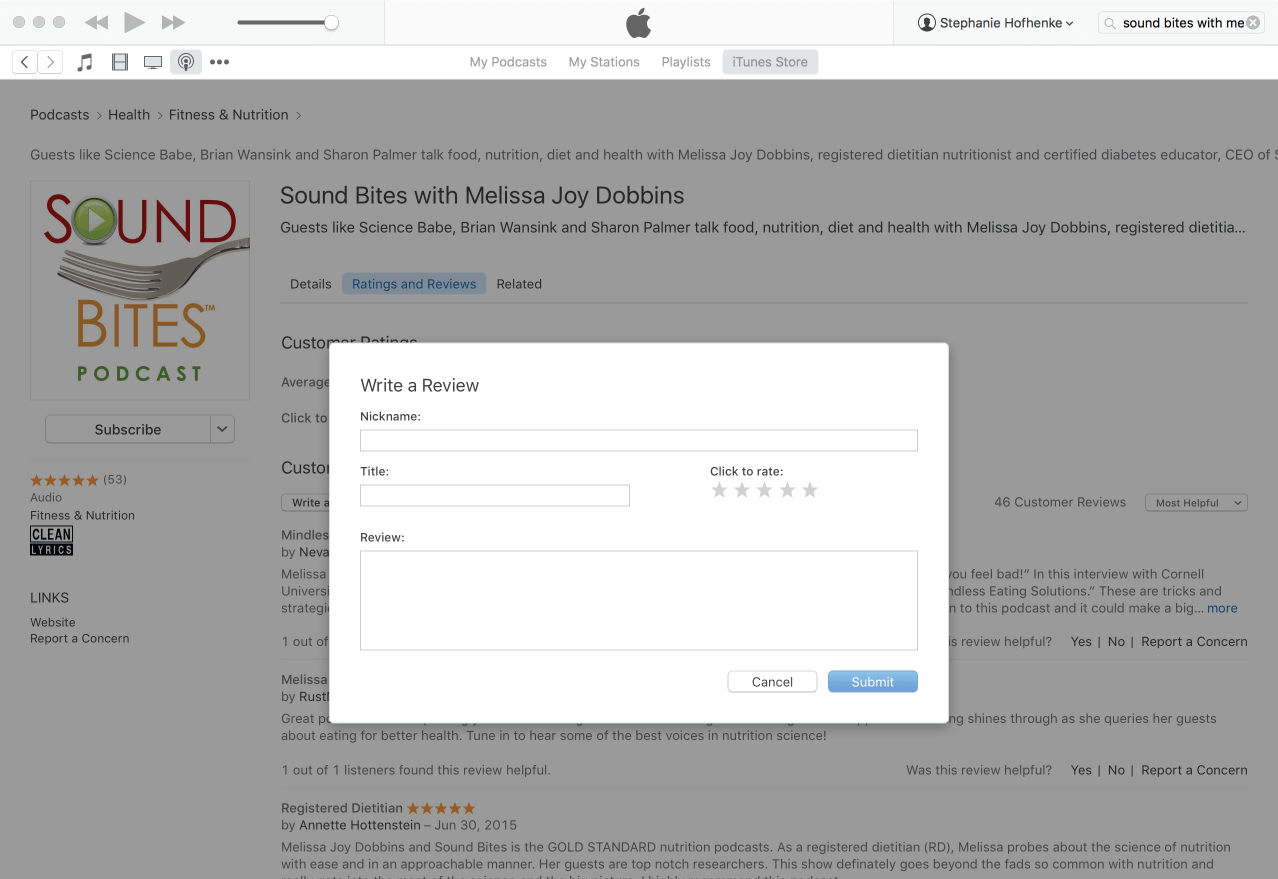
Click Write a Review
View reviews and write your own review.
Write your review…. Thank you!
Write your review!
How to subscribe via iTunes
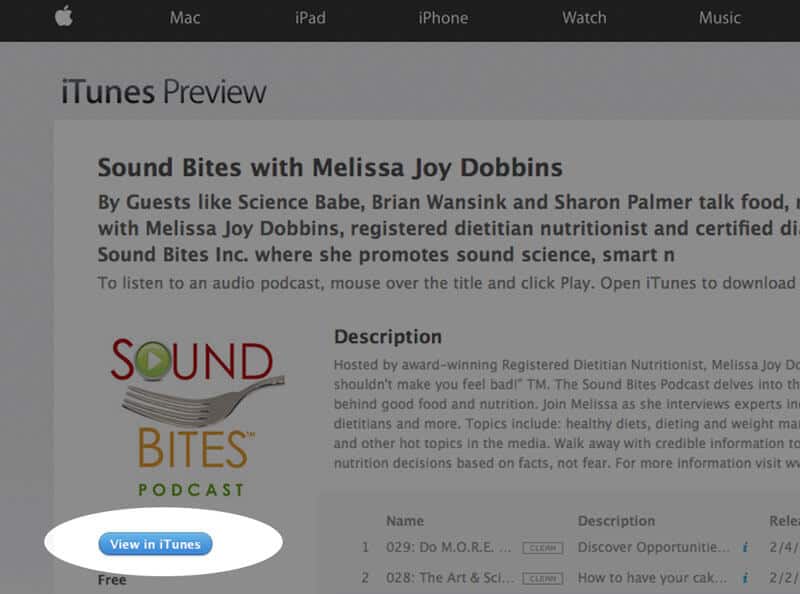
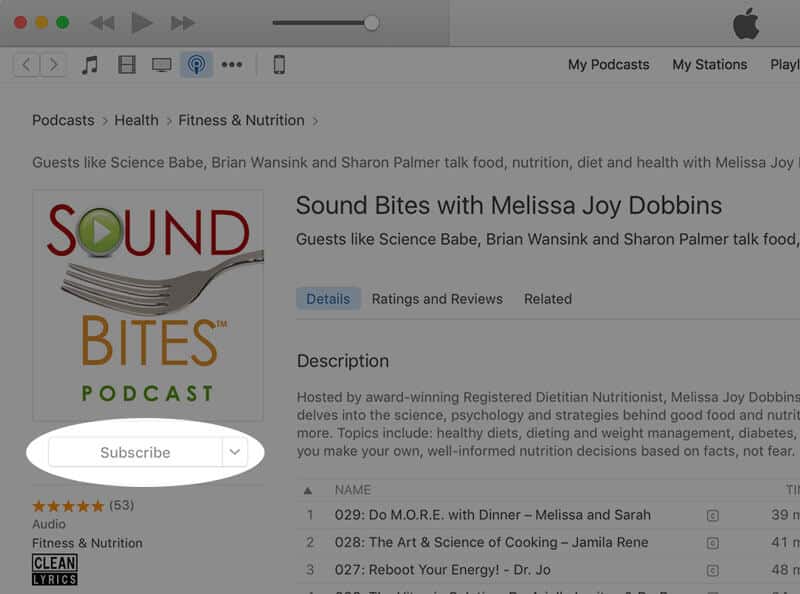
Click here to view the Sound Bites Podcastin iTunes, then click the blue “View in iTunes” button. This will open your iTunes application directly to Sound Bites Podcast. Click the “Subscribe” button, and your done!