Celebrating over 1 Million Downloads and 50,000 Free CEUs on the Sound Bites® Podcast | NEW: Get 1 years’ worth of CEUs with the new 15-CEU Podcast Course
Click here to earn 1.0 FREE CEUs for listening to this podcast episode!
Disclosure: Commercial support has been provided by Avocados – Love One Today®. Ginger Hultin is a paid consultant for Love One Today.
The Role of Diet in Cancer Risk Reduction
Cancer is a complex disease that is influenced by many factors including genetics, environment, and lifestyle behaviors. According to the World Cancer Research Fund, emerging evidence suggests that people who eat very little or no fruits and vegetables are at the greatest risk for developing certain cancers. In this episode, we explore the relationship between lifestyle behaviors and cancer risk, highlight current research on diet and cancer risk reduction including new research related to avocado consumption and cancer, as well as strategies to help increase fruit and vegetable consumption and other habits that help to mitigate cancer risk.
I find food to be empowering when it comes to cancer. In a time of a lot of unknowns, nutrition is something that you can utilize during treatment or when focused on risk reduction that can truly help you feel better.” – Ginger Hultin
Tune into this episode to learn about:
Cancer incidence in the U.S.
National Cancer Institute estimates for types of cancer
Gaps in awareness about the link between diet and cancer
New research about cancer prevalence and risk factors
Challenges and limitations in cancer/nutrition research
Risk reduction vs. “prevention”
Updates on nutrition/dietary patterns and cancer risk
Which types of cancers are more related to diet than others
FDA health claims related to fruits and vegetables and cancer
Why fruits and vegetables are beneficial for cancer risk reduction
New research on avocado consumption and cancer risk
Nutrient profile of avocados and how that relates to cancer risk reduction
Tips for healthcare providers to help patients reduce their risk of cancer
Tips and tricks for eating more fruits and vegetables
Lifestyle factors to consider for cancer risk
Resources for health professionals and the public
Ginger Hultin, MS, RDN, CSO
Ginger Hultin is a Seattle-based Registered Dietitian Nutritionist and owner of the concierge, virtual nutrition practice Ginger Hultin Nutrition where she helps clients with complex health conditions through an integrative approach. She specializes in anti-inflammatory diets for integrative oncology nutrition, people with gastrointestinal disease, and autoimmune conditions.
Ginger serves as adjunct clinical faculty at the Bastyr Center for Natural Health in Seattle and has authored two nutrition books: Anti-Inflammatory Diet Meal Prep and the How to Eat to Beat Disease Cookbook and also hosts the Good Clean Nutrition podcast for Orgain®.
She is a graduate of the University of Washington and Bastyr University and is currently pursuing her doctorate of clinical nutrition at the University of North Florida.
A new research study showed that regular avocado intake (half an avocado a week) was linked to a lower risk of total cancer and reduced risk of colorectal, lung and bladder cancers in men.” – Ginger Hultin
Resources Some links may be affiliate links. As an Amazon Associate, I earn from qualifying purchases.
Welcome to Sound Bites, hosted by registered dietitian nutritionist, Melissa Joy Dobbins. Let’s delve into the science, the psychology, and the strategies behind good food and nutrition.
Melissa Joy (00:22):
Hello, and welcome to the Sound Bites Podcast. Today’s episode is about oncology nutrition and cancer risk reduction, and the role of fruits and vegetables in particular.
This episode is sponsored, commercial support has been provided by Avocados Love One Today. This episode has also been approved by the Commission on Dietetic Registration for one continuing professional education unit for registered dietitian nutritionists and dietetic technicians registered.
If you’re interested in that, you can visit the show notes for this episode or my CEU page at soundbitesrd.com for more information.
My guest today is Ginger Hultin. She’s a Seattle-based registered dietitian nutritionist, board certified specialist in oncology nutrition, and the owner of the virtual private practice, Ginger Hultin Nutrition, where she supports patients who are navigating cancer treatment or other complex conditions such as digestive issues or autoimmune conditions.
Welcome to the show, Ginger.
Ginger Hultin (01:25):
Hey, I’m so happy to be here. Thanks for having me.
Melissa Joy: (01:28):
Great to have you back. It’s been six years or so since you’ve been on the show, if you can believe that. I don’t remember the year, the date that we first met, but I believe it was through the Chicago Academy of Nutrition and Dietetics (maybe you remember more).
But we’ve stayed friends ever since, and just saw you actually at our annual dietitian conference (FNCE) in Minneapolis. So, it was so great to see you and catch up, and of course, I’m up to speed on all the cool things that you’re doing.
But for our listeners, I would love for you to share more about your background and the work that you do, and any disclosures to note.
Ginger Hultin (02:06):
Absolutely, and it was really fun to see you in Minneapolis. We’ve been friends for so long, and I think that was 2012, Melissa, or 2013. It’s been a long time.
Melissa Joy (02:19):
That would make sense. I was kind of new in my business, and you were living here in your internship?
Ginger Hultin (02:25):
Yep, and then I stayed in Chicago for about five years after that. I worked at a couple of different big health clinics and hospitals, but I spent most of the time at the Block Center for Integrative Cancer Treatment, and that is actually where I really developed my passion and understanding of cancer treatment, integrative care, supplement work in the cancer space.
And I first became a board-certified specialist of oncology nutrition. So, I’ve been that for 10 years now, and I live in Seattle, not Chicago anymore.
I do run my private practice, and the reason that I run my private practice virtually in the way that I do is because I know there’s a huge gap when people are going through cancer treatment. They’re so busy, they have so much to balance, or maybe they finish cancer treatment and they’re like, “Well, now, what?” And so, you really need nutrition support through all of that. And so, it’s one of my greatest passions.
I do some other stuff. I’m a podcast host myself at the Good Clean Nutrition Podcast. I work at Bastyr University here in Seattle. I’m adjunct clinical faculty with all my nutrition students, and I’m actually about six months out from earning my Doctorate of Clinical Nutrition from the University of North Florida right now.
Melissa Joy (03:40):
Congratulations, that is so exciting. I’m just going to call you Dr. Ginger for the rest of the-
Ginger Hultin (03:46):
Get ready, but you can call me that in six months, I’m so excited. It’s been a big journey, and I just loved learning more about research and nutrition research specifically. So, I hope to bring that to the audience today.
Melissa Joy (03:49):
Perfect.
Ginger Hultin (04:00):
And also, I really just wanted to make sure that our listeners here know that I’m being compensated by Avocados Love One Today for my time and expertise for this interview and episode.
Melissa Joy (04:08):
Okay, thank you so much. So, as I said earlier, our conversation today is about nutrition and cancer risk reduction with the focus on what recent research says about fruit and vegetable consumption.
So, I looked at some cancer statistics incidents in the U.S., and the National Cancer Institute estimates that this year, nearly 50% of new cancer diagnoses in men will be prostate, lung, and colorectal cancers. And over 50% of new cancer diagnoses in women will be breast, lung, and colorectal.
Now, Ginger, I saw a recent survey showing a gap in awareness of the link between diet and cancer. Now, this survey was in women, and it found that fewer than 3 out of 10 women cite diet when asked how to reduce risk of breast cancer.
And when they were prompted with a follow-up question about which specific foods might reduce breast cancer risk, only 23% mentioned vegetables, and 16% mentioned fruits. So, I was wondering if you’ve seen similar data, and if you could speak to what you’re seeing with regard to cancer incidence.
Ginger Hultin (05:26):
That really reflects what I’m seeing out there. Clients come to me because they’re fighting and demanding, “I know there’s a link, I know diet’s important,” but unfortunately, in the conversation out there on social media, even from some of my medical professionals, doctors will tell my clients what you eat doesn’t matter very much, don’t worry about it. Eat whatever you can.
And I always say, well, that’s just not evidence-based, because we know, and we need more awareness that what you eat matters a lot. It matters during treatment, it matters for reducing risk. And also, I found that diet and what you eat can be really empowering for people that are going through cancer treatment.
So, more emphasis needs to be placed on that, more education needs to be based on what the research is clearly showing us. And I also think we need more emphasis on preventative care. That’s diet and lifestyle. It’s also screening like mammograms and skin checks and colonoscopies.
When we focus more on those aspects, I think that’s going to help shift these numbers and trends in a more positive direction.
Melissa Joy (06:37):
Yeah, absolutely. What else are you seeing?
Ginger Hultin (06:40):
Well, there’s some really interesting studies coming out. There was actually a new one that I just saw about cancer prevalence and risk factors published in July of this year in a really interesting journal from the American Cancer Society.
And the study there found that about 40% of cancers and 44% of all cancer deaths in adults are actually attributed to diet and lifestyle factors. That is ranging from cigarette smoking, excess body weight, lack of physical activity, alcohol consumption, and of course, the diet.
So, the estimated proportion of cancer cases linked to dietary factors, and that could be the consumption of red and processed meat, low consumption of fruits and veggies, dietary fiber, dietary calcium. That’s about 4% for men and women. And with these large numbers about how many people are facing cancer, that’s a large percentage.
Melissa Joy (07:33):
Like 4% of a large number is a big number. And I think you were saying with the cigarette smoking, I mean, that I’m sure is the higher number.
Ginger Hultin (07:42):
That’s a huge contributing factor. So, if I ever have a client that is a smoker, that’s one thing that I will refer out to and start talking about right away because it’s a big problem for cancer risk. But out of all the different factors that you can control, low fruit and veggie consumption actually contributed to most cancer cases and deaths. So, it’s often a very important factor that is underrated.
And I do just want to point out that there’s so much that we know and there’s so much still to learn. So, when we’re talking about research in cancer care, there’s some limitations. This particular study that I’m talking about was observational in nature, and that means the researchers are looking at a large population, and they’re showing whether people were exposed to a risk factor and whether they had cancer 10 years later.
So, observational data doesn’t show cause and effect, but it does show trends and associations. That’s something that you’ll see again and again in cancer research.
So, I would say that the research is actually really good, and we have huge population studies and long-term data, but nutrition research is very complex and a little bit hard to really get into the nitty gritty. And so, it’s important to always think about what kind of study was it and how was it designed when you’re talking about cancer and diet.
Melissa Joy (09:00):
Oh, yes. Thank you so much for bringing that up and making that point because as my regular listeners will know, I talk about the types of research studies in nutrition, and just the limitations inherent in studying nutrition.
And to your point, observational or studies that look at associations or correlations are not looking at cause and effect. So, thank you so much for putting a finer point on that.
So, I’d also like to touch on the words we use. So, we’re kind of making some clarifications with regard to limitations, but also the words we use are very important in the way that we share nutrition information and the way that they impact how people respond to what we’re saying.
For example, as a certified diabetes educator, there’s been a lot of changes in the verbiage and the language that we use in the 27 years that I’ve been certified, in addition to things like saying “people with diabetes” instead of “diabetic.” There’s also been changes in things like instead of saying “controlling blood sugars,” we’re talking about “managing blood sugars.”
So, is there anything in the cancer space that is similar to that? I know we’ve been talking about the term cancer risk reduction. Is that better and more preferred than prevention?
Ginger Hultin (10:18):
There’s so many similarities between the diabetes language and the cancer language. So, you don’t say “cancer patient,” you say, “person with cancer.” So, that’s really similar. So, it’s like you are a person first and you’re going through cancer treatment, and that doesn’t define you. So, that’s really important.
But also, I don’t use the word “cancer prevention,” I use the word “risk reduction” to your point, because no cancers are a hundred percent preventable. You can eat broccoli every single day and still get cancer. So, there’s a lot of different aspects and assaults on our system.
And so, we can’t just clearly say this cancer is preventable. Risk reduction is actionable, and given all the different risk factors that contribute to getting cancer — diet, lifestyle, social determinants of health, genetics, there’s so many different aspects of it, but everyone can reduce their risk in some way if they’re looking at diet and lifestyle.
They just can’t prevent cancer, that’s not possible. And so, the words really matter when you’re in the cancer risk reduction world.
Melissa Joy (11:33):
Yes, thank you. We really need to make these clarifications for one thing to reduce stigma, but also to sort of manage expectations and the realities of cancer.
Ginger Hultin (11:46):
For sure. And this really ties back also about the methodology of cancer and nutrition research. There’s inherent limitations there. We know a lot about trends and associations, but less about cause-and-effect. Cancer and the cause of cancer is really complex.
For example, cancer isn’t one thing, it’s not one disease. It’s like hundreds of diseases. Everything’s very different, like brain versus breast, versus skin. Those are different diseases, different reasons, different treatments.
And I did want to comment on cancer treatment specifically. It’s a huge area of focus of mine. Nutrition plays a role there too. One of my favorite things is when somebody reaches out, they say, “I just got diagnosed, I want a dietitian on my team from the beginning.” And that’s where I tend to be able to help people the most.
But I would also say, let’s say you’re years in and you’re really struggling to maintain your weight or you’re not feeling well or having a lot of side effects, nutrition can still help. So, food and nutrition play a wonderfully supplemental role.
They are not a cure on their own, that’s incredibly important, but they can really help you maintain your weight, support your immune system, feel better while you’re going through treatment, stay in treatment better, stay out of the hospital. This is the research that’s available that shows how awesome nutrition is for people going through treatment.
Melissa Joy (13:08):
Yeah, it sounds like a whole other episode we should probably do.
Ginger Hultin (13:12):
We should. And the people that I really tend to work with are more “outpatient,” so that’s like monitoring people while they’re in treatment and they’re at home or after treatment. And then we start working on reducing the risk of recurrence.
I have worked inpatient in the hospital before and that’s where more people are getting tube feeds or having surgeries. It’s just a little bit of a different practice, and so I wanted to point that out.
Melissa Joy (13:39):
Yeah, absolutely. Even when I was a clinical dietitian working in the ICU, I did some of that a long time ago.
I do want to mention there’s a wonderful resource called Nutrition for Individuals with cancer – a comprehensive resource guide. It’s on the loveonetoday.com site and I will also link to it in my shownotes at soundbitesrd.com. It covers information such as how cancer and treatment can affect appetite, nutritional and dietary side effects of cancer treatments, tips for healthy nutrition, recipes that address nutritional issues and more nutrition resources. So, really encourage people to check out this wonderful resource.
Well, we know that research informs our knowledge and application as dietetic practitioners and healthcare providers. As dietetic practitioners, we are evidence-based and science along with application is what’s helped our profession and the medical field advance.
So, I’d love to hear from you about where the research is on diet and cancer risk reduction overall, and then we can focus more on fruits and vegetables. So, what does the body of research say in terms of nutrition behaviors, dietary patterns, and cancer risk?
Ginger Hultin (14:25):
Yeah, I’m really happy we’re talking about this because I struggle hugely with this, because as a dietitian, I bring the integrative big picture evidence-based approach to my clients. But what a lot of people are hearing out there a lot on YouTube, on social media is like, “This supplement is a cancer cure, or you must do this kind of sauna or bath” or I call them single agent cures.
And that would sure be easier and really simple if there was just one quick answer. But as we know, it’s so much more complex than that. And what we’re really seeing in the research is this big picture holistic approach focusing on patterns, not singular food nutrients or agents.
And so, one of the most important pieces of research here is coming out from the World Cancer Research Fund International. You’ll see them as WCRF, and they put out these big reports. And what they’re showing is there’s increasing evidence that it’s not about one specific food or nutrient, or component of food.
It’s more about big picture patterns of the diet and physical activity that combine to create a positive metabolic state that makes the body less friendly or conducive to those genetic alterations that cause cell damage that can eventually lead to cancer.
So, what we really need to look at is what you’re doing most of the time every day, all day, what you’re eating as a general dietary pattern, how you’re exercising, what you’re exposed to. That big picture approach is so much more powerful than I’m going to focus on this one vitamin or this one antioxidant. It’s important to be a holistic thinker here.
Melissa Joy (16:18):
Well, that’s good to hear. I mean, we’ve seen for many years now how the dietary guidelines have shifted over to more of a dietary patterns approach anyway, instead of specific foods, food groups, nutrients. That makes a lot of sense. Tell me what else you’re seeing with regard to some of the specific food groups perhaps.
Ginger Hultin (16:36):
There is some really interesting more specific guidelines because I think people get very frustrated when they’re like, “Well, what do I do?” Everybody wants to know what do I do? And the research does give us some pretty clear guidance.
Plant-based patterns — I’m not saying only vegan or vegetarian, but generally, more plants, less animal foods seem to be beneficial. So, we’re looking at whole grains, vegetables, fruits, and legumes like beans or lentils. Those should be the majority of your normal diet.
And we also on the other side of that see limiting the consumption of red and processed meat seems to be really important. And the important word there is limit, not eliminate.
So, if you do eat red meat, limiting the consumption to no more than three portions a week, it shows up in research again and again, and that’s about 12 to 18 ounces cooked. So, it’s not like you can never have meat, but the research is clearly showing less is better.
And then there’s some pretty powerful research that has come out in the past decade about processed meat, and that’s like the bacon, hotdog, salami, chorizos of the world. Those do show up as negative in the cancer research and diet world. So, definitely some guidance on what to have and what to limit.
But there’s some really exciting information about fruits and veggies. Emerging evidence suggests that people who consume the least, eating like little to none, when those folks start to eat more, that can be protective, and those are the people that are at the most risk of developing certain cancers.
So, that’s a great place to focus. And as a dietitian, I know you practice this way too: adding in foods is a really fun way to feel empowered and you’re taking charge and reducing your risk.
Melissa Joy (18:24):
And addict enjoyment too. I always say probably the number one thing, if I could change, that people are not getting enough fruits and vegetables. So, something like 1 out of 10 people are getting enough fruits and vegetables in the diet. So, yeah, there’s so many reasons to increase those.
Ginger Hultin (18:41):
There’s a lot of opportunity there. And I do find that people get very nervous, scared, angry when they think that they’re having something taken away.
So, instead of being like, “You can’t ever meet again or you can’t drink alcohol,” because we know that there’s a strong tie between alcohol and cancer — instead of focusing so much on what you can’t have, I do set goals around that, but I’m also like where can you add foods in that is going to make the difference? And that really is fruits and veggies.
Melissa Joy (19:08):
Absolutely. So, are you seeing other certain types of cancers that are more related to diet than others? I mean, I have some guesses, but not the expert, so I’ll ask the expert.
Ginger Hultin (19:20):
Yeah, there are some pretty clear links to certain types of dietary behaviors and certain types of cancers. So, alcohol is a really clear one. We see connections between alcohol consumption and head and neck cancers, liver, colorectal, and then postmenopausal breast cancer. That’s becoming more and more clear.
We also see a high fiber diet is protective of breast, colorectal cancer, and maybe even gastric, pancreatic, and prostate cancer. We need more research in those areas.
And then while we’re on lifestyle in general, exercise is incredibly protective. I feel like a lot of people don’t realize that enough. It’s protective of breast, prostate, colon, endometrium, and maybe even pancreatic cancers.
Melissa Joy (20:11):
And you mentioned this linker connection, so I assume this is all correlational.
Ginger Hultin (20:16):
It is, and it’s not like if you exercise more, you’re never going to get breast cancer. That’s not what we’re saying here, but you’ll see studies that show that people that exercise more have lower rates.
And so, this isn’t just in one or two studies, these are in large, long-term, huge population studies. So, I hardly trust this research and they show up again and again in the guidelines. I would say it’s something that I do recommend my patients follow.
Melissa Joy (20:43):
Yeah, I mean when we say it’s correlational, we’re not saying it’s just correlational, there’s no cause and effect. There are some strengths to both of those types of studies for sure. And actually, I take a deep dive into this with Karen Collins in a related episode that I’ll link to in the show notes if anybody’s interested.
So, we’ve talked about the limitations to some extent with regard to just nutrition research in general, and the correlational nature. But are there other limitations or challenges that you’d like to speak to when it comes to research in this space?
Ginger Hultin (21:17):
For sure. We need more generalizable data. So, for example, we need more studies in women. Women haven’t always been studied as much as men, and that’s really important.
Diet is very hard to study. Melissa, I know that you talk about this a lot on the podcast, it’s really important. There’s limitations in food frequency questionnaires or people self-reporting their diet. But unless you’re following somebody around and recording every single thing they eat, you can’t track thousands of people or hundreds of thousands of people without some sort of tools. And it’s just important to know that there’s limitations there.
Melissa Joy (21:54):
Absolutely. Well, let’s focus a little bit more now on the fruits and vegetables. I know that the FDA has two approved health claims related to fruits and vegetables in cancer. What specifically — again, I have some guesses, but I would be curious to hear what specifically it is about fruits and vegetables that makes them beneficial for cancer risk reduction, and could you possibly share any new research in this area?
Ginger Hultin (22:21):
Yeah, there’s been some really interesting stuff coming out here. So, there’s a few different pieces that make fruits and veggies beneficial. One is that they’re nutrient-dense, so they’ve got lots of vitamins, minerals, and antioxidants.
They have a lot of fiber. For example, there’s four to five grams of fiber just in one single apple, there’s anti-inflammatory benefits to the body. Also, there’s supportive nutrients for the immune system, there’s positive effects on the gut microbiome.
So, when you eat these foods, it seems so simple, like just a common everyday fruit or veggie, but it really has far reaching effects in the body in many different ways, which I think is fun to think about.
Melissa Joy (23:03):
Yeah, absolutely.
Ginger Hultin (23:04):
There was a very interesting study that I wanted to talk through a little bit that was published last year, and it’s called A Prospective Study of Avocado Consumption and Cancer Risk in U.S. Men and Women. And this was a study done by Harvard researchers.
This study was the first prospective epidemiological study to examine avocado consumption and cancer risk. And what they did is they looked at data from about 45,000 male health professionals and 67,000 female nurses, and the association between weekly avocado consumption of about a half cup or a half an avocado. So, this is a really large study.
And what they found is regular avocado intake, about a half of an avocado a week was linked to lower risk of total cancer, and reduced risk of colorectal lung and bladder cancers in men. I do want to point out that the results were mixed for women across the study cohort.
So, the findings differed among women who consume the same amount of weekly avocados. In that group, no associations were observed with total endometrial, or ovarian cancer risk. A preliminary association between avocado intake and increased risk of breast cancer was seen in postmenopausal women, and women without diabetes, but they couldn’t replicate the results in an additional analysis using a more recent database. So, I’d say that part of it was a little bit unclear.
And these exciting findings, they’re consistent with other evidence that avocados are healthy, but it’s really important to note that the findings can’t be considered causal or generalized to a more diverse population because it was very specific on these health professionals.
But these findings I’m so excited about, they support a growing body of evidence about the important role of avocados and how they might affect our health. It’s really great news for fruits and veggies that continues to link their intake to positive health outcomes.
Melissa Joy (25:02):
Excellent. Yeah, I noticed that the surprising findings about the breast cancer, like you said, they were not replicated in an additional analysis using this more recent database.
And I wanted to point out too, it’s my understanding that this study was supported by grants from the National Institutes of Health and the NIDDK, the National Institute of Diabetes and Digestive and Kidney Diseases. Is that correct?
Ginger Hultin (25:40):
Yep, absolutely. And so, that helps reduce the risk of bias, and especially these outcomes on men, they’re really, really exciting.
Melissa Joy (25:49):
Yeah, interesting research because we know that avocados have a unique nutrient profile compared to other fruits, they’re basically the only fruit that contains monounsaturated fat, and we know that this type of fat and unsaturated fats in general are beneficial for health: cardiovascular health, satiety, helping absorb fat-soluble vitamins. What else about avocados makes them nutritious?
Ginger Hultin (26:15):
Well, what we see in avocados really mimics what I was mentioning earlier about all the different reasons that fruits and veggies are beneficial for cancer risk reductions. So, avocados are a good source of fiber, that’s incredibly important.
There’s three grams in one serving, and that’s only a third of a medium avocado. They also have nearly 20 nutrients including vitamins, minerals, dietary fiber, and phytonutrients. That’s those plant compounds, the antioxidants I was mentioning.
And like you mentioned also, avocados are heart healthy, and when people are in cancer treatment or in recovery, you really need to think about the health of your cardiovascular system.
That heart healthy research has linked consumption of avocado to benefits for other chronic diseases as well. Heart disease, type two diabetes, they’re pretty incredible fruit.
Melissa Joy (27:21):
Yes, and they’re yummy.
So, Ginger, are there some labs that we should think about that are nutrition-related when we’re looking at cancer risk reduction or even going through cancer treatment?
Ginger Hultin (27:35):
Well, there’s a few things that we really need to think about when we’re talking about risk reduction. So, when you’re doing that preventative screening, and then also when you’re going through treatment as well.
So, there’s a few different nutrients that I really like to have people request or monitor that they might not normally think of. Vitamin D as in dog, is a big one. A lot of people are just walking around really low in that nutrient, but that nutrient has a tie to cancer and to the immune system in several ways.
So, a lot of times all you need to do is request it. And so, I often am telling people to monitor their vitamin D and to ask their doctors about it. It’s also important to think about iron. I also will recommend ferritin, that’s a measure of iron storage. A lot of people are walking around with low iron, and they don’t realize it.
Vitamin C is a nutrient found in lots of fruits and veggies, and that can help with iron absorption. So that’s one that I really like to monitor is the iron and ferritin. And then I talk a lot about anti-inflammatory diets, and people always ask me, “How do I know if I’m inflamed?”
And one way you can know is there’s a lab for that. It’s called CRP (C-reactive protein), and it’s a marker of systemic inflammation. So, if you have really high CRP, it’s like why? And then when you’re going through cancer treatment, it’s pretty normal in my experience, to see higher levels. But that can drive cachexia, an undesired weight loss when you have cancer.
And so, vitamin D, iron, CRP, these are really helpful labs that you can just get drawn. They’re pretty normal, but a lot of times you have to request it, and really work with a holistic thinking team so that they’re looking at the different nutritional aspects of cancer risk reduction and what’s going on with your body when you’re going through cancer treatment.
Melissa Joy (29:22):
Thank you. That is very interesting, I appreciate that.
So, kind of getting back to eating patterns or dietary patterns. I know in the most recent International Food Information Council annual food and health survey, it indicated about 50% of people follow some sort of eating pattern, such as more mindful eating was actually one of the eating patterns that was more at the top of the list, or plant-based, which interestingly, was more at the bottom of the list.
But I think that might be because people are like, “What is plant-based?” That’s such a problem with the definition or lack thereof — but focusing on the fact that we eat in patterns and we’re not looking at these specific foods, what are some behaviors or habits that dietitians and other healthcare providers should focus on to help patients reduce their risk of cancer?
Ginger Hultin (30:14):
Well, I find that a lot of people know they should be eating more fruits, veggies, or fiber. People come to me, they’re like, “I know I should do this,” or I work with a lot of healthcare providers. I have so many people on my caseload that are nurses, doctors, they know, but how to fit it in with a really busy lifestyle is the hard part. And then how to stick with it is even harder.
Even if you’re vegetarian or plant-based, that doesn’t necessarily mean that you’re eating enough plants. So, this is an area that I really help people problem solve and set goals around. It doesn’t make any sense to me to make some dietary changes that only last a week or a month, and can’t navigate the holidays, can’t navigate a vacation. They really need to fit into your unique life.
So, I would say we’re well past calories in versus calories out. It’s way more about the quality of the nutrients, where they come from, how much you’re eating in a day, what kind of foods, and then very importantly, whether you’re enjoying it or not. And just like you, I’m often focused on what you can add in that’s helpful, and how you can make it realistic long-term.
Melissa Joy (31:25):
So, let’s talk about some of our favorite tips and tricks. I’ll let you go first, especially with the fruits and vegetables, fiber (add that in there, please) — tips that you share. And again, how to make this part of your regular routine so that it’s not just a, “Oh, I’m sticking with this for a week, and then I just fall off the track.”
Ginger Hultin (31:48):
A hundred percent. When you make a change that’s not realistic and then you stop doing it, that is a very negative cycle that makes people feel bad. But instead, you can take the right pace and the right kind of steps for you as a unique individual. If you do that correctly, it’s so empowering. So, I have so many examples, Melissa, this is like my favorite topic.
Melissa Joy (32:14):
Well, can I just say real quick, I love that you pointed out, because I say this a lot — I don’t know if I’ve said it on the podcast recently, but I’ve said it throughout my whole career.
When you make a change and you don’t stick with it, it’s not that yeah, then you’re not getting that extra nutrition or fiber or whatever, but the fact that you set this goal and you “failed,” and that negative cycle is more damaging than anything else, I think. So, I just wanted to reiterate what you’re saying.
Ginger Hultin (32:43):
Right.
Melissa Joy (32:44):
Let’s bring on those tips I want to hear them.
Ginger Hultin (32:46):
Yeah, for sure. And a lot of times I tell people, maybe you didn’t fail, maybe it wasn’t the right goal or the right timing. I like to think about it, just maybe it wasn’t right for you in that moment. Also, a lot of people think like, “Oh, there’s this one answer that if I just figure it out or just do what someone else did, I’ll be fine.”
But ultimately, there’s no one right answer. It’s like what does it look like for you? What kind of food do you like? What fits into your lifestyle? What is your family like?
Melissa Joy (33:16):
And what works for you?
Ginger Hultin (33:18):
Totally. Right now, I’m talking a lot about really quick, simple family friendly meals. So, casseroles can be healthy. Sheet pan meals — you put everything on a sheet pan and put it in the oven. One pot option or crockpot recipes.
So, I really like to have people throw in a can of tomatoes, use frozen chopped onion celery and carrots as a base, and really pro pre-chopped frozen, ready to go stuff that you just open and go. And then it’s really fun with these types of foods to toss in some fresh cilantro on top, fresh parsley, chopped green onion or chopped avocado, so that fresh that you’re not going to be maybe putting in the casserole, you’re going to put it on top as a beautiful color and flavor. That’s a fun way to add in veggies and fruits that is so simple.
Melissa Joy (34:12):
Oh, I love those ideas. I’m all about the easy dinners and the casseroles and the crockpot and everything. In fact, I hesitate to say this because my regular listeners will know that I’ve been working on my updated Do More with Dinner resource for two years.
Ginger Hultin (34:29):
Nice.
Melissa Joy (34:30):
And I have been diligently working on it, but it keeps taking a backseat to some things. But I have some of my favorite sheet pan, one pot type things.
But I love your point about dumping in canned tomatoes, using frozen vegetables, and then having those really tasty fresh items on top. I love that.
Well, I guess I was thinking more for my current go-to, and I’m really excited about this and I hope it doesn’t make people laugh; when I want some candy or something sweet, I opened the candy cabinet and I decided to put the canister of raisins there because I’m like a chewy person, I like to chew.
And I can’t tell you, 9 times out of 10, I’ll see the raisin container and I’ll say, “Oh, that’ll do it. That’ll hit the spot.” So, that’s my new thing. And likewise, I definitely want people to know that it doesn’t have to be fresh — here’s how you can utilize your canned and your frozen and your dried and your juices as well.
And this is kind of maybe basic, but I think it bears repeating. Can you add one more fruit or vegetable to every single snack or meal, or maybe just add one more a day. Just having that top of mind.
I think we’re used to thinking like, “Oh, am I getting two or three food groups in this, or am I getting protein in this?” But can you think how can I add some fiber? How can I add some fruit or vegetable? Then my favorite avocado tip is I make a really awesome guacamole, and that recipe is going to be in the Do More with Dinner thing as well.
But there’s a ton of recipes with avocados that I will link to in the show notes of course. But it’s always fun to think about just simple tips that you can try, and which ones are going to stick. I think the raisin thing is going to stick for me.
Ginger Hultin (36:23):
That’s a really good one. I also have a lot of clients that do well with wanting a sweet treat at night, and they’ll do frozen berries or grapes. Those are really, really good. I have a lot of success with that.
And then another thing that I tell my clients is you’re so much more likely to eat veggies that are chopped and ready to go, that if it’s like a whole stack of carrots or celery in your fridge. I have my clients spend a few minutes each week just prepping veggies and putting them in pretty glass containers.
When you put those out at a party, when you drop it in front of kids, when you have them after work for yourself, you’re so much more likely to eat them, it’s really incredible. And then if you can add a little dip, like a yogurt dip or a peanut butter dip, or a guac, or a hummus, or a dressing, that makes it even more fun and satisfying.
So, honestly, it sounds so simple, but just taking a moment to prep and chop fruits and veggies, it makes it exponentially more likely that people are going to grab them and munch on.
Melissa Joy (37:25):
Absolutely. I know I think we kind of think, “Oh, well, I don’t want to wash the produce or anything until I’m ready to use it, because it might make it go bad faster,” but really, you got to think it’s like six and one half a dozen the other, if you prep it and it’s ready to go because we say that with kids and teenagers all the time, but it works with adults too.
My favorite thing recently is I’ve got this great salad dressing that I make that just makes me want to eat more salads. It’s a vinegarette and it’s really simple, and I literally am like, “Oh, I really want that dressing, so I’m going to make a salad to go with it.” A little bit goes a long way.
Ginger Hultin (38:02):
It’s so important to eat foods that you look forward to and enjoy. Can I share one avocado tip?
Melissa Joy (38:09):
Yeah.
Ginger Hultin (38:10):
A lot of my clients that are very busy, or especially people that need more calories going through treatment for cancer, I love to do stuffed avocado. It’s just the best snack, so there’s so much that you can do.
Everybody loves avocado, right? It’s so delicious. And if you can make it stuffed with plant-based foods or chicken or beans or what have you, there’s really interesting recipes out there. It’s an awesome, really healthy, nutrient-dense, wonderful snack that really helps my clients a lot.
Melissa Joy (38:40):
What types of stuffing?
Ginger Hultin (38:41):
I sent somebody the other day one that had a chicken stuffing, and she was so into it. And just like I have a lot of people doing meal trays, and you can say, “Please bring me these stuffed avocados,” and then you just have them for the week, and they’re such an easy grab and go nutrient dense option. They’re really wonderful.
Melissa Joy (38:58):
Very good. So, in wrapping up, I would love to just kind of circle back and maybe review some of the other lifestyle behaviors that help reduce the risk of cancer and support overall wellbeing. Since we’ve been focusing on the diet aspect, I just want to kind of back up and review those again.
Ginger Hultin (39:15):
Yeah, there is so much that you can do, and I truly hope that people find it empowering. Maybe you choose one or two that’s exciting to you and feels realistic.
One of the most powerful things you can do lifestyle-wise is physical activity, and it doesn’t have to be going to the gym for hours every day. What I have my clients do is just work up to that recommended 150 minutes per week of moderate activity.
And if that sounds overwhelming and you’re starting with zero, then we set a small goal. I set goals all the time with people on a stationary bike to do five minutes or 10 minutes. That is a big improvement starting from zero.
Melissa Joy (39:55):
Same with walking or stretching. And if you just do five minutes, next thing you know, like, “Oh, I’m going to do 5 or 10 minutes more,” and then you’re at 15. And yeah, I think the getting started is a big part of it.
Ginger Hultin (40:09):
It is. I set a lot of goals around that. I set goals around getting your laundry off of your treadmill or putting the rower not in your basement with the spiders.
Melissa Joy (40:21):
Oh, God.
Ginger Hultin (40:22):
So, yeah, getting fitness clothes that you like and fit or getting new fitness shoes that feel good, those kind of barriers can be a huge game changer when you can work through them.
Melissa Joy (40:32):
Absolutely. That’s reminded me of my outpatient days when I would talk to people about those things exactly. And I would say, “These are barriers.” Don’t say, “Well, I don’t have time or this or that.”
Don’t look at it as an excuse. Look at it as a real barrier that requires a solution to get beyond. It’s like problem-solving, troubleshooting, and takes the stigma away.
Ginger Hultin (40:58):
Yeah. I hear people say things like, “I’m lazy,” and I’m like, “I don’t know if that’s the case.”
Melissa Joy (41:03):
Don’t label yourself.
Ginger Hultin (41:05):
Yeah, totally. Instead, they’ll be like, “Well, I don’t like going out when it’s rainy and cold,” and I’m like, “Bingo, that’s the barrier. How are we going to work around that? What’s the fix for that?”
Melissa Joy (41:15):
Yeah. It’s like neither do I, so then I find something inside. You’re not alone.
Ginger Hultin (41:21):
Totally. I also work with people on healthy sleep habits. I think sometimes people don’t really realize that profound benefits of sleep, and so many people are walking around sleeping 4, 5, 6 hours a night when most folks really need more like seven to nine.
There’s a direct tie between sleep and your immune system, and your immune system fights on your side against abnormal cells and cancer. It’s a really important part of healing. You want to make sure your immune system is strong, not just for avoiding colds and flu, but also as an anti-cancer strategy.
So, making sure to make sleep a priority and do sleep hygiene and work on barriers to sleep, that’s incredibly important.
Melissa Joy (42:06):
Absolutely. And then of course, the screenings and the regular medical care and protecting your skin from the sun. We have to say those things because they’re so important.
Ginger Hultin (42:14):
They really are, and that requires going to the doctor yearly, and having proactive talks. Sometimes they don’t bring it up, and so I’ll be like, “Hey, this is my family history. This is how old I am now. What do you think about this? Should I consider doing this sooner?” Those are really powerful talks to have, and a lot of times they’re very open to it.
I think some people are scared or don’t understand them, or maybe not all of these tests are completely pleasant, so some people just maybe don’t want to deal with it, but I think it’s very important to put it on your list, have a conversation with your doctor, and just have a plan for when you need to be thinking about different screening measures.
Melissa Joy (42:53):
Yeah, I’m at the point now where when I have my screening done, whatever test it is, I’ll look a year out on the calendar and say that this is due because other than the dentist, I’m not getting postcards in the mail reminding me of these things, and it falls off your radar.
Ginger Hultin (43:08):
Yeah. I always ask my clients, I always have this section in my notes that says, “Medical, are you due for, I don’t know, visits, immunizations, labs?” Just putting it on people’s radar that that’s an important part of preventative care and taking care of yourself.
Another thing I’ll do for people is like, “Hey, what time of year are you going to do all your appointments?” So, sometimes we’ll batch them, like It’s a new year, I do all my appointments in January or around my birthday or in September when school starts.
So, sometimes tying your appointments to a certain time of year can also be really powerful for remembering.
Melissa Joy (43:44):
Oh, that’s a great idea. I love that. Well, Ginger, this has been very informative and helpful. I would love for you to share how people can connect with you and follow you on social media and online.
Ginger Hultin (43:55):
Yeah, I really hope folks do follow along. I love to talk about all my plant-based recipes I’ve got going, about tips and ideas for cancer risk reduction, for anti-inflammatory.
I’m across the board on every social at my name, Ginger Hultin Nutrition. I have my podcast, which is a Good Clean Nutrition Podcast at healthcare.orgain.com, and I really hope people check out the health professional tab on loveonetoday.com, where you can find the latest avocado nutrition research, free educational materials, and a collection of delicious and easy to make recipes that everybody could enjoy.
Melissa Joy (44:33):
Awesome. Thank you so much. This has been so much fun. I’ll have to have you back soon.
Ginger Hultin (44:38):
Anytime. I think we have more to talk about. This is a really, really interesting topic that I want to bring more awareness to.
Melissa Joy (44:44):
Absolutely. And thank you everybody for tuning in. All the links to the research, the recipes and the resources that we talked about in the episode will be in my show notes soundbitesrd.com. And again, if you’re interested in free continuing education, don’t forget this podcast episode has been approved for one free CEU through the CDR for dietitians and diet technicians.
And you can always find whatever episodes are currently available on my free CEU tab at soundbitesrd.com. And thank you again to Avocados Love One Today for commercially supporting this podcast episode. And as always, enjoy your food with health in mind. Until next time.
[Music Playing]
Voiceover (45:31):
For more information, visit soundbitesrd.com. This podcast does not provide medical advice, it is for informational purposes only. Please see a registered dietitian for individualized advice.
Music by Dave Birk, produced by JAG in Detroit Podcasts.
Copyright: Sound Bites, Inc. All Rights Reserved.
LISTEN, LEARN AND EARN
Listen to select Sound Bites Podcasts and earn free CEU credits approved by the Commission on Dietetic Registration (CDR) for registered dietitian nutritionists and dietetic technicians, registered. Get started!
Get Melissa’s Sound Science Toolkit here!
Partnerships:
Sound Bites is partnering with the Association of Diabetes Care and Education Specialists (formerly the American Association of Diabetes Educators)! Stay tuned for updates on the podcast, blog and newsletter!
Sound Bites is partnering with the International Food Information Council! Stay tuned for updates on the podcast, blog and newsletter!
Sign up for my monthly newsletter and episode eblasts so you never miss an update!
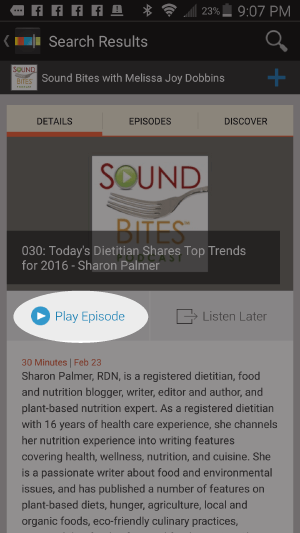
Listen on Stitcher (Android)
Install the Stitcher App
1. Search for “sound bites with melissa joy dobbins” 2. Choose Play Current Episode or Add to Playlist
Choose “Play Episode”
Subscribe & Review on iPhone
Open the “Podcast” app on your iPhone
Search for “Sound bites with melissa joy dobbins”
Open the podcast and click “Subscribe” and your done!
Write a Review
Click “Reviews”, then “Write a Review”.
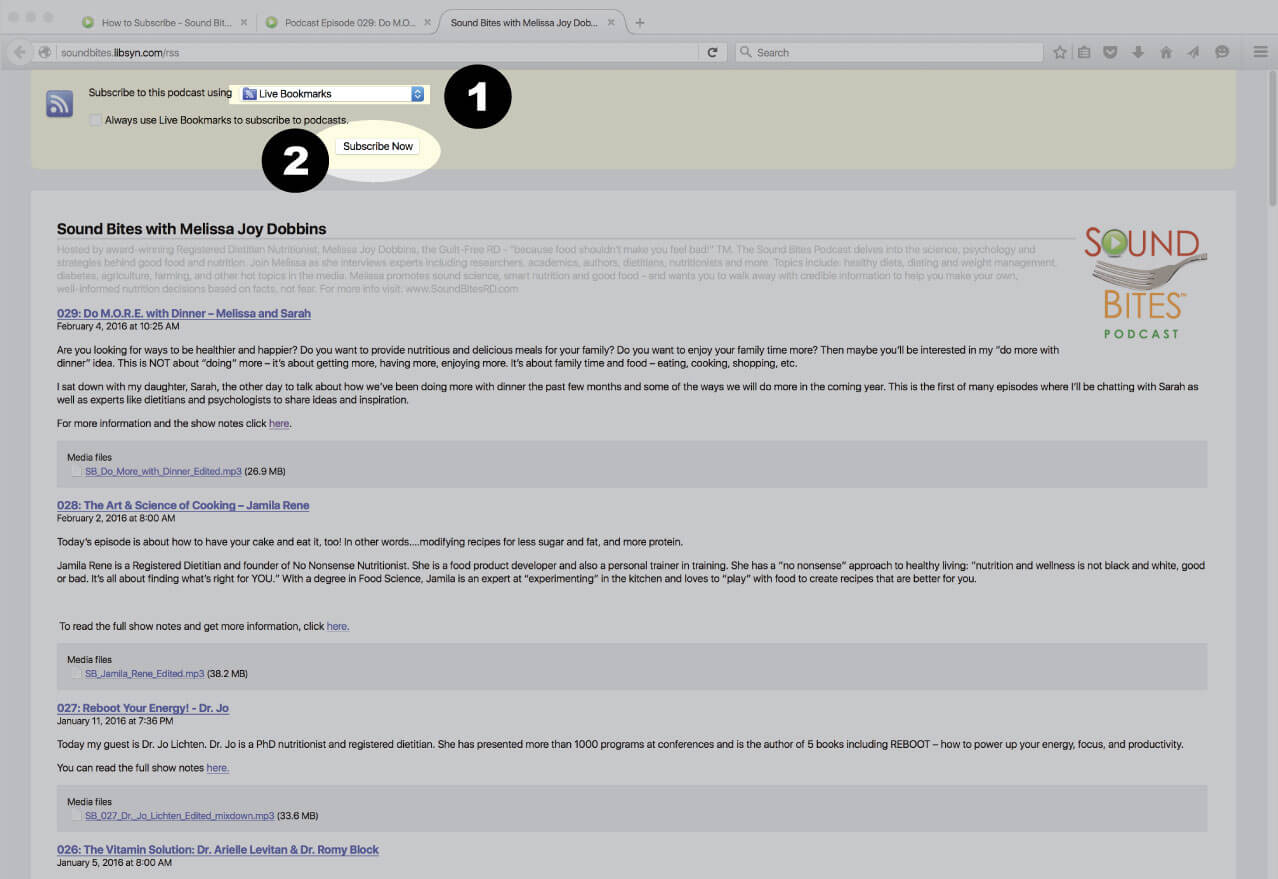
Subscribe via RSS Feed
Navigate to any podcast player . Click on the RSS feed icon.
Click on the RSS feed icon.
Click on RSS Feed
Choose which application you would like to use to receive the RSS feed
Click “Subscribe Now”
Confirm settings and subscribe.
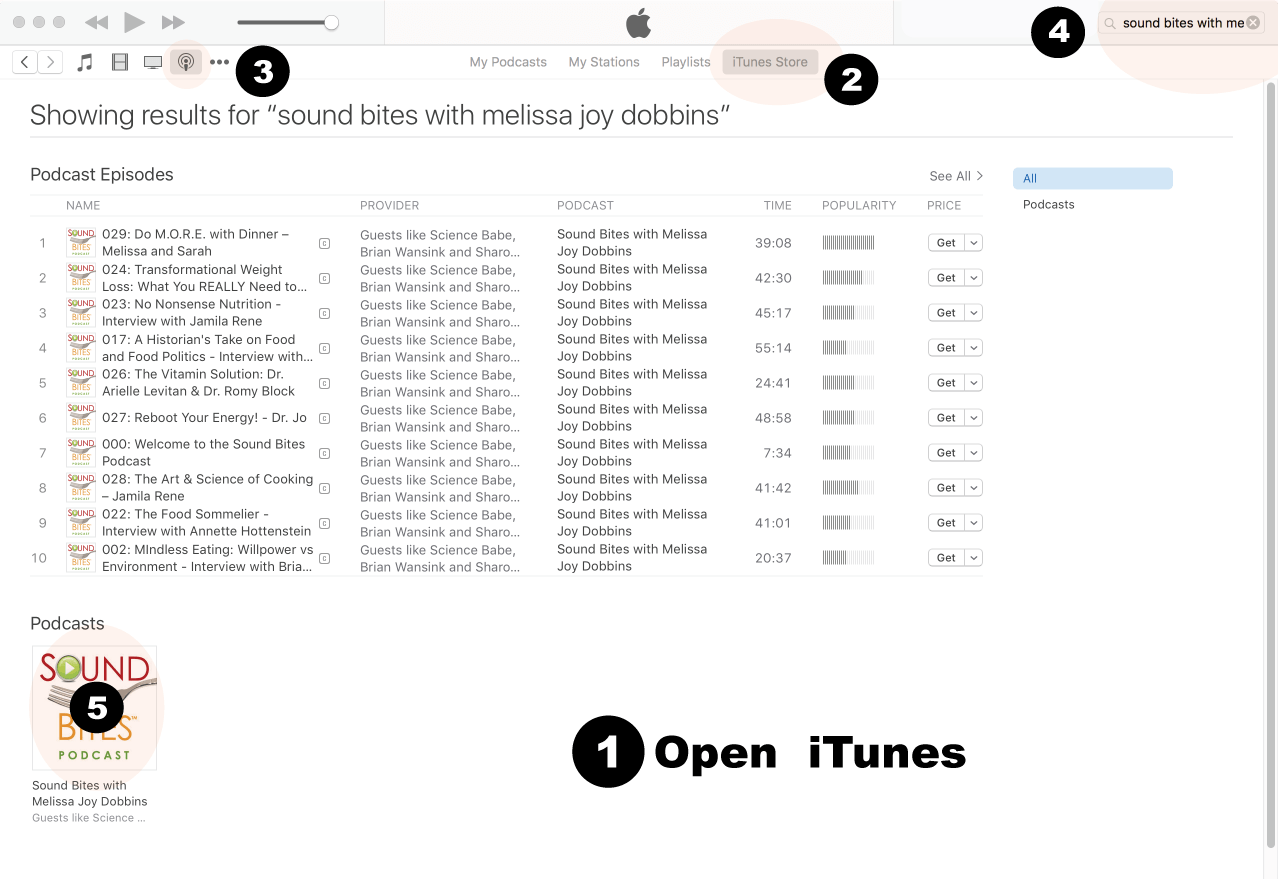
How to Review in iTunes
Open iTunes desktop application
Click iTunes Store
Click on Podcasts
Search for “Sound bites with Melissa Joy Dobbins”
Click on podcast image
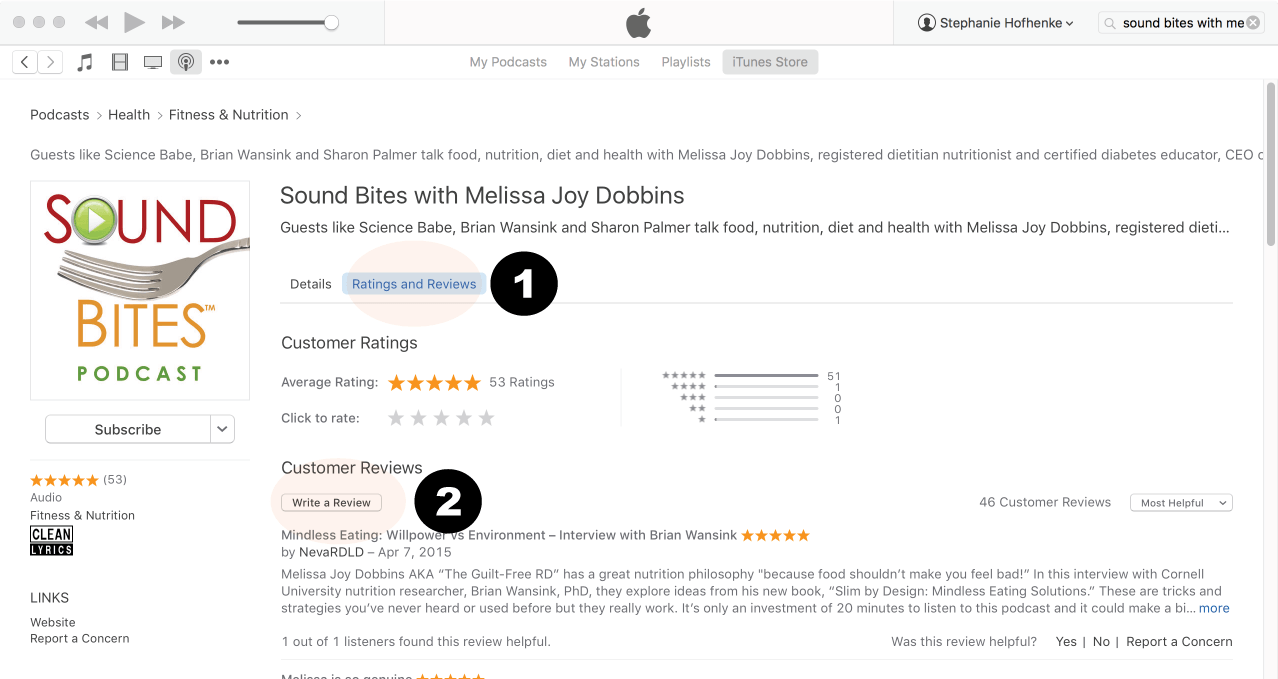
Search for Sound Bites podcast in iTunes
Click Ratings & Reivews
Click Write a Review
View reviews and write your own review.
Write your review…. Thank you!
Write your review!
How to subscribe via iTunes
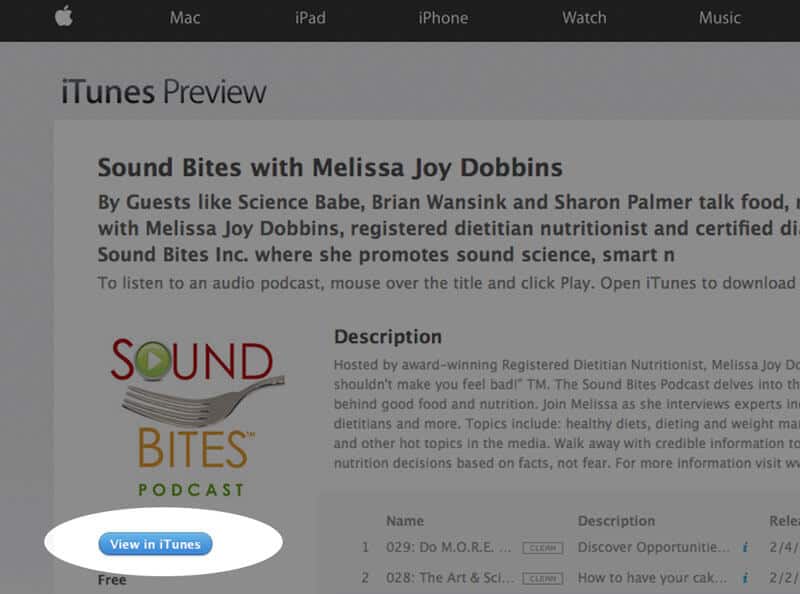
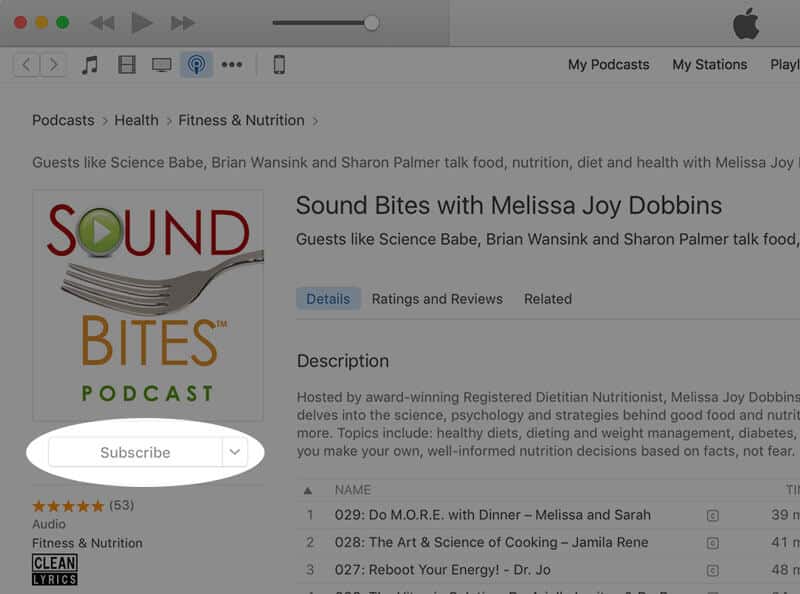
Click here to view the Sound Bites Podcastin iTunes, then click the blue “View in iTunes” button. This will open your iTunes application directly to Sound Bites Podcast. Click the “Subscribe” button, and your done!




 Ginger Hultin is a Seattle-based Registered Dietitian Nutritionist and owner of the concierge, virtual nutrition practice Ginger Hultin Nutrition where she helps clients with complex health conditions through an integrative approach. She specializes in anti-inflammatory diets for integrative oncology nutrition, people with gastrointestinal disease, and autoimmune conditions.
















Great Podcast. Enjoyed every minute of it
Thanks Veronica – so glad you enjoyed it!
great pod cast. really enjoyed!
Thanks Cathy – so glad you enjoyed it!
Melissa
Great podcast! My brother is going thru treatment, and this has helped him tremendously.
Shelia,
I’m so glad you found this episode helpful. My best to you and your brother.
Melissa