Celebrating over 1 Million Downloads and 50,000 Free CEUs on the Sound Bites® Podcast | NEW: Get 1 years’ worth of CEUs with the new 15-CEU Podcast Course
The Importance of Communication in Navigating Healthcare Harm
When you or your loved ones are in the hospital it can be overwhelming and stressful. You may feel unsure about speaking up and asking questions or sharing information with your healthcare team. But research indicates that up to 70% of patient harm events are due to communication breakdowns, and most people don’t realize how much power they have in managing their own care—and how understanding their rights and speaking up can truly make a life-saving difference.
Never doubt that a small group of thoughtful, committed, citizens can change the world. Indeed, it is the only thing that ever has.” ~ Margaret Mead
Tune into this episode to learn about:
understanding your healthcare consumer rights
taking charge of your own healthcare
how to help a loved one in the hospital
staying safe in the healthcare system
tools to navigate the healthcare system
how families and patients can speak up when they feel intimidated or reluctant
the 3 “P”s and “CUSS” words to empower conversations
stories and examples of healthcare harm that can impact patient safety
how to choose the best hospital for the safest care
resources including a free patient safety checklist
Julie Siemers, DNP, MSN, RN
Dr. Julie Siemers brings over 40 years of diverse nursing experience spanning practice, education, and executive leadership in healthcare. With a strong foundation in acute critical care as both a practitioner and leader, she is deeply committed to advancing patient safety. Dr. Siemers earned her Doctor of Nursing Practice degree from Touro University, Nevada, with graduate and doctoral research focused on patient safety and driving meaningful reforms in healthcare. She is also the author of “Surviving Your Hospital Stay: A Nurse Educator’s Guide to Staying Safe and Living to Tell About It,” a resource designed to educate and empower patients and their families.
Resources
Some links may be affiliate links. As an Amazon Associate, I earn from qualifying purchases.
Transcript Speakers: Melissa Joy & Dr. Julie Siemers
[Music Playing]
Voiceover (00:00):
Welcome to Sound Bites, hosted by registered dietitian nutritionist, Melissa Joy Dobbins. Let’s delve into the science, the psychology, and the strategies behind good food and nutrition.
Melissa Joy (00:24):
Hey there, if you’re a dietitian and you’re trying to fulfill your continuing education requirements, be sure to check out my free CEU activities. I have nearly three years’ worth of free CEUs you can receive by listening to my podcast.
I also have a CEU package on sale for one year’s worth of continuing education credits, which offers the convenience of taking only one quiz and receiving one certificate for all 15 credits. Simply go to my website at soundbitesrd.com/freeceus for all the details.
Hello, and welcome to the Sound Bites Podcast. Today’s episode is about how to communicate and advocate for yourself and your loved ones in the healthcare setting.
We are going to talk about some really important topics such as how to take charge of your own healthcare, knowing and understanding your healthcare consumer rights, choosing healthcare partners, and how to help a loved one in the hospital.
My guest today is Dr. Julie Siemers. Dr. Julie is a patient safety consultant, industry nurse leader and educator, she’s also the founder of Lifebeat Solutions and the author of the bestselling book; Surviving Your Hospital Stay: A Nurse Educator’s Guide to Staying Safe and Living to Tell About It.
I’m going to have Julie share a little bit more about her background, but I did want to share this with you. Since 2009, Dr. Julie has been educating students, colleagues, and the broader medical community on the vital skills needed to recognize patient deterioration and ensure safe nursing practices.
Now, as a patient safety expert and founder of Lifebeat Solutions, she’s on a mission to make healthcare safer for everyone.
Welcome to the show, Dr. Julie.
Dr. Julie Siemers (02:15):
Thank you so much for having me here. It’s an honor.
Melissa Joy (02:18):
Oh, I am so interested in this topic. I probably can speak for almost everybody listening that we probably each have at least one story where we’ve been in a little bit of a healthcare situation that’s scary and frustrating.
I didn’t know people like you existed, but I’m so excited to talk more about the work you do and the advice you have for all of us listening, just to be more empowered and effective in these healthcare situations like I said, that can be very scary and very serious at times.
So, tell us a little bit more about your background and how you became a nurse and really, how you became interested in this area of focus.
Dr. Julie Siemers (03:01):
Yes, my mom said when I was 16-years-old, “Hey Julie, (when I was trying to figure out what I wanted to do with my life) why don’t you be a nurse?” Because she had always wanted to be one. I was like, “Yeah, I really like that idea.” So, I applied and got right in.
So, I started nursing school at 17-years-old, and for the next 30 years I worked at the bedside. So, I worked critical care areas, medical surgical areas, the cath lab, I even spent 10 years as a flight nurse on the helicopter, which was amazing, learned so much there.
And then when I started nursing education in 2009, that’s when I had to work on a thesis for my master’s degree and I started digging and found out … I was shocked as a nurse to find out the degree of healthcare harm, and so then I continued on and did my doctoral project on that too.
So, yes, I’ve been researching this topic for the last 15 years and teaching to the students and the community healthcare workers as well as lay people what the gaps are in our healthcare system and their chasms really.
Melissa Joy (04:07):
And I know that that is a huge topic. There’s so many different things that we could talk about. Clearly, we’re going to focus mostly on what we as patients and loved ones can do. And we’re not here to bash the medical community and say how things are going wrong, we’re just talking about the realities of the landscape right now.
So, if you could share where are things at today? How dare I say bad? What are the concerns and the issues that you’ve seen that we need to know kind of to set the stage?
Dr. Julie Siemers (04:40):
Well, first, knowing that medical harm and preventable error is the third leading cause of death is probably the place to start. Because even healthcare workers or professionals are shocked at that finding.
The other thing to know that’s been in the healthcare literature, medical journals, et cetera – since 1955, why is it still happening? And that’s where my desire, my passion for this really grew, is that we can do something.
And so, that’s where the intense, what can we do and why I came up with the book that I wrote, and then also in my TEDx talk, talking about how consumers, we really need to bridge that gap between communication breakdowns between patients and their families and the healthcare system, but also within the healthcare system itself.
Melissa Joy (05:35):
Yes, and in our previous conversation, I really liked that we can address both sides of that puzzle because as I said earlier, we’re not going to sit here and just say how things are going wrong in healthcare, whatever.
We’re talking about solutions, and also, we’re not going to just focus on putting the onus on the patient or the family. We’re kind of looking at that whole picture, which again, you could talk for days about all of that, but we’re going to hone in on a lot about what we can do.
But you said in your TED talk that 70% of patient harm events are due to communication breakdowns, you just alluded to that. And I have to say, as a healthcare professional, as someone who has worked in a clinical hospital setting, as a communications expert, I’ve been shocked at how I’m quite skilled in the situation to advocate for my loved one and communicate, yet it’s still been extremely frustrating and scary.
If I’m struggling, I can only imagine how somebody who doesn’t have the medical background and the communications background that I have. And even just knowing that they can speak up, and my regular listeners know as a diabetes educator, that’s one of the reasons I love working with that population is because there’s so much of the empowerment piece and helping them have better conversations with their healthcare team, and that they’re in the driver’s seat, they have a role here. So, even just on that level, I think that there’s a lot of work to be done about helping people speak up.
We’ve heard a little bit about why you are doing the work you’re doing, but was there something more specific that you wanted to share about what inspired you to focus on this?
Dr. Julie Siemers (07:16):
Yeah, and I talk about this in my TEDx talk too. My parents were in an airplane accident, they survived. But I was living across the country with five children, a four-month-old baby, and working full-time in the ICU, and the communication with the healthcare team was very limited and very frustrating as a family member. Especially being a nurse, I felt like I couldn’t help. So, that was also a part of how can we fix this system? And that’s one thing too, I’ll lead into.
Medical error has been found to be systems errors problem. Yes, it’s usually an individual that makes a mistake, but it’s because of holes in the system that line up to allow the mistakes to happen, and that’s why I think that transparency has to be a new culture.
That communication between healthcare providers and their families and the families and the patients has to be a new culture that we can insist on politely with the healthcare team that when we speak up, we’re advocating, but we’re also helping the healthcare team because we know healthcare today is so complex, it seems to get more complex even though we have more technology and research, et cetera.
But the nurses, most places, they’re understaffed, and so they’re scurrying and hurrying between patients, and that’s where you as a patient’s family member can assist. And that’s what I want to look at this solution as a bridge.
Melissa Joy (08:50):
I love that, bridging the gaps. And I’m glad you articulated the systems errors, is that the phrase you used? Because again, we’re not here to say somebody’s incompetent or some human error, it’s that bigger picture and the solutions versus blame and pointing fingers.
So, I know you shared a couple of stories in your TED talk. Is there one story besides the story about your parents that you’d want to share about kind of an example of how things can break down or did break down, or maybe a situation where crisis averted, if you will?
Dr. Julie Siemers (09:25):
Yeah, there unfortunately are so many stories of patient harm that occur, but what I will say is, and again, where families can come in and help, but this is what I developed in Lifebeat Solutions, was the courses for nurses to fill in the gaps. And so that is, I guess my platform is to recognizing when patients are becoming unstable.
And in the literature, it’s probably for a couple decades at least, have said that patient deterioration, the signs, the clues happen 6 to 24 hours prior to a cardiac arrest. So, those physiological signs are something that families can help communicate to the healthcare team.
Neurological changes for example, if mom that just had surgery is confused and this isn’t her baseline, this isn’t normal for her, that’s a red flag we need to pay attention to. Or mom’s heart rate now because they have monitors and we can see is 110, which is too fast, but it’s sustained and therefore, now, mom’s heart rate has been fast or too fast for the last hour, what’s the problem?
We need to get that nurse in to investigate and say, “Is this pain-related? Is it low volume if they just had surgery, maybe they’re bleeding internally? Is it the pain medication they had, a side effect to that pain medication and we need to watch them closely?” Does that help explain it a little bit?
Melissa Joy (10:59):
Yes, absolutely. What should I ask you first? How families and patients can speak up when they’re intimidated or reluctant or don’t even maybe even know? Obviously, we’re raising awareness – but they’re not sure if they have the confidence to do so or how to do so. Or should we talk first about what are some of the most important things that patients and families need to know to stay safe?
Dr. Julie Siemers (11:22):
Let’s start with the communication and the hesitancy, and I’ll share a story with you too because it just brings home the point. But when a family member feels concerned (so I’ll give you the cuss words): concerned, uncomfortable, scared, and it’s a safety issue.
So, you as family members can utilize those words to get the attention of the healthcare team when you’re concerned, when you’re uncomfortable, when you’re scared, and that should be the clue for them to really listen to you.
It’s not that we’re communicating something that isn’t real because we feel it, we know it, and never, never ignore your gut intuition. That is really important because you know your family member better than anyone.
So, one of the stories I’d share is Louis Blackman, he was a 15-year-old that had chest surgery. The surgery went fine, but the following day, he started complaining of abdominal pain. His mom was really concerned and did communicate that concern to the healthcare team, but no interventions were taken.
And he continued to have more pain, and now, his vital signs were changing, and the healthcare team just didn’t listen to his mom. And he ended up dying, which is so tragic because it was preventable.
Louis was having abdominal pain because the pain medication that he was given was an NSAID, a nonsteroidal anti-inflammatory drug that caused an ulcer. And because of his dehydration status, meaning he came out of surgery, probably a little hypovolemic.
And that medication is contraindicated in that case because the mucosal lining in your GI tract gets thinner, and therefore, the drug then is a little more harmful to the gut lining. And over time, those next few days, that ulcer perforated and caused bleeding in his abdomen.
On the autopsy, they found three liters, which is, I don’t know what size a liter is of blood in his abdomen. But he had signs way before that happened and the dots weren’t connected by the healthcare team. So, again, listening to the family is so important.
Melissa Joy (13:46):
And I would add that it’s okay to just … you feel concerned, you feel scared to just ask questions, and certainly, the staff is busy. But maybe their answer to your question will reassure you and then you’ll understand why such and such is happening, and then you move on.
So, let’s move into what are some of the most important things that families and patients need to know.
Dr. Julie Siemers (14:10):
So, to tie this together, I’ll say that I know it’s in our culture, we don’t like to come out of our comfort zone and say, “But Dr. Jones said, and now Dr. Smith is saying something different,” and we choose to remain silent because we still are in that culture of the doctor knows best.
But that is where we’ve got to shift our perspective in knowing that we’re supporting our loved one and being a team member with the healthcare team. If you don’t speak up, think about it this way – if you choose to remain silent because you’re scared to speak up or you’re unsure (that’s probably what happens most of the time), the harm that could occur because you don’t speak up, that’s far greater or graver consequences than you actually speaking up.
So, knowing that you are acting as a team member, even if it’s not fully received in that light, the more we as patients and family members do that, we’re going to shift the culture.
Melissa Joy (15:18):
I love that. I feel like shifting that perception that maybe doctor so and so doesn’t know what the other doctor said and maybe I’m the conduit to that. And even if it’s just like, “Oh, well, yes, here’s why I disagree, or oh that’s helpful, and I’ll add that into what I’m recommending,” yeah, I think it’s really important to just communication.
And I’ve been in this situation so many times with family in the hospital where I’m saying to one of my parents, “Can you believe how much this comes down to communication?” That’s so, so important.
So, what are some examples of healthcare harm that can impact patient safety? Is there any other issues about that you want to address?
Dr. Julie Siemers (16:03):
I would say healthcare acquired or healthcare associated infections are still a major problem. And the number one way to combat that and decrease the spread of infections in the hospital is handwashing.
And so, this is a simple way that even I think patients and their families sometimes are still afraid, but it’s a simple way that you can ease into, “Can you please wash your hands before you come and touch my wife?”
Sometimes you’ll hear, “Well, I just washed my hands in the other room.” Yes, but there was a doorway, a handle or whatever and say, “That’s awesome, but I still would like you to wash your hands.”
And it’s intimidating sometimes to even say that to a physician, but it doesn’t matter who. All of them have been taught, all healthcare professionals have been taught in the fundamentals of their training to wash your hands. So, that would be I think one really important one.
Melissa Joy (17:03):
Well, and that makes me think about, you have these three Ps that I’d like you to share because I think that works nicely into what you’re saying, is as long as you’re following these three Ps, you can rest assured that you’re helping and you’re not being rude. So, share those.
Dr. Julie Siemers (17:20):
So, the first is be present. Be present during shift change with the nurses when they’re giving report to each other, and take notes, it’s really important. Also, be present in your heart. Come in with a good intention, come in with the intention that you’re there to help, you’re there to be a bridge.
I know it’s high anxiety and can cause a lot of distress being in an unfamiliar situation and unfamiliar environment with unfamiliar language. And then be present if you can when you know the doctors are going to make rounds.
The second P is be polite. I know it’s hard sometimes, and sometimes, it’s easy to feel snappy or be upset, and that comes across. But if you can just remember, I think most healthcare providers are really trying to do their best, and just coming in with that mindset of good intention and be polite.
And the last one is be persistent. So, if you say like Louis’s mother did, “Something is wrong with my son …” She did not know that she could escalate that per hospital protocol and the chain of command to the charge nurse, and then the hospital supervisor, and then the hospital administrator on call, which there’s a hospital administrator on call 24/7. So, be persistent when you feel something needs to be done.
Melissa Joy (18:44):
All those three Ps are so important and I’m reminding everyone listening about the cuss words: I’m concerned, I’m uncomfortable, I’m scared, and there’s a safety issue. And to your point, when we’re upset and we’re scared and we’re concerned, it’s very unsettling.
But if we can … even just communicating that, like, “I’m sorry, I’m really worried,” and connect with somebody on that level that can allow them to be a little bit more compassionate with where we’re coming from. And then again, we’re on the same team, we’re all trying to achieve the same goal, I think that’s really important.
Before we jump into how we can choose the best hospital, because you shared a website with me that I had never heard of and some specific tools that we can share with our listeners, maybe now is a good time for me to share my story. I think it’s a good example of what we’re talking about today.
So, my relative was supposed to have a procedure and we had a lot of questions and concerns about it. There was a risk of complication that 8 to 10% of patients have. So, I don’t know how you say that. 8 to 10% of these procedures result in this complication, which is pretty high.
We had a lot of questions and concerns before we agreed to it. The doctor was pretty dismissive, “Don’t worry about it, it’s fine.” And a few days before, myself and my relative both were like, “You know what, we’re not getting the answers to our questions, we’re not feeling good about this. We’re going to put it off for now.” Because it wasn’t an emergency procedure.
Six months later, scheduled the procedure, went in, had it done on a Monday, that resulted in a hospital stay. A certain medication was started, they needed to monitor her. And the next day in the early afternoon, she started having some severe pain and a scan was ordered.
The scan wasn’t done until late the following day. At which point, the results were sent stat. The staff was backlogged, they were short staffed, we kept saying, “She’s in pain, we need this scan.” And then of course, when they saw what they saw, they said emergency surgery was needed.
And both my brother and I were present, very, very present, and I think that helped. But also, just seeing that, that was very scary. She survived the emergency surgery, but what happened prior to that is we had to wait for an ER.
The doctor was actually in the room doing another procedure on her to just make her be able to make it to the emergency surgery, and the doctor did apologize, which I was shocked and appreciated.
And here’s the other thing, if she had gone home after that procedure, she probably wouldn’t be here today. So, the fact that she was in the hospital and being monitored but still there’s so many places where things can break down.
And my brother and I just stayed on it. We just kept saying, “There’s something wrong, where’s the scan? We need this to happen,” and so that’s one of many stories. I’m sure everybody listening probably has their own story, but it just can be so touch-and-go and so upsetting.
Dr. Julie Siemers (21:52):
You’re right. And I think why this is so important to talk about too is because we are all going to be a patient someday or have a family member who is a patient someday, and the statistics say that one in four (and this was a research article that came out two years ago) Medicare patients suffer some kind of harm in the hospital.
And then if you add in all age categories, pediatrics or anybody under Medicare age, it’s one in 10. As you said, 8 to 10% risk is not good odds when we expect to go into the hospital and be treated, healed, not harmed.
Melissa Joy (22:33):
And it’s good to know that going in, and I should clarify that complication was what ended up happening to her. But when you come full circle and it’s we were concerned about it, they were very dismissive, “Don’t worry, it’s not going to happen.”
And then it did happen and the doctor apologizing, we were sort of like, “This is why we were worried, and we needed that communication and we needed to be on top of that,” like going in and yeah, sorry.
So, let’s talk about how we can choose a safe hospital. I’ve always lived in metropolitan areas and … well, I shouldn’t say always. I’ve moved around, I’ve lived a lot of different places, but for my whole career I’ve been in the Chicago area and have had the fortune of having a lot of different health systems to choose from.
Of course, it depends on what your insurance covers and I’ve worked in many different health institutions. And I do have to say when you work in a hospital setting, you kind of have the insider knowledge on who the good doctors are and all of that, which I wish everybody had that insight.
But you have a website and some recommendations on how we can kind of see what grade our hospital of choice might have.
Dr. Julie Siemers (23:40):
Yes. So, there’s a nonprofit organization called Leapfrog, and the website is hospitalsafetygrade.org. And you can go in and just put your zip code in there and you can see the hospitals in your area and how they’re rated A through F, just like college or high school grades.
There are 22 categories that rate the patient safety for each hospital, and each of those categories is red, yellow, green. So, you can see, hey, this hospital does really well in preventing blood clots after surgery, but they don’t do well with preventing postoperative pneumonia.
And where this information and knowledge can help you as patients and family members, is specifically ask the surgeon: “How are you going to help my mother so she doesn’t end up with a blood clot? What are the orders that you write? What is the protocols that this hospital follows to prevent blood clots?” That was another story in my TEDx talk, a man who died of a preventable blood clot.
So, unfortunately, knowing these things happen and they’re still happening is where we as patient advocates need to become informed and educated. So, that is a great place to start.
I personally would never, ever go to a D or F-rated hospital. I would really hesitate with even a C rated hospital. And so, you can look and ask the physician those questions. And I’m sorry that you had that situation of them being dismissive, but unfortunately, that is also part of our culture.
And again, when you choose a physician or a surgeon, find one that you can communicate with and that respects you, that’s one of your patient rights. We don’t have to be dismissed or put in the corner as they say in that movie, “Dance and put baby in the corner.”
Melissa Joy (25:30):
And I love your suggestion, and I guess I do this, but I think it’s really, really helpful is to bring in a notebook and write things down after this emergency surgery. And not only did the doctor apologize, but he gave us his cell phone. And when my relative went in for a follow-up appointment with the surgeon, there were some things that didn’t seem quite right.
And so, I called this other doctor and informed him of what had happened at that appointment, and he said, “No, I need to see her tomorrow.” And so, that communication and that connection did help moving forward.
So, the other thing about just the communication piece and writing things down is we’re all human, we’re all busy, and I really do think it’s about connecting those dots and coming back and saying, “Well, remember on this date, we talked about this,” so, “Oh yeah, that’s right.”
Even something (and I’m sure everybody listening can relate to this) – you’ll go in for an appointment and they’ll ask you if you’re on a certain medication or I don’t know, whatever and you’ll say, “Yeah, we just talked about this a week ago.” And they completely forget because they see a lot of different patients or whatever. So, I think it’s really important to connect those dots.
Dr. Julie Siemers (26:44):
For sure.
Melissa Joy (26:46):
So, are there any other tools you can share with our listeners to help them navigate the healthcare system? We’ve got the cuss words, we’ve got the three Ps, we have this website, just the whole communications and empowerment perspective. What other tools can you share?
Dr. Julie Siemers (27:01):
I have a free patient safety checklist that I can give to you and you can share with your listeners and it really just gives some high-level things to know and to watch for. The one thing I would say too is to familiarize yourself with what is normal procedures or what is normal vital signs, educate and inform yourself before you go to the hospital.
Because when you’re in that time of stress isn’t the time to learn how to communicate or how to help your loved one. So, I’m not trying to be doom and gloom as I said, but it is being informed and educated that really is going to empower you, and start before you need it.
Melissa Joy (27:44):
I could not agree more. I think that just shifting that mindset of we’re there, the doctors know everything, I know nothing, don’t rock the boat, don’t bother them, you’re just going to delay whatever work they’re doing, and I know nothing about this procedure or this illness – if you know, you might be the one to see that first sign that something is not right.
Well, I’ll definitely have that patient safety checklist in my show notes at soundbitesrd.com as well as information about your book.
Before we wrap up, can you just kind of share your vision, what needs to change in the healthcare industry, and it’s kind of time, it’s past due time. Share your vision with us.
Dr. Julie Siemers (28:28):
Yes, I fully agree. I think Americans are ready for taking responsibility and taking action to help their loved ones be safe. We can’t be in the passive role anymore. Healthcare has changed so much, and I really think there is hope, but one thing that must change is transparency.
Healthcare systems have kept things in the shadows and swept under the rug. When patient harm occurs, 80% of hospitals require a non-disclosure. They don’t want their name across the news, they don’t want the mistake happening, or people knowing about the mistake.
But here’s the problem with lack of transparency, is the same problem is going to happen again because it’s a systems error. It allows a human to make a mistake. So, if we don’t close those gaps in …
Let’s just take for example the RaDonda Vaught case with Vanderbilt a couple years ago. When they did the investigation, of course she was fired, and she was blamed because she did give the paralyzing agent instead of the sedative agent and the patient died.
So, yes, she was responsible, but when you look at the systems, what they found was the medication dispensing cabinet had multiple errors, nurses were told just to override it. There wasn’t safety checks in place, and by originally sweeping it under the carpet and then an anonymous tip brought it to light, but those systems errors, gaps won’t close until we talk about them.
And it isn’t about personal blame. Yes, it is a person that did that, but let’s get right down to every single patient in that bed is somebody’s family member. And if we have a healthcare administrator or team, board or whatever, making the decision to not be transparent, that same mistake that you just went through in your system could impact your family member. And so, we really have to bring it back to the person, the humanity and the compassion.
I would like to add, because I think this is so important, we don’t have a national patient safety board. We have the National Transportation Safety Board and the Federal Aviation Administration, and case in point in my backyard, a couple of weeks ago, the midair collision between the military helicopter and the American Airlines, which killed 67 people is horrific.
And yes, we have peace of mind that we know the investigations going on to try to figure out why the problem happened so we can close that gap and so that we don’t have those tragedies occurring, but there is nothing for patient safety.
And here’s the statistics that’s even more chilling: over 500 patients a day across our nation die of preventable harm. But there is no agency, there is no recourse for patients’ families when patient harm occurs. So, it’s not making headlines, and therefore, it’s not a number one priority, but I believe it should be.
Melissa Joy (31:42):
Yes, I agree. Thank you for sharing that. Are there any parting words that you have as we’re wrapping up, and also, where people can find more information about this topic and connect with you online, where they can find your book and your TED talk?
Dr. Julie Siemers (31:56):
Thank you so much. Yes, my website is drjuliesiemers.com, all of my socials where I talk about topics of the week or the day to help again, inform and educate is Dr. Julie Siemers. And then my book is on Amazon, but there’s also a link on my website for that.
And my parting words are find the courage to advocate for yourself and your loved ones because it will make the difference someday to someone between life and death.
And I know that we all want to live our best lives and coming from that intention, from the heart of being a team member, even though we may not feel we’re invited right now, I think with the shift in us, that it is going to shift the culture of healthcare.
Melissa Joy (32:48):
Thank you so much. I have enjoyed this conversation, it’s such an important topic. And to that point that you just said, I will say that that doctor who dismissed and then apologized, he so appreciated that I was present and that I was asking questions.
So, you can shift that dynamic, and I just have a lot of hope and just so appreciate the work that you’re doing and just happy to share it out with my listeners.
Dr. Julie Siemers (33:15):
Thank you. I really enjoyed being here.
Melissa Joy (33:18):
For everybody listening, as always, enjoy your food with health in mind, until next time.
[Music Playing]
Voiceover (33:25):
For more information, visit soundbitesrd.com. This podcast does not provide medical advice. It is for informational purposes only. Please see a registered dietitian for individualized advice.
Music by Dave Burke, produced by JAG in Detroit Podcasts. Copyright, Sound Bites, Inc. All rights reserved.
LISTEN, LEARN AND EARN
Listen to select Sound Bites Podcasts and earn free CEU credits approved by the Commission on Dietetic Registration (CDR) for registered dietitian nutritionists and dietetic technicians, registered. Get started!
Get Melissa’s Sound Science Toolkit here!
Partnerships:
Sound Bites is partnering with the Association of Diabetes Care and Education Specialists (formerly the American Association of Diabetes Educators)! Stay tuned for updates on the podcast, blog and newsletter!
Sound Bites is partnering with the International Food Information Council! Stay tuned for updates on the podcast, blog and newsletter!
Sign up for my monthly newsletter and episode eblasts so you never miss an update!
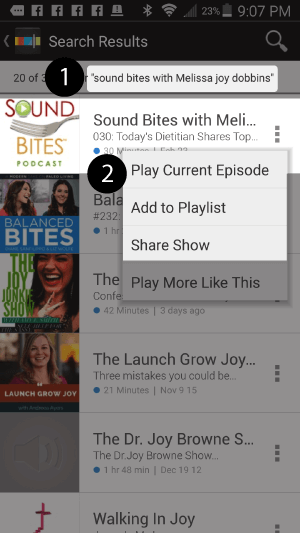
Listen on Stitcher (Android)
Install the Stitcher App
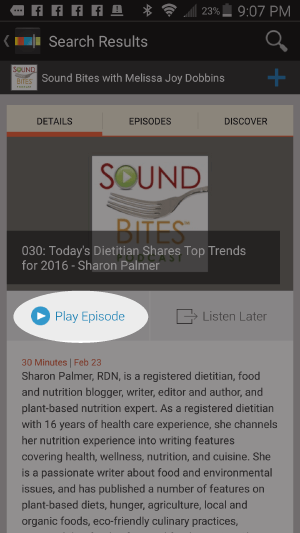
1. Search for “sound bites with melissa joy dobbins” 2. Choose Play Current Episode or Add to Playlist
Choose “Play Episode”
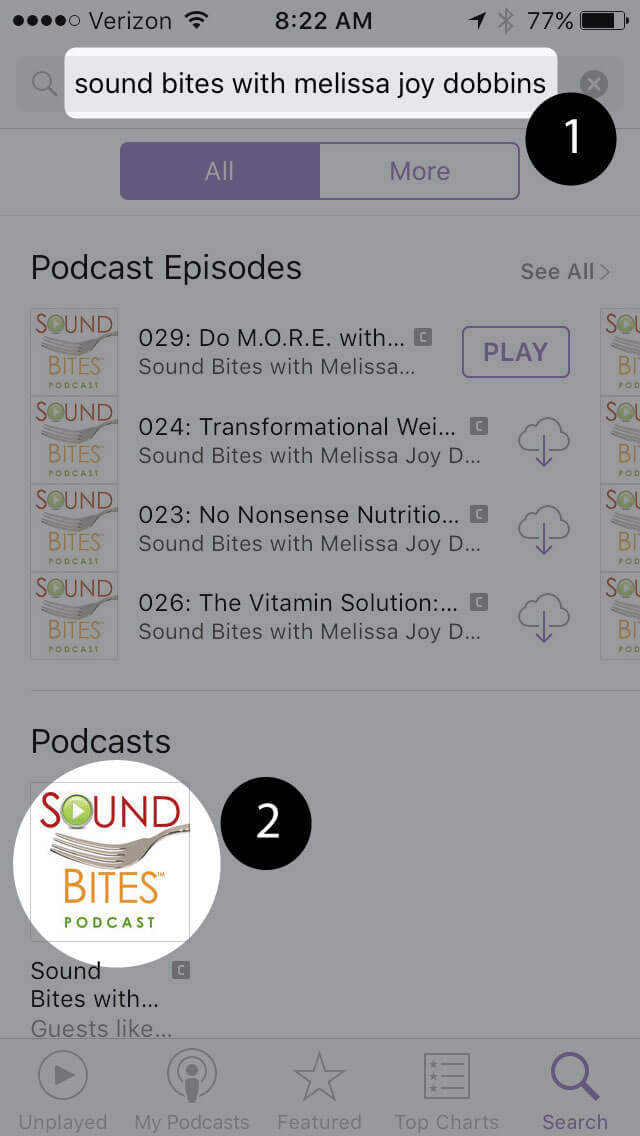
Subscribe & Review on iPhone
Open the “Podcast” app on your iPhone
Search for “Sound bites with melissa joy dobbins”
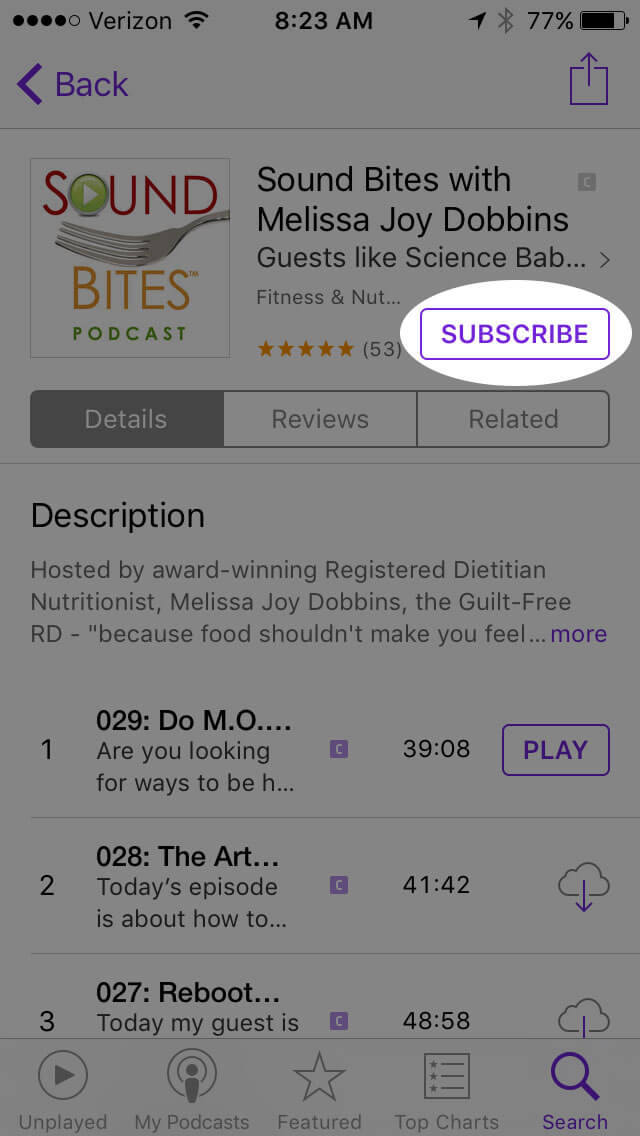
Open the podcast and click “Subscribe” and your done!
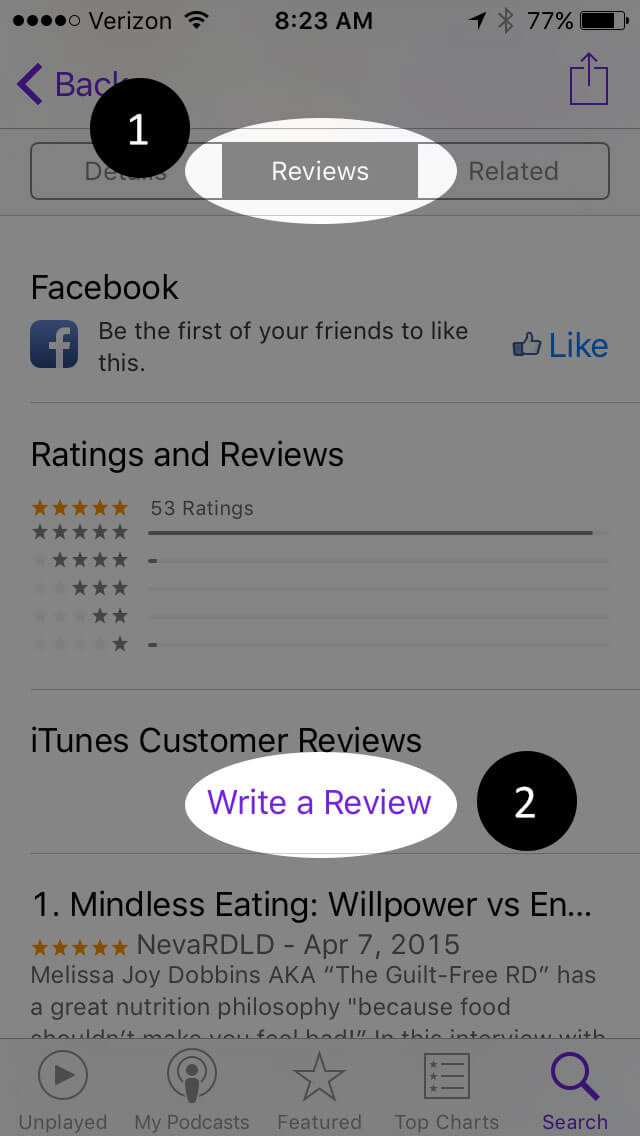
Write a Review
Click “Reviews”, then “Write a Review”.
Subscribe via RSS Feed
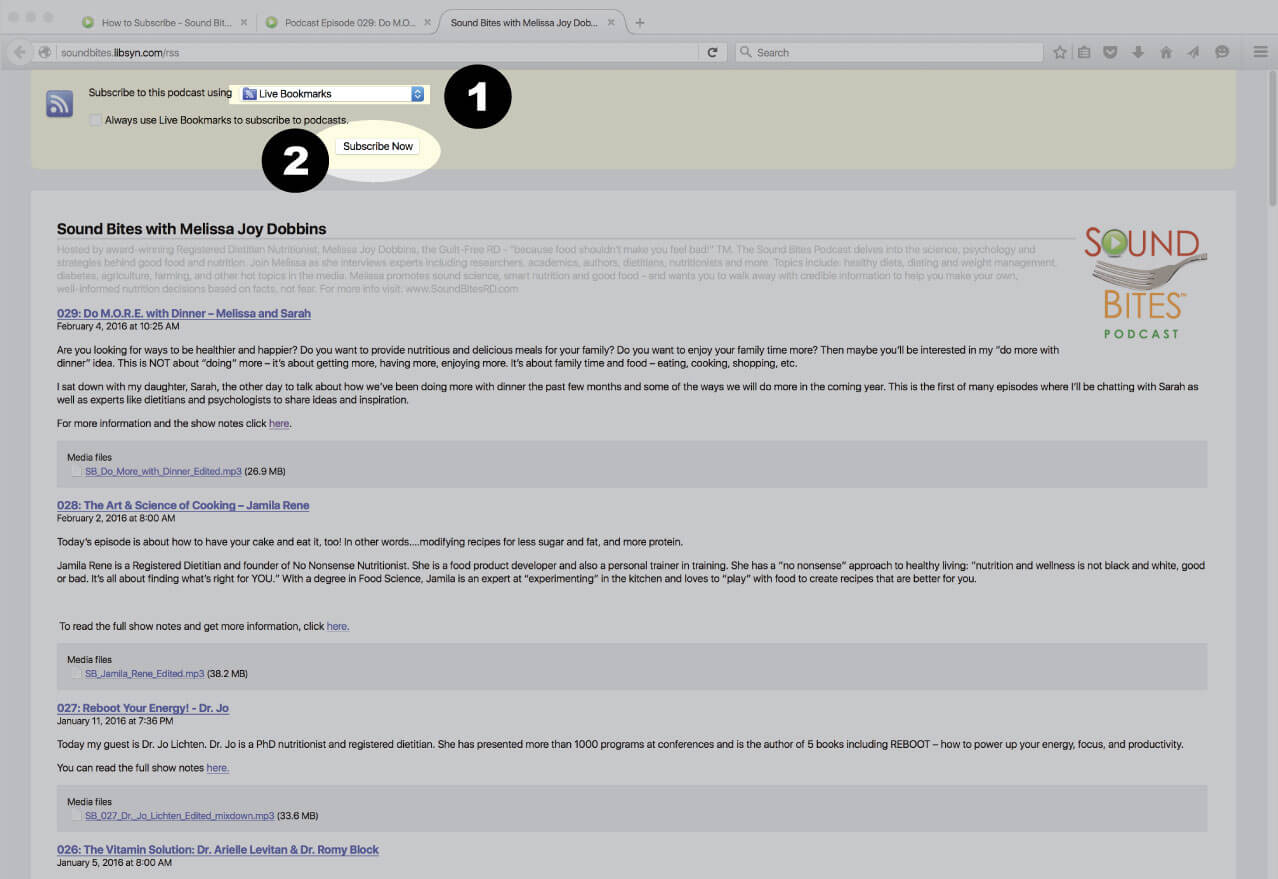
Navigate to any podcast player . Click on the RSS feed icon.
Click on the RSS feed icon.
Click on RSS Feed
Choose which application you would like to use to receive the RSS feed
Click “Subscribe Now”
Confirm settings and subscribe.
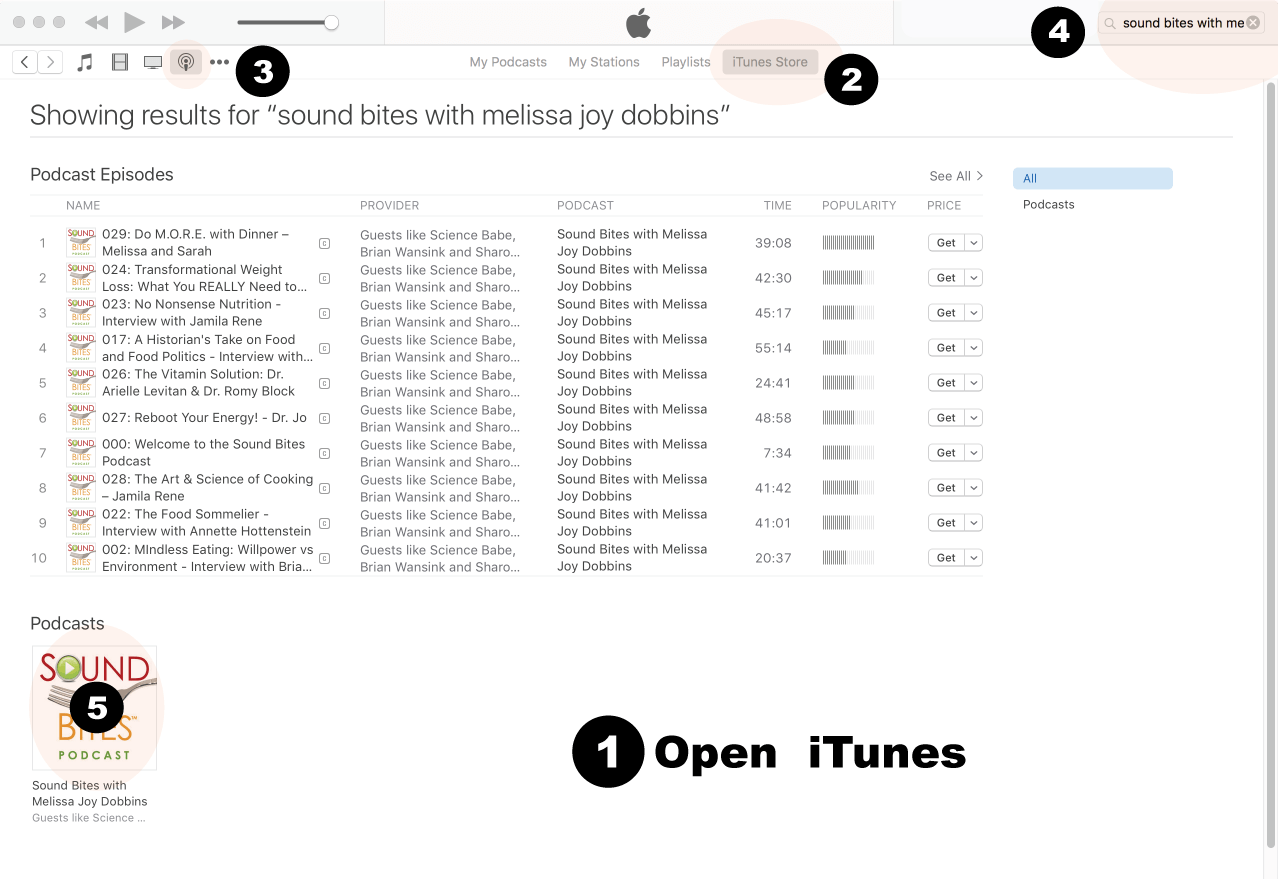
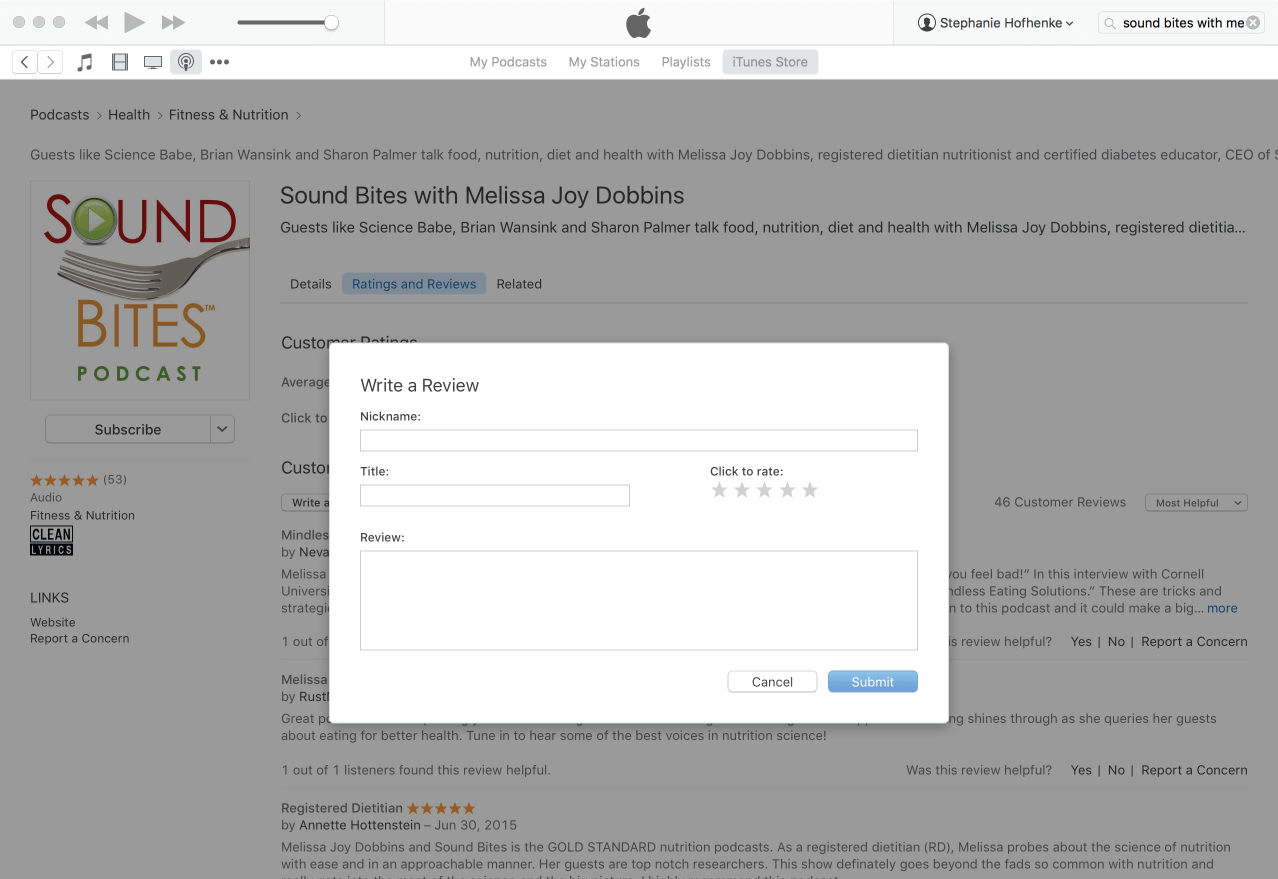
How to Review in iTunes
Open iTunes desktop application
Click iTunes Store
Click on Podcasts
Search for “Sound bites with Melissa Joy Dobbins”
Click on podcast image
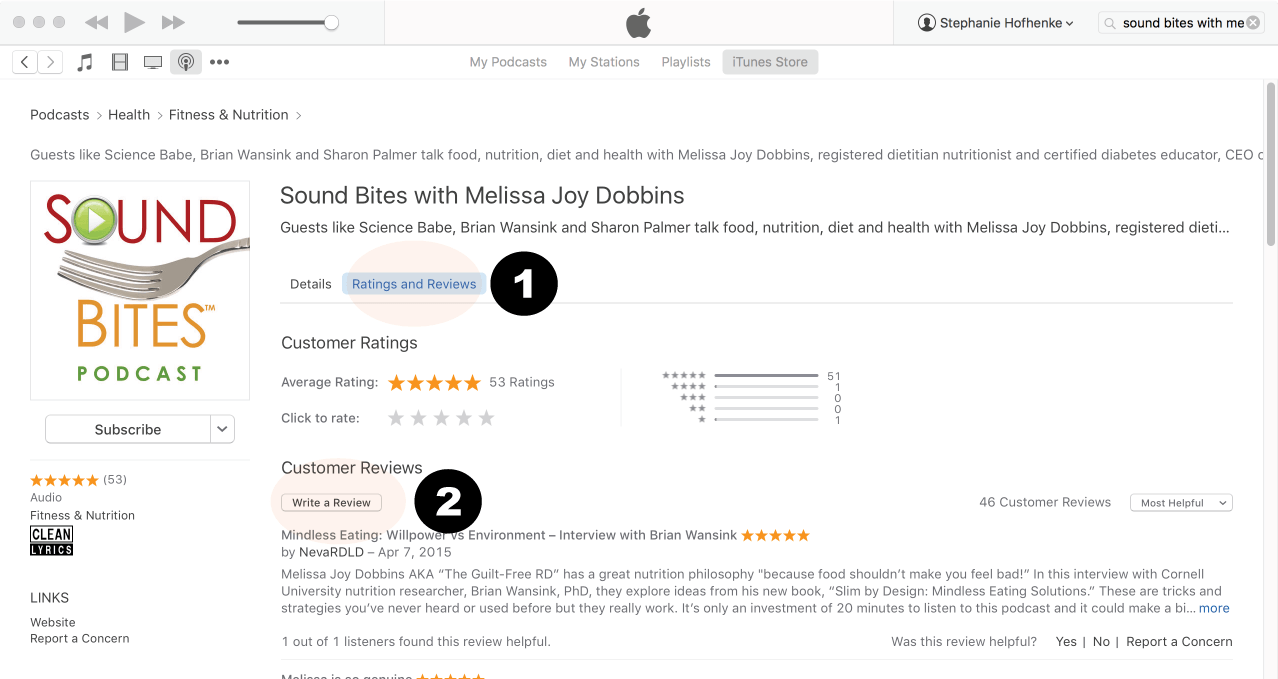
Search for Sound Bites podcast in iTunes
Click Ratings & Reivews
Click Write a Review
View reviews and write your own review.
Write your review…. Thank you!
Write your review!
How to subscribe via iTunes
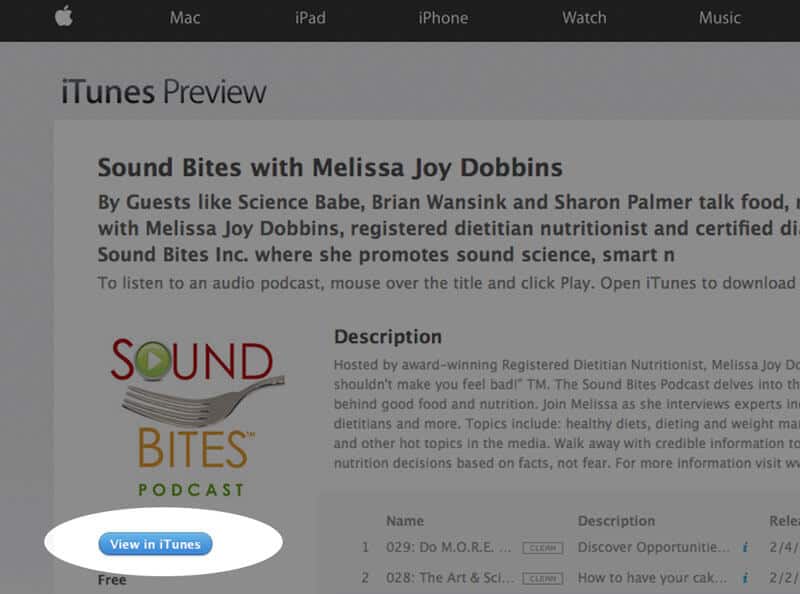
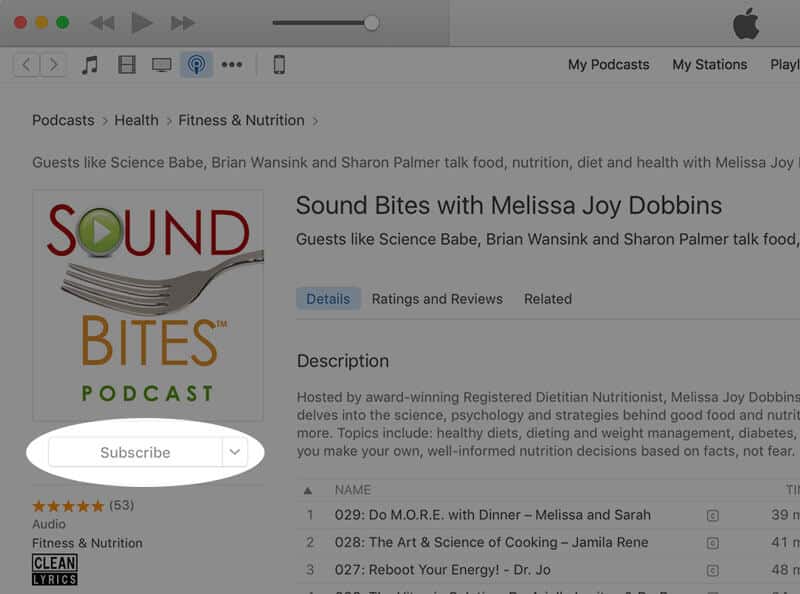
Click here to view the Sound Bites Podcastin iTunes, then click the blue “View in iTunes” button. This will open your iTunes application directly to Sound Bites Podcast. Click the “Subscribe” button, and your done!




 Dr. Julie Siemers brings over 40 years of diverse nursing experience spanning practice, education, and executive leadership in healthcare. With a strong foundation in acute critical care as both a practitioner and leader, she is deeply committed to advancing patient safety. Dr. Siemers earned her Doctor of Nursing Practice degree from Touro University, Nevada, with graduate and doctoral research focused on patient safety and driving meaningful reforms in healthcare. She is also the author of “Surviving Your Hospital Stay: A Nurse Educator’s Guide to Staying Safe and Living to Tell About It,” a resource designed to educate and empower patients and their families.