Celebrating over 1 Million Downloads and 50,000 Free CEUs on the Sound Bites® Podcast | NEW: Get 1 years’ worth of CEUs with the new 15-CEU Podcast Course
Click here to earn 1.0 FREE CEUs for listening to this podcast episode!
Disclosure: Commercial Support has been provided by the UMF™ Unique Manuka Factor Honey Association
UMF™ Mānuka Honey is A Functional Food: Look for the Quality Mark
New Zealand mānuka honey is a powerful functional food. For centuries, the unique and powerful healing properties of the mānuka tree (Leptospermum scoparium) have been understood by the indigenous Māori people of New Zealand.
With more than 2,300+ natural compounds identified in New Zealand mānuka honey it has captured the attention of scientists and health professionals across the globe. Research has identified mānuka honey’s Unique Mānuka Factor (UMF™), a unique group of bioactive compounds, such as methylglyoxal (MGO) and leptosperin, which in synergy contribute to its science-supported antibacterial, antioxidant, and anti-inflammatory properties.
Today, UMF™ quality rating system is the most comprehensive, independently certified and internationally recognized quality assurance system for New Zealand mānuka honey. It’s designed to validate mānuka honey potency, authenticity, purity, shelf life and freshness for honey producers, brands, customers and consumers around the world. Each mānuka honey product that carries the UMF™ trademark must pass the stringent Unique Mānuka Factor Honey Association (UMFHA) quality, grading and rating tests. UMFHA represents beekeepers, processors and marketers.
Tune into this episode to learn about:
what mānuka honey is and how it is different from other types of honey
where mānuka honey comes from and how to identify authentic mānuka honey
how bees make mānuka honey compared to other types of honey
why mānuka honey is considered a functional food vs a sweetener
health research supporting the benefits of mānuka honey including antibacterial, anti-inflammatory and antioxidant properties
the role beekeepers played in recognizing the topical benefits of mānuka honey
the UMF™ quality rating system
the role of beekeepers in creating the UMF™ quality rating system and why a quality control system is important
what the UMF™ ratings mean
how to use and enjoy mānuka honey to maximize the benefits
new and emerging areas of clinical health research – gut health, cancer, etc.
the Mānuka Mastery Course (a free online self-paced course)
resources for health professionals and the public
Megan Grainger, PhD
Megan Grainger is a Senior Lecturer in Analytical Chemistry at the University of Waikato, Hamilton, New Zealand. She first become involved in mānuka honey research as an undergraduate BSc student where she was part of the New Zealand team that isolated the compound responsible for the unique activity in mānuka honey. She found a passion for chemistry, in particular honey research, and has continued to work in honey research. For her PhD, she created the first forecast model to predict the growth of this unique non-peroxide antibacterial compound over time. Forecasting is now routinely used by beekeepers and honey producers to help achieve a high-quality mānuka honey product.
After completing her PhD, Megan worked as a Technologist, Team Leader then as the Foods Operations Manager for a commercial analytical testing company, focusing on honey testing, before taking on her role at The University of Waikato where she enjoys teaching, mentoring students and carrying out research.
Megan continues to work on a variety of research questions in the mānuka honey space, including determining why mānuka honey behaves differently in authentication and quality tests compared to other honeys. She also investigates other New Zealand native honeys for unique qualities.
Aside from honey, Megan has an interest in trace element and heavy metal research. She is currently investigating the affect that heavy metals have on honeybees.
James Jeffery, beekeeper
James Jeffery is part of a founding family and business behind the UMF system and a leading beekeeper producing premium high rated mānuka honey. James is part-owner of Summerglow Apiaries, with his parent’s in-law and UMFHA founding members, Bill and Margaret Bennett. From the home of mānuka honey in the Waikato province of New Zealand, James with Bill, Margaret, and the family have built a reputation for supplying some of New Zealand’s highest-rated, highest quality mānuka honey using industry leading production processes.
Resources
Some links may be affiliate links. As an Amazon Associate, I earn from qualifying purchases.
Transcript Speakers: Melissa Joy, Dr. Megan Grainger, & James Jeffery
[Music Playing]
Voiceover (00:01):
Welcome to Sound Bites, hosted by registered dietitian nutritionist, Melissa Joy Dobbins. Let’s delve into the science, the psychology, and the strategies behind good food and nutrition.
Melissa Joy (00:23):
Hello, and welcome to the Sound Bites Podcast. Today’s episode is about New Zealand mānuka honey, which has a rich, cultural history, and extensive clinical research on a variety of health benefits.
This episode is sponsored. Commercial support has been provided by the Unique Manuka Factor Honey Association, which is an independent trade association founded over 25 years ago by New Zealand beekeepers.
We are submitting this episode to the commission on dietetic registration for one free continuing education unit for dietitians, diatechnician and certified diabetes educators. So, if that is of interest to you, please be on the lookout for that.
My guests today are Dr. Megan Grainger and beekeeper, James Jeffrey. Dr. Megan Grainger is a senior lecturer in analytical chemistry at the University of Waikato Hamilton, New Zealand.
James Jeffery is part of a founding family and business behind the UMF system, which is the Unique Manuka Factor system, which we’ll be talking about today, and a leading beekeeper producing premium, high rated mānuka honey.
Megan and James, welcome to the show.
James Jeffery (01:34):
Well, evening.
Dr. Megan Grainger (01:36):
Hi, Melissa.
Melissa Joy (01:37):
I’m talking to you both from New Zealand. Well, I’m in Chicago, you are in New Zealand, so this is really exciting.
I would love for each of you to share a little bit more about your background and the work that you do with our listeners so that we can get to know you a little bit better before we jump into the topic. Megan, let’s start with you.
Dr. Megan Grainger (01:56):
Hi, Melissa, thanks for having me. I’m really excited to be here and speak all about Manuka today. My background, if we go back to when I was finishing school, I wasn’t really sure what I wanted to do as most young people do. I was toying with the idea of science or maybe journalism, and I ended up coming to university to study a science degree with a side of Japanese of all things.
And then in my first semester, I took a chemistry paper, and during the semester, one of the lecturers actually approached me and asked if I would come and work in their lab with them, and of all things, to work on mānuka honey, and from there, I was hooked.
And so, I completed a Bachelor of Science and Chemistry, and then a master’s in chemistry, and then finally a PhD in chemistry, which was also on mānuka honey. This work was looking at forecasting the potential of the unique mānuka factor and honey.
And then once I finished my degree, I started to work in a commercial laboratory. And I stayed there for four years as a technologist, moving through to a team leader in their honey division, before managing the foods division as an operations manager.
And then I just happened to take on some students while I was in industry, and the supervisor happened to come and see them, and just mentioned that there was an academic job going at the university. And while I hadn’t planned on changing careers right then, I decided it’s not very often these jobs come up.
And I applied and I’m now a senior lecturer in analytical chemistry at the University of Waikato, and I think of it as the home of mānuka. And so, I’m still working on all things mānuka and the research, but also doing a bit of bee work as well.
Melissa Joy (04:17):
Excellent. Thank you so much. And James, how about you?
James Jeffery (04:19):
Yeah, hi. Thanks for having me on. I can’t tell you as intriguing academic story, but I could tell you a little love story about why I’m here.
When I was about 15, I met my now wife, Christine, who is the daughter of and you referred earlier to the founding family or one of the founding families of the mānuka honey industry here in New Zealand.
And as young men do some strange things for love, that led me to working alongside my mother and father-in-law, or my now, mother and father-in-law, Bill and Margaret Bennett. I met them for the first time when I was 15, and we had a rather uncomfortable ride in a beekeeping vehicle to a bee site some two and a half, three hours away from home. It was quite quiet and awkward, but it was as it turned out to be the start of a great relationship.
So, I’ve worked in and out of the industry since 15-years-old. I’ve been off and done some other things eight years in the New Zealand police and back to bees because of the lifestyle it offers and the family-friendly nature. I enjoy learning about bees and I’ve spent a lot of time sort of appreciating the way that they fit into nature, and the way that you have to understand how nature works for it to be successful.
So, over the last decade, I’ve spent time in the industry also not just keeping hives, but working with scientists, politicians, regulators, both locally and internationally to sort of bridge the gap between producing this honey and the consumer that buys it, talking to them about how the product works, what it does, and how they can be sure they’re getting a genuine product.
Melissa Joy (06:07):
Excellent. Thank you. Well, I’ve been doing this show for almost 10 years, and I can tell you you’re the first beekeeper that’s been on the show, so I’m really looking forward to learning more from you. And just a fun fact, my name Melissa is Greek for honeybee, so who knew, right?
And so, I don’t know if you can see, I have bee artwork all around in my office and things like “bee happy,” things like that, so I’m a fan.
So, let’s start off with what is mānuka honey? James, maybe you can share a definition and explanation for us there.
James Jeffery (06:42):
Sure. So, New Zealand, sometimes people from New Zealand are referred to as Kiwis, and we’re not particularly inventive or descriptive when it comes to describing things. The Māori word for our country is aotearoa, which is literally translated into the land of the long white cloud. So, mānuka honey is simply honey produced from the nectar foraged by bees.
And a mānuka tree, it’s not a brand, it’s just simply the honey that is produced by the bees from that tree. So, it’s a bit like goat’s milk is the milk from a goat. So, the brands sort of come into it at a later date, but the product is the same no matter what brand name is on a jar.
Melissa Joy (07:24):
Yes, and we’re going to definitely talk more about that, but thank you for starting off with that because I do want our listeners to know right off the bat that it’s not a brand and we’ll explain more about what it is and the rating system and the science behind it and everything. But thank you for starting off with that.
You mentioned the mānuka tree, the New Zealand native mānuka tree. Megan, maybe you wanted to speak a little bit to the chemistry aspect of the ancient healing properties.
Dr. Megan Grainger (07:52):
Sure. The Māori, who are the indigenous people of New Zealand have known about these properties for a thousand years, and they were using mānuka for all types of treatments, and they think of it as what we call rongoā, which is the Māori word for medicine or treatment. They were using it all parts of the mānuka tree.
So, they were chewing the leaves in the bark for oral treatments and to help heal sore throats. They were infusing bark so that it could be used as a sedative to treat stomach ailments, balms were created from ash and gum to put topically onto scolds and burns, and they were even using the vapor from boiled leaves to treat coughs and colds.
Melissa Joy (08:45):
Oh, okay. And I know we’re going to get more into the research on the honey, but let’s switch over to James. Let’s talk about beekeepers and the role they play in the production and recognizing the benefits of mānuka honey.
James Jeffery (09:00):
Yeah, so as Megan just sort of mentioned, it’s long been established historically that mānuka had some interesting properties, and then along came the European settlement of New Zealand. I just did some research this morning, and as a New Zealand beekeeper, I should know this, but it appears about in the 1830s, we received our first beehives in New Zealand.
And that looks to me like it was in the north island of New Zealand, which is very heavily populated with very dense mānuka tree forests, coastal inlets and wetlands, and you can be certain that those hives would’ve been foraging on that nectar. So, for 150 odd years, those hives obviously expanded and grew and were circulated around New Zealand from two hives initially to a small cottage industry.
And initially, mānuka honey was seen as a bit of a problem product because the technology that we had in our industry to take the honey out of the honeycomb was not really suitable for removing mānuka honey from the comb because mānuka honey is a very thick, almost a jelly-like substance and the mechanical means of extracting the honey from the comb wasn’t particularly successful at getting that out.
So, a lot of beekeepers actually tried to avoid those densely populated mānuka regions when the flowering was taking place so that they didn’t have to be stuck with honey inside the hives they couldn’t extract.
But one thing they did recognize is that (and it’s known worldwide) honey in itself has got some wound healing properties, but it became quite apparent to a lot of beekeepers that for some reason, mānuka was better than the other honeys. And nobody really sort of understood why although when you take into consideration what Megan’s just mentioned about the traditional uses of the plant, you could put two and two together.
But in the 1980s, it sort of kicked off with a researcher out of the University of Waikato, Dr. Peter Molan, who was looking at what honey was good for … and why mānuka in particular performed better than other honeys.
And so, he was involved in collecting and studying honey samples from around New Zealand and they did notice a huge difference between the performance of mānuka and other New Zealand honeys.
Melissa Joy (11:22):
So, I understand that mānuka honey is mono floral and other honeys like clover honey are multi floral. Can you explain that a little bit? Is that part of why it’s so unique?
James Jeffery (11:34):
Yeah, so the terminology around mono floral and multi floral refers to mono meaning one nectar source, and multi meaning many nectar sources.
So, as beekeepers, the crop that we are targeting, we try and place our hives in the most densely populated areas of that particular crop. So, the beekeepers are very driven to pollinate almond plantations specifically in the California region. So, they bring all of their hives to that location and that’s the job that they do for us.
With mānuka, we focus on bringing the hives to locations where the forests are the most dense, where there’s very little contaminant nectars, other types of plants that are around. We will always get a little bit of something else in the honey.
Bees forage indiscriminately, so they just fly out and they find the best-looking flower, and the highest yielding net flower. But sometimes, we need to do things like use some pretty specialist four by four vehicles to access these areas and even helicopters from time to time to take hives into the center of these forests.
So, yeah, when it comes to the different types of nectars, what we are aiming for is the most pure of any one particular crop, and mānuka is the target for us here in New Zealand.
Melissa Joy (12:54):
So, let’s talk about the UMF, the Unique Manuka Factor. What is this quality rating system? I understand there’s four factors, and then we’ll talk about the beekeeper’s role in creating the system, or maybe whichever one you think makes sense to talk about first.
James Jeffery (13:13):
Yeah, sure. So, initially, when people started to … well, Dr. Molan started to research the mānuka honey, and it became clear that there was something special about it, it became a little bit of a problem in the industry that anybody and everything was being sold as mānuka honey. There were no standards around it.
There was an inference that honey from New Zealand was this particular honey, and there was no real way for a consumer to guarantee that they were buying the product that they thought they were buying. So, this is where my mother and father-in-law, Bill and Margaret became involved.
They decided that they wanted to market honey themselves because they could see the problem that the consumers were facing, they were confused and unable to sort of guarantee that they were getting genuine product.
So, they approached an export-focused New Zealand government agency called New Zealand Trade and Enterprise, who advised them that they needed to get together all of the beekeepers that were interested and get around the table and set some standards.
So, that’s kind of the genesis of the Unique Manuka Factor Honey Association, it’s been through some different stages in its life, but it began as a consumer-focused industry body with the support of the New Zealand government. And its sole purpose is to provide assurance to the consumer, the buyer, the person that is spending their money, hard-earned money on this product that they’re getting the right, genuine product.
Melissa Joy (14:42):
Right. And we’re going to talk much more in depth about how it’s different and the research that speaks to if a consumer has heard about mānuka honey and the benefits of it, they want to be sure what’s on the label is what’s in the bottle or in the container.
James Jeffery (14:56):
That’s right, yes.
Melissa Joy (14:57):
Tell me more about the quality rating system and the four factors.
James Jeffery (15:01):
So, initially, when you’re looking for a mānuka honey product, you need to be sure that the product comes from New Zealand. That’s where the trees grow, that’s where the research was carried out, and that’s what the UMF rating system and quality system guarantees you that any product bearing that trademark must be packed, labeled and exported from New Zealand. So, that’s the first tick.
And then secondly, we are looking at the components of the honey, and these are all naturally occurring chemical components within the honey. And the first on the list is the MGO or methylglyoxal, which gives you an indication of the individual honey’s antibacterial properties. So, it talks about the potency.
So, the MGO level, the higher the number, the more of that compound exists within the honey and the more patent it is. The second factor is the DHA, and I’m hoping Megan will explain this a little bit better later on, but essentially, in a layman’s terms, the DHA converts to MGO slowly.
And as a consumer, when you see those levels and you understand that DHA needs to be present for the MGO to be present, it gives you an indication of the life of the honey or the potential that honey has to stay alive while you have it on your shelf or in your fridge.
Thirdly, there’s the Leptospira. So, the Leptospira is a compound that’s only found in the nectar of mānuka trees. It’s unique, it doesn’t occur anywhere else, and it can’t be synthesized or potentially easily synthesized, so its existence in the honey gives you certainty that you’re buying a genuine product.
And then finally there’s the HMF or actually, I won’t even try and pronounce that one because it’s outside of my pay grade, and that is a compound that increases with age and heat. So, it’s about the way the honey’s been treated and how it’s been looked after.
So, for us honey, with a very low HMF level is very sought after. It proves to the consumer that we’ve looked after their product, right throughout the supply chain, we’ve cared for it.
Melissa Joy (17:14):
And then we have a graphic that I’ll put in the show notes at soundbitesrd.com as well. Actually, I think I have a couple that spells all of that out. So, the MGO refers to the potency, the Leptospira refers to the authenticity, the DHA refers to the shelf life, and the HMF and the quality. And then there’s some values, some numbers that we’ll get into a little bit later.
I think you may have answered this because you said that mānuka honey only comes from New Zealand, but are there any other ways that you identify the authenticity or the authentic mānuka honey? Do you look for anything else other than the UMF or that it’s from New Zealand?
James Jeffery (17:55):
Yeah, so that’s what we’re trying to take care of as an organization so that when a consumer sees a jar of honey with that logo, they don’t have to worry about anything else. They can see that we’ve taken care of all of those things for them and that’s why we try and encompass all of the concerns that a consumer might have. So, when they see that logo, they can see that we’ve ticked all the boxes for them.
Melissa Joy (18:19):
Okay, great. Yeah, and just to reiterate for our listeners, it’s not a brand but that logo, that mark, that certification mark if you will, would be on different brands, different products to indicate that it contains authentic, unique mānuka honey. Did I get that right?
James Jeffery (18:36):
Yeah, you got it.
Melissa Joy (18:38):
Good, good, good. Okay, well let’s transition over to Dr. Megan. Let’s talk about those UMF ratings, the 5+, 10+, 20+, I’m not sure if I’m saying that right and what is recommended. We’ve got levels for everyday wellbeing, different clinical applications. So, can you kind of walk us through that and again, for our listeners, we have a nice graphic online if you wanted to check that out.
Dr. Megan Grainger (19:03):
Sure. James has given us a perfect introduction into this. So, we know that the UMF is … these four factors are potency, authenticity, shelf life, and freshness, and I want to hone in a little bit more on that potency.
So, methylglyoxal or MGO is what’s responsible for that antibacterial activity. Now, honey is a natural product as we know, and the bees are free to harvest nectar, take nectar from wherever they want to. And so, batches change across seasons and locations. And so, therefore, by testing for the MGO in each batch, we know what we are getting.
And there’s some batches of honey that have high MGO and some that have low. And so, by having this rating of our 5+, 10+, 15 and 20, we are able to kind of separate out from a lower potency up to our really clinical type. And so, a UMF 5 would be the perfect choice for a consumer who’s looking to add a little bit of mānuka into their diet with some good benefits.
Whereas if we go to the other end, the UMF 20 is something that will have much higher MGO in it. This is more something we’d use when we are ill, when we might have a cold or a cough or used topically on a wound.
And I should note that while we have MGO, there are a lot of other compounds in mānuka honey, which I’m sure we will talk about more in depth soon, but all of these have an effect as well. And so, knowing these higher ratings potentially have more of those compounds as well.
Melissa Joy (21:03):
Okay, great. Yes, and I think because there are so many different compounds that speaks to the variety of health benefits that we’re going to talk about as well.
So, why is mānuka honey considered a functional food instead of say a sweetener? This was interesting to me. Well, it’s all been interesting to me but this one particular, I was like, “Oh wow, okay, now I’m totally thinking about this differently.”
Dr. Megan Grainger (21:28):
It’s kind of two camp. Some people think of, “Oh, honey is just sugar,” and some people forget that honey has sugar in it. And to be honest, as you say, mānuka honey can be classified as a function of food because it’s a nutrient dense food which is associated with these health benefits. So, it’s not just sugar, there are all these other compounds in there that are supporting our overall wellness.
So, we’ve got our phenolic compounds as well. In there, there’s vitamins and minerals. And by incorporating mānuka honey into a well-rounded diet, it can be really beneficial. But of course, we do need to remember that there is the sugar in there, so the key is that well-balanced and well-rounded diet.
But the thing I love about honey is it’s not processed, it’s not like just refined sugar like sucrose, like our table sugar, we’re getting these other added benefits in there as well. And to be honest, humans, we’re always going to have a sweet tooth, and so why not choose that option that’s going to give you that added extra.
Melissa Joy (22:39):
So, I assume it’s the same sugar content as other honeys.
Dr. Megan Grainger (22:44):
So, yeah, honey is give or take about 80% sugar, and this is made up primarily of glucose and fructose around about 40% of each, maybe just a little bit lower.
There’s a little bit of sucrose in there because what happens is when the bee collects nectar from the flower, which generally is predominantly sucrose, they take it back to the hive and add enzymes and process it. And during this process, the sucrose breaks down to glucose and fructose. And then there are also a few other … so I should take a step back.
So, sucrose is made up of glucose and fructose. So, there’s two monomers. So, sucrose is a disaccharide and then we have what we call oligosaccharides, which are chains of multiple sugars joined together, and these oligosaccharides are good prebiotics and mānuka has some of these as well.
Melissa Joy (23:44):
Okay, great. I’ve never tasted it to my knowledge. So, can you speak to how it tastes and also the cost factor?
Dr. Megan Grainger (23:53):
That was actually going to be a question from me to you, what you thought of the taste. So, I know that in the U.S. a lot of honey comes in the little beer bottles with its liquid, whereas mānuka is much thicker. James talked about this before being much more difficult to get out of the comb, and so it’s got this thixotropic nature.
And mānuka honey also is quite a dark honey compared to say something like a clover honey, which is a lot lighter, and this is due to those extra compounds that mānuka honey has. So, these phenolics imparting that color on it. Not only the color, these phenolics are contributing to that taste and aroma. And so, I would describe mānuka as quite a full bodied and complex flavor and aroma. It’s got these woody and earthy sense in it.
And when we think about a UMF 5, so the one that’s got maybe a little bit less of these compounds, it’s a little bit of a milder taste. And if we go through to a higher grade, maybe UMF 15 or 20, we get maybe even slightly more bitter taste in there and some people describe it as medicinal.
Now, I do a lot of work with schools trying to teach about chemistry and science. And a lot of what I do is I try and turn it and take it to a bee and a honey focus. And so, I take different honeys, our beautiful other New Zealand native honeys as well and definitely always take a mānuka and then a clover, and we make a little smiley or sad face chart of which is everyone’s favorite and least favorite, and even the youngest school age kids, everyone seems to love mānuka honey.
Melissa Joy (26:01):
Really, that’s great. I know you mentioned children, so that makes me think, for regular honey, it’s not recommended for children under two-years-old, I assume. Is that the same?
Dr. Megan Grainger (26:14):
Yeah, that’s the same. And it’s due to these infants having their immune system is still developing, and so sometimes there can be bacteria in the honey that they’re not able to deal with. And so, we should be avoiding giving these infants honey, but also, we need to remember that there is sugar in there, and well, they’ve got their baby teeth and we just want to try and prevent a bit of tooth decay as well.
Melissa Joy (26:46):
Alright. So, let’s talk about the number of bioactive properties that is unique to this New Zealand mānuka honey, and also, we’ve mentioned antibacterial, but let’s talk about the different kind of, sort of categories of the health benefits.
Dr. Megan Grainger (27:02):
We could talk all day on this one, so we’ll try and summarize it into nice little groups. So, the UMFHA or the Unique Manuka Factor Honey Association carried out a mānuka ID project a few years ago, and they identified over 2,300 natural compounds in mānuka. And to put this in perspective clover honey has 90 compounds.
Melissa Joy (27:29):
Oh wow, okay.
Dr. Megan Grainger (27:30):
So, it’s amazing how many are in there. And these are coming from the nectar of the mānuka tree and then as the bees are dehydrating the nectar into honey, they’re being retained in this honey.
So, with all these components and compounds, it’s not surprising that as you say, we’ve got antibacterial, anti-inflammatory, we’ve got all of these modes of action at play. And with all of these compounds, we’ve got complex synergies that are occurring.
And to be honest, even now, we are still discovering more and more that mānuka is able to do, and there’s just so many things going through my mind, it’s like, “What is the next thing to talk about?” But probably the best one to talk about first would be the antibacterial component of mānuka because this is kind of where it all started from.
And Dr. Peter Molan, he did a lot of work into this originally, and at that point in time, he knew that mānuka honey had this antibacterial effect, but he noticed that there were differences in potency across these honeys.
And interestingly, the work that I was doing when I talked right at the start in my introduction as an undergraduate student working in the laboratory with Professor Merilyn Manley-Harris, we were isolating the compound.
And so, I was part of the team at Waikato, there was an independent research happening in Germany at the time as well, and we isolated the compound and found that it was methylglyoxal. So, that’s allowing us to now take that grading system.
Melissa Joy (29:26):
I just want to highlight what you just said. You were there and part of the process of isolating that MGO, right?
Dr. Megan Grainger (29:33):
Yeah. Correct.
Melissa Joy (29:34):
That’s amazing.
Dr. Megan Grainger (29:35):
So, Germany got their publication out just before us, but we followed out very soon after it to say that, “Hey, the two independent laboratories are seeing the same thing.” And to be honest, that’s what got me hooked on chemistry and mānuka honey.
So, I’ve spent I think it’s about 18 years now working on mānuka and family and friends are like, “Are still analyzing that.” “What else is there to do?” And so, I mean, we are kind of digressing, but it brings it back to this point of there are so many compounds in here.
All honey is actually antibacterial. So, we’ve talked about honey has this high sugar content, but this causes osmotic pressure and low water activity which is really good because bacteria aren’t able to grow in these conditions, they need more availability of water.
And the osmotic pressure is actually really good antibacterial-wise for using in honey wound dressings because it helps to draw lymph out and helps the healing process. Honey also has acidity and low pH, and part of this is due to this enzyme glucose oxidase, which breaks down glucose into gluconic acid, which gives this low pH and into hydrogen peroxide.
Now, hydrogen peroxide is known to have antibacterial properties, but the special thing about mānuka honey is that we have this methylglyoxal. So, what happens when you use honey? Topically, the hydrogen peroxide is deactivated in a wound by catalase and enzyme. So, if this happens in a normal honey, we don’t have these antibacterial properties, but mānuka has methylglyoxal, which is still working.
So, it’s a much more powerful topical use, and we see hospitals worldwide using these mānuka honey bandages. There’s so many other factors I could talk about around antibacterial, but do you want me to carry on talking about antibacterial, or do you want me to go into anti-inflammatory?
Melissa Joy (32:04):
Yeah, let’s transition to anti-inflammatory and antioxidant too.
Dr. Megan Grainger (32:08):
So, there is research out there that talks about methylglyoxal reacting with proteins in the honey. And research shows that the proteins that are added by the bee become more potent as anti-inflammatory agents which are inhibiting the anti-inflammatory response, meaning that we are not getting this response when we’ve got this damaged tissue.
So, mānuka honey is kind of a step above other honeys for this anti-inflammatory property. But not only that, there are these other compounds at play in there. We also have antioxidants, so our phenolic compounds, our flavanols, and these are all helping support cellular health, there’s many stories I could tell you.
So, people are using mānuka honey not only for these topical wound dressings, which was pretty much where it started from, but when they have coughs and colds and a sore throat, I know that is my go-to.
I don’t use just the normal throat lozenges. I will always either use a throat lozenge made from mānuka honey or I will just go straight to the cupboard and grab a teaspoon of honey, and I do a lot of lecturing, and so those days we have got a bit of a scratchy throat, it’s a fantastic one for that. But now, we are also seeing not only is it good in these areas, we are moving through to discovering more about mānuka honey being positive for gut health.
And not only that, there’s recent research out, so James mentioned the compound, Leptospira as a marker of authenticity of mānuka, but we’ve just seen research saying that this compound actually moves from the gut through to the bloodstream, and so now, this opens up a whole new research area, what benefits does this have?
Melissa Joy (34:11):
Wow, yeah. So, I’m glad you mentioned, there’s the topical and then the oral uses. And obviously, you’ve been working in the research on mānuka for 18 years, but how many years of research overall? What are we looking at here?
Dr. Megan Grainger (34:28):
So, it’s been going much longer than I’ve been part of this. So, it’s been about 50 plus years of this research into this area, and we are just learning more and more. And as we find what compounds are responsible for these modes of action, it allows us to hone in on these areas.
Now, a lot of these natural products, some people don’t think that they work so much, but I think a lot of that comes down to there is so much variation. So, one batch of a product might not be the same as the other, and so this UMF quality mark really helps to show the consumer that I’m getting what I think I am.
Melissa Joy (35:17):
Right. Yeah, that makes sense that using this rating, and the potency or the concentration almost, that you would look at it that way, that that can line up with different health benefits and different properties. So, maybe that will lend itself to future research to say, “Hey, if you’re really looking for gut health, this is the UMF rating that you’re looking for.” Does that make sense?
Dr. Megan Grainger (35:45):
Exactly, yeah. That’s exactly the way we see it. And we’re already seeing that for this topical and the antibacterial with the methylglyoxal.
Melissa Joy (35:54):
So, just a clarification then too, if we are using it in an oral sense, we have to be careful to not heat it above a certain temperature. Can you speak to that?
Dr. Megan Grainger (36:06):
Definitely. So, my PhD was looking into the conversion of this compound dihydroxy acetone or DHA for short that comes from the nectar of the mānuka flower. Now, when the honey is harvested, over time, this converts into methylglyoxal, but this is affected by time and temperature. Not only that, the temperature is also affecting methylglyoxal, so MGO.
It’s quite a reactive compound that’s why it’s so good for these uses we’ve been talking about. But it also means that it might react further to other compounds. And so, when we’re using it, we want to make sure we just are a little bit mindful about what we are doing with it.
It is great as a cold food, so adding it to smoothies, drizzling it on your pancakes, using it in salad dressings, but if we do want to use it in our dinner as a hot food, it is just thinking about when we are going to add it.
So, if we’re making a stir fry, we’d cook our stir fry and then add it right at the end for these benefits of say, soothing a sore throat or when you’ve got a cough or a cold, it’s fantastic in a cup of tea, but we don’t want to boil the honey.
We want to make our cup of tea and then at the last moment, put a spoonful in and stir it in as after that water’s cooled a little bit. And this is going to just make sure we are retaining those benefits of not only the methylglyoxal, but all of those other phenolic compounds that are in there.
Melissa Joy (37:52):
Yeah. We don’t want to destroy those. Did we talk about how the unique non-peroxide antibacterial activity was discovered?
Dr. Megan Grainger (38:02):
James talked a bit about this one. So, that was through beekeepers knowing that there was just something a little bit different about mānuka honey. And then one of the beekeepers gave a jar to Dr. Peter Molan and said, “Hey, test this.” And the way that he tested it is what we call a well diffusion assay.
So, we take agar and we put staphylococcus aureus into the agar, and then we set it into a plate. So, kind of for those of you that don’t know about agar, it’s kind of like jelly but it’s a little bit squishy. And into that, we punch out holes, and then fill those holes with a honey solution.
We also fill some of the holes with a standard of phenol, which has known antibacterial properties. And then we incubate the plate overnight, and the next morning, we go and have a look at what we call a zone of exclusion. And this is the area around that hole where the bacteria failed to grow because of its antibacterial properties.
Now, for mānuka honey, we talked about having MGO as the cause of the antibacterial property. And so, what we do is we actually add catalase to remove the hydrogen peroxide so that we know that these properties are these non-peroxide activity.
Melissa Joy (39:31):
Okay, great. Thank you for speaking more to that. That makes a lot of sense. Before we wrap up, I have some information about a free mānuka mastery course for people. I want to hear from each of you, what are your favorite ways of using mānuka honey? You mentioned a few things like dressings and drizzling and things like that, but I’m sure each of you kind of have some of your favorite go-tos. So, James, how about you?
James Jeffery (39:55):
Yeah, sure. So, obviously, I don’t have to pay the same amount as some other people for mānuka honey because it’s essentially on tap here with me. So, we use it in a lot of stuff. I’ve got seven children and they use it on breakfast cereal, smoothies, toast is probably the biggest one for us. But most of the honey that we consume is just straight off the spoon. So, any complaint that comes from the child, no matter what it is, “Go and have a spoon of honey” is generally the response. Yeah, so that’s kind of how we consume the most of it in our family.
Our friends that we give honey to or that purchase it through our store, pretty much, it’s cold. We don’t do a lot of cooking with mānuka, we’ve got other honeys that we can do that. But in smoothies or just straight off the spoon, it’s probably the best for us.
Melissa Joy (40:45):
Okay, great. Okay. And Megan, how about you?
Dr. Megan Grainger (40:47):
I’m the same as James, I like it straight from the spoon. It’s a no fuss … it’s just got such a great taste and flavor to it, but I also really do like putting it into making my own salad dressings because it just gives that beautiful taste into your salads.
Melissa Joy (41:07):
Excellent. Before I talk about this free course, is there anything else either one of you would like to add, something that I didn’t ask or just a bottom-line takeaway that you’d like to share?
James Jeffery (41:17):
Just going back on previous comments that I think it’s very important any consumer looks for the UMF quality mark as a means of verification that they know what they’re getting when they buy the product. It’s not a cheap honey to buy, and I think you need to have the surety that you’re buying genuine product.
Melissa Joy (41:34):
Oh yes, I’m glad you mentioned that. I was going to ask about how the cost compares.
Dr. Megan Grainger (41:39):
Cost-wise of mānuka honey, James talked about helicopters to drop hives right into the middle is not an easy thing to do. But not only that, mānuka, I’m sure James can talk better about this, but it’s a short flowering season, and with the way seasons are these days, we don’t necessarily get this beautiful four weeks of sunshine.
There is rain, and if it happens to rain right at that moment when the flower is producing nectar, then the bees are getting less of it. And so, all of this adds up to it’s a scarce product, we can collect it at one time of year.
And so, that added with these amazing benefits, although you’re buying mānuka honey on the shelf with other honeys, we can think of it as it’s that functional food. So, it has these other properties as well. And so, yes, Manuka may be a bit more expensive than say a clover or just a table honey, but it’s worth it.
Melissa Joy (42:47):
And it’s also different, right?
Dr. Megan Grainger (42:49):
Yeah.
Melissa Joy (42:50):
Okay, thank you. I know there was a survey of 111 dietitians that found nearly 84% had heard of mānuka honey, and nearly 40% had used or consumed it, plus 54% were aware of the unique health attributes of New Zealand mānuka honey. But if you’re like me and you didn’t know much about it, you’ve learned a lot today.
Listeners, there is a free online course that I want to just tell you briefly about and I’ll have it linked in the show notes at soundbitesrd.com. This is for anybody who wants to learn more about mānuka honey, whether you’re a health professional or not.
It’s a 40-minute online course with some learning modules, a video, and short list of questions, and then a final test to become a UMF mānuka honey specialist. So, anybody who wants to know more about the benefits and the origins and the health applications. So, anybody who’s interested can check that out.
And as we’re wrapping up, I know that I have the UMF New Zealand mānuka honey website, there’s a mānuka honey health research database. Megan, I don’t know if there’s anything you wanted to speak specifically to that. And then the UMFHA is where this mastery course is through, so I’ll have the link there. There’s some downloadable handouts for dietitians and retailers as well.
Dr. Megan Grainger (44:14):
The UMFHA website is a wealth of information. It’s got this beautiful front page where if you want to know more about the anti-inflammatory or the antioxidant properties, you can click there and it will show you the research because one thing we didn’t touch on is there are over 500 independent original research articles out there on the benefits of mānuka honey. So, this is a great resource to go find some of those.
Melissa Joy (44:45):
That’s a lot of research. I love it. Well, thank you both for taking time out of your busy schedules to talk all things mānuka honey, I really appreciate it.
James Jeffery (44:55):
Thanks for having me.
Dr. Megan Grainger (44:56):
Thanks, Melissa. It’s been great fun.
Melissa Joy (44:58):
I have learned so much. And for everybody listening, if you like this episode, share it with a friend, check out other episodes on the podcast, and as always, enjoy your food with health in mind, until next time.
[Music Playing]
Voiceover (45:13):
For more information, visit soundbitesrd.com. This podcast does not provide medical advice, it is for informational purposes only. Please see a registered dietitian for individualized advice.
Music by Dave Birk, produced by JAG in Detroit Podcasts, copyright Sound Bites, Inc. All rights reserved.
LISTEN, LEARN AND EARN
Listen to select Sound Bites Podcasts and earn free CEU credits approved by the Commission on Dietetic Registration (CDR) for registered dietitian nutritionists and dietetic technicians, registered. Get started!
Get Melissa’s Sound Science Toolkit here!
Partnerships:
Sound Bites is partnering with the Association of Diabetes Care and Education Specialists (formerly the American Association of Diabetes Educators)! Stay tuned for updates on the podcast, blog and newsletter!
Sound Bites is partnering with the International Food Information Council! Stay tuned for updates on the podcast, blog and newsletter!
Sign up for my monthly newsletter and episode eblasts so you never miss an update!
Listen on Stitcher (Android)
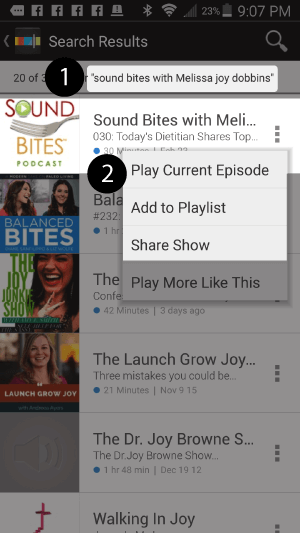
Install the Stitcher App
1. Search for “sound bites with melissa joy dobbins” 2. Choose Play Current Episode or Add to Playlist
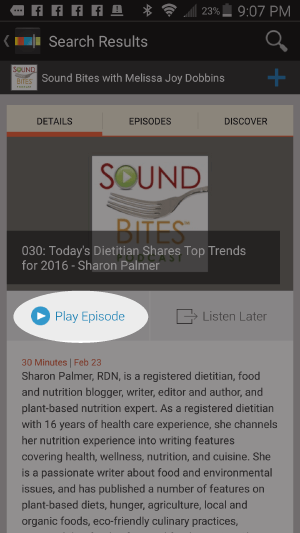
Choose “Play Episode”
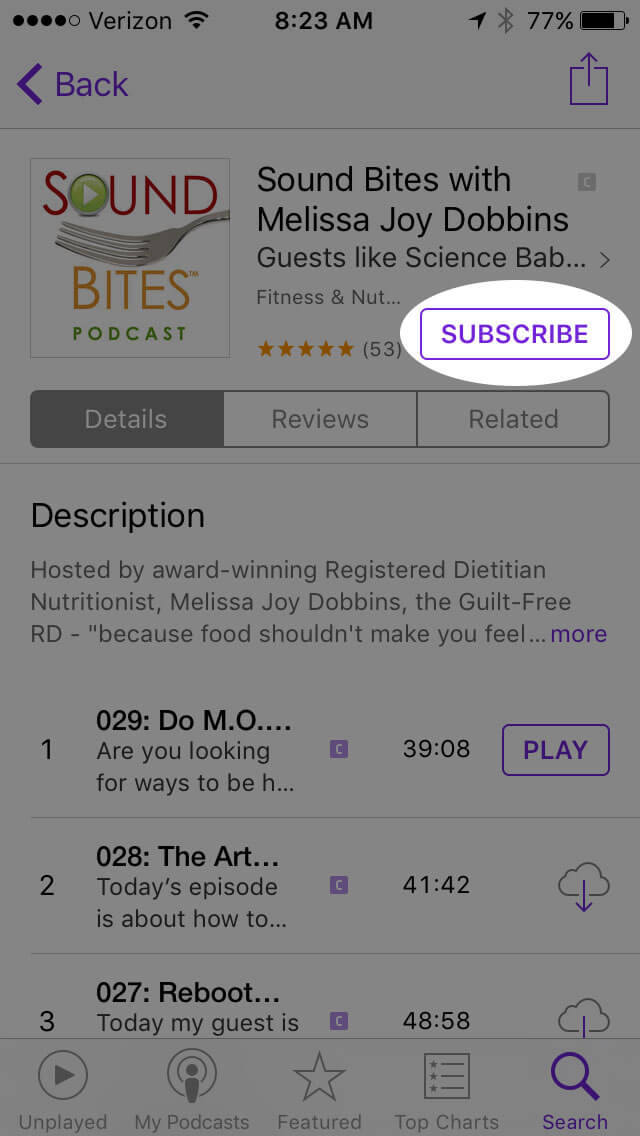
Subscribe & Review on iPhone
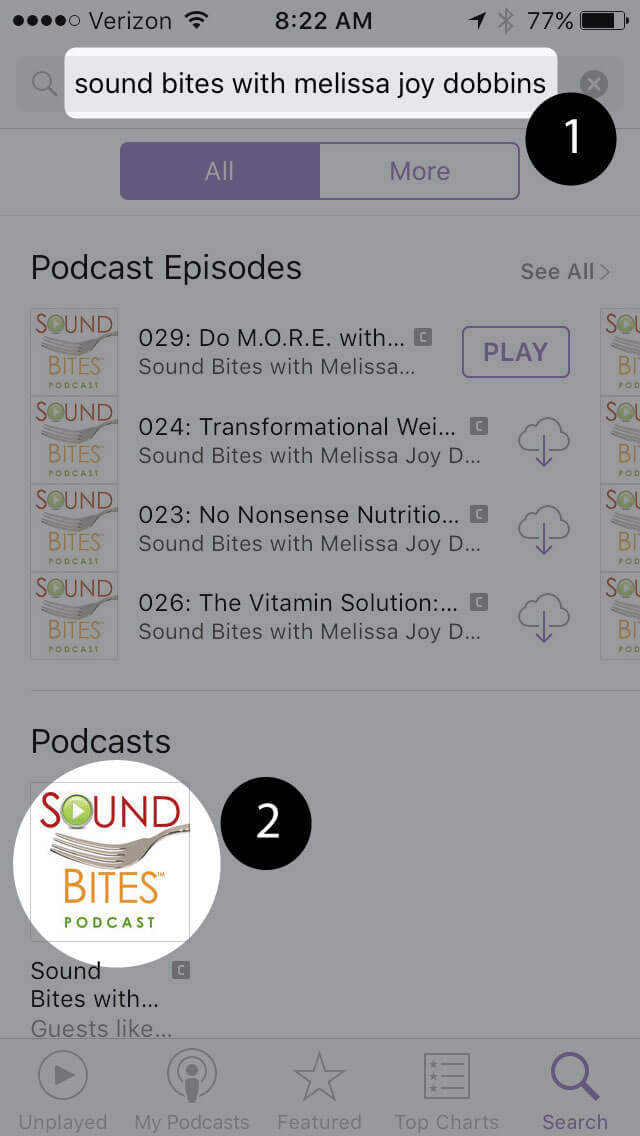
Open the “Podcast” app on your iPhone
Search for “Sound bites with melissa joy dobbins”
Open the podcast and click “Subscribe” and your done!
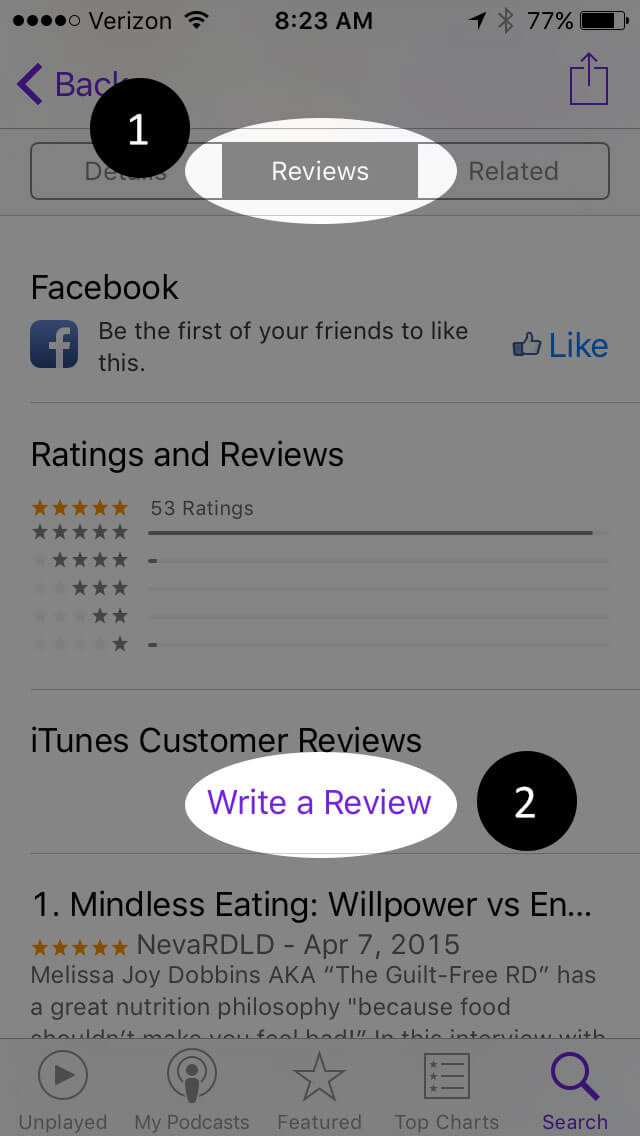
Write a Review
Click “Reviews”, then “Write a Review”.
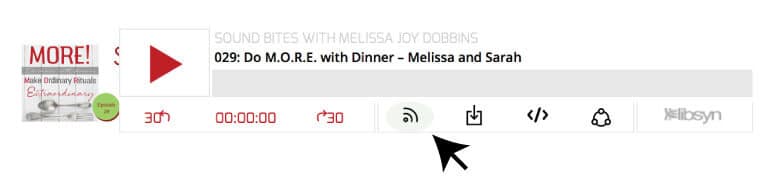
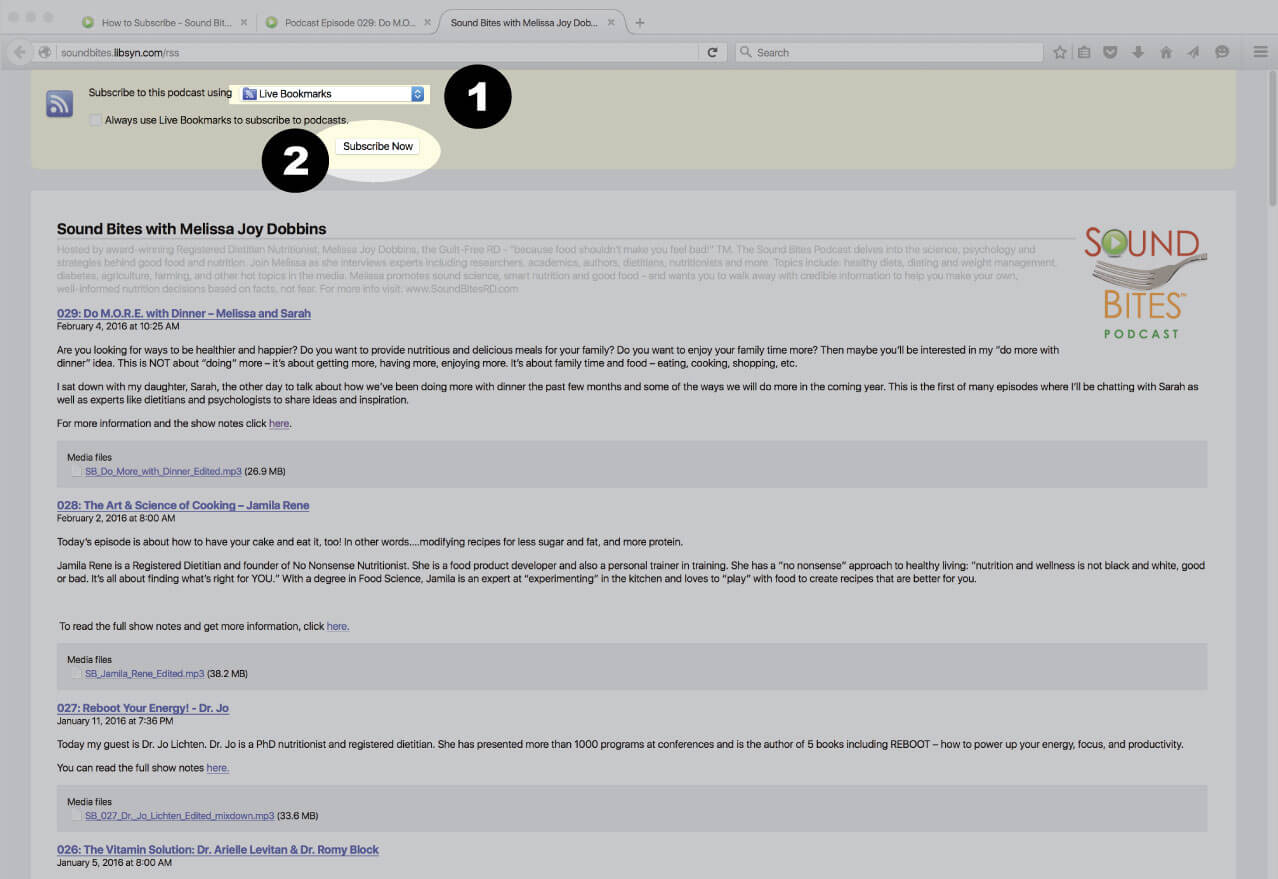
Subscribe via RSS Feed
Navigate to any podcast player . Click on the RSS feed icon.
Click on the RSS feed icon.
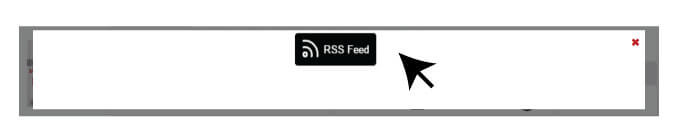
Click on RSS Feed
Choose which application you would like to use to receive the RSS feed
Click “Subscribe Now”
Confirm settings and subscribe.
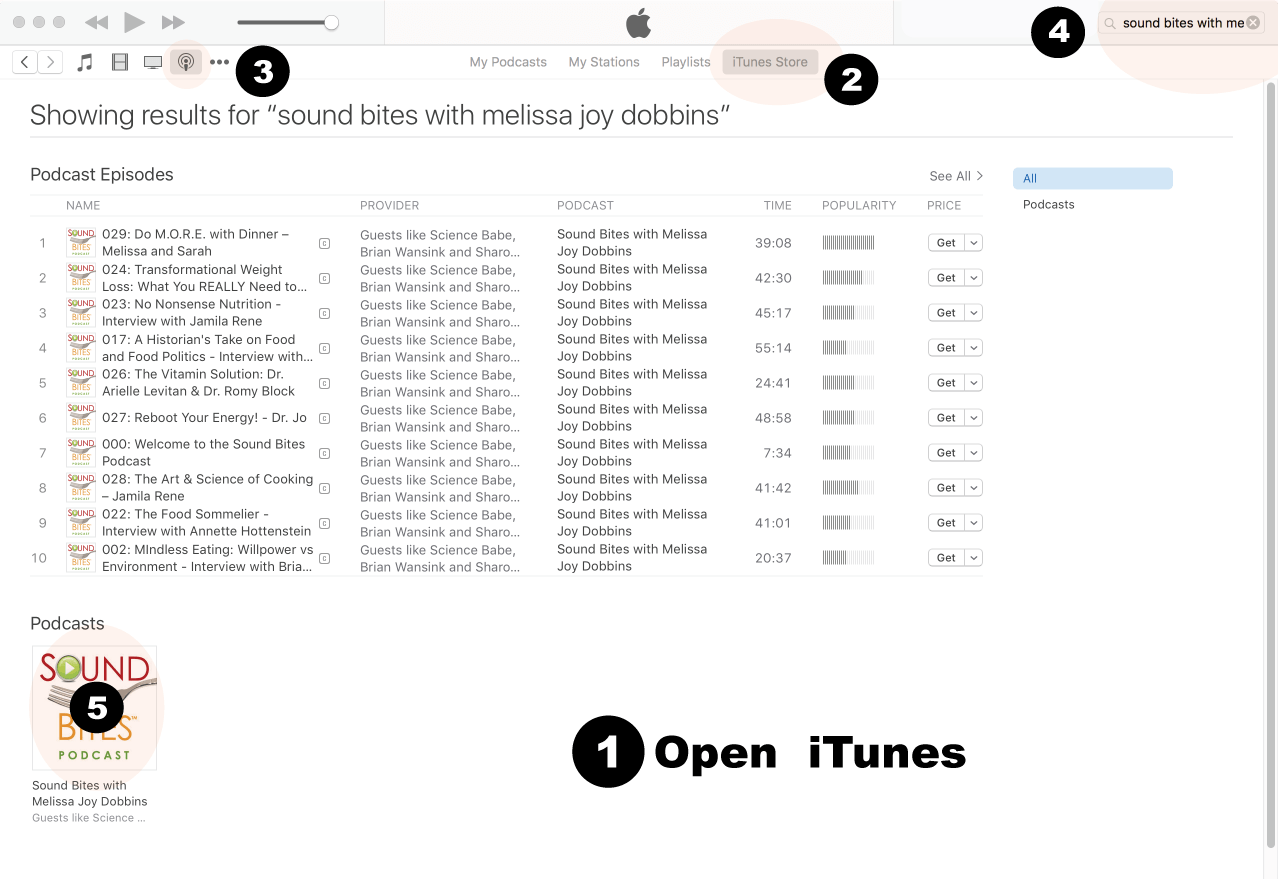
How to Review in iTunes
Open iTunes desktop application
Click iTunes Store
Click on Podcasts
Search for “Sound bites with Melissa Joy Dobbins”
Click on podcast image
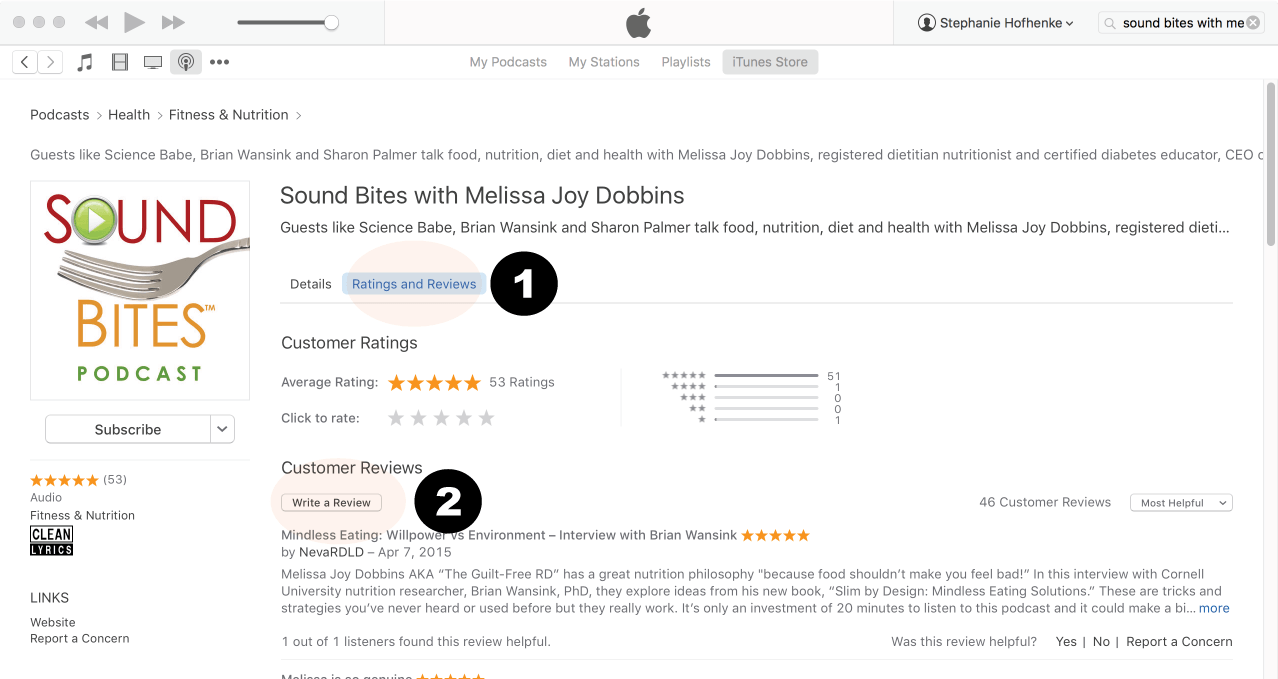
Search for Sound Bites podcast in iTunes
Click Ratings & Reivews
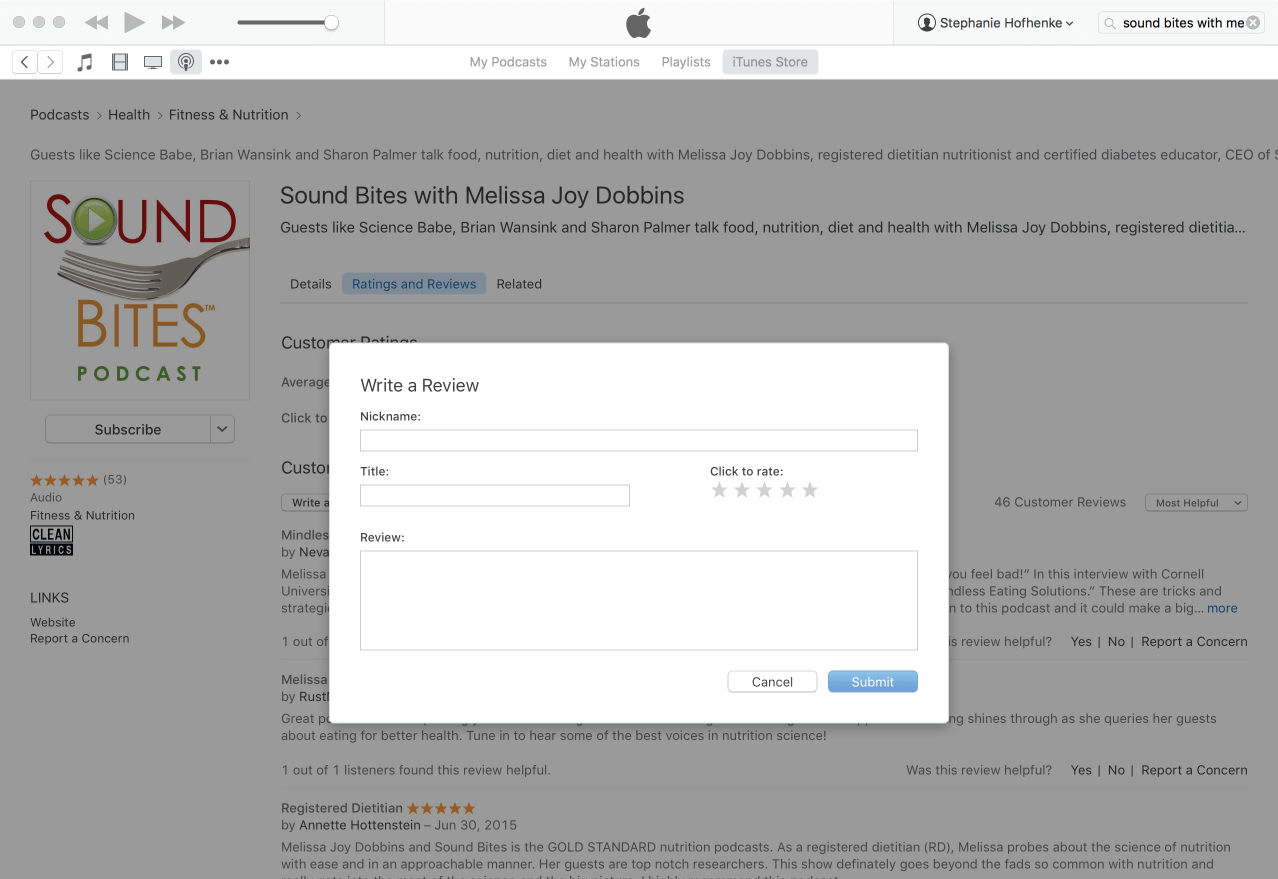
Click Write a Review
View reviews and write your own review.
Write your review…. Thank you!
Write your review!
How to subscribe via iTunes
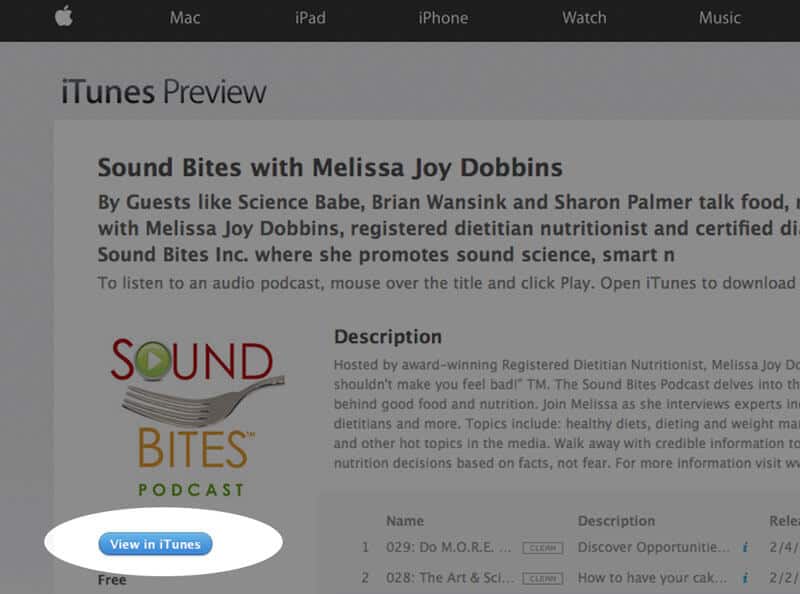
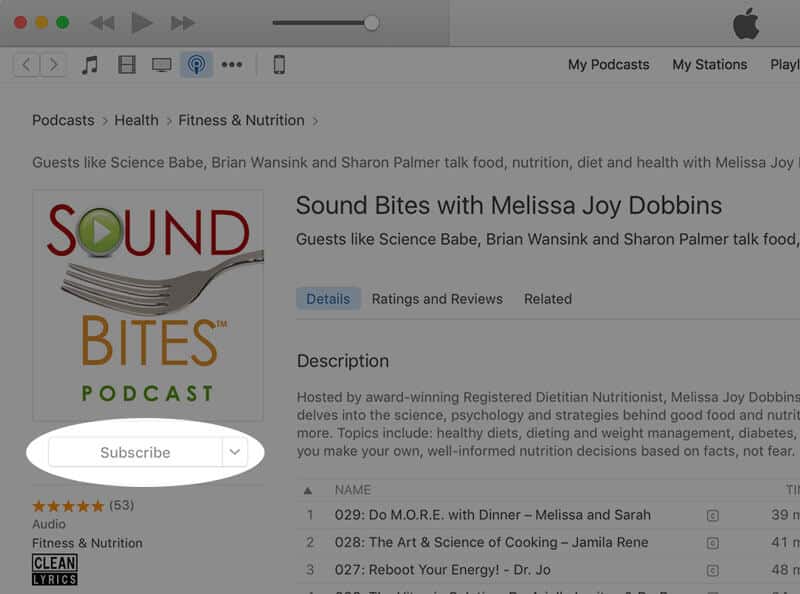
Click here to view the Sound Bites Podcastin iTunes, then click the blue “View in iTunes” button. This will open your iTunes application directly to Sound Bites Podcast. Click the “Subscribe” button, and your done!