Celebrating over 1 Million Downloads and 50,000 Free CEUs on the Sound Bites® Podcast | NEW: Get 1 years’ worth of CEUs with the new 15-CEU Podcast Course
Beyond Traditional Nutrients: The Role of the Food Matrix on Health
According to new research conducted by the University of Kansas Medical Center, just three cups of dairy milk a day can increase the brain’s level of glutathione, a powerful antioxidant that helps protect the brain from some of the damage that accompanies aging and aging-related diseases such as Alzheimer’s and Parkinson’s.
Tune into this episode to learn about:
The term “food matrix” and its role in health
The dairy food matrix’s impact on health
Glutathione and brain health
Evolving research on full-fat dairy and health
Common myths about dairy and health
Dairy’s benefits go beyond bones. There’s a body of research indicating dairy food consumption is linked to benefits like lowering biomarkers of inflammation and reduced risk of non-communicable diseases like type 2 diabetes, cardiovascular disease and high blood pressure.” – Dr. Chris Cifelli
Chris Cifelli, PhD
Dr. Chris Cifelli is Senior Vice President of Nutrition Research at National Dairy Council and is responsible for establishing the strategic vision for the research program, which examines the role of dairy foods in healthy and sustainable eating patterns and how dairy foods can meet emerging health and wellness needs. Dr. Cifelli is active in several professional organizations. He currently serves as the Past-Chair of the Nutrition Translation Research Interest Section of the American Society for Nutrition, is a member of the Membership Committee for the American Society for Nutrition, is Chair of the Science and Translation Committee for the International Scientific Association for Probiotics and Prebiotics, and is Chair of the Gut Microbiome Committee of the Institute for the Advancement of Food and Nutrition Science. In addition, he has authored or co-authored over 35 peer-reviewed manuscripts, reviews and abstracts.
[00:00:01] Female Speaker: Welcome to Sound Bites, hosted by registered dietitian nutritionist Melissa Joy Dobbins. Let’s delve into the science, the psychology, and the strategies behind good food and nutrition.
[music]
[00:00:22] Melissa Joy Dobbins: Hello and welcome to the Sound Bites podcast. Today’s episode is about the food matrix, specifically the dairy food matrix, and research on related health benefits and outcomes in brain health in particular. My guest today is Dr. Chris Cifelli he’s the Senior Vice President of Nutrition Research at the National Dairy Council, where he is responsible for establishing the strategic vision for the research program, which examines the role of dairy foods in healthy and sustainable eating patterns, and how dairy foods can meet emerging health and wellness needs. Welcome to the show, Dr. Cifelli.
[00:01:01] Dr. Chris Cifelli: Hi Melissa. How are you today?
[00:01:02] Melissa: Great. How are you?
[00:01:03] Dr. Cifelli: I’m doing wonderful. Looking forward to the conversation. Thanks for giving me some time to talk with you today.
[00:01:08] Melissa: Oh, my pleasure. We worked together before when I was at the Dairy Council. Should I call you Dr. Cifelli or should I call you Chris?
[00:01:14] Dr. Cifelli: Please call me Chris.
[00:01:16] Melissa: Thank you. I want all the listeners to know that this episode is not sponsored, but my regular listeners will know that I did my master’s research on dairy and also was a Dairy Council employee, and national spokesperson previously. Chris, I would love for you to share more about your background and the work you do. I’m curious how you got interested in nutrition, to begin with, perhaps this research focus and this niche, and whatever you would like us to know about your background.
[00:01:44] Dr. Cifelli: That’s a great place to start. Probably like most people listening, my path to nutrition science wasn’t a linear one. It had a lot of curves and bumps in it. My dream, actually through college was to become a medical doctor. As I was taking my biology courses and all my prerequisites, I had some flexibility in my schedule at Penn State. My mom of all people suggested, “Hey, why don’t you take some nutrition classes?” She’s like, most people always been fascinated by different diet patterns and things like that. Gave it a shot, liked it, minored in nutrition. As fate or luck would have it did not get into medical school my first go-round. Entered a master’s program in nutrition science at Penn State. Had every intention of saying, “Okay, I’m going to do these two years. I’m going to enhance my resume. I’m going to reapply and go be a great doctor.” I just fell in love with nutrition, fell in love with research. I studied vitamin A metabolism under a great mentor Dr. Katherine Ross. One thing led to another and I got my doctorate in nutrition science.
[00:02:52] Melissa: Excellent. That is very interesting. I think wouldn’t it have been interesting with all of that nutrition background that you did end up being a medical doctor. It would be fascinating if more doctors had more nutrition science in their education. Well, let’s jump into the topic. We’re talking about the food matrix and the dairy food matrix in particular, but this is a relatively new term at least to me. I would love for you to explain what is the food matrix, why are we hearing more about this term recently?
[00:03:22] Dr. Cifelli: It’s an excellent question. When I was growing up and probably you as well, we used to hear a lot about milk builds strong bones, dairy’s good for bone health. It wasn’t really until I started at National Dairy Council 15 years ago that you begin to realize dairy foods are linked with a lot of other health benefits, with lower risk of Type 2 diabetes, better blood pressure, lower risk of cardiovascular disease. We start to say, well, how can one food group be linked with all these beneficial health outcomes? It really is because of the uniqueness and this dairy matrix.
When we talk about the matrix, we really mean not just the nutrients and bioactives in the food, but also the physical-chemical properties of that food that make it unique. A good way to think about this– and I love music — is a symphony. I don’t know if any of you have or any of your listeners have ever gone to hear the symphony, but you can picture the string section starting up and it sounds wonderful, but then the horns come in, the percussion instruments, then the wind instruments, and together the sound just blows you away. That’s like the matrix. Each individual section is good on its own. Calcium is great on its own, Zinc, Selenium are great on their own. The protein of dairy are great on their own but when you put it together in that unique package, it makes wonderful music. It’s really a fascinating and really cool thing that we’re excited to talk about and share.
[00:04:48] Melissa: I love that analogy. It really helps explain the matrix. We know that in the world of nutrition, we encourage food first for nutrients. Then there’s a role for supplements as needed, but we’ve gotten away from or tried to get away from just looking at foods as far as the nutrients they provide. Like you said, we don’t just look at dairy and say, “Oh, that’s calcium for strong bones.” There’s other things within that matrix like protein is part of why it’s good for strong bones. All these other health benefits that we’re going to touch on, particularly brain health. I think it’s exciting to think about this newish approach to not just nutrients from food, but how those nutrients work together in that package. Before we get into some of this research on brain health, are there any common questions, common myths, or anything about dairy that you’d like to address, perhaps something that people might be surprised to learn about dairy?
[00:05:43] Dr. Cifelli: Yes. I credit my mom, again, being a typical consumer. She approached me one time about seeing a story or hearing from a neighbor. It might actually been my aunt who always is following the latest trends in dieting on saying, “Does dairy cause inflammation, Chris?” I remember saying to my mom, like, “No. Why would you think that?” It turned out to be much more common myth than I realized. I thought my mom was just being a mom. [laughs] We get questions a lot about does dairy cause inflammation. The science really shows the complete opposite.
There’s been several systematic reviews over the past five years that have looked at the relationship between dairy foods and markers of inflammation. In each instance, they’re showing dairy either has no negative impact or can be beneficial on those inflammatory markers. It’s one of those things that worrying about whether dairy is increasing your inflammation and should you avoid it, is just not true. Really, people should be encouraged for its nutrient package and then all its other health benefits as we’ll dive into, to really consume dairy as part of a healthy eating pattern if they are having some risk factors for inflammation.
[00:06:51] Melissa: We’ll probably touch on inflammation again during this conversation, but just maybe for people who are wondering what is the negative impact of inflammation or why is inflammation bad. If you could just touch on that before we move on.
[00:07:08] Dr. Cifelli: Excellent. Inflammation in and of itself isn’t bad. I scrape my knee later today, we want inflammation to kick in. It’s one of the body’s first line defenses against infection. Where inflammation becomes problematic is what’s called chronic inflammation. That’s where the body is just unable to turn it off quickly. You maintain this level of inflammation, which can damage cells and has been linked to increased risk of cardiovascular disease and Type 2 diabetes. You want your inflammatory process to kick up when needed but then turn off. In some people, it seems like it stays at a higher level.
[00:07:45] Melissa: One of the things that I found really interesting when we had our call before this interview was some of this new research on brain health and glutathione. I know there’s a research study that you’re going to walk me through this study, what it looked at, and what it found. Tell us about this.
[00:08:05] Dr. Cifelli: This was an exciting work. It was done at the University of Kansas Medical Center and it was funded by National Dairy Council, to be transparent. We had seen in a preliminary study that people who drank more milk tended to have in an associative way, higher levels of an antioxidant called glutathione in their brains. Glutathione helps eliminate free radicals. It’s thought to help reduce the risk for things like Alzheimer’s and Parkinson’s disease. Maintaining normal levels of that in the brain, it is very important.
This was a clinical trial in older adults and looked at people who would consume three cups of milk per day for three months versus a control group that continued with just their normal amount of dairy intake, which was about a cup and a half, which is typical for the US adult. At the end, they confirmed what they had seen in the original observational study that having more dairy in the diet led to higher levels of this powerful antioxidant in the brain. It’s exciting because we’re all looking for ways to maintain our cognition, maintain our brain health as we age, and just meeting dairy recommendations. Adding a cup and a half more milk to your diet each day can be one easy way to help reduce your risk for having some of these diseases later in life.
[00:09:23] Melissa: That begs the question, what is the average dairy intake? Then specifically, the control group versus the test group, if you will, walk us through the methods and the findings there.
[00:09:35] Dr. Cifelli: In the US population, according to National Health and Nutrition Examination Survey, we’re averaging right about one and a half servings for adults. Kids usually consume more dairy foods. Then it decreases with age. The one and a half in this, the control group was consuming one and a half dairy servings, whereas the intervention group, the milk group investigators added a cup and a half of milk more per day to get to three servings which is recommended by the dietary guidelines for Americans. They were able to consume it. It was 1% milk and they can consume it with meals and they didn’t have to drink it free-standing. The results showed that the people in the Milk group did increase their dairy intake and that it led to these changes in this brain antioxidant directly. The rest of the diet you were supposed to keep it the same. According to the study, participants did keep their other diet consistent.
[00:10:30] Melissa: Consistent with what they had previously been eating.
[00:10:32] Dr. Cifelli: Yes, correct.
[00:10:33] Melissa:
How do you control for something like that?
[00:10:35] Dr. Cifelli: That’s where the wonderful work of dietitians comes in. There’s a lot of consulting that goes on. The study dietitian would meet with them regularly, correct food diaries and records and 24-hour recalls, and counsel them to maintain their diet while in the intervention group, including their dairy. In fact, my wife Amy did that in her former role with Penny Kris-Etherton at Penn State as a research dietitian. She was very familiar with this and always smile because I know how much effort goes into that from the dietitians on these studies to ensure that the patients are following the diets prescribed.
[00:11:09] Melissa: Oh yes. Thank you for mentioning that. Your wife is a dietitian. I forgot about that. That’s really cool. With every study, there are strengths and limitations, so I’d love for you to discuss that a little bit. Also based on the study findings, how that might inform future research.
[00:11:27] Dr. Cifelli: You said it very well. No one study is ever conclusive, right? It’s just another piece in the puzzle. I like to think of science in that way as you’re trying to assemble a puzzle and sometimes the picture becomes more clear even when all the pieces aren’t together so we can make strong recommendations for certain things. In other cases, you’re just getting the outline of the puzzle right and you really can’t make out what the picture’s gonna look like.
I’d say the strength of this study were there was a randomized controlled trial that it was not asking people to consume more than what is recommended by the DGA, and using participants who were pretty typical in terms of matching the US population. In terms of limitations they looked at those adults 60 to 89, so not sure if similar results would be seen in say younger adults or even kids. While three months seems like a long time for a randomized control trial, and it is. It’s still only three months. Again, don’t know if a longer duration would be better the same or go back to baseline values. Again, it’s a very good study. It gives us a lot of reason to hypothesize again that increasing dairy would be an easy way to help maintain health in the brain.
[00:12:41] Melissa: Thank you. You mentioned a couple of things that I really want to emphasize because I know when I worked for Dairy, we would recommend three servings a day and that’s the amount that the dietary guidelines recommend. Some of the research that we looked at, say when I first started in 2003, there was some really compelling research about dairy’s role in weight management. I was doing health professional presentations and outreach at the time and I’d get a lot of questions from dietitians and other healthcare practitioners about the research and wondering why are we even talking about dairy and weight management.
One of the reasons I think we were looking at it is because like the inflammation question or myth, a lot of people assumed that increasing dairy or meeting the dietary guidelines recommendations for dairy would cause weight gain. This compelling research was showing, actually, it’s the opposite. It helps with weight maintenance. I don’t know if people weren’t ready for that science, but there was just a lot of questions about it. At the end of the day, I would always take a step back and say, “We’re just recommending the three servings.” Which is what we recommend for bone health and the DASH diet, which we’re going to touch on for blood pressure management and other things, so what’s the harm in meeting the dietary guidelines if it helps with weight management?
Great. I really wanted to emphasize that you’re not talking about drinking a gallon of milk every day and exceeding these DGA recommendations. Also, you addressed the population studied and you said that it was fairly typical, but there are some criteria as far as age and other things like that. With most research you have to look at, can it be translated to another population and other populations might need to be studied. A question that comes up as you’re talking is, how much research has been done on glutathione and brain health? Any on dairy at all or is this the first one?
[00:14:36] Dr. Cifelli: I would say this is in its infancy in terms of the amount of science. It doesn’t take away from the strengths of the studies that have been done, but it’s a new benefit that has been linked to dairy as opposed to something you said like the DASH diet and blood pressure where there’s been now decades of research showing in various populations and all different levels of sodium intake and stuff showing it continues to have a benefit of blood pressure.
I’d say this is a new and emerging health outcome which is exciting. Again, dairy is more than just the calcium and vitamin D for bone. It lends itself to meeting those consumer wellness territories that we know they’re looking to feel calm during the day, have a little less stress, maintain their mental sharpness. While we have more work to do, it certainly gives us reason to believe that dairy foods can play a role in helping consumers meet their wellness needs.
[00:15:32] Melissa: Great. I would love to hear more about any consumer insights that you guys are doing at the Dairy Council because these emerging health and wellness needs, certainly COVID had an impact on that or brought some of these needs to light and maybe emphasized some of these health and wellness needs. If you could speak to that a little bit, that would be really interesting.
[00:15:53] Dr. Cifelli: We’ve learned unsurprisingly that the idea of wellness has evolved. Not that long ago when we were studying nutrition and it was all about clinical inputs. As a dietitian, what is the right diet for somebody who’s on needs dialysis? Has had a heart bypass, and we would study things like blood pressure and CVD as the main outcomes. All of us in our daily lives understand sleep quality, feeling energetic throughout the day, needing that boost in the afternoon. Helping to manage stress, feeling a little less anxious, keeping our mental focus are all part of our wellness as well. It’s not just, “Oh, I got to keep my blood pressure in check.” In fact, you probably feel more the lack of sleep or stress way more than you do your blood pressure.
[00:16:42] Melissa: For sure.
[00:16:43] Dr. Cifelli: What we’ve learned through these consumers, and especially in say the Gen Z population is that’s also what they’re looking for. They want their diets and their foods to holistically help them. They want to feel good about what they want to eat. I think we’ve learned also that telling people to avoid foods may not be the right way. It’s trying to shift them and encourage them into– and giving them permission to eat foods that taste good, fit their culture and their lifestyle, and also then benefit their health. It’s been really fascinating as we’ve learned from these things.
I think COVID brought them to light, as you said, Melissa, really pushed them to the forefront because we were really anxious and really nervous and really like, “What is going on?” I think we’re now coming out of that and feeling the ability to work with consumers to say, “Hey. In our case, dairy is a solution for these wellness needs and it’ll also help your bones.”
[00:17:40] Melissa: Right, by the way.
[00:17:42] Dr. Cifelli: By the way.
[00:17:42] Melissa: Thank you for explaining that. I know that was one of the things that I loved about working with the Dairy Council is we had all this research, we had all this science, but we also had consumer insights which I talk a lot about on the podcast, that you got to have both. We can’t just look at research in a vacuum and we can’t just look at those media headlines which frankly, I oftentimes feel like that’s not what real people are worried about, focused on, concerned about. Although it certainly does create some worry for them, but when it comes to their real day-to-day lives, it’s usually not what they’re thinking of or focused on.
I want to ask you a little bit about the DASH diet, and I’ve been hearing a lot about full-fat dairy and I’d love to pick your brain on that. As we move forward too, are there any general recommendations you can share with our listeners, some of who are the general public, some of who are health professionals, dietitians? Just in digesting nutrition research in general, you mentioned that this glutathione study was a randomized control trial, most nutrition research is more epidemiological. If you could maybe address that difference, and then just– you also said this is one study, how do we look at what’s coming out in the research and get some perspective on that and like I said, digest all of this information for ourselves and for our audiences.
[00:19:07] Dr. Cifelli: It’s a really–
[00:19:09] Melissa: Big question. [laughs]
[00:19:10] Dr. Cifelli: Good and complex question. Totally agree that the bulk of the evidence in nutrition science is observational in nature. That can be in two forms. You can use the NHANES dataset, which is a nationally representative data set, collected every two years by the CDC that you can go in and look at what people are eating, what are the number one food sources of certain nutrients, so on and so forth. Then you have the larger prospective cohorts. A lot of you are familiar with the nurses health studies. The health professional follow-up studies are probably the best known ones. One out of Harvard University. They have their strengths and they have their limitations. Then you have your clinical trials, which also have their strengths and limitations in nutrition because you can’t run a clinical trial long enough to see if somebody has a heart attack.
That’s where the observational studies that follow people for 10, 20, 30 years do have the benefit of looking at some of those outcomes. Ideally, you put it all together. You look at the observational evidence with the clinical evidence and if you see 25 studies that are showing a benefit of say, the DASH diet on blood pressure, three, four, five studies that are showing no effect, and maybe one that showed the opposite, you would look there and say, the preponderance of the evidence is showing the DASH diet’s benefit of blood pressure. That gives us a strong likelihood that we can make a recommendation. If things are more evenly spread out, maybe 20 neutral studies and 20 beneficial studies, maybe more work needs to be done in better design studies probably in a clinical setting probably be to help elucidate answers there.
It’s very complex. The dietary guidelines advisory committee, which comes together every five years, does a wonderful job of asking questions, doing systematic reviews, which is when you pull multiple studies together, put all the data together, and then run statistics on it to see if you see a trend or a result in a given direction based on all those studies. Instead of having one study with 80 people, now you may have 50 studies with 100,000 people. They have shown, again, not really surprising me, that diets higher fruits, and vegetables and whole grains, and dairy foods, and leafy greens are healthier, whether that’s the DASH eating pattern, a more US-centric one, or even the Mediterranean version, they all show health benefits and there’s really good evidence to support that.
[00:21:42] Melissa: Thank you. You mentioned in the glutathione study there were 73 participants. Is that large, small? Because you’re talking about the number of people being studied seems pretty obvious, but if you could elucidate a little bit more why more people matters?
[00:22:00] Dr. Cifelli: The study number should be determined by something called a power calculation. The investigator upfront should say the aim of the study is to look at changes in brain glutathione levels. Based on previous evidence to detect statistical difference, we need to see a change of say five. Then you could do this calculation and it tells you you need 20 people per group. The number really should be aligned with that power calculation. I tell people all the time, don’t get hung up on the actual sample size. That said, when you have a lot of studies individually and maybe the effect sizes are variable, so you’re seeing increase in one study, what’s to say let’s just use blood pressure because it’s a really good example, a change in systolic blood pressure -5 in one study, but -1 in another study, maybe at more up one in a different study. If you poo; all that data and then run statistics, you give more confidence of the directionality of the results, as opposed to each of us having to analyze those studies individually. We tried to make it more objective as opposed to subjective in your analysis of multiple studies.
[00:23:10] Melissa: Is that a meta-analysis?
[00:23:11] Dr. Cifelli: That would be a meta-analysis coupled with the systematic, yes.
[00:23:15] Melissa: Awesome. With this dairy and brain health glutathione study, what does the future look like? What are the next steps that you might see that either you know or you can speculate on?
[00:23:28] Dr. Cifelli: With a lot of the work we do at the National Dairy Council, we’re always hoping that we’re going to spark others to look at this. I think you gave a really great example with weight management in the early 2000s, we funded some work that led to people seeing that maybe dairy foods are associated with weight gain as you noted. That has spawned into– I don’t even know the number if we studied it or Googled it or PubMed searched it real quick, but definitely close to 100 studies since probably 2000 that have looked at the relationship between dairy and weight. Our hope is the same thing will happen. We want to be a catalyst for future work. We want others to either confirm or refute what we see in our studies. That’s really the scientific method. We want others to try to replicate it.
If they can’t, that’s great. That just means, “Hey, why didn’t they see what we saw? What study do we have to do to better understand this?” If they do, that helps show that we’re heading in the right direction and that others are finding what we found. It’s not just the dairy industry showing this, but others as well. That’s our hope with this brain glutathione as well, is that others will be interested in this and look at it as well, maybe look at it in different populations, maybe look at it in different races and ethnic groups to see if the same thing, maybe look at on younger men and women. Then we’ll get a more clear picture if dairy really is benefiting that brain antioxidant.
[00:24:56] Melissa: Great. You mentioned that this study was funded at least in part or completely by the Dairy Council.
[00:25:02] Dr. Cifelli: Yes, this one was fully funded by the Dairy Council, yes.
[00:25:05] Melissa: I always ask my researchers who come on the show, what do you say to people who maybe criticize industry-funded research?
[00:25:13] Dr. Cifelli: National Dairy Council has been around for over 100 years. We got our start in the early 1900s, really when E.V. McCollum identified vitamin D and first suggested that it would be good to add it to milk because milk is naturally high in calcium. Ever since in the US, milk’s been fortified with vitamin D. It helped eradicate rickets in a lot of the country. We’ve prided ourselves since then on being transparent with our science, holding ourselves to the highest scientific integrity, and really, as I said, trying to be a catalyst for others. The way we do that is we have an external advisory board that reviews all the proposals that come in. We have them third-party reviewed. They provide their scientific expertise to ensure that anything we fund is of the highest scientific merit. Very similar to NIH review, or USDA review panel. We actually stipulate with the researchers that they have to present and/or publish their work and all we’ll get out into the public domain, so that could be a presentation at a scientific conference where then the abstract is publicly available, or we really hope for is a peer-reviewed publication.
[00:26:22] Melissa: Regardless of the outcome?
[00:26:24] Dr. Cifelli: Regardless of the outcome, yes. I could point to several studies that we’ve done over the years where the hypothesis just didn’t turn out the way we expected. Again, that’s science. It’s the only way we can move forward, is if we are publishing what we find and others are doing the same so that we can work together to help people choose the right foods that are going to help them live a healthy life.
[00:26:47] Melissa: That brings me to my next question. Great segue. I know that there are challenges. Not all research gets published. I would love for you to speak to that for what you’re seeing. I love that you encourage, if it can’t be published then at least present it at a meeting or something. If you could speak to that because I know that it’s an unfortunate aspect of research that there are some barriers and challenges to getting everything published.
[00:27:13] Dr. Cifelli: The peer review process and the publication process is certainly challenging even for the best researchers. There’s a lot of people competing for spaces in journals, a lot of really great science are going on. Right now as somebody who is asked to review a lot of manuscripts, I think journal editors are struggling to find quality reviewers, which has slowed down the process. I would say it’s not untypical for work that we either fund or we do ourselves. to have to go to multiple journals sometimes to– just it wasn’t a fit, or sometimes you aim a little higher than maybe you should. It does take time to get these things published. I think as a scientific community, we need to figure out ways to improve the process, which I think we can say for a lot of things. I always encourage people not to get discouraged. There are ways through societies to present that data. Then once it’s out there again, it helps move the field forward and just to be persistent with the process so that we can get the science out there because we need it. Without it in the public domain, it really doesn’t help anyone.
[00:28:23] Melissa: Thank you. This is the first time I’ve heard this concept of, maybe it didn’t get published, but it’s still getting out into the public domain. It’s being presented. It’s available to people who can review it or read it, and especially if they’re interested in that particular topic and maybe doing research in that area. That’s great. What about this full-fat dairy and health? I’ve seen a lot of social media about this, but I haven’t taken a deep dive myself. I wanted to take the opportunity to ask you what’s the research going on there and why and what kind of findings are you seeing. I know it’s related to the DASH diet, at least some of it.
[00:29:02] Dr. Cifelli: This really gets back to our opening where we talked a little bit about the matrix. It’s not unique to dairy. There are other foods, I think avocados or nuts that have high-fat levels that eggs another example of cholesterol that in the past I think have been demonized for having a higher level of say fat or cholesterol or sodium in them, and certainly understandable. From a public health perspective, we’re trying to give people guidance to eat foods that are going to reduce their risk of disease, allow them to live a happy, healthy life, function into their older years, and so on. When it comes to full-fat milk or yogurt or cheese, I think the unfortunate thing was people perceived maybe it was increasing more weight, or had a lot of saturated fat, or in cheese’s case could also be higher in sodium, and eliminated those foods or maybe reduced the amount they were eating unnecessarily from a health perspective. The body of evidence clearly shows that full fat dairy products are not contributing to your cardiovascular risk. They’re not increasing weight gain, they’re not leading to a worse blood pressure or type two diabetes. In fact, in a lot of instances it’s showing the opposite. You mentioned the DASH diet.
There was a study, probably six or seven years ago now that replaced the lower fat varieties of dairy in the DASH diet, which for those of you who just need a quick refresher, the dietary approaches to stop hypertension diet is high in fruits and vegetables and whole grains and dairy and had low saturated fat and sodium. Naturally lower fat dairy varieties were used in the original DASH study, which came out in the late 90s. This was a study we funded. we replicated the DASH diet and showed that putting full-fat dairy products in didn’t change the results.
You actually saw the same blood pressure reductions, you actually saw a little bit of improvement in some of the other cardiometabolic outcomes like HDL cholesterol, which again isn’t surprising because that’s linked to fat intake as well. That’s just one example of many that have looked at this idea. We’ve seen cheese doesn’t increase LDL cholesterol as you would predict based on the sat fat level, in studies.
It’s this unique matrix because you look at the numbers and you say, wow, dairy’s got sat fat cheese has a lot of fat in it. That’s mostly fat of protein and it should increase your risk for CVD based on the linkage between sat fat and LDL cholesterol and then LDL cholesterol and vascular risk. You see the opposite.
The most recent example Melissa is really the study that came out earlier this year that looked at mortality in the US using NHANES and dairy and showed that dairy intake in total so regardless of fat level, was linked with lower cardiovascular mortality and was not linked to all cause or cancer mortality. Clearly, there’s something about the dairy matrix that’s helping drive these results.
[00:32:04] Melissa: Okay, yes. I was going to say “why” and it’s potentially the mechanism is involved with the matrix.
[00:32:10] Dr. Cifelli: Milk fat is packaged in a unique membrane, so think of a basketball, you have your outer membrane and inside where the air, that’s where all the fat would be held and it’s called the milk fat globule membrane. It studded with proteins and different things. In and of itself, the milk fat globule membrane seems to have beneficial effects. Not only is it helping get the fat delivered to your intestinal cells and then into the body, but also maybe modulating health benefits on its own.
Again, this is something that’s emerging and we’re just learning a lot about, but it is unique to dairy all and you’re seeing this matrix effect of how the fat is processed. Again, it’s dairy’s a great example, but almonds and nuts and avocados again. They’re high in fat and yet you see clearly opposite things due to maybe the fiber in there or how it’s digested. We just can’t wrap our heads fully around it yet, but I’m sure we’re going to understand it more and more in the coming years.
[00:33:08] Melissa: Thank you. I know seeing that correlation sometimes if it’s a randomized control trial you can look at causation but then that mechanism, I remember with the weight management research we were looking at the potential mechanism and it seems like with the DASH diet and I’m glad you specified dietary approaches to stop hypertension. We learned, oh, calcium and potassium are important for blood pressure management, not just the sodium.
That unfortunately I think is something that’s still lost on a lot of people that I think is just as important to shout from the rooftops as we need more produce and we need more fruits and vegetables in our diet. We need more fiber. Blood pressure is not just about sodium. Thank you for sharing more about that. Is there anything else that you wanted to touch on with regard to dairy being linked to positive health outcomes?
I would love to talk a little bit about lactose intolerance. When I first started with the Dairy Council in 2003, I had just come off of being a supermarket dietitian. Prior to that, I had been an outpatient diabetes educator for five years and prior to that, I did clinical. I was surprised that the Dairy Council wasn’t really talking a lot about lactose intolerance.
Frankly, I learned things like yogurt is well tolerated for many people with lactose intolerance because it has live and active cultures and a lot of hard cheeses have very little lactose, and even milk that has a lot of lactose, some people can tolerate small amounts and gradually increase it. To me that was like, oh my gosh, I have so many patients who would be so excited to hear this information because in general people would say, I like dairy, but it doesn’t like me.
Frankly, I would tell them to go get some calcium-fortified orange juice. I’m so sorry that I did that, but I didn’t know, didn’t know any better. I think that by the time I left the Dairy Council in 2011, I was so excited. We’re talking all about this lactose intolerance and the research going on. Curious where that is today? 10 years later?
[00:35:11] Dr. Cifelli: Yes, lactose intolerance and lactose maldigestion even. Whether we truly have diagnosed lactose intolerance or you perceive it is certainly a barrier for people to consume milk and dairy products. I like what you said because then there are options to include dairy. We understand that if people remove dairy from the diet, it is really hard to replace. The milk is a good or excellent source of 13 essential nutrients.
It’s really difficult to replace those 13 nutrients through other foods, whether individually or collectively. We modeled a study where we asked that question, can you replace dairy easily? We showed you either have to spend more money or more, we usually eat more food to replace those nutrients. We want to give people options, eat what you enjoy if something does upset you, we’re not here to force milk down anybody’s throat.
There are great options. This is personal. My parents are very lactose intolerant, but they have found a lactose-free milk that they enjoy and that tastes good to them. It has allowed them to continue to put milk on their cereal and have a little chocolate milk when they want a little treat. Now on the market, there’s multiple lactose-free options.
Ones that are traditional where you’ve broken the lactose back into its individual sugars, the glucose and galactose and ones where they’ve used filtration techniques to actually just remove the lactose but maintain a lot of milk’s other qualities. Yogurt is another great example of a food that can be incorporated into those who lactose-free. The live and active cultures and yogurt help digest lactose.
You and your listeners may be surprised to know that the European Food Safety Authority, which is like our FDA, actually has an approved health claim for yogurt with lactose intolerance. It’s one of the few approved health claims that they have in general. Yogurt is usually a great option for people who again suffered from lactose maldigestion.
Then your hard cheeses, your cheddars of the world are naturally low in lactose as well. There are ways to incorporate dairy into your diet to make sure you’re getting those key nutrients. Being cognizant, people who regular milk, conventional milk just doesn’t agree with them all the time.
[00:37:34] Melissa: Thank you. We touched on inflammation. We talked about the matrix of course and the brain health and lactose intolerance. Anything else that you wanted to mention? Any interesting research going on? I know there’s a ton of research going on at the Dairy Council I’m sure, but is there anything else that you wanted to share with us on that?
[00:37:49] Dr. Cifelli: One study I would be excited to share about. I’m laughing because it’s going to be about bones where we got started. This was work that we did in collaboration with several dairy organizations around the world. Now we’re National Dairy Council here in the US but there’s a Dairy Australia and a dairy farmers of Canada.
We collaborated with them to do a two-year study in healthcare facilities, residential age care facilities in Australia. It actually enrolled over 7,000 adults. Half of them were maintained on their usual diet. They lived at these facilities, they got their breakfast, lunch, dinner there and nothing changed. The other half, they increased the dairy to meet calcium, and protein recommendations. They added another serving of milk or yogurt or cheese or what have you to the diet. They sprinkled it in different dishes so they didn’t just say here’s a cup of milk and the results of this two year study were amazing and fascinating. You had a significant reduction in falls and fractures in the dairy group. You’re talking about later in life when people are still trying to maintain their function, their activities of daily living they going to get around and the simple addition of adding more dairy to their diet allowed them to have less falls and fractions.
This isn’t observational, this is clinical, this is clinical data. Like I said, over 7,000 Australian adults showing this. Again, you asked a great question earlier about limitations, the one limitation, again these are older adults as opposed to those maybe in their 50s and 60s.
Nonetheless, weaving in some cottage cheese or a cheese stick or a little pot of yogurt, these little changes in your diet make huge differences for most of us. That’s true whether we’re talking falls and fractures. It’s true whether they’re talking blood pressure, just getting an extra serving of dairy because we’re not meeting recommendations, can go a long way to help people achieve a healthier lifestyle.
[00:39:51] Melissa: Thank you. That’s really interesting. Very exciting. I know that there’s a ton of information online. I was swimming in it when I worked for the Dairy Council, I’m like, “There’s so much information here.” If you could share with us some links, resources, anything that we’ve touched on today, of course, I’ll have links in my show notes at soundbitesrd.com. If you want to share websites and perhaps how people can connect with you. I know you’re on LinkedIn, I’m not sure if you’re on any other social media per se.
[00:40:20] Dr. Cifelli: Yes, for the Dairy related stuff, USDairy.com is the place to go. It has all of our information on there. You search science summaries. It’s my favorite thing to search. We have approved, kind of published two pagers on dairy and different outcomes so, and they’re all referenced. You can see all the original research and stuff. If you’re looking for information, that is a great place to go. We also have other resources on there for the practitioners, how to incorporate Dairy or suggestions again for like lactose intolerance on how to sip it or mix it in with different things.
Yes, LinkedIn is a great way to connect with me. I am on Twitter. I will admit I’m probably not the best tweeter, but I am on there and certainly, my email, ChrisCifelli@dairy.org is a great way to get in touch.
[00:41:10] Melissa: Excellent, thank you. Like I said, I’ll have all these links in the show notes. I know that there’s more information about the dairy matrix if people want to take a deeper dive into that. Of course, the studies that we touched on, and I think there’s like a 75-page state of the science, dairy foods and health PDF that you shared with me. All of that will be on my show notes and I just can’t thank you enough for coming on the show and talking all things Dairy Matrix with me.
[00:41:34] Dr. Cifelli: Oh, thank you for having me, Melissa. It was a really great conversation and appreciate your time in setting this up.
[00:41:40] Melissa: Of course. For everybody listening as always, enjoy your food with health in mind. Till next time.
[music]
[00:41:47] Female Speaker: For more information, visit sound bites rd.com. This podcast does not provide medical advice – it is for informational purposes only. Please see a registered dietitian for individualized advice. Music by Dave Birk. Produced by JAG in Detroit podcasts. Copyright Sound Bites Inc. All Rights Reserved. [music]
[00:42:12] [END OF AUDIO]
LISTEN, LEARN AND EARN
Listen to select Sound Bites Podcasts and earn free CEU credits approved by the Commission on Dietetic Registration (CDR) for registered dietitian nutritionists and dietetic technicians, registered. Get started!
Get Melissa’s Sound Science Toolkit here!
Partnerships:
Sound Bites is partnering with the Association of Diabetes Care and Education Specialists (formerly the American Association of Diabetes Educators)! Stay tuned for updates on the podcast, blog and newsletter!
Sound Bites is partnering with the International Food Information Council! Stay tuned for updates on the podcast, blog and newsletter!
Hi Lauren,
No, we are not submitting this episode for CEUs. However, you can always check the CEU page here to see what episodes are eligible for CEUs: https://soundbitesrd.com/sound-bites-podcast-free-ceus/
Thank you!
Melissa
Sign up for my monthly newsletter and episode eblasts so you never miss an update!
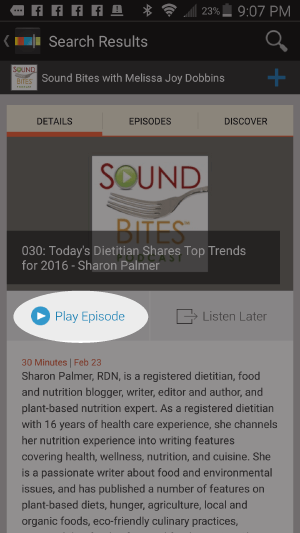
Listen on Stitcher (Android)
Install the Stitcher App
1. Search for “sound bites with melissa joy dobbins” 2. Choose Play Current Episode or Add to Playlist
Choose “Play Episode”
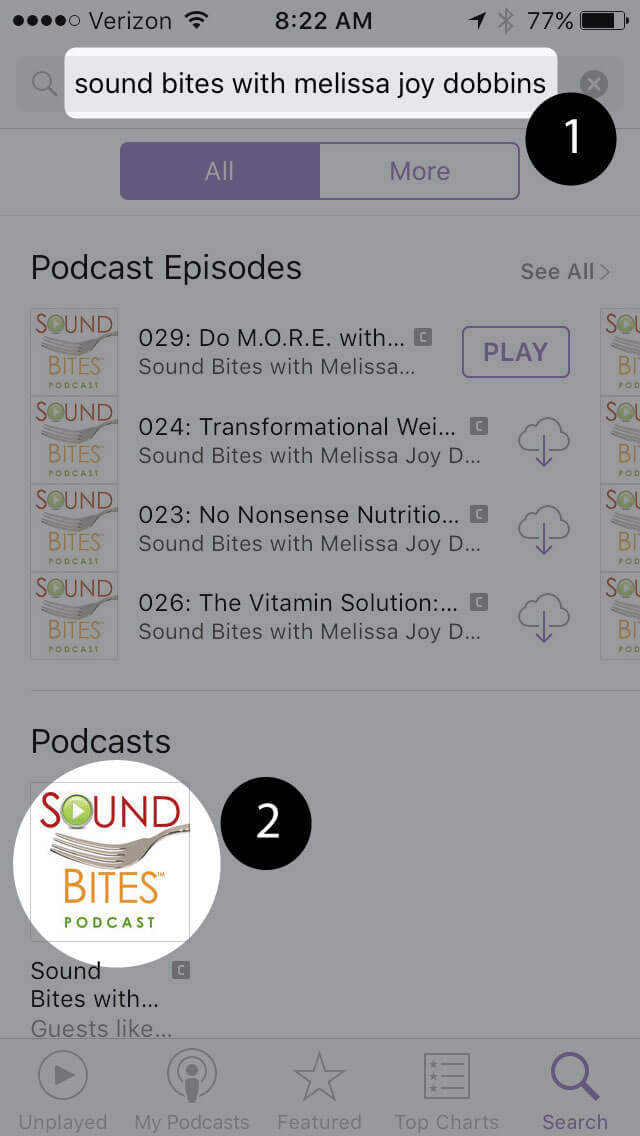
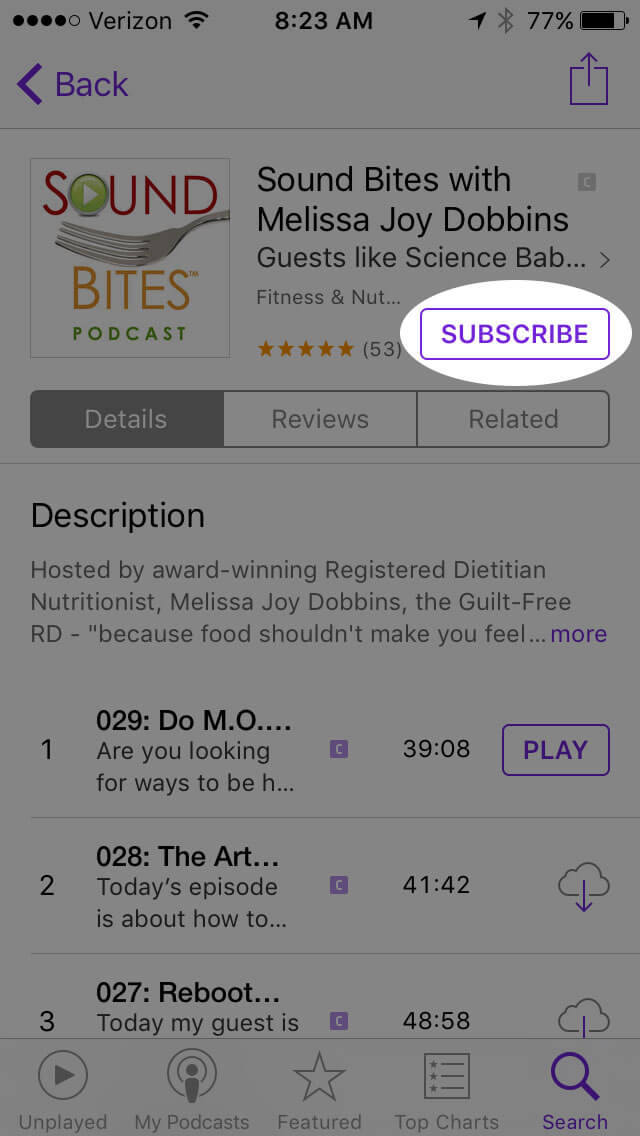
Subscribe & Review on iPhone
Open the “Podcast” app on your iPhone
Search for “Sound bites with melissa joy dobbins”
Open the podcast and click “Subscribe” and your done!
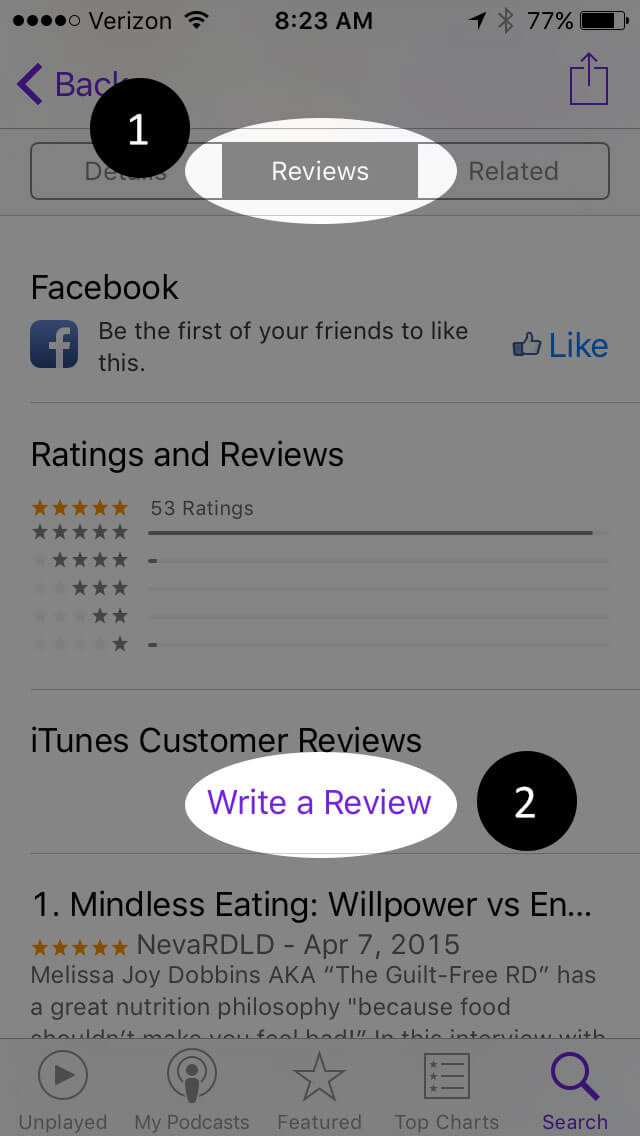
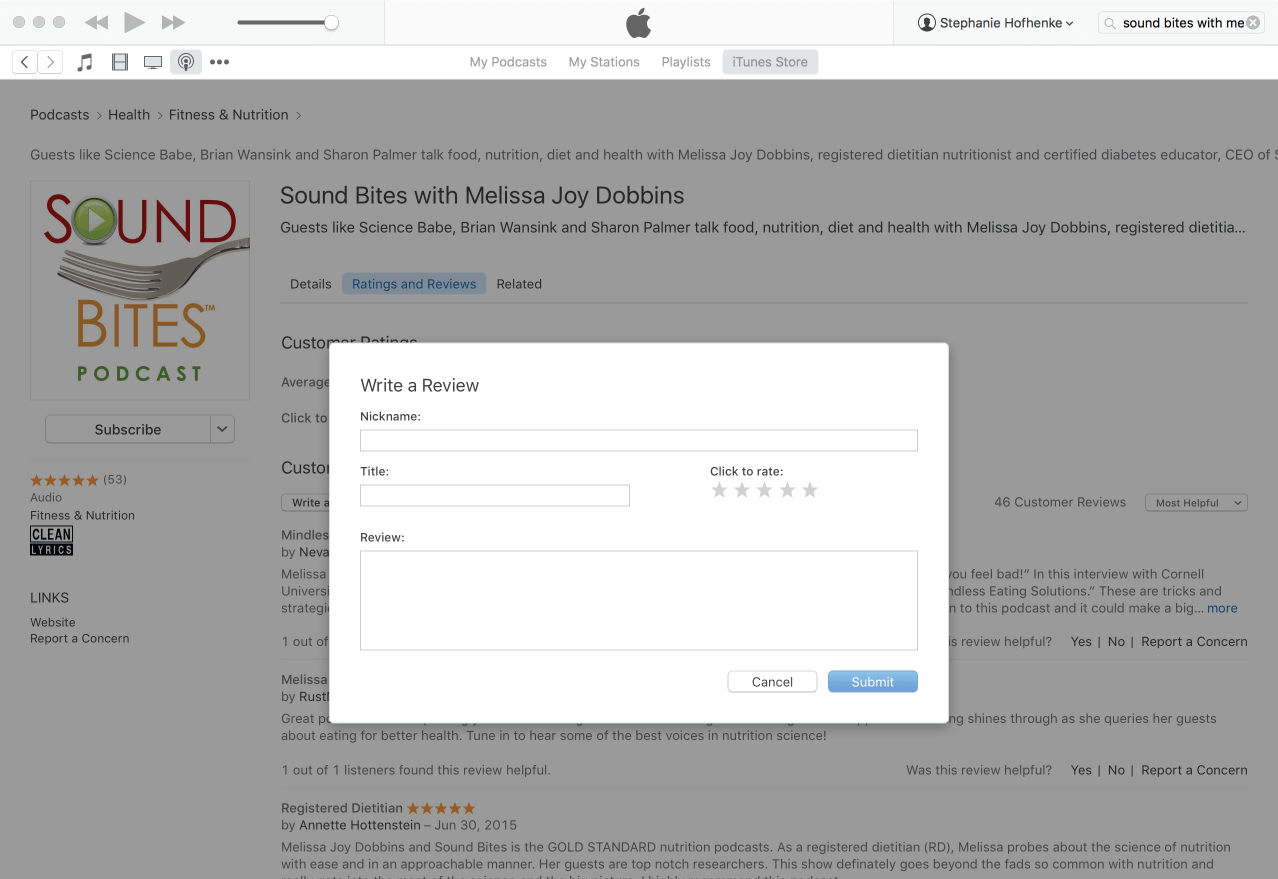
Write a Review
Click “Reviews”, then “Write a Review”.
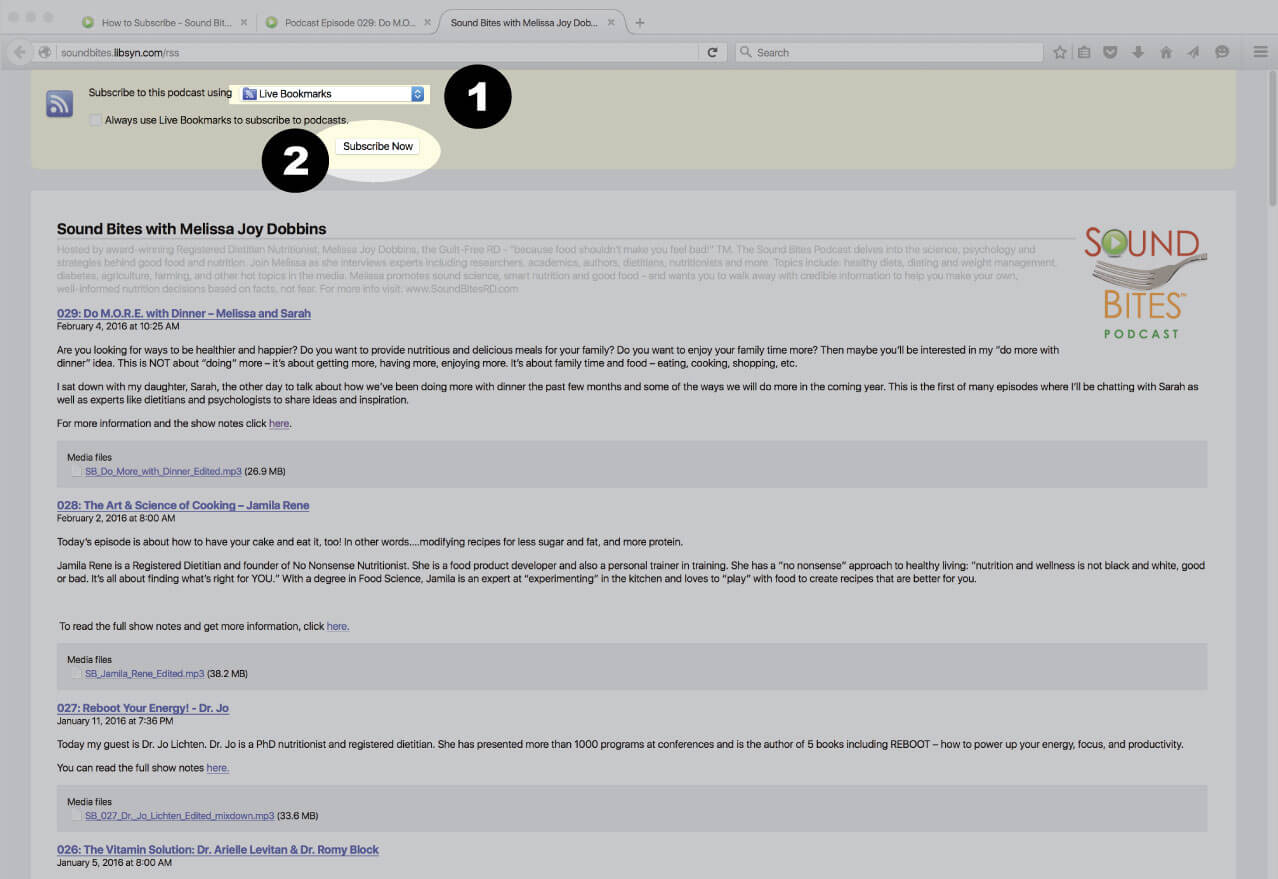
Subscribe via RSS Feed
Navigate to any podcast player . Click on the RSS feed icon.
Click on the RSS feed icon.
Click on RSS Feed
Choose which application you would like to use to receive the RSS feed
Click “Subscribe Now”
Confirm settings and subscribe.
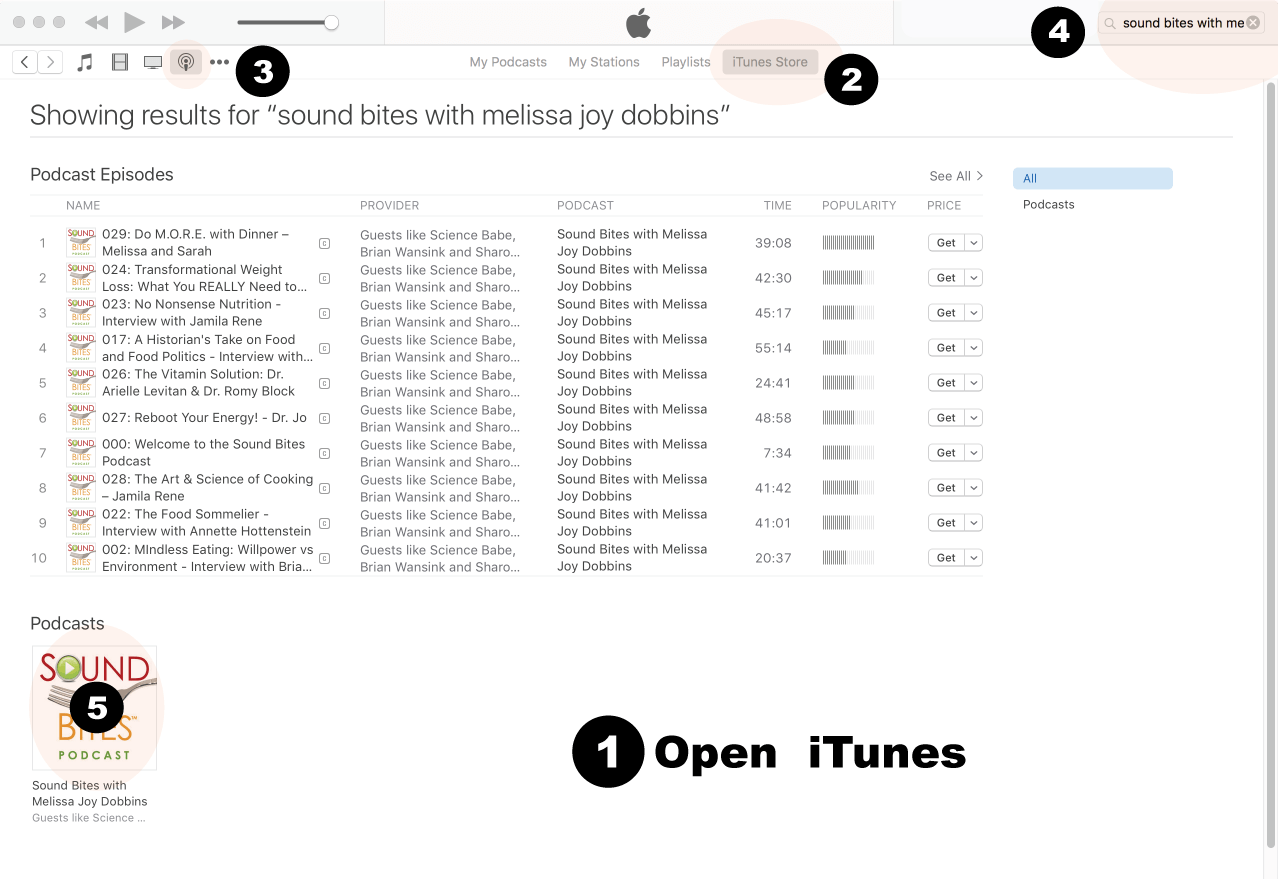
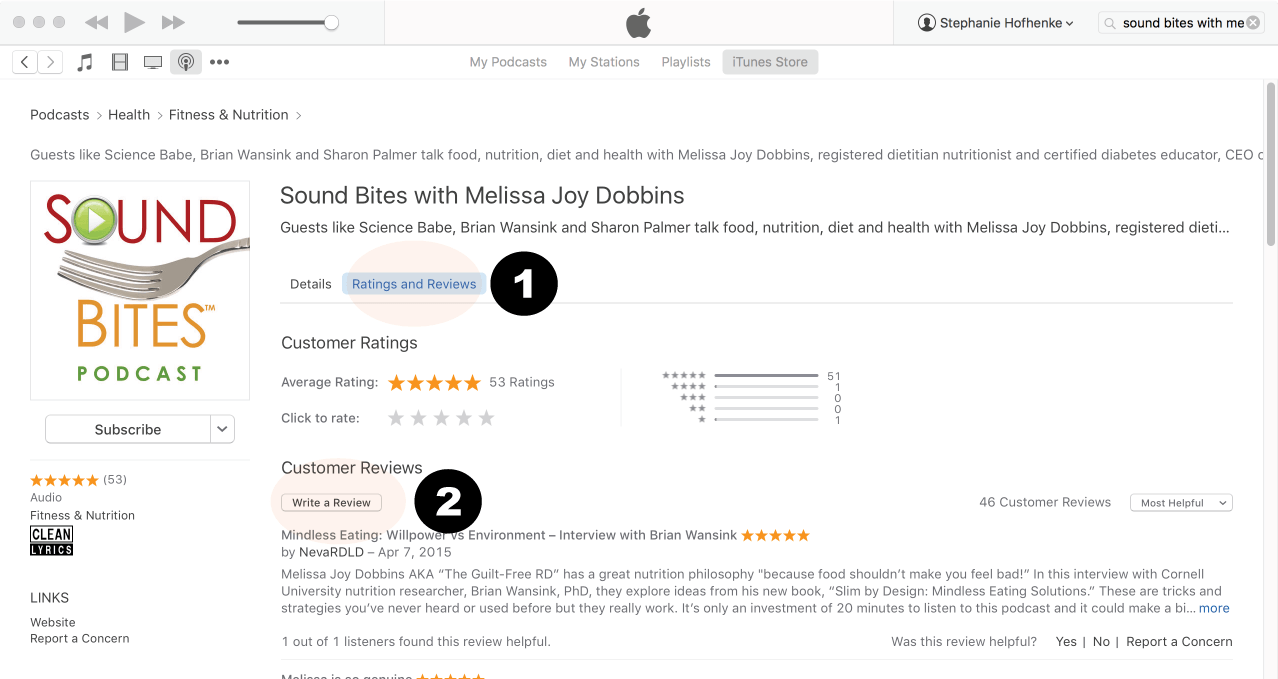
How to Review in iTunes
Open iTunes desktop application
Click iTunes Store
Click on Podcasts
Search for “Sound bites with Melissa Joy Dobbins”
Click on podcast image
Search for Sound Bites podcast in iTunes
Click Ratings & Reivews
Click Write a Review
View reviews and write your own review.
Write your review…. Thank you!
Write your review!
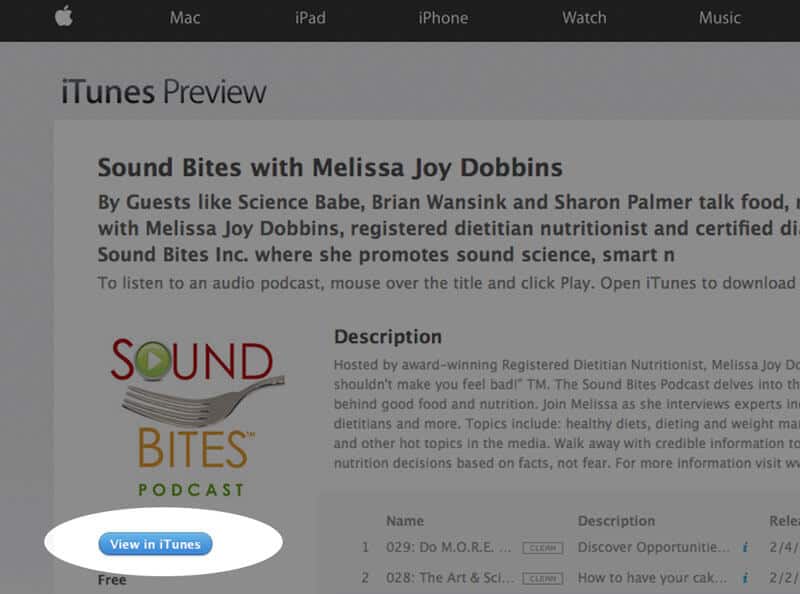
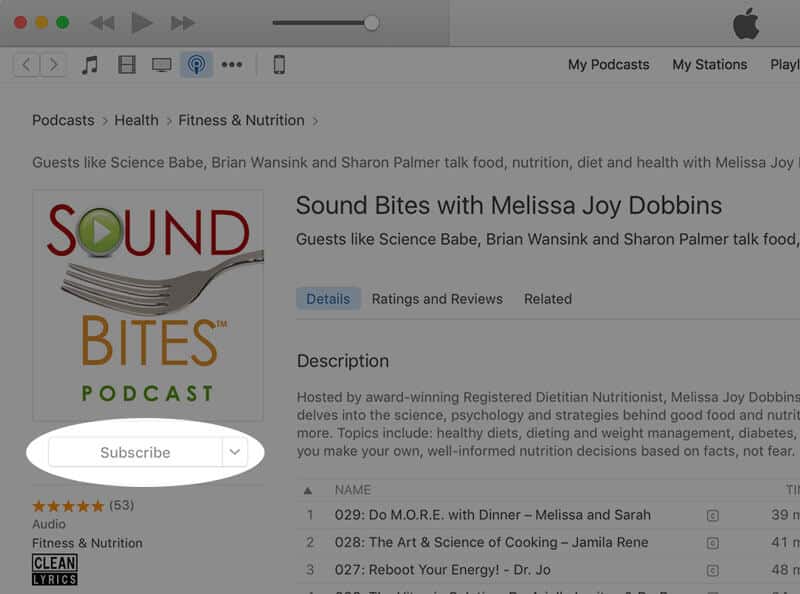
How to subscribe via iTunes
Click here to view the Sound Bites Podcastin iTunes, then click the blue “View in iTunes” button. This will open your iTunes application directly to Sound Bites Podcast. Click the “Subscribe” button, and your done!
















Hi Melissa, do you foresee this podcast counting towards CEU credit? Thank you!
Hi Lauren,
No, we are not submitting this episode for CEUs. However, you can always check the CEU page here to see what episodes are eligible for CEUs: https://soundbitesrd.com/sound-bites-podcast-free-ceus/
Thank you!
Melissa
Thank you!