Celebrating over 1 Million Downloads and 50,000 Free CEUs on the Sound Bites® Podcast | NEW: Get 1 years’ worth of CEUs with the new 15-CEU Podcast Course
Disclosure: This episode is NOT sponsored. Dr. Chris Mohr is a partner with Balchem and part of the Healthcare Professional Influencer Program.
The Forgotten Vitamin: K2’s Role in Cardiovascular and Skeletal Health
Vitamin K2 might not be the first nutrient you think of when it comes to heart health or bone health – but it should definitely be on your list of important nutrients. This episode explores the science behind vitamin K2, how it differs from K1, and its role alongside other nutrients in supporting cardiovascular and skeletal health.
Tune into this episode to learn about:
the differences between vitamin K1 and K2
why K2 matters for heart and bone health
food sources and if they are common in the diet
how much vitamin K2 is recommended
other nutrients that work with vitamin K2 to support heart and bone health
research on vitamin K2’s role in heart and bone health including the AVADEC Trial
what to look for in supplements
ways to assess the quality of supplements
updated vitamin D recommendations
preventing deficiency vs. optimal amounts of nutrients
resources for health professionals and the public
Chris Mohr, PhD, RD
Dr. Mohr is an internationally recognized subject matter expert and speaker around nutrition and well-being. He was on both the Men’s Fitness Magazine and Men’s Health Magazine Advisory Board and has worked closely with some of the largest food companies and corporations including Deloitte, Delta Airlines, Johnson & Johnson and more to help navigate the intersection of science and application among consumers. His expertise has resulted in him presenting at the White House and CIA, in over 10 countries globally and in most of the 50 states in the U.S. Dr. Mohr is a sought-after expert who has appeared on a variety of TV shows, contributed to the USA Today and Wall Street Journal among others. He is an above-average pizza maker with waning professional chef aspirations.
Resources
Some links may be affiliate links. As an Amazon Associate, I earn from qualifying purchases.
AVADEC Trial: Effects of vitamin K2 and D supplementation on coronary artery disease in men: A RCT
DANCODE Trial: Effects of vitamins K2 and De supplementation in patients with severe coronary artery calcification: a study protocol for a randomized controlled trial
Vitamin K and Bone Health: A Review on the Effects of Vita1min K Deficiency and Supplementation and the Effect of Non-Vitamin K Antagonist Oral Anticoagulants on Different Bone Parameters
Welcome to Sound Bites, hosted by registered dietitian nutritionist, Melissa Joy Dobbins. Let’s delve into the science, the psychology, and the strategies behind good food and nutrition.
Melissa Joy (00:22):
I’ve been getting a lot of questions from listeners about the continuing education credits that dietitians can get for some of my podcast episodes.
So, I wanted to clarify that I do offer free CEUs for some episodes, but not all the episodes. I have about three years’ worth of free continuing education credits, as well as some very low-cost CEUs and a package on sale for one full year’s worth of CEUs.
If you want the convenience of taking just one quiz and getting one certificate for all 15 credits, this is a fun and easy way to get your credits. So, be sure to check it out. And you can get all the details on my website at soundbitesrd.com/freeceus.
Hello, and welcome to the Sound Bites Podcast. Today’s episode is about several important nutrients and their roles in heart health and bone health. In particular, vitamin K or vitamin K2, which you may not have heard much about, and other nutrients that work together with vitamin K to support heart and bone health.
Including vitamin D, there’s some new updates on this important vitamin. And also, we’ll touch on things like calcium, omega-3s, fiber as they fit into this whole heart health and bone health equation.
I want everybody to know that this episode is not sponsored.
My guest today is Dr. Chris Mohr. Chris is a registered dietitian with a PhD in exercise physiology. He’s an internationally recognized speaker, serves on the men’s fitness advisory board, and is the co-owner of the wellbeing consulting company, Mohr Results with his wife Kara. Welcome to the show, Chris.
Chris Mohr (02:09):
It’s great to be here. Thanks for having me, Melissa.
Melissa Joy (02:11):
We’ve known each other for quite some time, and this is your first time on the podcast, so I guess that was a long time coming. I’m excited to talk with you.
So, share a little bit more about your background and the work you do with our listeners before we dive into vitamin K and heart and bone health.
Chris Mohr (02:26):
Yeah, absolutely. So, I’m a dietitian as you mentioned, I have a PhD in exercise physiology. So, early on, I went to school for nutrition with the interest in sports nutrition specifically, which is where or why I pursued a PhD in exercise physiology so I could understand a little bit better around the working body, the human body in different settings, in different activities. And then again, pair that with nutrition to better help individuals.
So, fast forward now, almost 30 years from when I kind of finished school, things have transitioned a little bit. I certainly still do some work in the sports nutrition space and the fitness space. But I’ve also kind of transitioned to do a lot of help around the corporate wellness space, and helping individuals and executives within the corporations better manage their own wellbeing.
Again, through the same topics, nutrition and sleep and exercise as well. But more of the corporate athlete versus the athlete on the field, let’s say.
Melissa Joy (03:24):
Yeah, very good, very good. Oh, and definitely, want you to mention any disclosures that you have to note.
Chris Mohr (03:30):
I’ve worked with a variety of companies over the years, both food companies and other consulted companies as well.
Most recently, one of the companies I’m working with is a company called Balchem, which is a raw ingredient manufacturer which provides ingredients for different products that you may be taking, various multi vitamins and supplements and so on.
Melissa Joy (03:50):
So, Balchem manufactures or sources vitamin K2, right?
Chris Mohr (03:54):
Correct. Among many other ingredients as well. But they provide vitamin K2, exactly.
Melissa Joy (03:59):
So, that ingredient goes into, like you said, a variety … different manufacturers use that in their supplements.
Chris Mohr (04:04):
Right.
Melissa Joy (04:05):
And we’re not talking about any specific brands or anything today, but you’re a paid consultant with them and like I said at the top of the interview that this episode’s not sponsored, but just want to put that out there.
So, what is vitamin K2, what’s the difference between K1 and K2, and why don’t we hear much about this vitamin?
Chris Mohr (04:23):
Yeah, so vitamin K2, it’s interesting because I’ve always, I mean obviously learned about it in nutrition. But on a more personal level, I’ve always heard about it because it’s common with blood thinning medications. People have to be aware of their intake.
My dad has been on a blood thinning medication for ever since I remember. I remember always kind of hearing my mom talk about measuring his vitamin K levels; Coumadin, his blood thinning medication, and measuring to make sure that he’s getting enough in the diet to make sure the amounts are appropriate.
Aside from what I then learned in school, then putting that into practice, that’s where I was first familiar with it, was in the sense of association with blood thinning medications. But it does a lot more than just that and it plays a significant role in heart health, in bone health.
There’s a lot of real interesting data of the importance it has, even brain and various areas in the body, but heart and bone are two of the big ones that have more recently been investigated and discussed for its importance in both of those areas.
Melissa Joy (05:26):
Yes. I was thinking the same thing when I was doing a little research for this interview is, yeah, I have a family member who’s been on Coumadin for decades, and it’s like oh yeah, they need to look at keeping their vitamin K intake consistent.
Chris Mohr (05:39):
Consistent, right.
Melissa Joy (05:40):
Because vitamin K helps with blood clotting, and so they want to keep their levels at a certain consistency.
And I’m thinking, there’re certain foods that provide vitamin K, like leafy greens. But is there a difference between K1 and K2 with regard to food sources? How much do we need? And vitamin K2 is the one that we’re going to be focusing most on for these heart health and bone health benefits, right?
Chris Mohr (06:06):
Right. So, there is the difference. So, number one, vitamin K is one of the fat-soluble vitamins as a whole. And then there’s like you mentioned, K1 and K2.
Now, K1 is primarily found in a lot of leafy green vegetables, like you mentioned: spinach, kale and so on. But then vitamin K2 is also found in some fermented foods, egg yolks, some animal products as well. So, like I said, what’s very important is not that certain people have to manage intake and keep it consistent, versus limiting or adding certain amounts. Again, the consistency is the key there.
But vitamin K1 versus K2, the food sources are a little bit different like we had mentioned, but a lot of the research now around bone health and heart health and so on is specifically on vitamin K2, which is where we’re going to focus today’s interview.
Melissa Joy (06:55):
Right, exactly. So, tell us how vitamin K2 is working in the body. Like what is happening that is resulting in this heart health and bone health support?
Chris Mohr (07:04):
Yeah, so first of all, it’s more bioavailable than vitamin K1. So, bioavailability is very, very important. And it also has a significantly longer half-life, meaning that it lasts longer within your body just like a medication has certain half-lives. Now, with vitamin K2, there’s also several forms. I don’t want to get too confusing here, but there are different forms of vitamin K2.
So, that’s also an important piece to the puzzle when we’re starting to look at intakes especially if you’re adding a supplement to the diet, what do you look for within that supplement? But just understand that at the start, vitamin K2 is more bioavailable than vitamin K1, and has a longer half-life of about 72 hours. So, it’s a pretty significant half-life, again, based on the intake and based on the foods you’re eating and so on.
The one big piece with vitamin K2 is how it does activate certain proteins. And again, we start to look at heart health. One of the interesting pieces is the role it plays in soft tissue. So, it actually removes some of the calcium away from soft tissues and help shuttle it into bones.
So, then you look at one, how it helps heart health by removing it from the soft tissues, but then two, how it also helps bones by then shuttling that calcium into bone. So, again, it actually is like a twofold benefit, so to speak. Which is one of the interesting things about it. Again, improving heart health and improving bone health simultaneously, which is really impressive and unique for a vitamin.
Again, it works synergistically then with calcium as I mentioned. And also, vitamin D, which is another important nutrient vitamin when we start to look at heart health and bone health as well.
Melissa Joy (08:46):
Yeah, that’s what I found was really interesting, is the way that the vitamin K2 activates these key proteins. Like you said, it’s like a dual benefit. It’s helping with heart health because it’s pulling the calcium out of that. I don’t want to say it the wrong way.
But like you said, shuttling the calcium away from the soft tissues. And you’ll speak more when we get into the heart health, but like the calcium in our arteries and stuff, it’s not good to have it there, and it’s putting it in the bones where it’s supposed to be.
So, let’s talk about heart health first. Tell us about, maybe a little bit about the prevalence and how the vitamin K2 is working with vitamin D, which I found really interesting because I don’t … I mean, I know vitamin D is good for a lot of things, but I don’t often think of it as a heart health nutrient.
Chris Mohr (09:33):
Heart disease is the number one killer in America, both men and women, unfortunately. It’s often called that silent killer. And also, what’s concerning is that a recent survey showed that over half the Americans don’t know that they may be at risk for heart disease.
Again, kind of going back to what you just said is we might have some calcification of the arteries and then our overall diet and lifestyle could play a role in affecting various hormones, also various lipids in our body. So, a lot of us unfortunately around risk for heart disease, like I said, the number one killer for both men and women.
Now, at the same time, fortunately, a lot of heart disease is let’s say, preventable, but we could certainly reduce the risk of heart disease and cardiovascular disease through how we treat our bodies, what we put in our bodies, how we move or don’t move, sleep.
Again, there’s many, many others and we’ll talk about some others as well. But some recent trials have actually shown the importance of vitamin K in conjunction with vitamin D like you had mentioned, and other nutrients.
For example, there’s one recent trial called the AVADEC trial, and that investigated the effect of vitamin K2 and vitamin D on the progression of coronary artery calcification. So, that’s what we talked about earlier with that calcification, is the hardening of the arteries essentially.
One of the benefits of K2 is that it shuttles calcium away from the soft tissues and into bones. Again, vitamin D is also a player in that, and none of these nutrients work in isolation, they all work together synergistically.
So the Videk trial used K two vital, which is a Balchem ingredient that is patented in typically 99.7%, MK seven, which is identical to the K two molecule found in nature and fully bioactive.
This particular trial used720 micrograms of K2 and 25 micrograms of D3, which is about a thousand IUs versus placebo for two years. And one of the endpoints was looking at reduced calcium progression among those with the calcium scores, and it showed a strong benefit for those taking the K2 and the vitamin D together.
So, that was a pretty large trial that just happened not that long ago. It was published not that long ago, but it was one of the larger trials showing those two nutrients in particular could help.
Melissa Joy (12:01):
Do they know what the connection or the mechanism is between K2 and vitamin D, or are they working together in a way, or they’re each kind of doing their own thing that is resulting in these benefits?
Chris Mohr (12:15):
Not necessarily in that trial, but for some other things that I have seen, they seem to be working together. But again, none of these nutrients seem to work in isolation, as I mentioned. And that’s why it’s important as dietitians, we talk about balance and within our diet, it’s not one thing or another thing, but it’s the combination of these that makes a big difference.
Melissa Joy (12:32):
Yes, is there an RDA or AI for K2, or is it vitamin K in general, and are we getting adequate levels in our diet? How common is a deficiency?
Chris Mohr (12:47):
Deficiency is actually pretty rare, and actually, less than 1%. But that said, when we think about deficiency versus kind of insufficiency versus what’s optimal, those don’t always correlate. So, of course, first and foremost, make sure we’re eating a diet with the foods that we discussed earlier, and not just from K2, but the K1 as well.
So, the leafy greens, fermented foods, a lot of the foods you’ve heard about for other benefits as well. Some animal products, if you do eat animal products, that provides some … egg yolks all provide variety sources of vitamin K as a whole.
That particular study that I had just mentioned, supplementation was at a higher dose than is even generally recommended 720 micrograms, which a lot of data isn’t quite showing even that much, but that study did show some benefit.
So, it’s certainly something that I say always check with your own healthcare provider. You can have your vitamin K levels tested to see where you are. But it is interesting that maybe – again, the basic RDA is, as we know, that’s the level that is really just preventing deficiencies so to speak, not necessarily optimal.
But again, that’s why it’s always important to check with your own healthcare provider to see what might be the best approach for you.
Melissa Joy (14:02):
Absolutely. So, the amount you said in the study was 720?
Chris Mohr (14:08):
720 microgram.
Melissa Joy (14:10):
So, what is the recommended daily allowance or dietary allowance? What is it? RDA. What is the RDA?
Chris Mohr (14:16):
Yeah, I know it’s changed so many times. The RDA for women versus men, obviously it varies a little bit (like not obviously), but it does vary a little bit.
So, the range is 90 micrograms a day for women, up to 124 men, but that’s adults, so ages 19 and up. And then again for pregnant or lactating women, it’s 90 micrograms as well. Children, adolescents a little bit different, but for adult men and women, more than 90 to 120 microgram range.
Melissa Joy (14:44):
Okay. And that’s to prevent deficiency?
Chris Mohr (14:47):
Exactly.
Melissa Joy (14:48):
Okay. You had mentioned you can get your blood levels tested, but that’s not a typical test. When you go to the doctor for your annual visit, they don’t typically test for that, but that is something that you could ask for?
Chris Mohr (15:00):
You could ask for it. Again, they don’t typically do that because unless you’re on a blood thinning medication or otherwise, they can do it, but because deficiency is rare, it’s not something that is commonly added to your basic lipid panel or just blood panel I should say.
Melissa Joy (15:17):
Yeah. And as we’ve been saying, if somebody’s on a blood thinning medication, they get their levels checked pretty regularly.
So, if you aren’t having your levels checked, obviously most people are not, and you’re trying to have a healthy varied diet, when might you want to consider a supplement, and what do you look for in supplements?
Chris Mohr (15:36):
Yeah, it’s a good question. So, again, the particular study that I just mentioned was a significantly higher dose than the RDA. It’s 720 micrograms.
I’ve seen different products at around 200 micrograms. It seems to be common among many of them. And from what I’ve seen, I think there are enough data that it might be a wise idea to add a supplement. Maybe it doesn’t have to be up to 720 micrograms, but I think that 200 mark seems to be a good ballpark. And I’ve seen that number in a lot of quality brands out there, quality products out there.
And that brings up the point of what is a quality brand? And supplements, there’s so many out there and there’s so much information. One of the ways to assess the quality of a supplement, not the only way, but one way is something called the USP symbol. It would be usually proudly stated on the label. And essentially, what that is, is telling you that what is on the label is in the product.
Unfortunately, those two things don’t always match. But if you have the USP symbol on there, that at least confirms that you’re getting again, what it says on the label you are getting in the product. So, it’s meeting those label claims, which is particularly important.
And since we’re talking about USP, the K two vital that I mentioned before is the USP standard and is backed by 15 clinical trials.
Now, that said, there’s some other things you can look for when you’re looking at a vitamin K product, and I mentioned that vitamin K2 is the particular ingredient that you want to look for. But then I mentioned in the very beginning that there are different forms of vitamin K2 and the one that you want to look for specifically is vitamin K2 MK-7. And again, that is the one that has been shown to be more bioavailable and most useful for your body.
Melissa Joy (17:23):
Okay, great. Yeah, and I grabbed a couple supplements out of my cabinet. I’ve got a vitamin D3 supplement, and it’s got the USP symbol on it. I have a Mega D3 and MK-7 supplements, and to your point, that one has about 180 micrograms of the vitamin K2. And I also checked my multivitamin. Most multivitamins do have a little bit of vitamin K in them. The one I have here has about 25% daily value at 30 micrograms.
Chris Mohr (17:52):
And I don’t want to say it’s standard for multivitamin. Some of course have way, way more than that. The Mega Men, Mega Woman, et cetera.
From my perspective as a dietitian, I’m certainly not suggesting any mega doses of anything. So, in the case, the ones you pulled out and looked at, even 25% of the RDA is getting a little bit there in conjunction with the foods that you’re eating.
So, supplements to me are always kind of that insurance policy, or I always call them compliments because they should complement a quality diet, not certainly replace anything in the diet.
Melissa Joy (18:25):
Yes. And we always say try to get as much of your nutrition as you can through food because of how all the nutrients work together in the food. We can’t always exactly replicate that in a supplement if we don’t know how all of those things are working together. But supplements do help fill those nutrient gaps.
And we’ll talk a little bit more about the new stuff with vitamin D in a little bit. But how much research is there on vitamin K, vitamin K2? You mentioned one study and I know there was a couple of other studies that you had sent over to me earlier in the week.
A lot of times, we hear more research is needed, but how much research is out there already, and is it quality research? Is it observational control trials?
Chris Mohr (19:08):
Right, exactly. There’s so many different yes you want to see studies, but then how are those studies done? And the one I mentioned earlier is a high-quality study, and there have been many others as well.
So, in my mind, from what I’ve seen and read, there is a high level of quality research that has been done around vitamin K. And again, it’s various outcomes, whether it’s heart health, bone health, et cetera. So again, there’s a variety of randomized controlled trials, there’s observational studies. And it’s nice to see that combination than so much data out there.
One thing that you brought up a second ago, when we think about food and getting away from studies for a second — when we think about food, some of the foods that provide vitamin K are great sources of so many nutrients, unfortunately, they’re also not very common in many people’s diets. So, yes, we always encourage leafy greens, but a lot of people aren’t eating those on a regular basis or various animal products or egg yolks or whatever it may be.
So, that’s another piece to the puzzle is … it’s not so widespread across so many foods, and that’s another reason that supplementation might be a consideration, A, because of the food sources it’s in, and again, encouraging you to please eat them on a regular basis. But B, some of the dosing may be a little bit lower than has been shown to be particularly beneficial with these various outcomes we’re discussing.
Melissa Joy (20:33):
Yeah. And we see that with vitamin D as well. It’s not really widely spread in foods. We get it from the sun, our body makes it when we’re exposed to the sun, but then we’ve got sunscreen and wearing clothes and hats and things to decrease our risk of skin cancer and so on.
And two of the studies that you sent me on vitamin K2 and D3 supplementation and coronary artery disease or coronary artery calcification, both of those were in 2023. So, those are really recent studies. And we’ll put as many of these studies that we can link to that are open access and available, we’ll put those in the show notes at soundbitesrd.com.
So, let’s talk a little bit about bone health now and compare and contrast like any of the differences as far as like how vitamin K2 is working in that sense and the nutrients, it’s working with vitamin D obviously with that too, but any nutrients that are beneficial to bone health and any information you can share on osteoporosis.
Chris Mohr (21:34):
Yeah, so that’s another kind of a silent killer in a way. Not necessarily like heart disease in that sense, but you don’t know you have it until there’s a problem.
And again, my mother-in-law just recently actually was walking down the stairs and her femur snapped. The thickest bone, the biggest bone in the body. Again, didn’t know until there was a problem, and then they went in there like, “Oh yeah, there’s a big problem.”
So, in that sense, we need to make sure we are doing all that we can to strengthen our bones. Now, unfortunately, most of that work should have happened years ago when we were younger, because that’s when you are building most of the bone that you can.
But that being said, it doesn’t mean that once you hit 30-years-old and a lot of that bone seems to be done remodeling. We can still provide nutrients to our body, and of course, bone strengthening exercises, resistance training, things along those lines that all play a big role in the strength of our bones as well.
And going back to the nutrients, vitamin K is one of those nutrients that plays a big role as well. Calcium is the one that’s always talked about and absolutely it is important and same with vitamin D. But as we talked about earlier, vitamin K is another piece to that puzzle. And in particular, helps calcium do its job by shuttling into bones and moving it away from soft tissue. So, it helps put calcium in the place we want it, it also works together with vitamin D as well.
So, like we said earlier, this is all kind of this big synergistic process within our body. These nutrients are working together to help put the nutrients where they need to be and remove them from the other places.
Melissa Joy (23:16):
And so, what have you seen in the research and the literature about vitamin K2 and bone health?
Chris Mohr (23:23):
Yeah, so when we think about vitamin K2 and the role it plays — so one, I mentioned this earlier, but it’s important to reiterate that it is more bioavailable form of vitamin K. And it works with vitamin D3, and it helps regulate calcium to support bone health.
Teens acquire approximately 25% of bone mass in a period of about two years during adolescence, and this is why it’s so critical to make sure that we’re getting the nutrients that we need. Vitamin K two, as we mentioned, is a vital ingredient for really all stages, and in particular for bone development.
Great. Thank you. Yeah. And we’ve got, um, a research article that I can put in the show notes as well about optimizing bone health in children and adolescents. Um. So we’ll add that.
So, vitamin D in addition, promotes the production of vitamin K, dependent proteins which help calcium to where they need to be to build and maintain that healthy bone. The role that it plays is with those other nutrients in particular to help make sure that our bones are getting the nutrients that they need.
Melissa Joy (24:00):
Excellent. So, now, maybe is a good time for us to talk more about this vitamin D update. There was some new information that came out earlier this year about vitamin D with regard to the goals for what our blood levels should be. Even intake recommendations like testing, supplementation. This information came from the Endocrine Society.
Can you kind of give us the lowdown on this? Because it was in my opinion, a pretty big deal. Vitamin D has been a big deal in our field. You and I have been dietitians for about the same amount of time, I’ve been around a little bit longer than you. And I would often tell people like well, I think like the vitamin D story has been probably one of the biggest things that I’ve seen in my career. So, share this update and what we need to know about.
Chris Mohr (24:47):
Yeah, it was pretty interesting, looking at that. And like you said, vitamin D has been the hot nutrient, and I’m included in this, is it was always telling people that when you got your checkups, ask for your vitamin D to be tested.
And more recently, the suggestion now is you don’t necessarily need to ask for this test. Now, again, the other piece is that levels, people are recommending a thousand IUs or so. I’ve seen two 5,000 Ius, and that’s significantly higher than the RDA, which is 600 IUs for most adults. But again, that shift in not having people test on a regular basis is really an interesting one.
So, I think from what I’ve seen, vitamin D is a critical nutrient in our diets and also from the sun. And like you said, it is a hard one to get from the diet. It’s not the most prevalent in the overall diet, and most people aren’t eating sardines on a regular basis. And mushrooms that have been activated with light have vitamin D in it and fortified milk, those are all great foods.
Or like you said, the other piece is, we’re covering ourselves in suntan lotion, and generally wearing clothes outside. Because of those things, we don’t make a tone from the sun. I actually did hear years ago a very famous vitamin D researcher, he actually said to get enough vitamin D from the sun, you need to stand outside naked for about 15 minutes a day, like with your arms kind of outspread and wide. He was in Nebraska, he said, in particular, for those people in the northern states.
But all that said, now with that newer data suggesting, not asking for a regular checkup or a regular test for vitamin D, it’s interesting to see that shift because like I said, for years, vitamin D has been on the forefront of so much research and so many conversations around nutrition.
That said, I mean I think kind of going back to a basic multivitamin with the straightforward RDA is not a bad idea of vitamin D, but doesn’t seem to be that we need to go above and beyond unless there is a specific deficiency concern and something your healthcare practitioner has brought up.
Melissa Joy (26:57):
Yeah, my understanding is there was a little confusion because the nutrition board of the National Academies had suggested ranges, like what levels would be considered a deficiency, what would be adequate. And the Endocrine Society kind of had different levels. But now, they’ve retracted those standards because there’s been so many more randomized control trials that have had stronger evidence.
The thing that caught my attention especially was that they’re saying there could be adverse effects if your levels are too high. And I believe those levels are greater than 50 nanograms per milliliter or 50 to 60. Whereas before, that was sort of considered a good normal adequate range.
And I think some of the negative effects, certainly kidney stones is a concern, but they were even saying certain types of risk of cancer and so on. So, they’re really not recommending regular testing, they’re not recommending regular supplementation for just the average healthy person. Of course, there’s always different specifics with regard to certain populations.
In fact, people with obesity often have low blood levels of vitamin D. That’s a little bit more common to have a deficiency because vitamin D may be sequestered in adipose tissue. But yeah, so I get a little nervous like oh, what’s the harm in still just having your levels checked because I’m a regular vitamin D supplementer, and I’m like well, now, I want to make sure that it’s not too high.
Whereas, before it was like oh, make sure it’s not too low and you’ve got this big wide range of normal, so I’m going to have to adjust to this new information.
Chris Mohr (28:41):
I’m the same way. And again, for years, it was kind of like you said, they’re now not recommending over 15 and for a while, it was that 50 to 80 was kind of the sweet spot. Even though that was above the general recommendations, that’s kind of most experts were saying, “Well, 50 to 80 seems to be where you really want to be.”
I’m with you that I don’t think getting tested is a bad thing by any means to see where you were. And for me, just for an example, so many years ago, almost 20 years ago now, I did the Ironman in Louisville, Kentucky, which is hot and sunny and it was in August, and just coincidentally around the time I was training.
So, I was in the sun all the time. And yes, I wore sunblock and so on, but my levels, if I remember correctly, they were 18 or 19 which is … and then I’m thinking I’m outside all the time and now I did add a supplement.
So, I’m of the mindset that having more information is not a bad thing. Maybe we don’t need to over supplement where we might have been. Like you, you’re in Chicago and I’m far south of there.
Melissa Joy (29:45):
(Laughs) Not getting a ton of sun here.
Chris Mohr (29:47):
Yeah, not getting a ton of sun, exactly.
Melissa Joy (29:48):
Yeah. Very good. And just to put a finer point, there’s deficiency and then there’s optimal levels for people to kind of remember. A lot of the levels that we talk about like how much you should eat of a certain nutrient or a supplement. That’s to prevent a deficiency, but then there’s that range of optimal amount.
Chris Mohr (30:10):
The other piece I’ll add to this and kind of bill a period on is of course, it is a good reminder that just because some is good, more isn’t necessarily better. And then there is a balance in our body. So, in this case of vitamin D, just because you might be a little bit low, all of a sudden, you start taking more of that, and then does that throw anything else off?
Melissa Joy (30:29):
That’s a great point.
Chris Mohr (30:30):
Which is maybe where some of these recommendations shifted a bit because with anything, more isn’t necessarily better.
Melissa Joy (30:37):
Yeah, no, that’s a great point. And with both vitamin D and vitamin K, they’re both fat soluble vitamins. They’re going to stay in the body longer, and with vitamin K1 being from the leafy greens, that’s going to be better absorbed if you’ve got like salad dressing or oil on your leafy greens and that sort of a thing.
The other thing that makes me wonder then, can you get too much vitamin K2, especially being a fat-soluble vitamin?
Chris Mohr (31:03):
Right. And that’s certainly always a concern. Like you said, with a fat-soluble vitamin where you are storing it. Now, the particular study I mentioned earlier, they were taking 720 micrograms a day in that study, which is significantly higher than we’ve discussed, than 90 to 120 micrograms.
Melissa Joy (31:21):
It’s not likely (laughs).
Chris Mohr (31:24):
Exactly. So, that’s why I said most supplements that I’ve kind of seen, like you said you had a multivitamin at 180 micrograms, and I’ve seen a lot around that 200-microgram mark. So, it’s a little bit above the RDA, but not necessarily completely, I would say off the charts or just so elevated, because is that affecting anything else? We don’t necessarily know.
Melissa Joy (31:46):
So, we know that vitamin K2 and vitamin D3 are both important for heart health and bone health. Let’s talk briefly about some of those other nutrients and of course, calcium’s involved here. Like calcium out of the arteries into the bones, very good. But we also know that omega-3s are important and fiber is important. So, just briefly, if you want to address those.
Chris Mohr (32:08):
Absolutely. To me, I always say I think fiber is the unsung hero of nutrition. Of course, protein is getting all the love and yes, protein is critical.
Melissa Joy (32:17):
I know I always say fiber needs a PR agent.
Chris Mohr (32:20):
They need a much better PR agent, exactly. The outcomes aren’t as exciting though with fiber, but they are certainly critical.
Last I saw, most Americans are eating about half or less than what’s recommended on a daily basis. So, making sure … it goes back to some of the same foods we’ve already talked about. Some of the leafy greens would be great on a regular basis, and berries and beans and the wide variety of fruits and veggies and whole greens, all of those provide fiber.
And the recommendation, generally speaking, is about 25 to 35-ish grams for men and women. And again, we could boil it down even further per a thousand calories, this much.
Melissa Joy (32:59):
Yeah, it’s 14 per a thousand, I think.
Chris Mohr (33:01):
Exactly. So, I always say for most people, a 25 to 35 is certainly a good starting point. If you’re not quite there, don’t go there overnight. When we moved into our recent house now years ago, but we moved into our house, there’s an older woman who lives down the street from us and our youngest daughter became … she said, “Ms. Bobby is my best friend now.”
This woman’s in her eighties, my daughter was like five at the time. She went to Ms. Bobby’s house after school and then came home. And like dinner time, she’s like, “Oh, I’m not hungry.” “Girl, what did you have?” She gave her three Fiber One bars.
Melissa Joy (33:34):
Oh my gosh (chuckles).
Chris Mohr (33:36):
So, don’t go from zero to a hundred (laughs), but fiber is certainly critical.
Melissa Joy (33:42):
Yeah. Not going to be hungry for a while. Yes.
Chris Mohr (33:45):
Exactly.
Melissa Joy (33:46):
And we know that there’s insoluble fiber and soluble fiber. And the soluble fiber is often what we hear more about being good for heart health, and the insoluble fiber is more good for gut health. But fiber’s good for bone health too, right?
Chris Mohr (34:01):
It is. I mean, fiber has so many benefits. So, yeah, heart health is the one you always hear about. But certainly, bone health, certainly just overall wellbeing, of course regularity decreases the risk of colon cancer, and even other cancers as well.
So, yes, soluble and insoluble. And the other thing I often say is fiber is almost like a vitamin in the sense that there’s a whole bunch of different types. Soluble and insoluble are the kind of the big picture ones and the umbrella terms, but then there’s so many different types of fiber. That’s why it’s so important to eat a variety in the diet because then you get beta glucan and the other oat fiber insoluble, different types of soluble fiber and so on. Variety is key in the diet.
Melissa Joy (34:44):
Yes, absolutely. I recently did an episode on prebiotic fibers, and there’s so many different kinds and variety is the key. And that’s one of those generic or kind of basic recommendations that we throw around that I think people don’t understand.
The reason we recommend variety is because there’s so many different nutrients, and if we don’t have enough variety in the diet, we’ll be more likely to miss out on important nutrients.
Chris Mohr (35:12):
And then we think about, you said prebiotic fiber, it makes me think of fiber plays a role in gut health. So, when we think about the microbiome super popular and fiber feeds that microbiome, which then also plays a role in bone health and heart health. And that’s why our body is one big system that all works together.
Melissa Joy (35:31):
Yes. You have to have a healthy gut in order to have a healthy body, for sure. What about omega-3s? I know you’re kind of an omega-3 expert guru. I mean, you’re expert in a lot of things, but you really get into omega-3s a lot in your work.
Chris Mohr (35:46):
Yeah, I do. And I’ve been interested in them for a very, very long time. From the sense … it started with my mom has high triglycerides, purely genetic and started reading some of the research in college, I was like, “Oh, this is something that’s interesting.” And now, fast forward, there’s actually over 50,000 research studies on omega-3s. So, best sources of them are fish or algae. If you don’t eat fish, that’s from a supplement standpoint, you’re not going to necessarily start gnawing on algae, necessarily. But that is where fish get their omega-3s.
So, again, without getting into all the details, there’s different types of omega-3s, EPA and DHA, those are the two that come from fish primarily. There’s a third type of omega-3 that comes from more plant-based sources: flax seed, hemp seed, the various nuts, some leafy greens. But without getting into all the details, those are not quite as effective from an omega-3 standpoint as the other two that come from fish.
So, again, goes back to variety. But at the same sense, if you do eat fish, or again, if you’re not excluding it for any particular reason, allergy or you’re following a vegan diet, make sure you are a couple times a week, you’re having some of those fatty fish like the salmon and tuna and so on. Because there are enormous amounts of data on heart health, on brain health, on skin health, eyes, and so many other pieces to the puzzle. That’s just one of the big benefits of omega-3s for sure.
Melissa Joy (37:12):
Yes, and seafood twice a week is the recommendation. And you’re familiar with the term SMASH?
Chris Mohr (37:19):
Yeah.
Melissa Joy (37:20]):
So, acronym SMASH stands for, what are the fish? Sardines, Mackerel-
Chris Mohr (37:26):
Anchovies.
Melissa Joy (37:27):
Anchovies.
Chris Mohr (37:28):
Salmon.
Melissa Joy (37:29):
Salmon and Herring (laughs), we did it.
Chris Mohr (37:34):
Yeah. We put it together, we might be off with our Ss there or something, but if we are off, those five are great sources of omega-3s, but I think that’s what they are. So, those fattier fish are like all of those and more are great and great options.
Melissa Joy (37:49):
Yes. And I’ve done several Omega-3 related episodes. I’ll throw those links in the show notes at soundbitesrd.com as well.
As we’re wrapping up, is there any other research that you wanted to share or takeaways on this vitamin K2 that we haven’t touched on? Anything I didn’t ask?
Chris Mohr (38:07):
Yeah, no, I think what’s important again is just monitoring your overall diet as we talked about. You don’t necessarily have to run out and get a blood test from your doctor for your vitamin K level because deficiency is very rare. At the same sense, it is also critical in your overall diet.
We talked about it for heart health and bone health two certainly important pieces in the body or parts of the body. What’s important then if you are adding a supplement is to make sure you’re looking for a quality supplement. Talk about the difference between vitamin K1 and K2. Vitamin K2 is more bioavailable.
And then one of the ways that you can confirm the quality of the supplement you’re taking is a USP symbol. USP symbol on the label to make sure that it does what’s on the label is in the bottle. And then K2, vital brand vitamin K2 is something to look for as well. It might also say vitamin K2 MK7.
So, looking for those on the label, if you’re adding a vitamin K supplement is a wise idea. There are certainly plenty of data to show that it might absolutely support heart health, bone health and just overall wellbeing as well.
Melissa Joy (39:18):
Okay. Excellent. And there’s a ton of resources on this. There’s fact sheets, even we’ve got some health professional and consumer fact sheets on vitamin K2 or vitamin K in general, and vitamin D. And then any of the research articles that we can put in the show notes, I will do that. And where can people connect with you and follow you on your website, social media?
Yeah, absolutely. So first we talked a lot about vitamin K and there’s a website you can go to vitamin k2 vital.com. So it’s k2 vital.com. And then for for me, I. My website is just more results, MOHR results.com, and that’s the same as my Instagram handle as well.
“Mohr results. Excellent. Thank you so much. This has been really interesting.
It’s great to be here. Great to, great to chat Melissa.
And for everybody listening, as always, enjoy your food with health in mind and some vitamin K two till next time.
[Music Playing]
Voiceover (40:10):
For more information, visit soundbitesrd.com. This podcast does not provide medical advice, it is for informational purposes only. Please see a registered dietitian for individualized advice. Music by Dave Birk, produced by JAG in Detroit Podcasts. Copyright Sound Bites, Inc. All rights reserved.
LISTEN, LEARN AND EARN
Listen to select Sound Bites Podcasts and earn free CEU credits approved by the Commission on Dietetic Registration (CDR) for registered dietitian nutritionists and dietetic technicians, registered. Get started!
Get Melissa’s Sound Science Toolkit here!
Partnerships:
Sound Bites is partnering with the Association of Diabetes Care and Education Specialists (formerly the American Association of Diabetes Educators)! Stay tuned for updates on the podcast, blog and newsletter!
Sound Bites is partnering with the International Food Information Council! Stay tuned for updates on the podcast, blog and newsletter!
Sign up for my monthly newsletter and episode eblasts so you never miss an update!
Listen on Stitcher (Android)
Install the Stitcher App
1. Search for “sound bites with melissa joy dobbins” 2. Choose Play Current Episode or Add to Playlist
Choose “Play Episode”
Subscribe & Review on iPhone
Open the “Podcast” app on your iPhone
Search for “Sound bites with melissa joy dobbins”
Open the podcast and click “Subscribe” and your done!
Write a Review
Click “Reviews”, then “Write a Review”.
Subscribe via RSS Feed
Navigate to any podcast player . Click on the RSS feed icon.
Click on the RSS feed icon.
Click on RSS Feed
Choose which application you would like to use to receive the RSS feed
Click “Subscribe Now”
Confirm settings and subscribe.
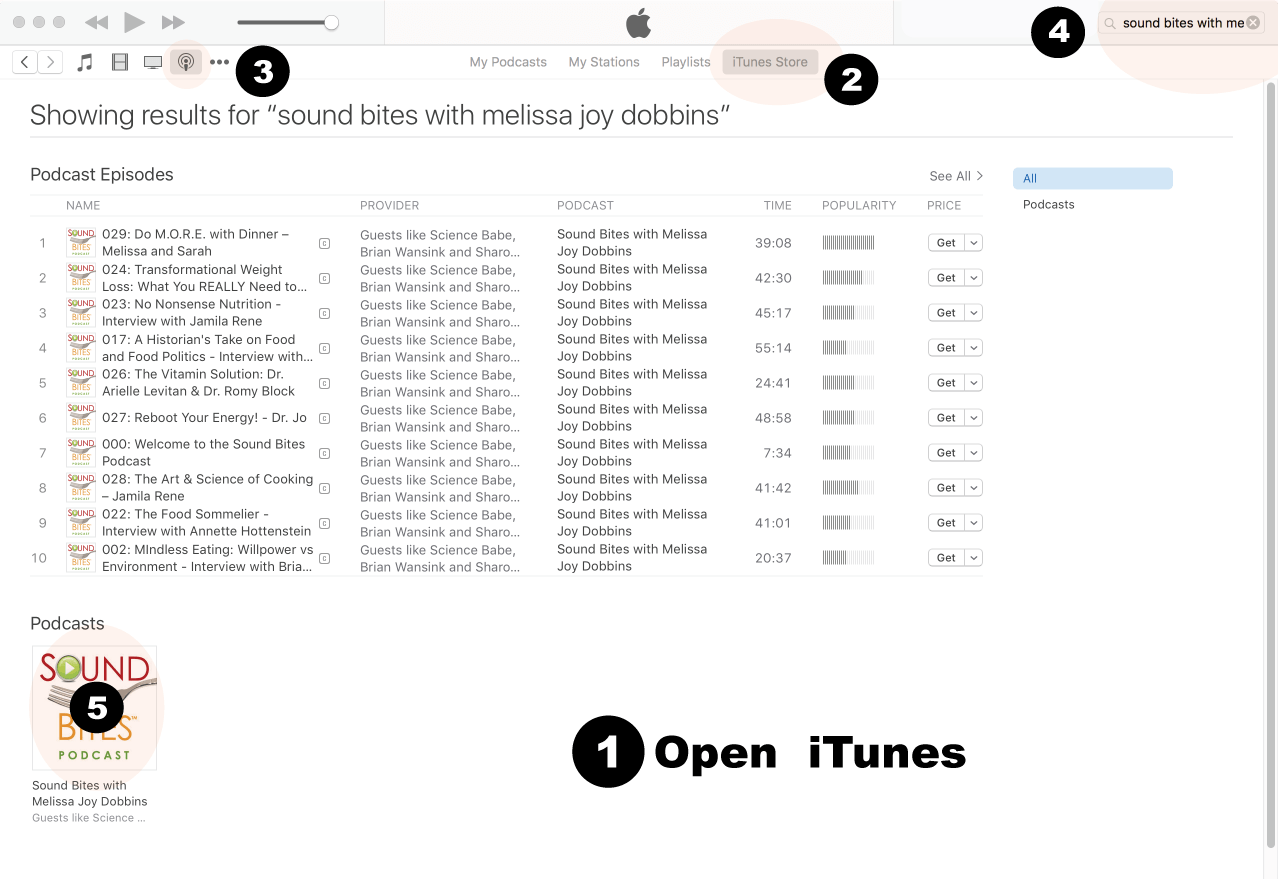
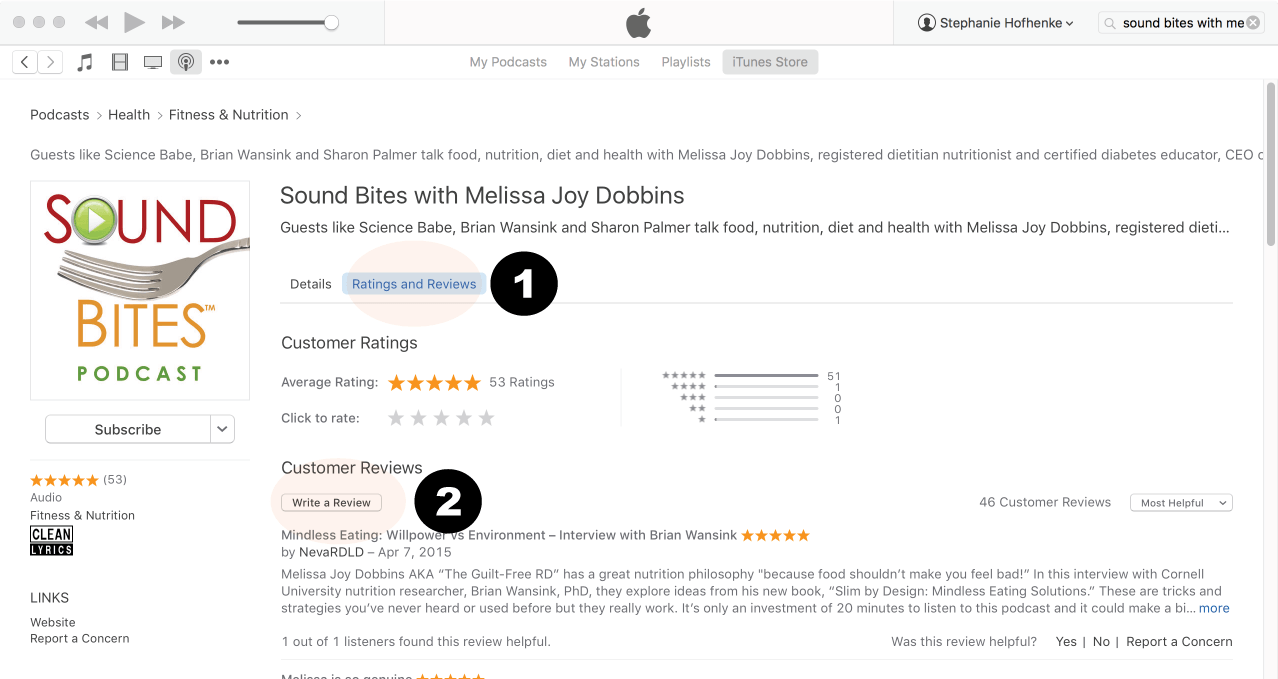
How to Review in iTunes
Open iTunes desktop application
Click iTunes Store
Click on Podcasts
Search for “Sound bites with Melissa Joy Dobbins”
Click on podcast image
Search for Sound Bites podcast in iTunes
Click Ratings & Reivews
Click Write a Review
View reviews and write your own review.
Write your review…. Thank you!
Write your review!
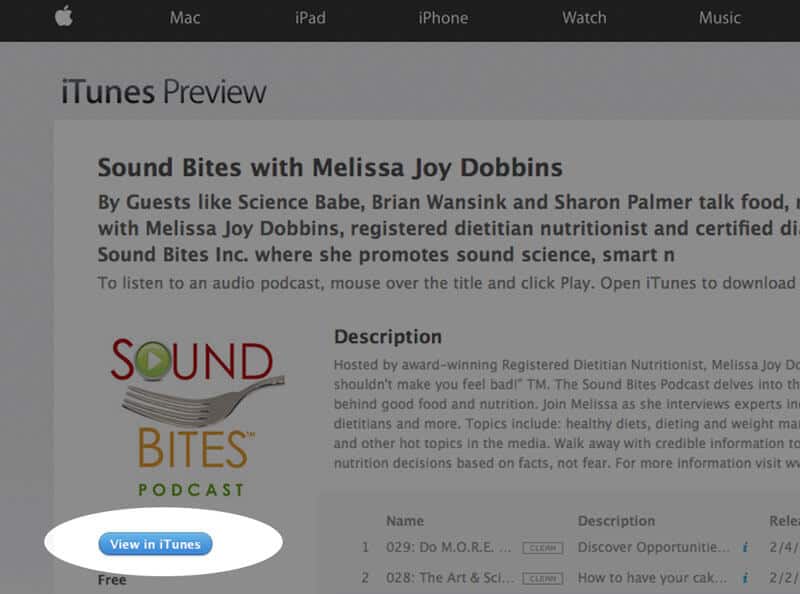
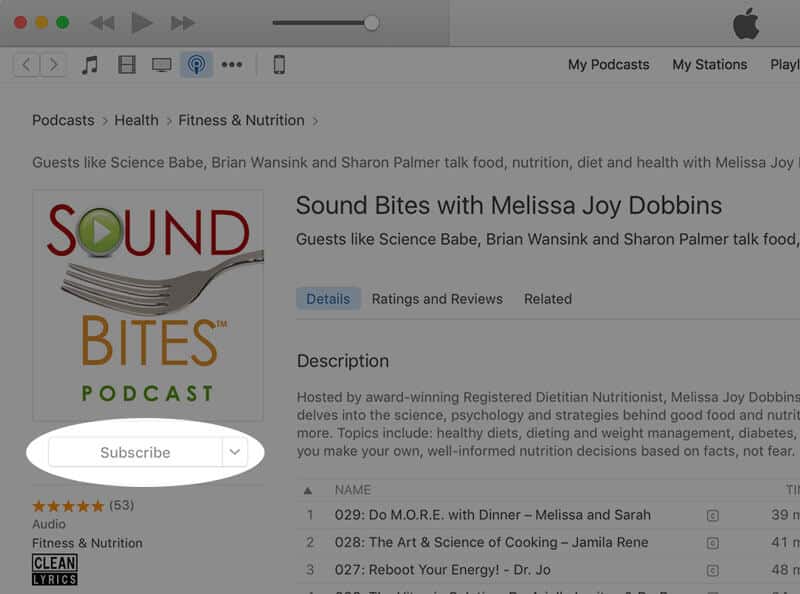
How to subscribe via iTunes
Click here to view the Sound Bites Podcastin iTunes, then click the blue “View in iTunes” button. This will open your iTunes application directly to Sound Bites Podcast. Click the “Subscribe” button, and your done!




 Dr. Mohr is an internationally recognized subject matter expert and speaker around nutrition and well-being. He was on both the Men’s Fitness Magazine and Men’s Health Magazine Advisory Board and has worked closely with some of the largest food companies and corporations including Deloitte, Delta Airlines, Johnson & Johnson and more to help navigate the intersection of science and application among consumers. His expertise has resulted in him presenting at the White House and CIA, in over 10 countries globally and in most of the 50 states in the U.S. Dr. Mohr is a sought-after expert who has appeared on a variety of TV shows, contributed to the USA Today and Wall Street Journal among others. He is an above-average pizza maker with waning professional chef aspirations.