Celebrating over 1 Million Downloads and 50,000 Free CEUs on the Sound Bites® Podcast | NEW: Get 1 years’ worth of CEUs with the new 15-CEU Podcast Course
Click here to earn 1.0 FREE CEU for listening to this podcast episode!
Disclosure: This episode is sponsored by the American Pecan Council and Mary Ellen Phipps is a paid spokesperson for the American Pecan Council
Blood Sugar Management: More Than Just Carbohydrates
Blood sugar balance and managing diabetes is not about what foods you need to eliminate.” – Mary Ellen Phipps
Blood sugar management is crucial for people with diabetes, and balanced meals and snacks are key for people with diabetes, prediabetes and even those at risk for diabetes. Many people think carbohydrate foods and sugar are the only dietary factors involved, and often focus on what to limit or eliminate from their diets in order to manage blood sugar. The truth is that incorporating other important nutrients into your meals and snacks can actually have a positive impact on blood sugar management.1
Tune into this episode to learn about:
Mary Ellen’s background in nutrition and living with type 1 diabetes
Different types of diabetes and who is at risk
Why blood sugar management is so crucial
Blood sugar fluctuations or “spikes” in people without diabetes
The role of continuous glucose monitoring (CGM)
Why carbohydrates have a larger impact on blood sugars than protein or fat
Three key nutrients for blood sugar balance
How to add certain foods to your diet to help balance blood sugars better
Common questions or confusion about blood sugar management
How to plan for balanced snacks
Tips for munching mindfully
Resources for the public and health professionals
You will have more success managing your blood sugar by focusing on what you add to your diet rather than focusing on what you cut out.” – Mary Ellen Phipps
Mary Ellen Phipps, MPH, RDN, LD
Mary Ellen Phipps is the cookbook author and registered dietitian behind milkandhoneynutrition.com. As someone who’s been living with type 1 diabetes since she was 5 years old, she strives to combine personal experience and professional expertise into relevant and relatable diabetes education available for free online. Mary Ellen received her Bachelor of Science in Nutrition Sciences from Baylor University and her Master of Public Health in Epidemiology from the University of Texas School of Public Health, where she also completed her dietetic internship. You can find her on social media (@milknhoneynutrition on Instagram and @diabetesnutritionist on TikTok) and traditional media helping bring joy back to life and the kitchen for people with diabetes. She is the author of The Easy Diabetes Cookbook (2021), and The Easy Diabetes Desserts Cookbook (2022), and a contributing writer, recipe developer and content expert for WebMD, CNBC, and other leading health and wellness organizations.
Diabetes Meal Planning from Center for Disease Control and Prevention. November 3, 2022. https://www.cdc.gov/diabetes/managing/eat-well/meal-plan-method.html
Liu, X. et al. Changes in nut consumption and subsequent cardiovascular disease risk among US men and women: 3 large prospective cohort studies. J. Am. Heart Assoc. (2020) doi:10.1161/JAHA.119.013877.
Barber, T. M., Kabisch, S., Pfeiffer, A. F. H., Weickert, M.O. The health benefits of dietary fibre. Nutrients (2020) doi:10.3390/nu12103209.
O’Neil, C. E., Nicklas, T. A. & Fulgoni, V. L. Tree nut consumption is associated with better nutrient adequacy and diet quality in adults: National health and nutrition examination survey 2005–2010. Nutrients (2015) doi:10.3390/nu7010595.
[00:00:00] VO: Welcome to Sound Bites, hosted by registered dietitian nutritionist Melissa Joy Dobbins. Let’s delve into the science, the psychology, and the strategies behind good food and nutrition.
[00:00:22] Melissa: Hello and welcome to the Sound Bites Podcast. Today’s episode is about the blood sugar roller coaster, specifically how to manage blood sugars when you have diabetes or prediabetes by what you are adding to your diet, not what to take away. We will discuss three important nutrients for blood sugar balance, and also address prediabetes and people at risk for diabetes and what you should know about blood sugar balance.
My guest today is Mary Ellen Phipps. She’s a registered dietitian, content creator and cookbook author, living with Type One Diabetes. Welcome to the show, Mary Ellen.
[00:01:00] Mary Ellen: Thanks for having me. I’m excited to be here.
[00:01:02] Melissa: It’s good to see you. Before we jump into today’s topic, I want to let our listeners know that this episode is sponsored by the American Pecan Council, and we are submitting this episode to the commission on dietetic registration for one, free continuing education unit for registered dietitian nutritionists, dietetic technicians registered, and certified diabetes care and education specialists. So if that is of interest to you, stay tuned for that. You can always check my free CEU page at soundbitesrd.com/freeCEUs to see what episodes are currently available. Now, Mary Ellen, I’m so excited to have you on the podcast.
We’ve had the opportunity to work together recently on some projects, and I’ve really enjoyed getting to know you. And I’m looking forward to your insights. But first I would love for you to share more information about your background and the work you do, and any disclosures to note. And I understand that you are under the weather today. You have strep throat, you’re such a trooper! So thank you for sticking it out and talking with me today. I’m really happy that you’re here.
[00:02:10] Mary Ellen: Yes, I’m so excited to be here. I do sound like I have a little bit of a frog in my throat.
But we will be good. I’m really excited to get to chat today. As you mentioned, I am a spokesperson for the American Pecan Council, as well as several other brands and entities, and if any listeners have questions about that, they can always check out MilkAndHoneyNutrition.com. But as you said, I’m a registered dietitian who also happens to be living with Type one diabetes, so there’s a lot of overlap and crossing paths that happen there.
But I started MilkandHoneyNutrition.com about seven years ago, and it’s really just been this great outlet for getting to talk to the diabetes community and my whole goal is to bring joy back to the kitchen for people with diabetes and joy back to life. Cuz I’ve been living with type one since I was five years old, so that’s 31 plus years. You can do the math, figure that out.
But I really strive to combine my personal experience and professional expertise into relevant, but more importantly relatable, diabetes education. So I think it helps that people understand that, you know, I know what it’s like, I know what it feels like.
But I did my Bachelor in nutrition sciences a long time ago at Baylor University, and then my Masters of Public Health in Epidemiology from the University of Texas School of Public Health here in Houston. That’s where I currently live, and I also completed my dietetic internship there. You can catch me on pretty much any social media platform, and I have written two cookbooks.
The first one is the Easy Diabetes Cookbook, and the second one is the Easy Diabetes Desserts Cookbook. One of the things I love about my publisher and the way they let me do this is they kind of are like sister books. They’re very similar in like the layout and the design and kind of the overall cohesive look.
One is just all different types of recipes. One is specifically desserts.
[00:03:57] Melissa: Fun. So that’s your most recent one is the desserts one, and it was sort of like a follow up to the first one?
[00:04:01] Mary Ellen: Yes. So I was fortunate enough the first cookbook did really well and they were like, hey, do you wanna do another one?
And it was pretty soon after that one. So I was like, yes, but only if it’s like my favorite food category, which is desserts cuz that’s.
[00:04:13] Melissa: Oh funny.
[00:04:13] Mary Ellen: Going back to wanting to bring joy back to people with diabetes. That’s definitely one of those categories where people, I think they just get a little sad after a diagnosis or finding out that they’re at risk for diabetes.
Because they feel like it’s something they can’t have. Or maybe that they’re now destined to only have to have something that’s sugar free or something like that. So it’s a great opportunity to bring some happiness back to the kitchen.
[00:04:34] Melissa: I love that. And Joy’s my middle name, so I love it even more, but I really Love how you talk about being relatable because I’ve watched your Instagram posts and reels and you are very relatable and I just love listening to you.
So you talk so naturally and share. You know, I think one of the most recent ones I saw was how you were having a couple of bad blood sugar days and you’re just keeping it real. I think that’s just wonderful and yes. There is a lot of sadness and fear. I often talk more about the fear, but I appreciate you bringing the topic of sadness to diabetes, pre-diabetes at risk for diabetes.
I think, you know, I’m a certified diabetes care and education specialist and I have been for 25 years, and so I’m really happy that we’re gonna be talking about this topic and diabetes on the podcast again today because it’s been a while since I’ve talked about diabetes on the show. I appreciate learning a little bit more about your background and you said you were diagnosed when you were five.
But before we jump into the topic a little bit more in depth, could you share a little bit about your diagnosis story? And obviously as the conversation continues, I’m sure you’ll be able to Kind of weave in or comment, how your personal and professional experiences again do kind of dovetail.
[00:05:50] Mary Ellen: Yeah, absolutely. So anytime I tell my diagnosis story, I feel like I have to tell like my family’s story as well. Cause we have a very strong genetic component for type one diabetes in our family. So, yes, I was diagnosed at five, but prior to that my aunt, my mom’s sister, was diagnosed about 10 years before that. She was what we probably now would know as LADA, but initially misdiagnosed as type two, then figured out it was type one.
And then a few years later, my mom had actually just found out she was pregnant with me. And, was going about normal life. But it came time for her glucose tolerance test. And they were like, oh, you have gestational diabetes, which was odd because she had no risk factors. And, you know, it was the eighties, so things were a little bit different, but they were like, okay, well, immediately needed insulin again.
Another kind of thing that was like, eh, something’s off here. But she went about, she was super strict with what she ate. She took her insulin as needed, pretty much her entire pregnancy. Like she loved desserts. She was craving ice cream, but just wouldn’t have it. So the kind of ironic part of the story is she gives birth to me.
They had told her once you give birth, you’ll be good. You can go back to eating like you would otherwise. So she told my dad, she was like, I want ice cream. Like, get me some ice cream. And so he went and got her this,I don’t know, this big ice cream thing, brought it to her in the hospital. She devoured it and her blood sugar went through the roof.
And so they were like, eh. Yep. This is something else. This is type one. And so that had happened with my aunt and then my mom. And then right around the time I was about five years old, they noticed that I was losing weight. I was wetting the bed again. All of a sudden, young girls, we sometimes will see like yeast infections and other sicknesses.
And so that was starting to pop up. And my mom knowing probably full well what was happening, tested my blood sugar at home. And so this is where I consider myself very fortunate that I didn’t end up in DKA or anything like that, because they knew what to look for cuz we had such a strong family history.
And she tested my blood sugar and it was like over 300. So she calls the pediatrician and the pediatrician’s like, eh, you’re just being paranoid. So full on mama bear mode. She marches herself up to the pediatrician’s office without an appointment, tests my blood sugar in the office. And they were like, okay, yes, take her. Take her to the emergency room.
And so it kind of went from there. And then we had a long period of no diagnoses. And then, my brother. I have a younger brother who does not have type one, but his little boy was diagnosed, a couple years ago as well. So we’ve got a very strong family history happening there.
[00:09:10] Melissa: Wow. Well, thank you for sharing your story and your family’s story. I always find it fascinating and just love getting to know more about you. And coincidentally, I worked at a maternal fetal medicine clinic, about 10 years ago was it? So yeah, I got to see gestationals, a lot of gestationals but also type ones and also, yeah, type twos.
So all very different. Which kind of leads me to my next question. Let’s start with some information about diabetes, pre-diabetes, at risk for diabetes. Just very top line for people listening as a refresher, or maybe they’re not aware of the differences.
[00:09:44] Mary Ellen: Right. So type one diabetes, which is what I have and my family members, is an autoimmune condition where basically the most simplified version is your body’s immune system attacks the cells in the pancreas that produce insulin, which is basically our body’s way of digesting carbohydrate.
And so it usually comes on anywhere. Noticeable symptoms from when we notice them to when we have full destruction of the pancreas, for lack of a better way to say it, or of the beta cells, three to six months. It’s a very rapidly developing condition. And now we also have LADA, which is a form of type one, which is a slower development of type one.
But it’s still the same thing where we’re not dealing with type two, where it’s a more gradual type. One is a very rapid onset. People who are at risk of this are people with a strong family history. Certain viral infections can put you at risk for type one, later on down the road. And then any sort of history of other autoimmune conditions. So like celiac disease or rheumatoid arthritis and things like that, that kind of fall in that autoimmune category, you can tend to see people with multiple conditions there.
But then you have type two. Which is a very gradually progressing disease that has multiple possible causes. Everything from modifiable factors to things that we have no control over. I think a lot of people assume, mistakenly so, that type two is just because you didn’t eat well or you didn’t exercise enough, and it’s just not true.
I think we are making progress to change people’s mind on that, but it’s definitely still an uphill battle. But pre-diabetes and type two diabetes are essentially the same condition, but it’s like a timeline. It’s a progressive timeline as you mark your way down. I describe what’s happening to the pancreas with pre-diabetes and type two diabetes is almost like an engine.
It’s having to work a little bit harder in the beginning and then a little bit harder, and a little bit harder, and a little bit harder until you get to the point where part of it starts to not function. And so we start with this Insulin inefficiency. As we move further down, we get to basically insulin deficiency.
Different causes. Different methods of treatment. But when it comes to nutrition and our end goal, we’ve got a lot of similarities as well. And that’s one of the things I like to talk about. Cuz unfortunately in diabetes culture there’s a lot of like type one versus type two mentality, which that could be a whole other podcast episode.
[00:12:08] Melissa: Yes. You’re booked. I’m having you come back on, talk about that. Okay. Yes.
[00:12:12] Mary Ellen: At the end of the day, anyone with diabetes, regardless of the type, is we’re trying to balance blood sugars, maintain stable blood sugars as often as we can. That’s what we’re trying to do. And the dietary strategies for that are not all that different.
[00:12:25] Melissa: Okay, great. I’ve never heard it explained quite that way. It’s very interesting. I love hearing your insight on that and the diet is very, very similar. And you could obviously weigh in on this. I mean, there are some things with type one with if you require insulin and if you’re on a pump and things like that, that gotta get a little bit more into the carb counting or, you know could help you. I shouldn’t say gotta. Everything’s different for different people. But maybe a little bit more math involved in that. But yes, the goal, like you said, is to keep those blood sugars managed as well as possible. So I’d love for you to explain a little bit like why are managing blood sugar is so crucial.
If you could speak to the consequences or the complications that we’re trying to avoid.
[00:13:10] Mary Ellen: Yeah, so essentially blood sugar management matters because chronic high blood sugars or rapidly changing blood sugars can lead to inflammation and tissue damage that essentially ages us quicker. I always tell people, and I’ll use myself as an example, I started to get gray hair at 16.
Because I’d had diabetes and it was pretty decently managed, but it was just the nature of the disease. So on the outward signs, that would mean like maybe wrinkles earlier than you would expect or things like that. But then you flip that and you think about, okay, on the inside that can happen as well.
Tissues can start to degrade. You can start to see signs of excessive inflammation, that basically are just aging us faster. This happens in the blood vessels. That happens in the organs. And the more often we can reduce high blood sugar and prevent those rapid changes, and that’s where we get into talking about blood sugar friendly eating and slowing down carbohydrate absorption, which I know we’re gonna talk about.
We wanna prevent those long-term complications. And then for the short-term complications, it’s simply wanting to feel your best because having a low blood sugar or having a high blood sugar does not feel good.
[00:14:17] Melissa: Great. Quality of life. And even if, I know sometimes in diabetes people get hypoglycemia unawareness.
Maybe before they’re diagnosed, they kind of get used to the high blood sugars or it happens so gradually and maybe they don’t feel it, but then when they get the blood sugars in the more goal range, then they notice how bad they were feeling and how much better they were feeling now.
And I would love to clear something up before we talk further about these key nutrients for blood sugar management and carbohydrates and things like that, because we’re seeing a lot of trending social media activity, if you will, about people without diabetes using continuous glucose monitors, those CGMs. You know, they’re biohacking their blood sugars cuz they’re saying they’re spiking and crashing. So I would love to hear your take on, are blood sugar fluctuations a problem for people without diabetes or pre-diabetes and/or what do people who are, might be at risk for diabetes? Where do they come into play with that?
[00:15:21] Mary Ellen: Yeah, so I could get on a soapbox for a long time about this as someone who has to wear one. But at the end of the day, if you don’t have diabetes or you’re not at risk for diabetes, your pancreas is doing its job. Some blood sugar fluctuation is a normal physiological response to food and stressors and your environment around you. And it’s not anything to be worried about because again, it goes back to the speed at which blood sugar is changing. And so for a person who has a fully functioning pancreas, there are gonna be changes. That’s normal physiology, but they’re very slow, gradual changes. I’m doing my hand here, like the listeners can see me.
And then when you get into someone with diabetes, that’s when we have more volatile, changing blood sugars and we really can use the assistance of a CGM to help manage those. Now there certainly are situations for people without diabetes who maybe have some other medical reason that blood sugar is impacted.
Melissa: Yeah, and I’m not trying to bash people who are into that or whatever. But you know, you mentioned the sadness and the joy, and I oftentimes go back to the fear factor. So I don’t want people to feel like that’s something that they have to do and that that’s something that could be life changing for them if they don’t have diabetes.
I don’t think it’s necessarily a healthy thing for people to get so hyper focused. In full disclosure, I did use one for two weeks and I was like, um, yeah, so I just had the perfect lunch and it went up a little bit, but it was normal and I just thought I can’t eat any better than a perfect lunch. I won’t get into all the details cuz we’re going off, I’m going off on a tangent here, but basically I don’t want people to feel like they need to do that. And that if they don’t have diabetes, they don’t have issues with their blood sugar, that they need to do that and that it would be helpful for them.
So, my little soapbox as well. Okay. Let’s talk about carbohydrates. It’s no secret. Carbohydrates impact our blood sugars more than other macronutrients like protein and fat. But a lot of people, again, I’m going back to the fear factor. A lot of people are afraid of carbohydrates and they think they’re bad, and so I would love to address that as we start talking about macronutrients.
[00:17:53] Mary Ellen: Yeah, absolutely. Carbs have clearly gotten a bad reputation in today’s food culture and media. But I think a large part of this is people assume because diabetes impacts carbohydrate metabolism, that somehow carbohydrates are what caused it. And that’s a complete fallacy and it’s just not the case.
It’s really important to remember that carbs and then the nutrients that come along with them. So this is your micronutrients, your protein, your fat. They contribute to overall health, energy levels and metabolism. And just because you have diabetes doesn’t mean you shouldn’t be eating them. Or because you’re at risk, it doesn’t mean you should be avoiding them.
Foods with carbohydrates offer so much more than just the carbohydrates. And it’s important to remember that, that they come with a wealth of other nutrients that we need to have access to.
[00:18:42] Melissa: I really like the way you put that about because diabetes impacts carbohydrate metabolism. Then people just assume the carbs are to blame.
And going back to being diagnosed with diabetes or what causes diabetes, like you said, a lot of people think, well, you ate poorly or you ate too much sugar. And the sugar you ate caused the diabetes. So that’s very interesting. And yeah, carbohydrate foods come with other nutrients like protein and fat.
You know, a lot of carbohydrate foods are a combination, like milk, is carbohydrate, which is the lactose or the milk sugar. It’s got protein and it has varying amounts of fats. You know, it’s fat-free milk, whole milk, 2%, and so on. So that’s a really good point.
[00:19:25] Mary Ellen: Yeah. And we can also talk about like a serving of pecans, which is like 19 pecan halves.
Not only has three grams of plant-based protein and three grams of fiber, but it has seven milligrams of gamma tocopherols, which is an antioxidant. They’re a good source of thiamin and zinc and an excellent source of manganese and copper, so there’s so much more than just one nutrient coming along in this food. They also have 18 grams of unsaturated fat, 12 of which are the mono unsaturated fats, which help with lowering LDL cholesterol levels and only two grams of saturated fat.
[00:20:00] Melissa: This is the exact reason we encourage people to get nutrition from food first and then supplement. Food provides a lot of nutrients, and especially nutrient rich foods.
So from both professional and personal experience, I know that restriction and deprivation don’t work. And so when I talk to my audiences, I try to reassure them that they don’t need to be restrictive. Deprivation is probably not gonna be their friend, but I would love to hear your approach to including certain foods and nutrients for this blood sugar balance versus what to take out.
[00:20:37] Mary Ellen: Yeah, so the first thing I always try to tell people to focus on is focus on what to add to your, you know, meals and snacks and not what to take away. Because I think if we look at old school diabetes education, it was like, you can’t have this, this, and this. And you gotta eat this. When in reality, you can still enjoy all of your favorite foods while living with diabetes.
We wanna strive to have fat, fiber and protein in each meal and snack and just not eat carbohydrates by themselves. I think that’s the simplest way to describe it. You know, a great example is enjoying your favorite fruit. So many people with diabetes and listeners, you’ve probably encountered this.
People with diabetes think fruit is off limits or that it’s gonna spike blood sugar. But the reality is they just need to pair them with a fiber and a protein source. So you know, next time you wanna enjoy a banana or an apple, you can try pairing it with a serving of pecans. Pecans are perfect for that on the go snack that you can enjoy pretty much anytime and anywhere. So it goes great with super portable fruit options as well.
[00:21:40] Melissa: Excellent. Thank you. So can you explain exactly how, including fat, fiber, and protein at a meal or a snack works?
[00:21:48] Mary Ellen: Our bodies digest carbohydrates the quickest, and so by adding in fat, fiber and protein, which take longer to digest than carbohydrate, we’re essentially slowing down how quickly our bodies can digest carbohydrate.
And this promotes more stable blood sugars after you eat. Because if your body is digesting carbohydrate really rapidly, it’s gonna raise blood sugars very quickly. Again, that goes back to wanting to decrease the speed, not have blood sugars changes rapidly. But if we’re slowing down that digestion, we’re gonna get a more blunted curve.
If you think about a curve on the graph of your blood sugar, we want a more blunted curve and not just this rollercoaster look to it. The more the side that we as human beings can actually feel is a more steady blood sugar response, also means a more consistent supply of energy. You feel less tired, you feel more satisfied.
[00:22:40] Melissa: Oh yeah, that’s a great point. I mean, I know that and it makes sense, but when the blood sugar’s changing quickly, that’s when we don’t feel great.
[00:22:47] Mary Ellen: Yeah, absolutely. And going back to our example with nuts, they can be a great tool to help with this and thus includes pecans. Increasing your consumption of nuts like pecans can contribute to not only improved diet quality, cuz remember we’re talking about those nutrients that come along with food. It’s not just a nutrient in isolation. They make a convenient nutrient dense option as part of an overall balanced diet. So another example would be instead of having crackers on their own, you pair them with that serving of pecans. Again, that’s about 19 halves. Again, we get three grams of fiber and three grams of plant-based protein.
[00:23:25] Melissa: Great. What do you find, or what do you hear that people are either most confused or most curious about When it comes to trying to balance their blood sugars?
[00:23:36] Mary Ellen: I think a lot of the time people just assume it’s just about sugar or it’s just about carbohydrate. They forget or they don’t realize that our other macronutrients, fat and protein also play a role.
This is actually a concept I cover pretty in-depth in that second cookbook, the Easy Diabetes Desserts Cookbook. Because the gut reaction when somebody hears like, we’re gonna make a dessert more blood sugar friendly is they assume we’re just gonna pull some of the sugar out. And I’m like, actually you don’t have to.
There’s a whole lot of other ways that we can make a dessert more blood sugar friendly, and they don’t involve touching the sugar at all.
[00:24:10] Melissa: Interesting. Very cool. Yeah, there’s a lot of science in the baking aspect. Whenever I talk to people about, you know, sugar reduction in baked foods, I’m like, it has a function. You can only do so much because it’s not just flavor. It’s got the browning and the crispiness and things like that. So that’s really cool. What have you seen or heard about registered dietitians, either their knowledge or maybe needs or gaps in knowledge regarding how to help people with balancing their blood sugars?
[00:24:40] Mary Ellen: I think a lot of dietitians, in the space, at least that I know, are saying the same thing. They’re trying to get consumers to look at the bigger picture. But if we’re being honest, the concept of balance and moderation, they’re just not as appealing to the consumer as, you know, sensationalist headlines and the, all these lofty promises from celebrities and online personalities.
So I think it’s important for dietitians to focus on key, maybe, I don’t wanna say problem areas, but I don’t know how else to describe it. Like a key point in the day for people. And so snacking is a great one to focus on. Everybody loves a good snack. So one way healthcare professionals can help their clients is to really teach the importance of balanced snacking.
Snacking is that area that a lot of people are interested in, we all eat snacks. Most people eat up to like three snacks a day.
[00:25:31] Melissa: Wow.
[00:25:31] Mary Ellen: And that’s totally normal if you’re following your hunger cues, which is really important to do. So when we talk about a balanced snack, in addition to being mindful of the portion size, which is kind of what we have to think about, at least with regards to managing blood sugars within diabetes or pre-diabetes, but what makes a balanced snack?
What nutrients do we want people to include in there? And so I know in my work, personally, and what I choose to recommend is I want people to have some sort of carbohydrate food along with a protein source. Preferably that carbohydrate food has a decent amount of fiber in it as well. So, we’ve been talking about pecans and a serving of pecans and a serving of a carbohydrate food are kind of the perfect pairing.
Because pecans only have about four grams of carbohydrate per serving. Three of those grams are fiber, which helps keep you full. And then they also have three grams of plant-based protein per serving. So when you pair, maybe your favorite carbohydrate, we talked about crackers, we talked about fruit.
You’ve also got oatmeal. If we’re looking at more of like on the breakfast side of things, but there’s a lot of different combinations you can do there if you’re focusing on a protein food, and a carbohydrate food.
[00:26:45] Melissa: Okay, great. Cause I know, you like to say every time you eat, whether it’s a snack or a meal, try to have fat.
Well you don’t say try. You said make sure to have fat, fiber and protein on your plate, and I assume that also means with carbs too.
[00:27:01] Mary Ellen: Yes, yes. Where the carbs tend to fall into place, like starches or sugars. People generally don’t have a hard time including those, but it’s more combining those other nutrients, the fat, fiber, and protein.
Adding them in. Again, going back to getting out of the restriction mindset, if you can tell someone, Absolutely, you can have a bowl of pasta, just don’t eat it by itself. Let’s add a plant-based fat source in, let’s add a protein source. Let’s add some fiber, like some fiber rich vegetables on top.
There’s a lot more potential there. And getting more into the psychology side of it. There’s a lot more confidence that comes from showing people how to enjoy the foods they love, rather than telling them, Nope, you gotta go eat this over here.
[00:27:46] Melissa: Right. Absolutely. It’s really, not hard at all when you’re grabbing for something, at least myself, that it typically will be some sort of carbohydrate.
And so to stop and think, okay, does this carbohydrate have some fiber? If not, is there something I can add that has fiber and then the protein and the fat? And you know, we haven’t talked too much about this, so I’d love for you to talk a little bit more about this. A lot of people say what? Adding fat? You know, that’s gonna add calories.
And I know obviously we want heart healthy fat. How do we get people to think, okay, I’ve got some carbs. That was easy. Let’s look at fiber, protein, fat, and not be afraid of adding fat?
[00:28:28] Mary Ellen: Right. So I was a child of the eighties and nineties where the fat-free message was sent very, very loudly.
That’s very hard to break that, and I think we still have a lot of people today who still think that way. And the place where heart healthy fats come in is to really help increase satiety and fullness. And really trying to get people to think about, what’s gonna help my body feel the best? And you have to be kind of careful with, especially in type one diabetes, large, large amounts of fats where we’re looking at more than like 30 grams per meal can have negative effects. But a very rational amount, less than that, is actually really good for helping you have higher energy levels, helping you stay full for longer and really contributing to overall wellness.
[00:29:16] Melissa: Yeah. When you’re talking about the large amounts of fat for type one, I’m thinking pizza is always challenging, but delicious.
[00:29:23] Mary Ellen: Yeah.
[00:29:23] Melissa: So then can we talk about some snack ideas and examples, like maybe some common snacks and how they stack up? Or how to build a better snack.
[00:29:35] Mary Ellen: Absolutely. So this idea of pairing foods together that we’ve talked about this whole time, it’s really easy for me to say let’s pair some protein and fiber rich foods with carbohydrate foods, but without giving examples, it’s kind of lost in the shuffle. So I have a list of like several snacks that I like to turn to and recommend to people both for myself and for other people. The first one would be, you know, super trendy right now. And for the last few years is avocado toast. It is actually a very well-balanced meal filled with lots of different nutrients.
You can choose your favorite kind of bread, preferably like a more fiber rich whole grain bread. And then you’ve got nutrient rich avocados we talked about like milk and pecans earlier. More than just maybe the nutrient they’re known for. There’s so many other things that come along with it, and avocados are another example of this.
So I think most people tend to think of plant-based fat., That’s what you would eat them for, when in reality they also offer fiber, potassium, certain carotenoids, like they’re a really great opportunity to add some more nutrition into your snacks.
[00:30:38] Melissa: Mm-hmm. Yeah. And a lot of people aren’t thinking about the fiber that they provide, but for sure that it’s very popular.
Love my avocado toast.
[00:30:46] Mary Ellen: Yeah, me too, for sure. The next one would be my blood sugar friendly take on trail mix. And so instead of doing the traditional trail mix that’s loaded with dried fruit and candies, at the grocery store, you can actually start with a base of popcorn. That you can make at home, you can pop it the microwave, however you wanna do it.
I like to take like a cup of popcorn and then I’ll sprinkle in, maybe a tablespoon of some chocolate chips or low sugar chocolate chips, and then a serving of pecans, those 19 halves of pecans. And you mix that together and those three kind of flavors together, you’re getting fiber, you’re getting protein, and you’re getting also like the palatability of a good snack, like that crunch, that texture.
It just makes for a really pleasurable eating experience, maybe in the middle of the afternoon.
[00:31:29] Melissa: Oh, I love that. And I feel so proud of myself because we just started making our own trail mix because, let’s face it, it’s more cost effective to build your own and then you can put whatever you want in there that you like.
And it dawned on me that adding popcorn would be a nice addition. So we started doing that and did also like the little chocolate chips. So I love that. Absolutely.
[00:31:53] Mary Ellen: And then the third one I have is pretty classic. And we kind of touched on this a little bit briefly earlier, but just fruit and cheese.
You can’t get more simple than that, whether you’re at home or you’re on the go, combining a piece of fruit, which again, comes with all of these other nutrients besides just carbohydrate, and cheese. You’ve got protein and you’ve got fat in there. And so they’re kind of that like classic combo.
And again, the possibilities are endless with types of fruit and types of cheese. . If you wanna get fancy and have like a little charcuterie board, if you will. But yeah, that’s a another example and. Another example would be, if you want a pre-packaged something like, cause we all live very busy lives, is like a higher fiber bar or protein bar. But this is also a good lesson in knowing how to understand that nutrition label. Because I think a lot of people get confused when we talk about fiber versus different types of carbohydrate. And so it’s important for consumers to know, like when you look at a food label, you’re gonna see a total carbohydrate number, but carbohydrate isn’t just one type of carbohydrate.
There’s sugars in there, both naturally occurring and added sugar. You’ll see that added sugar line on the food label as well, as well fiber. And those are added sugar. Sugar and fiber are what get listed on the food label. And then obviously, we’ve got different kinds of starches that don’t get listed in detail on the label, but those added sugar, fiber, and sugar, those are types of carbohydrate that are included in that total carbohydrate number.
So I always tell people, if you’re picking a pre-packaged food like a bar that I said. You want to look at like how much of that carbohydrate is sugar? How much of that carbohydrate is added sugar? How much of it is fiber? Obviously, if a greater percentage of that total carbohydrate is fiber, you’re probably gonna see a better blood sugar response most likely.
[00:33:42] Melissa: Yeah. So let me ask you about that real quick, because I personally, when the added sugar revision came out where they were listing that on the label, just the diabetes educator in me was like, ah, I think this is going to get confusing for people. So I’m sure it probably depends on the person and how much math and their numeracy literacy that we talk about, a lot when we’re talking about label reading.
But the simplest way is kind of what you just ended with was the more fiber within that total carbohydrate the better. Right?
[00:34:10] Mary Ellen: Right. Absolutely. And that’s why like when people ask for, well, how much fiber should I have? And how much sugar is okay? Well, it’s kind of relative. We have set guidelines from organizations like the American Diabetes Association and things like that.
But with regards to individual foods like that, it’s all in the greater context. You’re looking at how much fiber is in there, also, how much protein is in there also. And the thing I like to say too about the added sugar component is we wanna minimize that as much as possible, but having a teeny, like a small amount is gonna be fine.
But when you get more added sugar, that means you’re adding an additional sugar that doesn’t have these other nutrients We talked about like, sure, fruit has naturally occurring sugar, but it also has all these other great nutrients that come along with it. When you’re putting in added sugar, you’re just putting in sugar. You’re not usually putting in additional nutrients.
[00:34:55] Melissa: That’s a great point. I really like it that way because I tend to take a step back. I can say you can look at the total carbohydrate and also compare. So let’s say you’re comparing two bars, which one has more fiber? Which one has less added sugar?
And what are the total carbohydrate amounts, like to kind of take the guilt factor out? You can have those added sugars, but to your point, just know that they’re not coming with those additional nutrients.
[00:35:19] Mary Ellen: Absolutely. Yeah. And my last example is just like a typical container of like a lower sugar yogurt with a serving of pecans on top.
I’m big on texture and so I love the texture variety of like a creamy yogurt with crunchy pecans mixed up into it. And you’re getting, you know, protein and depending on the type of yogurt, some fat in there. And then you’ve got protein and fiber and fat coming from the pecan as well. And so again, makes another well-rounded snacking experience.
[00:35:49] Melissa: I like that texture thing too. Unless I have something crunchy with it, sometimes even just fresh blueberries on top of it or something with a texture. And the same with cottage cheese. I like adding something crunchy to it, or like salads or chicken salad.
That’s a great opportunity to throw in some pecans too. I just love that taste and texture.
[00:36:10] Mary Ellen: Absolutely. And I’m big on like the overall eating experience, and I think the texture variety is very mentally stimulating, whether we realize it or not, which can contribute to like how satisfied you are with a snack.
Do you get bored with it or is it actually like a fun eating experience?
[00:36:26] Melissa: Yeah. And just a quick note too, like if somebody’s counting carbohydrates, not everybody’s going to, and we talked about comparing the labels and so on, but with some of these snacks that you’ve recommended or that we’ve discussed, is there a certain, I don’t know, ratio. Like if for every one carbohydrate point or 15 grams of carbohydrate, would you recommend adding the 19 pecan halves, or is it like, even if it’s two servings of carbohydrate, you’re sticking with that one serving of 19 pecan halves?
[00:36:55] Mary Ellen: It depends on the person. I wish I could give like a set answer. But this is where it really becomes important for consumers to work, when we’re getting that specific, to work with a dietitian or a diabetes educator, one-on-one, to really determine what works for them. Cuz one thing we find when we get down on the individual level is some people respond better to larger amounts of fiber.
Some people respond better to larger amounts of protein. We know in general that this concept of fat, fiber, and protein can help promote balanced blood sugars, but how much of which and what combination, that’s definitely much more of an individualized thing, that I think warrants that conversation of sitting down one-on-one with a registered dietitian or a diabetes educator.
[00:37:37] Melissa: Yeah, great point. And, just one more thing about the fiber, since everybody has different needs, but when it comes to fiber, it’s pretty standard, you know, how much fiber we need a day. If we could talk about the goals for that, and then also because we talked about that a serving a pecans has three grams of fiber.
Just wanted to point out that that is considered a good source. It’s more than 10% of the daily value. So if you wanted to address anything more about those fiber numbers, that’d be great. Yeah.
[00:38:05] Mary Ellen: So you know, our standard recommendation is what, 25 to 30 grams of fiber? But if someone’s only getting down around 10 to 15 grams of fiber per day. I’m not gonna have you jump up. I think any dietician, we’re not gonna have ’em jump up to 25 to 30 super quick, because that’s gonna have some serious, uh, GI side effects possibly. So we’re gonna work on gradually adding that fiber in and snack time is the perfect way to do that.
Because you can add in these small increments, if we wanna just increase fiber intake by, you know, five grams a day, a serving a pecans get you more than halfway there. So it’s a really great opportunity to make those gradual increases.
[00:38:45] Melissa: Yeah. And I don’t have the stats in front of me, but we know that most people are not meeting their fiber recommendations across the board. I think when we think about getting more fiber, we might think about whole grains or, you know, high fiber cereal, or, maybe we think about produce, but oftentimes we forget about things like nuts and avocado, right? Or maybe we don’t even know that they have fiber in them.
So all of those few grams here and there really do add up. So I just wanted to put a finer point on the fiber conversation. So thank you.
[00:39:17] Mary Ellen: Absolutely.
[00:39:20] Melissa: Thank you. So as we’re wrapping up, what are your bottom line takeaways or recommendations for people who get the concept? My carbs are easy, I gotta start looking at fiber, fat, and protein. How can they get started making some changes and what’s your sort of parting advice on that?
[00:39:39] Mary Ellen: Again, focus on the overall healthy diet that is balanced with carbohydrates, protein, and fat.
All of our macronutrients, we’re not just looking at taking away carbohydrates or adding something else in. We’re looking at the overall picture. And include foods like pecans that offer fat, fiber, and protein with your carbohydrates. So say you wanna enjoy a bowl of oatmeal, like I mentioned, or cereal, add some pecans on top for that added blood sugar benefit of fiber and protein and plant-based fat. You can, I like to say, mindfully munch, if you will. Pre-measure your pecans before snacking or adding ’em to a recipe. Rather than just kind of eating them from the package, those 19 halves is considered a serving. Try to minimize distractions when you’re working or watching TV while eating.
I recognize that’s not completely avoidable, just given the nature of our lives, but try to be more intentional when you’re eating, and then follow your hunger cues with regards to snacking and meals, and when you feel hungry, stop what you’re doing if you can, and honor those hunger cues and then stop when you’re full.
[00:40:43] Melissa: Mm-hmm. Yeah, I think that’s really important. I think a lot of times we don’t honor the hunger cues, and I’m really glad that you brought that into the conversation. And we would also love if anybody needs more guidance to sit down with a registered dietitian who has some experience with diabetes and they can provide more advice on how to get more healthy fats, protein, fiber into their meals and snacks. But we’ve also got some great resources that we’re gonna share as I wrap up. But I also wanted to mention, cuz at the top of the conversation we talked about diabetes and pre-diabetes and also people at risk. I’d love for you to weigh on this, but my take is if you’re at risk for diabetes, eating this way is healthy for everybody and this may be able to help them have a healthy diet and delay the onset of diabetes for a longer period of time. Is that true?
[00:41:36] Mary Ellen: I think that can definitely be true for a lot of people. You know, if you know that you’re at risk for pre-diabetes or type two diabetes, eating a well-rounded, well-balanced diet is going to help you be as prepared as possible and potentially prevent or delay the onset of something that might happen down the road.
And I think it’s important to remember that we don’t always have control over a diagnosis like that, but if anything, it would prepare you for the best way to eat for a diagnosis like that. And I think for people who maybe don’t have any risk factors, it’s just an overall balanced way to eat.
Like you were saying, it promotes energy levels. It promotes happiness and joy. There’s a strong connection to blood sugar levels and mental health that we’re starting to see research on. So I think there’s a lot of factors there.
[00:42:22] Melissa: Thank you. Those are really great points. And as I mentioned, we have some great resources I would love for you to share. And you mentioned a couple of things at the top of the interview, but please share your website and your social handles.
[00:42:33] Mary Ellen: Yeah. So you can contact me or read about any of my work, check out some blog posts on milkandhoneynutrition.com. On Instagram, I’m @milknhoneynutrition. And then over on TikTok, I’m Diabetes nutritionist.
[00:42:47] Melissa: Great, thank you. And I’ll have all of those links in my show notes at soundbitesrd.com as well. And then of course, we’ve got the Americanpecan.com website and social media.
They’re on social media at American Pecan, and there are some great recipes, snacking, tips, and resources for dietitians to use in their practice at americanpecan.com, including a diabetes friendly snacking handout that I’ll have linked in the show notes as well. And the American Pecan Council also has a really great health professional network called Pecan Powerhouses.
Members get access to research resources, recipes, and exclusive opportunities, so I definitely recommend checking that out, joining, and I’ll also have the link to that in my show notes as well.
So thank you so much Mary Ellen for coming on the show and sharing all of this information and inspiration. I love the joy factor and I look forward to continuing to follow you on social media and seeing all the great things that you’re doing.
[00:43:48] Mary Ellen: Thank you so much for having me. I loved our conversation and it was a pleasure to be here.
[00:43:52] Melissa: Thank you. And for everybody listening, as always, enjoy your food with health in mind. Until next time.
[00:44:00] VO: For more information, visit sound bites rd.com.
This podcast does not provide medical advice – it is for informational purposes only. Please see a registered dietitian for individualized advice. Music by Dave Birk. Produced by JAG in Detroit podcasts.
Copyright Sound Bites Inc. All Rights Reserved.
LISTEN, LEARN AND EARN
Listen to select Sound Bites Podcasts and earn free CEU credits approved by the Commission on Dietetic Registration (CDR) for registered dietitian nutritionists and dietetic technicians, registered. Get started!
Get Melissa’s Sound Science Toolkit here!
Partnerships:
Sound Bites is partnering with the Association of Diabetes Care and Education Specialists (formerly the American Association of Diabetes Educators)! Stay tuned for updates on the podcast, blog and newsletter!
Sound Bites is partnering with the International Food Information Council! Stay tuned for updates on the podcast, blog and newsletter!
Sign up for my monthly newsletter and episode eblasts so you never miss an update!
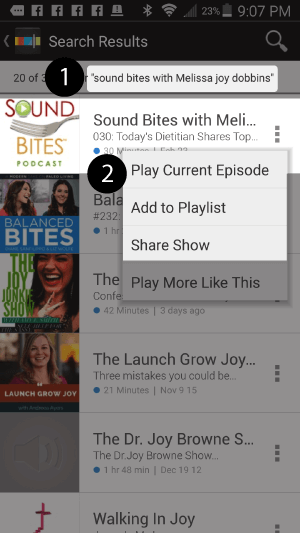
Listen on Stitcher (Android)
Install the Stitcher App
1. Search for “sound bites with melissa joy dobbins” 2. Choose Play Current Episode or Add to Playlist
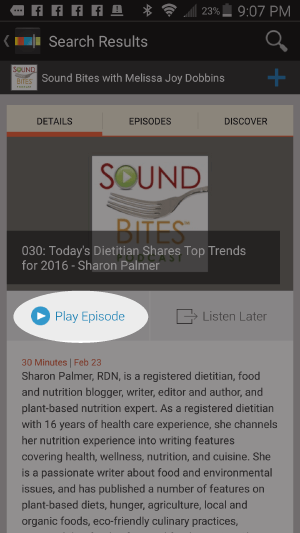
Choose “Play Episode”
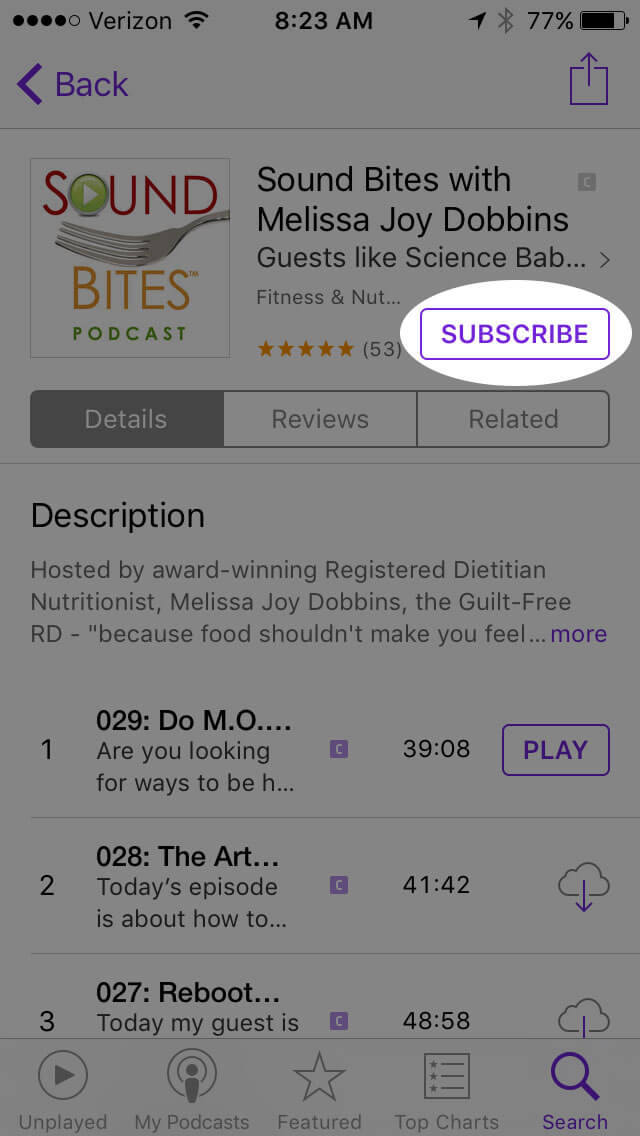
Subscribe & Review on iPhone
Open the “Podcast” app on your iPhone
Search for “Sound bites with melissa joy dobbins”
Open the podcast and click “Subscribe” and your done!
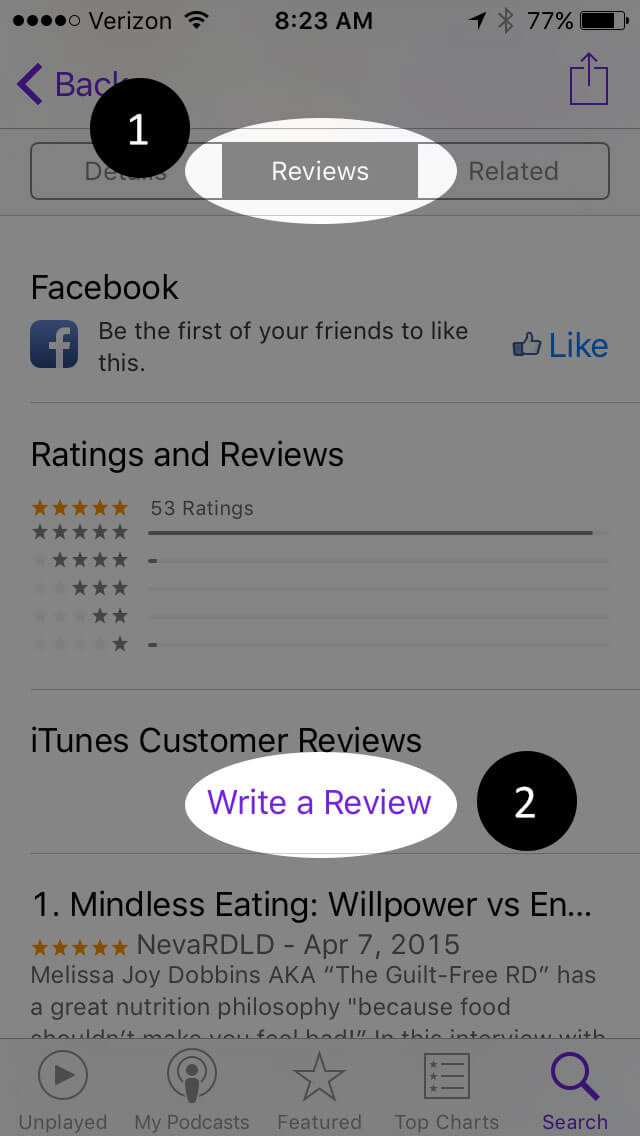
Write a Review
Click “Reviews”, then “Write a Review”.
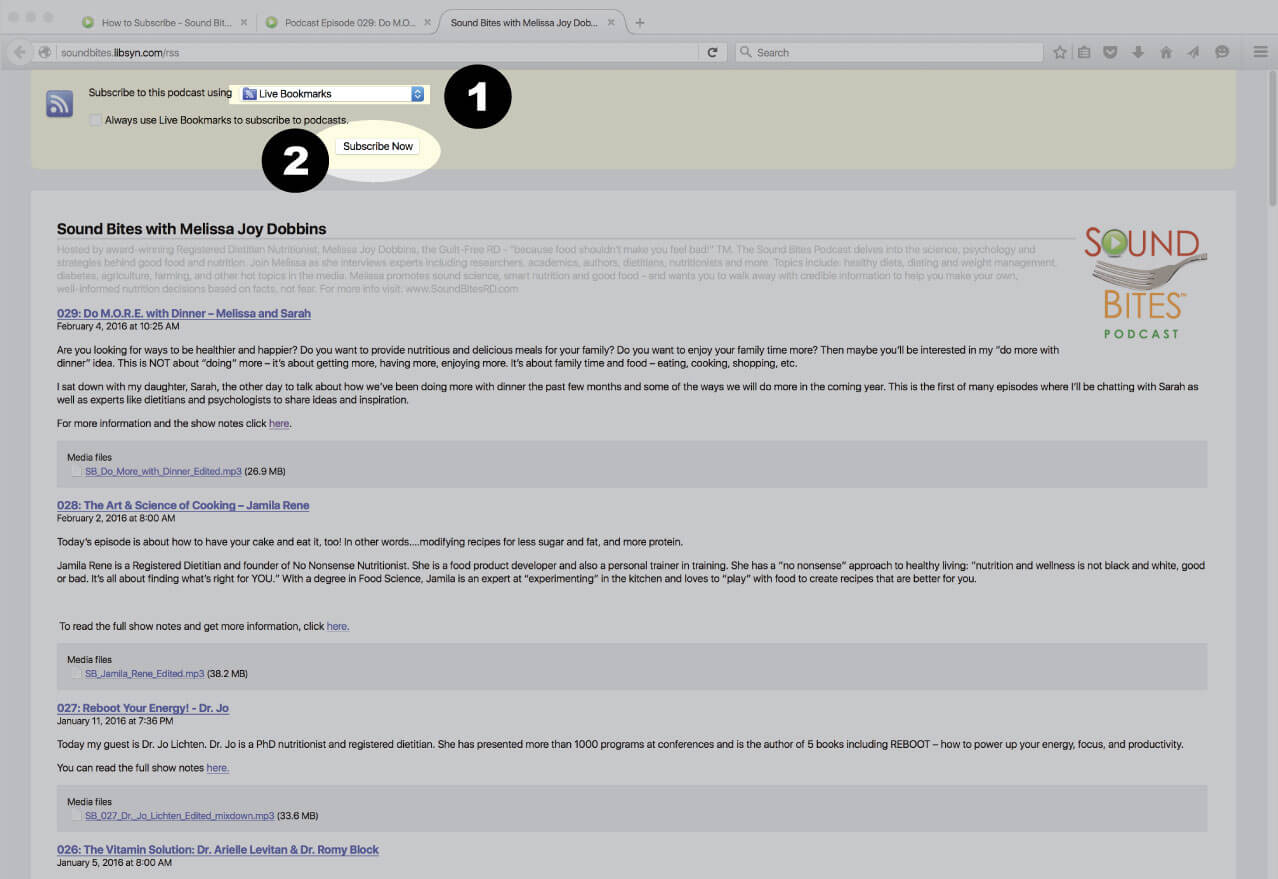
Subscribe via RSS Feed
Navigate to any podcast player . Click on the RSS feed icon.
Click on the RSS feed icon.
Click on RSS Feed
Choose which application you would like to use to receive the RSS feed
Click “Subscribe Now”
Confirm settings and subscribe.
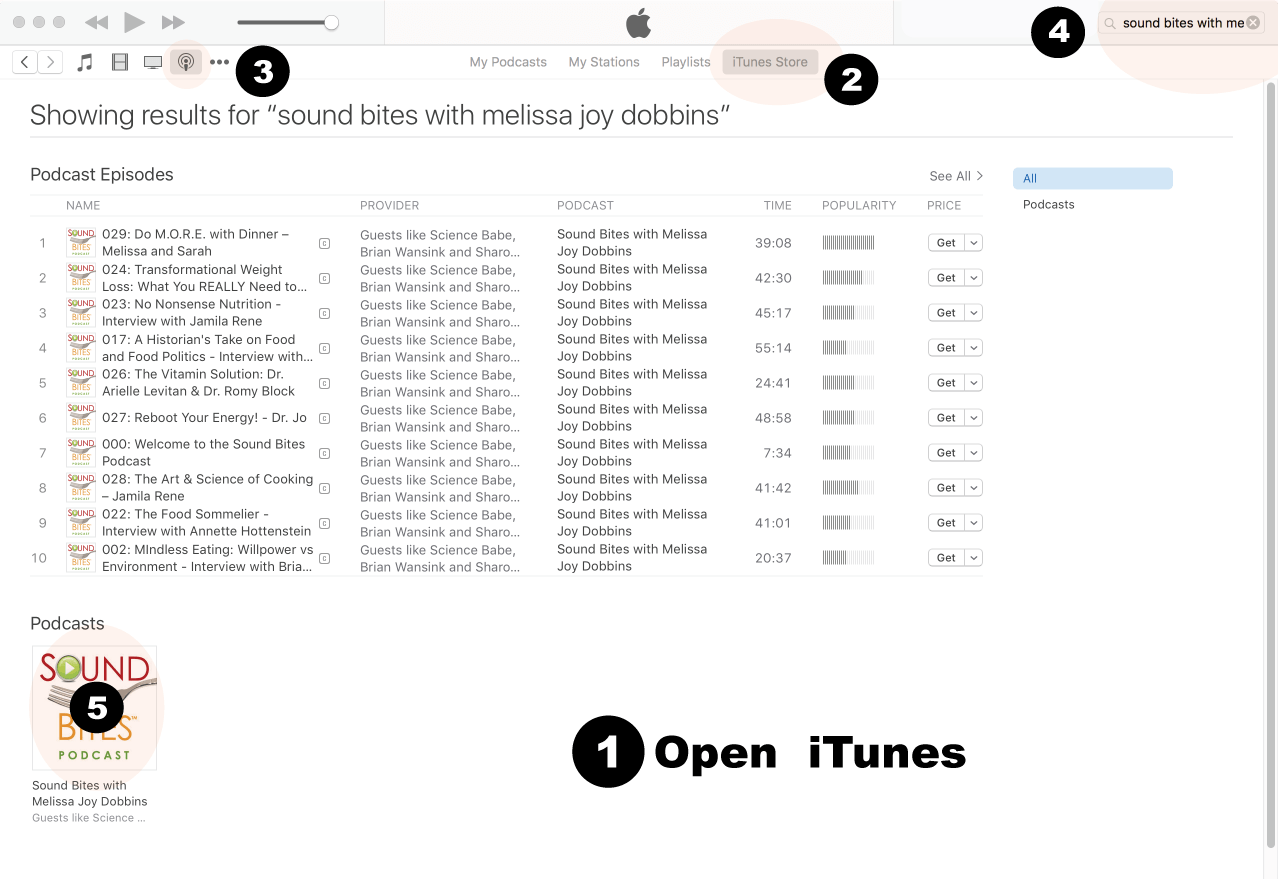
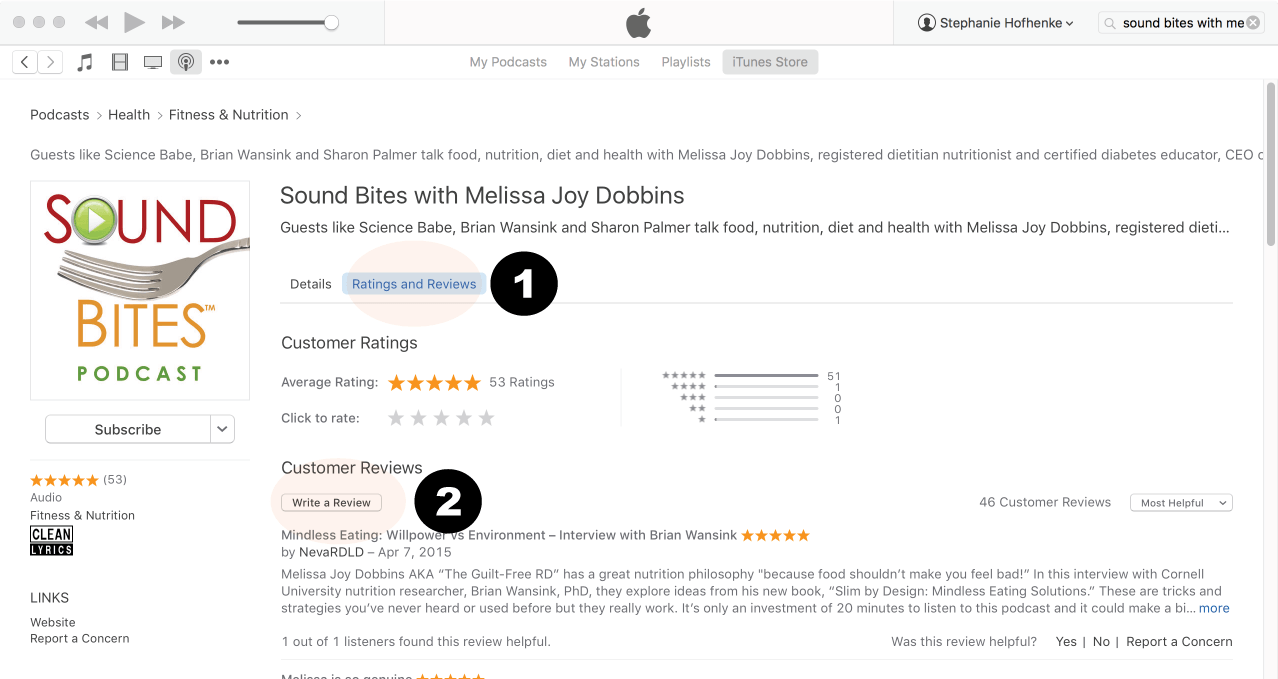
How to Review in iTunes
Open iTunes desktop application
Click iTunes Store
Click on Podcasts
Search for “Sound bites with Melissa Joy Dobbins”
Click on podcast image
Search for Sound Bites podcast in iTunes
Click Ratings & Reivews
Click Write a Review
View reviews and write your own review.
Write your review…. Thank you!
Write your review!
How to subscribe via iTunes
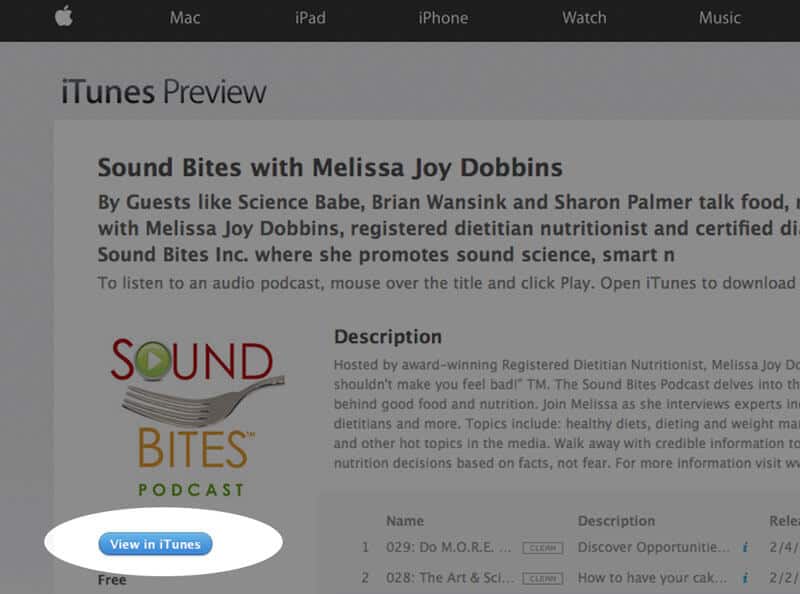
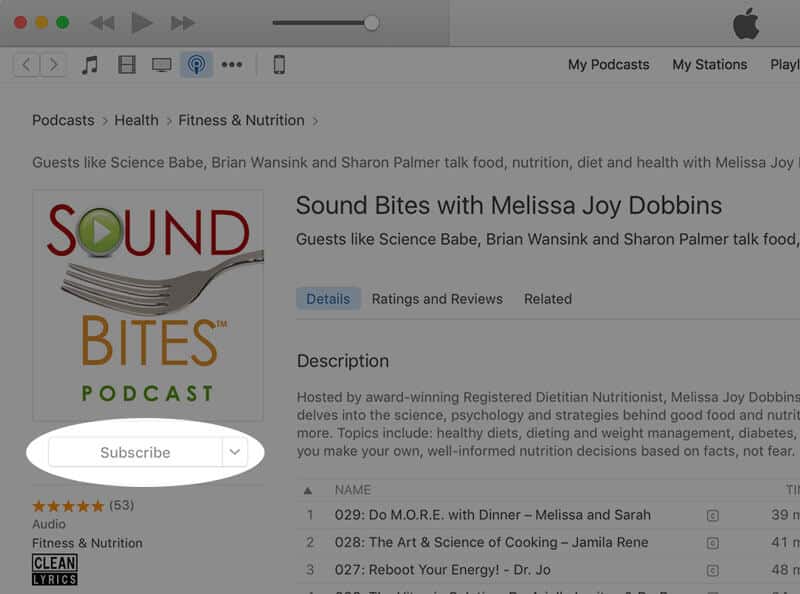
Click here to view the Sound Bites Podcastin iTunes, then click the blue “View in iTunes” button. This will open your iTunes application directly to Sound Bites Podcast. Click the “Subscribe” button, and your done!





















Excellent information.
Thank you.
Thank you!
Very interesting podcast and valuable information about Pecans!
Thank you!