Celebrating over 1 Million Downloads and 50,000 Free CEUs on the Sound Bites® Podcast | NEW: Get 1 years’ worth of CEUs with the new 15-CEU Podcast Course
Disclosure: This podcast episode is a paid collaboration between Sound Bites® and Potatoes USA, the nation’s potato marketing and research organization, representing U.S. growers and importers. Potatoes USA is committed to providing the nutrition science community with evidence-based information about the role of potatoes in healthy lifestyles.
New Carbohydrate Quality Food Scoring System Addresses Heterogeneity of Carbohydrate Foods & Culturally Inclusive Diet Patterns
The White House Conference on Hunger, Nutrition and Health addressed the need for future nutrition guidance to be more inclusive of a variety of cultural eating patterns. The Dietary Guidelines for Americans (DGAs) recognizes this need, yet the healthful dietary patterns described therein continue to focus on Euro-centric ways of eating. Even the Mediterranean dietary pattern demonstrated in the DGAs focuses primarily on three regions of the Mediterranean (Greece, Italy, and Spain), all of which are predominantly White.
Greater understanding of how a wide variety of carbohydrate foods impact nutrition and health within the context of culturally inclusive diets is imperative to create dietary guidance that is relevant to all Americans. Recognition of these foods, especially as our population continues to diversify, is part of the appeal and utility of a new scoring system that helps define high-quality carbohydrate-containing foods.
While there are many ways to define carbohydrate quality, none of the existing strategies, such as glycemic index and others focused on carb/fiber/sugar ratios, look beyond the carbohydrate content and address other nutrients of public health concern–and ones that primarily come from carb-containing foods, such as potassium and sodium.
Inclusion of a wider range of cultural foods could go a long way towards creating nutrition guidance that resonates with diverse populations in the United States. In addition, culturally relevant nutrition guidance can help address health inequities in the US, in particular the disproportionate impact of nutrition-related chronic diseases in historically marginalized communities.
The Quality Carbohydrate Coalition (QCC) Science Advisory Council (SAC) was formed to find a more inclusive way of helping health professionals and consumers choose higher-quality carbohydrate-containing foods and build diets that align closer with DGA. The QCC-SAC is made up of scientists with expertise in carbohydrate research, epidemiology, nutrient profiling, and cultural competency. Together, this group has proposed a new way to approach defining carbohydrate quality.
Many cultural staple carbohydrate-containing foods fall higher on the Glycemic Index scale – which, as we discussed, is hardly significant to the individual. What does matter, across all people, are intakes of essential nutrients such as potassium and fiber, which is something that only our scoring system demonstrates. Our demonstrations highlight foods from many cultural eating patterns can be part of a healthy way of eating.” – Dr. Judy Rodriguez
Tune into this episode to learn about:
the increasing diversity of the United States population
consumer confusion about the role of carbohydrates in the diet
how carbohydrate foods provide important nutrients beyond fiber and sugar
limitations of the glycemic index and other tools to measure carbohydrate quality
how the research community recognizes the need for a globally accepted definition of carbohydrate quality as well as a simple, effective tool to help people make more nutritious food choices
the development and applicability of a new carbohydrate food scoring system
two published manuscripts introducing the new scoring system and a third manuscript pending publication that demonstrates how the tool aligns with the DGAs and a variety of healthy eating patterns and affordable eating patterns
The Carbohydrate Food Quality Score is a simple tool that helps solve for the heterogeneity across carbohydrate foods and the need for more nuance in recommendations to help Americans build healthier diets. Other tools in the literature include carbohydrate metrics that focus most heavily on dietary fiber and added sugars. While these metrics are certainly important (Americans consistently fall short of fiber recommendations and exceed added sugar recommendations), they do not address other nutrients of public health concern–and ones that primarily come from carb-containing foods, such as potassium and sodium.” – Dr. Adam Drewnowski
Carbohydrate-containing foods span across various food groups, and recommendations can be confusing and inconsistent. For example, vegetable recommendations are based on a color scheme, or a single component of a food (starch) or a catch-all ‘other’ category for foods that don’t fit the color or starch criteria. This isn’t very helpful when trying to identify higher quality carbohydrate containing foods.” – Dr. Judy Rodriguez
Adam Drewnowski, PhD
Dr. Drewnowski is a professor of Epidemiology and the Director of the Center for Public Health Nutrition at the School of Public Health and the University of Washington. Dr. Drewnowski is a leader in obesity and social disparities in diet and health who earned his PhD in psychology from The Rockefeller University in New York, and an MA degree in biochemistry from Balliol College, Oxford. Among several indices, he is the inventor of the Nutrient Rich Foods Index which rates individual foods based on their nutritional value. Dr. Drewnowski has authored over 200 academic publications, reviews, and book chapters and he has advised government and international agencies.
Judy Rodriguez, PhD, RD
Judy Rodriguez is a professor of Nutrition and Dietetics in the Brooks College of Health at the University of North Florida. She is a past president of the Academy of Nutrition & Dietetics and has received numerous awards, including the Academy’s Medallion and Distinguished Professor recognition at UNF in 2013. Dr. Rodriguez has authored many peer-reviewed and consumer publications, including Ways to Eat Well and Feel Better, and the Latino Food Lover’s Glossary. Dr. Rodriguez is a Registered Dietitian who received a PhD in Anthropology from Rutgers University, an MA in Nutrition and Higher Education, and a BS in Nutrition and Dietetics from New York University.
Resources
Sign up on the Potato Goodness website to receive the latest potato nutrition research, education resources and other valuable materials.
Hello and welcome to the Sound Bites podcast. Today’s episode is about carbohydrates. Specifically, a new carbohydrate food scoring system to help people make more nutritious food choices. My guests today are Dr. Adam Drewnowski and Dr. Judy Rodriguez. Dr. Drewnowski is a professor of Epidemiology and the director of the Center for Public Health Nutrition at the School of Public Health, and the University of Washington. He is a leader in obesity and social disparities in diet and health, and the inventor of the nutrient rich foods index, which rates individual foods based on their nutritional value. He earned his PhD in psychology and an MA degree in Biochemistry, and has authored over 200 academic publications, reviews and book chapters.
Dr. Judy Rodriguez is a registered dietitian and professor of nutrition and dietetics in the Brooks College of Health at the University of North Florida. She is a past president of the Academy of Nutrition and Dietetics and has authored many peer reviewed and consumer publications. She received a PhD in anthropology and an MA in Nutrition and Higher Education and a BS in Nutrition and Dietetics. Dr. Drewnowski and Dr. Rodriguez, welcome to the show.
Judy 01:16
Thank you.
Adam 01:17
Thank you.
Melissa 01:18
For our listeners, I want to be sure that you know that this podcast is a paid collaboration between Sound Bites, and Potatoes USA, the nation’s potato marketing and research organization representing US growers and importers. If you listened to Episode 202, defining quality carbohydrates, the latest science and recommendations, this is a follow up to that episode. So we are talking about how to define quality carbohydrates. And that episode was about a year ago. So we’re really interested to hear what’s happened in the meantime and getting an update on all things carbohydrate. But also we are submitting this episode to the Commission on Dietetic Registration for one free continuing education unit for registered dietitian nutritionists, dietetic technicians registered and certified diabetes care and education specialists. So if that is of interest to you, stay tuned for that.
You can always check my free CEU page at soundbitesrd.com/freeceus to see what episodes are currently available. I have nearly 50 activities available now including five ethics CEUs, and this episode might be submitted to include an ethics CEU as well. So all that aside, I’m really excited to have both of you on the show. I would love to hear a little bit more about both of your backgrounds and your work, especially as it applies to the topic of carbohydrates. And of course, any disclosures that you may have. Judy, let’s start with you.
Judy 02:54
Hi, Melissa, thank you for the invitation to talk with you today about carbohydrate quality. In terms of disclosures, I am a member of the Quality Carbohydrate Coalition Scientific Advisory Council. And for transparency, I’m also a chairperson of the Academy of Nutrition and Dietetics Inclusion, Diversity, Equity and Access or IDEA Committee. Personally as a registered dietitian, I’ve been fortunate to work in a variety of settings as a clinical dietitian and inner city youth nutrition education director, I worked for WIC or the Woman Infants and Children’s program, and as a consultant in child care, food services training, and also for some research projects, including the Hispanic HANES program or research and some international. And as you mentioned, most recently, I chaired the Department of Nutrition and Dietetics and help direct their baccalaureate. And their face to face and online masters and internship programs and help them start our doctorate in clinical nutrition. But I’ve always had a special interest in food and culture and working with underserved and at risk populations. So really, my broad vision has helped me appreciate the possibilities and the impact of our profession. And do you know that carbohydrates are a main staple in all culture groups?
Melissa 04:21
Absolutely. And cultural foods and diets are a big part of this conversation. So I’m really excited to have your expertise to weigh in on this. Adam, what would you like to share about your background and your work?
Adam 04:35
I thank you. I’m professor of Epidemiology, the School of Public Health at University of Washington. I got my degrees in psychology and biochemistry at Oxford University and at Rockefeller University in New York. But I have been working mostly on social disparities as they apply to obesity and associated diseases. I also do a lot of work on nutrient profiling, and that is looking at quantitative methods to assess or capture nutrient density of different foods. We’ll talk about those in greater detail later on. In terms of disclosures, I am an invited member of the Quality Carbohydrate Coalition. And I have also developed nutrient profiling schemes for other groups interested in capturing nutrient density of foods. And those groups include foundations, governments, and private industry, all of whom are interested in nutrient profiling.
Melissa 05:33
Thank you very much. I have been following your work for a very long time because I was a supermarket dietitian back in the early 2000s. And then I worked for the Dairy Council. And nutrient rich is the term that I’ve been using, instead of nutrient dense for a long time. And I think that’s due to you. So I appreciate your work and just thrilled to have both of you on the show. This is going to be an interesting update on carbohydrate quality. So recently, we had the White House Conference on hunger, nutrition and health. And they mentioned that there’s this increased call for attention, if you will, for future nutrition guidance to shift to be more inclusive of a variety of cultural eating patterns. Of course, this is something that registered dietitians especially, and other health care professionals have been talking about for quite some time. But Judy, I would love for you to share a little bit more about the need for this shift for more inclusivity of these cultural and traditional foods.
Judy 06:37
We know the US is becoming increasingly diverse. For example, according to the 2020 census, the diversity index for the US is about 61%. And that’s almost a seven point change in just a decade, which is quite a big change. We know that Caucasians or white Americans are about 60% of the US population. Hispanics are about 18%. Blacks or African Americans are about 12%. Asians comprise 7%. And Native Americans or Alaska Natives and Pacific Islanders are about 2%. In looking at this with a little bit more eye, we know that Hispanics had the most growth. But we know that Asians had the fastest rate of growth. And so there’s also diversity within these categories. For example, when we talk about Hispanics, it’s really a brushstroke. We are usually referencing the Western Hemisphere or the Americas. The Americas is about 33 countries of about which 19 are Spanish speaking.
So there’s a lot of diversity there. When we talk about Asian, that’s about 45 different countries. And when we talk about Blacks and African Americans, we’re talking about African Americans, but also Afro Caribbeans, and Blacks from all around the world. And when we talk about Native Americans, they’re not Alaska Natives. Keep in mind that the US has officially something like 547 official, native named groups. So there’s a lot of diversity there. So it’s important that the dietary guidelines recognize this diversification. But they still continue to focus on a Eurocentric way of eating. Even the Mediterranean diet focuses on Greece, Italy, and Spain, which are predominantly Caucasian. There was an article by Duffy and Burt that talked about the problem or issues limiting examples of dietary patterns to only specific groups or cultures. And they highlight some of the benefits of some of the non-white dietary patterns like West African dietary patterns where you have peanuts, legumes, tubers, and pulses, like in a West African peanut stew, those are very nutritious.
So you’re right, the White House Conference on Hunger, Nutrition and Health, actually, one of its pillars was specific to helping all consumers have access to healthy choices, and to invest in public education campaigns that resonate with different cultural communities. And that really means that something like My Plate really needs to make sure that it includes education materials that are culturally relevant for different groups and maybe even translated into different languages.
Melissa 09:39
Excellent. And for our listeners who might be new to this, the Mediterranean is more than just Greece, Italy and Spain. Can you just mention some of the other countries in that area that we need to be including in this conversation?
Judy 09:56
Well, sure. For example, some of the countries in Africa they have their own dietary guidelines and icon. And so they will focus more in their base, or staples, some of those roots and tubers that may not be really placed in a Mediterranean context. And that’s when I talked about things like the cassava, the yams, the peanut, they might be implicit, or in a more subtle way placed in a Mediterranean, but they’re not a heavy part of the guidelines. If you look at some of the Asian countries, for example, they may have a pagoda and the pagoda will be done differently. Latin America, some of them use a plate, but some of them use a pyramid. Some of them actually use a ball. One of them uses a mortar and pestle. Some of them use a drum. And they all interestingly enough have the basic high carbohydrate, high quality carbohydrates foods place in their dietary guidelines.
Melissa 10:59
Thank you. Let’s talk a little bit more about the wide variety of carbohydrate foods and their impact on nutrition and health within this context of culturally inclusive diets.
Adam 11:09
I was actually at a conference on the Mediterranean diet at Harvard years ago. And somebody I think a famous cookbook writer, it may have been someone like Paolo Wiltshire stood up and said that, “Well, Mediterranean diet is a concept. It’s a brilliant concept. But it’s a concept. And there’s really no evidence that anybody in the Mediterranean countries is actually consuming the Mediterranean diet, as we think of it.” I mean, Greece, oh my god, chocolate cake, ice cream, and French fries all way. The highest consumption of fish is in Portugal, which is not even on the Mediterranean. And three quarters of Mediterranean countries, as you point out, Judy, are in Africa where they consume no wine. They’re not necessarily vegetarian. And there’s plenty of meat, so I think Mediterranean diet is a kind of concept that you have in your head of everything that is healthy. But it does not often correspond to reality. In my mind the one country, which does have a truly Mediterranean diets still is Turkey. Where the breakfast is the tomatoes and cheese, dried fruit, breads and carbohydrates, all of those things. In Turkey, not Italy, not Greece, not Spain, I say it’s Turkey, take a look at the Turkish breakfast. It is what the Mediterranean diet ought to be. Actually very interesting. So as I say, Mediterranean diet is a brilliant concept if you can hang anything on, but reality a bit more difficult. And in some cases, not always, when you insist on the fresh fish and shellfish and the shrimp and scampi, it can be expensive.
Melissa 12:45
Mmm hmm. Thank you so much.
Judy 12:46
And I think that’s a really important point that Adam makes. And that is that, all of these guidelines are in fact an aspirational instrument. And so what we really need to look at is, what are we working towards? How does that particular guideline or how do those icons reflect our aspirations? But then what is really going on in those countries? And we know that worldwide or globally, we’re seeing changes in all of these diets that are in some ways moving us toward the less desirable health outcomes and dietary patterns. So in some ways it’s trying to bring back some of the traditions and integrate them into the aspirations for better outcomes.
Adam 13:36
I think aspirational is the word I was looking for. So you’re absolutely right. The White House Conference brought in another aspect, which you also just brought up, affordability. We’re looking for quality diets and affordable costs. And I think the White House conference was about diversity absolutely. But it was also the affordability component. Those are supposed to be low cost healthy diets that are culturally appropriate and socially acceptable, and apply to everyone into population subgroups. Do I think the concept here is the one of affordable nutrient density? What we want is affordable, safe, nutrient rich foods.
Melissa 14:15
Excellent.
Judy 14:17
And you know, one of the issues which is really why we’re here is that, when you look at different food groups, the high quality carbohydrates are in that category of the most affordable relative to the other groups. And that’s why it’s important, then, for both practitioners and consumers to understand that this is not a group that we should be eliminating, but rather focusing on more and doing it with a more strategic eye toward quality.
Melissa 14:50
Right. And just to wrap up that conversation with the cultural aspect, because many traditional cultural foods like beans — I’m a diabetes educator and a lot of patients are like, “beans are high in carbohydrate.” These traditional cultural foods like beans are so nutritious and shouldn’t be discouraged, they should be encouraged. So let’s shift our conversation to this confusion around carbohydrates. We are constantly seeing articles in the mainstream media about cutting carbs for weight loss and better health. And I already referenced the previous episode that I did with Dr. Sid Angadi and Dr. Julie Miller Jones, on the topic of carbohydrate quality. So again, that’s episode number 202. If you haven’t listened to it, I encourage listeners to scroll back and check that out.
But during that episode, we talked about, while all carbohydrates ultimately break down into glucose, there are a diverse group of compounds ranging from simple monosaccharides, such as glucose and fructose, to various types of polysaccharides like starch and dietary fiber. And they provide more than just carbs. Is not just simple or complex. They can also serve as vehicles for important nutrients like potassium, vitamin C, and B vitamins. But despite this nuance in this carbohydrate food category that we talked about, the current metrics to help people choose quality carbohydrates don’t necessarily account for these little slight differences, and some of the other nutrients that are kind of ignored along the way. So again, it’s more than just sugar, fiber, carbs, there’s a lot more to that. So perhaps a good place to focus here now is to understand what the current nutrition guidance tells us when it comes to carbohydrates. Maybe Judy this is a good opportunity for you to weigh in on that.
Judy 16:47
Yeah, that’s a really important point to go back to looking at what is the guidance telling us. So really, the US Dietary Guidelines, basically say, about 130 grams for carbohydrates. And that’s what we call the recommended daily allowance or RDA. In terms of range, it’s about 45% – 65% of calories that should come from carbohydrate. And that’s what we call the acceptable macronutrient distribution range, or AMDR. Now, the AMDR really accounts for variability in lifestyle, genetics, health, and other factors. We know that there isn’t a one size fits all when it comes to carbohydrate recommendations, because of what we just discussed, the heterogeneity of the population. And we also know though that less than about 30% of calories, of total calories from carbohydrate, really has been associated with increased mortality. Interestingly enough, there was a comparison of the traditional Asian Indian diet and the Chinese diet to the US diet. And they found that the Asian Indian diet is about 60% – 67% carbohydrate. The Chinese died is about 70% carbohydrate. And again, that really is much different from what we know in the US, which is roughly about 50%.
So you’re right, we’re not consuming as much as the recommendations are. And the other thing is that if you look at trend data, we’re actually starting to consume less or fewer carbohydrates in our diet. But some of that trending probably has to do with what you were talking about, some of these diets that emphasize higher protein, low carbohydrate. Some of these, I call them, fad diets, they come and go, and there’s a whole variety of them, but that seems to be influencing it. The other side too is, we’re seeing increased consumption of sugar sweetened beverages, pastries, candies, and desserts. Foods that people call carbohydrates, but in reality, they’re not. They’re sugar and fat laden foods that happened to include carbohydrate. And we’re blaming them, we’re using this binary, good/bad for carbohydrate unfairly. And we know that even in some of the at risk and underserved populations, we have even higher risk for high consumption of some of those sugar laden, sweetened beverages and pastries because of the cost and easy access. So we really need to look at dietary guidance for the entire population, but also then carve out what are the different issues across different cultural groups.
Melissa 19:40
Absolutely. So because the carbohydrate containing foods span across various food groups, these recommendations they’re really confusing and inconsistent. Can you talk a little bit about, you know, you already mentioned like the sugary, fat laden indulgent foods and Dr. Julie Miller Jones always refers to those as doodles, ding dongs and doughnuts. So those are clearly not the same as a piece of bread or rice or beans. We’ve got grains, but we’ve got vegetables, and then there’s different color recommendations for vegetables. Can you talk about that in a little bit more detail?
Judy 20:15
Yes. Actually, if you think of the US guidelines and the MyPlate, really what we do, and this has added to the confusion is, in the MyPlate, or in the foods group categories, we have what’s known as grains. And by default, I think what that has done is it’s had the population think that carbohydrates only come from the grain group. And they don’t recognize that other groups, such as, in the protein group sometimes we put in the legumes, but they have carbohydrates, high quality carbohydrates. And in the fruits and vegetables group, we also have carbohydrates. And so there’s this thought that the carbohydrates only come from that, or, again, the sweets, the pastries, that other group that we say you need to use less or consume less. And then they tend to ignore the fruits, the vegetables, and also the legumes and pulses.
The other thing that really adds to that confusion is that we tend to use different ways of classifying or categorizing the high carbohydrate foods. So in some cases, we use whole grain versus not whole grain. Or different types of fiber, digestible, and the non-digestible, or the soluble and the non-soluble. With the fruits and vegetables, we use the color rainbow. And then if foods don’t fall in some of the colors, we call them, the other group. So all these different kinds of systems for defining them has really created a lot of confusion. And we don’t know that most of the time they tend to be binary systems, or they tend to be a single item system, like it’s high in starch. And what we really need is a system that defines quality in a more holistic approach that is aligned with the dietary guidelines. And that’s something that Adam can address in more detail. But that’s really what we were trying to look at in coming up with a quality measure.
Melissa 22:24
Exactly. So that brings us to why we need this holistic approach and this tool that Adam is going to explain in detail. But first I want to say you are both carbohydrate experts and part of the Quality Carbohydrate Coalition, the Scientific Advisory Council for Potatoes, USA, as you mentioned in your introductions. And I know that you’ve been involved in recent presentations and publications about carbohydrate quality. And that’s why you’re here today to talk with me. But tell us about your work with the Quality Carbohydrate Coalition Scientific Advisory Council, and then we’ll get into the nitty gritty about this new tool.
Judy 23:01
Well, there have been several meetings over the past few years of the Quality Carbohydrate Coalition. The first one was really a meeting to discuss, what are some of the issues related to defining carbohydrate quality? And then some of those meetings then later evolved into, what are the elements or things that have been done at this point? And what are the pros and cons related to that work? And what else needs to be done? What’s been missing? And how then do you start to put that into some kind of a formula where you can address these? But also, very importantly, make sure that it aligns with what the Dietary Guidelines and the recommendations are because some of the systems or measures that have been done, haven’t done that. And while you may have a measure, if it really isn’t aligned with what we’re trying to achieve in terms of population health outcomes, it really doesn’t help as much. And so that’s really where we did our work and how we got to this step.
Melissa 24:10
Thank you for explaining why it’s so important to align with the dietary guidelines. And we’re looking at these nutrient gaps, right? So I mentioned some publications, but can you specify what has been published so far? And what’s coming in the future so that we can build on that with this discussion?
Judy 24:29
Well, we’ve had two publications. One of them really talked about the need for a quality system. And then the other publication talked about how we went about trying to create an algorithm that could be used in looking at the elements that we were trying to basically include. And then the publication that we’re really working on now is really about applying it to specific foods. and looking at it from a more globally based approach of different cultural foods and how they would fit into this algorithm.
Melissa 25:09
Okay, thank you. And I’ll be sure to link to those in the show notes and keep apprised of when the third one becomes published and share that with my listeners. So as we’re talking clearly carbohydrate quality can vary between food sources. And the work that you’re doing on this quality carbohydrate coalition is really to help people choose high quality or nutrient dense, or I like to say, nutrient rich carbohydrates more often than lower quality, less nutrient dense carbohydrates. So, Adam, why don’t you talk to us about how do you make it easier to make better carbohydrate choices with this new scoring system? Tell us all the details about this new system.
Adam 25:52
Let me begin by reinforcing a very important point that Judy made. And that is, people very often think of carbohydrates as being either grains or sweets. So the choices between grains, and sugars, and maybe even soft drinks, combinations of carbohydrate and sugar, or carbohydrate and fat. That is not the whole universe of carbohydrates. It is actually the World Health Organization that drew people’s attention to legumes, and beans, and fruit and vegetables, all of which contain carbohydrates. So in fact, our first order of the day was to expand the carbohydrate universe to include these foods, including starchy vegetables, including white potato, which had not previously been considered as part of the carbohydrate category. And if they were, they were lumped together with bad carbs. There was this idea that there are good carbs and bad carbs.
The good ones are fruits, vegetables, and beans. The bad ones are pretty much everything else, refined grains, sugars, and sweets and so on. So we wanted to say, we’re now expanding the carbohydrate universe beyond grains and beyond the sugars to actually include the beans and vegetables in it, first point. The second point, and the carbohydrate coalition came to that conclusion as well. Is that there are four domains by which carbohydrate quality is judged. The first domain or aspect is fiber. More fiber is good. The second one is probably free or added sugar. High sugar is bad. So you want carbohydrates with high fiber, and low sugar. And then we thought to that we would add whole grains which had not previously been used in carbohydrate quality metrics. And then as long as we were dealing with fruits, vegetables and breads, we thought we would add potassium and sodium, for reasons I will come to.
Bread is very often a carrier for sodium, the major source of dietary sodium in the American diet. It’s not salty foods. It’s foods with some salt, which are consumed frequently. And potassium, of course, is a nutrient of concern, with very high levels found in vegetables, fruit, potatoes, and other vegetables. So the elements we’re playing with, were fiber, free sugars, whole grains, potassium, and sodium. You notice that I did not mention glycemic index. Now one of the criteria to address carbohydrate quality has always been the glycemic index. But the glycemic index is not really a function of the carbohydrate, it is really a function of you reacting to carbohydrate post ingestion. And this is why the Food and Drug Administration has been very reluctant to put anything to do with glycemic index on packages on the shelf. Pre ingestion. So we and other people have steered away from glycemic index towards other aspects of carbohydrate. In fact, fiber and whole grains do indirectly deal with the glycemic index. Foods high in those are going to be low in glycemic index.
So what was our starting point, there was a very nice paper published by a group at Tufts, which actually was co-authored by one of my graduate students looking at a carbohydrate quality score. Essentially a point system. There are four models. These are the first practical carbohydrate quality indices, and those were based on the ratios of carbohydrate to fiber, carbohydrates to fiber changing to sugar, and fiber to sugar. They had complicated names. I won’t go into those which all referred to carbohydrate to fiber to free sugar ratios. Essentially we took those as our starting point and awarded our carbohydrate rich foods points depending on its fiber content 10% or more, relative to carbohydrate, free sugar content 10% or less relative to carbohydrate content. And we looked at the simultaneous scores, foods which had both low fiber and high sugar, and on top of that, we added potassium and sodium. And for grain foods, we added whole grains.
There was no point adding a whole grain score to potatoes, potatoes do not contain whole grains, but they do contain potassium. So we ended up with two scores, one for the universe of carbohydrate foods, and one specifically for grains, which did include whole grains. And so here we found actually some surprises, of course, consistent with the WHO and the dietary guidelines, beans, legumes, vegetables, including starchy vegetables and fruit scored extremely high. No surprise there. Those are in fact high quality carbohydrates. We’re happy about that. And then when it came to grains, obviously, those products which had high fiber, low sugar, and whole grains scored very well. And those included interesting enough, ready to eat cereals, crackers, and a number of breads, which were all of interest as being high quality carbohydrate foods. We actually identified a number of carbohydrate foods. They were led by oatmeal, and cooked cereals, and ready to eat fortified cereals and other foods. But there was quite a great deal of quality carbohydrates present in the nutrient composition database that we’re using.
We’re using a publicly available FNDS at Central for the Nutrient Database for dietary studies publicly available from the USDA. And then we had another surprise, actually not a surprise. I knew the results ahead of time. But we applied the carbohydrate quality score to vegetables, and specific types of vegetables, including white potatoes. So we compared starchy vegetables and non-starchy vegetables, because we had been told that potatoes were bad and the leafy vegetables were good. The carbohydrate quality score ranked them equivalently. There are equally good. So potatoes can resume their place among the vegetables, which is where they belong. They had been unfairly lumped together with soda and soft drinks and candy and so on. They do not belong there. They belong with vegetables where they belong, very close to the non-starchy vegetables and very close to beans.
We do have another paper on that very topic. And that was a nice application of the new Carbohydrate Quality Index, a formal measure to assess the quality of carbohydrate foods. So we’re very pleased with the indices. But this is a nice way of quantitatively scoring carbohydrate quality, based, as I say, on fiber, free sugar, whole grains, sodium and potassium. Two scores, one for all of the carbohydrate foods, and one specifically for the grain foods and the grain based mixed dishes. So that’s the score in a number of publications in peer reviewed literature that have been documented.
Melissa 33:29
Excellent. And we’re going to talk a little bit more about this scoring system. But first, we mentioned the glycemic index. And we talked about this quite a bit in episode 202 and Dr. Julie Miller Jones explained, just like you said, the results, or the response can vary based on the person’s individual response. It also can fluctuate based on how a food is prepared. And as you mentioned, and I think Judy mentioned that, it hasn’t been reliably associated with health outcomes. So just wanted to emphasize that as a Certified Diabetes Care and Education Specialist, I’ve never appreciated the glycemic index. I never found it useful or helpful with patients and clients. But I think it’s about 40 years old. It’s been around for a long time. And to compare and contrast it with this system that you’re sharing with us that is more holistic and looking at the actual nutrients of the food.
Not to mention glycemic index versus glycemic load and eating foods and mixed meals and so on. So I just wanted to make a quick comment about that. I also wanted to ask you, when you’re talking about potassium and sodium and the added or the other term is the free sugars, fiber, and the whole grains. Also I wanted to know about those enriched and fortified foods because you mentioned like some cereals and things like that. If it’s enriched or fortified, maybe it’s a B vitamin, I guess would be a good example. Does that factor into the scoring system?
Adam 35:00
Okay, let me make two points. One is, there is a difference between enrichment and fortification. Enrichment is putting nutrients into food, putting back nutrients into food, which were taken away during processing. Whereas fortification is voluntary in America, it is the addition to foods of nutrients they did not previously contain. So for example, dairy products in the United States are fortified with Vitamin A and Vitamin D, this is voluntary fortification. Now, our carbohydrate quality score does not take fortification into account because it does not really deal with micronutrients. So if you have a cereal fortified with various vitamins and minerals that would not be a part of the carbohydrate quality score. We worried about that, because we said carbohydrates can be carriers of other nutrients, including B vitamins, including the fortificants in ready to eat cereals. It’s plenty of stuff but we really stayed with the chemical constituents of carbohydrates, fiber and sugar, and just made the exception for potassium, sodium, the electrolytes, because of their content in carbohydrate containing foods. Potassium in fruits and vegetables, sodium in some carbohydrate bread type products. So those were important, we did not really deal with the various vitamins and minerals which are present. And in fact, the flour is fortified or enriched in United States with B vitamins.
Melissa 36:31
Thank you. And then just as a side note, the FDA has this proposed rule to update the definition of the nutrient content claim “healthy,” because it came out nearly 30 years ago, and it hasn’t been updated since then. So just because that’s top of mind right now and a hot topic. I would love to hear you weigh in on that whole issue.
Adam 36:53
I’m so glad you mentioned that. I think the FDA was swayed by the KIND citizen petition from the KIND Company. The KIND company petitioned the FDA to change this definition of healthy because some of the products did not pass being too high in saturated fat. And so the company argued that healthy foods such as salmon, avocados and so on, would not pass because of saturated fat content, and they argued for recognition of some food groups that would be intrinsically recognized as healthy. So the FDA took six years to react and now put out for public comment, a proposed set of regulations. Long story short, for grains, the criteria are set at three quarters ounce equivalents per serving, less than 5% of added sugars per serving and I believe less than 10% Daily Value of sodium per serving. Servings are RACCs Reference Amounts Customarily Consumed. The upshot of that is those are very stringent criteria. And for grains, virtually nothing passes, we did a screen to find out of the 600 grains in FNDS database. what did pass? 22% did pass including Cheerios and quinoa. Oatmeal did not make it. And so the question then becomes a very good question for dietitians. 97% of the grains according to the FDA proposed rule are unhealthy. Only 3% are healthy. So what’s left to eat? The USDA says we need to consume healthy foods. The FDA says there are no healthy foods. What to do? It’s a dilemma. They were hoping that the FDA first of all will reconsider and give people additional time to respond. I also looked at the dairy products and very few pass. The carbohydrates are pretty much killed because of sodium. So I think they are setting the bar so high and is extremely counterproductive. If there are no healthy foods to be had, why even bother?
So there are a number of comments I could address to the FDA regarding this. I think the comment period is still open. So we’ll see what happens with that next. One more point, the FDA defines fruits and vegetables to be intrinsically healthy, as long as they are whole and raw. Frozen, no, canned no, sliced no. So intact carrots, okay. Grated carrots, sliced carrots you’re on your own. None of this makes any sense. I will say it now and I’ll say it again, we are waiting for the FDA to reconsider some of it. This could be of immense interest to dietitians everywhere.
Melissa 40:07
Yes. Absolutely. Well, thank you for sharing all those insights. And maybe they’ll consider looking at this carbohydrate food quality score. That would be nice.
Adam 40:16
That’s right. Exactly, yes.
Melissa 40:18
So circling back to this carbohydrate food quality score, the system, the scoring system or tool, we talked about the importance of aligning with the existing Dietary Guidelines for Americans, recommended dietary patterns and we’ve talked about affordable eating patterns and being culturally diverse as well. So it’d be really nice if you could walk us through an example of a specific food like potato, you mentioned it earlier, but you didn’t say the score. So, potatoes are a commonly consumed vegetable in our diet and culturally in a lot of diets. So how do potatoes rank in the system?
Adam 42:44
I would have to look that up, but I will say good because you have got potato, you got vitamin C, you’ve got fiber, you’ve got potassium, with probably polyunsaturated fat if it’s in olive oil, monounsaturated fat, so a nutrient density score would be quite good. Not as a carbohydrate quality score. But the nutrient density score like a nutrient rich food index would deal with the fats and oils and other things which the carbohydrates quality score does not. Carbohydrate quality score is really for carbohydrates. But when you look at a roasted potato with a skin, you’re looking at other components, which other nutrient profiles would come with. I would say, go for it. Good score, highly nutrient rich.
Melissa 43:26
And as a follow up to that, is this scoring system intended for only dietitians? Is it intended for other healthcare professionals? Is it intended to be used like literally with patients one on one? Are we going to be talking about here’s a list of foods and their scores? What’s your vision? Maybe both of you can weigh in on that.
Judy 43:45
In terms of visualizing, too, how I would see different groups use it. One thing to keep in mind is that this is a tool. It’s one of many tools that health professionals, we need to put together with other instruments to help people develop a practical lifestyle plan that really focuses on using diet toward their health outcomes. So from that perspective, in my mind, it’s really one of many instruments that we really need to use, and over time, with nuances, more information about the different foods and their values, because that’s one of the areas where we recognize we need more research, a lot of the foods that are common, especially culturally are not in a database.
So right now they cannot be analyzed and scored, we need more information there. But then we also need more information into how does it fit into an overall, or contextualized pattern for the individual. And that’s one of the things that we often fall into. Sort of an easy thinking again, binary. Okay, so this is good, and this is not good. What we really want to do with this kind of a tool is put it in a context of different types of quality carbohydrates across a person’s entire dietary pattern. Because while we want everybody to focus on the higher quality carbohydrate scores, we know realistically that sometimes they will need to eat something that’s on a lower score. Or for affordability, they may need to have something that lower score in combination with several higher score items. So it’s about creating a holistic approach to the dietary pattern that focuses on the high quality but helps them learn how to integrate some of the lower quality foods into their overall health plans and outcomes.
Melissa 47:36
Yes, excellent.
Adam 47:37
Let me give you a different perspective. And this is why Judy and I complement each other so well. So surprised to find out that nutrient profiling is actually used by corporations to reevaluate the quality of their portfolios, and they can also use it for product reformulation. So, if for example, General Mills were to say, “Oh, we use the carbohydrate quality score to improve the quality of the carbohydrate in our product,” I would be very happy. So you can certainly have educational uses of nutrient profiles, you can have regulatory uses. Also, you can have major applications to reformulation of healthier products. And arguably, if you change the formulation of the best-selling products on the shelf, it may have a huge public health impact. So I think the interests of nutrient profiling is right there when it comes to product reformulation and making foods with high quality carbohydrates available for general use. And by the way, those products are going to be affordable, and nutrient rich.
Melissa 48:40
Very interesting. Thank you for sharing that. I’m glad that we’re talking about how this tool, this system, it’s not like if it gets a score of one, it’s bad and a score of five is good. And we’re back to the binary. It’s just on a Likert scale, basically. And we do want to emphasize that it’s sort of like in the grains category. Make half your grains whole, which I hate that phrase because I think it’s confusing, but the point being, many of your choices can be higher quality, but it doesn’t mean that all of them have to be of higher quality and there’s a place for other lower quality carbohydrate foods, whether it’s because of cultural reasons or affordability, or maybe they’re the enriched and fortified and you’re getting some B vitamins there some folate or something that’s really important as well.
Judy 50:14
And one thing too that I wanted to mention, Melissa, that I think is very important, because I guess it’s near and dear to my heart is that, this kind of instrument also helps us do an assessment of the value of different cultural foods. Many of which are basic carbohydrate staples that we have seen with immigration tend to decrease in consumption, and they’re healthy items that we really want to encourage. And so that really has benefits from two perspectives. One is that, it’s highlighting ethnic foods from other cultures that are nutritious. Think of the whole wheat tortillas, the chapattis, the buckwheat noodles, and the mung beans, all of these different cultural foods. And so that helps with the sense of pride and tradition and maintaining healthy habits within those cultures.
But I also like to point out, and I know that you’ll probably get tired of me hearing this, we are a multicultural society, everybody in the United States eats ethnic foods. And so by doing this and highlighting the healthy ethnic foods, we help people who are now going out and eating all these diverse cuisines, how to pick the healthier ones from those cultures. Chinese food, Thai, Vietnamese, Japanese, Mexican, Italian, these foods are eaten by everybody. Nobody is monolithic in their eating in the United States. We want to show everyone that it’s not just some of the Mediterranean area foods that are healthy, that there are healthy choices from all these ethnic cuisines.
Melissa 52:08
Great point. Wonderful. That’s a great way to sort of wrap this show up. But before I do that, is there anything else we need to know about the carbohydrate food quality scoring system? About cultural foods? Anything else that you wanted to share with us?
Adam 52:26
I think the impact of the carbohydrate food quality scoring system is that it is an objective metric. You can tell a computer to screen carbohydrates and does not really depend on a subjective opinion. And I think that many of the previous judgments were based on value judgments, personal opinion. Now we have the metric. I can run through a screening system and see whether or not a given carbohydrate food fits in or does not fit in. And many do. I think about 15% of the foods that we screened, were absolutely high carbohydrate quality food.
Melissa 53:00
Excellent.
Adam 53:01
And then again, as you point out, it is not a yes or no, because it’s a gradation. It’s a five-point scale, six if you include zero, and so everything is on the range, your diet does not have to be all just foods that score five, that can be very boring, actually. And you want more diversity, and you can really mix and match. As Judy said it’s aspirational, it’s really long steps towards a given goal. It does not have to be right at the end. You want to get there gradually.
Judy 53:33
And I think that’s really important. And for people who have this negative attitude about carbohydrate, it gives them an objective measure for inclusion, not deprivation. And I think that’s very important.
Melissa 53:48
Excellent, thank you. Well, it’s my understanding that people can go to the website apre.org, A-P-R-E.org. That’s the Alliance for Potato Research and Education website. For more research insights on potato nutrition APRE is dedicated to advancing the scientific understanding of the role potatoes can play in promoting health. And people can also go to potatogoodness.com, which is the official website of Potatoes USA, there’s a bunch of great information there as well. I will have all of the research citations and other papers and stuff that we talked about, and maybe some visual slides from Dr. Drewnowski as well in my show notes at soundbitesrd.com. But was there any other resource that you wanted to mention?
Judy 54:34
I think there are a lot of different websites that give really good information. Of course, the Dietary Guidelines website, the Eat Right PRO website, Diabetes Prevention Program. So there are really some excellent resources out there and we can provide more if you’d like.
Melissa 54:52
Excellent. Thank you both again for being on the podcast and sharing all of this wonderful information and giving us an update on carbohydrate quality. Again, everything will be in the show notes at soundbitesrd.com. And people can stay tuned for the approval of the continuing education units. And for everybody listening as always, thank you for listening and enjoy your food with health in mind and some quality carbohydrates. Till next time.
LISTEN, LEARN AND EARN
Listen to select Sound Bites Podcasts and earn free CEU credits approved by the Commission on Dietetic Registration (CDR) for registered dietitian nutritionists and dietetic technicians, registered. Get started!
Get Melissa’s Sound Science Toolkit here!
Partnerships:
Sound Bites is partnering with the Association of Diabetes Care and Education Specialists (formerly the American Association of Diabetes Educators)! Stay tuned for updates on the podcast, blog and newsletter!
Sound Bites is partnering with the International Food Information Council! Stay tuned for updates on the podcast, blog and newsletter!
I love bread! A good CHO😁 I really enjoyed this episode. I learned something new about the new CHO score. Thank you for sharing this relevant information.
Sign up for my monthly newsletter and episode eblasts so you never miss an update!
Listen on Stitcher (Android)
Install the Stitcher App
1. Search for “sound bites with melissa joy dobbins” 2. Choose Play Current Episode or Add to Playlist
Choose “Play Episode”
Subscribe & Review on iPhone
Open the “Podcast” app on your iPhone
Search for “Sound bites with melissa joy dobbins”
Open the podcast and click “Subscribe” and your done!
Write a Review
Click “Reviews”, then “Write a Review”.
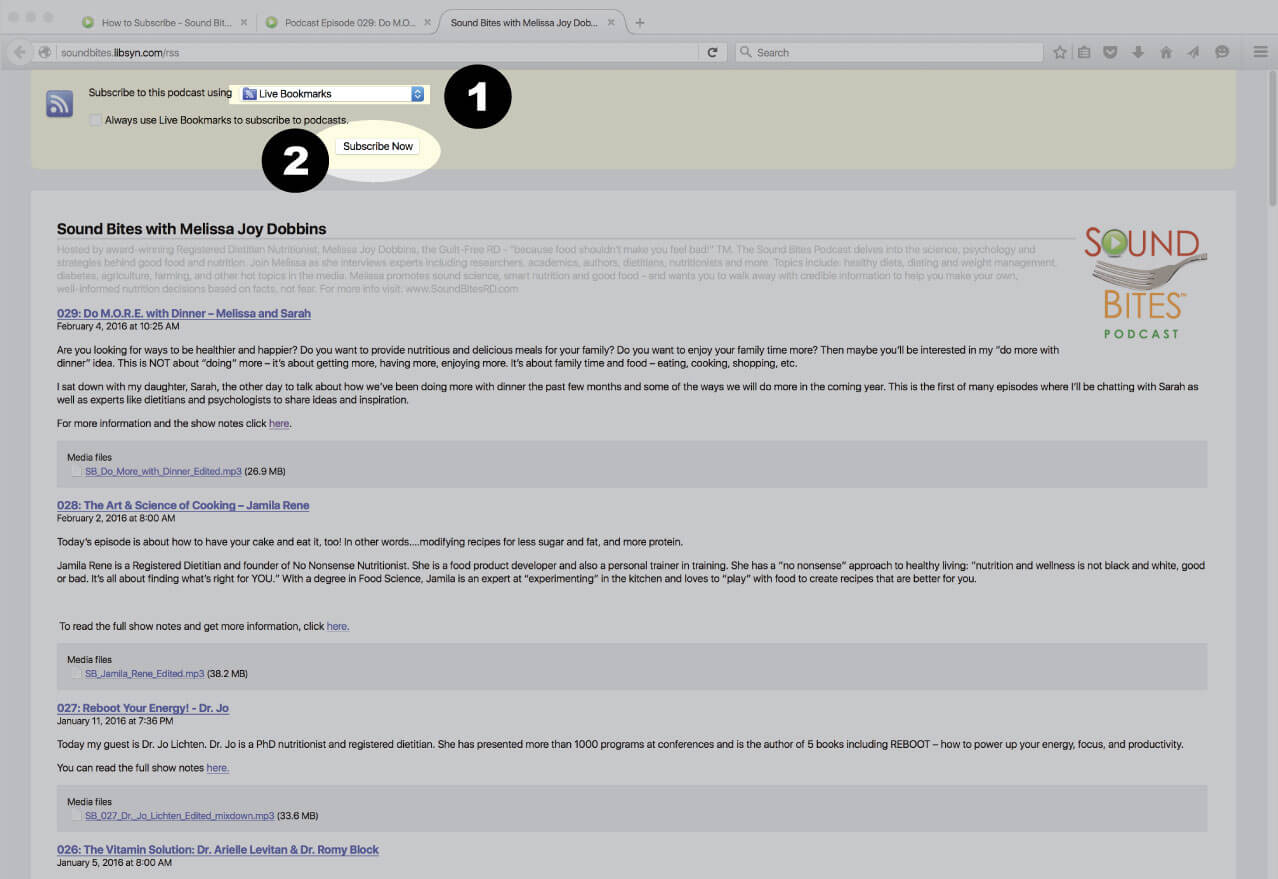
Subscribe via RSS Feed
Navigate to any podcast player . Click on the RSS feed icon.
Click on the RSS feed icon.
Click on RSS Feed
Choose which application you would like to use to receive the RSS feed
Click “Subscribe Now”
Confirm settings and subscribe.
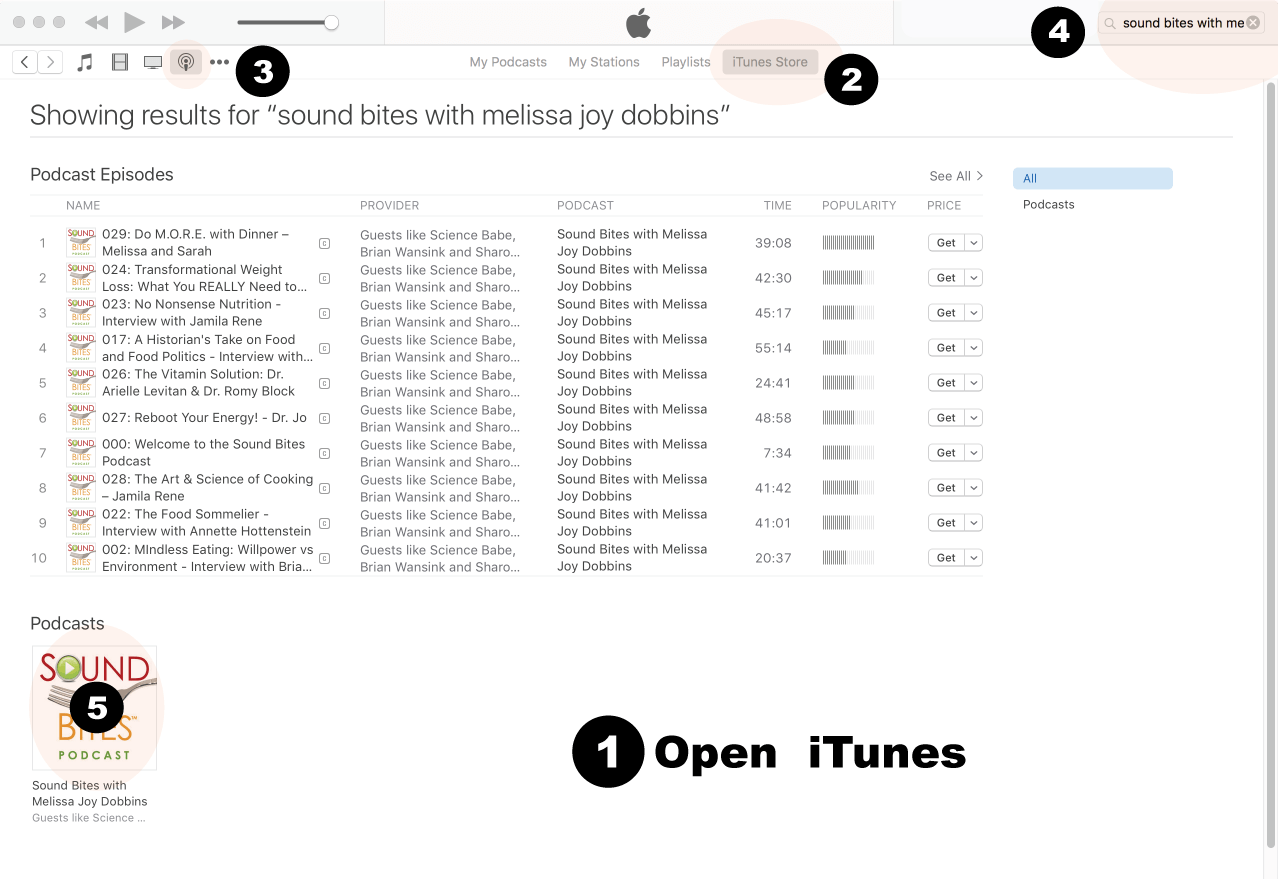
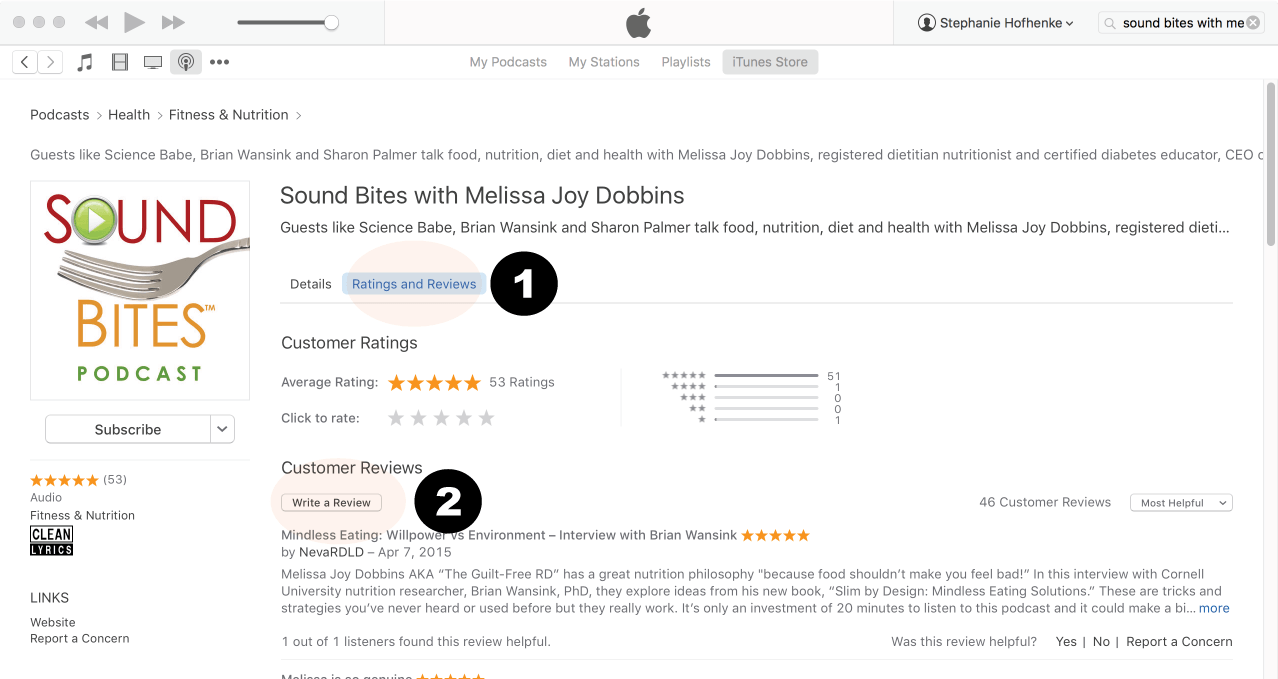
How to Review in iTunes
Open iTunes desktop application
Click iTunes Store
Click on Podcasts
Search for “Sound bites with Melissa Joy Dobbins”
Click on podcast image
Search for Sound Bites podcast in iTunes
Click Ratings & Reivews
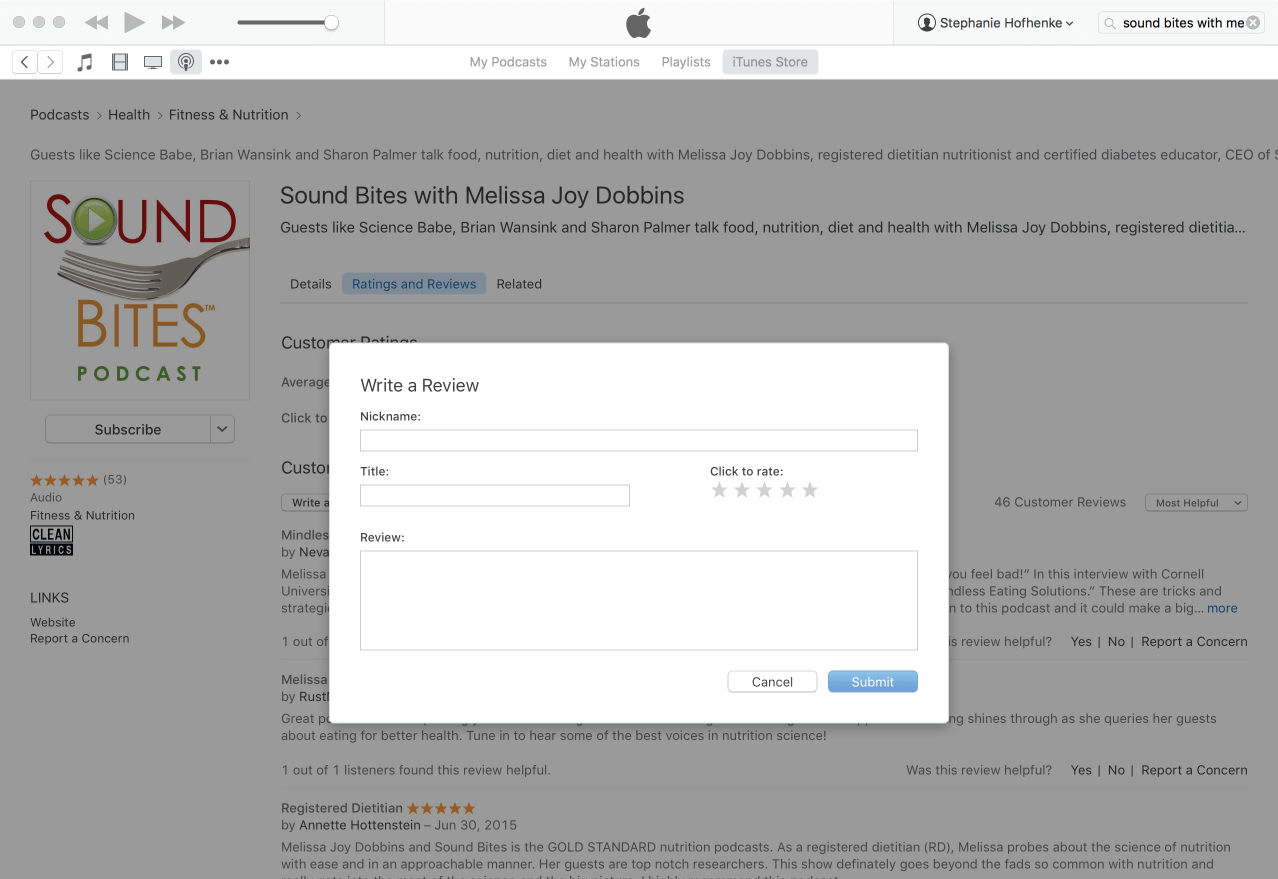
Click Write a Review
View reviews and write your own review.
Write your review…. Thank you!
Write your review!
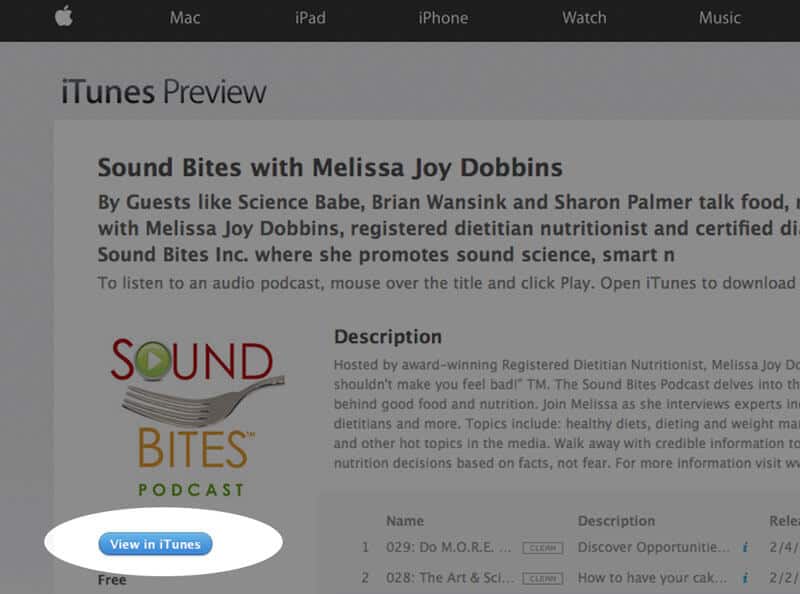
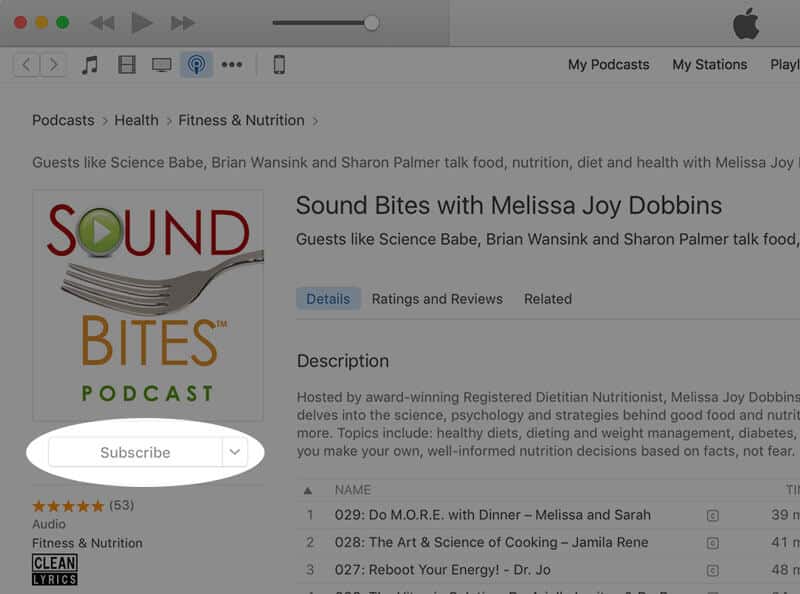
How to subscribe via iTunes
Click here to view the Sound Bites Podcastin iTunes, then click the blue “View in iTunes” button. This will open your iTunes application directly to Sound Bites Podcast. Click the “Subscribe” button, and your done!

























I love bread! A good CHO😁 I really enjoyed this episode. I learned something new about the new CHO score. Thank you for sharing this relevant information.
Thank you, Ivys! I’m so glad you enjoyed it!
Melissa