Celebrating over 1 Million Downloads and 50,000 Free CEUs on the Sound Bites® Podcast | NEW: Get 1 years’ worth of CEUs with the new 15-CEU Podcast Course
Sensory Science and Research on Sweetness in the Diet
The topic of sweet taste and the relationship to diet and health is one that has been of interest to food and nutrition scientists for many years. To assist in reducing sugar consumption, some authoritative bodies currently recommend reducing the consumption of sweet-tasting foods and beverages, regardless of the source of the sweet taste (i.e., caloric or low-calorie sweeteners). These recommendations stem from concerns that human attraction to sweetness may be a potential risk for developing less healthy eating patterns. Despite the need to measure sweetness of the diet to help us further understand the relationship between nutrition and health and sweetness, currently there is no consensus method to measure the total sweetness of the diet. There are well-established sensory techniques in laboratory settings for individual foods, but agreement on the optimal approach for measuring the sweetness of the total diet is lacking, particularly for large-scale population-based studies.
Recently a practical approach for estimating sweetness of the diet was built onto a sweet taste database to evaluate trends in the sweetness of the diet in U.S. children and adults. This method can also be used to better understand the impact of dietary sweetness on diet quality and health outcomes.
Our research found that the sweetness of the diet on average declined by about 23%, which represents a pretty dramatic decrease in the estimated sweetness of the diet. The U.S. population appears to be adjusting to less sweet diets, and this stands in contrast to that idea that the consumption of sweet foods and beverages inherently leads to more consumption of such items. In addition, when you compare the data on dietary sweetness to obesity, we essentially see an inverse correlation, meaning that when obesity was lowest, sweetness was highest, and when sweetness was lowest, obesity was highest.” – Dr. Colin Rehm
Tune in to this episode to learn about:
Psychobiological determinants of eating behavior
How sweetness is defined
How sweetness can be measured
Why it’s important to study sweetness and understand its implications
Trends in the overall sweetness of the U.S. diet
The contribution of low-calorie sweeteners to the sweetness of the diet
Implications of recent research conducted on sweetness
Future research on sweetness
The idea that exposure to sweetness leads to enhanced liking is simply not true. You get saturated with the sweetness – and also of umami, of every taste, if you are repeatedly exposed it will get less and less rewarding as you consume too much of it.” – Dr. Kees de Graaf
Kees de Graaf, PhD, MSc
Kees de Graaf is emeritus professor in Sensory Science and Eating Behavior (SSEB) of Wageningen University, the Netherlands.
De Graaf got his MSc degree in human nutrition and consumer science in 1982, and obtained his PhD in 1988 on the taste perception of mixtures of sweet tasting compounds. De Graaf has published about 300 scientific papers, mostly on the psychobiology of eating behaviour. His work has a h-index of 65 and has been cited more than 14.000 times. Research and previous teaching activities focus on the meaning of sensory signals, such as taste (e.g. sweetness, saltiness, fattiness), odor, and texture for eating/nutrition behaviour and the regulation of energy intake.
De Graaf is section editor of the journal Physiology & Behavior, and associate editor of the journal Food Quality and Preference.
Colin Rehm, PhD, MPH
Dr. Rehm is an epidemiologist and a Senior Principal Scientist with PepsiCo, Health and Nutrition Sciences. He has expertise in nutritional epidemiology and dietary surveillance. In his role at PepsiCo he uses publicly-available survey data to better understand trends and patterns in dietary intakes and their effects on health. Prior to joining PepsiCo in 2019, Colin was a Clinical Assistant Professor and managed research and evaluation related to community and population health interventions at Montefiore Medical Center in the Bronx. Colin completed a post-doctoral fellowship in nutritional epidemiology at the Friedman School of Nutrition Science and Policy. Dr. Rehm has co-authored more than 85 peer-reviewed papers, with work appearing in JAMA, American Journal of Clinical Nutrition, American Journal of Preventive Medicine and JAMA: Pediatrics.
Resources
To learn more about PepsiCo’s nutrition initiatives, visit the PepsiCo Health and Nutrition Sciences website for Health Care Professionals.
To learn more about the research discussed in this podcast, visit Frontiers in Nutrition here.
A list of Colin’s additional publications can be found here.
Kamil A, Wilson AR and Rehm CD (2021) Estimated Sweetness in US Diet Among Children and Adults Declined From 2001 to 2018: A Serial Cross-Sectional Surveillance Study Using NHANES 2001–2018. Front. Nutr. 8:777857. doi: 10.3389/fnut.2021.777857 https://www.frontiersin.org/articles/10.3389/fnut.2021.777857/full
Lease H, Hendrie GA, Poelman AAM, Delahunty C, Cox DN. A Sensory-Diet database: A tool to characterise the sensory qualities of diets. Food Qual Prefer. (2016) 49:20–32. doi: 10.1016/j.foodqual.2015.11.010
Van Langeveld AW, Gibbons S, Koelliker Y, Civille GV, de Vries JH, de Graaf C, et al. The relationship between taste and nutrient content in commercially available foods from the United States. Food Quality Prefer. (2017) 57:1–7. doi: 10.1016/j.foodqual.2016.10.012
[00:00:00] Melissa: Hello. And welcome back to the Sound Bites Podcast. Today’s episode is about the research on sweetness in the diet. What sweetness is, how to measure it, why it’s being studied and how it’s being studied. I have two expert guests today, Dr. Kees de Graaf and Dr. Colin Rehm. Kees de Graaf is Emeritus professor in sensory science and eating behavior at Wageningen university, the Netherlands. De Graaf got his master of science degree in human nutrition and consumer science and obtained his PhD on the taste perception of mixtures of sweet tasting compounds. He has published about 300 scientific papers, mostly on the psychobiology of eating behavior, which sounds fascinating. De Graaf is section editor of the journals, psychology and behavior, and associate editor of the journal, food quality and preference.
Colin Rehm is a senior principal scientist and head of the global epidemiology program at PepsiCo health and nutrition sciences. He’s an epidemiologist with expertise in nutritional epidemiology and dietary surveillance. Prior to joining PepsiCo, Colin was a clinical assistant professor and managed research and evaluation related to community and population health interventions at Montefiore medical center in the Bronx.
He completed a post-doctoral fellowship in nutritional epidemiology at the Friedman school of nutrition science and policy. And he has coauthored more than 85 peer reviewed papers. I’d like to welcome you both to the show.
Thanks for having me nice to be here.
I am really interested in this topic and looking forward to our conversation.
I’ve given you both a short introduction, but I would love for each of you to say a little bit more about your background and your work pertaining to sweetness. And of course, any disclosures you might have Colin, let’s start with you.
[00:01:56] Colin: Sure. So as you mentioned, I’m an employee of PepsiCo for disclosures.
And I think one thing I’d like to share with you is that as an epidemiologist, I’m a big advocate of conducting detailed descriptive studies that can really inform our thinking and our approach to developing thoughtful evidence-based dietary interventions and policies. I’m very happy to share with you a recent study
I conducted with colleagues looking at dietary sweetness in the United States trends and patterns. And I’m very happy to be here to speak about that today. Thank you.
[00:02:29] Melissa: Thank you and Kees?.
[00:02:32] Kees: Well, as you said, I’m a emeritus professor in sensory science and eating behavior. I’m trained as a nutritionist, did a PhD in psychophysics, sensory science and my career I focused on yeah, the role of sensory signals for eating behavior and nutrition also regulation of energy intake. With respect to a disclosures, I’ve collaborated with many industries, food industries, both public partners and private partners. My PhD was on sweetness. So that was about 34 years ago and I’m still in sweetness.
So it’s a fascinating topic and it’s really exciting to work in this area.
[00:03:17] Melissa: Great. Thank you. I mean, I’m surprised that you’ve been studying it for as long as you have, because I feel like it’s really becoming more of a hot topic lately. And so I’m really interested to hear the insights that both of you have to share, but let’s start with what is sensory science, Kees,
Tell us what it is and what its purpose is.
[00:03:36] Kees: Well, sensory science studies the sensory perception of food, and it deals with different senses. So the sense of vision, sense of hearing, sense of taste, sense of smell, and it studies how people respond to foods, how they use these senses alone and in combination and how it affects things like palatability but also things like sweetness, intensity or texture perception or smell identification. So it’s really just study of sensory perception of foods.
[00:04:14] Melissa: Now your work has focused on the meaning of sensory signals, such as taste odor texture for eating behaviors. So I’d like to hear more about these psychobiological determinants of eating behavior.
[00:04:27] Kees: I think most people, most consumers would consider tastes to be one of the most important aspects of food selection. People consume the food they like and avoid the foods they dislike. And of course, taste and smell and texture are very important attributes in that. And the sweetness – we are born with an innate liking for a sweetness and a innate aversion to bitterness and sour.
Yeah. So that drives our food choices and also our food intake. For me, the most important lesson of my whole period is that taste and smell are much more than palatability alone. They have a very distinct functional role in eating behavior.
[00:05:14] Melissa: Well, and we know that year after year, the international food information council surveys – they have their food and health survey and taste is always the number one driver of purchases at taste is king, as they say. But it’s interesting to think about how it’s much more than just the flavor and our focus today is going to be on sweetness. So Kees, can you just describe or define what is sweetness and how do you measure it?
[00:05:44] Kees: Well to find another word for Sweetness is difficult. Of course. I think Sweetness is one of the most enjoyable sensations in life for many, many people. When you look at the dictionary on the word sweetness, you get things like satisfying, happy, agreeable. So all positive terms. And you could also say in a more technical sense that sweetness is a sensation elicited by a sense of taste through the tastebuds.
But that’s a more technical definition, which doesn’t say what it is, of course.
[00:06:19] Melissa: And how do you measure it?
[00:06:21] Kees: You can measure it by asking people how sweets something tastes. And if you do that in a controlled way, in a controlled setting, in a disciplined way, you get reliable and reproducible answers in the sense that, and when you increase the concentration off sugar or another sweetener, then the sweetness intensity will go up to a certain extent.
And if you do that accurately and carefully, you can get very precise measures of sweetness.
[00:06:53] Melissa: Okay. Now you’ve done much of the foundational research on sweetness. And so I’d love to hear some of the learnings from your research to date.
[00:07:02] Kees: Well, what we see in the Netherlands is that we measured the Sweetness intensity and also the other taste intensities of our whole database of Dutch foods, which comprise about 80% of the energy content in the Netherlands. And then we divided the foods into various taste groups. One group with sweet and sour. One group is Sweet and fat. A third group is salty Fatty umami taste. We also have a neutral cluster and a bitter taste cluster.
And what we see is that sweet tasting products, they comprise about 20 to 30% of the energy intake in the Netherlands. And for women it’s slightly higher than for men.
[00:07:48] Melissa: Very interesting. You mentioned umami, so. I have done episodes related to umami. And so maybe it would be nice to just recap you listed some of the types of flavors that our tongue can detect.
So it’s sweet salty – you list them. I don’t want to get them wrong.
[00:08:08] Kees: Sweet, salty, bitter, sour, and umami taste. Okay. And umami is the taste of protein or it’s supposed to signal protein concentration in foods.
[00:08:18] Melissa: Like a savory sort of, yeah. Savory. Excellent. So I know that in your work you created a sweetness database. Can you tell me a little bit about that?
[00:08:29] Kees: Yeah. We created a database of about 500 foods commonly consumed in the Netherlands and we measured the sweetness of all these foods. So that’s a way to get insight into how sweetness contributes to the overall energy intake in the diet. And it also allows you to make population comparisons, for instance, between young people and old people between normal weight people and obese people, and between men and women and in that way you can play around now with data and also look how sweetness affects. Nutritional intake, energy intake, but also I think bodyweight and and all these types of measures.
[00:09:13] Melissa: And we’re going to get into some of those interesting questions and learnings it makes me think of the supertaster. I don’t know if that’s still a term, but I think it’s pretty common knowledge that children tend to have less tolerance for that bitter flavor, which poses a problem when we’re trying to get them to eat more vegetables. Is this sort of in line with what you’ve seen in your research?
[00:09:36] Kees: More or less, but that’s another chapter, I think the tastes of vegetables is. To be honest, I think that’s most vegetables do not have much tastes.
[00:09:46] Melissa: So maybe it’s more of a texture issue.
[00:09:48] Kees: Yeah. Like, like cauliflower. It’s not bitter, it’s not sour. It’s not sweet. It’s not salty. Now it’s a texture. But in order to make it palatable most people use cheese or something.
[00:10:02] Melissa: Right. Right. Yeah. Okay, great. Thank you. Now, Colin you mentioned the research that you have done recently at PepsiCo so I’d love to hear about that.
And perhaps just in general, why your team was interested in studying sweetness to begin with?
[00:10:16] Colin: Yeah, that’s a great question. So first as I’m sure you’re aware and your listeners are aware PepsiCo makes and sells a fair number of sweet products on both our foods and beverages side of. Whether we use traditional caloric sweeteners or low calorie sweeteners.
So to us, it’s really important that we be up to date on the latest research on sweetness, and also that we contribute to that research so that we can better understand the role of sweetness in the diet. And as I mentioned in my introduction, this information is really critical for understanding trends and patterns and seeing where consumers are going and also to inform development of appropriate policies.
[00:10:52] Melissa: Yeah. I’m glad you mentioned that because a frequent question that I have for my guests is what is the importance of industry research? And sometimes industry research gets criticized because it might appear biased. But I often hear from folks like yourself that the industry has a responsibility to do research and to contribute to that and support that. So thank you.
[00:11:15] Colin: Yeah, absolutely. And to put that research into context, as a company, we’ve made some specific goals around reducing sugars, specifically in our beverages portfolio. And one of those goals is that two thirds of, of our beverage portfolio should have less than a hundred calories from added sugars per 12 ounces.
And to address that goal, we’ve done numerous things, including reducing the amount of sugar in some products, whether it’s through reducing the amount of caloric sweeteners, or using a combination of traditional sweeteners and low calorie sweeteners, developing new products that use low calorie sweeteners developing smaller portion sizes in some cases, and also expanding into new categories and developing new hydration solutions, things like flavored water seltzers or things like that. So one of the most important tools, though, in doing sugar reduction is low calorie sweeteners, and really you can’t do sugar reduction at scale without using low calorie sweeteners. And the take-home with low calorie sweeteners is really that the scientific consensus is that they’re safe and numerous leading nutrition and health organizations support the use of low calorie sweeteners as a means of reducing energy and added sugars consumption. So it’s really one of the important pieces of our toolbox in helping the population consume less added sugars while still giving them the sorts of products that they’re looking for.
[00:12:39] Melissa: Yes. Thank you for saying that as a dietitian and a diabetes educator, I have had several episodes related to sugar sweeteners, low calorie sweeteners, no calorie sweeteners on the podcast. So I’ll link to some of those in the show notes at soundbitesrd.com if people want to listen to those, but even though I’ve talked about that topic frequently, there’s one question that I have for you that I haven’t really delved into that much.
And that’s are there concerns about the sweetness of low calorie sweeteners having implications, like just perpetuating our desire for sweet tastes and increasing our consumption of sweet foods and beverages because we have that sweetness from the low calorie sweeteners.
[00:13:25] Colin: Yeah. That’s a really good comment.
And that’s something that you see a lot. So as I mentioned, dozens of organizations have essentially said that low-calorie sweeteners are a good tool to use. But there’s a small number of, of health authorities or influential people on things like social media who have proposed this idea or hypothesis that low calorie sweeteners shouldn’t really be encourage because they’re extremely sweet.
So as I’m sure your listeners are aware, the amount of low calorie sweetener to produce similar amount of sweetness is very, very small. They’re very, very intense sweeteners. And the thinking is that by exposing people to these very sweet foods, whether that’s from low calorie sweeteners, or from sugar, that it enhances our liking and our preferences for sweet tasting products, which could then lead to increased consumption, and potentially over time developing less healthy eating patterns. However, when you actually look at the science in the trials, this hypothesis isn’t really supported. It gets repeated lots and lots of times. And as we know, when things get repeated, it becomes more difficult to disprove them over time. But really the state of the evidence suggests that that that idea or hypothesis isn’t really supported by the data.
[00:14:43] Kees: I think if you dive a little bit deeper into the whole thinking, I think it becomes quite obvious. If you are exposed to a sweet diet for one meal, or even we did a trial some time ago where we exposed people to sweet foods only for one day. And then people get bored of the sweetness in the really long for something savory.
So the idea that exposure to sweetness leads to enhanced liking is simply not true. You, you get saturated with the sweetness and yeah, you get fed up with it. So what else meant with the functional role of sweetness and also of, umami, every taste, if you are repeatedly exposed will get less and less rewarding after you consume too much of it.
[00:15:37] Melissa: Interesting. Well, that sits well with my guilt free RD philosophy, which is enjoy your food with health in mind. And don’t deprive yourself and enjoy those things, but it does make me think – I’ve heard and I believe it to be true that with salt, you can adjust your taste buds. You can decrease your salt intake and get used to the lower sodium diet.
And then when you have something salty, it’s really noticeable. I might be jumping ahead a little bit here, but have you seen anything regarding that with sweetness?
[00:16:08] Kees: Well, there’s been published research on the sweetness, also an equity one long-term trial on sweetness, where people were exposed to a low sweet diet and a regular sweet diet.
And they measured sweetness preferences after three or four months, and then it appeared at the sweetness preference – so the level of optimal light sweetness remained the same. Ooh. And there was no change.
[00:16:34] Melissa: Very. Great. Thank you. So, Colin, how do you study sweetness? Tell me about the study that you did and the design methodology and results?
[00:16:45] Colin: Happy to. So, as was mentioned, measuring sweetness is challenging and there are really no practical tools that can be used to measure sweetness in large scale population-based data. Which is just an epidemiology way of saying in big datasets that represent the general population. And that’s typically what we would want to look at.
So with my colleagues, we sought to develop what you might consider a proxy or approach or shorthand approach to estimating the sweetness of the diet and really what the challenge is, and this is a challenge globally, but in dietary assessment tools or data, low calorie sweeteners are not quantified.
So for example, if you have a, a diet soft drink or something like sucralose in a dietary survey, it doesn’t have an estimate of the amount, right? It just says diet Cola or low calorie cookie. So what we sought to do was essentially identify the most comparable item, comparing that low calorie sweetened item to the regular item and estimate, essentially what we’re calling sugar equivalents and this approach, we conducted a small scale sensory trial where we test about 20 foods to show that that in general, this approach does work in that the low calorie sweetened version in the regular version typically elicit similar amounts of sweetness from, from trained panelists.
So essentially what we did is we then use this data and the large national health nutrition examination survey, which is probably something that your listeners are familiar with, but it’s one of the biggest and best dietary surveys in the world. And NHANES includes very detailed dietary data on, in the data we used on over 75,000 people.
So since we were able to use this data to then look at patterns and trends in the estimated sweetness of the diet in the United States, and we looked specifically from 2001 to 2017-18. And we found that the sweetness of the diet on average declined by about 23% anywhere between 20%, 27%, depending on the, on the population subgroup that you looked at, which represents a pretty dramatic decrease in the estimated sweetness of the diet.
What’s really interesting is that this decrease was not uniform across different food categories or food groups. Specifically, we saw the biggest change in beverages, decreasing by around 35% or south. And we also saw a decrease in sweeteners. So that’d be things like people adding sugar to their coffee or tea or low calorie sweetener versions of that to their coffee or tea also appeared to go down, but less so than beverages.
And to me what’s most interesting is that the sweetness from foods – so that would be both from sweet foods and maybe foods that contain some sweetness, but aren’t really identified as sweet foods – was really, really stable. Essentially, it didn’t change much at all over the study period. There is some suggestion that sweet foods went down a little bit and other foods went up a little bit, but the amount of change was really, really quite small.
So to me, this is a very, very interesting observation and my kind of reading of this is that there’s been a lot more emphasis on sugar reduction or sweetness reduction from beverages. So a lot more policy around things like sugar sweetened beverages, in some cases recommendations around limiting the amount of juice that’s consumed, especially for, for younger kids, which has led to really increasing consumer awareness and sensitivity, I believe around beverages.
And I don’t think the same thing has happened around foods. I also think that there may be some innate ways that foods and specifically sweet foods are kind of part of our life – making it difficult to reduce consumption of those foods.
[00:20:45] Melissa: Yeah. I recently did an episode on sugars and added sugars. And what you’re saying about the decrease in sweet beverage consumption really seems to be the bulk of how our actual intake of sugar has steeply declined. So hearing the same thing from you as, from that guest. And also did another episode with Marianne O’Shea from PepsiCo back episode 170, and she talked a lot about sugar reduction strategies and how it’s easier in a beverage then in the food matrix to reduce the sugar and in the sugar and added sugars episode, which was 207 – talking about the function is of sugar beyond sweetness. So I’m guessing that that has something to do with it as well. But I would love to hear more of your thoughts on the sweetness in foods and also added sugars on the food label is still fairly new. Do you think that that might help increase awareness with regard to sweetness and foods.
[00:21:47] Colin: Sure. So those are both great things to follow up on. So to address the first point that you made, that’s certainly true and I’m not a product developer, but I’ve certainly heard from colleagues and others that adding low calorie sweetener to a food product, whether it’s a baked good or a candy or a dairy type dessert, like an ice cream is a much more difficult process than adding it to a beverages for the very reasons that you mentioned.
So I would just simply agree with that statement. In terms of sugars from foods, I think it remains to be seen what effect the added sugar label will have. What I can tell you is that from the early two thousands or late 1990s to present, we haven’t really seen much change at all in consumption of sweet types of foods.
So whether that’s cookies, candy, ice cream, it’s been very, very stable over the last 15 to 20 years. And to me, this is very interesting because this is also a period of time where we’ve been very focused on things like, well, things like obesity, the obesity epidemic, and we have seen lots of changes in the diet.
Obviously we’ve seen sugars or added sugars go down. We’ve seen whole grains go up, but yet these kinds of sweet type foods remain very, very stable. And I just think that’s really fascinating and really suggests that these foods play a very specific role in our lives. And I’m not a sociologist or anything like that, but I think kind of, if you think about your day-to-day life and how these foods play a role, I think it’s this very, very interesting.
[00:23:18] Melissa: Yeah. Could you speak a little bit more to that correlation or lack thereof? We’ve seen sugar intake go down. I don’t know, has low calorie sweetener intake gone up. Is that even something that has been measured and then the obesity rate.
We hear the media pointing the finger at sugar and that low calorie sweeteners, not necessarily helping the problem, but our obesity rate keeps going up.
[00:23:42] Colin: Yeah, that’s right. So, obesity in the United States has never been higher than it is currently. It’s increased from about just over 30% in the early two thousands to the low forties about 43% based on the most recent data.
So you’re right, obesity does continue to go up and to me, when I compare the data on dietary sweetness to obesity, we essentially see an inverse correlation and I’ll, don’t want to sound like a statistician here, but essentially what that means is that when obesity was lowest, sweetness was highest. And when sweetness was lowest, obesity was highest.
And there are limitations to that sort of interpretation of data, but to me, it does suggest that at the very least it’s a very complicated issue. It also suggests it’s not as simple as this is the only factor responsible for it. So that’s a great point. In terms of low calorie sweeteners, part of our motivation for doing this was to be able to quantify the amount of low calorie sweetener consumes.
And what we saw as an increase through the late two thousands and then a bit of a decrease thereafter. So it’s not as simple decrease or increase. It looks like it’s basically a, an increase followed by a decrease. Which appears to be mostly driven by people moving a bit away, not completely away, but moving a bit away from diet carbonated soft drinks and things like that.
[00:25:04] Melissa: Yeah. Which as a former supermarket dietitian, I know that there are many more beverage options available today. And I believe that that has had to have an impact on sugar sweetened beverages and diet beverages as well. Can you tell me more about the, or tell me about the implications of this research.
You mentioned a little bit about limitations. I’d like to always like to hear about the limitations and also what the learnings have indicated with regard to maybe future research.
[00:25:35] Colin: Great. So as an epidemiologist, I think I will start with limitations. We’re known for being really good at describing those.
And I think they’re really important to note. So the first thing I’d raise is that the dietary data that we’re working with here has details, but it doesn’t have as much details as we might like. We’re probably missing some foods or beverages that probably contain low calorie sweeteners. And that will introduce a bit of bias into our analysis.
I’m pretty confident that we’re not missing any big players specifically for beverages and sweeteners. But there may be some foods that we’re missing because foods more often contain low calorie sweeteners in kind of a hidden way. So for example, might not be labeled diet tomato sauce but there are certainly tomato sauces on the market that contain some low calorie sweeteners to reduce the sugar content.
Again, not to bore you with statistics, but my coauthors and I conducted a number of what’s called sensitivity analyses, which is essentially a way of basically introducing some worst-case scenarios into your study and making sure that you still have the same conclusion. And we did that where we essentially pretended that we missed a lot of foods.
And essentially when you do that, we come to the exact same conclusion – that the sweetness of the diet is down. It’s mostly down due to beverages, specifically carbonated soft drinks, fruit drinks, and juice, less so for other beverages and that really our primary ndings aren’t really changed too much.
[00:27:01] Melissa: You can talk stats all you want. I love it.
[00:27:05] Colin: Don’t tempt me. So in terms of implications, I think the first one that to me is really important to note is that consumers appear to be adapting to less sweet diets. And as it has been mentioned, and as we all know, the number one driver of food choice is taste, right? NHANES unfortunately does not include a question how much people like their diet or how pleasing their diet is to them. But I imagine essentially what we would find is that people’s diets are as good, and when I say good, I don’t mean nutritionally – I mean, in terms of how much people like them – as they were or was entire study period.
So essentially people are consuming a bit less sweetness, but they still like their diets. The second point I’d make is that less so in the United States, but in some places there are specific policies or rules being implemented that are trying to get at sweetness, rather than say sugar reduction or any other aspect.
And in my observation is, is that if dietary sweetness is declining and declining fairly quickly, I would suggest that those sorts of policies probably, maybe aren’t as merited as they should be. And then the last point I’d make is that some studies have suggested that the population exposure to low calorie sweeteners has increased in those studies have been based off of looking at the number of products that contain low calorie sweeteners.
So they’re using things like the consumer panel surveys where essentially people in these panels provide receipts. And nowadays, if you scan the items when they’re in the store, so these big databases of what people are buying, and some of these studies have found that there’s an increasing number of products that contain low calorie sweeteners.
And that’s been used to make the argument that people are consuming more low calorie sweeteners. And I think there’s an important caveat to that point. And that is that it’s not really counting for the absolute number of products over time. So as you mentioned a previous question, we’ve never really seen the variety of foods that we’ve seen as we see now.
Right? So just imagining the jam or the tomato sauce or the beverages aisle, we’ve never had more options. And so really what I think here is that people are picking up simply more products,
[00:29:14] Melissa: More variety, for sure. That’s right. Very interesting. Did your research at all look at some of these indulgent foods cookies, cakes desserts, things like that with regard to whether they contain sugar or low calorie sweeteners.
Because when you’re talking about how these foods have a place in our diet, I’m wondering if people are really looking for the real sugar and not wanting to give up any potential taste changes to have the low calorie sweeteners, or are they finding some really good substitutes? Just curious if your research saw anything with regard to that?
[00:29:54] Colin: Yeah, that’s an interesting idea. For foods, as I mentioned, we really saw there weren’t a lot of low calorie sweetened options. They appear to be very niche, right? So there are some low calorie cookies. Yogurts is a big area where low-cost sweeteners are used in a bit in ice cream, but on average, we really didn’t see a lot of that.
And I think it speaks to the technical challenges of using low calorie sweeteners in foods in addition to probably some of the issues that you mentioned around consumer desires or consumer acceptance, or however you might want to frame that.
[00:30:27] Melissa: Okay, great. This is all very interesting. I’m curious for both of you to give our listeners what do we need to know now from everything that we’ve learned from the research, what do we need to know now about sweetness in the diet? And in my audience is a mixture of the general public and healthcare professionals. So what do we need to know as consumers and also perhaps for the healthcare professionals listening? How can we help guide the public?
[00:30:57] Kees: Well, for me, sweetness in beverages is something different than sweetness in foods. And I think it’s similar applies for a sugar sweetened beverages versus low energy sweetened beverages. So I think for sweeteners in beverages, you are a very quickly exposed. And I think it’s very clear – did you get a lot of energy from sugar sweetened beverages, which are not compensated for? So I think in that sense, liquid sugars lead to over-consumption of energy whereas I think that’s not the same for solid sugars. And so if you get exposed to the sweetness and if you have foods that you consume slowly, then that has a effect on satiation, and I think that reduces the risk of over-consumption.
[00:31:47] Melissa: I would love to ask you more about that because I did a recent episode on ultra processed foods, and I learned about something called hyperpalatability and energy intake rate. Is that what you’re speaking to? When we have this potential to get a lot of calories quickly, without it really filling us up or satisfying us on some level, is that related?
[00:32:09] Kees: Yeah, well, I think we developed ourselves the term energy intake rate, because I think it’s a kind of indicative measure for the obesogenic capacity of a food. Some foods, of course, you can eat very quickly and have a very high energy density. And then within a couple of minutes you consume 2000 kilocalories easily without being satisfied or feeling full.
And for of course, other foods, that’s very difficult. If you consume fruits apples or oranges or then, you won’t consume a thousand kilocalories from that. So, I think there’s huge differences in the satiating capacity of foods.
[00:32:52] Melissa: Right. And, and just to clarify, people can go to that episode and take a listen. It is episode 205.
The conversation there was really saying is processed and ultra processed – is that really the issue or is it more this hyperpalatability and the potential to really get a lot of calories – being unaware of how many calories you’re getting it at a time. So that’s an interesting conversation if anybody wants to check that out, but thank you Kees for speaking to that. Colin, what about you?
[00:33:21] Colin: A couple of things I’d like to add, and I’m probably repeating myself to some extent, but the first observation that’s important is that the U S population appears to be adjusting to less sweet diets. And this kind of stands in contrast to that hypothesis or idea that we mentioned earlier, the consumption of sweet foods and beverages inherently leads to more consumption of such items.
So essentially by showing 20 year declines in dietary sweetness, it provides some indirect data that, that stands in opposition to that hypothesis, because if sweetness was highest in the early two thousands, It certainly wouldn’t be our expectation that it would go down year after year after year until the most recent data that we’ve looked at.
The other kind of key take home message is that only about 10% of the sweetness in the diet that we looked at is coming from low calorie sweeteners. This, I think represents a really clear opportunity for shifting some of that sweetness from traditional caloric sweeteners to low calorie sweeteners, which I think could have really profound effects on added sugars consumption, dietary energy intakes, and potentially on health outcomes down the road.
So for me, those are the two biggest kind of take home messages from this study.
[00:34:36] Melissa: Love it. So as we’re wrapping up, I’m just curious to hear from both of you, what you see on the horizon for future research in this area , Kees,, especially you ,you’ve been doing this for so long. What can you tell us about what’s coming next?
[00:34:51] Kees: Well, what’s coming next, we’re currently doing a very big trial on the modifiability of sweetness preferences as a function of sweetness exposure. So that will answer the question if you have a low sweetness diet, whether you sweetness preference goes down, or whether you have a high sweetness night, whether your preference goes up. That’s a very big long-term study. So I think in a few years time, we’ll have the answer to that. I think other areas are -we’ve called it sensory epidemiology, where you look at say distributions of tastes according to populations. I think you can measure sweetness in a very decent way, across big populations, if you want to.
So, and that is interesting because then you can also see how sweetness contributes to energy intake in our savory tastes and other foods contribute to energy intake in that I think that’s exciting because it’s really taste that people are interested in, and not only biochemistry. So I think we should also study taste and include that in recommendations.
[00:36:01] Melissa: Excellent. And just curious, cause you’ve mentioned a couple of times about the different populations. Have you seen or do you expect to see, then people are getting they’re 23 and me and DNA tests and things like that done. Are you expecting to see like, oh, maybe you have a genetic predisposition – I mean, we all born with that innate taste for sweetness, but.
[00:36:22] Kees: No. The answer is no. I don’t see where we – I’ve been in the field for a long, long time. And there’s been lot of work on sensory sensitivity and the taste of diets and energy intake. I don’t think there’s much into it. I’ve worked on this on a long time and at sometime you have to take your loss and and so well, that’s interesting.
I don’t work on that area anymore and I don’t want to work on it. We did find though that in in the Netherlands, for instance, when you look at different weight classes, that obese people, they consume slightly less sweet foods compared to normal weight people. And they consume more savory fatty foods than normal weight people.
[00:37:10] Melissa: Well, that’s very interesting.
[00:37:11] Kees: Yeah, I think so. I think it’s exciting.
[00:37:15] Melissa: Good. Well, thank you for weighing in on that. And Collin, what do you see on the horizon for future research?
[00:37:21] Colin: So I’ll kind of answers to this from the perspective of a epidemiologist or population health scientists. One of the things that we always look for is to see how this might look in other populations. So I think understanding how dietary sweetness trends or patterns might look and non US settings would be an obvious place to look next. The challenge there of course, is that not a lot of countries have high quality dietary surveys. And those that do often do not conduct those surveys the same way year after year, which makes looking at trends difficult.
I’d like to continue monitoring this in the United States as more data becomes available. A big question is what has been the effect of the pandemic? The pandemic has obviously affected our lives in many ways, including , how we eat, how we purchase foods, how we interact with our environment. And I think it will be really interesting to look at how that has affected dietary sweetness.
And the last kind of question that I’d have is what’s the relationship between consuming a sweet diet and nutritional intakes. In what ways does it affect our diet and specifically, what are the trade offs that people might be making? And how does that look like in terms of diet quality and things like that, I think will be a really interesting way of better understanding the impact of dietary sweetness rather than just viewing sweetness as maybe an inherently risky behavior or something like that.
[00:38:50] Melissa: Right? Like, instead of just looking solely at the sweetness on its own, but within the context of the whole diet, that would be very interesting.
[00:38:59] Colin: Exactly. Right. So sometimes we think that sweet foods are inherently always a dessert or a treat. Right. And I think that kind of dichotomous thinking is probably not the right way of thinking about food and about diets.
And so understanding the trade offs that people make. And sometimes the things that have to be done to food to make them maybe not highly palatable, but tasty to people and enjoyable to people is something that we can’t discount. And obviously as was to come up probably five or six times in this conversation, Since tastes is such an important driver, discounting sweetness is is probably not a great idea.
[00:39:37] Melissa: Right. And as always, when we approach research it’s really, what are the questions we’re asking and how are we asking them? So that makes a lot of sense. Well, thank you. Was there any other information that either one of you wanted to share that I didn’t ask about?
[00:39:53] Colin: I’d like to just make sure I provide a link to where people can find our research.
PepsiCo has a website, PepsiCohealthnutritionsciences.com. You can either enter that directly or Google it. And that’s the website that we’ve created in the last year for healthcare professionals, dietitians included, where they can find our latest research and information. So you can find that there under the publications tab. Just wanted to make sure people knew where to find that research.
[00:40:19] Melissa: Awesome. Great. And I will put the link to that in my shownotes as well@soundbitesrd.com, along with any other resources that we’ve touched on, or that might come up and follow up conversations with you afterwards.
Well, thank you both so much for being on the show. This has been a very interesting topic and I look forward to continuing to follow the research and the learnings. For everybody listening as always enjoy your food with health in mind, and a little bit of sweetness. Till next time.
LISTEN, LEARN AND EARN
Listen to select Sound Bites Podcasts and earn free CEU credits approved by the Commission on Dietetic Registration (CDR) for registered dietitian nutritionists and dietetic technicians, registered. Get started!
Get Melissa’s Sound Science Toolkit here!
Partnerships:
Sound Bites is partnering with the Association of Diabetes Care and Education Specialists (formerly the American Association of Diabetes Educators)! Stay tuned for updates on the podcast, blog and newsletter!
Sound Bites is partnering with the International Food Information Council! Stay tuned for updates on the podcast, blog and newsletter!
Sign up for my monthly newsletter and episode eblasts so you never miss an update!
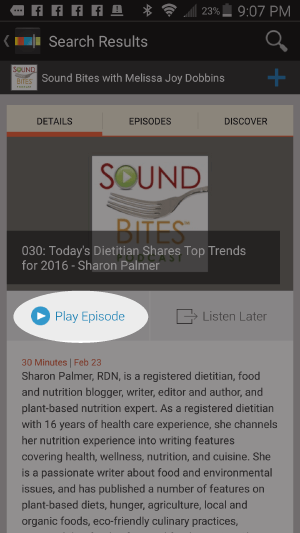
Listen on Stitcher (Android)
Install the Stitcher App
1. Search for “sound bites with melissa joy dobbins” 2. Choose Play Current Episode or Add to Playlist
Choose “Play Episode”
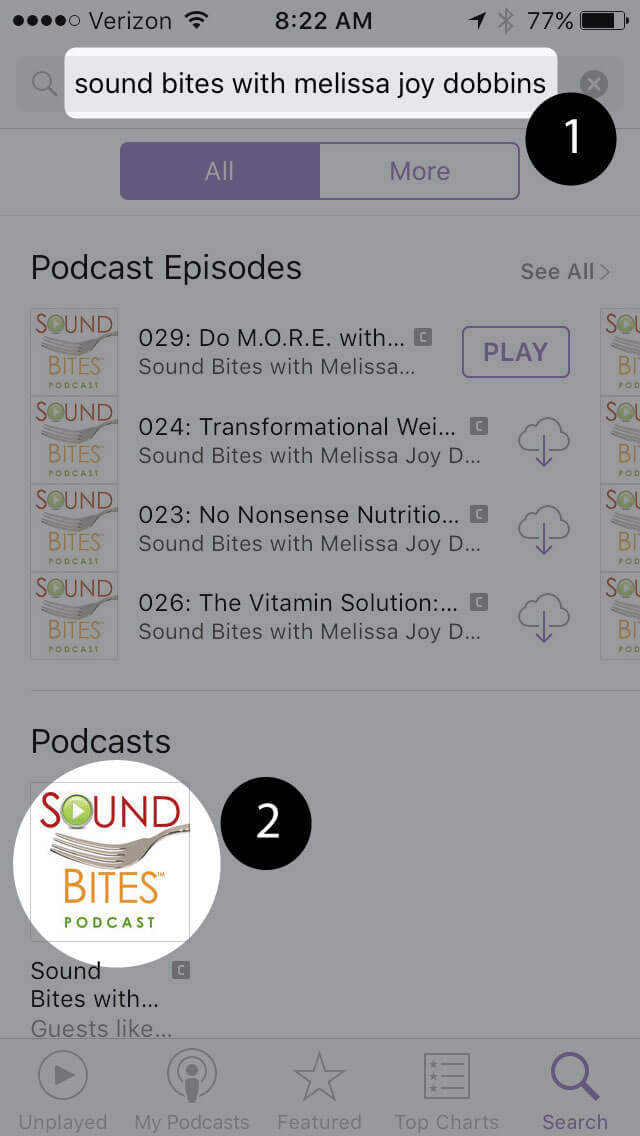
Subscribe & Review on iPhone
Open the “Podcast” app on your iPhone
Search for “Sound bites with melissa joy dobbins”
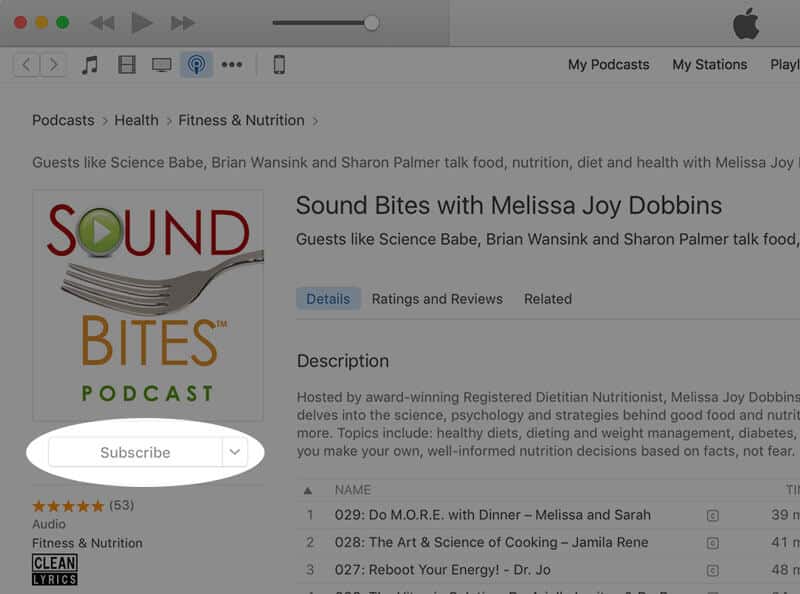
Open the podcast and click “Subscribe” and your done!
Write a Review
Click “Reviews”, then “Write a Review”.
Subscribe via RSS Feed
Navigate to any podcast player . Click on the RSS feed icon.
Click on the RSS feed icon.
Click on RSS Feed
Choose which application you would like to use to receive the RSS feed
Click “Subscribe Now”
Confirm settings and subscribe.
How to Review in iTunes
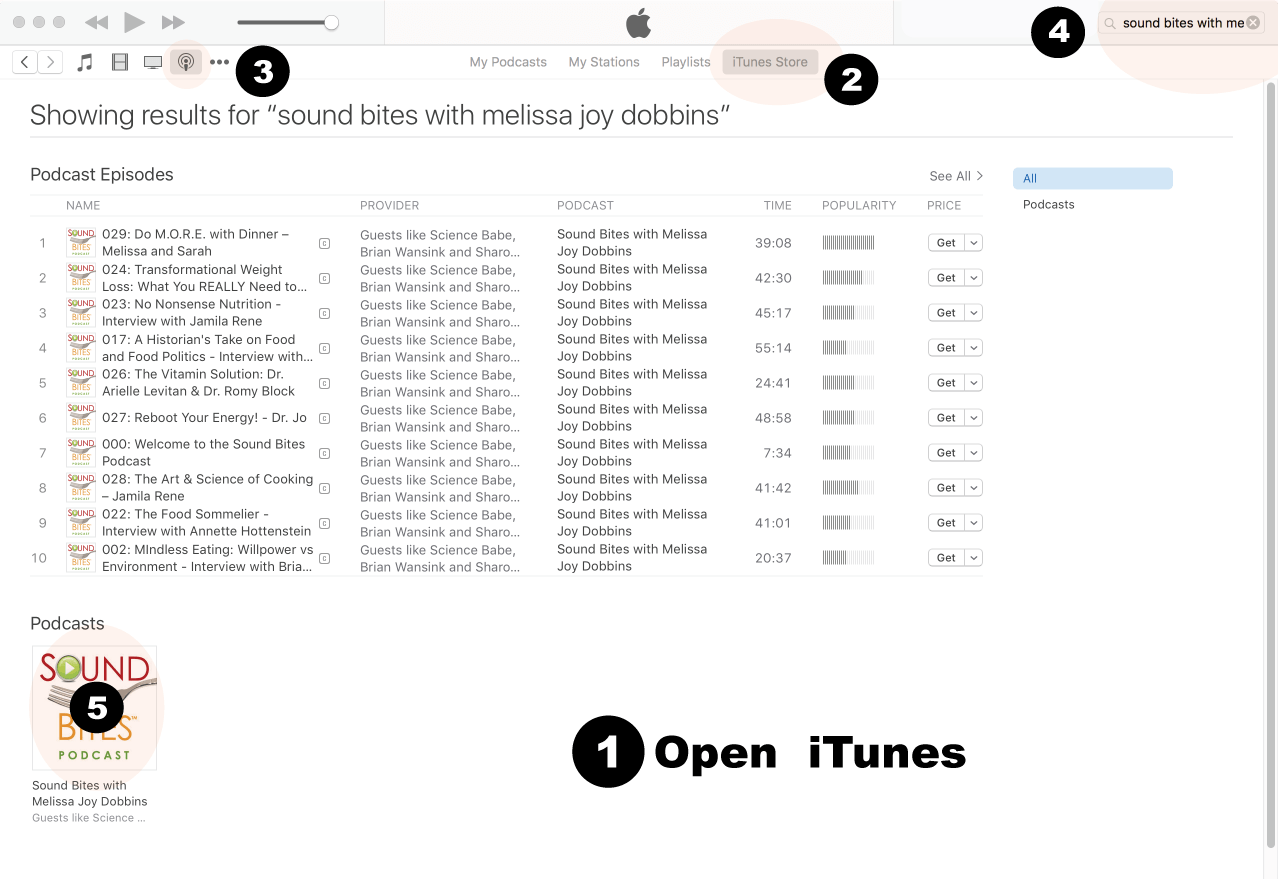
Open iTunes desktop application
Click iTunes Store
Click on Podcasts
Search for “Sound bites with Melissa Joy Dobbins”
Click on podcast image
Search for Sound Bites podcast in iTunes
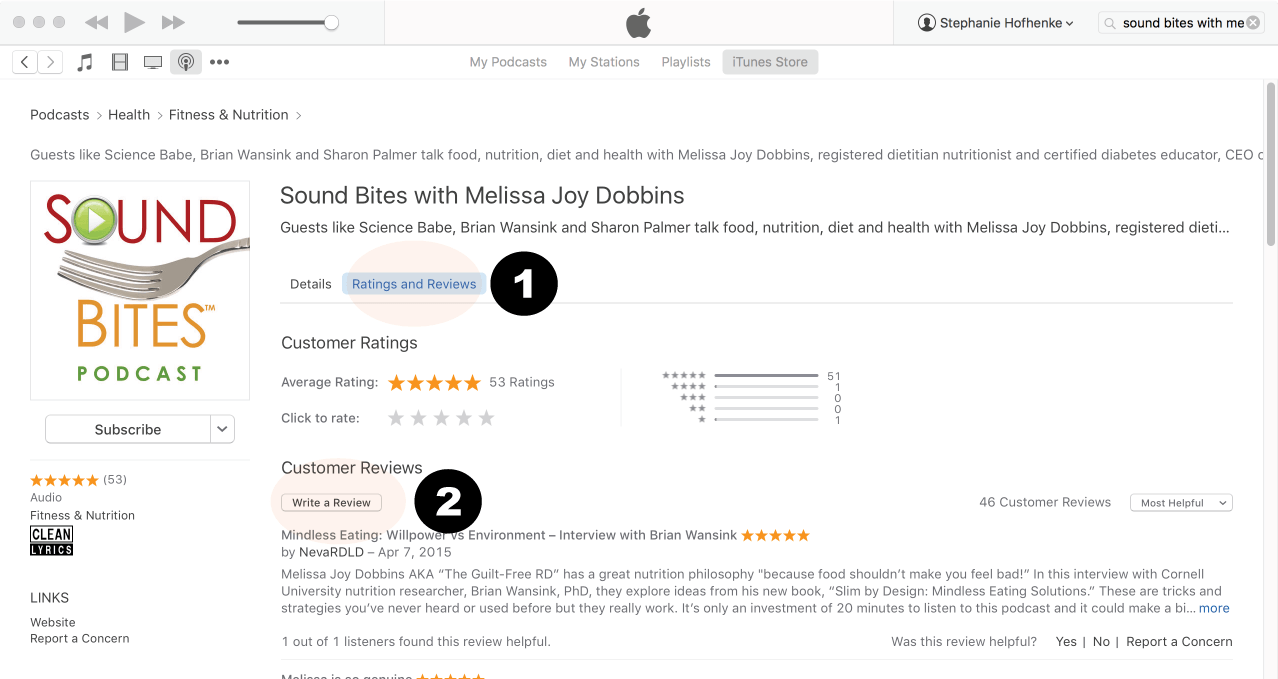
Click Ratings & Reivews
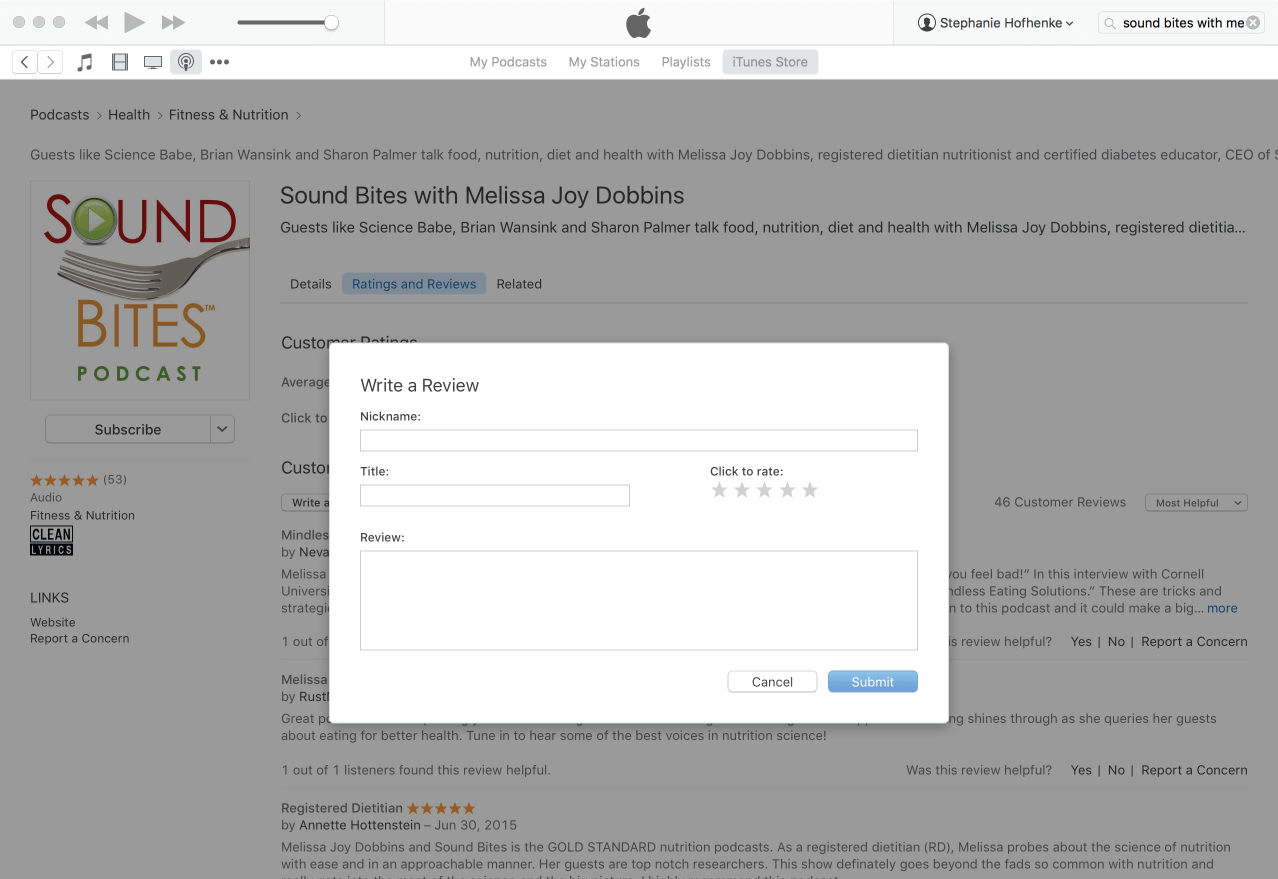
Click Write a Review
View reviews and write your own review.
Write your review…. Thank you!
Write your review!
How to subscribe via iTunes
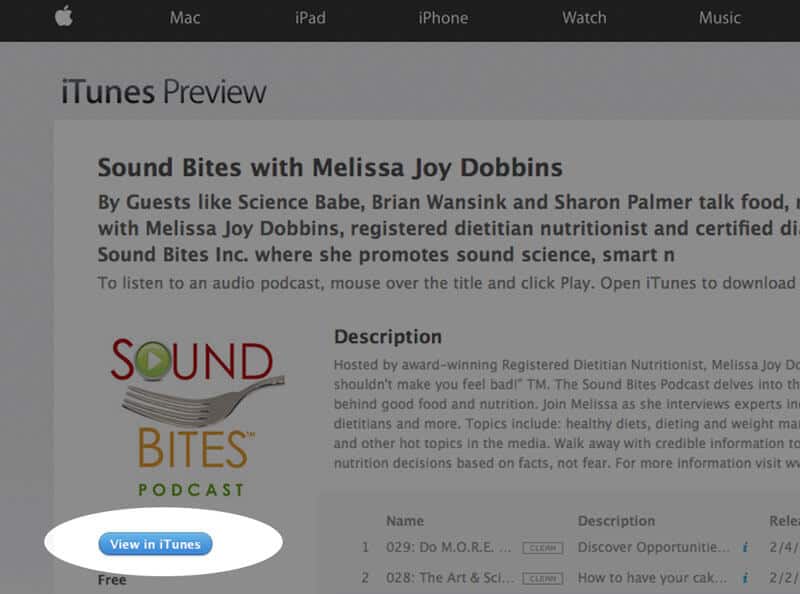
Click here to view the Sound Bites Podcastin iTunes, then click the blue “View in iTunes” button. This will open your iTunes application directly to Sound Bites Podcast. Click the “Subscribe” button, and your done!