Celebrating over 1 Million Downloads and 50,000 Free CEUs on the Sound Bites® Podcast | NEW: Get 1 years’ worth of CEUs with the new 15-CEU Podcast Course
Ultra-processed Foods, Hyperpalatability, Energy Intake Rate and Nutrient Density
The term ultra-processed foods (UPF) has been increasingly cited in the media and social media, and there’s also been a dramatic increase in research on UPF in the past few years. But what are ultra-processed foods? Are they contributing to chronic diseases like obesity, diabetes and heart disease? Are we eating more of them than ever before? How can we better understand the complexity of this topic and better evaluate the health and nutrition aspects of these foods?
Tune in to this episode to learn about:
The definition of UPF
Recent research on UPF
The NOVA classification system
Tufts University Food Compass Score
UPF association with adverse health outcomes such as obesity and diabetes
Hyperpalatability and “Energy Intake Rate”
The environmental impact of UPF
Benefits of food processing
Consumer insights about plant-based meat alternatives
How soyfoods rate on various food rating systems
Why “nutrient density” may not be the whole story
Modern soyfoods such as soy burgers are more processed than many of the traditional soyfoods, but they compare well with their animal-based counterparts and as a result of fortification, can be sources of nutrients not already present in soybeans.” – Dr. Mark Messina
Mark Messina PhD, MS
Dr. Messina is the Director of Nutrition Science and Research for the Soy Nutrition Institute Global, the co-owner of Nutrition Matters, Inc., a nutrition consulting company, and an adjunct associate professor at Loma Linda University. Over the past three decades, Dr. Messina has devoted his time to the study of the health effects of soyfoods and soybean components such as isoflavones. He writes extensively on these subjects, having published more than 100 articles and book chapters for health professionals, and has given more than 700 presentations to both consumer and professional groups in 55 countries. Dr. Messina is the chairperson of the editorial advisory board of, and writes a regular column for The Soy Connection, a quarterly newsletter that reaches over 250,000 dietitians and other health professionals.
One of the concerns about ultra-processed foods is that they’re ‘hyperpalatable’ but when we looked at soy meat versus hamburger and cow’s milk versus soy milk we found that none of these concerns about ultra-processed foods actually applied to these soy based products. I would hate to see someone not eat a soy burger or drink soy milk simply because they heard that they were classified as ultra-processed foods by the NOVA food classification system.” – Dr. Mark Messina
Ultra-Processed Diets Cause Excess Calorie Intake and Weight Gain: An Inpatient Randomized controlled Trial of Ad Libitum Food Intake- Open access paper by Hall et al.
Some Ultra-Processed Foods Are Needed for Nutrient Adequate Diets: Linear Programming Analyses of the Seattle Obesity Study- Open access paper by Drewnowski et al.
[00:00:00] Melissa: Hello. And welcome back to the sound bites podcast.
Today’s episode is about ultra processed foods. This buzzword has been
increasingly cited in the media, and there’s been a dramatic increase in research
on ultra processed foods in the past few years. But what are ultra processed
foods? Are they causing obesity and chronic diseases like diabetes and heart
disease?
[00:00:26] Are we eating more of them than ever before? Should we be
avoiding them, all of those questions and more will be answered. My guest
today is Dr. Mark. Messina. Dr. Mark Messina has a PhD in nutrition. He has
been focused on soy and soybean components for the past 32 years. He’s
currently director of nutrition science, and research at the soy nutrition Institute
global.
[00:00:52] And he’s an adjunct associate professor with Loma Linda university.
Welcome to the show Dr. Messina. Well, welcome back. I should say you are on
episode number 148, talking about a soy research update, cancer allergies, and
protein. It’s a very popular episode and I encourage people to check it out and
you can get one free continuing education unit.
[00:01:15] If you are a dietician, Diet technician or certified diabetes care and
education specialist. And speaking of that, we are submitting this episode today
for continuing education. So stay tuned for that and check out my CEU page. I
currently have over 30 free CU activities available@soundbitesalready.com
slash free CEUs.
[00:01:38] So Dr. Messina, please tell our listeners more about yourself and
your background and. If they want to take a deeper dive again, they can go back
and listen to 148. But for the purposes of our conversation today would love to
hear more about the work that you do and how the soy guy quote unquote got
interested in ultra processed foods.
[00:01:57] Mark: That’s my favorite topic talking about myself, I guess. You
know, as you mentioned, I’ve been in the field for about 32 years. I have a PhD
in nutrition. I also have a master’s degree in nutrition and after graduating, I
began working for the NIH. Uh, specifically the national cancer Institute
became interested in soy foods.[00:02:18] And since about 1990, I’ve really focused entirely on soy foods and
soybean components. So I spend most of my time writing and reading about,
soy, and also speaking about, soy I am doing interviews like.
[00:02:32] Melissa: Excellent and fun fact, your wife’s a dietician. So we talked
about that back in episode 1 48. Now I recently did an episode on processed
food, which had been wanting to do for a really long time.
[00:02:45] And that’s also a very popular episode, episode number 1 98, if
anyone’s interested. Ever since then, I’ve been wanting to do an episode on ultra
processed foods to kind of continue the conversation. And coincidentally, I
recently saw you present on this topic, so I’m really excited to have you back on
the podcast while our focus is on ultra processed foods as a soy foods expert,
you’re going to be speaking to soy foods and using those as examples.
[00:03:13] But if you want to kind of help me, um, in our listeners, make the
connection as to, you know, why is the soy foods guy talking about ultra
processed?
[00:03:21] Mark: Yeah, I’d be happy to do that. And it’s surprising to me that
I’m actually talking about this topic because I haven’t focused on processing or
ultra processed foods until about one year ago.
[00:03:34] And that’s because there’s a connection between the ultra processed
foods and some of the more commonly consumed soy foods. So only provide a
little bit of background. The term ultra processed foods was actually coined in
So if you look at the world scientific literature, you actually don’t see any
papers published on ultra processed foods before 2009.
[00:03:56] And since that time, the research has exploded. The term ultra
processed food was coined by Brazilian researchers who developed or created a
new food classification system called nova. It’s not an acronym. It doesn’t really
stand for anything. It does mean new in a Portuguese, perhaps. That’s why they
chose that word.
[00:04:18] So they came up with a food classification system based entirely on
the extent to which foods are processed. Now, there are a lot of food
classification systems out there, and these are designed to be a guide for
consumers. A simple way that consumers can help identify foods that arehealthy from foods that are less healthy, but without exception, those existing
food classification systems are really just based on nutrient content.
[00:04:51] So if a food has desirable nutrients like calcium and protein and fiber
The food receives a higher score. If it has less desirable nutrients, such as
sodium or saturated fat that receives a lower score until you do some
calculations to come up with one number, some of these systems are based on
like a five-star rating with five star being the best one star being the least
healthy food.
[00:05:16] But again, they’ve all been based on nutrient content. In contrast this
Nova food classification system is based on the extent to which a food is
processed. The foods that are most processed are these ultra processed foods,
the least processed foods, which are categorized as group one foods are the
minimally processed foods.
[00:05:36] So a minimally processed food would be a fruit or a vegetable. It
actually also is a meat and cows milk because those are largely unprocessed
foods. And over the past, 10 years. There has been quite a bit of research
looking at the relationship between the consumption of ultra processed foods
and a variety of health outcomes and what you see almost without exception.
[00:06:03] And it’s really not surprising is that the more ultra processed foods
you consume, the worst, the health outcomes are. So you see ultra processed
food intake being linked with Everything from obesity to cancer, to
cardiovascular disease. And the reason that I say it’s not surprising is because
when you look at the nutrient content of many ultra processed foods, it’s not
very impressive.
[00:06:32] These foods are often high in sugar and fat and not very nutrient
dense and very calorically dense. So there’s a debate within the scientific
community about the extent to which the nutrient content of an ultra processed
food is responsible for these adverse outcomes. Some people think it’s entirely
due to the poor nutrient content of these foods.
[00:06:58] Other people think there’s something else going on because ultra
processed foods are foods that are typically made or include food additives.
They could be flavor enhancers, they could be preservative. There are also
foods that are often comprised of extracts of different foods. So you might havea food that contains a concentrated source of protein, perhaps whey or soy
protein.
[00:07:23] And that would qualify that food as an ultra processed food. And
some argue that it’s more than just nutrient content, that accounts for these
adverse health outcomes.
[00:07:32] Melissa: Hmm. Okay. There’s a lot for us to dive into there, but I do
want to say, you know, as a former supermarket dietician, I was pretty familiar
with a lot of the different food rating systems.
[00:07:43] I had never heard of Nova in, like you said, it’s fairly new.
Mark: 2009
Melissa: Okay. So it was interesting because. At face value when you’re saying,
yeah, if it’s got more nutrients, it gets a higher rating. If it has, I should say the
nutrients that you want to consume more of it gets a higher rating of it has more
fat calories, sodium, the things that you want to decrease.
[00:08:07] It, it gets a lower rating.
[00:08:09] Mark: That’s true for the non Nova food classification systems for
Nova. That’s not the case at all. It’s just entirely based on processing. And that,
in my opinion is the problem with Nova. Right.
[00:08:22] Melissa: Okay. And that’s what I was going to ask you more about
because even Nova aside, these other rating systems, it sounds pretty straight
forward.
[00:08:30] But with every single rating system that I was familiar with there
were Flaws things that just didn’t make sense. Whereas like a diet soda might
rate higher than actually a food that provides nutrition because maybe that
nutrient rich food had a little bit more fat or sugar in it or something. Tell me
more about Nova.
[00:08:50] You said it’s strictly based on that processing level. It doesn’t take
anything else into consideration?
[00:08:56] Mark: No it doesn’t but you make a really good point. These
systems all have limitations because they’re designed to be simple. For purposesof helping to guide the consumer. So there are cases where a food that you and I
might consider to be relatively healthy, has a low score and vice versa.
[00:09:18] And I think these systems continue to be refined. So Tufts university
came out with the food compass score, which I think is a very good system. And
it actually looks at 54 different attributes of food And Tufts university just rated
8,000 foods and you can actually download these foods free of charge. Now
what’s interesting about the food compass score is that many of the ultra
processed foods as classified by Nova actually score very high.
[00:09:54] And so that points out that the Nova food classification system is not
very nuanced. So, you know, I give this example, oftentimes if you take milk
and fruit and make it into a smoothie, that would be a minimally processed
food. But if you add a concentrated source of protein to that smoothie, it
actually becomes an ultra processed food.
[00:10:19] Even though I think both of us would agree that the smoothie with
the protein is a better. Then the smoothie without one. So I think the Nova food
classification system is really just too simplistic and does a disservice to
consumers in many ways. Of course nutritionists recommend as much as
possible consuming, minimally processed foods.
[00:10:42] I mean, that’s something that we all endorse, but one of the leading
authorities in this field actually analyzed the diets of individuals. We found that
it was very difficult to meet nutrient needs. If you only consume minimally
processed foods or if you only consumed ultra processed foods. So what he
found was that you needed a combination of minimally processed foods and
ultra processed foods to actually meet all of your nutrient requirement because
many ultra processed foods are fortified with a variety of vitamins and minerals,
and many of these.
[00:11:22] Vitamins and minerals are shortfall nutrients. These are nutrients that
we typically do not consume sufficient amounts on. So I think ultra processed
food to have a role in the diet. And the reason I got interested in this field in the
first place is because. The plant milks in general. So Oak milk, pea milk, soy
milk, and the plant meats, whether they’re made from wheat or pea or soy are
generally classified as ultra processed foods.
[00:11:54] And I think that is scientifically unjustified,[00:11:58] Melissa: right? So, you know, I talk about nutrient rich foods on
every episode. I’m sure that comes up, uh, because for me. Trying to simplify
things, but not oversimplify things. I always want to just, let’s take a step back,
you know, whatever the marketing or the labeling says on the food, whether it
says it’s free from or excellent source of this, or actually that’s a good one.
[00:12:23] Um, or, you know, whether it says it’s processed or ultra processed,
or these terms we Throw about natural . Let’s look and see how much nutrition
does this food provide. How many of these nutrients, like you said, these
shortfall nutrients or the nutrients to encourage, um, nutrients of concern versus
the things that we, you know, we want to limit or not be excessive in Calories.
[00:12:45] Sodium fat, saturated, fat sugar. How much nutrition is that food
providing? And for me, that kind of just levels the playing field and keeps our
eye on the prize. And I think these terms, you know, whether something’s
processed or ultra processed, shouldn’t the deciding factor be? Is it somewhat of
an empty calorie food or is it more nutrient rich?
[00:13:08] But I think you’re going to share at least some preliminary insights as
to what you alluded to earlier, that it might be a little bit more nuanced than that,
but I don’t know if you want to react to what I just said.
[00:13:22] Mark: So I don’t disagree with. Because in the end, I do think the
nutrient content should be the determining factor regarding the healthfulness of
the food.
[00:13:35] And as I mentioned before, that’s how most existing food
classifications judge foods. And so I do think it’s difficult for many consumers
to be able to on their own, look at the nutrient content of the food to determine
whether. It is a healthy food or less healthy food. And that’s why these food
classifiation systems, I think can be useful because it may put it on a five point
scale and, you know, the more points, the higher, the quality of the food.
[00:14:06] So I think they are very useful. But the Nova system thinks that you
also have to take into consideration. For example, whether a product has an
emulsifier or a food additive as part of the makeup. And that would typically not
be part of most food classification systems because the Noga proponents would
argue.
[00:14:30] Number one, that some of these food additives may be harmful and
others might suggest that simply. Degrading the food matrix in of itself can havehealth consequences. So for example, even if you look at something like corn on
the cob versus canned corn, they’re going to have relatively similar nutrient
content, but the act of Chewing
[00:14:55] Itself may actually cause some physiological changes that could have
a more or less desirable effect on how you handle that particular food. Or if you
are looking at the sugar content of a food to determine whether that food is
going to affect your blood glucose levels. If the sugar is part of the food and its
natural state
[00:15:21] It may have a different effect from a food that contains the same
amount of sugar, but the sugar is not part of the food matrix. And so I do think
that we have to at least consider the possibility that we have to look at more
than just the nutrient content of a food. You know, the other issue that goes
along with that is that there are, as you well know, non nutrients in foods, these
are often referred to as phytochemicals that can have an effect on our health.
[00:15:53] And these are often not considered in these existing food
classification systems. And when you consume whole foods, especially whole
plant foods, you tend to get a lot of these potentially beneficial phytochemicals
plant chemicals.
[00:16:08] Melissa: So sometimes called phytonutrients, right? Yep. You, so we
know that there’s been a lot more research on ultra processed foods.
[00:16:15] especially since the term came about in 2009, because that term
wouldn’t have existed before then. Um, but can you tell us a little bit about what
the research shows beyond maybe what you’ve already indicated?
[00:16:26] Mark: Well, first of all, a lot of our calories come from ultra
processed foods. Well, over 50% in this country, and that’s true of many
developed countries around the world.
[00:16:36] So I think that’s probably not a good thing. I mean, as we said before,
generally speaking, you want most of your diet to be in the minimally processed
or unprocessed forms. Now I have nothing against processing because you
know, there are degrees of processing and it’s important to appreciate that
because processing.
[00:16:54] Involves heat. I mean, heat is a form of processing and heat can
inactivate anti-nutrients that are naturally found in plant foods. And some cases,the processing such as fermentation can actually create beneficial compounds
that aren’t in the unfermented food itself. So it’s all about the degree of
processing.
[00:17:18] And as I said before, why I got interested or became interested in this
area of research is because I’ve been focused on soy for the past 30 some years
and these plant meats. Soy meats and most soy milks are classified as ultra
processed. So if the Nova food classification systems continues to be embraced
and it’s embraced by the FAO and WHO and a number of countries around the
world have it as part of its their dietary guidelines, the Nova food classification
may discourage people from consuming these foods, which I think are quite
helpful and also compare well
[00:17:59] When you look at them versus their animal-based counterparts. So if
you compare, soy milk with cows milk. Or a soy burger with a hamburger. And
so I think in this case, the Nova food classification system does a real disservice
to some foods.
[00:18:17] Melissa: Right. Right now, just real quick, you mentioned
anti-nutrients uh, so for people who aren’t listening, could you just explain that
real quick?
[00:18:24] Yeah,
[00:18:24] Mark: sure. Anti-nutrients are found both in animal foods and plant
foods, although for the most part they’re associated with plant foods. Uh,
because the plant oftentimes synthesize these compounds as a defense against
predators, and they’re also a storage form of some nutrients. So if you consider
phytate also referred to as phytic acid.
[00:18:47] That is a storage form of phosphorus in plants, but phytate in plants
also binds minerals. So it inhibits the absorption of minerals, such as iron and
calcium. There are also compounds called protease inhibitors. These compounds
inhibit the activity of enzymes that we need to digest proteins. So many plants
are very high in these.
[00:19:15] Anti-nutrients but as a result of processing, we can eat those foods
and they’re very healthy for us. And in fact, some of the compounds that have
been historically classified as anti-nutrients actually are thought to have somebeneficial effects. So I mentioned phytate inhibits Mineral absorption. It’s also
an antioxidant.
[00:19:39] Some of the protease inhibitors have been shown to inhibit cancer, in
different, experimental models. So I think all the points out is that, you know,
food is very complex. It’s hard to simplify things. We should focus as much as
possible on minimally processed foods. But you know, these processed foods
are very convenient.
[00:20:01] They have a long shelf life, which I think is very important for food
waste and food loss. Also, they are often very economical and that’s an
important issue for food security.
[00:20:16] Melissa: Absolutely. Yeah. And we, and we get into more about the
importance of, and benefits of food processing or processed foods. Well, I
should just say the food processing in episode 1 98.
[00:20:26] So encourage people to check that out. Um, but what else can you
tell us about the ultra processed foods research and perhaps maybe some
consumer insights? I know that there was a recent IFIC survey, international
food information council that had some interesting insights as well. Yeah. Well,
[00:20:44] Mark: generally speaking.
[00:20:47] people have a relatively negative view of the term processed foods,
aside from even ultra processed foods. If you do a Google search, looking at
junk foods, processed foods and ultra processed foods, you come up with pretty
much the same images. And I think it’s understandable because over the years
processed foods has sort of come to mean junk foods.
[00:21:14] So if you think of. Processing. I mentioned corn on the cob versus
canned corn. And then the next step would be corn chips. And I think most
people despite whether they enjoy them or not, would consider corn chips to be
a highly processed food and ultra processed food. And one that you would only
consume occasionally as opposed to corn on the cob, uh, which you could
consume as much as you wanted.
[00:21:39] So again, it’s important to consider the nuance that processing is
really an important component to our food system. It’s absolutely essential. And
I mentioned before that as a result of processing, we’re able to get a lot of ournutrients that are not naturally found in those foods. Maybe the best example is
actually cows milk.
[00:22:04] I think oftentimes consumers don’t realize that cows milk is actually
fortified with vitamin D. It’s not naturally present. And vitamin D is a short fall
nutrient. And if you’re living in, you know, the climate yeah, Massachusetts,
you’re not going to be going outside very much. And most people have
relatively low levels, the serum levels of vitamin D.
[00:22:28] So you get that from fortified soy milk, for example, and the soy
milks are fortified with calcium as
[00:22:34] Melissa: well, right? Yes. And that’s a great point. And that’s what
I’ve always thought of as well. It’s sometimes it’s, it’s a long time coming with
regard to some public health initiatives, but like folate in, you know, fortified in
grains, breads and grains.
[00:22:51] Um, that was something that. You know, has helped significantly
reduce the incidents of neural tube defects.
[00:22:57] Mark: Absolutely. An iodine. That’s another really good when you
think of the harmful effects of iodine deficiency, and most of us get our iodine
from iodized salt. So these are all examples of processing that are just very
beneficial for society.
[00:23:15] You know, others would say, well, there’s processing and then there’s
ultra processed. And I appreciate the difference between the two. It’s just that, as
I mentioned, a lot of ultra processed foods actually score quite high. And even if
you think of some of the oils, the seed oils, like soybean oil, corn oil, in most
systems, they score quite high because they’re high in polyunsaturated fat, the
type of fat that lowers blood cholesterol.
[00:23:42] Whereas the Nova food classification system rates them very poorly
in contrast lard or butter is actually rated very high in the Nova classification
because they’re less processed. That’s right. But it’s loaded with saturated fat,
right? I think in some respects Nova’s been helpful because it’s forced the
nutrition community to consider in greater detail, the effects both good and bad
of processing.
[00:24:11] And so one of the things I did along with several of my colleagues is
published well, it’s not quite published yet, but hopefully it will be within thenext several weeks. We actually compared soy milk with cows milk and. Soy
burgers with hamburgers. And we went through some of the concerns that have
been raised about ultra processed foods to see if they apply more to the soy
products than they did to their animal-based counterparts and what we found
without exception
[00:24:40] Was, it was not the case. So one of the really big concerns about ultra
processed foods is that they’re hyper palatable and you know, the old
advertisement for potato chips, you can’t just eat one or even jello. There’s
always room for jello. I mean, we all know that once you get into a bag of some
snack foods, that that bag is toast.
[00:25:00] I mean, you’re just going to go right through it. So I think hyper
palatability is an issue and the food industry does add flavorings to foods and
additives that are designed specifically to improve the taste of that food after all
they’re in the business to make food that tastes good. So I, you know, you can’t
really fault them for that.
[00:25:23] There are a lot of these issues, but when we went through the soy
meat versus the hamburger and the cows milk versus the soymilk. We found that
none of these concerns about ultra processed foods actually applied to the
soy-based products. That’s really what got me interested. I hate to see someone
not eat a soy burger or drink.
[00:25:43] Soy milk simply because they heard that they were classified as ultra
processed foods by the Nova food classification system.
[00:25:53] Melissa: Right. Could you expand a little bit on this research in this
paper coming out, uh, was this perceptions of consumers or was this a trial? I’m
confused on the methods.
[00:26:03] Mark: Yeah. And I’d be happy to do that.
[00:26:04] And I, your confusion is understandable. I didn’t do a very good job
explaining it. So it was a review paper, some of the studies we looked at were
clinical trials and some were consumer surveys. So for example, not surveys,
but looking at consumer taste preferences. So for the hyper palatability question,
we looked at data that compared to soy burger with a hamburger or a cow’s milk
with soy milk.[00:26:32] And we found there was no evidence to suggest that the soy products
were hyper palatable in that they were more likely to be consumed in excess
than the animal based counterpart, we also looked at the effects of soy milk and
cows milk on blood sugar levels. So those were clinical trials, no difference
whatsoever between the two.
[00:26:56] So, um, we looked at chewing time because the faster you can eat
something. The greater, the likelihood is that you’re going to over consume it.
And so I am a really fast eater and my wife is always telling me to slow down
and, you know, there are a lot of fast eaters out there and it takes a while for
your senses to kick in so that you would actually register that you’re full.
[00:27:21] So it’s good to eat foods a little bit more slowly. And when you break
the food matrix, To be easier to consume foods very quickly. So you think about
the time it might take to eat an apple versus how long it would take to drink
apple juice? The juice would go down much more quickly. So when we looked
at all these different attributes, we even looked at a study that compared the
chewing time of a chicken product, actual animal based with a soy-based
chicken.
[00:27:53] And the time it took to chew five grams was no different between the
two products. So I think this paper will make a contribution to the literature
because it points out that simply because Nova classifies a food as in one way,
doesn’t mean that it can’t make a contribution to the diet. The other issue is that
some of the ultra processed foods are thought to be bad for the environment
because of the packaging involved
[00:28:18] And that is an issue. I think we all agree that there’s too much
packaging, not only for foods, but a lot of the products that we buy, but again, it
doesn’t apply more to the soy products than it would to cow’s milk or
hamburger.
[00:28:30] Melissa: Right. Right. Okay. So, so the hyper palatability and this
information that you’re sharing regarding this, uh, research that you did is that
also speaking to the energy intake rate that you were talking about in your
presentation,
[00:28:42] Mark: Yeah that seems to be a really important one.
[00:28:45] And it was highlighted by a study published in 2019 by Hall and
colleagues who are internationally recognized obesity researchers. And theyactually help put the Nova food classification system on the map because they
set out to determine how an ultra processed food diet would affect health in
comparison to a diet based entirely on unprocessed foods.
[00:29:11] So he actually had volunteers that were in a metabolic ward, so they
knew everything that they were eating and they could eat as much food as they
want. For two weeks, they consumed an ultra processed foods. And for two
weeks, they consumed a minimally processed food diet and what they found
much to their surprise.
[00:29:29] And they acknowledged that in their research paper is that when the
participants were consuming, the ultra processed food diet, they actually gained
a little bit of weight. And it was just over a two week period when they consume
the unprocessed food diet, they lost a little bit of weight. And the difference
between the two
[00:29:47] results were statistically significant, which means that it likely did
not occur by chance. So in other words, the evidence was suggesting that the
ultra processed foods may have contributed to weight gain, but what they also
acknowledged in the paper is that the ultra processed foods were more energy
dense.
[00:30:06] They had more calories per gram. You could also eat those foods
more quickly. So if you can eat the ultra processed foods more quickly and they
have more calories per amount of food, you’re going to be able to consume
more calories. And that’s exactly what happened. Participants consumed about
500 calories more per day when they were consuming the ultra processed food
diet.
[00:30:32] But again, it’s not that surprising because the ultra processed foods
were consumed more quickly and they were more energy dense. And that’s
exactly what you would expect
[00:30:42] Melissa: Right and if they’re consuming more total calories, you
would expect them to gain weight.
[00:30:46] Mark: That’s that’s what happened. But the study is being cited as
evidence that ultra processed foods can contribute to obesity.
[00:30:55] And that might be the case. I mean, of course as you know Obesity is
a complex issue and multi-factorial, there are many reasons for why so many ofus are overweight and obese, but then if you get back to the soy versus animal
comparison, you can’t drink soy milk more quickly than cows milk, right? And
the same thing for the burgers and the energy density, the number of calories per
gram is actually lower.
[00:31:21] in the soy milks and the soy burgers. So again, those criticisms of
multi-process foods don’t apply to these soy products
[00:31:29] Melissa: right? So with that energy and take rate, these hyper
palatable ultra processed foods, uh, there, it’s just easier to unknowingly get
more calories when you’re choosing those
[00:31:43] Mark: that’s right. And it has to do with satiety, the feelings of
fullness.
[00:31:48] As I said before, the more quickly you can eat foods and if they’re
more energy dense, it’s interesting. You think about any food. If you go back to
that. Corn on the cob, canned corn. I mean, you can eat a heck of a lot of
calories in corn chips, you know, much more so than corn on the cob. And if
you don’t put butter on or, you know, some sort of oil and corn on the cob,
you’re probably not going eat that much to be in with, but the corn chips have
flavorings and they’re high in sodium, which it’s an attribute that characteristic
of food that people enjoy.
[00:32:17] So a lot of this is not very surprising. It’s just that the Nova
classification system is just too simplistic and it categorizes a lot of Healthful
foods as being unhealthy and that’s just not good for the country. Sure. This is
the
[00:32:30] Melissa: age old problem that we have a nutrition is simplifying
things, but not oversimplifying them because that’s not helpful.
[00:32:36] Um, so yeah, it sounds like there’s a lot of interesting, uh, research
and focus on this and it’s even more complex than just look at the nutrition, like
I always say, so it was very interesting. Is there any thing that you can share
with us as far as takeaways for everybody listening, whether they’re the average
consumer or whether they’re a healthcare professional, trying to help patients or
clients or other insights or information you wanted to
[00:33:02] Mark: share just in general.[00:33:04] I agree with your general perspective, which is that, you know,
nutrient content is important and as much as possible you want to consume.
Foods that are not extensively processed and that’s, you know, whole grains,
legumes, fruits, and vegetables, et cetera. It’s nuts, seeds, but simply because a
food is processed.
[00:33:28] Does not mean you should not consume it. So if you like beans and
you don’t have enough time to actually cook dry beans by all means, have a can
of beans. And they’re pretty darn healthy source of fiber. Great source of
protein.
[00:33:44] Melissa: Yeah. And also just a quick little side note. If you rinse the
beans, you can reduce the sodium content by 40%.
[00:33:51] Mark: That’s great because I did not know that. I taught you
something. Yeah. You know, they have potassium and folate, so they’re really
under utilized source of nutrition in our country. Absolutely. And so I do think
processing is a consideration, but it’s only one factor when you’re looking at the
healthfulness of the
[00:34:12] Melissa: food.
[00:34:12] Absolutely. And, and I say this a lot, but I want to really put a finer
point on it. People say, oh, well, you know, clean labels, short ingredients lists,
you know, those long ingredients list foods. I say no, no, no, no. That does not
necessarily mean that it’s not nutrient rich or it doesn’t provide a lot of good
nutrition.
[00:34:30] And I think some soy foods would fall into that. They might have a
longer ingredients list and that’s okay. Take a step back and look at the nutrition.
[00:34:38] Mark: Let me, let me give you an amen on that one. And I’m really
glad you brought that up before we ended, because I have actually seen. Some
soy products criticized for their long ingredient list.
[00:34:49] And the reason the ingredient list was long was because they had
vitamins and minerals added to it. I mean, that’s just Uh, it may work well in the
form of marketing, but it’s really quite dishonest. So ingredient lists really has
nothing to do with the quality of the food itself.[00:35:08] Melissa: Yeah. I did a podcast interview with Kris Sollid from IFIC
the international food information council, where we talked about consumer
perceptions and insights about.
[00:35:18] Um, short ingredients list, long ingredients lists. I can’t remember
what number that is, but I’ll link to it in my show notes if anybody’s interested,
but it’s really too bad that a lot of people have that perception. Um, you and I
can shout it from the rooftops. Like that’s not necessarily an indicator that it’s
not nutritious.
[00:35:35] Any other takeaways or final thoughts as we’re wrapping up.
[00:35:40] Mark: Well, since you referred to me as the soy guy early on, I’ll
just give a plug for soy foods. I think soy can make an important contribution to
an overall healthy diet. And, you know, try to consume two servings per day,
but one is better than none.
[00:35:55] And because there are such a wide variety of foods that can be made
from soy beans from the traditional Asian soy foods, you know, miso, tempeh,
tofu, soymilk to the modern soy foods, like, soy burgers and soy nuts. And then
there’s edamame – the green soy beans. It’s easy to incorporate some soy into
the diet
[00:36:15] Melissa: and I know for more information about soy foods, soy
health and nutrition research, people can go to the soy nutrition Institute or SNI
global website, their Facebook, Twitter, and LinkedIn I’ll have those links in my
show notes, but the website is SNIglobal.org, I believe.
[00:36:34] Is that correct? Okay. Great. And then maybe you could provide me
some links to include in the show notes where people can find out more about
the research that you’ve talked about and the Nova system and all things ultra
processed, uh, that we’ve touched on.
[00:36:50] Mark: Sure. I will do that.
[00:36:51] Melissa: Okay, great. Well, thank you so much for coming back on
the show.
[00:36:55] It’s been a pleasure talking with you and learning more about this
really interesting buzzword ultraprocessed. Thanks for the invite. My pleasure.And for everybody listening as always enjoy your food with health in mind till
next time.
LISTEN, LEARN AND EARN
Listen to select Sound Bites Podcasts and earn free CEU credits approved by the Commission on Dietetic Registration (CDR) for registered dietitian nutritionists and dietetic technicians, registered. Get started!
Get Melissa’s Sound Science Toolkit here!
Partnerships:
Sound Bites is partnering with the Association of Diabetes Care and Education Specialists (formerly the American Association of Diabetes Educators)! Stay tuned for updates on the podcast, blog and newsletter!
Sound Bites is partnering with the International Food Information Council! Stay tuned for updates on the podcast, blog and newsletter!
Getting 30 grams of protein at breakfast is a challenge for me! I’m not a fan of protein powder or protein bars, so wondering if you have examples of food combinations you eat regularly to get to that amount?
Sign up for my monthly newsletter and episode eblasts so you never miss an update!
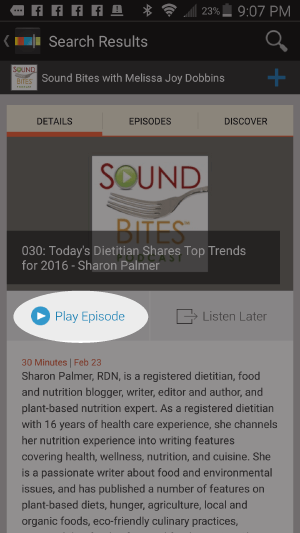
Listen on Stitcher (Android)
Install the Stitcher App
1. Search for “sound bites with melissa joy dobbins” 2. Choose Play Current Episode or Add to Playlist
Choose “Play Episode”
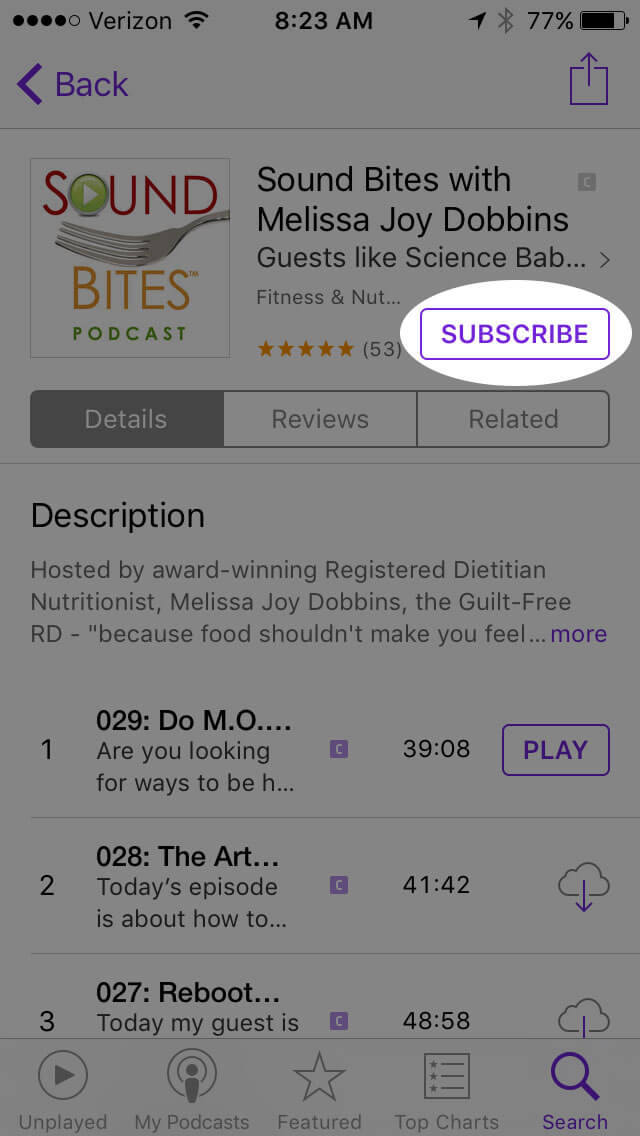
Subscribe & Review on iPhone
Open the “Podcast” app on your iPhone
Search for “Sound bites with melissa joy dobbins”
Open the podcast and click “Subscribe” and your done!
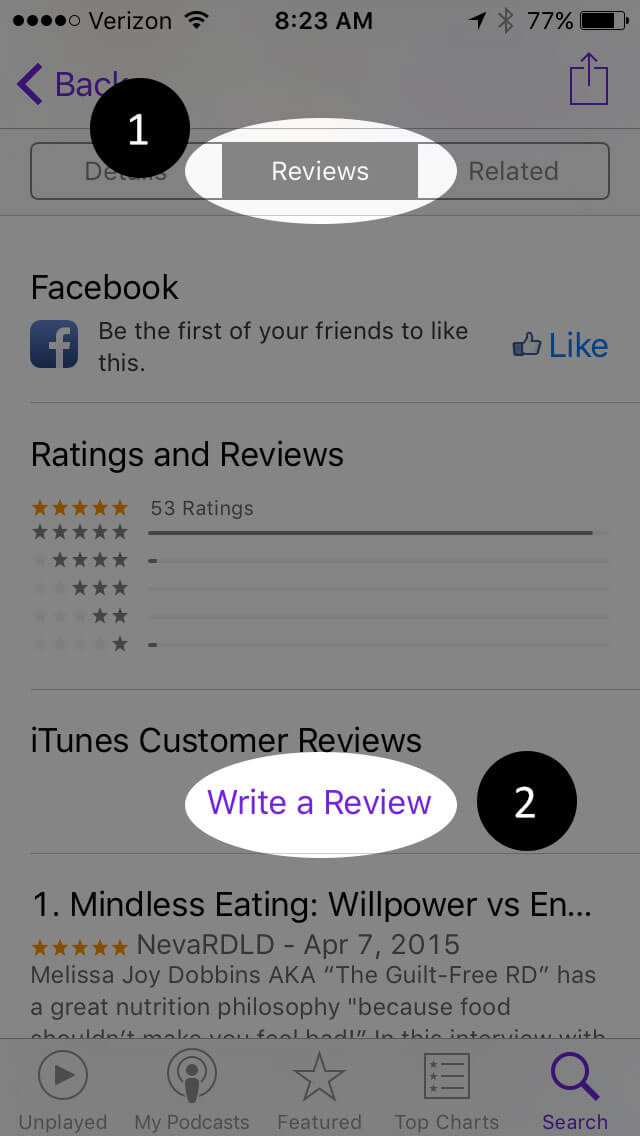
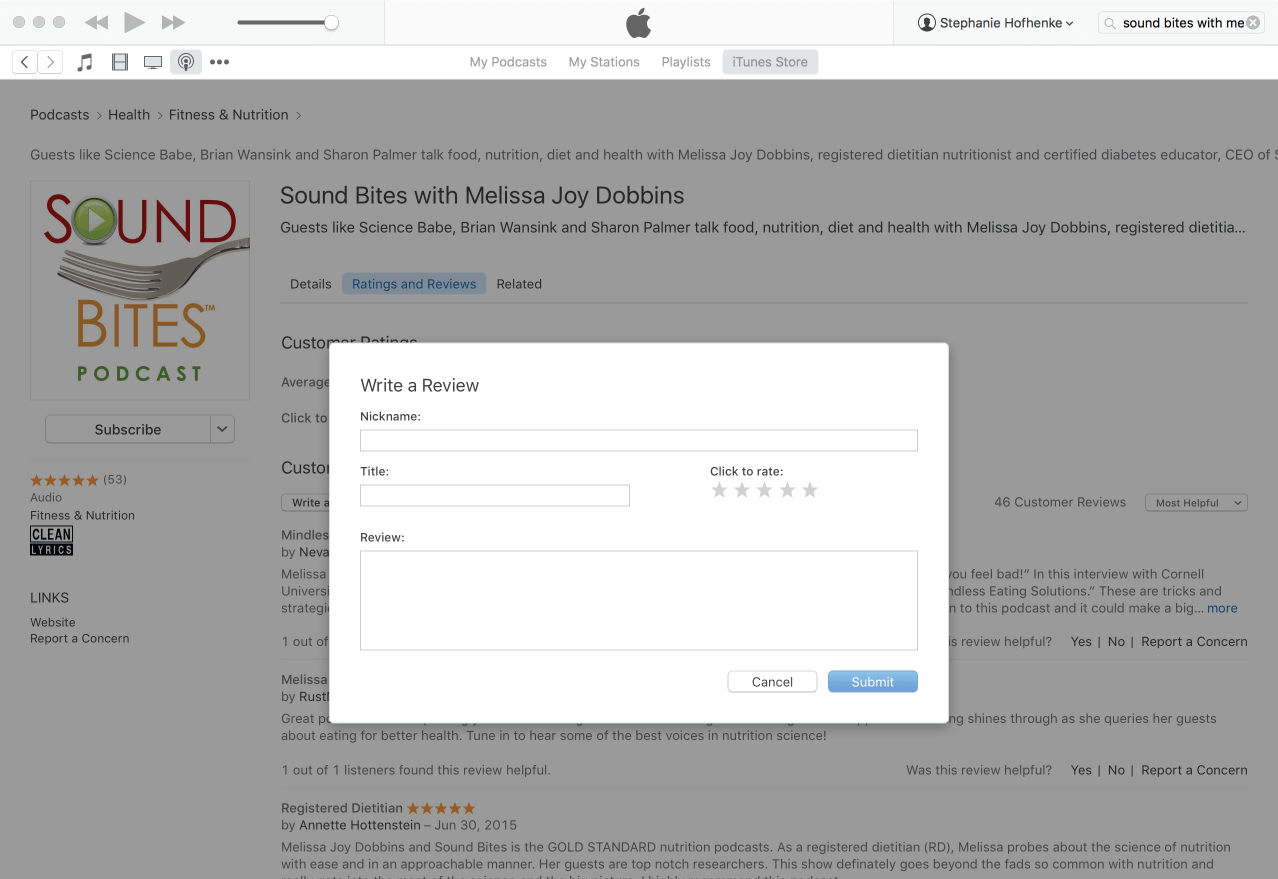
Write a Review
Click “Reviews”, then “Write a Review”.
Subscribe via RSS Feed
Navigate to any podcast player . Click on the RSS feed icon.
Click on the RSS feed icon.
Click on RSS Feed
Choose which application you would like to use to receive the RSS feed
Click “Subscribe Now”
Confirm settings and subscribe.
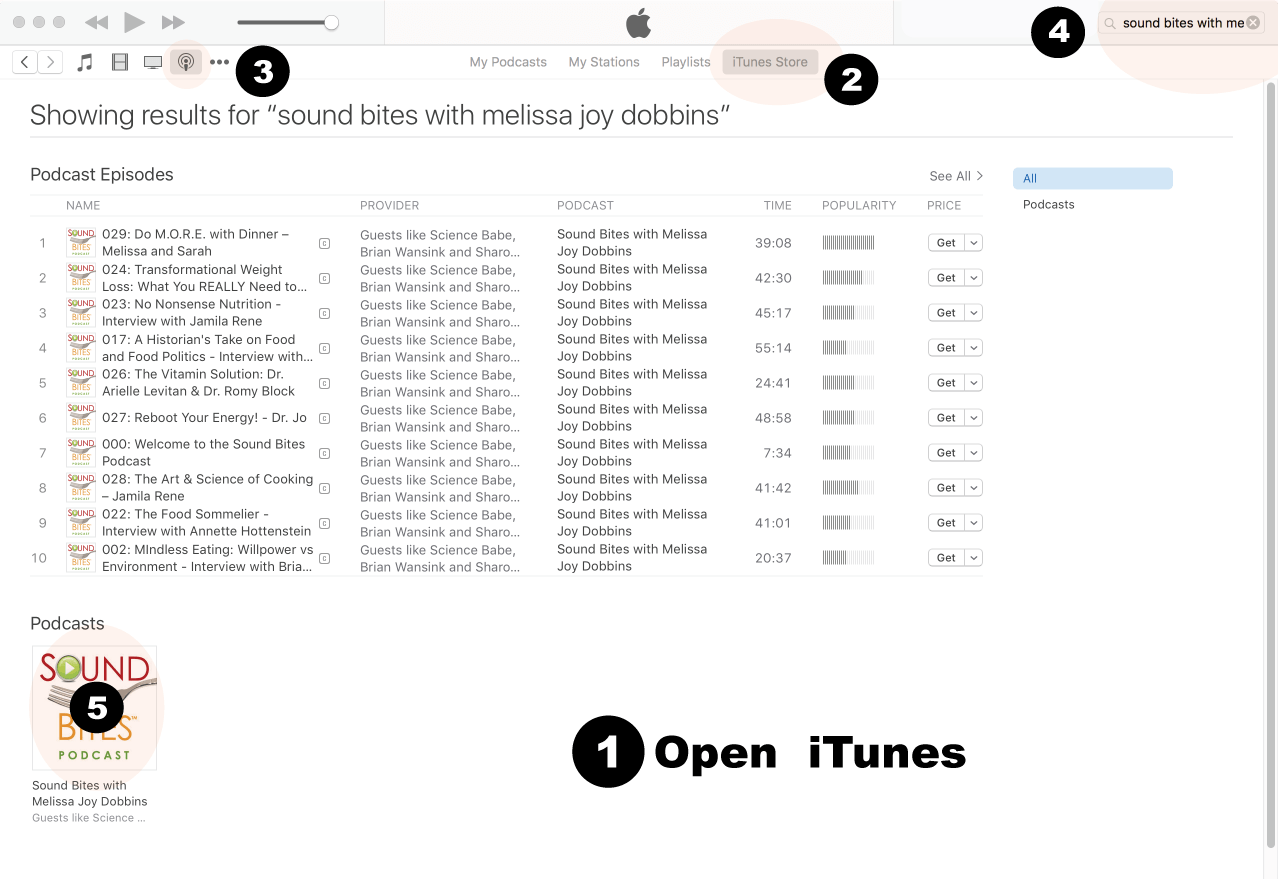
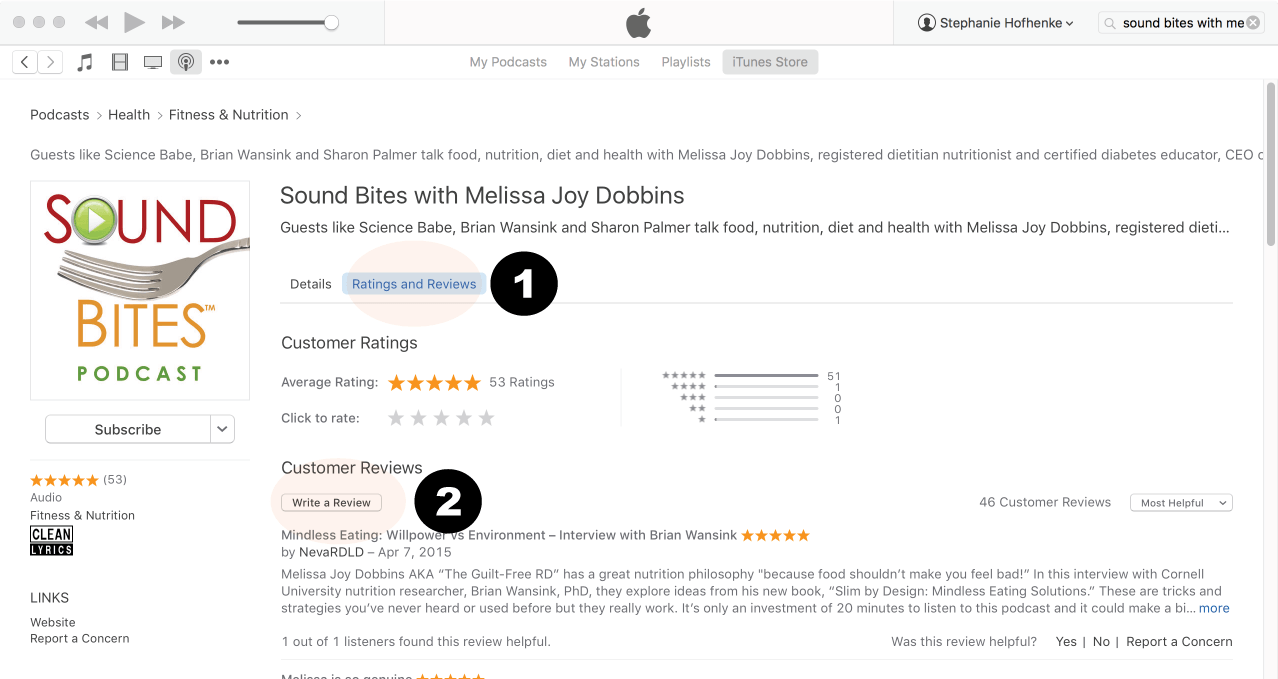
How to Review in iTunes
Open iTunes desktop application
Click iTunes Store
Click on Podcasts
Search for “Sound bites with Melissa Joy Dobbins”
Click on podcast image
Search for Sound Bites podcast in iTunes
Click Ratings & Reivews
Click Write a Review
View reviews and write your own review.
Write your review…. Thank you!
Write your review!
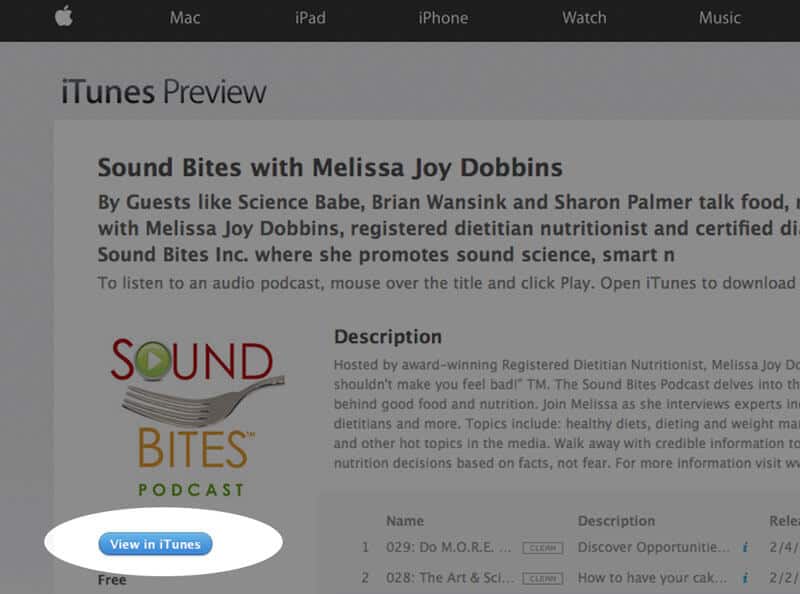
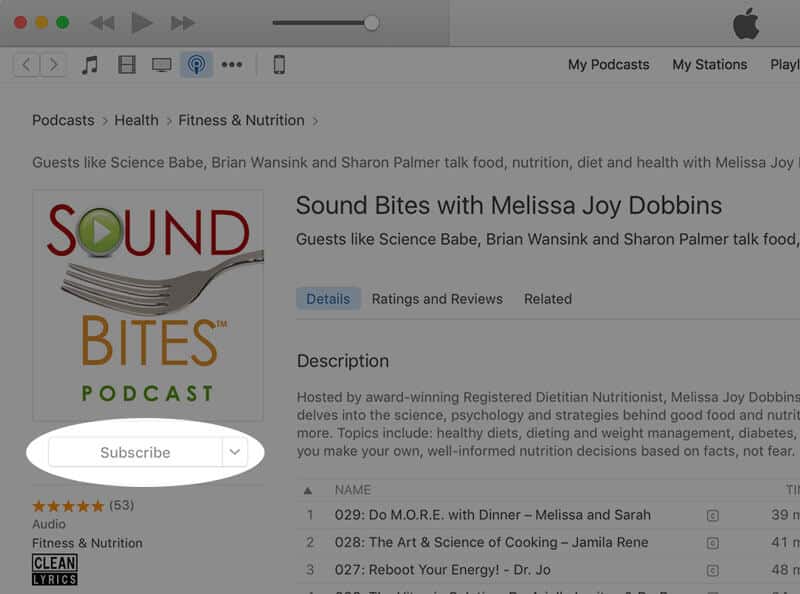
How to subscribe via iTunes
Click here to view the Sound Bites Podcastin iTunes, then click the blue “View in iTunes” button. This will open your iTunes application directly to Sound Bites Podcast. Click the “Subscribe” button, and your done!




















Getting 30 grams of protein at breakfast is a challenge for me! I’m not a fan of protein powder or protein bars, so wondering if you have examples of food combinations you eat regularly to get to that amount?
Hi Jill,
I agree! it is a challenge for me, too. My favorite way is the Fairlife Nutrition Plan milk chug I mentioned in the outtro. But here is a link to my colleague Neily’s post on high protein breakfast ideas: https://www.neilyonnutrition.com/2014/04/15/7-high-protein-breakfasts/ and a link to my colleague Lauren’s book Protein-Packed Breakfast Club: https://www.amazon.com/dp/1543011241?ref=exp_laurenpincusrd_dp_vv_d
Hope these are helpful!
Melissa