Celebrating over 1 Million Downloads and 65,000 Free CEUs on the Sound Bites® Podcast | NEW: Get 1 years’ worth of CEUs with the new 15-CEU Podcast Course
Unpacking Food Lawsuits: Public Health or Personal Responsibility?
You’ve seen the ads: “You may be entitled to compensation.” But what happens between that commercial and the courtroom—and what happens when the food on our plates becomes the focus of a lawsuit?
Today, we’re taking a peek behind the curtain of large-scale litigation: how these lawsuits come together, who funds them, and how courts evaluate the science. Does a settlement mean a claim has merit? And where do public health, corporate accountability, and personal responsibility intersect?
We’ll also explore litigation involving ultra-processed foods and claims about addiction and chronic disease. What could these cases mean for food prices, choices, and the health of consumers? Let’s unpack the legal arguments—and the questions behind the headlines.
Tune in to this episode to learn about:
an introduction to food industry litigation
how lawsuits are generated and the role of advertising
the influence of Wall Street and mass marketing campaigns
history of food-related lawsuits and their resurgence
case study: The Martinez lawsuit and court dismissal
the role of judges and expert witnesses in court
science, ultra-processed foods, and public health
personal responsibility and the addiction narrative
impact of litigation on consumers and public health
Mark Behrens, Esq.
Mark Behrens co-chairs Shook, Hardy & Bacon’s Washington, DC-based Public Policy Group. He has over 30 years of experience representing business defendants in legal matters and is a national expert on civil justice issues. Mark is a graduate of Vanderbilt University Law School.
We are hearing about ‘addiction’ because plaintiffs’ lawyers are framing these cases around addiction to flip the narrative and counter the companies’ personal responsibility defense. Their argument is, ‘We couldn’t control our behavior because we were addicted.’ I think they’ll have a hard time making that case, but that’s why you’re hearing the addiction narrative, it’s an effort to overcome a personal responsibility claim by the companies.” – Mark Behrens, Esq.
Resources
Some links may be affiliate links. As an Amazon Associate, I earn from qualifying purchases.
This is shock and awe litigation. The idea is to use Wall Street dollars, mass marketing campaigns to generate thousands of lawsuits, both to overwhelm the company’s ability to muster a defense, but also overwhelm the court system as well, and get the courts to suddenly start saying, “How can we settle this massive claims rather than look at the merits of individual cases because it would tie up the court system if we were actually to litigate individual claims that number in the tens of thousands.”
[Intro Playing]
Voiceover (00:36):
Welcome to Sound Bites, hosted by registered dietitian nutritionist, Melissa Joy Dobbins. Let’s delve into the science, the psychology, and the strategies behind good food and nutrition.
Melissa Joy (01:00):
Hello, and welcome to the Sound Bites Podcast. Today’s topic is about lawsuits and the food industry. You’ve seen the ads, you may be entitled to compensation, but what happens between that commercial and the courtroom, and what happens when the food on our plates becomes the focus of a lawsuit?
Today, we’re taking a peek behind the curtain of large-scale litigation, how these lawsuits come together, who funds them, and how courts evaluate the science. Does a settlement mean a claim has merit? And where do public health, corporate accountability, and personal responsibility intersect?
We’ll also explore litigation involving ultra-processed foods and claims about addiction and chronic disease. What could these cases mean for food prices, choices, and the health of consumers? Let’s unpack the legal arguments and the questions behind the headlines.
This episode is not sponsored. Do me a favor and click the follow button wherever you’re listening. That’s a great way to support the show and make sure you get notified about new episodes.
My guest today is Mark Behrens, attorney at law. Mark Behrens co-chairs the public policy group of Shook, Hardy & Bacon, a large national law firm that primarily represents corporate defendants in complex lawsuits nationwide. He has over 30 years of experience in the law, and does a frequent lecture on legal trends. Mark is also a graduate of Vanderbilt University Law School.
Mark, welcome to the show.
Mark Behrens (02:32):
Thank you for having me.
Melissa Joy (02:33):
So excited to dig into this conversation, but first, I would really love for you to share with our listeners more about your background and the work you do, and any disclosures to note.
Mark Behrens (02:43):
Sure. As you said, I am a partner and co-chair of the public policy group at Shook, Hardy & Bacon. I’ve been a practicing lawyer for over 30 years. Throughout that time, I’ve represented defendants in civil cases, lawsuits in court, and also working very substantially in the civil justice realm, that is trying to improve our court system to make it fair to everybody that uses it.
Melissa Joy (03:12):
Excellent. And any disclosures to note?
Mark Behrens (03:15):
No.
Melissa Joy (03:16):
Okay, great. So, let’s begin with some definitions. I think most people are familiar with the term class action, class action lawsuit, but you talk about mass tort litigation. What is that?
Mark Behrens (03:29):
Yeah, a mass tort is simply where you have many individual claimants that come forward and file lawsuits. So, a class action is actually a very specific legal term that refers to a type of case where you have a handful of people that claim to represent this mass of people with them, and the case goes forward based on a handful of people and the results may be extrapolated out.
In a mass tort, this is not one giant case typically, but hundreds or thousands, sometimes tens of thousands of individual lawsuits that may be filed around the country, often many times filed in certain magnet courts that have a reputation for benefiting plaintiffs, and plaintiffs will form shop to get their cases into those places.
Melissa Joy (04:24):
Okay, thank you. Yes, I was surprised to learn from you how lawsuits are “generated” and these ads that we see aren’t really what we think they are. So, talk to us about how lawsuits are generated and the role of advertising.
Mark Behrens (04:41):
Sure. Well, there’s really been an evolution in how lawsuits are brought today. In the old days, somebody would be injured and they would call a lawyer that maybe they saw on the Yellow Pages, or maybe they saw a billboard in their community, or a local television ad, and they would actually go to the lawyer that was going to represent them and they would have a conversation, and the lawyer would go forward with their case.
That’s not how mass tort cases are handled. These cases today are generated by a litigation industry that we can go into all of these details, but it’s basically a coming together of mass marketing firms that know how to run mass media campaigns with television advertising, billboard advertising, internet advertising, working together with what are called lead generators.
These are companies that are not law firms, but are simply marketing firms that are advertising on television or on the internet to collect claims, to collect the names of people that may have been exposed to a product and claim some injury to it.
And then a lot of this behind the scenes is being pushed by Wall Street. Big institutional investors are pumping billions of dollars into the legal system, working with plaintiff’s law firms to run these ads and get these cases filed in huge numbers. And I call it, if you go back to the Iraq War many years ago, remember they called it shock and awe.
This is shock and awe litigation. The idea is to use Wall Street dollars, mass marketing campaigns to generate thousands of lawsuits and overwhelm, try to file those in the court system, both to overwhelm the company’s ability to muster a defense, but also overwhelm the court system as well, and get the courts to suddenly start saying, “How can we settle this massive claims rather than look at the merits of individual cases because it would tie up the court system if we were actually to litigate individual claims that number in the tens of thousands.”
Melissa Joy (06:55):
Very eye-opening. This is a big business approach to litigation. Is there anything else you wanted to say about Wall Street investors or overwhelming the system? I know we’re going to get into some specific examples in a little bit.
Mark Behrens (07:12):
Sure. Well, we have a newer phenomenon that really is propelling a lot of the television advertising that you see. Today, it’s been estimated by the American Tort Reform Association that roughly $2.5 billion is spent annually on lawsuit advertising, two and a half billion dollars. And a lot of that money is coming from Wall Street investors that look at the legal system as an alternative investment.
If you are a large institutional investor and you can look, do I put my money in the stock market? Do I put it into real estate? Do I buy Bitcoin with it? They look at the lawsuit system as an alternative investment where they can get double-digit returns or better by supporting litigation. And so, they are partnering up with mass tort law firms to pump money into these firms, pump money into advertising campaigns to generate these lawsuits.
And it is a new playbook that is meant to generate cases as quickly as possible without necessarily looking at the merits of any of these individual cases to try to overwhelm the system and produce a mass settlement.
Melissa Joy (08:29):
Okay, yes. And we’re going to talk specifically about the role of the judge and expert witnesses a little bit later, but do most of these cases settle? And if these companies settle, does that really relate it at all to the case having merit?
Mark Behrens (08:45):
Many mass tort cases do settle. And as you alluded to, many of them are done simply for business reasons that are not tied to the merits of the lawsuit.
A few years ago, for example, back in 2019, there was a mass settlement of a blood thinning drug called Xarelto where plaintiffs said that they had some adverse effects from it. There were a half a dozen test trials by the court to see whether these cases had merit, and the companies won every one of the test trials.
And yet, those cases settled with the defendants putting up $770 million, three quarters of a billion dollars to settle cases where the juries in every one of the test cases said those cases had no merit. And it was simply because it was cheaper on a per plaintiff basis to settle for business reasons rather than hire some law firm, large law firm like ours to litigate them one by one in court. And there have been other recent examples I can go into if that would be of interest.
Melissa Joy (09:57):
Okay, yeah. As we go through our conversation, if something comes up, definitely. Again, it’s just very eye-opening. And some of what you’re saying, it makes sense to hear it, but it’s just not how things appear until you, like I said, peek behind the curtain there.
What are you seeing regarding awards in cases that actually do go to trial? Let’s talk about that a little bit.
Mark Behrens (10:20):
Well, we’re seeing a few different things. One is that there’s a phenomenon that on the defense community, business community, we call nuclear verdicts. Nuclear verdicts are verdicts that it’s a phrase that was coined to describe verdicts, jury verdicts that are $10 million or more.
And really, leading into COVID, and then coming out of the reopening of courthouses, we are seeing that nuclear verdicts are happening both more frequently, we’re seeing a lot more of them, and that they’re more severe.
Whereas 10 years ago, it might be unusual to see a $10 million case. We’re seeing those not only more often today, but we’re seeing awards that rather than being 10 million, they’re 20 million, 50 million, $90 million. And the cost of lawsuits, lawsuit awards far outpaces inflation. So, you can’t just simply say, well, the price of milk has gone up, or the price of gasoline has gone up.
So, we would expect jury awards to go up somewhat like any other product, but they’re going up at a pace that is far in excess of what can be described by inflation.
Melissa Joy (11:35):
That’s a lot. Is the United States more litigious than other countries?
Mark Behrens (11:41):
Far more litigious. There are a number of unique aspects to our lawsuit system, and some of them can be good, but like everything, there are side effects that may not be socially beneficial.
So, a few ways in which the US legal system is different than virtually every legal system around the world. One is the contingency fee system. You see the billboards of the ads, “You don’t pay unless we win,” then you hear the plaintiffs do that.
That’s marketing lingo to lure people in with the thought of I’m getting something for nothing. I’m getting something for free. I don’t have to pay unless I win. So, of course, people are going to roll the dice because if you win, the lawyer’s fee comes out of any settlement or judgement. So, the consumer herself is not paying money upfront out of their own pocket to finance this lawsuit.
The lawyer or the lawyer working with an institutional investor fronts all the money for the lawsuit, and if they win, they essentially split the recovery. The lawyer gets paid and then the consumer gets paid. That’s not the way it is throughout most of the world where you have to pay your lawyers. And obviously, that’s going to be a barrier to many people being able to sue in other countries.
So, that is a good aspect of the United States system. We have access to justice that doesn’t exist elsewhere in the world, but there are problematic aspects of it where we see the system really being abused in some of these mass tort cases simply to use that to generate large numbers of cases that may not be substantiated by the evidence or even the facts in the case. So, that’s one. Our contingency fee system is unique.
The other is that in most cases, most countries, the cases are decided by a judge. So, if you have a case in France, you go before a judge. In the United States, almost all of our civil lawsuits — civil for people that aren’t legal scholars, it would be your tort cases, personal injury, slip and fall, medical malpractice, as opposed to the criminal law system.
So, you have civil, which is what most people think of when they sue, and then the criminal system, which is separate. In our civil system, juries that are people pulled from the community will decide cases. In other countries, it’s almost always a judge, and there are very good aspects of the jury system.
It’s an opportunity for people to participate in our democracy. For most people, voting on election day and serving on a jury are the two most direct way that ordinary citizens can participate in our democracy.
But there are some downsides to that where you will often hear litigants say that in a very compressed trial where the science may be very complex and difficult to understand, that ordinary people without a scientific background may have trouble hearing two different sides, and really be able to make decisions about based on science that may be very complicated.
Melissa Joy (15:11):
And nuanced.
Mark Behrens (15:12):
And nuanced and emotions. We’re seeing a populism in the United States that is spilling over into our courtrooms. Right now, whether you’re talking about the far left or the far right of our political spectrum, there is a populist movement that is very anti-corporate, anti-business, anti-insurance these days.
And again, the same things that we’re seeing in the polling for the elections are making their way into courtrooms because it’s the same people that are pulling the lever to vote, are going into juries. They’re bringing that populism with them.
And again, there’s some very good aspects of that, but lawyers on the plaintiff’s side are very adept at manipulating, using messaging to manipulate juries into reaching certain results. And we can talk about some of the ways that they can do that, but we’re in an environment right now that’s very difficult for corporate defendants.
Melissa Joy (16:15):
Yeah, definitely. So, let’s discuss more specifically how this applies to the food industry. Can you share a little history with us? Because I know this isn’t brand new, but there’s sort of been a re-emergence of food industry related lawsuits.
Mark Behrens (16:33):
Yeah. So, back about 25, 26 years ago, let’s say around 2000, the plaintiff’s personal injury bar decided to try to bring lawsuits for health conditions caused by overeating. And the targets in that era were fast food companies. It was McDonald’s and Burger King and companies like that, Wendy’s. It was the fast food industry.
And again, the allegations being brought by the plaintiffs in those cases were that they over-consumed foods that they claimed were not healthy. They claimed that they weren’t told about this, and that it was the company’s responsibility to pay them money for obesity-related health conditions.
Those cases, there were a couple that were filed in New York and against McDonald’s and other fast food companies, and those cases were dismissed. And that was about the time that you may remember there was a documentary called Super Size Me where a fellow took, I think it was a month and only ate at McDonald’s. And again, he claimed that he had adverse health conditions caused by this.
Well, normal consumers don’t pick any particular type of food or product and only eat that for a month. And most people have personal responsibility and know what’s better for them and the foods they eat, but also their lifestyle and exercise and so forth.
So, there was an attempt 25 years ago tied in with this documentary that was an effort at that time by the plaintiff’s bar to try to tap into mass tort litigation against the food companies. Why? Because everybody in America could be a plaintiff because everybody eats food.
So, if you’re a lawyer looking to where can I mine a large population of people to be plaintiffs in my lawsuits, food’s a good place to go because every person in America eats food. So, it’s lucrative and there are a handful of companies in the industry that are very, very large companies and they have a lot of money.
So, plaintiffs look at this and they say, “Boy, everybody in America could be a potential plaintiff. We’ve got many companies that have very deep pockets. Now, we just need to come up with a narrative to try to hold them responsible.” And it didn’t work.
And in fact, about half of the states in the United States responded to those lawsuits with something called Common Sense Consumption Act. Half the states in the country passed laws that said, “We’re not going to allow people to overeat, to have unhealthy lifestyles, and then blame the food companies for their health conditions.” Personal responsibility is something that is also a traditional hallmark of the United States.
And so, the litigation really frankly went away for about 20 years. But one of the things we see with mass tort lawyers, they’re very creative, that no bad idea ever really goes away. It goes away for a while, and then they wait for a moment in time when they think maybe the public is going to be more receptive to these ideas.
And so, they’re trying again. And there was a lawsuit I can talk about a little bit called Martinez that was filed in Philadelphia, which is really the latest round to try to resurrect a failed litigation strategy from 25 years ago. But they’re pivoting this time. Rather than suing the restaurants, they’re suing the food companies, the manufacturers.
Melissa Joy (20:22):
Yeah, I definitely want to get into that quite a bit, but I do want to say just interestingly, I have a colleague, Dr. Jim Painter, who has actually been on the podcast before, and in response to the Super Size Me documentary, he produced a short film, I think it was in 2005, with his students from Eastern Illinois University called Portion Size Me.
And they followed two students, a bigger male and a smaller female. And I say those sizes just because two very different calorie needs, and they ate fast food for a month, but in their proper portions for their bodies and their calorie needs, and they actually lost a little bit of weight, and it improved their cholesterol levels.
And so, Dr. Jim Painter was saying it’s not the food, it’s the portions. And you mentioned personal responsibility and he mentioned that as well. But then he also said the food industry or the fast food industry, it would help if they would make more reasonable portions for us to seem like what’s normal.
And I’d like to talk a little bit more about personal responsibility as we go through and talk about the Martinez case, because I think we’re in a different place with that than we were 20 years ago. And I think that there’s a lot of nuance there that we can get into.
But yes, I heard about this Martinez case from Philadelphia about a year or so ago. In fact, I was contacted to potentially be an expert witness, and I have served as an expert witness in nutrition related fraud case back in 2013, I think it was. And we can get into that story if people are interested. But yeah, so I ended up not being selected. We agreed that I wasn’t the best fit for them, and as you will get into this case, it didn’t move forward.
But let’s talk about the case. Who brought it? What was it about? And where does the judge fit into that? Where would expert witnesses fit into that?
Mark Behrens (22:33):
Sure. So, Mr. Martinez filed a lawsuit brought by the Morgan & Morgan Law Firm, which you see the ads running constantly on television. They’re one of the largest television advertisers in the world, certainly the largest in legal services.
And they filed a lawsuit on his behalf in Philadelphia in December of 2023, and they were alleging he was 18 years old at the time the lawsuit was filed. But his allegation was that when he was 16 years old, he was diagnosed with type two diabetes and non-alcoholic fatty liver that he claimed came from eating ultra-processed food from 11 of the major food manufacturers.
The case was filed. His complaint was 150 pages long. Only two pages of it actually talked about Mr. Martinez. The other pages were simply a vilification of the food industry, lots of allegations that the companies are addicting consumers, the same narratives that we heard 25 years ago when State Attorneys General sued the tobacco companies.
The plaintiffs literally took the playbook that they used in those cases and they’re switching out the name and putting food in the same type of complaint. But in any event, Mr. Martinez filed his complaint, 150 pages, very little information at all about Mr. Martinez. We don’t know a lot about him other than his claim that he has type two diabetes and non-alcoholic fatty liver.
But the court looked at the complaint very carefully, and in August of 2025, the federal judge threw out the case. They dismissed the complaint because the complaint really reads as a vilification of the food industry. And they said these companies made ultra-processed food and that caused his injury, but there was no detail whatsoever in his complaint about what products he actually used, when he used them or how much he used them. And those are key elements to any lawsuit.
You have to show for any product, how much, what was the dose? When you look at toxicology, the dose makes the poison. Everything, water at some astronomical levels could be harmful to us. You think a thing like an aspirin, one tablet can cure a headache, maybe make heart attacks go away. If you drink a bottle of aspirin, it can kill you.
So, dose is really critical when we look at toxic tort litigation, mass tort litigation. And the judge said here, there’s nothing about his dose. There’s nothing about what products he actually ate. He simply sued brands, food companies, and not the actual products that he used.
And the judge said that to attack an industry industry-wide was woefully deficient. The judge described the complaint, even though it was 150 pages long, as woefully deficient. Dismissed the lawsuit, they tried to come back and put a few more facts in the lawsuit to try to get the first base. The judge dismissed it again, and so now they’re filing an appeal with a federal court of appeals hoping that they’ll get a more receptive audience.
But the fact that there’s failure in one case doesn’t mean that these cases are going to go away. The plaintiff’s bar will typically file lawsuits on different theories in different jurisdictions, and they’re sort of like an enemy that’s probing a defense to see where they can break through.
And so, this was just a first attack, if you will, but we’re going to see more. We’re going to see more of these types of claims, and in probably other jurisdictions where they try to get a different … they just try different places until they see what sticks.
Melissa Joy (26:45):
Okay, interesting. So, if one of these cases does get through and does go to court, does go to trial, let’s talk about the role of the judge, the role of an expert witness, and what that might look like in an ultra-processed foods related claim.
Mark Behrens (27:03):
These cases should never get to court. And the reason I say that is that there are so many challenges in front of plaintiffs. The first one that we saw in Martinez, that they have to lay out a lot more facts in their complaint about what are the actual products that they used, when did they use them, and how did those products actually cause their injury.
But if they get past first base, and the judge says there’s enough in the complaint to allow this case to go forward, ultimately, after discovery is conducted, which is sort of the fact-finding exercise in litigation, then they have to have an expert that will testify that a particular product from a particular company caused this person’s alleged illness.
And to do that is going to be a very tough hurdle for plaintiffs to overcome because they will have to show that it was one particular food product or a handful of food products that caused the illness. But how do you weigh those particular products against all of the other foods that somebody could eat in a day or not to mention, their whole lifetime?
So, how do you say that foods from eight different products or even a hundred different products caused a particular illness when they’re probably still a small portion of all the foods that that person would’ve eaten? So, that’s the first thing. They’re going to have trouble saying that their condition is caused by eating certain foods by certain companies.
The other is they have to look at alternative causes. In other words, what else could have caused the type two diabetes? And for that, they have to look at genetics. They have to look at family history. Is there a family history there of type two diabetes that the person might be predisposed to these conditions notwithstanding anything having to do with their diet?
So, we have to look at that. We have to also look at what kind of lifestyle did they have? Were they sitting on the couch all day watching television or are they exercising? Lack of exercise, poor diet. These are also alternative causes that go into this. And then the personal responsibility factor, how much of this is the plaintiff’s own personal decision to have an unhealthy lifestyle?
Those are all going to go in and to find an expert witness that can say, notwithstanding lack of exercise, notwithstanding all of the other foods that somebody might have eaten in their lifetime, I’m going to say that these 11 foods are the cause of this person’s injury, that’s going to be very hard to do.
And in our system, the judges have an obligation to be gatekeepers, particularly in the federal court system. The Supreme Court used that term many years ago describing the role of judges, and they have a role to be gatekeepers, to only allow experts to testify if what they’re going to say is reliable and is going to help the jury reach its decision.
But if the expert is getting up and merely opining about junk science, opining about things that are not scientifically grounded, then the judge has an obligation to not let that person testify at trial. Because if it’s not reliable testimony, it’s not helping the jury reach its decision, it’s only going to confuse or distract the jury from the facts of the case. And a judge should not allow that to happen.
And if the experts are disqualified, most toxic tort cases hinge on the expert evidence. And if the expert is not allowed to testify, the cases will then typically be dismissed because the plaintiffs don’t have a leg to stand on.
Melissa Joy (31:04):
Wow. Well, I am so glad to hear that the judges have this responsibility and this gatekeeping role, science for the win. I’ve talked about ultra-processed foods a lot on the podcast and people can dial back to many of those episodes. I’ll put links in the show notes for this episode at soundbitesrd.com.
But just in a top line for everybody listening, there’s still a lack of a definition for ultra-processed foods and the most commonly used classification system is called Nova, but that’s purely looking at the level of processing and not the nutrient profile of the food.
And some of these, we throw around these words, this food is addictive or this food, there’s this hyper-palatability to it. It’s desirable. And I’ve talked with a lot of sensory science people on the podcast as well, as well as food scientists. And again, I’ll link to those episodes in the show notes as well. But there really to date is there’s no mechanism or plausible explanation or any science to show that foods are addictive. And when it comes to the hyperpalatability, it could be the desirability of a food.
Like Mark, you might prefer your lemonade sweeter, I might prefer my lemonade more citrusy. Hyperpalatability issue is more of a personal characteristic versus a food characteristic. But one thing that I have seen that I am passing along is if a food or beverage can be consumed more quickly and it’s not filling you up, then you might want to pause and make note of, okay, I might consume more of this food, and therefore, get more calories.
That would mean it would harken back to, well, is it a food that doesn’t have much fibre? Is it a food that is maybe devoid of some nutrition? And so, we already have these guidelines from credible science that show, yes, we want the right amount of protein, carbs, fat, fiber, healthy types of fat in the diet, micronutrients, vitamins, minerals, that sort of a thing.
And we want to decrease total fat and saturated fat and excess sodium and excess sugar. We have all these reasonable things in place. The buzzword of ultra-processed foods might make certain foods an easy target, but at the end of the day, if we take a step back and we look at what nutrients does the food provide, I think that has to be part of that equation.
But let’s talk a little bit about that personal responsibility factor. Like I said, I think it’s a lot different today than it was 20 years ago. And I think personal choice and making educated choices, which is one of the reasons I’m a dietitian, is helping people make informed choices based on facts and not fear, that personal choice and that educated informed choices is always going to be an important part of that puzzle.
But now, I think these days we’re seeing more like, okay, we’re talking about access to food, to nutritious food, affordability, factors that do influence people’s choices. So, I think from more of a public health perspective, there’s a community public health responsibility to help level that playing field a little bit.
But we’re always going to have food companies producing indulgent foods and foods that we want that taste good. So, I think we have to balance all of those things out. What are your thoughts?
Mark Behrens (34:39):
Yeah, I think the reason you’re hearing so much about addiction, like in Martinez lawsuit, the whole thing is making this fiction that we’re food addicts. And the reason they’re doing that, the plaintiff’s lawyers know that personal responsibility is going to be an issue that’s front and center in all of these lawsuits.
I’m a father of middle school kids. If I would leave it up to them, they would spend the afternoons not doing homework because it’s harder than watching TV. They wouldn’t go exercise or run around because it’s harder than watching TV. And they’d rather eat candy than other foods because it’s sugary and it tastes good.
So, it’s my responsibility to say, no, you have to have a healthy lifestyle. You have to, yes, have treats, but it can’t be all you eat. You need to do your homework. You have to do the hard things even if it’s not easy and it’s not what you want to do.
But we hear about addiction coming up because the plaintiff’s lawyers know that these cases, if they get past first base, are going to be based on personal responsibility. The company’s saying all of these things I’ve just said — look, you made a choice not to exercise, not to get off the couch, not to do things, but to take the easy way out, watch TV and overindulge with not a balanced diet.
So, the plaintiffs make this about addiction because what they’re trying to do is flip the narrative and say, “Well, it’s no longer personal responsibility because we couldn’t help ourselves. We couldn’t control our own behavior because we were addicted.” So, it’s a plaintiff’s narrative that they’re coming up with to try to overcome what will be the defense of these cases at trial.
And again, I think they’re going to have a hard time making that case because people can get off … I do make my kids do their homework, I do make them get off the couch. I give them treats obviously, usually when they do go work out or have their homework, but I don’t let them just have unhealthy foods all day long.
So, I think the plaintiffs are going to have trouble overcoming this, but that’s why you’re hearing about this addiction narrative. It’s an effort to overcome a personal responsibility claim by the companies.
Melissa Joy (37:19):
Interesting. That does make sense. And yeah, they’re going to have a hard time overcoming that because there’s no science that shows food is addictive.
Ultimately, at the end of the day, how do you see this type of litigation impacting consumers and then the public?
Mark Behrens (37:54):
These cases are about enriching the lawyers that bring them, and that’s really it. If the cases are successful and moving forward, first and foremost, consumers will pay. People have to understand that the deep pocket, when they sue these companies that are seen as deep pocket defendants, the deep pocket is our own pocket.
If you sue a food company and get a large recovery or file tens of thousands of lawsuits and force a settlement of cases that don’t have merit on their own, that is going to be passed down to consumers in the form of higher prices. The lawsuit system is a form of inflation, and we all pay for it.
So, people think a lot of times in auto accident cases, well, it’s just some insurance companies paying. Well, we all have car insurance and every time somebody files a frivolous lawsuit or a staged accident case, that affects all of us, that affects our insurance rates.
So, the first thing that we’ll see is food costs will go up. It’ll be another form of inflation that consumers will have to pay. The other is that we may have less choice, that consumers won’t have the freedom to choose the foods that they want to eat even as a treat because those things could be denied from them by companies that just want to avoid the threat of litigation or the cost of litigation.
So, lack of food choice and more expensive food are the two outcomes that I could see if these types of lawsuits would be allowed to go forward.
Melissa Joy (39:37):
And from a nutrition standpoint, we know that vilifying ultra-processed foods or demonizing them and strongly discouraging them from the diet isn’t going to necessarily result in better public health because even according to the Nova system, there are very nutrient rich foods on the ultra-processed foods list like flavored yoghourt, which I’ll just say that and people can scroll back to some of those other episodes. But we know that that’s not necessarily going to improve public health.
Do you think this type of litigation would result in any real public health benefit?
Mark Behrens (40:18):
Not that I see. I don’t. It would be more effective rather than having this be a big money grab by plaintiff’s lawyers to enrich themselves, maybe to educate, to do what you do with your listeners — educate people to make healthy balanced decisions about the foods that they eat.
There is a place to have treats in food, but it needs to be balanced as a part of a healthy diet. We have to exercise more. We have to do these other things that are more difficult than sitting on a couch, but we need to do them for our health. And I think that’s really where the benefit would be to the public, I think, is more education for people to have a balanced lifestyle.
Melissa Joy (41:05):
I agree. And I think when people talk about the food industry, making food taste better, it’s like, yeah, that’s what we want. And you know what? They’re doing that with nutrient rich foods as well, healthier foods. They’re making them taste better so that the easy choice can be the healthy choice.
Mark Behrens (41:21):
And there has to be portion control. I like you were saying about portion control because it doesn’t matter what food it is. If you eat too much of it, you’re going to have the risk of adverse health effects.
So, anyway, I think just part of the food conversation needs to be less about vilifying, because this is just about trying to find deep pockets for lawyers to make even more money and pivot the conversation towards public health, balanced lifestyle, balanced diet, and exercise. And I think that would help our society a lot more than giving lawyers a whole bunch of more money.
Melissa Joy (41:56):
Very well put. Thank you so much. I really appreciate that. I think that’s a great final thought to wrap up on, but if there’s anything else you wanted to share or let us know where people might be able to find out more about this topic. I mentioned my related episodes that I’ll put in the show notes. I will have your LinkedIn link in the show notes as well, but is there any other thoughts or where people can find more information?
Mark Behrens (42:22):
I think just the internet is probably where most people get their information today. I’m not aware of any particular source to look at, but I’m sure there’s plenty of sources out there including your own where people can get more information.
But I really appreciate what you’re doing to show other perspectives here and provide balanced information for consumers.
Melissa Joy (42:46):
Well, thank you. I appreciate what you are doing. When I saw you present, my mind was blown, and I learned so much and it was really fun to kind of bring my perspective from my field and your perspective from your field together, and bring that out to our listeners today. So, thank you so much.
Mark Behrens (43:08):
Thank you. Appreciate it.
Melissa Joy (43:10):
And for everybody listening, as always, enjoy your food with health in mind, and some portion control. Until next time.
[Outro Playing]
Voiceover (43:18):
For more information, visit soundbitesrd.com. This podcast does not provide medical advice. It is for informational purposes only. Please see a registered dietitian for individualized advice.
Music by Dave Birk, produced by JAG In Detroit Podcasts. Copyright, Sound Bites Inc. All rights reserved.
LISTEN, LEARN AND EARN
Listen to select Sound Bites Podcasts and earn free CEU credits approved by the Commission on Dietetic Registration (CDR) for registered dietitian nutritionists and dietetic technicians, registered. Get started!
Get Melissa’s Sound Science Toolkit here!
Partnerships:
Sound Bites is partnering with the Association of Diabetes Care and Education Specialists (formerly the American Association of Diabetes Educators)! Stay tuned for updates on the podcast, blog and newsletter!
Sound Bites is partnering with the International Food Information Council! Stay tuned for updates on the podcast, blog and newsletter!
Sign up for my monthly newsletter and episode eblasts so you never miss an update!
Listen on Stitcher (Android)
Install the Stitcher App
1. Search for “sound bites with melissa joy dobbins” 2. Choose Play Current Episode or Add to Playlist
Choose “Play Episode”
Subscribe & Review on iPhone
Open the “Podcast” app on your iPhone
Search for “Sound bites with melissa joy dobbins”
Open the podcast and click “Subscribe” and your done!
Write a Review
Click “Reviews”, then “Write a Review”.
Subscribe via RSS Feed
Navigate to any podcast player . Click on the RSS feed icon.
Click on the RSS feed icon.
Click on RSS Feed
Choose which application you would like to use to receive the RSS feed
Click “Subscribe Now”
Confirm settings and subscribe.
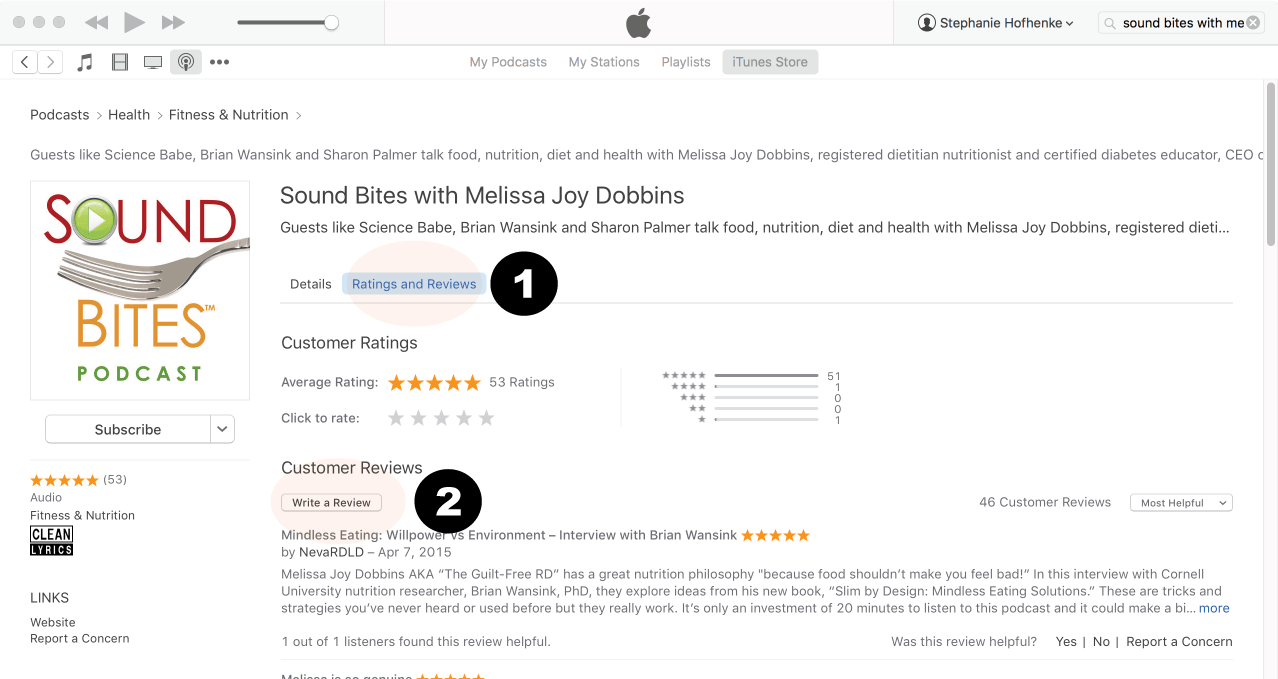
How to Review in iTunes
Open iTunes desktop application
Click iTunes Store
Click on Podcasts
Search for “Sound bites with Melissa Joy Dobbins”
Click on podcast image
Search for Sound Bites podcast in iTunes
Click Ratings & Reivews
Click Write a Review
View reviews and write your own review.
Write your review…. Thank you!
Write your review!
How to subscribe via iTunes
Click here to view the Sound Bites Podcastin iTunes, then click the blue “View in iTunes” button. This will open your iTunes application directly to Sound Bites Podcast. Click the “Subscribe” button, and your done!




 Mark Behrens co-chairs Shook, Hardy & Bacon’s Washington, DC-based Public Policy Group. He has over 30 years of experience representing business defendants in legal matters and is a national expert on civil justice issues. Mark is a graduate of Vanderbilt University Law School.