Celebrating over 1 Million Downloads and 50,000 Free CEUs on the Sound Bites® Podcast | NEW: Get 1 years’ worth of CEUs with the new 15-CEU Podcast Course
This episode offers the opportunity to earn 3.0 free CEU credits as part of a 3-part series. Simply enjoy the 3 podcasts, complete the quiz and reflection, and download your CEU certificate. Get started here.
This 3-part series is sponsored by Danone North America. This series has been submitted to the Commission on Dietetic Registration for 3 hours of continuing professional education credits for RDNs, NDTRs and CDCESs.
Part 2 of 3: What a Healthy Relationship with Food Looks Like and How Flexitarianism Can Help
Diet culture can make people feel bad about their bodies, and therefore anxious around food. What starts out as an innocent journey to ‘healthy eating’ turns into anxiety around food, distorted body image and can even progress into disordered eating.” – Chelsey Amer
Diet culture is a system of beliefs that emphasize thinness over health. Diet culture equates weight loss and thinness as superior – both physically and morally – which leads people to spend time, money and mental effort towards achieving the “ideal body.” A healthy relationship with food on the other hand is free from diet rules about what to eat, when to eat and how much to eat and allows you to eat all foods in a way that feels good for your body. This balanced and flexible approach to food fits perfectly in the flexitarian lifestyle.
This 3-part podcast series discusses the benefits of flexitarian eating and its intersection with promoting a healthier relationship with food and planetary health through sustainable zero waste cooking efforts.
Diet culture chips away at self-esteem and leads to feelings of guilt and restriction around food, and shame around our body. And in the end it strips the joy away from actually engaging in healthy habits like eating nourishing foods you enjoy and moving your body in a way that feels good.” – DJ Blatner
Tune into this second episode in the series to learn about:
examples of diet culture and the negative consequences associated with it
what a healthy relationship with food looks like
how flexitarian eating can provide opportunities to improve your relationship with food
7 flexitarian pathways that can help create a better relationship with food
what food freedom is and how to achieve it
ways to increase awareness of how you think about food and the dialogue in your head
tips for how to challenge and release negative thoughts
focusing on what to add to your plate to help yourself feel good
We are the first models for our kids when it comes to food attitudes and behaviors. If your child hears you being unkind to yourself when it comes to food choices, they’re more likely to learn that behavior too. Taking a flexible, ‘flexitarian’ approach and acknowledging that all foods fit is a great first step to setting your little ones up to have a healthy and happy relationship with food in the future.” – Amanda Blechman
Chelsey Amer MS, RDN, CDN
Chelsey is a registered dietitian nutritionist, cookbook author and food photographer based in New York. She obtained a Bachelor of Science in psychology from the University of Michigan and received her Master’s of Clinical Nutrition from NYU.
As the owner of Chelsey Amer Nutrition, an online nutrition counseling and consulting business, Chelsey’s mission is to help women feel their best while getting in touch with their bodies and discovering how all foods can fit in their healthy lifestyle. When Chelsey is not working with her clients, she develops tasty, allergy-friendly recipes and photographs every bite for her healthy food blog on ChelseyAmerNutrition.com and on Instagram @chelseyamernutrition.
At the core of both flexitarian eating and food freedom is the freedom from restrictions and strict rules. When you’re able to ignore the ‘external noise’ and home in on what your body is telling you and asking for in terms of nourishment, you’ll be a happier and healthier eater in the long run.” – Chelsey Amer
Dawn Jackson “DJ” Blatner RDN, CSSD
Dawn Jackson “DJ” Blatner is a registered dietitian nutritionist and certified specialist in sports dietetics. She also has a Certificate of Training in Integrative and Functional Nutrition. She is the author of two books: The Flexitarian Diet, ranked a top plant-based diet by US News & World Report, and her second book, The Superfood Swap.
She is a trusted expert appearing regularly in local and national media outlets such as The Today Show and Good Morning America. She won the primetime reality TV show on ABC called, My Diet Is Better Than Yours. Dawn worked as the head dietitian for the Chicago Cubs for 10 years, hosted an Emmy-nominated TV show in Chicago for 3 seasons, and won the 2021 Media Excellence Award from the Academy of Nutrition & Dietetics.
She owns a nutrition consulting & communications business with a focus on real food & more fun. She lives in Chicago and has a healthy obsession with jumping rope. You can find her online at djblatner.com and on Instagram @djblatner.
The point of eating well is to improve your *quality of life*, so trying to force yourself on a restrictive diet that makes you miserable defeats the point. Being a flexitarian ‘feels’ good to follow and contributes to overall well-being not just by the nutrients it provides, but also because it’s about what works for you. And because of this, it can help people have a better, more flexible relationship with food.” – DJ Blatner
Amanda Blechman, RDN, CDN
Amanda is a registered dietitian nutritionist and Director of Health & Scientific Affairs at Danone North America. Since joining Danone North America in January 2013, Amanda has led a broad array of activities in several evolving nutrition spaces including flexitarian eating patterns, pediatric nutrition and organic dairy. In her role, she supports leading yogurt brands including Oikos, Light + Fit, and Two Good, pediatric brands including Happy Family Organics and Aptamil, and more. She’s a regular media contributor, providing expert commentary and credible nutrition content to journalists. As a mom of two young children, Amanda loves to combine her passions of food and family in her work. She is also a creative cook and recipe developer, and in her free time she enjoys sharing helpful tips on social media to make family meals less daunting for parents and caregivers. Visit her Instagram @amandablechman.
Mingay, Edwina, et al. “Why We Eat the Way We Do: A Call to Consider Food Culture in Public Health Initiatives.” International Journal of Environmental Research and Public Health, vol. 18, no. 22, 2021, p. 11967., https://doi.org/10.3390/ijerph182211967.
Blatner DJ. The Flexitarian Diet: The Mostly Vegetarian Way to Lose Weight, Be Healthier, Prevent Disease, and Add Years to Your Life. New York: McGraw Hill, 2008.
Episode Transcript
Scroll below or
download here.
[00:00:00] VO: Welcome to Sound Bites, hosted by registered dietitian nutritionist Melissa Joy Dobbins. Let’s delve into the science, the psychology, and the strategies behind good food and nutrition.
[00:00:22] Melissa: Hello and welcome to the Sound Bites Podcast. This is a three part series on the Flexitarian diet. And how it intersects with a healthy relationship with food and planetary health through zero waste cooking efforts. And more. Throughout this series, I will be interviewing several distinguished registered dietitians, and I want to thank Danone North America for their support and sponsorship for this three-part education and C E U approved series.
So we are submitting this series to the commission on dietetic registration for three hours of continuing education credit for registered dietitian, nutritionist, dietetic technicians, registered and certified Diabetes Care and Education Specialists. This series will also include one Ethics, C e U. So for more information on that and the resources, you can visit my website atSound Bitesrd.com.
And also danone referral pad.com. So in today’s episode, we will be discussing how Flexitarianism helps support a healthy relationship with food. So we will outline problems with today’s diet culture. Explain what a healthy relationship with food looks like and how a flexitarian eating style can provide opportunities toward reaching that goal.
And also share tips to adopting a flexible, healthy relationship with food and help ditch diet toxicity. Woo. Can I get a woo. All right. My first guest is Amanda Blechman, a registered dietitian and the Director of Scientific Affairs with today’s sponsor, Danone North America. Our second guest is Chelsey Amer.
She’s a New York based registered dietitian nutritionist with a private practice, Chelsey Amer Nutrition. Plus. She’s a recipe developer, food blogger, and cookbook author. Chelsey’s mission is to help clients feel good through food. And our third guest is Dawn Jackson Blatner or DJ Blatner. She is a nationally recognized Flexitarian expert and author of The Flexitarian Diet and the Superfood Swap books.
Welcome to the show, ladies.
[00:02:33] Dawn: Oh, thank you so much for having me.
[00:02:35] Chelsey: Thank you for having us.
[00:02:37] Amanda: Thank you so much. I am so excited to be doing this. This is a really important topic to me on a personal level, which I’m sure we’ll get to chat about, but also as a dietitian at Danone North America. Very similar I think, Chelsey, to your mission.
Our mission at Danone is to bring health through food. To as many people as possible, and we know that so much of a healthy and really enjoyable lifestyle is individual. There’s no one size fits all, and that’s why we offer so many different types of foods. We have a lot of dairy-based options, plant-based options.
We are looking to meet the needs and preferences of so many different people.
[00:03:14] Melissa: Absolutely. Thank you Amanda. And our listeners will get used to our different voices so they know who’s speaking. Of course they know mine. And I did wanna mention also, this is the second episode in the series, so be sure to dial back to our previous episode where we set the whole stage on what the Flexitarian diet is.
Hint, it’s not a diet. And I’m not gonna belabor that because I want you to go back and listen to that first episode. And of course, we’re gonna dive more into the Flexitarian diet slash lifestyle today. Chelsey, as you’re joining us as the new guest today, in the previous episode, we got to hear a little bit more about DJ and Amanda’s background.
So I would love for you to share a little bit more about your background and the work you do before we jump into the focus of today.
[00:03:59] Chelsey: Absolutely. Thanks so much for having me. I’m Chelsey Amer. I’m a registered dietitian based in New York. As you mentioned earlier, I have a private practice that really focuses on helping women feel good through food.
So we don’t focus on diets and restrictive plans, but instead we take a really holistic view of what helps you feel your best and what can we eat to really home in on that. And that’s really what I focus my practice on for the past several years.
[00:04:25] Melissa: Thank you so much Chelsey. It’s nice to get to know you better and I think the best place for us to start to set the stage today is to have you tell us what exactly is diet culture?
[00:04:36] Chelsey: Yes, absolutely. So contrary to what I think a lot of people believe, diet culture isn’t just being on a diet. It’s a really, an entire system of beliefs and culture that emphasizes thinness as the end all be all. Diet culture really equates weight loss and thinness as superior, both physically and morally, which leads people to spend exorbitant amounts of resources, including time, money, and mental efforts towards achieving the quote ideal body.
So notably it promotes weight loss at the expense of other pillars of health. So you’re really sacrificing your mental and your physical and your emotional health for the sake of thinness.
[00:05:16] Dawn: It’s so well said, Chelsey. And I follow you on social media and when I think of your work, I really think of this word balanced.
You’re so good at that and I can’t agree more. Like when I think about diet culture, I really just say it’s the pursuit of thinness at all costs, and I’m saying people’s time, their energy, their money, their mental wellbeing, their physical health, and their joy. This is the pursuit of thinness at all costs.
[00:05:44] Melissa: Totally stealing that joy. Very true. So Chelsey then, Why don’t we have you share some examples of diet culture, just to bring it to life more for our listeners.
[00:05:56] Chelsey: Totally. Diet culture seeps into our lives everywhere, so once you’re aware of it, it’s like hard not to see it. So it’s labeling our foods as good and bad and how many people do that on a daily basis.
Oh, this is good, this is bad. Or even if you’re in the supermarket, food brands labeling their foods as skinny or clean. Or even the act of shaming other people for gaining weight. Like we saw this a lot during the pandemic with that quote, quarantine 15. So it really can also be this pervasive belief that 1200 calories a day is appropriate for most adults, when really that’s the average amount required for a toddler.
As someone having a toddler. I see it firsthand. There was something as simple as the pressure that you must eat Diet foods in order to look a certain way. I think DJ, you mentioned social media earlier. I think another really relevant example is the what I eat in a day videos on social media that specifically show someone’s body giving the impression if you eat like me, you’ll look like me, and that’s just not true.
So diet culture is, Everywhere. As I said, it’s in advertising, marketing, branding, gym, schools on the playground, like mom’s talking. It’s literally everywhere.
[00:07:04] Dawn: Yeah. You know what? I can jump in and just say like from probably just this last week when I think about where I hear it and see it. It is somebody saying something like, oh my gosh, you look so good.
Did you lose weight? Hi complimenting weight loss, diet culture. Can’t we think of something better to compliment people on, or brunch with friends is, oh my gosh, I know I shouldn’t be eating this. I’m being so bad. And it’s oh, hey that’s diet culture. When you’re shaming your food choices and you’re assigning morals to you being bad or good eating something or This just happened to me.
I was in an online workout class and the instructor said, everybody, let’s do five more burpees so we can eat dessert later. And I was like, oh my gosh. This is diet culture. Using exercise to earn food is this pervasive thing that diet culture has done to so many of us.
[00:07:59] Amanda: And I think you made such a good point, Chelsey, that once you’re aware of it, you can’t unsee it.
You can’t unhear it and suddenly it really is everywhere. You may not have noticed it at first, but once you know what diet culture is, you really, you can’t not see it and hear it everywhere.
[00:08:15] Chelsey: And then you become aware of what other people are saying so much and like you see it and it’s just takes over like you’ve noticed it everywhere because it has seeped into our lives in this seamless way that it’s almost become normalized in a way when it shouldn’t be.
[00:08:32] Melissa: And it’s good though that we can’t unsee it. It’s annoying and it’s upsetting, but at least we’re aware of it. So that’s important. Those are really great examples. So let’s talk a little bit about why it’s so bad. Obviously I said it’s annoying, it’s upsetting, but it’s so much more than that. So talk to me about some of the negative consequences of this diet culture.
[00:08:57] Chelsey: I really think that at the core, it makes people feel bad about their bodies and then anxious around food. And we all have to eat several times a day, every day. And what starts out as this innocent journey to healthy eating turns intoa lot of anxiety around food. A disordered body image that can even progress into disordered eating. Yeah. Which is obviously damaging mentally.
[00:09:18] Dawn: Yeah. You said it all. I think diet culture, it chips away at self-esteem, right? It just is chipping away and so you eat, you feel guilty and restriction.
You look at your body, you feel shame. These are horrible things and one of, I think the scariest oOf all is that it ends up stripping away the natural joy of engaging in healthy habits. So eating nourishing foods that are making you feel good and enjoying moving your body in a way that feels good. All of that is stripped away in the name of this diet culture.
[00:09:52] Melissa: It’s so important. And I think it starts with good intentions and you’re trying to be healthy, and then it just morphs into this very unhealthy, obsessive, restrictive, and negative mindset.
[00:10:12] Amanda: It’s true. And it actually, it starts so early. You always hear them say, kids are the best regulators with food.
There’s really not all of this social and emotional baggage ith our kids, and we’re the first models for our kids when it really comes to having these attitudes and behaviors around foods. So if your child hears you thinking negatively about your food choices, being unkind to yourself when you make a food choice or about your own body, they’re more likely to learn that behavior too.
And here we are, we’re all trying so hard to make sure that we’re raising responsible, kind good stewards of our earth and just wonderful children. But if we’re not being kind to ourselves, they’re gonna see that and learn that as well. And so taking this really flexible flexitarian approach and acknowledging that all foods fit and nothing is good or bad is a really great first step to help set up our little ones for having that healthy and happy relationship with food down the road.
[00:11:05] Melissa: Great points. Yes. Thank you for bringing up how it starts. I talk about that a lot on the podcast, and it’s really important. And nobody’s perfect, but we need to pay attention to how we think about those things and how we talk about those things, especially to younger people around us. So all great points.
Diet culture is pervasive and toxic. Let’s shift over into more positive, constructive what are some constructive steps that we can take to combat this diet culture?
[00:11:36] Dawn: For me speaking on ,my Flexitarianism. This is really where that word flexible is just such an important point. No strict rules. It bends and flows with your lifestyle today. You might feel one way the next day you listen to yourself and you feel another way. And that flexibility is why I love the flexitarian approach to living. And if you think about. How we all alluded, it all starts out innocently that all you’re really trying to do is improve the quality of your life.
And you’re saying, oh, you know what, maybe I should shift a little bit of what I’m eating. And when you then force yourself to go on these restrictive diets and makes you miserable, it actually defeats the whole purpose of why you started this improved quality of life. So for flexitarian living, that word flexible, again, is so key.
Not just because you’re getting nutrition in your food, but you’re actually learning flexibility to have that healthier relationship with food and joy really being a nutrient, flexibility can feed that joy.
[00:12:44] Amanda: That’s my favorite thing, DJ. I just, joy is a nutrient. It’s now, it’s on every menu that I plan.
[00:12:51] Melissa: I love that too. I can’t tell you how much I love it cuz you know, my middle name is Joy and I feel like maybe that’s my new brand. I don’t know. I’m gonna rebrand. I’m the joy nutrient. So all of this makes so much sense and it’s a perfect fit and that’s why we’re talking about it today.
But let’s talk about. How specifically the Flexitarian approach can help foster this better relationship with food?
[00:13:13] Dawn: Okay, so what I did is I pulled back and played a game of opposites. I was like, okay, how do you know if you’re actually on a diet and how is flexitarianism not that? So I pulled together seven things that came to mind where I was like, okay, what is a diet and how is Flexitarian not that, right? So the first one is very clear. Chelsey mentioned, Amanda mentioned it. We talked about it already. Foods are labeled good and bad on a diet. That’s how you know you got a green list, you got a red list.
But flexitarian foods aren’t labeled good or bad. There is actually no food that is off limits. It’s all in there. So that’s the first one. Second one you know you’re on a diet when. You are making food decisions about what you are eating. To make the scale go down, no other reason, right? You’re making this decision, will the scale go down?
But flexitarian is not that. It is food choices are about feeling good and not you know those scale outcomes. Such a big part of dieting is not making decisions based on anything but the scale.
[00:14:18] Chelsey: Exactly. I think that is so important. If you put less emphasis on weight and the number on the scale, you’ll better be able to get in touch with your body’s internal cues.
I can’t say how often I talk about this with clients, including what you want to eat, how much your body needs in that day, which can change day to day. Plus how those foods actually make you feel versus listening to external rules.
[00:14:39] Dawn: Oh yeah. I love your point about how much to eat, cuz that’s actually the third thing when I was thinking about how do you know you’re on a diet?
Oh, because you’re weighing food, you’re measuring food, you’re counting food in order to tell you how much to eat. But when you are having a healthier relationship, food, when you are a flexitarian, you are using those natural hunger and fullness cues. You’re not weighing things, measuring things. You’re listening to those internal cues that you were talking about, Chelsey. Four. How do you know you’re on a diet? You are following rules of foods to eliminate. It’s all about. Flexitarian is about what can you add? How much plants foods can you add? How much nourishing foods can you add and not about restricting foods. The fifth one, I sat back and I thought, how do you know you’re on a diet?
And you’re like, oh, food becomes simply this “Fuel source” and emotion and joy are not factored in. It’s like it’s all about you as some sort of machine. But flexitarian is that meals are to be both enjoyed because they’re healthful enjoyed because they’re enjoyable and they taste good and they make you happy. And I know you talk a lot about that Chelsey.
[00:15:45] Chelsey: Yes, this is one of the first things that I encourage my clients to examine when they are trying to improve their relationship with food is think about what your body is telling you as opposed to what you think you should be eating. Especially for chronic dieters who are used to following again, those external rules, we’re not tuning inside.
[00:16:03] Amanda: Totally, it’s the should. Versus what actually your body is telling you. I talk about this a lot with my kids too, and I don’t know, Chelsey, if you guys have similar conversations. Both my kids are under five. My four and a half year old daughter, we talk to our tummies, so sometimes she says, I want more.
I don’t like this. And she’ll be complaining or asking for more food. And so we just take a moment and say, okay, what’s my tummy telling me? What am I in the mood to eat today? Do I need more? Am I full? Should I wait a few minutes and see? And it takes a lot of the pressure off cuz we’re, it’s fun and it’s cute and we’re having a conversation with our tummies and a couple minutes later she’ll say, okay I talked to my tummy, it says I definitely want more, or whatever it is at that meal.
But it just takes all that pressure off and we’re listening to our bodies. There’s nothing external. It’s what her tummy is telling her.
[00:16:52] Dawn: Ugh, I love that. I think all adults need that retraining, right? It’s talking to your tummy. So then there’s a couple more on my list when I was thinking, so the sixth one when I was saying how do you know you’re on a diet is that you’re following rules of this diet that are actually hard to do when you are living, socializing, traveling, trying to enjoy yourself.
You’re really feeling wow, this is hard to do. But when you’re on a Flexitarian style plan, there are no actual strict rules. So you can socialize, you can dine out, you can travel, you can do all of those things. I think that’s a big one. You know how deeply and how enjoyably can you live that’s how you know you’re on a diet or not.
And then the last one and I think this will speak to both Chelsey and Amanda with families, and that is when you’re on a diet, you usually have to eat something different than your entire family or friends at mealtime. But when you’re flexitarian and you have that flexibility, you don’t have to make any separate meals or you don’t have to make diet meals
that’s different from what your family is eating.
[00:17:55] Amanda: Totally. We do this all the time and really just because I don’t want anyone turning anything down, I want everybody to love all their food. So we like to do a lot of build your own plate meals and just have different options. So taco bowls with beans or ground meat.
Tonight we’re actually having tofu taco bowls just cuz I have tofu in the house and I wanna use it. And I’ll probably offer another option for those who may not want the tofu. We have cheese and we also have plant-based shredded cheese. In the fridge always. Sometimes I top it with plain Greek yogurt.
Sometimes we skip it. What kind of tortilla do you like? All the same meal, but it’s really easy to mix and mash and make sure that everyone’s getting a version of what they love. So we’re all happy, we’re all finding the joy in the meal and I’m not having to do like extra work. I am most certainly not a short order cook, and I wanna just
increase the acceptance at the table. I don’t know, Chelsey, if you guys do anything similar, at home.
[00:18:48] Chelsey: 100%. I think it’s so important, especially when so many people have grown up seeing their moms or dads dieting for so many years and it’s, I think a lot of. Maybe like our generation now is being really aware of that.
Our kids just absorb everything. It’s not even what you’re saying, but it’s your actions that really even speak louder than your words.
[00:19:08] Amanda: Yeah. I actually, you had a really cute reel about that I think this morning that I saw. I did come up, I did your mom asking you to go on a diet with her and like how in today’s day and age, it’s like a very different approach.
[00:19:21] Melissa: Wow. I need to check that out.
[00:19:22] Chelsey: I have so many clients who contact me and it’s the their parents are asked, not just moms I don’t, I’m a mom all moms are doing, all moms are doing their best. I’m a mom too, and nothing against my mom. But I think that it’s just moms do their best and a lot of times if moms.
are dieting for years. That’s what their kids then think they should do. And it’s essentially telling your kids that like your body’s not good enough. Like you’re not listening to your body. You need to follow these rules. And I have clients who are 11, 12, 13, and then also older and are trying to break away from that pattern that they’ve seen their parents been in for so many years.
[00:19:57] Melissa: Yeah, I’m just thinking about so many personal experiences that I’m not gonna share right now, but just I think it’s so important we’re talking about this because it is a huge mind shift for a lot of people in just increasing that awareness and just having a new way of thinking about this, and I just think this is wonderful.
Chelsey, your work focuses on food freedom, so I’d like for you to explain what that means. Yeah.
[00:20:22] Chelsey: Similar to what DJ was saying earlier about flexitarianism, food freedom is the freedom from restrictive diets and rules and regulations that you have to follow. It’s. Freedom from following a specific planet tells you what to eat, when to eat, how much to eat those are all really rigid rules that some people follow.
And food freedom is the exact opposite. As a result, you can really eat all foods in a way that feels good for your body, and it’s a really balanced approach. So someone who has finally achieved food freedom, probably after years of dieting and restricting. They don’t spend all their time obsessing about food and thinking about food, but instead can really live, like DJ said, that carefree life, traveling, dining out, that focuses on experiences, connections with others, and the more valuable parts of your life.
[00:21:10] Melissa: Absolutely. Let’s talk about how food freedom can lead to a healthier relationship with food. More specifically.
[00:21:17] Chelsey: Yeah. In order to improve your relationship with food, it’s really essential to view all foods on an equal playing field, and that’s what food freedom favors. Food freedom allows all foods to fit in your overall diet.
Again, without the strict rules or guidelines without labeling foods. Good or bad, or thinking of yourself as good or bad for eating certain foods. And when you allow all foods to fit, you’re less likely to feel out of control around certain foods cuz you know that you can eat them at any time. So you’re giving yourself permission to eat all foods.
Which lets you then entertain how does this food make me feel? Does the food give you more energy or does it leave you sluggish 20 minutes after eating it? So let’s take a fan favorite – pizza, for example. I’ve had many clients who’ve restricted pizza when they’re on a diet. But then when their kids are eating it or they’re at a party, their willpower crumbles and they’d overeat pizza, feel sluggish, floated. And the best way I can describe it is just like blah. Because pizza was always restricted and then you feel out of control around it. But when you find food freedom, you know that you can have that pizza at any time. So you’re better able to eat it in a way that feels good for your body.
So you’re not gonna have really any feelings of guilt or shame around the food, which overall can improve your relationship with food. So similar though to a flexitarian lifestyle, when you have that pizza maybe you’re then thinking what can I pair or add to my pizza to feel better? So maybe you’re pairing it with a side salad with chickpeas for a more balanced meal
that has protein and veggies, plus carbs and fats. So I think that there’s this misconception that people think that food freedom just means eat whatever you want, whenever you want it. But this really isn’t the intention behind the concept. It really highlights the importance of focusing on how food makes you feel.
And more often than not, once you find food freedom, you’ll want to eat in a well-balanced way that helps your body feel good with protein and carbs and veggies, and fats. Because that’s how you have energy and sustainable energy. That feels good.
[00:23:25] Melissa: I love the focus that you’re explaining on how food makes you feel, because I do think that helps explain.
Yeah, like you said, food freedom is not just eat whatever you want. Cause I think some people are like, oh, that sounds great, but I don’t quite get it. And I’ve talked about that on the podcast before with some of my guests. Okay, help me understand this A little bit better cuz I feel like I’m just scratching the surface and I really think focusing on how food makes you feel really resonates with me.
Like I get it and I can pay attention to that and see how my day develops with that sort of a focus. And really apply that. So could you give some examples of how we can start incorporating Flexitarianism to support this healthier relationship with food? And you mentioned adding, and DJ’s always talking about adding and that being a healthy approach as well.
What can I add? Maybe I’m adding stuff for nutrition, maybe I’m adding stuff for flavor. Maybe I’m adding stuff for joy. So let’s talk about that and maybe. Dawn, DJ, this is where you can jump in.
[00:24:25] Dawn: I always hear this term, right? Healthy relationship with food and it feels so big. I took a step back and I thought how can I very quickly to the point describe this for even myself?
What does this actually mean? And so healthy relationship for food is choosing foods that make you feel good. This is both physically and mentally without shame or guilt. So this is how I begin, just a very brief sentence. It’s is this making you feel good physically and mentally? Without shame or guilt.
And so that’s why again, I I’m always talking. I love Flexitarian. I love Flexitarian. Cuz it really helped me do that personally. And then I wrote the book to share it. But really, flexitarian was a very personal commitment that I made to myself about loosening up and enjoying life and food.
And so no matter what meal you are in the mood for, you can make it more flexible just by adding more plants – it’s more flexitarian when you’ve added some more plants. So let me give you an example. So In the morning, it can be a smoothie. You add your fruits in there and you’re a flexitarian.
So sometimes it’s dairy milk, or sometimes it’s a plant-based milk. That’s the sort of flexibility that you get when you’re not pigeonholing yourself with strict rules, and that can change day-to-day or week to week. Or you want a burger. Okay, you’re a flexitarian, you want a burger? What kind of burger is it?
It can be a beef burger. It could be a salmon burger. It could be a bean burger. You can do whatever feels good to that day and you can say, okay, hey, guess what? I can have more plants on it. So I can put lettuce on there, onion on there, tomato on there. I could put some veggie sticks on this side with a yogurt based ranch dip, and that yogurt could be dairy or it could be plant-based.
It’s very flexible like that.
[00:26:12] Amanda: And it doesn’t have to be the same thing every time, right? Preach. On a Tuesday you’re having your regular hamburger, but next week, oh gosh, salmon is on sale. I’m gonna make these amazing salmon burgers. It can be anything depending on where you are.
In your journey or what your tummy says that day? Yeah. We actually, this this happened one time when I, we were having burgers for dinner, but then I pulled out my bag of buns and they were fuzzy. So I’m like there goes that. And so I was trying to think of some other ways how can we eat them?
I had a few English muffins in the freezer, and then I had a lot of lettuce in the fridge and I was like, great. We’re having cheeseburger salads and it was all the same stuff in a bowl of greens. The kids had the English muffins cuz it’s easier for them to eat as the sandwich. And we all got to have it in the way that we preferred it, but we still made sure that we were adding in those veggies.
[00:27:05] Dawn: Amanda, you did the exact flexitarian thing, right? How can you add more plants anytime, no matter what you’re eating, you know that addition is so positive. It’s exactly why this is a lifestyle and not a diet. And you can really do this with any type of food. So we could be tacos, beef tacos, chicken tacos, fish tacos, lentils tacos, adding your salsa, your guacamole.
Which are plants, add dairy, yogurt, or a plant-based yogurt alternative. You get to flex, you get to decide what you feel like that day, what you have in your house. Pasta. It could be meatballs, it could be bean balls. You add some broccoli to it for more plant factor, and I know Chelsey talked a lot about pizza.
It could be meat and veggie pizza, or it could be just a veggie pizza. And then you’re adding salad on the side like she mentioned. So it’s all of these family favorite foods. You notice I’m talking about tacos, I’m talking about pasta, I’m talking about pizza, I’m talking about burgers. These are all things that.
Families love. I know we’ve talked about this already, but it’s just reinforced that you can sit down and have chicken quesadillas or bean quesadillas with an entire family getting to decide what they like. That flexibility is the healthy relationship with food.
[00:28:15] Melissa: Awesome. Yes. I just have to add, cuz I know in the last episode we talked about pizza and I said I have this really awesome pizza dough recipe that includes yogurt and self rising flour and over the weekend.
I channeled my inner flexitarian and I made a chicken pizza with black beans and some tomatoes with the green chilies , and of course cheddar jack cheese, but anyway, added the beans on there too, so I just had to throw that out there.
[00:28:42] Dawn: I love that. That’s exactly right. Just like you don’t have to have just dairy milk in your fridge or just plant-based milk in your fridge.
You can have both. You don’t have to have just chicken or just beans. You can have both. I love that example, Melissa.
[00:28:55] Chelsey: Yes, it’s not, or it’s and. I also think it’s really important for budget concerns. You don’t always have to have both options. So if you have one option, and now at grocery, prices are out of control.
So if you have whatever option you have available, you can feel confident using it. And that’s like the flexible way to use it. And if you don’t have a healthy relationship with food, it’s really hard to be okay with using whatever you have.
[00:29:19] Melissa: Wow. That’s really mind blowing. Thank you for sharing that. It’s so important. I love these perspectives. It’s really helpful to really take a deep dive on this. I really appreciate your perspectives on this. And Chelsey, can you give maybe some more examples of ways we can take steps to creating this healthier relationship with food?
[00:29:39] Chelsey: Absolutely. I think one of the first steps that you can take is just to start eating the foods you love without judgment.
And so simply add back in some of your favorite foods into your diet without it being a cheat day or a special occasion. Just on a regular Tuesday, eat a food that you love, that you know maybe in your past life you would’ve reserved for a cheat day. And you don’t need to go from zero to 100 overnight and just start eating like everything, but you can slowly add back some of the foods that you’ve previously eliminated on a diet.
So maybe that’s just actually eating whole grain toast with your scrambled eggs at breakfast if you once put bread as off limits. Or maybe you’ll try adding back dairy into your diet if you’ve only been having plant-based alternatives for some time. So it’s really important also to consider how you think about food and the dialogue that plays in your head when you are adding back in these foods.
So do you feel like you’re cheating by eating something that you think is labeled as both bad? And when that thought floats into your mind, acknowledge it. Meet it and meet it with a truth. So like eating a cookie doesn’t make me bad. Just as eating a salad doesn’t make me good. Then release the thought.
So instead of judging yourself, just really let it go. And the more that you can change that inner dialogue that you’re having and how you speak about food, the more freedom you’ll feel about food. So I also think that you can add to your plate to help yourself feel good. So remember, We’re not just eating all the foods.
We want to also focus on how we feel. So and I think. A lot of times that’s forgotten. So you wanna feel good physically and mentally. So think about it like filling up on just cookies won’t provide you with the energy that you need for the afternoon, even if it sounds good. Who doesn’t love a cookie?
But think about why you can add to that cookie. So if you’re in the mood for a cookie, perhaps pairing it with a Greek yogurt for protein could help sustain your energy to help you feel your best and actually be able to get through your afternoon of work. So everyone’s journey to food freedom will really be different based on your environment, your history with dieting, even like any possible history of trauma, your access to food, budget, and there are so many factors that influence it.
Just take one step at a time and think about what you can add.
[00:32:00] Melissa: Very good. So speaking of dieting history, I was gonna ask you, what about trigger foods? Those foods or beverages that maybe we find them tempting, difficult to have around because maybe they’re hard to have in moderation, and I get the concept of well allow yourself to have it.
But I would love to hear you talk a little bit more about how this might look for somebody who has some of these triggering foods and they’re afraid to have them around. I’m sure it takes time, but I would love to maybe hear some more nuts and bolts on how that might play out.
[00:32:33] Chelsey: Yes, exactly. You hit the nail on the head, it takes time.
So there’s often what we call a honeymoon phase. Like in the beginning of a relationship you have that honeymoon phase on. The same is true if you’ve been dieting for 10, even like 2, 5, 10 years. You’re going to have that honeymoon phase in the beginning where you might be eating more of those previously like off limits or trigger foods.
But first of all, know that won’t last forever. Even if like you feel like it will, I promise you that it really won’t because that also wouldn’t feel good in your body. So if you’re actually thinking about what your body needs just eating those trigger foods won’t feel good in your body for very long.
So if you give yourself unregulated permission to eat those foods over time, they will lose their appeal to a degree where you no longer feel out of control around those foods. And over time you’ll be able to enjoy a couple of cookies and move on without guilts or shame. One of my favorite things is that my clients were like, yeah, I kinda forgot that was in my pantry.
I used to plow through a bag of whatever, and they’re like, yeah, like they actually want stale. And I’m like, that’s huge. But yeah, it’s huge. But the goal is not to waste food. The goal is not to like, not enjoy it anymore. But really that honeymoon phase will pass. But I also wanna acknowledge that it’s not easy if you have a history of dieting or even disordered eating.
And this is where working on that, like inner trusting your body is so important and really relying on those internal cues of what your body is telling you and working with the dietitian can really help if you’re struggling with this.
[00:34:04] Melissa: Okay, thank you. That’s all very helpful and definitely appreciate the suggestion about working with a dietitian.
That’s why we’re here. We can help people. Absolutely. So obviously we see some overlaps, huge overlaps between Flexitarian and Food Freedom. Talk to me a little bit more about that overlap, that sweet spot.
[00:34:25] Chelsey: Yeah. We’ve hit on this earlier in the podcast, I think, but really at the core of both Flexitarian Eating and Food Freedom is the freedom from rules.
Freedom from restrictions. And when you’re able to ignore the external noise as I call it, and home in on what your body is telling you and asking for in terms of nourishment, cause your body speaks to you, believe it or not you’ll be happier and healthier in the long run. And DJ, I know we’ve mentioned like joy as a nutrient is very similar in terms of like food freedom.
There’s a really big emphasis on satisfaction and it’s very similar to feel like joy from your food. Not mentally restricting yourself and like really enjoying your food.
[00:35:06] Melissa: Very good. So DJ, speaking of that, what are some ways that we might add joy to our meals and snacks?
[00:35:13] Dawn: I have two things that I do with my clients when we’re trying to get to this place, and the first one is called a joy plate check.
So taking a deep breath. Before you eat and like Chelsey’s calls it tuning out the noise, just like taking a deep breath and looking at your plate, doing this plate check. And I believe we have two people inside of us that we have a wild child who wants to have the best, fun and most joyful life, and we also have a health nut in there.
Really making sure ourselves are energized and healthy and we’re living this long life. And so this wild child in Health nut, I ask people to slow down and talk to both of them inside of themselves about their plate and reflect on. Are both of them feeling satisfied? Is there a way that you may need to boost the joy for your wild child to have a little more of that creamy yogurt based ranch dressing on there to really fun it up and feel more enjoyable?
Or, hey, how’s your health nut doing? Do you need to throw on an extra little handful of spinach because your health nut is saying, Hey I’d like to see more greens on there. So this double entity, they’re both equally magnificent in our body and to make sure that they’re not fighting at any one meal and that both of them are listened to is something we work a lot on with this joy plate check.
And then secondly, I do a joy food list. I have found that many. Have lost touch with actually what they actually liked to eat. They don’t even remember anymore because they’ve been on so many diets telling them what to eat. They don’t know what to eat. So we start this joy journal of their foods that they remember loving as a kid.
Some of their things that if they didn’t have to think about, wait, what were be the most delicious foods at a restaurant that they would like to order, or all those kinds of things. And making sure this list is accessible like on their phone or on a sheet of paper close by when they’re meal planning0
for their week. These are not special foods that you can only eat certain times. These are things to make sure you’re shopping for on a weekly basis, putting in your regular life, having joy in your regular life. And so for me, that flexibility, that word flexible is just really what it comes down to when it comes down to joy and that healthy relationship with food.
And remember, flexibility, it changes day to day, meal to meal, month to month. So you don’t have to have some sort of strict set. I’m a flexitarian and this is what I do. I’m a flexitarian and I’m always flexible to listen to my body and what it’s asking for.
[00:37:46] Chelsey: Exactly. Without restrictions, you’re really able to eat all foods, which I believe is at the core of a healthy relationship with Sue because you’re not always thinking about what you can’t have, but instead, you’re focusing on what you can.
And I also just wanna mention something that you said earlier. What foods really satisfy that wild child. A lot of times if you start to eat some of what we were saying before, also like your trigger foods, maybe you don’t enjoy them as much as you once thought. Cause they’re not restricted anymore.
So I think that really having that check with yourself it goes both ways.
[00:38:16] Amanda: Totally. This is so important. This all is like so great. I do wanna pause for a moment and acknowledge the fact that all of us have talked about having conversations with our bodies. I think that this is a notion that we we don’t always think about.
And I love that we’re all on the same page about checking in with how we feel and how foods make you feel and how you feel about them. I love it cuz most of the time when I say talk to your tummy, I get a lot of raised eyebrows and puzzled looks, so I’m glad we’re all on the same RD page. I love all of this and so many great points, especially the fact that Flexitarian is flexible day to day.
Because I’m in the mood for something one day. It doesn’t mean I want it every day, and that’s why I am so proud to be a dietitian at a company like Danone North America because they really get it. We really get it. There is not one size fits all. There’s not even a one size fits all for you. On any given day, it can change and it’s all about choice.
So our goal in bringing health through food is to have options that may work for you on a Tuesday, and then on a Wednesday you have something else or something you know, in your fridge, like DJ was saying, having. Dairy milk and plant-based milk alternatives in your fridge. Together. I have three or four different kinds of milk and milk alternatives in my refrigerator at any given time, because there’s four of us in this house.
And we’re all at different ages and stages and preferences, and that’s what it’s all about. There’s no judgment. There’s no guilt, there’s no feelings about it. It just is, these are the foods that we need that we enjoy, and they all live together in harmony in my cheesy fridge, just, it’s just a loving world of food inside my refrigerator.
And I’m just so happy to have this conversation with you guys because it makes so much sense. It is so true, and I wish we could continue getting the word out about all of this important food relationship and flexibility stuff. It’s so great.
[00:40:06] Melissa: Yes. Thank you so much. I have learned so much in the last couple of episodes with you guys and we’re gonna learn more about food waste coming up with Roseanne Rust, but this has really been helpful for me.
Even just thinking of like satisfaction I think, oh, am I full? Am I kind of content? But now I’m throwing in the joy and this whole wild child and health nut. That’s genius. I love that so much. And I’m gonna have more fun with my food now and I just, I love the joy food list. It’s just such a great idea.
Thank you. DJ, that’s just, oh, I’m so excited. Thank you all for sharing all of the insight and advice and just this robust conversation. I would love for each of you to share one more parting tip or takeaway some words of wisdom for our listeners to help inspire them to start making some of these changes.
[00:41:00] Chelsey: All right, I’ll go first. Truly, I believe that anyone can improve the relationship with food even if you’ve been dieting for so many years and you’re like, no, like I can’t do it. But you really can just start to tune into your internal cues versus those external rules. And before you eat your next meal, ask yourself three questions.
I’m gonna break this down really easy. One, how hungry am I? That will help you gauge how much food you need at the moment. Is, or like a meal or is a more like a. And then number two, what am I really in the mood for? Cuz that will help you boost your satisfaction if you really tune into what you want to eat.
And then number three is how will this make me feel? I’m pretty sure you probably could have guessed those three from list, but like everything on this podcast. But those three questions, how hungry am I? What am I in the mood for, and how will this make me feel?
[00:41:46] Dawn: I love that. That’s a great takeaway.
Great tip. And for me, when I think about flexitarian, I think it’s all about adding and not restricting foods or food groups. So in that spirit of leaving you with one parting idea is thinking about being more flex by adding more plants to what you’re currently eating, right? So that’s really the sort of like in quotes, homework to being a flexitarian, adding more plants.
So it could be you’re having yogurt in the morning and you wanna add some fruits and nuts to that, or you’re having your usual taco or pasta and you’re gonna add some beans to that like Melissa did. Or you’re just having a sandwich at lunch and you’re like, Hey, maybe I should throw some veggie sticks on my plate.
So flexing in some more plants is a great place to start.
[00:42:27] Amanda: Love it. I think what I would say is figure out which foods bring you joy and fun and pleasure, and then give yourself the permission to actually enjoy them. So that you don’t feel out of control around certain foods, even little things like. I would only eat lowfat or nonfat yogurt.
And the thought of putting a full fat yogurt in my fridge 10, 15 years ago was just so unheard of. Not that it’s an indulgent food, just that it was something that for me in my head was off limits. And now we take great pleasure in enjoying whole milk yogurt and it’s so fun, it’s so versatile.
My kids do art with it. My son takes a bath in it, not so intentionally. And it’s just the base of so many fun recipes that having that permission has been so important for us.
[00:43:16] Melissa: Wonderful tips. Thank you so much for all of this information. As I mentioned, we have one more episode in this series.
I’m really excited about that. Again, we’re gonna talk about how Flexitarian eating, intersects with fighting food waste with dietitian, Roseanne Rust. Amanda, thanks again to Danone North America for making this series possible. DJ, thank you again for bringing in the Joy Factor and Chelsey, it’s just been a pleasure getting to know you better and all of your food philosophy that I’m gonna start applying today. And again, just reminding everybody, we are submitting this for three continuing education units, so stay tuned for that if that’s of interest to you. If not, just enjoy the series. And for all of you listening today, please tune into the previous episode and of course the third episode in this series.
And for all the information that we’ve talked about, resources, .books information. Those will all be linked in the show notes at Sound Bitesrd.com. So thank you again for tuning in, and as always, enjoy your food with health in mind and some joy. Until next time.
[00:44:22] VO: For more information, visit sound bites rd.com.
Music by Dave Birk, produced by JAG in Detroit podcasts.
LISTEN, LEARN AND EARN
Listen to select Sound Bites Podcasts and earn free CEU credits approved by the Commission on Dietetic Registration (CDR) for registered dietitian nutritionists and dietetic technicians, registered. Get started!
Get Melissa’s Sound Science Toolkit here!
Partnerships:
Sound Bites is partnering with the Association of Diabetes Care and Education Specialists (formerly the American Association of Diabetes Educators)! Stay tuned for updates on the podcast, blog and newsletter!
Sound Bites is partnering with the International Food Information Council! Stay tuned for updates on the podcast, blog and newsletter!
Sign up for my monthly newsletter and episode eblasts so you never miss an update!
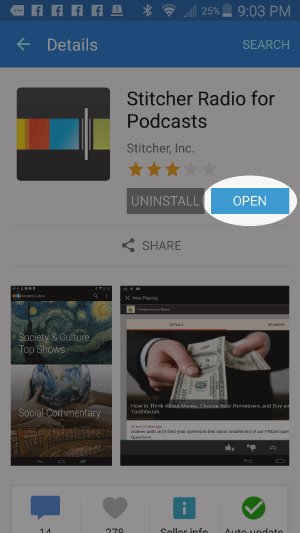
Listen on Stitcher (Android)
Install the Stitcher App
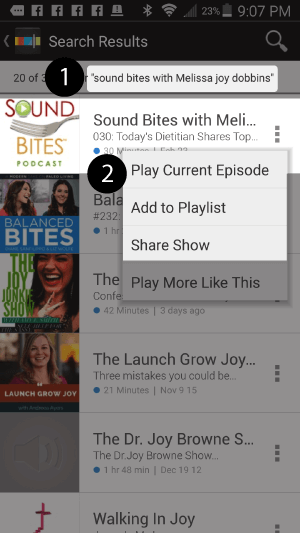
1. Search for “sound bites with melissa joy dobbins” 2. Choose Play Current Episode or Add to Playlist
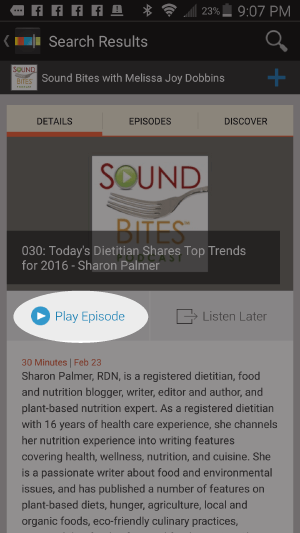
Choose “Play Episode”
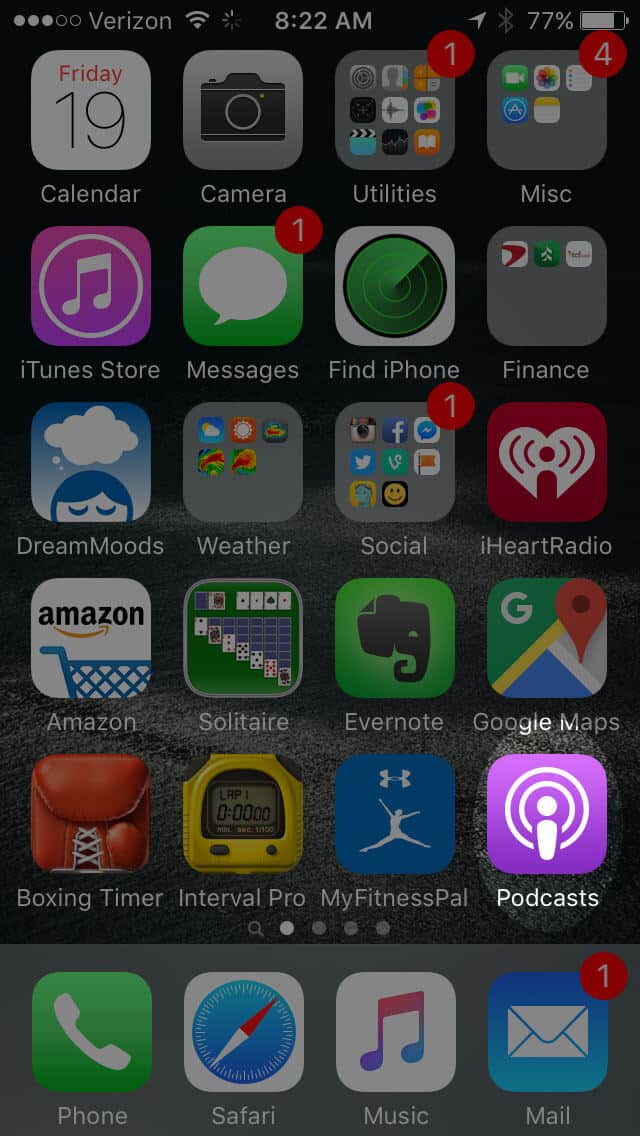
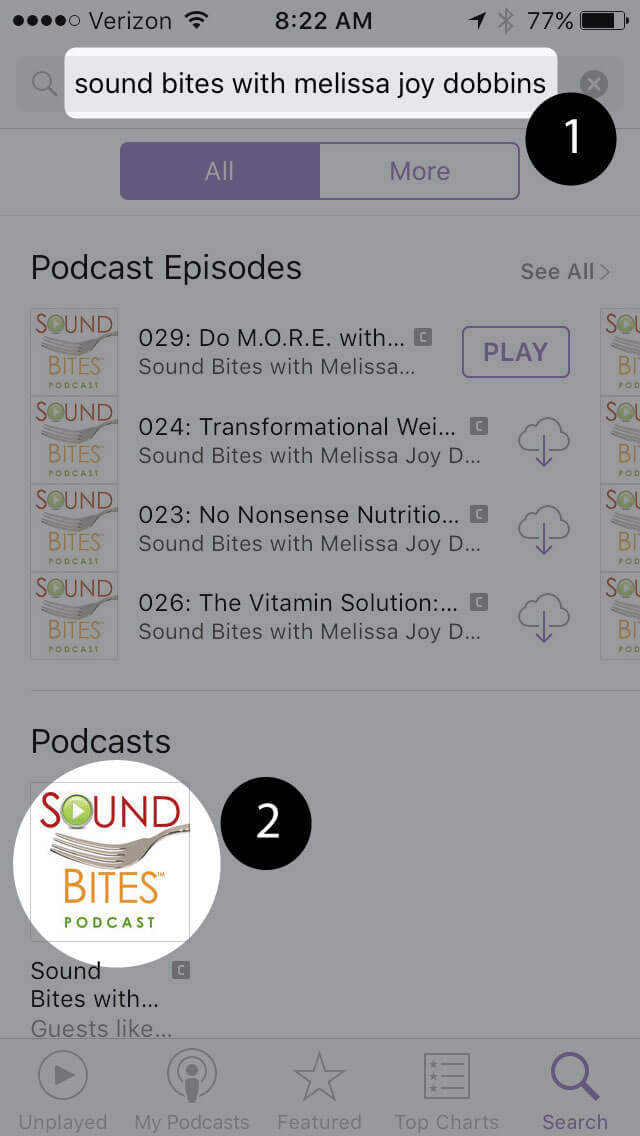
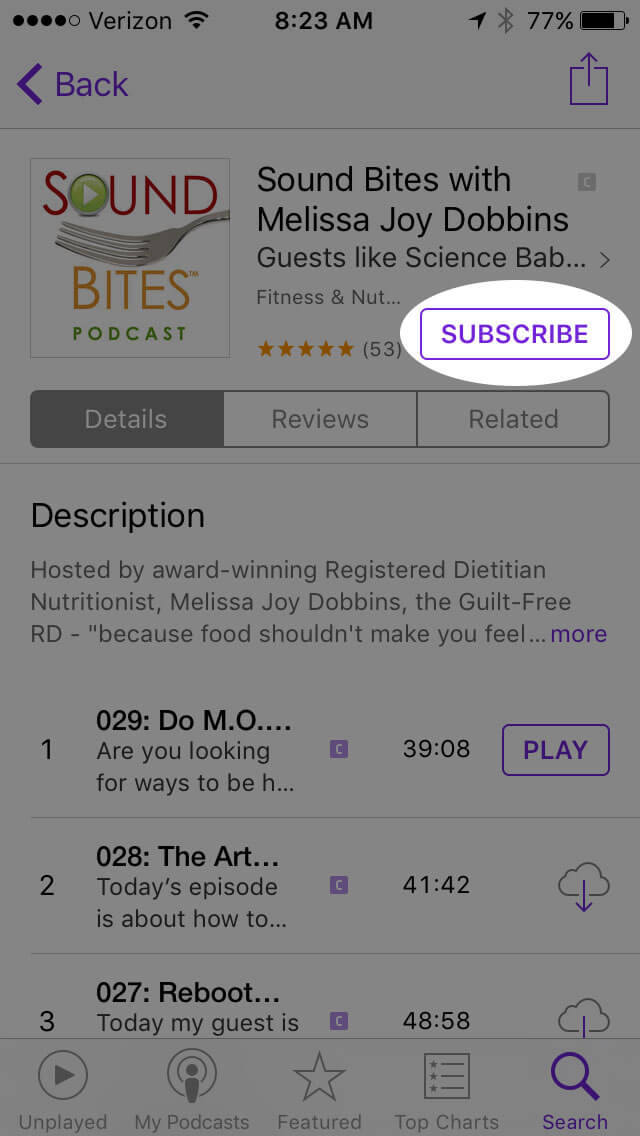
Subscribe & Review on iPhone
Open the “Podcast” app on your iPhone
Search for “Sound bites with melissa joy dobbins”
Open the podcast and click “Subscribe” and your done!
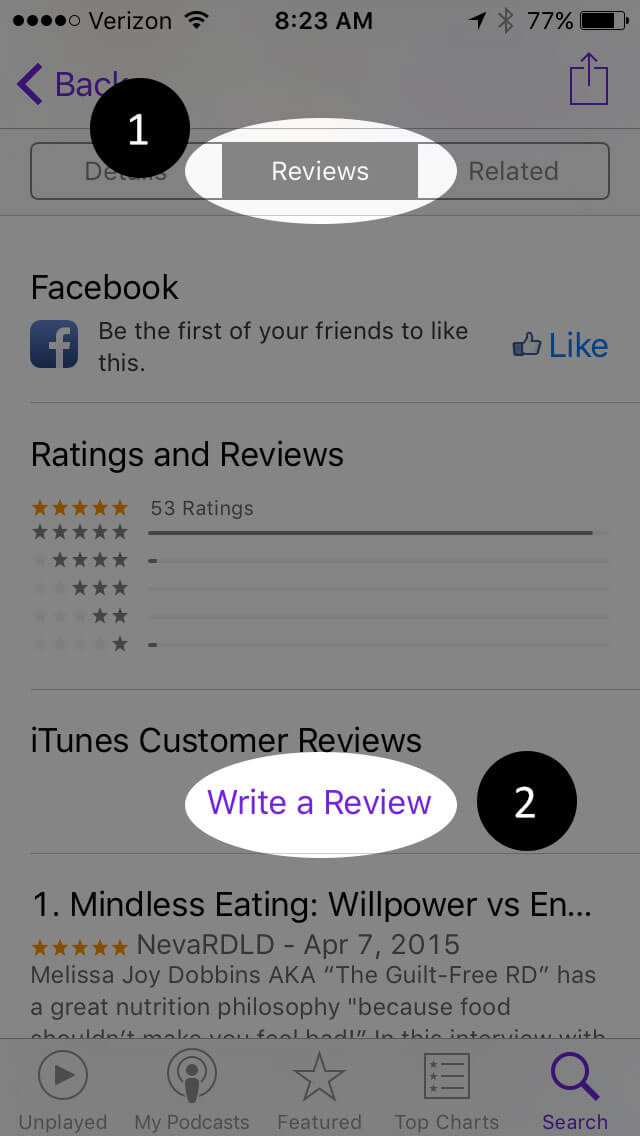
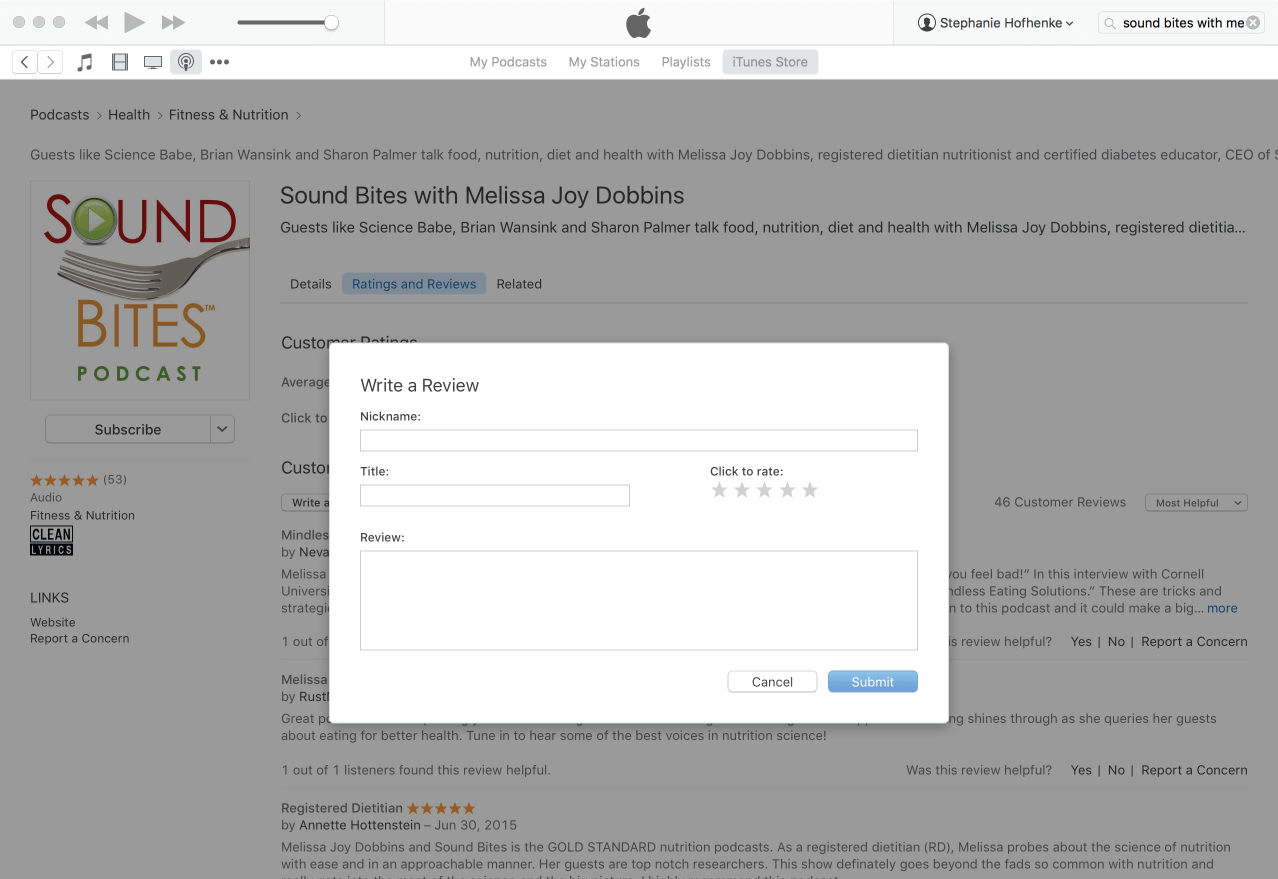
Write a Review
Click “Reviews”, then “Write a Review”.
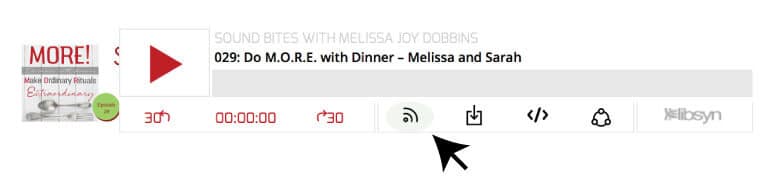
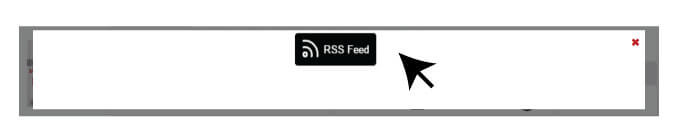
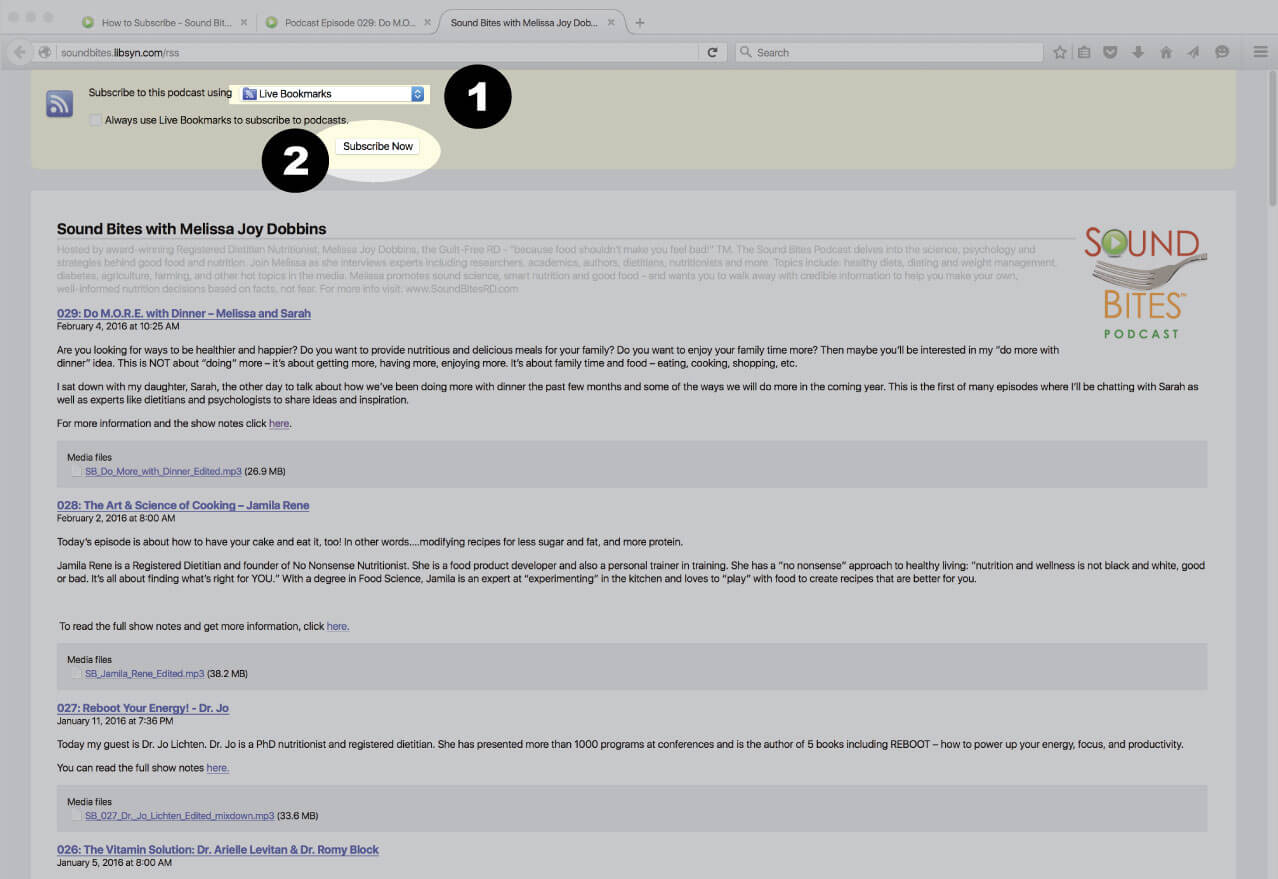
Subscribe via RSS Feed
Navigate to any podcast player . Click on the RSS feed icon.
Click on the RSS feed icon.
Click on RSS Feed
Choose which application you would like to use to receive the RSS feed
Click “Subscribe Now”
Confirm settings and subscribe.
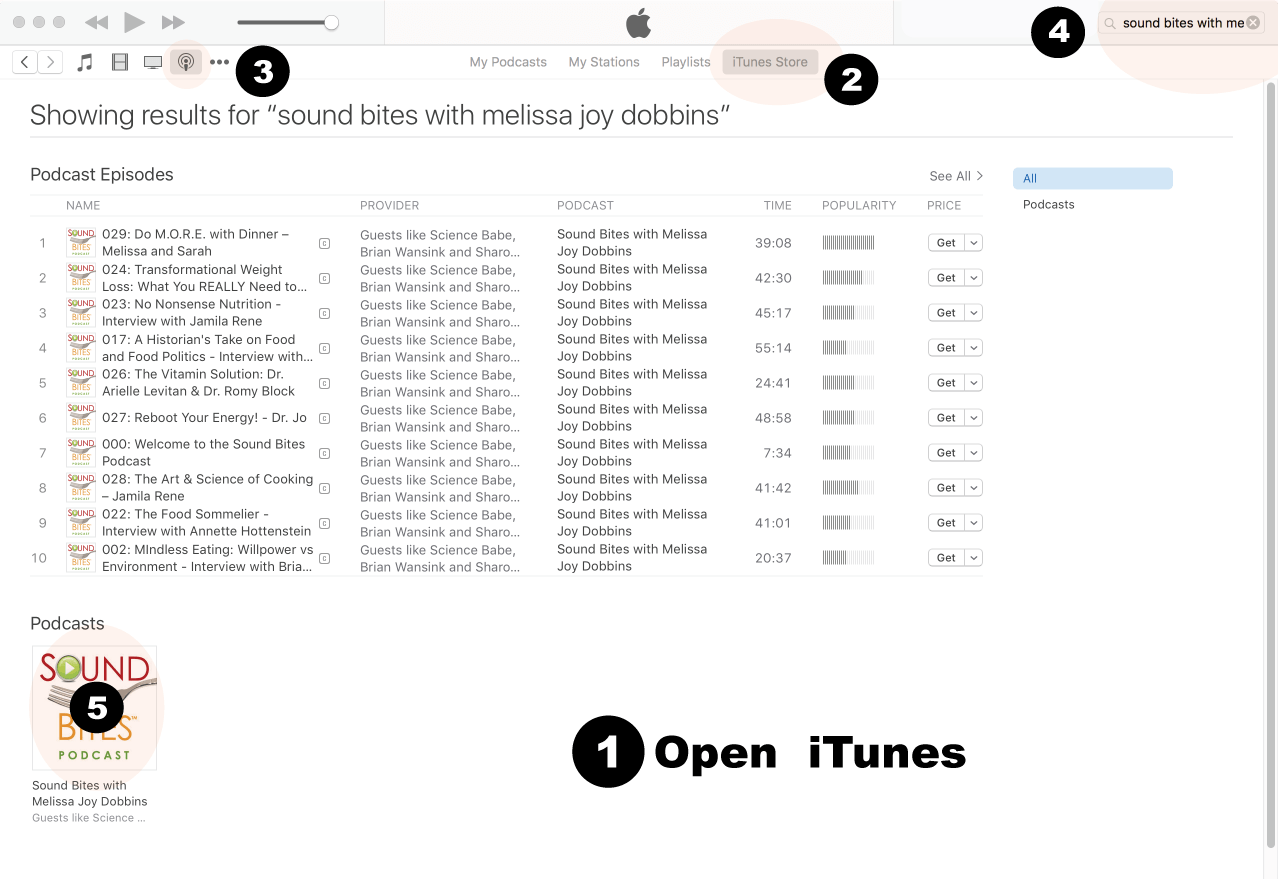
How to Review in iTunes
Open iTunes desktop application
Click iTunes Store
Click on Podcasts
Search for “Sound bites with Melissa Joy Dobbins”
Click on podcast image
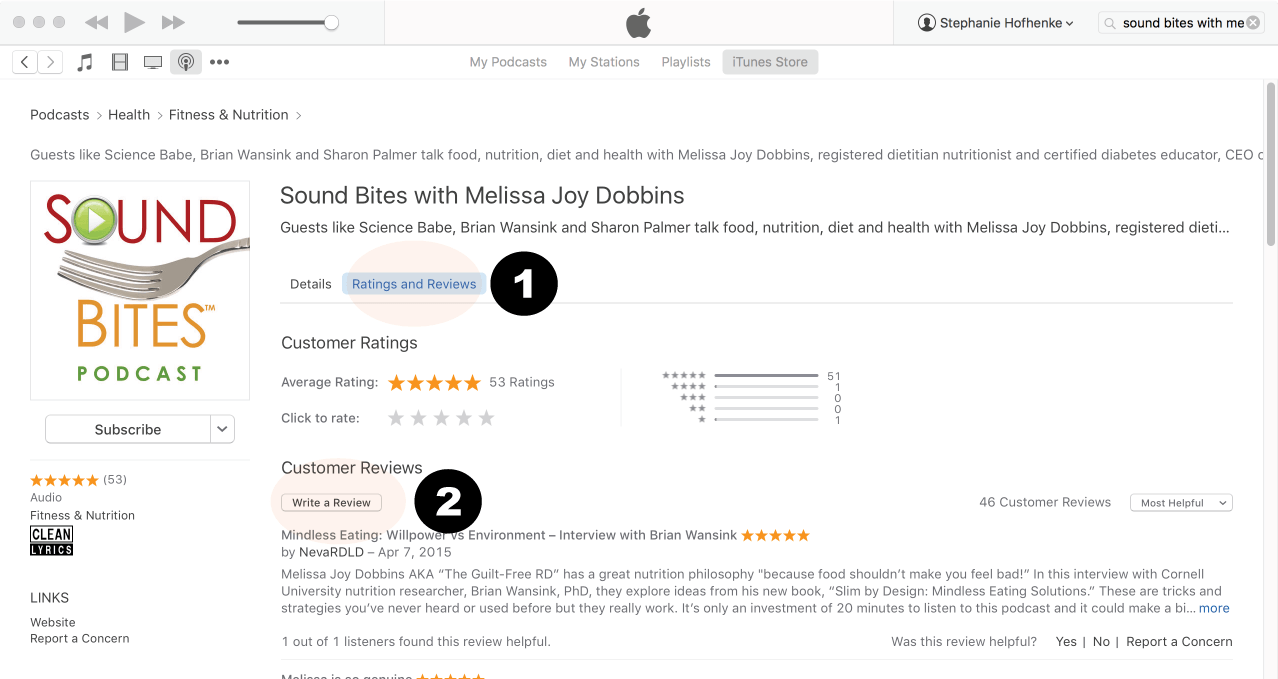
Search for Sound Bites podcast in iTunes
Click Ratings & Reivews
Click Write a Review
View reviews and write your own review.
Write your review…. Thank you!
Write your review!
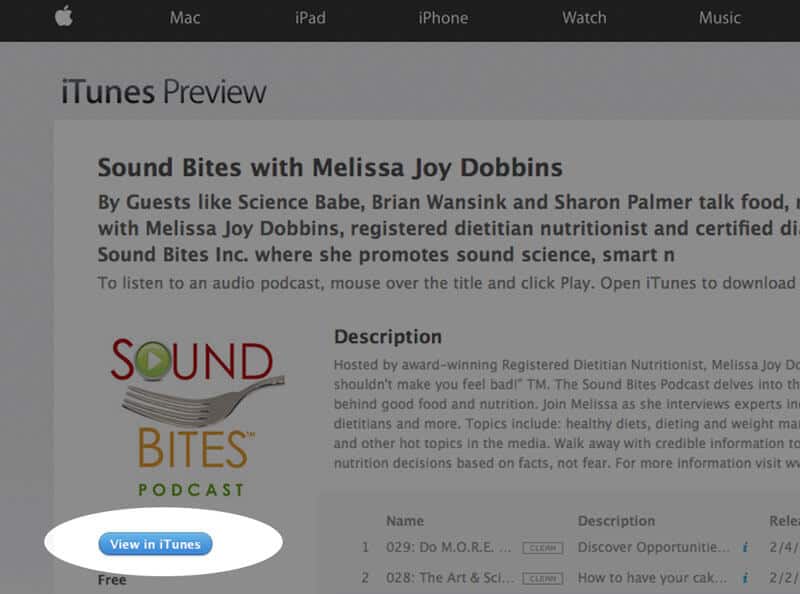
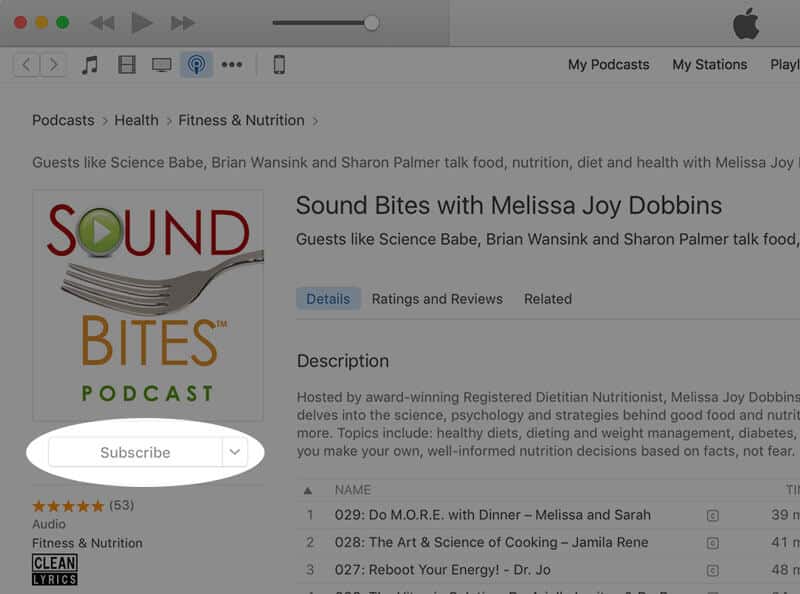
How to subscribe via iTunes
Click here to view the Sound Bites Podcastin iTunes, then click the blue “View in iTunes” button. This will open your iTunes application directly to Sound Bites Podcast. Click the “Subscribe” button, and your done!