Celebrating over 1 Million Downloads and 50,000 Free CEUs on the Sound Bites® Podcast | NEW: Get 1 years’ worth of CEUs with the new 15-CEU Podcast Course
Identifying Gaps in Consumer Knowledge Helps Uncover Attitudes and Behaviors
This year’s Food & Health Survey marks the 19th consecutive year that the International Food Information Council (IFIC) has surveyed American consumers to understand the perceptions, beliefs and behaviors surrounding food and food-purchasing decisions. IFIC’s consumer research elevates the voice of the consumer, a contribution often left out of important discussions about food and nutrition and can help identify gaps in consumer knowledge that tailored resources and messaging can address.
“I want to underscore the importance of IFIC consumer research, as it comes directly from the public. Our findings can be helpful in addressing gaps in consumer knowledge, as they uncover attitudes and behaviors, which can inform compelling resources and messages that empower consumers to make more informed choices that move them closer to dietary recommendations and improved health.” – Kris Sollid
Tune into this episode to learn about:
key findings from this year’s survey
perceptions about health and nutrition
how “healthy” food is defined
food and beverage purchase-drivers
health benefits sought from foods and beverages
types of diets people are following
what people are looking for on labels
how confident consumers are in the safety of our food supply
consumer mindset around weight loss medications
how different generations and income levels impact purchase-drivers
how stress impacts food choices
how food choices impact emotional wellbeing
where people are getting nutrition information and what sources they trust
resources for more information
Kris Sollid, RD
Kris is the Senior Director of Nutrition Communications at IFIC. He’s been with IFIC for nearly fifteen years and currently leads their consumer research program. In this role, he regularly shares IFIC’s research and insights with food and nutrition professionals on national and global platforms.
Kris is a registered dietitian, active member of the Academy of Nutrition and Dietetics, and is a past president of the Academy’s DC affiliate.
Resources Some links may be affiliate links. As an Amazon Associate, I earn from qualifying purchases.
Welcome to Sound Bites, hosted by registered dietitian nutritionist Melissa Joy Dobbins. Let’s delve into the science, the psychology, and the strategies behind good food and nutrition.
Melissa Joy (00:22):
Hello and welcome to the Sound Bites Podcast. Today’s episode is about consumer insights to understand perceptions, beliefs, and behaviors surrounding food and food purchasing decisions.
You may have heard of the International Food Information Council and their annual food and health survey. This year marks the 19th anniversary of this annual survey.
My guest today is Kris Sollid. Kris is the Senior Director of Nutrition Communications at the International Food Information Council, or IFIC. He’s been with IFIC for nearly 15 years and currently leads their consumer research program.
In this role, he regularly shares IFIC’s research and insights with food and nutrition professionals on national and global platforms. Kris is a registered dietitian, an active member of the Academy of Nutrition and Dietetics and is a past president of the Academy’s D.C. Affiliate.
Welcome to the show, Kris.
Kris Sollid (01:18):
Hi, Melissa. It’s so nice to be here with you.
Melissa Joy (01:20):
So great to have you back on. I should say welcome back because you were on the podcast back in episode 153. The title of that episode was Food Insight, Consumer Research Trends and Communications, and it was a very popular episode.
And you know this, Kris, I would have you or somebody from your team on the podcast every month if I could because you guys do such awesome work and I’m so excited to dive into the new survey, but also other stuff going on at IFIC.
And I want our listeners to know that this episode is not sponsored, and we might be submitting it to the commission on dietetic registration for continuing education credits. So, if that is of interest to you, you’re a dietitian, diet technician or a diabetes educator, you can always go to my website at soundbitesrd.com and there’s a CEU tab where there’s a ton of free CEUs that you can access.
And I also have a new package that you can purchase for one whole year’s worth of CEUs, including an ethics performance indicator.
So, Kris, I would love for people to hear more about your work and your background. I mean, my regular listeners know that I’m a number one fan of IFIC, I love Consumer Insights and I just want to have you share more about your background and really the important role that Consumer Insights have in the work that you do, and everything that you want to share with us at this point about what’s going on with the work you’re doing at IFIC.
And of course, as we wrap up, we will also share some more information.
Kris Sollid (02:58):
I’m always happy to talk about the work we do and even myself when prompted, I’m a second career dietitian, so I sort of fell into this job just by chance, and fortunately, landed at such a wonderful place to work like IFIC. The work we do really focuses on the voice of the consumer.
So, I think you’ll hear from our discussion today how important that is for all sorts of food and health professionals to really understand that consumer mindset, what drives them to make the certain choices that they do, particularly when it comes to food, something we’re all invested in and helping people make more informed and better choices that can lead to better health outcomes.
So, I think that’s really the value of our research and I’m really excited, always excited to talk about it and particularly with you today.
Melissa Joy (03:46):
And Kris, for those people who aren’t familiar with you and haven’t listened to the previous episode where we talked quite a bit about your background and your second career dietitian role, tell us a little bit about what your first career was and how you decided to transition to dietetics.
Kris Sollid (04:02):
Yeah. I found myself at a point in life where I was always thinking about food and health and being very active growing up playing sports. And it just took me a while to come around to this idea that maybe that’s something I could pursue a career in.
So, I was in the hospitality industries, working on golf courses, working in hotels for many years and making that switch going back as a second career dietitian really just opened up a whole new world of possibilities for me.
Really invigorated my science brain and all the things that I have been instilled in growing up. Fortunately to be growing up in California with access to seasonal, fresh foods instilled in me by my parents to how important the elements of nutrition and physical activity were.
So, as I’ve aged and as I’ve moved around the country, I understood quickly that that’s not something everyone was privileged to have, nor do people have an interest in learning more about those things. At least my circle of friends and peers at the time.
So, it was really something that struck me over time and maybe just one day a light bulb went off and I said, “That’s where I want to take my life.” And that’s where I’ve been and I’ve been fortunate enough to be at IFIC for more than a decade now, doing the work that I love doing.
Melissa Joy (05:23):
Yes, that’s wonderful. And your team is growing. We have some mutual friends who are working on the team with you and just so excited about that. And you’re based in D.C. if I didn’t mention that earlier.
So, let’s dive into the new 19th annual survey, food and health survey. I attended a webinar where you and your team shared some top line takeaways, but also some of the specific ones. And I just personally find this year’s survey even more interesting than usual. It’s my understanding that it came out in June and the sample size tripled this year, which is really cool.
So, maybe just kind of give us an overview of the food and health survey and what we kind of need to know, just kind of set the stage before we get into the takeaways.
Kris Sollid (06:18):
Sure, yeah, my background, Melissa did a nice job explaining how many years we’ve run this survey. This is an annual survey from us here at IFIC, it is our flagship survey. This is the 19th consecutive year that we’ve conducted this survey.
We do lots of other research, by the way, on separate topics. This food health survey is really focused on everything, collecting data and insights on everything that people may understand or perceive about nutrition.
So, it ranges from topics on food safety to food production, to nutrition, down into the weeds of nutrition. If you’re a dietitian like we are, you might find those elements interesting.
But it’s really meant to gauge that consumer mindset, what their beliefs are, what their attitudes are, what their behaviors might be or reactions to certain things. Maybe something around food labeling or maybe something that’s a little bit more controversial that they may be hearing about in the media.
So, we really look at collectively these insights annually so we can trend them over time. We can retrospectively look to see where attitudes have shifted on certain topics over time, but we also ask new questions.
Every year, we’re looking at invigorating the survey with new topics that might be emerging trends that you all are aware of that we’re catching wind of. We want to know where the consumer is starting from when things are just coming out. Whether it’s through the media, through friends and family or social circles, really trying to capture where the consumer believes maybe science is on a certain subject or what they’re hearing about certain subjects.
And we track that over time. We can look going forward, we can look going backward to try to understand how consumers are absorbing information and how can we help inform them about that information they’re hearing.
Melissa Joy (08:06):
It seems like you had a lot of really new questions this year. Like I said, it was like, “Oh that’s interesting. Oh, that’s interesting.” And it is really cool to see a question that you have asked over the years, it’s down from previous years or it’s up from previous years.
Tell us just in general, how you conduct the survey. Is it phone surveys? And maybe a little bit too, I know we talked about last time, but I always find it interesting too, there’s a lot that goes into formulating the question that you ask because the answers you get are only as good as the questions you ask, right?
Kris Sollid (08:38):
Yeah. That’s right. So, we work with a wonderful partner, our research partner is Greenwald Research. They’ve been working with us for more than a decade now on the survey. So, they are familiar with the questions we trend, with the questions we ask, and as partners, thought partners really, we’re really looking for ways for them to develop questions that are of interest and do it in ways that are unbiased to elicit the most accurate responses.
We do put our surveys through cognitive testing to try to understand if the questions are being received as intended. So, I think that’s a really important step in consumer research. So, that phase is really critical, giving us feedback to how we might need to improve something around our questions.
So, our surveys are conducted online. Our research partners have access to consumer panels that consumers around the country have opted into, so that’s one caveat here. People have to have internet access and they have to opt into these panels to be given access to research partners like ours.
And when we conduct our online surveys, our research partners are also balancing our samples to match or be reflective of the U.S. population based on the latest population surveys.
So, that’s a really important element to our work. It helps us be able to extend our findings across the population we are capturing, that demographic, and those groups are based on age, education, region, ethnicity, all of the things that help us say that these are reflective of the U.S. population.
Melissa Joy (10:10):
And thank you for explaining that. Yes. And as we go through some of the findings, it becomes apparent, you’ve got different generations having different responses or different income levels and it’s fascinating.
Could you give us just a brief overview or summary of the key findings? I know that’s part of the survey results document itself and I should mention all of this is available online and we’ll share all the links as we wrap up. But I’d love to hear sort of your executive summary top line.
Kris Sollid (10:41):
Sure. So, as we’ve been working on this survey for 19 years now, there are a few questions that we ask every single year. There are some that we do trend in each survey and there are new ones.
When we look at the trending questions for this year that we’ve asked in every single survey since its inception, we find that taste and price still lead the way when it comes to which factors drive consumer purchasing decisions with food.
We’ve also found some interesting findings around the consumer confidence in the safety of the food supply. Another question we’ve asked in every survey, and this year we find it down from previous years.
So, I think those are two top line findings from trends we’ve asked in every single food and health survey that we’ve conducted. But I’m excited to talk more about the new questions you’ve mentioned as well.
Melissa Joy (11:28):
Okay, great. Oftentimes when I do presentations, I include IFIC information and yeah, the number one driver for purchases, taste is always king, but there’s some just really interesting nuances. As you mentioned, over the years and at income level and things like that.
There’s so much information that we could dive into, where would you like to start?
Kris Sollid (12:05):
I would love to start with some trends around how people tell us they’re eating and what people tell us they’re eating and what benefits they’re looking to gain from those foods.
So, this year we found that more than half of people in the past year have tried a new specific way of eating. So, this is something we found in recent years as well. So, it’s not necessarily an increasing trend, but if you go back more than four or five years, we have seen this on the rise.
And this year the most popular diet that people say they tried in the last year is high protein.
Melissa Joy (12:39):
Yeah, I found that interesting. And some of the other options like the second one, second most popular was mindful eating. So, I love that, that’s a “diet.” I think that the definition of diet might be expanding, which I think is a good thing.
I also noticed that this sort of juxtaposition of it’s much further down on the list, but more people saying vegetarian and fewer people saying plant-based, which is semantics maybe. But tell me what some of your thoughts are on these different specific eating patterns.
Kris Sollid (13:14):
Yeah, one thing we try to do in our survey work is oftentimes we want terms like diet or like plant-based to be interpreted by the survey taker. So, we’re not overly explaining to them what these things mean.
We want them to tell us what they think they mean and if that means following a diet that’s plant-based, they can indicate that, we’re not really drilling into the specifics of what plant-based means in this regard. We’ve done that in the past, but in questions like this, we’re really interested in that interpretation from the consumer themselves.
Now when we look at the top trends, we’ve seen high protein, we’ve seen mindful eating, we’ve seen things like intermittent fasting come in near the top of this list over recent years. So, we do know that those trends are being followed and being heard and seen and tried by the consumer.
So, it’s really important as health professionals that we’re up on these trends and we’re able to speak to consumers in a way that’s helpful to them.
Melissa Joy (14:08):
Right. And as you’re talking, I want to make sure our listeners know, you mentioned earlier this is your annual food and health survey, but you guys do a ton of other surveys, Consumer Insights focused on different topics and we’re going to touch on that again, as we wrap up what some of the maybe newer ones are.
But you’ve got insights based on protein, diet plant-based diets, things like that. So, definitely want our listeners to know about those opportunities and resources. Okay. What next?
Kris Sollid (14:36):
So, in addition to the types of diets people are following, we’re also tracking what people tell us they’re trying to get from their foods and their diet. And specifically in this last year, we find that most people tell us they’re really looking for more energy from the foods and beverages they choose.
They’re also looking for things like healthy weight. They’re looking for things like healthy aging. So, these are things that the broad population are looking for. These are leading drivers for their food choices.
But what’s really interesting is when you look through the generational differences and we see where some similarities are and where some differences are, it can really help us like understand how to talk to these different generations differently based on what’s most important to them.
Melissa Joy (15:20):
Yes, and I want to mention, I recently did an episode on Gen Z and their relationship with food and I found the information just really surprising. And I do think, yeah, when we look at these different generations, they’re so different and they have their unique personality, if you will.
And yeah, different things resonate with them. To your point, younger generations are prioritizing energy and weight loss while the older ones are prioritizing healthy aging, which makes sense.
And it’s interesting to see that healthy aging has moved up on the list or increased from previous years. I don’t know if I’m saying that right. Digestive health is trending higher as well as far as being an area of interest or health benefits sought emotional mental health.
I think we’re going to talk a little bit more about that later, which I found very interesting. Especially, we’re four years out of the pandemic if that’s even the way you want to say it. Four years since the pandemic started, I guess. And the mental and emotional and stress aspect of our lives and our food relationship is interesting.
Kris Sollid (16:36):
Yeah, I had mentioned some of the differences, but also some of the similarities are important too. You mentioned the importance of each generation placed on things like weight loss. So, that’s a common theme we all have.
When people think of food, they’re often thinking about weight and its impact on weight, that energy and fatigue, that’s something that each generation is trying to address possibly in different ways, but it is, we do see that rank highly for each of the generations.
And you mentioned some differences too around emotional and mental health, younger generations being much more in tune to that, therefore looking for those certain benefits from their foods more than some of the older generations. For sure.
Melissa Joy (17:15):
Yes. Another thing that I’d love to touch on is a lot of this is obviously like when someone’s in the grocery store, what products are they looking for? What buzzwords are they interested in? And so, I’d love to hear about what people are saying that they’re looking for and what defines a healthy food or what are they looking for on packages?
Kris Sollid (17:38):
Yeah, this is a big question that everybody always asks. In fact, our federal government is updating their definition for healthy. So, it’s a really timely question.
Consumers over the last few years have told us that the top criteria they use to define healthy food are fresh, good source of protein and low in sugar. So, those may not be surprising to a lot of you, but these are really some of the criteria that consumers are looking for. Whether that be on package or whether that be in messaging about certain foods. These are the ones that they’ve honed in on the most to try to help them understand or define whether or not a food is healthy.
Now there are other things that people look for when it comes to defining a food as healthy or unhealthy. Those are things like specific nutrients, whether they’re a good source of things like potassium, whether they contain food groups like fruits or vegetables.
Low in sodium is another one we know consumers are looking for. But there’s also terms that go beyond those very specific definitions or macro or micronutrients. Things like natural. Things like limited or no artificial ingredients, which may have some looser definitions in the consumer mindset.
We do see that consumers are compared to last year anyway, they are less likely to be using natural as an indicator of healthy. But they’re a little bit more likely to be using phrases and terms like limited or no artificial ingredients or preservatives in their criteria for defining healthy foods.
Melissa Joy (19:11):
Yeah, I like that because I feel like natural is so vague and didn’t really have a definition. And at least with the limited or no artificial ingredients, I mean, I’m not saying necessarily something people should avoid, but at least it’s a specific thing that they’re looking at.
Kris Sollid (19:29):
And we’ve seen that on the rise in recent years. So, that’s I think a really important trend that we’re capturing here. Consumers are tuned into that. There can be lots of debates around whether the number of ingredients in a food make it more helpful or less healthful within the scientific community.
But it’s important to understand what the consumer is using to define certain criteria while these debates exist within our communities around important topics. But going back to the consumer, understanding that voice from the consumer, what signals are they sending to us can really help inform how we speak back to them or what the scientific literature is saying.
Melissa Joy (20:07):
Excellent point. Thank you. So, building on that, you had mentioned at the top of the conversation that the overall confidence in the safety of the U.S. food supply is down. Talk to me about those results. What did you see there and what do you think it means?
Kris Sollid (20:25):
Yeah, compared to last year we’ve seen a pretty big dip in confidence in the food supply, in the safety of the food supply that is. So, we’ve seen significant differences between last year and even when we go back 10 years, we’re looking at fewer people today expressing confidence in the safety of the food supply than they did in 2014, for example.
So, when we look at those two data points, both compared to last year and to 10 years ago, we’re seeing some slips in the confidence that consumers have in the safety of the food supply. And there could be a number of reasons for that.
And whether or not that’s even true or not is up for debate. We have a very safe, we have a very secure food supply, but it’s the perception among the consumers that can matter. So, if you think back over the last 12 to 18 months, there have been incidents that have possibly eroded the consumer confidence in the safety of the food supply.
Melissa Joy (21:15):
Right. Yes. And thank you for, again clarifying, we’re talking about consumer perceptions, not necessarily what the science shows. So, I appreciate that.
And along those lines as well, I mean we talked a little bit about this, but there are certain terms like natural, organic, healthy, we mentioned briefly. Talk to me more about what you’re seeing with this regarding being safety signals. What does that mean?
Kris Sollid (21:40):
So, this is a newer question we’ve asked in our food and health survey. And what we found is that foods labeled as natural, organic or healthy or no artificial ingredients or colors are the top signals that people are looking for in store when they’re determining whether or not a food is safe.
Melissa Joy (21:57):
Yeah. That conveys to them the safety factor, not necessarily healthy or whatever, but that reassures them in some way that it might be safe.
Kris Sollid (22:07):
Correct. And so, with thinking about our foods and our food supply, we have a very safe food supply. The assumption is that everything that makes it on shelf is safe for consumption and these terms don’t necessarily have a safety indicator attached to them. However, that is something that consumer is overlay on such terms.
So, I think that’s an important consideration to think about as some of these terms are less defined than others. Clearly a term like organic has a very set definition, but it does not address safety.It is a production technique. Things like natural are less defined, but the consumer is interpreting those in a way that does have a connotation towards safety.
Melissa Joy (22:49):
Got it. The safety halo, maybe like the health halo. And I believe one of the newer questions this year also has to do with weight loss medications and perceptions on safety and effectiveness. So, what did you see with those questions? What can you share with us?
Kris Sollid (23:10):
So, this is another new question we have in this year’s survey, taking the opportunity to understand or at least get a baseline on consumer mindsets around some of the new anti-obesity medications that are becoming more mainstream.
They’ve been described in a number of ways, but I think we all know what we’re talking about here when we’re thinking about weight loss medications for lack of a better term.
And what we wanted to do in this year’s survey was to try to begin, at least to set a baseline of understanding around consumer perceptions of their effectiveness for weight loss and also of their safety for weight loss.
And what we found was that more people, nearly half of Americans believe that these prescription weight loss drugs are an effective way to lose weight. Far fewer, however about 3 in 10 in this year’s survey tell us that they believe they’re a safe way to lose weight.
So, that difference is really interesting in my mind and an important one that more people believe they’re effective than believe that they’re safe.
Melissa Joy (24:14):
Yeah. And I’m looking at some of that data. 1 in 10 consumers say they’ve tried a prescription weight loss drug in the past year and an additional 22% say they have considered it.
Kris Sollid (24:25):
Yeah. That’s an important thing that we wanted to capture in this year’s survey. People’s reporting of actually using these medications or people’s consideration in the past year of using these medications. And what we’ve seen when you combine those two together is about 3 in 10 have either taken one in the past year or considered taking one.
Now if you think about the incidences of obesity or the prevalence of obesity in our population and who may be eligible for these drugs, who may be taking these drugs who are not eligible, there’s lots of unanswered questions I think in this space, but it’s really important for us as a consumer research organization to try to understand here not just who’s taking them or who’s considering taking them, but what their beliefs are around them.
And even going beyond those beliefs. Some folks may be taking them even though they’re not confident in their safety.
Melissa Joy (25:18):
Yeah. Actually, and I recently did an episode on weight loss medications and to your point, there’s a lot of different terms we could use to describe them. So, if anybody’s interested, check that out.
The number one question that is on the survey every year is the one that you mentioned earlier about how taste remains a top purchase driver. So, I’d love to go through this in depth over the years. There’s taste, price, healthfulness, convenience, and there’s also a question about environmental sustainability.
So, this is sort of, I don’t know, the gold standard question from this annual survey. So, tell us all about this.
Kris Sollid (25:56):
Yeah. This is an example of one we’ve asked every single year. So, for 19 straight years we’ve asked this question and about a decade ago, a little more than a decade ago, we understood the importance of including the environmental sustainability element to this question.
So, we’ve added that. So, we’ve got more than a decade of data trending on that. So, an important inclusion and an important reminder that many of the questions we ask are close-ended. And by that, I mean we’re giving consumers a defined set of responses to answer. We’re not opening up to just anything that they’d like to say.
However, we do capture questions that are open-ended as well. But here, when we’re listing these factors, we’re asking folks to tell us the degree to which they influence their purchasing decisions.
And the interesting thing that I always love to remind people about this set of factors that are close-ended that we put to consumers is that in the 19 years of our survey, while the percentages that people are responding to these questions may fluctuate in every year, the rank order in which they say these have an influence on their purchasing decisions have not changed in 19 straight years.
So, simply put, every survey for 19 years that we’ve asked this question, the rank order of the influence on purchasing decisions has gone taste, price, healthfulness, convenience, and then environmental sustainability since we started adding that in 2011.
So, that’s an important reminder as we look at our survey, we’re not necessarily looking at the exact percentages we’re looking at sometimes stepping back, looking at those macro trends and this trend telling us that taste and price really do lead the way when it comes to the drivers of our food and beverage purchasing decisions.
It doesn’t necessarily mean that healthfulness and convenience are less important. As health professionals and food communicators, we really want to be encouraging the consumer to think more strongly about the healthfulness of their food choices.
Melissa Joy (27:53):
Right, absolutely. And generational differences, household income differences. Tell us a little bit about some of that because I think that’s where it’s almost like the charts get all wonky.
Kris Sollid (28:07):
Yeah, that’s something that our increased sample sizes here gives. It’s the ability to look more closely at and it’s really exciting for a question like this in particular, you can look at the aggregate for what does the whole survey tell us.
But you can also drill down on important factors like income, like household income. We know how much of a direct influence that can have on the choices that we’re making with our foods. And just as a couple examples we’ve seen as income grows, we see that the importance of price declines, not surprising, but to see the data show you the effect of that is really striking.
Similarly, we see that the influence of healthfulness rises as income rises. So, very interesting to think about the more disposable income, more access to, you know, healthier food choices. But the importance of those food choices seem to grow as income grows, at least around healthfulness.
Similarly, you can look at things like convenience. There’s an interesting little conundrum here where we think about convenience of being very important for households with lower income, but also households with higher income as well. Think about the time strap nature of each of those scenarios.
So, it really is important to both of those groups. We’re also looking at taste. And taste seems to increase as the importance of taste on food and beverage purchasing decisions also seems to increase as income grows.
And just the last thing I’ll say on this related to income is environmental sustainability, you would assume that the importance of that factor would grow as income grows. But that’s not really something we’ve seen so far, at least in this year’s survey when you look closely at the data.
So, I think that’s really interesting because you would assume it’s the higher earners that think most often about the importance of making food choices that are more environmentally sustainable.
Melissa Joy (30:06):
Right. And as they may have more disposable income, some of those products may cost more. And I know you have surveys specific to that. We’ve talked about this in the past is people might say they want a product that’s “better for the environment” but they’re not quite willing to pay more for it.
And so, you would think with more disposable income you would see more of that. Yeah, it’s very interesting and sometimes I wonder too about the convenience factor, and I get all excited that healthfulness is typically above convenience, but that’s for that aggregate the whole group, different subsets are going to have different results there, I’m sure.
And I wonder, is convenience going to possibly be associated with processed foods and some of the negative connotations in the dialogue about those today? Again, not necessarily a science evidence-based situation, it’s more of a perception, but I think that’ll be an interesting-
Kris Sollid (31:01):
And convenience being just a function of time as well. It doesn’t necessarily have to mean anything around the healthfulness of our food choices, but if you think about the availability or the time available once a day to cook from scratch, for example, to make more home cooked meals that include fresher items that may take longer to put together. It’s not something that everyone has available to them throughout their day.
Melissa Joy (31:27):
Of course. Let’s talk a little bit about the impact of stress and wellbeing on nutrition because that really stood out to me with this survey. I don’t think there were new, new questions because I think some of this kind of started coming out around when COVID surveys that you did as well. But I find it very interesting, and I’d love for you to share your thoughts.
Kris Sollid (31:50):
Yeah. And based for that reminder around when we started thinking more closely about this, the onset of the pandemic really opened up our eyes in many ways to thinking about what are the impacts of stress, not just on our lives, but on the food choices that we make.
So, in the last couple of years in our food and health survey, we’ve been assessing the frequency or the degree to which people have experienced stress. We found that in this year’s survey, more people this year compared to last year said they’ve experienced some level of stress in the last six months.
So, we see that on the rise now two data points don’t make a trend, so it’s something will be looking more closely at going forward. But it is an interesting finding, nonetheless.
And we found that among those people who have experienced increased levels of stress in the last six months, we see that nearly half of them say that it is led to choosing less healthy foods and beverages.
So, that relationship between feeling stressed and the food choices we make is somewhat apparent. Now, if we also think about the role of feeling stress or our mental and emotional wellbeing, we do find that a significant number of consumers tell us that the impact of their foods and beverage choices is informed by their mental and emotional wellbeing.
And in the reverse, we also find that the impact of their emotional and mental wellbeing has an influence on their food choices. So, we do see a relationship there, or at least the consumer understanding the two-way relationship between our emotional and mental state and our food choices.
Melissa Joy (33:25):
Yes. Seems pretty apparent like you said. And it was interesting too that women, people with lower household income and Hispanic populations or Hispanic people are more likely to report being stressed.
Kris Sollid (33:39):
Yeah. We have the ability; we look at the demographics within our survey to see where those differences are. This just happens to be an example of those who have experienced stress within the last six months, women being more likely than men, lower household incomes compared to higher household incomes.
So, that’s another example of where our increased sample sizes give us the ability to dig deeper within those demographics.
Melissa Joy (34:01):
Yes. And there’s a slide that yeah, it’s like the lower level of the income, most stressed, less healthy reporting and then the higher level, less stressed and most reporting healthy and happy.
Kris Sollid (34:17):
Yeah. Just like we talked about the influence on purchase decisions, we can map out based on reported household income, what those trends are specifically around the levels of stress people are experiencing. We do see a relationship between higher incomes experiencing less stress within the last six months.
Conversely, we see reported levels of happiness, self-reported health status both increase as household income grows at least within our sample size or our sample this year.
Melissa Joy (34:48):
I don’t know if this was a specific question that you asked in the survey or just with all the work that you do at IFIC. We talk a lot about we have a safe, affordable food supply, but we’ve seen grocery prices growing, increasing.
And I think when people, a lot of the stress commentary on the survey, it’s like, it’s the economy, it’s politics, it’s things like that. Are you getting any insight from consumers where they feel, “Yeah, I’m getting squeezed at the pocketbook with my grocery dollars.” Any insights there to share?
Kris Sollid (35:23):
Yeah, pretty much everyone has noticed the increased price of food. So, that’s something we’ve asked in the last two years. We’ve seen that more than 90% of people have noticed an increase in the cost of food over the last year. And this is something that speaks generationally as well. Everyone’s noticing it.
But we do see that baby boomers notice it the most. They notice it more than every other generation. At least they have noticed it. Gen Xers notice it more than Gen Z or millennials. Millennials notice it more than Gen Z, so at least in our sample, there’s a linear relationship between the observance of the increased cost of food by generation.
Melissa Joy (36:00):
That makes sense. We have the longer memory and history.
Kris Sollid (36:08):
It’s important to think about, so who’s aware of the rising cost of food and the stress that might bring. Because when we ask people about stress, one thing we did in this year survey for the first time was try to assess the contributions of stress to people’s lives from all aspects.
We’ve asked people around personal finances, the economy, healthcare, work, school, politics, the environment and our food choices. And what we’ve seen or what we found this year is that many more elements of our lives add stress than our food and beverage choices.
That’s not to discount the stress that our food and beverage choices can add to our lives. For example, we found 23% of people saying that their food and beverage choices have added stress to their lives. And that’s compared to almost 60% of people who say that managing their personal finances adds stress to their lives.
So, I think it’s just an important reminder that although we only want to talk about foods and beverages and all the ways in which it impacts our lives, there are things happening outside of that space that are contributing negatively to people’s lives. Like stress.
But when you think about those differences between generations, when we ask people about that stress, there are lots of similarities. You would think that just as older generations are noticing that the price of food increasing more than youngers. But every generation tells us that managing personal finances adds to their stress.
So, some ranking higher than others, but it’s a top two consideration among every single generation. So, it’s not, we can dismiss lots of things around the economy or the cost of certain items just growing over time, but it’s something that every single generation feels and are concerned about.
Melissa Joy (37:50):
Right. Well, speaking of stress, let’s talk about the social media aspect. What are you seeing with the survey around where people are getting information? What are they trusting? Who are they trusting?
Kris Sollid (38:04):
Yeah. Not surprisingly, everyone’s on social these days. We’re making that assumption. What we’ve asked in this year’s survey in the last couple surveys is about people’s exposure to food and nutrition content on social media.
So, we’re aimed specifically at that within our survey. And what we’ve found is that more than half of people have been exposed to some form of food and nutrition content on social media. And that’s up significantly from last year. Last year about 4 in 10 reported that they had been exposed to food and nutrition content on social media. This year we’re up to around 54%.
So, a big jump there. What we’re not seeing is a change in the degree to which people trust that information. We find that almost 7 in 10 trust that information that they come across on food and nutrition in the social media space.
Fewer people are telling us that they trust it a lot, but more people are telling us they trust it a little. So, overall we don’t see much of a change there in trust compared to last year.
But I think it is important to look at those even minor changes sometimes when we’re seeing a drop in that high level of trust that people have in that information. Although not a drop overall. Thinking about how people receive that information, who they share it with, how they couch it, how often are they acting on that information, important in considerations that are related to trust in that information.
Melissa Joy (39:30):
Yeah. Really important. Yes. What else are you seeing in that space?
Kris Sollid (39:34):
So, generationally, just getting back on that generational theme again, probably not surprising to you, we do find that younger generations are more likely to be exposed to food and nutrition content on social media. They’re likely present in social media more often.
So, there’s some aspects there that are probably contributing to that. But we also find that they’re more likely to trust that information on food and nutrition in social media space than older generations.
So, one thing we’ve found in this year’s survey is that really baby boomers seem to be the most healthy skeptics around this type of information. There might be lots of reasons contributing to that. Maybe they’re less confident in technology, things around AI become big conversations. There might be some skeptics there.
But just generally speaking, we have found that baby boomers are the most healthy skeptics when it comes to that exposure to food and nutrition information on social media.
Melissa Joy (40:28):
Yeah. The changing media landscape, I guess. Very interesting. As we’re wrapping up, what else would you like to tell us about this specific survey? And then like I said earlier, I would love to hear about other projects going on at IFIC and other takeaways that you have for us.
Kris Sollid (40:43):
Yeah, well this survey, if you’re a registered dietitian, I’ve got some good news for you. We’ve done some work around trust in the information that people hear about food and about nutrition. As we’ve tracked previous surveys, we find that registered dietitians and primary healthcare professionals are among the most trusted sources.
So, that’s great news for us dietitians, but it’s also an important reminder that people are listening to what we have to say. So, in terms of our credibility, our transparency, all of the information we’re sharing, being evidence-based.
And the ability for those healthcare professionals, us included, to translate really complex and nuanced and detailed information in the scientific literature becomes even more important as we begin to talk to the general public about what it means for them, how to apply it most appropriately so that we can help them make more informed food choices.
Melissa Joy (41:37):
Absolutely.
Kris Sollid (41:37):
In terms of what else we’re working on, thanks for plugging it. And I know you’ve already mentioned the other survey work we do, we conduct monthly surveys, we conduct other topic specific research projects. Most recently we’ve published consumer research around barriers to dairy consumption, specifically within some BIPOC population.
So, if you’re interested in learning more about what our consumer research says about that I’d encourage you to check that out. That’s free and accessible on our website foodinsight.org.
We’ve also recently published some work around front of pack labeling and some of the decisions that FDA is considering about how to make search as mandatory for food packaging. So, if that’s of interest to you, I’d encourage you to check that out again, also on our website foodinsight.org.
And we also do monthly webinars, which often highlight our monthly consumer research. We’ve done a recent webinar on snacking with Dr. Joanne Slavin that came out in August, so I’d encourage you to check that out. And also look to our fall schedule. We’ll be talking a lot more about of topics that are of critical importance to dietitians and other health professionals.
Melissa Joy (42:49):
Excellent. And you just recently in the spring, I believe, published a new science communication guide, which is already in my Sound Science toolkit. It’s fabulous.
And for my listeners who are not familiar with it, you can access the Sound Science toolkit through my website at soundbitesrd.com. You just sign up and you get a password and it’s just digital resources like this that just help you understand, interpret and communicate nutrition science. So, I’m really excited about that new guide.
Kris Sollid (43:21):
Yeah, thanks for that plug. You’ve put a lot of work into that resource over the last year or year and a half. It’s great to hear that people are using it, people are noticing it. A really critical element to food communicators, understanding the nature of science and how to speak to the average consumer who we know.
Unfortunately, science literacy in our country is not where we want it to be. So, trying to take those conflicts issues and bring them to the public in a way that they can be more easily understood is something we’re very interested in here at IFIC.
In addition to the consumer research we do, we are a science communications organization, so this is something that we have an enormous passion for and always happy to provide more resources that help other food communicators do their job.
Melissa Joy (44:08):
Excellent. Yes, thank you so much. IFIC is passionate about science communication and helping support dietitians and other food and nutrition professionals, so if you’re not familiar with their resources, you are now, go to their site, get engaged with everything that they have to offer.
And Kris, just thank you so much for coming on the show and all the awesome work you and your team are doing. Like I said before, I could have you guys on more often, but I know we have some plans to have other team members on very soon.
So, I’m going to hold that for sure on my calendar and make sure that that happens. And just thank you again. It’s been a pleasure talking with you.
Kris Sollid (44:47):
It’s always a pleasure talking to you, Melissa.
Melissa Joy (44:49):
All right. And for everybody listening, if you enjoyed this episode, share it with a friend, tune into the other episodes, follow the podcast on Spotify, Apple Podcasts, wherever you consume your podcasts. And as always, enjoy your food with health in mind. Until next time.
[Music Playing]
Voiceover (45:08):
For more information visit soundbitesrd.com. This podcast does not provide medical advice. It is for informational purposes only. Please see a registered dietitian for individualized advice. Music by Dave Birk, produced by JAG in Detroit Podcasts, copyright, Sound Bites Inc. All rights reserved.
LISTEN, LEARN AND EARN
Listen to select Sound Bites Podcasts and earn free CEU credits approved by the Commission on Dietetic Registration (CDR) for registered dietitian nutritionists and dietetic technicians, registered. Get started!
Get Melissa’s Sound Science Toolkit here!
Partnerships:
Sound Bites is partnering with the Association of Diabetes Care and Education Specialists (formerly the American Association of Diabetes Educators)! Stay tuned for updates on the podcast, blog and newsletter!
Sound Bites is partnering with the International Food Information Council! Stay tuned for updates on the podcast, blog and newsletter!
Sign up for my monthly newsletter and episode eblasts so you never miss an update!
Listen on Stitcher (Android)
Install the Stitcher App
1. Search for “sound bites with melissa joy dobbins” 2. Choose Play Current Episode or Add to Playlist
Choose “Play Episode”
Subscribe & Review on iPhone
Open the “Podcast” app on your iPhone
Search for “Sound bites with melissa joy dobbins”
Open the podcast and click “Subscribe” and your done!
Write a Review
Click “Reviews”, then “Write a Review”.
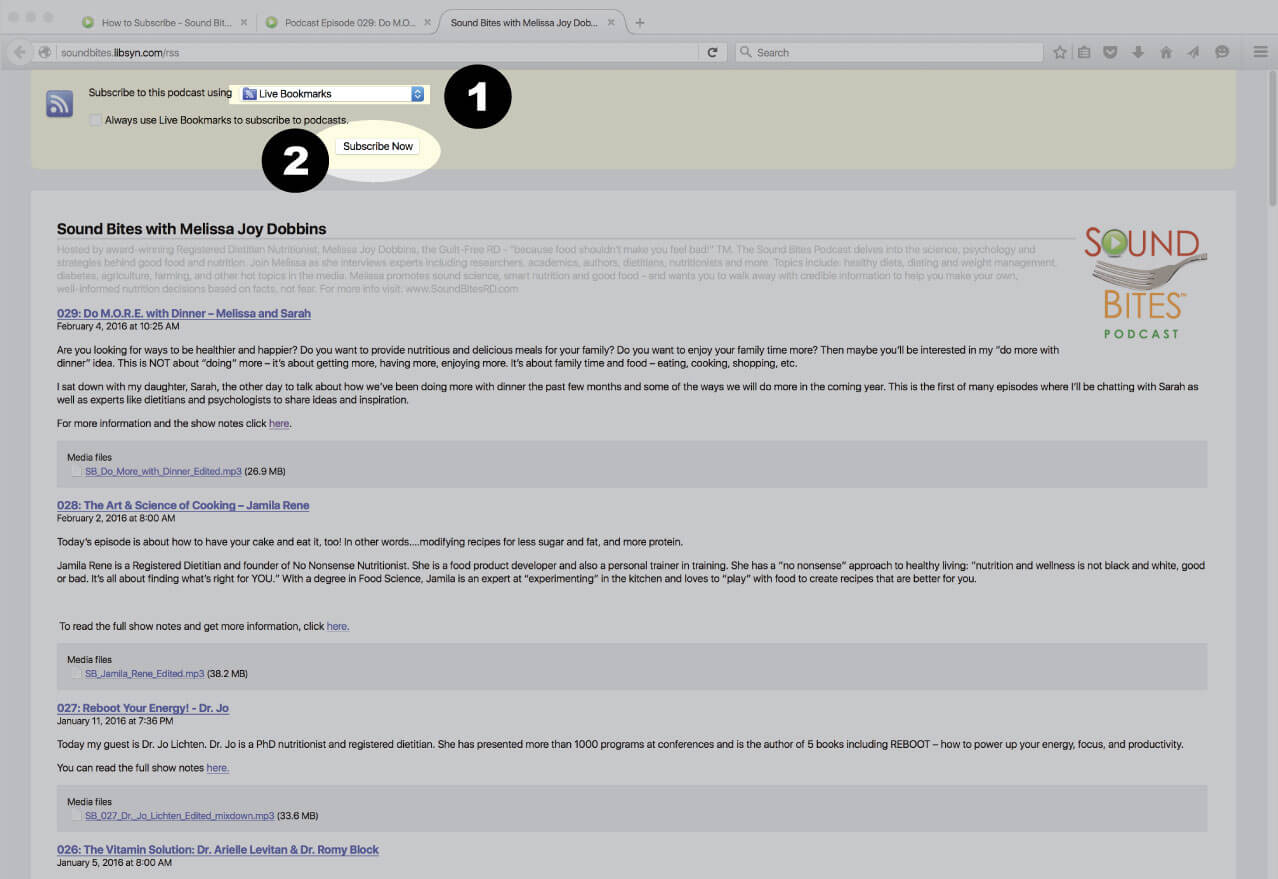
Subscribe via RSS Feed
Navigate to any podcast player . Click on the RSS feed icon.
Click on the RSS feed icon.
Click on RSS Feed
Choose which application you would like to use to receive the RSS feed
Click “Subscribe Now”
Confirm settings and subscribe.
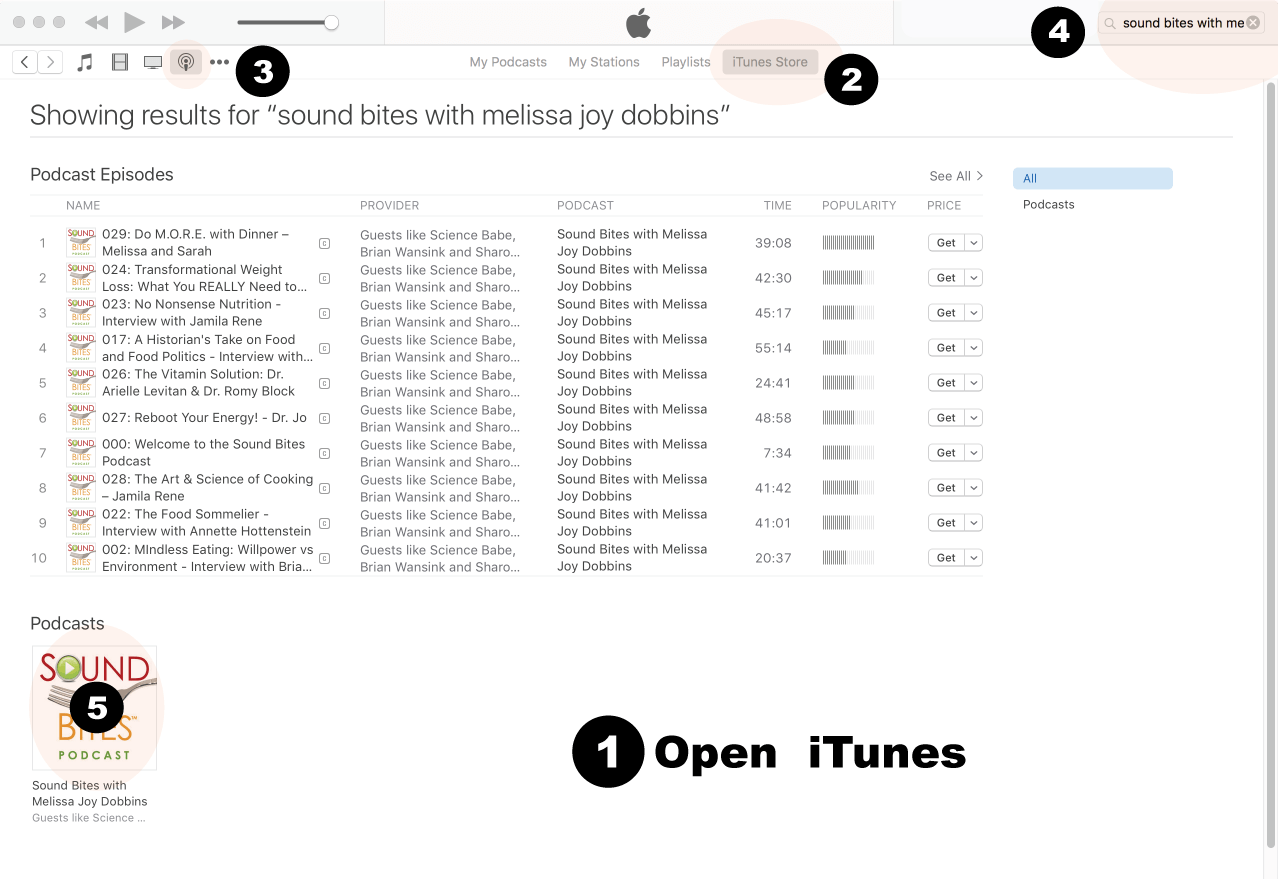
How to Review in iTunes
Open iTunes desktop application
Click iTunes Store
Click on Podcasts
Search for “Sound bites with Melissa Joy Dobbins”
Click on podcast image
Search for Sound Bites podcast in iTunes
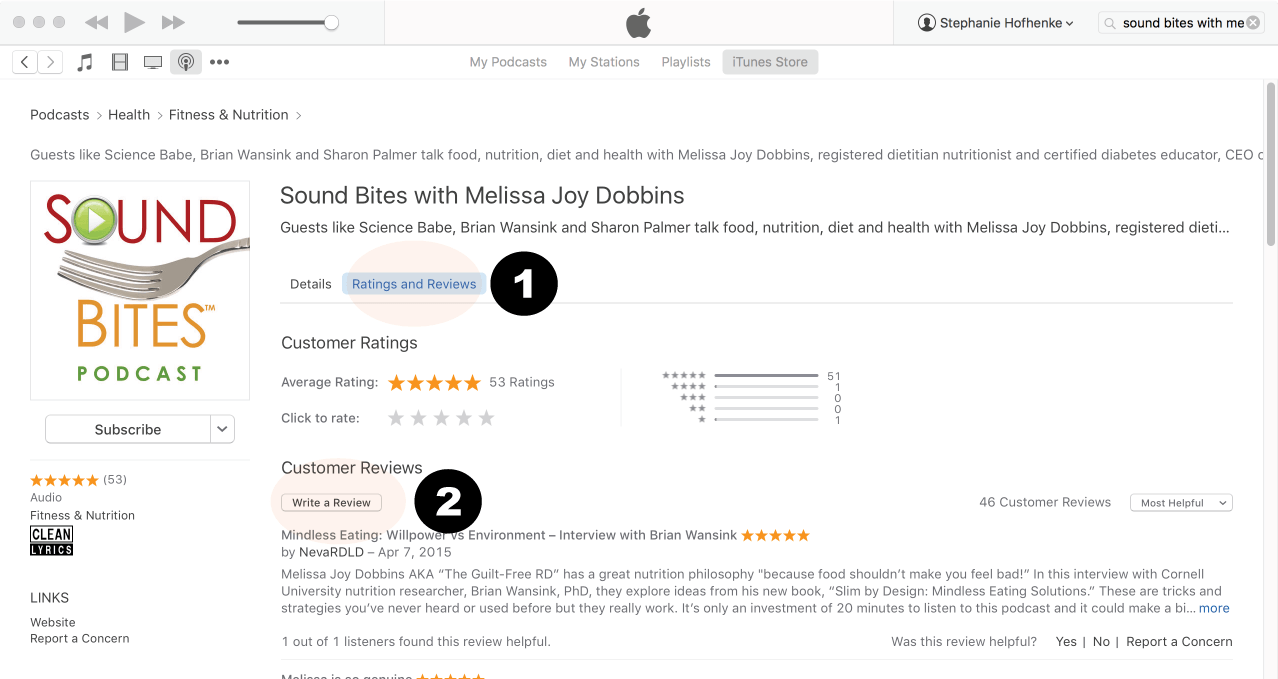
Click Ratings & Reivews
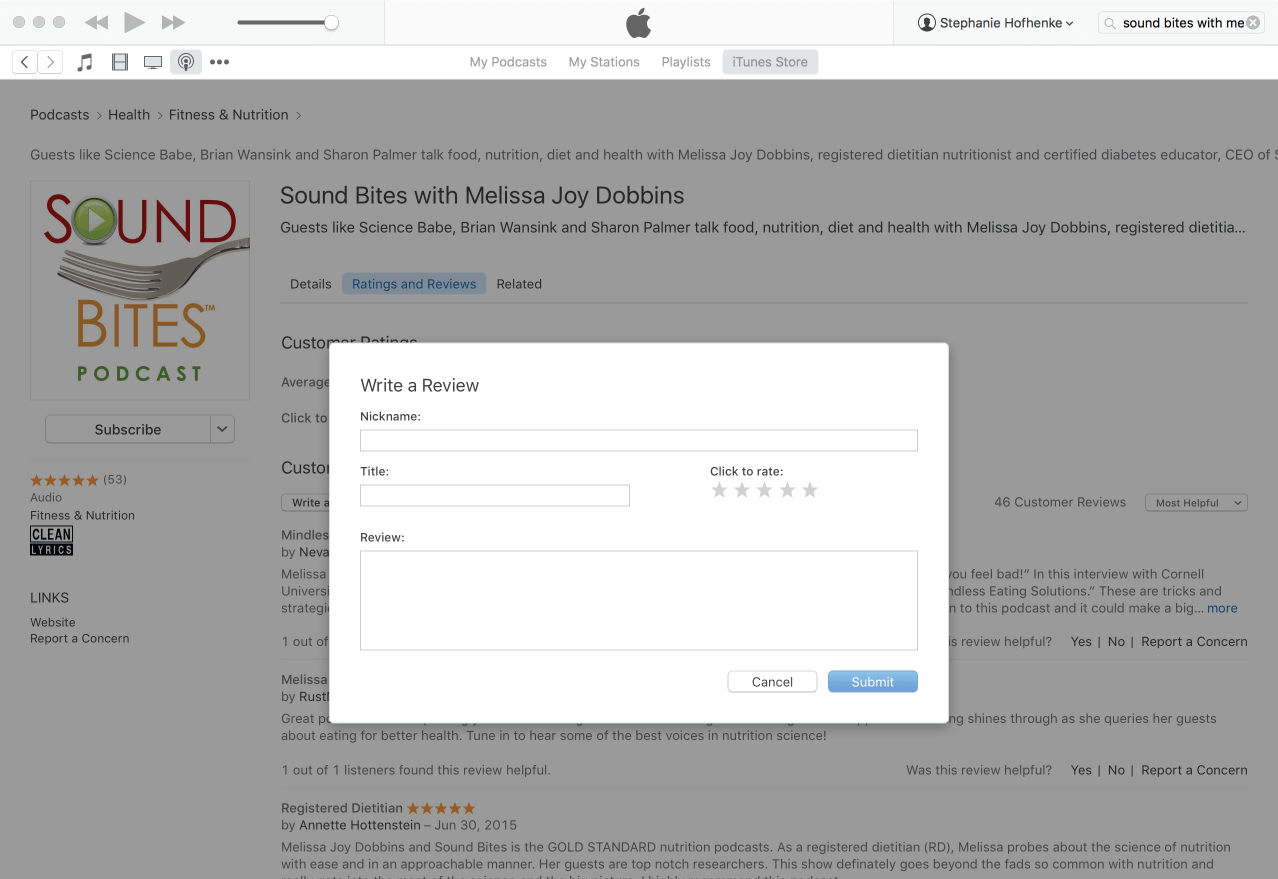
Click Write a Review
View reviews and write your own review.
Write your review…. Thank you!
Write your review!
How to subscribe via iTunes
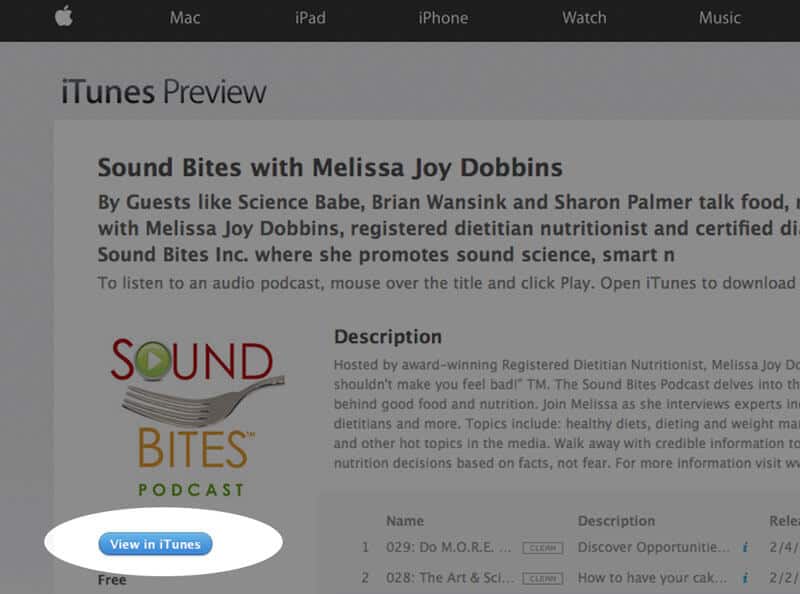
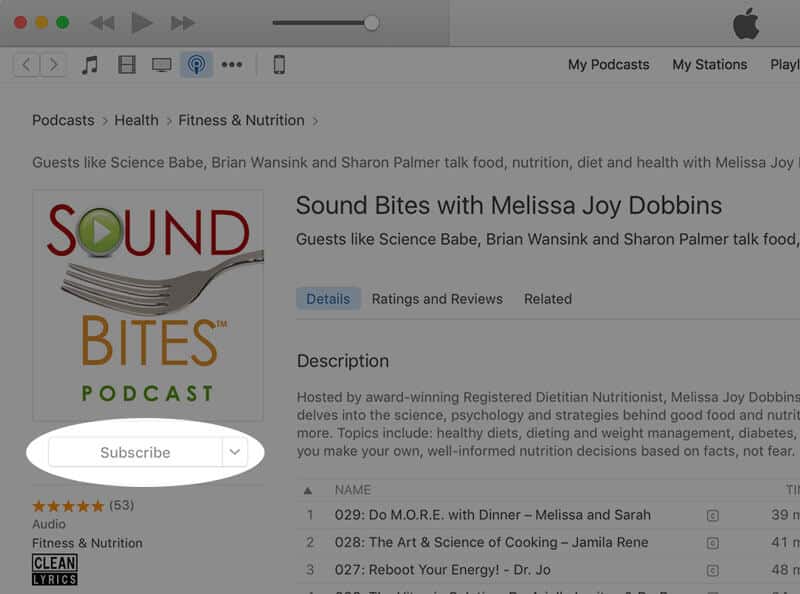
Click here to view the Sound Bites Podcastin iTunes, then click the blue “View in iTunes” button. This will open your iTunes application directly to Sound Bites Podcast. Click the “Subscribe” button, and your done!




 Kris is the Senior Director of Nutrition Communications at IFIC. He’s been with IFIC for nearly fifteen years and currently leads their consumer research program. In this role, he regularly shares IFIC’s research and insights with food and nutrition professionals on national and global platforms.